Posted in prophecy, Uncategorized

Preaching in Jesus’ name

Therefore thus says the Lord concerning the men of Anathoth, who seek your life, and say, “Do not prophesy in the name of the Lord, or you will die by our hand” (Jeremiah 11:21).

and when they had called in the apostles, they beat them and charged them not to speak in the name of Jesus, and let them go. (Acts 5:40).

The name of Jesus Christ is extremely powerful. I’m not talking that it’s powerful like a magic charm, or a mantra, or a mystical incantation. His name is powerful because Jesus is the most powerful person in the Universe, because He sustains the world with His will, because He became the unique, one and only sacrifice for sin, died, and rose again defeating death.  He is the I AM. He is the Authority. It’s that simple.

And Jesus came and said to them, “All authority in heaven and on earth has been given to me.” (Matthew 28:18)

You can preach in any other name and the heart of the listener might or might not be emotionally or mentally affected. He might become emotional at a good speech delivery. She might feel temporarily joyful or sad but that burns off because an emotional reaction it doesn’t reach the soul. Only the word of God can affect the soul, and the only name in which we preach the true word is Jesus.

When the words affect the soul, the reaction has staying power, whether it’s to cause the person to retreat further into sin, or to convert under grace.

In the New Testament we know that the party opposing Jesus (Scribes, Pharisees, Sadducees) hated the name of Jesus. They hated His teachings, His disciples, His power, His authority, His resurrection. They thought they had authority, but they did not.

Pilate thought he had power and authority. He did not know that his authority was not his own, but was from above.

So Pilate said to Him, “Do You refuse to speak to me? Do You not know that I have authority to release You and authority to crucify You?” Jesus answered him, “You would have no authority over me at all unless it had been given you from above.” (John 19:10-11)

Jesus’ name has power. Not because it’s a magic mantra. But because all authority in heaven and on earth has been given to Jesus. He is the ultimate authority over men. And men’s souls sense this. We rebel against authority. We fight authority but authority always wins, sang John Cougar Mellencamp in his “The Authority Song”. We been doin’ it since we were young mean and we come out grinnin’.

We think it’s funny to rebel against parents, teachers, employers, police, the law, the government. But who we’re really rebelling against is God and God alone. He is the authority and He gives His authority to parents, teachers, employers, police, the law, the government. However, He retains sole claim to all authority and dispenses it to whom He desires. That is why when we rebel it is against Him and Him alone. (Psalm 51:4).

The authority of the name of Jesus calls for men’s submission to that name, but in our sinful state we protect our rebellion instead of submit to authority. We are rebels, sinning at every turn and hating those who tell us to stop.

Fortunately, Jesus’ name does have power. Without His power, we would never be saved. Jesus lived a perfect and holy life under the Law. He fulfilled every bit of it, and was crucified unjustly. He took on all man’s sins and endured God’s wrath for that sin. He died and was buried.

Three days later He rose again victorious over death!

“O death, where is your victory? O death, where is your sting?” The sting of death is sin, and the power of sin is the law. But thanks be to God, who gives us the victory through our Lord Jesus Christ. (1 Corinthians 15:55-57)

Vainly attempting to grasp our rebellion against authority, or foolishly trying to keep whatever scraps of authority we think we have, will always end in one moment, one act: bowing before Jesus and confessing Him as Lord. It’s better to submit to His authority now and be adopted as son and friend, than to have confess to Him as a rebel.

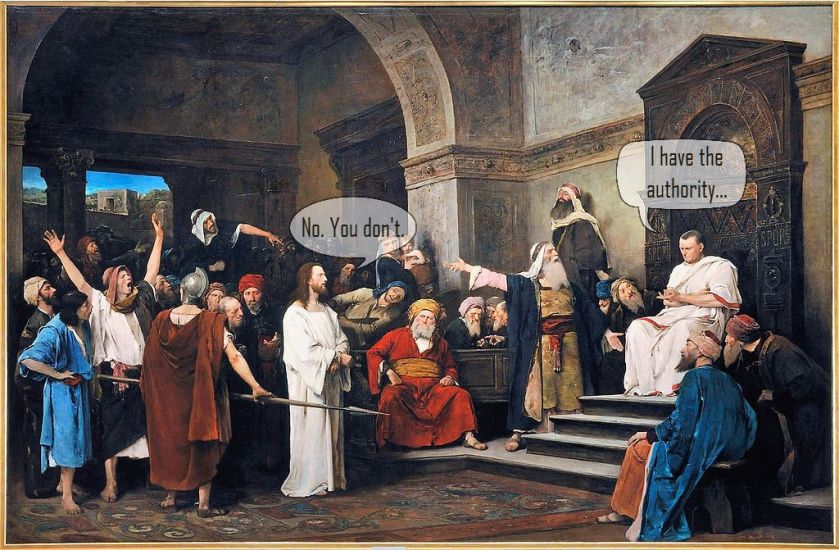
Munkacsy_-_Christ_in_front_of_Pilate
With apologies to artist Mihály Munkácsy, “Christ before Pilate, 1881

Posted in prophecy, Uncategorized

God is faithful to his Gospel

The Great Tribulation is a time prophesied to occur in the future, where God will pour out His stored-up wrath on the unbelieving world, and onto Israel. The church will have been raptured prior to the beginning of this 7-year period. (Revelation 3:10). The church is not under wrath, but our sins have been forgiven. In us there is no condemnation, that’s why we will be removed beforehand.

The Tribulation is not the general time between His first and second comings where believers will have the promised trials and persecutions. The tribulation is a distinct time referenced as THE Tribulation. It will exist for a set purpose, certain things will happen in an progressive fashion (as prophesied in Revelation 6-18 and elsewhere) and it will cease at its end to usher in a 1000 year kingdom on earth of peace where Jesus walks and reigns with His people. (Revelation 20:2-7, 2 Thessalonians 1:7-8, Daniel 9:24-27, Matthew 24:3-28…)

During this Tribulation, it will be a hell on earth, literally. The abyss is opened and many chained up demons are let out to wreak havoc. (Revelation 9:1-12). It’s a time when God’s 4 sorest judgments will occur. He releases 4 horsemen to have their fill of death and chaos and sin and evil wrought upon the people. It will be a time of punishment, vengeance, retribution, and wrath. Many millions upon billions die. (Revelation 6:8, Revelation 9:15).

Before I get to my main point, let’s turn aside for a comment. People incorrectly view the God of the Bible as a split personality. There’s the God of the Old Testament who is wrathful, and the Jesus of the New Testament who is nice. Jesus “hung out with sinners” and spoke the Beatitudes, after all.

God is God and He changeth not. In the OT He rendered wrath, but He was also compassionate and kind. I can give many examples. He spoke gently to Hagar in the wilderness. He sent angels to feed and comfort Elijah. He answered Habakkuk’s complaints gently. He gave Hannah the son she prayed for. He spoke to Moses as a friend. And so on.

In the NT, God is kind but He is also wrath. Wrath is mentioned many times in the NT. It’s mentioned in Matthew, Luke, John, Romans, Ephesians, Colossians, 1 Thessalonians, Hebrews, and most of all, 11 times in Revelation, where Jesus is rendering it or ordering His angels to deliver it. If you read the Jesus of Revelation, there exists no sissified, needy Jesus at all. He never existed. THAT Jesus is a figment of man’s imagination.

Now to the point, despite the horrors of The Tribulation, despite the wrath and death and chaos and sin, God still seeks souls. He saves. He saves many, multitudes one cannot number! They are saved from every language and nation and tribe and tongue! His grace abounds even in wrath.

By what process does He save?

1. His Two Prophets. Their story is contained in a Revelation 11:3-13. Their ministry begins:

And I will grant authority to my two witnesses, and they will prophesy for 1,260 days, clothed in sackcloth.

They preach in Jerusalem and according to prophecy, it’s for a set number of days. People will try to kill them. Those who hate the LORD will hate their message of sin and wrath and judgment. But while they are prophesying God’s word on earth during the allotted number of days, nothing can harm them. As a matter of fact, they can spew fire and kill those who try to kill them. (Revelation 11:5). When the allotted number of days is up, they will be successfully killed. (Revelation 11:7). Their bodies will lie in the street for three days, and the world rejoices that their devastating message will have been silenced, or so the world thinks. They are resurrected and ascend to heaven before the world’s astonished face. (Revelation 11:11-12).

The result is that for 1,260 days the world hears two indestructible witnesses preach the everlasting gospel to the world, whether they want it or not.

The 144,000.

Their story is contained in Revelation 7:3-8 and Revelation 14:1-5. God plucks 12,000 from each Jewish Tribe as His firstfruits of Gospel salvation in their Messiah. Though none of the verses explicitly say that the men from the 144,000 evangelize, it’s highly likely that they are agents of the Gospel. The fact that they are chosen, sealed from harm during the judgments indicates that they have work to do. One’s relief and joy in Christ always yields a loosened tongue to proclaim His glories. How much more so in the Wrath? Also, the very next scene after they are saved and sealed, we see multitudes of redeemed from the earth. Imagine 144,000 Apostle Pauls running around, lol. People are going to be saved.

The Three Angels at Midheaven.

Their story is in Revelation 14:6-11, but the first angel in verses 6-7 is the one who proclaims the eternal Gospel to the entire world, every nation, tongue, tribe, and people.  Every. One. Hears.

What a God we serve! He pursues even as He concludes the last moments of His Age.

ecclesiastes

Posted in prophecy, Uncategorized

The Greatest Revival That Ever Will Be?

Yesterday I looked at what true revival looks like. True revivals are far from the superficially but temporarily euphoric “revivals” we have sadly become used to. Jonathan Edwards wrote about the massive and immediate deep changes that occurred during the Great Awakening. In reading his “A Faithful Narrative of the Surprising Work of God in the Conversion of Many Hundred Souls in Northampton,” written in 1737, we learned that new converts and those who were revived all had one major thing in common: an awareness of their sin and a growing hatred for it. The outgrowth of this fact is that people became more temperate, taverns emptied while the pastor’s house filled. Neighbors became loving helpers of one another, and left off their previous bitter gossip, and so on. The change was overnight, that was one of the “surprising” things Edwards remarked upon.

So the hallmarks of a true revival include awareness of sin, understanding of the wrath of God for it, and a relief and love of the grace that has been bestowed in spite of it.

Those were also the hallmark of another major revival in the Bible, though not the one I’ll focus on mainly today. In an essay I wrote recently, “What was the greatest revival ever?” the Ninevites responded to God’s message through Jonah by repenting in dust and ashes. Through Jonah, God had foretold coming judgment, and the worst people on the planet at that time people believed him.

And the people of Nineveh believed God. They called for a fast and put on sackcloth, from the greatest of them to the least of them. (Jonah 3:5).

As a revival continues, the people remain in Christ, they continue in good works (the evidence of saving faith), and they give glory to God in all they do and say.

If Nineveh was the greatest revival that ever was, what is the greatest revival there ever will be?

The Great Tribulation.

There are prophecies remaining to be fulfilled. Most of them were fulfilled in Christ, praise God. The prophecies remaining are:

The rapture of the Church,1 Corinthians 15:51-53, (the church members, living and dead caught away to heaven to be enclosed and protected from the judgment of the Tribulation.)

The Tribulation, the promised wrath and judgment upon the world for sin. Daniel 9:24-27 has the reasons and the outline of what is to happen. So does Matthew 24 and Revelation 6. Many prophecies are to be fulfilled during this 7 year period. The antichrist will come, who will be a real man, the false prophet, the great apostasy, an uncreation of the earth, the Two Prophets (likely Elijah and Enoch), the 144,000, Mark of the Beast, Armageddon, and so on, all occur during this time.

The judgment seat of Christ (2 Corinthians 5:10). This occurs in heaven and it involves assessing believers in their faithfulness in service to Christ, not a judgment for sin.

Return of Jesus: AKA The second Coming. At the close of the Tribulation, Jesus returns in power and glory and smites the armies at Armageddon. This concludes the Church Age, or the Last Times/End Times.

The judgment of the nations (Matthew 25:31–46) where Jesus judges the nations for how they treated Israel and also judges who is to enter the Millennial Kingdom, the 1000 year reign of Christ on earth. Since believers and non-believers alike will be alive at the end of the Tribulation, Jesus will sift one from the other, and cast non-believers into hell and believers will be granted entry into the 1000 year Kingdom.

Millennial Kingdom: Jesus is alive and reigning over the world and Israel is living within all the promises made to that nation of people, their lands, their King and their identity all intact and thriving. More here.

The Eternal State: After the Millennial Age,  eternity begins. It is prophesied that the earth will melt in a fervent heat and be remade. (2 Peter 3:10). All prophecies will have been fulfilled. After that, there is nothing in the Bible that tells us what we will be doing or what the next Age will be like.

Back to the greatest revival that ever will be.

People think that when the rapture happens, there will no longer be any chance for people to be saved. That there will not be salvation during the Tribulation. The opposite is true. The greatest revival ever will occur. It will be a time of evangelism unparalleled in our human history.

After this I looked, and behold, a great multitude that no one could number, from every nation, from all tribes and peoples and languages, standing before the throne and before the Lamb, clothed in white robes, with palm branches in their hands, 10 and crying out with a loud voice, “Salvation belongs to our God who sits on the throne, and to the Lamb!” (Revelation 7:9).

But are these people from the Tribulation? How do we know they aren’t just believers from the Church Age?

A little further along in Revelation that question is answered for us:

Then one of the elders addressed me, saying, “Who are these, clothed in white robes, and from where have they come?” 14I said to him, “Sir, you know.” And he said to me, “These are the ones coming out of the great tribulation. They have washed their robes and made them white in the blood of the Lamb. (Revelation 7:13-14)

And this:

When he opened the fifth seal, I saw under the altar the souls of those who had been slain for the word of God and for the witness they had borne. (Revelation 6:9)

God is always working to bring people to His Son. At no time does the Spirit cease drawing souls to glory. During the Tribulation, though it will literally be hell on earth, a time that will be shocking and upsetting in the extreme (Luke 21:26, Matthew 24:22), people will be saved. They will be truly saved, not false converts. We know that they’ll be true, because though they know they will die, they praise the Lamb and remain true to His glory even unto martyrdom. (John 15:13).

Psalm 145:3, Great is the LORD, and greatly to be praised, and his greatness is unsearchable.

jesus poster

~~~~~~~~~~~~~~~~~~~~~~~~~~~~~

Further Reading:

The Last Great Awakening

Will there be a second chance for salvation after the Rapture?

Will the Church go through The Tribulation?

Posted in prophecy, Uncategorized

Revelation 101

So often I hear that people are scared to, or worried about, reading the Book of Revelation. It’s this monolith at the end of the Bible that people stay away from because it’s too hard, too mysterious, too difficult to understand. Yet the book itself says otherwise.

Believers cannot afford to ignore the immense truth this book contains. In fact, we’re commanded not to; Revelation 22:10 says, “Do not seal up the words of the prophecy of this book, for the time is near.” ~John MacArthur

It’s actually one of the easiest books to understand.

By the way, the book is called “Revelation” singular. It’s not “Revelations.”

Daniel is dense. Pound for pound, Zechariah has twice as much prophecy than Revelation. Some of the minor prophets are hard to understand because of the time frames and the history. Romans is heavily philosophical. If I was to pick a book that is hard to understand, I’d choose any of those over and above Revelation. Revelation is actually one of the easiest book in the Bible to understand.

How can I say this?

Two reasons.

1. It is the ONLY book in the Bible in which the reader is promised a blessing if he or she reads it. The. Only. Book. That’s something worth paying attention to. The promise is stated at the beginning and at the end of the book.

Blessed is the one who reads aloud the words of this prophecy, and blessed are those who hear, and who keep what is written in it, for the time is near. (Revelation 1:3).

How can we keep what is written in it, if we do not read it?

And behold, I am coming soon. Blessed is the one who keeps the words of the prophecy of this book.” (Revelation 22:7).

Clipboard04Did Jesus promise a blessing, and in a cosmic ‘gotcha’, then make it intellectually or spiritually too difficult to understand? Or is it because it’s one book that proclaims Jesus in His full glory, promises a great ending for His people, and wants us to look ahead for the encouragement?

2. It has its own built-in study guide. Despite the chaos it reveals, it is actually a very orderly book. I’m not kidding.

The first three chapters are greetings and letters to churches, which we would do well to study. To each church, Jesus identifies himself in a different way, revealing a certain aspect of Himself that matches the warning or commendation He gives to the church. It also shows how intimately He is involved with His church as its Head and its Priest.

In Chapter 4 the scene shifts to heaven. In Chapter 5 we’re still in heaven, but now heaven is readying for the “things to come”, meaning, the global judgment.

Chapter 6-18 are those judgments. Again, it’s orderly. A series of three (perhaps four, if the Seven Thunders are judgments) each containing 7 judgments are unleashed, one after the other. The time frame is fairly chronological. It’s also rapid. The events take place mostly within three and a half years (7 total) so reading this main portion of Revelation can be compared to reading the Gospel of Mark. Mark reports quickly, covers a great time frame in short order, and uses muscular language and a rapid pace. It’s the same with this portion of Revelation.

The judgments, in addition to being judgments, are also working to UNcreate the world. Compare Genesis 1-2 with Revelation 6. Genesis shows the creation, Revelation is the UNcreation. As the LORD deals with sin, He is also preparing the world for its upcoming regeneration (“The New Earth.”). Mainly the story proceeds chronologically with an occasional glimpse back to heaven or a parenthetical comment.

Chapter 19-22 is the wrap-up- the new heavens and new earth, New Jerusalem, the Marriage Supper, the final strings to tie up, the last encouragement.

Voila!Clipboard05

As for the symbolism, scripture interprets scripture. The symbols are not a lot harder to interpret than other analogies and symbols in the Bible. Jesus being the vine (we know He is not ACTUALLY a vine). Or when the angels pour out the bowls of wrath, we are reminded of Jesus drinking the cup of wrath. The dragon with seven heads and ten horns and seven crowns on its heads is a similar kind of symbol to the ram with long horns of Daniel 8, which is interpreted for Daniel right in the same chapter.


I’m not saying everything about Revelation is easy. It still takes study. What I’m saying is that is is not harder than any other book of the Bible and in some ways it is easier. Please do not be intimidated by it.

On sale now at Grace To You through June 25 is a booklet for $1.50 called A Jet Tour Through Revelation. It is adapted from a sermon MacArthur gave a while ago. Even when the sale is done the booklet only costs $2.00. Of course, you can listen to the sermon for free at any time. The booklet-

-helps take the mystery out of a portion of Scripture many people consider too difficult to understand. Yet, the book of Revelation promises blessing to those who read its words and heed them. This Jet Tour booklet will help you make sense of the symbols, imagery, and significance of this amazing prewritten history. It will increase your appetite for heaven—or give you a needed dose of concern about your eternal future and point you to Christ, who alone can save you from the wrath He will one day bring.

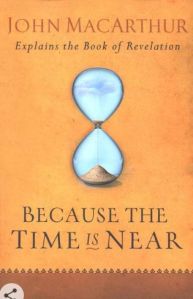
One of my favorite books on Revelation is another of MacArthur’s -“Because the Time is Near”. This book is also on sale now for $8.25. I found it not only to be clear, non-academic and useful in laymen’s terms, so encouraging. Yes, the Book of Revelation is encouraging. Seeing all that wrath poured out is hard on the heart, but it is also encouraging knowing Jesus took that same wrath for His people. This in turn inspires a profound relief and love for His work on the cross. It’s one thing to know about the cup of wrath He endured, it is another to understand it. Revelation helps you understand sin and wrath, and by contrast, grace. In this way, reading Revelation helps you love Jesus even more.

Far from being a dense, mysterious, non-understandable book, I have always found it to be encouraging, amazing, and inspiring. It shows Jesus as He is now, in full glory, power, and beauty. It is one of my favorite books of the Bible, Genesis being the other!

Please don’t be intimidated by Revelation, just start reading it. You will be blessed. That is a promise from Jesus.

Posted in prophecy

When a sweet smell is foul

Hear, O earth; behold, I am bringing disaster upon this people, the fruit of their devices, because they have not paid attention to my words; and as for my law, they have rejected it. What use to me is frankincense that comes from Sheba, or sweet cane from a distant land? Your burnt offerings are not acceptable, nor your sacrifices pleasing to me. (Jeremiah 6:19-20).

The LORD had instituted incense offerings which can be seen in Exodus 30:7-8; Exodus 30:34; 2 Chronicles 13:11. According to Easton’s Illustrated Bible Dictionary, from 1897, we read of incense that the sacrifices were

a fragrant composition prepared by the “art of the apothecary.” It consisted of four ingredients “beaten small” (Exodus 30:34-36). That which was not thus prepared was called “strange incense” (30:9). It was offered along with every meat-offering; and besides was daily offered on the golden altar in the holy place, and on the great day of atonement was burnt by the high priest in the holy of holies (Exodus 30:7 Exodus 30:8). It was the symbol of prayer (Psalms 141:1 Psalms 141:2; Revelation 5:8; Revelation 8:3 Revelation 8:4). Source Easton’s Illustrated Bible Dictionary, 1897. Public Domain, copy freely.

A Renaissance era pomander container. Source

In today’s verse from Jeremiah we read that the LORD had become angry with a sweet smelling offering that was devoid of obedience and love for His law. An empty sweet smelling fragrance would do nothing to satisfy Him or render the giver justified in any way. It’s ineffective. Instead, such an empty sacrifice incurs wrath.

The notion of ineffective perfumes reminded me of the 14th century bubonic plague remedy. People were told to carry pomanders, which were perfume balls containing herbs, flowers, and spices, either around their neck or in their hand, and to sniff it constantly so as to ward off the disease.

Pomanders are traditionally mixtures of fragrant substances which are often held within a container – although the term can also be applied to the container itself. The odours given off by the mixtures were once believed to offer protection against disease and they are particularly associated with times of plague, from the 1300s onwards. Their use is linked to centuries-old miasma theories which suggested that disease was transmitted through foul-smelling air. Keeping a sweet-smelling pomander close by was believed to offer protection.

Miasma theory posited that disease was carried by a cloud of poisonous vapor in the air, which was created by decay and could be identified by a bad smell. Following the logic that bad smelling air carried disease, it makes perfect sense that you could “cure” the air by making it smell good. Hence the perfume. And the long nose to stuff good smelling material into.

It seems silly to think that a perfume ball containing a few herbs and sweet-smelling spices would protect one from bubonic plague! But just as silly were the Jews who thought that they could disobey Him all day long and at the end offer the Lord God a sweet smelling offering and everything would be all right. Such empty fragrances do nothing to ward off the disease of sin. Nor would they protect one from wrath and judgment.

So what would satisfy His wrath and stay His judgment?

Thus says the LORD:
Stand by the roads, and look,
and ask for the ancient paths,
where the good way is; and walk in it,
and find rest for your souls
(Jeremiah 6:16)

The good way is traveling the road of His word. It pleases the LORD and it gives rest to the rebellious soul. We also would do well to inquire as to where the good paths are, and walk on them. The sweetest scent of all is obedience.

————————————

Note: Tomorrow- the link between incense and prayer

Posted in prophecy, Uncategorized

A short encouragement about the rapture (with no dates)

Phil Johnson, GraceLife Pulpit pastor and Executive Editor of Grace To You, also the editor of John MacArthur books, tweeted this:

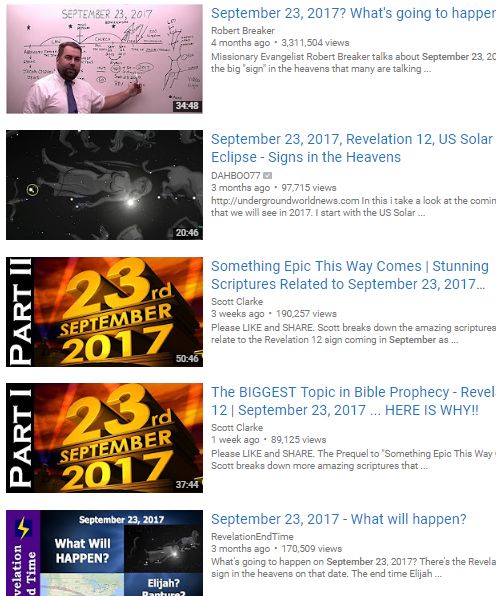
Accepting the challenge, I searched it. Ahem. These were a few of the results-

It’s the same on Goggle when you do a regular search.

We don’t read the news and match to the Bible, but instead we read the Bible and then understand how our sinful actions in today’s news repeat the same old sinful behaviors of the past. We know that judgment of those actions came then and will come again. God is the same yesterday, today, and tomorrow.

Shall we pray to our patient but wrathfully righteous God? May we pray for our nation to call out to Him in abject apology for thrusting Him aside and instituting false gods? We are a nation in dire need of repentance. Otherwise, we know the rest of the story…and there are still so many to be saved.

Read the Bible, be a Berean! We need truth more than ever in these falling away, lying times. Meanwhile, enjoy His provision, whatever it may be. Today it’s the rain, tomorrow maybe the longed-for job? A dinner invitation? A powerful sermon? God will provide what we need when we need it. Our Father will feed us, even as He does the birds, and are we not more valuable than they? 🙂 (Matthew 6:26).

I think about the rapture every day. I know that evil men wax worse, and that each succeeding generation gets more sinful. I know that we are closer to the rapture today than we were yesterday. I can’t wait for the rapture to happen, but please don’t set dates. Just be ready to explain to anyone who asks about the hope we have within us. (1 Peter 3:15)

Posted in prophecy, Uncategorized

The Nile River, the Nile in the Bible, and the Nilometer

Rivers figure prominently in the Bible, in the people’s economic life, in their well-being, and in prophecy. The first rivers mentioned in the Bible are the four rivers crossing the Garden of Eden.

A river flowed out of Eden to water the garden, and there it divided and became four rivers. 11The name of the first is the Pishon. It is the one that flowed around the whole land of Havilah, where there is gold. 12And the gold of that land is good; bdellium and onyx stone are there. 13The name of the second river is the Gihon. It is the one that flowed around the whole land of Cush. 14And the name of the third river is the Tigris, which flows east of Assyria. And the fourth river is the Euphrates. (Genesis 2:10-14).

The River Euphrates is also known later in the Bible as the Mighty River.

The Nile River is (likely reference) mentioned in Genesis 15:18-

In the same day the LORD made a covenant with Abram, saying, Unto thy seed have I have given this land, from the river of Egypt unto the great river, the river Euphrates:

In the 5th century Herotodus said that without the Nile, there is no Egypt. Its importance is clearly seen. Where the river has its sway, there is green. Where there is no river, the desert begins. The Egyptian people have always depended on the Nile for life.

ATS Dictionary explains,

As rain very seldom falls, even in winter, in Southern Egypt, and usually only slight and infrequent showers in Lower Egypt, the whole physical and political existence of Egypt may be said to depend on the Nile; since without this river, and even without its regular annual inundations, the whole land would be but a desert.

The Nile has two branches, the White and the Blue, and its overall length is 4,000 miles! About 900 miles of the great river flows through Egypt proper.

The Egyptians lived by the annual flooding of the Nile. When the floodwaters receded, it left behind fertile silt, which added greatly to the nutrient level of soil for crops.

Smith’s Bible Dictionary explains the specifics, and you will rapidly come to understand the Nile’s importance for the region.

“With wonderful clock-like regularity the river begins to swell about the end of June, rises 24 feet at Cairo between the 20th and 30th of September and falls as much by the middle of May. Six feet higher than this is devastation; six feet lower is destitution.” –Bartlett. So that the Nile increases one hundred days and decreases one hundred days, and the culmination scarcely varies three days from September 25 the autumnal equinox. Thus “Egypt is the gift of the Nile” – [as Herodotus first stated].

Thise are the agricultural and geographical facts. As for the Nile in the Bible, Moses was indirectly named due to his having been found in a basket in the Nile River. Exodus 2:10-

When the child grew older, she brought him to Pharaoh’s daughter, and he became her son. She named him Moses, “Because,” she said, “I drew him out of the water.”

The name Moses is Hebrew from the word mashah; drawing out (of the water), i.e. Rescued; Mosheh, the Israelite lawgiver — Moses, according to Strong’s Concordance.

We read of the Nile again in Exodus 7:21. One of the plagues of Egypt against Pharaoh involved the Nile.

And the fish in the Nile died, and the Nile stank, so that the Egyptians could not drink water from the Nile. There was blood throughout all the land of Egypt.

There is an interesting article at Atlas Obscura revealing the locations of and history behind the “Nilometer.”

In ancient Egypt, the behavior of the Nile could mean life or death each harvest season. So, long before the Aswan Dam was constructed to manage the flooding of the great river, Egyptians invented an instrument to measure the waters in order to predict the Nile’s behavior: the nilometer.

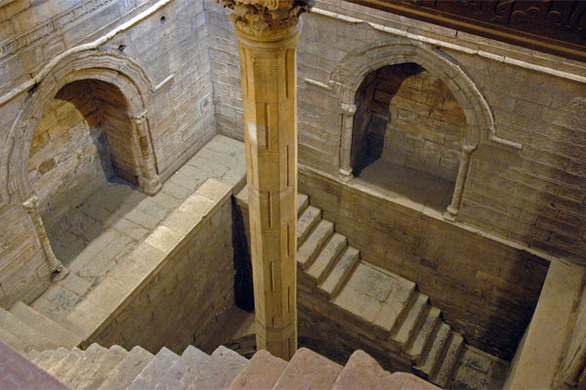
There were three kinds of nilometers, and examples of all three can still be seen around Egypt. The simplest was a tall column housed in a submerged stone structure called a stilling well. One of these nilometers can be seen on Rhoda (or Rawda) Island in Cairo, an octagonal marble column held in place by a wooden beam at the top that spans the width of the well. The stilling well included a staircase so that priests, who were in charge of monitoring the nilometers, could walk down and examine the column.

Measuring shaft of the Nilometer on Rhoda Island, Cairo. Baldiri/CC by SA 3.0

The remainder of the article at Atlas Obscura is interesting. Check it out!

Sadly, the Nile also figures prominently in biblical future prophecy as well.

The third angel poured out his bowl into the rivers and the springs of water, and they became blood. (Revelation 16:4).

This evokes the former plague we read about in Exodus 7. J. Orr’s Commentary reminds us of the impact it had on the people.

The first of the series of plagues which fell on Egypt was of a truly terrific character. At the stretching out of the red of Aaron, the broad, swift-flowing current of the rising Nile suddenly assumed the hue and qualities of blood. The stroke fell also on the reservoirs, canals, and ponds. Whatever connection may be traced between this plague and natural phenomena (see Hengstenberg) it is plain that it stood on an entirely different footing from changes produced under purely natural conditions.

1. The water was rendered wholly unfit for use.
2. It became deadly in its properties (ver. 18).
3. The stroke was instantaneous.
4. It was pre-announced.
5. It descended on the river at the summons of Moses and Aaron.
6. It lasted exactly seven days (ver. 25).

An event of this kind was palpably of supernatural origin. Contrast Moses with Christ, the one beginning the series of wonders by turning the river into blood; the other, in his first miracle, turning the water into wine (John 2:1-12). The contrast of judgment and mercy, of law and Gospel.

The smiting of the Nile was – 1) A proof of the power of Jehovah, 2) A blow at Egyptian idolatry, 3) A warning of worse evil to come, 4) The removal of the plague at the end of seven days betokened the unwillingness of God to proceed to extremities.

Those extremities will come to full fruition and power during the Tribulation. In Isaiah 19 we read of the Burden of Egypt and God’s plans for the people.

And the waters of the sea will be dried up, and the river will be dry and parched,

Barnes’ Notes interprets the as-yet-unfulfilled prophecy this way:

Shall be wasted – This does not mean “entirely,” but its waters would fail so as to injure the country. It would not “overflow” in its accustomed manner, and the consequence would be, that the land would be desolate. It is well known that Egypt derives its great fertility entirely from the overflowing of the Nile. So important is this, that a public record is made at Cairo of the daily rise of the water. When the Nile rises to a less height than twelve cubits, a famine is an inevitable consequence, for then the water does not overflow the land. When it rises to a greater height than sixteen cubits, a famine is almost as certain – for then the superabundant waters are not drained off soon enough to allow them to sow the seed. The height of the inundation, therefore, that is necessary in order to ensure a harvest, is from twelve to sixteen cubits. The annual overflow is in the month of August. The prophet here means that the Nile would not rise to the height that was desirable – or the waters should “fail” – and that the consequence would be a famine.

What a disaster looms for Egypt (and the rest of the world!) Our God is creator and Sovereign over all. He will do it. One way to ensure that you are not present on earth for the coming Tribulation disaster of famine and judgments is to repent and place your faith in Jesus. Sins will keep you here but faith in the resurrected Son of God, in whom salvation is found in no other, will rescue you from the day of wrath.

Shall not the land tremble on this account, and everyone mourn who dwells in it, and all of it rise like the Nile, and be tossed about and sink again, like the Nile of Egypt? (Amos 8:8)

I hope you’ve enjoyed this quick natural history overview of the Nile River in the Bible. The Lord made the Nile. It has sustained people for thousands of years. It’s been a border, a life’s blood, and a symbol. It’s been used as a judgment and it will be used so again.

The Bible is rich with things to study. The best part is that all studies lead us back again to the same source: Jesus. He is the wellspring of life, all water flows from Him.

but whoever drinks of the water that I will give him will never be thirsty again. The water that I will give him will become in him a spring of water welling up to eternal life. (John 4:14)

Posted in prophecy, Uncategorized

Throwback Thursday: He will open the door and He will close the door

This essay was first published on The End Time in December 2011.

Do you take the Lord’s power and grace for granted? Have you diminished His Holiness in your mind? Many people in this day and age have. How do I know? They think the Lord will somehow relent, and allow everyone into heaven after all. Or that His mercy is so great and so wide that they will be forgiven, even if they do not know Jesus. Jesus will not relent. His decision is final, and His decrees are sure. If you do not know Jesus on the day you die, you will be cast into hell. If you do not know Jesus on His day of wrath, if you die you will be cast into hell.

Even saying such a thing in this day and age seems like a revolutionary act. People chide us Christians who flatly declare the truth from the Word, that He will not relent. “Our God is a loving God,” they exclaim. “He would never do that!” Well, Remember rebellious Korah who was swallowed by the earth? Remember Uzzah who touched the ark? Remember Ananias and Sapphira, who blasphemed the Spirit by lying to the Apostle? Jesus will not relent, because He is the door.

I am the door: by me if any man enter in, he shall be saved, and shall go in and out, and find pasture.” (John 10:9).

He is the only One who opens the door.

I know your deeds. See, I have placed before you an open door that no one can shut. I know that you have little strength, yet you have kept my word and have not denied my name.” (Revelation 3:8).

He is the One who shuts the door.

And they that went in, went in male and female of all flesh, as God had commanded him: and the LORD shut him in. (Genesis 7:16).

When the ark was filled He shut the door and the rest of the world was judged. And so it will be again, for the unaware.

But while they were on their way to buy the oil, the bridegroom arrived. The virgins who were ready went in with him to the wedding banquet. And the door was shut. “Later the others also came. ‘Sir! Sir!’ they said. ‘Open the door for us!’ “But he replied, ‘I tell you the truth, I don’t know you.’ (Matthew 25:10-12)

He is the King of the Kingdom and it is He who says who enters and who doesn’t. He is the Door. Right now the door is open to all who would repent. It will be shut at the rapture. Not that anyone cannot be saved after the rapture, but with the door shut, you are in the cold, hard world and exposed to believing the lie.

and with all the deceit of unrighteousness in those who perish, because they received not the love of the truth, that they might be saved. And for this cause God shall send them strong delusion, that they should believe a lie,” (2 Thessalonians 2:10-11)

Enter now while the door is open. Repent and believe the truth: that Jesus is resurrected Lord and He is the only way to enter the Kingdom. He speaks the truth, and when He says that judgment is coming, believe it. The time will come when the door will be shut. As it says in Isaiah 26:20- “Come, my people, enter you into your chambers, and shut your doors about you: hide yourself as it were for a little moment, until the indignation is past.”

While the door was open, they did not listen and believe in Noah’s day:

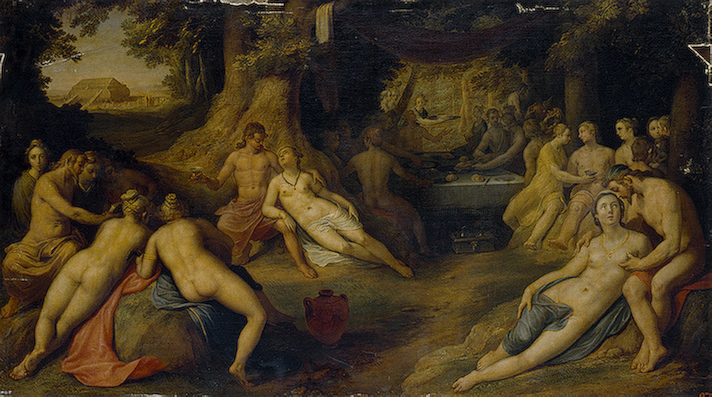
Sinners before the Flood, 1594 Cornelis Cornelisz. van Haarlem
After the Flood, Circa 1588 Cornelis Cornelisz. van Haarlem

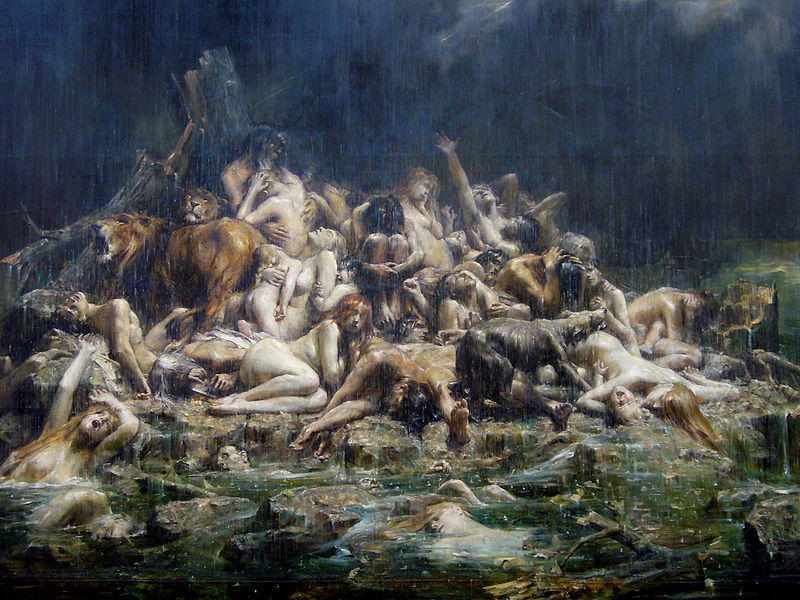
This is what Judgment looks like:

The deluge, Léon Comerre  (1850–1916) 

This is what grace looks like:

Noah’s flood KAULBACH, Wilhelm von (1805-1874)

How so? you ask. How is this grace? The serpents are writhing, the people are dying! Well, don’t focus on the serpents and the people. It is one way we diminish His holiness and His mercy. Focus on Him and His protected righteous and the fact that His promises of salvation are sure. The angels ministering, the ark itself was a lengthy warning to the same people who are now crying for the door to be opened. “Come, my people, enter you into your chambers, and shut your doors about you: hide yourself as it were for a little moment, until the indignation is past.” He made a way for the righteous to be saved!

Please answer His call, and repent!

Once the owner of the house gets up and closes the door, you will stand outside knocking and pleading, ‘Sir, open the door for us.’ “But he will answer, ‘I don’t know you or where you come from.'” (Luke 13:25)

Don’t grumble against each other, brothers, or you will be judged. The Judge is standing at the door!” (James 5:9)

Posted in prophecy, Uncategorized

Eschatology is not a fringe field of study but it attracts a wacky fringe element

I get excited as anyone about the thought of the rapture happening any minute. It has always been imminent, meaning, it could happen at any time without any particular circumstance HAVING to have happened first. Not like during the Tribulation where there is a specific series of chronological events, one preceding the other. Interest in the future has always been high.

Unfortunately, the theological field of study of “Last Things”, also known as Eschatology, has fallen into disrepute over this last generation. I do my best to present credible essays which strive to demonstrate that eschatology should still be a major area of concern for Christians.

One reason the field of study has fallen in status is because so many people think nothing of twisting the scriptures and promoting wacky theories. Others set dates. When the date passes by without the projected event having occurred, the followers become defeated not just with eschatology but with Christianity in general. Pagans also love to make a mockery of us when this happens. The verse below prophesies the mocking of prophecy.

They will say, “Where is the promise of his coming? For ever since the fathers fell asleep, all things are continuing as they were from the beginning of creation.” (2 Peter 3:4).

Another reason eschatology has fallen to less than credible status are that the fringe elements simply adding craziness to it. Aliens, conspiracy theories, and a heavy focus on interpreting signs and omens in current events all add to the pot which in turn adversely affects perceptions of the field.

A reader in all sincerity sent me a link to an article that seemed to explain certain aspects of the rapture with which she was unfamiliar. She was questioning it and wanted to know my take. I appreciate these kinds of questions because it’s encouraging to know that people think and question about these sources.

The author of the piece is a woman who writes at a website called Cross and Cutlass. She made many statements that were assertive in their dogmatism. When this happens it often confuses people, because dogmatic statements in print seem credible just for being dogmatic. It’s the old, “If it’s in print, it must be true” notion.

Here are some of her statements.

Originally, God set up the constellations to reflect the Gospel. Many people don’t know this, and I have only recently discovered this.

Warning #1. Whenever you see someone saying that an interpretation has been ‘hidden’ for thousands of years, and only recently discovered, run. The Bible isn’t a code, it’s not a secret, and it’s not unknowable until some lone person in a corner of the internet makes a “new discovery.” The Holy Spirit has been illuminating the Bible for millennia. The standard interpretations are the correct ones. It’s called church history, preaching the Gospel, and hermeneutics.

Warning #2. There are no scripture verses to support her statement that God set up the constellations to reflect the Gospel. Instead, she uses a hundred-year-old book as her source called The Witness of the Stars by E.W. Bullinger. I’ll provide a link below from the Creation Research Institute debunking Bullinger’s “Gospel in the Constellations” theory.

Listen. Scholars over the last two thousand years didn’t ALL fail to look up and notice the Gospel in the constellations. If it’s a new theory, it is almost a sure bet that it’s wacky, wrong, or based on twisted scripture and a poor hermeneutic. I’m talking to you Jonathan “Isaiah 9 Harbinger” Cahn and John “Blood Moons” Hagee.

The author of the wacky eschatological piece also claimed the following;

Now a great sign appeared in heaven: a woman clothed with the sun, with the moon under her feet, and on her head a garland of twelve stars. Then being with child, she cried out in labor and in pain to give birth.  Revelation 12:1-2
The woman here is the constellation Virgo, the Virgin, who every Biblical scholar says represents Israel. In fact, Israel in Biblical days was well aware of these constellations and their meanings. Even as far back as Enoch.

Warning #3. Again we have a dogmatic statement with no proof: “the woman here is the constellation Virgo…” Then the author adds her connection to truth by incorrectly referencing scripture. She changed Virgo to virgin, which the scripture nowhere indicates. The Greek word for woman in the verse she cited means “woman, wife, lady.” As a wife, she would most assuredly NOT be a virgin, which the scripture actually indicates, The woman is, in fact, giving birth to a child. So, #hermeneuticfail.

The author goes on offering what seem like credible evidences but are actually tangential or made-up or just plain ridiculous. Like this statement:

Now, let’s move to Virgo being in labor. Jupiter was known by the Jews as the planet Messiah or the King planet. Jupiter enters the womb of Virgo every 12 years. Only every 83 years does it stay in the womb of Jupiter for the full period of a human pregnancy.

Be very cautious when people use constellations as their guide to prophecy. It is a satanic corruption. Astrology is an abomination to God. The Institute for Creation Research makes some excellent points regarding the constellations as a guide to the Gospel. Here are just a few of their good points, and the full explanation under each point is at the link:

The “Gospel in the Stars” Theory1) There is no uniform zodiac constellation. [in cultures across the world]
2) There is no uniform message behind the stars. As in the case of astrology, the star-formed zodiac signs can be assigned whatever meaning the interpreter decides upon; the purported messages behind the signs are completely arbitrary.
3) The message of the stars is out sequence.
4) There is no biblical evidence to support GIS. Bullinger cites a number of Bible verses that have nothing to do with stars revealing the gospel. For instance, he interprets the word “constellation” (Mazzaroth in Hebrew and Lucifer in the Latin Vulgate) in Job 38:32 as the twelve signs of the zodiac when, in fact, the precise meaning of the term remains uncertain.

I also wrote about horoscopes, i.e.interpreting the stars via their positions in the sky, and other omens/oracles, which forbidden to do.

GotQuestions has a good article about astrology.

Please be careful when following a website or teacher or preacher who is presenting explanations about Last Things. The fringe element is growing every day, with wacky theories, conspiracies, astrology, omens and signs.

I have found that one of the best expositors of the book of Revelation is John MacArthur. There are several other men I’d point you to, who do a good job with prophecy and explaining the scriptures regarding prophecy, like S. Lewis Johnson and James Montgomery Boice (who is excellent on the Book of Daniel!). The MacArthur sermons contain either audio or video AND transcripts. S. Lewis Johnson’s sermons are transcribed too. Boice is good, too. Also solid on eschatology are Phil Johnson and Martyn Lloyd Jones and Dan Duncan at Believers Chapel, all of whom are on the web.

Sad to say I do not recommend RC Sproul on eschatology. Though I do listen to him on the topics of holiness, justification, and beauty, I do not trust his hermeneutic on eschatology. He is a preterist, a stance that believes that all or most prophecies were fulfilled in 70AD at the destruction of the temple in Jerusalem. If one is a partial preterist they believe most of the prophecies were fulfilled. Further, preterists believe that Revelation’s language is only figurative. Though it is heavily symbolic, scripture interprets scripture and the correct interpretation CAN become known. Just not to preterists, I guess! I feel strongly about this. I use a reference from Randall Otto’s review of Sproul’s book as a punctuation to my feelings on preterism and eschatological hermeneutic overall.

Randall Otto reviewed Sproul’s eschatological stance as a preterist when Otto reviewed Sproul’s book The Last Days According to Jesus, thus,

One can only marvel at the hermeneutical duplicity at work here and the way it ravages genre analysis. By means of such a hermeneutic any text could be made to say anything. The recognition of genre types provides bases for how to understand a text. Seeing similarities in form and content to other texts enables the interpreter to view a text differently than if those similarities went unnoticed. By applying to the text the potential extrinsic genre-types, “the interpreter eventually determines the intrinsic, originally intended genre and thereby is able to utilize the correct ‘rules’ for understanding that text.” [12] The elasticity with which these “rules” are applied to such texts elicits a problematic inconsistency vis-a-vis the parousia.

So sadly, even within conservative and evangelical corners of the faith, misinterpretations in eschatology occur. Yet, last things are not unknowable. MacArthur said,

I’m seeing this world unravel. There doesn’t seem to be any way back. I mean this is totally out of control. This is a free fall down a black hole. So, you can’t just say, “Well, eschatology doesn’t matter.” That is not helpful. People want answers. Where is this thing going? It’s not fair to God, it’s a dishonor to God to say, “Well, the Bible is not clear.” It is clear. It is absolutely clear.

Here is an example of that clarity, even on eschatological matters. After the Soviet Union fell and the split-off nations came into existence, each with freedoms and openness to religion, 1,600 pastors in Kazakhstan asked Dr MacArthur to come and teach them. He spent 7 days a week, 8 hours a day teaching, for two weeks. The pastors wanted one entire day on Revelation so MacArthur went through the book systematically from start to finish. At the conclusion of chapter 22, the pastors said,

“You believe what we believe.” I said, “I believe what you believe?” Same Bible. Guess what? It’s so clear that people with no training, no seminary, and no commentaries could understand what the book of Revelation said.

Some things are difficult to understand. I’m not saying I have everything figured out. I can’t understand the Daniel verses referring to the Beast, or how the Last Days verses across the OT like Amos and Obadiah fit together in the grand picture, etc. But if  I studied for a long time and referred to credible commentaries and prayed and was patient, I could by the illumination of the Holy Spirit. Peter mentioned that some verses were hard to understand when referring to some of Paul’s writing on eschatological topics.

He writes this way in all his letters, speaking in them about such matters. Some parts of his letters are hard to understand, which ignorant and unstable people distort, as they do the rest of the Scriptures, to their own destruction. Therefore, beloved, since you already know these things, be on your guard not to be carried away by the error of the lawless and fall from your secure standing. (2 Peter 3:16-17).

The context of Peter’s comment is the end of days, when the earth is to be dissolved and a new earth established. That’s the ‘such matters’ Peter is referring to. Peter says he understands when Paul writes of these matters that some parts are hard to understand, but not impossible because it is the unstable who twist them. If you are not unstable, by default, you already know the truth, and Peter urges us to stand on it, and not be carried away.

I think the best way to handle prophecy, especially the next one to be fulfilled (rapture!) is to study the Bible, which keeps us joyous in troubling times, listen to credible expositors preach the verses, and stay out of fringe end time groups online.  We should also keep an expectation of imminence about us, and to stop looking for signs. It only promotes defeatism when the signs inevitably pass without fulfillment, and it destroys the credibility of the study of eschatology itself.
Posted in prophecy, Uncategorized

“Sorry I Never Knew You” – Should we sing about God’s judgments?

Eschatology: the part of theology concerned with death, judgment, and the final destiny of the soul and of humankind.

Eschatology isn’t taught much. Many preachers feel underqualified to preach it because their seminary shied away from educating their students on these important doctrines. Many other preachers (incorrectly) believe that the body of doctrines in eschatology contain mysteries too dense and befuddling to fully understand. Another reason, sadly, is that many preachers and teachers don’t want to get involved in “controversies” regarding the timing of the rapture of whether there really will be a 1000 year kingdom on earth before eternity begins, controversies that aren’t really controversial at all. However, because of perceived difficulties of one kind or another, they shy away and don’t teach their congregants about ‘last things.’ Finally, the climate today in evangelical Christianity is to be ‘tolerant’ and ‘loving’, so the doctrines regarding judgment, hell, wrath, etc. are not ‘on trend’. Speaking of judgment and hell is almost taboo.

This vacuum in proper eschatological teaching has led to many fringe people ‘teaching’ on these things but instead, they’re just promoting wacky theories or generally mishandle the doctrines of last things completely. For example, they focusing on signs or setting dates, or worse, they lead many astray, confuse the sheep, or tarnish what should be a glorious hope. This wackiness has made orthodox preachers even more reluctant to delve into these doctrines because the fringe element has made eschatology almost into a joke and they don’t want to be associated with the fringe folks. So they stay even further away…and so on. The cycle continues.

It’s one reason I’m so relieved and excited I have access to Dr MacArthur’s teaching on last things. At home, I’ve been going through his Revelation series on Friday nights. I also trust S. Lewis Johnson, Martyn Lloyd Jones and Alistair Begg on last things also.

With the dearth of eschatological doctrines taught during sermons and Bible Studies, nowadays there is even less chance of finding songs about last things in worship music. But surprisingly, hymns, praise songs, Southern Gospel and Bluegrass Country used to be populated with songs about such things.

I was driving home from church on Sunday and turned my radio to a different channel. I found a little station out of Cornelia, Georgia I had not heard before. It was playing some old-timey country tunes from the 60s. This one I heard was by Naomi and the Segos, formerly Sego Brothers And Naomi. The group began gaining exposure in the late 1950s, though the band was well known in Georgia before that.

Their sons “Sorry, I Never Knew You” tells the story of a man who was dreaming. He was in heaven with all the people before Jesus, and when it was his turn to face Jesus he confidently said he had been a Christian all the while. The Lord uttered the title refrain, ‘Sorry, I Never Knew You, there is no record of your birth’. The song goes on… and at the end, the man awoke and with tears in his eyes, took stock of his faith, realized he’d been self-deceived, and repented.

I was so stunned I pulled the car over in order to listen, and to ponder the sudden sucking sound of a vacuum I heard in my mind. With that song from 1964, the first Gospel song to sell over 1 million records, by the way, I suddenly realized how FEW songs nowadays dwell on any of these topics. Would a song like that even get on the radio these days? Never mind make a million sales?

Here at SGM Radio, (Southern Gospel Music radio) they write of Naomi Sego, a Music Legend.

The song I’d heard was on what I have described before as one of the two most difficult and tear-inducing verses in the entire Bible, for me. There will be many on His day who plead for entry into the Kingdom, but the Lord will say,

And then will I declare to them, ‘I never knew you; depart from me, you workers of lawlessness.’ (Matthew 7:23)

It’s a devastating promise. I say promise because it is prophesied, which means it will come true. I will exult in Jesus righteousness and His perfect ability to make judgments, but the thought of many self-deceived “Christians” being rejected in tears and in horror, being cast away into the Lake of Fire is emotionally wrenching.

The question is, should we sing about it? What are the boundaries of singing about God’s judgments? Is that a subject that’s off limits in music as well as it seems to be in preaching?

When songs have good doctrine in them, even praise songs or popular songs, the Lord can and does use them for souls. I read several websites where people said they had heard Sorry I Never Knew You when it came out and were saved by it. “I never knew you” is directly from the Bible and covers a scene explicitly described there. The song closely matches the scene.

We should sing about last things because they’re biblical. Last things were important to Jesus- He preached on His Second Coming almost more than any other topic. The Psalms are songs, and many of them were about judgment, the righteous decrees of God and how He will finally exult over His enemies.

I love singing about the rapture in songs such as “I’ll Fly Away”. There is nothing wrong and everything right with hanging our hopes on Jesus’ future promises. (2 Timothy 4:8). But I needed to clarify my thinking on the topic further, so I did some research.


Bob Kauflin at Worship Matters wrote a few essays on the topic that I liked. In this essay, Should we sing songs about God’s judgments?, he outlines three ways God might like us to sing about His judgments,

–focus on Jesus judgment on the cross
–God’s past judgments
–God’s future judgments

And here is the important point I want to make. Yes, I believe it is OK to sing about judgment and last things. But, as Mr Kaufman wrote,

The point of all this isn’t that we should always [emphasis mine] be focusing on God’s judgments, nor to sing about them in a cold-hearted way that minimizes the tragic consequences of sin. The point is to magnify the greatness of God’s holiness, justice, righteousness, sovereignty, power, mercy, kindness, and grace in his judging evil, and especially in the judging of the Savior in our place at Calvary. His undeserved kindness has enabled us to be forgiven, to be adopted as precious children, and to anticipate unending joy at God’s right hand in the new heavens and the new earth.

In his follow-up essay, Mr Kaufman wrote,

Songs that Reference God’s Judgments

In a recent post, I suggested that generally we shy away from singing songs about God’s judgments, but that judgment is a theme found in many Psalms and Scriptural songs. I promised that I’d follow up with a post that suggested some songs we can sing that reference God’s judgments and help us think about them in a way that honors God, encourages a passion for holiness, and strengthens our confidence in the gospel.

I long for His appearing and not a day goes by when I don’t pray or sing “your kingdom come…” but that does not mean I’m cold-hearted about those who will be left behind to face the Great Tribulation or even an eternity in the Lake of Fire. In longing for His judgment it means He will have no more enemies. I long to be delivered from this body of death. I want never to sin against Him again. I want pure lips to praise Him. Most of all I want all the people to praise Him with pure hearts, with no sin or stain to interfere with the glory He is due from His redeemed.

If a song like “Sorry I Never Knew You,” which is doctrinally accurate, is used to gain Him one more soul in His triumph, then it is a good thing. We need more songs like that.