Posted in prophecy, Uncategorized

One of Jesus’ titles is “The Coming One”. He IS coming again. Are you ready?

In listening to John MacArthur’s series in Revelation, this sermon yielded some glorious truths, once again. The sermon is titled The Certainty of the Second Coming. Now, we all know Jesus is coming to earth again. This time He will not be a meek servant, but a powerful judge. But do we know just how certain His coming is? How often the Bible makes reference to it? We don’t hear the Second Coming preached much, or spoken of often. But it is the next prophetic event on the calendar (along with the rapture, which will happen just prior). Here is an excerpt from the sermon:

“The Coming One” was a title for Messiah. “The Coming One” was a special name for Messiah. In fact, back in Matthew we have an interesting reference to it. I’ll just read it to you. In Matthew, John the Baptist was in prison and he sent word by his disciples to Jesus. And they said to Him, “Are You the Coming One?” You see, the Jews all knew that the Coming One was a Messianic title. Jesus is the Coming One. That same verb, erchomai [???], that means “coming,” is used directly or indirectly with reference to Christ nine times in the book of Revelation. Seven of those nine times it is the words of Jesus Himself, referring to Himself as “the Coming One.”

This book, then, is about the coming of the Coming One. And the present tense indicates to us that He’s already coming, so that we have this sense of expectation that leads John to say, “Look, He is coming,” as if we are to be living in eager expectation. This, again, is the great heart of the book [of Revelation].

For every time the Bible mentions the first coming of Christ, it mentions the second coming 8 times. For each time the atonement is mentioned once, the second coming is mentioned twice. Jesus refers to His second coming 21 times, and over 50 times we are told to be ready for His return.

Over 50 times we are warned to be ready for His return? Wow. Yet for all the lack of preaching and teaching on it, one would think it is not important. But it is highly important. I recommend MacArthur’s series in Revelation. My personal opinion is that his best book has been Because the Time is Near, an overview of Revelation.

Through death, rapture, or Judgment, you will meet Him. Are you ready?

~~~~~~~~~~~~~~~~~~~~~~~~~~~~~~~~~~
Further Reading

Alistair Begg/Truth for Life Devotional: Be Ready

Ligonier Devotional: Discerning the Signs

Grace to You Article: Marks of a Committed Christian

Posted in prophecy, Uncategorized

Throwback Thursday: Sin’s poison is visible in the world

A version of this was originally published on The End Time in December 2009

Jan Brueghel the Elder
THE GARDEN OF EDEN WITH THE FALL OF MAN

In these waning days of the Age, do you think about the Garden of Eden? What untainted creation must have looked like? I do. The only mirror I have of earth as originally intended is in Genesis 1, and there, the LORD called it “good.” The reverse of that is earth in today’s condition. And today it looks pretty bad.

How far and deep has the effect of sin permeated our waters, our land, our food, and our very bodies and brains? Everything seems as poison now. Creation itself is laboring under the poisonous effects of a sinful world. “For the creation was subjected to futility, not willingly, but because of Him who subjected it, in hope that the creation itself also will be set free from its slavery to corruption into the freedom of the glory of the children of God. For we know that the whole creation groans and suffers the pains of childbirth together until now.” (Romans 8:20-22)

“[T]herefore thus says the LORD of hosts, the God of Israel, “behold, I will feed them, this people, with wormwood and give them poisoned water to drink.” (Jer 9:15) Matthew Henry writes of that verse, “Every thing about them, till it comes to their very meat and drink, shall be a terror and torment to them. God will curse their blessings.” Malachi 2:2 is that reminder of His promise to curse even the blessings of food and water.

I am not referring to the curse of oil spills or overflowing landfills or garbage scows nor greenhouse effects. I am talking the tide of sin-pollution and its impact on a falling world. “Therefore thus says the LORD of hosts concerning the prophets, ‘Behold, I am going to feed them wormwood And make them drink poisonous water, For from the prophets of Jerusalem pollution has gone forth into all the land.’” (Jeremiah 23:15). If we insist on wallowing in sin, then the Lord obliges by sending its visible manifestation to us and causes us to eat and drink of it.

Worse, “Behold, I will corrupt your seed, and spread dung upon your faces, even the dung of your solemn feasts; and one shall take you away with it.” (Malachi 2:4). Does the dung promise to mean that if we speak refuse, live in refuse, offer Him refuse, that we will eat refuse? That just as we punish a puppy who messes in the house with rubbing his face in it, God will do the same?

How we have allowed sin’s effects to creep like a tide of polluted water to poison the world. How often we see the bitter herb ‘wormwood’ used in the bible as a visible materialization of our sin. And so it will be again: “The name of the star is called Wormwood, and a third of the waters became wormwood, and many men died from the waters, because they were made bitter.” (Revelation 8:11)

Sin is a terminal condition. Do not underestimate how seriously God takes it when we refuse to turn away from sin!! Do not underestimate your own sin! Do not think you will escape! The only remedy is the blessed Hope, His forgiveness, made possible because of His sacrifice of blood on the cross. If you feel burdened with guilt for your misdeeds, and believe Jesus died and rose again for your sin, then ask him with sincere heart to forgive you. Believe on His name. Only the forgiven of sin can dwell with the Most High and Holy. Those with sin in them will be given over to the poison that it truly is, now made increasingly visible and manifest in this dying world.

Posted in prophecy, Uncategorized

He is Risen!

Jesus accomplished the work God sent Him here to do. He did it perfectly, sinlessly, and died on the cross after absorbing all God’s wrath for sin. He even endured a horrific separation from the Father. Jesus had only ever known perfect harmony with God and love and sweet communion. O! To be cruelly dismissed from His presence! Jesus was not afeared of the pain of the crucifixion as much as he was dreading being separated from God. It was the loneliest moment in history forever.

He endured that separation and bore the wrath, so we would never have to. We can come into sweet communion with the Father, justified, sanctified, and someday, glorified.

God was pleased with His Son, and resurrected Him from the dead.

God raised him up, loosing the pangs of death, because it was not possible for him to be held by it. (Acts 2:24)

Posted in 2012 prophecy, prophecy, Uncategorized

Woe and Lamentation!

For you will not abandon my soul to Sheol, or let your holy one see corruption. (Psalm 16:10)

Therefore he says also in another psalm,
‘”You will not let your Holy One see corruption.’

For David, after he had served the purpose of God in his own generation, fell asleep and was laid with his fathers and saw corruption, but he whom God raised up did not see corruption. (Acts 13:35-37).

O! It is grievous to think of our precious Lord being nailed to the cross as He was on ‘Good’ Friday. It IS a Good Friday because His life, death, and resurrection makes it possible for sins to be forgiven once and for all. Jesus’ work on the cross made permanent reconciliation with His called ones possible. It was effectual and final.

But oh! To think of his broken body being carefully lowered from the cross, quickly prepared for burial, and laid in a dark tomb…. it wounds the conscience. It darkens the heart. It grieves the flesh. Death is final, the body no more thriving with movement and color. Only limp, pale, dead tissue- a lump of nothing that came from dust and will turn to dust.

And Joseph bought a linen shroud, and taking him down, wrapped him in the linen shroud and laid him in a tomb that had been cut out of the rock. And he rolled a stone against the entrance of the tomb. (Mark 15:46).

But no! Not Christ’s body! He will not see decay. However, the grief and suffering of His disciples who did not know that at the time, is woeful to consider.

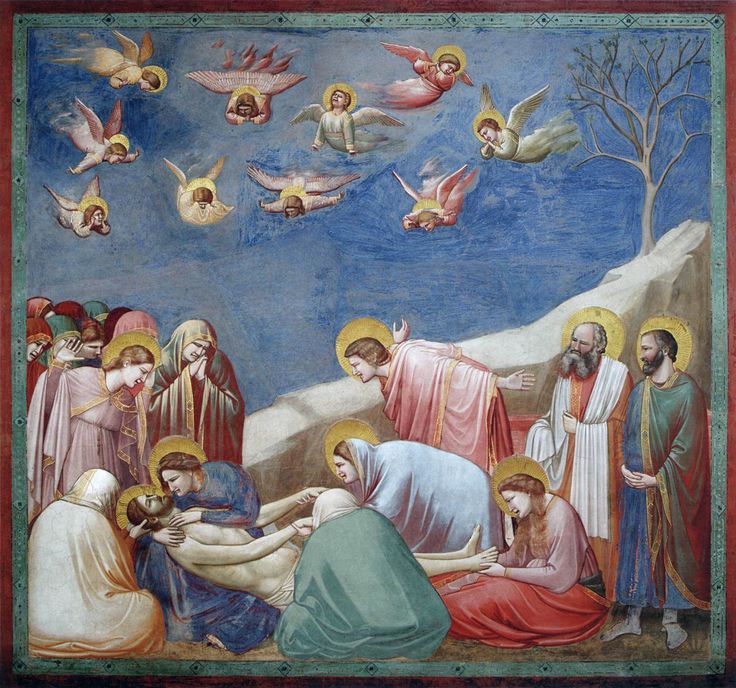
Giotto painted the lamentation over Christ’s death in the early 1300s. Grief is palpable to the viewer. The dead tree on the hillside symbolizing the tree in the garden where Adam and Eve made their fatal choice…the three women surrounding his limp body, likely Mary Magdalene gently cradling His feet and the mother Mary holding His head, the angels who long to look into these thing also shown affected by the death and burial of Christ, their God whom they had known since their own creation created in eons past.

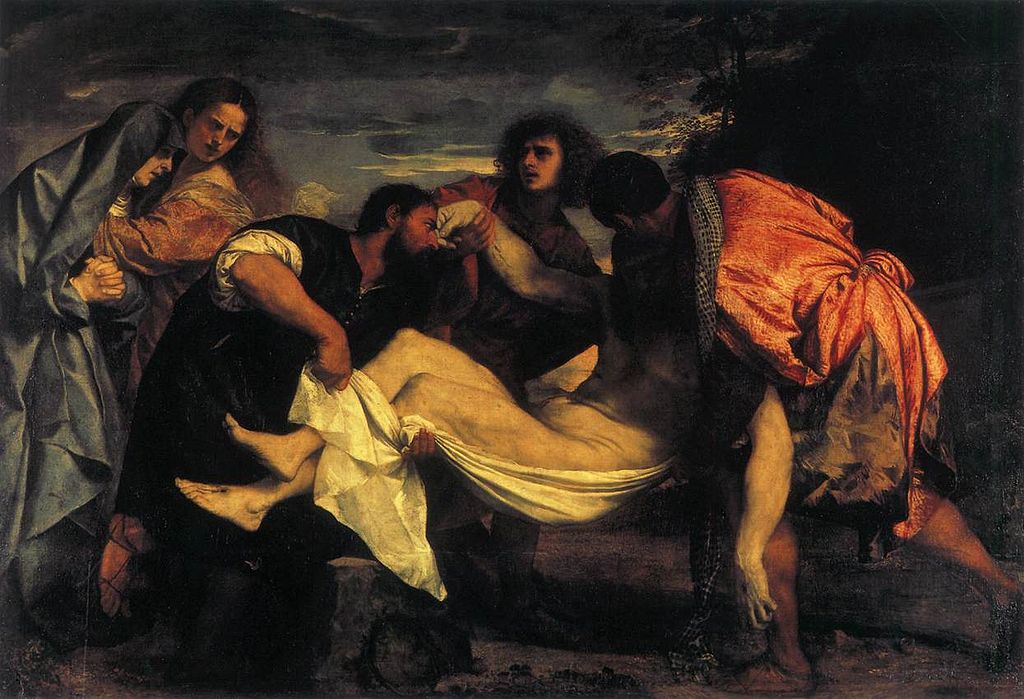
Titian also depicted the entombment of Christ, painting the more intimate scene below in 1520. The major figures are at Christ’s death, including Mary, John, Nicodemus, Peter, and Joseph of Arimathea, displaying more restraint that Giotto’s depiction, still carefully remove the body and prepare Him for entombement. The twilight timing allowed Titian’s usual use of darkened tones to add depth to the lamentation. Christ’s upper body itself is receding into the darkness, foreshadowing the tomb. What strength they had to carry Him without staggering under unimaginable grief, and place Him behind the rock!

Bela Čikoš Sesija’s Mourning of Christ is an even more intimate portrait. Painted sometime in the late 1800s, this Croatian painter shows the undeniably lifeless Christ in shadow, but His white robe, symbolizing purity and sinlessness is highlighted by a heavenly glow, along with the crown of thorns, symbolizing His suffering. The grief of the two women is also palpable, as is their resignation to the finality of death.

Praise God, Sunday is coming! What joy they will know in one more day’s time! For all eternity, death is conquered, swallowed by His suffering and propitiation for sin, absorbing the wrath for His chosen sinners once for all. Hallelujah!

Posted in prophecy, Uncategorized

Holy Week: A Personal God

God is a personal God. Even the thunderous, Mt. Sinai, pestilence-bringing, smiting God of the Old Testament. Yes. Especially the Old Testament God. And of course in the New Testament God is a personal God, too. We see Him in Jesus, who is both fully man and fully God. He had come to serve. He did so meekly and humbly, even washing feet.

We read in Genesis that God created the worlds, He did it personally and carefully, with precision. He spoke them into life.

‘In the beginning, God said’… He spoke.

And God said, And God said, Genesis 1:3, 6, 9, 11, 14, 20, 24.

When it came time to form man, God did not speak. He did it Himself, personally, and with His own breath.

then the LORD God formed the man of dust from the ground and breathed into his nostrils the breath of life, and the man became a living creature… (Genesis 2:7)

Therefore, we see that God’s intimate formation of the world got even more intimate when He made man.

It gets even better.

Because of the life, death, and resurrection of Jesus, we have an even more intimate relationship with Him and He with us. We are His body, His blood covers us. We are IN Him.

It is holy week, so it bears thinking about Him on a special level. We are “in Christ”. We read it in 1 Peter 5:14; Philippians 1:1; Romans 8:1, Colossians 3:3. We have it explained in Galatians 3:26-28-

for in Christ Jesus you are all sons of God, through faith. For as many of you as were baptized into Christ have put on Christ. There is neither Jew nor Greek, there is neither slave nor free, there is no male and female, for you are all one in Christ Jesus.

John MacArthur explained about what it means to be “in Christ” in his inimitable way in the sermon, Under the Law, or In Christ? He opened the salient portion of the sermon this way before going on to spend time expounding what it means to be In Christ. I recommend the sermon.

To ask the question, “What is a Christian?” That question is simply answered, right here. A Christian is one who is in Christ. That’s all. You can imagine following the teachings of Buddha, following the teachings of Confucius, or following the teachings of Muhammad, but you can’t imaging anyone saying, “I’m in Confucius. I’m in Buddha. I’m in Muhammad.” There’s no such thing as a Christian who isn’t in Christ. You see, we’re not following the teachings of a man, we’re in union with Him. If that boggles your brain, you haven’t heard anything yet. In Christ.

We have a personal God. We have a loving God. He is expressly concerned with His creation, and particularly concerned with His children.

It is holy week. Hallelujah to the Lamb!

Posted in prophecy, Uncategorized

Predestination means people are elected as vessels of wrath, too. Part 3

Vessels of Wrath Part 1 here
Vessels of Wrath Part 2 here

A few days ago I’d posted an essay about predestination. This is the doctrine where the Bible teaches that God is completely sovereign over everything that happens, including individual salvations. He elects people to salvation, independently and apart from foreknowledge of any decision they make. It’s all His grace, and not our decision.

People dislike that doctrine and fight against it. One of the reasons people resist the plain truth of the doctrine is that people want to think that somewhere in their heart or mind, they chose God. However, we are dead in sins and trespasses and have no ability to choose God, or ‘make a decision’ about our salvation. It is granted to us. (Galatians 3:22). We have no part in it, except the resulting gratitude and service in His name.

The verse to consider today is from Romans 9:21-24

Has the potter no right over the clay, to make out of the same lump one vessel for honorable use and another for dishonorable use? 22 What if God, desiring to show his wrath and to make known his power, has endured with much patience vessels of wrath prepared for destruction, 23 in order to make known the riches of his glory for vessels of mercy, which he has prepared beforehand for glory— 24 even us whom he has called, not from the Jews only but also from the Gentiles?

There are vessels of mercy, and there are vessels of wrath. Considering anything regarding God is weighty and should fill the saved and the non-saved with awe and humility. But to really consider His work of judgment should bring to mind the famous comment attributed to martyr John Bradford, “There but for the grace of God go I”.

Here is M’Cheyne preaching on the Romans verse. In my opinion, it’s brilliant. The full sermon is here.

——————————–

The Vessels of Wrath Fitted to Destruction
by Robert Murray M’Cheyne

I come now to the third point–the reason given why believers are saved. Verse 23 – “And that he might make known the riches of his glory on the vessels of mercy, which he had afore prepared unto glory.” One reason why there are vessels of wrath fitted to destruction is, that God may show by contrast the riches of his grace on the vessels of mercy. You know, brethren, we learn many things best by contrast: for example, the rainbow is never seen so bright as in the bosom of a dark cloud. So, brethren, we shall never see the love and com passion of God in them that are saved so gloriously displayed as when we see his wrath poured out on the vessels of wrath. This, then, is one reason why there are vessels of wrath.

I believe that the “riches of glory” here spoken of are the whole rainbow of the divine attributes displayed in the salvation of souls. It was for this reason that God provided that there should be vessels of wrath fitted for destruction. This may appear to you very awful: it is so to myself. I could not and dare not speak of it if it were not here in God’s own Word.

I would just show you one or two of his attributes that will be brilliantly illustrated in the salvation of souls. One is, the sovereignty of God. I have often told you of this. Many of you do not believe it; but there is a day coming when God will put it beyond a doubt. There are whole churches – whole bodies of professing Christians – that deny it; but there is a day coming when there will be none in heaven, or earth, or hell, that will deny it. Suppose that day were come, and this congregation divided, some on the left hand, some on the right, will you not see then God’s sovereignty in the contrast? You were once all the same. You were under the same condemnation. Some of you came out of the same womb – were nursed at the same mother’s breast; yet it will be seen that some will be taken and some left. What made the difference? Every creature will see that God made the difference, that he had “mercy on whom he would have mercy.”

Another is, the pardoning attribute of God. At present this is denied; but, brethren, in that day it will be made known. God will make known the riches of his glorious mercy on the vessels of mercy. O brethren, when one vessel is cleansed and taken up to glory, and another is left to perish, and when you see that they were equally sinful, then you will see that it was blood that made the difference. God will make known the riches of his mercy in the vessels of mercy, as well as his wrath in the vessels of wrath fitted to destruction.

Let us learn a few lessons from this subject. And –

1st. All will not be saved. It is a fearful delusion among you – I do not say you avow it, but you practically say, you believe – that there will be no hell. It was God’s plan that there should be vessels of wrath as well as vessels of mercy. Brethren, it is better it should be so. O do not dream! All will not be saved. There are vessels of wrath as well as vessels of mercy. Some of you, I think, are going to hell, and some, I trust, are going to heaven; and doubtless it is best it should be so, though I cannot explain the reason of it. The net has good and bad fishes: some will be taken into the vessel, and some will be cast away.

2nd. Every one of you will be to the glory of God. You will be made to glorify him in one way or another. You will either do it willingly or unwillingly. You must form a step to his throne. Ah, brethren! I believe each of you will yet be a beacon or a monument – either a beacon of wrath or a monument of mercy, “He hath made all things form himself; even the wicked for the day of evil.” Yes, wicked man, you would rob God of his glory if you could, but you cannot. If you come to Christ, you will show forth his glory in saving you; but if you do not, God will show forth his power in destroying a vessel of his wrath.

3rd. There is a third lesson we may learn. It is, the chief end of God in the world to manifest his glory. Many think, especially infidel men, that God’s chief end is the happiness of his creatures; but, from deep study of the Word of God for years, I see that it is not so. If that were his chief end, all would be happy. His chief end is diverse – it is self-manifestation. Had it not been for this, God would have remained alone in awful solitude. I would desire to speak with deep reverence on such a subject. This seems to be the reason why there are vessels of wrath as well as of mercy – that they might be mirrors to reflect his attributes. And I believe, brethren, when creation is done, and when redemption is done, that there will then be a complete manifestation of the glory of God.

4th. Another lesson we may learn is, God is longsuffering to the vessels of wrath. I remember a person who once argued with me that she must needs be a child of God on account of his goodness to her. She enumerated many blessings she had received – how God had protected her in a foreign country, how many trials she had been delivered out of, and how many domestic comforts she had enjoyed. My only answer to her was, “The goodness of god leadeth thee to repentance.” It is no proof that you are a child of God that God has borne long with you. There would be many children of God here, if this were the case. Ah, brethren! Strange though it may seem, he does not want any to perish – he does bear long with you.

Last of all, the destruction of the vessels of wrath will be no grief to the vessels of mercy. I once spoke to you of this before; but I would again remind you of it. The redeemed will have no tears to shed; and here is the reason – the very destruction of the wicked makes known the riches of divine grace. O my believing brethren, it will be an awful day when we shall not weep to see them perish. The day is hastening on – the day when no more rivers of waters will run down our eyes because they keep not God’s law. But, O brethren, till that day come let us weep on; for, although God will be glorified in the destruction of the vessels of his wrath, he will be more glorified in making them vessels of mercy. The Lord bless his own Word. Amen.

—————–end——————

perfect love moon verse

Further Reading

Is Predestination Biblical?

Doesn’t John 3:16 mean that anyone can believe?


Posted in prophecy, Uncategorized

Predestination means people are elected as vessels of wrath, too. Part 2

The verse to consider today is from Romans 9:21-24

Has the potter no right over the clay, to make out of the same lump one vessel for honorable use and another for dishonorable use? 22 What if God, desiring to show his wrath and to make known his power, has endured with much patience vessels of wrath prepared for destruction, 23 in order to make known the riches of his glory for vessels of mercy, which he has prepared beforehand for glory— 24 even us whom he has called, not from the Jews only but also from the Gentiles?

There are vessels of mercy, and there are vessels of wrath. Considering anything regarding God is weighty and should fill the saved and the non-saved with awe and humility. But to really consider His work of judgment should bring to mind the famous comment attributed to martyr John Bradford,”There but for the grace of God go I”.

Here is Scottish pastor Robert Murray M’Cheyne preaching on the Romans verse. In my opinion, it’s brilliant. I’ll post M’Cheyne’s point 3 tomorrow, Lord willing. Part 1 is hereM’Cheyne’s full sermon is here.

~~~~~~~~~~~~~~~~~~~~~
The Vessels of Wrath Fitted to Destruction

I come now to the second reason why any are left to perish–it is, that God may show his power. “What if God, willing to make his power known?” We are frequently told in the Bible of the power of God. He said to Abraham, “I am the Almighty God.” We are told in the ninety-third Psalm, that “the Lord on high is mightier than the noise of many waters; yea, than the mighty waves of the sea.” We are frequently told of his almighty power; and not only so, but we have brilliant examples of it.

The first upon record is creation. “God said, Let there be light: and there was light.” “He spake and it was done – he commanded and all things stood fast.”

Another example of the same thing is, the constant providence of God. “In him we live, and move, and have our being.” He rides on the swift wings of the wind.

Another example of the power of God is, his restraining and bridling of the wicked. “Be ye not as the horse, or as the mule, which have no understanding, whose mouth must be held in with the bit and bridle.” – Psalms 32:9. This is the way in which God holds the wicked.

Another way in which God makes his power known is, in the conversion of souls. “Not by might, nor by power, but by my Spirit, saith the Lord.” This is said to be “the wisdom of God and the power of God.” I believe the converting of a soul is something greater than the making of the world.

Brethren, there is one exhibition of divine power that yet remains – it is, the destruction of the wicked. “What if God, willing to shew his wrath, and to make his power known, endured with much longsuffering the vessels of wrath fitted to destruction?” I believe, dear friends, that the reason why God has raised up Pharaohs is to show his power in them. He said to Pharaoh, “For this cause have I raised thee up, that I might show my power in thee.” No, I say, in regard of those of you in this congregation who will die unsaved, that God has raised you up, to show his power in you. Thus, it is said in Isaiah 62, “I will tread them in mine anger, and trample them in my fury; and their blood shall be sprinkled upon my garments, and I will stain all my raiment.” And then in Revelation 18, “She shall be utterly burned with fire; for strong is the Lord God who judgeth her.” And we are told by our Lord in Matthew 10:28, to fear God, “who is able to destroy both soul and body in hell.” You will notice in this passage that he says, “God is able to destroy”; and therefore, brethren, it is plain that there must be some great power exercised in his destroying the wicked; and I think it is to consist in this – God will destroy their well-being, but not their being. Here, then, is another exhibition of the power of God.

When lately in the north of Scotland, I stood on the sea-shore, and saw the rocks standing out of the sea. It was very remarkable to stand and see the mighty waves dashing upon the rocks. There were two things remarkable in it: first, the greatness of the rocks on which the waves dashed: second, the rocks remaining unmoved – no force of the waves could move them. Brethren, this scene is an emblem of what will be witnessed another day, when God shall pour out his wrath on the wicked. Ah, brethren! will it not be fearful to see God put out his power upon the wicked – to see him upholding them with one hand, and pouring out his wrath upon them with the other? Surely, brethren, the power of God’s wrath is very great. If any of you have seen a great furnace, you will have seen the power that the fire has; but fire is God’s creature. What must his power be who is the Creator?
——————————–

Further Reading

Predestination means people are elected as vessels of wrath, too. Part 1
Predestination means people are elected as vessels of wrath, too, part 3

Jesus’ Predestined Life

Is Predestination biblical?

Posted in prophecy

Predestination means people are elected as vessels of wrath, too. Part 1

A few days ago I’d posted an essay about predestination. This is the doctrine where the Bible teaches that God is completely sovereign over everything that happens, including individual salvations. He elects people to salvation, independently and apart from foreknowledge of any decision they make. It’s all His grace, and not our decision.

People dislike that doctrine and fight against it. One of the reasons people resist the plain truth of the doctrine is that people want to think that somewhere in their heart or mind, they chose God. However, we are dead in sins and trespasses and have no ability to choose God, or ‘make a decision’ about our salvation. It is granted to us. (Galatians 3:22). We have no part in it, except the resulting gratitude and service in His name.

The verse to consider today is from Romans 9:21-24

Has the potter no right over the clay, to make out of the same lump one vessel for honorable use and another for dishonorable use? 22 What if God, desiring to show his wrath and to make known his power, has endured with much patience vessels of wrath prepared for destruction, 23 in order to make known the riches of his glory for vessels of mercy, which he has prepared beforehand for glory— 24 even us whom he has called, not from the Jews only but also from the Gentiles?

There are vessels of mercy, and there are vessels of wrath. Considering anything regarding God is weighty and should fill the saved and the non-saved with awe and humility. But to really consider His work of judgment should bring to mind the famous comment attributed to martyr John Bradford, “There but for the grace of God go I”.

Here is M’Cheyne preaching on the Romans verse. In my opinion, it’s brilliant. I post ed M’Cheyne’s point 2 here. I’ll post point 3 tomorrow and the next day, Lord willing. The full sermon is here.

~~~~~~~~~~~~~~~~~~~~~

The Vessels of Wrath Fitted to Destruction

The following sermon preached on the afternoon of March 12, 1843, was the author’s last in St. Peter’s. “It was observed, both then and on other occasions,” says Andrew Bonar, “that he spoke with peculiar strength upon the sovereignty of God.” The following evening McCheyne’s illness commenced and on Saturday, March 25, he went to the Saviour whose glory he lived to proclaim.
“What if God, willing to shew his wrath, and to make his power known, endured with much longsuffering the vessels of wrath fitted to destruction: and that he might make known the riches of his glory on the vessels of mercy, which he had afore prepared unto glory?” – Romans 9:22,23

In a former discourse, brethren, I attempted to show you that the reason why God will punish the wicked eternally is, because he loveth righteousness. It is said in the eleventh Psalm, “Upon the wicked He shall rain snares, fire, and brimstone, and an horrible tempest: this shall be the portion of their cup, for the righteous Lord loveth righteousness.” I then tried to show you, that God has created hell, and will maintain it for ever, not because He loves human pain – I believe it is not so, nor is it because He is subject to passion, as men speak of passion – but because the righteous Lord loveth righteousness.

And I showed you, as you will remember, what a certainty hell is to the wicked. If it had its origin in the love of human pain, then you might have hoped that it would have an end; or, if it proceeded from passionateness, then it might cool; but ah! when it proceeds from Jehovah’s love of righteousness, I see, brethren, in that a reason why “the worm dieth not, and the fire is not quenched.”

There is a second question which no doubt has occurred to you: why are there any left unpardoned at all? Why was Adam left to fall? Could God not have held him up? Or, if it was necessary that Adam should fall, in order that Christ might die, why are not all saved? Surely there is efficacy in the blood of Christ to pardon all – why, then, are not all saved? There are many answers to that question which we will know in a higher state of being; but here is one; “What if God, willing to show His wrath and to make His power known, endured with much longsuffering the vessels of wrath fitted to destruction: and that He might make known the riches of His glory on the vessels of mercy, which He had afore prepared unto glory?” You will notice, brethren, that in these words the apostle Paul tries to give an answer to that question. He does not answer it directly, he employs a “what if”.

Let us enter into this subject a little more deeply. There are three reasons set down here why men are allowed to perish.

I. The first is, that God was willing to show His wrath. These words are terrible. We are told frequently in the Bible of the wrath of God. It is not like human wrath: it is calm, settled – it consists principally in a regard to what is right. This is the wrath of God. We are told a great deal about it in the Bible. It is revealed against all sin. “For the wrath of God is revealed from heaven against all ungodliness and unrighteousness of men, who hold the truth in unrighteousness.” – Romans 1:18 Observe the word “all” – it is against all sin. Then Colossians 3:6, “For which things’ sake the wrath of God cometh on the children of disobedience.” We are told also, brethren, that this anger is constant. “God is angry with the wicked every day.” – Psalms 7:11. The bow of God’s justice is, as it were, already bent against the wicked, the arrow of God’s is already on the string against the wicked. And then we are told that His wrath is intolerable. In the Psalm which we were singing (Psalms 90:11), it is said, “Who knows the power of thy wrath?” And we are told in Revelation, “The great day of His wrath is come, and who shall be able to stand?”

But we learn more by example than even by these declarations. We have many examples of God’s wrath and its consequences. The first example we have is, his casting the angels out of heaven. We are told by Jude, “That the angels which kept not their first estate, He hath reserved in everlasting chains, under darkness, unto the judgment of the great day.” And we are told by Peter, “That God spared not the angels that sinned, but cast them down to hell, and delivered them into chains of darkness, to be reserved unto judgment.” Now, brethren, in several respects this was one of the greatest examples of divine wrath we have, for it seems to have happened in one day. One day these angels were in heaven – the next in hell. One day they were angels of light – the next fiends of darkness. And then this made it fearful, when the Lord left them no room for repentance. One thing the universe might have learned from this was, that God will certainly punish sin.

Another example of God’s punishing sin was not in heaven, but one earth, when He sent the deluge upon it. “God saw that the wickedness of man was great in the earth, and that every imagination of the thoughts of his heart was only evil continually. And it repented the Lord that He had made man on the earth, and it grieved Him at His heart. And the Lord said, I will destroy man, whom I have created, from the face of the earth.” And so it came to pass: “The flood came, and carried them all away;” and it has left traces on our world still, to show that God will not fail to punish sin.

Another example of divine vengeance was, when God destroyed Sodom. “Now, the men of Sodom were wicked, and sinners before the Lord exceedingly.” The cry of its wickedness went up to heaven, and God sent down two angels, to see if it was according to the cry that came up; and they found it even so; and, when they had taken out just Lot, God rained fire and brimstone upon the devoted city; and he has left traces of it there to this hour.

There was yet another exhibition of divine wrath on earth – it was the death of God’s dear Son. If ever there was a time when God could have said that he would forego his wrath it was surely this. It was this for two reasons. First, because the object of that wrath was dear to God. There never was on in the universe so dear to God as his Son. And another reason was, Christ had no sin of his own. Just as his robe was seamless, so was his soul sinless. Nay, brethren, that one act of his – laying down his life, was so glorious, as an exhibition of God’s justice, that the universe never saw its “marrow”. “Yet it pleased God to bruise him.” These words do not give the least shadow of his suffering from God on account of our sin. Brethren, if any thing in the world can show that God will punish sin, it was the death of his dear and sinless Son.

There is one exhibition of his wrath yet to come. Verse 22 – “What if God, willing to shew his wrath, and to make his power known, endured with much longsuffering the vessels of wrath fitted to destruction?” God is yet to destroy the souls that he has made–not the angels that fell, for he has done that already, when he cast them into hell, but the souls on which he has waited. There is to be a new exhibition of wrath that the world never saw the like of before. He is going to show what he will do to the despisers of his Son – to those who despise his gospel. it will be a new thing when “God will be revealed from heaven in flaming fire, taking vengeance on them that know him not, and that have not obeyed the gospel.” God waits to show his wrath. Ah, brethren! it will be fearful to feel it – it is fearful even to think of it. so I believe it will be with the wicked: they will be beacons, to show how God will punish sin.

~~~~~~~~~~~~~~~~~~~~~
Posted in prophecy, Uncategorized

The second best moment in all the universe

But the day of the Lord will come like a thief, and then the heavens will pass away with a roar, and the heavenly bodies will be burned up and dissolved, and the earth and the works that are done on it will be exposed. Since all these things are thus to be dissolved, what sort of people ought you to be in lives of holiness and godliness, waiting for and hastening the coming of the day of God, because of which the heavens will be set on fire and dissolved, and the heavenly bodies will melt as they burn! But according to his promise we are waiting for new heavens and a new earth in which righteousness dwells. (2 Peter 3:10-13)

Waiting….waiting…

The best moment in all of the universe through all of time, of course, is when Jesus arose from the grave, victorious over death and sin and Hades. The second best moment in my opinion, will be the culmination of all things, when God puts an end to sin and refreshes the universe by scrubbing it from His presence forever. This will include destroying the old heavens and earth and making a new heavens and a new earth.

The end of this world is a good thing. Jesus will regenerate the earth, He will cleanse us from our sins by glorifying our bodies, He will heal us completely, He will resurrect the saved, He will restore the damaged children, He will appear to us in His full glory, and much more. Who wouldn’t wish for that?

We are blessed, yes, blessed to be watching the Lord of the Universe work visibly in the world. He gave us the Word, and He is allowing us to see His word alive, organic, living and breathing coming true before our eyes in His providence and in His people. He regenerates hearts and His children bear fruit before our eyes. He transforms lives and we watch it before our eyes. The cycle of seasons march through years, and we see His hand ordaining and sustaining it all.

His promises are true, and though no one likes to see hunger and pain and grief, but we do see through those hardships that His promises are true. His promises that trials will come also include all of the above as well- the glory and the justice concluded and the conclusion of His work in the Church Age.

And in addition, when the day comes for your death, or the rapture, you will say as Paul did, “For I am already being poured out like a drink offering, and the time for my departure is near. I have fought the good fight, I have finished the race, I have kept the faith.  (2 Timothy 4:6-7).

There is no shame in longing for His appearing!

Henceforth there is laid up for me the crown of righteousness, which the Lord, the righteous judge, will award to me on that day, and not only to me but also to all who have loved his appearing. (2 Timothy 4:8)

Do not be embarrassed at wishing for His will to be done! There is glory! His glory, made manifest in us who walk the earth doing His will, pointing to the only Hope!

We are waiting…waiting…

Posted in prophecy, Uncategorized

We live our lives in a waiting room

Life is a waiting room

It might seem strange to say this, but we are not living to live. Living is not the point of our living. Waiting is. We live while we’re waiting.

For the grace of God has appeared, bringing salvation for all people, 12training us to renounce ungodliness and worldly passions, and to live self-controlled, upright, and godly lives in the present age, 13waiting for our blessed hope, the appearing of the glory of our great God and Savior Jesus Christ, (Titus 2:11-13).

Paul is giving Titus some instructions and reminders as to our duties as Christians, to be done while we wait.

Matthew Henry’s Commentary on the Whole Bible reminds us also that this life is a preparatory for the one to come.

To look for the glories of another world, to which a sober, righteous, and godly life in this is preparative: Looking for that blessed hope, and the glorious appearing of the great God and our Saviour Jesus Christ. Hope, by a metonymy, is put for the thing hoped for, namely, heaven and the felicities thereof, called emphatically that hope, because it is the great thing we look and long and wait for; and a blessed hope, because, when attained, we shall be completely happy for ever.

In today’s time it’s not considered mature to speak of prophecy. I believe that’s wrong. I believe that because so many verses stress that we are to look forward, to hope in His coming promises, to wait for His return. I can’t think of a better encouragement than to dwell on His prophecies. This life is difficult. (John 16:33). It’s full of evil people and seducers waxing worse and worse. (2 Timothy 3:13). It’s full of disease, strife, challenge, and vigilance. (1 Corinthians 11:30, 2 Corinthians 12:7-10, Proverbs 28:25, Psalm 46:1,1 Peter 5:8).

We are being trained while we wait. But waiting is our task, our joy, our hope. We should look to His return for encouragement. He is the blessed hope!

Illustration by Chris Powers