
Posted in prophecy, Uncategorized

Thirty Days of Jesus: Day 28, Resurrection of central importance

Christmas advent. We are coming toward the end of our look at the life of Jesus through scripture. The first section of His life was seen through verses focused on prophecy, arrival, and early life.

The next section of verses looked at Him as the Son, second person of the Trinity.

We proceeded into looking at Jesus as the Son’s preeminence, His works, and His ministry. Under ministry & works, I chose verses showing His attributes and aspects of being servant, teacher, shepherd, intercessor, and compassionate healer; and His attributes of omniscience, having all authority and power, and sinlessness.

Now it’s the last section. We’ll look at His resurrection, ascension, and prophesied return. There is one more day until Christmas, but I have more verses waiting. We are going to go over by a week, into the New Year, which I believe fits. When we finish, we will be looking at the New Year with all that entails, the feeling of freshness, hope, optimism for a new start. And when we finish the last verse, we will be looking through the lens of scripture at the hope and optimism of His return and that all will be made new.

On to today’s picture verse. Note Paul’s statement “of first importance”.

thirty days of jesus day 28

Further Reading:

CARM: Jesus’ resurrection was physical

Al Mohler: Of First Importance: The Cross and Resurrection at the Center

And what is of first importance? “That Christ died for our sins in accordance with the Scriptures,” and “that he was raised on the third day in accordance with the Scriptures.” The cross and the empty tomb stand at the center of the Christian faith. Without these, there is no good news — no salvation.
Paul gets right to the heart of the matter in setting out those truths that are “of first importance.” Following his example, we can do no less.

~~~~~~~~~~~~~~~~~~~~~~~~~~~~~~~~~~~~~~~~~~~~~~~~~~~~~~~~~~~~~~~~

Thirty Days of Jesus Series-

Introduction/Background
Day 1: The Virgin shall conceive
Day 2: A shoot from Jesse
Day 3: God sent His Son in the fullness of time
Day 4:  Marry her, she will bear a Son

Day 5: The Babe has arrived!
Day 6: The Glory of Jesus
Day 7: Magi seek the Child
Day 8: The Magi offer gifts & worship
Day 9: The Child Grew
Day 10: The boy Jesus at the Temple
Day 11: He was Obedient!
Day 12: The Son!
Day 13: God is pleased with His Son
Day 14: Propitiation
Day 15: The gift of eternal life
Day 16: Two Kingdoms
Day 17: Jesus’ Preeminence
Day 18: Jesus is highest king
Day 19: Jesus emptied Himself
Day 20: Jesus as Teacher
Day 21: Jesus as Shepherd
Day 22, Jesus as Intercessor

Day 23: Jesus as Compassionate Healer
Day 24: Jesus as Omniscient
Day 25: Jesus’ Authority
Day 26: Jesus’ Sinlessness
Day 27: He rises!

Posted in prophecy, Uncategorized

The Carpenter

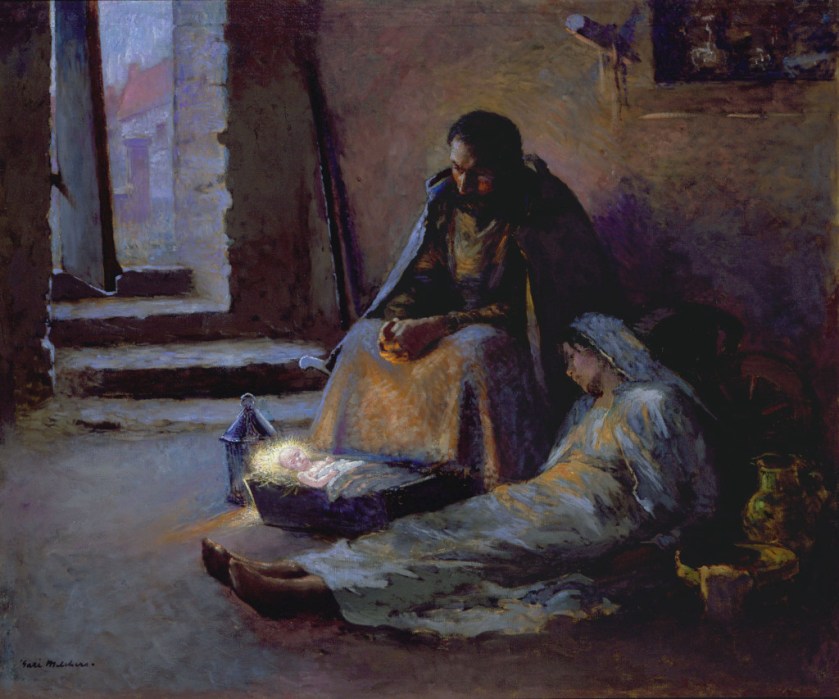
Yesterday I wrote a short bit about Joseph, foster-father of Jesus, and posted Gari Melchers’ painting of The Nativity.

Today I will mention just this. In biblical times (now, too), the son took on the father’s profession. The tailor’s son became a tailor. The butcher’s son became a butcher. The blacksmith’s son became a blacksmith. The fisherman’s son became a fisherman. My own father, and his father before him, became a funeral director.

Many professions are mentioned in the New Testament. Tentmaker, tanner, lawyer, merchant, silversmith, coppersmith, governor, soldier, shepherd, scribe, tax-collector, seller of purple, potter, all those professions and more populate the pages.

Of all the professions God could have chosen for the foster-father of Jesus to be, and then Jesus himself, God chose carpenter.

Why not Shepherd? After all, Psalm 23:1 explicitly identifies the Lord as a metaphorical shepherd. Why not an actual one? It was a frequently mentioned profession. Abraham, Jacob, Moses, David, Amos, and even Rachel were shepherds. The motif was huge. But no. He is the Good Shepherd, but not a shepherd.

Many of the disciples were fishermen…but God did not choose for Jesus to be a fisherman, even though He became a fisher of men.

Tax collectors were hated, and Jesus was destined to be rejected and hated, but God did not choose for Jesus to be a tax collector.

On a brief side note, we know that Jesus knew of His mission. He was there to follow God’s will. He said as much in the first NT recorded words of His incarnation: Did you not know I must be about my Father’s business? (Luke 2:49). He knew who His Father was and He knew what he was there to do. And He said later at the Wedding at Cana, before He began His public ministry, “My time has not come.” (John 2:2). We know He knew of his life, and his death. It would be on that most painful grotesque, cursed methods of execution, nailed to a tree. Even death on a cross.

So, as Jesus grew and learned His foster-father’s trade, as the carpenter pounded nails every day, did He wonder about the nails that were to pierce Him? Did He see the holes in the wood even as he took over Joseph’s shop upon Joseph’s death? Did He think about the holes in His hands and feet as he worked in the wood shop? He said in the Garden of Gethsemane upon the night of His arrest, that His spirit was willing, but his flesh was weak. Always the nails were before Him.

Jesus had an entire lifetime to see wood and nails, and to keep the method of his painful death always before His eyes.

Praise Him to the highest for His love.
nails

Posted in prophecy, Uncategorized

Thirty Days of Jesus: Day 27, He rises again

Christmas advent. We are coming toward the end of our look at the life of Jesus through scripture. The first section of His life was seen through verses focused on prophecy, arrival, and early life.

The next section of verses looked at Him as the Son, second person of the Trinity.

We proceeded into looking at Jesus as the Son’s preeminence, His works, and His ministry. Under ministry & works, I chose verses showing His attributes and aspects of being servant, teacher, shepherd, intercessor, and compassionate healer; and His attributes of omniscience, having all authority and power, and sinlessness.

Now it’s the last section. We’ll look at His resurrection, ascension, and prophesied return. There are 4 more days until Christmas, but I have 10 more verses waiting. We are going to go over by a week, into the New Year, which I believe fits. When we finish, we will be looking at the New Year with all that entails, the feeling of freshness, hope, optimism for a new start. And when we finish the last verse, we will be looking through the lens of scripture at the hope and optimism of His return and that all will be made new.

On to today’s picture verse. Today and tomorrow focus on the Resurrection. Do not forget the Resurrection. It is the linchpin to the entire doctrine of Christ. For without the raising of Jesus, we believers are most to be pitied! Our hope would be vain, and all would be lost. (1 Corinthians 15:12-19).

thirty days of jesus 27

Further reading:

Devotional: The Hope of Christ’s Resurrection

Parenting: Resurrection: The Most Important Truth

~~~~~~~~~~~~~~~~~~~~

Thirty Days of Jesus Series-

Introduction/Background
Day 1: The Virgin shall conceive
Day 2: A shoot from Jesse
Day 3: God sent His Son in the fullness of time
Day 4:  Marry her, she will bear a Son

Day 5: The Babe has arrived!
Day 6: The Glory of Jesus
Day 7: Magi seek the Child
Day 8: The Magi offer gifts & worship
Day 9: The Child Grew
Day 10: The boy Jesus at the Temple
Day 11: He was Obedient!
Day 12: The Son!
Day 13: God is pleased with His Son
Day 14: Propitiation
Day 15: The gift of eternal life
Day 16: Two Kingdoms
Day 17: Jesus’ Preeminence
Day 18: Jesus is highest king
Day 19: Jesus emptied Himself
Day 20: Jesus as Teacher
Day 21: Jesus as Shepherd
Day 22, Jesus as Intercessor

Day 23: Jesus as Compassionate Healer
Day 24: Jesus as Omniscient
Day 25: Jesus’ Authority
Day 26: Jesus’ Sinlessness

Posted in prophecy, Uncategorized

What about Joseph?

In conversation about the advent of Jesus’ incarnation and the nativity, a friend shared her daily devotional with me. She said that her church had given out an advent calendar with daily devotions, and that day’s focused on Joseph.

She explained that it mentioned that we focus on Mary the virgin who conceived, Gabriel’s announcement, the angels’ proclamation, the shepherds, the wise men, even the star and the manger, but Joseph isn’t mentioned a lot.

Joseph was Jesus’ foster-father. We know Joseph’s father was named Jacob, and that Joseph was of the Davidic line. (Mt 1:16). We know Joseph was from Nazareth. (Luke 2:4). From Matthew 1:19 we also know that he was a just man.  We know he was a carpenter. (Matthew 13:55). That is all we know. Joseph is not mentioned again after Jesus turned 12 and appeared at the Temple. He was likely dead by the time Jesus was crucified, because Jesus commissioned John for Mary’s care. If Joseph had been alive, Jesus would not have needed to do that.

I posted this painting last year but I’ll do it again with some different thoughts this time. Gari Melchers was an American painter of the end of the last and the beginning of this century. Born of German immigrants and the son of a sculptor father, Melchers’ works are excellent. One of my favorite works of his is The Nativity. Its focus is a bit different than the usual nativity scenes. He painted the scene absent of animals and Wise Men. He painted not an adoring Mary, but a more realistic scene where Mary, exhausted, with dirty rag and bowl of water beside her, leans against her husband’s shoulder, gazing wearily at the Child. The Child in the feeding trough, swaddled, appears to be glowing, or is that just the lantern’s glow that Joseph has set near him? Joseph in turn, looks at his son.

It’s his expression that arrests you.

Joseph’s hands are clasped quietly in his lap. His total focus is on the Babe. What is Joseph thinking? In Matthew 1:20, an angel had come to Joseph in a dream and had confirmed that the child within Mary was conceived by the Spirit. Joseph knew the truth. But how can a man’s mind wrap around that?

Perhaps he is thinking of the revelation that the Savior is at last come to men. But as a baby? Perhaps he is thinking of the grave responsibility of raising the son of God. Perhaps…we don’t know. It’s an interesting moment. It’s not ‘Mary did you know?’ but, ‘Joseph what do you think?’

See below for yourself:

melchers nativity

Tomorrow, a bit more on Joseph the carpenter.

I praise the Lord for all the elements of the Incarnation, all the parts of His plan that He perfectly executed.


Posted in prophecy, Uncategorized

Thirty Days of Jesus: Day 18, The Highest King

thirty days of jesus day 18

Further Reading

Though the verse is literally speaking about King David, the relation of David to Christ means the verse also prefigures the preeminence of King Jesus. The throne, through David’s line, would last forever through Christ.

Gill’s Exposition says,

Also I will make him my firstborn,…. Or, “make him the firstborn”; make him great, as Jarchi interprets it; give him the blessing, the double portion of inheritance: so Christ is made most blessed for ever, and has all spiritual blessings in his hands; and is heir of all things, and his people joint-heirs with him. Christ is God’s “firstborn”, or “first begotten”, Hebrews 1:6, being begotten by him, and of him; … even him the Father promises to make “higher than the kings of the earth”; having a kingdom of a superior nature to theirs, and a more extensive and durable one; and even they themselves shall be subject to him; hence he is called “King of kings”, Revelation 19:16.

The King of Kings shall reign forever, His Kingdom shall endure. See Day 16: Two Kingdoms for related verse & info.

Thirty Days of Jesus Series-

Introduction/Background
Day 1: The Virgin shall conceive
Day 2: A shoot from Jesse
Day 3: God sent His Son in the fullness of time
Day 4:  Marry her, she will bear a Son

Day 5: The Babe has arrived!
Day 6: The Glory of Jesus
Day 7: Magi seek the Child
Day 8: The Magi offer gifts & worship
Day 9: The Child Grew
Day 10: The boy Jesus at the Temple
Day 11: He was Obedient!
Day 12: The Son!
Day 13: God is pleased with His Son
Day 14: Propitiation
Day 15: The gift of eternal life
Day 16: Two Kingdoms
Day 17: Jesus’ Preeminence

Posted in prophecy, Uncategorized

The US President orders embassy move to Jerusalem

Today the US President Recognizes Jerusalem as Israel’s Capital and Orders U.S. Embassy to Move

WASHINGTON — President Trump on Wednesday formally recognized Jerusalem as the capital of Israel, reversing nearly seven decades of American foreign policy and setting in motion a plan to move the United States Embassy from Tel Aviv to the fiercely contested Holy City.

“Today we finally acknowledge the obvious: that Jerusalem is Israel’s capital,” Mr. Trump said from the Diplomatic Reception Room of the White House.

This is nothing more or less than a recognition of reality. It is also the right thing to do. It’s something that has to be done.”

The president cast his decision as a break with decades of failed policy on Jerusalem, which the United States, along with virtually every other nation in the world, has declined to recognize as the capital since Israel’s founding in 1948. That policy, he said, brought us “no closer to a lasting peace agreement between Israel and the Palestinians.”

Jerusalem is an ancient city, first mentioned in the Bible in Genesis 14 when Abraham gave a tenth of all that he had to the mysterious Melchizedek, king of ‘Salem’ (Jerusalem) and a Priest of the God Most High. Jerusalem was not always the capital of Israel. Earlier in Israel’s history, the ark was located at Shiloh, in the tabernacle, for 400 years.

Go now to my place that was in Shiloh, where I made my name dwell at first, and see what I did to it because of the evil of my people Israel. (Jeremiah 7:12).

my place … in Shiloh—God caused His tabernacle to be set up in Shiloh in Joshua’s days (Jos 18:1; Jdg 18:31). In Eli’s time God gave the ark, which had been at Shiloh, into the hands of the Philistines (Je 26:6; 1 Sa 4:10, 11; Ps 78:56–61). Shiloh was situated between Beth-el and Shechem in Ephraim.

Eventually, the LORD Placed His name at Jerusalem.

but I have chosen Jerusalem that my name may be there, and I have chosen David to be over my people Israel. (2 Chronicles 6:6)

Solomon’s proclamation to the worshipers (6:3–11) links two great themes together as facets of the Davidic covenant: the holy city of Jerusalem and the holy temple building. Solomon acknowledges that God has finally chosen a permanent dwelling place for his Name. From the beginnings of the covenant, the symbol of God’s presence has been portable. As one of the consequences of building a permanent dwelling for God’s Name, the location of that building, Jerusalem, is now a holy city. Three great themes are united in this great effort prescribed by the Davidic covenant: the sacred dynasty, the sacred temple building, and the sacred city of Jerusalem. Bowling, A. C. (1995). 1-2 Chronicles. In Evangelical Commentary on the Bible

The future looks bright for Jerusalem.

The LORD will possess Judah as His portion in the holy land, and will again choose Jerusalem. (Zechariah 2:12).

I’m very glad that Jerusalem is recognized by the US as Israel’s capital city. I pray for peace there, now and forever.


Posted in prophecy, Uncategorized

The Idlers at the Gate

‎This celebrated sixty-ninth psalm has been called the missionary’s psalm. It speaks of the miseries of one far from home and kindred, of one who proclaims God to those who will not heed. The unbelievers, in their rage and scorn, heap injury upon the preacher, afflict him both in body and in mind. “Because for thy sake I have borne reproach; shame hath covered my face. I am become a stranger unto my brethren, and an alien unto my mother’s children. “For the zeal of thine house hath eaten me up, and the reproaches of them that reproached thee are fallen upon me.”

‎Then follows the picture of this good man mocked by the idlers who even to-day, as in the psalmist’s time, gather about the gate of every Eastern city, to chat with those who pass, and comment upon them. The ridicule of these falls heavily upon the psalmist; he cries out, “Thou hast known my reproach, and my shame, and my dishonour: mine adversaries are all before thee. Reproach hath broken my heart; and I am full of heaviness; and I looked for some to take pity, but there was none; and for comforters, but I found none.”

Source: The Bible and its Story, Volume 6: Poetry–Prophets, Psalms to Isaiah

The Bible and Its Story is a massive collection of images which illuminate the story of Scripture. The images are taken from modern paintings, illustrations, and other renderings of the ancient text. Together, The Bible and its Story serves as a pictorial narrative of the entire story of the Bible—from beginning to end. It compiles the best of modern artwork to bring the Bible vividly to life.


Posted in prophecy, Uncategorized

Left Behind in Labrador

Youtube offers endless hours of entertainment for those wanting a brief escape. My cousin posts a positive and humorous vlog every day, which I enjoy watching. Then I might browse videos showing funny antics of children or animals.

One Vlogger I enjoy is Don’s Family Vacations, who focuses a lot on tips for cruisers. I don’t enjoy traditional large ship cruising, but I enjoy his tips anyway. He’s kind, engaging, and the information about the Cruise Ships is interesting.

He stresses in several of his vlogs that the Cruise Ship always leaves on time. If you attend an off-ship excursion, be sure to arrive back at the dock before they take in the gangway and cast off. They will leave you behind.

This is from Cruise Critic:

Far be it from us to take joy from another’s misery, but we admit there’s something inherently amusing about passengers sprinting the length of the dock — often to the mocking cheers of those already onboard — when they realize they’re late getting back to their cruise ship. Usually these aptly named “pier runners” are lucky. They throw themselves across the gangway, and the doors close behind them. Others, however, aren’t so fortunate. Mistakes happen, in spite of the best-laid plans; if you find yourself still on dry land while your ship is sailing off into the sunset, it’s not the end of the world. Check out our tips and advice for how to avoid missing your ship, how to prepare in case you do miss it and what to do if your cruise ship leaves you behind.

Sometimes I go on Youtube to watch short vlogs of people running to catch the ship, always in vain. I look at the pier runners as the ship steams away, thinking about their predicament of being in a foreign country without resource. It must be scary to arrive from your excursion to an empty, deserted pier! Cruise Critic did say,

What must those people with unfortunate timing think? How awful to be left behind. According to Don of Don’s Family Vacations, they must somehow get home using their own money and resources. Once the passenger has missed the ship, the Cruise Line is not responsible for them any longer.

I laughed along with the  observers in these videos, until I remember that once, I’d been a pier runner too!

My husband and I took a cruise that wasn’t a cruise. We traveled as passengers aboard an icebreaker/ferry/cargo ship in Upper Quebec and Labrador. (Relais Nordik). At that time, there were few roads connecting the villages that dotted the shoreline of this large Province, and the boat acted as ferry, mail boat, grocery delivery, and human transportation from one port to another. In between the towns after Sept-Iles, there was only tundra.

Back in the 1990s when we were aboard, conditions were primitive. The sole aim of the ship was to transport cargo and passengers, not to cater to people boarding the boat as a cruiser. We slept in a quadruple bunk room, ate with the crew, and played cards or watched the scenery because there were no on-board activities. Now, the Ship has nicer cabins for people who want to take the route as a cruising passenger, they suggest shore excursions, and provide dinner seatings with set tables and everything! It’s still rough and tumble though. The ship is still mainly a ferry. Due to variable and potentially rough conditions, the cruise line disclaims a specific return time shorter than a 36-48 hour window, lol.

The run went from Rimouski to Blanc-Sablon, and included Anticosti Island

I collect shells. At one stop, we walked the beach and I noticed that Canada grows some giant scallops! The shells cast up on the beach were 3 to 4 inches across. I got absorbed looking at all the shells on the beach. I saw some species I’d never been able to collect, and there were other species I wasn’t familiar with. Time passed.

Gradually I noticed that it was quiet. Too quiet. Everyone had left! Oh no!

I ran as fast as my short legs could go, and I saw the ship with engines on and lines casting off. The crew was trying to take in the gangway but my husband was standing on it and wouldn’t let them. I got up there and ran up the ramp and they withdrew the gangway and we were off. That was a close one!

They said that on this route, if we’re left behind, we’re supposed to knock on doors of the few homes until one of the homeowners takes pity on you and lets you sleep there till the ship is on the return route. When the ship returns you can get back on and resume your journey. Depending on where the ship left you behind, it may be 2-4 days until it returns.

As I hustled up to the ship I was wondering what I would do if I was left behind. I had a nasty knot in my stomach and I was breathing hard, and it wasn’t just from the running! I was almost left behind to dwell in a unfamiliar land

It makes me wonder even more about the people who will be left behind when the real ship sails. The real ship I’m talking about is the Ship of State, the Church. Paul said in Romans 11:25,

I do not want you to be ignorant of this mystery, brothers and sisters, so that you may not be conceited: Israel has experienced a hardening in part until the full number of the Gentiles has come in,

The term ‘full number’ is from the Greek pleroo, and means full number, completeness. The word was usually used in reference to a ship and its full number of crew. Admiralty law at the time banned any ship from sailing until the full number of necessary sailors were staffed to man it.

What will it feel like to be left behind for those people in the world who aren’t saved, and have some familiarity with Christianity? Maybe they’ve heard someone give the Gospel, or know of the rapture and left behind from the books or movies. The devastating feeling the cruiser has in the pit of their stomach when they’ve been left behind at the pier will be magnified a million-fold. You’ve been left behind on earth. There will be no running to catch the ship, for it will disappear in the blink of an eye. One moment here, the next…gone.

There is a solution that will ensure your participation in the rapture. When it sails will it have you in it? The solution is to repent of your sins. Ask Jesus to forgive them, and lay your life down at His feet. Once you trust in Jesus as the Savior King, then He will consider you not an enemy any more but a sheep in his fold.

Don’t be a pier runner.

Here are some fictionalized versions of what the rapture might look like.

Posted in prophecy, Uncategorized

Pleading for a reduced charge

People who are unsaved have a list of charges against them. These are the sins (crimes) they have committed against Jesus during their lifetime. At the end of time, Jesus will assemble all the unsaved and judge them. The judgment is not whether or not they will be going to heaven or hell. The one and only standard against which people are judged is whether they believed in the Son.

They will be judged on their crimes. God keeps track.

And I saw the dead, great and small, standing before the throne, and books were opened. Then another book was opened, which is the book of life. And the dead were judged by what was written in the books, according to what they had done. (Revelation 20:12).

For the Son of Man will come in His Father’s glory with His angels, and then He will repay each one according to what he has done. (Matthew 16:27)

This is not just a New Testament concept. It is in the Old Testament too, seen in the eschatological book of Daniel.

A river of fire was flowing And coming out from before Him; Thousands upon thousands were attending Him, And myriads upon myriads were standing before Him; The court sat, And the books were opened. (Daniel 7:10).

Unsaved people are judged according to their deeds they did in life, and their words, and their thoughts. (Luke 8:17, Romans 2:16, Matthew 12:37).

The sea gave up its dead, and Death and Hades gave up their dead, and each one was judged according to his deeds. (Revelation 20:13).

John MacArthur said of this verse,

The record, by the way, for each person will be unique and so will the punishment. That’s an important thing to think about. Hell is not like some great big hole where everybody gets thrown into the same place with the same level of torment. No. Every person’s life will be evaluated uniquely and every person’s punishment will be consistent with that unique evaluation.
For example, and I need to explain this cause it’s very important to understand there are degrees of punishment consistent with degrees of sinfulness. … So there is a more and a less tolerable punishment, fitting the level of sin.

Knowing this, all this foundation I just laid, that we’re judged on our deeds, thoughts, and words, and that the punishment corresponds in relativity to other how many crimes they committed, let’s turn now to two other verses.

And falling to his knees he cried out with a loud voice, “Lord, do not hold this sin against them.” And when he had said this, he fell asleep. (Acts 7:60).

Then Jesus said, “Father, forgive them, for they do not know what they are doing.” And they divided up His garments by casting lots. (Luke 23:34).

What does this mean? I’m sorry that after looking at the scriptures and many commentaries, I do not have an answer. I don’t know how this plea turns out in the heavenlies. But my thoughts are, if punishment is relative, and if we plead with God to forgive a sinner’s sin against us, would He remove that sin from their charge, reducing the severity of the punishment by a jot or a tittle? Stephen prayed so. Jesus did as well. It’s worth thinking about.

You’ve heard, no doubt, in the earthly judicial system about a reduced charge. You’ve seen lawyers on TV plea bargaining and listing the charges and then the judge might decide to remove a charge or two and the person serves a sentence with a lesser degree of punishment. There legal terms are familiar to to you.

Recently the adult son of a well-known theologian-pastor was charged with two felonies and two misdemeanors. When it came time for sentencing they decided to forego a trial. The judge wiped one felony and two misdemeanors from the list of this man’s charges and the man was only charged with one misdemeanor. He’s serving 18 months of probation and no jail time. Some charges were removed and thus the punishment was lessened.

Jesus commanded in the Lord’s prayer to forgive those who trespass against us. Is it too bold to plea that He remove the charge of those who trespassed against us from their list of crimes thus lessening their punishment? Stephen did not think it too bold. Does God actually do so if we pray it? I do not know.

I do know that when I pray for my enemies, and specifically for God to remove the charge of their crimes against me from the list of crimes which we know are ultimately perpetrated against Him, it is a prayer of grace and humility that changes me.

Do nothing from selfish ambition or conceit, but in humility count others more significant than yourselves. (Philippians 4:3).

Can I forgive as God asked us to forgive? Can I pray this as Stephen had? If I think of others more highly than myself, I will.

Gill’s Exposition says of the Acts 7 verse and Stephen:

Lord, lay not this sin to their charge: do not impute it to them, or place it to their account; let it not rise and stand in judgment against them, or they be condemned for it; grant them forgiveness for it, and for every other sin: there is a great deal of likeness between Christ and this first martyr of his at their deaths; Christ committed his Spirit into the hands of his Father, and Stephen commits his into the hands of Christ; both prayed for forgiveness for their enemies; and both cried with a loud voice before they expired; for so it follows here,

Pray for your enemies, for those who have done you wrong. God will dole out the punishment as He wills, the Lord knows, I do not know. But meanwhile, we grow in grace when we think of others more highly than ourselves, even our enemies, and plead with the Lord to remove this charge from their list of deeds and not hold it against them.

angel lamb's book of life