The LORD makes us some promises that are fear-inducing. Other promises He makes are awe-inspiring. Some are both at once. They are bookends of man’s folly and God’s glory.
In Joel’s prophetic book, at chapter 3 verse 10, it is written: “Beat your plowshares into swords And your pruning hooks into spears; Let the weak say, “I am a mighty man.”
Most of us have heard the line that we will beat our swords into plowshares. That verse is located at Isaiah 2:4 – “And He will judge between the nations, And will render decisions for many peoples; And they will hammer their swords into plowshares and their spears into pruning hooks. Nation will not lift up sword against nation, And never again will they learn war.”
Did you know that there were opposite prophecies concerning the plowshares, the one in Joel and the other in Isaiah? God is great and His Word is great.
Growing up, I used to watch the PBS Masterpiece Theatre classic “I, Claudius”. It was about one of the least known Emperors of the Roman Empire, Claudius. Claudius is not as well known, being sandwiched in history between the more famous emperors Caligula and Nero. I was fascinated with the Roman banquets, of which the show “I, Claudius” had many. I used to wonder why they ate while reclining. It seemed cumbersome to me.
Christmas means baby Jesus. Everybody loves the baby. The swaddling clothes (so cute!) the manger (awww, really?), the Wise Man (distinguished solemnity). It is a tremendous story. It is THE story of all of history. God Himself came in flesh, incarnated solely to grow, live a perfect life, and die.
We are coming toward the end of our look at the life of Jesus through scripture. The first section of His life was seen through verses focused on prophecy, arrival, and early life.
The next section of verses looked at Him as the Son, second person of the Trinity.
We are coming toward the end of our look at the life of Jesus through scripture. The first section of His life was seen through verses focused on prophecy, arrival, and early life.
The next section of verses looked at Him as the Son, second person of the Trinity.
We proceeded into looking at Jesus as the Son’s preeminence, His works, and His ministry. Under ministry & works, I chose verses showing His attributes and aspects of being servant, teacher, shepherd, intercessor, and compassionate healer; and His attributes of omniscience, having all authority and power, and sinlessness. Continue reading “Advent: Thirty Days of Jesus- Day 29, Ascension”→
Christmas advent. We are coming toward the end of our look at the life of Jesus through scripture. The first section of His life was seen through verses focused on prophecy, arrival, and early life.
The next section of verses looked at Him as the Son, second person of the Trinity.
We know Jesus is the Man-God. His divinity was on display when He healed, did miracles, or taught with such authority that the hearers were astounded.
His human nature was on display when He was weary (John 4:6), hungry (Mark 11:12), or thirsty (John 19:28).
When Jesus appeared before the magistrate, Pilate said to the crowd, Behold the man. Here is the verse:
So Jesus came out, wearing the crown of thorns and the purple robe. Pilate said to them, “Behold the man!” (John 19:5)
Most of us are familiar with that phrase, and that momentous event in the life of Jesus. But did you know that Zechariah said it first? In one of the many visions God gave the prophet Zechariah, the phrase appears. Thus Pilate’s utterance was a fulfillment of an Old Testament picture pointing to a New Testament truth.
And say to him, ‘Thus says the LORD of hosts, “Behold, the man whose name is the Branch: for he shall branch out from his place, and he shall build the temple of the LORD. (Zechariah 6:12)
Though the vision actually shows Joshua being crowned, it is in reality a picture of the crowning of Jesus. The Jamieson Fausset Commentary explains further:
Behold, the man—namely, shall arise. Pilate unconsciously spake God’s will concerning Him, “Behold the man” (Jn 19:5). The sense here is, “Behold in Joshua a remarkable shadowing forth of Messiah.” It is not for his own sake that the crown is placed on him, but as type of Messiah about to be at once king and priest. Joshua could not personally be crowned king, not being of the royal line of David, but only in his representative character.
[Source: Jamieson, R., Fausset, A. R., & Brown, D. (1997). Commentary Critical and Explanatory on the Whole Bible (Vol. 1, p. 723). Oak Harbor, WA: Logos Research Systems, Inc.]
Roy Gingrich’s outlines on the prophetic books are helpful here explaining Zechariah’s vision of Joshua’s crowning, and the Heavenly utterance “Behold the Man whose name is the branch!”
THE SYMBOLISM OF THE CROWNING OF JOSHUA
The crowning of Joshua, a priest, with a regal crown symbolizes the future crowning of Christ, a priest (after the order of Melchisedec), with a regal crown (as Israel’s and the world’s, King) at His Second Advent.
During Christ’s earthly ministry, He was crowned with a crown of thorns, Matt. 27:29; during His present sitting at His Father’s right hand, He is crowned with a crown of glory and honor, Heb. 2:9; at His Second Advent, He will be crowned with many crowns, Rev. 19:12 (as the King of Israel, Matt. 27:37, and as the King of all the earth’s Kings, Rev. 19:16).
THE PROPHECIES CONCERNING THE MESSIAH (Zechariah 6:12, 13, 15)
(Here we have one of the Old Testament’s most complete, yet concise, prophecies concerning the person, the office, and the work of the coming Messiah.)
1. The Messiah will be the antitype of Joshua (6:12).
To “behold the man,” Joshua, was to “behold the man,” the Messiah, for the one is typical of the other. The Jews, at Christ’s first advent, “beheld the man,” the Messiah, crowned with thorns, John 19:5. The Jews, at Christ’s second advent, will “behold the man,” the Messiah, crowned with many crowns, crowns of glory, Rev. 19:12. See the four “beholds,” Zech. 6:12; Isa. 42:1; Zech. 9:9; Isa. 40:9.
[Source: Gingrich, R. E. (1999). The Books of Haggai and Zechariah (p. 34). Memphis, TN: Riverside Printing.]
Here are the four Beholds Mr Gingrich mentioned.
Behold the Man!
And say to him, ‘Thus says the Lord of hosts, “Behold, the man whose name is the Branch: for he shall branch out from his place, and he shall build the temple of the Lord. (Zechariah 6:12)
Behold the Servant!
Behold my servant, whom I uphold, my chosen, in whom my soul delights; I have put my Spirit upon him; he will bring forth justice to the nations. (Isaiah 42:1)
Behold the King!
Rejoice greatly, O daughter of Zion! Shout aloud, O daughter of Jerusalem! Behold, your king is coming to you; righteous and having salvation is he, humble and mounted on a donkey, on a colt, the foal of a donkey. (Zechariah 9:9)
Behold your God!
Go on up to a high mountain, O Zion, herald of good news; lift up your voice with strength, O Jerusalem, herald of good news; lift it up, fear not; say to the cities of Judah, “Behold your God!”(Isaiah 40:9)
We’re entering the Thanksgiving season, and gratitude and thankfulness are much on our minds. I am thankful for the fact that I shall behold Him! All knees will bow and all tongues will confess, meaning all peoples will behold Him, their God. But I’m grateful I shall behold Him as one who is forgiven by His grace, not ashamed or crushed by fear – but worshiping Him rightly- in Spirit and in truth. My gratitude for Him having delivered the means by which to dwell in righteousness now and forever and to behold His face in love knows no bounds. Brethren, WE SHALL BEHOLD HIM, OUR MAN-GOD, Savior, Lord and King!
I attended High School in the mid 1970s. It was an excellent high school, offering high-end academics, a thriving sports program, a beautiful campus, and star teachers. To us, though, it was just high school, and the best thing about it was none of those things.
It was Senior Privileges.
Seniors were allowed entry to spaces in the school that no other students were allowed to enter. These spaces were severely restricted, and anyone who was not senior was barred.
For example, the Health Room was once a senior-only room, and was furnished with couches, a television, and refrigerator, if you can believe it. Even more unbelievable in this generation’s health-conscious era, of the area of the school’s inner courtyard where three brick walls connect was once reserved as a smoking area for students. Smoking is now banned on the entire campus.
I never took advantage of those privileges but there were two others that I enjoyed.
Seniors during the 1970’s and 1980’s could sign themselves in and out of school. If we had a study hall first period of the day, we were able to come in late. We were able to sign out of school in the case of a last period study hall. I used to sign out and go to McDonald’s and get breakfast, which was a new offering back then. McDonald’s introduced the Egg McMuffin in 1972 and a full breakfast in 1977. The novelty of the McMuffin and hash browns was too luscious to resist. I signed myself out of study hall and drove to get breakfast a la McD’s style, also bringing back orders for friends who didn’t have a car.
But the greatest privilege to me was that seniors-only could use the courtyard. The courtyard was not an arborist’s dream. It was a scrubby place, not really a greenspace, just well-worn paths amid gasping grass, concrete benches, the aforementioned smoking area, and some trees. But the school was large and being able to cut down travel time between classes to beat the bell was extremely compelling. Plus only seniors could go there.
All the Freshmen knew about senior privileges. We’d look upon the seniors emerging from the courtyard with awe, and excitedly talk about the day we, too, would be allowed entry into this most prized restricted area. I don’t have enough words to relate to you the thirst, angst, and yearning for senior privileges. WE were blocked out, but THEY could go hang out! They could go in and come out! They could remain in a private area just for them! We wanted that!
Courtyard at Hotel Inca Real, Cuenca, Ecuador. EPrata photo
The parallel to God’s courts is the point I want to make here. Do we possess the same fervency to be in God’s courts? Do we yearn for the privilege of being in His courts?
The Psalmist said,
For a day in your courts is better than a thousand elsewhere. I would rather be a doorkeeper in the house of my God than dwell in the tents of wickedness. (Psalm 84:10)
The righteous man will flourish like the palm tree, He will grow like a cedar in Lebanon. Planted in the house of the LORD, They will flourish in the courts of our God. (Psalm 92:12-13)
Enter his gates with thanksgiving, and his courts with praise! Give thanks to him; bless his name! (Psalm 100:4)
I know when the time comes to enter His fabulously luxuriant and holy courts, it will be with thanksgiving and praise. But until then, do we yearn for His home, which is our home? Do we look with joy and anticipation when it will finally be our turn to enter the restricted area, the private area reserved for only those chosen? Do we crave to be there, enjoying the privilege of being in His court?
I can’t imagine what it will look like or what it will be like to enter His courts. The Bible tells us that we can’t conceive of it. My juvenile mind could not conceive of any privilege or any courtyard sweeter than the High School Courtyard reserved for those of a certain age. Just as now, my juvenile Christian mind cannot conceive of a courtyard sweeter or more tranquil that, say, the one at the Hotel Inca Real in Cuenca Ecuador, adorned with plants, tiled floors, resting benches, beauty and peace.
But, as it is written, “What no eye has seen, nor ear heard, nor the heart of man imagined, what God has prepared for those who love him”– (1 Corinthians 2:9)
But I can and do joyfully anticipate His courts even without being able to visualize them. It is quite humbling to think of Jesus preparing this place for us.
*I wrote this in 2015. by March of 2019 we were all pondering these things more immediately…
But Peter and the apostles answered, “We must obey God rather than men. 30The God of our fathers raised Jesus, whom you killed by hanging him on a tree. 31God exalted him at his right hand as Leader and Savior, to give repentance to Israel and forgiveness of sins. 32And we are witnesses to these things, and so is the Holy Spirit, whom God has given to those who obey him.” (Acts 5:29-32).
I heard a good sermon on the aspect of Jesus as Prince. On Expositor.fm my usual morning line-up to which I dedicate some time in the AM includes wonderful sermons from Barnhouse, Boice, MacArthur, Lloyd-Jones, Sproul and more. A sermon from Acts 5:29-32 delivered by Martyn Lloyd-Jones struck me. Two Lines of History, looked at Jesus as Prince over governments.
We must obey God rather than men is not a license to run amok and freely break the law and become rebellious, of course. God instituted Governments. He is sovereign over them. What is meant here is that where a choice comes to obey God OR man, we obey God. That was the choice given to Peter and he chose wisely.
The concept is, Jesus is savior but also Prince- Governor of nations! He is the Prince of the Universe, the only one who can govern, the only one who has a right to govern, the only one who is going to govern. But the world rejects this. It needs to be convinced of this, convicted of it.
Of man’s history, man’s government, what are the characteristics of this? It is quite clear in history and in the Bible that God’s government has been rejected by man who rejects the voice Divine. Despite all of man’s efforts to produce order, the jungle is always encroaching. Man sweats, labors, cuts back the jungle of immorality and yet strife, lawlessness, dictatorships, wars always encroach.
The Decline and Fall of the Roman Empire by Edward Gibbon is a monumental work. He listed five reasons why civilizations decline and fall.
1. The undermining of the dignity and sanctity of the home, which is the basis of human society.
2. Higher and higher taxes and the spending of public money for free bread and circuses for the populace.
3. The mad craze for pleasure; sports are becoming more and more exciting and brutal every year.
4. The building of gigantic armaments when the real enemy was within the decadence of the people.
5. The decay of religion–faith fading into mere form, losing touch with life, and becoming impotent to warn and guide the people.
(Edward Gibbon, The Decline and Fall of the Roman Empire, 1787).
Geographically, Paul was a resident of Jerusalem but a citizen of Rome. Spiritually we are residents of Georgia (or Kentucky or Washington) but our citizenry is in heaven. We owe respect and allegiance to those whom God has set over us in government, but our highest loyalty is toward the Prince of Governments.
For to us a child is born, to us a son is given; and the government shall be upon his shoulder, and his name shall be called Wonderful Counselor, Mighty God, Everlasting Father, Prince of Peace. Of the increase of his government and of peace there will be no end, on the throne of David and over his kingdom, to establish it and to uphold it with justice and with righteousness from this time forth and forevermore. The zeal of the LORD of hosts will do this. (Isaiah 9:6-7)
Let us sort out out our loyalties and allegiances. Let us look inward in order to prepare for a moment which may come to us as it did to Peter, and make our decisions regarding God and man.Will we obey man, or will we obey the Prince of Government?
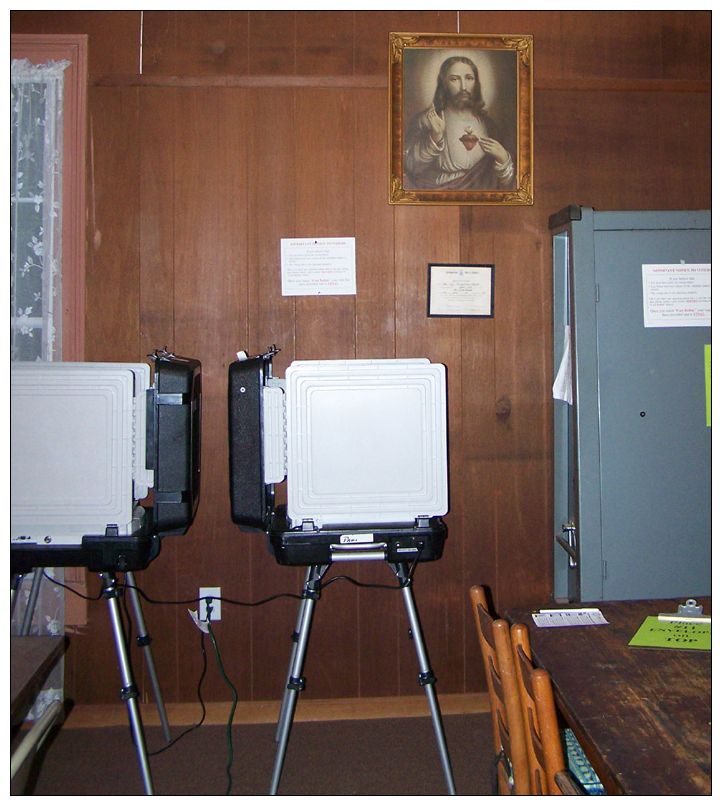
A polling station, with watchful Jesus over the government…EPrata photo