We are in the section of my Advent thirty day flow where we examine PROPHECY, ARRIVAL, and EARLY LIFE of Jesus.
In this section I chose verses that reflect the prophecies that predict His coming. Prophecy warns of coming judgment but it also comforts in that it foretells the holy and wonderful resolution of all things for the believer. This resolution didn’t begin with Jesus’ incarnation as a babe in the manger, it began before the foundation of the world when the God-head held an intra-council discussion and Jesus voluntarily chose to become the sacrificial Lamb.
Thirty days of exalting Jesus through selected verses with pictures representing the prophecy, life, death, resurrection, and Second Coming of our Savior.
History tells us this is exactly what happened, with David’s royal dynasty all but dying out as a result of God’s judgment of His people through Assyria and Babylon. Nevertheless, Isaiah also saw that while the Davidic line would seem to be dead, life would remain within the stump. A shoot—life barely detectable at first—would emerge. But once this shoot went forth, it would become a mighty tree.
He comes forth out of the stem, or stump, of Jesse. When the royal family, that had been as a cedar, was cut down, and only the stump of it left, almost levelled with the ground and lost in the grass of the field (Dan. 4:15), yet it shall sprout again (Job 14:7); nay, it shall grow out of his roots, which are quite buried in the earth, and, like the roots of flowers in the winter, have no stem appearing above ground. The house of David was reduced and brought very low at the time of Christ’s birth, witness the obscurity and poverty of Joseph and Mary. The Messiah was thus to begin his estate of humiliation.
Jesse [Jĕs’se]—jehovah exists or firm. The son of Obed and father of David, and grandson of Boaz and Ruth, and an ancestor of Christ (Ruth 4:17, 22). Jesse had eight sons and two daughters by different wives (1 Sam. 17:12-14, 25). Isaiah speaks of “the stock of Jesse,” a phrase indicating that it was from Jesse the Messiah would come. The humble descent of the Messiah is contrasted with the glorious kingdom He is to have (Isa 11:1).
For all who are led by the Spirit of God are sons of God. For you did not receive the spirit of slavery to fall back into fear, but you have received the Spirit of adoption as sons, by whom we cry, “Abba! Father!” The Spirit himself bears witness with our spirit that we are children of God, and if children, then heirs—heirs of God and fellow heirs with Christ, provided we suffer with him in order that we may also be glorified with him.
What is adoption? “A. Adoption is an act of the free grace of God, in and for his only Son Jesus Christ, whereby all those that are justified are received into the number of his children, have his name put upon them, the Spirit of his Son given to them, are under his fatherly care and dispensations, admitted to all the liberties and privileges of the sons of God, made heirs of all the promises, and fellow-heirs with Christ in glory.“
Think of that for a moment…how great and bountiful this gift is.
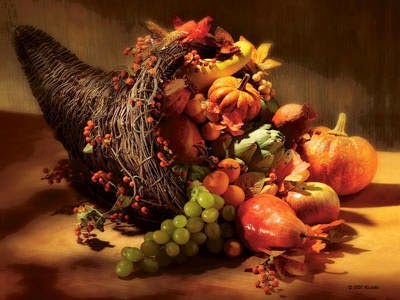
At Thanksgiving we often see the American symbol of the ‘horn of plenty’ also known as the Cornucopia. The horn is filled to overflowing with harvest items from this time of year, such as this depiction from American Greetings freebies:
Adoption is an act of the free grace of God, in and for his only Son Jesus Christ, whereby all those that are justified are given gifts from HIS harvest of plenty. Picture the overflowing cornucopia of plenty from Jesus with His harvest treasures:
–received into the number of his children, –have his name put upon them, –the Spirit of his Son given to them, –are under his fatherly care and dispensations, –admitted to all the liberties and privileges of the sons of God, –made heirs of all the promises, and –fellow-heirs with Christ in glory.
All Christians have these and so much more to be thankful for. I know I am grateful for the opportunity to be grateful to Jesus forever.
Angels figure very, very prominently in the NT. People don’t really know this, or they overlook angels in the created order. At the other end of the scale, some are so preoccupied with angels they nearly fall into angel worship.
With Christmas coming up, we will be singing about angels. “Angels We Have Heard on High,” and “Hark the Herald Angels Sing,” and “It Came Upon A Midnight Clear” come to mind.
Once you start studying angels, you realize how frequently they are mentioned in the New Testament. And as for the nativity story, they figure prominently, making many appearances!
There’s the myriad of angels who appeared to the shepherds on the field at night of Jesus birth. The angel Gabriel appeared to Mary, then to Zacharias. An angel appeared to Joseph in a dream. An angel later appeared to Joseph in a dream another time, and warned him to take Mary and Jesus to Egypt.
I’ll be taking a look into angels over the next few days:
What do RC Sproul and John MacArthur have to say about angels?
I watched this happy video of a puppy waiting for his boy to return home from school. I’d planned to put it on my other blog as a happy little pick-me-up. But it’s almost impossible for me to see anything and not make a spiritual application, lol. So here it is. First, the happy puppy:
Awww!! So cute! Here is the question I ask us all, myself included. Are we a puppy? Do we show obvious and generous and committed love to people? Do we rush to pick up their burdens? Are we excited to see them? To the point of eagerly waiting?
Do we patiently wait for the Lord’s Day then joyfully bound into church with expectation of ‘seeing’ the Master? Are we excited for hymn singing and fellowship among the brethren?
Just sayin’
“Beloved, let us love one another, for love is from God, and whoever loves has been born of God and knows God.” (1 John 4:7)
“They were continually devoting themselves to the apostles’ teaching and to fellowship, to the breaking of bread and to prayer. (Acts 2:42).
“Bear one another’s burdens, and so fulfill the law of Christ.” (Galatians 6:2)
“For I long to see you, that I may impart unto you some spiritual gift, to the end ye may be established;” (Romans 1:11)
I am a literacy educator in a lower elementary school. I am also a writer. I am an editor. And I have been a voracious reader since I read “Dick and Jane“.
I love words, everything about words. Words have great impact. Nothing will convince me otherwise.
I read an interesting list of points an author made about John Bunyan’s conversion. John Bunyan was the writer of Pilgrim’s Progress, a book many say is the most important book in English ever written, apart from the Bible. It is without doubt a literary masterpiece. It has stood the test of time since its publication in 1678. It is regarded as one of the most significant works of religious English literature in history. And the man who wrote it was raised as an atheist.
“John Bunyan had no family influences encouraging him to become a Christian. … In June 1644 when he was 16 his mother passed away and four weeks later his sister died. Eight weeks after his mother’s death his father remarried and in 8 months his wife gave birth to a boy whom his Royalist father named ‘Charles’. Four months earlier John had left home and had joined the Parliamentary Army fighting against King Charles. There was little affection between son and father. How then did John Bunyan become a Christian? There were ten factors which all played their part, great and small:”
One of these factors caught my attention-
Bunyan was stirred by the godly conversation of Christians. He would work in Bedford and eat his bread with some Christian women who tailored their conversation for his ears. They talked of their own sin, the new birth, and the love of Christ. Bunyan listened intently and later wrote, ‘They spoke as if joy was making them speak. They were to me as if they had found a new world,’ and he often sought them out and sat with them.
‘they tailored their conversation for his ears.’ How important it is, to speak of Jesus in truth for known hearers and unknown hearers! The women must have seen the Spirit working in Bunyan, and they made a choice to and selflessly not speak of the carnal or mundane or the personal, but of the joy of His grace!
They were living this:
Let your speech always be gracious, seasoned with salt, so that you may know how you ought to answer each person. (Colossians 4:6)
Gill’s Exposition says of the Colossians verse,
“let grace be the subject matter of your speech and conversation. When saints meet together they should converse with each other about the work of grace upon their souls, how it was begun, and how it has been carried on, and in what case it now is; they should talk of the great things and wonders of grace, which God has done for them, which would be both comfortable and edifying to them, and make for the glory of the grace of God”
Parents carry a pulpit with them. And from it, thousands of times a day, we preach a sermon to our kids. Whether the sermon is a good one or a bad one, we can be sure of this one thing.
Whether we are preachers exhorting in church, parents teaching our children, or two simple Puritan Christian ladies serving lunch to an obviously tortured soul in John Bunyan, we have the privilege and the responsibility to speak ‘as if joy was making us speak.’
What glory it brings the Lord when we intentionally speak of the riches of His grace. Hearers known and unknown to us, Christian and perishing, listen to us and our Spirit-carried words,
For we are a fragrance of Christ to God among those who are being saved and among those who are perishing; to the one an aroma from death to death, to the other an aroma from life to life. (2 Corinthians 2:16)
For John Bunyan, the ladies’ words were the aroma of life to life (‘he often sought them out and sat with them‘). Therefore season your conversation with love, joy, and salt, and watch with admiration and joy where He carries your words. For we all have a pulpit.
For from him and through him and to him are all things. To him be glory forever. Amen. (Romans 11:36)
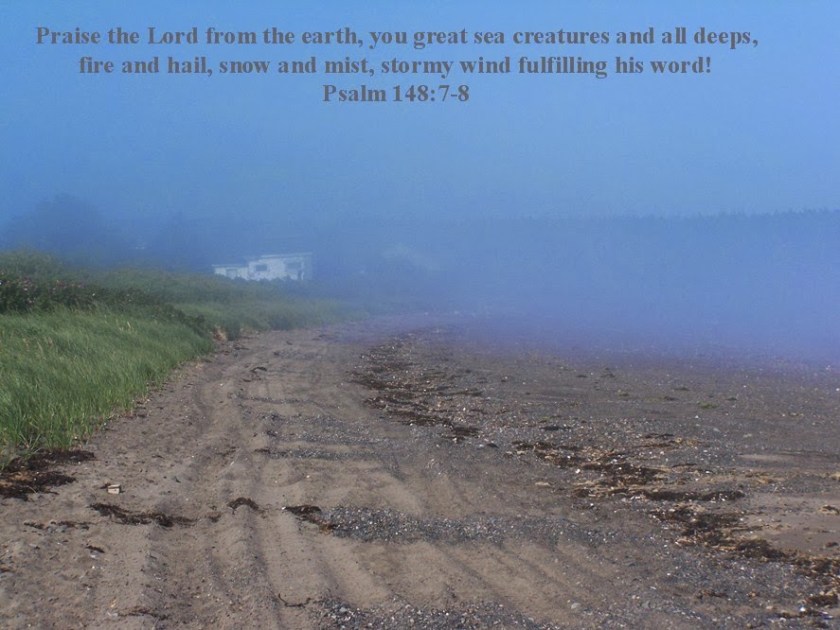
Isn’t it comforting to know that God ordains every single thing that happens, even every droplet in the fog bank rolling over the beach roses at the easternmost point of a nation.
In the beginning God created the heavens and the earth. Genesis 1:1
In the late 1980s I was inspired by the movie Shirley Valentine, a film that depicted a middle-aged London wife unhappy with her boring husband and her dreary life. “I want to sip wine in the place where the grape is grown” Shirley had said. So she chucked her husband and her life and jetted off to sunny Greece, swam topless, had an affair, and decided to stay. I guess she liked the wine better than her husband.
Vineyard, Chiusi, Tuscany. EPrata photo
I was very much taken with the notion of changing one’s life. I was entranced by Shirley’s life mantra, of ‘sipping wine in the place where the grape is grown’. I had tried a conventional life, but my husband had chucked me, I was saddled with a house in a dreary climate and three jobs to pay for it. I wanted more. Sipping wine in places where it’s grown was certainly not the dying mill city of snowy Maine. It bespoke of gentle Tuscan hillsides, green California dreams, or Greek whitewashed stucco. What a goal, Shirley, what a goal.
I went to wine places. California, Tuscany, South of France, rolling hills and grape vines abounding. But wine was just wine and the problem was the same. I met my goal. It was empty.
I searched with my heart how to cheer my body with wine—my heart still guiding me with wisdom—and how to lay hold on folly, till I might see what was good for the children of man to do under heaven during the few days of their life. … Ecclesiastes 2:3
What was the meaning of life? Where was permanence, solidity, something that would not disappear in a breath? Something that would give lasting joy, meaning, and purpose? What is man’s chief end??
Then I considered all that my hands had done and the toil I had expended in doing it, and behold, all was vanity and a striving after wind, and there was nothing to be gained under the sun. (Ecclesiastes 2:2-4, 11).
Question. 1. What is the chief end of man? Answer. Man’s chief end is to glorify God, and to enjoy him for ever. Westminster Shorter Catechism
Here are two ends of life specified. 1. The glorifying of God. 2. The enjoying of God.
First. The glorifying of God, 1 Pet. 4:11. “That God in all things may be glorified.” The glory of God is a silver thread which must run through all our actions. l Cor. 10:31. “Whether therefore ye eat or drink, or whatsoever ye do, do all to the glory of God.”
Everything works to some end in things natural and artificial; now, man being a rational creature, must propose some end to himself, and that should be, that he may lift up God in the world. He had better lose his life than the end of his living.
The great truth asserted is that the end of every man’s living should be to glorify God. Glorifying God has respect to all the persons in the Trinity; it respects God the Father who gave us life; God the Son, who lost his life for us; and God the Holy Ghost, who produces a new life in us; we must bring glory to the whole Trinity.
Q. What is it to glorify God? A. Glorifying God consists in four things: 1. Appreciation, 2. Adoration, 3. Affection, 4. Subjection. This is the yearly rent we pay to the crown of heaven.
Watson continued in his sermon to explain what and how to appreciate, adore, love, and submit to God.
King Solomon, who wrote Ecclesiastes concludes with the eternal wisdom:
Now all has been heard; here is the conclusion of the matter: Fear God and keep his commandments, for this is the duty of every human being. (Ecclesiastes 12:13).
Wine is vanity, travel is vanity. All we do when we relocate is bring our depravity with us. We are the problem. Godless, we are adrift in a sea of evil, wafting from one vain flurry to another. Drifting as dust motes upon an acid air, we leave evil, bring evil, and expire as evil. We believe ourselves to be maidens of rosy blush and coy innocence, when we are simply mud mounds cast upon miry shores. Godless, we are drenched with corruption.
The Lord saw that the wickedness of man was great in the earth, and that every intention of the thoughts of his heart was only evil continually. And God saw the earth, and behold, it was corrupt, for all flesh had corrupted their way on the earth. (Genesis 6:5,12).
When we are saved by His grace through faith, we are cleansed, our sin nature is given a Helper. We are dressed in white robes and stood on our feet, no longer to crawl in the dust like the serpent. We are given a will and testament that promises eternal peace, treasures, crowns, and dwellings in glory with the Savior. Our goal shifts to one of giving Him glory and enjoying Him forever.
I was listening to a Grace Community Church Question and Answer session. I always appreciate how John MacArthur can sum up complex theological thoughts and issues so succinctly. I also enjoy the variety of questions. There came a question from what sounded like a very young boy.
Q. [W]why didn’t Jesus stop Eve at the garden of Eden when she ate the fruit? Like, I mean, pow, He can just stop it like that. Why didn’t He?
The audience laughed in delight at the boy’s voice, obviously filled with pique and awe, and the profundity of his query. The answer was equally profound. Follow the link above to listen or read.
I got to thinking more about that moment. We often field a question such as that one. We also tend to ask why didn’t God erase Adam and Eve and start humankind over again? But it occurred to me that this next question isn’t always asked, ‘After the Fall, why did God continue to reveal Himself?’
After the Fall He could have turned His back on humans, and returned to His perfect communion within the Trinity. He could have shrugged, left us to our own devices on earth all our lives and then pow, when we die we wake up in hell, not knowing it even existed.
God didn’t do that.
We often field the question, ‘If God is so loving why does he send people to hell?’ He does that so that His power and holiness and justice and righteousness can be magnified. But He doesn’t do so as a bait and switch or a trick. He has revealed Himself to us in His word, in His creation, in His Son, and in His elect through the Spirit. They know hell exists. They know they deserve to go there. (Romans 1:21-23).
Our God, your God whether you believe He exists or not, loves His world and continues to work His sovereign plan of salvation in it upon those whom He has foreknown. He will be glorified. (Isaiah 49:3, Ezekiel 28:22, Haggai 1:8, John 12:28).
He will be glorified. And He chose to do it starting with a snake, a piece of fruit, and a woman.
Therefore glorify the LORD in the east. Extol the name of the LORD, the God of Israel in the islands of the sea. (Isaiah 24:15).
Growing up in Rhode Island in the 1960s was a fun experience. The nation’s smallest state is beautiful and the ocean and Narragansett Bay is never far from anyone who lives there. We happened to live just a few miles from the ocean and most Sundays we took a drive south to Saunderstown, crossed the Jamestown bridge, and then took the ferry to Newport. The ferry was a blast.
Newport is home to all those Jacob Astor mansions from The Gilded Age. Dad would drive the kids and mom around the island on Ocean Drive past all the mansions, past the smaller mansions on the water’s edge with their lovely lawns and rocky outcrops reaching for the sea, and then we’d have a picnic by the park and watch the boats
There was no Newport Bridge at that time. You had to take the ferry. On the ferry, we passed boats, the islands with lighthouses, and other sights. One sight always captured my attention.
Clingstone is a house built in 1905, perched atop a small, rocky island in an island group called “The Dumplings” in Narragansett Bay, near Jamestown, Rhode Island. It withstood the devastating 1938 Hurricane, (though was damaged) faced other hurricanes, storms, decay, renovation, and more. The house is known by locals as “The House on a Rock”.
Even to my young eyes the house looked strong. I mean, it’s built on a rock! I often wondered what it was like to live there.
I don’t have to wonder any more what it is like to build my house on the rock. In His grace, He saved me and taught me to cling to the rock. I have my own Clingstone now. Isn’t it funny how life goes. Jesus, who was so far from my mind for over 40 years, is my All in All now. The little girl with big eyes looking at the House on a Rock, the Rock all for her own now and a house that will never fall.
The verses below are familiar but please slow yourself and read them carefully. Then really think about it for a minute, before you go on to other things. The verses are soul-soothing. Be encouraged.
Everyone then who hears these words of mine and does them will be like a wise man who built his house on the rock. 25And the rain fell, and the floods came, and the winds blew and beat on that house, but it did not fall, because it had been founded on the rock. (Matthew 7:24-25).








 the-end-time.org