Posted in encouragement, theology

“To the city of refuge!”

By Elizabeth Prata

This week I’m posting a few essays about cities. Yesterday I wrote about “The Pride of Cities.” Today let’s learn about the biblical Cities of Refuge.

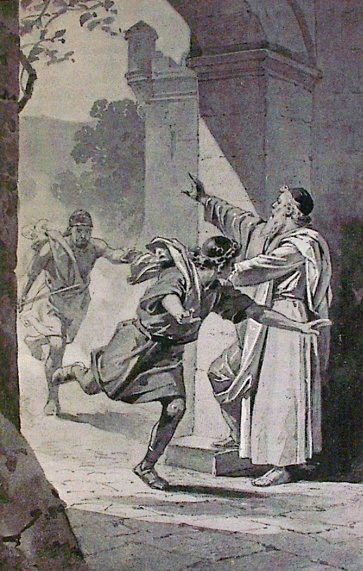
Left, Illustrator of Charles Foster, The Story of the Bible, 1884, “City of Refuge”.

Asylum. Sanctuary Cities. Manslaughter. Innocent. These are judicial terms that are not new, the men of Bible times knew them and we know these terms today.

Our God is a God of justice. He knows what is in a man, and it’s sin. He knows we hate and that we murder. Murder happened early on in human history, when Cain slew Abel in Genesis 4. And sin was only introduced in Chapter 3.

He knows that when blood is shed, blood must pay. Therefore, God made it possible for wrongful shedding of human blood to be avenged. In the Old Testament, the nearest relative of the wrongfully killed person had legal standing to hunt the murderer down and kill him with no repercussions to himself. (Numbers 35:19, 21, Deuteronomy 19:12).

Numbers 35:19, The blood avenger himself shall put the murderer to death; he shall put him to death when he meets him.

Numbers 35:21, or if he struck him down with his hand in enmity, and as a result he died, the one who struck him shall surely be put to death; he is a murderer; the blood avenger shall put the murderer to death when he meets him.

Deuteronomy 19:12, then the elders of his city shall send and take him from there and give him over into the hand of the avenger of blood, that he may die.

However, there are times when blood is shed accidentally, or unknowingly. This person is called a “Manslayer” as opposed to the aforementioned ‘murderer’. If a man accidentally killed another man, God made a way for that person to be able to flee to a City of Refuge, so called in the Bible, and hurl himself upon the judicial investigation of the priests or elders of that city. Here’s how Charles Spurgeon explains it:

You will remember that when the children of Israel were settled in Canaan, God ordained that they should set apart certain cities to be called the Cities of Refuge, that to these the man-slayer might flee for security. If he killed another unawares, and had no malice aforethought, he might flee at once to the City of Refuge; and if he could enter its gates before the avenger of blood should overtake him, he would be secure.

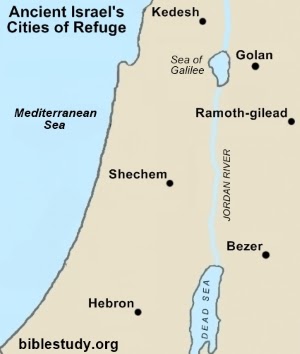
Cities of Refuge were carefully selected at strategic locations so that no person living in the Land would have to run far to access it. They were equally spread out. A person anywhere in the Land could reach them in a day or less. The Cities of Refuge were open to strangers, too.

Cities of Refuge (source Smith’s Bible Dictionary) were six Levitical cities specially chosen for refuge to the involuntary homicide until released from banishment by the death of the high priest. (Numbers 35:6,13,15; Joshua 20:2,7,9) There were three on each side of Jordan.

Source

Kedesh, in Naphtali. (1 Chronicles 6:76)

Shechem, in Mount Ephraim. (Joshua 21:21; 1 Chronicles 6:67; 2 Chronicles 10:1)

Hebron, in Judah. (Joshua 21:13; 2 Samuel 5:5; 1 Chronicles 6:55; 29:27; 2 Chronicles 11:10)

On the east side of Jordan –

Bezer in the Wilderness, in the tribe of Reuben, in the plains of Moab. (4:43; Joshua 20:8; 21:36).

Ramoth-Gilead, in the tribe of Gad. (4:43; Joshua 21:38; 1 Kings 22:3)

Goolan in Bashan, in the half-tribe of Manasseh. (4:43; Joshua 21:27; 1 Chronicles 6:71)

What you had to do, if, say you were chopping wood and your axe head flew off and killed the man next to you, is run to the city. Upon arrival, you would have to tell the elders what happened. You’d have to make it there before the ‘avenger of blood’, usually the nearest next of kin to the dead man, gets you and kills you.

The elders would provide you a place to stay and food, until they met to discuss your case.

If the case is adjudicated as accidental, you would be allowed to remain in the city of refuge freely until the High Priest died. After that you could go home. If you left the city of refuge prior to the death of the High Priest, the avenger of blood could perform the death penalty without penalty to himself.

I find all this amazing, that God provided opportunities for justice in these cases. What I find even more fascinating is just how seriously the Israelites took the cities of refuge.

These cities of refuge were a fact, real cities with real roads leading up to them. The roads leading up to it would need to be maintained. They erected signs at intervals so that the fleeing man-slayer would know where to go. They maintained the signs regularly also. Spurgeon again from the same link as above:

We are told by the rabbis that once in the year, or oftener, the magistrates of the district were accustomed to survey the high roads which led to these cities. They carefully gathered up all the stones, and took the greatest possible precautions that there should be no stumbling-blocks in the way which might cause the poor fugitive to fall, or might by any means impede him in his hasty course. We hear, moreover, and we believe the tradition to be grounded in fact, that all along the road there were hand-posts with the word “Refuge” written very legibly upon them, so that when the fugitive came to a crossroad, he might not need to question for a single moment which was the way of escape; but seeing the well-known word “Refuge,” he kept on his breathless and headlong course until he had entered the suburb of the City of Refuge, and he was then at once completely safe. Spurgeon

It’s true about the roads and the signs, not just tradition. This is from the Jewish Encyclopedia, written after Spurgeon preached that message:

Corresponding to the care for the proper location of these cities were the other ordinances referring to them. The roads leading to them were marked by sign-posts at the crossroads, with the inscription “Miḳlaṭ” (Refuge); the roads were very broad—32 ells, twice the regulation width—smooth and level, in order that the fugitive might not be hindered in any way (Sifre l.c.; Tosef. l.c. 5; Mak. 10b; B. B. 100b). The cities chosen must be neither too small nor too large: in the former case a scarcity of food might arise, and the refugee might consequently be forced to leave his Asylum and imperil himself; in the latter case the crowds of strangers would make it easy for the avenger of blood to enter undetected. There were other measures of precaution in favor of the refugee. Dealing in weapons or implements of the chase was forbidden in the cities of refuge. Furthermore they had to be situated in a populous district, so that a violent attack by the avenger of blood might be repelled, if necessary. Jewish Encyclopedia, 1906

God is incredible the way He set up society in those days. I look forward to the real, actual Millennial Kingdom, the 1000 year kingdom when God fulfills His promises to Israel and we live with Him on earth- Jesus as King and David ruling as under-King.

Meanwhile, the spiritual lesson is this: though there are sanctuary cities on earth today, there is one city to which every person on earth should flee. Or sins are high crimes against a Most Holy God. We all deserve the death penalty. However, if we flee to Jesus the High Priest, we may throw ourselves at His feet and plead His blood to cover our sins. If we repent and trust Him as Savior, He will forgive the crime and we will escape the penalty- which is death.

And since Jesus as High Priest never dies, we will live without fear of death forever.

Hallelujah! 

Posted in encouragement, Uncategorized

The truth about grace

By Elizabeth Prata

Grace is a concept. But it’s not just a concept. Grace is a gift, but it’s not just a gift. Grace is a force. Think about how powerful grace is. Think about its power as it exists in Jesus, as it is delivered to the saints, its common state as it covers the world, and its special state as it enlivens the saints to do our work.

Here is an excerpt about grace from a sermon from John MacArthur called, Strength Perfected in Weakness, looking at this verse: 2 Corinthians 12:7-10.

or because of these surpassingly great revelations. Therefore, in order to keep me from becoming conceited, I was given a thorn in my flesh, a messenger of Satan, to torment me. 8 Three times I pleaded with the Lord to take it away from me. 9 But he said to me, “My grace is sufficient for you, for my power is made perfect in weakness.” Therefore I will boast all the more gladly about my weaknesses, so that Christ’s power may rest on me. 10 That is why, for Christ’s sake, I delight in weaknesses, in insults, in hardships, in persecutions, in difficulties. For when I am weak, then I am strong.

In speaking of the linchpin part of the passage, ‘my grace is sufficient for you’, MacArthur said,

But grace is not just an inert sort of concept; it is a force, it is a power. It is a power that transforms us. It is a power that awakens us from sleep. It is a power that gives us life in the midst of death. It is a power that is dynamic enough to transform us from the kingdom of darkness to the kingdom of God’s dear Son. It is the power that saves us. It is the power that keeps us, the power that enables us, the power that sanctifies us, and the power that one day will glorify us. You have to look at grace as a force, a divine force that God pours out into the lives of His people at all points to grant them all that they need to be all that He desires.

Grace is a gift.
Grace is a state.
and…
Grace is a POWER.

Posted in clouds, encouragement, grace

Creation Grace: Clouds

By Elizabeth Prata

Look in the Bible for how many times clouds are mentioned. The word is used for different reasons and in different ways. It is fun to think of His grace in giving us the literal clouds, which shield us from the hot sun, or which gives us rain. The variety and wonder of the different shapes of clouds: nacreous, cumulus, tubular, cirrus, etc, and the different reasons for clouds, both literal and symbolic, is a study in itself.

The best reason to think of clouds is that Jesus will return in one!

Posted in body, encouragement, eternity, glorified, victory

What will it be like to be glorified?

By Elizabeth Prata

I’m 63 years old. When I was young I said I’d never prattle on about my ailments, like a great-aunt Tilly or a Grandpa Joe.

But now the doctor said I have bad arthritis in my knees, my feet swell, my eyes get so dry, my digestion is sensitive, and I get these headaches…

Ack. And my bodily griefs are piddling compared to some who endure disease, chronic pain, and trauma by fire or accident. Anyway, I think so often about seeing Jesus. My prayers usually end with asking, “Is this the day? Lord, soon come!”

After the promise and excitement and joy of seeing Jesus, the next part I’m looking forward to is the new body.

In a moment, in the twinkling of an eye, at the last trumpet. For the trumpet will sound, and the dead will be raised imperishable, and we shall be changed. (1 Corinthians 15:52)

OK, that’s a great start. We shall be changed. Hmmm. Changed how?

When the perishable puts on the imperishable, and the mortal puts on immortality, then shall come to pass the saying that is written: “Death is swallowed up in victory.” (1 Corinthians 15:53).

Ok, we will be immortal. That’s a fact that a lot of unsaved people do not know and a lot of saved people do not ponder enough. All peoples who have ever lived will be immortal. The unsaved dead will be raised for eternal punishment and the saved dead will be raised for eternal joy and communion with the Savior. In new bodies!

Matthew Henry Commentary says,

He assigns the reason of this change (v. 53): For this corruptible must put on incorruption, and this mortal must put on immortality. How otherwise could the man be a fit inhabitant of the incorruptible regions, or be fitted to possess the eternal inheritance? How can that which is corruptible and mortal enjoy what is incorruptible, permanent, and immortal? This corruptible body must be made incorruptible, this mortal body must be changed into immortal, that the man may be capable of enjoying the happiness designed for him.

Henry, M. (1994). Matthew Henry’s commentary on the whole Bible: complete and unabridged in one volume (p. 2276). Peabody: Hendrickson.

Further, the verse says we will be imperishable. This means we will not only be eternal but we will not even have to worry about our bodies. They cannot perish. Imagine living without worrying about the end of our lives?! Take death off the table and just imagine how much of a relief it will be.

He will wipe away every tear from their eyes, and death shall be no more, neither shall there be mourning, nor crying, nor pain anymore, for the former things have passed away. (Revelation 21:4)

Our bodies and our hearts and our minds will no longer feel any kind of pain. Not even the memory of it.

In 2 Corinthians 5:8, Paul said, “We … would prefer to be away from the body and at home with the Lord.” When we die, we’re home. Imagine a small boy who falls asleep in the back seat of the car. When the family gets home, his father picks him up and carries him into the house. When he wakes up, he’s home. That’s what will happen for God’s children.

Death is glory. It is paradise, as Jesus said. In Philippians 1:21, Paul wrote that “to die is gain.” When we die, we will gain imperishable, glorified, spiritual bodies (1 Cor 15:42–44) and be like Jesus in this way (1 Cor 15:49). We will know God and each other as we are known (1 Cor 13:12). And we will eat of the tree of life and live forever (Rev 22).

Barry, J. D., Heiser, M. S., Custis, M., Mangum, D., & Whitehead, M. M. (2012). Faithlife Study Bible. Bellingham, WA: Logos Bible Software.

As for the rest, will we have ‘magical’ powers? Matter will be different. Jesus appeared to the huddled disciples behind a locked door in a secure room. How does THAT happen? Will we be able to appear in Canada then Chile then Japan in the blink of an eye, transporting ourselves from one place to another, like Philip who went from Samaria to Azotus in a lateral rapture? (Acts 8:39-40).

Time will tell what the mechanics of our glorified body will be like. For now, rejoice in the fact that if you are saved by the blood of the Lamb, your immortal body will be fitted for bliss, eternally.

Posted in encouragement, theology

Encouragement: Keeping our conscience tender

By Elizabeth Prata

I hope this fine late spring week has offered you beautiful glimpses of God’s creative intellect and His wonderful power. Once, I saw a rainbow extending from left to right directly in front of me, and for the first time I even saw the end of the rainbow pooling in colors right there on the ground. (No pot of gold, sorry 😉

I’m semi-not looking forward to the weather easing into summer. Summers in Georgia can be brutal like a hot box. But the upside is that school is out and I can stay home and read and write and blog and podcast and listen to sermons and nap!

We always enjoy the march of the seasons. “He appointed the moon for seasons: the sun knoweth his going down.” (Psalm 104:19, KJV).

Wherever we are in the world, reading this blog, we see and understand the times and seasons. In spring, we look for the robin, the crocus, the ladyslipper. In summer we look for puffy clouds, rain showers, cicadas. The orderliness and consistency of the seasons since His ordination of them is a comfort. Yet even in Jeremiah 8:7 it is said of the seasons, meaning HIS season,

Yes, the stork in the heaven knows her appointed times; and the turtle and the crane and the swallow observe the time of their coming; but my people know not the judgment of the LORD.”

In the natural history of Israel, Barnes notes explains, “Jeremiah appeals to the obedience which migratory birds render to the law of their natures. The “stork” arrives about March 21, and after a six weeks’ halt departs for the north of Europe. It takes its flight by day, at a vast height in the air (“in the heaven”). The appearance of the “turtle-dove” is one of the pleasant signs of the approach of spring.”

As for the part of the Jeremiah verse which speaks to His judgments, Matthew Henry holds sway here:

“Sin is backsliding; it is going back from the way that leads to life, to that which leads to destruction. They would not attend to the warning of conscience. They did not take the first step towards repentance: true repentance begins in serious inquiry as to what we have done, from conviction that we have done amiss. They would not attend to the ways of providence, nor understand the voice of God in them, ver. 7.

They know not how to improve the seasons of grace, which God affords. They would not attend to the written word. Many enjoy abundance of the means of grace, have Bibles and ministers, but they have them in vain. They will soon be ashamed of their devices. The pretenders to wisdom were the priests and the false prophets. They flattered people in sin, and so flattered them into destruction, silencing their fears and complaints with, All is well. Selfish teachers may promise peace when there is no peace; and thus men encourage each other in committing evil; but in the day of visitation they will have no refuge to flee unto.”

How perfect and prescient His Word is! Let us enjoy the seasons of grace that Jesus offers His children.

In Numbers, where God is dispensing instruction to the Priesthood, God said, “I am giving you the service of the priesthood as a gift.” (Numbers 18:7b). It is a gift to serve Him. It is a gift to dedicate one’s life to Him. It is a gift to be close to Him. It was a gift to the people who needed priests. He also gave the Prophets as a gift and in the New Testament, the gift of prophecy/preaching is also a gift. (1 Corinthians 12:10; Romans 12:6).

I feel deeply for Jeremiah the Prophet, who was known as The Weeping Prophet. Jeremiah lived in a time when the People’s pride was dragging them backward into sin and away from the LORD. (Jeremiah 13:15-27; “Pride precedes captivity”.) He lived when the people’s sins had piled up. Jeremiah was the last prophet sent to preach to the Southern Kingdom. The searing effects of their sins had hardened them so much that no one ever listened to Jeremiah. He never had one convert. “Yet they did not obey or incline their ear, but followed the counsels and the dictates of their evil hearts, and went backward and not forward.” (Jeremiah 7:24). Seasons of sin means seasons of bondage.

We speak of His love these days and His joy, peace in knowing Him. All these things are good to have and feel and be. But where is the grief? Where are our weeping prophets (Christians) today? Do we repent in grief for our sins?

Our conscience is a gift too. Let us keep it in good order in every season.

Meanwhile, keep up the good fight, persevere. Repent of the big things and the little things. Keep a tender conscience. Enjoy the gift of His Spirit and His people, and His church, and His word. Soon enough, our faith will be made sight, and we shall see Him as He is. What a day that will be!

hope 7
EPrata photo

Further resources:

John MacArthur, book, The Vanishing Conscience

RC Sproul 4-min devotional, Don’t Waste Your Conscience

Monergism, selections on the conscience by Puritans, essay by JI Packer: The Puritan Conscience

Posted in encouragement, Uncategorized

An encouragement on fixing our eyes on Jesus

By Elizabeth Prata

If you want to look like Jesus, look at Jesus.

I focused on the phrase “fix your eyes upon Jesus” from Hebrews 12:2. I looked up the word “fix” and the Strong’s says

872 aphoráō (from 575 /apó, “away from” and 3708 /horáō, “see”) – properly, “looking away from all else, to fix one’s gaze upon” (Abbott-Smith).

How helpful. I should not glance, not peek, not glimpse, but FIX my GAZE upon him, looking away from all else and steadily drinking in all that He is.

Looking away from all else…what does that mean? It means not being attached to the things of this world. Your country, your job, your family, your spouse, your car, your ‘stuff’, your health, is not more important than Jesus. He is the source and the giver of those things. Fix your eyes on Him.

We need to spend more time with Jesus to look more like Him. Moses only got to see God’s ‘back’ and His face after being with God was so bright it had to be veiled. We have the privilege of looking at Jesus’ “face” as it were, through His word. I want my face to be shining, to have my being conformed to Him, to have my mind transformed. But it won’t happen unless I read the Bible. I must look away from all other distractions and FIX my GAZE on Jesus. A Bible skim won’t even do.

We become like what we behold.

Posted in encouragement, Uncategorized

Kay Cude poetry: Our Fortress Prevails

Poetry by Kay Cude. Used with permission.  Right click on image to open larger in new tab. Artist’s statement below.

I keep returning to our (me!!) needing to “remember” God’s promises and provision. GOD THE I AM is the only fortress in Whom we find a righteous protector, defender and provider. He is the only place of eternal refuge from the world’s continuing tragedies and chaos. He is the stronghold Who is and Who will provide peace, wisdom, understanding, instruction and endurance.

OUR FORTRESS PREVAILS

Posted in creation, encouragement, fall, God, seasons

God’s glory in creation: awe-inspiring and beautiful

By Elizabeth Prata

The spring months are among my favorites of the year. The hot-hot-hot summer is not here yet. The skies display clarity, before summer haze sets in. The stars are bright at night. There is a new vigor and freshness of the days and a crispness to the evening where it feels just so good to draw up your blanket and cuddle.

The Lord ordained the seasons in their progressions since the very beginnings. The cycle is one that is both useful and beautiful. He could have made everything gray and rectangular. But He didn’t. The diversity of foods, lands, stars, trees, and seasonal changes is gloriously gorgeous. The display of leaves during fall, the harvest bounty, the stars glittering above in the clear night sky…all useful, yes, for signs and growing and timing … but beautiful too.

Our God is creative and His works are to be praised.

And God said, “Let there be lights in the expanse of the heavens to separate the day from the night. And let them be for signs and for seasons, and for days and years, (Genesis 1:14)

EPrata photo

While the earth remains, seedtime and harvest, cold and heat, summer and winter, day and night, shall not cease.” (Genesis 8:22)

For everything there is a season, and a time for every matter under heaven: a time to be born, and a time to die; a time to plant, and a time to pluck up what is planted; (Ecclesiastes 3:1-2).

EPrata photo

He made the moon to mark the seasons; the sun knows its time for setting. (Psalm 104:19)

Six days you shall work, but on the seventh day you shall rest. In plowing time and in harvest you shall rest. (Exodus 34:21)

EPrata photo

He has made everything beautiful in its time. Also, he has put eternity into man’s heart, yet so that he cannot find out what God has done from the beginning to the end. (Ecclesiastes 3:11)

EPrata photo
Posted in encouragement, Uncategorized

A reminder about hope

By Elizabeth Prata

Blessed be the God and Father of our Lord Jesus Christ! According to his great mercy, he has caused us to be born again to a living hope through the resurrection of Jesus Christ from the dead, (1 Peter 1:3)

Well that says a lot! Each phrase is an encouragement. I’m focusing on living hope today. Our living hope is not a dead hope. It is not surmise, speculation, or empty ‘what if’. It is a living hope because we are IN Christ and He is living and He is our Hope.

Gill’s Commentary says

Saints are both begotten again to the grace of hope, and to the glory which that grace is waiting for”. Our hope is because of Christ, it is in Christ and it is Christ. It is a living hope

hope