Now before the Feast of the Passover, when Jesus knew that his hour had come to depart out of this world to the Father, having loved his own who were in the world, he loved them to the end. (John 13:1)
‘To the end’ does not mean to the end of Jesus’ life. To the end does not have a finite, temporal quality here. ‘To the end’ in Greek means to the end of where love ends, an infinite quality. Strong’s says,
It is well-illustrated with the old pirate’s telescope, unfolding (extending out) one stage at a time to function at full-strength (capacity effectiveness).
So to the end doesn’t mean to the end of Jesus life, it means to full extension or furthest capacity. This, of course, is an infinite love, the end of which is only contained in Jesus the finite God-man, who is infinite.
As you go throughout your day, realize that this love was not offered to or lavished on just the disciples, but it’s also lavished on you and me. It’s given to all who believe. Such love is beyond comprehension, yet we experience it daily.
No matter what you are going through or experiencing, Jesus loves us ‘to the end’, to the fullest capacity that it is possible to love. What comfort.
Nevertheless, many even of the authorities believed in him, but for fear of the Pharisees they did not confess it, so that they would not be put out of the synagogue; for they loved the glory that comes from man more than the glory that comes from God. (John 12:42-43)
Isn’t that such a sad statement. The verse in context is speaking of Jesus and the wonderful things He had been doing. He had performed signs and wonders in the presence of the Jewish rulers, yet many did not believe. Others believed, yet did not confess it because they coveted man’s glory more than God’s.
I listened to S. Lewis Johnson preach on the Transfiguration of Christ last Saturday on Expositor.fm, the 24-hour expository preaching station. It was an astounding and convicting and beautiful sermon expounding on the moments when Jesus was transfigured into His glory on top of the mountain in front of Peter, John, and James, and was seen talking with Moses and Elijah. Johnson said that he was surprised to learn that though there are many sermons about Jesus’ life, including His birth, His Baptism, His Temptation, His crucifixion, and His Ascension, but not His Transfiguration. It is a greatly neglected moment in Jesus’ life, he said. Johnson opened his sermon, **The Transfiguration of Christ, this way
One of the most astonishing of our Lord’s experiences, the one occasion in which the bright beams of his glory blaze through the sack cloth covering of his humanity, is the transfiguration of Jesus Christ.
In this next portion of the sermon, Johnson stresses the change on the inward man when communing with Jesus.
Matthew’s account stresses the inward. For the word, metamorphoo, which is the word that is used here—we get the English word metamorphosis from it—is a word that refers to the transformation of the essential character or essential being of a person. And the text says, he was transfigured before them. So I think that what is involved here is a glorification of the Son in anticipation of the historical glorification of the Son. In other words, in the way he was transfigured, there is a transfiguration not only of the outward but also of the inward. And you’ll notice, too, that it says his face shone like the sun and his raiment was white as the light. Isn’t that striking? Even his garments took on a different look.
Now I think we all know that when a person is in the presence of God, transformation takes place in that person. Moses was in the mount receiving the law and when he came out his face so shone before the children of Israel that they feared to approach him. And you’ll remember that he had to put a veil on his face, which he took off when he went in again before the Lord. And after he finished speaking with the children of Israel giving the message, he put on the veil again. They were afraid to approach him.
Stephen, who was communing with the Lord even in his death when they were stoning him to death, had a face so they said that looked like the face of an angel. In other words, communion with the Lord Jesus transforms a man’s not only outward look but even his inward being. Paul puts its doctrinally when he says, we all with open face beholding as in a glass the glory of the Lord are changed into the same image and from glory to glory. It is true that communion with the Lord Jesus ennobles the whole man, ennobles his soul, ennobles his appearance, ennobles his gestures, ennobles his habits.
My Prayer:
Lord let our eyes be be transfixed on Jesus always, reading Your word and praying diligently,
Lord, let our inward and outward man be transfigured into His likeness, which is beauty personified, holiness and goodness,
Then let us be translated into glory at Your timing,
Forever to transcend sin, death, and hell, to dwell in eternity with You and Your angels, the Spirit, and the Father.
**Note: the sermon to which I’ve linked is not the exact same sermon of which I had heard. That sermon was called The Son is Transfigured. However I was unable to find that exact sermon, which went into other details I enjoyed hearing about. I emailed and the reply was that sometimes the radio stations RefNet and Expositor.fm have access to some sermons that have not been made public and it’s likely that was one of the sermons I’d heard. For all intents and purposes though, the point remains the same- there are not many sermons on the subject of the Transfiguration, this is a good one, and I urge you to study it from a good and credible preacher and to read the passages yourself and enjoy the insights the Spirit will bring to mind. 🙂
Though once we are saved, we are always saved, (John 10:28, Ephesians 1:13), the verse in Hebrews gives some people trouble.
For it is impossible, in the case of those who have once been enlightened, who have tasted the heavenly gift, and have shared in the Holy Spirit, and have tasted the goodness of the word of God and the powers of the age to come, and then have fallen away, to restore them again to repentance, since they are crucifying once again the Son of God to their own harm and holding him up to contempt. (Hebrews 6:4-6).
Does that mean a saved person can fall away and never be able to be saved again?
Charles Spurgeon did the best job I’ve read on the clarity of the Hebrews verse. See if you agree (or don’t 😉
You know how many passages there are in which it is positively asserted that if a child of God did deliberately and totally apostatize, his restoration would be utterly impossible—not difficult, but impossible. This is one of the greatest proofs of the doctrine of the final perseverance of the saints, since there is no man in a condition in which it is impossible to save him, and yet any man would be in such a state if he apostatized. Therefore true believers shall not apostatize, but shall stand fast, and shall be kept even to the end. Yet, could they totally apostatize, they could never be restored again: the greatest remedy having already failed, there would remain no other. C.H. Spurgeon
It’s Fall here in Georgia. In honor of the (finally!) cooler temperatures, I scheduled a visit to the sunflower/pumpkin patch with my friend. It’s not too far from us, only about 40 minute drive. It’s free to get in, and the only thing you pay for are any pumpkins or sunflower cuttings you might want. It should be a fun morning. I’m envisioning us to grab a coffee, enjoy a nice drive out there, stroll in the crisp air, take LOTS of photos, and have a relaxing drive back.
The previous social engagement I scheduled was with this same friend … last December. Does it seem strange to you that I have social outings only twice per year, or ten months apart? Not to me. It’s normal, and the pace is perfect.
I’m autistic and most weekends and evenings I spend recovering from the day and the week alone at home. In the silence. The bewildering aspects of sociability, the noise of being among people, the nasty surprises like a bell going off or a car alarm blaring, wear on me like I’m cheese on a cheese grater. By the end of the day every last nerve is whittled down, my body is actually throbbing in pain, and I’m near tears.
Not that I don’t enjoy people, I do. Most times I enjoy a witty remark, a pleasant exchange, or just seeing what people wear or what they brought for lunch. I like the people I work with and I love the children. It’s just that by the end of the day it’s sensory overload. I need time to recuperate.
It’s also that I don’t really want to have lengths of time with people. Though it’s true that sometimes I really don’t, other times I think it might be nice to do so. Whether that flickering desire stems from a genuine level of empathy or friendliness, or I’m just succumbing to a social pressure to do something most people enjoy, I don’t know. Being a typical Aspergers person I don’t care. The thought is fleeting and then I’m on to more serious pursuits.
But then…I read things like this in the Bible:
And day by day, attending the temple together and breaking bread in their homes, they received their food with glad and generous hearts, (Acts 2:46)
On the third day there was a wedding at Cana in Galilee, and the mother of Jesus was there. Jesus also was invited to the wedding with his disciples. (John 2:1-2)
And as he reclined at table in his house, many tax collectors and sinners were reclining with Jesus and his disciples, for there were many who followed him. (Mark 2:15).
Six days before the Passover, Jesus came to Bethany, the hometown of Lazarus, whom He had raised from the dead. So they hosted a dinner for Jesus there. Martha served, and Lazarus was among those reclining at the table with Him. (John 12:1-2)
And all who believed were together and had all things in common. (Acts 2:44)
The Bible shows us that there were gatherings in the Lord’s name and friendships and dinners and parties and weddings and banquets. The Bible is strong on gathering together, fellowship with like-minded believers, koinonia, service, hospitality and building each other up. So avoiding any and all gatherings is not an option. Church going and small talk afterward, being a member of a small group study, and joining the occasional all-church gathering is important. I do so because it’s commanded and I seek to honor the Lord. I just wish it wasn’t so painful.
Well, someday it won’t be!
In heaven the fellowship will be without limits, without fears, without any negatives at all. I can’t imagine how it will be to be freed from the distress of social interaction. Talking will be full of meaning because it will center on Jesus without reservation and without error. The sweetness of being together will be fully realized as we visibly see our selves as His body and visibly see Him as the Head.
I suppose I will still have the same autistic brain since He made me this way in the first place. I am guessing that even in heaven there will be those people there who are more gregarious and those who are more shy. We will retain our personality after all, but without the underlying cause being fear, or distress, or anxiety. I’m looking forward to visiting with martyrs, Apostles, heroes, and all the rest of the laypeople who comprise His redeemed church in a sweet fellowship devoid of anything negative and wholly saturated with glory, goodness, and joy.
I love photos and videos that show the microscopic. It’s all God’s creation and to be able to see the smaller things unusually not observed by the unaided eye just gives me a thrill to peek into His smaller creations that are just as magnificent as the Alps or the change of seasons or the constellations. Here is a short clip of things crystallizing. It’s fascinating. Continue reading “The beauty of creation at the microscopic level”→
What were the original languages the Bible was written in? How did we get the Bible? Is the Bible corrupted by men when they were translated?
Good questions!
The Bible was written in two main languages, Hebrew in the Old Testament, and Greek for the New Testament. Two other languages appear briefly. One of them is Aramaic. A few chapters in Ezra and Daniel were originally in Aramaic and one verse in Jeremiah, also.
There are a few words in another, fourth language that appears extremely briefly for a few words in Job, and that’s Ugaritic. The Ugaritic does’t impact the original Bible’s reading and interpreting so much as it does in helping to understand the Hebrew overall.
Two thousand tablets written in Ugaritic were discovered in 1929. The Kingdom of Ugarit was located in Syria, and was a thriving kingdom of the late Bronze Age (1570 – 1200 BC.) It co-existed with the Hebrew tribes and,
The Ugaritic texts offer innumerable literary and religious parallels to biblical literature. The parallels are so rich and in some cases so specific that it is evident that the Ugaritic texts do not merely provide parallels, but belong to a shared or overlapping cultural matrix with the Hebrew Bible. (Source)
The Ugaritic language was almost letter for letter identical to Hebrew, and where the Hebrew word was unknown or difficult to interpret in context, the Ugaritic texts helped as a kind of Rosetta Stone in interpreting the Hebrew biblical word properly.
I’ve been preaching the past couple weeks on forgiveness. In preparing I’ve found Chris Brauns’ work, Unpacking Forgiveness, to be immensely helpful. A position that I have held for awhile now is that forgiveness isn’t simply about us. We don’t forgive someone primarily because we release ourselves from some prison of bitterness. Though that is certainly a benefit—we forgive because God forgave us.
Recently in a coincidence, our pastor explained the same concept, but from a different perspective. We usually focus more on the process and benefits of forgiving others, but what about forgiving ourselves? The scene he was preaching through was from Genesis 45. Joseph is revealing himself to his brothers, who had sold Joseph into slavery 13 years prior. He is reassuring his brothers that he is not angry and will not harm them. Genesis 45:5 says,
And now do not be distressed or angry with yourselves because you sold me here, for God sent me before you to preserve life.
Joseph is a picture of Jesus. Joseph did the unthinkable, he forgave his brothers for selling him into lsavery and conspiring to murder him. Yet … note the part of the verse that says ‘do not be angry with yourselves’. People in the church today have made up this brand new phrase. It’s not anywhere in the Bible. It goes like this- “I know that God has forgiven me, but I just can’t forgive myself.” My pastor had explained it this way,
It’s a phrase that has become very popular in church circles. ‘I know that God of the Universe has forgiven me, big deal. The REAL issue is I just can’t forgive myself.’ I heard someone explain this issue in a way that shines new light, sheds new light on this issue. It made me never want to use the phrase. This is what I heard from one pastor. He said, “If you’re saying that if I know God has forgiven me, but I’m still angry at myself, I still can’t forgive myself, what you’re saying is, the blood of Jesus may be good enough for God, but the blood of Jesus is not good enough for me. I have higher standards than the God of the universe.” This means you have put yourself above God and you have higher standards than God.
Also as an example, let’s say you did something at work, and you got fired. You did it. You did something wrong and you got fired. You say I know it was sinful and I’ve repented. I know God forgave me for this but I lost my job and I’m still mad at myself. I can’t forgive myself for what I did. This is a sign in that moment that the job was actually more important than God. The job had become my God-replacement. I was getting my meaning, my purpose, my worth and value, my joy. Now that I’ve ruined it, I just can’t move on. That would be an evidence that God hasn’t taken first place yet in your life.
Forgiveness is an attribute of God which demands our attention because it’s so integral to the Gospel. Jesus forgives us our original sin unto justification:
He has delivered us from the domain of darkness and transferred us to the kingdom of his beloved Son, in whom we have redemption, the forgiveness of sins. (Colossians 1:13-14).
Jesus forgives us our sins post-salvation when we repent:
If we confess our sins, he is faithful and just to forgive us our sins and to cleanse us from all unrighteousness. (1 John 1:19).
In this verse, we learn about the infinite-ness of forgiveness. Such forgiveness includes riches of His grace (which is infinite), how it is dispensed (lavishly), and that it’s made known to us in all wisdom and insight.
In him we have redemption through his blood, the forgiveness of our trespasses, according to the riches of his grace, which he lavished upon us, in all wisdom and insight making known to us the mystery of his will, according to his purpose, which he set forth in Christ as a plan for the fullness of time, to unite all things in him, things in heaven and things on earth. (Ephesians 1:7-10)
Do we have more wisdom than God and more insight as regards forgiveness within the place of His plan? What a ghastly thought! However that is exactly what we are saying when we say we know that God forgives us, but we just can’t seem to forgive ourselves.
On the surface it might sound pious and humble to say that you can’t forgive yourself, but it isn’t. If you knew you sinned and asked Jesus to forgive you, He has. Leave it with Him and go on about your business in confidence of His love and according to the riches of His grace.
So many people, especially women, are hopscotching the globe founding important ministries, establishing orphanages, ’empowering’ native women, or teaching to packed arenas, that it makes the rest of us humdrum ladies feel, ahem, left behind. Should we be doing the big things? Can we do the bigger things? Are we doing enough?
All I do every single day, is go to work. I come home and I study my Bible &pray, I write, and if I have enough energy after that, I read a bit. Then I go to sleep and do it all over again. On the weekends all I do is grocery shopping, laundry, cooking the week’s lunches ahead, and study a lot more and write a lot more. I go to church on Sunday late afternoon. Bed time. Repeat.
I’m not skipping off to host conferences or giving interviews or unashamedly on tour or in Rwanda on a storytelling trip. I wash dishes in obscurity in Comer GA and my job is to help kindergarteners tie their shoes and learn their ABC’s. It’s not glamorous. It doesn’t seem like it’s very much at all of a contribution to the kingdom. I mean, Beth Moore is a nearly 60 year old grandma busy helping her daughter through her unbiblical divorce and interacting with her grandchildren yet keeps a a packed schedule. Younger women also seem to be doing the big things, the glamorous things, like Jennie Allen and Raechel Myers and Kari Jobe. As for me, I’m just plodding.
Well, let’s hear it for the plodders.
First, if you are a mother, you are in a highly esteemed Biblical position. You are doing such wonderful work for the kingdom in being a foundation block in society, in raising pure young women and strong young men for the next generation. I thank Mrs Paton and Mrs Spurgeon and Mrs MacArthur and Mrs Johnson and all the other Missus’ who raised men and women who in turn, impact the kingdom.
Secondly if you think of the life of Paul most often we think of the highlights. His speeches before thousands, his dramatic miracles, his appearances before kings and leaders.
However, Paul also walked. Thousands upon thousands of miles, he plodded. He trudged. He hiked. From one town to another, in all weathers. In addition, Paul sewed tents. (Acts 18:3). He did the mundane. He wrote letter upon letter to friends. He fundraised. The in-between miracle times in his three missionary journeys were rife with the mundane and the insignificant, except nothing about a Christian’s life is insignificant. Not Paul’s and not mine and not yours. The Lord cares for all our concerns. He clothes us and feeds us and He even knows the number of hairs on our heads. To Him, it’s all significant.
As for the women of the New Testament, Dorcas was beloved not because she was on storytelling tours of Rwanda empowering women for great things, but because she sewed. She made clothes for the poor and she “was always doing good”. (Acts 9:36). She lovingly helped, humbly and quietly, within her own sphere.
Mary, mother of God? Do we hear of her going on her book tour, telling about the angel that came to her one day, and the miracle of the three wise men or hyping up audiences with her harrowing tale of narrowly escaping the massacre of the innocents? No. Whether she was in Egypt or in Israel, Mary simply raised her Son. She brought Him up in the faith and managed her household and she raised Jesus’ siblings too. A few times a year she made the pilgimage to the Temple and the rest of the time, she did what women then and onward have done, she lived in her home and she was faithful to the Lord through His word.
Here are two articles about the plodding kind of faith that endures. That kind of faith is cement. It’s bedrock.
It’s sexy among young people—my generation—to talk about ditching institutional religion and starting a revolution of real Christ-followers living in real community without the confines of church. Besides being unbiblical, such notions of churchless Christianity are unrealistic. It’s immaturity actually, like the newly engaged couple who think romance preserves the marriage, when the couple celebrating their golden anniversary know it’s the institution of marriage that preserves the romance. Without the God-given habit of corporate worship and the God-given mandate of corporate accountability, we will not prove faithful over the long haul.
This one is one of my favorites. It’s by John MacArthur, titled An Unremarkable Faith
Meet Larry, a thirty-six year old Science teacher. Larry married Cathy 12 years ago. They love each other and enjoy raising their two sons. Larry’s life wouldn’t hold out much interest to the average citizen. His Facebook account doesn’t draw many friends and nobody ever leaves a comment on his blog. In fact, most people would summarize Larry’s life with one word—boring. But not Larry. Teaching osmosis to junior high students, playing Uno with his kids, and working in the yard with Cathy is paradise to him. But the real love of his life is Jesus. Larry’s a Christian. He’s been walking with the Lord for more than 20 years.
Not that founding orphanages isn’t worthwhile or something women or men can’t or shouldn’t do. Not that going on a missionary trip to Africa isn’t something Jesus wants us to do. But the big doers are fewer than we think, despite the hype. Most of the church is populated with plodders. As Kevin DeYoung concluded his article,
Put away the Che Guevara t-shirts, stop the revolution, and join the rest of the plodders. Fifty years from now you’ll be glad you did.
On September 11, 2001, Muslim terrorists attacked the United States by flying 4 planes into certain targets*, killing all on board and many bystanders too.
They hit the World Trade Center’s two towers in NYC, the Pentagon in Washington DC, and *one plane never did reach its intended target due to the heroics of the passengers. They instead drove the plane, suspected of targeting the Nation’s Capitol building, into the ground in Pennsylvania instead.
The attacks killed 2,996 people and injured over 6,000 others and caused at least $10 billion in property and infrastructure damage and $3 trillion in total costs. … It was the deadliest incident for firefighters and law enforcement officersin the history of the United States, with 343 and 72 killed respectively. (Wiki)
That day was 15 years ago but I remember its searing pain and bewilderment like it was yesterday. It occurred two years and two months before I was saved and I remember in the aftermath wondering a lot about death, eternity, and religion. It is still a painful day to remember.
As the rubble was starting to be cleared two days later, a volunteer who was looking for bodies came across a large piece of steel beam that had fused into what looked like a cross.
The Washington Post also has a story about the 9-11 cross at the Twin Towers site. The article states,
“A grief-exhausted excavator named Frank Silecchia found it on Sept. 13, 2001, two days after the terrorist attacks.” In the clip from The History Channel, Frank said, “Terrorism took down the Towers, but faith rebuilds our hearts”. The article recounts the discovery of the cross. In parts, a Catholic point of view shows through. However, it is still an interesting story of a grief-stricken soul trying to find meaning in the chaos.
The History Channel shows a clip of the story of the cross.
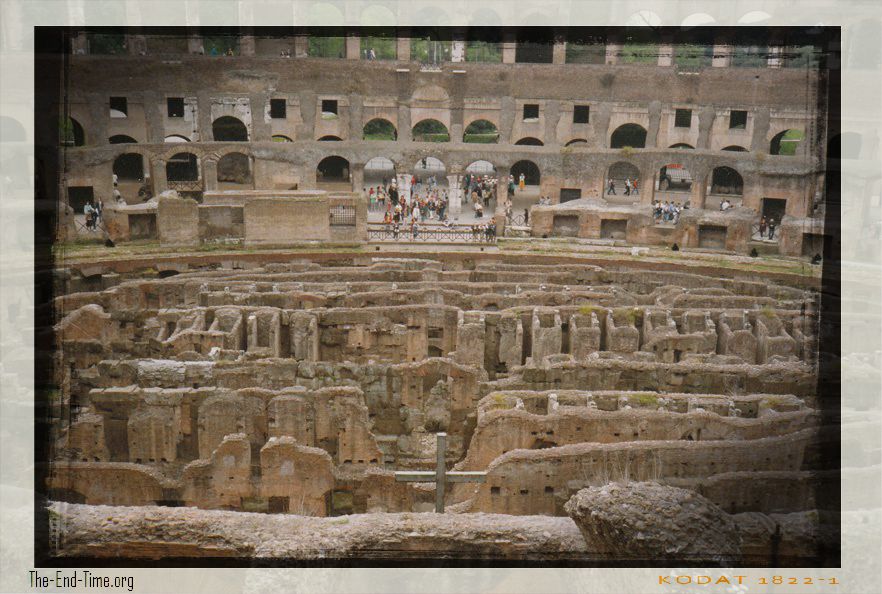
A few years ago I wrote a piece about the cross at the Colosseum in Rome. It is a simple sturdy cross, located at the place where the Christian martyrs were held below ground and pushed up to the floor of the amphitheater, where hungry lions were waiting to devour them.
The photo below is the one I had taken when I visited there in the late 1990s, before I was saved. I never saw the cross when I was visiting and snapping the photo. The lost truly are blind, unable to see the things of Christ. Yet after I was saved and I was sorting through photos, I spotted the cross immediately.
Recently Challies posted an essay titled The High Calling of Bringing Order out of Chaos. I liked reading about the original chaos into which God brought order, the creation of the earth. The article went on to describe the order that comes from labor, you know, work. Laboring to subdue the earth, and tending the Garden. Order is created by man’s work in obedience to God’s will. True order is created in man’s soul-submission to God’s spiritual will, which is belief in the Son.
An unsaved man’s soul is in chaos, formless, and void. It assigns no meaning to events that happen, such as 9-11. It does not know goodness, holiness, or God. The beauty of horrific events is that through them, some are saved. Their souls are knit into likeness of Jesus, increasingly conformed in holiness and purity to His.
Order is created with every regenerated heart. Every time a person comes to the cross, the soul which is without form, and void, is filled with grace and peace and is made a new creation in God’s image. Order ensues for the previously stony heart, made soft and pliable, conforming to His likeness.
The spiritual chaos brought by the terrorists’ act is one that can’t be described in any sensible manner. Shock, disbelief, anger, hunger for any and every scrap of information, then exhaustion, and finally raging grief eventually subsiding to a dull ache that arises whenever one thinks about the day fromt he distance of time. Millions of people asked the same questions that day. “Why does man continually do this to one another? Why is there war? Why did God let this happen?” Without Jesus, one can only answer in platitudes. With Jesus, every answer becomes clear.
Spiritually, emotionally, and nationally, chaos occurred. However, eventually order ensued. It was the same with the martyrs at the Colosseum. The chaos of the ghoulishly gleeful crowds, the spiritually blind howling for death of the Christians, the roars of the lions, the swirl of sand and dust and blood as the martyrs fell one by one. The world without Christ is one of spiritual chaos. With Jesus, the cross brings meaning and order to the troubled, turbulent soul.
Chaos
Life and order in creation must be sustained by God. (Psalm 104:29; Colossians 1:16-17. God uses chaos as a judgment- Isaiah 34:11 See also Isaiah 24:1,3-4,10-12,17-21; Isaiah 27:10; Isaiah 32:14; Zephaniah 1:14-15; Revelation 6:15-17. (source)
Orderliness In his creating, sustaining and saving work, God reveals himself as a God of order. Likewise, the life of his people and of society as a whole should be orderly.
Orderliness in creation Isaiah 45:12 See also Genesis 1:31; Job 26:7-10; Job 38:4-11; Psalm 8:3; Psalm 19:1; Psalm 104:5-9; Isaiah 40:26; Ac 17:26
Orderliness in providence Genesis 8:22. See also Psalm 65:9; Psalm 104:14-27; Psalm 145:15; Acts 14:17. (source)
The attacks happened on a Tuesday. On Sunday, churches all across America were filled. People asking, seeking, trying to find order in the chaos. Pastors grappled with answering the graphically visible questions of life, death, religion. As one article I read said, the attacks delivered an unfathomable religious jolt.
When you hide your face, they are dismayed; when you take away their breath, they die and return to their dust. (Psalm 104:29).
The difficult question, of course, is do most people even know this God they’re reaching out to in this time of need? And is He listening? Are there any absolute authoritative answers to the serious looming spiritual questions being raised as this worldwide crisis trickles down to an intimate individual’s spiritual issue between the creature and the Creator? How can people deal personally once and for all with the problems at the level of their own souls?
The chaos if life without the cross, and the orderliness of peace of life with the cross. It’s all about the cross, which means it’s all about Jesus. Whether times are good and flowing with milk and honey, or dramatically terroristic and chaotic, standing firm under the cross makes the difference.






 the-end-time.org