Forty-three years and thirteen years in the making, seven-and-a-half years of writing and three months of editing & formatting, today my eBook “Encouragement In Grace” launches at Amazon.
For 43 years I was an unsaved rebel enemy of Christ. Hating Him at every turn, I tried ignoring my festering conscience. I was perplexed by the revelation of God to the world through the world, but rejected the solution of Jesus as Creator. Finally I dabbled in almost every other religion I could find to salve my anxious and offended soul. For forty-three years, nothing worked.
After a torturous series of events lasting several years, at long last and in His perfect timing, I was saved by His grace. I did not have an aisle-walking pillow soft Just As I Am salvation. I did not have an easy experience with warm sensuous embraces by an invisible Groom. I did not hear a gentle voice calling me toward clouds. I was dragged kicking and screaming over the threshold of the Door and was given the grace to repent despite my howling objections. At last, I succumbed.
As a result, I value His grace so dearly.
Post-salvation, the Spirit prompted me to begin using my time and writing ability for His glory. I began blogging and exploring theological issues in the topics of discernment, encouragement, and prophecy, the gifts the Spirit had delivered to me. For nine years I blogged, accelerating my writing activity for the last seven years by blogging daily. I wrote on the range of topics in the way I prayed would encourage or convict readers and honor the Lord.
The internet, and blogs in particular, were a gracious addition to the technology the Lord has allowed to be invented. They have been a wonderful relief to me, a writer who has been minimally published, but despaired at the hurdles and gatekeeping of the tightly-knit publishing industry. Blogs allow authors to side-step all that. What a benefit to live in a nation that allows free expression and discussion of Christian topics on self-publishing platforms.
Years later, along came self-publishing platforms such as Amazon’s Kindle Direct Publishing. Hallelujah! KDP and other programs make self-publishing easier … but never easy. Writing is not easy. Writing about God and for God is even less easy. Neither is it easy researching among the competing self-publishing platforms, proof-reading, formatting, and marketing. But it makes the process of disseminating material written by people like me more straightforward. For that, I’m grateful for the opportunity to make Jesus known through these means.
The next two books in this series will be published approximately four months apart. As with Encouragement In Grace, the next eBooks will be published through the Kindle Direct Program, Lord willing. They’ll be called –
Prophecy In Grace
Discernment In Grace
If you should choose to buy the eBook, I pray that “Encouragement In Grace” convicts, enlightens, or sheds some other aspect of Jesus onto your heart and mind.
I was in a non-church setting with some 7-year-olds recently. They were drawing a picture to go along with the story about pizza they had just read. When one boy finished his drawing he still had room on the page. He asked if he could draw a cross. I said sure.
Of course then the others wanted to draw a cross too. Most or all of them have been exposed to Jesus. As they drew their crosses they began to talk about Jesus. The original boy said, ‘Jesus died on the cross’. Another said, ‘isn’t He living now’? I chimed in and said His is living now, that He walked around on earth for 40 days after His death and resurrection and talked with His friends. Continue reading “Faith of a child”→
Behold, children are a heritage from the LORD, the fruit of the womb a reward. (Psalm 127:3)
Children are a blessing and the verse above refers to children born to biological parents.
Many verses speak about children. The Bible makes it equally clear that all children (especially orphans) are to be regarded as vulnerable and to treat them kindly. Jesus holds them in high regard. They are to be trained up in the way they should go. They should not be provoked. They should be unhindered in their approach to God and His laws. They are to be protected else a millstone hung around the neck of one who causes them to stumble. They are a crown to the aged and streets full of happy children playing are a sign of God’s favor. They are an answer to prayer. Orphans (“the fatherless”) are objects of care and concern.
With all the attention given children, we know that the Lord cares for them. In thinking of kids, we often restrict ourselves to thinking of the family. I propose that anyone who works with children has a God-given privilege to adhere to the Bible’s verses regarding them, as well. The children are a heritage for the parents, but also for the teacher, the foster mother, the nanny, the social worker, the nursery school administrator, the playground monitor. Each and every child is a gift from the Lord, to each person the Lord has assigned to watch over them.
Then Esau looked up and saw the women and children. “Who are these with you?” he asked. Jacob answered, “They are the children God has graciously given your servant.” (Genesis 33:5).
Children are a gracious gift, If you work with children in any way, you are blessed.
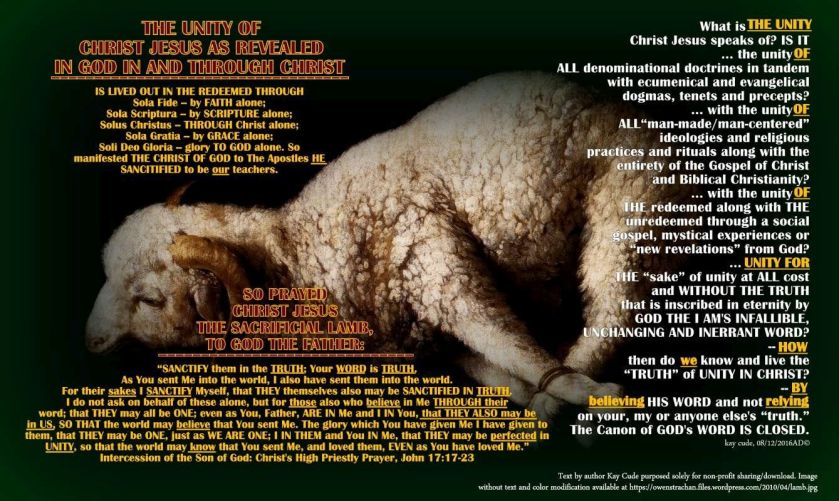
I was compelled to do a piece about “unity in Christ” and what Christ means, not what “we” assume He means. [The picture] is Christ the Lamb of God who manifested all that “unity” of the redeemed in God the Father and God the Son!
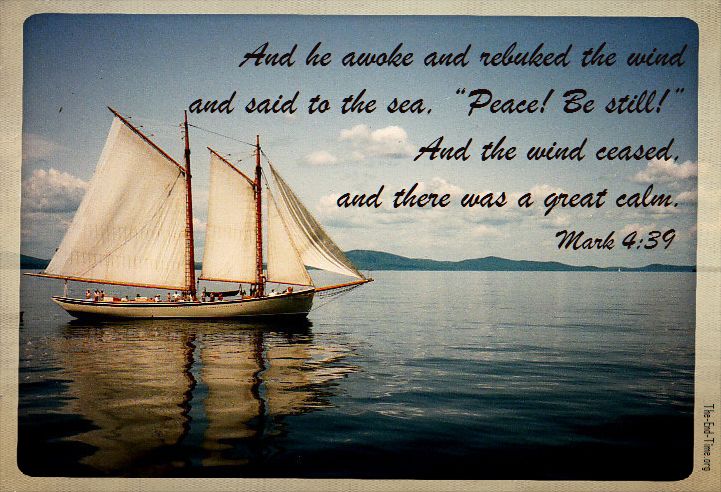
And the peace of God, which surpasses all understanding, will guard your hearts and your minds in Christ Jesus. (Philippians 4:7)
Even if the worst happens on our shores (war, earthquake, tsunami…) I have the peace that passes all understanding. He is in control and our anguish and our life is but a breath, so it will only be for a short time. I pray you have that peace as well. Barnes Notes explains the peace that passes all understanding so well.
Which passeth all understanding – That is, which surpasses all that people had conceived or imagined. The expression is one that denotes that the peace imparted is of the highest possible kind. The apostle Paul frequently used terms which had somewhat of a hyperbolical cast (see the notes on Ephesians 3:19; compare John 21:25, and the language here is that which one would use who designed to speak of that which was of the highest order. The Christian, committing his way to God, and feeling that he will order all things aright, has a peace which is nowhere else known. Nothing else will furnish it but religion. No confidence that a man can have in his own powers; no reliance which he can repose on his own plans or on the promises or fidelity of his fellow-men, and no calculations which he can make on the course of events, can impart such peace to the soul as simple confidence in God.
Are you saved? If so, then demonstrate that faith by clinging to Him, His promises, and His Truth. It is the best- the only- safe port in a storm! This is a great time in the United States to be peaceful, for others will see your calmness and through the grace of the Holy Spirit, they will ask you…”what is it that you have…?” and you will have the inestimable privilege of saying, “Let me tell you about Jesus…”
If you are not saved and you see someone who seems calm and graceful all the time, whose countenance seems glowing. (Exodus 35:35) it is because we have what Jesus has given us- His peace. We have been with God. We are no longer at war against Him but have become friends and sons of the Most High God. He imparts a peace that allows His children to look upon earthly circumstances with an eternal perspective.
Dear unsaved person, your good works are not enough to get you to heaven. Being really, really nice is not enough to get you to heaven. You can never do enough to get to heaven. The only way is through Jesus. You wonder what is it about Christians that makes them (us) seems o gentle and calm and they just look different? It’s His peace. The sin struggle is over. The unanswered questions about why we are here and how the world was born and why people are like they are…these questions are answered. Right now would be a good idea to start praying seriously to the Lord above to resolve your internal war. You are a God-hater, perhaps actively but certainly passively. Do you want peace and rest from always striving and yet not knowing? (2 Timothy 3:7). He will provide His peace, upon repentance and faith in His resurrected self.
We see so many stories of people launching ministries, or selling everything to move into an inner-city, or striking off to a mission-receiving nation. They are doing Big Things for Jesus.
Sometimes I receive a comment where a Christian woman feels ineffective and insignificant for Jesus. She is either a stay-at-home mom, or works in a job in which she is not a decision-maker, a person droning away in a cubby somewhere. She feels like she would like to make a bigger impact for His kingdom but is not in any kind of powerful position to do so. How can we make a Gospel-impact for Jesus where we are?
I’d first like to celebrate the fact that there are women who yearn and strive to obey her King and to make a difference in souls. Like David, there are many women who adhere to this verse from Psalm 119:59–
I hastened and did not delay To keep Your commandments.
And yet, many wonder since their sphere is so small, how they can minister effectively? Are they making any difference at all? Could we do more?
Our pastor is teaching through Genesis. We learned about Joseph last Sunday. By Genesis 39, Joseph has been sold into slavery by his duplicitous brothers. He is working in the house of Potiphar the Captain of the Guard, as a slave. He is a slave, remember. Bought with money as property to do a master’s bidding. Joseph had no say, no power, no sphere in which he wielded decision making capabilities. He was just chattel, slaving obscurely away in a palace of a captain of Egypt.
Now Joseph had been brought down to Egypt, and Potiphar, an officer of Pharaoh, the captain of the guard, an Egyptian, had bought him from the Ishmaelites who had brought him down there. (Genesis 39:1)
The “captain of the guard” or “captain of the body-guard,” both titles meaning the same thing, was responsible for the security of the king’s prisoners and for executing their sentences upon them. He was also the official guardian of the person, or body, of the king—the chief of the king’s bodyguard. Source: Freeman, J. M., & Chadwick, H. J. (1998). Manners & customs of the Bible
From that Commentary we know that Potiphar was no low person on the totem pole. When Joseph arrived at “Potiphar’s house”, it wasn’t a bungalow. Perhaps Potiphar did not even see Joseph much at the beginning, or if he did, it was in passing.
The Bible is silent on Joseph’s exact circumstances, but much has been written about slavery in many different eras, especially Roman times. In the Roman era, as many as 10,000 slaves per day were auctioned off. The Master or the Master’s representative would buy them off the block, usually in bunches. Initially, the Master would not know what each slave was capable of. Their skills were a mystery. They were just faceless laborers, an unknown quantity. At first, they would usually be put to menial work and as the Master or his representative got to know the slaves better he would re-distribute them around the property or give them tasks according to their strengths. This is what happened with Joseph.
The LORD was with Joseph, and he became a successful man, and he was in the house of his Egyptian master. 3His master saw that the LORD was with him and that the LORD caused all that he did to succeed in his hands. 4So Joseph found favor in his sight and attended him, and he made him overseer of his house and put him in charge of all that he had. (Genesis 39:2-4)
Joseph slaved away, and yet the LORD was with him. He was apart from his family, alone…but the LORD was with him.
Matthew Henry says of this situation in his complete Commentary,
His master preferred him, by degrees made him steward of his household, v. 4. Note, (1.) Industry and honesty are the surest and safest way both of rising and thriving: Seest thou a man prudent, and faithful, and diligent in his business? He shall stand before kings at length, and not always before mean men. (2.) It is the wisdom of those that are in any sort of authority to countenance and employ those with whom it appears that the presence of God is, Ps. 101:6.
Matthew Henry’s commentary on the whole Bible: complete and unabridged in one volume
And we know how the event ended. God used Joseph in a mighty way for His purposes. (Genesis 50:20).
If Joseph, a slave, persevered in Godly character enough to influence an entire household and then an entire nation, what can God do with us? Anything, no matter where we are or no matter how small our own sphere seems. Use your vocation for Godly influence, doing all as to the glory of God (1 Corinthians 10:31). Even then, we don’t have to save an entire nation. The biggest things on the planet are influencing people with the Gospel, the true words of Christ. Even one soul impacted for the Kingdom is the highest work one can accomplish. InZechariah 4:10 we read,
For whoever has despised the day of small things shall rejoice, and shall see the plumb line in the hand of Zerubbabel. “These seven are the eyes of the LORD, which range through the whole earth.” What does that verse mean? John MacArthur comments,
In that case, the re-building of a temple smaller than the one smaller than Solomon’s may have been discouraging to some, (cf Ezra 3:12, Haggai 2:3), The Lord announced that His pleasure was upon this work, and that His omniscient care was watching over and taking pleasure in its completion. He said in effect, don’t despise what God is pleased with.”
If you’re a person with no influence, a small sphere, or seeming insignificance for the Kingdom, you’re not. Don’t despise the small things. It is the Lord’s work and He is pleased with it. To Him, it is big things, especially when He fills them to perfection on His Day of glorification when ALL things come to completion. Use your vocation for Him in any way, large or small, that you can. His eyes range through the whole earth, and He sees you, and loves you and is with you.
This light isn’t a mighty lighthouse guiding thousands to port safe from the storm, but its light sure means a lot to the one family trying to get home.
Go to the ant, O sluggard; consider her ways, and be wise. 7Without having any chief, officer, or ruler, 8she prepares her bread in summer and gathers her food in harvest. 9How long will you lie there, O sluggard? When will you arise from your sleep? (Proverbs 6:6-9)
Matthew Henry Commentary
6:6-11 Diligence in business is every man’s wisdom and duty; not so much that he may attain worldly wealth, as that he may not be a burden to others, or a scandal to the church. The ants are more diligent than slothful men. We may learn wisdom from the meanest insects, and be shamed by them. Habits of indolence and indulgence grow upon people. Thus life runs to waste; and poverty, though at first at a distance, gradually draws near, like a traveller; and when it arrives, is like an armed man, too strong to be resisted. All this may be applied to the concerns of our souls. How many love their sleep of sin, and their dreams of worldly happiness! Shall we not seek to awaken such? Shall we not give diligence to secure our own salvation?
The Scripture alphabet of animals
If you look at the sixth verse of the sixth chapter of Proverbs, you will read, “Go to the ant, thou sluggard; consider her ways, and be wise.” A sluggard, you know, is a man, or woman, or child, who does not love to read or to do any kind of work, but likes to sleep or be idle all the day long. Do you think you were ever acquainted with one?
Now see what the Bible tells the sluggard to do. It bids him go to the little ant, and “consider her ways,” that is, look on and see what she does. Have you ever watched the ants when they were busy at work? It will give you very pleasant employment for half an hour on a summer’s day. In some places you may see small ant-hills scattered about, so close together that you can hardly step without treading on them; and you may find other places where there are not so many, but where the hills are much larger. I have seen them so large that you could hardly step over one of them without touching it with your foot and breaking some part of it. And then how busy the little creatures are! Just kneel down on the grass beside them, and notice how they work! You will see one little fellow creeping along as fast as he can go, with a grain of sand in his mouth, perhaps as large as his head. He does not stop to rest, but when he has carried his grain to help build the hill, away he goes for another. You may watch them all day and never see them idle at all.
You see why God tells the sluggard to go and look at the little ants: it is that when he sees them so busy, he may be ashamed of himself for being idle, and learn to be “wise,” or diligent in whatever he undertakes. I should not think he could help going to work, after he had looked at them a little while.
The ants seem to be very happy, and I think it is because they are so busy. God has put nobody in this world to be idle: even children have something to do. The inside of an ant-hill is very curious, but it is not easy to examine it without destroying all the work that the little insects have taken so much pains to finish. There is a kind of ant in warm climates that builds for itself hills as high as a man. They are not made of sand, but of a kind of clay; and have a great many cells or apartments, and many winding passages leading from one part to another. All this is done, as the Bible says, without “guide, overseer or ruler;” that is, they have no one to direct them how to do it. God gives them skill just as he does to the honey-bees in building the beautiful cells which you have so often admired; all His works are wonderful. Cook, H. N. (1842). The Scripture alphabet of animals. New York: American Tract Society.
We read in the “Pastoral Epistles”, Titus and Timothy, what to do that is consistent with sound doctrine. The pastoral epistles are: “those letters written by Paul to Timothy and Titus in the New Testament. So, they are 1 and 2 Timothy and Titus. They are called pastoral because they are letters with instructions for pastors, congregations, and general functions within the church.”
We read what people are supposed to do in order to display the highest qualifications for behavior and character.
I want to note the first sentence of Titus 2:1-10,
But as for you, teach what accords with sound doctrine. Older men are to be sober-minded, dignified, self-controlled, sound in faith, in love, and in steadfastness. Older women likewise are to be reverent in behavior, not slanderers or slaves to much wine. They are to teach what is good, and so train the young women to love their husbands and children, to be self-controlled, pure, working at home, kind, and submissive to their own husbands, that the word of God may not be reviled. Likewise, urge the younger men to be self-controlled. Show yourself in all respects to be a model of good works, and in your teaching show integrity, dignity, and sound speech that cannot be condemned, so that an opponent may be put to shame, having nothing evil to say about us. Slaves are to be submissive to their own masters in everything; they are to be well-pleasing, not argumentative, not pilfering, but showing all good faith, so that in everything they may adorn the doctrine of God our Savior.
Paul is telling Titus to teach according to sound doctrine. Paul does not particularly outline what the sound doctrine is, at this point because the point of the letter is to encourage Titus to display and hence his flock to display certain behavioral attributes. In displaying these attributes in life, they will be acting consistently with sound doctrine.
In an interesting parallel, Paul gives Timothy a list of behavioral attributes, too. The difference is, Paul’s list to Timothy includes behaviors that are contrary to sound doctrine. Here is the list:
Now we know that the law is good, if one uses it lawfully, understanding this, that the law is not laid down for the just but for the lawless and disobedient, for the ungodly and sinners, for the unholy and profane, for those who strike their fathers and mothers, for murderers, the sexually immoral, men who practice homosexuality, enslavers, liars, perjurers, and whatever else is contrary to sound doctrine, in accordance with the gospel of the glory of the blessed God with which I have been entrusted. (1 Timothy 1:8-11).
Anyone displaying these negative attributes in their behavior are acting against sound doctrine.
The second item to focus on is the reason we are to behave consistent with the good doctrine we have been taught. It is so that the name of Jesus will not come under reproach. If we behave against sound doctrine, the adversary (satan, that old dragon) will be able to use us to bring reproach upon Jesus’ name.
In the unbelieving world, it is very easy to avoid Christians. Their mind is darkened, so they do not see us.
“Now this I say and testify in the Lord, that you must no longer walk as the Gentiles do, in the futility of their minds. They are darkened in their understanding, alienated from the life of God because of the ignorance that is in them, due to their hardness of heart.” (Ephesians 4:17-18).
Two kingdoms are co-existing side by side, locked in a war. The opponents are- satan’s army and his unbelievers whom he influences, and Jesus’s army and His saved believers. The unbelievers do not really see us but they are aware of our presence. What I mean is, unbelievers as a whole do not think about Christians in their daily lives. It is very easy to have no contact with Christians, be unaware and uncaring about Christian life, and go for long periods of time not hearing or seeing Christian language or behavior. It is like oil and water. As we know, oil and water may occupy the same space in a glass, but they do not mix. (Left, oil and water)
And also as we know, the kingdom of Jesus is not of this earth. (John 18:36). It is in heaven. So how will the unbeliever see the kingdom of God?
When we behave in the sterling way as Paul outlined to Titus, the veil parts. The unbeliever sees the Kingdom. He sees it because the Light is so bright! He cannot avoid seeing the Kingdom that dwells among them because the Light is so bright!
for behold, the kingdom of God is in the midst of you. (Luke 17:21b).
We ARE the kingdom, the veil parts, they see us when we act according to kingdom attributes. How will the unbeliever see the King, unless they see the Kingdom? Jesus is in heaven on His throne, but the kingdom He created is within us for this present age. The unbeliever will see it if we act according to sound doctrine, as Paul urges Titus.
Never let anyone tell you that ‘doctrine doesn’t matter.’ It does. It is not just head knowledge but it expresses itself through behavior that brings the Kingdom forward and lets the blind to see the unreproached name of Jesus.
Paul ended that paragraph by saying that we may adorn the doctrine of Christ the Savior. The word adorn is defined – “properly, to beautify; to adorn, make compellingly attractive, very appealing (inviting, awesomely gorgeous).
We are not gorgeous but Jesus in us is gorgeous! Let us pray for the strength and wisdom to go forward each day so that we may adorn Him, and be compellingly attractive in the eyes of those who are living in such darkness. We have been told how to act, and how not to act.
Henry Branagh in Henry V
In 1415, Henry V was severely outnumbered as they prepared for battle at Agincourt. This battle was dramatised by William Shakespeare in the play Henry V featuring the St. Crispin’s Day Speech in which Henry inspired his much outnumbered English forces to fight the French. It was a stirring moment in the film adaptation when actor Kenneth Branagh gave the speech. It was the speech when the King said, once more into the breach, dear friends. I was inspired to jump up and fight against the opposing forces! It was unusual for a king to call his army men ‘friends.’
Our King has given us a stirring speech, too. It is the bible. His doctrine is the inspiration for us to leap up and go into battle. But our battle is not in flesh and blood nor with swords. Our battle is through our behavior and our words, and the love we carry for our King, a remarkable eternal king who calls US His friends. Would you fight for Him in truth and kindness and gentleness so that we may adorn Him?
I suppose you think you already know as much about sheep and lambs as I can tell you, and perhaps you do. Yet I dare say you never took up your Bible to see how many times they are mentioned there, or how many beautiful things are said about them.
Abel, who, as you know, was the third man that lived on the earth, was a “keeper of sheep;” and there have always been a great many shepherds in the world from that time to this. Some of the men who lived in old times had a great many sheep. Job had seven thousand, which God allowed to be taken from him; but afterwards gave him twice as many-fourteen thousand. At the time when Solomon’s beautiful temple was dedicated to God, he offered a sacrifice of a hundred and twenty thousand sheep.
If you want to know how many that is, try to think of a pasture with a hundred sheep in it-then think of a hundred pastures, just like it, with just as many sheep in each-then think of those hundred pastures taken twelve times over, and you will begin to understand how many there were. It is not common with us to have persons whose whole business it is to take care of sheep, but that was always the way in Bible countries.
This was not done by servants, at least not always; for a great many rich men employed their children as shepherds. Rachel, who was afterwards the wife of Jacob, “kept her father’s sheep”-so did Jacob’s twelve sons-so did Moses for his father-in-law.
Cook, H. N. (1842). The Scripture alphabet of animals. New York: American Tract Society.
Click to enlarge. Kay Cude: published with permission
Artist’s statement:
For me, the lone tree speaks of God’s wonderful handiwork, not only representing His gift of nature, but brings to mind that His redeemed are not alone, but safely tucked within His Might eternally. And as the brilliance of the sun pierces boldly through the dark-ending of the storm, one thought leads me to another — remembrance of Christ’s death and resurrection. Then speaks to His beloved redeemed: the “things” of this world are now more clearly seen through the light of His Salvation! We must daily pause to remember…