Posted in encouragement, Uncategorized

From unclean to pure lips

Do you ever feel like such a terrible sinner that the very words of repentance and sorrow pouring from your lips in prayer to heaven is a blot on the name of Jesus?

But the tax collector, standing far off, would not even lift up his eyes to heaven, but beat his breast, saying, ‘God, be merciful to me, a sinner!’ (Luke 18:13)

I can relate to Isaiah (the lips part, not actually seeing the LORD!)

And I said: “Woe is me! For I am lost; for I am a man of unclean lips, and I dwell in the midst of a people of unclean lips; for my eyes have seen the King, the LORD of hosts!” (Isaiah 6:5).

But then in His Day He will purify our lips and when we praise Him we will be clean! Imagine praising Him from pure lips!

Then I will purify the lips of the peoples, that all of them may call on the name of the LORD and serve him shoulder to shoulder”. (Zephaniah 3:9 NIV)

Posted in encouragement, Uncategorized

The dignity of our spiritual release

I was reading the Valley of Vision, A collection of Puritan Prayers and Devotionals, which is a stunning book, by the way. It’s one of the top three books on my shelf, after the Bible and barely before Pilgrim’s Progress.

In my version, there is a prayer on page 60 titled simply, “A Christian’s Prayer”. One particular line spoke to me deeply. The Christian who was praying (writing) the prayer wrote,

May I remember the dignity of my spiritual release

Continue reading “The dignity of our spiritual release”

Posted in encouragement, Uncategorized

How to witness-lite

I was saved when I was 43 years old. At the time just before grace came and released me from spiritual bondage, I was working two jobs. In the morning I’d work from 6:30-10:30 putting up Post Office mail. Sorting the mail behind the wall of PO Boxes, I could hear the conversations occurring in the lobby. There was a particular Bible-believing pastor who used to come in and cheerfully greet everyone. It wasn’t one or two seconds before he would mention Jesus. Not ‘Lord’, or “Him’, or ‘God’, but he’d say “Jesus”. Things like, “Isn’t it a great day on Jesus’ world?” or “How are you on this day Jesus made?”

I’d become inflamed when I heard the name of Jesus. I believed that there was a God, the existence of the world in its complexity made it obvious. I was one whom the verse in Romans 1:19-20 applies,

For what can be known about God is plain to them, because God has shown it to them. For his invisible attributes, namely, his eternal power and divine nature, have been clearly perceived, ever since the creation of the world, in the things that have been made. So they are without excuse. 

However, I was also one for which the previous verse applied, too,

For the wrath of God is revealed from heaven against all ungodliness and unrighteousness of men, who by their unrighteousness suppress the truth.


And, what truth was I suppressing? Jesus, for He IS the truth. Therefore any mention of Jesus by anyone, with all its attached concepts- sin, repentance, wrath, inflamed my heart and mind and I suppressed it all.

When I’d hear that name I’d push the mail into the PO Boxes a little harder, I’d grind my teeth, I’d mutter to myself, “Why doesn’t he shut up? Doesn’t he know nobody wants to hear that bunk? Doesn’t he know that nobody’s listening??”

Of course, lol, I was listening.

Soon after that, my carefully built fortresses I’d built in my heart and mind were as wafers and wisps in the face of Jesus’ power who, in His irresistible grace, in His timing, instantly crumbled them all down. I became a believer.

The lessons there were some I never forgot. Please allow me to share these few tidbits.

I know we feel funny when we witness to people. Sometimes we think we have to approach people in a way to share deep, complicated, theological truths in a private setting. Sometimes we beat ourselves up for missing an opportunity, or failing to be clear, or for being fearful we’ll forget critical component.

When we speak to each other as believers, or when we to those we interact with as we go through our daily life (clerks, tellers, cashiers, etc), we should say the name of Jesus, specifically. Saying His name in the public square has power. Not as in magic genie power, but because the name of Jesus is the only name, the name above all names, and the name upon which we come to salvation, the name of Jesus incites people.

Secondly, have conversations about Jesus in the public sphere. Speak of him in the college cafeteria, in the meeting before it begins, at the coffee counter. Just a quick exchange with the friend you’re with of what you learned about a specific verse, or reciting a scripture, or an insight regarding a parallel verse. Others around you hear these conversations. You may never know who heard them, as the pastor never knew I was listening, but the Holy Scriptures have impact upon whom the Lord decides they will have impact. Speak His truths in public, the word will not come back empty.

Of course we do want to witness as to the full message when we can. But when we can’t, don’t feel like you’ve failed. Speak His name or a few verses to someone in the public square. The name of Jesus and His word has power to chip away at the hardest of hearts.

Posted in encouragement, Uncategorized

The ‘Wondrous Strange’ Gospel

Back in 1998 I drove a few hours from my home in Gray, Maine to Rockland, Maine. The destination was the Farnsworth Library & Art Museum. The Farnsworth is a gorgeous museum tucked away on the rockbound coast. The New York Times wrote of the opening of the Farnsworth and the Wyeth collection this way,

Ever since N. C. Wyeth bought a place in Port Clyde, south of Rockland, in the early 1930’s, the family has summered here, and Andrew Wyeth’s painting ”Christina’s World” is, for many people, synonymous with Maine. The Wyeth center is attached to the Farnsworth Art Museum, a respected 50-year-old institution that focuses on artists connected with Maine and that has built one of the best small, specialized collections in the country.

They had advertised a collection I was dying to see. It was called, “Wondrous Strange: the Wyeth Tradition: Howard Pyle, N.C. Wyeth, Andrew Wyeth, James Wyeth.” You might or might not know that the three generations of Wyeths have a deep connection to Maine, and all three generations owe inspiration to Pyle. The generations went like this- Turn-of-the-last-century illustrator Howard Pyle; His student was N. C. Wyeth; N. C.’s student and son was Andrew Wyeth (wife Betsy); Andrew’s student and son was Jamie Wyeth. Betsy Wyeth chose the paintings and illustrations for the show I was driving to see, and named it Wondrous Strange.

The theme of the show is described from the catalog as, “an imaginative, often disquieting, dreamlike imagery.” The catalog/book describes the paintings- “Demonic eyes shining out of a shadowy tree. A blind man staggering through a moonlit landscape. Disembodied, dark hands rising out of snow. A feral dog with one blue eye. Ambiguous shadows harboring human shapes.”

The NY Times described it this way:
While Andrew and Jamie work in cooler times, there is no question that some of the images in ”Wondrous Strange” are really weird. Andrew paints a corpse emerging from a block of melting ice and severed hands perched on ice floes; Jamie portrays himself with a pumpkin head and as a clownish scarecrow. He depicts lighthouses with the same fierce perspective that his grandfather used for Peg Leg Pete.

One of the paintings’ raison d’etre is described by the artist Andrew Wyeth himself as ”to memorialize the emotions he felt upon viewing his father, N. C. Wyeth, in his casket.” Yes. Weird indeed.

Here are a few of the paintings that were mounted in that long-ago show.

“Mischief Night,” by Jamie Wyeth.
“Pumpkinhead Visits the Lighthouse,” by Jamie Wyeth

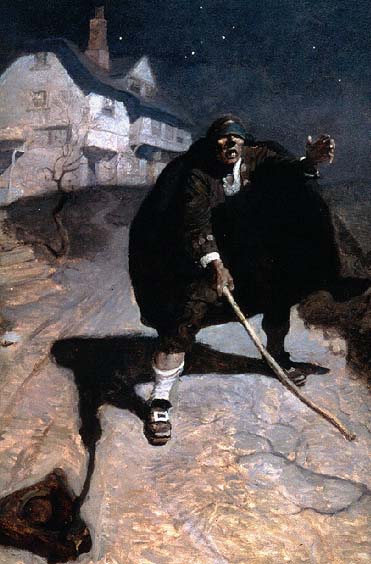
Treasure Island illustration, NC Wyeth, 1911

One painting that was included in the show was this one, called simply, “Lighthouse”, by Jamie Wyeth. This painting adorns the cover of the catalog/book.

It’s eerie. There’s nothing particularly ghoulish about the scene. In fact, many other paintings were more weird and fiendish. But there is something maniacal and out of control in this painting. The scudding clouds evoke thoughts of monstrous hands strangling the world, the fortress-like lighthouse, the wild hair, the jarring vestment of a wrinkled military uniform worn on a wild hill… the painting is a perspective of the world that’s cracked, tilted, and agitated.

Perhaps that was the appeal- weirdness, agitation, and ghoulish specter of the disquieting. As I said, I’d driven a few hours and it was going to be a day trip, no less. After seeing the exhibition and having lunch with the friend accompanying me, we’d turn around and drive home. The attraction of the wondrous strange to the pagan heart is strong.

The title of the show comes from Shakespeare’s Hamlet Act I Scene V-

HORATIO
O day and night, but this is wondrous strange!
HAMLET
And therefore as a stranger give it welcome.
There are more things in heaven and earth, Horatio,
Than are dreamt of in your philosophy.

Returning from nostalgia, on Saturday I was listening to John Gerstner’s Handout Apologetics this morning. The lesson was on The Gospel of God, lesson 10. Gerstner said of the Gospel,

The question remains, how do I know that this Jesus of Nazareth, a man among men, was more than a man among men? You ask me to believe He was actually God incarnate? When did anybody ever stretch the credulity of the human mind more than when it is asked to believe that that simple peasant of Galilee was God dwelling in human flesh?!

The mind of man couldn’t think it up. To think a Person in the Godhead, would unite humanity with deity, and suffer in that humanity and yet as deity, survive the wrath of the Godhead, that is something that when you read about it in the Bible you know it has to be true, it couldn’t be fictional. It is so strange, so wonderful so beyond human anticipation that it has to be a God-given reality.

Well, you know of course why I spent time writing about the Wyeth wondrous strange exhibition. The mind of man I’d thought was so imaginative in painting and illustrating eerie and strange scenes, is not so wondrous strange after all. The REAL wondrous strange is the reality of the Gospel, of a God whose act of sacrificial incarnation, suffering, and death is SO strange that man had never ever thought it up in any religion, before or since. The wondrous strange mind of God, who had planned this devastatingly necessary separation of His Son from the Godhead since before the foundation of the world, in merciful love and grace, is the strangest wonder of all. As Halloween proceeds through this day, please ponder the most strange philosophy, Horatio, ever not dreamt of in earth, but is real and true from heaven.
Posted in encouragement, Uncategorized

What does it mean to “reason together”?

People are surprised when they learn that the following verse is not in the New Testament. It sounds New Testament-ish. But it’s not in that book.

Come now, let us reason together, says the LORD: though your sins are like scarlet, they shall be as white as snow; though they are red like crimson, they shall become like wool. (Isaiah 1:18).

It’s from Isaiah.

Things get even more interesting. It is the LORD God telling His people to approach Him to reason with Him, and to do it in confidence and not in fear. In the verse, God is speaking to His chosen people Israel.

Gill’s Exposition explains:

Come now, and let us reason, together, saith the Lord,…. These words stand not in connection either with the preceding or following, but are to be read in a parenthesis, and are thrown in for the sake of the small remnant God had left among this wicked people, in order to comfort them, being distressed with sin.

These, seeing their sins in their dreadful colours, and with all their aggravating circumstances, were ready to conclude that they were unpardonable; and, seeing God as an angry Judge, dared not come nigh him, but stood at a distance, fearing and expecting his vengeance to fall upon them, and therefore put away the promises, and refused to be comforted;

when the Lord was pleased to encourage them to draw near to him, and come and reason with him: not at the bar of his justice; there is no reasoning with him there; none can contend with him, or answer him, one of a thousand; if he marks iniquity in strict justice, none can stand before him; there is no entering the lists with him upon the foot of justice, or at its bar:

but at the bar of mercy, at the throne of grace; there the righteous may dispute with him from his declarations and promises, as well as come with boldness to him; and at the altar and sacrifice of Christ, and at the fountain of his blood:

here sinners may reason with him from the virtue and efficacy of his blood and sacrifice; and from the Lord’s proclamation of grace and mercy through him; and from his promises to forgive repenting and confessing sinners: and here God reasons with sensible souls from his own covenant promises and proclamations to forgive sin; from the aboundings of his grace over abounding sin; from the righteousness of Christ to justify, his blood to cleanse from sin, and his sacrifice to atone for it.

We have a good God, abounding in mercy and patience. His grace is eternal. His Son’s atoning sacrifice is eternal. Our communion and reasoning with Him is eternal.

Posted in encouragement, Uncategorized

Footsteps of the Man of Galilee: Jenin by Early Morning Light

I like the book Earthly Footsteps of the Man of Galilee due to the wonderful, sepia photos of places where Jesus walked. Taken in the late 1800s, the photos record a mostly unchanged region, where it is inspiring to peer into the picture and imagine the days of Jesus’ incarnation. Here is the synopsis of the book:

‎Earthly Footsteps of The Man of Galilee and the Journeys of His Apostles contains 400 original photographs by Robert E.M. Bain, taken in Egypt, Israel, Syria, Lebanon, Turkey, Greece, and Italy. Descriptions for each photograph are written by James Lee. These photographs depict the life of Christ and the influence of his ministry—the locations where Christ was born, baptized, crucified, as well as scenes from his prayers, miracles, and sermons. This resource also contains photography of sacred sites between Jerusalem and Rome. Vincent, J., Lee, J., & Bain, R. E. M. (1894). Earthly Footsteps of The Man of Galilee and the Journeys of His Apostles. New York, NY;St. Louis, MO: N. D. Thompson Publishing Co.

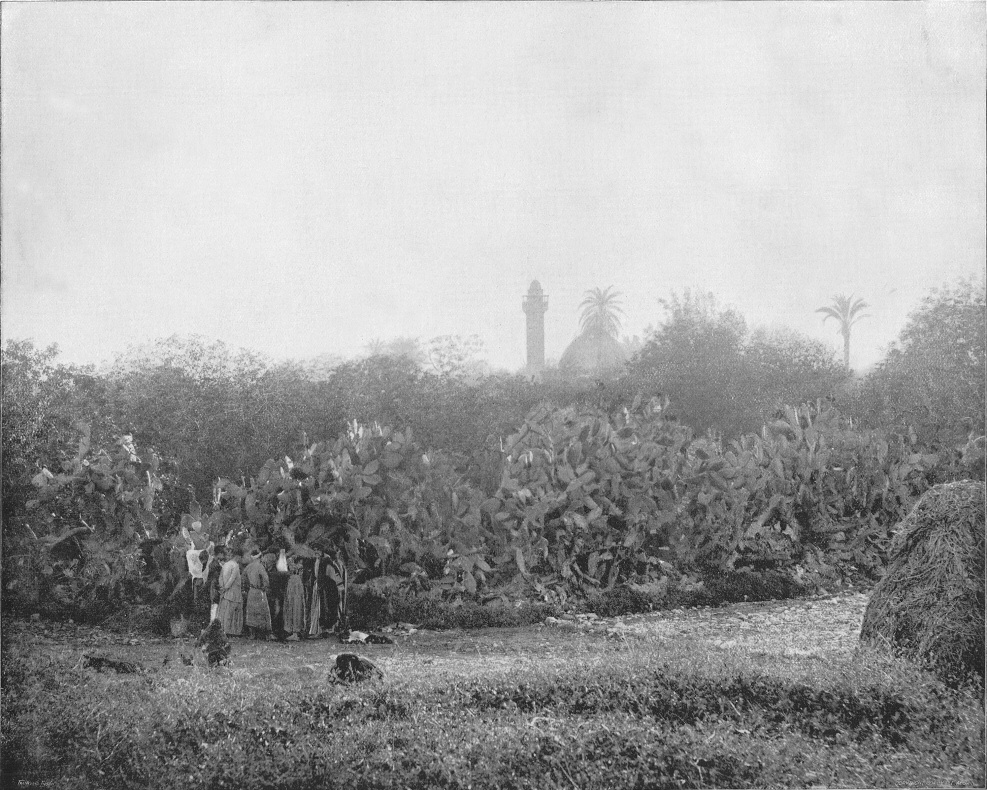
Jenin by early morning light.

Jenin is perhaps ten miles to the right of the route Joseph and Mary are supposed to have followed on their return from the sojourn in Egypt. It is one of the places, however, our Lord often passed during the years of His active ministry. Jenin is supposed to be the Ginea of Josephus, which again answers to the ancient En-gannin or “Garden Spring” (Joshua 19:21) with the territory of Issachar. The road from Nazareth to Jerusalem always passed this way, therefore, we are on sure ground again as we think of Mary on her way to Jerusalem with Joseph; on her way from Egypt; on her way from Nazareth to Jerusalem again when the lad Jesus was twelve years of age.

Jenin is a well-built town of some importance. It was never a fortress, but its soil is fertile and its verdure uncommonly beautiful. It is situated on the boundary between the mountains of Samaria and the plains Esdrælon. An excellent spring, rising to the east, is conducted through the village which abounds with fruit orchards and large gardens. Jenin is now the chief town between Nablous and Nazareth. Its people are Moslems, fanatical, rude and rebellious. There are a few families of the Greek faith. The inhabitants deal in all the products of the country, and their best customers are the Bedouin Arabs on the east of Jordan. Their dress is peculiar. H. B. Tristram describes it thus: “They wear no trousers, but a long blue and white striped cassock reaching to the ankles and bound around the waist by a broad leather girdle.”

Posted in encouragement, Uncategorized

Asking the LORD for help sometimes has unexpected results

Now when Daniel learned that the decree had been published, he went home to his upstairs room where the windows opened toward Jerusalem. Three times a day he got down on his knees and prayed, giving thanks to his God, just as he had done before. Then these men went as a group and found Daniel praying and asking God for help. (Daniel 6:10-11 NIV)

Daniel, the Godly youth, was in a bad way. He had been carried off to Babylon and separated from all he had known. He was under the earthly sovereignty of King Darius, while Babylon the city and the Kingdom of Persia was at its peak. Darius was pleased with Daniel and had planned to set him high in his court as a second-in-command administrator. The other administrators were jealous and plotted ways to defeat Daniel by stealth. They tried to find something with which to charge Daniel, but could not. They said if we find something it will be having to do with His God. So the jealous administrators went o King Darius and urged him to make a decree that anyone who prayed to another god except to Darius for the next thirty days should be thrown into the lion’s den. Darius liked the idea, and made the decree. That’s where we pick up the above verse. Daniel heard the decree had been set, and according to Persian law kingly decrees cannot be repealed.

First it should be mentioned that Daniel did not compromise. Likely he had men telling him that “it’s only 30 days, just ride it out. Just don’t pray to Yahweh this month’. Daniel did not compromise. As a matter of fact, he went immediately to his room and prayed. The jealous administrators knew Daniel would, and they spied on him just as immediately.

We know the story. Daniel was ‘caught’ by the jealous administrators, and Darius reluctantly sentenced him to the lion’s den. God showed His majesty and power by shutting the lion’s mouths and Daniel was unharmed and released.

Note the verse though. The NIV has it most clearly but all verses say the same. Daniel was making supplication to the LORD. Daniel prayed- to ask for help.

Daniel knew he’d been painted into a corner. Instead of looking around at his shrinking options, he looked up. He asked the Lord for help.

The help came. It was to sentence Daniel and throw him into the lion’s den!!

Daniel knew His God had the power to save him or the power to allow him to die. Daniel was a Godly man. However, Daniel was a man, and no doubt he was scared to face lions and wondering about this version of the help he had prayed for! Nevertheless, Daniel trusted God.

When we pray to God for help, He hears our prayer. He is a good, good Father who knows the number of hairs on our heads. If He cares for the sparrow which is a small insignificant bird, will He not care for us, His children? He will!

However we never know in what form the help will come. God will always shine His glory, and in so doing He might make circumstances that we can see with our fleshly eyes seem dire. Our eyes can only see so much less, like, 10% of what is going on at any given time. We can’t see the invisibles, the heavenlies, and the circumstances beyond our eye and ear range but they are all working God’s will to His glory and our good. (Romans 8:28).

The key is to pray, ask for help, and then to trust the outcome. Even if it is our moment to part the veil and go to the other side, God will hear our prayer, and He will use our situations to show His glory. Trust and obey, as Daniel did, even if we are thrown into a metaphorical lion’s den!

Look at the lasting glory that occurred through the help that came to Daniel:

Then King Darius wrote to all the peoples, nations, and languages that dwell in all the earth: “Peace be multiplied to you. 26I make a decree, that in all my royal dominion people are to tremble and fear before the God of Daniel,

for he is the living God,

enduring forever;

his kingdom shall never be destroyed,

and his dominion shall be to the end.

27He delivers and rescues;

he works signs and wonders

in heaven and on earth,

he who has saved Daniel

from the power of the lions.”

(Daniel 8:25-27)

Amen!

Posted in encouragement, Uncategorized

Ack, Millennials these days

Millennial Generation comedy #1, by John Crist.

“Millennial International is a sponsor based program designed to help Millennials live the lives they portray on Instagram.” HT Challies

Millennial Generation comedy #2, by Micah Tyler

We love to poke fun at younger generations. We read this famous quote from one elder statesman regarding the younger generation.

“The children now love luxury. They have bad manners, contempt for authority; they show disrespect for elders and love chatter in place of exercise.”

This is a quote anyone from any generation could have uttered. It was actually Socrates, who lived from 469-399 B.C.

Many times we perpetuate stereotypes of preceding or upcoming generations. However, it happens that oftentimes the parodies and pokings are based on germs of truth. We shouldn’t succumb to stereotypes but we shouldn’t ignore the truths, either. Those in older generations do have concerns whether the ones coming up will handle with care and thoughtfulness the gains made and achievements won by the elders in previous generations. When we pass the baton, will it be to hands that care for it well? Or will they be casual about receiving the baton, or worse, even drop it?

We read about the ‘generation gap.’ We hear that this generation is the first that will not have a better life or opportunities than their parents. The skepticism about generations is not only one way, from elder to younger. Younger people often worry about their future because of long-lived elder generations like us soaking up resources in health care and social security.

I agree with the following author’s quote about generations:

Every generation wants to be the last. Every generation hates the next trend in music they can’t understand. We hate to give up those reins of our culture. To find our own music playing in elevators. The ballad for our revolution, turned into background music for a television commercial. To find our generation’s clothes and hair suddenly retro. Chuck Palahniuk, author of Lullaby.

Though we may poke fun of the other generations, (either elder to younger or younger to elder) and even though there are grains of truth in all of it, what does the Bible say about generations?

“O my God,” I say, “take me not away in the midst of my days— you whose years endure throughout all generations!” (Psalm 102:24)

The writer finds encouragement in the midst of all his distresses. God’s eternal existence is a pledge of faithfulness to His promises, says Jamieson-Fausset-Brown Bible Commentary.

Or this verse,

Your faithfulness is to all generations: you have established the earth, and it stays. (Psalm 119:90). Gill’s Exposition says,

Thy faithfulness is unto all generations,…. Or “to generation and generation” (y); to his people in every age, fulfilling his word, supplying their wants, giving them new mercies every morning and every day; never leaving and forsaking them, according to his promise: his faithfulness never fails, it endures for ever, and is exceeding great and large indeed

We can poke fun of generations or even grouse about them. We can worry, look askance, and hope and encourage. But one thing is clear, Jesus is faithful to all generations. His promises touch all generations, sustain all generations, and ultimately will bring home all generations.

What age will we appear in heaven? Will we be looking the age when we died or were raptured? Will we be the age of Jesus when He died? God created Adam and Eve at a certain age, which was adult+. Our bodies do have a peak at which our deterioration is not yet exceeded by our growth. We do hit peak before going downhill, perhaps we will be resurrected at that peak age. Whatever the actual age-look we will be, won’t it be funny if we are all the same age-look, and there are no more generations? Where would we be if the elder ones could not grouse “Ack, kids these days”, or if the younger ones can’t say “Get out of the way, Grandpa!” Lol.

For now in earth, Brett Harris, author of Do Hard Things: A Teenage Rebellion Against Low Expectations, said,

The beauty of collaboration between older and younger generations is that we combine strength with wisdom—a surefire way to accomplish more for the glory of God.


Posted in encouragement, Uncategorized

How MUCH does Jesus love us?

Now before the Feast of the Passover, when Jesus knew that his hour had come to depart out of this world to the Father, having loved his own who were in the world, he loved them to the end. (John 13:1)

‘To the end’ does not mean to the end of Jesus’ life. To the end does not have a finite, temporal quality here. ‘To the end’ in Greek means to the end of where love ends, an infinite quality. Strong’s says,

It is well-illustrated with the old pirate’s telescope, unfolding (extending out) one stage at a time to function at full-strength (capacity effectiveness).

So to the end doesn’t mean to the end of Jesus life, it means to full extension or furthest capacity. This, of course, is an infinite love, the end of which is only contained in Jesus the finite God-man, who is infinite.

As you go throughout your day, realize that this love was not offered to or lavished on just the disciples, but it’s also lavished on you and me. It’s given to all who believe. Such love is beyond comprehension, yet we experience it daily.

No matter what you are going through or experiencing, Jesus loves us ‘to the end’, to the fullest capacity that it is possible to love. What comfort.

Posted in encouragement, Uncategorized

The glory of men versus the glory of God

Nevertheless, many even of the authorities believed in him, but for fear of the Pharisees they did not confess it, so that they would not be put out of the synagogue; for they loved the glory that comes from man more than the glory that comes from God. (John 12:42-43)

Isn’t that such a sad statement. The verse in context is speaking of Jesus and the wonderful things He had been doing. He had performed signs and wonders in the presence of the Jewish rulers, yet many did not believe. Others believed, yet did not confess it because they coveted man’s glory more than God’s.

It’s interesting about the word glory here. Strong’s Concordance says of the word glory/doksa, Continue reading “The glory of men versus the glory of God”