Posted in encouragement, Uncategorized

God cares very deeply and eternally for His people

If you haven’t listened to Martyn Lloyd Jones’ series called Great Biblical Doctrines, you’re missing out. I listened to two this morning, Redemption: The Eternal Plan of God and The Covenant of Grace in the Old Testament. These  and the other sermons in the series edify and encourage.

Tomorrow I’ll continue with the final essay in the 3-part series I’m doing on the vessels of wrath, but for the Lord’s Day, which is a day of rest, prayer, and exaltation of His glorious name, here is something encouraging Dr Lloyd-Jones said in both the above linked sermons.

God is so loving and concerned with His people that he declares in both the Old Testament and in the New, His faithful and eternal love for us. He restates His covenant of Grace over and over, to reassure us. he is our God, and we are His people! The Jews are His chosen ones, and grafted into that family of Abraham, are the church age saints, the Gentiles.

Because God is in heaven and we were not, we would otherwise never, ever know of His plan since before the foundation of the world to bring a people to Himself. But He condescended to tell us, and more than once. Here, see:

“At that time, declares the Lord, I will be the God of all the clans of Israel, and they shall be my people.” (Jeremiah 31:1)

And they shall be my people, and I will be their God. (Jeremiah 32:38)

And they shall know that I am the Lord their God with them, and that they, the house of Israel, are my people, declares the Lord God. And you are my sheep, human sheep of my pasture, and I am your God, declares the Lord God.” (Ezekiel 34:30-31).

You shall dwell in the land that I gave to your fathers, and you shall be my people, and I will be your God. (Ezekiel 36:28)

What agreement has the temple of God with idols? For we are the temple of the living God; as God said, “I will make my dwelling among them and walk among them, and I will be their God, and they shall be my people.” (2 Corinthians 6:16)

and I will be a father to you, and you shall be sons and daughters to me, says the Lord Almighty. (2 Corinthians 6:18)

For this is the covenant that I will make with the house of Israel after those days, declares the Lord: I will put my laws into their minds, and write them on their hearts, and I will be their God, and they shall be my people. (Hebrews 8:10).

And I heard a loud voice from the throne saying, “Behold, the dwelling place of God is with man. He will dwell with them, and they will be his people, and God himself will be with them as their God. (Revelation 21:3)

Doesn’t that just make your heart swell with love and also crush your pride? Why, why does God want us? We’re awful, sinful, dirty, and depraved. It’s to show the riches of His mercy, His faithfulness, His righteousness, His love.

God Himself is such a blessing. Praise Jesus, and may His spotless name be revered throughout all eternity by His people.


god's love for us verse

Posted in encouragement, Uncategorized

A note of encouragement: Don’t be discouraged by the Internet

I’m thankful for the internet. I leaped on that thing the minute it was invented! I’ve been an Amazon customer for 20 years. I’ve had the same email address for almost 20 years. Recently I was looking at my Flickr account, it’s ten years old. I have over 1500 photos there. I can’t believe so much time has passed. I’ve been blogging for ten years.  I started word processing  on a computer with Windows 3.1 in 1997. This was a big deal to a writer used to carbon, typewriter ribbon and whiteout.

I know we complain about how the internet is a vast wasteland, as Newton Minow famously said in 1961 of the then new technology of television. New technology always degrades because the unsaved human always degrades. But the opportunities today via the world wide web  to get the Gospel out, to hear long lost sermons, archived books like Pilgrim’s Progress on CCEL, is truly astonishing, says this lady who was an adult before the internet was invented.

I know that Social Media oftentimes is not social, especially if you have a conservative or evangelical point of view. Warning about false teachers, presenting the Gospel, sharing Bible verses makes people angry. If you need to limit your time on social media so as to stay encouraged, positive, and joyful, then do so.

But the technology itself is tremendously encouraging to me. I enjoy listening to music from a streaming local Christian radio station, or Pandora. I enjoy hearing sermons on RefNet.fm or Expositor.fm. I love reading the classics or getting access to posted dissertations, papers, and theological material otherwise I’d never see. Youtube’s plethora of clips and sermons is amazing, not to mention archives of long-gone but not forgotten preachers like Martyn Lloyd Jones, S. Lewis Johnson, James Montgomery Boice and Donald Grey Barnhouse… Never mind that last week was the annual Shepherds’ Conference sponsored by Grace Community Church, where 4500 pastors from around the world come to hear biblical preaching, enjoy fellowship, be encouraged, and be served- and it was live streamed and recorded for posterity.

The capacity for us to dwell on the negative is human. It’s always present. If you are having bad experiences online, it’s human nature to let those dominate your thinking and color your perspective. I use filters on Twitter to exclude certain words. I’m not shy about muting certain people. On Facebook, I use F.B. Purity, a free app that lets me exclude certain words, and arrange my wall to limit ads, crass headlines, and other things I don’t want to see. On my blog, I delete comments that tout false doctrine or are simply ad hominem- and I don’t think twice about it. If I say something that ticks someone off because of the Gospel, I reply once or maybe twice, and then end it there if the conversation isn’t going anywhere. I don’t fight. I don’t read sites that fight. I use social media to contend, but not to fight.

Use any and all means available to tailor what you need to tailor on social media so as to keep your sanity and your positive attitude.

But, don’t throw out the baby with the bathwater. Retain a wonder and a gratitude for this amazing vehicle called the world wide web. Use it to be an example of His kindness, and use it to promote His name and His gospel. 🙂 Jesus gave us His peace:

Peace I leave with you; my peace I give you. I do not give to you as the world gives. Do not let your hearts be troubled and do not be afraid. (John 14:27).

Posted in encouragement, Uncategorized

Never forget what sinners we are, and what a Savior! (repost)

This was originally published on this blog in June 2014.

The actual wickedness of men’s lives bears a very small proportion to what is in their hearts. But when lust is inwardly cherished, it will break forth into outward sin. Those who tempt others to drunkenness never can be their real friends, and often design their ruin. Thus men execute the Divine vengeance on each other. Those are not only heated with sin, but hardened in sin, who continue to live without prayer, even when in trouble and distress.” ~Matthew Henry’s Commentary on Hosea 7:1-7

Gustav Kaser said of icebergs,

Think of an iceberg! Only about 1/7th rises above the surface of the water. The remaining 6/7ths are under water and not visible to the human eye. A human being is comparable to an iceberg.

The wickedness we see above the surface is only a small proportion to what is in our hearts…

Therefore, praise God that He sent His Son! Jesus lived a sinless life. He died shedding His blood for those appointed to salvation, and pleased with His Son, God raised Him to life on the third day. Now instead of staggering under the weight of all my sin, that which is seen and that which is unseen below the surface, Jesus sees it all, and He saved me anyway. Now I have His righteousness declared upon me by God. As long as I am in this sinful body breathing air on earth, I have been released from the power of sin via the Holy Spirit indwelling me. I have the glorification to look forward to, when I’m no longer even in the presence of sin.

I will greatly rejoice in the Lord; my soul shall exult in my God, for he has clothed me with the garments of salvation; he has covered me with the robe of righteousness, as a bridegroom decks himself like a priest with a beautiful headdress, and as a bride adorns herself with her jewels. (Isaiah 61:10)

Posted in encouragement, Uncategorized

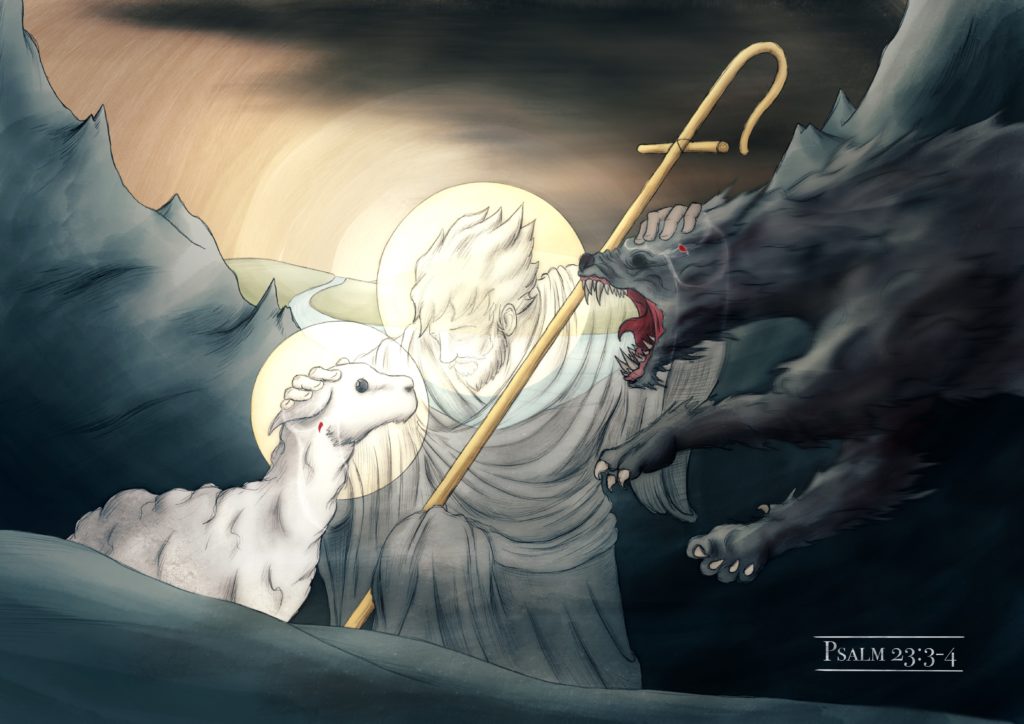
Visual Theology: He restores my soul

Chris Powers is creating visual resources for the global church. His resources are free and meant to be shared. Chris creates tract cards, visual exegesis that can be shared separately or through his book Visual Exegesis Vol. 1, study guides and lessons, animations, and more. Please visit his website at fullofeyes.com. He is also on Patreon, and you can donate to his ministry just once or on a recurring basis. He needs $2,000/month to be self-sustaining, and currently the level of giving is $1,947. Won’t you consider being the patron who puts him over the top?

Thank you for reading and if you’re led, sharing his work and/or giving.

Click to enlarge
“He restores my soul. He leads me on paths of righteousness for His name’s sake.
Even though I walk through the valley of the shadow of death,
I will fear no evil, for you are with me; your rod and your staff, they comfort me.”
Psalm 23:3-4

Artist’s Explanation: By Chris Powers

I wanted this image to visually express the transition from the pastures into the valley that takes place between verses 2 and 4. The overall color scheme is much darker and the jagged edges of the valley frame the distant pastures in the background.

Verse 3 emphasizes the sovereign leading of the shepherd. It is he who guides and goes before His sheep. This is significant to note because in verse 4 we find ourselves in the Valley of the Shadow of Death. The implication is that the sheep is in the valley because the Shepherd has led him there. And—because the entrance into the valley of shadow is by the design of the Good Shepherd—I wanted to show that the sheep is no less in the almighty hand of his shepherd in verse 4 than he was in verses 1-3. In fact, the sheep’s intimacy and dependency upon the shepherd is only intensified by the valley.

In the pastures the shepherd’s presence and goodness were mediated by the grass and water, but in the valley the mediators have been removed and the shepherd himself has become the desperate and hope-filled focus of the lamb (“I will fear no evil for you are with me.”).

The attacking wolf represents the onset of the valley and its terrors (It need not be only death. The Hebrew word translated “shadow of death” can apply to various grievous and hard to bear sufferings that come as we live life in a fallen world. Sickness, loss, a season of doubt or darkness in the soul might all be categorized under this shadow). The shepherd’s hand on the wolf’s head is intentionally ambiguous. He could either crush the animal’s skull into the ground….or allow it to continue its trajectory toward the lamb. However—whatever the outcome— the hand on the wolf’s head declares the shepherd’s sovereignty over all that befalls his own (John 10:28, 21:19, 22).

The wounds of the shepherd visible behind the head of both the lamb and the wolf declare two different truths. The wound behind the head of the wolf reminds us that Christ’s death and resurrection has overcome all of His people’s enemies and that—should they be allowed to harm His beloved—it will only be to the enemy’s final downfall and His people’s exaltation (John 16:33, Philippians 1:28-29, 2 Thessalonians 1:5-8, Revelation 12:11).

The wound behind the lamb’s head is a reminder that our Lord and God and Shepherd Himself has suffered equivalent to and greater than any suffering He may ordain for us. The hand wounded in sovereign love authors our sorrows, and because He Himself is a slain yet living Lamb, He has infinite compassion on those whom He leads. The shepherd who laid down his life as a lamb is the one who goes before us (Isaiah 49:10, Micah 2:12-13, John 10:4, Hebrews 2:18, Revelation 7:17). And since he has led the way through suffering into glory, He has transformed all of our suffering into an avenue for deeper fellowship with Him, fuller joy in Him, and greater exaltation of Him (2 Corinthians 12:9, Philippians 3:10, 1 Peter 2:21).

Notice also that, if the wolf is to attack the lamb, it must pass the through the cross (represented in the staff). This is yet another reminder that the death and resurrection of our Good Shepherd has “de-fanged” the enemy. Because of Christ’s victory on Calvary, tribulation, distress, persecution, famine, nakedness, danger, sword—and whatever else might assail the people of God—cannot separate us from the love of God and, indeed, can only serve our ultimate good and His ultimate glory (Romans 8:28. 31-39).

Lastly for verse 4, I wanted to really emphasize the intimate fellowship with the Savior that often comes in the context of suffering (though it might not feel like it in the moment). First, notice that the lamb is intently focused on the shepherd and that the shepherd’s head is inclined toward the lamb. Though the wolf is slathering and raging, it is not the focus, rather, its onslaught has driven the sheep closer to the master. Second, the light of the two halos forms a sort of quiet, personal space—shared by the sheep and shepherd—amidst the darkness and motion in the rest of the image. And lastly, notice that the distant green pastures and still waters are visible through the face and torso of the Shepherd. The soul-restoring kindness of the shepherd, previously mediated through grass and water, is now accessed directly—and only—through communion with the Shepherd Himself.

In conclusion, I want to point back to verse 3. There we read that YHWH leads His people in paths of righteousness for His Name’s sake. There is much to say about that statement, but for this image the main thing I tried to emphasize is that the paths into which YHWH sovereignly leads His own are intended to make the goodness and beauty of His Name known to them and to those who observe their lives. This is true even (and especially) of those paths that lead through dark valleys because the Name of YHWH is most perfectly communicated in the death and resurrection of Christ, and when the Christ-follower is led through a time of hardship, the glory of Christ’s crucifixion and resurrection is—in a sense—echoed in their lives.

Christ’s love-borne death reverberates in His people’s sufferings as they entrust themselves humbly into the hand of God to do with them what He will for His glory (1 Peter 2:19-21). And the joy of Christ’s resurrection radiates from His Bride’s face as she endures hardship with hopes set, not on the things that are seen, but on the unseen, blood-bought, and resurrection-assured glory that is to come (2 Corinthians 4:14-18).

So, by making the practical implications of Christ’s death and resurrection visually apparent in this image, I am attempting to show that the valley experiences of God’s people bring the crucifixion and resurrection to the foreground and, consequently, glorify the name of our Shepherd and God who is climactically declared at the cross (Psalm 23:3, John 17:26).

Posted in encouragement, Uncategorized

Recommendation on Devotionals

If it helps anyone, here are three devotionals I like, use, and recommend. I’m just some internet lady, so as always, use your discernment when choosing theological material.

I use alternately three particular devotionals. I like them for men and women, but I especially like them for women because we are too often subjected to wispy and insubstantial devotionals aimed at our gender which are light on theology and heavy on the crayon coloring. These are my favorites:

1. Morning & EveningSpurgeon “Charles Haddon Spurgeon’s classic Morning and Evening collection of daily devotionals was written in England more than a century ago. For generations, its cherished gems of daily strength and meditation inspired millions.”

It is in hard copy and also online, so that if you’re  out and about or traveling you can get it on Kindle or just on WiFi and not miss a day. I love Spurgeon’s devotionals and I read and post one each morning. His “Faith’s Check-book” is another devotional I enjoy, these are even shorter and like the Morning & Evening devotional , are very uplifting.

2. John MacArthur: Any devotional. Heavy on scripture but short enough devotions to help fuel a daily habit and not take so much time one abandons it before beginning. Here is a great overview and review of four of his devotionals which are organized in various ways (daily verse-by-verse through one larger passage, topically, NT, or OT).

3. Valley of Vision: A Collection of Puritan Prayers. Despite being written in Puritan days the language is easily understandable.) I personally consider this book the third most important in the English language, ever (after the Bible and Pilgrim’s Progress). I cannot read one and not feel convicted and slain before the throne of Jesus. They’re wonderful!! The hard copy is available at Amazon, the online

Blurb: “Draw upon the inspiration of the elegant prayers of such Puritans as John Bunyan, Isaac Watts, David Brainerd, Augustus Toplady, and Charles Spurgeon. The Valley of Vision has been prepared not to simply supply Christians with prayers, but to prompt and encourage them as they walk upon the path of others who’ve gone before them. You’ll relish the elegance of these writings as they transport you to the heavenly throne of grace. Topics include redemption and reconciliation, holy aspirations, penitence, and more.”

Enjoy!

Posted in encouragement, Uncategorized

Jesus’ predestined life

Predestination is a topic many people either disbelieve or refute. Here is the Christian Apologetics and Research Ministry’s definition of foreordination:

Foreordination is the same as predestination which means that God ordains what will happen in history and in salvation. It means to appoint beforehand. The word ‘foreordained” is used in the KJV in 1 Pet 1:20. Source

It’s the difference, for example, of God using the circumstances around Esther’s situation to make events come out like He wanted, and causing the circumstances of Esther’s situation, in order to work His pre-planned purposes. Understanding Foreordination means you see the God of the universe as the cause of everything for His purposes and will, instead of a bystander scrambling to pick up pieces from man’s actions in order to work it all out for the good.

See these two of many verses regarding foreordination-

also we have obtained an inheritance, having been predestined according to His purpose who works all things after the counsel of His will, (Ephesians 1:11).

to do whatever Your hand and Your purpose predestined to occur. (Acts 4:28).

I apologize in advance…but I heard a sermon in which I took notes and forgot to credit the source. I did not make the following up. It’s from a sermon I was listening to, but sadly I don’t remember who spoke it!

In it, we learn that Jesus did not have a problem with foreordination. We also see clearly that foreordination did not nullify Jesus’ will and it did not turn Him into an automaton. Here is the sermon excerpt:

~~~~~~~~~~~~~~~~~~~~~~

Whenever we find a doctrine to be challenging to us [like predestination] the most helpful question we can ask is: ‘What did Jesus think of this? How did it work out in his life?’ 

When we ask those questions in connection to God’s foreordination and predestination, and search the Scriptures to see how they worked out in Jesus’ life, what do we discover?
There never was a man so conscious that his life had been predestined by god as the Lord Jesus Christ. But this did not turn him into a an automaton, or a mere puppet. God’s predestination is not biological determinism, nor it is a form of fatalism. 

There was, surely, never a freer man, or one more conscious that his actions were his responsibility than our Lord Jesus Christ. He did not become our Saviour by accident on the one hand or merely as a machine n the other. He was destined to be our Saviour; and to that destiny he freely committed himself. He never saw nor felt any contradiction between God’s sovereignty in his life and his own responsibility for his actions., neither should we.

That God had planned His his destiny in advance becomes clear from the very beginning – in the first two chapters of his Gospel Matthew mentions five occasions when Jesus fulfilled Old Testament prophecies when he was too young to have had any choice in the matter.

Matthew 1:22-23

22 All this took place to fulfill what the Lord had spoken by the prophet:
23 Behold, the virgin shall conceive and bear a son, and they shall call his name Immanuel (which means, God with us).

Matthew 2:5-6

5 They told him, “in Bethlehem of Judea, for so it is written by the prophet:

6 “‘And you, O Bethlehem, in the land of Judah,
are by no means least among the rulers of Judah;
for from you shall come a ruler
who will shepherd my people Israel.'”

Matthew 2:15

15 and remained there until the death of Herod. This was to fulfill what the Lord had spoken by the prophet, “Out of Egypt I called my son.”

Matthew 2:17-18

17 Then was fulfilled what was spoken by the prophet Jeremiah:

18 “A voice was heard in Ramah,
weeping and loud lamentation,
Rachel weeping for her children;
she refused to be comforted, because they are no more.”

Matthew 2:23

23 And he went and lived in a city called Nazareth, so that what was spoken by the prophets might be fulfilled, that he would be called a Nazarene.

~~~~~~~~~~~~~~~~~~~~~~

For me, knowing God is in COMPLETE control is a balm. Understanding that He orchestrates events from before the foundation of the world is a relief. He does not have to play catch-up. He does not have to scramble. He is not surprised.

When you read the genealogies, doesn’t it occur to you that God is in control of each and every person meeting and marrying and procreating at the perfect and exact time, so that eventually the line of the Tribe of Judah will produce the Lion? God had to have been behind that since Adam and Eve for the lines to descend in the way He wanted with the bloodlines fulfilling promises and prophecies.

Many are the plans in the mind of a man, but it is the purpose of the Lord that will stand. (Proverbs 19:21)

If you’d like to learn more about predestination, here is a series by Ligonier. Usually they have a paywall, but not for this series. It’s entirely free.

Predestination A Teaching Series by Dr. R.C. Sproul

Here is an essay from Grace To You answering the question: What does the Bible teach about election?

Posted in encouragement, Uncategorized

‘Unpopular the Movie’ is devastating in a good way, as the Gospel always is

Red Grace media has published Unpopular The Movie, and it’s wonderful. This half hour movie is Christ-centric, accurate, clear, and presents the Gospel in a devastatingly biblical way. When you hear/read the Gospel, unvarnished and with open ears and open eyes, it singes the heart and devastates the soul. It is incendiary. Even as a long-saved person, it will try your emotions, and bring you low. We ALL need The Gospel. Continue reading “‘Unpopular the Movie’ is devastating in a good way, as the Gospel always is” →

Posted in encouragement, Uncategorized

The great thing about Jesus is…

There are so many great things about Jesus. They are innumerable. Today let’s look at two passages, one from the Old Testament and one from the New. God isn’t one way in the OT and another in the NT. The two testaments are linked and it is a unified whole. Both Testaments reveal the same God, Son, and Spirit. Continue reading “The great thing about Jesus is…” →

Posted in encouragement, Uncategorized

Knitted with Christ

He will never, ever, never, ever NOT love us!

Who shall separate us from the love of Christ? Shall tribulation, or distress, or persecution, or famine, or nakedness, or danger, or sword? As it is written,

“For your sake we are being killed all the day long; we are regarded as sheep to be slaughtered.”

No, in all these things we are more than conquerors through him who loved us. For I am sure that neither death nor life, nor angels nor rulers, nor things present nor things to come, nor powers, nor height nor depth, nor anything else in all creation, will be able to separate us from the love of God in Christ Jesus our Lord. (Romans 8:35-39) Continue reading “Knitted with Christ” →

Posted in encouragement, Uncategorized

Old Testament Briefs: The Ark was a box

I love the Old Testament and I study it a lot. I’m blessed with a great teaching pastor who loves it too. He frequently exposits chapters from the OT. When he’s in the NT, he always makes connections to the Old. As a matter of fact, our church held a community-wide seminar last Saturday called “Christ in Context”, where our teaching pastor and one of our elders led us in three sessions that connected Christ from the OT to the New: Continue reading “Old Testament Briefs: The Ark was a box” →