Posted in encouragement, Uncategorized

God created a colorful world. He didn’t have to…

Genesis 1:1:

In the beginning, God created the heavens and the earth

When God created the earth, He could have made it colorless. He could have used only His brush strokes of black, or gray, or brown. The world could look like this:

Did you ever wonder why God graced us with a common grace of color? He has made the world beautiful in its time, says Ecclesiastes 3:11. This beauty includes the spectrum of colors which we enjoy in all its prettiness. I particularly enjoy colorful flowers.


The Bible has in it of course, references to colors. It doesn’t, however, really explain if colors of the tabernacle meant anything, if they individually had a symbolism. Other colors do have a symbolism. Here is Baker’s Evangelical Dictionary’s entry on color:

Color, Symbolic Meaning Of

Although the Bible contains relatively few references to individual colors, their symbolic associations are theologically significant. Colors usually symbolize redemptive and eschatological themes. The Bible is, however, silent on whether the colors used in the tabernacle, temple, and priestly garments held symbolic meaning.

Black signifies gloom, mourning, evil, judgment, and death (Lam 4:8; Micah 3:6; Zechariah 6:2 Zechariah 6:6; Revelation 6:5 Revelation 6:12). Its image is often one of dense, impenetrable darkness (Job 3:5; Isa 50:3). The terms “darkness” and “night” parallel this usage (Job 3:3-7; Joel 2:2; Zeph 1:15). Hell is the place of “blackest darkness” reserved for the godless (2 Peter 2:17; Jude 13).

The pale horse of Revelation 6:8 resembles the color of the terror-stricken and corpses (cf. Jer 30:6; Dan 10:8). The horse’s color matches the work of its rider. Its rider is called Death, who, with Hades, goes forth to kill a fourth of humankind.

An expensive dye, purple represents wealth and royalty (Judges 8:26; Est 8:15; Daniel 5:7, Daniel 5:16, Daniel 5:29; Luke 16:19); for this reason, idols were attired in purple (Jer 10:9). The purple dress of the harlot symbolized Roman imperial rank (Rev 17:4; Revelation 18:12, Revelation 18:16). Before his crucifixion, Jesus was robed in purple in mockery of him as “king of the Jews” (Mark 15:17, Mark 15:20; John 19:2, John 19:5; cf. Matt 27:28,; “scarlet robe”). Garments of purple suitably clothe a wife of noble character (Prov 31:22).

Red symbolizes blood. Israel’s sin as brilliant scarlet and deep-red crimson is analogous to the bloodstained hands of murderers (Isaiah 1:15 Isaiah 1:18). The images of red, blood-soaked garments of God as an avenging warrior (Isa 63:1-6) and the fiery red horse bringing slaughter through warfare (Zech 6:2; Rev 6:4) describe divine retribution against evildoers (see also Joel 2:31; Rev 6:12). The red color of the dragon (Rev 12:3) and beast (17:3) symbolizes the shedding of innocent blood (11:7; 16:6). The red heifer (Nu 19:1-10) and scarlet wool (Heb 9:19) symbolize the Old Testament means of purification through blood; the New Testament powerfully expresses the fullness of Christ’s atoning work through a contradictory color image: believers’ robes are washed pure white through the blood of the Lamb (Revelation 7:9 Revelation 7:13-14 ; 19:13-14).

White signifies purity and holiness. It depicts complete forgiveness of sin. David and Israel’s bloodguilt would be fully removed, leaving them whiter than snow/wool (Psalm 51:7; Isa 1:18). It represents the absolute moral purity of God (Da 7:9), Christ (Rev 1:14; Mark 9:3; pars.), angels (Mark 16:5 ; pars. Acts 1:10), and believers (Rev 2:17; 3:4-5; 4:4), and thus of the divine judgment of God (20:11) and Christ (14:14). It indicates the certainty of God’s conquest and victory over evil (Zechariah 6:3 Zechariah 6:6; Rev 6:2; 19:11).

H. Douglas Buckwalter, Bibliography. G. W. Thatcher, Hasting’s Dictionary of the Bible, 1:456-58; P. L. Garber, ISBE, 1:729-32; A. Brenner, Colour Terms in the Old Testament; “Color, ” BEB, 1:494-96.

Color is a common grace. Every person on the planet whether young or old, saved and acknowledging the creator or unsaved and worshiping the creation, enjoys the colors of this earth. Everyone can admire a sunset, colorful avian plumage, floral hues that delight the senses.

Theopedia defines common grace as

Common Grace refers to the grace of God that is common to all humankind. It is “common” because its benefits are experienced by the whole human race without distinction between one person and another, believers or unbelievers. It is “grace” because it is undeserved and sovereignly bestowed by God.

The Lord God created a world that is beautiful. Its beauty is enhanced by the colors He created for us (and Him!) to enjoy in our common grace. The painted desert, the lush tropics, the animals, insects, and fish in all their rich tones and hues are a joy. He didn’t have to But He did.

Thank you Lord!

Posted in encouragement, Uncategorized

El Shama: A God who hears, He is a God who listens

Doesn’t it just crush you to pray to Jesus…and know He hears us? It’s incredible, and a privilege we always remember in gratitude.

As Isaiah cried in his wonder and grief, “I am a man of unclean lips!” (Isaiah 6:5). In my case, a woman of unclean lips. Why should I be able to use these lips to pray to Jesus when I am the chief of sinners, wretched woman that I am? What is man that God should be mindful of us? (Psalm 8:4). Why should He hear us?

But He does.

Though ‘El Shama’ is not an official name of God, it refers to the fact that God hears…He listens. God told Hagar to name her soon to be born son Ishmael. Ishmael is is a combination of el and shama, “God hears” or “God listens”. The name would be a reminder to Hagar and all who knew them that He heard Hagar’s cry in the wilderness. (Genesis 16:11). He listens.

Psalm 17:6 says

I have called on you, for you will hear me, O God: incline your ear to me, and hear my speech.

Gill’s Expositions says of the Psalmist’s plea in verse 6,

“for thou wilt hear me, O God; God is a God hearing prayer; he is used to hear his people, and they have frequent experience of it, and they may be assured that whatsoever they ask according to his will, and in the name of Christ, he will hear; and such an assurance is a reason engaging the saints to a constant calling upon God, Psalm 116:2; and such confidence of being always heard Christ had, John 11:41;”

1 John 5:14 says,

And this is the confidence that we have toward him, that if we ask anything according to his will he hears us.

Did Peter forever relive his anguish each morning of his remaining life, when he heard the rooster crow the day awake and remembered his own perfidy? Owww, Peter, I understand your grief, the pain of betraying Jesus in word or in deed from our own sinful actions. Yet…Jesus prayed for Peter. Luke 22:32. He did not pray for Judas. Both men betrayed Jesus, but Jesus prayed for Peter.

If you’re a Christian, Jesus prays for you, too. It’s staggering to consider that the God of the Universe prays for us. He hears us, and He prays for us. We have a superlative God, One who is true and kind and loving and compassionate. Sister, no matter what you are going through, Jesus hears your prayer and He takes your cares to the Father in prayer. Be encouraged.

be strong verse

Posted in encouragement, Uncategorized

Our struggles are not so different

“Help me never to mistake the excitement of my passions for the renewing of the Holy Spirit, never to judge my religion by occasional impressions and impulses…”

Excerpt from the Valley of Vision, today’s devotional, ‘True Religion’. The set of Puritan prayers edited by Arthur Bennett is copyrighted and requested not to be published so I won’t post the entire devotional, as energizing and encouraging as it is. You can read today’s full devotional here.

More info on the book here:

“In this classic volume, edited by Arthur Bennett, the prayers of the Puritans are brought to life. Including prayers of Richard Baxter, John Bunyan, Isaac Watts, Charles Spurgeon, and others, The Valley of Vision is a selection of petitions and meditations in the Puritan tradition. This compilation of prayers is intended to teach and encourage Christians to be faithful in their private and family worship.”

What I love about the book is not just the quality writing, the stirring sentiments, and the deep theological pleas and truths. It’s also that we can see that in the 1600s, 1700s, 1800s Christians prayed and pleaded for the same things we do in the 2000s, go through the same things, have the same cares and wants. O, the thread that connects us to the brothers of the past. It’s glorious and it’s Jesus. He keeps us, He hears us, and He knows us. We are truly family with these precious brethren who lived and loved and struggled, just as we do. Yes, they were heroes, but they were men and women, and thus, had a flesh nature that plagued them until the end. Just as we have and we do.

Sister, are you fighting against temptation to mistake personal passionate emotion for Holy Spirit enlivenment? So did the Puritans. Perhaps it was Bunyan or Watts, or one of the other men who wrote today’s devotional, who asked the Lord in his prayer to help him not mistake passion for Holy Spirit. Are you seeking “to be enrolled amongst the earthly great and rich”? Or are we asking “to be numbered with the spiritually blessed”? as the devotional writer stated. Are we ‘feeling and confessing ourselves a stranger and a pilgrim here’ or do we seek to hide, meld in, or worse, pursue earthly goods and fame? The Valley of Vision writers sought the same spiritual blessings we pursue we do and were yet tempted to stray toward the same paths we encounter today.

The good news is that foremost, Jesus is the same yesterday, today, and forever. (Hebrews 13:8). He responds to our please with the same compassion, care, and perfection that He did to all the previous pray-ers and pursuers we read of in the Valley of Vision.

It is also good news that Jesus knows what is in a man. (John 2:24-25). And He loves us anyway.

He also knows what temptation is, having encountered it at all points. And so He sympathizes with us. (Hebrews 4:15).

He is also God, who is above us and beyond us in comprehension, but He gave us His word so as to know Him and be encouraged by His love and strength when we’re tempted. For when we’re sad. For when we’re confused. For when we fail. For everything.

All Scripture is breathed out by God and profitable for teaching, for reproof, for correction, and for training in righteousness, (2 Timothy 3:16).

Whether we are John Bunyan in the 1600s, the author of Pilgrim’s Progress and nearly 60 other books, whether we are Isaac Watts in the 1700s, writer of 750 hymns and acknowledged as the father of English Hymnody, whether we are 1800s Charles Spurgeon, the Prince of Preachers and deliverer of over 3500 sermons, or whether we are Elizabeth Prata in the new millennium, a Christian woman who isn’t anybody, or whether you are you, we all share the same struggles, the same fears, wants, and affections. We share Christ.

We’re blessed that the Lord raised up good men like the aforementioned ones, and also the editor of Valley of Vision, who compiled these monumental prayers and devotions. We take encouragement from them, and thus strengthened, we go forth as the writer said, paying attention to our principles as well as our conduct, to our motives as well as our actions.

As it says in today’s devotional, please, Jesus-

Give me large abundance of the supply of the Spirit of Jesus, that I may be prepared for every duty…

Posted in encouragement, Uncategorized

Losing my salvation

John MacArthur has famously said on more than one occasion, “If I could lose my salvation, I would.” His comment is a succinct but devastatingly incisive statement about the fallenness of man. The fleshly part of man wants to be in control. It wants to be king of our lives. Even Christians who understand our own depravity and desire to work FOR God soon find that if they do not carefully reign in the flesh, that we are not participating in our own sanctification, but we’re bossing God around and replacing Him with the idol of works.

MacArthur wasn’t guessing when he said what he said. I’ts grounded in the bible. There is biblical precedent for his statement.

God instituted a Doctrine of Works. Don’t bristle. Stay with me. In Genesis 2, God told Adam,

The LORD God took the man and put him in the garden of Eden to work it and keep it. 16And the LORD God commanded the man, saying, “You may surely eat of every tree of the garden, 17but of the tree of the knowledge of good and evil you shall not eat, for in the day that you eat of it you shall surely die.” (Genesis 2:15-16).

As Martyn Lloyd Jones said of the Doctrine of Works in his sermon “The Covenant of Grace in the Old Testament“, the Genesis verses are obviously a doctrine of works. God told Adam to–

–work the Garden
–keep the Garden
–not eat of the fruit.

The inheritance of the reward from God was entirely dependent upon what Adam did or did not do. This is works.

It failed.

It failed immediately and utterly. Adam failed to work correctly for his reward from God. Since we are all in Adam from the moment of birth, from the moment of conception even, (Romans 5:12, Psalm 51:5) we, too, will fail to please God with our works. (Hebrews 11:6).

Once again Lloyd Jones, “If man in a perfect position didn’t keep the covenant of works, then what is the point of God making a new Covenant of Works? And indeed He didn’t. He then made a Covenant of Grace.”

We cannot, cannot, inherit any reward from God based on our own works. We have proved this. It was tried, it failed, it’s done. God made a Covenant of Grace which is that we receive a reward from Him based on HIS choice, HIS will, HIS election, HIS grace. Our reward is all based on faith, and guess what? The faith we have is also a granted gift from Him. (Galatians 3:22). It is a faith that HE keeps for us and in us. It’s sealed. (2 Corinthians 1:22, Ephesians 1:13).

This knowledge of works v. faith has import for those who are in a works-based religion – which is to say everyone else in all other religions, even atheism. Mormons try to reach god through their covenant of works. Catholics try to pile up works so as to acquire enough to please God. Islam teaches “To those who believe and do deeds of righteousness hath Allah promised forgiveness and a great reward,” (Surah 5:9). And so on. And so on. And so on…

Our working out of our salvation through fear and trembling is a result of the sovereign choice of God to dispense faith and repentance to us. It’s based on our knowledge of the above, that our works while in the flesh count as filthy rags. It’s all Jesus, from start to finish, including His reward to us. We receive a glorified body so that we may no longer sin against Him. We become sons, adopted to His family, and thus co-heirs. We receive manifold and eternal mercies in heaven. Most of all we receive HIM. Jesus is our treasure. In His grace he shared Himself with us, gladly, voluntarily.

Praise God for the Covenant of Grace. Because, if I could lose my salvation, I would.

riches of his grace verse

Posted in encouragement, Uncategorized

A Mother’s Agony

Luke 2:34-35

And Simeon blessed them and said to Mary his mother, “Behold, this child is appointed for the fall and rising of many in Israel, and for a sign that is opposed 35 (and a sword will pierce through your own soul also), so that thoughts from many hearts may be revealed.”

We know that the people whose lives are recorded in the Bible were real. Abraham, Noah, Daniel, Hagar, Rahab, Mary…and the others, were all real people who lived a life on earth with all their joys and trials, and heartaches and triumphs. They did their jobs, sang and laughed, worshiped, prayed, ate, relaxed, and did everything real people do.

Sometimes we read about their lives on the pages of the Bible and as inspired as we are, we tend to think of these people as object lessons, as in, what can I learn from their lives that will inspire me to further obedience or knowledge of Christ?

I see people close to me going through difficulties and heartaches. Some have aging parents in poor health, some are experiencing grief because of death, some are parents with ill children or have children who have received dread diagnoses.

The Lord saw fit to place me in this era and in this nation, where, as a Christian, I am not currently being stalked, hunted, killed, persecuted, or arrested. I know our brethren in the closed countries are, but as of now I personally am not. Sometimes I feel guilty about that, but then again, this is when and where the Lord created me, He appointed times and seasons for everything, so I cannot speak back to the Potter.

I think some of the greatest agonies ever endured. Number one has to be the separation Jesus endured when God withdrew from Him on the cross. “My God, My God, why has thou forsaken me?” Jesus cried. (Matthew 27:46–47). The glory and intimacy He had enjoyed for all eternity with the Father was broken, and Jesus was alone in the dark, spiritually bereft.

If there is a number two agony someone had endured, could it be Jesus’ Mother, Mary, watching her Son hung up as a criminal, beaten, tortured, and dying in front of her eyes? Most mothers believe in their sons. Moms tend to err on the side of their innocence, proclaiming their son’s non-guilt to anyone who would listen. However of all mothers who ever lived, Mary alone knew she had a perfect Son. He never did a wrong thing. He never harmed anyone. Growing up, He treated everyone with perfect courtesy, perfect consideration, perfect attention, perfect honor, perfect trust, perfect love…the list is infinite because Jesus’ qualities as God were perfectly and fully manifested in His human life.

So for Mary to see her beautiful Son, hung up as the lowest criminal, on the most dastardly method of execution ever invented, must have been a grief only mothers can conceive of, and even all other mothers can’t know the depths of her spiritual and motherly despair.

Jesus knew His mother’s temporal agony would be great and her future as a widow would be uncertain. The Lord is good and kind.

When Jesus saw His mother and the disciple whom He loved standing nearby, He said to His mother, “Woman, here is your son.” 27Then He said to the disciple, “Here is your mother.” So from that hour, this disciple took her into his home. (John 19:26-27)

He also knew her spiritual agony would be great too. As Barnes’ Notes says,

Yea, a sword … – The sufferings and death of thy Son shall deeply afflict thy soul. And if Mary had not been thus forewarned and sustained by strong faith, she could not have borne the trials which came upon her Son; but God prepared her for it, and the holy mother of the dying Saviour was sustained.

The Lord of all is so great, kind, wonderful. He is the originator of our faith, the pinnacle of perfection. And yet even as he looked ahead to the sure knowledge of imminent separation from the Father, a moment none of us can even plumb the surface of, never mind the depths, Jesus cared for His weeping and agonizing mother. He sustained her in her faith and spiritually carried her through her agony.

Whatever agony you endure, especially if you are a mother, remember Mary. Remember that even though her crisis was one that no other mother can even attempt to understand, we can still sympathize. It gets even better, because Jesus is there to help us, sustain us, give us the courage to endure. He did for Mary. He will for you.

Posted in encouragement, Uncategorized

The truth about grace

Grace is a concept. But it’s not just a concept. Grace is a gift, but it’s not just a gift. Grace is a force. Think about how powerful grace is. Think about its power as it exists in Jesus, as it is delivered to the saints, its common state as it covers the world, and its special state as it enlivens the saints to do our work.

Here is an excerpt about grace from a sermon from John MacArthur called, Strength Perfected in Weakness, looking at this verse: 2 Corinthians 12:7-10.

or because of these surpassingly great revelations. Therefore, in order to keep me from becoming conceited, I was given a thorn in my flesh, a messenger of Satan, to torment me. 8 Three times I pleaded with the Lord to take it away from me. 9 But he said to me, “My grace is sufficient for you, for my power is made perfect in weakness.” Therefore I will boast all the more gladly about my weaknesses, so that Christ’s power may rest on me. 10 That is why, for Christ’s sake, I delight in weaknesses, in insults, in hardships, in persecutions, in difficulties. For when I am weak, then I am strong.

In speaking of the linchpin part of the passage, ‘my grace is sufficient for you’, MacArthur said,

But grace is not just an inert sort of concept; it is a force, it is a power. It is a power that transforms us. It is a power that awakens us from sleep. It is a power that gives us life in the midst of death. It is a power that is dynamic enough to transform us from the kingdom of darkness to the kingdom of God’s dear Son. It is the power that saves us. It is the power that keeps us, the power that enables us, the power that sanctifies us, and the power that one day will glorify us. You have to look at grace as a force, a divine force that God pours out into the lives of His people at all points to grant them all that they need to be all that He desires.

Grace is a gift.
Grace is a state.
and…
Grace is a POWER.

Posted in encouragement, Uncategorized

God cares very deeply and eternally for His people

If you haven’t listened to Martyn Lloyd Jones’ series called Great Biblical Doctrines, you’re missing out. I listened to two this morning, Redemption: The Eternal Plan of God and The Covenant of Grace in the Old Testament. These  and the other sermons in the series edify and encourage.

Tomorrow I’ll continue with the final essay in the 3-part series I’m doing on the vessels of wrath, but for the Lord’s Day, which is a day of rest, prayer, and exaltation of His glorious name, here is something encouraging Dr Lloyd-Jones said in both the above linked sermons.

God is so loving and concerned with His people that he declares in both the Old Testament and in the New, His faithful and eternal love for us. He restates His covenant of Grace over and over, to reassure us. he is our God, and we are His people! The Jews are His chosen ones, and grafted into that family of Abraham, are the church age saints, the Gentiles.

Because God is in heaven and we were not, we would otherwise never, ever know of His plan since before the foundation of the world to bring a people to Himself. But He condescended to tell us, and more than once. Here, see:

At that time, declares the Lord, I will be the God of all the clans of Israel, and they shall be my people.” (Jeremiah 31:1)

And they shall be my people, and I will be their God. (Jeremiah 32:38)

And they shall know that I am the Lord their God with them, and that they, the house of Israel, are my people, declares the Lord God. And you are my sheep, human sheep of my pasture, and I am your God, declares the Lord God.” (Ezekiel 34:30-31).

You shall dwell in the land that I gave to your fathers, and you shall be my people, and I will be your God. (Ezekiel 36:28)

What agreement has the temple of God with idols? For we are the temple of the living God; as God said, “I will make my dwelling among them and walk among them, and I will be their God, and they shall be my people.” (2 Corinthians 6:16)

and I will be a father to you, and you shall be sons and daughters to me, says the Lord Almighty. (2 Corinthians 6:18)

For this is the covenant that I will make with the house of Israel after those days, declares the Lord: I will put my laws into their minds, and write them on their hearts, and I will be their God, and they shall be my people. (Hebrews 8:10).

And I heard a loud voice from the throne saying, “Behold, the dwelling place of God is with man. He will dwell with them, and they will be his people, and God himself will be with them as their God. (Revelation 21:3)

Doesn’t that just make your heart swell with love and also crush your pride? Why, why does God want us? We’re awful, sinful, dirty, and depraved. It’s to show the riches of His mercy, His faithfulness, His righteousness, His love.

God Himself is such a blessing. Praise Jesus, and may His spotless name be revered throughout all eternity by His people.

god's love for us verse

Posted in encouragement, Uncategorized

A note of encouragement: Don’t be discouraged by the Internet

I’m thankful for the internet. I leaped on that thing the minute it was invented! I’ve been an Amazon customer for 20 years. I’ve had the same email address for almost 20 years. Recently I was looking at my Flickr account, it’s ten years old. I have over 1500 photos there. I can’t believe so much time has passed. I’ve been blogging for ten years.  I started word processing  on a computer with Windows 3.1 in 1997. This was a big deal to a writer used to carbon, typewriter ribbon and whiteout.

I know we complain about how the internet is a vast wasteland, as Newton Minow famously said in 1961 of the then new technology of television. New technology always degrades because the unsaved human always degrades. But the opportunities today via the world wide web  to get the Gospel out, to hear long lost sermons, archived books like Pilgrim’s Progress on CCEL, is truly astonishing, says this lady who was an adult before the internet was invented.

I know that Social Media oftentimes is not social, especially if you have a conservative or evangelical point of view. Warning about false teachers, presenting the Gospel, sharing Bible verses makes people angry. If you need to limit your time on social media so as to stay encouraged, positive, and joyful, then do so.

But the technology itself is tremendously encouraging to me. I enjoy listening to music from a streaming local Christian radio station, or Pandora. I enjoy hearing sermons on RefNet.fm or Expositor.fm. I love reading the classics or getting access to posted dissertations, papers, and theological material otherwise I’d never see. Youtube’s plethora of clips and sermons is amazing, not to mention archives of long-gone but not forgotten preachers like Martyn Lloyd Jones, S. Lewis Johnson, James Montgomery Boice and Donald Grey Barnhouse… Never mind that last week was the annual Shepherds’ Conference sponsored by Grace Community Church, where 4500 pastors from around the world come to hear biblical preaching, enjoy fellowship, be encouraged, and be served- and it was live streamed and recorded for posterity.

The capacity for us to dwell on the negative is human. It’s always present. If you are having bad experiences online, it’s human nature to let those dominate your thinking and color your perspective. I use filters on Twitter to exclude certain words. I’m not shy about muting certain people. On Facebook, I use F.B. Purity, a free app that lets me exclude certain words, and arrange my wall to limit ads, crass headlines, and other things I don’t want to see. On my blog, I delete comments that tout false doctrine or are simply ad hominem- and I don’t think twice about it. If I say something that ticks someone off because of the Gospel, I reply once or maybe twice, and then end it there if the conversation isn’t going anywhere. I don’t fight. I don’t read sites that fight. I use social media to contend, but not to fight.

Use any and all means available to tailor what you need to tailor on social media so as to keep your sanity and your positive attitude.

But, don’t throw out the baby with the bathwater. Retain a wonder and a gratitude for this amazing vehicle called the world wide web. Use it to be an example of His kindness, and use it to promote His name and His gospel. 🙂 Jesus gave us His peace:

Peace I leave with you; my peace I give you. I do not give to you as the world gives. Do not let your hearts be troubled and do not be afraid. (John 14:27).

Posted in encouragement, Uncategorized

Never forget what sinners we are, and what a Savior! (repost)

This was originally published on this blog in June 2014.

The actual wickedness of men’s lives bears a very small proportion to what is in their hearts. But when lust is inwardly cherished, it will break forth into outward sin. Those who tempt others to drunkenness never can be their real friends, and often design their ruin. Thus men execute the Divine vengeance on each other. Those are not only heated with sin, but hardened in sin, who continue to live without prayer, even when in trouble and distress.” ~Matthew Henry’s Commentary on Hosea 7:1-7

Gustav Kaser said of icebergs,

Think of an iceberg! Only about 1/7th rises above the surface of the water. The remaining 6/7ths are under water and not visible to the human eye. A human being is comparable to an iceberg.

The wickedness we see above the surface is only a small proportion to what is in our hearts…

Therefore, praise God that He sent His Son! Jesus lived a sinless life. He died shedding His blood for those appointed to salvation, and pleased with His Son, God raised Him to life on the third day. Now instead of staggering under the weight of all my sin, that which is seen and that which is unseen below the surface, Jesus sees it all, and He saved me anyway. Now I have His righteousness declared upon me by God. As long as I am in this sinful body breathing air on earth, I have been released from the power of sin via the Holy Spirit indwelling me. I have the glorification to look forward to, when I’m no longer even in the presence of sin.

I will greatly rejoice in the Lord; my soul shall exult in my God, for he has clothed me with the garments of salvation; he has covered me with the robe of righteousness, as a bridegroom decks himself like a priest with a beautiful headdress, and as a bride adorns herself with her jewels. (Isaiah 61:10)

Posted in encouragement, Uncategorized

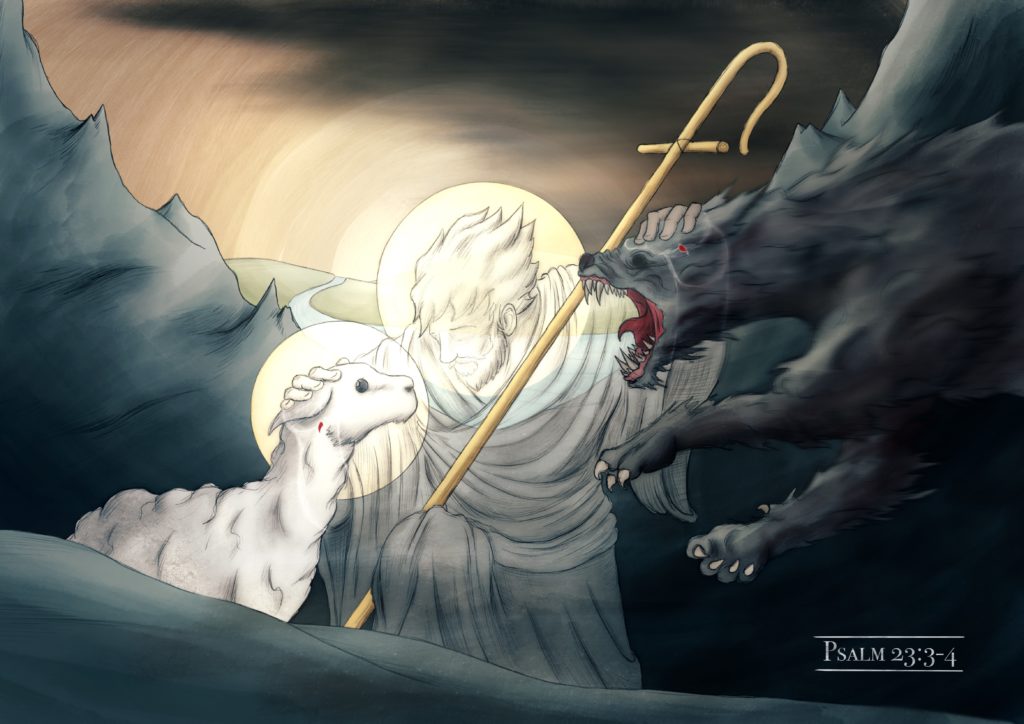
Visual Theology: He restores my soul

Chris Powers is creating visual resources for the global church. His resources are free and meant to be shared. Chris creates tract cards, visual exegesis that can be shared separately or through his book Visual Exegesis Vol. 1, study guides and lessons, animations, and more. Please visit his website at fullofeyes.com. He is also on Patreon, and you can donate to his ministry just once or on a recurring basis. He needs $2,000/month to be self-sustaining, and currently the level of giving is $1,947. Won’t you consider being the patron who puts him over the top?

Thank you for reading and if you’re led, sharing his work and/or giving.

Click to enlarge
He restores my soul. He leads me on paths of righteousness for His name’s sake.
Even though I walk through the valley of the shadow of death,
I will fear no evil, for you are with me; your rod and your staff, they comfort me.”
Psalm 23:3-4

Artist’s Explanation: By Chris Powers

I wanted this image to visually express the transition from the pastures into the valley that takes place between verses 2 and 4. The overall color scheme is much darker and the jagged edges of the valley frame the distant pastures in the background.

Verse 3 emphasizes the sovereign leading of the shepherd. It is he who guides and goes before His sheep. This is significant to note because in verse 4 we find ourselves in the Valley of the Shadow of Death. The implication is that the sheep is in the valley because the Shepherd has led him there. And—because the entrance into the valley of shadow is by the design of the Good Shepherd—I wanted to show that the sheep is no less in the almighty hand of his shepherd in verse 4 than he was in verses 1-3. In fact, the sheep’s intimacy and dependency upon the shepherd is only intensified by the valley.

In the pastures the shepherd’s presence and goodness were mediated by the grass and water, but in the valley the mediators have been removed and the shepherd himself has become the desperate and hope-filled focus of the lamb (“I will fear no evil for you are with me.”).

The attacking wolf represents the onset of the valley and its terrors (It need not be only death. The Hebrew word translated “shadow of death” can apply to various grievous and hard to bear sufferings that come as we live life in a fallen world. Sickness, loss, a season of doubt or darkness in the soul might all be categorized under this shadow). The shepherd’s hand on the wolf’s head is intentionally ambiguous. He could either crush the animal’s skull into the ground….or allow it to continue its trajectory toward the lamb. However—whatever the outcome— the hand on the wolf’s head declares the shepherd’s sovereignty over all that befalls his own (John 10:28, 21:19, 22).

The wounds of the shepherd visible behind the head of both the lamb and the wolf declare two different truths. The wound behind the head of the wolf reminds us that Christ’s death and resurrection has overcome all of His people’s enemies and that—should they be allowed to harm His beloved—it will only be to the enemy’s final downfall and His people’s exaltation (John 16:33, Philippians 1:28-29, 2 Thessalonians 1:5-8, Revelation 12:11).

The wound behind the lamb’s head is a reminder that our Lord and God and Shepherd Himself has suffered equivalent to and greater than any suffering He may ordain for us. The hand wounded in sovereign love authors our sorrows, and because He Himself is a slain yet living Lamb, He has infinite compassion on those whom He leads. The shepherd who laid down his life as a lamb is the one who goes before us (Isaiah 49:10, Micah 2:12-13, John 10:4, Hebrews 2:18, Revelation 7:17). And since he has led the way through suffering into glory, He has transformed all of our suffering into an avenue for deeper fellowship with Him, fuller joy in Him, and greater exaltation of Him (2 Corinthians 12:9, Philippians 3:10, 1 Peter 2:21).

Notice also that, if the wolf is to attack the lamb, it must pass the through the cross (represented in the staff). This is yet another reminder that the death and resurrection of our Good Shepherd has “de-fanged” the enemy. Because of Christ’s victory on Calvary, tribulation, distress, persecution, famine, nakedness, danger, sword—and whatever else might assail the people of God—cannot separate us from the love of God and, indeed, can only serve our ultimate good and His ultimate glory (Romans 8:28. 31-39).

Lastly for verse 4, I wanted to really emphasize the intimate fellowship with the Savior that often comes in the context of suffering (though it might not feel like it in the moment). First, notice that the lamb is intently focused on the shepherd and that the shepherd’s head is inclined toward the lamb. Though the wolf is slathering and raging, it is not the focus, rather, its onslaught has driven the sheep closer to the master. Second, the light of the two halos forms a sort of quiet, personal space—shared by the sheep and shepherd—amidst the darkness and motion in the rest of the image. And lastly, notice that the distant green pastures and still waters are visible through the face and torso of the Shepherd. The soul-restoring kindness of the shepherd, previously mediated through grass and water, is now accessed directly—and only—through communion with the Shepherd Himself.

In conclusion, I want to point back to verse 3. There we read that YHWH leads His people in paths of righteousness for His Name’s sake. There is much to say about that statement, but for this image the main thing I tried to emphasize is that the paths into which YHWH sovereignly leads His own are intended to make the goodness and beauty of His Name known to them and to those who observe their lives. This is true even (and especially) of those paths that lead through dark valleys because the Name of YHWH is most perfectly communicated in the death and resurrection of Christ, and when the Christ-follower is led through a time of hardship, the glory of Christ’s crucifixion and resurrection is—in a sense—echoed in their lives.

Christ’s love-borne death reverberates in His people’s sufferings as they entrust themselves humbly into the hand of God to do with them what He will for His glory (1 Peter 2:19-21). And the joy of Christ’s resurrection radiates from His Bride’s face as she endures hardship with hopes set, not on the things that are seen, but on the unseen, blood-bought, and resurrection-assured glory that is to come (2 Corinthians 4:14-18).

So, by making the practical implications of Christ’s death and resurrection visually apparent in this image, I am attempting to show that the valley experiences of God’s people bring the crucifixion and resurrection to the foreground and, consequently, glorify the name of our Shepherd and God who is climactically declared at the cross (Psalm 23:3, John 17:26).