Posted in encouragement, Uncategorized

Earthly Footsteps of The Man of Galilee: the thorny fence

I love the old book, Earthly Footsteps of The Man of Galilee and the Journeys of His Apostles.

The book contains 400 original photographs by Robert E.M. Bain, taken in Egypt, Israel, Syria, Lebanon, Turkey, Greece, and Italy. Descriptions for each photograph are written by James Lee. These photographs depict the life of Christ and the influence of his ministry—the locations where Christ was born, baptized, crucified, as well as scenes from his prayers, miracles, and sermons. This resource also contains photography of sacred sites between Jerusalem and Rome.

In these photographs taken in the late 1890s, not much had changed in Palestine from the time of Jesus until then. When one sees the vintage, sepia photo of a lone colt tied to a tree in front of a house, one can easily imagine the scene when Jesus told the disciples to go find the young donkey so He could ride into Jerusalem. When one sees a cracked and browned picture of an oil or a flour mill, we can easily imagine commerce and trade as Lydia had with her business of purple.

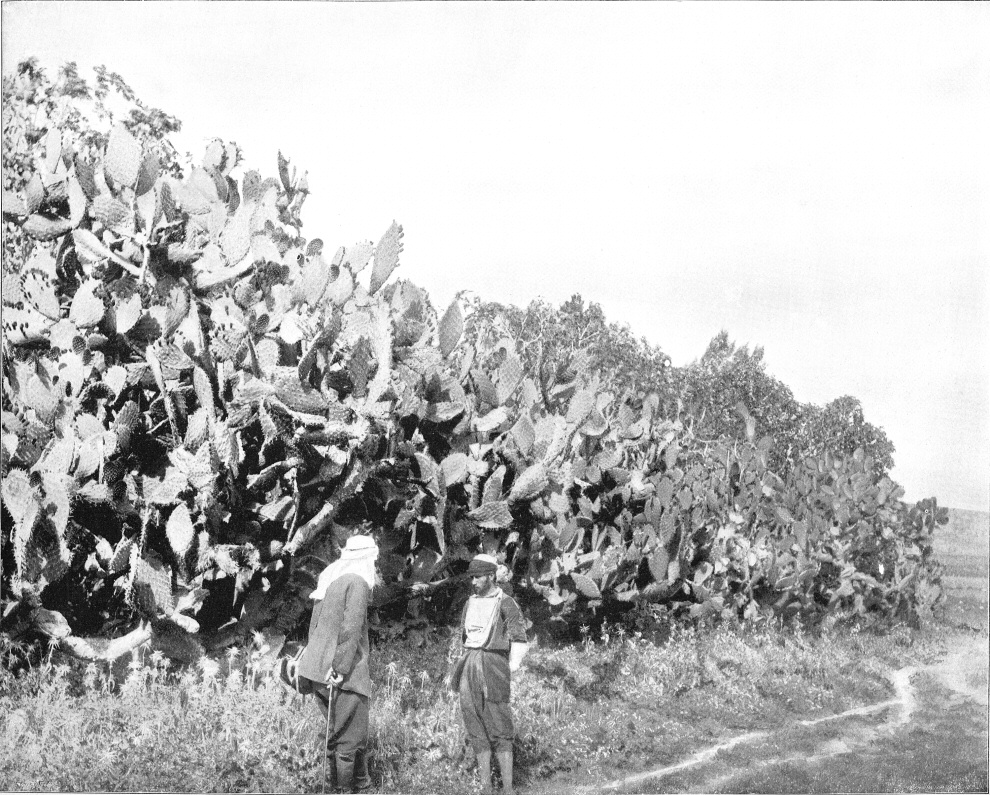
Here below is a fence in Palestine. The caption explains what the reader is seeing and also contains thoughtful ponderings about Jesus and His Gospel. What I think of when I see this photo, is the impenetrable aspect of the fence and the strong deterrent of thorns. The verse from the Parable of the Sower springs to mind.

Other seed fell among thorns, which grew up and choked the plants. (Matthew 13:8)

The agricultural and localized references written in the Bible are so much better appreciated by us in our day when looking at photos like this, or when I seek to learn about the plants and animals of the region.

Sadly, the book is out of print and very rare and expensive, but fortunately, it has been digitized and I can look at the photos on my Logos 6 software. By the way, if you are reading this before noon on this day, Tim Challies has a Free Friday Giveaway that runs until noon on Saturday, raffling off a Logos 7 Silver package. A hefty gift, if you sign up and become the lucky winner.

Earthly Footsteps of The Man of Galilee and the Journeys of His Apostles caption-

‎The thorny cactus abounds in Palestine. It forms a most secure fence, growing sometimes to a height of twelve feet. Beyond this wall are fig trees and olive trees, pleasant vines and fragrant flowers. The man in the picture with white head dress and staff held behind him is the dragoman of the photographic company of 1894.

We linger at Dothan because, besides the memories of Joseph and his brethren, there is an Old Testament picture which must have been recalled by Mary on her pilgrimage to Bethlehem. The prophet Elisha lived here for a time, and it was to Dothan that the Syrian King sent an army to surround and to capture him. By night they came—”horses and chariots and a great host.” And they “compassed the city.”

In the early morning, when Elisha’s servant arose from his bed and went forth “behold, a host compassed the city both with horses and chariots.” Then the prophet’s servant was afraid and he said: “Alas, my master; how shall we do?” And the prophet answered: “Fear not, for they that be with us are more than they that be with them. And Elisha prayed and said: Lord, I pray thee open his eyes that he may see. And the Lord opened the eyes of the young man, and he saw; and behold, the mountain was full of horses and chariots of fire round about Elisha.”—2 Kings 5:13–18.

The reality of the invisible realm, of God and His angels, of life immortal, of the protecting influence of heaven in all the struggles and endeavors of earth—these are doctrines which the Man of Galilee came to proclaim to the race of man. These are doctrines which gave strength and comfort to Mary in her pilgrimage from Nazareth to Bethlehem.

Jesus is utterly fascinating. These long-ago glimpses into the lands upon which He walked are endlessly interesting and encouraging. I hope you find them encouraging also. Of course, nothing can compare to the lands that await us, a renewed earth and domicile in New Jerusalem. Jesus is worthy to be praised, for His earthly sinless life, and His holy sovereign reign over all the earth and universe beyond.

I am the Alpha and the Omega,” says the Lord God, “who is and who was and who is to come, the Almighty.” (Revelation 1:8)

Posted in encouragement, Uncategorized

The Galilean fishermen and their boats (and calming of the storm)

One day he got into a boat with his disciples, and he said to them, “Let us go across to the other side of the lake.” So they set out, 23and as they sailed he fell asleep. And a windstorm came down on the lake, and they were filling with water and were in danger. 24And they went and woke him, saying, “Master, Master, we are perishing!” And he awoke and rebuked the wind and the raging waves, and they ceased, and there was a calm. 25He said to them, “Where is your faith?” And they were afraid, and they marveled, saying to one another, “Who then is this, that he commands even winds and water, and they obey him?” (Luke 8:22-25; also Matthew 8:23-27).

Sea of Galilee, at Tiberias. View of ruins at shore of Galilee. 1862.
Public Domain

The Calming of the Storm, a 33-minute sermon on the biblical text of  Luke 8:22-25 from Ligonier Ministries is very good.

The Sea of Galilee is an important location in the biblical history. Jesus displayed His sovereignty over creation on the sea of Galilee when He calmed the storm and rebuked the waves. ‘The wind and waves obey Him!’.

Don’t you find it interesting that seasoned fishermen were afraid for their lives? These were tough men who saw death on a daily basis. Between the high death rate in general in the first century, the daily animal sacrifices, and the naturally high mortality rate due to their profession, they were familiar with terror and the presence of death. Yet in this storm, they were afraid for their very lives.

What’s the Sea of Galilee like? Let’s get a mental picture.

The “sea” is really a freshwater lake. It ranges from 16 miles tall to 9 miles wide. By comparison, Lake Tahoe in the United States is 22 miles long and 12 miles wide. The Sea of Galilee has been given other names, including Lake Gennesaret, and Lake Tiberias.

City of Tiberias – Jewish Fishermen by the Sea of Galilee, Palestine,
a photograph by William H. Rau, 1903. Public domain

The storms on the Sea are legendary. This is because of its geography, which makes it prone to sudden, boiling storms and pitched waves. It sits about 640 feet below the level of the Mediterranean Sea, and it’s surrounded by towering hillsides. Ravines on the Sea’s west side funnel cool air into the basin. When the cool air rushes into hot air rising from the low sea level valley, the resulting clash can create sudden, fierce winds that stir up steep waves. These choppy waves can become big enough to swamp a boat. When you get a steep chop and no space for the waves to become rolling, there’s no time for the boat to climb up one wave and surf naturally down another. The waves simply pound down on its bow, and if caught broadside, the waves can capsize you in a moment. As a former yachtsman, I can attest that there is no worse situation for sailor and boat alike than high winds and a steep chop. The boat takes a severe pounding, as does the helmsman!

In Jesus’ time, a thriving fishing industry was one of the main ways men earned a livelihood in and around that area. Peter, James, and John earned their living as fishermen. The lake yielded many kinds of fish. Three of the most popular were Sardines, Biny fish, and Tilapia, now known as “St. Peter’s Fish”.  According to the Wiki Bible project, “Biny fish are easily identified by the “barbels” or whisker type flesh that hangs from around the mouth. These fish are a hardy fish that was popular for the Sabbath feasts. These Biny fish can usually be found near schools of sardines as they are predatory fish eating everything from snail and mollusks to sardines.”

‘The Storm On The Sea Of Galilee’ By Rembrandt van Rijn

We know that the fishermen were petrified for their lives during the terrible storm. But after Jesus calmed the storm, they became more petrified.

He said to them, “Where is your faith?” And they were afraid, and they marveled, saying to one another, “Who then is this, that he commands even winds and water, and they obey him?” (Luke 8:25).

The word in the verse for afraid is phobēthentes, the main word is phobéō or phobos. You will recognize the English use of the word in ‘phobia’. It means to put to flight, to terrify, frighten. If the men hadn’t been trapped in the boat in the middle of the sea they would have run away! Much like the men did in Daniel 10:7. It is a fearful thing to fall into the hands of the living God. (Hebrews 10:31).

The scene should stir in us an awe and a recognition that there is nothing more terrifying, even waves that swamp your boat, than the living God who created the waves and calms them at a word. The takeaway is that though the waves made the men were fearful for their lives, when Jesus displayed His sovereignty over the creation, they feared for their souls.

He is a great God, powerful, yet kind to His children. Praise His holy name.

Posted in encouragement, Uncategorized

The Tree of Life

I like trees.

They’re majestic. They’re interesting. They’re helpful to the environment. They provide a home for birds. They provide scenes for artists. They enhance the view.

The Bible mentions many trees. Acacia, myrtle, juniper, cedar, cypress, chestnut, olive, almond, fig… The list goes on.

There are references to trees as a metaphor for strength and for prominent men (Psalm 1:3) or as a symbol of evil (Psalm 37:35).

Of all the trees mentioned in the Bible there is one pre-eminent tree. The Tree of Life.

Tree of Life
The meaning of “the tree of knowledge of good and evil” in the Eden narrative is not as clear as the meaning of the “tree of life.” Direct allusions to the tree of life are found in both the Old Testament and the New Testament. Significantly, in the book of Proverbs the tree of life is like a symbol: 

  •      of knowledge (Prov 3:18);
  •      of righteous fruit (Prov 11:30);
  •      of accomplished desires (Prov 13:12);
  •      of a wholesome tongue (Prov 15:4; Marcus, “The Tree of Life,” 117–20). 

Baez, E. (2016). Tree of Knowledge. Lexham Press.

The New Testament contains four references to the tree of life, all of which appear in Rev 2 and Rev 22. In this eschatological context, the tree of life functions as a future source of healing and immortality for the faithful. 

In Revelation 2:7 and 11, the saints who emerge victorious in Christ through testing are promised the tree of life (Rev 2:7) and deliverance from the second death (Rev 2:11). Osborne argues that in this context, the tree of life symbolizes the cross, which makes access to God and eternal life possible (Osborne, Revelation, 124, 563). Similar imagery is attested elsewhere in the New Testament (e.g., Gal 3:13). Tree of life imagery also serves as a polemic against the Greek Artemis fertility cult of Ephesus, where her temple was a “tree shrine” in which she symbolized life (Osborne, Revelation, 124). 

The final chapter of Revelation ties the tree of life back to the garden of Eden as “a picture of forgiveness and consequent experience of God’s intimate presence.” This chapter uses language and imagery of early Jewish literature (Beale, The Book of Revelation, 234–35). 

Faro, I. (2016). Tree of Life. Lexham Press.

The tree of life used to be in the Garden of Eden. (Genesis 2:9). Where is it now? In the paradise of God- AKA heaven. (Revelation 2:7b, 19)

It is an actual tree. Will the tree of life be a palm tree? A new kind of tree humans have never seen before (except Adam and Eve)? I am very much looking forward to seeing this tree.

Spiritually, our precious Savior is a Tree of Life (John 14:6). In only Him is life. Praise God for sending His Son. He is the tree of life, in whom we are rooted, in whom we grow, and in whom we shelter.

Further Reading:

Answers in Genesis: The Tree of Life

The Tree of Life stood in the centre of the Garden of Eden which elsewhere is called ‘The Garden of the LORD’.1 It was a real tree, to be sure, but let me suggest that it was also symbolic of the fact that God was, and is, the source of eternal life and blessing. Adam and Eve were to have their life centred in Him, even as the Tree was in the centre of His Garden.

Posted in encouragement, Uncategorized

End of the Week Encouragement

1 Thessalonians 5:1-9: Now, brothers, about times and dates we do not need to write to you, for you know very well that the day of the Lord will come like a thief in the night. While people are saying, “Peace and safety,” destruction will come on them suddenly, as labor pains on a pregnant woman, and they will not escape. But you, brothers, are not in darkness so that this day should surprise you like a thief. You are all sons of the light and sons of the day. We do not belong to the night or to the darkness. So then, let us not be like others, who are asleep, but let us be alert and self-controlled.

We will not be surprised. The Lord is gracious and kind! Therefore we are alert, looking for our Redemption and mindful of the lost state of our brothers. Prophecy should spark us to fervency of faith and greater hope.

Have you had a good week? Yes? Praise Jesus! No? Then praise Him anyway! We have another week to witness, and to share the Gospel with people in our lives. I pray that He will shine His light through me even more brightly this week than the week before so that when people see me, they really see Jesus’ glory.

Ephesians 4:13 says, Till we all come in the unity of the faith, and of the knowledge of the Son of God, unto a perfect man, unto the measure of the stature of the fulness of Christ:… won’t that be a wonderful moment when we ALL worship Him in unity and perfect wholeness of the Body!

It is my opinion that God is slowly but surely removing protection from the world, and He is upsetting our self-satisfied equilibrium by demonstrating we can only depend on Him. But no matter what your interpretation is of worldly events, ultimately, we all know God is sovereign. He owns the world and the people in it. (Psalm 24:1).

Ezekiel 39:28 – Then they will know that I am the LORD their God, for though I sent them into exile among the nations, I will gather them to their own land, not leaving any behind.

Is this a prophecy that has been fulfilled? Or is it one to come? It is one to come, and is related to the last days. Matthew Henry comments:

This is the conclusion of the whole matter going before, and has reference not only to the predictions concerning Gog and Magog, but to all the prophecies of this book concerning the captivity of the house of Israel, and then concerning their restoration and return out of their captivity. 39:23-29 When the Lord shall have mercy on the whole house of Israel, by converting them to Christianity, and when they shall have borne the shame of being cast off for their sins, then the nations shall learn to know, worship, and serve him. Then Israel also shall know the Lord, as revealed in and by Christ. Past events do not answer to these predictions. The pouring out of the Spirit is a pledge that God’s favour will continue. He will hide his face no more from those on whom he has poured out his Spirit.

Today would have been my father’s 84th birthday. He died suddenly and instantly in an automobile crash two-and-a-half years ago. He had never been born again. He personally believed his eternity was settled, because God does not exist. ‘He is a crutch for the witless, an opiate of the masses’ he told me many times. That is not true, as Christians understand. However, for all those people who wonder, who question, who say that they will wait until later to settle their after-life issues: you never know when it will be your time to meet your maker!

Hay bale kills ELO member

A giant bale of hay has killed a founding member of the Electric Light Orchestra (ELO) band after it tumbled down a hill and crashed into his van. Cellist Mike Edwards, 62, died after the 600 kg (1,323 lb) bale rolled down a steep field in Devon, southern England, smashed through a hedge and careered on to the road. He died instantly in the freak accident on Friday afternoon.

DO NOT WAIT! Settle your sin account with Jesus now. Eternity is long!

Posted in encouragement, Uncategorized

The LORD is Creator and Commander of the animal kingdom

The Lord in His power directs every atom, every person, every angel, every demon, and every animal on earth (and in heaven). He created all and He is in control over all.

Not that He makes humans like robots, but His providence sees to it that His will and His plans are carried out. I enjoy pondering His power over His creation, don’t you? There are many verses that speak to this fact. Here are a mere few that demonstrate His sovereignty.

“The earth is the LORD’s, and everything in it, the world, and all who live in it; for he founded it on the seas and established it on the waters” (Psalm 24:1-2).

Before the mountains were born or you brought forth the whole world, from everlasting to everlasting you are God” (Psalm 90:2).

He is before all things, and in him all things hold together” (Colossians 1:17).

One demonstration of His power is His control over the animals. Let’s take a look.

The most obvious one is His control over animals when He sent them to Noah to board the ark.

Of the birds according to their kinds, and of the animals according to their kinds, of every creeping thing of the ground, according to its kind, two of every sort shall come in to you to keep them alive. (Genesis 6:20).

In Exodus, He sent the plagues of flies, gnats (Exodus 8:16-19), frogs (Exodus 8:1-15) and killed all the cattle- except the ones who belonged to the Hebrews. Lest someone believe that it was an accident, the Bible declares that the LORD did it.

And the Lord did so. There came great swarms of flies into the house of Pharaoh and into his servants’ houses. Throughout all the land of Egypt the land was ruined by the swarms of flies. (Exodus 8:24).

EPrata photo


And the next day the Lord did this thing. All the livestock of the Egyptians died, but not one of the livestock of the people of Israel died
. (Exodus 9:6).

Prophet Elijah was fed by ravens.

And the word of the Lord came to him: 3 “Depart from here and turn eastward and hide yourself by the brook Cherith, which is east of the Jordan. 4 You shall drink from the brook, and I have commanded the ravens to feed you there.” (1 Kings 17:2-4).

Lest anyone think it was an accident, note that the LORD “commanded” the birds to do this. It was His will and desire that this should occur. And it did.

In Numbers 22:28 He made a donkey speak. What I found funny was that Balaam argued back. He was arguing with a donkey! He didn’t say, “Hm, this donkey which I have ridden all my life and it never spoke before, suddenly began acting strangely and then it talked to me. It must be the LORD.’ No, Balaam said he was so mad at the donkey he would like to kill it. The donkey then pleaded his case. A strange scene, for sure. But the LORD made the donkey speak. Once again, He is in control.

Of course one can think of the bears God sent to maul the taunting youths, the great fish He sent to swallow Jonah, the lions’ mouths he closed in the lion’s den for Daniel, the ram he sent to Abraham caught in the thicket atop Mt Moriah, and many other instances of how the LORD used animals to fulfill His will.

In the New Testament, He made the fish overload the disciples’ nets so much that their net broke. (Luke 5:6). In Matthew 17:24-27 he put a drachma coin into a fish’s mouth. He will call the birds of the air to the Great Supper of God. (Revelation 19:17).

EPrata photo

God communicates with His creatures. He cares for them. They indicate that there IS a Creator as a product of God’s creative energy and will.

I enjoy thinking about the sovereignty of God through these topics. His created order, the world, and heaven contain animals of which he creates, communicates with, and cares for. They do what He wishes and they even give praise to their creator. (Psalm 148:10-13).

We can do the same.

EPrata photo
Posted in encouragement, Uncategorized

Throwback Thursday: If We had X-ray Vision, what would Sin Look Like?

This was first published in January 2014 on this blog.

—————————
When satan was created, He was the most beautiful angel. Ezekiel 28:12 says

Son of man, raise a lamentation over the king of Tyre, and say to him, Thus says the Lord GOD: “You were the signet of perfection, full of wisdom and perfect in beauty.”

Inside or out, satan was not only beautiful, but he was the very seal of perfection. But it didn’t last. Though he was created perfect, one day, unrighteousness was found in him.

You were blameless in your ways from the day you were created, till unrighteousness was found in you.” (Ezekiel 28:15)

Initially, sin might look beautiful but the more a person becomes trapped in it, the less beautiful it seems to them and the more they are eternally destroyed.

The woman may be beautiful, and the sin so enticing, Proverbs 5:3 says,

For the lips of the adulterous woman drip honey and her speech is smoother than oil.

But the end of it all is is hell.

In the end she’s as bitter as wormwood and as sharp as a double-edged sword. Her feet go down to death; her steps head straight for Sheol. (Proverbs 5:4-5)

But sin at first has to look great, and not like ot really looks, or else no one would engage in it.

How does sin really look? Remember Superman’s X-Ray vision?

THIS is what sin might look like. Here is the Old Man. Once so beautiful and shining, it is what satan’s soul looks like. Eve thought the fruit looked good and a delight to the eyes, (Genesis 3:6) but shortly after all it had brought was pain and bondage (Genesis 3:16). If we had X-ray vision and could see beyond the enticing surface, this is what we would see:

“Sin”, collage on handmade paste paper, by EPrata

O, would that sin looked like this to our eyes, then we would not be so attracted to it! And sadly, horrifically, it is what us inside us. This ugliness is what Jesus sees when He looks at a non-believer. Lovingly, He still died for us.

but God shows his love for us in that while we were still sinners, Christ died for us. (Romans 5:8)

However, being that sin is so gross and deadly, it makes the triumph of Jesus all the more glorious.  Where satan is all-darkness that fools us into thinking it is light, Jesus never had one blot, one lie, one corrupt thought, one serpent slither. Not once, not ever. He IS the Light!

God is light, and in Him is no darkness at all. (1 John 1:5)

If we had X-ray vision looking at Jesus, our eyes would see only glory upon glory, shining like the sun. He is a prism of Light, reflecting throughout all the universe and into the eternity we will share with Him! When He looks upon a believer He sees that same righteousness-

For He has made Him to be sin for us, who knew no sin; that we might be made the righteousness of God in Him. (2 Corinthians 5:21)

Don’t be fooled by the initially enticing beauty of sin. It is gross, destructive, horrible. Put on your X-ray vision to see beyond the surface lie. Run from it toward Jesus who set us free from its bondage, and gave us the Spirit’s vision to see through its enticing spoils. Satan’s offerings are nothing. Jesus is our all in all.

Posted in encouragement, Uncategorized

Paul’s warm letters

These are the openings of all of Paul’s letters, except Galatians. Please don’t skip, read them through.

I thank my God in all my remembrance of you, always in every prayer of mine for you all making my prayer with joy, 5 because of your partnership in the gospel from the first day until now. And I am sure of this, that he who began a good work in you will bring it to completion at the day of Jesus Christ. (Philippians 1:3-6).

I give thanks to my God always for you because of the grace of God that was given you in Christ Jesus, 5 that in every way you were enriched in him in all speech and all knowledge— 6 even as the testimony about Christ was confirmed among you— 7 so that you are not lacking in any gift, as you wait for the revealing of our Lord Jesus Christ, 8 who will sustain you to the end, guiltless in the day of our Lord Jesus Christ. 9 God is faithful, by whom you were called into the fellowship of his Son, Jesus Christ our Lord. (1 Corinthians 1:4-9).

Grace to you and peace from God our Father and the Lord Jesus Christ. … Our hope for you is unshaken, for we know that as you share in our sufferings, you will also share in our comfort. (2 Corinthians 1:2,7)

For this reason, because I have heard of your faith in the Lord Jesus and your love toward all the saints, I do not cease to give thanks for you, remembering you in my prayers… (Ephesians 1:15-16).

We always thank God, the Father of our Lord Jesus Christ, when we pray for you, 4 since we heard of your faith in Christ Jesus and of the love that you have for all the saints, 5 because of the hope laid up for you in heaven (Colossians 1:3-5).

We give thanks to God always for all of you, constantly mentioning you in our prayers, 3 remembering before our God and Father your work of faith and labor of love and steadfastness of hope in our Lord Jesus Christ. (1 Thessalonians 1:203).

We ought always to give thanks to God for you, brothers, as is right, because your faith is growing abundantly, and the love of every one of you for one another is increasing. Therefore we ourselves boast about you in the churches of God for your steadfastness and faith in all your persecutions and in the afflictions that you are enduring. (2 Thessalonians 3-4).

To Timothy, my true child in the faith: Grace, mercy, and peace from God the Father and Christ Jesus our Lord. (1 Timothy 1:2).

To Timothy, my beloved child: Grace, mercy, and peace from God the Father and Christ Jesus our Lord. I thank God whom I serve, as did my ancestors, with a clear conscience, as I remember you constantly in my prayers night and day. As I remember your tears, I long to see you, that I may be filled with joy. (2 Timothy 2:2-4).

To Titus, my true child in a common faith: Grace and peace from God the Father and Christ Jesus our Savior. (Titus 1:4).

To Philemon our beloved fellow worker 2 and Apphia our sister and Archippus our fellow soldier, and the church in your house: Grace to you and peace from God our Father and the Lord Jesus Christ. I thank my God always when I remember you in my prayers, because I hear of your love and of the faith that you have toward the Lord Jesus and for all the saints, and I pray that the sharing of your faith may become effective for the full knowledge of every good thing that is in us for the sake of Christ. For I have derived much joy and comfort from your love, my brother, because the hearts of the saints have been refreshed through you. (Philemon 1:1-7).

A hallmark of Christianity is love.

By this all people will know that you are my disciples, if you have love for one another. (John 13:35).

Barnes Notes says of the John verse,

That is, your love for each other shall be so decisive evidence that you are like the Saviour, that all people shall see and know it. It shall be the thing by which you shall be known among all men. You shall not be known by special rites or habits; not by a special form of dress or manner of speech; not by special austerities and unusual customs, like the Pharisees, the Essenes, or the scribes, but by deep, genuine, and tender affection. And it is well known it was this which eminently distinguished the first Christians, and was the subject of remark by the surrounding pagans. “See,” said the pagan, “see how they love one another! They are ready to lay down their lives for each other.” 

I think it’s clear that Paul genuinely loved his people and cherished his overseers. His letters were full of approbation for them. He had high regard for his fellow workers, and wasn’t shy about saying so.

Wouldn’t it be lovely to receive a letter like Paul’s? Wouldn’t it be great to be received in person the way that Paul greets his friends? It would, on both counts. I fail the standard Paul sets here, both in reaching out with loving, personal messages to warmly encourage as Paul does, and in displaying a genuine love in person for the believers “in the common faith.”

How about you? Is there something more you can do to ‘boast of a friend’ to other friends? To pray for them earnestly? To visit with them in love, exulting in your common love of Christ?

Please re-read the letter introductions, and think of someone you can love and encourage today. I know I will.

Posted in encouragement

What about a Christian’s Weakness?

There’s weakness, and then there’s weakness. It depends on which kind you’re talking about.

Christian women are noted as the weaker vessel. (1 Peter 3:7). GotQuestions explains in this excerpt:

This is not a popular idea among many women or even many men. However, the Scripture tells us that the woman was deceived (1 Timothy 2:14), she is subject to her husband (1 Peter 3:1) and that she is a “weaker” vessel. That women are usually physically weaker is undeniable, but the implication of the fall is that by virtue of her being deceived by Satan, women may also sometimes be weaker in other ways. That definitely does not mean she is less valuable (Ephesians 1:6) or that she does not have equal access to grace (Galatians 3:28). 

As for Christian weakness in general, we’re all weak, we are supposed to be. Paul said that Jesus replied to him,

‘My grace is sufficient for you, for My power is perfected in weakness.’ Therefore I will boast all the more gladly in my weaknesses, so that the power of Christ may rest on me. That is why, for the sake of Christ, I delight in weaknesses, in insults, in hardships, in persecutions, in difficulties. For when I am weak, then I am strong. (2 Corinthians 12:9-10).

There’s weak because we’re laden with sin that makes us weak. That is one reason we strive not to sin. We pick up our cross daily and slay it. When we do sin, it’s important to address it by repenting to Jesus and making things right with theother person, if you had involved another person in your sin. Sin is one reason we become weak and ineffective.

There’s weak because we understand our depravity and seek the Spirit’s strength. There’s weak when we see how powerful Jesus is, and understand our own powerlessness in the face of His omnipotence. There’s physically weak, due to illness temporary or permanent.

In some cases, God gives us weakness. He gave to Paul a “thorn in the side” both to keep Paul humble, and to demonstrate that all we need is His grace (not our own strength). (2 Corinthians 12:7)

In America where I’m from, strength is valued. Strength, bravado, and self-sufficiency are nationally recognized attributes, idols, even. In addition, American Feminism has also contributed to a national consciousness that we woman are supposed to have it all together and be capable of all things at all times. “I can bring home the bacon AND fry it up in a pan” and so on.

The attributes of weakness, meekness, and humility aren’t as valued as they are in other nations. But it’s OK to be weak. It’s good. Why?

It’s God who strengthens us. I can do all things through him who strengthens me. (Philippians 4:13).

Wouldn’t you rather have His strength than your own strength, anyway? 🙂

~~~~~~~~~~~~~~~~~~~~~~~~~~

Further Reading

Here are a few resources on our weakness.

Desiring God: Don’t Waste Your Weakness

The End Time: Are you a weak woman, or are you a weak woman?

Grace To You blog post: God’s Sufficient Grace

Ligonier Devotional: Power in Weakness

Posted in encouragement, Uncategorized

The Sad Story of the Wind Phone

The lost are in the night, the cold, the outside. The lost are stumbling around, leading each other into a pit. They know not what they do. They dwell in a land of darkness with no hope.

For that reason, we can have compassion and pity.

This week I read an article that pulled at my heart strings. It was one of those articles that evoked pity, but also gratitude. I say gratitude because the Lord transferred me from the Kingdom of Darkness into His kingdom of Light. I have hope for an afterlife, the assurance of His more sure word on what is going to happen.

The phone of the wind. CC BY-SA 4.0

Wind Telephone
A disconnected rotary phone for “calling” lost loved ones offered a unique way of dealing with grief in disaster-stricken Japan.

When Itaru Sasaki lost his cousin in 2010, he decided to build a glass-paneled phone booth in his hilltop garden with a disconnected rotary phone inside for communicating with his lost relative, to help him deal with his grief.

Only a year later, Japan faced the horrors of a triple disaster: an earthquake followed by a tsunami, which caused a nuclear meltdown. Sasaki’s coastal hometown of Otsuchi was hit with 30-foot waves. Ten percent of the town died in the flood.

Sasaki opened his kaze no denwa or “wind phone” to the now huge number of people in the community mourning the loss of loved ones. Eventually, word spread and others experiencing grief made the pilgrimage from around the country. It is believed that 10,000 visitors journeyed to this hilltop outside Otsuchi within three years of the disaster.

The article goes on to assure the reader that the wind phone is meant to be used as a one-way communication. In other words, the people dialing the rotary dial and speaking their grief to the wind do not expect to hear anything in return at all. It’s just a symbol, a process, and an activity to help people feel more in control during their time of grief.

But we do not want you to be uninformed, brothers, about those who are asleep, that you may not grieve as others do who have no hope. (1 Thessalonians 4:13).

Not knowing about what happens after death is a number one issue for the unsaved. They might utter it, or they might never utter it, but we know that the gaping maw that is the great, unanswered question of eternity always lurks behind their thoughts. We know this because they are children of wrath (Ephesians 2:3) and the wrath abides on them all the time. (John 3:36). As Paul said, If our hope in Christ is for this life alone, we are to be pitied more than all men. (1 Corinthians 15:19).

We Christians have the assurance of a sinless, perfect afterlife with Jesus. We also have the promise of loving attention by a God who hears our prayers. (Psalm 34:15). We do not need a wind phone, we have the ear of the Almighty God! What praise there is in that! We are encouraged to take our supplications to Him, He hears us from His mighty temple. (Psalm 18:6).

Doesn’t it just tug your heart strings to see something like a wind phone atop a lonely hill in Japan? Doesn’t it pierce you, knowing the sadness and grief of the lost will not be salved? But doesn’t it also pierce you (as it does me) to have the ability to pray to the Holy One, and not? While the lost are installing phantom phones to whisper their grief into the wind, we are assured we have the ear of the High Priest at our disposal.

Pray more. Jesus is the God who sees and hears. He knows the voices of His sheep. Our griefs, supplications, petitions, cares, burdens, praises, and joys reach Him even though He is an unutterable distance away. But He is this close, too, inside us, knowing our sinews and heartbeats. He knows what we will ask before we ask it. He knows the need to be comforted even as we clasp our hands and open our mouth. He is great, attentive, wise, and concerned. Pray more. And tell the lost before they need a wind phone, that there is One who will listen, if they repent.

——————————————-

Further Reading

The Master’s Seminary: When an Unbeliever Dies: Offering Comfort without Distorting the Truth

Desiring God: How Do You Deal with the Death of an Unsaved Loved One?

Posted in encouragement, Uncategorized

David’s brave prayer

In Matthew 16:24-26 we read,

Then Jesus told his disciples, “If anyone would come after me, let him deny himself and take up his cross and follow me. 25 For whoever would save his life will lose it, but whoever loses his life for my sake will find it. 26 For what will it profit a man if he gains the whole world and forfeits his soul? Or what shall a man give in return for his soul?

We know that passage means we turn our back on the kingdom of darkness and everything it represents, including self-aggrandizement, self-absorption, selfishness, anything self, &etc. We know we are supposed to die to self. We know we are supposed to hold others in higher regard than ourselves. We know it is written that we should be willing to lay down our life for our friends.

It’s hard.

Very hard.

Oh, does the flesh rebel against this.

We read in Psalm 7:3-5, the following prayer by David.

O Lord my God, if I have done this,
if there is wrong in my hands,
if I have repaid my friend with evil
or plundered my enemy without cause,
let the enemy pursue my soul and overtake it,
and let him trample my life to the ground
and lay my glory in the dust.

In that section of the Psalm, David is saying that if he has violated his Godly principles and done evil to a friend, may the Lord crush him. He is saying that if he has done evil to an enemy without cause, may him be trampled to the ground without honor.

Barnes Notes explains,

repaid friend with evil – The meaning here is simply that if he were a guilty man, in the manner charged on him, he would be willing to be treated accordingly. He did not wish to screen himself from any just treatment; and if he had been guilty he would not complain even if he were cut off from the land of the living.

plundered enemy without cause – The allusion here is to the manner in which the vanquished were often treated in battle, when they were rode over by horses, or trampled by men into the dust. The idea of David is, that if he was guilty he would be willing that his enemy should triumph over him, should subdue him, should treat him with the utmost indignity and scorn.

No wonder David was a man after God’s own heart. It is a hard thing to pray. Because, God will do it.

Sometimes I try to pray this kind of prayer. The words stick in my throat. Or, as the words come out, I soften them. I am a weakling when it comes to the battle between myself and others. ‘Lay my glory in the dust’? I am far from mastering that.

Praise God for the Psalms. They are comforting yes, but they are convicting too. Lord, help me by giving me the strength to more deeply obey Your principles. As I take up my cross today and go down the dusty road, give me the strength to truly care for others beyond myself, in spite of myself, denying myself.

EPrata photo