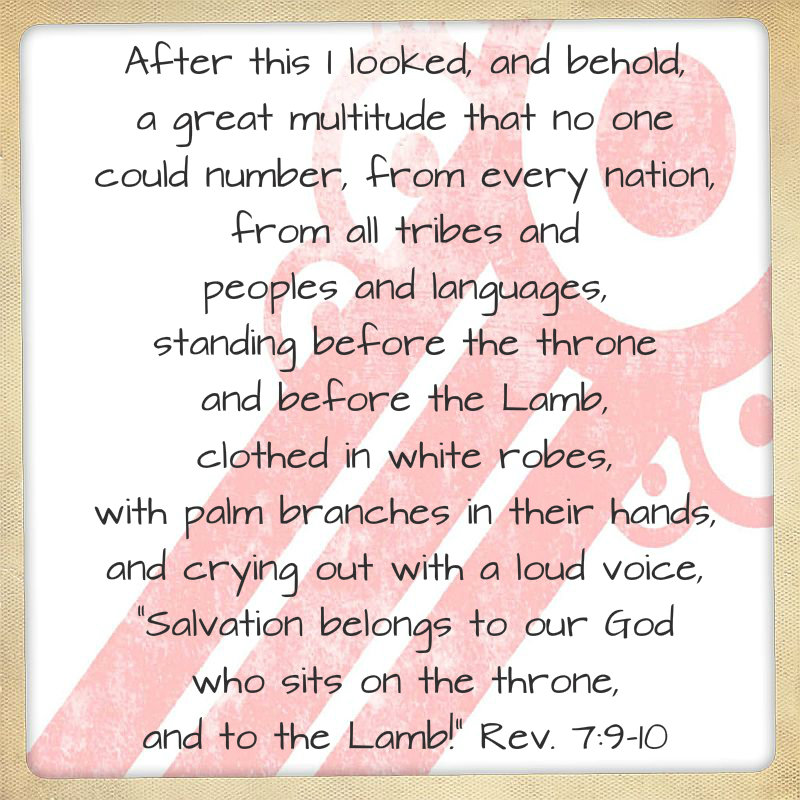
Pentecost yielded 3000 souls. Hallelujah! However, the harvest of souls will be even greater during the Tribulation. (Rev 7:9-10, 13). Hallelujah again!
Was it The Great Awakening? That revival, in three waves, yielded thousands over three waves, (First (c. 1730–1755; Second c. 1790–1840); Third c. 1855–1900), but Jonathan Edwards worried that some of those in the frenzy were simply carried away by emotionalism and societal pressure rather than their own brokenness over sin, marking them as false converts. In response to the very real probability that mixed in with the genuinely converted were many false professors, he wrote The Distinguishing Marks of a Work of the Spirit of God.
Revivals have always been plagued by errors in judgment from leaders and participants alike, Edwards warned, and have suffered from the delusions of Satan. Great care and discernment are always the order of the day. ~God’s Spirit or Human Hysteria? My Time Among the Charismatics, by Jeff Robinson.So it’s hard to count that revival’s numbers and thus its effects.
So what was the greatest revival ever? For sure?
It was Nineveh that yielded 600,000 souls for the glory of God. It was and still is the largest harvest God has effected to date. In addition, we know that was a genuine repentance and coming to faith, because first, the Bible said so, and second, the LORD stayed His hand in destroying the city. (Jonah 3:5, 10).
How do we know it was around 600,000 souls when the only number mentioned in regards to Nineveh is 120,000? Jonah 4:11 says,
And should not I pity Nineveh, that great city, in which there are more than 120,000 persons who do not know their right hand from their left, and also much cattle?
‘Not knowing the right hand from the left’ is a Hebrew idiom meaning ‘children’. Children don’t know their right hand from their left. Extrapolating the number of children and assigning them to two parents, historians and theologians estimate the city was populated by about 600,000. Its size also (three days’ walk) indicates a populous, bustling city of this magnitude.
By comparing these revivals at Pentecost, Nineveh, and the Tribulation we can praise God for His continuing and marvelous ongoing work in salvation. We will have lots of company in heaven! As Jonah said, “Salvation belongs to the Lord.” (Jonah 2:9). He will glorify His name by His mighty power to deliver men from the darkness of bondage to sin, speaking life into their dead bones,and resurrecting them to eternal life. Praise the Lord!
Our pastor began a new series Sunday on Jonah. He is taking it slow and luxuriating in our verse-by-verse exposition, which means I am too.
I want to say how delighted that he opened the sermon by explaining that the Book of Jonah, with all its supernatural wonders, and especially the great fish swallowing the prophet, was history and really happened as the Bible says. As the wrongly attributed George Orwell quote goes, “In a time of deceit, telling the truth is a revolutionary act.”
Don’t take for granted both the real and spiritual slings and arrows that are flung against your pastor for being brave in preaching the unvarnished truth to a skeptical world. Be sure to pray for him for his spiritual, physical, and emotional health and well being.
I love the prophets and I love the book of Jonah. So on the Monday after our pastor delivered the sermon I listened to four sermons on Jonah, and on Tuesday I listened to one more. There are multiple layers in Jonah, lots of deep, rich aspects one could go in the journey through this wonderful book. I know our pastor will bring out many truths as we sit under his preaching throughout the summer.
But being practical and being logical, and having been a mariner in my younger days, there was one question that bugged me. I could not find an answer to it in any sermon, commentary, or study Bible note. Until it hit me. It hit me like a thought-comet the Holy Spirit flung at my mind.
Here is the scene:
The LORD hurled a great wind on the sea and there was a great storm on the sea so that the ship was about to break up. 5Then the sailors became afraid and every man cried to his god, and they threw the cargo which was in the ship into the sea to lighten it for them. But Jonah had gone below into the hold of the ship, lain down and fallen sound asleep. (Jonah 1:4-5).
The storm was rough. The word ‘hurled’ in describing the Lord’s hurling of a storm is the same word that was used to describe King Saul’s hurling of the spear to David. This was not an ordinary storm, and the sailors knew it. Mariners don’t exaggerate. If anything, they understate the height of the waves or the intensity of the storm. Later, with a cup of grog in hand, they might say, “Aye, the boat bounced a bit.” Or “The waves were stirring all right.” Sailors are tough.
So it’s notable that the sailors were afraid. The word in Hebrew is terrified, also reverent. They knew it was some god that was doing this and they were religiously afraid. They prayed to whichever god they followed to appease him or her.
Before throwing over the cargo, the sailors would have been shortening sail. Billowing sails in a storm blow out and become tatters. So they’d reef the main and take in the jib. When that doesn’t work they take in the main sail completely and go under bare poles. They would throw the attached anchor overboard to help stabilize the boat. They would shift ballast in the hold. They would cut the dinghy away if they had one. Then they would throw over the cargo. Last, they pray, because foxholes are filled with praying people. Activity on a boat during a storm is at a pitched and chaotic level.
Does anyone know where the love of God goes when the waves turn the minutes to hours? Gordon Lightfoot, The Wreck of the Edmund Fitzgerald
It is also loud. In winds that high, the waves roar, and even the spray is loud. The spray and foam mix with the air and it’s hard to breathe, you’re breathing water half the time. The high winds whistle and beat against the mast and buffet the sailors. The waves slam and beat against the boat, which in turn creaks and makes all manner of tortured sounds. Mariners have to scream to be heard when they give directions, and when the wind becomes too loud, they just use hand gestures. Sometimes that doesn’t even work because darkness and spray obscure all sight. Anything on deck or below deck not in place or lashed down moves, skids, flings around like crazed maniacal ping pong balls.
Though the above activities are not mentioned, that is what they would have been doing. When the usual marine protocols failed, the sailors resorted to a last resort: throwing the cargo overboard. This lightens the boat and makes it bob in the water higher, so the tall waves have less chance to over-swamp the boat and capsize it or break it apart. Sailing with cargo is a money-making enterprise, and you do not want to anger the ship’s owner by having thrown over what amounts to his money. So when we read that the sailors threw over the cargo, this is very last resort.
If you’re down below, sailors have to tie themselves in or raise the bunk boards, so they aren’t flung across the cabin like a rag doll.
Against this backdrop, Jonah was asleep. Depending on the translation, scripture says not only that Jonah was sleeping, but he was fast asleep, sound asleep, in a heavy sleep, a deep sleep. How, how could Jonah sleep through all this?
It bugged me. It was not normally possible to sleep that way during a storm as severe as described. I pondered this over and over again. It seemed an important juxtaposition, the sleeping prophet as the boat is almost sinking.
Then it hit me. Jonah wanted to die.
The book of Jonah is clear about this fact. It’s stated several times that Jonah wanted to die. He would rather die than obey God in evangelizing the Ninevites. At the least, when Jonah ran away disobeying God it was a usually a death warrant. Jonah would have been aware of the cost for disobedience in the Holy of Holies, and also Uzzah’s penalty for disobeying when he touched the ark.
Jonah wanted to die as seen in Jonah 1:12 when he could have repented on deck and asked God’s forgiveness, but he chose instead to be thrown into the sea, to be tossed around like a peanut then drown alone.
In Jonah 4:3 he explicitly said he wanted to die, rather than live. He said it again in Jonah 4:8. So four times we see Jonah acting in ways that showed or stated he was serious about dying.
Elijah wanted to die because people were so bad. Jonah wanted to die because God was so good.
People who are intent on death often suddenly display an eerie calm. As the sailors were above fighting the storm, what they were really fighting for was their lives. Not Jonah. He was not fighting for life, he was resigned to death. He fell asleep. Deeply.
However potentially even more worrying is a sudden calmness, and many individuals who are contemplating suicide have a sense of resignation that can result in them acting very calm and even peaceful in the days leading up to their attempt. If they have gone from appearing excessively sad and exhibiting mood swings, to suddenly acting calm and peaceful then this can be a very dangerous sign and it’s important to look out for other signs that the calmness may not be all it seems.
Jonah was serious about dying. He wasn’t exaggerating. It wasn’t hyperbole. It wasn’t an idiom. He really preferred death to obedience, death to being an instrument of God’s compassion and love toward the pagan and evil Ninevites.
Elijah the prophet wanted to die, too. After the showdown against the Prophets of Baal and Queen Jezebel, we read,
But he himself went a day’s journey into the wilderness and came and sat down under a broom tree. And he asked that he might die, saying, “It is enough; now, O LORD, take away my life, for I am no better than my fathers.” 5And he lay down and slept under a broom tree. (1 Kings 19:4-5a).
Elijah’s sleep was a regular sleep, a completely different Hebrew word than Jonah’s deep sleep. Another difference is that Elijah wanted to die because people were so bad. Jonah wanted to die because God was so good. (Jonah 4:2-3).
I wonder if Jonah spent three days in the belly of the fish rather than one day, or one minute, because he hoped to die again. Maybe as the fish swallowed him, he was thinking, “OK, this is convenient, no one lives in a fish, now I can die!” But when it didn’t happen and didn’t happen, and on a third day it didn’t happen, then Jonah prayed his prayer. I wonder if it was his stubbornness kept him inside a foul, airless, acidic, sewage, rotting belly of a fish for all those days, only praying when he realized the Lord was going to keep him alive no matter what. Sigh. So realizing the Lord was going to supernaturally keep him alive anyway, he prayed his famous prayer in Chapter 2 and was released. Because in chapter 4 he said two more times he still wanted to die.
Who or what is your life ring? Who do you call for your S.O.S.?
So that’s the story of the death-seeking Jonah. It tells us a lot about him on that boat, that he wanted to die rather than see thousands come to Christ. That he could sleep amid a hurricane. God dealt graciously and kindly toward Jonah.
Which is good, because He deals with us graciously too. When we complain, run from Him, exhibit racist tendencies, or are just knowingly but stubbornly resist His will, He is patient. The Book of Jonah ends with a question that once again displays God’s love:
“Should I not have compassion on Nineveh, the great city in which there are more than 120000 persons who do not know the difference between their right and left hand, as well as many animals?”
Should we not have compassion on the lost, as God seeks their salvation and is slow to anger, that all would repent? We were rebellious, once, too. The LORD is gracious and compassionate, slow to anger and rich in love. (Psalm 145:8).
the women should keep silent in the churches. For they are not permitted to speak, but should be in submission, as the Law also says. (1 Corinthians 14:34).
Paul was exhorting about orderly worship here. The women, who as Hebrews were not invited to participate in worship with the men or to be educated, were over-exuberant in their new found freedom as Christians. As a result, worship had gotten out of hand. Worship must be orderly, quiet, and respectful, that was the watchword. And Paul gave that word in this passage.
Is there a time for a woman to holler and throw stools at the pastor? Apparently there was for Jenny Geddes. She’s gone down in Reformation History as someone who stood up for Jesus. Here’s how.
Jenny Geddes (c. 1600 – c. 1660) was a Scottish market-trader in Edinburgh, who is alleged to have thrown her stool at the head of the minister in St Giles’ Cathedral in objection to the first public use of the Anglican Book of Common Prayer in Scotland. The act is reputed to have sparked the riot which led to the Wars of the Three Kingdoms, which included the English Civil War.
Well, that’s some stool. It all happened on July 23, 1637 in Edinburgh.
Always independent, the Puritan Scots had become suspicious of the increasing encroachment of liturgy and rigid traditions a la the Roman Catholic Church. They had observed King Charles Is’ coronation rites and were displeased with his use of Anglican rituals. Next came forced use of the Book of Common Prayer, a high Episcopalian book, with its readings in the Apocrypha. King Charles issued a warrant in 1635 declaring his spiritual power over the Church of Scotland, insisting that the Church would be issued with a new book of liturgy which would be read at services. And on July 23, 1637 in St. Giles Cathedral, the Common Book of prayer was opened and John Hanna, Dean of Edinburgh, began to read.
Jenny Geddes sat fuming on her “fald stool” or a “creepie-stool” meaning a folding stool. Finally she had heard enough and stood up and cried; “Deil colic the wame o’ ye, fause thief; daur ye say Mass in my lug?” meaning “Devil cause you severe pain and flatulent distension of your abdomen, false thief: dare you say the Mass in my ear?” And at that she hurled her stool straight at the Dean’s head. This sparked a full scale riot in the church. one congregation member who had been heard uttering a response to the liturgy was thumped with bibles. The Dean took cover and the Provost summoned his men to put down the disturbance. The rioters were soon ejected from St Giles and the Bishop of Edinburgh appealed for calm. However this was not going to end quietly…
The national spiritual unrest was real, but overlaid upon the spiritual unrest was political unrest too. Hence the riots that sparked the Wars of the Three Kingdoms, and then the English Civil War. You can read about that part of the history elsewhere.
Jenny Geddes’ anger at the encroachment of evil into the pure worship service reminded me of another, more recent ‘Jenny Geddes.’
On November 10, 2013, Memorial Church of the Reformation in the city of Speyer, Germany hosted Karl Jenkins’ performance piece, titled “A Mass for Peace- “The Armed Man” where as part of the performance, the Islamic call to prayer is performed by an Imam.
German woman Heidi Mund had heard of this performance, grabbed her flag on which is emblazoned “Jesus Christ is Lord” headed to the church, and bought her ticket. But first, Ms Mund said, she prayed. To make matters even more emotional, the church the performance was to be held at was the Memorial Church of the Protestation in Speyer Germany, constructed specifically in 1900 where,
Its construction was supposed to be a reminder of the protest action that the imperial evangelical states brought to bear in 1529 at the Reichstag in Speyer. The Luther memorial in the vestibule and the adjacent statues of local Protestant rulers serve as reminders of this event.
Having no particular plan, she quietly listened to the music and readings, but when the Imam began praying to Allah in Arabic and saying, “Allahu Akbar!” she felt what she called a holy anger rising up in her. Much like Jenny Geddes, who was righteously aggrieved with the blasphemy in her midst, Mund stood up at this “interfaith event” and fearlessly began shouting that Lord Jesus alone is God and proclaimed His supremacy over all the earth.
If we are confronted with something of like kind, what would be our reaction? There is a time to sit silently and submissively, but is there ever a time for disruption and holy anger? Jenny Geddes threw a stool, narrowly missing the preacher’s head. Physical violence is never appropriate. How would we react to the incursion of evil into a holy place, a place set aside for the proclamation of the pure word? Just food for thought.
Both Geddes and Mund knew of what was to happen during the service. Neither were surprised. Mund prayed ahead, one can surmise that perhaps Geddes had also prayed ahead. In one way or another, we are all confronted with false doctrine creeping in. Start praying ahead for strength in the Lord to react in ways that honor and glorify Him.
————————————
Further Reading
Trivia: Scottish Poet Robert Burns named his mare Jenny Geddes
It was in the month of July — a month since become so memorable in the history of human freedom — on the twenty-third day of the month, that Jenny emerged from domestic obscurity to historic celebrity and renown.
On that day there was a strange ferment throughout Scotland and a wild excitement in the city of Edinburgh. King Charles had resolved to make Presbyterianism give place to Prelacy throughout the realm. A book of canons had been prepared subversive of the whole system of Presbyterian government, and had been enjoined upon the realm by proclamation upon the king’s simple prerogative.
Following this book came a liturgy as a law of public worship, and a royal edict had commanded its introduction into all the churches of the realm on this memorable Sabbath day. Notice to this effect bad been given the Sabbath before, and hence this intense excitement. For the Scottish people knew that if this measure were carried into effect by the authorities, Presbyterianism was virtually in its grave.
As the hour of Sabbath service approached, the streets of Edinburgh were thronged with crowds of people — every bosom throbbing, every eye flaming with excitement. But whither were they directing their steps? Conspicuous from many a point in the city of Edinburgh is a lofty tower, terminating in an open, carved stonework, with arches springing from the four corners and meeting together at the top in the form of a crown.
Already more than three centuries were looking down from that tower-top. It rose from the centre of a vast and venerable pile, including the High Church at the eastern end, There Knox so often preached, and within which pile “forty altars” were at one time supported.
It was thither mainly the crowds were pressing, and among them Jenny Geddes. Not being overburdened with modesty, she elbowed her way through the crowd to a convenient place, her stool, in near proximity to the pulpit, and seated herself on her throne. The edifice was filled to repletion with titled nobility and the nobler untitled nobility of the Scottish Presbyterian masses. There were present archbishops, bishops, the lords of the session, the magistrates of the city, members of the council, “chief captains and principal men,” and Jenny Geddes and her stool.
The excitement was becoming every moment more intense. The minutes dragged themselves along with tormenting tardiness and the suspense was becoming almost breathless. When the feeling was wrought up to its highest tension the Dean of Edinburgh made his appearance, clad in immaculate surplice, book in hand — the fatal book of the liturgy — the device of English Prelacy for the reform of Scotch Presbytery. The book was opened and the service begun.
The cup was now full, though as yet no one pretended to know, no one dreamed, what form of expression the pent-up indignation of the outraged people would assume. The question was soon decided. No sooner had the first words of the book, through the lips of the clean, reached the ear of Jenny, the stern prophetess on her tripod, than a sudden inspiration seized her. In an instant she was on her feet, and her shrill, impassioned voice rang through the arches of the cathedral:
“Villain! dost thou say mass in my lug?’ and in another instant her three-legged stool was seen on its way, travelling through the air straight toward the head of the surpliced prayer-reader. The astounded dean, not anticipating such an argument, dodged it, but the consequences he could not dodge.
He had laid his book, as he thought, upon a cushion — the cushion proved a hornet’s nest. In an instant the assembly was in the wildest uproar. Hands were clapped; hisses and loud vociferations filled the house, and missiles, such as the hand could reach, filled the air. A sudden rush was made toward the pulpit by the people in one direction, and from the pulpit by the dean in the other. On the retreat of the dean, the Bishop of Edinburgh took his place in the pulpit, and solemnly commanded the winds and waves to be still, but no calm followed. He was as rudely handled as his brother in oppression, and nothing but a vigorous onset of the magistrates saved his lawn and mitre from the rough hands of Jenny Geddes’ soldiery.
We read one of many verses about the importance of slaying the sin that still dwells within us.
But I keep under my body, and bring it into subjection: lest that by any means, when I have preached to others, I myself should be a castaway. (1 Corinthians 9:27 KJV).
See also also Colossians 3:5.
To that end, I strive to slay the sin in me. I pray constantly to the Lord for the Spirit’s help in sinning less against Jesus today than I did yesterday.
Sometimes, when I feel strong (boastful?) I think my war cry against sin looks and sounds like this:
But I am such a puny human! Most days I am sure that my ferocious war cry really just looks and sounds like this:
Praise the Lord for His strength, His constant love, and His faithfulness in keeping us in His hand!
Sinning. Every human on the planet, no matter his or her age, is good at sinning. Hands down. Me included.
Look at this example from scripture.
Woe to you, blind guides, who say, ‘If anyone swears by the temple, it is nothing, but if anyone swears by the gold of the temple, he is bound by his oath.’ You blind fools! For which is greater, the gold or the temple that has made the gold sacred? And you say, ‘If anyone swears by the altar, it is nothing, but if anyone swears by the gift that is on the altar, he is bound by his oath.’ You blind men! For which is greater, the gift or the altar that makes the gift sacred? So whoever swears by the altar swears by it and by everything on it. And whoever swears by the temple swears by it and by him who dwells in it. And whoever swears by heaven swears by the throne of God and by him who sits upon it. (Matthew 23:16-21).
What this section of scripture is about is Jesus pronouncing woes upon the Pharisees. The Pharisees were one of the two ruling classes in Israel, the Sadducees being the other. The Pharisees had twisted the faith into something unrecognizable, laying incredible burdens down on the people, (like over 600 laws!) failing to minister to sinners, making sons of hell twice as worse as they were, and being total hypocrites. When Jesus pronounced His many woes upon them, this particular set of woes involved swearing by the LORD and lying.
The Pharisees has cunningly devised a way to appear to swear by the Lord but be able to get out of it later. They THOUGHT that if they swore an oath by the temple and not by the gold of the temple, they could break their oath later with no repercussions. Or swear by the altar and not the gift on the altar, or by heaven and not by the throne in heaven. “It depends on what the meaning of is is.”
Photo Pixabay.com. cc.
Look how finely they were splitting hairs! They were dead wrong, as we read Jesus’ excoriation of their sly practices. All the hairs matter.
But you see how we as humans excel at sinning and rationalizing our sin. We’re really, really good at it. “It wasn’t that bad.” “It wasn’t a real promise.” “No one keeps promises anymore.” “I’m not gossiping, I’m relating a prayer request.” “It wasn’t as bad as that other guy’s sin over there.” “No one saw.”
All rationalizations are simply self-justifications. And there is only One who justifies, Jesus. Our pitiful attempts to justify ourselves when we sin are just evil blasphemies and vain delusions. When we transgress God’s laws, we injure ourselves and dig ourselves deeper into the pit we will eventually fall into.
As I go through the day I ask Jesus to show me where I am sinning but rationalizing it away. Where I am too ignorant or blind to see my own sin. I ask Him to help me sin less against Him tomorrow than I did today, by the Spirit’s conviction and strength. I am not only the Chief of Sinners, I am Queen of Rationalizations! Open the eyes of my heart, Lord. I pray mine and your walk grows purer with each day and each step. Paul was so wise to pray this for his people:
I pray that the eyes of your heart may be enlightened in order that you may know the hope to which he has called you, the riches of his glorious inheritance in his holy people, (Ephesians 1:18).
Lord open the eyes of my heart so I may see and repent of the sins that lurk there. All the ways of a man are pure in his own eyes, but the LORD weighs the spirit. (Proverbs 16:2).
Parents, I can’t imagine how hard it must be to raise children in this sex-drenched, lascivious age. Millennials, I can’t imagine how hard it is for you, between the ages of 18 and 25, to negotiate college, relationships, and the world in this age of sin and temptation.
This is why I appreciated discovering Katie Gregoire’s video channel.
According to her “About” on Youtube, Katie Gregoire is,
just a quirky, 19 year old, Christian university student who likes to talk to a camera every now and then. I also have atrocious parking skills and a slight obsession with Captain America. Stay awesome, and don’t be stupid or make bad decisions.
– Katie xo, James 1:2-3
Katie talks really fast. But she enunciates very well. OK, I got that out of the way. She is a college student who muses on Christian life. I’ve listened to two of her videos (only 2 cuz of the talking fast thing…) and I enjoyed them. I really liked her ‘rant on purity’ very much. Many other people did too, because it got 2X the amount of views her videos usually get, which is a healthy 10,000-15,000. The purity video seems to have struck a chord. Toward the end when she got to her point I went A-HA!
Please watch and let me know what you think in the comments.
There is currently a groundswell of interest in a new program for parents teaching sex education to their children called Passport 2 Purity by Dennis and Barbara Rainey at FanilyLife. It seems like a good program. This dad’s review of it was balanced and in concise terms expressed what Katie Gregoire so wisely noted on her rant. (Hint: too often we focus on prohibition and not affirmation.) He is Fred Mok, a pastor in San Jose, CA.
Pastor Mok’s ultimate conclusion in his review of Passport2Purity was that the Raineys “were able to communicate law in the context of the gospel in a way their children were able to receive and experience as God’s graciousness towards them.”
Here is Pr Mok’s overview of the weekend program Passport 2 Purity and his review after having gone through it with his boys. A Dad’s Review of Passport to Purity
Crazy world! But the sane world is coming, and Jesus will rule and reign. So we study end time prophecy in order to obey the command of Him who said to be watchful, sober, and vigilant; to encourage each other with these words, and to turn our eyes from this world in preparation for the next. And let’s offer His world to as many as we can! Let’s encourage fellow saints who are fainting, embroiled in besetting sin, or who are only lukewarm. We all need encouragement, and it’s the one thing these days that is FREE.
Therefore encourage one another and build one another up, just as you are doing. (1 Thessalonians 5:11).
But you, beloved, by building yourselves up in your most holy faith and praying in the Holy Spirit, (Jude 1:20).
Have you been thinking all along that we were making a defense to you? We speak before God in Christ, and all of this, beloved, is to build you up. (2 Corinthians 12:19).
And soon enough, one of these days we will all really be physically going up, built up in Christ’s majestic plan, and we will see it in its conclusion. He is building His church upon Himself, the Rock.(Matthew 16:18).
“I will build my church.” The church is not a building. It’s a people, with or without a building. But the Bible pictures this people sometimes as tree that grows and sometimes as a building that is built. The point is that this people has a builder, and the builder is the Christ, the Son of the living God. Jesus builds the church.
As of yesterday I have published 4000 essays at the End Time. My goal has been to share thoughts on the three general topics of prophecy, discernment, and encouragement. Of late I added Poetry and Visual Exegesis. I’ve published daily (with only 3 exceptions) since January 2009. It’s a privilege to study God’s word and then write about it. It’s even more of a privilege to have a sister in the faith click on the links to credible ministries that I offer, and become edified as a result.
This is one of my goals – to point to solid ministries led by men so sisters can find good commentaries, sermons, and other material.
Another goal I’ve had is to provide explanations about prophecy that aren’t wacky. It’s discouraging when I google prophecy ministries and the search results yield such a plethora of date setting, conspiracy theorist, downright insane websites. Prophecy is important, edifying, and interpretable. I hoped to add to the internet archive of reasonable and thoughtful essays exploring this most delightful and thrilling topic, in a way that honors God and teaches the sisters.
Another goal has been to present discerning essays exploring troubling teachings and the teachers that bring them, without snark or mocking. I hope I’ve succeeded in this, but sometimes I know I haven’t. Please forgive me.
I also seek to encourage. Just speaking of Jesus and His wonderful attributes is a privilege and doing so lifts me up. I hope it does you as well.
4000 essays is quite an accomplishment, and I thank the Holy Spirit for giving me the mental capacity, the physical energy, and the spiritual insight to persevere in this ministry. I’ve enjoyed it, and I plan to continue, Lord willing. Thank you for reading The End Time. Tune in tomorrow for another essay, #4,002, as we persevere and do not become weary in doing good.
“There remains a sabbath rest for the people of God” (Hebrews 4:9).
My favorite Andy Griffith episode is called Man in a Hurry. It’s from Season 3, episode 16. A businessman from the city is traveling through and his car breaks down at the edge of Mayberry. It’s a Sunday, though, and nothing is stirring, even a mouse. Not until church lets out, and even then, the hard-working citizens of Mayberry are committed to and enjoy their Sabbath rest. The man’s frustration with the towns’ seeming unwillingness to help him fix his car grows until he eventually succumbs to the slow-down sweetness of friendship, rest, and communion.
When people reflect on the old TV show they usually mention their most enjoyable scenes are when one or more characters are sitting on the front porch, not doin’ anything much. In the scene below, it’s Sunday, it’s after church and Sunday dinner, Andy and Barney simply sit, listen to the crickets, or softly sing hymns.
Here is Sinclair Ferguson on “Sabbath Rest“. What IS Sabbath rest, anyway?
In creation, man was made as God’s image—intended “naturally” as God’s child to reflect his Father. Since his Father worked creatively for six days and rested on the seventh, Adam, like a son, was to copy Him. Together, on the seventh day, they were to walk in the garden. That day was a time to listen to all the Father had to show and tell about the wonders of His creating work.
Thus the Sabbath Day was meant to be “Father’s Day” every week. It was “made” for Adam. It also had a hint of the future in it. The Father had finished His work, but Adam had not.
Ferguson continues explaining the Sabbath rest and then turns to what the Sabbath should mean to us Christians now that Jesus has come. It’s a good read.
Saturdays are a pile-up day. I picture Saturdays for most people as a day when the litter along the side of the road has blown up against a fence. All the chores, tasks, things you’d planned to do have blown up against Saturday and it’s a busy day attending to them all. Children’s birthday parties, sports games, visiting Mom and Dad, grocery shopping, laundry, school projects….the list is endless. With all the hurry-hurry on Saturdays, it’s sometimes hard to stop that momentum on Sunday.
But we’re supposed to.
But one may ask: “How does this impact my Sundays as a Christian?” This view of the Sabbath should help us regulate our weeks. Sunday is “Father’s Day,” and we have an appointment to meet Him. The child who asks “How short can the meeting be?” has a dysfunctional relationship problem—not an intellectual, theological problem—something is amiss in his fellowship with God.
This view of the Sabbath helps us deal with the question “Is it ok to do … on Sunday?—because I don’t have any time to do it in the rest of the week?” If this is our question, the problem is not how we use Sunday, it is how we are misusing the rest of the week.
As you conclude your day today, if you are reading this on a Saturday (or any other day for that matter), are you in a hurry? Are you cramming in things to do in and around church services? Are you distracted, frazzled, hurried? Slow down. Reflect on how you’re using the week, and how your rest on the Sabbath is to be used as a refreshment to your soul and a reflection of all that God has done and is doing.