Posted in charismatic, discernment, grace community church, intruder, strange fire

John MacArthur confronted by intruder mounting the stage during Sunday Service

By Elizabeth Prata

On Sunday, August 16, an intruder wearing a backpack mounted the pulpit at John MacArthur’s Grace Community Church while Dr MacArthur was preaching the Sunday morning service, put his fingers in his lips and emitted a piercing whistle, pointed his finger at the pastor and began shouting that he had a message from the Lord to deliver to him.

The man, a Scottish “evangelist,” was angry that Dr MacArthur had preached in the past that the charismatic gifts have ceased, an interpretation termed “cessationism.” This biblical teaching was most recently delivered at the Strange Fire conference at Grace Community Church two years ago. That conference was a much-needed response and rebuke to the Charismatic movement which claims that Jesus delivers personal revelation to individuals today in the form of the temporary sign gifts of prophecy, tongues, interpretation of tongues, and also that people can and do perform miracles like raising people from the dead and healings, as the first century apostles performed.

Charismatics believe these temporary gifts intended as a temporary sign were not temporary at all and have never ceased. They believe the gifts continue. They are continuationists. Continuationism and its heresies and false notions of Christianity are rapidly overtaking the faith all around the world. If you have ever seen a “church service” where people are shouting, jerking, fainting or otherwise gyrating, this is a Charismatic church. If you have ever seen people lined up for healing by “an anointed preacher” at a healing crusade, this is charismania. If you ever have seen claims from ‘pastors’ who shout for the Holy Spirit “to show up” and He supposedly does by showering the congregation with gold dust from the ceiling, you’ve seen a charismatic congregation.

Not all Charismatic churches are so wild, but the ones that seem quieter are just as dangerous. They speak in tongues which are gibberish. They claim that the canon of scripture is not closed and have a word delivered by the Lord to share. Beth Moore makes claims all the time that Jesus speaks to her and commands her to teach what He tells her. Disgraced pastor Mark Driscoll claimed to have had many visions and audible revelations from God. So you see it is not just the Benny Hinns and Kenneth Copelands of the world engaged in dangerous twisting of God’s word in regard to the temporary sign gifts, but even conservative segments of the faith have now accepted personal revelation and mystical practices associated with Charismania.

The Strange Fire conference of 2013 sparked angry outbursts and heated reactions from certain segments, mainly from the people who claim to possess these gifts and are going around performing them. Apparently this intruder was one who feels he is a prophet from God, as he said while on the podium at GCC last Sunday. The reaction to the Strange Fire conference is continuing and satan is still inspiring people to anger over the biblical rebuke the preachers and teachers at that conference delivered. The warfare is real and ongoing. (Ephesians 6:12)

Here is video of the intruder at Grace Community Church. You can see he mounted the pulpit rapidly and got within 20 feet of MacArthur before anyone noticed or stopped him. Even though two men in the front row immediately rose and approached the intruder, I was shocked at how fast it happened. When the intruder points his finger at the esteemed pastor, it could as easily have been a gun. GCC fellow pastor Phil Johnson said the intruder got “way too close” to MacArthur.

Here is a video of Dr MacArthur’s gracious reaction afterward. It is a 3-minute video from SO4J, but it’s “exclusive” to SO4J.com so I can’t embed.

VIDEO OF MACARTHUR’S RESPONSE: JOHN MACARTHUR IS VERBALLY ATTACKED BY A FALSE PROPHET

This brings to mind safety concerns, of course. The congregants at Charleston’s Emmanuel African Methodist Church last June certainly didn’t expect to be shot while praying and singing inside the church, but that shooting shocked America and the world. Nine people were killed.

Even though Joel Osteen’s Lakewood Church is not a church and Osteen is not a pastor, many people think it’s a church, and some had no compunction about mounting an orchestrated rebellion while services were going on this past June. These hecklers were outraged at Osteen’s brazen falsity and began calling him a liar as Osteen prepared to ‘preach’. There were six individuals ushered out from the Lakewood arena by security that day.

Unfortunately we are seeing these scenes of bouncers or security men ushering away some intruders more and more often. Here is GCC Pastor Phil Johnson with comments on the incident:

~~~~~~~~~~~~~~~~~~~~~~~~~~~~~~~~~~

PHIL JOHNSON:

Here are some comments about church security and the performance of the GCC security team in particular. These are compiled mainly from my own replies in a couple of recent comment threads. The one comment below that I have put in quotation marks was made by one of my FaceBook friends. All the other comments from which I compiled this are mine:
__________

I agree that it’s both irritating and scary to see someone with mischief on his mind get that close to John MacArthur, but we are not going to erect a barrier between the pastor and the people in our church. I imagine the security team will henceforth put their most young and spry guys on the front row. But it’s a simple fact of life that if someone bent on doing harm is determined enough, it’s not possible to guarantee that every possible threat can be thwarted. On the other hand, all of us who preach Christ at GCC are willing to die for Him–but not willing to permit miscreants to force a barrier between the people and the elders. John MacArthur isn’t going to move around among his own congregation in a plexiglas bubble like the Popemobile.

I know for a fact that the security team is carefully examining Sunday morning’s incident with an eye to improving or beefing up the measures they take. But they DID handle this situation without injury to anyone involved, and the entire interruption lasted less than sixty seconds.

Bear in mind that over the years, the vast majority of criticisms aimed at our security team have come from people who seem to think ANYTHING they do is too hasty, too heavy-handed, or otherwise unChristlike. In fact, Martha Mac’s front-row video of Sunday’s incident (posted on her FB page) drew dozens of comments from charismatic critics and postmodern bleeding hearts who complained that the treatment our Scottish “prophet” friend received was overly harsh. So people should appreciate and have some empathy for the difficult position the security staff are in.

Finally, here’s a comment someone else posted elsewhere regarding security’s handling of this incident:
__________

“As a former LEO and member of my church’s security team, who knows a few of the GCC security team members, well done fellas. I agree with Phil that it was a measured and gentle approach, and they took care of business without incident. Praise the Lord! It will be good for them to do a review this incident to see how a response could be improved or tweaked next time, but there will always be lag time in any response, and there is always the risk that someone can get to your pastor first. Also, there is a delicate balance between what is the desired level of response by security, both from the pastor’s perspective and the congregation’s perspective. Go too hard, and there is criticism; go too soft, and likewise. John and his security team have an understanding on what is expected of them in their response, of this I am sure, and this appears to have played out. If you notice, John points at the disorderly subject, and the men react immediately and start to approach the stage. The subject stops away from John, and is merely pointing and yelling, with no visible weapon, which calls for a less dynamic response from the security team. Professional job, gentlemen. In under a minute, the situation is resolved, and it’s back to business as usual. Thank you for posting this, Phil, as a good reminder to those who protect our faithful pastors each and every week.”
_________

In short, I think people who don’t actually have hands-on responsibility for church security at this level should probably keep their Monday-morning quarterbacking to themselves.

~~~~~~~~~~~~~~~~~~~~~~~~~~~~~~~~~~

We are not guaranteed safety in this world. Though we believe church should be a safe place, and we strive to make it so, it is actually ground zero in the warfare in which we engage. Sometimes that warfare shows up in the form of an angry person…sometimes the angry person has a gun. We are not guaranteed safe passage from this world to the next, what we are guaranteed is trouble.

I have said these things to you, that in me you may have peace. In the world you will have tribulation. But take heart; I have overcome the world.” (John 16:33)

strengthening the disciples and encouraging them to remain true to the faith. “We must go through many hardships to enter the kingdom of God,” they said. (Acts 14:22)

Ultimately the take-away is… PRAY FOR PASTORS. The pastors who unflinchingly preach the truth of God are most at risk. Pray for them for God to keep them spiritually safe, and physically safe. And He will. Until it is the day ordained from the foundation of the world for them to be called home.


Posted in discernment, Eve, heresy, Jesus bible, the shack, william p. young

Eve, an upcoming book by William P. Young of The Shack; The heresy continues

William P. Young is an author of religious stories. You might know him as the author of the runaway bestseller a few years ago, The Shack. (2008). He also wrote Cross Roads in 2012. Young said The Shack was fiction, nonetheless he used biblical theology to twist God’s word and manipulated the “fictional narrative” to present a different Jesus, a different Holy Spirit, a different God, a different view of sin and a totally different view of the atonement. Young’s book harmed Christians by insinuating Young’s aberrant theology into their minds, all under the sensitively emotional flow of ‘fiction.’ You can read a substantive Christian review of The Shack here at Tim Challies’ site.

In addition, I did some digging and discovered that Young channeled some of The Shack. Channeling is when an author turns off his mind, gives it over to a supernatural entity, and allows that entity to write the book for him. The writer is then simply a vessel used by an entity on the other side (a demon) speaking what the demon wants said. It is an occult practice that is surprisingly prevalent. One example is Beth Moore channeling “When Godly People do Ungodly Things.” An ironic title when a supposedly godly person channels demons to teach about God.

Stay away from The Shack.

Unfortunately, Young is not finished with writing, and he has another book of religious fiction coming out. It’s called “Eve“. Read some of the promotional material describing the upcoming book Eve below-

Eve is a bold, unprecedented exploration of the Creation narrative, true to the original texts and centuries of scholarship—yet with breathtaking discoveries that challenge traditional misconceptions about who we are and how we’re made. As The Shack awakened readers to a personal, non-religious understanding of God, Eve will free us from faulty interpretations that have corrupted human relationships since the Garden of Eden.

I want you to double down and really think about what is being said here. This is a discernment lesson on how to resist language that is designed to get you to succumb to curiosity and read a heretical book. I am going to re-paste the same blurb from above with some words highlighted and then explain why they are highlighted.

Eve is a bold, unprecedented exploration of the Creation narrative, true to the original texts and centuries of scholarship—yet with breathtaking discoveries that challenge traditional misconceptions about who we are and how we’re made. As The Shack awakened readers to a personal, non-religious understanding of God, Eve will free us from faulty interpretations that have corrupted human relationships since the Garden of Eden.

Any time you read that someone has discovered a new way to interpret the biblical narrative, RUN. Key words are “unprecedented” and “breathtaking discoveries.” How can a text be ‘true to centuries of scholarship’ yet yield discoveries no one else has ever noticed? Has the Holy Spirit hidden these new interpretations until now? From everyone except Young? No. Just think of the pride and hubris here. Everyone, just everyone has gotten it wrong about Eve, and Wm. Paul Young as he likes to sign himself, is the one man to find out the real interpretation.

“Challenge traditional misconceptions.” ‘Tradition’ is a loaded word, used by bible twisters to paint Christianity, or the Bible, as irrelevant. It’s another way to say what Young said in The Shack, subtly undermining Christianity, with using the word ‘old’, such as “the old seminary training wasn’t helping” and “he half expected him to pull out a huge old King James Bible…”. When a word is used like that enough times within the story, slowly the reader comes to accept the undermining. And again, the hubris and pride here is evident. We have all been shackled to misconceptions and “faulty interpretations”, and William P. Young is going to “free” us. With a book. Of fiction.

You can have a pretty good idea what these so-called interpretations are that “have corrupted human relationships since the Garden of Eden.” All this hyperbole makes it sound like it is another Bible, the book Eve is going to be that startling and powerful. But secondly, given the age of feminism, I am surmising that Young is going to throw out there an egalitarian view under cover of supposed scholarship coated in narrative and then when the blow-back comes coyly say, “It’s just fiction…”

Here is more of the blurb seeming to affirm that indeed, feminism is on the table:

Eve opens a refreshing conversation about the equality of men and women within the context of our beginnings, helping us see each other as our Creator does—complete, unique, and not constrained to cultural rules or limitations.

In an interview, Young said of his new book,

Having said that, most of the existing assumptions we have of the Genesis story have been told from an either/or, and dominantly male, viewpoint rather than holistic and human, and I believe that has had a devastating impact on our view of God and our relationships, one with the other. This novel is not intended to add to the existing adversarial divisions but look for something deeper and truer about us as human beings that will bring freedom to us all.

The Genesis story has been told in God’s point of view. If the Word is absent a response or perspective from Eve, that is because God arranged it that way. And yet it isn’t absent. Both their answers to God’s questioning were recorded. Both were – ahem – equally cursed for disobeying. It is not up to Young to re-frame it.

Secondly, there’s that coyness again, dis ingenuousness, or outright lie. The book Eve IS intended to add to the existing adversarial divisions, because in another interview Young said he fully expects his ‘evangelical friends’ to be upset.

Thirdly, there is that hubris and pride again. Young is saying here that his interpretation of the Garden story of sin has found something truer (than the Bible?!) and will “free us all.” Jesus freed us, not Young. His Word frees us, not Young’s new interpretation of it. Wm. Paul Young is going to free us with his new interpretation? RUN.

Young says that for 40 years he has had questions regarding those moments in the Garden. Quite often the false teachers will seek to affirm their piety by placing a lengthy time frame on something. I’ve been studying for 10 years…I prayed for several hours…Beth Moore told a long story about her 21 days of fasting before coming to some sort of epiphany, which she then taught to the audience. Here, Young seeks to buttress his faulty scholarship by placing it within a long time frame because he seeks to give it substance.

I understand his fascination with that moment in the Garden that changed everything. I have read and re-read Genesis 1-3 many times. My favorite places to go in the Bible are the early part of Genesis and all of Revelation, tremendous bookends. There are many questions, some that can be illuminated by the Spirit with proper scholarship and consistent with traditional interpretations for the last 4000 years, and other questions that will not be answered this side of the veil, if ever. God put in His word what He knew would benefit us and what He wanted to put in there. So we wait, and if it still matters to us in heaven, we an ask there. It’s part of submitting to the authority of God and of trusting Him

However, Young’s questions are sad. He said he has for 40 years asked:

–What happened?
–Where did we all go wrong?
–What is it about us as human beings that can produce such great wonder and do such catastrophic damage?

Answers: “What happened” is contained in Genesis 1-3. Period. It is clear and beautiful and enough.
We “all went wrong” when we absorbed Adam’s sin-nature. Biologically, generations subsequent to Adam and Eve changed when disobedience (sin) entered their heart and mind. Witness son of Adam, Cain, who killed his brother, failed to properly worship God, and backtalked Him. At the Fall of Man, God cursed the earth and prophesied about the pain and anguish Adam’s rebellion will bring to all future generations. This is information that is presented clearly in Genesis 3. Anyone having trouble with it means they repudiate the corrupt nature of our biology and the fact that we are all born sinners. (Psalm 51:5, Psalm 14:3, Romans 3:12, Romans 5:12).

The reason some “humans produce great wonder” is that they are energized by the Holy Spirit to do such wonders. And remember, what seems a wonder to us is not a wonder if it is not done in Christ and for Christ. Anything done in the flesh is a filthy rag to God, even what seems a wonder to our innocent or ignorant eyes. (Isaiah 64:6). Others who remain in sin do “catastrophic” damage to each other and to our Holy God, as did Eve and Adam, because satan comes to steal, kill and destroy. That’s what sin does. It is always a catastrophe. These are not difficult concepts.

Questions answered.

Now, I am not totally being flip when I say that. Young is a perfect example of the verse which warns that some are “always learning and never able to arrive at a knowledge of the truth.” (2 Timothy 3:7). For 40 years Young has been seeking answers to questions that are already answered in the Bible. He continues to ask them because he does not like the answers.

Some, like Young, “… devote themselves to myths and endless genealogies, which promote speculations rather than the stewardship from God that is by faith.” (1 Timothy 1:4).

CONCLUSION

At some point, a Christian must come to a settled conviction about what they believe. It might seem pious to wonder about why it all went wrong for 40 years, but it actually betrays the heart of an unregenerate person. When one engages in endless speculations, one cannot witness to truth. If Young wondered for 40 years about the origin of sin and its effects, then he does not understand our need for a Savior from that sin. A person who doesn’t understand why we need a Savior is not a Christian.

When I say we must come to a “settled conviction,” I’m not talking about uninformed dogmatism. The Spirit’s ministry is to make scripture clear. Ask Him to help you come to an informed, grace-filled conviction. Once you know what you believe and why, you can witness with power.

I am being tough on Young and advising you my dear sisters and brothers strongly about the language that Book Publishers are using to arouse curiosity regarding this book. Young himself said in an interview that he understands that many of his evangelical friends will be alarmed at the concepts in the book. Therefore Young said to “read first and ask questions later.” That is exactly what the serpent got Eve to do! Eat first, ask questions later. Don’t fall for it. Book promoters are good at whipping up curiosity. If you read “Eve“, you will become frustrated and upset at the twisting going on, or you will succumb to the confusion that endless questions bring and begin to say “yes, maybe he has a point…”

You will also be shocked to see some of your favorite, previously solid bible teachers, friends, pastors, celebrities you admire, extol this book. Apostasy is growing. Like a magnet sweeping up iron filings, the attraction to apostasy is proving irresistible to many. Books like these naturally draw out the serpent’s poison that is already in them. However it is still saddening and discomfiting when we hear and see comments from teachers and leaders we once thought of as discerning suddenly swerve and extol the left path, and not the right one.

It is all for the glory of God however. Whom He allows to be drawn to these false notions about Him and engage in unedifying things (Philippians 4:8) it is for the purpose of showing who the genuine Christians are. Bear fruit, stay the course, pray always, and exalt Jesus with your heart, mind, strength, tongue and heart. These things please our Sovereign. And that is what we are put on earth for.

Shorter Catechism-
Q. 1. What is the chief end of man?

A. Man’s chief end is to glorify God, [a] and to enjoy him for ever. [b]

[a]. Ps. 86:9; Isa. 60:21; Rom. 11:36; I Cor. 6:20; 10:31; Rev. 4:11
[b]. Ps. 16:5-11; 144:15; Isa. 12:2; Luke 2:10; Phil. 4:4; Rev. 21:3-4

Posted in discernment, ligonier, rc sproul

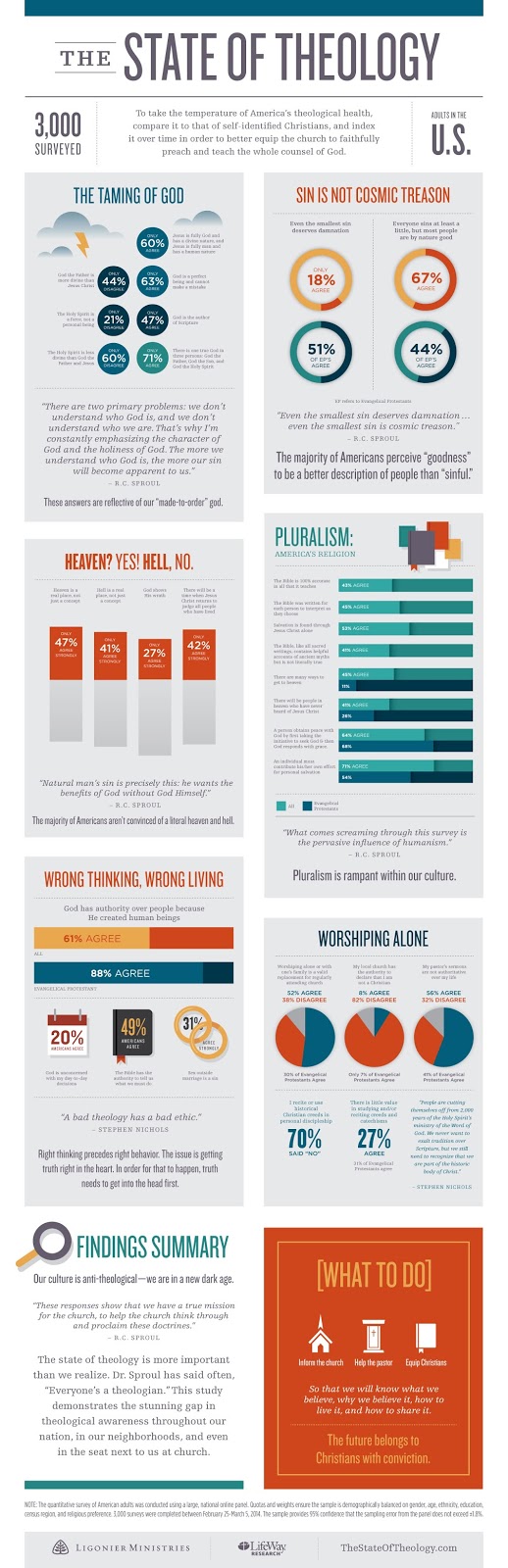
Ligonier Ministries: The State of Theology "We are in a new dark age"

Here is a wonderful info-graphic from Ligonier Ministries.

The State of Theology

It is Ligonier’s desire to serve the church in fulfilling the Great Commission. This survey has helped to point out common gaps in theological knowledge and awareness so that Christians might be more effective in the proclamation, teaching, and defense of the essential truths of the Christian faith. 

View the infographic, listen to Dr. R.C. Sproul discuss these findings on Renewing Your Mind, or download the official white paper and survey with key findings. You can also download the entire study in a .pdf.

Remember the point of absorbing this information is to educate yourself, but then to go forward and witness properly to others, either Christians or non-Christians. Now you know where the gaps in biblical knowledge are and can be part of helping to fill that in for people.

Thanks goes to Ligonier Ministries for this information and all their enduring hard work.

—————————————-

Further reading

Wretched: Drive By Theology

Phil Johnson’s List of helpful Theology Bookmarks

Posted in discernment, gentle speech, rebuke

Gentle speech, curses and rebukes

EPrata photo

The Christian life is one of constant awareness. We are constantly aware that we are bought with a price, and that we we all to Him. Jesus has standards for His ransomed people in which He wants us to live. And because He is our Beloved King, we strive to follow His standards.

Sometimes it’s hard to know what to do when. We pray for everyone unceasingly (1 Thessalonians 5:17)…until we are told not to pray for such a one anymore. (1 John 5:16).

We must share the Gospel with all people (Matthew 28:19) … until we are to shake the dust off our feet (Mark 6:11)…and not give pearls to swine (Matthew 7:6).

I’m not saying the Christian life has contradictions, but I am saying that God knows best in situations what to do and we must stay repented up, prayed up, and studied up in order to discern what His will is when encountering situations that we find ourselves in.

Another situation that demands discernment is our speech. The Bible says a lot about our speech. It is supposed to be patient, gentle, and filled with love. And yet sometimes we read in the Bible that the Apostles were sharp, insulting, and berating.

Here are two essays which speak to the two different ways we’re called upon to speak His wisdom and truths.

Love is how we speak truth, not how we avoid it.

Anyone who spends any time at all in the Bible will soon realize there is a continuous emphasis placed on actively loving one another (i.e.: Leviticus 19:18, John 15:12, Romans 13:8-10, Galatians 5:14, James 2:8, 1 John 4:21), even those who qualify as enemies (Matthew 5:44). First Corinthians 16:14 tells us to “do everything in love.” But many people struggle with this all-encompassing directive especially when they find themselves facing the difficult task of confronting sin in a family member or co-worker. Inevitable questions arise like, “Is it even possible to lovingly rebuke someone?” and if it is, “Does lovingly rebuking sin in someone else mean that we cannot be direct and forthright with the person we are confronting?” As Christians, do we have to sugarcoat what we say to others in order to fulfill God’s command to love them?

And yet there seems to be times when it is necessary to use sharp, cutting language.

Surprised by Scripture: Love and Spirit-inspired insults

Our expectation of the Spirit-filled person is that they would sincerely love people; that they would be manifestly gentle; that they would speak with kindness and patience in all circumstances. And those are good, biblical expectations. But the book of Acts shows us the Spirit-filled life is full of surprises. … Here’s where our expectations about the Spirit-filled life get upended:

But Saul, who was also called Paul, filled with the Holy Spirit, looked intently at him and said, “You son of the devil, you enemy of all righteousness, full of all deceit and villainy, will you not stop making crooked the straight paths of the Lord?” (Acts 13:9–10)

…This doesn’t sound like what we would call kind or civil or gentle. These are biting words, pointed words, sharp words directed at a particular person. In this case, the fruit of the Spirit is name-calling, insults, and harsh words. In this case, Spirit-prompted boldness means not mincing words about the wickedness of this magician. When Spirit-Inspired Insults Are Necessary:

Read both essays to see the bookends of speech we are expected to think about when we are confronting a person in sin. These things are not contradictory, and they are not for all Christians all the time. Some people, usually leaders, can and do make Spirit-inspired insults…and yet sometimes the pointed confrontation is necessary to employ against the sinning one, even to the extent they are ushered from the church under discipline and handed over to satan. (1 Corinthians 5:5).

The idea is that we are always striving to walk in the center line of His ways, constantly seeking Him to determine the proper course of action in any given situation, so that His name is glorified.

Posted in church life, discernment, doctrine, false, false teacher, sister

"My Sister in the faith is reading a heretical book/studying heretical material. How do I tell her?"

A sister in the faith asked me that question in the title the other day. I responded in the comments but now I’m making a stand-alone piece. These are my experiences and advice, but are based on my understanding of scripture. I it helps any sister. If you have had experience in helping a sister in the faith turn away from using poor, unedifying materials, please chime in. This essay isn’t the be-all and end-all, just a starting point.

I know that when I go to church and see a sister in the faith carrying a book by Ann Voskamp, or attending a Beth Moore study, my stomach clenches and my heart drops. Then, I worry. I know that heretical materials have just enough truth to seem good but so much heresy it will soon pollute my sister’s thinking. False teaching is meant to destroy, and my sister is in its cross-hairs. This is not something we can ignore.

But how to tell her? It’s uncomfortable and difficult to do. We don’t want to hurt anyone’s feelings yet it must be done because false teaching is a blight on the name of Jesus. In addition, we will have to answer for our failure to act in love. James 4:17 says,

“Anyone, then, who knows the good he ought to do and doesn’t do it, sins.”

We also know that in these dark days where the truth is not exalted, that we will more than likely be labeled as a troublemaker. I have had this experience myself. Of course we seek to be diplomatic in these kind of conversations, so take care that we are speaking the truth gently and not roughly. But no matter how gentle and diplomatic you are, there is a good chance the person will take offense. Since there are so many false converts these days, there’s also a good chance they will subsequently label you as critical, intolerant, and trouble with a capital T.

In addition, we have the problem of deception by investment. (Term coined by Glenn Chatfield). This means that people who follow false teachers are invested in them. They have spent money on their books or devotionals, they have perhaps attended a meeting or conference. Thus, they are invested financially, emotionally, and time-wise. They’ve been seen and heard letting their chips fall in the side of what you’re telling them is a false teacher. Puncturing that will pierce pride because you’re piercing their very selves. They will want to be defensive. No one likes a conversation like that.

So with these things in mind, here is a teaching called The Gentle Art of Correction based on 2 Timothy 2:23-26. It is aimed at pastors and leaders but its principles are good for ladies too. 🙂

So, how? I take two examples from the bible. In the first example, Priscilla and Aquila took Apollos aside to instruct him (Acts 18:24-28). Apollos was a believer, hadn’t sinned, but needed to have the full counsel of God given to him before he went too much further in preaching like he’d been doing. The duo did not embarrass him by correcting him in public, but took him aside and to Apollos’ credit, he sat at their feet and learned.

Secondly, in Matthew 18:15-20 it describes what to do when someone in church sins against you. And isn’t following a false teacher a sin? There is flesh involved. So in the case of Mt 18:15, even though the verse says ‘if a brother sins against you’ and technically they have not sinned against you personally but against Jesus as the Head of the Church, the restoration began in private.

I think that the spirit of the Acts and Matthew verses tell us that the first step is to go to the sister you want to talk with quietly in private. So that is what I do.

What I’ve done is something like this: “I see you are carrying a new Joyce Meyer book. I have learned some things about her that I think are important for you know. Are you open to me putting my thoughts down on paper and sharing it with you later?” That way they do not feel sandbagged or cornered. If they say “No, thanks, I really like Joyce Meyer,” then pray for them. The Spirit might help them change their mind, and they might return to you later and ask for that information. Sometimes a nudge takes a while.

In another case the opportunity just seemed right and presented itself when it came up in a conversation. I gently and with tears, pleaded for the woman to turn from her false doctrine. She was a good listener and at the end asked me to offer her some biblical advice on it. I did so the next time we were together, I gave her a paper. I believe the 2nd situation came about because I had been praying over the issue and asked the Lord to make a way for me to bring it up. Prayer is always an important component of these conversations, before, during and after.

Since emotions run high in these situations I’ve found it helpful to have written the bible verses and issues down on paper so they can look at it later. It also guards against being misquoted. Third, it helps me maintain my focus. In these kinds of talks with sisters, since women are emotional, we tend to stray to the emotional side of the conversation. Having the verses written down helps keep the focus on Jesus. It is the Word that changes minds, not our tears, and not our persuasion.

Other pastors I listen to said they have asked to person to coffee at a later time some they could discuss it. This works too.

If you are considering approaching a sister who has strayed into false territory in lockstep with a false teacher, I encourage you to read the Bible.org link above, and to pray. Ultimately the battle is the Lord’s and the battle is spiritual. The dear sister we wish to approach is not the enemy but the spirit behind her favored book or curriculum is the enemy.

As you pray, the Lord will open your mind as to what He wants you to do in any given situation. And don’t be startled if the person gets huffy or angry. The more genuine a sister is, the more they may get embarrassed thinking that they have been spotted doing something wrong by carrying this book or touting that teacher, because they truly love the Lord. If they do indeed truly love the Lord, they will calm down and thank you for it later.

If they don’t, then you have a clean conscience before Jesus because you tried. Continuing to pray for them will help soften any disharmony in your own heart you may feel after the encounter. 🙂

——————————–

Further Reading

Responding with Grace: When Emotionalism Trumps Discernment

Nine Reasons Discerning Women are Leaving Your Church

Posted in bible, church, discernment, disharmony, factions, prophecy, unity

When unity is not preferred

Are there factions in your church? EPrata photo

Factions in church are a deed of the flesh.

Now the deeds of the flesh are evident, which are: immorality, impurity, sensuality, 20idolatry, sorcery, enmities, strife, jealousy, outbursts of anger, disputes, dissensions, factions, (Galatians 5:20)

Here, the progression is given. Enmities result in strife, then morphs into jealousy, which are inward attitudes. Eventually the inward attitude becomes outward behavior in the form of fits of anger, then progresses to disputes, entrenched into dissensions (which literally means here ‘standing apart’), and then these harden into factions.

The word factions in Greek as it’s used here in the Galatians verse means ‘personal choice due to strong opinion’. As an example to show rivalries gravitating to factions, some Jews chose to be Sadducees as opposed to Pharisees. Pharisees believed in an afterlife containing rewards for the righteous and and punishments for the wicked, and had added many traditions to the faith. Sadducees believed only the Torah and therefore no afterlife. Little discussed in the Bible but existing at the same time as the Pharisees and Sadducees were two other factions within Judaism, the Zealots and the Essenes. These four factions had splintered the religion as given by God to Moses and the Prophets. The dividing lines were hard and fast until it came to Jesus and then the adage ‘the enemy of my enemy is my friend’ came to life and they set aside their jealousies and rivalries to kill their Messiah.

One wonders if the Sadducees and Pharisees had not spent hundreds of years in jealousies and rivalries they might have been thinking straight regarding who Jesus is when He came. But anyway…that’s a speculation. The lesson here is that Paul warns that these attitudes become entrenched, and then make an outward progression into undesirable behavior.

Is your church splitting due to rivalries or dissensions?
EPrata photo

Factionism is often mentioned in the New Testament. Because humans populate the church, the sinful tendency to divide along theological, moral, or just plain silly lines is always present. Paul chastised the Corinthians for ‘following’ preferred teachers, Peter, Apollos, himself, or none at all and only Christ. (1 Corinthians 1:12). He reminded them that Christ has not been divided, then he reminded them in Whose name they had been baptized.

In another case of mentioned factionalism, in Apostolic authority Paul pleaded with Euodia and Syntyche to set aside their differences and come together. (Philippians 4:2). As Pulpit Commentary says, “Their dissensions disturbed the peace of the Church.” Paul called them sisters and so they were believers risking a church unity that is desirable and should be sought after by all members, not pursuing disharmony and upset by entrenching into their own supposed correct positions on whatever it was they were arguing about.

Ephesians speaks to the importance of unity in the church. Paul says we should be-

eager to maintain the unity of the Spirit in the bond of peace. (Ephesians 4:3)

 In 1 Corinthians 1:10 Paul says for there to be no divisions among us-

I appeal to you, brothers, by the name of our Lord Jesus Christ, that all of you agree, and that there be no divisions among you, but that you be united in the same mind and the same judgment.

We do this through love, which is the perfect bond of unity (Colossians 3:14), forbearing and forgiving one another, (Colossians 3:13). And so on and so on. Unity is important.

The Christian life is marked with a thin line, on which we stay only through the grace of Christ and the guidance of the Spirit, and our diligence in searching the Word. Because … the opposite of the above is also true. There are times we are NOT supposed to unite. At times, we are supposed to mark those who cause divisions and avoid them. (Romans 16:17). We’re called to shake the dust off and go away from those who won’t listen (Mark 6:11). Paul and Peter didn’t hold back when warning the members of those who put stumbling-blocks in their way, they variously called them dogs in vomit, blots, and blemishes. Even gangrene and cursed ones. Those are warnings not to unite, or even tolerate (Revelation 2:20).

But those are unbelievers mentioned in those verses. What about believers? Should we pursue unity at all costs with believers? No. In 2 Thessalonians 3:6 Paul urged,

In the name of the Lord Jesus Christ, we command you, brothers and sisters, to keep away from every believer who is idle and disruptive and does not live according to the teaching you received from us.

The 2 Thessalonians verse is about believers and it is a command! In Matthew 18, the last part of the multi-step process for dealing with sin in a believer is to treat them as a pagan or a tax-collector if the sinner refuses to heed.  (Matthew 18:17).

In another Thessalonians verse, Paul reiterates how to treat believers, in this case idlers who were using the church as a welfare state.

Take special note of anyone who does not obey our instruction in this letter. Do not associate with them, in order that they may feel ashamed. (2 Thessalonians 3:14 )

So when do we do what? How do we know when to pursue unity and when to allow separation? It is especially hard when we are being told by the shallow end of the church culture that any disunity whatsoever is to be avoided.

It’s obvious that there are different kinds of unity. We unite in Christ into one body in theological unity in the Gospel, forbearing and overlooking the theological points of disagreement where possible and are “non-essential.” We do not overlook sin but we display some patience with people in the process of helping them overcome it, especially the babes in Christ. In this, the moral imperative is strict; help, point out, warn, all the while forbearing in love as they are given a chance to rectify. However, we never overlook persistent or flagrant or rebellious sin. Ever.

Who are the peacemakers among you?

So be careful when using the word unity. Just like there is with any human involvement with anything, there are gradations and nuances. During the hopefully short period when situations are being addressed and resolved there will be some disharmony. Depending on the maturity of the church, in some places this disharmony will be more evident than others. Of course overall given human penchant for selfishness, there will be seasons of unity and seasons of disharmony in any church for whatever reason. Even these take time to settle.

While unity is to be pursued and factionalism is to be avoided, sometimes the Lord uses it to the good. There IS a good that comes with factions in churches. Paul wrote in 1 Corinthians 11:18-19,

For, in the first place, when you come together as a church, I hear that there are divisions among you. And I believe it in part, for there must be factions among you in order that those who are genuine among you may be recognized.

In verse 18 Paul strongly chastises the divisive Corinthians by saying when they get together for the Lord’s supper it is for the WORSE! How would you like to hear your pastor say that? “Y’all make Christianity worse when you’re together, you big ole bunch of squabbling firecrackers.”

Matthew Henry says, “The apostle rebukes the disorders in their partaking of the Lord’s supper. The ordinances of Christ, if they do not make us better, will be apt to make us worse.”

Yet in the next breath Paul says something very interesting:

“There MUST be factions”

Here, the word factions is heresies. It indicates a worse state than in verse 18, which was divisions. In verse 19 divisions have become heresies. Now the problem mirrors the Sadducees and Pharisees, with the hard and fast and permanent division in the faith. One faith then becomes two, or nearly so. Schism, because of heresy.

Yet why would Paul say ‘there MUST be heresies’ (factions)? I thought we were to avoid disharmony and pursue unity? This may sound abrupt or unbelievable to innocent ears, but God actually intended for there to be factions. Because, how are we to know who the peacemakers are if there is never any disruption to the peace? How are we to know to whom ministries should be given if there is never an opportunity for one to display wisdom or patience? Divisions and disharmony is the way Jesus uses circumstances to reveal genuine believers.

If you pardon the long excerpt, after reading widely and wrestling with writing an explanation myself, I have found no better explanation than Pastor John MacArthur’s. Here is his commentary on 1 Corinthians 1:19, ‘there must be factions’:

The Celebration of the Lord’s Supper part 1

Now, he goes further in verse 19. And this is really an interesting statement. He says, “I believe it for this reason, I believe it because there must be also heresies among you that they who are approved may be made manifest among you.” Boy, that is a strange statement, folks. Did you hear what he said? He says the reason I believe you’ve got division is because there must be division among you so that the ones who are approved might be made manifest. 

You say, “Is he saying that the church has to have heresy?” Yes. What does the word “heresy” mean? I’m glad you asked because that’s very important. The word “heresy” doesn’t mean totally what we’ve made it mean today. The word “heresy” basically means, it comes from a root that stresses the idea of a choice, choosing. It simply means a choice of a group who hold a given opinion. I’ll tell you how you’ll understand it. It’s translated again and again in the gospels by the word “sect.” It’s a group of people who hold an opinion. It doesn’t have to be bad. It doesn’t mean that it’s good. It’s used in a neutral sense in, say, Acts 24. It talks about the sect of the Nazarenes. 


It isn’t necessarily bad. It’s used in a bad sense in Galatians 5:20 where it refers to one of the works of the flesh, is hairesis, or heresies, or what it means is differences of opinion. And there it has to do with the selfish contention, has to do with a self-centered factious clique kind of thing, and that’s its use here. 

There has to be contention, if you will. Or there has to be factions in the church. There has to be problems in the church. There has to be differences of opinions in the church. You say, “Well, why? I mean, you just said in 1 Corinthians1:10 get rid of them all, now you’re saying they’ve got to be there. … Well, what’s he saying here?” No, he’s saying it has to be that they who are approved might be manifest among you. 

Now, wait a minute. Paul says I believe there are those groups because they’re necessary. Now, notice the statement, “there must be.” That’s dei. D-E-I in the Greek. It is a word that means it is necessary. “It is necessary”, and then you should translate the word factions, that’s how it should be. It is necessary that there be factions among you. That little word “it is necessary” is used again and again and again in the new Testament. A very common particle; very, very, very useful. And in many of its uses, it singles out something that is necessary because of the will of God. It is used of something that is necessary because of the will of God. For example, it is necessary that Jesus suffer and, right, and die and rise again. It is necessary that I go to Jerusalem. You find that little particle again and again and again connected with something that Jesus must do because that is God’s will.

And here we have the same thing. It is necessary. Why? Because God is doing something that needs it. What’s He doing? He is approving certain people and making them manifest to you. How? Because when problems arrive and when factions arrive you will soon find out who the good folks are, the dokimoi: the approved, the tested, the gold who come out of the fire purified. Evil is necessary to manifest good. 

You don’t know who the peacemakers are in your church unless you need somebody to make the peace, right? You don’t know who the people are who show the love in the church unless you know how they’ve been related to the people who don’t show it. You see, it’s adversity and struggle and contention that causes the true leadership, the true godly people, the true walking in the Spirit folks to rise to the top and be visible to everybody. Trouble has a way of manifesting personality and it has a way also of manifesting spirituality. The dokimoi are the ones that hang in there and give evidence of walking in the Spirit in the midst of a difficult situation

Perhaps your church has had a change of leadership or a change of heart and now wants to root out female leadership that had infiltrated. This will cause disharmony. Unity will be shattered. There will inevitably be some who don’t appreciate the change of direction nor the removal of women. As is the way of rivalries some will go around gossiping and complaining and mounting up for sides to be taken. The Lord uses this time of factioning and disruption to manifest true believers. Whatever the Godly reason that unity has been interrupted, and there are oh, so many possibilities, Jesus will use it to show to one and all who the genuine ones are.

Pursue unity when possible,
but not at the expense of truth

Now the opposite could be happening. Maybe a disharmony is occurring not for a Godly reason but because the leadership wants to initiate or perpetuate a false doctrine. Maybe the genuine ones have warned, pleaded, prayed, and offered proofs. Yet despite the true believers’ attempts to sway them from their willful path, they insist. During this time also, there will be disunity. Sides will be taken. The patient yet firm stand of the genuine ones will be noticed and remembered either now or later. And if not on this side of the veil, then certainly at the Bema seat.

Now for one last, important thought. The crux of this essay. After all this, if you are still with me, dear reader, please take this thought with you as I close. If God says there must be heresies in order to manifest true believers, isn’t it to satan’s advantage to whitewash all divisions so that true believers will NOT be made manifest? Couldn’t it be that this culture’s current insistence in unity at all costs be a satanic ploy to intimidate the genuine ones so they are not made manifest?

I understand that when Jesus wants something to happen, He will make it happen. I am not saying satan has power to controvert Jesus. But think on it. If Jesus as the Head uses divisions and heresies to advance His church by manifesting true believers, it is in satan’s evil interest not to let that happen.

So keep that in mind when you hear “unity at all costs!” As I said at the outset, unity is preferred, but not at the expense of tolerating false doctrine. Unite is not preferred when it’s a ploy to silence the ones who Jesus intends to stand apart as genuine.

When Brothers Dwell in Unity
A Song of Ascents. Of David.

133 Behold, how good and pleasant it is
when brothers dwell in unity![a]
2 It is like the precious oil on the head,
running down on the beard,
on the beard of Aaron,
running down on the collar of his robes!
3 It is like the dew of Hermon,
which falls on the mountains of Zion!
For there the Lord has commanded the blessing,
life forevermore
. Psalm 133

And yet you know that when rivalries come and the Lord uses you to be seen as genuine, the period of testing is sometimes painful. But Peter has encouragement–

But in your hearts honor Christ the Lord as holy, always being prepared to make a defense to anyone who asks you for a reason for the hope that is in you; yet do it with gentleness and respect, having a good conscience, so that, when you are slandered, those who revile your good behavior in Christ may be put to shame. (1 Peter 3:15-16).

Posted in discernment, lysa terkeurst, Michelle Lesley, proverbs 31 ministry, the best yes

Re-Blog: Leaving Lysa: Why You Shouldn’t Be Following Lysa TerKeurst or Proverbs 31 Ministries

Michelle Lesley writes at Michelle Lesley Books. Last week she wrote a wonderful article to which I’d linked, called “Nine Reasons Discerning Women Are Leaving Your Church“.

In the ‘Nine Reasons’ article’s comments section a reader had asked Ms Lesley to offer some biblical discernment regarding a new and popular author Lysa TerKeurst. Ms Lesley replied, and then expanded that reply into a stand-alone article. The article is re-blogged below.

Parallel to that, I’ve noticed a new popularity in a certain young author/teacher/social justice champion: Lysa TerKeurst. Her book “The Best Yes” was featured heavily by the “She Reads Truth/IF:Gathering” ladies, a group/ministry of which I’d researched and rated negatively. These women are not edifying to you nor are they helping the cause of Jesus Christ. Though associations are important, I don’t believe guilt by association should be the only factor to warn about this or that person or ministry, but it is an indicator. This put Ms TerKeurst on my radar, but I waited. Since then, I have not had time to review Ms TerKeurst further.

Now Ms Lesley has done so, and has graciously allowed me to re-blog her work here. Yesterday I wrote extensively on the phrase that Paul begins his warning to the Colossians about mysticism and ascetic practices. He said in Colossians 2:18 “Let no one disqualify you for the prize…”. One of the problems with false teachers and false teachings is that they hinder the Christian in his or her walk, color our perceptions so that we cannot think clearly about Jesus, and defraud us of our rewards. If we should see a sister falling under the sway of a false teacher we should help them by letting them know they are at risk of being defrauded. We do this because we love them and want the best in Christ’s name for our sisters.

Here is Ms Lesley:

Leaving Lysa: Why You Shouldn’t Be Following Lysa TerKeurst or Proverbs 31 Ministries

According to her web site, “Lysa TerKeurst is president of Proverbs 31 Ministries and the New York Times best-selling author of The Best Yes, Unglued, Made to Crave, and 16 other books.” She also blogs prolifically and speaks at numerous Christian women’s conferences.

Lysa is charming, friendly, and down to earth- the type of person I would probably want to be friends with if I knew her personally. We have several things in common: a big family (she has 5 kids, I have 6), women’s ministry, we’re even just a couple of months apart in age (which shocked me, since she looks so much younger!).

I first became familiar with Lysa a year or so ago when her name, articles, and memes of her quotes (and those of Proverbs 31 Ministries) began appearing in my news feed on Facebook. What I was seeing sounded good, and I hoped against hope that she was a doctrinally sound teacher of God’s word that I could recommend to my friends and readers. In fact, I resisted vetting her for a while because I was afraid of being disappointed by another popular Christian women’s author and teacher who seemed biblical on the surface but turned out not to be.

Sadly (and I genuinely mean that- I was sad), that is exactly what I found when I began to research Lysa TerKeurst at the request of several of my friends and readers. It’s my prayer that Lysa will repent of the areas in which she is acting against Scripture, learn biblical hermeneutics so she can rightly handle God’s word, and have a tremendous – doctrinally sound – impact on the thousands of women who love her so much. I would love nothing more than to give her a virtual “high five” and highly recommend her to others if she would do so.

Until such time, I regret that I must recommend that women not follow Lysa TerKeurst or Proverbs 31 Ministries (including the other women who write for and are leaders in this ministry) for the following reasons:

1. Lysa unrepentantly preaches to and instructs men in violation of 1 Timothy 2:12-14 (as well as the many other passages of Scripture that do not allow this). Without exception, every female Bible teacher I know of who unrepentantly instructs men also teaches other doctrinal error (usually Word of Faith or seeker driven false doctrine).

If a woman is supposedly knowledgeable enough about the Bible to be in the position of teaching and authoring, yet doesn’t understand or obey such a basic biblical truth, what does that say about the rest of her knowledge of the Bible? How can you trust that anything else she teaches you about the Bible is accurate and true?

2. Lysa is a member of Steven Furtick’s Elevation Church (where she has preached the Sunday morning service on multiple occasions), and has written articles and made videos supporting his false and eisegetical teaching. She has also preached the Sunday morning service at Perry Noble’s New Spring Church.

If you are not familiar with either of these men, you should know that they both egregiously and narcissistically mishandle God’s word (click links above). Both of them support and agree with prosperity preachers such as T.D. Jakes, Joyce Meyer, Christine Caine, etc., and many of these have preached at their churches. Perry Noble is perhaps most famous for having AC/DC’s “Highway to Hell” played during his Easter Sunday service a few years ago.

This is the type of false teaching Lysa supports and is being fed each time she attends her home church. The old adage, “You are what you eat,” is true in both the physical and the spiritual realm.

3. Lysa partners with and calls Christine Caine a “dear friend”. Christine Caine also unrepentantly preaches to men and is a proponent of the false Word of Faith (prosperity gospel) doctrine, as a leader at Word of Faith “church,” Hillsong. Because this is “another gospel,” (Galatians 1:6-9), partnering with Caine is a violation of 2 Corinthians 6:14-18.

For these reasons, plus her habitual mishandling of Scripture (as outlined in the resources below), I unfortunately must recommend that women not follow, support, or receive teaching from Lysa TerKeurst or Proverbs 31 Ministries (including any writers or speakers affiliated with Proverbs 31 Ministries).

Posted in colossians, discernment, false teachers, lloyd-jones, spurgeon

Don’t let anyone disqualify you from the prize!

Puffed up in visions they have seen

Colossians is a tremendous book. Of this verse in Colossians, let’s first focus on the first five words, Paul’s warning, underline mine-

Let no one disqualify you, insisting on asceticism and worship of angels, going on in detail about visions, puffed up without reason by his sensuous mind, (Colossians 2:18 ESV)

Let no one keep defrauding you of your prize by delighting in self-abasement and the worship of the angels, taking his stand on visions he has seen, inflated without cause by his fleshly mind, (Colossians 2:18, NASB)

Let no man beguile you of your reward in a voluntary humility and worshipping of angels, intruding into those things which he hath not seen, vainly puffed up by his fleshly mind,” (Colossians 2:18 KJV).

The word disqualify/defraud/beguile here in context refers to an umpire. Strong’s defines it,

“to deprive” refers to discouraging (misleading) believers, diverting them from their full potential for receiving their unique glorification.

Paul uses the same metaphor with the result being the prize in Philippians 3:7-14. In the MacArthur commentary the prize is explained. Now, be assured that no one can deprive you of the ultimate prize, salvation. Of that, Jesus said “and I give eternal life to them, and they will never perish; and no one will snatch them out of My hand. “My Father, who has given them to Me, is greater than all; and no one is able to snatch them out of the Father’s hand.” (John 10:28-29).

Spurgeon said in his excellent sermon on the verse titled “A Warning to Believers“,

THERE is an allusion here to the prize which was offered to the runners in the Olympic games, and at the outset it is well for us to remark how very frequently the Apostle Paul conducts us by his metaphors to the racecourse. Over and over again he is telling us so to run that we may obtain, bidding us to strive, and at other times to agonize, and speaking of wrestling and contending. Ought not this to make us feel what an intense thing the Christian life is—not a thing of sleepiness or haphazard, not a thing to be left now and then to a little superficial consideration?

Though you can’t be disqualified for the ultimate prize, an umpire can sideline you. Or, he can make calls that affect the other players in the game around you, diminishing your effectiveness. MacArthur said of the umpire metaphor,

The false teachers claimed a mystical union with God. Paul exhorts the Colossians not to allow those false teachers to keep defrauding them of their prize. It was as if the heretics assumed the role of spiritual referees and disqualified the Colossians for not abiding by their rules. ~MacArthur Commentary on Colossians & Philemon

False doctrine is not only a corruption in the church, it does damage to you individually. One way false teaching and false teachers harm you is that following them even temporarily and certainly for a long period disqualifies you for the prize. That much is clear.

What is inferred is our responsibility to our brethren who are following a false teacher. How will it be when they are judged, when told to give an account of themselves (Romans 14:12, 1 Corinthians 3:11-15). Service to Jesus and our works for him while in the flesh is examined, as well as conscience, words spoken, and how well we overcame the flesh, in addition to other things. We will cringe and cry when we hear Jesus say that a friend has lost some prizes because they followed a false teacher and thus were disobeying Jesus, while we knew all along and never said anything.

Christ’s soldiers are striving for the prize

And will that be counted as sin against us? A sin of omission is just as bad as a sin of comission. James 4:17 says,

Anyone, then, who knows the good he ought to do and doesn’t do it, sins.”

Pursuing evil is sinful (sin of commission) and avoidance of doing good is also bad. (sin of omission) What, then, as we see a sister sliding into the influence of a false teacher and we fail to warn, even as Paul warned the Colossians? We are supposed to build each other up. (1 Thessalonians 5:11, Romans 14:19). What will Jesus say to us regarding a sister we let down?

As for the rest of the verse, I listened to 4 sermons and read 4 different commentaries, just on Colossians 2:18. It’s a powerful verse and has within it portents, warnings, and explanations. It’s dense and difficult. But here is the master of logic, Martyn Lloyd-Jones, who made it so clear. I enjoyed his sermon on the verse best. (Although Spurgeon’s was a close second).

In this portion of his sermon, “The Danger of Error“, Lloyd-Jones is talking about the ones who were upsetting the Colossians, the Gnostics. He said they were people who are false, and in that falsity have a striking characteristic which gives them away. It’s not the only characteristic, but it is one you’ll see often. As you read this transcribed part of the sermon, see if this doesn’t bring anyone to mind. Of course, listening to the sermon is preferred because his accent, inflections, and word emphases bring the piece to life.

[Of the cults and false religions]…don’t they always give you an impression they are much more zealous and enthusiastic than you are? Always talking about it, always advocating it, always urging you to go to their meetings. They’re tremendous in enthusiasm, and zeal, and activity. Now the scriptures teach us that it’s always a characteristic of such people. It is one of the great errors of course, that the devil always makes, he always overdoes what he’s trying to do. He produces therefore this carnal excitable zeal. The Apostle doesn’t hesitate to use the term like “delusion.” He says let no man beguile you with enticing words. Yes! It is a beguiling. It is a form of delusion. And the result of such a delusion always is that you get this…excess. This overplus, somehow always overdone.

Let’s be clear about these things. Oftentimes this very enthusiasm is the thing that that attracts innocent Christian people. “Look at their zeal, they can’t be wrong! Look at what they’re prepared to sacrifice, look at the time they give to it! They must be right’, says the innocent Christian. The NT has much to say about this. They have itching ears to start with, then they’re carried away by this false zeal.”

Here is Spurgeon on that excitable zeal the false mystics put forth to beguile you:

A notion is abroad that if you are but earnest and sincere, you will be all right. Permit me to remind you that if you travel never so earnestly to the north, you will never reach the south, and if you earnestly take prussic acid you will die, and if you earnestly cut off a limb you will be wounded. You must not only be earnest, but you must be right in it. Hence is it necessary to say, “Let no man beguile you of your reward.” “I bear them witness,” said the Apostle, “that they had a zeal for God, but not according to knowledge, but went about to establish their own righteousness,

Don’t let their mystical visions beguile you!

Keep thinking about who teaches falsely with zeal and enthusiasm, so much so that many others are confounded by their energy, as Lloyd-Jones says, believing that so much zeal must stem from a Godly source.

Lloyd-Jones concluded by offering some practical tests to see if someone is false, these mystical ascetics, puffed up with visions-

Here are the tests:

1. Keep Christ and your relationship to him central
2. A way to test any teaching is this: does it make you think better of Christ? Does it magnify Him? Does it exalt Him? You’ll find with these other things, my friends, that they don’t do that. You’ll be praising their teaching.

Keep thinking about those false teachers who inspire impassioned defenders, saying that he or she is great, rather than how he or she pointed them to the Great One.

Keep thinking about them that go on and on about their messages from God, their visions, dreams, personal revelations delivered to them in the bathroom or a cabin in Wyoming or half-asleep in bed, and check your mind and heart to see if you don’t think they are a little bit more mystical and theologically higher up than you are because of it. Or worse, if the false teacher himself or herself thinks they are higher up than you poor saps who don’t get the regular direct deliveries … but they’ll humbly share them with you anyway.

Let’s end where we started. Don’t let anyone defraud you of the prize. The ultimate prize is Jesus, His faith, His comfort. Spurgeon said,

Let no man deprive you of the present comfort which your faith should bring to you. … Let me just for a few minutes have your attention while I speak upon this. Dear brethren, you and I, if we are believers in Christ, are this day completely pardoned. There is no sin in God’s book against us. We are wholly and completely justified. The righteousness of Jesus Christ covers us from head to foot, and we stand before God as if we had never sinned. Now let no man rob you of this reward. Do not be tempted by anything that is said to doubt the completeness of a believer in Christ. Hold this, and, as you hold it, enjoy it. Let no man beguile you of the reward of feeling that you are complete in Christ.

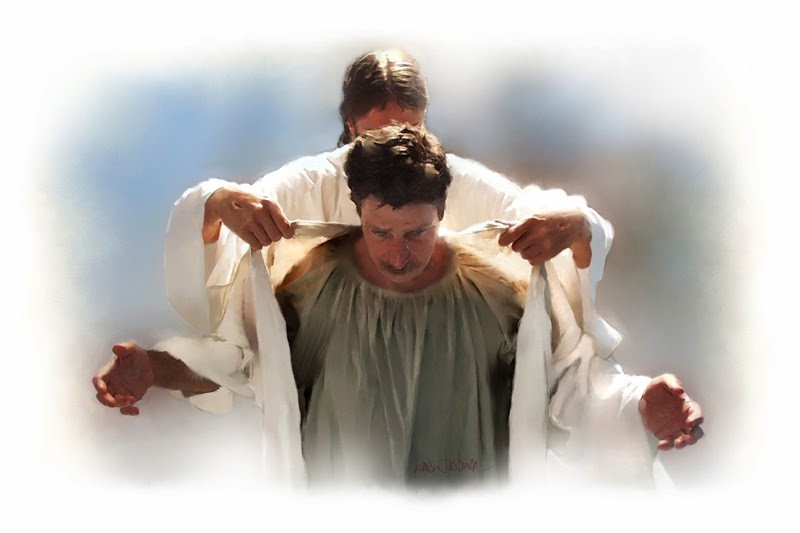
Lars Justinen, Robe of Righteousness
Posted in bible teacher, direct revelation, discernment, jack kelley

Discernment Lesson: Jack Kelley

EPrata photo

It’s not easy to determine if someone is a false teacher or is fairly solid but teaching false things temporarily. At what point does one decide not to follow a certain teacher anymore? I’ve written about this in the past. For each person the tipping point might be different.

One reason people have different tipping points could be because people have certain non-negotiables which are deal-breakers for them. For example, some who have been false converts for many years and were graciously awakened to their lost state have a low tolerance for easy believism. Some who were in a Charismatic church and have been graciously delivered have a low tolerance for healing crusades and charlatans. Others simply recognize they do not yet possess as much discernment as they need in order to continue following a certain teacher, so they go away from him or her to be on the safe side.

Nor should it be easy to cast someone’s name into the fire of falsity. Making such a determination requires humility, discernment, patience, and wisdom. Making a hasty judgment would mean we’ve impugned a brother or sister, and God takes a dim view of that. (Romans 14:19).

However the alternate should also stand. If we should manifest discerning patience in watching a bible teacher or preacher’s trajectory, when that tipping point is reached and enough biblical evidence is accumulated, we should not be hesitant to declare for Jesus and point this person out as a destroying enemy. (Romans 16:17).

For me, Rick Warren praying to the false god Isa, promoting corporate growth strategies for church, man-centered theology, consistently failing to give the Gospel to audiences he was invited to speak to, not to mention ecumenism with Islam and Catholicism, is enough for me to say “false.”

Beth Moore’s bible twisting, her shallow and emotional storytelling narcissistic approach, pop psychology, automatic/occult writing, and puffed up visions showed me that I can say “false” with confidence and biblical integrity.

Billy Graham’s lifelong compromises with Catholicism and his universalism make it clear to me that he, sadly, is also false.

And Joyce Meyer, Joel Osteen, and Mark Driscoll’s many sins against Jesus are the equivalent of training wheels on the discernment bike for baby Christians to spot as false. Or should be.

At some point in time, all of the above began to show their aberrant doctrines. And at some point one discerning person saw them while others less discerning didn’t see them yet. Especially when it’s early, we should not jump to conclusions, but watch.

Be serious students of the word, as the Bereans were

I’d like to raise a huge red flag regarding Jack Kelley of GraceThruFaith.com. There are enough things taught at his website that cause me to fear for the less discerning. He promotes:

Easy Believism

Gap Theory

Old Earth is OK

And a while back, he heartily refuted anything and everything about Calvinism (AKA Doctrines of Grace). I have not been able to re-discover those essays on the newly designed website in order to link to them.

I caught the opening to a Bible Study recently published on the site recently and I’d like to use it as a discernment lesson. Though Mr Kelley does use the Bible and seems to treat it with proper respect, the above and this below is a flag. Personal revelation is one of my deal-breakers. Let’s unpack this opening statement to a recent Bible study and think it through.

Please note the black underline. The title is “Bible” study. Good enough. I like those.

The first sentence declares that the message he is about to teach was given to the author directly by the Lord. Ergo, it was not derived by the “Bible” through study. There’s an immediate contradiction and an immediate problem.

This is a red flag. No messages are ever given personally by the Lord. Understanding of His word, His will, His plan for us are given in the Bible. This is the Doctrine of Illumination and it’s one of the Spirit’s ministries. (Ephesians 1:17-18).

We turn to the red underline. Excited, the half-asleep author hastily scribbled down the thoughts and went back to sleep. I’ve done this. Every writer of secular material does. However, note the method by which he claimed to have tested whether the Spirit had just knit together an understanding of scripture. It made sense to him, so he decided. Yet Acts 17:11 called the Bereans noble because they tested what they were being taught against scripture (note, being taught in real life, not personally receiving a message while half-asleep).

Let’s look at the Acts 17:11 verse closely. We want to be called noble.

Now these Jews were more noble than those in Thessalonica; they received the word with all eagerness, examining the Scriptures daily to see if these things were so.

–they received the word with eagerness. Their eagerness bespeaks a diligence. They sought it out. (Strong’s on the word eagerness, prothumias, “who is already being willing, i.e. an eager disposition which is pre-inclined, already “ready and willing”). In other words, they were not lying in bed half asleep startled that the Lord personally plopped wisdom and understanding of the verses to their mind.

–they examined the scriptures. What they heard, they tested against what was written. They allowed scripture to be the benchmark of whether it passed the test. They did not say  ‘Oh! It makes sense to me, it must be true.’

–they did so daily. This bespeaks a constancy in their attempts to both study and grow. It also bespeaks a maturity in that they didn’t relax their guard on a favored teacher nor did they relax their diligence on their own selves in the fleshly mind. Pride wants to say “Oh, yah, I’ve been doing this for years, I can tell when something makes sense”, laziness wants to say “Aw, you know it is probably true, no need to test.” Yet Humility and Obedience says “I will always use the Bible to test what I hear because the Lord is worth it and the devil is prowling.”

After receiving the word, the Bereans checked.

Now sometimes we say things in shorthand. I hear people say “The Lord told me” when I know they actually mean “I’ve studied this for a week and the Spirit illuminated its eternal wisdom to my mind.” ‘Lord told me’ is shorter. So maybe in this example case that is what happened. However…

In writing though we want to be clear. There is room on a web page for a few more words stating the method by which we arrived at an interpretation. Failing to do so and instead putting out a notion that it was gained half-asleep by revelatory means is misleading and dangerous. At the least, it perpetuates slang we should strive heartily to rid ourselves of. If a person is mature enough in the faith to have derived an interpretation studiously by the Spirit, they are mature enough to say the lesson is founded on normal means of interpretation.

And really, does it inspire confidence in your teacher when he reveals the lesson is founded on scribbled notes gained while half-asleep? Does such a statement do justice to the stricken and risen Lord?

No matter how solid the ensuing Bible study seems to a person, its opening is immediately corrupted by stories of half-asleep revelatory interpretations and testings that make sense apart from having tested against the only standard there is: the Bible. After all, this IS a Bible study. If there is a problem at the outset with the method arrived at or the foundation on which it rests, no matter how good the rest of the lesson seems to be, it’s an interpretation standing on sifting sand. And we all know what happens when the tide comes in.

And everyone who hears these words of mine and does not do them will be
like a foolish man who built his house on the sand. Mt 7:26. (EPrata photo)

The upshot of this discernment lesson is two fold:

Let’s dispense with Christianese shorthand like “The Lord told me”. This confuses the less discerning into thinking that unique interpretations delivered by revelatory means are standard, when they aren’t.

Let’s watch the language and methods of the teachers under whom we choose to sit, in real life or online. What they say is often a first indicator of a growing problem. There are buzz words satan likes to use and be alert for those.

For out of the heart come evil thoughts, murder, adultery, sexual immorality, theft, false witness, slander. (Matthew 15:19)

Evil thoughts here is the Greek word dialogismos, and it means

“reasoning that is self-based and therefore confused – especially as it contributes to reinforcing others in discussion to remain in their initial prejudice”.

So watch out for those buzz words and any teaching that includes even a bit of “The Lord gave me a message and I’m going to teach it to you now.” Once you attune your mind to be alert for it, you’ll be surprised at how dismayingly often you hear it. Instead, stick to the pure word and people who interpret it purely (as possible)

Every word of God proves true; he is a shield to those who take refuge in him. (Proverbs 30:5)

Posted in Burnout, Church Mothers, Discerning Women, discernment, encouragement, Michelle Lesley, prophecy, tower of babel, trevin wax

Gibberish, Discerning Women, Burnout, Church Mothers, Eschatological Discipleship

Around the interwebs, edifying and thought-provoking essays for your enjoyment.

What I been sayin,’ words mean things. Words matter. They really do.

I’d written back along,

Well, the second problem that ties back into the first (ecclesiastical feminism) is that words mean things. They mean things. Any liberal in any realm in the battle for hearts and minds will first seek to change meanings of commonly understood words in order to co-opt the meaning and then to redefine them to their advantage. Example: sodomite—->homosexual—->gay. In the church world, we no longer sin. We make mistakes. We’re no longer Christian. We’re Christ followers.

GIBBERISH 
Tower of Babel, Pieter Bruegel the Elder (1563)

So. Words matter. Until they don’t. The ever-brilliant Carl Trueman writes about The Coming of Age of Today’s Gibberish whereupon an “Editor’s Note” attempted to say what certain words mean without being too specific about what they really mean. Like the word “woman” and menstruate”.

Editor’s note: This blog post refers to individuals who menstruate as women because the author wanted to highlight gender inequality in health care. We acknowledge that not all individuals who menstruate identify as women and that not all individuals who identify as women menstruate, but feel this generalization is appropriate considering the gendered nature of most health care policies. 

One might translate what the editor is really saying as ‘the concept of being a woman is now utterly meaningless but we have decided to preserve the fiction at those points where it is politically convenient for us to do so.’ Notice the editor’s use of the vague term feel and the slippery adjective appropriate. As ever, in our aesthetic age, it is impossible to argue against a feeling.

DISCERNING WOMEN

Here, Michele Lesley lists Nine Reasons Discerning Women Are Leaving Your Church and every single one is 100% a ‘hear, hear’.

The absence of discerning women in churches gives rise to many other problems. Godly mothers raise godly children, and absent discerning moms, the next generation of church life suffers. Elder discerning women have much to bring to the table (reason #7) in being the Titus 2:4 women teaching the younger. As discerning women leave churches the less discerning take over and soon you have the blind leading the blind. Third, the contributions to the faith of discerning women are without measure. Within our biblically prescribed roles, we see New Testament women advancing the Gospel and expanding the kingdom in myriad ways.

Priscilla and Aquila were discerning enough to see the potential in Apollos and taught him separately. Lydia’s home became a hotspot for prayer, teaching, and hospitality-fellowship. Dorcas gently led many women in a worthwhile sewing circle, teaching biblical principles by example.

On the other hand, you have a young and skittish and Rhoda who was so startled to see rescued Peter standing at the gate she shut it and left him there, believing the false but then-widely-popular notion that humans have a doppelganger angel, and that was who came to visit.

Soon, if not already, you will have churches that are absent your wise Priscillas, and Dorcas’ and Lydias and instead filled with foolish Rhodas.

Even though it is a bad thing that discerning women are leaving the churches, it is encouraging in a sense if you are one of the discerning women. At least you know you’re not alone in your concerns. Read Ms Lesley’s piece, it’s good.

While Scripture is pretty clear that we can expect women (and men) who are false converts to eventually fall away from the gathering of believers, why are godly, genuinely regenerated women who love Christ, His word, and His church, leaving their local churches?

BURNOUT

Other men and women are leaving due to burnout. Yikes, burnout is an epidemic, just at the time when we need good men and women ministering to the flock. Please, please avoid burnout. Please, please pray for your pastors and leaders.

Question: “What does the Bible say about burnout?”
Anyone who has experienced burnout knows it is not something he ever wants to experience again. Burnout is commonly described as an exhausted state in which a person loses interest in a particular activity and even in life in general. Burnout is a state of emotional, physical, social, and spiritual exhaustion. It can lead to diminished health, social withdrawal, depression, and a spiritual malaise. Many times, burnout is the result of an extended period of exertion at a particular task (generally with no obvious payoff or end in sight) or the carrying of too many burdens (such as borne by those in the helping professions or those in positions of authority, among others).

CHURCH MOTHERS
Photo by Alysia Burton Steele

An interesting peek at a part of Christian culture of which I have no experience and very little knowledge

Chronicling Mississippi’s ‘Church Mothers,’ and Getting to Know a Grandmother

Ms. Bearden and Ms. Floyd were part of a larger assemblage of 50 African-American women whom Ms. Steele had chosen to chronicle in text and image for a book-in-progress she has titled “Jewels in the Delta.” Whether by formal investiture or informal acclamation, nearly all the women in the book held the title of “church mother,” a term of respect and homage in black Christianity.

ESCHATOLOGICAL DISCIPLESHIP
Jesus giving the Farewell Discourse (John 14-17)
to his disciples, after the Last Supper,
from the Maesta by Duccio, 1308-1311

Trevin Wax is an Editor at LifeWay and is working on his doctoral dissertation. He wrote recently that his dissertation is on the topic of Eschatological Discipleship.” This is a topic near and dear to my heart, because it is exactly the focus of this blog. How are we to live, biblically, knowing of Jesus return? I’d observed that too many people, as Trevin wrote below, focusing on Jesus’ past work and avoiding the future promise of His return. Yet the Bible is replete with admonitions for living, encouraging, and a praying for the future deliverance via the promises of prophecy. This is what Trevin is writing about. Here is the excerpt from his longer essay which is mainly on other topics. He wrote that he is taking a break from blog writing to focus on his dissertation writing, whichis the topic of:

Eschatological Discipleship

The topic of my dissertation is “eschatological discipleship.” Following Jesus means understanding our times in light of the biblical vision of history and having the wisdom to make the right choices when the path ahead seems unclear. 

Many gospel-centered folks are right to point out that the New Testament’s moral imperatives are often grounded in Christ’s finished work for us in the past. What we sometimes overlook, however, is how many of those moral imperatives also look forward to Christ’s return in the future. We are called to be “children of the day” in a world that knows only darkness. 

The question that propels me forward is this: 

What kind of discipleship is necessary to fortify the faith of believers so that we understand what time it is, we rightly interpret our cultural moment, and see through the false and damaging views of history and the future that are in our world? 

That is the question I posed in my workshop at TGC this year: Discipleship in the Age of Richard Dawkins, Lady Gaga, and Amazon.com: Grounding Believers in the Scriptural Storyline that Counters Rival Eschatologies. (The audio from the talk is available here.)
To be alert to our times is a gospel requirement, says Oliver O’Donovan:

To see the marks of our time as the products of our past; to notice the danger civilisation poses to itself, not only the danger of barbarian reaction; to attend especially not to those features which strike our contemporaries as controversial, but to those which would have astonished an onlooker from the past but which seem to us too obvious to question. There is another reason, strictly theological. To be alert to the signs of the times is a Gospel requirement, laid upon us as upon Jesus’ first hearers.

I agree.

Enjoy the day today friends, look forward to the future and keep looking up!