Posted in discernment, expository preaching, Jesus preaching, word

Why emergent/liberal churches will never have the power of the first century church they want

“I want our church to be like an Acts 2 church.”
“Oh, Holy Spirit, come down in power and presence to us today.”
“The original church was the best, we should be like them. We can be like them.”

I hear and read comments like those a lot today. The liberal or emergent churches stand on stage with a fog machine and the praise band plays the same refrain over and over, millennials are swaying and hands are upstretched. They cry out for power and wisdom and for the Holy Spirit to descend upon them in force. They crave ever more potent “experiences” and “power” and “anointing” as the early church seemed to have had.

And yet there is one critical ingredient that they lack, and in so lacking, they will NEVER have the power of the spirit that they crave. Can you guess what that ingredient is?

The word of God.

Preaching from the Bible.

Expository preaching in the power of the Spirit.

Teaching the people from God’s word.

Do you realize how much preaching from God’s word took place in the first century church? ALL OF IT. Jesus, (in Luke 24:13-35) Peter, Stephen, Paul…all preached the Old Testament and taught the new covenant as given to them by Jesus. Sermons, sermons, sermons. Expository preaching is what drove the first century church of Acts. Preaching. Much of Acts are recorded sermons preaching God’s word.

The book of Acts gives a unique glimpse into the life and practice of the early church. It describes the coming of the Holy Spirit at Pentecost in Acts 2, the spread of the Gospel outside of Jerusalem in Acts 8 and to the Gentiles in Acts 10, how the church made decisions in regards to doctrine (Acts 15), and more.
The sermons recorded in Acts give us a window into the preaching ministries of Peter, Stephen, Philip, James, and Paul, along with the immediate impact those sermons had.
Below is a list of sermons preached in Acts along with a short description and reference for each are listed below. Not every passage below quotes the preacher’s sermon directly, but each passage will share something important about the content of the sermon or the response of the hearers. (source & chart below)

Many of these churches/preachers them tacitly or overtly declare expository preaching as old, dusty, and/or unnecessary. Or worse, some say it’s so easy it’s cheating. Yet such preaching is entirely necessary.

It is the preaching from God’s word that is the power. The liberal/emergent/millennials want power but they deny the vehicle that will bring them that power. They want wisdom but deny the only place where wisdom resides. They want Spirit power by bypass Jesus, who IS the Word.

From The Cripplegate, an excerpt from an interview with expositor Steven Lawson on the nature of expository preaching.

I believe that the Apostle Paul lays out the essentials of preaching in 1 Timothy 4:13 when he writes, “Until I come, give attention to the public reading of Scripture, to exhortation, and to teaching.” 

In true expository preaching, there must be the reading of the text, the teaching of the text, and the exhorting with the text. Expository preaching informs the mind, ignites the heart, and impels the will. 

The supposed preaching that only instructs the mind is not a sermon, but a lecture. The supposed preaching that merely touches the heart is not a sermon, but a mere devotion. The supposed preaching that merely challenges the will is not a sermon, but a manipulation. True expository preaching must address all three aspects of the inner life of a person — mind, emotion, and will. Anything less, is not expository preaching.

Is your preacher more excited to read the announcements than to read the word of God? Or does he unashamedly proclaim the Word in power and truth?

In the beginning was the Word, and the Word was with God, and the Word was God. He was in the beginning with God. All things were made through him, and without him was not any thing made that was made. In him was life, and the life was the light of men. The light shines in the darkness, and the darkness has not overcome it. (John 1:1-5)

——————————

Further Reading

Six Characteristics of a Healthy Church

[hint: one of them is expository preaching]

Posted in discernment, mystery, scientology

Scientology opens new building in Atlanta, Martyn Lloyd Jones’ Mystery of God’s will

which He lavished on us. In all wisdom and insight He made known to us the mystery of His will, according to His kind intention which He purposed in Him. (Ephesians 1:8-9)

Martyn Lloyd-Jones preached a phenomenal series through the Book of Ephesians. His sermon on the verse from 8-9 is called The Mystery of God’s Will. It is so rich with insight and profundity I listened to it twice and then transcribed part of it so as to study more. Here is MLJ on the word mystery in Ephesians and other verses:

Mystery is a key term. If we do not understand its meaning we shall certainly go astray. … What, then, does this term mean? Well, let us have a few negatives. It does not mean the same as the manner of the cults and the mystery religions which were common in Paul’s day. A kind of mystic secret, which is only revealed to a few initiates and which is deliberately kept from and guarded from everybody else. No, that was the characteristic of the mystery religions. You went into the temples and you went through certain procedures. It was a secret that was really confined to a few philosophers and exceptional people. It was never given to the common, ordinary people.  

Oh no, it was closely guarded and kept, and there was a great ceremony and ritual and then you were initiated. There are certain cults as you are familiar with at the present time which are clearly based upon such practices and are the very antithesis of the Christian faith. Behind closed doors, the secret must be kept and never divulged, and nobody knows. It’s the opposite of Christianity which proclaims, preaches, expounds, heralds, and wants everybody to know it. It isn’t a closely guarded secret to which only initiates are admitted. No, it isn’t that. 

More important perhaps is that we should say this: that when this truth is described as a mystery, it doesn’t mean that it is something that is incomprehensible to the human mind in and of itself and therefore vague and nebulous and indefinite. Now that is the more important point to emphasize today. Because, there is a popular school of thought which says something like this: it is that the Christian faith can never be stated in propositions. Those of you who are following the journals will recognize this as part of the Barthian movement, followers of Karl Barth of Switzerland. They say that truth, salvation, cannot and must not be stated in propositional terms.

Well what is it then? They say it is essentially an encounter. It is this existential moment when God speaks to man and addresses him and then something happens. And all man’s attempts and endeavors to put it into print of necessity are wrong and false and misleading. That is why they say that ultimately all you have in the Bible is very fallible. That it is only man’s attempts to state this thing that happened at the moment of encounter. You mustn’t tell men that you must believe certain propositional truths, they say that truth can never be stated propositionally. It’s a mystery. In other words, their definition of a mystery is that it is something incomprehensible, something that men cannot state and cannot express. Any attempt to do so detracts from it.

Now, I say that it is vitally important that we should realize that that is not the meaning of mystery. That view of mystery is not confined to the Barthian movement and to its various adherents, there are others who believe the same thing. …

I suggest that those definitions of mystery are utterly erroneous.

Gill’s Exposition explains the Ephesians verse, what God’s mystery is

the mystery—God’s purpose of redemption hidden heretofore in His counsels, but now revealed (Eph 6:19; Ro 16:25; Col 1:26, 27). This “mystery” is not like the heathen mysteries, which were imparted only to the initiated few. All Christians are the initiated. Only unbelievers are the uninitiated.

And yet, there are so many false religions around the world and on our own doorstep that take the word mystery and build an entire false religion around it. People follow a track or a hierarchy in attempting to climb toward solving the “mystery”. They will all perish if they adhere to their track on the mystery religion. So many men and women have founded religions where people fruitlessly seek to perform tasks and rituals which will eventually (they hope) reveal the mystery. In all cases, these false religions or secret societies are attempting to contact god or gods. As this page explains,

The idea of there being different levels then moves the process on and ensures that the new initiate strives to become an adherent or full member by learning the ways of the club or society – and thus the initiate becomes fully engulfed in the world of the society.

Secret societies take this membership a step further by including certain devices within the “knowledge bank” that the initiate must learn. These devices include secret handshakes and words, special days of the year known only to the few, and insights into standard texts. All this, and more, makes the initiate feel ever more important. In all instances, the ultimate enlightenment experience seems to be kept back for the very highest levels of initiation – lower levels of illumination are permitted and used for the lower degrees.

One modern secret society which proposes to unlock “mysteries” is the Scientology cult. One knows that cults attract large numbers. Cults indulge the flesh, appeal to intellect, or make a person feel exalted or special. It’s disheartening to see how many people fall for the false claims.

Cults have

excellent ways of drawing in members and utilizing a heightened state in the individual for their own ends – whatever they may be.

Scientology in particular, according to their own definition,

In one form or another, all great religions have held the hope of spiritual freedom—a condition free of material limitations and misery. The question has always been, however, how does one reach such a state, particularly while still living amidst a frantic and often overwhelming society?
Although modern life seems to pose an infinitely complex array of problems, Scientology maintains that the solutions to those problems are basically simple and within every man’s reach. Difficulties with communication and interpersonal relationships, nagging insecurities, self-doubt and despair—each man innately possesses the potential to be free of these and many other concerns.
Scientology offers a pathway to greater freedom.

No, it does not. The only pathway to freedom is through Jesus, because He forgives our sins and frees us from bondage to them.

I live within range of Atlanta. In this essay we are speaking of mystery religions, (cults) one of which is Scientology. Scientology says they offer “total freedom” but only through a veil of secret teachings. The following was news last weekend. Even at that, the information that published in the paper was not reported on by an unbiased journalist, it was from a carefully scripted press release from the organization itself. This means that the information we learn is only what the Organization wants us to know. The Church of Scientology-Atlanta held the grand opening of its new campus in Sandy Springs on Saturday and it seemed to be quite a draw.

So much wasted flesh… (photo source)

It’s quite disheartening to see so many people seek mysteries which have no resolution, when the resolution to everything is Jesus, and he is out in the open. We must address our sin, not indulge it, as the mystery religions do. Even more sad, is this article below reporting from the press release of the same event,

The Atlanta opening continues an explosive growth period for the Church in the past 12 months. And more is on the way, with openings in the coming year planned for cultural epicenters in Australia, New Zealand, Europe and North America. Joining the Church’s opening celebration were 1,500 Atlanta Scientologists, plus those from along the Eastern Seaboard. (source)

Many people are seeking what is false. These people seeking the false are not just in Atlanta like in the picture above, but they are all around the world. And they are seeking what is false not just through Scientology but other mystery religions too. It’s saddening to the point of mourning to see so many people in one photo applauding the mystery religion that will reveal no mystery but only send them to hell.

Enter through the narrow gate; for the gate is wide and the way is broad that leads to destruction, and there are many who enter through it. “For the gate is small and the way is narrow that leads to life, and there are few who find it. (Matthew 7:13-14)

The problem with the mis-definition of “mystery” is that non-believers seek knowledge to resolve the mystery, but never seek the resolution to our universal problem, which is sin. And sin is no mystery to anyone, even the unbeliever. (Romans 1:18).

If anyone acknowledges that Jesus is the Son of God, God lives in them and they in God. (1 John 4:15)

For there is one God and one mediator between God and mankind, the man Christ Jesus. (1 Timothy 2:5)

Posted in barnhouse, discernment, social justice

What is God doing in the world today?

The following is a sermon excerpt transcribed from Dr Donald Grey Barnhouse. The sermon “What is God Doing Today?” can be found here. Dr Barnhouse launched his long-running radio program in 1927, and he pastored from 1927 until his death in 1960. Therefore this sermon had to have been preached sometime in that time frame, yet its age, at youngest perhaps 56 years old and at oldest, perhaps 90, is fresh and relevant today. 

We so often hear the cry of the social religious liberals to that they plan to change the world with their acts, or bring about social justice through this or that organization or these millions in donations. This of course is not a new theme. Dr Barnhouse’s sermon lets us know just how off-kilter the social justice cries really are. And how stale.

I recommend the sermon in its entirety at the link above.

————————————–

What is God Doing Today?

The question I am going to ask and answer today is ‘will the church save the world?’ What is God’s purpose in our age? God has but one purpose for the church, and He is confining that purpose to this age. In the Bible, God reveals that purpose.

Now we know that all Bible revelation centers around the work of the Lord Jesus Christ in two phases. First, He came to suffer for the sins of men. And He will come the second time to rule with a rod of iron and to bring righteousness to the earth. The Old Testament reveals nothing about the period between His First and Second coming. That revelation was made after Pentecost. 

What are God’s plan and purpose for this age? We need to find out so that we may not work contrary to them. A great New England preacher was once asked why he did not cooperate with Dwight L. Moody. The minister replied that he and Mr Moody did not agree on the purpose of life and work. This minister looked upon the church as a great ship, sailing through stormy seas, perhaps, but sailing on nevertheless in triumph, sure to come into port someday, with all the world on board. He expected that all the world would be Christianized and that everyone would be brought under the domination of the Gospel.

Mr Moody, on the other hand, looked upon the world as a sinking vessel, from which the church was to save as many souls as possible before the world foundered in great catastrophe. Obviously, it’s impossible to harmonize these two points of view. Therefore we need to examine God’s word so that our plans and purpose may be in harmony with His.

Never in the prophetic outline of the Church Age given in the word of God do we find the Church comprising more than a fraction of the population of the earth. Never is this Church spoken of as ‘all-inclusive’. Not one verse in the Bible teaches or even allows one to infer that the world is ever to be converted through the work of the church. Rather it is definitely taught that never will all people be in the true church. The low spiritual condition of many churches today is due in large measure to the fact that leaders have failed to recognize this truth and have been seeking to accomplish purposes that are out of harmony with the plan of God. Many leaders, lay and clerical alike, are trying to change the intellectual currents of the age. They are seeking to transform the social and economic order. Their aim is to build a new civilization for children to be born into. All this is foreign to the plan of God. Such ideas cannot be found in the New Testament.

Anyone who claims to be a follower of Jesus Christ can only adopt the attitude of the Lord Jesus toward the age in which we live. Our Lord spoke in no uncertain terms about the intellectual currents of this world system…its civilization…its social and economic order… He said in John 15, “If the world hates you, know that it has hated Me before it has hated you. If you were of the world, the world would love its own.”

There is no word here about trying to change the attitudes of the world toward believers in Lord Jesus Christ. … Christ NEVER hinted that there was any hope for this world as it is in its present condition. There is hope for believers, salvation for those who turn to Christ, but no hope for the unbelieving world. In John 17 Christ even refused to pray for the world. In His last, great prayer, recorded in John 17, He said “I have manifested your name to the people whom you gave me out of the world…9I am praying for them. I am not praying for the world but for those whom you have given me, for they are yours.” 

It is not God’s purpose in this age to improve the social or moral order of the world. Anybody who seeks to make this world a better place to live in has failed to understand the purpose of God today. For God’s purpose is to form His church, the Body of called-out ones.

Posted in boyfriend, discernment, romance

Jesus is not our boyfriend

By Elizabeth Prata

Not all girls universally desire a romantic groom to come sweeping in on a white horse to rescue them. Not every woman is a romantic.

Ladies, don’t buy into the current attitude that because all women want a romantic groom, that we can envision Jesus as that romantic groom. The romantic Jesus-boyfriend complex is an unfortunate trend that in fact diminishes the august majesty of our King. He is also Savior, Redeemer, Priest, Father, Friend, Healer, Provider, and a host of other facets to His personality that are the complete God-man whom we worship. He is not our boyfriend.

Jesus is not a Prince Charming jousting for a lady fair’s attention. Jesus is not Prince Charming trying to win a fair maiden’s attention. He is GOD! He doesn’t woo. He doesn’t plead. He doesn’t leave small favors on our doorstep so we would finally fall, smitten, at His feet. He is GOD! He decides whose name will go in His lamb’s Book of Life. He decided that before we were even formed. Then he makes it happen.

Now the main point in what has been said is this: we have such a high priest, who has taken His seat at the right hand of the throne of the Majesty in the heavens, (Hebrews 8:1)

And He is the radiance of His glory and the exact representation of His nature, and upholds all things by the word of His power When He had made purification of sins, He sat down at the right hand of the Majesty on high, having become as much better than the angels, as He has inherited a more excellent name than they. (Hebrews 1:3-4)

“Yours, O LORD, is the greatness and the power and the glory and the victory and the majesty, indeed everything that is in the heavens and the earth; Yours is the dominion, O LORD, and You exalt Yourself as head over all. (1 Chronicles 29:11)

Does that sound like a man who is supposed to woo his woman and fall head over heels, weaving a daisy chain together to bestow with a kiss? No.

Bless the LORD, O my soul! O LORD my God, You are very great; You are clothed with splendor and majesty, (Psalm 104:1)

And yet we women are subjected to titles like this, depicting our majestic God as as a foppish suitor. This terrible book was actually written, actually published and is actually on sale:

The Wild Romancer: Uncovering the Romance Jesus Longs to Lavish on You, by Brenda Cobb Murphy.

Jesus longs for something? This would indicate an impotence that does not exist. It evokes a weak man who wishes, hopes, tries, but does not accomplish. But Jesus accomplished it all. He defeated death by the power of His sinless will! Yet these kind of titles are all too common. This theme is all too frequent in “women’s studies”. One ‘teacher’ urges women to “make Jesus the supreme romance of your life, if we would “only let Him.” Ann Voskamp says that we “make love to God.” Sarah Young carries this erotic-romantic theme forward in her book, Jesus Calling Grads. That’s idolatry, projecting our own emotions onto Jesus and worshiping the image we have created.

He did not come to woo us gently to His heart. He came to shed His blood so as to exhaust God’s wrath for His elect’s sin. Even the concept of wooing toward salvation is foreign to the Bible. No one seeks for God, no not one. (Romans 3:10-11). We women are not wandering romantics looking for our Prince Charming, who whispers sweet nothings into our ear and satisfies the need for glamour and mystique in our love lives as we finally, sweetly succumb. He is the avenging Savior ransoming us from sin’s bondage in His inestimable timing. Sometimes salvation is hard, messy, and initially unwanted.

It is the romanticizing of Jesus that is one of the ways we remake God into our own image. This is idolatry. We have a human desire or need, and we make God into an image that fills that need.

Isaiah 44:15 & 17 say of idolatry,

Then it becomes fuel for a man. He takes a part of it and warms himself; he kindles a fire and bakes bread. Also he makes a god and worships it; he makes it an idol and falls down before it.

From the rest he makes a god, his idol; he bows down to it and worships. He prays to it and says, “Save me! You are my god!”

The romantic whispery Jesus is the false God some women have made, and this is concerning because these women have a platform for publishing books or speaking to thousands of women. This is the false Jesus they urge women to fall down before.

Jesus is not our prom date. He is the creator, sustainer and destroyer of worlds. (Genesis 1:26, Colossians 1:17, 2 Peter 3;10). He decided to create man for a relationship with Him, so that man may know Him and glorify Him. (Psalm 86).

Jesus is not our boyfriend.

————————————————–

Further Resources

Critique: Why Jesus isn’t your boyfriend

Jesus did not accomplish redemption to marry us individually. He died for the church corporate, of which we are a part. His death accomplished something much greater than simply meeting our deep-seated desires for a significant other.


Posted in charismatic, discernment, strange fire

Strange Fire Q & A: How do we distinguish between the Spirit prompting us, and our own thoughts?

One hundred years ago, the modern Pentecostal movement was born. By October 2013 the Pentecostal movement has morphed into the Charismatic movement with its particular brand of false doctrine and had infected much of western Christianity and polluted quite a bit of Christianity abroad. The excesses of the movement include faith healing, reports of raising the dead, babbling tongues, alleged prophecies and direct revelation, disorderly church services and worse. The movement assaulted the sufficiency of scripture, the inerrancy of scripture, besmirched the name of Jesus Christ and damaged the faith of many. 

John MacArthur and his team at Grace To You took a stand against this movement and sought to bring clarity to why its doctrines needed comparison to the Bible correction. To that end, they organized the Strange Fire Conference, held in the fall of 2013. One of the main purposes of the conference was to initiate a substantive discussion about these issues. It achieved its purpose. Every sermon preached at the conference rebuked the movement simply by preaching the truth, and brought correct biblical doctrine to the fore. Given the outcry, it seems that the effect was immediate.

There were many good questions asked at the various seminars and Q & A sessions held during the conference period, but not all of them could be immediately answered. After the conference concluded, ministers and theologians at Grace Community Church and The Master’s Seminary wrote out answers to these unanswered questions, compiled them, and put them on one web page.

The page is a treasure trove of good, solid rebuttals to and practical helps about what to do if encountering Charismatic doctrines in your church, in your family, or in yourself.

~~~~~~~~~~~~~~~~~~~~~~~~

Epidemic in the Charismatic movement is the acceptance of personal revelations. Everybody and their brother it seemed is hearing from Jesus and were eager to share “a word from the Lord”. Such practices assault the sufficiency of scripture, of course, and must be corrected. However, one book is doing its level best to continue to attack the sufficiency of God’s word-  Jesus Calling. Jesus Calling was published in 2004, 16 years ago now, but is still on the bestseller lists. Friends, Jesus is not calling. he has spoken and His word is contained in the closed canon of scripture. The book has spawned a cottage industry of studies, devotionals, children’s books, and other material that has never stopped polluting the faith. Indeed, it seems to be increasing in its staying power and corrupt work.

Here is just one of the Questions and Answers in the Strange Fire Q&A page.

Q. How do we distinguish between the legitimate prompting of the Holy Spirit and our own thoughts or will?
A. While God can prompt us to think or do something, He has not given a clear and objective mechanism to identify when He is doing that. Since no one can identify with absolute certainty the source of the impressions he experiences, he must not ascribe authority to them or rely upon them as direction from God. John MacArthur gives good advice on that point in this downloadable audio. Mistaking a personal impression for divine guidance can lead us far astray from God’s will and may cause serious problems in our lives. 

How should a Christian respond to what he thinks might be a leading of the Holy Spirit? By comparing the impression with the objective, authoritative revelation God gave us—the Scripture. So, does the thought you are having agree with biblical theology? Is the action condemned or condoned in God’s Word? Will that choice ultimately bring glory to God? As you answer these questions in light of biblical teaching, you can know whether you are walking in the will of God.

I would also encourage you to listen to John’s two messages on the topic of understanding God’s will for your life. You can listen to the messages here.

Posted in discernment, parable, tares, weeds

Parable of the weeds (hint, it’s not about the church)

The Parable of the Weeds


He put another parable before them, saying, “The kingdom of heaven may be compared to a man who sowed good seed in his field, but while his men were sleeping, his enemy came and sowed weeds among the wheat and went away. So when the plants came up and bore grain, then the weeds appeared also. And the servants of the master of the house came and said to him, ‘Master, did you not sow good seed in your field? How then does it have weeds?’ He said to them, ‘An enemy has done this.’ So the servants said to him, ‘Then do you want us to go and gather them?’ But he said, ‘No, lest in gathering the weeds you root up the wheat along with them. Let both grow together until the harvest, and at harvest time I will tell the reapers, Gather the weeds first and bind them in bundles to be burned, but gather the wheat into my barn.’” (Matthew 13:24-30)

Donald Grey Barnhouse, in his sermon “What is God Doing Today?” explained,

Now, the Lord Jesus Christ taught clearly that we are in this age to sow the seed – that is, to spread the Gospel. But we are to expect that only part of the seed will fall on good ground, that is, believing hearts. And that the rest will not produce good fruit. The fault is not with the seed, but with the hearts. Christ taught that satan would plant counterfeit believers in the midst of true believers so that it would be difficult to tell the real from the false. The true and the false, the real and the counterfeit grow together until the harvest which is the end of the age in which we live. These truths He taught in the Parable of the Sower and the Wheat and Tares. And he gave the explicit interpretation Himself, not leaving it to man’s imagination. The good and the bad are to grow together. Neither will destroy the other. God will take care of the separation.

Matthew Henry:

So prone is fallen man to sin, that if the enemy sow the tares, he may go his way, they will spring up, and do hurt; whereas, when good seed is sown, it must be tended, watered, and fenced.

EPrata photo

What is a weed? It is useful to study the properties of the object of the agricultural metaphor which the Lord in His wisdom used to explain the parable to us. As we read these properties of weeds, let’s keep in mind how these properties mirror the properties of the unbeliever. At the Penn State Extension website, we read Introduction to Weeds,

–a plant growing where it is not wanted
–a plant whose virtues have not yet been discovered. (R.W.Emerson). [Ed note: i.e. a virtueless plant]
–plants that are competitive, persistent, pernicious, and interfere negatively with human activity (Ross, et. al.)
–No matter what definition is used, weeds are plants whose undesirable qualities outweigh their good points, according to man.

These qualities of weeds certainly mirror the unbeliever’s qualities. Unbelievers in the world interfere with our activity, in pernicious, persistent, and competitive ways. This is because they are sown by satan. To continue looking at weeds:

Certain characteristics are associated with and allow the survival of weeds. Weeds posses one or more of the following:

a) abundant seed production;
b) rapid population establishment;
c) seed dormancy;
d) long-term survival of buried seed;
e) adaptation for spread;
f) presence of vegetative reproductive structures; and
g) ability to occupy sites disturbed by human activities.

I was particularly struck by the notion that weeds engage in “rapid population establishment”. Satan does not rest. One weed soon leads to others.

Weeds are troublesome in many ways. Primarily, they reduce crop yield by competing for water, light, soil nutrients, and space.

The parable is fairly simple, as parables go. The field is not the church. The Lord said the field is the world. (Mt 13:38). If we interpret the field as the church, then we would have a conflict with Matthew 18:15-17, which says to put unrepentant sinners out of the church, i.e. uproot them. So the field is the world, and the unbelievers are sown by satan.

In this tolerant, all-inclusive age, some people chafe when we say that there are two kinds of people in the world, those who are children of the Kingdom and those who are children of satan. We hate to think that there is no middle ground, or love to think that there must be ‘some good’ in people, they’re kinda, almost, mostly good. But no. If a person is not under the control and sovereignty of the Lord Jesus, they are under the control and sovereignty of satan. Wheat or tares. There are no hybrids.

The parable is telling us that we believers are sown into the world by Jesus. Let’s stop there. How wonderful! To be specifically planted by Jesus in the time and in the place He desires us to be grown is a very comforting thought. Matthew Henry wrote the comment to the verse by saying, “when good seed is sown, it must be tended, watered, and fenced,” and how wonderful it is to know we are being grown, nurtured and tended by Christ Himself.

The last part of the parable reminds us that Christ will do the separating at the end of the age. Again, this does not mean pastors aren’t to pursue biblical correction or even excommunication for unrepentant church members. It means that the world’s harvest will be accomplished by Jesus, since he has the power and discernment to see men’s hearts.(John 2:24).

The tares’ fate is to be thrown into the fire, and a woeful moment that will be for them, but for believers it will be an honor to watch Jesus right everything and avenge His name. (Revelation 6:10, 19:2).

Angels if you notice are God’s ministers of judgment. They often carry out the judgments God pronounces. They did at Sodom, also, it was an angel of the Lord that struck Herod down, and throughout Revelation angels execute the dread judgments, to name a few examples. And at the end of the age, they are the harvesters. Revelation 14:16 says,

So he who sat on the cloud swung his sickle across the earth, and the earth was reaped.

The five worst words in the Bible in my opinion. “…and the earth was reaped”. It demonstrates the power and might of the Lord to easily punish men. It also shows the meager and measly efforts of man to thwart Him. It is not possible. It is a terrifying verse because at some point all things will not go on as they have been. There is an end day. It will end for the tares. But it will continue in glory for the wheat!

Posted in charismatic, discernment, doctrine, strange fire

Strange Fire Q&A: How does God use false teachers and their heresies?

One hundred years ago, the modern Pentecostal movement was born. By October 2013 the Pentecostal movement has morphed into the Charismatic movement with its particular brand of false doctrine and had infected much of western Christianity and polluted quite a bit of Christianity abroad. The excesses of the movement include faith healing, reports of raising the dead, babbling tongues, alleged prophecies and direct revelation, disorderly church services and worse. The movement assaulted the sufficiency of scripture, the inerrancy of scripture, besmirched the name of Jesus Christ and damaged the faith of many.

John MacArthur and his team at Grace To You took a stand against this movement and sought to bring clarity to why its doctrines needed comparison to the Bible correction. To that end, they organized the Strange Fire Conference, held in the fall of 2013. One of the main purposes of the conference was to initiate a substantive discussion about these issues. It achieved its purpose. Every sermon preached at the conference rebuked the movement simply by preaching the truth, and brought correct biblical doctrine to the fore. Given the outcry, it seems that the effect was immediate.

There were many good questions asked at the various seminars and Q & A sessions held during the conference period, but not all of them could be immediately answered. After the conference concluded, ministers and theologians at Grace Community Church and The Master’s Seminary wrote out answers to these unanswered questions, compiled them, and put them on one web page.

The page is a treasure trove of good, solid rebuttals to and practical helps about what to do if encountering Charismatic doctrines in your church, in your family, or in yourself. Here is just one of the Questions and Answers in the Strange Fire Q&A page.

~~~~~~~~~~~~~~~~~~~~~~~~~~~~

Does God allow false teaching to continue so believers can distinguish between true and false doctrine? 

Paul told the Corinthian church, “There must be heresies among you so that those who are approved might be made manifest’ (1 Corinthians 11:19). Would you please comment on this verse in light of the charismatic movement? Does God allow these false movements, in part, so the distinction is made clear to His people? Thanks. 

The Greek word translated as “heresies” in the King James Version is hairesis. While that word can refer to false teaching or heresy in certain contexts, Paul’s intended meaning when using the word in 1 Corinthians 11:19 is clearly the other possible meaning of “division, faction, separate group.” In this paragraph Paul is confronting the Corinthian believers’ selfishness and sectarianism (see vv. 18, 21–22, 33). The text of the New King James Version clarifies the meaning by updating the translation from “heresies” (KJV) to “factions” (NKJV). Paul says that when those inevitable divisions happen, they serve the good purpose of distinguishing between the sinful and the righteous people in the church.  

Having said that, the situation Paul describes regarding disunity in the Corinthian church is similar to the result of the error being taught within the charismatic movement today. The doctrines they tolerate and often perpetuate distort, pervert, and contradict sound, biblical teaching. The truly saved who revere and carefully study God’s Word can see the difference between false charismatic teaching and sound theology. While we would never condone false doctrine and practices, we do rest in our confidence that God uses even the wickedness of man for His good purposes (cf. Genesis 50:20; Acts 2:23; Romans 8:28)

Posted in charismatic, discernment, jesus calling

Strange Fire Q & A: Jesus Calling

One hundred years ago, the modern Pentecostal movement was born. By October 2013 the Pentecostal movement had morphed into the Charismatic movement with its particular brand of false doctrine and had infected much of western Christianity and polluted quite a bit of Christianity at home and abroad. The excesses of the movement include faith healing, reports of raising the dead, babbling tongues, alleged prophecies and direct revelation, disorderly church services and worse. The movement assaulted the sufficiency of scripture, the inerrancy of scripture, besmirched the name of Jesus Christ and damaged the faith of many.

John MacArthur and his team at Grace To You took a stand against this movement and sought to bring clarity to why its doctrines needed comparison to the Bible and thus correction. To that end, they organized the Strange Fire Conference, held in the fall of 2013. One of the main purposes of the conference was to initiate a substantive discussion about these issues. It achieved its purpose. Every sermon preached at the conference rebuked the movement simply by preaching the truth, and brought correct biblical doctrine regarding the sign gifts of the Spirit to the fore. Given the outcry, it seems that the effect was immediate.

There were many good questions asked at the various seminars and Q & A sessions held during the conference period, but not all of them could be immediately answered. After the conference concluded, ministers and theologians at Grace Community Church and The Master’s Seminary wrote out answers to these unanswered questions, compiled them, and put them on one web page.

The page is a treasure trove of good, solid rebuttals to and practical helps about what to do if encountering Charismatic doctrines in your church, in your family, or in yourself.

~~~~~~~~~~~~~~~~~~~~~~~~~~~~

Epidemic in the Charismatic movement is the acceptance of personal revelations. Everybody and their brother it seemed was hearing from Jesus and were eager to share “a word from the Lord”. Such practices assault the sufficiency of scripture, of course, and must be corrected. However, one book is doing its level best to continually to attack the sufficiency of God’s word-  and that book is “Jesus Calling”. Jesus Calling was published in 2004, 16 years ago now, but is still on the bestseller lists. The book has spawned a cottage industry of studies, devotionals, children’s books, and other material that has never stopped polluting the faith. Indeed, it seems to be increasing in its staying power and corrupt work.

Here is just one of the Questions and Answers in the Strange Fire Q&A page.

Last year a friend gave me the book Jesus Calling by Sarah Young.  How do I approach my many friends who love this and similar books? 

Scripture has true spiritual power to save and sanctify those who listen and obey it, but human writings masquerading as divine prophecy—such as Jesus Calling—have no such power.  Nevertheless, many people today are enticed by the idea that God is speaking supernaturally through these frauds.  

In order to help your friends, you should gently point out the superior authority of Scripture and refer them to passages such as 2 Peter 1:16–21, 2 Timothy 3:16, Jude 3, and Psalm 19:7–11.  Another good resource is John MacArthur’s two-part series, The Sufficiency of Scripture.

Posted in bible study, commentaries, discernment

Commentary author recommendation: Roy Gingrich

Dr Roy Gingrich, source Faithlife

We study the Bible because we love Jesus and want to know more about Him. The only place where we can reliably learn more about our Savior is in His word, which is THE authoritative word. We ladies like to learn theology, so we read God’s word.

I cut my teeth on the Old Testament, loving it from the beginning even as a babe in Christ. I spent the first years of my salvation reading all the Old Testament Prophets. They’re hard, though, complicated at times and filled with symbolism, idioms, and long history which requires understanding for context. The Holy Spirit is the main help to us, because scripture teaches scripture. He illuminates the word to us as we study and pray. Psalm 119:18 says,

Open my eyes that I may see wonderful things in your law.

Ephesians 1:17-18 says

that the God of our Lord Jesus Christ, the Father of glory, may give you the Spirit of wisdom and of revelation in the knowledge of him, having the eyes of your hearts enlightened, that you may know what is the hope to which he has called you …

However, for information regarding the histories or interpretations of other difficult passages, we also use commentaries. God has raised up men before us who wrote down explanations and comments regarding the books of the Bible. In researching the book of Jeremiah, for example, I found few sermons, and fewer commentaries (which were available to me or reasonably priced enough to access).

Some people look down their noses at using commentaries, saying “I just use scripture.” Really? you don’t also listen to your pastor who stands there week after week explaining the scriptures to you? In his essay 20 Tips on How to Use Bible Commentaries, Professor and Pastor David Murray quotes Spurgeon,

It seems odd, that certain men who talk so much of what the Holy Spirit reveals to themselves, should think so little of what he has revealed to others. My chat this afternoon is not for these great originals, but for you who are content to learn of holy men, taught of God, and mighty in the Scriptures. It has been the fashion of late years to speak against the use of commentaries…A respectable acquaintance with the opinions of the giants of the past, might have saved many an erratic thinker from wild interpretations and outrageous inferences” (C H Spurgeon).

The essay linked above with HOW to use commentaries, because there is a right way and a wrong way. Just as you study alone, you learn from your pastor, and listen to online sermons, definitely read commentaries also. Do use them.

On my Logos 6 software, I learned of a theologian called Roy Gingrich. I had not heard of him before and yet I was intrigued. He has commented on all the Bible and some Bible topics besides. He lived relatively recently and most of his writing was finished in the latter part of his life, in the 1970s to the ’90s and even into the 2000s.

The bio at the Faithlife (Logos) wiki states,

Roy Gingrich was an American pastor and author best known for his comprehensive commentary series. He was born to Arthur and Arista Gingrich on February 3, 1920 in Ozark, Illinois, the youngest of four children. Roy received God’s call to enter the Christian ministry in 1941. After intensive preparation and pastoral stints in Illinois and Indiana, he became pastor of Faith Bible Church in Memphis, Tennessee, where he remained for over 40 years.

In 1963, Gingrich graduated cum laude from Victory University (formally Mid-South Bible College) and soon thereafter joined the teaching staff. Gingrich began writing conservative Bible commentaries in 1964. Roy Gingrich’s Commentaries in Outline Form (100 vols.) includes 60 different commentaries on the books of the Bible, and 40 additional commentaries on major Bible themes.

In 2001, Dr. Gingrich retired from a long and fruitful ministry, but continued to revise his commentaries and lecture at colleges and churches in the US. In 2003, he was inducted into the Crichton College Hall of Fame.

Here is one revoew of one of the commentaries. Of Dr Gingrich’s Commentary on Isaiah, fellow Professor of Theology Paul M. Davidson at Mid-South Bible College wrote in 1977 in the preface to Gingrich’s Commentary on Isaiah,

The book of Isaiah is named for its author, the prophet Isaiah. Isaiah means “Jehovah is salvation” or “Salvation is of Jehovah.” He is rightly called “the Evangelical Prophet of the Old Testament.” By common consent, he ranks among the great literary geniuses of all time and his book is recognized as a part of the world’s great literature. 

According to tradition, Isaiah was martyred, sawn asunder, Hebrews 11:37. Just so, in the hands of destructive modern critics his book has suffered, being cut up into many parts. Consequently, liberal Biblical scholars today deny the unity as well as the Isaiah an authorship of this great work. They affirm that it is the product of various authors, writing at different times, long after Isaiah’s death. Then an unknown redactor combined the various elements into the book that we know today as Isaiah. 

In view of the above errors, it is refreshing to read Mr. Gingrich’s thoroughly orthodox, expanded, analytical outline of Isaiah. His exposition comes from a balanced and responsible conservatism which gives the work an abiding value. Like his other books, this one begins with a full general introduction, treating such topics as authorship, unity, historical background, importance, etc. This is followed by a succinct exegesis and explanation of the text. Both the layman and the busy preacher can use this commentary and quickly come to the heart of a passage and receive much help. For the greatest profit, this outline should be both read and studied with an open Bible. It is designed for both personal and group use.

For many years, Mr. Roy Gingrich has been pastor of Faith Bible Church, Memphis, Tennessee. He is a graduate of Mid-South Bible College, where he is presently a much loved and respected professor. He is truly a humble man of God and a diligent, tireless student of the Word. The reader of these pages has before him the fruit of many hours of prayerful research and the insights of six or seven of the most outstanding and scholarly commentaries on Isaiah.

Heartily and without reservation, I encourage pastors, teachers, and lay persons desiring a thorough grasp of Isaiah to study carefully this analytical outline, this outline being an interesting and effective aid to an understanding of this portion of the Scriptures.

The really interesting thing about Dr Gingrich’s approach to writing commentaries, is that they are all outlines. I love me some Matthew Henry but in accessing his Whole Commentary on the Bible through Logos, sometimes it takes me a long time of reading before I get to the single nugget I want. Mr Gingrich wrote all his commentaries, including the Prophets, as an outline, with a one or two clear, concise sentences for each verse. It’s very helpful. Here is an example of a page from his commentary on Zechariah.

I have not read all of his commentaries, obviously. Just last night I completed downloading the final commentary on the major and minor prophets, to that end, my set is now complete. I’ve enjoyed what I’ve read so far of Dr Gingrich’s work and I especially love he outline form. They are great for small group, too. If you are looking for an alternative to long, complicated commentaries which seem to be orthodox and best of all, affordable, please consider Dr Gingrich’s outlines. They have proved invaluable.

Most of his outlines are available as a download through Logos 6 or Kindle or other method. There are paperback copies available through Amazon also.

Available from RoyGingrich.com

Available at Amazon

————————————

Further Reading

20 Tips on How To Use Bible Commentaries

Posted in be sober, beth moore, discernment, hair

Beth Moore’s hair pride

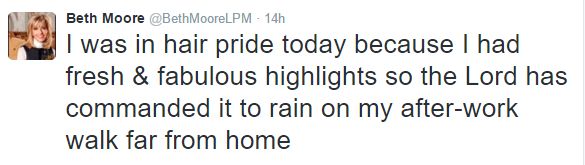
A friend on Facebook put up a screen shot of a Beth Moore tweet, which is truly outlandish.

HT Bud Ahlheim

I had written a comment, “Troubling is the narcissism, but more troubling to me is purporting to KNOW and positively state that she has knowledge of why God does things at any particular moment. She is mistress of the theological humblebrag.”

Someone asked a very reasonable question:

Come on, guys. I know there are plenty of Beth Moore issues, but do you seriously think this wasn’t a joke?

Is it a joke? Should we all just lighten up? I thought about it for a while then wrote back,

If this was the only tweet, essay, book blurb, or audio statement she ever made of this nature, then yes, joke. Sadly, in context of the body of all her work over many decades, such shallow narcissism, self-.involvement, and comfy cozy God-talk is all too usual for Moore. So I conclude it is not a joke, or only a half-hearted joke.

The points here are both good. Don’t take one thing a teacher or leader said once and blow that up especially if it’s obviously meant as a joke. Common sense should prevail. However if a certain unbiblical behavior is constant, for example, anger or sarcasm or boasting, then by all means take the totality of the person’s work or speech and compare it to scripture.

In one other thought, I replied again,

And let’s say in devil’s advocate fashion, that it was a joke, a lighthearted comment meant for fluff. Remember, Moore says she teaches God’s word, speaks for God in her lessons and influences millions of women over several generations. Is this the kind of speech a mature Bible teacher should be constantly and ‘light-heartedly’ tweeting? (Tweets of this nature are constant).

Would a mature teacher with gravitas, say a John MacArthur, ever tweet, “I had tie pride so God made me spill soup on it right before I went to the pulpit so I’d have to take it off.”? No, Titus 2:7b-8 applies.

Some teachers take their relationship with God seriously and other teachers don’t.

There are several things to unpack here. As for the totality of her casual rapport with God, such Twitter comments are all too sadly common from Mrs Moore. She says God calls her honey, baby, babe, kiddo, and other terms of intimate endearment. Setting aside the allegations of direct revelation, can one believe that God calls Moore these things? Did God call John His pal? Did He refer to John the Baptist as kiddo? Did He announce the birth of Christ by shouting from heaven, “Hey, Mary baby!” No. Not that there aren’t tender and intimate moments (Jesus comforting Hagar in the desert, an angel baking bread for a tired Elijah, etc,) but the casualness of such speech diminishes God’s august stature and our own witness.

When Beth Moore goes on a Sabbath play date with God at the zoo and says she and God had a blast, compare that casual kind of language to the Bible by inserting one of the Patriarchs, Prophets, or Apostles’ names. In the Bible lesson where Moore claimed she and God went on a date, contained in her book The Beloved Disciple, she had said God took over her steering wheel and as if on autopilot He steered her into the zoo where she and God watched a baby koala sleep while she sipped a Starbucks fancy drink. Nothing was reported as to what God had sipped. As her date with God to learn how to Sabbath rest concluded, Moore declared she and God had a blast.

Let’s compare that scene to the moment when the real God actually taught Moses about the Sabbath. Sadly for Moses, God did not take over Moses’ legs and put him on autopilot as Moses trudged up Mount Sinai. He did that on his own. When Moses got to the top, did he and God watch a sleeping mountain lion while Moses sipped brewed tea and God wrote the Ten Commandments? Was it a picnic atmosphere when Moses met with God up there? Did Moses then feel restful and walk back down the mountain and face all Israel and declare, “God and I had a blast! We played!” I think not.

As for the casualness of declaring what God is doing and saying at any given moment, we have lost the gravitas due our Savior, thanks in no small part to Moore and her silly statements. Remember John the Baptist’s father, Zechariah. He was a priest and labored in the Temple on rotation, it was his rotation when Gabriel appeared and announced to Zechariah that he would be blessed with the forerunner prophet to Messiah despite he and his wife Elizabeth being advanced in years. (Luke 1:8-23). Zechariah was then struck mute when he asked an impertinent question. God is serious! That Moore’s impertinence has been overlooked for this long is a measure of how much common grace He bestows upon unbelieving sinners like her.

As for the silly self-involvement of Moore’s statement, that God made it rain specifically so that her hair would be flattened, it’s just too over the top to comment on. The pride in which someone would actually say that and believe it is just sad. God didn’t make it rain in order to bring sustenance to farmers so people could eat? (Leviticus 26:4, James 5:18). God didn’t make it rain so He would prove He is still ordering the progression of the seasons in His capacity as Creator and sustainer of all things? (Genesis 8:22). No, He made it rain so Beth Moore’s hair would be squashed down, never mind the thousands of other people nearby who do not have hair pride and who would also suffer the woe of flat hair for the rest of their journey.

My points are several:

1. Do not follow Beth Moore
2. Give Jesus His due and respect Him on social media
3. If you’re not sure if something a teacher has said or a Bible anecdote really applies, insert a Bible character’s name into it and if you can’t picture him or her saying it then there’s your answer. Examples:

Moses said, “God and I had a blast up on Sinai!”
Paul and Silas were singing in jail and God appeared and said “Baby, you have not even begun to believe Me. You haven’t even begun!’”
Mary said, “Elizabeth, guess what! God hollered from heaven and said “Baby, you’re gonna have a baby!”

Comment to the naysayers:

No. I have not contacted Moore. She already has been contacted, multiple times, and she refuses to repent. Also, contacting her is not necessary. See here and here.

No, I am not against lighthearted tweets. This from Moore was appropriately fun and lighthearted:

Goofing around with her daughter after her grandkids were sleeping is a mom-daughter fun thing to do. Fine. Not fine is when you start tweeting you know what God is doing and including His name in your silliness. It’s offensive to me as a Christian and as a woman.

The Second Commandment says not to take the Lord’s name in vain. At Desiring God, that is defined:

How do you define the sin of taking the Lord’s name in vain? 

Well that’s a quote from the Ten Commandments: “Don’t take the name of the Lord your God in vain.” The idea of vanity (and I think the Hebrew carries this connotation) is “don’t empty the name.” 

So it doesn’t just refer to a certain tone of voice or a certain use of the word. It’s dealing with God and speaking of God in a way that empties him of his significance. This includes both throw-away words—like “God!” or “Jesus!”—as well as speaking about him in trifling and flippant ways. Not just swear ways but cheap ways, low and insignificant ways that just treat him like a commodity. And when you hear them you sense that there is no weight to that sentence, no corresponding emotion to that statement. It seems to have just been gutted.

Older women likewise are to be reverent in behavior, not slanderers or slaves to much wine. They are to teach what is good, 4and so train the young women to love their husbands and children, 5to be self-controlled, pure, working at home, kind, and submissive to their own husbands, that the word of God may not be reviled. (Titus 2:3-5).

Self-control. Does the Body of Christ good.
——————————————–
Further Reading:

Breaking up with Beth Moore, by Pam Terrell

The Apotheosis of Beth Moore, by the husband of the woman above, Robert Terrell. Very good essay.

Strange Fire Q&A,

How do I respond to people who refuse to admit that those who supposedly receive divine revelation are dangerous even though they don’t teach outright heresy? 

Can you talk about the dangers of popular teachers who are not heretical but say that God talks to them?  I am thinking specifically of Beth Moore.  What are we to do with people who refuse to see the danger and insist such teachers are OK? 

Believers must always listen carefully when any teacher or preacher speaks about the Bible and theology.  They must share the nobility of the Berean saints whom Luke commended for double checking Paul’s teaching according to Scripture (cf. Acts 17:1–11).  While Beth Moore teaches with accuracy on some points, she also holds positions and teaches doctrines that are both incorrect and dangerous.  

Beth Moore promotes contemplative prayer, a mystical practice not found in Scripture which includes elements of eastern mysticism.  She chooses not to draw firm doctrinal lines on her website while implying the Roman Catholic Church is a Christian denomination alongside the Methodist, Baptist, and other denominations.  Beth also claims that she has received visions from God and sometimes receives revelation from Him in her heart.  From these examples we must conclude that the lack of biblical and theological depth in Beth Moore’s teaching renders her a dubious and dangerous source of Bible teaching.  You may read a critique of Beth Moore’s teaching here.