Posted in discernment, theology

Puritan Wives: Anne Hutchinson- Screeching usurper, or passionate devotee?

By Elizabeth Prata

You know how some people jokingly say he or she ‘broke the internet’? Well, Anne Hutchinson broke the colony.

History hasn’t been that kind to Puritan wife Anne Hutchinson. She is either portrayed as an oppressed early feminist denied her identity, or a screeching harridan who deserved what she got. She has been called a heroine, an American Jezebel, an instrument of satan, poison, and a great imposter (the negative ones were all from John Winthrop).

Of course the truth is somewhere in the middle.

The introductory entry in this series on Puritan Wives is here. If you’d like to read some background to the Puritan emigration and founding of Massachusetts Bay Colony, you can read that link.

Sometimes we think of our historical brethren as backward or uneducated, but in fact Puritan Massachusetts was populated with highly literate people, and that included the women, unusual for the time. The 1600s was an era when women were mainly quiet at home, revered, but out of the public eye. However, Hutchinson was loud and active. An intelligent, complex, wayward mother of 15 children, she was tried and banished from the Massachusetts Bay Colony. Exiled at age 47 in 1638 and left with nowhere to go, she traipsed to Rhode Island where she was welcomed by that colony’s founder, also-exiled Roger Williams.

That was the end of the end of the Antinomian controversy but not the end of Anne Hutchinson.

Anne was born Anne Marbury in 1591 in Alford, England. Her father was an Anglican cleric. Being literate himself and a teacher, he educated Anne to the fullest.

The family moved to London and lived there a while, but when Anne married childhood friend William Hutchinson she moved back to Alford. There, they enjoyed John Cotton’s sermons. Cotton was an outstanding theologian and a dynamic preacher, a combination not often found. Cotton was extremely well thought of.

Cotton was an Anglican preacher who had served for 20 years by the time the Hutchinsons met up with him. He believed the Church needed reforms, such as divesting itself of ritual and ceremony, but did not want to separate from it. He wanted to change it from within. As time went on, though, his consistent attitude against the framework of the Anglican church and his continual speaking against it eventually exceeded the leniency his overseers gave him, and pressure forced him out. He sailed for Massachusetts in 1633.

Devastated, Anne prompted her husband to follow Cotton. In 1634, the Hutchinsons packed up their 14 children and decided to follow Cotton to the new Colony that had been established just 13 years prior.

The Hutchinsons and William’s brother-in-law, John Wheelwright, were quickly accepted into the life of the colony. Anne was a midwife, and she met and discipled many women on her normal rounds. Being articulate and a deep thinker, many women sought her commentary on the Bible. Anne soon began holding weekly meetings at her home, commenting on Cotton’s sermons.

So far, so good. A woman ministering to her fellow sisters in body and soul is what the Bible tells us ladies to do. (Titus 2:3-4). Mothering in midwifery and ministering spiritually to sisters in the colony is a good thing.

However, it wasn’t long before notoriety and interest caused men to attend her meetings, which were ever-expanding. Anne’s commentary was insightful, but a woman leading men in preaching and teaching, even in the privacy of a home, is a dangerous endeavor spiritually. The tendency to usurp is great, and that is what Anne did when she taught and preached to men.

Does sin ever only get worse? Yes. Eventually, Anne did not restrict her home meetings’ topics solely to dissecting/discussing her pastor’s sermons, she strayed into dissecting other ministers’ sermons, too, usually negatively. She criticized heavily.

More men began showing up, women too. Her ‘talks’ gravitated to mainly criticism of everyone else besides her favorite, John Cotton. She began to call names, and impugn character. She hinted that some were antichrists. She said that these other pastors were preaching a covenant of works, while the only true pastor, Cotton, was preaching rightly, the covenant of grace.

In looking at the two sides of the theological debate, it seems to me that both sides were right and both sides were wrong. However, the nuances of this soon-to-be schism are not the purview of this essay, and besides, many other people smarter than me have written on it.

My goal is to look at Anne Hutchinson’s life, and the effects of a rebellious woman’s actions and how they harm the body.

Several of the named pastors naturally took a dim view of her preaching, and there was a meeting held to discuss what to do. John Winthrop, the spiritual leader of the Puritans at that time, was equally, if not more angered.

And the sin deepened. Soon Hutchinson began to encourage women to rise up and walk out of sermons that preached doctrines with which she did not agree. Walking out is a disdainful, rebellious act. But many women did it.

The meetings continued, only growing in number. Anne’s dissections of others’ sermons, were not God-glorifying nor encouraging to pastors. Nor did they focus on educating the attendees and enlighten them as to Jesus as Savior. Nor did they prompt the people to good works. They were simply to point out the pastor’s errors and to cement her own position which she believed to be righteous. Think of the worst discernment ministries running today, who lack love, and who never lift up but only tear down, and that was the situation between 1636-1638 with Anne.

Anne was spurred on by people who should know better.

A male admirer put it this way-

“I’ll bring you to a woman who preaches better gospel than any of your black-coats who have been at the ninnyversity, a woman of another kind of spirit who has had many revelations of things to come….I had rather such a one who speaks from the mere notion of the Spirit without any study at all than any of your learned scholars.” (Source)

One of Anne’s doctrines was that a person did not need any clergy, but could be guided by their own inner light. Anne was correct that the Spirit dwelling in us illuminates the scriptures to our mind, but incorrect that we need no clergy at all to explain the scriptures to us.

Note that “Inner light” is a Quaker term. Quakerism was rising at the time, in fact, another woman, Mary Dyer, supported Hutchinson but was later hanged as a rebel. The Quakers did not believe in baptism, formal prayer and the Lord’s Supper, nor did they believe in an ordained ministry. Each member was a minister in his or her own right, women were essentially treated as men in matters of spirituality, and they relied on an “Inner Light of Christ” as their source of spiritual inspiration, according to Dyer’s Wiki entry.

The equality of men and women in Quakerism, the lack of ordained ministry (to whom church members submit) and the inner light were all things Hutchinson would have been attracted to. It was this the admirer above was hinting at. Quakerism was anathema to Puritans and they enacted many laws against it.

Right, the statue of Hutchinson on the Massachusetts State House at 24 Beacon Street, Boston, MA. Still so controversial 375 years after death, and almost 100 years after the statue was commissioned, the original recipient, the Public Library, refused it and the Legislature ignored it for 2 years. It was finally installed in 2005. Story here: A heretic’s overdue honor

And Anne’s sin just deepened and deepened. It wasn’t long before Hutchinson began spouting personal revelations and prophecies. The apex of this was at her trial for sedition and heresy. Anne’s behavior had spawned a schism, had encouraged women to rebel, and caused a region-wide argument on the finer points of works v. grace. It also exiled her brother-in-law, John Wheelwright. It damaged Cotton’s reputation for years to come. The colony itself was suffering over this to the point of collapse. Winthrop’s “city on a hill” was only after a few years mired in petty bickering and politically unstable, caused no less by a woman. She had to be stopped.

Hutchinson was put on trial, after various attempts to get her to stop, recant, and repent. Hutchinson held firm. In her trial, she bested every single man in a theological debate, including Winthrop, who never forgave her as we’ll see later.

It might have gone her way, except at the last, she overstepped, and claimed that God Himself had told her these things. The initial charge of sedition was not met with a preponderance of evidence, due to her skill in theological combat. However when Hutchinson insisted God spoke to her personally, she was charged with blasphemy and exiled. In the spring, she moved to nearby Rhode Island and founded Portsmouth. Her husband and many of her children were already there.

Anne Hutchinson is noted as “a woman of conscience who yielded to no authority”, as quoted in this book about fellow Puritan preacher William Wentworth. Today’s feminists laud Hutchinson’s stance, but Christians know that is not the way. Of course we yield to authority.

Her friend and pastor John Cotton noted the missteps and sins Hutchinson committed,

Three things I told her made her spiritual estate unclear to me.
1. That her Faith was not begotten nor (by her relation) scarce at any time strengthened, by publicke Ministry, but by private Meditations, or Revelations, onely….
2. That she clearly discerned her Justification (as she professed:) but little or nothing at all, her Sanctification: though (she said) she believed such a thing there was by plain Scripture….
3. That she was more sharply censorious of other men’s spiritual estates and hearts, then the servants of God are wont to be, who are more taken up with judging of themselves before the Lord, then of others. Source: The New England Antinomian Controversy, Monergism

The first two are part of the theological controversy, but it’s the third I’d like to draw your attention to. Hutchinson rebelled against the scriptures, namely 1 Timothy 2:12 by teaching men. She and was unconcerned and unrepentant about it. She also failed to submit to her leaders, as Hebrews 13:17 says to do. Open and constant criticism of your leaders by disparaging them and encouraging walk-outs, is sin. (Also 1 Thessalonians 5:12, 1 Corinthians 16:16). Anne seems to have been unconcerned about the rift she was causing, and the word submit didn’t seem to be in her vocabulary. When she knew she was causing a problem, she did not repent, but persisted. This violated Romans 12:16, as she did not live in harmony with one another and failed to be humble. See also 1 Peter 3:8.

Left, John Cotton by John Smibert

Hutchinson was seen even by her lone supporter as overly judgmental and critical, as John Cotton enumerated in his list, #3.

How many Proverbs did Anne Hutchinson violate? She was not the meek, kind, quiet woman Proverbs calls us to be. She did not tend to her house (Proverbs 14:1). She was contentious, quarrelsome, and loud.

The woman of folly is boisterous, She is naive and knows nothing. (Proverbs 9:13).

When we step outside God’s ordained spheres for us, chaos ensues. I’m not speaking solely of women stepping into leadership or usurping men. Children are called to live in obedience to their parents. Men are supposed to lead the household. John Winthrop wrote of Anne’s husband William,

a man of very mild temper and weak parts, and wholly guided by his wife,

[Of interest: Where is Beth Moore’s Husband? 90-second NoCo Radio video clip]

There are spheres for all of us, and when we set them aside for our own glory or our own purposes, even for a deeply held conviction or our conscience, chaos comes.

Anne’s positive influence could have been great. She was mother of 15 children, many of them boys. Her insights and strong theological knowledge could have raised up a new generation of founding fathers for our nation. If Anne had remained in her mid-wifery and women’s Bible study sphere, and tended to her home, who knows what might have come of it.

As it was, there were a few positives from the negatives of the Anne Hutchinson controversy. Winthrop sought a colonial confederation to unite the colonies. The men banded together and established Harvard College, initially a seminary to train up the generation of men, as this quote indicates,

To provide a bulwark against remnants of Hutchinson’s free-grace theology, just two weeks after she was banished the General Court of Massachusetts finally released funds in November 1637 to establish the “College at Newtowne” (renamed Harvard in 1639)

Third, it spurred Roger Williams to deepen his conviction that there should be a “wall of separation” between church and state. Hutchinson was tried as a seditionist and a heretic, and eventually convicted of blasphemy. Williams thought that-

the magistrate should not punish religious infractions—meant that the civil authority should not be the same as the ecclesiastical authority. The second idea—that people should have freedom of opinion on religious matters—he called “soul-liberty.” It is one of the foundations for the religion clauses of the First Amendment to the United States Constitution. Williams’ use of the phrase “wall of separation” in describing his preferred relationship between religion and other matters is credited as the first use of that phrase, and Thomas Jefferson’s source in later writing of the wall of separation between church and state in a letter to the Danbury Baptist Association in 1802.

It was effectively the end of the city on the hill Winthrop had wanted to establish. His theocracy was no more.

banished
Banishment from Mass. Bay Colony. Wikimedia. It took 6 days to walk to RI

Hutchinson was not the only bad actor in this debacle. John Winthrop behaved badly too. (Among others). Anne was in her mid-forties when the trial occurred. She was either pregnant during the trial or shortly after. She emigrated to Rhode Island the spring after the trial ended and shortly afterward, gave birth. The issue from the birth was not a baby but what is believed to have been a hydatidiform mole, or molar pregnancy. It was a mass of tumors, not a baby. Knowing the outcome of it being publicly known, the Hutchinsons had it quickly and secretly buried. However, Winthrop heard about it, sought the grave, got it exhumed, and used the tragedy as ‘proof’ that his stance was right. He wrote of it widely: ‘see how the wisdom of God fitted this judgment to her sin every way, for look—as she had vented misshapen opinions, so she must bring forth deformed monsters.”

[Of interest: Anne Hutchinson’s Monstrous Birth and the Pathologies of Obstetrics]

This to me, is a total lack of charity and speaks ill of his own character. Later, when it appeared that Massachusetts was set to annex Rhode Island (it never happened), fearing reprisals, Anne and her children (her husband had passed away by then) moved out of Winthrop’s reach and into New York, the Netherlands’ territory. A year later, Anne and all but one of her children were killed in an Indian massacre. Many New England pastors wrote gloating reports of her death. Winthrop called her upon her death “An American Jezebel.” I pray that today’s pastors are more charitable and loving toward their own sectarian.

If you’re a woman beset by conscience due to doctrinal difference with your pastor, what should you do? Well, not usurp the men, criticize openly, and encourage walkouts. Certainly don’t put words into God’s mouth that your stance is directly from Him.

First, decide if your difference is a salvific one or a secondary or tertiary issue. Next, pray, for your pastor, but for yourself too. Pray for wisdom and enlightenment. Perhaps you are wrong!

Then, be patient. You’re not the only one to have spotted an issue that threatens the church. Perhaps other men are working on it behind the scenes. Not everything depends on you. Be patient.

If it continues or worsens, then make an appointment to see the pastor, with your husband if possible. Ask questions to learn, don’t go in with guns blazing thinking you know it all. Ask, be an eager hearer.

Return home and be more patient. Let the information you’ve gained sink in, consult your husband, and read the Bible. Pray some more. Resist the temptation to gossip about it to mount up soldiers for your side.

As time goes on you might be relieved to find the Lord has resolved this issue, or you might find it worsening and have to make decisions. If you decide to leave your church, leave well.

Anne Hutchinson was an amazing colonialist who had much to offer the colony and her church. Unfortunately, she went outside the bounds of the ordained spheres for a woman and she caused upset, schism, and was a negative role model. There’s no doubt though, she was formidable and earned a place in American history. As a wife, though, the more negative Proverbs speak of her and women like her than do the positive ones.

Be peaceable, And the Lord’s servant must not be quarrelsome but kind to everyone, able to teach, patiently enduring evil, (2 Timothy 2:24)

———————————————–

A few resources I used for background, sources for you too

Revising what we have done amisse’: John Cotton and John Wheelwright, 1640
The William and Mary Quarterly

The Antinomian Controversy 1636-1638: A Documentary History, by David D. Hall, Editor

William Wentworth: Puritan Preacher by Susan Ostburg

Rebels and Renegades: A Chronology of Social and Political Dissent in the United States by Neil Hamilton

Anne Hutchinson Preaching in Her House in Boston, illustration published in Harper’s Monthly, circa February 1901 http://historyofmassachusetts.org/anne-hutchinson/
Posted in discernment, theology

Beth Moore has a lot to answer for in normalizing women preaching/teaching to men

By Elizabeth Prata

Sometimes the pot warms its water so slowly even the most discerning frog swimming in it doesn’t realize the change in temperature in his environment until it’s too late. Even though this isn’t scientifically true, “the story is often used as a metaphor for the inability or unwillingness of people to react to or be aware of sinister threats that arise gradually rather than suddenly,” as Wikipedia explains.

It was a given that for more than 2000 years women are not to be teachers or preachers of men. We women can and do teach, we minister, and we evangelize. We discuss, we help, we clarify perhaps in a private setting, but we are not to have biblical authority over men in church expository situations.

I do not permit a woman to teach or to exercise authority over a man; rather, she is to remain quiet.” (1 Timothy 2:12)

How is a women preaching to men a sinister situation? It’s sin. As RC Sproul said, sin is cosmic treason!

Ask the metaphorical Jezebel of Revelation 2:20 who was teaching things God did not say. Jesus promised to kill her and her followers. Inserting words into God’s mouth is sin.

Look at the Garden. One certain fruit was eaten against God’s command, and the entire race of humankind was polluted with sin. Ignoring what God said is sin.

What God says to do or not do matters. We don’t need 50,000 verses. One is enough. Women are not allowed to teach the Bible to men.

But Beth Moore does.

She has been doing it for 30 years.

Woe to Beth Moore.

A female generation is about 25 years. Therefore, it’s woe to the generation of women coming up in Christian circles who have for the entire time been seeing Moore’s preaching to men as normal, even with her pastor’s overt blessing, or the tacit blessing of her denomination the Southern Baptist Convention and its arm, Lifeway.

For years Moore taught Bible to a co-ed Sunday School class of 600-700 people as you read in that link above and later up to 900 people as stated in this link:

At that time, God began to do a new thing, stirring the heart of Beth to move to a new meeting place, meeting time, change the name of the class, and allow men to attend.

Is it God stirring the heart of a woman to disobey scripture and to teach men? I think not. In Revelation 2:23 it’s noted that Jesus will strike Jezebel’s children dead. These are not Jezebel’s biological children, but the spiritual daughters she is raising up in her polluted, sinful likeness.

The 1 Timothy scripture seems not to bother Moore. She has not repented of this cosmic treason. She describes her origins as a Bible teacher. Her Sunday School class began in 1985 and she was still teaching it in 2005. Her class almost from the beginning had a mixed audience.

Being a woman called to leadership within and simultaneously beyond those walls [of an SBC church] was complicated to say the least but I worked within the system. After all, I had no personal aspirations to preach nor was it my aim to teach men. If men showed up in my class, I did not throw them out. I taught. ~Beth Moore

It does not matter if you “had personal aspirations to preach” to men or not. If you do, you’re sinning. If you fail to stop it, you’re sinning.

How did this begin? Moore began teaching an aerobics class in Texas in the 80s at her church. It gravitated somehow (don’t ask me how, that’s a leap I can’t figure) to a Bible class in 1985. That soon turned to a co-ed class, then a 600-700 member coed class.

Moore eventually founded Living Proof Ministry in 1994. By 2003 her Living Proof Live conferences had gone beyond the confines of her church and beyond the Texas border. A national magazine took notice. Their opening sentence called her a minister.

“Once a victim of abuse, Beth Moore is one of America’s most popular ministers today.”

The article went on to note that men attended her Sunday School class. It was popular, so crowded with both sexes that attendees were asked to car pool because the parking lot was so jammed.

But the crowded conditions don’t seem to deter them. Not even the men, who came for a while in large numbers, were put off–until the ministry limited them by asking them to sit in the back, and if necessary, give up their seats to women. It is a women’s Bible study, after all. And though men are not restricted from attending, they aren’t encouraged, either. The selectivity has nothing to do with the location. With her pastor’s sanction, Beth teaches a co-ed Sunday school class of 600 to 700 in the same Southern Baptist church each week. But her ministry “really is to women,” she says. “My love is women in the body of Christ.” [emphasis mine]

An obedient teacher says “My love is for Christ and His word, and I asked the pastor to restrict the class to women only.” But as Beth Moore said above, “I didn’t throw them out. I taught.” She sought bigger rooms to accommodate them all.

The ‘aw, shucks, I’m really just a women’s teacher’ won’t cut it when pleading for mercy in front of the throne. Failure to obey the Word is failure to obey. She has been a usurper from the beginning.

And she keeps on teaching.

In 2010 when her fame was rising, Christianity Today did a 6-page cover story on her. The article cites the following:

Before she begins, she addresses the few men in the crowd. A Southern Baptist, Moore emphasizes that her ministry is intended for women. “The gentlemen who had such courage to come into this place tonight, into this estrogen fest if you will ever find one in your entire life: we are so blessed to have you,” Moore says. “I do not desire to have any kind of authority over you.”

It’s laughable to pronounce a blessing on the men in attendance, welcome them, preach the Bible to them, and then meekly deny any authority over them. Is her teaching from the Word authoritative over the women but not the men sitting next to them? Or do the women reject her authority to teach and they’re just coming, say, for the music? You see the illogic. If she teaches authoritatively, she teaches authoritatively to all in the hearing of it.

As far as Moore’s coyness that she does not desire to be authoritative over them, this is false. Genesis 3:16 tells us it is IN us to want to usurp male authority. It doesn’t matter if you desire to break God’s command or not, if you DO, you’re sinning. Try telling the traffic policeman that “I did not desire to speed on the highway” and see if he lets you go.

The Christianity Today story is page not found anymore. However, the link is here in the web archive split into 6 pages if you want to see the source.

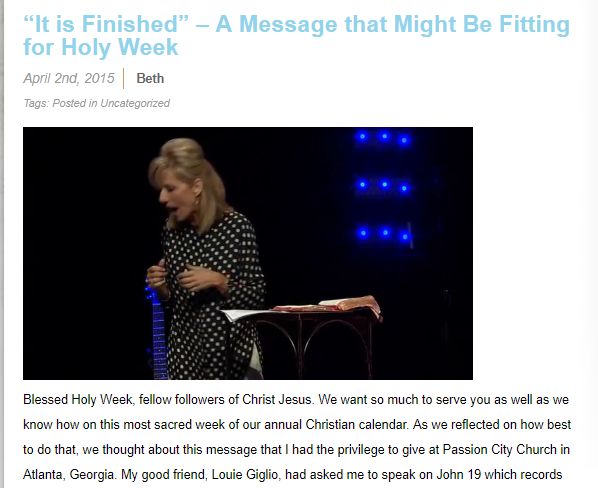
Moore’s occasional weak protest, that men attend her classes and conferences on their own volition so it isn’t really her fault, doesn’t hold water. She taught men in her SS class for 20 years. By 2012, she was personally asked to substitute for pastor Louie Giglio preaching the Sunday Service at Louie Giglio’s Passion City Church, and she accepted. It was Holy Week, and she preached John 19 to a very, VERY large crowd of congregants. Some of these people, men included, lined up two hours early just to hear her.

Brian Dodd was one of those men. He attended Passion City Church that weekend and wrote a recap of her sermon. Gushing about how Moore is “a church leader” and how excited he was that he showed up hours early.

Moore affirmed on her blog that she was asked to preach at Giglio’s church and that she accepted.


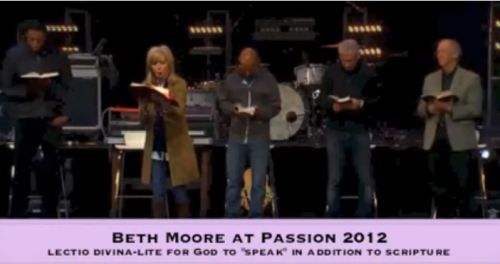
Screen grabs from videos like this in 2012 harm women when they see a female on stage preaching from the Bible shoulder to shoulder with men. It’s visual egalitarianism. Photos like this are damaging. L-R, Lecrae, Moore, Chan, Giglio, Piper preaching at Passion Conference in 2012:

In addition to Moore’s actual preaching to men, a sin, she sins by failing to separate from other women who preach and call themselves pastors. She encourages women in their preaching to men.

We must separate from false teachers and heretics. Moore does not do that, and by her continued support of these people, and they of her, more confusion is added to the body of believers, particularly younger women. Women are the weaker vessel, (1 Peter 3:7), gullible to false teaching if we are unrepentant (2 Timothy 3:6), and our flesh wants to usurp the husband (Genesis 3:16). It is unwise to partner with heretics and to encourage them. By partnering with them, Moore proves her allegiance.

After decades of teaching men and preaching to men, any declarations otherwise are only lip service.

If a woman publicly preaches to men for decades, is seemingly accepted in this role, and even promoted in it, the cumulative damage to the greater body of women is great. In June 2018, the Washington Post published an incredible article about Moore. The title was,

How Beth Moore is helping to change the face of evangelical leadership

In the article she is called a ‘great preacher’,

She has her audience laughing, tearing up and clapping, much like they would listening to any great preacher.

The article’s author notes that the Southern Baptist Convention doesn’t allow female preachers, and then went on for a paragraph describing how Moore gets around it by using tweets, books, and speaking engagements as her pulpit. The article also describes how Moore is the face of global evangelism and is personally the transition linchpin for this new future:

Moore is one of the evangelical leaders today who represent the future of the global church, in which people outside Europe and the United States will be dominant. … Moore represents this transition, which is shaping even the most conservative corners of evangelicalism.

There is the danger. After so many decades of preaching and teaching, Moore has warmed the pot and the girl froglets see women preaching to men from pulpits, in churches, at conferences, or other settings, as normal. Desirable. Meanwhile, despite the Bible’s instruction to women to be gentle, meek, quiet, and industrious, tending to their homes and children, Moore has become culturally confrontational. Political. As the lengthy article about Moore last month in The Atlantic reveals,

“Privately, however, Moore has never cared much for the delicate norms of Christian femininity.”

We know. If she did, she would not preach to men. The pot is boiling now. Is this what we want for our young women? Women who are confrontational, rebellious, vocal, political, taking on the culture, preaching to men, partnering with other rebellious preacher women and ignoring her home duties?

Though she often performs domestic femininity for her audience, in her own life she has balanced motherhood with demanding professional ambitions. She traveled every other weekend while her two daughters were growing up—they told me they ate a lot of takeout. Source The Atlantic

Performs’ domestic femininity? Pretends. AKA, lip service. (Isaiah 29:13).

Writers like J. Lee Grady would love to see more women preach like Moore does. He writes in Ministry Today Magazine that it’s finally about time that women take the reins in the pulpit.

What is baffling about this whole experience is that there are large numbers of Christians today who don’t believe Beth Moore should be preaching to [mixed gender] audiences like the one in Orlando. In fact, some fundamentalists have launched attacks on her because she preaches authoritatively from pulpits.

We need an army of women like Beth Moore, and my prayer is that more women will seek the Lord and dig into His Word with the same passion that Moore has. I believe she is a forerunner for a new generation of both men and women who will carry a holy Pentecostal fire that cannot be restricted by gender.

The Washington Post predicts that, as well. Grady’s desire may yet come true. There was talk this summer of Moore being nominated for president of the Southern Baptist Convention. Her virtue signalling tweets, politically charged ‘Open Letters‘ on social media and timely hopping onto cultural topics such as social justice are akin to a Senator’s moves before a presidential run.

Imagine, within one generation a woman whose former claim to fame was the latest aerobics moves climbed steadily up to being seriously considered for president of the world’s largest denomination, a conservative one, at that. One generation, after 2000 years of holding fast to scripture on this issue. Sin is amazing in its power.

I began this essay chronicling Moore’s journey to normalizing women’s usurpation of men from the pulpit by saying ‘It was a given that for more than 2000 years women are not given to be teachers or preachers of men.’ It was. It WAS. Past tense.

Yet the LORD our God is still on His throne and He still maintains a hard line on the roles women and men are to operate within in His church. That is a given.

For God is not a God of confusion but of peace. As in all churches of the saints, the women should keep silent in the churches. For they are not permitted to speak, but should be in submission, as the law also says. If there is anything they desire to learn, let them ask their husbands at home. For it is shameful for a woman to speak in church. (1Corinthians 14: 33-35).

Posted in discernment, theology

Gay demographics: what are the REAL numbers?

By Elizabeth Prata

This post first appeared on The End Time in June 2012

If the homosexual lobby is to be believed, every other person you bump into is gay. At work, at home, in town, in the city, in church, the more vocal activists in the lobby make it seem like people who self-identify as homosexual or lesbian are a major portion of the population.

They scream about rights, and their civic due, and not being marginalized any more like any other large minority group, such as African Americans. Black people as a major minority rose up in the 1960s to claim their civil rights, the gay lobby says, and homosexual lobby now makes the same claims. Homosexually-oriented people are elected to office, serve as community leaders, even preach from pulpits. There is a homosexual character on most sitcoms now, either as a regular character or as a recurring character. Homosexual references are made on scripted shows and on reality television shows, movies, and books. Christian colleges have gay support clubs now. We are literally saturated with the notion that homosexuality is the norm. Heck, even the animals do it, so it must be normal, right?

Not so fast.

I opened with “If the homosexual lobby is to be believed…” but what are really the statistics on numbers of self-identified gay and lesbian people in America? Can we believe those numbers? I am not talking about a girl who experimented once when she was 12, or the guy who woke up sorry and embarrassed after the drunken orgy of a frat party. I am talking the militant, life-long, “out” homosexuals who choose to live that lifestyle as mirror to heterosexuality.

No. We can’t believe the numbers. They’re a crock.

Americans Have No Idea How Few Gay People There Are
“One in ten. It’s the name of the group that puts on the Reel Affirmations gay and lesbian film festival in Washington, D.C., each year. It’s the percent popularized by the Kinsey Report as the size of the gay male population. And it’s among the most common figures pointed to in popular culture as an estimate of how many people are gay or lesbian. But what percentage of the population is actually gay or lesbian? With the debate over same-sex marriage again an emerging fault line in American political life, the answer comes as a surprise: A lower number than you might think — and a much, much, much lower one than most Americans believe.”

So, what are the numbers? Well, Americans believe a quarter of the population is gay. The true number is about 4% and is probably probably closer to 2%. A 2011 report by the Williams Institute on Sexual Orientation estimated that 4 million adults identify as gay or lesbian, representing 1.7% of the population over 18. (source)

That is some very successful perception-altering on their part. So how is it that the homosexual lobby has made it seem like you can’t swing a cat in the Bible Belt without hitting a queen or a dyke? Because of this.

Bunheads.

Bunheads is (was- it didn’t last) a new ABC Family show by the producers of Gilmore Girls. I never saw the tv show Gilmore Girls but every news story I read about Bunheads identifies the show that way so I will too. Bunheads is the nickname for ballerinas, and the show that made its debut last Monday is touted as a new family oriented entertainment.

I saw the pilot and I liked it. I thought the writing was sophisticated and witty, the show was emotional without being sentimental, and I put it on the list for future watching.

So what is my concern with the show and how does it relate to the vastly overestimated homosexual numbers? Here:

At one point toward the end of the pilot episode, which is on ABC Family I remind us all, the mom-in-law character was having a heart to heart talk with her new daughter-in-law. The girl had just married the mom’s son and had moved into their home in a town called Paradise.

The scene took place in a roadhouse toward the end of the show, a show in which constant references had been made for the last 90 minutes to the smallness of this rural seaside town. It is small. There is no movie theatre. It has just about one store. (Giving directions to a newcomer- “Go to Main Street, turn left, and look for the store called Sparkles.”) The teens, when feeling frisky and up to no good, break into the library and, gulp, read. It’s so small that teenagers literally have nothing else to do but read? THAT is how small, out of the way, and retiring this little town is. Even the show synopsis calls it a “sleepy coastal town.”

So back to the scene. The new daughter-in-law asks about the dancers attending the mom-in-law’s ballet class. The teenage girls all had a story, and of one, the mom-in-law said,

“Her dad’s gay. Oh, he thinks it’s a big secret but we all know. Thing is, if he would just come out of the closet he would smile once in a while. And plus, there are a lot of very nice, single gay men in town.”

A town so small has “a lot” of gay men? The perception the homosexual lobby would have us believe, and uses family entertainment to do it, is that literally just about everyone is gay. Bombard a population with that message for thirty years and you get a new generation coming up who thinks everyone is gay. And if there are so many gays, then it must be normal. That is the strategy. Normalization through numbers.

Of course I’m not blaming the entire skewed perception on one television show, but it is representative of the insidious but casual nature that scripted tv and movies: that every closet has a gay person lurking inside it, summoning up the courage to leap “out.” We have been saturated with casual one-off lines like the one in Bunheads casually declaring that there are “a lot” even in this small town. ‘We don’t have a theater but we’ve got our gays!’

You can see the success the homosexual lobby has had in altering the perception of a nation of over 300 million souls. The homosexual lifestyle is an aberration. Some succumb and choose it. Make no mistake, though, it is a choice, not an identity. I understand the fight that homosexual people have in resisting that aberrant behavior. All people attempt to resist sin in some form or fashion. I understand also that some sins are more besetting than others. God will still judge them.

BUT, God in His loving kindness, accepts the repentance of one who seeks to shed that lifestyle and turn to Him. His mercy is greater than any sin, and He listens to prayers beseeching deliverance. Here is a moving three minute clip from a testimony John MacArthur shared of a homosexual’s repentance. (The clip says 7 minutes but the audio goes out after three minutes.) It is quite moving:

If you are involved in a homosexual lifestyle, or any lifestyle that is unacceptable to God, please repent. Ask Him to forgive your sins, and make Him Lord. His wisdom is so vast that he will lead you into a life that is purer and more peaceful than you can ever imagine.

Posted in discernment, theology

Should you attend a Cursillo weekend? (Great Banquet/Walk to Emmaus/Tres Dias etc). These people did

By Elizabeth Prata

cursillo1

Part 1 here: The Cursillo Theology
Part 2 here: The Cursillo Experience

The plaudits and accolades and gushes of past participants of the many different Cursillo programs are readily available online. Many people have gone through a Cursillo Weekend (in their terminology, “made Cursillo”) and have loved it. The aim of the program is to make known to people the love of God and to revive them for service to others as a lifetime priority. This is a good thing.

However, Cursillo’s theological grounding is from the Catholic religious system, its methods use emotional and psychological manipulation (to purposely “break you down”), it is theology-lite, and as a parachurch ministry it tends to separate people from their own church, or undermine it, requiring constant reunion meetings and written “service sheets” to track your Cursillo efforts.

I have collected first person reviews of the Cursillo program either from the internet or directly from friends and acquaintances who have a different story to tell than the glowing reports one usually reads.

It must be said that though you may never have heard of this movement, it is huge and growing. The Cursillo movement takes place through one-on-one personal invitations, and much of the program is held in a private retreat, with its activities kept secret.

As a result, a lot of people have never heard of Cursillo programs (Walk to Emmaus, Great Banquet, Tres Dias, and so on). I only heard about Great Banquet because a reader asked me to research it, since she had been invited and knew very little about the weekend. Great Banquets are thriving in the American midwest where the founder is from, especially Indiana and Illinois.

Therefore, I researched the program at her urging. It has taken me three months to gather enough information to write a comprehensive review. Since publishing part 1 & part 2, many readers have contacted me to tell me they either went through the program and were upset by it, or they know someone who is involved and are saddened by their involvement. Cursillo is bigger than I knew. See photos:

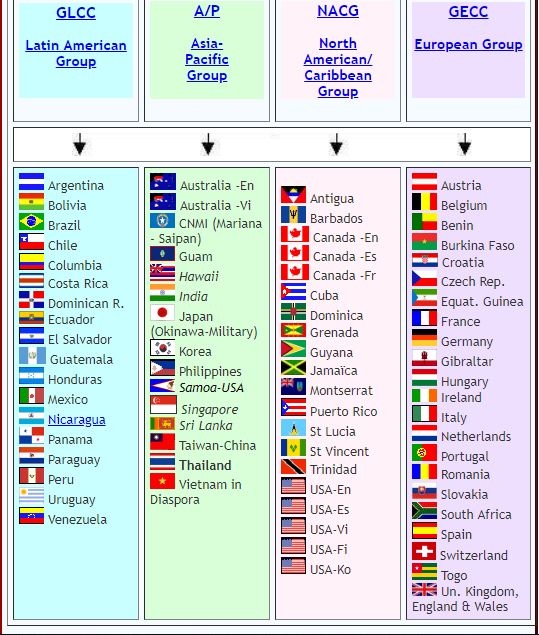
global cursillo
This screen grab shows all the countries Cursillo programs are in

From Wikipedia: Today, Cursillo is a worldwide movement with centers in nearly all South and Central American countries, the United States, Canada, Mexico, Puerto Rico, Great Britain, Ireland, France, Spain, Portugal, Italy, Germany, Austria, Australia, New Zealand Aotearoa, Japan, Korea, Taiwan, the Philippines, Sri Lanka and in several African countries. The movement is recognized by the Holy See as member of the International Catholic Organizations of the Pontifical Council for the Laity in Rome.

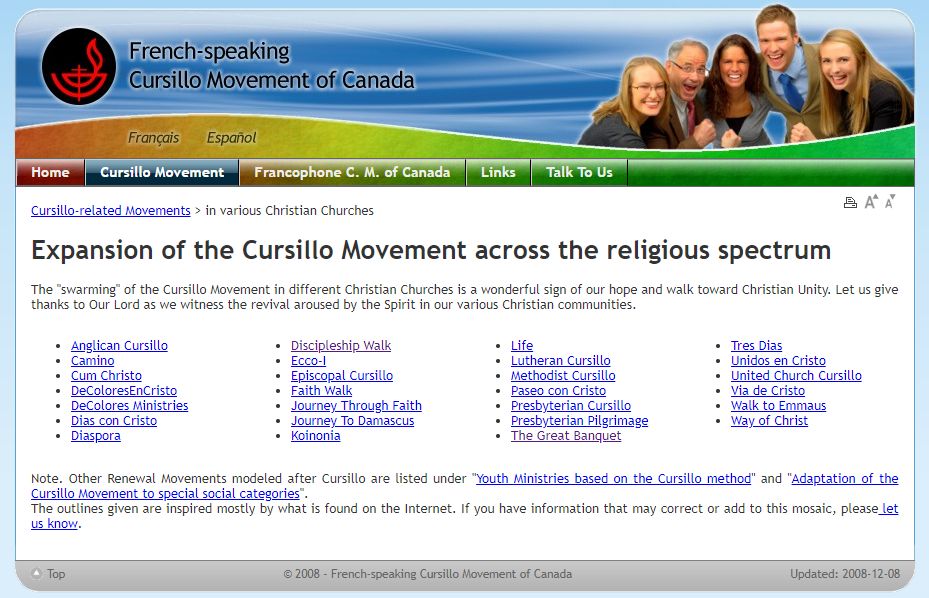
cursillo list.jpg
This screen grab is a listing of all the different titles of the various
Cursillo programs. Some are denomination-specific, others are non-denom

Two authors that I know of have written an objective review of the movement. One is Marcene Marcoux, who wrote her thesis on it, “Cursillo, Anatomy of a Movement: The Experience of Spiritual Renewal” (1982). Another is Brian V. Janssen whose 2009 book is called “Cursillo: Little Courses in Catharsis”. Both of these are available at Amazon and elsewhere.

Marcoux writes,

Clearly, Thursday is structured to effect a disorientation of the candidates, that is, to plunge them into a shocking state of self-awakening. The individuals must handle this shock in isolation since they are prohibited from speaking with other candidates and must maintain silence. They are segregated from others and left without any supportive group to share their frustrations and anxieties. Candidates listen to words that may upset them and that are designed to do exactly this. The images and examples are purposefully selected to instil aloneness and helplessness…

All of the techniques and methods are hurled, if you will, toward the candidates to disturb their sense of themselves and to instigate a process of transformation. The years of planning and perfecting by the early team in Mallorca, and all that has been learned in the years of expansion, have shaped a powerful methodology that assails the candidates from many directions. Nudged, disturbed, worried, upset, the candidates wrestle with questions planned to affect them: to shock, to startle them…

The cursillo is not a superficial gathering haphazardly established, but a well-structured method with a significant history and regional, national, and international structures continually shaping its process. It is this phenomenon the candidates confront, with all its momentum and the force of its potential impact. …those who approach their religion from a more rational perspective may be taken aback by the emotional level of the cursillo, considering its methods too demonstrative and reminiscent of Protestant revival meetings.

The First Person reviews below support Marcoux’s observation. These reviewers note the lack of Bible use, the canned aspect of the lectures, and the physical disorientation via lack of sleep/solitude/meals/heat/rest room, etc.

FIRST PERSON REVIEW
This commenter was a 73 year old female at the time of her participation. She attended Discipleship Walk, non-denominational Cursillo. She also found a leader’s manual at a library and read it. She related,

She could tell something was wrong the first night, the next morning for sure something was wrong.
You sit at the same table each time. Monitors at each table checking you out even in your room.
She was not allowed to turn the heat on in her room.
She was not allowed a nap.  Only 5 minutes of free time.
The leaders manual stressed keeping you off balance. It also stressed choosing people under 55 (this candidate was 73).
The manual calls Cursillo a method.  If you break the method at any point, there will not be a conversion at the end of the movement (the weekend). Cursillo is a movement.
The lectures are canned.
She was able to get a thesis from Northwestern University’s library, “An Anatomy of a Movement”, by Professor Marcene Marcoux.
Leaders manual dated 1962. A  librarian found the manual for her. A footnote she recalls “long boring lectures”.
She doesn’t recall ever hearing the Bible quoted. They tell you to bring your Bible, but you just leave it opened on the table.
The monitors are over-bearing.
No time for personal things.
Skimpy meals.

FIRST PERSON REVIEW.
This is a pastor from a Southern Baptist church who went one weekend and his wife went the next. He attended the Methodist Walk to Emmaus.

Little to no scripture used. A lot of sweet stories a lot of singing. Everything is done in secret no explanation to really any reason why everything is done in secret. They take your watch, cell phone and any kind of communication device. You go to gather in groups to different meetings.
It felt like every lesson was kind of like that old book that came out years ago “Chicken Soup for the Soul”.
You know my struggle with my Assurance salvation. I walked away in doubt from the whole entire event. I don’t feel that anything was directly against the Bible. But nothing was directed to me to read my Bible. And in that it’s very dangerous. The entire time was an emotional roller coaster.
The letters from loved ones was touching but I could have done that on my own.

I would not recommend anyone to go. I know you know this but if it’s not grounded in the word of God, I say stay away. It was very edifying for me in my flesh. That is extremely dangerous.

FIRST PERSON
(female, Tres Dias)

Yes, whatever you can to deter people from being involved in this. I attended this is 2007, so I don’t remember everything. But there are certain things that stick out to me. I imagine you will be exploring the theological inaccuracies taught there, which is important but I often reflect on the cult-like principles of it. I believe I was a false convert at the time and yet by God’s grace and a whole bunch of particular circumstances I had already started questioning some of the things taught in the church and their behaviors were alarming.

I’m not sure if you are aware that at these retreats they take your watch so you don’t ever know what time of day it is. They tell you when to get up, go to bed and eat. You are not allowed to talk between moving from one place to another. They choose your roommate for your stay and they choose which table you sit at and who sits with you. No one is told there is a spy at the table who has been to a retreat before, and they are there to take back to the organizers all you say. They reveal this the last day.

This is deception, lying and spying is what communists do to Christians, it should not be a behavior found among each other. I felt very angry about this without understanding what I was angry about.

There is also a session where you are led into a room and seated in a circle on the floor and one fellow goes around the room just looking you in the eye and you are not allowed to look away. No one is allowed to speak. Does all this not sound cultish? I mean where is this found in the Bible? It makes me very upset because I know lots of people still running this that I attended the church with who are nice people, just deceived, like I was.

FIRST PERSON REVIEW.
This person is a female, Methodist, with a MA in Christian Education from Southwestern Seminary. She attended a Walk to Emmaus and wrote about her experience on her blog, which can be found here.

My first impression was that I was being initiated into some weird “Christian” cult (and, I’m not sure that my impression changed until the very end on Saturday). I believe that as Christians we are called to represent Christ with truth and excellence, and I did not see that in the weekend. Don’t get me wrong, the end result was good, but for the most part it was frustrating, annoying, weird, and made me angry. It took me almost the entire Walk to get over all of the things that kept me from spending time with my Father, and it shouldn’t have been that way.

I was turned off at many points during the weekend, and if I hadn’t come into this weekend rooted deeply in my faith and understanding of Christ, I probably would have run screaming. Following a script. Life doesn’t follow a script. Jesus didn’t follow a script. And the original walk to Emmaus with the men and Jesus definitely didn’t follow a script.

Maybe it’s so everyone can have the same experience, but come on, no one ever has the same experience. I felt like I was being read to the entire weekend, and it seemed to suck so much life out of the stories and experiences shared. Christ came to bring us LIFE not a script.

This next review is from a web page called Questioning Cursillo, which I recommend. This excerpt below is from a male participant, who at the time was/is a pastor of a Baptist church and a professor at a Seminary. I recommend you go to the page and read the reviews in their entirety.

FIRST PERSON REVIEW
(Male Baptist pastor/professor.)

Cursillo-based retreats are at best a social experiment in conformity and a distraction from the Christian life, and at worst, for some sensitive individuals, a true potential trauma. They are not a cult in the sense that they do not extract money from participants, seek to control them long-term, or commit serious abuses. But they do use techniques that are psychologically manipulative—techniques quite similar to cult techniques—to produce a supposed experience of God. If God is real, God has no need of such things; they only serve to give faith a bad name as mindless conformity.

1. Cursillo is heavily influenced by Catholic theology. No one denies that the Cursillo movement began as an effort at spiritual renewal within the Catholic Church in Spain. The weekend I attended was sponsored by the _______ Cursillo Council, a Protestant organization. However, on the first evening we recited Catholic liturgy underneath a Crucifix. It was the first time in my life I had ever heard of Veronica. [A Catholic saint].

2. Cursillo is influenced by a charismatic approach to sanctification. Many people involved in the Cursillo movement seem to think that three days at a Cursillo retreat means someone is instantly mature and ready for service. The whole concept is similar to the Charismatic belief in a “second blessing” whereby one becomes instantly sanctified and free from sin.

This is my primary objection to Cursillo. Maturity does not come in three days and it is misleading to teach someone that it does. Instead, maturity comes from a consistent, daily walk with Christ. There are no short-cuts to Christian growth. I do not recommend the Cursillo movement for anyone who is serious about spiritual growth. Doctrinally, the concept has a flawed view of sanctification. Practically, it creates a super-spiritual attitude that is divisive to the local church.
_____________________________________

Conclusion

My own bias is that I’m suspicious of para-church organizations. Sometimes they are quite helpful. But many times they compete with the local church.

Cursillo is at root a Catholic movement in its theology. It is also an ecumenical movement. It deliberately downplays theology in pursuit of unity based on emotion. For example, here is part of a FAQ page from a Walk to Emmaus saying to overlook theology in pursuit of what I personally would consider a false unity. –

Emmaus is for fostering unity in Christ, not for theological debate and arguments about denominations. Emmaus tries to foster appreciation and openness to the different faith-perspectives of the participants. Bring a spirit of Christian tolerance and charity toward others, including members of other denominations. If you cannot affirm your unity with other kinds of Christians, if you tend to define Christianity narrowly and legalistically or are intolerant of those who see things differently, then Emmaus is probably not for you.

One of the things that a different Walk to Emmaus page said, was that doctrine and social issues divide. One issue they say to set aside, that is too divisive, is salvation. Let that sink in.

The issues of doctrine & social issues, can, and have been, divisive within the church. Doctrinal issues have included the method of baptism, gifts of the Spirit, salvation, and eschatology to mention a few. Social issues have included marginalized persons who are homeless or imprisoned, pro-life vs. pro-choice, abortion, caring for the aged, ethnic inclusiveness or exclusiveness, and gender affinity. Clearly, the issue of whether or not the practice of homosexuality is compatible with Christian lifestyle is at controversy in the church today. … In Emmaus, such social issues are transcended and set aside as we affirm one another in our fundamental beliefs …

[underline mine] Source (pdf). And while homosexuality and gender affinity are social issues, they are also issues that directly contradict Imago Dei and everything we read in Genesis 1 and 2. Therefore, I consider them theological, foundational issues.

—————————————-
I contacted the United States founder of the Great Banquet, Jack Pitzer. I had read on the Great Banquet pages that the GB is “Governed by an ecumenical board of directors.” That phrase is repeated on almost all FAQ Great Banquet pages. Curious that though the Board was mentioned frequently, the names or denominations of the Directors were not. I wanted to know which denominations they were from, if there were any women on the board, and if any of those women were pastors or in control of spiritual direction or curriculum. So I contacted Mr Pitzer to ask. I wrote,

Hello,
I would be interested in knowing who is on the Board of Directors of The Great Banquet and what faith background they come from?
Thank you so much!
Elizabeth

Mr Pitzer replied the next day. This was his reply in total:

Who is Elizabeth Prata?

It was not the reply I was expecting.

I sent back an answer. At the time I was sincerely just interested in finding out a bit more about the GB on behalf of my friend. Little did I know that secrecy and stonewalling would spin me out on a three-month odyssey of discovery about Cursillo, which in turn would prompt me to write these essays about the movement. My emailed reply:

I’m a Christian woman in Georgia whose friend was invited to The Great Banquet and I’m just interested in knowing more about it. On the websites I read they said that there is an ecumenical National Board. Several of the sites encouraged interested parties to contact the people in charge FMI. Would you be so kind as to share who is on the Board and which faith backgrounds they come from? Thanks!

Though Mr Pitzer is no doubt a busy man, I did appreciate that he replied.

I wrote the Great Banquet back in 1990. It is a “short course” in Christianity. It is a “cursillo-model” experience. The Board is made up of Presbyterians, Baptist, and Independent Christian. If you want to know about me – get on line and look up Lampstandpc.org. I am the Head Pastor and you can even listen or watch sermons or Bible studies I have done.  Jack Pitzer

I did contact other regional Great Banquet leaders to find out more specific information for my friend who is in the Midwest, (where GB is most popular) asking about who comprises the “ecumenical Board”. One woman who was very kind to answer my questions, said at one point, “We don’t talk about the name of our church or what denomination we are. We are all Christians who believe that Christ Jesus is our Lord and Savior.”

And that is a problem. Mormons, Jehovah’s Witnesses, and Catholics all believe that Jesus is Lord and Savior. Methodists believe that too but rebel against their Lord and Savior by ordaining women. ‘Jesus as Lord’ is not the only benchmark to determine if one should participate in a a 72 hour course in Christianity. For the discerning woman, prior to committing to 72 hours of lectures and a cathartic intimate community experience, I’d want to know who is behind the curriculum and who is guiding the movement’s direction.

For example, The Master’s Seminary’s Institute for Church Leadership (ICL) is organized specifically to train up lay leaders, just as Cursillo is. I can take a similar quantity of credit hours at ICL. If I am deciding whether to invest 72 hours of time at Cursillo (which IS Spanish for “short course”) or take a short course for 60-70 hours at The Master’s Seminary Institute for Church Leadership, I need to make an assessment on which is best to devote my time and/or money. Cursillo’s curriculum and Board of Directors should not be secret.

I looked at other para-church organizations and all of them with the exception of Great Banquet, published the names, photos, and bios of who is on their National Boards. It’s not an unreasonable request to ask of a Christian organization whose forefathers and head of the church were always transparent. (John 18:20; Mt 26:55; John 7:26). Can you imagine Paul being cagey about the names and spiritual biographies of the 7 chosen deacons? (Acts 6:1-6). “Uh, they’re just men from around. Why do you want to know? Who are you, anyway?”

I did get the sense that the people involved in these Cursillos are sincere about helping people become more service-oriented and grow closer to Christ. In my opinion, though, the emotionalism and manipulation is not necessary in a Christian movement.

I leave you with this,
If a “method” can be so readily applied across the world’s different cultures and in so many different denominations, with strikingly similar results, even to the moment, is it of the Spirit? Is the Holy Spirit cookie cutter? Does the Holy Spirit need man’s methods to grow saints in discipleship and service? If one’s service is based on emotionalism and catharsis, what happens when the mood dissipates?

Women should base their service on knowing who Christ is from the Bible. Our emotions we feel about Him and serving others stem from our mind, that is, knowing who He is from His word. He is the rock that never dissipates.

Further resources:

Blog review:Should Baptists Participate in a ‘Walk to Emmaus?’ By Mike McGuire, a SBC pastor

Book: Marcene Marcoux, “Cursillo, Anatomy of a Movement: The Experience of Spiritual Renewal” (1982).

Book: Brian V. Janssen “Cursillo: Little Courses in Catharsis”. (2009)

Thesis: Doug Hucke: The Great Banquet Retreat as a Strategy to Transform Northminster Presbyterian Church (2008)

Episcopal Clergy Talk letter (pdf)

Blog: THE CURSILLO MOVEMENT IN AMERICAAn Interview with Kristy Nabhan-Warren

Short video- this is good.

—————————

The Cursillo method is used by:
ACTS,
Encounter,
Antioch,
Awakening (college students),
Cum Christo,
DeColores (adult ecumenical),
The Great Banquet,
Happening,
The Journey (United Church of Christ),
Kairos Prison Ministry,
Kairos (for older teenagers),
Emmaus in Connecticut (for high school age teens),
Gennesaret (for those living with a serious illness),
Koinonia,
Lamplighter Ministries,
Light of Love,
LOGOS (Love Of God, Others, and Self) (Lutheran teen),
Teens Encounter Christ (teen ecumenical),
Residents Encounter Christ (REC) (a jail/prison ministry),
Tres Dias,
Unidos en Cristo,
Via de Cristo (Lutheran Adult),
Chrysalis Flight (Methodist Youth),
Walk to Emmaus (Methodist Adult),
The Walk with Christ (interdenominational),
Anglican 4th Day (Anglican Adult),
The Way of Christ (Canadian Lutheran adult),
Tres Arroyos (Charismatic Episcopal Church)
Journey to Damascus (Catholic hosted Ecumenical with weekly reunion groups for alumni) in The Corpus Christi, Houston, and Austin, TX areas. Source-Wikipedia


Posted in discernment, theology

Are you invited to The Great Banquet? (Not the one hosted by Jesus, another one). If so, read this

By Elizabeth Prata

This is part 1 of a 3-part series. I’ll look in this part at the theology behind The Great Banquet/Tres Dias/Walk to Emmaus retreats (all parallel movements under the same origin, Cursillo, a Roman Catholic three-day course).

In part 2 I look at the experience participants undergo in front of the scenes and the work behind the scenes to make it happen.
In Part 3 I’ll share comments from people who have attended.

You might have heard talk of people having been exclusively invited to attend a three-day retreat called Walk to Emmaus or The Great Banquet. You might have heard that these folks later attend weekly/monthly ‘reunion meetings’. You might notice the youth of your church going to something called Chrysalis or Awakening. What are these events? What do they do there?

It’s hard to discover, because the events seem shrouded in secrecy. One must be invited by a “sponsor.” Invitees are carefully pre-vetted. Afterward, if the “candidate” wants to take up the sponsor’s offer, they must apply. If accepted, the so-called “pilgrim” must in like turn be told not to let out the secrets after attending. Past participants decline to speak of exactly what goes on, they are especially told not to reveal about the Agape letters and the Dying Moments (now called Candlelight), maintaining they don’t want to spoil the “surprise.”

Yet the popularity of these events is growing massively. There is now a youth version of The Great Banquet called Awakening, and a youth version of the Walk to Emmaus called Chrysalis. There is a prison version called Kairos.

So what IS The Great Banquet? (Or its parallel event Walk to Emmaus?).

The Great Banquet (And Walk to Emmaus) is a 72-hour, [immersion] experience (usually Thursday evening to Sunday evening) that focuses on one’s relationship with God and with others, and training attendees to become effective Christian leaders. The three days include fifteen structured talks, given by both clergy and lay people. The talks are outlined and presented in a specific order for teaching attendees about grace and priorities. The talks are based in scripture and are peppered with personal experiences of the individual speaker.

There are some good intentions about the movement. The thrust is to arouse in the Christian a fervor to love others and be diligent in service to others. The organizers say that The Walk to Emmaus weekend is to “remember that the whole intent of The Walk to Emmaus movement is to develop church leadership and strengthen the witness of the Christian community in word and deed.”

On the surface this sounds great. Digging deeper reveals issues that impact the local church and the congregant, mainly negatively.

But first, what about the theology of the program?

The 3 days is broken down into 5 talks each day given by members of the Banquet/Emmaus team. Some talks are delivered by lay-persons and others given by clergy. Here is a link to the 15 talks with the scripts and advice for speakers. It is a list of talks for Walk To Emmaus organized by Cross Point Church in OK. It should be noted that this church has female pastors, some of whom serve at the Weekend event in their capacity as “pastor”.

The Great Banquet and Walk to Emmaus (and Tres Dias etc) are fairly interchangeable. In some cases I say Great Banquet (which was founded by a former Emmaus leader Jack Pitzer) and other times I refer to the Walk to Emmaus. I’ve excerpted the portions of the talks I desire readers to see most, and I’ve added my comment after. All the talks are listed below in the .jpg

First day talks
1. Priority

In discussing priorities, avoid mentioning God, Christ, salvation, or the usual theological words. This is because the talk should not even imply what the participants’ priorities ought to be. … The talk should be reasonable, speaking to the common sense and experience of the participants. A helpful way to illustrate the points of the talk may be a story, anecdote, or personal experience.

Setting a priority without mentioning Jesus or God is very sad. It is sad that at the outset, the first talk which leaders are told “will set the tone for the day,” trains speakers NOT to mention the most important Person in the universe.

The talk continued with presenting the false notion that we have ability in human power to set priorities and carry them out above and beyond our sin nature (sin is not mentioned in this first talk. Leaders are expressly told to keep it light and humorous.) For example, it is stated,

We have the capacity to rise above mere instinctual responses…we are not created to be slaves to the forces of nature and instinct.

True that we were not originally created to be slaves to our nature, but we fell. Every person born after Adam and Eve is a slave to sin, helpless and hopelessly enslaved to our base instincts. We need the salvation of Christ and the power of the Holy Spirit to overcome our nature and our instincts. It presents the notion that we have strength and power on our own to do service that’s pleasing to God. We don’t. This first talk sets the tone for the me-nature of the weekend.

The next talks focus a lot on grace. What can possibly be the matter with that, you ask. Well, there’s grace of the Bible and the grace not of the Bible. Grace not of the Bible is what is taught at these weekends, and it’s called prevenient grace.

2. Prevenient Grace
“Prevenient grace serves as the foundation of all other grace talks…”
“Prevenient grace is the courtship period of our relationship with God, God woos us into this relationship of grace.”
“Prevenient grace works through the Holy Spirit courting us, not forcing us.”

I think Saul/Paul would beg to differ about being forced into conversion. His conversion was definitely not “wooing”. Jesus said that Peter did not choose Jesus because it was not his flesh and blood that chose Him but the Father who revealed Jesus as Messiah. (Mt 16:17). Flesh and blood nor the will of man decides for God. (John 1:13).

The thrust of this talk, and thus all other talks since this one is the foundational talk, is Arminian. Adam and Eve, they say, made “wrong choices” in the Garden that separated them from God. What Walk To Emmaus and Great Banquet call a ‘wrong choice’, RC Sproul called “cosmic treason.” Big difference.

They say God is at work in our lives through grace before conversion.

Ligonier explains prevenient grace and its main error: that grace is not cooperative.

Arminius and Wesley understood the necessity of grace for salvation, but they wanted to preserve our ability to accept or reject saving grace. Thus, based on passages such as Titus 2:11, they proposed what is called “prevenient grace,” a grace given to all people that frees us enough from our bondage to sin that we have the ability to choose Christ but that does not finally persuade us to make that choice or guarantee that we will be saved. (Many Roman Catholics speak of God’s prevenient grace in a similar way.) This view has the advantage of stating that no one can be saved without grace or even God’s initiative in freeing our wills just enough to choose Him. The problem is that the doctrine of prevenient grace ends up creating a kind of de facto semi-Pelagianism. If prevenient grace is indiscriminate and merely restores our ability to choose, then it is hard to see how salvation is truly all of grace.

Here are a couple of other concerning scripts for leaders that I had an issue with-

3. Priesthood of All Believers
“The word priesthood may bring negative associations to some Protestant minds. However, when properly understood, “the priesthood of all believers” expresses the core of the Protestant Reformation and has been reaffirmed among Roman Catholics through the action of Vatican II.”

Using Vatican II as an affirmation for acceptable Protestant definitions is not reassuring.

3rd day talks
11. Changing Our World
“Changing our world begins with changing ourselves and sustaining that change in our heart (piety), mind (study), and will (action).”

It is true that we participate with the Spirit in being diligent to mortify sin and pursue holiness. However this aspect is not brought up in the talks, at least according to the script I had read. We don’t “change ourselves”.

As any Christian would like to do before committing to three-day immersion experience, one would want to know what is taught. I searched for many days and weeks in collecting background for this essay before finally finding the scripts for each talk at the Cross Point Church site. The average person won’t know the substance of the talks until he hears it live from the lay and clergy leaders during the weekend.

Question/Concern #1: Is it wise to submit to teaching by unknown people on unknown topics? No. Jesus said,

Jesus answered him, “I have spoken openly to the world. I have always taught in synagogues and in the temple, where all Jews come together. I have said nothing in secret. (John 18:20).

Moreover, the weekend is gender specific. Men attend on one weekend, their wives or other women the next weekend. I have never been a fan of separation. The Passion conferences separate youths from their parents, who are forbidden to attend unless he is the youth pastor. He is the only adult allowed to accompany the youths.

I do not see that exclusion attitude modeled in the New Testament. Women and men, husbands and wives attended the sermons, dinners, and events Jesus was involved in (with the exception of the few times Jesus drew aside His apostles to explain a parable or ascend the Mountain for Transfiguration).

For the same reason it is not wise to separate youths from the parents and pour into them an intense theological and emotional experience. Women are vulnerable theologically (1 Peter 3:7) and should not be forced to spend 72 hours of intense theological training by unknown leaders in an unknown curriculum without their husbands present. For that reason alone, husbands should say no to their wives participating.

The Methodists adopted the Catholic’s Cursillo retreat model and called it Walk to Emmaus. The Presbyterians adopted it and called it The Great Banquet. Other denominations followed suit, including Lutherans, Reformed, Pentecostals, etc. How has the theology been adapted from Catholicism and re-formed for Lutherans/Methodists/Dutch reformed/Episcopal/Presbyterians/Pentecostals, the denominations using the model at present? Doesn’t that seem one-size-fits-all?

Brian V. Janssen wrote in his book examining the movement that-

It is evident that Cursillo is not really about theology from the fact that the method is so readily adaptable to very divergent theological perspectives: Roman Catholicism, Lutheranism (Via de Christo), Methodism, (Walk to Emmaus), Anglicanism (Episcopal Cursillo), Presbyterianism (Presbyterian Cursillo and [Great Banquet], Pentecostalism, (Tres Dias), and Dutch Reformed (Reformed Cursillo). Janssen, “Cursillo: Little Courses in Catharsis

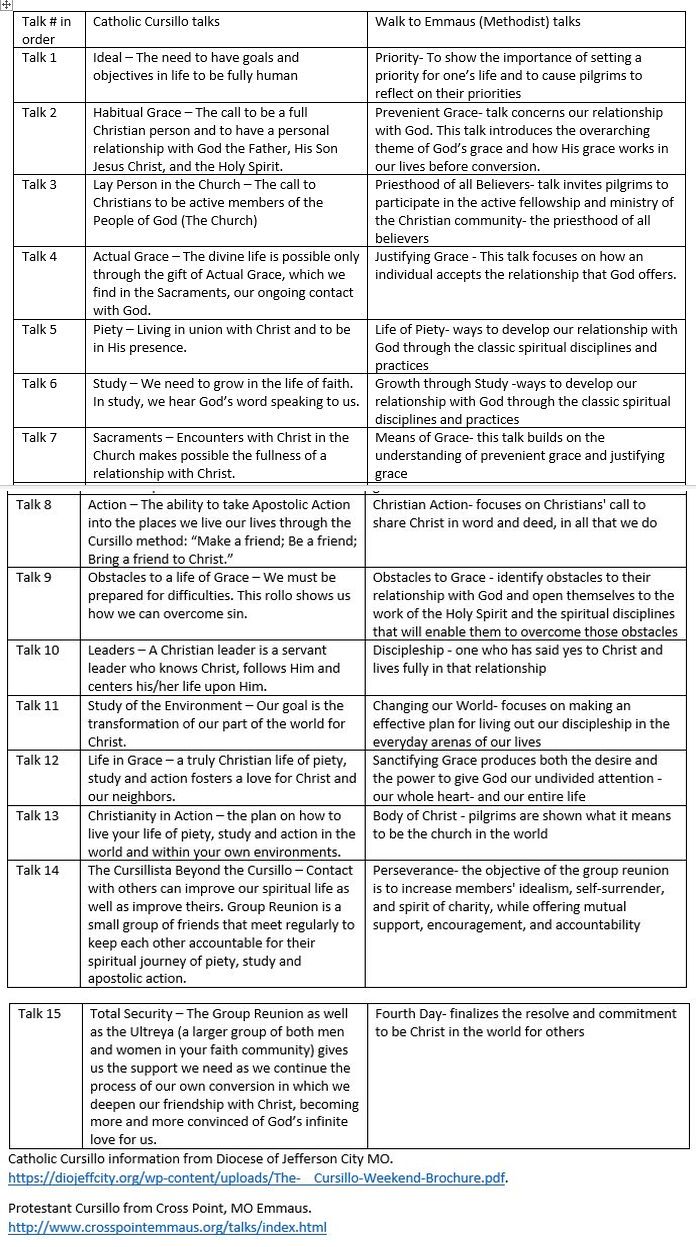
See chart. This chart compares the original Catholic talks with the Methodist talks, which has been relayed into all the other Protestant talks almost intact.

cursillo

Question/Concern #2: Can one participate in an immersion weekend and emerge unaffected by an all-purpose or watered down theology? A theology born of Catholicism no less?

No, one cannot. Jesus said in Matthew 7:14 that –

For the gate is small and the way is narrow that leads to life, and there are few who find it.

The gate is narrow and the way after that is narrow. The way doesn’t broaden as it sheds unwanted theologies or waters them down to accommodate more and more people. It remains narrow. Ecumenism is deadly. There is one Gospel, as Galatians 1:6-8 reminds us. We have seen above that the theology is downplayed, and what theology there is, is riddled with Roman Catholic error (prevenient grace, etc) or other error (Arminianism, downplaying sin/our sin nature, calling it “wrong choices”…excessive focus on love and none on wrath…emphasis on service in our own strength).

So if the theology isn’t the point, what is the weekend about? It’s about the experience, the feelings, and the catharsis.

More on that in part 2. I’ll go into specifics about what happens minute by minute at a Walk to Emmaus or The Great Banquet weekend. Stay tuned.


Posted in discernment, theology

Beth Moore anoints Kevin Jones as third Adam

When someone is a false teacher, their perfidy can show almost immediately, as it did with Charles Templeton. Or it can be hidden for a number of years and emerge slowly and minimally, as has happened to Beth Moore.

A writer at The King’s Dale was an early discerner of Moore, at least publicly online. In 2013 he had discerned her danger and wrote about her teaching. Dale said,

The 5 major types of her false teaching to be reviewed are:

Personal non-Biblical revelation
False gospel of pragmatism, self-improvement and prosperity
Legalism
Glorification of humanity
Roman Catholicism as a Christian denomination

Moore’s false doctrines primarily result from her mishandling of the Bible. She repeatedly demonstrates the following errors in her books and videos:
Eisegesis
Proof texting
Improper allegorical interpretation
Poor knowledge of the canon of Scripture and methods of translation

The above issues with Moore’s teaching remain the same, if not worse, and other concerns have been added to them by this date. Chris Rosebrough of Pirate Christian Radio chimed in soon after The King’s Dale did and went line by line through one of her teachings, biblically showing where Moore errs. He has doen so several times since.

I’ve been tracking her since 2011. In the last 7 years Moore’s slide has become apparent. Her eisegesis, false notions, and cultural embeddedness have grown worse.

Remember, if you are a Christian, your trajectory will always go higher. The indwelling Holy Spirit will always grow you. If you are a pagan, your trajectory will always grow worse. Always. Romans 1:21-32 shows this. In addition, 2 Timothy 3:13 says,

while evil people and impostors will go on from bad to worse, deceiving and being deceived.

Some people find it hard to accept the words “evil” when applied to Beth Moore. After all, she is bright, engaging, happy seeming, effective, and passionate. However, that is the evil genius of satan. If he had come to Eve as a red jumpsuited, pitchfork wielding demon, would she had listened? He came as himself, the most beautiful of angels, glory light shining softly with helpful words.

So it is no surprise if his servants, also, disguise themselves as servants of righteousness. Their end will correspond to their deeds. (2 Corinthians 11:15).

Yesterday Moore tweeted the following:

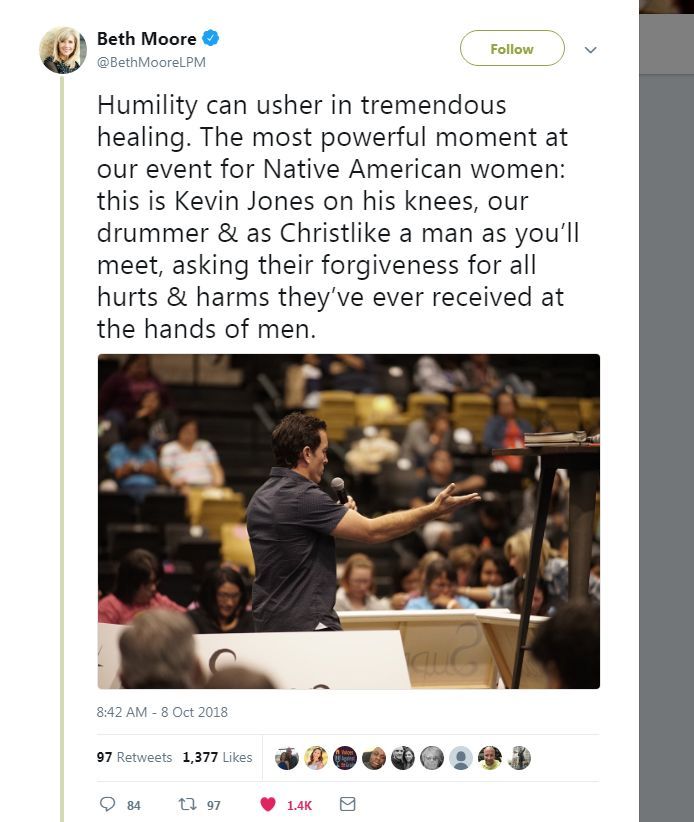
Of course this foolish act sparks a concern for Moore, Jones, and the thousands of women participating in the lesson in which Jones knelt. She is leading many astray. It’s a concern because it demonstrates how far gone Moore is into Social Justice, one aspect of which is seeking redress from people who have not hurt you personally but are lumped into some group defined by age, gender, and such. Her tweet and Jones’s action also perpetuates the false victim mentality.

Have you been hurt? I’ve been hurt. Hurt is not defined in Moore’s tweet(s). The word ‘sinned against’ isn’t even used, just ‘hurt.’ This kind of  language could include imagined hurts, past hurts, minimal hurts, or micro-aggressions (a new term that could describe something as slight as an imagined snub). A far cry from being disemboweled and burned at the stake, as many true martyrs were.

John Macarthur, preaching about the false fad of ‘Social Justice said of its victim mentality,

One word sort of sums it up and that is the word “victim.” Each of these segments of our population who are crying out for social justice believed that they have been victimized by others in this society. This word, more than any other word, describes their self-designed condition. The self-perceived victims of social discrimination today are women who believe that they have been long abused by men, not only personally, but sort of collectively. …

MacArthur acknowledges that many millions of people are victims. No one would dispute that. Not him, not me, not anyone. He said,

The world is full of victims – victims of war, victims of genocide, victims of crime, victims of terror. The world is merciless for all of us on many levels. … Let me make it clear. In God’s eyes – listen – no one is a victim. We are all perpetrators of open rebellion, scandalous, blasphemous sin against God. We are all rebels, we are all obstinate, we are all stubborn.

A problem is that “lately this victim status has been embraced by the evangelical church,” MacArthur said, and continued,

Let me make it clear. In God’s eyes – listen – no one is a victim. We are all perpetrators of open rebellion, scandalous, blasphemous sin against God. We are all rebels, we are all obstinate, we are all stubborn.

A worse issue than a flase teacher leading many astray is the stated representational facet of this act. Moore tweeted:

moore0

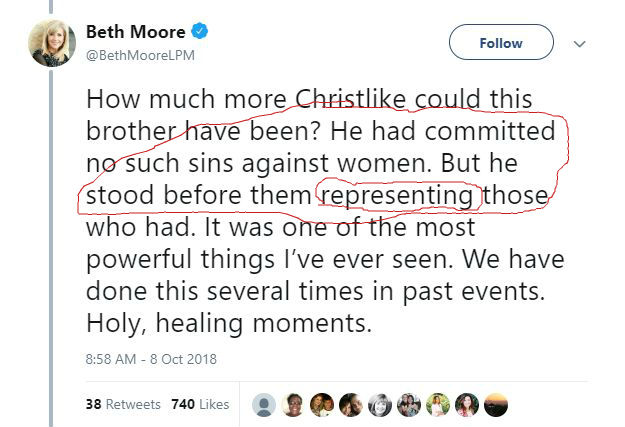
Adam was representative of the entire human race. At birth, we are all in Adam. Jesus substituted Himself as the sacrifice and took the punishment we deserve as in-Adam people. Jesus’s work as the second Adam is finished.

Therefore, there can be no third Adam. No one man can rorgive the “hurts” of all other men or women living and dead. It is ridiculous to even propose it. What Moore is promoting is corporate forgiveness by a sole representative.

Here is Owen Strachan at Midwestern Seminary with thoughts on corporate representation:

In the Old Testament, then, contrition took public form. The high priest confessed not only his sins, but the sins of all Israel. In the New Testament, a change takes place. God still has a people for himself, but he forms this covenant community not through a discrete nation, but an ingathering of Jew and Gentile alike (Romans 9-11). The gospel of grace in Christ crucified and resurrected entails not that God will create a second people for himself—composed of non-Israelites—but rather that the Abrahamic promises find their fulfillment in the Messiah. As the gospel is loosed, people from every tribe and tongue become citizens of the spiritual kingdom of Christ (Luke 11:20; Matthew 12:28; Hebrews 12:18-29). This is the true people of God; this is what the old covenant nation pointed to as the realization of the Abrahamic covenant.

What we call the “theocratic” dimension of the Old Testament has therefore ceased. By this I mean that you cannot look at any one nation on the earth today and identify it as the household of God. The household of God is not a building or a political entity at all; it is the blood-bought church of Christ, the church made up of redeemed sinners (1 Timothy 3:15; Hebrews 10:21). There is no longer a ritual overseen by a high priest in which one imperfect human person confesses the sins of any “national” people of God. Every Christian confesses sin to one another, and Christ the high priest intercedes for us at the right hand of God (Mark 16:19; James 5:16; Hebrews 7:25). This is the pattern of our confession. We have a perfect high priest who prays for us continually, and out of the overflow of this intercession we confess sin to one another.

But we also note what is not found in Ephesians 2 or Colossians 2 (or in Acts 10 as the Gentiles are fully welcomed by Peter). There is no teaching in the text that calls Jews to apologize to Gentiles in representational ways for past sins on the part of all Jews, and neither are Gentiles called to somehow make restitution for corporate wrongs on the part of all Gentiles. The “corporate apology” (used in a group sense, not a business sense) becoming common in our day is foreign to the New Testament

Justin Orman (@Jborman9) said on Twitter of Moore’s drummer and that sad scene,

It is remarkably easy to apologize for something you’ve never done to someone you’ve never wronged. Requires no humility, there’s nothing beneficial resulting from it, & it has no basis in Scripture. The whole point, as far as I can see, is to look holy, which is anti-Scripture.

As Dan Borvan said on Twitter,

In the sixteenth century, Beth Moore would have been condemned as a heretic.

Ladies, please avoid Beth Moore. As her paganhood descends further and further into depraved rebellion, she is taking many with her. (2 Peter 2:2).


Posted in discernment, theology

To all the commenters who reply, “Judge not” and “Did you go to her?”

Discernment is important.

Let me rephrase that.

Discernment is important.

Discernment is:

Discernment is the skill of understanding and applying God’s Word with the purpose of separating truth from error and right from wrong. ~Tim Challies

Charles Spurgeon drills down even further:

Discernment is not knowing the difference between right and wrong. It is knowing the difference between right and almost right.

Some believers are given a heightened ability to discern by virtue of possessing a gift from the Spirit.

and to another the effecting of miracles, and to another prophecy, and to another the distinguishing of spirits, to another various kinds of tongues, and to another the interpretation of tongues. (1 Corinthians 12:10).

For spirit-gifted discerning believers AND all others, we must practice discernment in our walk. (Hebrews 5:14). That means both identifying it AND acting on it. It’s non-negotiable.

Sheep, or Wolf? A Call to Discern
by Dr. Colin Eakin
Discernment: The Neglected Imperative

Where does God command believers to exercise spiritual discernment? Perhaps a better question is, where doesn’t He? The answer is Philemon. Of all the books in the New Testament, this letter of twenty-five verses is the only one in which there is no instruction for the believer to be on guard against falsehood. All remaining twenty-six books of the New Testament (and many of the Old Testament) exhort the believer, to a greater or lesser degree, to discern truth from falsehood and to act upon it.

Satan downplays the importance of discernment. How? He twists scriptures such as the ones under discussion today, two of the most abused scriptures in the Bible, plus one more-

Judge not, that ye be not judged. (Matthew 7:1)

And this one:

If your brother sins against you, go and tell him his fault, between you and him alone. (Matthew 18:15).

And this one:

Be nice. Jesus ate with sinners, you know.

Sadly, when I write an essay discerning a false teacher, or speaking against a false doctrine, inevitably I receive a slew of comments from women who insist I perform one or the other of the verses above. This makes me sad, because I know from such comments these women are not operating at peak Christian condition. Their insistence that I employ one or both of these verses usually reveals two things about them:

— they hold to an errant understanding of the verses above
— they hypocritically have failed to follow their own advice and ‘come to me privately’, and to ‘judge not’.

Wise people treasure knowledge, but the babbling of a fool invites disaster. (Proverbs 10:14).

Here is my rebuttal to the commenters lobbing the most abused discernment verses:

Judge not, that ye be not judged. (Matthew 7:1).

‘Do not judge’ cannot mean ‘do not discern.’ There are calls to discern in every book of the New Testament except Philemon, and many of the Old. (1 John 4:1, Philippians 1:9-10, Hebrews 5:14, Romans 12:2, 1 Corinthians 2:14, 1 Kings 3:9, & etc.)

Judge not can’t mean do not judge, because in John 7:24 we’re told to judge. Wisdom would suggest that rather than there being an inconsistency in the Bible, there is an inconsistency in our understanding.

So if Matthew 7:1 doesn’t mean not to discern and it doesn’t mean judge not, what does it actually mean? Well, first, read the verse in context. Here is Matthew 7:1-5,

Do not judge so that you will not be judged. For in the way you judge, you will be judged; and by your standard of measure, it will be measured to you. Why do you look at the speck that is in your brother’s eye, but do not notice the log that is in your own eye? Or how can you say to your brother, ‘Let me take the speck out of your eye,’ and behold, the log is in your own eye? You hypocrite, first take the log out of your own eye, and then you will see clearly to take the speck out of your brother’s eye.

It means when we do have to judge something, as in test, discern, check, etc, do not do so hypocritically, harshly, or wrongly. More here: GotQuestions- What does the Bible mean that we are not to judge others?

If a commenter reads one of my discernment essays and ignores the scriptures, the facts, and/or the point, but gently or harshly or anywhere in between, urges me to “judge not”, I will delete the comment but reply by pointing her to this essay.

2. Have you gone to her privately?

In this one, commenters are referring to a section in Matthew 18, where the Bible outlines procedures for church discipline. Here is the passage:

If your brother sins, go and show him his fault in private; if he listens to you, you have won your brother. But if he does not listen to you, take one or two more with you, so that by the mouth of two or three witnesses every fact may be confirmed. If he refuses to listen to them, tell it to the church; and if he refuses to listen even to the church, let him be to you as a Gentile and a tax collector. (Matthew 18:15-17 NASB)

This verse is about church discipline, when one member of a local body has sinned against another person in the local body. It is a local, internal procedure. It is not referring to our response to book reviews or other public statements false teachers have made.

Phil Johnson explained here, in a 2006 blog essay:

It would be a serious mistake to imagine that a private meeting is always a mandatory prerequisite before any Christian can legitimately express public criticism of another believer’s published work or public behavior. On the contrary, sometimes—especially when we’re dealing with a public and scandalous transgression—open rebuke may be warranted as a first response (cf. Galatians 2:11-14). Matthew 18:15-17 outlines instructions for dealing with private sins and personal offenses. These are not guidelines for dealing with false teaching or public behavior that might cloud the truth of the gospel or besmirch the reputation of the whole church.

Here is a link to a pdf “Editorial on Abusing Matthew 18” by Don Carson

Here is Tim Challies with an easy button version of Don Carson’s essay on Matthew 18 abuse.

If a commenter reads one of my discernment essays and ignores the scriptures, the facts, and/or the point, but gently or harshly or anywhere in between, urges me to “go to her privately”, I will delete the comment but reply by pointing her to this essay.

3. Jesus ate with Sinners

Strangely, in a third most abused verse in the discernment world, many of them say ‘Be nice. Don’t condemn. Jesus ate with sinners.’ What they are referring to is Mark 2:16.

And the scribes of the Pharisees, when they saw that he was eating with sinners and tax collectors, said to his disciples, “Why does he eat with tax collectors and sinners?”

If you think about it, you realize how massively ridiculous their statement that one should not cry out against false teachers or false doctrine is.

The only sinless person who ever lived was Jesus. Of COURSE He ate with sinners. He ate with sinners every time He ate. Jesus eating with sinners verse was about the Pharisees complaining that Jesus was eating with tax collectors and prostitutes whom the Pharisees believed were “sinners”, outcasts unworthy to be in polite society, while at the same time believing that they themselves were NOT sinners and worthy to eat with Jesus.

Jesus ate with sinners, having compassion on them, because they were lost sheep. However He never expected them to remain in their sin. He told the adulteress to ‘go and sin no more,’ for example. He also was very harsh with many other sinners. He whipped up a fury against the merchant greed-mongers in the temple. He called the Pharisees blind guides, fools, wicked, and greedy.

Of course we (forgiven) sinners will eat with (unforgiven) sinners because we are to be in the world. But if we see a friend involved in a false doctrine, do we take their food but leave them with a poison in their soul? No.

Jesus, Friend of Sinners: But How?
By Kevin DeYoung

As precious as this truth is—that Jesus is a friend of sinners—it, like every other precious truth in the Bible, needs to be safeguarded against doctrinal and ethical error. It is all too easy, and amazingly common, for Christians (or non-Christians) to take the general truth that Jesus was a friend of sinners and twist it all out of biblical recognition.

Jesus was a friend of sinners not because he winked at sin, ignored sin, or enjoyed light-hearted revelry with those engaged in immorality. Jesus was a friend of sinners in that he came to save sinners and was very pleased to welcome sinners who were open to the gospel, sorry for their sins, and on their way to putting their faith in Him.

More:

Why is it significant that Jesus ate with sinners?

If a commenter reads one of my discernment essays and ignores the scriptures, the facts, and/or the point, but gently or harshly or anywhere in between, urges me to “judge not”, I will delete the comment but reply by pointing her to this essay – and urge her to read the beginning section about the importance of discernment.

It’s the biggest problem.

People ask me this all the time, “What is the greatest need in the church today? What is the most compelling need? What do you see as the biggest problem in Christianity? The biggest problem in the church?

It’s simple for me to answer that. The biggest problem in the church today is the absence of discernment. It’s a lack of discernment. It’s the biggest problem with Christian people, they make bad choices. They accept the wrong thing. They accept the wrong theology. The are prone to the wrong teaching. They’re unwise in who they follow, what they listen to and what they read. ~John MacArthur, 2002.

You can enhance your discernment through constant training, (Hebrews 5:14), prayers for wisdom, (James 1:5) and staying in the word (Psalm 119:11). Then perhaps at some point you can help advise a sister and encourage her in her discernment walk. 🙂


Posted in discernment, theology

Many Christian Celebrity Moms are Distorting Biblical Motherhood; Part 1

By Elizabeth Prata

This part one will present the problem. Part two discusses the biblical correction/solution.

She lived and labored for her boys and her husband. At home she was a wife and mother and a model of what each should be. She taught the Bible to her sons and pleaded with them to turn to Christ. Thomas traced his early conversion to her pleading and her example.”
~Thomas Spurgeon’s memory of his mother Susannah, wife to preacher Charles Spurgeon.

Images and PR (public relations) matter. Ask the advertising, marketing, and PR industry why they spend so much money on it every year. The images and concepts they perpetuate onto the consuming public are important because those are the images and concepts they want people to adopt. The constant barrage of them, they hope, will cause a shift in their target audience’s perception of reality.

Even unintentional PR causes a shift in reality. If images and concepts are constant enough, eventually the mind begins to accept them as real.

Second-Wave Feminism emerged in the secular culture from roughly the mid-1960s to the mid-1980s. Since the Christian world is slower to adopt secular fads, the last twenty years or so in Christian world has followed suit with its own version of feminism. One reason this distortion has occurred is partly because of Christian(ish) female celebrities living and touting a life of motherhood that’s far from the biblical model, all the while claiming it is.

Eventually, the distortion became the reality in Christian circles, at least for many. Others who are more discerning became confused nonetheless.

These women write Bible “lessons” that sell by the millions. They write devotionals that women clamor for. They appear on television and social media, teaching and touting the ‘have it all’ life. They write books. They’re active in churches as speakers.

Here are a few examples of these women who claim to be Christian and to put their motherhood first as the Bible commends, but don’t. They include Beth Moore, Rachel Hollis, Raechel Myers, Diana Stone, and Joanna Gaines. I’d like for you to get a true sense of how repugnant these lives are by carefully reading their words and seeing their deeds. I also offer them as proofs you can use to contrast the lives of these celebrity Christian (ish) mothers and what the Bible calls mothers to be in the eyes of Jesus.

1. Beth Moore

Beth Moore said to Christianity Today in 2010 that her man demanded a regular home life, so she only travels every other Friday and comes right back home the next day.

“We walk the dogs together and eat out together all the time and lie on the floor with pillows and watch TV,” Moore says. “My man demanded attention and he got it, and my man demanded a normal home life and he got it.”

That’s nice. But it’s disingenuous in the extreme. The reality is that when I researched her schedule (in 2012), Mrs Moore was gone from home at least 20 weekends per year on her Living Proof tours- which usually occur on the weekends. On top of that, Mrs Moore taped sessions for her weekly show on the Life Today (these days, she has her own show), she travels for weeks on book tours, travels or tapes sessions for interviews, spends extended private time for weeks in a cabin by herself in Wyoming to write (as stated in the preface to “When Godly People Do Ungodly Things”). She is the President of her own company that in 2011 brought in 4.1 million dollars, with an excess after expenses of 1.3M. Her tax forms say that she spends 50 hours per week working for Living Proof.

And she did all this when she was raising younger children. A ‘normal home life’? Hardly.

In fact, my contention was confirmed and vindicated several years after writing that essay when the magazine The Atlantic quoted both Moore children (adults now) as saying when they were growing up “they ate a lot of takeout”. The article also stated that “Though she often performs domestic femininity for her audience, in her own life she has balanced motherhood with demanding professional ambitions. … Moore has never cared much for the delicate norms of Christian femininity. Her days are tightly scheduled and obsessively focused on writing.”

——————————————

2. Diana Stone

Diana Stone formerly wrote for the website She Reads Truth, developing female-oriented Bible devotionals for social media, as well as writing for the Huffington Post, New York Times, and other print and social media platforms. We read in Diana Stone’s bio that, “You can find her in the mornings with a cup of coffee and her Bible flung open, preparing for the day ahead.” Awww, admirable! “With a sweet daughter in tow, Diana clings to God’s Word daily.”

Mrs Stone relaxes with the Bible “flung open” … after she drops her daughter to daycare.

At the time of the writing, in 2014, for the past two and a half years, the couple had employed a part time nanny care for their daughter in their home so Mrs Stone could work as a freelance writer. After bumping along with several nannies, they eventually decided to put their child in daycare so Mrs Stone could continue to write at home.

“There’s a constant tug on me to be in both worlds 100%. Work should come first. Life should come first. What is a priority? Who gets my time that day – and is choosing one over the other wrong? When I’ve committed to being a mama and being paid to write, both need my top priority.” Source

First of all, there should be no distinction between “life” and “work.” Colossians 3:23 says “Whatever you do, work heartily, as for the Lord and not for men,”

Secondly, Behold, children are a heritage from the Lord, the fruit of the womb a reward. (Psalm 127:3).

Thirdly, you commit to the children, to being a mother. If committing to work that causes you to wonder “who should get your time that day”, you’re doing biblical mothering wrong.

Mrs Stone’s mothering got in the way of writing about being a mom, so the mothering was outsourced.

————————————

3. Raechel Myers

Raechel Myers is founder of She Reads Truth, a Bible devotional social media company. She identifies herself also as a sewist, writer, photographer, designer, author, CEO of a Limited Liability Company, Conference Fundraiser, Conference speaker, and world traveling Justice Activist. Oh, and mom. And wife.

In addition to her work at She Reads Truth, Myers makes trips to Africa to help women develop self-sustaining micro-economies. In an Instagram photo Raechel Myers published, her two young children are perched on a chair and on a table watching a laptop playing a video of their mother being interviewed at If:Gathering, with this caption,

“My husband just texted me this photo of the kids watching our @shereadstruth interview at the @ifgathering. Seeing my baby girl perched on the table watching her mommy talk about her Jesus- so blessed!!!!”

Perching your children on a table while daddy babysits so they can see you talking about Jesus to others through a screen is definitely not biblical motherhood. Another CEO-mother with divided time and loyalties.

————————————

4. Rachel Hollis

Rachel Hollis is an author, CEO of her event-planning company, speaker, social media darling, television broadcast guest commentator, podcaster, conference producer, and has been dubbed as a “motivational powerhouse for women.” She has four children. Here is her bio:

I’m Rachel Hollis, a proud working mama with four kids and an ultra hunky husband. I worship coffee like a deity, I read books like my life depends on it and think vodka with La Croix is one of the greatest inventions of the last decade. When it comes to women, there always seems to be a question about how we can balance everything. Girl, I don’t even try!
I’ve got four kids (one of which is the gorgeous queen I’m holding above) and whether I’m at home with them or at Chic HQ with the team, life is never calm and balanced. Instead, I embrace my chaos and seek only to feel centered amongst the flurry. The babies and housework and spreadsheets and meetings and 5th birthday parties to plan, along with a million other things that might overwhelm me? They are just a list of my many, many blessings.

Did you get all that? Read it carefully. Her opening lines referred to worshiping coffee as a deity and drinking Vodka. Her life is so busy she can’t prioritize her children or figure out a way to balance all her work outside the home with her kids, so she doesn’t even try. Her life, according to her, is chaos, a flurry, overwhelming, never calm, and unbalanced.  Kids love lives like that. Sadly, this is the norm that’s being presented to Christian women as motherhood: Happy-go-lucky chaos with the kids coming in last.

———————————–

Joanna Gaines is a television personality and co-star along with her husband of Fixer Upper, which a few months ago just ended a five-year broadcast run. Joanna maintains she is a mom first, stating at every opportunity possible that they remained committed to filming in Waco only because they wanted to be near their young children since the couple is dedicated to parenting first. Family first. etc and ad nauseum.

However, that is patently not so.

What they’ve got going is-

–a television show,
–home renovations,
–a realty office with employees,
–4,000-square-foot store with 140 employees,
–two vacation rental properties (not B&B’s),
–speaking engagements at $62,000 per,
–Magnolia Farms and its own apparel line,
-Magnolia Silos,
–Magnolia Villas, a gated subdivision of 37 garden homes in a pocket neighborhood. Chip’s first house flip earned him $30,000 15 years ago. Today he said he invested seven figures for the gated community,
–a new partnership with case goods manufacturer and importer Standard Furniture to create a comprehensive furniture collection called Magnolia Home. Joanna is designing the pieces,
–a bakery,
–Magnolia Market’s online business, ships 700 packages a day, employing 32 people,
–an autobiography due out in Fall 2016,
–a 600 square foot working garden,
–a 40-acre working farm with chickens, goats, cows, turkeys, horses, cats, dogs and bottle calves. Over 60 animals in all,
–craft workshop with tickets costing $100 per,

Chip and Joanna have added more companies, projects, and tasks since 2016 when this list was compiled. This month, the couple announced this month they are expecting a fifth child.

————————————–

In my 2016 essay about Joanna and her version of motherhood, I called her a hypocrite for saying one thing about motherhood, but doing the opposite. I was slammed for saying so. I can’t relate to you just how slammed I was. I received a torrent of abuse, criticism, and outrage just for pointing out the physical impossibility of actually living according to what they were saying. There are not enough hours in the day for Joanna to do all she needed to do for the companies AND biblically mother her children.

Daryl Austin of USA Today wondered the same thing. In his piece he asked, ‘The Gaines family says they put family first, but do they have time to live it? He listed all Joanna is into work-wise, then said:

That’s all incredible. For anyone else, I would be shouting my admiration from the rooftops. But I see Chip and Joanna differently, because they don’t want to be seen simply as a couple that can do it all. They want to be seen as a couple that can do it all while at the same time making their family their top priority.

This is just not possible, and it does a disservice to the parents who really are putting their children first. No matter how rich and famous, we are all limited by the same 24 hours in a day. You cannot do all they’ve done (or even a fraction of it) and still have any real time left over for family. Frankly, I wonder where they even find the time to brush their teeth, let alone spend quality, one-on-one time with each child daily.

Daryl Austin again:

Unchecked ambition for any of us is a bottomless pit. We live in a world where every social media user compares his worst to everyone else’s best, and mommy bloggers work tirelessly to portray unattainable perfect homes and families. Instead of correcting distorted realities, Chip and Joanna are adding to the problem. Not just in what they say, but also in what they show.

Many of the women above do display an unchecked ambition, distorting what God said a home should be like and turning it into a temple for self-gratification and career fulfillment. They SAY they love being a mom, but what they DO is show us they worship themselves. Many regular women suffer from this distorted reality. It’s confusing, being told that a career of helpmeet and mother is God’s desire if possible, yet seeing unchecked ambition, private jet flights, book tours, and fame as equally desirable- and attainable.

There are thousands and millions of behind-the-scenes Christian moms who are doing exactly what the Bible says to do in their roles. The sad part is that the image of the CEO-busy-divided loyalty-mom is the one that is seen. Their reach and influence has unfortunately normalized the have-it-all working moms’ lifestyle who give lip service to mothering, but in fact are fomenting a distorted reality for real Christian mothers and mothers-to-be.

Today, I wrote of what biblical motherhood isn’t. Tomorrow, the solution: Biblical Motherhood according to Jesus. What it is, why it’s important, and how it’s actually a call to war.

Susannah_photo
Susannah Spurgeon with her twin boys, Thomas and Charles

Posted in discernment, theology

Throwback Thursday: Does God Speak in Unidentified Promptings?

By Elizabeth Prata

This post first appeared on The End Time in September 2016

A quick lesson on discerning a meme. I saw this on Facebook. Here is a lesson on how to parse the silly sayings we see on social media. Let;s take it apart phrase by phrase and really think about what it is trying to communicate.

“Unidentified promptings” contradicts his word on the face of it, because He always identified Himself as the One speaking. Even when God spoke to pagans they knew this was an authoritative and undeniable voice of a God they must obey.

Would God speak behind a veil of uncertainty as to the source? No, never. Further, the Lord never spoke unclearly to an audience. He was always open and authoritative when He spoke. (Matthew 7:29). Did the Lord say “I shall give Pharaoh unidentified promptings to let My people go”? (Exodus 4:22). Does Exodus 7:17 say, “Thus prompts the LORD in unidentified manner, In this thou shalt strongly suspect through an inner voice that I am the LORD: behold, I will smite with the rod that is in mine hand upon the waters which are in the river, and they shall be turned to blood. Probably. If you discern the prompting correctly.”

In addition, if the promptings are unidentified, how do you know they are from God? We know the devil speaks. (John 8:44). We know our own heart speaks too, for out of it come evil thoughts–murder, adultery, sexual immorality, theft, false testimony, slander; says Matthew 15:19. Why would you want to risk acting upon something that could either be from the devil or your own dark heart?

Third, do you ever act on unidentified promptings in other cases in real life? If an unidentified voice whispered over the intercom at work to go do something, would you? If an unidentified voice left on your phone messages urged you to an action, would you do it? No. You’d probably say ‘This is creepy’ and delete the message or ignore the intercom. Why risk following an unidentified prompting that more than likely is coming from the devil or your own foolish heart?

Next, ‘promptings’ cannot be confirmed by the word. A prompting is a nebulous, gossamer thought like the last remnant of a dream you’re trying to hold on to before full consciousness erases it. How can the word of God confirm something so tenuous? In the Bible, is there a Book of Unidentified Promptings to which we turn blank pages and write our own indefinite and unclear words in invisible ink?

Last, ‘promptings’ are not a communication. They are an unidentified feeling, more than likely generated by ourselves from ourselves to ourselves.

Leave the unidentified promptings alone. Better to just read God’s word, make decisions according to His commands and precepts, and take responsibility for them.

Posted in discernment, theology

“Evil is a made-up concept”

By Elizabeth Prata

  • “I’m a good person”
  • “People are basically good.”
  • “There’s no such thing as evil.”
  • “Can we all just get along? Can we get along?” (Spoken by Rodney King whose 1992 acts of resisting arrest and beating by LA police was videotaped by amateur video & sparked massive riots in the city).

The unsaved mind rejects evil in the world. Why? Because then they would have to face their own evil. As cartoonist Walt Kelly’s character Pogo famously said,

“We have met the enemy and he is us.” 

In contrast to the world’s view of humanity, the Bible says of us humans that we are enemies of God, doing evil in His sight all day long. (Genesis 6:5).

  • “as it is written: “None is righteous, no, not one”; (Romans 3:10)
  • For all have sinned, and come short of the glory of God; (Romans 3:23)
  • The heart is deceitful above all things, and desperately sick; who can understand it? (Jeremiah 17:9)
  • For out of the heart come evil thoughts, murder, adultery, sexual immorality, theft, false witness, slander. (Matthew 15:19)

Emerging this month is a tragic story out of Tajikistan. Two idealistic and optimistic twenty-somethings from the US decided to quit their jobs and see the world. Being avid cyclists, they decided to do it by bicycle. They pooled their life savings, which wasn’t much since they were 27 year olds who’d just started their professional careers in Washington DC.

I can understand that urge to be a part of the world by seeing it and experiencing it. I did that with my husband. We both quit our jobs, and being avid sailors, bought a boat and sailed down the coast of the US to the Bahamas to see what we could see. Some people just have a wanderlust.

These two twenty-somethings remarked again and again that the people they met along the way were kind and hospitable to strangers.

As they biked along with two others they had met, one from Switzerland and one from the Netherlands, a car loaded with men spotted the group. The men turned the car around, sped up, aimed for them, rammed all four cyclists, ran them over, and then on the dusty roadside they stabbed the cyclists to death like dogs. They later claimed allegiance to ISIS and vowed to kill all unbelievers.

Jay Austin and Lauren Geoghegan had documented their journey on their blog and on Instagram. They basked in the hospitality of strangers, reciprocated kindness, and loved the world as it unfolded before them. Some say they saw it through dreamers’ eyes.

An unsanctified mind overlooks the evil we do, rejecting that our own evil is against a holy God for which we deserve punishment. The world is evil. It is under the dominion of the evil one. Unsanctified minds see the world as good, because they are so embedded in evil they don’t see it. The cyclists tragically misunderstood human nature, in choosing to believe that the surface kindness they experienced went deeper than it did.

Here is Jay explaining their worldview, written in a blog last April as they entered Morocco.

You watch the news and you read the papers and you’re led to believe that the world is a big, scary place. People, the narrative goes, are not to be trusted. People are bad. People are evil. People are axe murderers and monsters and worse.

I don’t buy it. Evil is a make-believe concept we’ve invented to deal with the complexities of fellow humans holding values and beliefs and perspectives different than our own—it’s easier to dismiss an opinion as abhorrent than strive to understand it. Badness exists, sure, but even that’s quite rare. By and large, humans are kind. Self-interested sometimes, myopic sometimes, but kind. Generous and wonderful and kind. No greater revelation has come from our journey than this.

There is a difference in believing that we can connect with people on a friendly level despite differences in shared values, and realizing that we humans are all the same because we share the most fundamental similarity of all: an inherent evil.

Evil most certainly is not a make-believe concept. Satan was highest and most beautiful of the cherubim until the day evil was found in him. (Ezekiel 28:15). He perpetuated his unrighteousness with Eve and Adam, persuading them to rebel against God. Ever since, humans have been born evil. (Psalm 51:5).

I was born evil. Jay and Lauren were born evil. They did evil every day of their lives (Romans 5:12). It is important to recognize evil for what it is. Baker’s Evangelical Dictionary of Biblical Theology defines evil by first stating that what is morally good is not what human society decides is in its best interest, but what the revealed will of God declares. Evil is opposition to God’s declared will. Psalm 5:6 says that God hates evil.

Recognizing one’s one evil and our own culpability before a holy God is a first step in understanding our need for Jesus. His Gospel commands us to repent of evil. If one denies that evil exists, then one is effectively stating that one does not need Jesus. We need Him to rescue us from our evil. It’s strange to think that the hopeful, evil-denying bikers are seen by God as just as evil as the ISIS men who stabbed them to death.

The question of the reality of evil, is not just a philosophical debate. When one eventually enters the other side of the veil, there are two destinations. One is for evil people. The other is for forgiven evil people. Evil is indeed real. But the grace of God gave us His Son, who took on all of God’s wrath for those evil deeds we do, and God punished Him instead of us evil-doers. If we repent of our evil deeds and ask Jesus to forgive us, He will. Otherwise, on His Day when many say to Jesus that they were good people,

Then I will tell them plainly, ‘I never knew you. Away from me, you evildoers!’ (Matthew 7:23 NIV)

This isn’t an academic issue. It’s a heart-rending issue. I’m not making light of the cyclists. In the world this very day, four sets of parents are mourning the loss of their children. Mothers are weeping and fathers are mourning. Evil is very real. The parents know it. Evil took their children. But the fatal flaw in that thinking is believing that they themselves are not evil.

Satan delights in deluding people that evil either doesn’t exist, or it’s a problem ‘out there’… or ‘somewhere else.’ The reality is, evil is in every heart. Only repenting to Jesus for our evil thoughts, speech, and deeds can absolve us of being punished for it.

If Jay and Lauren were not saved (and I suspect they were not), it is too late for them. It is not too late for any person still consciously drawing breath to appeal to the Son for forgiveness of our own evil.

FMI on the cyclists:

The Danger of Being Dreamers

ISIS Terror Attack on Cyclists

I’m always interested in passing along sermons, essays, or books that discuss evil from a biblical perspective. There are a lot of kooks out there ‘teaching’ about the devil and his demons. This sermon from Grace Community Church is good. I listened to all of it. It’s called The Domain of Darkness,  and teacher Chris Gee focuses on satan, demons, hell and what the Bible has to say about them.