Posted in discernment, theology

The difference between joy that’s sparked and joy that’s sustained

By Elizabeth Prata

I’m a minimalist. I have been since before it was a thing. I like to live a quiet life in a tiny house. I live a low-impact, moderately frugal and careful consumer lifestyle. Living small and frugal, one needs to be sure that item brings into the home will have a valued place. Also, any item brought in will need to have at least a dual function as well as be aesthetically pleasing.

Marie Kondo is a Japanese professional organizer and lifestyle consultant whose work has been a huge hit in Japan. Her four books on the subject are bestsellers, and her soft approach to decluttering has endeared her to many.

In January of this year, Netflix released a series called Tidying Up with Marie Kondo

Kondo’s method of organising is known as the KonMari method, and consists of gathering together all of one’s belongings, one category at a time, and then keeping only those things that “spark joy” tokimeku, the word in Japanese, means “flutter, throb, palpitate”), and choosing a place for everything from then on. Source

Marie’s book from which the Netflix series is based is called The Life-Changing Magic of Tidying Up. Marie defines tidying up (AKA decluttering) as a process of taking each item in your hand, asking yourself whether it sparks joy, and deciding on this basis whether or not to keep it. If you don’t want to keep it, you thank it for its service, and put it in the donate or rubbish bin. It is this process which helps bring ‘the magic that creates a vibrant and happy life.’

If this all sounds a bit touchy-feely to you, it did to me too. My old shirt is an inanimate object, designed for function and perhaps a pleasing aesthetic, but nothing more. The shirt doesn’t know I’m thanking it.

You are not imagining that there’s a subtext of religion that runs throughout Kondo’s work. Marie Kondo is a Shintoist. As a teen, Marie was actually an assistant in a Shinto shrine and it is that philosophy on which her decluttering empire is based.

Kondo says that her method is partly inspired by the Shinto religion. Cleaning and organising things properly can be a spiritual practice in Shintoism, which is concerned with the energy or divine spirit of things (kami) and the right way to live (kannagara). “Treasuring what you have; treating the objects you own as not disposable, but valuable, no matter their actual monetary worth; and creating displays so you can value each individual object are all essentially Shinto ways of living.” Source.

Many others have weighed in on the religious aspect of the phenomenon of ‘tidying up’ the Japanese/Kondo/Shinto way. I won’t weigh in on that. My interest for the purposes of this essay is the part where Kondo says to make meaningful decisions of each item in your closet or room that’s being decluttered, on the basis of whether it “sparks joy.”

Shintoism, for all its religiosity, is not a true religion. Only Christianity is. Ecclesiastes is an entire book of the Bible that discusses all the ways and means the unsaved heart uses to try and ‘spark joy.’

Personally, I attempted to find joy in almost all the ways mentioned in Ecclesiastes. I worked and toiled for acclaim. I went the political route. I traveled. I indulged myself. I had wealth. I lived frugal and minimalist. I obtained an advanced degree and was vetted for an even more advanced degree.

Why, oh, why, did those things not spark joy? They were enjoyable for a while, but after the diploma was given, the landmark viewed, the applause died down, the work ceased  … what was there? Only a lonely silence indicting me as to my withered soul and craven heart.

These things that Kondo tells her clients to pile on the bed and decide which of them sparks joy, well none of them. And all of them. At one time, all of them were things in front of your eyes pulsing with the promise of joy once you possessed it.

There is a reason that joy is only sparked in a secular soul. A spark is a fleeting and a small thing. Sparks go out. Quickly.

Before Christmas, children are the most joyful human beings on the planet. They radiate happiness with the expected bonanza of gifts and toys and candy and treats.  They beg and beg momma or daddy for this toy or that plaything and it seems like they will just die if they don’t receive it. Then Christmas comes and they open them up and squeal with delight. Then they go play with the box it came in.

Adults are exactly like that, only we hide it better. The shiny new golf clubs you wanted so bad, the new rug that the dog immediately threw up on and now is simply something that’s a pain to clean, the cookware that never gets used, the relationship you thought was THE one…. Oh, yes, those things sparked joy, for a fleeting moment.

These things I have spoken to you, that my joy may be in you, and that your joy may be full. (John 15:11)

Barnes’ Notes says

This promise of the Saviour was abundantly fulfilled. The apostles with great frequency speak of the fulness of their joy – joy produced in just the manner promised by the Saviour – by the presence of the Holy Spirit. And it showed his great love, that he promised such joy; his infinite knowledge, that, in the midst of their many trials and persecutions, he knew that they would possess it; and the glorious power and loveliness of his gospel, that it could impart such joy amid so many tribulations. See instances of this joy in Acts 13:52; Romans 14:17; 2 Corinthians 2:3; Galatians 5:22; 1 Thessalonians 1:6; 1 Thessalonians 2:19-20; 1 Thessalonians 3:9; 1 Peter 1:8; Romans 5:11; 2 Corinthians 7:4.

We rejoice not because an old shirt or a picture or a tennis racket ‘sparked joy’ for a short time, but because our names are written in heaven forever. (Luke 10:20). Comparing these two kinds of joy, the minimalist, sober, Shinto-esque decluttering is revealed for what it is.

What joy that our joy is in Him, it IS Him, it is complete, and it endures forever. His love endureth forever, and our joy in Him and His love for us endureth forever. Our spark will never go out.

Give thanks to the Lord, for he is good,
for his steadfast love endures forever.
Give thanks to the God of gods,for his steadfast love endures forever.
Give thanks to the Lord of lords,
for his steadfast love endures forever;
(Psalm 136:1-3)


FUrther Reading

Can I have Joy In My Life? RC Sproul
Interview with David Murray, author of HAPPY CHRISTIAN: TEN WAYS TO BE A JOYFUL BELIEVER IN A GLOOMY WORLD

Posted in discernment, theology

Resources: How to Spot a False Teacher

By Elizabeth Prata

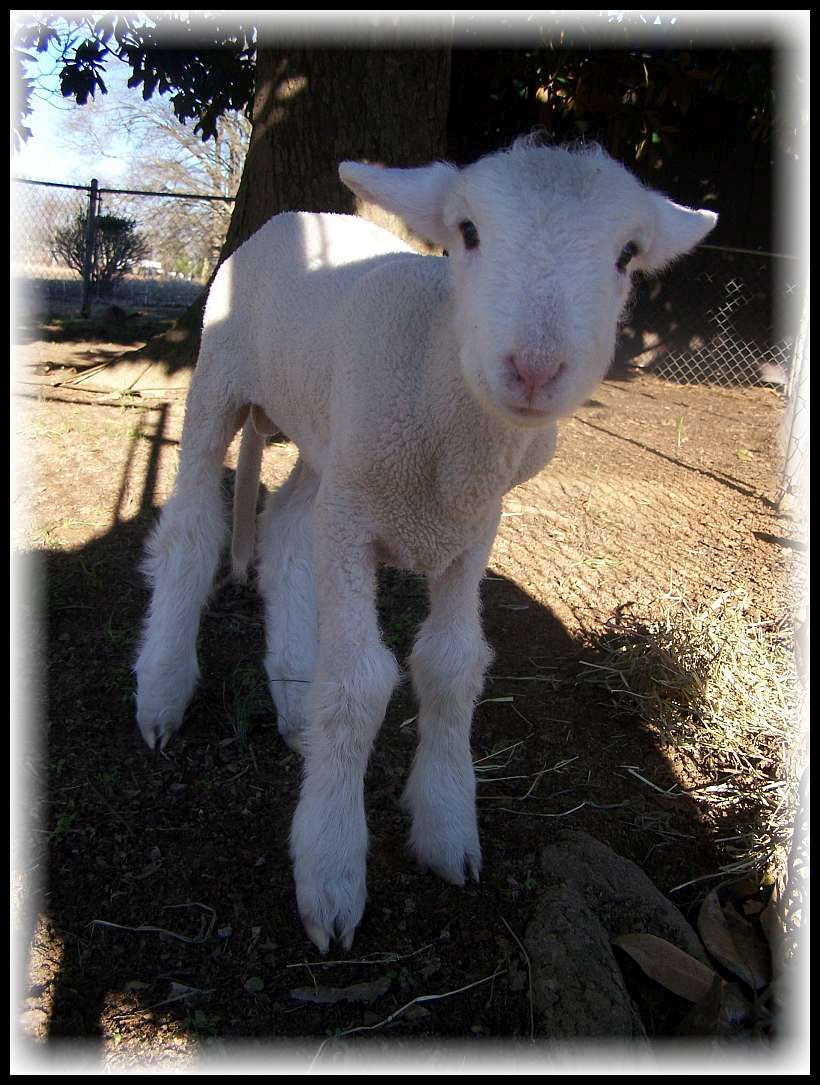
I’m helping a new believer. She is hungry for the word and wide eyed with wonder at everything being new and shiny. She started watching TV Preachers and we in our local body (I) have the sad job to let her know that not all that glitters in the Christian world is gold. We have to protect the lambs.

I remember the days after my conversion. I thought I was safe and that everything would now and forever be OK. The change in my worldview was immediate, it literally was like scales fell off my eyes. In eternity, it is true that everything will be OK, but there will be a lot of work, struggle, vigilance and not-OK stuff happening until I get there. The church is less safe than I thought and definitely takes vigilance to remain on the upward path of sanctification. Satan and the flesh and the world wants to knock us off our pins. It is our job to help new believers learn how to avoid these traps and pitfalls false teachers lay for us.

One main way satan operates is seeding the church with false teachers. Did you know that every New Testament Book except Philemon has strong warnings about being alert for false teachers and false doctrine? Some books of the NT are entirely devoted to the topic! (Galatians, 2 Peter, 1 John, 2 John, and Jude.)

Since it’s a big topic in the Bible, it should be a big topic for us. We shouldn’t focus on false teaching all the time, after all, the best way to spot a counterfeit is to learn the real thing. Thus, our study is God’s word, not false teachings. However, we do need to hone our discernment. (Hebrews 5:14).

Here are some good essays I’ve read lately that help us to identify false teachers.

Natasha Crain:

10 Signs the Christian Authors You’re Following are (Subtly) Teaching Unbiblical Ideas

The following are 10 signs that the Christian authors you’re following may be subtly teaching unbiblical ideas. I say “subtly” because I think most people would spot a problem immediately if a Christian said they didn’t believe in the Trinity. But it’s just as important to identify when less obvious warning signs—like the following—are present.

Denny Burk part 1 & 2-

How to identify false teachers

Given this obligation, it becomes all the more imperative to be able to identify false teachers when they emerge. Sometimes false teaching originates from outside of the church. Sometimes such teaching originates from within. The New Testament teaches that a more rigorous response is required when it arises within. Thus faithful pastors must learn how to identify and deal with false teachers. But how do we do that?

How To Deal With False teachers

In my last post, we looked at six characteristics that help us to identify false teachers. In this post, we will consider what pastors and congregations are supposed to do in response to such persons who emerge in their midst.

Michelle Lesley:

Popular False Teachers

The articles below are evidentiary findings on today’s most popular “divangelistas” (as well as a few male teachers and ministries in general). Please use them as teaching tools in the spirit of 2 Timothy 2:24-26 to help others understand the false doctrine these people are proclaiming, keeping in mind that the people who follow them most likely simply don’t know they’re following false teachers.

John MacArthur, blog essay

The Pathology of False Teachers

It takes careful discernment to see that the light is really darkness. Paul taught Timothy how to diagnose satanic darkness masquerading as divine light. Here’s how he described the key symptoms that identify those infected with the spiritual disease of false teaching:

Colin Smith:

7 Traits of False Teachers

In the same way Peter says, “There will be false teachers among you.” Notice the words “among you.” Peter is writing to the church and says, “There will be false prophets among you.” So he is not talking about New Age people on television. He is talking about people in the local church, members of a local congregation.

Luke Wayne at Christian Apologetics and Research Ministry. I like this one because he mentions the behavior of a false teacher. It’s not only about doctrine. Examine the teacher’s doctrine AND life. (1 Timothy 4:16).

How do you Identify a False Teacher?

We can identify a false teacher or a false prophet by examining first and foremost their teaching and secondly their behavior in light of Scripture. If what they are teaching is not consistent with what the Holy Spirit has plainly revealed in Scripture, they are a false teacher and are to be ignored, even if they live extraordinary lives, even if they appear to have supernatural insight, or even if they seem to work great miracles.

We are one body. Help the new believers, our vulnerable lambs, stay in the flock, growing and maturing in healthy ways.

lamb

Posted in discernment, theology

Discernment sometimes is like the Great Wave off Kanagawa

By Elizabeth Prata

A dear reader emailed me, dispirited. She said that she had tried to reason with a major Christian publishing company as to the fact that they sell so many books of false teachers, and thus they promote false doctrine. She became discouraged when the Publishing Rep countered her concerns with scripture and dismissed them, politely of course.

She said she felt like “a drop of water against a tsunami.”

I empathized heavily. I think we all feel like that from time to time.

When I was first saved, I remember the headiness of my new worldview. Now everything made sense! I knew why people were evil, why things always went wrong in government, why hope died, why nothing fulfilled my heart! I looked at the church as a glowing city on a hill, the resolution to everything, and a happily ever after.

Then I remember learning that more danger is within the church than out. That every NT book except Philemon warns severely of false teachers, of wolves after lambs, of lions devouring. I learned that I needed to be even more vigilant than I’d thought would have been necessary inside of a church. Actually church didn’t mean safety, it meant danger! I was flabbergasted when I learned just how many false teachers there are, and not just TV preachers, but ones in the church down the street, or even inside my own church! What I thought would be a time of ease after the restlessness of 4 decades of searching for peace, turned into a never-ending battle against my own flesh and against waves of false teaching trying to sweep me away.

Sigh.

Sometimes standing for Jesus means we sometimes do feel like a drop of water against a tsunami, especially when a monolith like a panel of pastors, or a major publishing company, or a mega-church are against your concerns.

The Great Wave off Kanagawa

I agree, sometimes our work for Jesus to withstand the evil waves of false teaching seem hopeless and pointless. I’ve had my share of difficult conversations too. The same day my reader contacted me, someone came onto a thread I’d done on Beth Moore and asking seemingly harmless questions. I offered scripture, she ignored it. I offered topics of heresies, with scripture, she ignored it. Finally she flatly said “You don’t know what you’re talking about”. All righty then.

Why, oh why, don’t they see the truth through scripture? Because they don’t submit to scripture as authority. At root, false teaching appeals to people because they are making their own gods. The flavor of false teaching they choose matches the sin they refuse to slay inside them. (2 Peter 2:18). If they are greedy, they will like prosperity preaching. If they are prideful, they will like the renown they will receive from Charismatics by giving false prophecies and speaking babbling tongues. And so on.

When we stand for truth, the hearer may or may not listen at that time. She may or may not repent later. In any case, our stand is a tribute to Jesus, demonstrating our own obedience and faith for which He will richly reward. Oh, but how powerful a drop of water can be, when it’s energized by the Spirit.

The listener’s failure to engage along biblical lines or respond to scripture will be on her own head. And that’s out of our hands. Did we try when our conscience was pressed by the Holy Spirit? Good, then we have not committed a sin of omission. (James 4:17).

Either way, they will be judged according to the amount of faith they have been given (Rev 2:23; Romans 12:3); and according to the position they hold. (James 3:1).

It reminds me of Paul, in Acts 18:6,

And when they opposed and reviled him, he shook out his garments and said to them, ‘Your blood be on your own heads! I am innocent. From now on I will go to the Gentiles.’

In Ezekiel 2:4-5 God told Ezekiel to speak His words to the rebellious House of Israel.

The descendants also are impudent and stubborn: I send you to them, and you shall say to them, ‘Thus says the Lord God.’ 5 And whether they hear or refuse to hear (for they are a rebellious house) they will know that a prophet has been among them.

Not that we are prophets, but the point is, when we speak God’s truth we do so whether they will hear or won’t hear. On the Day when they try to argue, they will have no excuse. (Matthew 7:21-23; Romans 1:20).

Barnes’ Notes says of Paul’s declaration in Acts 18:6-

I am clean – I am not to blame for your destruction. I have done my duty. The gospel had been fairly offered and deliberately rejected; and Paul was not to blame for their ruin, which he saw was coming upon them.

Jamieson-Fausset-Brown Bible Commentary says of v 18:5,

What that pressure was we happen to know, with singular minuteness and vividness of description, from the apostle himself, in his first Epistles to the Corinthians and Thessalonians (1Co 2:1-5; 1Th 3:1-10). He had come away from Athens, as he remained there, in a depressed and anxious state of mind, having there met, for the first time, with unwilling Gentile ears.

But he kept going. He knew when to cut off a conversation, sometimes we turn to more fertile soils when the Gospel has been rejected, and I mean to include discernment work among the Gospel umbrella. You’re making known ‘this same Jesus’ as in Acts 1:11 who ascended and will return, and letting hearers know they are clinging to a different Jesus.

I know how hard it is to go into a place where more than likely your heartfelt message will be rejected and perhaps you will even be slandered, marginalized, or cut off completely from fellowship, as has happened to some. It’s like knowing you’ll put your face into a buzz saw.

I know the dispiriting feeling when you come up against a seemingly insurmountable obstacle. While the wall may seem tall (or the tsunami wave high) it will fall like the walls at Jericho, either sooner or later.

Persevering honors the Lord in your obedience, it hones your own discernment, it establishes a prayer focus, but it also reveals how deep someone may be in sin.

Take heart. Even Elijah, John the Baptist, Thomas, Moses, and Jeremiah as a few examples, struggled in their ministry, at times saying, ‘what’s the point? They won’t hear me anyway…’

Either way the Lord can say to you, “Well done good and faithful servant.”

Sure, it feels like a drop of water against a tsunami.

Ovid said, “Dripping water hollows out stone, not through force but through persistence.”

water droplet

Posted in discernment, theology

Looking at Christine Caine’s speech at Passion 2019

By Elizabeth Prata

The Passion 2019 conference concluded last weekend. The event has expanded to four simultaneous venues spread among three cities, and all four were sold out. A total of just over 43,000 youths between the ages of 18-25 were in attendance.

One of the speakers this year was Christine Caine. Christine hails from Australia and is known for having founded the Propel Women organization and A21. Propel aims at “Activating every woman’s passion, purpose, & potential.” A21 “is abolishing slavery everywhere, forever.”

Caine is popular, but sadly she is a false teacher. Michelle Lesley wrote about Caine here. I wrote about her here.

The three-day Passion conference event is specifically a youth-oriented event. There is a restricted age-range that is allowed to attend. No one under 18 (unless you’re a senior in High School) and no one over the age of 26. Only the Pastor or Leader of the group attending may enter. No parents, no elder siblings, no elders of your church. Access denied.

Here are videos of the event.

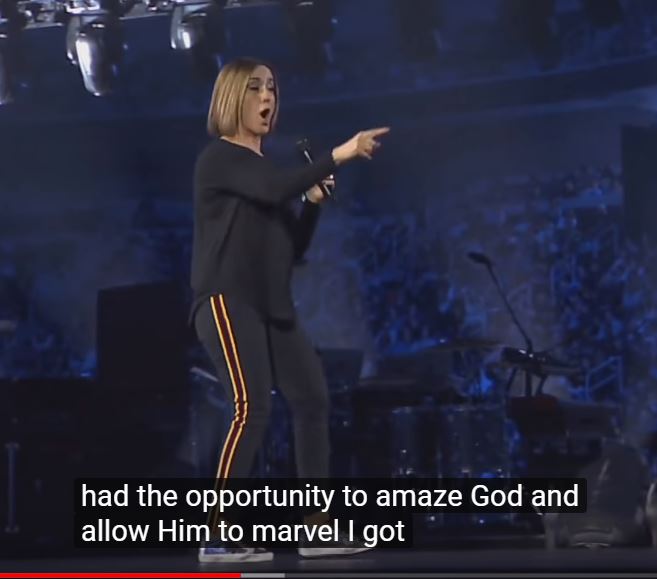
I received a query about Caine’s sermon, so listened to Caine’s it, which was almost an hour. Well, I muted the sound and pushed forward the slider in ten second increments while reading the closed captions. I read what she taught and it was straight Word of Faith, twisted verses and all. Here are specifics on how to detect Word of Faith teaching.

The Word of Faith movement is decidedly unbiblical.

At the heart of the Word of Faith movement is the belief in the “force of faith.” It is believed words can be used to manipulate the faith-force, and thus actually create what they believe Scripture promises (health and wealth). GotQuestions

Here are a few screen shots from the video with the captions of statements that stood out to me. Her base text is from Matthew 8:10,

When Jesus heard this, he marveled and said to those who followed him, “Truly, I tell you, with no one in Israel have I found such faith.”

In Word of Faith you’ll often hear the word ‘allow.’ The WoF believes (GotQuestions again) that ,

“Laws supposedly governing the faith-force are said to operate independently of God’s sovereign will and that God Himself is subject to these laws.”

In WoF world therefore, when we do something according to these laws, God can then be ‘allowed’ to operate within them. The section of Caine’s lecture as seen on the screen shot shows she is teaching classic WoF.

In WoF land, you will hear the word “activate” a lot. In WoF teachings, the object of our faith is our faith (really, us). We possess faith. Something we DO activates it, then God works within it. That’s why within WoF if something doesn’t happen the way we decreed it, (healing, prosperity) it means WE didn’t have enough faith. Things depend on us and our faith, not on God. You see the switch: in WoF teachings it’s switched from God being sovereign to us being sovereign. Word of Faith teachers need to read and re-read Job 38-41 to learn man’s place befroe a sovereign God.

As for activating things, God is not a dried up sea monkey waiting for a drop of water to activate Him. If we are regenerated, then the Holy Spirit is in us and He is always working. His will is independent of ours and He does as He wants. He needs no “activation.” Even the printed word of God is living and “active.” Nothing WE do activates it.

In WoF you will hear the word “miracle” a lot. Miracles are important to these people because they are the proof of ‘our’ faith. The emphasis, again, is on our faith, and the results from our faith, such as miracles (or health or prosperity). Biblically, miracles were a sign authenticating the unique personage of Jesus, who was sent from God. (John 20:30,31; John 2:23). The WoF teachers do not focus on Jesus as He is for Who He is.

So why did Jesus marvel at the centurion’s faith? Doesn’t Jesus already know everything? We remember that Jesus is God, but in His incarnation He was also man, and when He marveled it is this side of his dual-single nature that comes into play.

For example, Jesus “grew in wisdom”, (Luke 2:52). The God side of Jesus already knows everything, but the man side of Jesus grew because that is what men do, grow. We can’t really grasp how He can know everything but also grow wiser- but that is the mysterious nature of the hypostatic union. [FMI see this Theological Primer from Keven DeYoung on the Hypostatic Union].

Alternately, can Jesus be surprised enough to marvel at a person’s faith? It is the man-God nature again. Jesus dispenses all faith, so the Centurion received it from Jesus as God. Remember the verse in Mt 16:17 when Jesus told Peter,

“And Jesus answered him, “Blessed are you, Simon Bar-Jonah! For flesh and blood has not revealed this to you, but my Father who is in heaven.”

Jesus as man can be astounded at a man who was a Gentile, had never learned the scriptures, but who had faith enough to trust that Jesus’s power permeated all the universe and that His physical presence or absence to do a miracle was of no matter.

MacArthur:

“When Jesus heard this remarkable expression of the centurion’s humble faith, He marveled at him. Here is a glimpse of Jesus’ true humanity, since as God He is omniscient and cannot be surprised by anything. But just as in His humanity He became tired (John 4:6), hungry, (Matt. 4:2), and thirsty (John 19:28; cf. 4:7), so also could He be astonished at the faith displayed by this Roman soldier.”

Matthew Henry:

He turned him about, as one amazed, and said to the people that followed him, I have not found so great faith, no not in Israel. Note, Christ will have those that follow him to observe and take notice of the great examples of faith that are sometimes set before them—especially when any such are found among those that do not follow Christ so closely as they do in profession—that we may be shamed by the strength of their faith out of the weakness and waverings of ours.

RC Sproul explains why WoF folks like Caine believed as she does, here is a snippet from his devotional,

“Some professing Christians have concluded from texts like this that human faith gives power to God.”

In addition to Caine’s Word of Faith doctrines showing her as a false teacher, she was inappropriate elsewhere in her speech. She spoke twice of how husbands can be “getting some action” out of their wives. She spoke of a skiing accident where she was loaded onto a stretcher and bemoaned the fact that she wasn’t wearing any underwear. Yes, these items were included in her speech to thousands of teenage and young male adults listening. Should a teacher or pastor say this ever? Of course not.

Jude 1:4 warns that false teachers will pervert the grace of our God into sensuality-

For certain people have crept in unnoticed who long ago were designated for this condemnation, ungodly people, who pervert the grace of our God into sensuality and deny our only Master and Lord, Jesus Christ.

If Christine Caine’s “sermon” raised red flags to you, good for you. If anything in this essay raised red flags for you, good. He needs no activation, no Word of Faith Law to operate within, and He does not depend on us.

Our God is in the heavens; he does all that he pleases. (Psalm 115:3).

sproul

Posted in discernment, theology

There’s such a thing as fake [Christian] news

By Elizabeth Prata

Introduction

We hear a lot these days from our President about ‘fake news.’ Wikipedia defines this new term fake news as,

Fake news or junk news is a type of yellow journalism or propaganda that consists of deliberate disinformation or hoaxes spread via traditional print and broadcast news media or online social media

I’m sure you’ve all seen examples of this. Fake news is news that the mainstream media publishes which turns out to have been twisted or are simply untrue.

Well, there’s fake news in the Christian world too. Sometimes it happens due to ignorance. Not that the person passing it on is an ignorant person, but is perhaps ignorant of the scriptures. Sometimes it happens because someone is lazy and doesn’t dig, research, or think it through. Sometimes it’s carelessness. We see examples of the carelessness aspect via Jess Pickowitz’s eye-opening examples in her series called, “Meme Heresies.” We women tend to pass along the beautiful scripture quotations on Pinterest, Facebook, Instagram etc., but many of these contain heresies of their own, as Jess points out. She says,

#MemeHeresies is an effort to correct heresy with biblical truth and encourage women to reflect on the theological implications of what we’re sharing in the fast-paced world of social media.

Example of Fake Christian news

Well as I said, it happens in the Christian blogosphere media too. In 2007, John Piper wrote an article called,

The Morning I Heard the Voice of God

It began,

Let me tell you about a most wonderful experience I had early Monday morning, March 19, 2007, a little after six o’clock. God actually spoke to me. There is no doubt that it was God. I heard the words in my head just as clearly as when a memory of a conversation passes across your consciousness. The words were in English, but they had about them an absolutely self-authenticating ring of truth. I know beyond the shadow of a doubt that God still speaks today.

The essay continued in this vein, with Piper extolling all the virtues and wonders of hearing the voice of God. It wasn’t until near the end of his essay that the punchline became evident, Piper was writing about hearing the voice of God via his own scripture reading that day. The article was actually a rebuttal to an article that had appeared in Christianity Today that week written by an ‘anonymous middle-aged professor of theology’ at a ‘well-known university’ and whose name was ‘on the masthead of CT’. Anonymous had written that he had actually heard the voice of God and it had been specific. He was commanded to give all the royalties of his book to a certain needy student.

Piper’s article was a rebuttal against this kind of extra-biblical communication. (Though Piper certainly doesn’t let us down. In typical Piper fashion he fails to state outright that extra-biblical revelation isn’t true because it destroys the sufficiency of scripture, but wishily-washingly says that ‘when’ it happens it should not supersede our joy in His written word…)

Anyway, Piper stated,

I grieve at what is being communicated here. The great need of our time is for people to experience the living reality of God by hearing his word personally and transformingly in Scripture. … It has increased my love for the Bible as God’s very word, because it was through the Bible that I heard these divine words and through the Bible I have experiences like this almost every day. The very God of the universe speaks on every page into my mind — and your mind.

Yet the person/s writing at a blog called New Calvinist, a Dr. ES Williams and friends, apparently did not read to the end of the article or missed the punchline. He spent a long essay “debunking” Piper’s stance, a stance Piper didn’t even hold. However, you as a reader would not know that unless you took the time to also read Piper’s original essay the Anonymous Professor was contending against.

Williams’ essay was a thorough and blow-by-blow takedown of Piper’s hearing from God stance that seemed legitimate because it contained scripture. And also because it was written in elevated language.

Fake Christian news exists, so how do we practice discernment and get wise against Christian fake news?

Debunking Fake Christian News

1. It seems to not need saying, but it does: when you read Christian blogs or news sites, have your Bible handy. Or have a Bible tab open on your screen. Look up the scriptures used in the article and determine if they are the right address, the full scripture, and used in context. Many times, one or all of these is incorrect. I always double check my own scriptures when I write, because a numerical typo in a scripture address will bring you to a completely different scripture. And typis ar eazsy to make, lol.

For an example of a scripture used out of context, in a book I’m reading now, the scripture referenced is Matthew 18:20 ‘where two or more are gathered.’ The verse is used to buttress the author’s point that wherever two or three are gathered, the Holy Spirit and/or Jesus is there with them. Yet that is not the point of the scripture. It’s about church discipline.

One off-reference is not a reason to throw away an entire book, but it’s the start of a discernment path. If an author uses one scripture out of context or to make a wrong point, what else might there be in the book/article/pamphlet etc? Discernment is usually a gathering of a preponderance of evidence, weighed against the Scriptures, and used in a prayed-for wisdom.

2. If an article is mentioned in your news story or blog essay, then go ahead and read the original article the author is quoting. Context is important in studying the scriptures, and it’s important in judging Christian news, too.

3. Look up the author by simply googling his or her name, see what comes up. Read reviews of your author on Amazon or Goodreads, I usually look at the 3-star ones. The middle of the road reviews tend to be more even-keeled with credible pros and cons.

4. Look up who the author pals around with. Is his book recommended by credible authors, or non-credible ones? If you look on the back of a book, or at the blogger’s blog roll, you’ll see and understand a lot of where this author is coming from by whose names are there.

5. You can read the “About” page of the author/s blog or his bio at Amazon or wherever. You can also do the same with a Christian News Outlet author’s hyperlinked name. When the author page of the news piece you’re reading comes up with a lot of headlines like “So-and-So exposed!” or ” You won’t believe…” then you know they like to use hyperbole to make their case or to entice readers. The point should be the glory of God and the deepening understanding of the reader of our Savior, not clickbait.

I’m sure you can think of many other ways to spot and combat fake Christian news. The biggest thing is to stay in the Word. Studying the real thing always reveals the fake.

real fake

Posted in discernment, theology

Discernment Resources for you: Bookmark this!

By Elizabeth Prata

Is this teacher good? Is this Bible study credible? Is this book safe with good doctrine? I’m frequently asked these are normal and good questions, and I know that other ministries that offer discernment teachings are asked also.

We all should be practicing discernment, all the time. (Philippians 1:9). Hebrews 5:14 says discernment comes with training and maturity-

But solid food is for the mature, for those who have their powers of discernment trained by constant practice to distinguish good from evil.

Sometimes ladies don’t have time to pre-read a study to determine if it’s acceptable, they barely have time between the kids, husband, church, and home to read the study itself. Other times sisters just need a second opinion before setting up the appointment with the Ladies Minister or the Pastor. Other times a person just needs a jog or a jig into a direction, a framework that sparks their own thoughts.

So we’re asked. I’m grateful when I am asked, because I know there are women out there who care about good doctrine and only want to study with credible materials or people. Discernment as a tool or a skill (or in some cases, the gift) isn’t just for calling out false teachers or spotting poor doctrine melded with the true. It’s a book or a movie review. It’s oftentimes a lesson in itself teaching how to compare materials with scripture. It’s honing of the mind as it conforms to Christ. It’s all that and more.

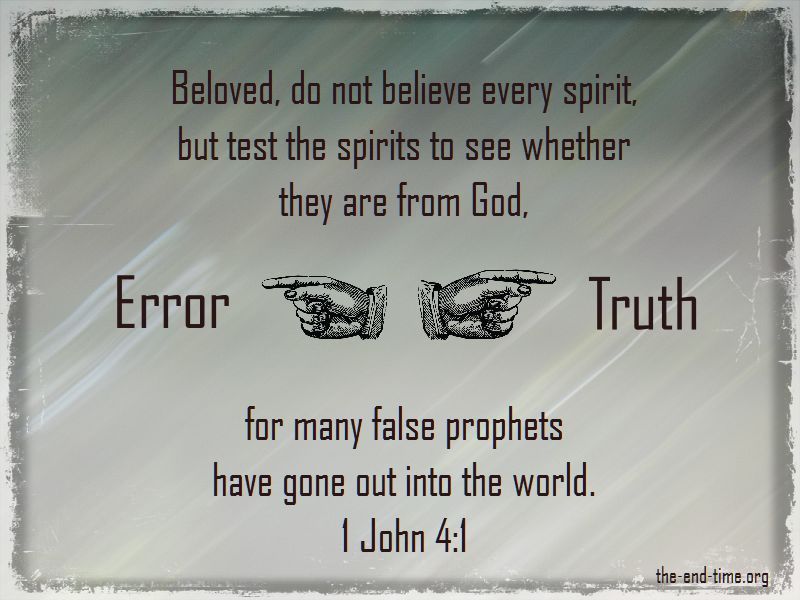
error and truth discernment

Here are some resources I use for my own reasons, which include all of the above. I offer these resources to you as an additional tool in your discernment toolbox.

Phil Johnson. Phil is Executive Director of Grace To You, the online ministry of Grace Community Church. (GCC). He is also editor of John MacArthur’s books, and a pastor in the GraceLife Pulpit, Sunday School Ministry of GCC. He has the gift of discernment, and often speaks on topics such as current fads and their impact in Christendom, false teachers, and other discernment issues. You can find his sermons at the GraceLife Pulpit. Phil also speaks at various conferences, including the well-known Strange Fire conference, which examined and evaluated the doctrines, claims, and practices of the modern charismatic movement. As a matter of fact,t he entire conference itself is a lesson in discernment and well worth your while. Phil also ran a blog for many years that dealt with discernment issues, Pyromaniacs, which has recently been revived with other writers contributing. You can search its archives. He also has a wealth of material here. He’s been online for over 20 years.

Justin Peters. Justin is an itinerant pastor with several specialties. He preaches expositionally, and also has an interest in teaching discernment matters via his series Clouds Without Water. Justin has written a book called Do Not Hinder Them, about evangelizing children, and has spoken out about the fad of ‘heaven tourism‘, examining the claims of those who allege they have traveled to heaven and back. He preaches and teaches extensively at conferences, for example, the Judge Not Conference, the Strange Fire conference here, and here, and here in an extensive interview about Lying Signs and Wonders, as well as many other places that can be found on Youtube.

Bob DeWaay. Critical Issues Commentary is a treasure trove of discernment works and other topics, led by Pastor Bob DeWaay. Critical Issues Commentary was founded to help people find their way out of unbiblical teachings that confused their understanding of the faith. There is so much at the site, you can take an entire course for free on Hermeneutics, or Systematic Theology, watch the video, How to Discern a True Work of the Spirit, learn from a five-video series on How Do We Really Hear From God, read articles reviewing Jesus Calling, Bill Johnson’s book, or Ann Voskamp’s book, and so on. His About page says in part, “Critical Issues Commentary is… a series of carefully researched essays on important theological issues. Since 1992 more than 80 articles covering more than 60 specific “critical issues” have been published. Each article contains Biblical exegesis as well as interaction with famous teachers and teachings. Our prayer is that God uses this effort to help readers grow in their faith and be strong in their witness.”

Michelle Lesley. Michelle runs a discipleship ministry, online here, and has written articles on various false teachers. She also travels and will speak at your church or organization. If you go to her site, there is a link at the top called Popular False teachers. You can also search her archives for specifically what you’re looking for. Michelle graduated from LSU with a degree in child and adolescent psychology, and earned her master’s family counseling.  She is a married mother of six. She loves being a stay at home, home schooling mom and enjoys reading, staying active at church and in women’s ministry…

Sharon Lareau. Mrs. Lareau at Chapter 3 Ministries is another treasure trove of biblical information, reviews, women’s issues, marriage, apologetics, and more. She is a 30-plus years married mom who homeschooled for 18 years. She says, “It is my prayer that Chapter 3 Ministries is a blessing to other women. It is my desire to encourage greater understanding about the biblical role of the Christian wife and to offer support for living it. It is also my desire to support my sisters in Christ in their efforts to be ready in the defense of our great hope. This defense can be given through our testimony and through the work of apologetics.” She has recently written a review of Tim Keller’s book “Prayer” as well as reviewed several of Beth Moore’s Living Proof Conferences. There’s a lot at the site, check it out.

Abandoned to Christ. Sunny Shell of Abandoned to Christ also ministers to women via her website and of course in real life as all of the above people do. She writes “about living abandoned to Christ in marriage, biblical submission, parenting, friendships, evangelism, and my often debilitating and very painful health issues for the past 13 years—all with the eternal, rich, and hope-filled perspective of the Gospel of Jesus Christ.” She is a married mother of two adult children who also volunteers at church, blogs, is writing her first book, and disciples younger women. She has a list of recommended books, resources to follow and stay away from,  and reviews, such as The Shack, the movie Son of God, Ann Voskamp/Beth Moore/Sarah Young, and much more.

Wretched. Todd Friel of Wretched Radio & TV also delves into apologetics and discernment issues. He has a wonderful series called Drive By, thus called because you can listen to the short lectures as you drive to work. They are generally between 7-15 minutes each. The series includes Drive By Discernment– 70 short lectures on the topic of discernment. There is also a DVD called Judge Not, about true biblical judging, or discernment. There is a wealth of short clips on Youtube under the Wretched Channel also. Don’ miss Too Wretched for Radio, short interviews with Phil Johnson on various fads, discernment topics and apologetics in current time.

Challies. Tim Challies has been blogging, reviewing books, and offering up discernment resources for ten years.  His website is a treasure trove of archived book reviews, to the good and the bad, plus lots of other resources.

Chapel Library: a Ministry of Mt. Zion Bible Church. This resource is not specifically aimed at discernment or apologetics but it is just too good not to include here. It’s often overlooked or amazingly, fairly unknown widely. It is another rich, full site of lots to choose for free. The Bunyan Archive, courses for free, studies in scripture, 850 books, tracts, and pamphlets to read online or download for free, including Adoniram Judson and the Missionary Call by Erroll Hulse, Advice for Seekers by Charles H. Spurgeon, Am I Really a Christian? by Thomas Boston, Anxiety by Arthur W. Pink, and so MUCH more. The whole site offers over 1100 resources for free.

I hope these resources suit you, there are many men and women out there, who labor for Christ and the common good.

discernment1


Posted in discernment, theology

Forget ‘What color is your parachute?’, Beth Moore wants to know the color of the hands that wrote the books on your shelf

By Elizabeth Prata

Just as our minds can’t conceive of how MUCH Jesus loves His own, we can’t conceive of how deep sin will go. (1 Corinthians 2:9). Just when we think sin can’t get any worse, it does. (Genesis 6:5).

False teaching is a plague on the church. It destroys the sinner. It hinders the Christian’s walk. It makes a blot on Jesus’s name. It should not be ignored.

For many years Beth Moore has been propagating false teaching. It’s always been there. It’s always been that way, if one cared to look.


Any
variation from the true Gospel is devastating. It’s of satan, and we know satan comes to steal, kill, and destroy. (John 10:10). It matters not that the package it comes in seems ‘pretty close’ to true doctrine. So what that an N almost looks like an M. It’s not and it alters the word it’s in completely. Moon isn’t Noon. Mail isn’t Nail.

Remove the second ‘b’ from Bible and you get bile. So, pretty close isn’t good enough.

Beth Moore has been twisting the faith for almost 30 years. She is a type of Jezebel spoken against by Jesus in Revelation 2:20. Her mysticism, direct revelation, Bible twisting, lavish lifestyle and more, has caught many an unwary women into her webs of lies. That is what false teachers do, and she is extremely successful at it. Rather than be stricken by Jesus, He has graciously allowed to gather momentum, influence, and followers for all this time. Only Jesus knows how long He will allow her to continue, and whether her comeuppance will happen before her death as well as after. But for now, it is the duty of those who see the N in the stream of M’s to call attention in clarion shouts that this thing is not like the others.

Though one knows God is sovereign, one can still be alarmed that Moore’s power and influence is only growing as time goes on. Of late, in addition to the usual Bible travesties, Beth Moore’s advancement along the wide road has picked up some additional new litter by the side of the way. The litter is wokeness, relevance, and attention to worldly systems.

Perhaps feeling that there were no new theological worlds left to conquer, or perhaps the Bible world was growing stale for her, or maybe she just needed new friends, Moore has plunged into expounding on new vistas having nothing to do with Jesus. As Kris Williams (@Kdubtru ) said on Twitter this week, unrelated to Beth Moore,

Church history has repeatedly and clearly proven one thing: Once the highest view of Scripture is abandoned by any theologian, group, denomination, or church, the downhill slide in both its theology and practice is inevitable.

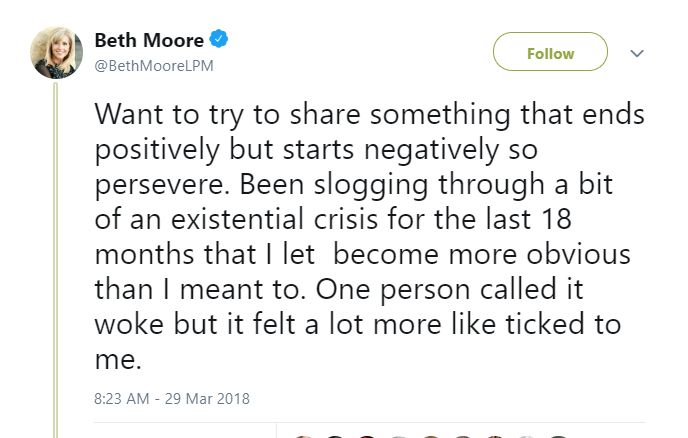
If one has tendencies to chronicle and track these things, (as I do) one can see that Moore’s downhill slide into ‘wokeness’ began earlier this year. In March to be exact.

Her non-sleepiness was followed by a sudden venture into political waters that same week, with this tweet,

This political awakening was followed by successive and incessant tweets and blogs taking on social justice, racism, and just rebuking the church wholesale. Perhaps you’ve noticed a distinct absence of Bible verses. There are references to biblical principles, and mentions of the Bible, but very few verses and hardly addresses at all. I’ve asked her about this. No response. Her social media is used quite often to bemoan secular woes now.

In April the MLK50 Conference happened. Moore was asked to be a speaker. Moore suddenly ‘woke’ to racial issues and began promoting them as a substitute for Gospel issues.

Moore’s foray into political ‘relevance’ was followed by the famous “Letter to My Brothers” in May of this year which accused basically every Christian man of not liking Moore and thus were misogynists hating on all women since the beginning of the church.

June saw a surge of interest in putting Moore up for president of the largest Protestant denomination in the world, the Southern Baptist Convention. Along the way discussions about women’s egalitarianism, social justice, and a host of other secular, fleshly issues ensued.

By October of this year the powerhouse secular media had taken note of Moore. Both The Atlantic and the Washington Post published lengthy stories about her. New vistas indeed. The Atlantic talked about how she is “taking on Trump”, and the Post talked about how she is “changing the face of evangelical leadership.”

Moore talks about how she stayed quiet for decades but now must speak up, she must. A cynic would say that she has amassed enough worldly goods and influence to risk stepping into secular arenas to conquer, and this seems to be working for her. Maybe the risk wasn’t so large after all.  In the spirit if the breathless titles on the TV show The Unbreakable Kimmy Schmidt, here are three titles regarding Beth Moore’s latest delinquencies.

Beth Moore Challenges Da Man!
(But Metha Leanne Todd pushes back)

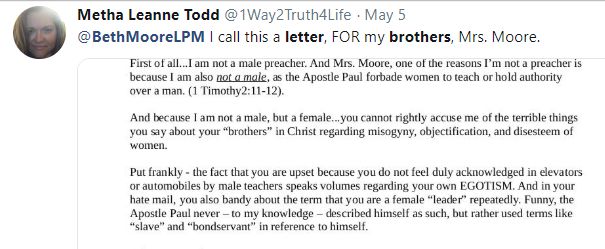
This past May’s “Letter to My Brothers” Moore takes exception, on behalf of all evangelical women whether they have asked her to or not, to the “way we women have been treated” in the visible church. And the way Moore herself has been treated, and according to Moore, it ain’t good. There’s a gulf, a huge gulf fixed, between male leaders and women leaders, and that gulf is filled to the brim with disrespect, maltreatment, and perhaps most mystifying of all, ‘peculiarities accompanying female leadership’. Clearly, this must stop.

Her letter did not go unnoticed. Not by the bigwigs, nor by the little people, like this articulate CNA CareGiver in Texas-

The rebuke went on, the above is just an excerpt. Full post here.

Hypocrisy Moment:

From Moore’s Open Letter to Brothers:

A few years ago I told my friend, Ed Stetzer, that, whenever he hears the news that I’m on my deathbed, he’s to elbow his way through my family members to interview me about what it’s been like to be a female leader in the conservative Evangelical world.

Interesting that a religious teacher who claims to have been a slave to Christ for 30+ years, says that when she’s on her deathbed, her only thought will be talking about herself and her life as a “leader,” and not the coming glories she will experience because of the cross and Christ.

Beth Moore battles misogyny!
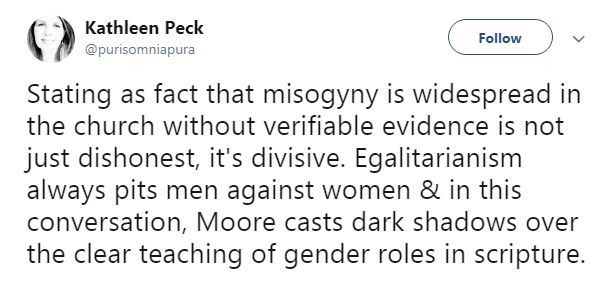
(But Kathleen Peck pushes back)

Pushing hard on the ‘women oppressed’ mantra, this month Moore was featured in a lengthy podcast interview: Beth Moore on Misogyny: The blurb goes- “Moore reflects on her journey as a woman in ministry, how she developed an authentic style of teaching that ministers to thousands of women, and her battle against misogyny in the church.”

It is an encouragement to see women like Ms Todd above and Ms Peck below, with courage and insights pushing back against false teachers like Moore.

Yes!

Of Interest-
Wretched Radio’s report on Al Mohler’s take on a woman for President of the SBC (11 minutes)
Friel quote from that episode: “Liberalism always starts with women’s issues. It’s the easiest one to get compromise on.”

Hypocrisy Moment:

It’s interesting that Moore, President of her own Corporation, earning a multi-million dollar income, owner of a three-storey office building in Houston, co-signer of her own family trust, and accumulator of four luxury homes and a boat, who has for decades enjoyed acclaim, leadership, and a wide influence and platform within evangelicalism, a woman who is jetted by private plane by one of the largest Christian Companies in the world, (because she makes us so much money, says one LifeWay worker), now complains about the ‘injustices women in evangelicalism’ have endured.

Beth Moore Battles Racism!
(But Dr. Oakley pushes back)

I’d say more about the insipidness of the ‘shade of hands’ tweet, but Dr Oakley nailed it.

Hypocrisy Moment:

There are 10-members on the Board of Directors at Living Proof. Four of them are Moores; Beth, husband Keith, daughter Melissa and daughter Amanda. They are white. Daughter and Board Member Melissa co-writes and researches Bible studies with her mom, Beth. Is it that perhaps “white hands” and only “white hands” at Living Proof  are theologically shaping the clay?

Conclusion

Moore has been in the business of teaching Bible for many years. Moore says she has had some sort of extreme “existential crisis” for the last 18 months, then came out earlier this year as a social justice, women affirming, race promoting warrior rebuking one and all for her own perception of things wrong with the global church. She has been virtue signalling, something Jesus hated (Matthew  6:1, 2, 5, 7, 16, 23:14). Her interests now are politics and secular causes. Drift from her initial mission is obvious.

Only time will tell where this slide will bring Moore, but it is more imperative than ever to raise the cry that this woman is dangerous and should be avoided

I appeal to you, brothers, to watch out for those who cause divisions and create obstacles contrary to the doctrine that you have been taught; avoid them. (Romans 16:17).

Posted in discernment, theology

Good advice from Charles Spurgeon about Twitter polls

By Elizabeth Prata

On Twitter there is a function that lets you put up a poll. Typically, there is a question followed by three or four answers. You can choose one and then go see the current results.

I’ve had qualms about polls for a while now, but was unable to put my finger on why, until this morning when I read Spurgeon’s Morning Devotional.

I can understand the reason some people put up polls. Some may want to gather information for a book they are researching. Some may be genuinely curious about a position people in their Twittersphere hold.

poll.jpg
However, it has been my experience that many of the poll questions ask the kind of questions where answers can’t really be stated from scripture. They are the kind of questions that ask how many angels can dance on the head of a pin or can God make a rock so big he can’t pick it up type of queries.

These lead to debates, to brothers arguing, to lurkers witnessing the exchanges and subsequently becoming dismayed. They’re a temptation for me. At any rate, time is wasted that could be more edifying doing something else. I’ve become a little frustrated with Twitter polls.

I’d mentioned Spurgeon’s morning devotional. We know Spurgeon lived and died well before social media was invented. So how could he possibly have anything to say about Twitter or Facebook polls? Well, if one relies on the scripture for all doctrine, for reproof, for correction, for instruction in righteousness, (2 Timothy 3:16) then, yes, there is an instruction for us here. Spurgeon draws it out below.

Brothers, Sisters, Myself, before putting up a poll, let’s consider the scripture being expounded here. In paragraph 2, Spurgeon even gave some excellent examples of non-starter questions. I believe these kind of questions and polls set the platform for needless strivings and contentions. I’ve seen it happen. Let’s do everything we can to provide opportunities for peaceful interactions, edifying and grace-filled.

Meditation for this Morning
“Avoid foolish questions.”—Titus 3:9.

OUR days are few, and are far better spent in doing good, than in disputing over matters which are, at best, of minor importance. The old schoolmen did a world of mischief by their incessant discussion of subjects of no practical importance; and our Churches suffer much from petty wars over abstruse points and unimportant questions. After everything has been said that can be said, neither party is any the wiser, and therefore the discussion no more promotes knowledge than love, and it is foolish to sow in so barren a field.

Questions upon points wherein Scripture is silent; upon mysteries which belong to God alone; upon prophecies of doubtful interpretation; and upon mere modes of observing human ceremonials, are all foolish, and wise men avoid them.

Our business is neither to ask nor answer foolish questions, but to avoid them altogether; and if we observe the apostle’s precept (Titus 3:8) to be careful to maintain good works, we shall find ourselves far too much occupied with profitable business to take much interest in unworthy, contentious, and needless strivings.

There are, however, some questions which are the reverse of foolish, which we must not avoid, but fairly and honestly meet, such as these: Do I believe in the Lord Jesus Christ? Am I renewed in the spirit of my mind? Am I walking not after the flesh, but after the Spirit? Am I growing in grace? Does my conversation adorn the doctrine of God my Saviour? Am I looking for the coming of the Lord, and watching as a servant should do who expects his master? What more can I do for Jesus?

Such enquiries as these urgently demand our attention; and if we have been at all given to cavilling, let us now turn our critical abilities to a service so much more profitable. Let us be peace-makers, and endeavour to lead others both by our precept and example, to “avoid foolish questions.”

Posted in discernment, theology

“We’ve always had false teachers…”

By Elizabeth Prata

Discussions about false teachers makes many people feel uncomfortable. It isn’t my favorite topic of conversation, either. For someone who might be saved but is teaching an errant doctrine, it’s a tragedy, because they are laboring under an incorrect interpretive method, or delusional thinking, or whatever it is that is making them believe something falsely. This means there is a significant stumbling block in their relationship with Christ. Over time that block may be removed by the gracious work of the Holy Spirit, or it may linger for a long while, hindering the Christian’s full effectiveness for Jesus’s name.

If a person is unsaved and is teaching falsely, it’s worse. Their eternal destination will be hell, (Jude 1:4) and that, of course, is a matter of grave concern.

However, it is important to have these discussions. There is danger in not having them. John MacArthur, from his commentary on Matthew 1-7,

There is danger, however, even for the truly humble and repentant believer. The first danger is of concluding that we have no right to oppose wrong doctrine or wrong practices in the church, lest we fall into judgmental self-righteousness. We will then not be willing to confront a sinning brother as the Bible clearly calls us to do. The second danger is closely related to the first. If we are afraid to confront falsehood and sin in the church, we will be inclined to become undiscriminating and undiscerning. The church, and our own lives, will become in more and more danger of corruption. Realizing the impact of sin in the assembly, (1 Peter 4:15), Peter made a powerful call for a confrontive church when he said, “For it is time for the judgment to begin with the household of God.” (v. 17). Believers must be discerning and make proper judgments when it is required.

One way that people deflect their discomfort in discussing about false teachers or false doctrine, is that when the topic arises, they use this familiar phrase-

“We’ve always had false teachers.”

The phrase is used as a subtle way to shift our attention away from the danger of false teachers. As if their presence all along is normal. This is a sort of Uniformitarian stance. John MacArthur on The Fallacy of the Uniformitarian stance

It is the theory that natural and geological phenomena are for the most part the results of forces that have operated continuously, with uniformity, and without interruption, over billions and billions of years. Uniformitarians assume that the forces at work in nature are essentially fixed and constant. Scientists who hold this view explain nearly all geological phenomena in terms of processes that are still occurring.

I’m extrapolating here from the Uniformitarianism in Geology and ecology but it’s the same kind of thinking. Peter said this about scoffers, which is in fact a uniformitarian stance:

They will say, “Where is the promise of his coming? For ever since the fathers fell asleep, all things are continuing as they were from the beginning of creation.” (2 Peter 3:4).

False teachers have been around since the beginning. I also agree that each generation tends to think it’s got it worst. Except, sometimes that generation is right. It IS the worst. For example, the generation living right before the flood was the worst ever up until then. (Genesis 6:5)

The generation living while Jesus was incarnated was the most hypocritical up until then. (Luke 3:7, for example)

In Matthew 24:12 Jesus warned that in the days between His first and second coming the love of many will grow cold. This indicates that the flood of falsity against the church will not remain static, but will grow and grow and grow. Paul wrote to Timothy in 2 Timothy 3:13,

But evil men and seducers shall wax worse and worse, deceiving, and being deceived. 

“Worse and worse.” So while yes, I agree “there have always been false teachers”, there will be an increase in their evil doctrines during the intermediate period between the two comings. Ergo, as time goes on, “there will be MORE false teachers.” I don’t know if this particular generation is the worst, but it certainly is worse than the one before it, and the next one will be worse still. It will be thus until He comes again to put an end to it.

And besides, so what if false teachers have always been with us?. Is that a reason to ignore them? Do we say that about murderers? ‘Ach, killers have always been with us, so…’

We speak up about false teachers because we are discerning and we care about the souls of those people false teachers are trying to seduce. We are discerning because we put into training our discernment, by speaking up.

But solid food is for the mature, for those who have their powers of discernment trained by constant practice to distinguish good from evil. (Hebrews 5:14).

We train in discernment but it’s not an academic exercise. After we train, we use what we’ve trained for. As Dr MacArthur said, “If we are afraid to confront falsehood and sin in the church, we will be inclined to become undiscriminating and undiscerning.” In other words,we’ll become theologically flabby.  We train, we hone our skill,s and we put them to use, just like any good muscle.

That’s not to say that we as ladies go all around pointing our every minor difference in theology, that’s not discernment, anyway. If we find something truly startling or errant, we go to our husbands, we see the pastor (not on Sunday, please), we pray, we study more, we wait, we do lots of things besides running around crying wolf. There is a time and a way to confront.

Even though it’s not a favorite topic, (confronting false doctrine/false teachers in church), we do cling to the promise of future purity for the Church. Someday, we will not have to confront anything or anyone. We will worship in perfect peace and accord with the Savior. What a day that will be.

books1

Posted in discernment, theology

A plague of false teachers

By Elizabeth Prata

“The early church was married to poverty, prisons and persecutions. Today, the church is married to prosperity, personality, and popularity.” Leonard Ravenhill.

We are living in a plague now. It is a plague of false teachers. False teachers bring a different Gospel, or meld the true Gospel with a false one, and they try to make the people forget the True and Living God. Jeremiah had complained to God about the false prophets and their message.

But I said, “Alas, Sovereign LORD! The prophets keep telling them, ‘You will not see the sword or suffer famine. Indeed, I will give you lasting peace in this place.'” (Jeremiah 14:13)

Jeremiah was concerned that the falsely positive messages would dampen their fervor and alertness of the people. Any message that a person accepts that is not from God is inherently damaging in some way, and ultimately damaging in every way. Paul referred to this process as gangrene. (2 Timothy 1:7). False teaching spreads and it kills as it goes.

This is why we must insist on proper interpretation of biblical messages from our pulpits, read books that have proper representations of the Gospel and God, it is why we must study for ourselves so when a TRUE message of peace does come, we can rely on it.

Later God answered Jeremiah,

They think the dreams they tell one another will make my people forget my name, just as their ancestors forgot my name through Baal worship.” (Jeremiah 23:27).

Has the United States forgotten God’s name? From my vantage point and in my opinion, yes.

Jeremiah was broken by the false prophets’ falsehoods and treachery upon the people and against our Holy God. Do we have that same attitude today? Do we simply say, “Meh” when learning this one or that one is a false teacher, or say “Well, let’s be loving and not say anything negative about it”? Let it not be so! Were Jeremiah’s tears in vain?

Matthew Henry’s explanation of Jeremiah’s concern:

“Because of the prophets and their sin, the false doctrine they preached, the wicked lives they lived; especially it filled him with horror to hear them making use of God’s name and pretending to have their instruction from him. Never was the Lord so abused, and the words of his holiness, as by these men. Note, The dishonour done to God’s name, and the profanation of his holy word, are the greatest grief imaginable to a gracious soul.”

There will come a day when Jesus will take care of the false teachers. We will shout hallelujah! Until then, do not forget the Lord’s name. Do not seek after false messages brought in another’s name. Do not ignore messages that the false ones bring, but reject them!

Matthew Henry continues:

“He charges it all upon the prophets and priests, especially the prophets. They are both profane (v. 11); the priests profane the ordinances of God they pretend to administer; the prophets profane the word of God they pretend to deliver;” … “God threatens to punish these prophets for their wickedness. They promised the people peace; and to show them the folly of that God tells them that they should have no peace themselves. They were very unfit to warrant the people, and pass their word to them that no evil shall come upon them, when all evil is coming upon themselves and they are not aware of it,”

Honor God’s name by studying His word. Encourage your pastor and teachers. Speak highly of Jesus and lift up fellow Christians, encouraging each other. Reject even the smallest amount of leaven, for it is dishonoring to His mighty name. Most importantly, do not let false messages creep in, for their design is to make you forget the name of God, and so instead, say,

I will proclaim Thy name to My brethren, In the midst of the congregation I will sing Thy praise.” (Hebrews 2:12).

Some day the visible Bride will be spotless.

wedding dress