Posted in bible, foreigner, hospitable, immigrants, refugees, United States

A two part look at the southern US border situation and influx of people: part 2

In part 1 we looked at migrations since bible times, and what the bible says about treating the foreigner residing among us.

In current times, mass migrations of populations still occur with regularity.

The BBC writes of the greatest mass movement of populations ever:

The end of World War Two brought in its wake the largest population movements in European history. Millions of Germans fled or were expelled from eastern Europe. Hundreds of thousands of Jews, survivors of the genocide perpetrated by the Nazis, sought secure homes beyond their native lands. And other refugees from every country in eastern Europe rushed to escape from the newly installed Communist regimes.

From Wikipedia we learn of immigration to the United States that,

  • Nearly 14 million immigrants entered the United States from 2000 to 2010.
  • From 1836 to 1914, over 30 million Europeans migrated to the United States.
  • The peak year of European immigration was in 1907, when 1,285,349 persons entered the country
  • Today Mexico is largest sending country with 135,000 annually (escaping poverty) and China is next with 71,000 (escaping industrial pollution). Mexico has been #1 sender and China #2 since at least 1990

In 1921, America installed a nation-by-nation quota on how many to allow in from each sending nation. Entry could be monitored and thus immigrants absorbed without overwhelming the services, lands, towns and cities. It was done away within 1965.

But the stranger that dwelleth with you shall be unto you as one born among you, and thou shalt love him as thyself; for ye were strangers in the land of Egypt: I am the LORD your God. (Leviticus 19:34)

In 2001 there was an issue in a city north of where I was living, Lewiston Maine. PBS reported in 2007:

Somali refugees began arriving in Lewiston, Maine (pop. 36,000) six years ago. Word spread that Lewiston had good schools, a low crime rate and cheap housing — and the Somalis began arriving in droves.

The NY Times wrote,

More than 1,000 have poured into this city of 36,000 in the last 18 months. Immigration experts said they could not think of another city that, proportionately speaking, had absorbed so many newcomers so quickly.

Lewiston is mill city. Unemployment was high, so the draw of Somalis was not due to an availability of easily obtained jobs. Maine’s climate is well known for its long, frigid winters with heavy snowfall, in contrast to Somalia’s climate at the desert equator with some of the highest mean temperatures in the world. So the draw was not the climate. Rumors went circulating among the Lewistonians that the Somalis were relocating to Lewiston from their initial settlement in Georgia because the welfare was better in Maine. Interviews with some of the newly settled confirm this was a prominent factor in their migration from Somalia to Clarkston GA to Lewiston Maine, with families back home getting the word that Lewiston was the place to come to.

Do not mistreat or oppress a foreigner, for you were foreigners in Egypt. (Exodus 22:21)

So, once word was out, Somalis arriving “in droves” swamped the city. Public Schools were scrambling to find ESL teachers. Interpreters were in short supply. Social service organizations and job trainers were overwhelmed. Housing went from 20% vacancy rate down to 7% vacancy rate a few years later but rents went up accordingly. In frustration, and of concern for both the newly arriving Somalis and the beleaguered citizens of his city, in 2002 Mayor Laurier Raymond wrote an open letter to the Somali community. He pleaded with them to discourage others from settling in Lewiston. He said:

“Please pass the word: We have been overwhelmed and have responded valiantly. Now we need breathing room. Our city is maxed-out financially, physically and emotionally.”

The letter received nationwide attention, and sparked a firestorm. Racial tensions increased. Religious tensions increased, Lewiston is one of the most Franco cities in the US and heavily Catholic. The Somalis were Muslim. Things have died down now, more than ten years later, but it hasn’t been an easy ride.

Do not despise an Edomite, for the Edomites are related to you. Do not despise an Egyptian, because you resided as foreigners in their country. (Deuteronomy 23:7)

Tensions arise and issues exist among legal immigrants when they pour in to one location in a sort space of time. What of illegal immigration? The lure of free stuff, a better life, and/or safety still draws people. The current immigration crisis at the Mexican border with the United States began in early June. Here is some news:

Illegal women, kids swarm US via Mexico after home countries report Obama ‘amnesty,’ free legal aid

Driven by an agricultural disaster and lured by news reports in their home countries that a feckless Obama administration has essentially declared amnesty for illegal aliens, thousands of women and children are flooding holding centers in Texas and Arizona. Since being overwhelmed by an influx of illegal immigrants at the Texas-Mexico border last month, including huge numbers of children unaccompanied by adults, the Department of Homeland Security has been transporting migrants – by bus and plane — from the Rio Grande Valley in Texas to sites in Arizona, The Associated Press reported. The immigrants are mainly coming from Central America, which makes it more difficult to deport them than just sending them back to Mexico.

“They keep coming. This will not stop. The call has gone out to Central American countries, countries abroad, that if you get here the doors are open,” Wilder said.  KRGV Channel 5, in the border town of McAllen, Texas, reported that migrants from Central American countries like Guatemala are hearing news reports at home that mothers with children are being welcomed in the U.S. with plane and bus tickets to the interior.

In 2011 when North Africa lit up in warfare, (Libya, Egypt, Algeria)…hordes of refugees fled from Tripoli to the tiny Italian island of Lampedusa, 70 miles away. 10,000 per month were flooding in. Lampedusa’s total area is 7 sq miles big. That’s it.

But the island was overwhelmed by a surge of more than 30,000 migrants between February and April this year. Aid workers based on the island say the situation, although difficult, has since improved. (source)

The island lies closer to mainland Africa — only 80 km from the Tunisian coast — than Italy, making it a key gateway for migrants searching for a way into Europe. Lampedusa’s 6,000 residents are often outnumbered by thousands of migrants housed in improvised camps on the island. (source)

Just like with the Somalis to Lewiston in 2001, once the call goes out about ease of entry, whether true or not, and once the call goes out that plenty of free stuff awaits the immigrants, whether true or not, it is hard to stem the flow. Remember, Isaiah said the wicked are like the restless sea.

But the wicked are like the tossing sea, which cannot rest, (Isaiah 57:20).

“Word has gotten out around the world about President Obama’s lax immigration enforcement policies and it has encouraged more individuals to come to the United States illegally,” said Rep. Bob Goodlatte, the chair of the House Judiciary Committee, in a statement last week. The White House had pushed back on that claim — until now. Their reversal comes after a Border Patrol memo, obtained and distributed by the conservative Center for Immigration Studies said the main reason migrants traveled to the U.S. was to “to take advantage of the ‘new’ U.S. law that grants a free pass or permit” from the U.S. government. Other reasons included gang violence, economic opportunity, and domestic abuse. (source)

Winslow Homer “Northeaster” 1895

That means they are without hope. Sinners escaping sin. Hopeless people more than anyone else need to reach a dream, need to seek a gleam of light somewhere in their dark world. What they grasp will be illusions and foam, striving after wind, even if they DO make it in and find a place to settle. But they don’t know this. So they try. They come.

They have no hope in Jesus, no certainty of His promises for this world and the next. Worse still, they live in grinding, generational poverty, terror-inducing generational war violence, or subsistence farming where one bug can wipe out a life’s work. No wonder at the drop of a hat they’ll get on a bus with their child and head north to the land of opportunity.

June 16, 2014: This year, the number of migrant children U.S. officials will apprehend along the border is expected to triple, according Customs and Border Protection. According to the memo, more than 90,000 migrant children are expected to be apprehended this year — and possibly as many as 140,000 next year. The number of unaccompanied children grabbed by border agents already grew by more than 10,000 from 2012 to 2013.

The situation is rapidly becoming a humanitarian crisis. Every day, hundreds of children cross the border, mostly making their way from violence-stricken areas in Honduras, Guatemala, and El Salvador. They have overwhelmed Border Patrol resources significantly in the Rio Grande area, and many migrants have been sent to processing facilities in Arizona. The causes for the influx are many, but a large portion are children fleeing increased drug and gang violence. (source)
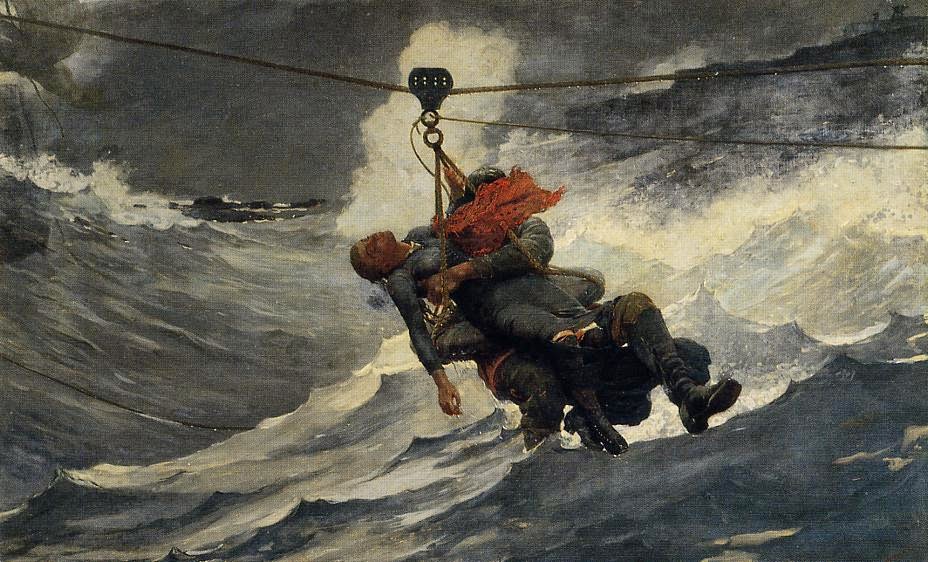
Winslow Homer “The Life Line

The situation at the border is a humanitarian crisis as well as a legal nightmare. How or why it is happening is less of an immediate concern than exists the problem of what to do. These are human beings, ‘foreigners residing among us’ as the bible says. Some are met with compassion. Others are met with anger.

Last week, it was reported from Florida that,

With more than 51,000 unaccompanied Central American children already here, and more expected to come, school officials ask the federal government for a helping hand.  Border kids costs more to educate, about $1,900 per head. Teachers must be bilingual. The students will need health care and psychological services because many arrive sick and traumatized by things they’ve seen and experienced on their journeys north

There is no doubt that sudden mass displacements either from refugees or immigrants, legal or otherwise, destabilize countries. Last month, Reuters reported from Iraq.

U.N. cites destabilizing risk of mass Iraqi refugee exodus

A senior U.N. humanitarian official on Tuesday flagged the risk of a mass exodus of Iraqi refugees from sectarian bloodshed overwhelming nearby countries already reeling from nearly 3 million uprooted Syrians. … “Looking at the situation of the countries of the region, I mean Syria is obviously not a possible destination (for Iraqi refugees), Jordan is now having the enormous pressure of the Syrian refugees,” Guterres said. “So it’s difficult to see how the region can cope with another big refugee outflow.

Two weeks ago, it was reported that,

Syrian Refugee Crisis Destabilizes Jordan

Almost 2 million people have fled Syria since the civil war began in early 2011, according to U.N. numbers. By some estimates 800,000 of these poured into neighboring Jordan, a traditional safe haven for refugees from previously war-stricken regions such as Iraq and Palestine. This influx is taking a heavy toll on the Arab nation which by the end of the year may host as many as a million refugees.  Instability in Jordan creates a dangerous situation for the region.

So in addition to the humanitarian crisis, the legal crisis, the political crisis, there now perhaps may be a threat to the stability of the United States through destabilizing the nation with a tsunami of refugees from Central America. Though in the face of the massive and longer term displacements from Syria and Iraq, and now Gaza, the few thousand along the lengthy US border can be put into a different perspective.It’s not so many people. And Turkey and Jordan are handling their thousands inflowing than we are handling our hundreds.

Winslow Homer “High Cliff” 1894

What are we to do? Is this the proper response?

The national controversy over a surge of Central American immigrants illegally crossing the U.S. border established a new battleground this week in a small Southern California town, where angry crowds stopped detained migrants from entering their community. The sentiment carried over to a raucous Wednesday night meeting at a Murrieta high school auditorium. Border Patrol and immigration officials got an earful. “This is an invasion,” attendee Heidi Klute said before a full house. “Why isn’t the National Guard stopping them from coming in?”

Not just Californians are angry, not just Floridians, but Texans as well. One woman at a raucous town meeting said, “What we see is not immigration, but an invasion, a deliberate invasion.”

When resources are scarce, people react with anger and fear. 9/11 changed Americans’ attitudes toward immigration, fewer believed it was a good thing for the US overall. 68% down to about half, 52%. (Wikipedia). With strange diseases popping up, and with the extreme drought already stretching local resources, residents react angrily.

And truly, if they had been mindful of that country from whence they came out, they might have had opportunity to have returned. But now they desire a better country, that is, an heavenly: wherefore God is not ashamed to be called their God: for he hath prepared for them a city. (Hebrews 11:15-16)

I do not have the answers. All I can offer is a historical perspective on nations, people-movements, and reasons for such restless seas. What is happening in the southern part of the US is not anything new. It isn’t particularly invasive, either, compared to the influx to Jordan and Turkey from Syria, and Lampedusa from Egypt and Libya. I can offer the biblical verses that shows Jesus  wants us to be compassionate and to show hospitality. I know it’s easy for me to say that far from the areas of tension. My water isn’t running out. My services aren’t stretched to the limit. My fears of crime or disease aren’t ignited. But isn’t that an opportunity for Christians in those areas to practice peace, love, and hospitality? Isn’t it an opportunity to show that we know we are not of this nation, we ourselves are sojourners and strangers. We long for a better country, we yearn to be reunited with our friends and families in heaven.

Yet…it is a fact that the bible also says to submit to the authorities. We can’t violate civil law. John MacArthur was asked about illegal immigrants in 1985-

Answering Tough Questions About the Christian and Government
WHAT ABOUT ILLEGAL ALIENS AND REFUGEES WHO ARE ILLEGAL IN THE COUNTRY, SHOULD THE CHURCH HARBOR THEM?

You might not realize this but we have had to deal with that not on a few occasions, of people who have come into the United States, for example, across the Mexican border or from Latin America, they come to California, they come to Los Angeles, they come to Grace Community Church, they come to a Bible study or whatever, perhaps in the Spanish department, they come to know Jesus Christ, they are saved, they become a part of the church and then we discover they’re here illegally. What is our responsibility?

Well the position we have taken on that is that our responsibility is to report them as illegal but do all we can to demonstrate that there are means to maintain their residence and presence and stand along side in any way we can to assist and help. But again, not to harbor them in violation of the law.

Now somebody is going to say, “Well, I mean, if they go back they’re not going to have any Christian friends, and so forth and so forth and so on.” The issue is not that, the issue is you obey what God says and you trust Him to take care of the circumstances. If we had a God who couldn’t be trusted, we might have a little problem here, right? If we had a God who couldn’t take care of them without us, we might worry about it. And so it becomes a situation where we need to go to the authorities and let them know what the situation is. We had a young man in a very unique situation some years ago. Came to the United States because he had kidney failure, couldn’t get dialysis in Mexico. Came to the United States, found here the ability to live and was saved, became a part of Grace Community Church and there he was an undocumented illegal alien, desperately in need to be here not only for spiritual reasons but for physical ones as well. And I don’t remember all the details of the situation except my memory serves to point out the fact that we did everything we could with the authorities who are not without some compassion and he was able to stay until eventually, I believe, he went to be with the Lord.

And behold, a lawyer stood up to put him to the test, saying, “Teacher, what shall I do to inherit eternal life?” He said to him, “What is written in the Law? How do you read it?” And he answered, “You shall love the Lord your God with all your heart and with all your soul and with all your strength and with all your mind, and your neighbor as yourself.” And he said to him, “You have answered correctly; do this, and you will live.”  But he, desiring to justify himself, said to Jesus, “And who is my neighbor?” (Luke 10:25-29).

That is the question. Who is my neighbor? Where is the peaceful shore?

——————–

Further Consideration:

Todd Friel of Wretched Radio had a short word, regarding the children of this current immigration influx

Immigration and the Christian: Should we send them all back?

Posted in bible, foreigner, hospitable, immigrants, refugees, United States

A two part look at the southern US border situation and influx of people

Part 2 here

Winslow Homer “Northeaster

But the wicked are like the tossing sea; for it cannot be quiet, and its waters toss up mire and dirt. (Isaiah 57:20)

[The ungodly are] wild waves of the sea, casting up the foam of their own shame; wandering stars, for whom the gloom of utter darkness has been reserved forever. (Jude 1:13)

The sea is an apt metaphor for the restlessness of the ungodly. They toss and turn, go to and fro, casting up muck and mire with ungodly thoughts and deeds. In Jude, he is speaking of infiltrating false teachers, but the metaphor is apt also to apply in general to the ungodly, their foaming spray prevents clear vision and in fact has no substance.

They waves dash themselves against the rocks, attempting to breach the ordained boundaries and come on a flood.

The situation at the southern border of the United States with Mexico has been in the news this past month. Thousands upon thousands of people are flooding across the border, seemingly unhindered. Many of these are children. It is difficult to determine why so many, why now. We have always has a porous border but it seemed that the limits were holding somewhat, but then last month the border suddenly collapsed and they came on in droves.

What do we call these people? Immigrants? Illegals? Refugees?

Winslow Homer “Summer Squall” 1904

I was asked to look into the situation and write about it. As with anything I write, I don’t like to simply put something out there and leave it adrift without context. Nor do I like to write something without having a solid Christian perspective on it. I like to embed a news piece or a situation in history and place a context on it, so we can understand what it means.

What is this crisis? Is it a humanitarian crisis? A refugee crisis? An illegal immigrant crisis? A deliberate enemy combatant strategy in asymmetrical warfare?

It might do to look at a few things first. Nations are artificial. Originally, God had us on one continent, speaking one language. One race, one people. After the flood, the bible seems to hint that the continents were broken up geologically and separated by seas.

To Eber were born two sons: the name of the one was Peleg, for in his days the earth was divided, and his brother’s name was Joktan. (Genesis 10:25)

In that way, the geography of nations was born. Genesis 10 outlines the Table of Nations and the fathers of those nations.

The population problem grew and grew. Nimrod settled the plains of Shinar and founded Babylon. He led the inhabitants into an apostasy revolt and built a tower to a false god. So God confused the languages and scattered the people across these recently divided lands. (Genesis 11:7-8). And so, the peopled nations were born. It was the first mass migration.

Winslow Homer, “After the Hurricane” 1899

Ever since, the peoples have been a restless sea, as Isaiah metaphorically proposed, throwing up muck and mire. After the end of the church age during the Tribulation, the antichrist will arise from ‘the sea’,

And I saw a beast rising out of the sea, with ten horns and seven heads, with ten diadems on its horns and blasphemous names on its heads. (Revelation 13:1).

Pulpit Commentary says of the sea in this verse,

The sea, again, is the type of instability, confusion, and commotion, frequently signifying the ungovernable nations of the earth in opposition to the Church of God

In some cases, peoples didn’t emigrate willingly. War or persecution struck many. The Old Testament has commands for how to treat “the alien” or the asylum seeker.

In fact, a multitude of Hebrews left Egypt with Moses. Jesus and his family fled persecution from Israel to Egypt. Leviticus 19:34 says,

You shall treat the stranger who sojourns with you as the native among you, and you shall love him as yourself, for you were strangers in the land of Egypt: I am the Lord your God.

Other translations of the Leviticus verse say ‘resident alien’ or ‘foreigner among you’.

And you are to love those who are foreigners, for you yourselves were foreigners in Egypt.  (Deuteronomy 10:19)

Do not despise an Edomite, for the Edomites are related to you. Do not despise an Egyptian, because you resided as foreigners in their country. (Deuteronomy 23:7)

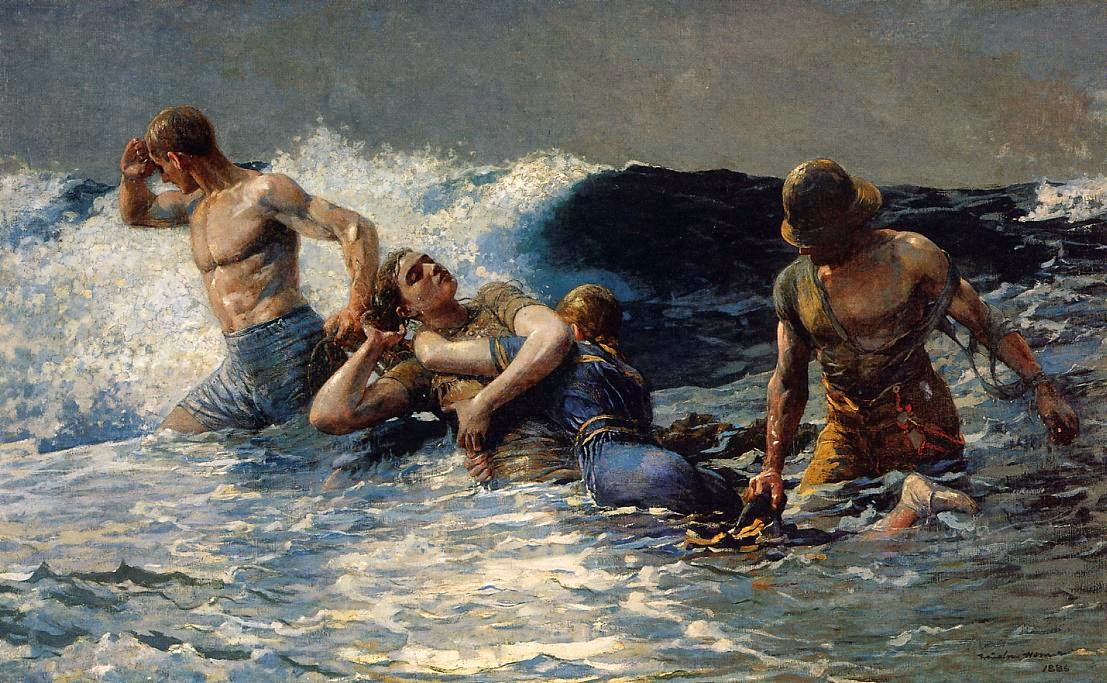
Winslow Homer “Undertow” 1886

In the New Testament, Matthew 10:23 describes persecution as one reason for mass migration.

But whenever they persecute you in this city, flee to the next; for truly I say to you, you shall not finish going through the cities of Israel, until the Son of Man comes.

Acts 8:1 records the persecutory migration of Christians from Jerusalem outward:

And Saul approved of his execution. And there arose on that day a great persecution against the church in Jerusalem, and they were all scattered throughout the regions of Judea and Samaria, except the apostles.

Ever since the separation of peoples into nations, they have moved restlessly from one side of the earth to another for one reason or another. They search for food (As Naomi and Ruth did). Sometimes they are captured and unwillingly brought to a new nation, as Daniel and his people were. (Daniel 1:1-3). Sometimes war and pestilence force them out. as the Acts 8:21 verse shows.

After Adam and Eve were forced to relocate from the Garden of Eden, they settled. Eve bore Seth, and they began to worship the LORD by name. (Genesis 4:26). Apostate, God-hater and rebellious Cain left that place, and he wandered. Cain left in search of a land that would accept him. He settled in Nod, east of Eden, and built a city; Genesis 4:16-17. Since the beginning, individuals, tribes, races, and whole populations have always moved. It is no different in these days.

Migration has always been a part of human history. But because of the widespread changes caused by globalization, more people are migrating than ever before. In the last 25 years the number of people on the move has doubled from 100 million to over 200 million.  Many migrants are forcibly uprooted and approximately 30-40 million are undocumented worldwide. (Source)

As one of the most complex issues in the world, migration underscores not only conflict at geographical borders, but also between national security and human insecurity, sovereign rights and human rights, civil law and natural law, and citizenship and discipleship. (Groody, NCR) (Source)

Winslow Homer “Eight Bells” 1886

From small tribes to mass emigrations, as Isaiah said, the unsaved are restless. Until the coming of the Son of Man, the Lion of the Tribe of Judah, to install His Kingdom and deliver peace…the people as the sea will always be looking for a new horizon, a better horizon.

Part 2, the migrations of today, including the southern US border.

———————

Further Consideration:

Todd Friel of Wretched Radio had a short word, regarding the children of this current immigration influx

Immigration and the Christian: Should we send them all back?

Posted in bible, civil law, gay marriage, homosexual, ryan anderson

Ryan Anderson explains why gay marriage doesn’t exist

Here is a 4-minute clip well worth watching for its logical, lawyerly speech regarding marriage. The responder is Ryan Anderson. Ryan T. Anderson researches and writes about marriage and religious liberty as the William E. Simon Fellow at The Heritage Foundation.

The homosexual man at the microphone is asking why he, as a married gay man, can’t have the same tax advantage when it comes time to file IRS tax returns, as a heterosexually married couple.

Anderson is brilliant in his response. The homosexual man doesn’t seem to understand the underlying principle of what Anderson tried to get at three times, so finally Anderson answers the gay man’s question within its limited scope. But he does that brilliantly too.

Then the man said,

“This at last is bone of my bones
and flesh of my flesh;
she shall be called Woman,
because she was taken out of Man.”

Therefore a man shall leave his father and his mother and hold fast to his wife, and they shall become one flesh. (Genesis 2:23-24)

Anderson said in part:

Marriage is a union of sexually complementary spouses, a permanent, exclusive union- man & woman, husband & wife, mother & father. If you’re not interested in entering into that sort of union, you’re not being discriminated against.

What you’re asking us to do is redefining marriage to include “the adult relationship of your choice.” The relationship of your choice happens to be a same-sex couple. There are other adults who want to redefine marriage to include a relationship of their choice, which may be the same-sex throuple, or the opposite sex quartet.

It’s like this. There is the color red. Red is known, it is certain. It is defined “of a color at the end of the spectrum next to orange and opposite violet, as of blood, fire, or rubies.”

EPrata photo

Now say some people came along and wanted to add yellow to the color red. They agitated for it, proclaimed, exhorted, fought for yellow to be added to red, just because they thought that would be good.

EPrata photo

And say that they were successful in getting yellow added to red. You don’t have red anymore. You have orange.

Because red and yellow make orange. Once you mix another element into the red, it becomes something else, and the old definition won’t fit anymore. People will not recognize the old thing because now it is a new thing.

Once you add same-sex humans to the old definition of marriage, it isn’t marriage anymore and it isn’t recognizable.

The homosexual man asked as a final question, why he, Anderson didn’t think that he, the gay man, had the right to get married.

Anderson concluded with this:

It’s not that you don’t have a right to get married, it’s that what you are seeking out, isn’t marriage.

Posted in bible, god told me, personal revelation, still small voice

How to respond to a "God told me" comment

source

In Christianity today, we have a major epidemic of use of the phrase “God told me”.

In some cases, God told me is shorthand for a process the Christian has undergone wherein they have read the bible to determine God’s will, have prayed, have submitted to Him and to church leadership, have counted the cost, and then have made a decision. Sometimes we’re guilty of saying “God told me…

–to join this ministry
–to become a missionary
–to leave this church
–to adopt a child

as shorthand for all the above. It is a poor use of the phrase however, and we shouldn’t say it. More on that in a minute.

More often it means that the Christian hasn’t heard from God but wants to elevate his decision into something inviolable, wherein the Christian’s decision can’t be held to account. After all, it was from God.

Other times, the Christian has received a supposed revelation and encapsulates that revelation by saying “God told me.” Many times they have received a dream, or a ‘nudge’ or have heard that ‘still, small voice’ and are basing their decision on this personal revelation from God on those things instead of the word and then trusting to providence.

EPrata photo

The ‘still, small voice’ is permeating Christianity, with the result that now most conversations among Christians are peppered with “God told me” as a result. This is partly thanks to Henry Blackaby, who opened the door to personal revelation in his “Experiencing God” workbook and series of lessons published in the 1990s. Baptists especially who had not been prone to mysticism prior to this, fell hard for the method the Baptist Blackaby was promoting. One reviewer of Experiencing God said here,

many readers will nevertheless find great encouragement in hearing a still, small voice among a vast number of everyday experiences.”

Blackaby taught: God Often Speaks in a “Still, Small Voice” (I Kings 19:11–13). Sometimes God will speak through “the wind or an earthquake or a fire,” but most often He speaks in a still, small voice. Be attentive!

‘Most often’? Where is that in the bible? Blackaby went on to sadly teach:

If you are not hearing God’s voice, examine your heart.

It is crushing to be told by an elder that we should be hearing from God, and if we aren’t we may be the problem!

Of the Mystical, Princeton theologian of yore BB Warfield said

There is nothing more important in the age in which we live than to bear constantly in mind that all the Christianity of Christianity rests precisely on “external authority.”

Relying on small voices, impressions, and God told me revelation diminishes the sufficiency of the bible by virtue of the fact that someone is adding to God’s revelation. The bible isn’t enough for them. In His book Things that Go Bump in the Church, Mike Abendroth along with co-authors Byron Yawn and Clint Archer explained in their theological decoder, that when you hear people say “God told me, it really means,

I really think I should do ______ but I’m forgetting that the canon of scripture is closed and there is no need for further revelation. I want confirmation for my precarious decision, and I’m mistaking intuition for God’s voice. I’m forgetting to follow Proverbs 3:5-6.

So we know that the still small voice is a twisted use of scripture ripped from its context, and the God Told Me phrase could either be shorthand meaning a biblical process a person has gone through or a short cut from reading the bible and a cover for their poor decision making. So here is the question I was asked:

How do we respond when someone says “God told me…”

It was a great question. Let’s get practical. I thought of a few responses, gleaned from the very good articles, sermon, and audio lessons linked below. Some of the responses below are mine, and some are a mixture from the articles below which are excerpted and reworked. They are not inclusive, or may not even be appropriate for you or your situation. But they may provide a start in your own thinking. Please search the scriptures for relevant verses which speak to this issue.

I recently wrote a serious piece about the Third Commandment, taking the Lord’s name in vain. One way to take it in vain is to trivialize it, to be swift or short. We have to be careful never to ascribe to Him thoughts He doesn’t have or things He never said. “God told me” very often does just that though, trivializes His name by ascribing things to Him He never said. It is a serious thing to say “God told me”!

I find that asking questions initially is the best way to begin. Be sincere in asking questions. Perhaps the person truly is using the phrase out of habit because everyone else does, or simply hadn’t thought about its use in light of the Third Commandment before.

  • I thought that the biblical canon is closed, that God has already told us everything we need for life and godliness.
  • I’d be too wary of the risk of introducing error to our lives and to the church to depend on a whisper voice.
  • I don’t believe God needs to give us special revelation to reaffirm what he has already told us to do in his word.
  • Did an angel deliver the news to you, like in the bible?

Here are a few more:

  • How did you test it to see if it is really of God? 
  • How can I test to see if it really from God? (special implications for married couples, business partners, or others in different kinds of partnership or ministry)
  • How do you know it’s not your intuition?
  • The only time I’m ever 100% sure God is speaking to me is when I am reading the Bible.
  • I can’t trust my heart or mind to speak to me because of Jeremiah 17:9 which says, “The heart is deceitful above all things and beyond cure. Who can understand it?”
  • I’m too mindful of the scripture in 2 Corinthians 11:14 which says “And no wonder, for even Satan disguises himself as an angel of light” to trust whether inner impressions are  from God. I just make my decision if it is within the biblically revealed will of God and trust Him top providentially work all things to the good for those who love Him (Rom 8:28)
  • What scripture were you reading, I’ll look it up (I wasn’t reading scripture). Then how do you know it’s not your own idea?

This next batch are reworked from the Cornestone link below, a piece taking Mark Driscoll of Mars Hill Church to task some years ago by declaring God speaks to him. These are a little edgier.

  • I’d be too scared to say ‘God told me’ because of the seriousness of the 3rd commandment, not taking God’s name casually, just in case He didn’t say what I thought He said. I usually just say “I have decided to…please pray for me”.
  • Do you think that that believers have access to “personal revelation” from God that equals/trumps the revelation of scripture?
  • Do you think that your subjective, personal experience of a word from God is in authority over the objective truth of scripture?
  • Do you think that your revelation minimizes the role of scripture in personal experience and the need for the faithful interpretation of scripture?

Those are some ideas…please let me know how you react when someone in conversation says to you “God told me”, or if you have said “God told me” and were reacted to.

~~~~~~~~~~~~~~~~~~~~~~~~
Further reading

Does God give us personal direction through a still small voice? 2-min audio lesson

The Still, Small Voice (sermon by Phil Johnson)

God told me…really?

Why Do We Say…’God told me’?

The Danger of God Told Me reflections

Posted in atonment, bible, justification, thief on the cross

Lessons from the Thief on the Cross

Jesus was crucified between two criminals, one to His right and another to His left. (Luke 23:33). They were thieves. (Matthew 27:44).

One of the criminals who was hanged railed at him, saying, “Are you not the Christ? Save yourself and us!” But the other rebuked him, saying, “Do you not fear God, since you are under the same sentence of condemnation? And we indeed justly, for we are receiving the due reward of our deeds; but this man has done nothing wrong.” And he said, “Jesus, remember me when you come into your kingdom.” And he said to him, “Truly, I say to you, today you will be with me in Paradise.” (Luke 23:39-43)

What was the forgiven thief’s name?

[crickets]

We don’t know, do we? When we look at the passage, often what is looked at, rightly, is the Lord’s compassion for man that He would ignore His own pain and minister to the sinners. Also, people use the text as proof that one can be justified without having done works such as baptism or partaken of the Lord’s Supper.

But what I’d like to look at is the man’s anonymity. All we know of him is that he is called The Thief on the Cross.

How would you like to be forever known by your sin? A thief. Forever.

There were others known by their sin, forever nameless in the bible. For example, there was–
–The Adulteress (John 8:3)
–The Serial Co-Habitating Woman at the Well (John 4:18)

What we know is that in the last moments of His incarnation, the last sinner whom Jesus justified was a thief. That’s what makes the thief special. He is forever identified with his sin. Not his name, not His socio-economic status (Rich Young Ruler, The Rich Man and Lazarus) not his race (Syrophoenician Woman). He was a thief, a criminal, and unnamed.

What makes the thief not-special is that you or I could have been that person on the cross next to Jesus just as easily. Having broken some Jewish Law or a Roman civil law, you or I could be executed for our crimes too. All crimes are sins against God. You could be —

–The Lustful Woman on the Cross
–The Liar on the Cross
–The Greedy Defrauder on the Cross
–The Hypocrite on the Cross
–The Embezzler on the Cross
–The Porn Addicted Man on the Cross

Forever identified not as a person by your sin. Indeed, the other thief is forever identified by his sin at this moment, he died not believing.

However, the thief’s notability is that he was the LAST person to be identified by His sin. Why? Colossians 2:13-14 says

And you, who were dead in your trespasses and the uncircumcision of your flesh, God made alive together with him, having forgiven us all our trespasses, by canceling the record of debt that stood against us with its legal demands. This he set aside, nailing it to the cross.

The thievery is nailed to the cross, but the thief is alive! He is restored! He has a name! We will know him in heaven!

The atoning work of Jesus Christ is full of mercy, grace, and compassion, of which we startlingly see demonstrated by the conversation between the thief and the Messiah. Our sins are forgiven, and we are no longer known as sinners with names such as The Thief, the Adulterer, The Liar. We are known to Jesus as children of God, washed in His blood, made alive via the cross, where our sins are still nailed. The anonymous now have a name, and the dead shall live.

Hallelujah!

Posted in bible, christian life, mothers, spurgeon

The importance of Mothers

I mentioned in a post a earlier today that I’d received a pile of books, one of them being the “Life and Works of Rev. Charles H. Spurgeon” (Memorial Edition), January 1, 1892. It is a biography of Charles Spurgeon, the famous preacher of the late 1800s.

In endeavoring to illustrate to the reader the influences of Spurgeon, it is noted that his great-grandfather, grandfather, and father were all preachers. The life and works of these respected men was much detailed, and used as an important illustration of the influence onto Spurgeon the son.

However, the mother is not left out. She is an important influence also. It was written of Charles Spurgeon’s father and mother,

“Both Mr and Mrs Spurgeon made great sacrifices of personal comfort to give good education to their children, and the children were taught the habits of thrift and self-denial. The care thus bestowed on their training when young has been to the parents a source of much satisfaction; the good results of that care are manifested in the happy home lives of their children. When, at some future period, the historian of the Metropolitan Tabernacle and of the Stockwell Orphanage is considering the primary cause of those great enterprises, the care which Mrs Spurgeon bestowed on the early training of her family must be counted as valuable auxiliary in preparing the way for such exemplary conduct.”

In addition, of Mrs Spurgeon solely, we read the following: (and please note Mrs Spurgeon bore 17 children, with nine of them dying when they were babies and she raised 8, all while her husband was often gone for long periods traveling the preaching circuit.)

Household Nurture

As the children were growing up, the father, like many professional and public men, feared his frequent absence from home would interfere with the religious education of the little ones. But happily for him he had a true helpmeet to cooperate with him in this important work, and happy for those children they had a noble mother who lived for them, and sought to build them up in true Christian character. Nor had she lived unrewarded for her pains. Hear the good man speak thus of his wife:

“I had been from home a great deal, trying to build up weak congregations, and I felt that I was neglecting the training of my own children while I was toiling for the good of others. I returned home with these feelings. I opened the door and I was surprised to find none of the children about the hall. Going quietly upstairs, I heard my wife’s voice. She was engaged in prayer with the children. I heard her pray for them one by one by name. She came to Charles and specially prayed for him, for he was of high spirit and daring temper. I listened till she had ended her prayer, and I felt and said, ‘Lord, I will go on with Thy work. The children will be cared for.”

Thank You Lord for Godly mothers! Thank You for Godly fathers!

Posted in bible, grace, jesus

Two Mother’s Day essays for those who have a problem with Mother’s Day

Sunny Shell: Celebrating a Different Kind of Mother
But this picturesque vision of a mother is not true for everyone. Some of us grew up in homes with parents who were atheists, agnostics, followers of false religions, or even worse…some of you were raised in homes with mothers who professed to be a Christian, but neither her living nor teachings were in accord with God’s word and she defiled your mind and polluted your heart with the vulgar, self-centered, and obscene things of this world.

Please read more from the headline link

EPrata photo

The Federalist: Mother’s Day is the Worst
If you haven’t been paying attention to your calendar, reminder emails, or non-stop television advertisements, let me be the first to tell you that Mother’s Day is on Sunday. This is also, as it happens, the worst holiday of the year. Why? It Can Be Super Cruel. But some time ago a friend of mine told me that at her church, a family had bought flowers to give to mothers as they walked out of services. This is a lovely idea to honor the wonderful work that mothers do. But it can be incredibly difficult for women, like my friend, who have just miscarried a child and are distraught about it. Given how commonplace infertility is, and how uncomfortably painful it is to endure, it’s almost a guarantee that some rah-rah-motherhood fest will hurt women we love. Churches seem to be the primary location for this well-intentioned humiliation. Pastor Michael Schuermann says that “attending church on this particular Sunday is often an exercise in frustration, woe, even great shame brought on by the absence of longed-for children.” He has some advice for pastors:

Please read more at the headline link.

Matthew 19:29 assures us, “And every one that hath forsaken houses, or brethren, or sisters, or father, or mother, or wife, or children, or lands, for my name’s sake, shall receive an hundredfold, and shall inherit everlasting life.” (KJV)


Posted in Aaron, almond tree, bible, jeremiah, resurrection, symbol

The Almond Tree: the promise and the beauty, a symbol of resurrection

Most of us aren’t farmers. Many of us don’t garden. Having lost our connection to the land, sometimes the biblical symbolism of certain agricultural meanings are lost to us. Let’s look at the almond tree.

Flowering almond trees, Wiki CC, by Daniel Sancho

The almond tree is mentioned in scripture several times and always in interesting contexts. Almond tree twigs are mentioned as early as Genesis 30:37 and Genesis 43:11. In Exodus 25:33, God is describing how the Golden Lampstand in the Tabernacle should look.

Source

Sweet almond tree branch with blossoms. Wiki CC

three cups made like almond blossoms, each with calyx and flower, on one branch, and three cups made like almond blossoms, each with calyx and flower, on the other branch—so for the six branches going out of the lampstand.

Calyx is the collective name for sepals of a flower. Easton’s Bible Dictionary explains,

A native of Syria and Palestine. In form, blossoms, and fruit it resembles the peach tree. Its blossoms are of a very pale pink colour, and appear before its leaves. Its Hebrew name, shaked, signifying “wakeful, hastening,” is given to it on account of its putting forth its blossoms so early, generally in February, and sometimes even in January

The International Standard Bible encyclopedia says,

The masses of almond trees in full bloom in some parts of Palestine make a very beautiful and striking sight. The bloom of some varieties is almost pure white, from a little distance, in other parts the delicate pink, always present at the inner part of the petals, is diffused enough to give a pink blush to the whole blossom.”

Did you know that there are sweet almonds and bitter almonds. Bitter almonds are toxic. It becomes cyanide when crushed and mixed with other enzymes inside the almond.

Gabriel Garcia Marquez once wrote poetically about the scent of bitter almonds and the fate of unrequited love as a lead-in to murder by cyanide poisoning. And in bitter almond oil as in a tragic romance, the sweet and the toxic are inextricably entangled.

Benzaldehyde is made by the decomposition of amygdalin (named for Prunus amygdalus, and in turn responsible for the bitterness that gives bitter almonds their common name). The other decomposition products are glucose (sweet) and hydrogen cyanide (toxic). … The utility of amygdalin to the plant is for defense, specifically as a deterrent to grazers from eating the valuable seed as well as the dispensable fruit. Inside the cells of the almond kernel, amygdalin is sequestered from the enzyme that breaks it down: amygdalin hydrolase. Crushing, as happens when the plant is grazed upon, brings the enzyme and amygdalin together, and cyanide is produced as a result–as much as 4-9mg per almond.”

Aaron’s rod famously budded almond leaves, blossoms, and fully ripe fruit. The LORD did this to prove that Aaron was His designated spokesman, with Moses.

On the next day Moses went into the tent of the testimony, and behold, the staff of Aaron for the house of Levi had sprouted and put forth buds and produced blossoms, and it bore ripe almonds. (Numbers 17:8)

As with Aaron’s rod, Jeremiah 1:11 use of the almond as a symbol. Jeremiah 1:11-12:

And the word of the Lord came to me, saying, “Jeremiah, what do you see?” And I said, “I see an almond branch.” Then the Lord said to me, “You have seen well, for I am watching over my word to perform it.

Pulpit Commentary says of Verse 12. – I will hasten my word; literally, I am wakeful over my word; alluding to the meaning of the Hebrew word for almond. The LORD will hasten to perform His judgments of Jerusalem which He proclaimed in His word to Jeremiah.

It was inevitable: the scent of bitter almonds always reminded him of the fate of unrequited love.”
Gabriel Garcia Marquez, ‘Love in the Time of Cholera”.

In Genesis 43:11 one of the ‘best gifts’ of the land that Joseph’s father Jacob urged his sons to bring to Egypt (unknowingly, to Joseph) were almonds.

In Plants of the Bible, it says, “The almond, Amygdalus communis, is a medium sized tree with narrow, light green leaves. Unlike the fig and olive, the almond does not live to a great age. The almond is a well-known symbol of resurrection because it is the first tree to flower. The white, five-parted flowers are up to two inches across and come in the late winter before the leaves of the tree develop. Because they may flower as early as late January or early February, it is sometimes possible to find almond flowers with snow.

Charles Spurgeon preached on the lessons of the Almond Tree. He says here,

“While I have felt compelled to speak of these solemn Truths, I am glad to turn to the other part of the subject which is this—that God is quick in performing His promises. They are like the almond tree—they blossom and bear fruit very quickly. “What sort of promises,” you ask, “are thus speedily fulfilled?” Well, first, the promise to give salvation to all these who believe in the Lo rd Jesus Christ. Listen— “The moment a sinner believes, And trusts in his crucified God, His pardon at once he receives, Redemption in full thro’ His blood.” I see “a branch of an almond tree” here. The Psalmist says, “His word runs very swiftly,” and I am a witness that it does. Many years ago, I, a poor sinner, went into a place of worship to hear the Gospel preached. The preacher repeated the Lord’s command, “Look unto Me, and be you saved.” I looked to Christ and I was saved that very instant. It takes no longer to tell the story than it did to work the miracle of mercy. Swift as a lightning flash I looked to Christ, and the great deed was done! I was a pardoned and justified soul—in a word, I was saved! Why should not the same thing happen to you who are here? It will happen to everyone who shall now be led to believe in Jesus Christ.”

On this most joyous of days, you who wonder at our joy, it is because we looked to Christ as our all in all, forgiver of sins, Lamb of God. You, also, look to Christ – and be saved. The almond tree blooms, quick with promises. The most wondrous promise of all is the resurrection of the Son of God.

Aaron’s rod budded, sprouted, and offered fully formed fruit, all at the same time. “According to the law of nature, all living things have a beginning and an end. However, this was not the case with Aaron’s rod, for God gave it a new lease of life. This miracle hinted at the resurrection of Jesus Christ. Even though death came to the world because of the actions of the first man, Adam, resurrection would come about on account of Jesus Christ (1 Cor 15:17–22). Hence, when Jesus was about to raise Lazarus from the dead, He told Martha, “I am the resurrection and the life. He who believes in Me, though he may die, he shall live” (Jn 11:25). … the flowering rod served to quell Korah’s rebellion and re-affirmed Aaron’s position as high priest. Furthermore, this wondrous sign hinted at the future Messiah and His status as the firstfruits of resurrection (1 Cor 15:20).” (source)

He is risen!

————————-
Further Reading

The Sign of the Almond Tree

The Lesson of the Almond Tree

Daily Bible Study: Almonds

Posted in bible, challies, commentaries, discernment, macarthur, matthew henry, spurgeon, teaching

Sayings and mottos that sound pious but aren’t. #2: "I don’t use commentaries because they’re men’s wisdom. I only use God’s Word when I study."

Part 1 of the series, Sayings and mottos that sound pious but aren’t. #1: “Let Go and Let God”
Part 3 of the series “I’m too humble to think that I could ever know what the Bible really means”
Part 4 of the series  Pray Big Because We Have a Big God
Part 5 of the series He’s so heavenly minded he’s no earthly good

Spurgeon

Some sayings sound legitimate on their surface. They sound pious. They sound biblical. Like this one: “Cleanliness is next to Godliness”. Only problem is, that one isn’t in the bible. At all.

It is sometimes hard to tell what truly is Christian and what merely sounds Christian. Charles Spurgeon wisely said, “Discernment is not a matter of simply telling the difference between right and wrong; rather it is telling the difference between right and almost right.” So what is right, and what is almost right (AKA ‘wrong’) about the following sayings which have become such cliches?

Some of these mottoes are:

  1. “Let go and let God”
  2. “I don’t use commentaries because they’re men’s wisdom. I only use God’s Word when I study.”
  3. “We can’t know for certain what the bible means, I’m not that smart”
  4. “Pray big because we have a big God.”
  5. “He’s so heavenly minded he’s no earthly good”

In part 1 we looked at “Let go and let God.” Now let’s look at #2,

“I don’t use commentaries because they’re men’s wisdom. I only use God’s Word when I study.”

“It has been the fashion of late years to speak against the use of commentaries…A respectable acquaintance with the opinions of the giants of the past, might have saved many an erratic thinker from wild interpretations and outrageous inferences.”
CH Spurgeon
Beth Moore says this a lot. It sounds like she’s being diligent and pious, doesn’t it? The phrase actually has a legitimate root. It’s called biblicism. GotQuestions defines biblicism as “Biblicism: a high regard for and obedience to the Bible as the ultimate authority” and this is a good thing.

However, many people take biblicism to an unintended end by rejecting all supportive works recognized as legitimately helpful by the Christian historical record.

It is less than pious to reject the wisdom of the faithful men God has raised up for our learning. God took time to mold men, justify them, install the Spirit in them, educate them, and empower them for good works. When we say “I don’t need commentaries” what we’re saying is that though we believe we have all the power necessary to learn all we need from the bible, (and we do, by the Spirit) it means we also totally reject God’s work in these men. It’s like saying, “I don’t need to listen to my pastor’s sermons because they are a man’s wisdom. I only need God’s Word” and then cover your ears in the pew and go la la la the entire sermon.

Jonathan Edwards

Who doesn’t need to read Jonathan Edwards’ sermon Sinners in the Hands of an Angry God? Who isn’t blessed in reading SPurgeon’s sermon on God’s Providence? Who doesn’t need to listen to Martyn Lloyd-Jones’ sermon series on the Great Biblical Doctrines? Who can’t use a Matthew Henry or a John MacArthur commentary? Do the people who make this impious claim really understand what they are saying? More to the point, do they realize what they leave themselves open to? Solid biblical and theological scholarship that comes from seminaries and universities or from church fathers obviously in the Spirit (such as Spurgeon who never went to college OR seminary) who remain adherent to God’s word, is teaching that actually guards us against heresy and helps us to remember of the hard lessons of church and martyrdom history.

It seems odd, that certain men who talk so much of what the Holy Spirit reveals to themselves, should think so little of what he has revealed to others. ~Charles Spurgeon

In almost every book or Bible study since Breaking Free, when Moore began to depart from the bible, Moore relates experiences of direct revelation from God or conversations with God. This is what will tend to happen as one rejects solid teaching supplements, begins to slack off in personal study, and fall into the trap of mystical intuition. We need as much help as we can get to remain on the right side of sound doctrine. (Titus 2:1)

“The best commentators are those who have written upon only one book. Few men can comment eminently well upon the whole Bible.” Charles SpurgeonAnd there are also a few logical facts to consider…

In and of ourselves, we aren’t the end of all wisdom about God’s Word. So sometimes we need a little help. That’s what commentaries are for, to help us understand the Bible better. Now, of course studying the bible alone is preferable. It is THE starting point. But it shouldn’t be the only method. Be discerning. But don’t neglect the historical wealth of God’s work in good men.

Martin Luther

In this issue of the student magazine, The Encourager, the author William J. Brown wrote, “To say the written wisdom of Spurgeon, Whitefield, Wesley, Calvin, Luther, Augustine and others have no bearing on our lives shows a bit of arrogance on our part. All we have left of these men is what they wrote. Their pastoral voices cry from the pages of ink-stained books. These men were wise (in many ways much wiser in their times than we are in ours.) We need to listen to these men and the things they desire to teach us about God’s Word.

One caution: Do not allow commentaries, sermons, books, or other notes to dictate to you about what the bible says and means. Begin with the Word of God itself and allow the Spirit room to work in illuminating it to your mind.

Here are some resources for you:

John MacArthur essay: How to Enjoy Bible Study

Kay Arthur’s study “Titus…Living with Integrity in a Hostile Culture” begins with an explanation about

Kay Arthur

inductive bible study- what it means and how to do it. [note: link is to .pdf]

How to Use Bible Commentaries

In keeping with Spurgeon’s exhortation that the best commentaries are ones where the author focused his heart, mind and attention on one book, the standout which comes to mind is Dr Martyn Lloyd-Jones’ exposition on Romans. As The Banner of Truth explains, “All over the world in the most diverse situations are to be found Christian men and women who owe an incalculable debt to the ministry of Dr. D. Martyn Lloyd-Jones who for thirty years was the minister of Westminster Chapel, London. His longest series of expositions was this 14 volume set of Romans, the greatest of New Testament Epistles.”

Martyn Lloyd-Jones sermons on Romans (free)
Martyn Lloyd-Jones commentary on Romans, 14-volume set for purchase

Pastor & book reviewer Tim Challies often makes recommendations on good commentaries. This link leads you to his page titled Best Commentaries on Each Book of the Bible

Wiki Commons, Amish housewife

To be sure, we strike a delicate balance between relying on the Spirit to illuminate the scriptures to us and consuming work the Spirit previously did in other men. We acknowledge that while He is all-sufficient for leading us into all truth (John 6:13), He is always working (John 5:17) and His work includes illuminating the meaning of scripture in others, too, who wrote it down for us.

Ultimately, the important thing is to actually read the bible. One may be surprised at how few people actually read it. I understand lives are busy. There’s a tendency to rely on one’s intuition, or at the other extreme, other people’s commentaries. Reading the bible is hard. Moms are busy, Dads are tired. Satan wants us to set daily reading aside ‘just for today.’ Soon you realize it has been two months.

When you begin, sometimes the text itself is hard to read. I just finished 1 & 2 Kings, and man, it was rough going. I hardly understood anything. The history was unfamiliar to me, the names were difficult to read and pronounce, the list of kings was confusing. I wanted to revert to the Prophets so many times, texts I love! But it’s important to just keep reading. Next time I read something from 1 or 2 Kings, it will be a bit easier. I needed to break that trail.

And now for something completely different, I think I’ll read Galatians next.

I use commentaries after I read a text, Vines Expository Dictionary of New Testament Words, old and new maps (I love seeing where these things are taking place), natural histories (if animals are mentioned or if the topography is important to the story), a Lexicon, Strong’s concordance, parallel verses, and more. I want to understand as much as possible about the text after I read it.

For example, it was helpful to know a simple thing like when I read “A Psalm of Ascents” to hear Phil Johnson explain that when the Israelites had to go to Jerusalem for a feast, it was uphill all the way. So they sang these song as they ascended. I looked up the topography and now I can better hear their singing in my mind and feel the dust under their feet and their tired legs as they ascend. Or when Elijah fled Jezebel from Mt Carmel to Beersheba to Mt Horeb, to see where he ran to and how far it was on a map.

Rely on scripture as your authority to learn the word of God and His revealed nature, and use supporting texts to expand your understanding for context and historical meaning. Don’t be abusive with them but don’t be ashamed, either. But above all, read the bible.

Commons, Photo by Savio Sebastian
Posted in bible, discernment, ephesian curch

"Spot the Difference at the E Churches – Reformation21 Blog"

I read this from Carl Trueman at Reformation 21 blog, and I thought it was terrific. I love doing what he did. We tend to overcomplicate things, and we tend to stray from the Word. If we just compare what we do or say to the bible, we are all set. The bible brings clarity to everything.

~~~~~~~~~~~~~~~~~~~~

Spot the Difference at the E Churches
Posted by Carl Trueman

I wonder if highly observant readers can spot the subtle differences between these two descriptions of the ideal candidates for ministry?

Elevation Church:

The typical applicant is 23-30 years of age who is a recent college/seminary graduate or someone with relevant experience. However, do not let the age range deter you from applying. The applicant should also be someone seeking to join with Elevation Church, who is a high capacity leader with the ability to multi-task and thrives in a fast paced ministry environment.

Ephesian Church:

The saying is trustworthy: If anyone aspires to the office of overseer, he desires a noble task. Therefore an overseer must be above reproach, the husband of one wife, sober-minded, self-controlled, respectable, hospitable, able to teach, not a drunkard, not violent but gentle, not quarrelsome, not a lover of money. He must manage his own household well, with all dignity keeping his children submissive, for if someone does not know how to manage his own household, how will he care for God’s church? He must not be a recent convert, or he may become puffed up with conceit and fall into the condemnation of the devil. Moreover, he must be well thought of by outsiders, so that he may not fall into disgrace, into a snare of the devil.