My father died in 2014. He was 81. He had never said “I love you” to his daughter.
Now he never will.
It’s a truth that doesn’t get any easier the older one gets. It’s actually harder to get used to the longer one drifts in time away from his death date, not easier.
He was a hard working man. He was a gifted raconteur. He was a wealthy man. He was a lot of things. But a father? Not so much. His ignoring of his kids as they grew, his intermittent but frequent abandonment of them as adults, his final, legal disownment of them as he aged all were stunning betrayals in the lives of three children, with untold consequences.
Every daughter can tell a different story about her father. Some stories are good, some are bad. Some are neutral. Some are bitter and some are sweet. Fathers, dear reader, have an effect.
There is a short film called The Father Effect. It is good.
The producer of this movie lost his own father to suicide when he was a boy. As he stated in the movie’s Mission page, the resulting film is his attempt
to educate, equip, & encourage men to be the dads God created them to be
Many of the people with whom I am connected through media and in real life have great parents who they honor and feel blessed to have grown up under. Others have disappointing stories they share, either freely or privately. Whatever the case with you, you know fathers have an effect on you for life. I worry for the fatherless who don’t have the solace of Jesus. For those among you who have had a less than blessed childhood, but are now safely home under Jesus’ wings, you know you have a REAL father. Jesus will love you forever, never abandon you, and is in fact, perfect. What a blessing this is. He is not only as Prophet, Priest, and King, but friend, brother, and Father.
The Encouraging Dads Project was an idea that came out of John’s experience in making The Father Effect Movie. As John talked to dads from all walks of life, he heard heartbreaking stories about how dads feel beat up, discouraged, and frustrated with their lives as dads. John was moved to do something to help encourage and inspire dads and The Encouraging Dads Project was born.
Take some time to encourage your Dad. Encourage a dad. Encourage a man who was a dad to you. Encouragement is free, and only takes a few moments. Send a letter, make a phone call, send a text, make a date to take him out for coffee. Tell him how special he is to you.
Dads, do the same for your daughters. If some time has gone by since you talked to her, take a moment to let her know how much she means to you, how proud of her you are, that you love her. My dad in all probability never confessed and repented and probably died outside of Christ. It was a sudden hit in a car crash. Boom. Gone.
He and I will not meet again, and I’m sorrowful for that. Eternity will go on and I will be loved perfectly by many fathers, and THE Father. I will forget the former troubling things, including Dad. He will remember everything, forever. If there is sorrow over your relationship with your dad, if you are on opposite sides of the salvation fence, let that fact weigh on you, and as the men in The Father Effect say, forgive.
Caption: “Our purpose in making this film is to create an awareness in fathers about the significant impact their words and actions have on their children and to help them become better fathers.”
And everyone who has left houses or brothers or sisters or father or mother or children or lands, for my name’s sake, will receive a hundredfold and will inherit eternal life. (Matthew 19:29).
The Bible is disgusted by false teaching and is strong on pure doctrine. Why? The consequences of error are dire.
Scottish Divine James Durham said, “Error destroys the soul (2 Peter 2:1; 2 Thessalonians 2:12). In fact, it brings on swift damnation ( 2 Peter 2:1). It overthrows the faith of many (2 Timothy 2:18), perverts Scripture to people’s destruction (2 Peter 3:16), and deceives many (Matthew 24:11). For this reason, it is also called damnable and pernicious (2 Peter 2:1-2).”
Further, Durham wrote, “No titles carry greater indignation and abomination than the titles given to such people. They are generally called dogs and evil workers (Philippians 3:2); wolves, or rather grievous wolves (Matthew 7:15; Acts 20:29), deceitful workers; ministers of satan, as if they were expressly commissioned by him (2 Corinthians 11″13); deceivers and liars (Revelation 2:2); evil men and seducers, who wax worse and worse (2 Timothy 3:13).“
False teaching is not to be overlooked, dismissed, watered down, or ignored. It is serious, serious business. There is correct doctrine and there is incorrect doctrine. One pleases the Lord. The other provokes His wrath.
The problem is ancient, it began in time immemorial past in heaven when satan, puffed with pride and ambition to unseat God, lied and enticed many holy angels to quit following God and to follow him. They took the swap and thus they fell and became demons. Satan brought the problem to earth in the Garden where he tempted our first parents and they fell, bringing the future entirety of humankind with them. Satan’s deceptions have continued, with warnings and prohibitions to us from God, through the Old Testament to the New, and into this very day.
That’s one path, the wide one. One side of the light vs. dark saga.
Alternately there are those on the narrow path. God raises up ministers for His name in every generation who are stalwart, true, persevering, and edifying. After Jesus came the Apostles, then the church fathers, the medieval men like Wycliffe and Hus, the Reformation men like Luther and to the Puritans and post-Puritans like Edwards, and the mid twentieth century men like Gerstner, Sproul, Lloyd-Jones. Today we have the new men like Riccardi, Pickowitz, Buice, James Coates…
The Lord always raises up good men, and aside from the ones mentioned, there are thousands and millions more He raised up that we never heard of but who labored faithfully to their end, and were brought to the bosom of their Priestly Shepherd to enjoy rest from ministering and to the bliss of being with the leader of the true Church.
This dichotomy of false teaching vs. true was brought to mind this week as I noticed two famous people are having birthdays a few days apart.
John MacArthur and Beth Moore. I have been involved at a distance with both these folks for a long time. I’ve seen the trajectories. I’ve read and listened to their works. And the starkness could not be more clear. Beth Moore’s output has damaged the faith and in many cases brought it into disrepute, while MacArthur’s has strengthened it and honored the Lord’s name.
John MacArthur will turn 85 years old on June 19. He has been ministering as pastor-teacher at Grace Community Church for 56 years. He was ministering 5 years before that as an associate pastor. He has been actively serving the Lord for 61 years. The Lord is gracious to give us all these decades with him, and surely his impact has been great.
He has never wavered on the authority of scripture, cessationism, young earth creationism, complementarianism, dispensationalism, the Lordship of Christ, proper Christology, and gender and sexuality. He has preached through every book of the New Testament verse by verse, which took 45 years to accomplish. He has written over 150 books which have been translated into myriad languages, faithfully shepherded his congregation week after week, withstood the covid closures, led a solid seminary, and has been acknowledged by Christianity Today as one of the most influential preachers of his time. His MacArthur Study Bible has sold more than one million copies, receiving a Gold Medallion Book Award. That Study Bible has been in the hands of pastors from the icy Faroes in the Arctic Circle to dusty back roads in Africa, to the jungles of Peru.
Certainly there are many other private ministrations in Jesus’ name that only MacArthur and the Lord know about between them. He is in a long line of blood-bought pastors who have risen to public knowledge and have edified many who learn from him and watch his godly life as one to imitate. Paul said “Be imitators of me, just as I also am of Christ”. (1 Corinthians 11:1). This means, “he was instructing us as believers to carefully examine our Savior’s life and the lives of His faithful servants. He gave a similar command earlier in 1 Corinthians 4:16: “Therefore I urge you to imitate me.” In the original Greek, the verb translated as “imitate” in 1 Corinthians 11:1 and 1 Corinthians 4:16 is mimētai and means “become a person who copies the words and behaviors of another.” (Source GotQuestions).
Perhaps the Lord has left MacArthur on earth so long in order to demonstrate His sustaining power in a faithful life that started and so far is ending well. The Lord is good to us.
For 45 years Beth Moore has been speaking here, there, and everywhere she possibly could. Regrettably, her speaking engagements have been laced with error and deception. She began, by her own words, in her early 20s as a “Christian Motivational Speaker”. She never left that profession, really. Then when she was 27 she began teaching a Sunday School class, but she said she was also “learning the scriptures” at that time. It’s a tragedy that they put her into a position where she was simultaneously learning the Bible AND teaching. She wasn’t ready.
Again by her own words, her class was “packed” and they all “had a blast” but “we weren’t really studying the scriptures”. Why? Because Beth said she “just thought up things to talk about and then I got panicked on Saturday because I think where is a scripture to go with it.” She never grew out of that improper hermeneutic even with “the doctrine class” she took. It was still motivational speaking but with with a thin Christian overlay of out of context sprinkled verses.
Did you know that Beth briefly attended seminary but dropped out? Why? She was “reading the environment and coming to the realization of what my opportunities would and would not be.” She chafed against the biblical hierarchy of male led faith, she has been clear about that. She obviously wasn’t in seminary to learn about Jesus and to parse the scriptures correctly. She wanted “opportunities” for herself and quit when she saw she couldn’t go rogue.
Yet she was teaching a packed Sunday School class of 2000, including men. She was preaching Sunday Night at the request of her then-pastor. She’d started teaching ‘Bible classes’ outside of her church interdenominationally. Her first ‘Study’ was published by Lifeway. What other “opportunities” was she looking for? What other “opportunities” remain? I leave it to you to surmise the answer.
Beth Moore will celebrate her 67th birthday on June 16, which at this writing is tomorrow. She has been actively ‘ministering’ for about 44 years. The Lord has His reasons for allowing false teachers to persist, and one of them is in order to see who is approved, and by contrast who is not. (1 Corinthians 11:19). Another reason perhaps is also to demonstrate His grace and mercy and patience in allowing such people to exist on His earth, in order to give opportunity to repent.
Jesus considers false female prophetesses an abomination. See His threatened condemnation to the false prophetess of Thyatira, but consider His grace, as He said He gave her time to repent. (Revelation 2:21). But she did not want to repent. Here, Matthew Henry is commenting on Revelation 2:21, the false prophetess of Thyatira-
They made use of the name of God to oppose the truth of his doctrine and worship; this very much aggravated their sin. They abused the patience of God to harden themselves in their wickedness. God gave them space for repentance, but they repented not. Observe, Repentance is necessary to prevent a sinner’s ruin. Where God gives space for repentance, he expects fruits meet for repentance. Where the space for repentance is lost, the sinner perishes with a double destruction. Source Henry, M. (1994). Matthew Henry’s commentary on the whole Bible (commenting on Revelation 2:21).
The problem with false teachers is that spreading error teaches others to lie. (Matthew 5:19). This is evil because error has its origins in the devil.
Please do not let Beth’s Christianish veneer and firehose gushing about Jesus distract you from the greed and ambition that lies underneath. Just as the Pharisees made a show of prayers on the street corners and attended banquets (so they could be honored for the chief seats), at Beth Moore’s core is a career minded, Jesus-using deceiver on a fast trajectory to hell. (2 Peter 2:1).
Wheat and tares grow together – for a while. Then comes the reaping.
The Lord is good to give us faithful pastors, He is also good to give us faithless wolves. He s always good. We learn who to imitate and who not to. We learn true doctrine and practice discernment by seeing what is false.
Psalm 100:5 For the Lord is good; his steadfast love endures forever, and his faithfulness to all generations.
I’ve been posting some missionary bios the last few days. The links to previous essays are at the end.
I post mission-minded posts, to remind us of the importance of evangelizing the lost not just near, but far. The letter from Judson to Ann’s father was extremely touching and reminded me once again of the danger that missionaries then and now face every day.
When missions began in earnest, missionaries often sent more ‘glowing’ letters back to the home church or overseeing Board. They needed support (translate, $$) and knew that people reading more positive reports tended to give more. Amy Carmichael didn’t do that and in fact, her accounts of the reality of the darkness she faced horrified readers. Her reports were rejected with notes to positive it up a little. She replied with a book titled “Things as They Are”.
John G. Paton knew he’d never see his father again, and Paton’s account of saying goodbye to him as Paton sailed for the South Pacific from Scotland was extremely touching. Below, Judson wrote clear-eyed to his fiancé’s father. We we a debt to the missionaries who submitted their lives to discomfort, danger, snares, seemingly fruitless toil, betrayals, sleepless nights, and hardship unimaginable.
illustration of Judson and wife Ann
In 1813, Adoniram Judson sailed to Burma from America with his wife Ann.
Before they married, Judson wrote a letter to Ann’s father asking for his blessing in marriage. This is what he wrote in the letter:
“I have now to ask whether you can consent to part with your daughter early next spring, to see her no more in this world?
Whether you can consent to see her departure to a heathen land, and her subjection to the hardships and sufferings of a missionary life?
Whether you can consent to her exposure to the dangers of the ocean; to the fatal influence of the southern climate of India; to every kind of want and distress; to degradation, insult, persecution, and perhaps a violent death?
Can you consent to all this, for the sake of perishing immortal souls; for the sake of Zion and the glory of God?
Can you consent to all this, in hope of soon meeting your daughter in the world of glory, with a crown of righteousness brightened by the acclamations of praise which shall resound to her Saviour from heathens saved, through her means, from eternal woe and despair?”
Soon after accepting Judson’s proposal of marriage and the life of a missionary, Ann wrote to a friend where she said the following:
“I feel willing, and expect, if nothing in providence prevents, to spend my days in this world in heathen lands. Yes, Lydia, I have about come to the determination to give up all my comforts and enjoyments here, sacrifice my affection to relatives and friends, and go where God, in his providence, shall see fit to place me.”
Ann became sick and died only a few years into their ministry.
Judson spent 38 years there until his death at 61.
Judson organized and published the Burmese dictionary.
Judson translated the Bible into the Burmese language.
Judson wrote gospel tracts and distributed tens of thousands in the first 6-years before seeing his first convert.
Judson preached the gospel faithfully.
Judson, along with his wife Ann, demonstrated what it was like to deny yourself, take up your cross daily, and follow Christ (Luke 9:23).
*Quotes taken from Courtney Anderson’s book: “To the Golden Shore: The Life of Adoniram Judson”
I’m taking a look at some missionaries this week. It’s refreshing to the soul, I believe, to honor the memory of those who heeded the call to go to strange lands, and devote their life ministering to a strange people. Some did it well (John G. Paton) and some did it poorly (Lottie Moon). There are others who just did it – with obvious results in their life, and others who labored and didn’t have obvious results until they had passed. Some set off for the mission field but died on the way (William Whiting Borden), others spent their decades on the field and never returned home. Some died right away (John Williams and James Harris from the London Missionary Society in 1839, killed and eaten by cannibals on the island of Erromanga only minutes after going ashore). Others spent their entire life being poured out as a drink offering.
The Lord reigns, over the lives of the lost and over the lives of those He specifically commissions to bring the precious cargo of the Gospel Good News to faraway lands.
Amy Carmichael (1867-1951) was a missionary to India. Her mission was to women and children of India and she labored during the first half of the twentieth century.
She was born in Ireland to a well-to-do family, who raised her as a Christian (Presbyterian). In her Methodist boarding school as a young teenager she accepted Christ as savior. Shortly after, her family’s circumstances changed when her father died and the family’s finances were severely reduced.
Amy Carmichael As a young woman. From AmyCarmichael.org
Amy Carmichael As a young women. From AmyCarmichael.org
She and her mother moved to Belfast, and Amy began visiting in the slums and saw the women there who worked in the factories…or who didn’t work at all. Women who worked in the factories wore shawls instead of hats, and were pejoratively called ‘shawlies.’ Amy’s heart went out to them, and she began a ministry for them in care and love, and fully dependent on the Lord to provide. The church crowd looked down on Amy’s ministry to the slum women and the shawlies and in fact were rather shocked.
A few years later she moved to Manchester from Belfast and formed another ministry to the young women in the factories and the slums. Amy received a call to be a missionary in Japan. However, Amy was not a well women, suffering from neuralgia. She went anyway, but the language was difficult for her. After a period of disappointment in the behavior of the missionaries there and more illness, 15 months later, Amy sailed for Ceylon and then for home, convinced that Japan was a mistake. After a lengthy recuperation, at age 28, she sailed for India.
Once again, Amy became ill, this time with dengue fever, and again, disappointed that the missionary ladies’ meetings were simply tea-drinking gossip-fests. She felt not solely disappointment this time, but despair. However, her early convictions of the Lord’s provision, sovereignty, and love sustained her, and falling to her knees in submission, Amy trusted that the Lord would not leave her desolate.
He didn’t.
Amy Carmichael with Indian children. From “Things As They Are”
Feeling led to move to the very south of India, Amy lived with a Christian missionary family and began an itinerant mission among the people of the slums, just as she had in Belfast and Manchester. Hinduism was very strong there, and with it, temple prostitution of children. Many, many girls were sold to the temples for the ritual perverted prostitution. In 1901, Amy met her destiny.
A young temple prostitute, 7 years of age, had been sold to the temple priests but repeatedly ran away. On this particular time, an older Indian woman brought the runaway to Amy, by then, known as a loving and understanding woman. The girl’s name was Preena, and as she sat in Amy’s lap and talked of the perverted rituals done to her by using the rag doll Amy had given her to demonstrate, Amy became shocked. Upset beyond words, she resolved to love these children sacrificially, and Amy’s mission became clear. She had found her place of service. It was 1901.
For the next 55 years, without furlough, Amy Carmichael rescued young children and women from temple prostitution or from being sold to the gods and goddesses. A few years later, she began rescuing boys, many of them born to the girls who had been prostituted. Once again, as in Manchester, Belfast, and Japan, some of the other missionaries looked down on Amy for loving the unlovable.
Old India, from Carmichael’s “Things As They Are”
Influenced and inspired by George Muller, Amy opened an orphanage, the Dohnavur Mission Orphanage which still ministers today. Many children were thus rescued, taught the Gospel, and loved by Amy and the staff. Soon, Amy was called Amma, which means mother in the native language. She loved sacrificially and constantly.
In addition to her mission work among the children of India, Amy was also known as a poet and a writer. In one of her books, she was so realistic about mission work that her manuscript was rejected. The editor’s note requested a rosier picture. Instead, she didn’t change a thing, but simply re-titled the manuscript, “Things As They Are” and pursued publication with renewed vigor. Of course, the book was eventually published. (You can read it here on Project Gutenberg or order through Amazon).
Even at that, within a few weeks of the publication of Things as They Are, some in England doubted its truth, and notes were sent from different parts of India seeking confirmation of the truths that Amy was sharing about life in the slums, the caste system, ritual temple prostitution, and more.
Here is one such confirmatory note, proclaiming the truths of the ‘more pessimistic’ side of missionary work.
From Rev. T. Stewart, M.A., Secretary, United Free Church Mission, Madras.
This book, Things as They Are, meets a real need—it depicts a phase of mission work of which, as a rule, very little is heard. Every missionary can tell of cases where people have been won for Christ, and mention incidents of more than passing interest. Miss Carmichael is no exception, and could tell of not a few trophies of grace. The danger is, lest in describing such incidents the impression should be given that they represent the normal state of things, the reverse being the case. The people of India are not thirsting for the Gospel, nor “calling us to deliver their land from error’s chain.” The night is still one in which the “spiritual hosts of wickedness” have to be overcome before the captive can be set free. The writer has laid all interested in the extension of the Kingdom of God under a deep debt of obligation by such a graphic and accurate picture of the difficulties that have to be faced and the obstacles to be overcome. Counterparts of the incidents recorded can be found in other parts of South India, and there are probably few missionaries engaged in vernacular work who could not illustrate some of them from their own experience.
Missionary Elisabeth Elliot and her husband Jim were greatly inspired by Carmichael. I wrote of the Elliots and their missionary work in the jungle of Papua New Guinea recently. In an Elisabeth Elliot newsletter from 2002, Elisabeth quoted Amy Carmichael’s realistic challenges of missionary work. She wrote,
“I would never urge one to come to the heathen unless he felt the burden for souls and the Master’s call, but oh! I wonder so few do. It does cost something. Satan is tenfold more of a reality to me today than he was in England, and very keenly that awful home-longing cuts through and through one sometimes—but there is a strange deep joy in being here with Jesus. “Praising helps more than anything. Sometimes the temptation is to give way and go in for a regular spell of homesickness and be of no good to anybody. Then you feel the home prayers, and they help you to begin straight off and sing, ‘Glory, glory, Hallelujah,’ and you find your cup is ready to overflow again after all.”
From her own eye-opening experience of personally reduced circumstances, to further eye-opening first-hand visits to the slums of Belfast, to the disappointments of fellow missionaries and church goers too well-to-do to help the poorest or most downtrodden, to Japan to Ceylon to England to India, which eventually brought her to Tamil region of south India, Amy Carmichael is a picture of sacrificial love and strength through God’s grace and provision. At the end of her life, Amy was bedridden for a period of years. It was at this time she flourished in writing her devotionals and poems and books. There are so many publishers have lost count even as the originals have disappeared. A standard number is that Amy wrote 35 books.
In a letter from a prospective missionary, one young woman asked Amy what it was like to be a missionary. Amy wrote back, “Missionary life is simply a chance to die.”
Amy never returned to England. She remained in India and it was there where she died in 1951. She did not want an elaborate grave nor a tombstone. Her place of bodily rest is marked simply with a birdbath the children erected, and a single word. Amma.
Of Amy Carmichael’s struggles, a very few recounted here. This short essay of a remarkable life does not include the illnesses, riots, rumors, prison threats, arsons against her, and much more. Amy better than anyone knew that missionary life many times meant death, threat of death, or near-death. The Tamils were NOT hungry for the Gospel and in fact called Amy a “soul-stealing woman.” She endured the earthly worst.
However, Amy also exemplified the spiritual best. Every day in India, Amy died to self and sacrificially cared for the country’s cast-offs, abused, neglected and poor. She endured with God’s strength and provision, and she left a legacy that inspired a new generation of missionaries. God always raises up a banner for His name, and for half a century in India, His banner was named Amy Carmichael.
in 1855 two German-born missionaries, Carl Wilhelm Ottow and Johann Gottlob Geissler, with the support of Dutch Christians, sailed for the forbidding lands of Dutch New Guinea.
After both the Dutch Indies government and the Sultan of Tidore had given permission, Ottow and Geissler left their schooner Ternate in January 1855. It was there they reportedly fell on their knees to pray and called out: “Im Namen Gottes betreten wir dieses Land” (“In God’s name do we set foot on this land”); after that they went across to the mainland to look at another site, then returned to the ship. Early in the morning of Monday, 5 February, the Ternate anchored off Manaswari to drop them off with their belongings. To this day that date is celebrated as marking the beginning of the Protestant mission in (formerly) Dutch New Guinea. (source)
One hundred years later, missionary work was still going apace in the Dutch New Guinea islands. Yet even by 1955, there were still peoples who had not even been contacted, who had not met with the outside world at all. Several missionaries resolved to correct this.
In 1968, in the same area but with a new name, now called Irian Jaya, Indonesia, two missionaries prepared to leave their mission base and penetrate the Snow Mountains. The Snow Mountains were home to one of the most feared tribes of the area, the Yali. This Stone Age tribe was heavily animistic, deeply superstitious, practiced human sacrifice, and they were cannibals. Very few men had met them and come out alive.
The two missionaries preparing to leave base were Phil Masters from America and Stan Dale from Australia, who had been working out of Korupoon for the previous 6 years. Though progress had been slow, the missionaries had seen some conversions from other tribesmen who had come to faith. For example, Masters’ work with the Kimyal (Kimjal) people had yielded some conversions in 1963 when several of the Kimyal chieftain’s sons had converted. Dale’s work with the Dani had led to conversions also. But not the Yali. They resisted, fiercely.
In this note Stan Dale wrote to his support personnel back in Australia, he said-
“Please continue to remember us in prayer. Unfortunately, there is not much interest where the visible results are small. We trust that something will happen in our areas that will bring glory to God, even though we may be unknown.”
The Yali were a short tribe of people, what we used to call pygmy. The Yali men grew to less than 5 feet, the women a bit shorter. Despite their diminutive stature, they were the most feared tribe in the mountains. They were savage and aggressive, cannibalistic toward other tribesmen not only during in war but sometimes hunting humans just for meat. After killing a person they would chop them, grind their bones and scatter the dust, in order to prevent the person from ‘returning’. As a result of their fearsome demeanor and ferocious acts, the mountain tribes rarely interacted with each other.
However, the language of the Gospel is universal, and while some tribes, like the Kimyal, had been somewhat receptive, Stan and Phil were determined to reach the Yali peoples too. In 1961 on a former trek where the Gospel had been preached to the Yalis along by Stan with fellow missionary Bruno de Leeuw, Stan had been shot with five arrows, and the duo retreated. Now Stan wanted to try again, this time Phil Masters would be his companion. The two men were propelled by an equally fierce conviction that the Yalis needed Jesus, even if at the expense of their own lives.
It was a grueling journey. The geography of the region was challenging, rugged, and isolating. Trekking was arduous. Though the native people would clamber through the dense jungle and trot barefoot up inclines in the rugged terrain, never slipping, the going was harder for the missionary men and their carriers from the Dani tribe. There was one friendly Yali with them.
As the group reached Yali territory, warriors came out of their huts, and menacingly waved their arrows. Undaunted, the group of missionaries and carriers continued. The Yali tribesman with the group observed that a sign had been given that they were to be killed. The group turned around and began trekking back. When they came upon a small, level river beach with rugged mountains towering over them, the Yali let loose a volley of arrows. Stan was hit numerous times, but amazingly, he simply stood. He tore the arrows out of his body, one by one. The volley of arrows continued and still, Stan yanked them out. The Yali became fearful, knowing these men served another God. Their volley of arrows became more intense, fearing more and more the God they served and wanting the men to die so they could quickly escape the area in case there was divine retribution.
Phil was spurred on by Stan, and the two men, who supernaturally had been withstanding an incredible onslaught, finally became too weak to pull out their arrows, and they fell. Several of the carriers were killed also. The Yali chopped the men and ate them, and scattered their ground-up bones so they could not be “resurrected,” a term they had heard before when Stan had shared the Gospel in 1961.
Phil Masters, author of the Daily Sentinel’s Missionary Diary, is reported missing in the interior of West Irian, Indonesia. A missionary for the Regions Beyond Missionary Union, Phil and his family have spent some six years in the primitive areas of what was once the island of Dutch New Guinea. The island was taken over by Indonesia over three years ago. Mrs. Masters is the former Phyllis Wills, daughter of Mr. and Mrs. Hollis Wills, Seney. It was reported by Phil’s parents, Mr. and Mrs. Tom Masters, Mapleton, were notified Monday morning by telegram that Phil is overdue from a trek into the interior. Although all the details have not been learned, it is believed Phil and another missionary went into the jungle to visit a neighboring village and haven’t been heard from since.
Mrs. Ron Severson, LeMars, has received a news release from the Regions Beyond Missionary Union, Philadelphia, with more information about Rev. Phil Masters. The Severson family was one of the interested in LeMars area families in the work of Phil Masters. The union reported the deaths of two of its missionaries in the eastern highlands of West Irian, former Dutch New Guinea, Wednesday, Sept. 25. The date had not been reported previously. Rev. Philip Masters and Rev. Stanley Dale were killed instantly in an ambush by hostile tribes while on an evangelistic trek between the RBMU outposts of Koruppun and Ninia, the missionary union source said.
The society is one of several mission groups working in the interior of West Irian among tribes just emerging from a stone-age culture. A phenomenal response to the message of the Gospel has been witnessed among some of those warring cannibal tribes. Notably, in the Swart Valley alone, since 1960, some 8,000 of the Dani tribe have become Christians, weapons and fetishes have been discarded and literacy has become widespread.
One of the last communications received by the home office from Mr. Dale carried this significant comment—“I have a burden for these places where the way is hard. Please continue to pray for the people of the Holuk that they may break free from their fetishes and declare themselves wholly on the Lord’s side. Please continue to remember us in prayer, for we still carry some heavy burdens that are not burdens of work.”
The Lord blessedly answered the missionaries’ prayers. The various peoples of the Seng Valley in Indonesia have been released from their shackles to a ritualistic and demonic system of fear and death. They are joyously free. Though the burdens Stan and Phil (and Bruno, and the Wilsons who are still there) carried were heavy, they were temporary. The massacred missionaries are now enjoying freedom from their earthy tent of a body and dwell in glory with Christ. The day will come when the two men, shot through with arrows and ignominiously eaten, will receive new glorified bodies and eagerly and joyously greet their brethren the Yalis in heaven. Only the Gospel of Jesus Christ can cause such warm love and dramatic transformational change.
The Lord Jesus Christ loves His people, all peoples, and He died and rose again to bring a message of light and hope to all men. He sends His Spirit to indwell men and some of those, Jesus has set them apart for missionary work to bring the Gospel message to those who are in deepest darkness.
The Korowai people of that area did not emerge into the 20th century nor had they been contacted by any Westerner until 1974. Wikipedia: “The first documented contact by Western scientists with members of a band of western Korowai (or eastern Citak) took place on March 17–18, 1974.”
We are not talking long ago times of unreached people groups. Dutch Christian missionaries immediately began living among the Korowai and the first converts came to Christianity in the late 1990s. You see that the fields are white, the need is deep. These cannibalistic, stone age tribes are still emerging into the present day.
And before the Wilsons who live there now, there was Dale and Masters, and before that Bruno de Leeuw and before that Carl Wilhelm Ottow and Johann Gottlob Geissler…and before that Apostle Paul and before that…JESUS. No matter where one extends the unbroken line of missionaries back, it always ends, or begins, with the first missionary. He left His holy habitation of pure glory to descend to depraved man, bringing the Light and the Hope of the Gospel.
Thankfully, some tribes already have emerged into the Light. Here is a wonderful video of the Kimyal people, whom Phil had worked with, rejoicing when a small plane brought to them their first Bibles in their own language. Below that, the Yali themselves commemorate the day that Bruno and Stan brought the Gospel to them in 1961, which has become their TRUE Independence Day.
The Kimyal Tribe of Papua, Indonesia celebrate the arrival of the New Testament Bible in the Kimyal language:
Youtube summary of video below: “On May 21, 1961, Stan Dale and Bruno de Leeuw made first contact with the Yali tribe in what is now Papua, Indonesia. In the week of May 16, 2011, the Yali held the Yubileum, or Jubilee: they celebrated fifty years since the coming of the Gospel to their tribe, and fifty years of its transformational impact on their society. This video captures some of the highlights of that celebration, as well as the Holuwon Yalis’ welcome of John and Gloria Wilson and their family, who had lived among them for twenty years:”
This is an excellent Christian speech. In this speech, Mrs Eliot seems to be speaking to a group of women in an information speech, or even a commissioning ceremony of ladies considering or entering into missionary work. It is a spellbinding talk, given from the lips of a gracious woman who has definitely been through it.
This synopsis below was on the Youtube page under the video. The video isn’t a video, it is audio only. Learn more about the life and ministry of Elisabeth Elliot.
Elisabeth Elliot (née Howard; born December 21, 1926) is a Christian author and speaker. Her first husband, Jim Elliot, was killed in 1956 while attempting to make missionary contact with the Auca (now known as Huaorani) of eastern Ecuador. She later spent two years as a missionary to the tribe members who killed her husband. Returning to the United States after many years in South America, she became widely known as the author of over twenty books and as a speaker in constant demand. Elliot toured the country, sharing her knowledge and experience, well into her seventies.
In the early 1950s, a group of missionary men and their wives went tot he dense Amazon in search of an unreached people group to witness to and minister to, the Aucas (now known as the Huaroani). They were known as the most vicious tribe in all the Amazon. Their generational cycle of revenge killings via spear had brought the tribe to the brink of extinction. Killing by spear was a way of life, and at the beginning of the speech you will hear Mrs Elliot remark upon the fact that the oldest man in the tribe was in his early 40s. Most of the younger men had been killed by the violent cycle of spearing.
After several months of contact by air in a promising start, in 1956 the five missionaries landed on the beach of a narrow clearing in the jungle to make personal contact on the ground. They were speared to death and the plane was trashed. The killing was actually over a misunderstanding, as was shown in the movie End of the Spear and in subsequent interviews with the Indians.
The deaths of the five missionaries resulted eventually in a great kingdom work. It sparked a renewed interest missionary work and a flood of new missionaries became trained and sent out into not just the Amazon jungle but all over the world. The result for the Auca tribe was that eventually they did become Christian, many of them.
But what of the immediate consequences for the five wives, now widows, and their children, now fatherless? How did they cope, emotionally and spiritually? Here Mrs Elliot relates Psalm 91 and her intimate understanding of the words contained in it. Please take a listen.
“Oh give thanks to the Lord; call upon his name; make known his deeds among the peoples!” (1 Chronicles 16:8)
~~~~~~~~~~~~~~~~~~~~~~~~~~
Further Reading/Viewing:
Movie accounts of the Auca incident:
End of the Spear: synopsis from Internet Movie Database, reviews, comments, etc.
Here is a documentary on the group of men who were killed, called Beyond the Gates of Splendor, which includes interviews with the mens’ sisters and wives who are still alive, and the Indians still living in Ecuador
Life Magazine’s 10-page article & photos about the incident named ‘Operation Auca’, published in 1956,
In the New Testament, Jesus pronounced oracular woes. He pronounced doom for peoples, individuals, nations, kings. He also predicted doom for entire cities!
Atlanta, Georgia. Photo by EPrata
Of those cities that reject Him, He said-
be sure of this: The kingdom of God is near. I tell you, it will be more bearable on that day for Sodom than for that town. (Luke 10:11b-12).
Woe to you, Chorazin! Woe to you, Bethsaida! For if the mighty works done in you had been done in Tyre and Sidon, they would have repented long ago, sitting in sackcloth and ashes. (Luke 10:13).
for Sodom—Tyre and Sidon were ruined by commercial prosperity; Sodom sank through its vile pollutions: but the doom of otherwise correct persons who, amidst a blaze of light, reject the Saviour, shall be less endurable than that of any of these. Jamieson-Fausset-Brown Bible Commentary
And the sense of the whole is, that though the iniquities of Sodom and Gomorrah were very great, and their punishment very exemplary; yet, as there will be degrees of torment in hell, the case of such a city which has been favoured with the Gospel and has despised and rejected it will be much worse than the case of those cities, which were devoured by fire from heaven; and than that of the inhabitants of them in the future judgment, and to all eternity;
Gill on Matthew 10:15. Gill’s Exposition of the Entire Bible
One wonders with New York City’s rejection of the Gospel and acceptance at its highest levels the horrific infanticide of babies, what their judgment will be.
Scoffers set a city aflame, but the wise turn away wrath. (Proverbs 29:8)
And what IS wisdom? Fear of the LORD. Nineveh was wise:
Then the people of Nineveh believed in God; and they called a fast and put on sackcloth from the greatest to the least of them. When the word reached the king of Nineveh, he arose from his throne, laid aside his robe from him, covered himself with sackcloth and sat on the ashes. He issued a proclamation and it said, “In Nineveh by the decree of the king and his nobles: Do not let man, beast, herd, or flock taste a thing. Do not let them eat or drink water. But both man and beast must be covered with sackcloth; and let men call on God earnestly that each may turn from his wicked way and from the violence which is in his hands. Who knows, God may turn and relent and withdraw His burning anger so that we will not perish.” (Jonah 3:5-9)
Bethsaida and Corazin were not wise, they were scoffers at the Gospel presented to them. Therefore, a whole City is to come under judgment!
The men of Nineveh will stand up with this generation at the judgment, and will condemn it because they repented at the preaching of Jonah; and behold, something greater than Jonah is here. (Matthew 12:41)
Some people have the false notion that the OT God and the NT God are different. People often point to a meek and gentle Jesus speaking softly to the woman at the well about her adulteries, or mournfully but silently pitying the Rich Young Ruler who rejected Him in for favor his own lands and wealth. But Jesus pronounced DOOM for entire cities, that means populations of thousands if not millions.
The five Cities of the Plain were a connected metropolis with enormous populations. When Sodom and Gomorrah were smote for their sin the doom also included the cities of Admah and Zeboiim. (Deuteronomy 29:23). Four of the Five Cities of the Plain gone.
Not to mention His righteous anger at the Temple money changers, his firm pronouncement in Matthew 24 of the worst time on earth there shall ever be when His judgment comes, his warnings about hell (which were frequent), and the Lord of Revelation who judges the earth. The New Testament is full of the same God of the Old Testament who is both love AND wrath.
Jesus came in humility the first time but will come in wrath the second time. We can be praying for our leaders, that the Lord would instill in the Christian leaders courage to withstand the secular tsunami of sin that inevitably comes against them. We can pray for the unsaved leaders for God to instill repentance into their heart and then they may do good in His name within their position.
“The pulpit is ever this earth’s foremost part; all the rest comes in its rear; the pulpit leads the world. From thence it is the storm of God’s quick wrath is first described, and the bow must bear the earliest brunt. From thence it is the God of breezes fair or foul is first invoked for favorable winds. Yes, the world’s a ship on its passage out, and not a voyage complete; and the pulpit is its prow. ~Herman Melville, Moby-Dick”
“Everyone then who hears these words of mine and does them will be like a wise man who built his house on the rock. And the rain fell, and the floods came, and the winds blew and beat on that house, but it did not fall, because it had been founded on the rock. And everyone who hears these words of mine and does not do them will be like a foolish man who built his house on the sand. And the rain fell, and the floods came, and the winds blew and beat against that house, and it fell, and great was the fall of it.” ~Matthew 7:24-27
Actually let’s back up a bit. It all begins and ends with God.
Sunset at Jerusalem. Source Faithlife media
Before the foundation of the world, God determined in His mind and His heart to select a people for Himself to have fellowship with. (Ephesians 1:4). He began with Adam and Eve, then made covenants through Noah, Abraham, David, and the entire People Israel. He revealed His extended operations and dealings with man by grafting in the Gentiles (all the world) to His promises of Redemption and grace through faith with any person who repents to Jesus, God’s Son.
Through all this Jerusalem has remained for almost the entire period the central city of God. Earlier named Salem, when we meet King Melchizedek of Salem, this city of Jerusalem is the true eternal city, not Rome as man has dubbed that ancient urban center.
Jerusalem! It is the eternal city, (Psalm 46:4, Revelation 3:12) God’s city where He has set His name, (1 Kings 11:36, 2 Chronicles 12:13) and is the city in which Immanuel (Matthew 1:23) will dwell in all His glory, (Zechariah 8:3) calling it Jehovah Shammah, The Lord is There. (Ezekiel 48:35). It is the nickname He uses when he calls His people. (Zechariah 3:2). When Jesus returns, “Then Jerusalem will be called the City of Truth, and the mountain of Yahweh of hosts will be called the Holy Mountain.'” Says Zechariah 8:3.
It is a place that figures solely as the most important land, city, and people in the history of the earth. All of history is dwindling down to one focal point: Jerusalem. So let’s take a look at this incredible place.
In all of history, there’s never been a distinct people group who dwelled outside of a national homeland for thousands of years yet retained their identity like the Jewish people have. There has never been a people on earth restored to their homeland after dozens of generations. There has never been a case where generations upon generations who forgot their own language and let it die, had it restored to the entire nation. No people, that is, except for God’s people in God’s land and in God’s city- Jerusalem. This is God’s hand.
This tiny nation is mighty in many ways, because her very existence has generated hate and war since her birth. Just existing provokes the entire world into hating her. Allowing her to make her own sovereign decisions as a nation inflames the world (satan).
Ancient maps placed Jerusalem in the center of the page. They knew that Jerusalem is God’s city and is the fulcrum of history, the axle of the wheel, and the center of the world stage. In the Jewish tradition, the Ark in the Temple in Jerusalem, through which God dealt with his people through the High Priest, it is the Foundation marking the “navel of world”. Ezekiel 5:5, “This is Jerusalem; I have set her at the center of the nations.”
We read a similar reference in Ezekiel 38:2, “to seize spoil and carry off plunder, to turn your hand against the waste places that are now inhabited, and the people who were gathered from the nations, who have acquired livestock and goods, who dwell at the center of the earth.”
And what of this land? What is it like? It is wonderful! From deserts of the southern Negev to the snow-capped mountains to the north, to the 270 miles of coastline along the Mediterranean and to the frontier at the east, it is a diverse land.
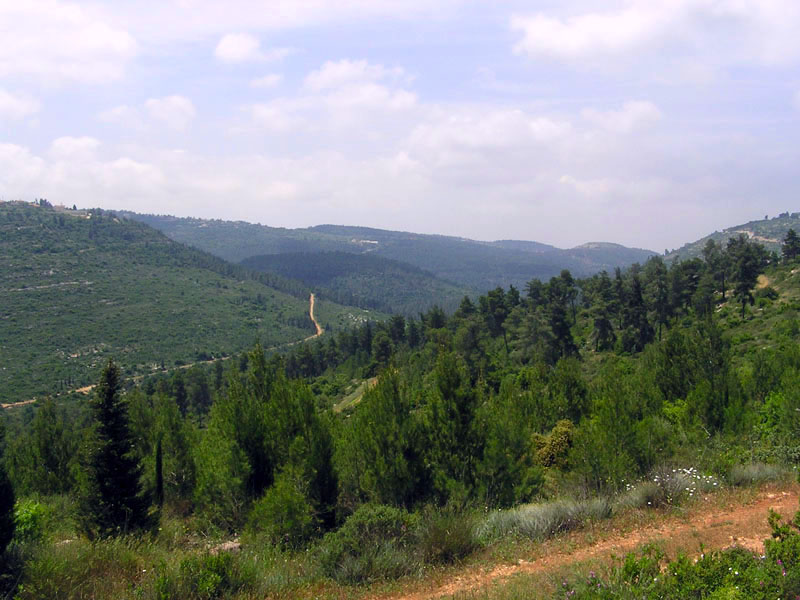
Mountains of Judea, source Wikipedia commons
Northern coast. Source Wikipedia commons
Jordan’s Rift Valley, Source Wikipedia commons
Acacia tree in Negev Desert, Makhtesh Gadol, Wiki photo
Jerusalem itself is about 2500 feet in elevation. It sits on a plateau within the mountains, which includes the Mount of Olives, and Mount Scopus. Valleys surround the city. We read in the Psalms some “Psalms of Ascent” because when Jews made the annual trek to the City for Passover, they climbed to the old City. They were ascending.
As the mountains surround Jerusalem, So Yahweh surrounds His people From now until forever. (Psalm 125:2).
And many mountains do surround the city, almost like a rampart. Some count the peaks numbering 7, and refer to the Revelation 17:9 verse describing a city of seven mountains upon which the harlot sits as Jerusalem, not Rome.
1. Mount Scopus, 2. Mount of Olives 3. Mount of Corruption 4. Mount Ophel 5. Mount Zion/Moriah (AKA the Temple Mount) 6. New Mount Zion 7. the Roman Antonia Fortress peak
The Kidron Valley runs to the east of Old Jerusalem and the Mount of Olives is actually separated from it. Along the southern side of old Jerusalem is the Valley of Hinnom, a steep ravine where hell or Gehenna is mentioned and the trash heaps blazed night and day. In biblical times, lush forests surrounded the city, forests of almond, pine, and olive. These forests are gone now. Due to the steep incline, farmers used a terracing system to keep the soil in place and those can still be seen today.
I’d mentioned that Jerusalem was the primary city for the Israelites for “most” of their life, but in the early years of the Israelite kingdom, the Ark of the Covenant was sometimes moved around to several sanctuaries, especially those of Shechem and Shiloh. Shiloh was the capital for almost 400 years, before the first temple was built. Jeremiah 7:12a says
“But go now to My place which was in Shiloh, where I made My name dwell at the beginning,
After King David’s capture of Jerusalem, the Ark was moved to Jerusalem. Its presence there signified the presence of the LORD within the Holy of Holies. Sadly, the people’s idolatry, bloodshed, and disobedience meant that eventually the glory would depart from the Temple (Ezekiel 9-10). This happened in advance of the Babylonian sacking of the temple. In fact, God’s glory would never again occupy a temple or a building on earth.
Today the glorious temple is mostly gone. Only the grounds and the Western Wall (a retaining wall) are left of the original building. Atop the grounds lies the Dome of the Rock, the 3rd most holy site in Islam. Will there be a third temple? Some believe so, that the events of Ezekiel 37 indicate a future restoration of the temple with Jesus bodily present and with His people:
And the nations will know that I am Yahweh who sanctifies Israel, when My sanctuary is in their midst forever.
Jerusalem today is a bustling city, the intersection of three religions- Islam, Christianity, and Judaism. One day the ‘City of Truth’ will know only 1 true religion, and its inhabitants will worship Yahweh properly. What a day that will be!
This is the third of a 4-part series on the Great Cities of the Bible. I’ve written about Damascus and Babylon in the first two parts. Damascus first because it is among the first cities mentioned in the Bible and is the oldest continuously inhabited city in the world. And I chose Babylon second because its presence from Genesis to Revelation dominates the Bible’s spiritual and historical landscape.
Now we turn to Rome. GotQuestions notes that – “Rome is not mentioned in the Old Testament but figures prominently in the New Testament. Although the city of Rome is not often directly mentioned, every place and event in the New Testament has Roman rule as its background.“
Part of the reason I’m doing this series is because we tend to be myopic in our day and age, thinking we are the most advanced or the most sophisticated or our culture is the best. It’s hard to physically go see that in Babylon because it is mostly a ruin now. Damascus is considered to be one of the most beautiful cities in the Arab world, but sadly, the ongoing war has destroyed much of it by now. However ROME! Ahh, Rome, one can wander the streets and see many buildings from the Bible days intact. One can envision Paul standing up in court…writing his ‘Jail Epistles’ (Ephesians, Colossians, Philippians and Philemon). We can visit the Colosseum where so many Christians were martyred.
Underfloor of the Roman Colosseum, where many Christians were martyred. EPrata photo
Rome is both the city and was an Empire. It is urban setting and also a character itself in the Bible history. It is a city past from Bible days, a thriving city today, and it is an Roman empire future in prophecy. Rome was the oppressor of the Jews in Judea but its engineered roads allowed for the dispersed believers to bring the Gospel out to the world.
It was first called The Eternal City (Latin: Urbs Aeterna; Italian: La Città Eterna) by the Roman poet Tibullus in the 1st century BC, and the expression was also taken up by Ovid, Virgil, and Livy. Rome is also called “Caput Mundi” (Capital of the World).
Rome is also known as the City of Seven Hills, due to the hills that it is founded on and provide a backdrop. This may become important later when in prophecy, discussed more in the postscript.
For almost a thousand years the continent’s people were either one of the unfortunate tribes conquered and absorbed into the vastly growing Roman empire, or were one of the privileged Romans citizens enjoying the engineering marvels the Romans invented and especially Pax Romana (widespread peace) during the 200 years of the Empire’s height. Paul the Apostle was a Roman Citizen, and this fact allowed him to escape one of the intended beatings, to stand in a Roman Court and plead his case, and at the end, legend says, given the less painful execution of beheading.
Rome was said to be founded around 625 BC in the areas of ancient Italy’s center known as Etruria and Latium. Etruria was home to the mysterious people of the Etruscans (from which we get the name Tuscany). Not much is known of the Etruscans, except they were a sophisticated culture, master bronzesmiths, their tombs were expertly painted, they formed city-states all over Tuscany as far south as Rome, and began sewer and other construction projects in Rome. It is said that the Etruscans had a heavy influence on the conquering Romans.
For about a hundred years or so, this merging and overlap of the Etruscans and the Romans led to the period known as the Age of Kings, which came to an end when the Etruscans disappeared, and the Roman Republic was born. (510 BC). It was during this time that Romans codified their laws and were led by the citizens (upper class senators and knights).
They continued to expand their empire with masterful military strategies and successive victories. By 338 BC they had conquered the entire Italian peninsula and a few years later gained control of the Mediterranean as a dominant maritime power.
The time of Jesus’ birth through his death & resurrection, the rise of the Church, and the last of the first generation witnesses (31BC to 90 AD and beyond) was known as the Imperial Rome era. During this period, Rome saw decades of peace, prosperity, and expansion. Its maximum land expansion occurred in about AD 117, near when Apostle John died. Its empire spanned three continents including Asia Minor, northern Africa, and most of Europe as far north as Scotland.
Unlike many other conquering empires, Rome allowed worship of personal gods. They were a pantheistic society. We remember in Daniel 1 when Nebuchadnezzar besieged and conquered Jerusalem and carried off its captives, “among them from the sons of Judah were Daniel, Hananiah, Mishael, and Azariah.7 Then the commander of the officials set names for them; and for Daniel he set the name Belteshazzar, for Hananiah Shadrach, for Mishael Meshach, and for Azariah Abed-nego.” (Daniel 1:6-7). The practice of forced assimilation was common. The boys were given new names, forced to eat what was eaten by the natives, and forced to worship what the natives worshiped, namely, the king. But unusually for an Empire, that was not Rome’s practice.
Definition: Assimilation is one outcome of acculturation. It involves the complete adoption of the ways of life of the new cultural group, resulting in the assimilated group losing nearly all of its original or native culture.
Rome practiced assimilation. Captured peoples from the many wars were brought to Rome as slaves but allowed to practice their religion and maintain their culture. The building in Rome called The Pantheon was originally a temple built for all Roman gods, then later any gods. Pan means “all” and “theos” means “gods”.
The Pantheon in Rome, one of Rome’s best preserved buildings to this day. EPrata photo
The Roman Empire was a primarily polytheistic civilization, which meant that people recognized and worshiped multiple gods and goddesses. Despite the presence of monotheistic religions within the empire, such as Judaism and early Christianity, Romans honored multiple deities. They believed that these deities served a role in founding the Roman civilization and that they helped shape the events of people’s lives on a daily basis. Romans paid allegiance to the gods both in public spaces and in private homes. While the Roman state recognized main gods and goddesses by decorating public buildings and fountains with their images, families worshipping at home also put special emphasis on the deities of their choosing. Source
The Jews in Judea were overseen (oppressed) by Rome, which sent it governors and soldiers to keep the peace, but largely (except for taxes to keep up the empire) they were allowed to continue as they were and that included worship.
Romans built things. Bridges, temples, mansions, aqueducts, and roads. They had sewers, hot and cold running water, and spas. They had colosseums for their beloved games. It was the roads that allowed the dispersing Christians to take the Gospel to the outermost parts of the empire and beyond. It was the spread of the Latin language in the huge Empire that allowed folks to understand one another when sharing the Gospel with natives. The Roman influence on art and architecture was massive and stands to this day. They loved games and competitions, and they built amphitheaters to play them in. The round and oval stadiums we see today are derived from the Romans. They even held “naumachia” in them, or sea battles. They engineered a system where the amphitheaters could be flooded to host maritime competitions with ships!
Because of their sophisticated government, art, engineering, culture, and lifestyle, the Romans often referred to all other tribes as “barbarians.” They deeply believed they were a superior race to the Germanic tribes or the Celts, both of which they had conquered. However, the Romans for all their marvels and sophistication in the arts, were still pagans, which means, barbaric themselves. Any culture that enjoys live bloody competitions to the death, which invents crucifixion as a method of execution, or dips Christians in tar and sets them alight for garden illumination, is barbaric themselves. No veneer of art or poetry or law can hide the fact that without Christ, any society will die. And the Romans did. After its Pax Romana era came to a close, the city declined until 410 when the Visigoth King Alaric successfully sacked the city of Rome. The “Eternal City” was no more.
POSTSCRIPT
After Alaric and the beginning of the Middle Ages, Rome slowly fell under the political control of the Popes, and in the 700s, Rome became the capital of the Papal States, which lasted until 1870. Even today, Vatican City is a sovereign state inside Rome. The Pope is one of the very the last absolute monarchs on earth. An Absolute Monarchy, which Vatican City is governed by, is defined as “a form of government in which a single person—usually a king or queen—holds absolute, autocratic power. In absolute monarchies, the succession of power is typically hereditary, with the throne passing among members of a ruling family.”
“Absolute monarchies, where the monarch is the final authority, are few and far between these days. There are currently five, excluding subnational monarchies: Brunei, Eswatini, Oman, Saudi Arabia and Vatican City.”
In Revelation 17:7, we read that Babylon the harlot is riding on a beast having seven heads and ten horns. The seven heads are called seven hills or seven mountains in verse 9. Everyone at the time that passage was written was so familiar with Rome being called the city of seven hills it is likely that they understood this to be Rome. As Daniel 2 describes the flow of the world empires from beginning to end in a vision of a statue, will the last empire be a revived Roman Empire? One that includes an absolute monarchy, that already exists today, led by a false prophet (of the Catholic Church?) Many think so.
Further Reading
Book- SPQR: A History of Ancient Rome by Mary Beard. (I’m reading this book. It’s good).



















 the-end-time.org