For the love of Christ controls us, having concluded this, that one died for all, therefore all died; (2 Corinthians 5:14).
Powerful. Have you ever thought about that before? That the love of God controls us? Or as KJV says, constraineth us? The word here whether it’s control, constrain, or compel, means in the Greek,
I press together, close, (b) I press on every side, confine, (d) I urge, impel,
Picture our ever growing sanctification as entering the wide end of a funnel, and slowly being drawn down the narrow end, the sides all around being Christ’s love to us which we ever grow in reflecting back.
Or, picture the scene where Balaam’s donkey was on a path so narrow the hedges pressed him in on all sides and the animal could not even turn around.
Some commenters on the subject-
with irresistible power limits us to the one great object to the exclusion of other considerations. The Greek implies to compress forcibly the energies into one channel. Love is jealous of any rival object engrossing the soul. Jamieson, Fausset, & Brown
Love has a constraining virtue to excite ministers and private Christians in their duty. Our love to Christ will have this virtue; and Christ’s love to us, which was manifested in this great instance of his dying for us, will have this effect upon us, if it be duly considered and rightly judged of. Source- Matthew Henry’s commentary on the whole Bible.
The phrase “the love of Christ” means His love for us as seen in His sacrificial death. “We love Him, because He first loved us” (1 John 4:19). He loved us when we were unlovely; in fact, He loved us when we were ungodly, sinners, and enemies (see Rom. 5:6–10). When He died on the cross, Christ proved His love for the world (John 3:16), the church (Eph. 5:25), and individual sinners (Gal. 2:20). When you consider the reasons why Christ died, you cannot help but love Him. Source, Warren Wiersbe, W. W. (1996). “Be Series.” The Bible exposition commentary.
Yes, we cannot help but love Him! Jesus is the most lovely, wondrous, majestic person in the entire universe! He created all things and upholds all things, yet condescended to incarnate into human flesh, and live among sin, sinners, and this sinful world! He died on the cross shedding His blood for us.
Let the love of Christ control you today. Let the love of Christ constrain you today. Let the love of Christ compel you today.
We are so used to certain phrases in the Bible that we may have lost the original sense of the meaning. For example:
The fly in the ointment is from Ecclesiastes 10:1, and a drop in the bucket is from Isaiah 40:15.
You’ve heard of “cast the first stone” right? Well, in Deuteronomy 17:7 we learn what it means. In a capital case, upon the finding of a perpetrator guilty, the witness must cast the first stone and thus begin the execution.
This is sobering. It ensures that the witness was sure about what he saw or said, else his conscience would be heavy. Also, the LORD would judge that witness guilty on judgment day.
John 8:7 a similar situation existed where Jesus said to the false witnesses of the woman caught in adultery, “When they persisted in asking Him, He straightened up and said to them, “He who is without sin among you, let him be the first to throw a stone at her.”
No one on earth is without sin, so Jesus did not mean anyone who is sinless may cast the stone. No, as Geneva Study Bible explains, the comment was meant-
Against hypocrites who are very severe judges against other men, and flatter themselves while they are sinning.
Barnes’ Notes on the Bible says of the John 8 verse,
This was in order that the witness might feel his responsibility in giving evidence, as he was also to be the executioner. Jesus therefore put them to the test. Without pronouncing on her case, he directed them, if any of them were innocent, to perform the office of executioner. This was said, evidently, well knowing their guilt, and well knowing that no one would dare to do it.
We should have soft consciences, pricked at wrongdoing. I see so much false witnessing, people flinging accusations and bearing false witness that seems not to affect their conscience at all.
In Romans 2:14-15, the word used for conscience is Suneidesis. It is used 32 times in the New Testament. The International Standard Bible Encyclopedia defines it as, “An inner witness that testifies on the rightness or wrongness of one’s actions or motives and, on the basis of them, pronounces judgment concerning the worth of the person.”
What is conscience? “The conscience is generally seen by the modern world as a defect that robs people of their self-esteem. Far from being a defect or a disorder, however, your ability to sense your own guilt is a tremendous gift from God. He designed the conscience into the very framework of the human soul. It is the automatic warning system” ~John MacArthur
It is a heavy, heavy thing to make an accusation and then have enough of a clean conscience to start the execution – the killing – of a human being. Be careful not to harden your conscience. Bearing false witness, especially on social media, seems like an easy thing for people to do. And the more they do it the easier it gets to press enter.
I recently read a book called Taming the Fingers: Heavenly Wisdom for Social Media by Jeff Johnson. It is very short, 88 pages. But it has scripture laden advice for monitoring one’s self on social media.
With wisdom from the Proverbs, Pastor Jeff Johnson offers five practical questions that can help us cultivate heavenly wisdom in our use of social media:
Am I controlled?
Am I calm?
Am I careful?
Am I compassionate?
Am I conscientious?
I have found that asking myself these questions has helped slow me down to make sure I am not impugning anyone’s reputation by insinuating wrong things or worse, making a false accusation.
Let none of us be hypocrites by casting the first stone.
I studied Colossians 2:13-15. I especially enjoyed Colossians 2:15-
“And having disarmed the powers and authorities, he made a public spectacle of them, triumphing over them by the cross.”
I used the NIV translation there because I like the word ‘spectacle’. The word in Greek is deigma, and the definition is “I hold up as an example, make a show of, expose.” (Strong’s 1165)
I love to think of how the demons were partying down when Jesus died on the cross, and suddenly He shows up! It is always especially humiliating when you’re at the pinnacle of gloating and someone comes along to puncture your balloon and show how wrong you were.
Barnes Notes says of the verse, (I really like Barnes Notes, and I use them a lot)
The terms used in this verse are all military, and the idea is, that Christ has completely subdued our enemies by his death. A complete victory was achieved by his death, so that every thing is now in subjection to him, and we have nothing to fear. … He made a show of them openly – As a conqueror, returning from a victory, displays in a triumphal procession the kings and princes whom he has taken, and the spoils of victory. This was commonly done when a “triumph” was decreed for a conqueror. On such occasions it sometimes happened that a considerable number of prisoners were led along amidst the scenes of triumph. Paul says that this was now done “openly” – that is, it was in the face of the whole universe.
So then I’m reading along in 1 Corinthians 4:9, and I see that word spectacle again
“For I think that God has exhibited us apostles as last of all, like men sentenced to death, because we have become a spectacle to the world, to angels, and to men.”
Italy Forum. EPrata photo
Once again, the allusion is military. After a successful military campaign, a triumphal procession was held. Flowers were strewn along the triumphal route, so that when the horses, chariots, and carts rolled over them, the fragrance of the triumph would permeate the city. A triumph granted to a general was the crowning achievement of his career. It marked his victory over opposing forces and was a platform for him to assert personal power.
“The Roman triumph (triumphus) was a civil ceremony and religious rite of ancient Rome, held to publicly celebrate and sanctify the military achievement of an army commander who had won great military successes, or originally and traditionally, one who had successfully completed a foreign war.”
“On the day of his triumph, the general wore regalia that identified him as near-divine or near-kingly, and a laurel wreath was held above his head. He rode in a chariot through the streets of Rome in unarmed procession with his army and the spoils of his war. At Jupiter’s temple on the Capitoline Hill he offered sacrifice and the tokens of his victory to the god. Thereafter he had the right to be described as vir triumphalis (“man of triumph”, later known as triumphator) for the rest of his life.“
It was a spectacle, all right. This was the order of procession, which stayed the same during the 500 total Triumphs held over the 1900 year history of the Roman Empire:
Order of Procession:
The Senate, headed by the magistrates without their lictors.
Trumpeters
Carts with the spoils of war
White bulls for sacrifice
Exotic animals from the conquered land
The arms and insignia of the conquered enemy
The enemy leaders themselves, with their relatives and other captives
The lictors of the imperator, their fasces wreathed with laurel
The imperator himself, in a chariot drawn by two (later four) horses
The adult sons and officers of the imperator
The army without weapons or armor (since the procession would take them inside the pomerium), but clad in togas and wearing wreaths. During the later periods, only a selected company of soldiers would follow the commander in the triumph, as a singular honour.
Rome- Colosseum. EPrata photo
To the Roman, the more impressive the array of high-ranking prisoners, famous names, kings, etc, the better the Triumphal parade. The more powerful, dangerous, or news-worthy the prisoner, the better the public spectacle of their execution.
Barnes explains his interpretation of 1 Corinthians 4:9, the public spectacle of the apostles, setting the scene in the Roman Colosseum as an example:
“Paul represents himself as on this arena or stage, contending with foes, and destined to death. Around him and above him are an immense host of human beings and angels, looking on at the conflict, and awaiting the issue. … The whole verse is designed to convey the idea that God had, for wise purposes, appointed them in the sight of the universe, to pains, and trials, and persecutions, and poverty, and want, which would terminate only in their death.”
See Hebrews 12:1 for a similar word-picture of the universe looking on in this ongoing battle of darkness and light:
“Therefore, since we are surrounded by so great a cloud of witnesses, let us also lay aside every weight, and sin which clings so closely, and let us run with endurance the race that is set before us”
It seems to me that we are duly reminded by scripture of two things:
1. God points to His own glory and His own sovereignty at all times and in all ways 2. God uses all beings to serve His purposes- whether demons, His own Son, Apostles, the unsaved, or His believing sheep.
Understanding that we are His spectacle, on display to a great cloud of witnesses, with the universe looking on and knowing even angels long to look into these things, (1 Peter 1:12), how might we behave? The Gospel is the universe’s Triumph, the Good News from age to age, from beginning to end. It is the one and only processional that counts. We are privileged to be His captives, put on display for His purposes- whether unto death as martyr in a jeering theatre of mockers, or unto life as a display of His mercy.
Paul said it best, “But thanks be to God, who in Christ always leads us in triumphal procession, and through us spreads the fragrance of the knowledge of him everywhere.” (2 Corinthians 2:14)
EPrata photo. Not a photo of our office, but another local building who put up an enormous flag
I was in my newspaper office. Tuesday is a big paper day, we go to print Wednesday morning. I rented the office from my friend who lived a big farmhouse, and she called me from her living room. I thought it was unusual that she phoned, being just a few feet away from me in the same building. But her voice evaporated all other thoughts. She said quietly but with fervor, “COME HERE NOW”.
The first plane had just hit the twin tower in NY. We watched with eyes open, breathing shallowly, standing with arms numbly at our sides…until the second plane hit at 9:03. Our eyes locked together, and we knew without saying a word that this was an attack. We also knew that nothing would ever be the same. We watched until another plane hit the Pentagon 34 minutes later. It felt like the world was coming to an end. It really did. We thought the world was ending. A knot was in my stomach and coherent thoughts refused to form in my head. We got our purses and the first thing we did was walk across the street to the hardware store and we bought the biggest flag they had. We went back to the office and put it up. Then we went to the bank to get money. Cash was going to be important if the electricity went out or we were ordered to evacuate. We didn’t know what was coming next and we wanted to be prepared. It could have been a nuke coming next, for all we knew. At the bank, they had the TV on in the break room with the door open and the volume up so customers could hear what was going on. A fourth plane had just gone down in PA. We saw the smoking crater. We knew that plane was part of whatever was happening.
We resolved that our freedom was under attack. Running a newspaper which reported the news and offered a platform for the people to speak their thoughts on any political or civic matter freely, we decided our most patriotic thing we could do to support the Constitution that day was to get the paper out. The terrorists were not going to stop the presses. They were not going to stop freedom from ringing out. And that is what we did.
Churches were full that Sunday, though a bit less full the following Sunday. By about four slim weeks, churches were back to their spotty attendance. Why is this? Why do people fly planes into buildings and kill others? Why is there murder? Why is there war? Why are there conflicts at every level? Because man is inherently wicked. Our hearts are evil above all things, who can know it? (Jeremiah 17:9). Because man is basically evil. If we didn’t have laws and limits we would be killing each other at every moment.
Jesus is the hope we have to become good. Not on our own merits. We do not become good through our own efforts. No, “Why do you call me good?” Jesus answered. “No one is good–except God alone.” It is not a popular thing to say, that we are not good, but we are not. [Click on the link for John MacArthur’s sermon the Sunday after 9/11/01 as he takes us through a biblical understanding of death, terrorism, and the Middle East]
I thank Jesus that He poured out His life so that we may live…and become righteous. “It is because of him [God] that you are in Christ Jesus, who has become for us wisdom from God—that is, our righteousness, holiness and redemption.” (1 Corinthians 1:30). Even at that, our fleshly lives on earth are a struggle, a struggle against sin and growth in righteousness. I long for the day when flesh shall be glorified and sin shall be banished.
So people are evil, and we struggle against our nature. We want what we want and we sometimes terrorize or go to war to get it. Such will be the way, until the end. The end that comes before the beginning!
In the meantime, as we watch the death throes of this old world (which means the birth of the Glorious World!)…we mourn but also we love our nation America.
The song you are about to listen to is from a Las Vegas Diamond Rio concert. They received an immediate resounding standing ovation, and continue to do so every time they perform it!
Here in America, In God We STILL Trust:
On the day of 9/11 there were people trapped above the strike zones who thought it would be preferable to hurl themselves out the shattered windows of the twin towers rather than burn to death. One photo in particular caught the world’s attention. It is called “Falling Man” and it seems that his graceful swan dive plummet was poignant in the extreme. Here is the back-story of that photo.
Five months after 9/11 the Superbowl came along, just as it always does. The Superbowl is noted for artful, funny, or avante garde commercial debuts, due to the high viewership of the game. Budweiser showed a commercial called “Respect” and showed it only once, then until now. Thanks to Youtube, the ad has resurfaced. It is sure to bring a tear to your eye. We remember American greatness, American products, American ways.
Jesus will return in glory with His glorified saints. He will institute new nations and new cities populated by sinless resurrected chosen ones. There will be no more war because our hearts will be made right with Him. There will be no more terror because we will want nothing, having been given it all by our Savior. If you bow low to the Savior, He will lift you up high. Please do it soon.
And that’s a shame, because it is the central point of all of the story of Redemption. God is Holy. That means He is perfect, sinless, well, Holy.
And one called out to another and said, “Holy, Holy, Holy, is the LORD of hosts, The whole earth is full of His glory.” (Isaiah 6:3)
Humans are not holy. We were originally created sinless, perfect, but through free will, Adam and Eve in the garden decided to follow Lucifer’s suggestion to eat the forbidden fruit, and in doing so, directly disobeyed a command from God. That is what sin IS, disobeying God. I used to tell my children in the Good News Club, an after school Bible club, that sin is anything we think, say, or do that displeases God. Since we have thoughts, words and actions that displease God all the time, and couldn’t stop if we tried, it means we are sinners with a sin nature. Paul refers to our sinful nature in Galatians:
The one who sows to please his sinful nature, from that nature will reap destruction; the one who sows to please the Spirit, from the Spirit will reap eternal life. (Galatians 6:8)
Even if you do not believe in Adam and Eve and the garden and the forbidden fruit, you know deep down, that you are a bad person who does wrong things. Even if you ever said one lie to spare a person’s feelings (“Yes, that dress looks great on you!”) you are disqualified from being with God in heaven. Why? His Holiness is eternal. So is that lie. Sin is eternal, too. It doesn’t go away after you say it or do it or think it. It remains. And your sin and His holiness shall never meet.
Why would a liar think he is qualified for heaven? A cheater? As self-admitted liars and cheats and adulterers, and gossips and lusty people, why do we think we are “a basically a good person” and therefore qualified to dwell forever with a Holy God? We aren’t.
However, God so desires a relationship with us, that He made a way. He sent Jesus to us. I used to think that Jesus first came to us at Bethlehem on Christmas. But that is not so. He has been with God since the beginning. Genesis 1:1-26 shows that the Father God, Jesus and the Spirit were all involved in the Creation. And just in case there is confusion on this point, John 1:1-3 says
In the beginning was the Word, and the Word was with God, and the Word was God. He was in the beginning with God. All things came into being through Him, and apart from Him nothing came into being that has come into being. In Him was life, and the life was the Light of men. The Light shines in the darkness, and the darkness did not comprehend it.
At one point known only to God, God said
“I will surely tell of the decree of the LORD: He said to Me, ‘You are My Son, Today I have begotten You.(Psalm 2:7)
And God’s Plan to send a Holy One to redeem us was enacted, as reiterated by Paul in Acts 13:33:
that God has fulfilled this promise to our children in that He raised up Jesus, as it is also written in the second Psalm, ‘YOU ARE MY SON TODAY I HAVE BEGOTTEN YOU.’
So if we’ve all been sinners since Adam and Eve and He is Holy and cannot dwell with us, that’s it, then, isn’t it? Not quite! We love because He first loved us (1 John 4:19) He loves us SO MUCH! He sent Jesus to us to minister and preach and heal, so that our only, ONLY call to the road to heaven is “This is the work of God, that you believe in Him whom He has sent.” (John 6:29b)
It is very simple. Believe. All other verses are spokes stemming that central truth: for example, believing in “the One” means believing in the Messiah. Why was He sent? To seek and save the lost. Why are we lost? We sin. Why is He Messiah? Because He is the ONLY one who is qualified to forgive our sins, being sinless. Why would we confess? Because He came to seek and save us from our sins, therefore it makes sense that we would acknowledge those sins through our stated belief in Him.
Many people believe in God. Believing in Jesus is a huge leap because the gulf between (Jesus and us) and (God and us) is sin. If you believe in Jesus you believe you are a sinner, like the thief on the cross did, because a person is finally recognizing his OWN sin in the face of the obviously Sinless one. Many people believe in God without believing they themselves are sinners and they leave Jesus out of the equation completely.
Because God is HOLY, and we sin, man must “reform your ways and your actions and obey the LORD your God. Then the LORD will relent and not bring the disaster he has pronounced against you. (Jeremiah 26:13)”
Believe, and turn from your sin. Repent and be dwelling in perfect love for all eternity! Love, love, love, we love because HE FIRST LOVED US! He is wonderful and a holy God like no other. “In the year that King Uzziah died, I saw the Lord sitting on a throne, high and lifted up, and the train of His robe filled the temple,” that is how holy He is. Yet for all His holiness, “Seeing then that we have a great High Priest who has passed through the heavens, Jesus the Son of God, let us hold fast our confession. For we do not have a High Priest who cannot sympathize with our weaknesses, but was in all points tempted as we are, yet without sin. Let us therefore come boldly to the throne of grace, that we may obtain mercy and find grace to help in time of need.” (Hebrews 4:14-16) He is waiting there for you with open arms.
Look in the Bible for how many times clouds are mentioned. The word is used for different reasons and in different ways. It is fun to think of His grace in giving us the literal clouds, which shield us from the hot sun, or which gives us rain. The variety and wonder of the different shapes of clouds: nacreous, cumulus, tubular, cirrus, etc, and the different reasons for clouds, both literal and symbolic, is a study in itself.
The best reason to think of clouds is that Jesus will return in one!
This week I saw a stunning photo from the Ark Encounter twitter stream. Then yesterday I found two books about Genesis, one was a scientific and devotional commentary on Genesis by Henry Morris of the Institute for Creation Research, and other other was by the same author of the science behind the creation flood. I love Genesis, especially the first 11 chapters, so it was on my mind.
Then I remembered I wrote this blog 6 years ago. It’s true today as it was then. Even more so, because an increasing number of theologians reject Young Earth and preach Old Earth or Gap Theory. I saw a Twitter poll the other day too, asking ‘if your pastor started preaching old earth, would you leave?’ I thought about it a long time. So these issues have been on my mind.
Years and years of Sunday School, VBS, and Children’s lessons about Noah’s ark like this…
…have led thousands and thousands of people to believe Noah’s ark was a cute little tub happily bounding along the sunny seas, and not the serious event that it was. I personally rate it as the third most serious event in the humankind’s history, after the Fall and the Crucifixion.
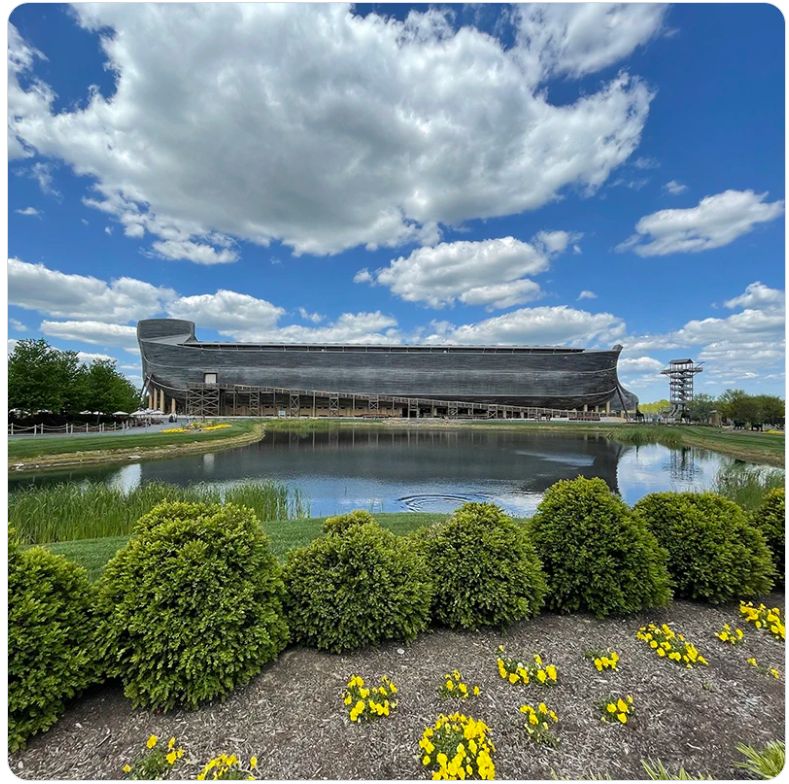
Ken Ham and the Creation Museum folks have built an Ark to biblical size. Guess what? In the face of this world’s current love affair with massive buildings, its penchant for tremendous construction projects, and its historical stunning size (it was twice as long as Caligula’s ships at Nemi) the fact is, at 510 feet long and 7 storeys high the Ark is the biggest timber frame structure in the world today. Imagine how stupendously awesome the structure would have been to the ancients. The pyramids were not built yet.
The above picture (the cover of a children’s biblical storybook) displays the unfortunate reduction in majesty and scope of the entire Noah/Flood/Judgment event. Below is the reality.
Credit: Ark Encounter photo
The post from Ark Encounter explains the photo above:
“@ArkEncounter: Our strategically placed viewing area in front of the lake allows guests to take in a spectacular view of the Ark and its reflection. This site is one of the most popular locations for family and large group photographs.”
Picture storybook illustrations are just as much a part of the recounting as the words. Be mindful of the diminishing of the seriousness of the event with the illustrations you share.
I published this in 2018 and I updated and added to it today because of a confirmation of a tweet I saw Sharon Hodde Miller express on Twitter recently. Moore took hold of the goat and brought it into into church where it lurked in corners and tried to be inconspicuous. Now these women settle the goat onto a pew and treat the goat as a sheep. Jesus said in Revelation 2:20-23 that he is against false female preachers/teachers/prophets, especially ones who preach falsely!
But I have this against you, that you tolerate the woman Jezebel, who calls herself a prophetess, and she teaches and leads My bond-servants astray so that they commit sexual immorality and eat things sacrificed to idols. 21I gave her time to repent, and she does not want to repent of her sexual immorality. 22Behold, I will throw her on a bed of sickness, and those who commit adultery with her into great tribulation, unless they repent of her deeds. 23And I will kill her children with plague, and all the churches will know that I am He who searches the minds and hearts; and I will give to each one of you according to your deeds.
This passage SHOULD strike deadly fear into these women who boast of their sin.
It was a given that for more than 2000 years women are not to be teachers or preachers of men. We women can and do teach, we minister, and we evangelize. We discuss, we help, we clarify in a private setting, but we are not to have biblical authority over men in church expository situations.
“I do not permit a woman to teach or to exercise authority over a man; rather, she is to remain quiet.” (1 Timothy 2:12)
How is a women preaching to men a sinister situation? It’s sin. As RC Sproul said, sin is cosmic treason!
Ask the metaphorical Jezebel of Revelation 2:20 who was teaching things God did not say. Jesus promised to kill her and her followers. Inserting words into God’s mouth is sin.
What God says to do or not do matters. We don’t need 50,000 verses. One is enough. Women are not allowed to teach the Bible to men.
But Beth Moore does.
She has been doing it for 35 years.
Woe to Beth Moore.
A generation is about 25 years. Therefore, it’s woe to the generation of women coming up in Christian circles who have for the entire time been seeing Moore’s preaching to men as normal, even with her former pastor’s overt blessing, or the tacit blessing of her former denomination the Southern Baptist Convention and its arm, Lifeway.
For years Moore taught Bible to a co-ed Sunday School class of 600-700 people as you read in that link above and later up to 900 people as stated in this link from her own former SBC church:
At that time, God began to do a new thing, stirring the heart of Beth to move to a new meeting place, meeting time, change the name of the class, and allow men to attend.
Is it God ‘stirring the heart’ of a woman to disobey scripture and to teach men? I think not. In Revelation 2:23 it’s noted that Jesus will strike Jezebel’s children dead. These are not Jezebel’s biological children, but the spiritual daughters she is raising up in her polluted, sinful likeness who preach and prophesy.
Being a woman called to leadership within and simultaneously beyond those walls [of an SBC church] was complicated to say the least but I worked within the system. After all, I had no personal aspirations to preach nor was it my aim to teach men. If men showed up in my class, I did not throw them out. I taught. ~Beth Moore
Abuse of the word “called” here is especially egregious, because it intimates that God assigned her to preach, which is in effect, co-opting God into her own sin, and using Him as the excuse. God will address this abuse on the Day.
Secondly, it does not matter if you “had personal aspirations to preach” to men or not. Your opinion does not matter, only the Bible’s statutes. If you do preach, you’re sinning. If you fail to stop it, you’re sinning.
Other women elsewhere began copying Moore’s excuses and language. “I’m called to do this”. “I have no desire to preach but it happened anyway”, “I want to step into the gifts God has given me to teach [men]” and the like.
Moore eventually founded Living Proof Ministry in 1994. By 2003 her Living Proof Live conferences had gone beyond the confines of her church and beyond the Texas border. A national magazine took notice. Their opening sentence called her a minister.
“Once a victim of abuse, Beth Moore is one of America’s most popular ministers today.”
The article went on to note that men attended her Sunday School class. It was popular, so crowded with both sexes that attendees were asked to car pool because the parking lot was so jammed.
An obedient teacher says “My love is for Christ and His word, and I asked the pastor to restrict the class to women only.” But as Beth Moore said above, “I didn’t throw them out. I taught.” She purposely sought bigger rooms to accommodate them all.
The leaders of her church allowed it, encouraged it. About this time, her pastor also asked Beth to preach the Sunday Night service, too. Woe!
She has been a usurper from the beginning. And she keeps on teaching. And the women were watching. Like hawks.
In 2010 when her fame was rising, Christianity Today did a 6-page cover story on her. The article cites the following:
Before she begins, she addresses the few men in the crowd. A Southern Baptist, Moore emphasizes that her ministry is intended for women. “The gentlemen who had such courage to come into this place tonight, into this estrogen fest if you will ever find one in your entire life: we are so blessed to have you,” Moore says. “I do not desire to have any kind of authority over you.”
It’s laughable to pronounce a blessing on the men in attendance, welcome them, preach the Bible to them, and then meekly deny any authority over them. Is her teaching from the Word authoritative over the women but not the men sitting next to them? Or do the women reject her authority to teach and they’re just coming, say, for the music? You see the illogic. If she teaches the Bible, she is teaching authoritatively, and it’s authoritative to all in the hearing of it.
As far as Moore’s coyness that she does not desire to be authoritative over them, this is false. Genesis 3:16 tells us it is IN us to want to usurp male authority. It doesn’t matter if you desire to break God’s command or not, if you DO, you’re sinning. Try telling the traffic policeman that “I did not desire to speed on the highway” and see if he lets you go.
The Christianity Today story is behind a paywall now. However, the link is here if you want to see the source.
Moore’s occasional weak protest, that men attend her classes and conferences on their own volition so it isn’t really her fault, doesn’t hold water. She taught men in her SS class for 20 years. By 2012, she was personally asked to substitute for pastor Louie Giglio preaching the Sunday Service at Louie Giglio’s Passion City Church, and she accepted. It was Holy Week, and she preached John 19 to a very, VERY large crowd of congregants. Now the “secret” was out and widely public. ‘Women, even SBC women, can preach! No one will stop us!’
Screen grabs from videos like this in 2012 harm women when they see a female on stage preaching from the Bible shoulder to shoulder with men. It’s visual egalitarianism. Photos like this are damaging. L-R, Lecrae, Moore, Chan, Giglio, Piper preaching at Passion Conference in 2012:
Now the POINT: (I know, I know, this blog is like a pastor giving a 30-minute sermon intro in a 40-minute sermon session,)
Moore is personally the transition linchpin for this new future of women preachers:
Moore is one of the evangelical leaders today who represent the future of the global church, in which people outside Europe and the United States will be dominant. … Moore represents this transition, which is shaping even the most conservative corners of evangelicalism.
There is the danger. After so many decades of preaching and teaching, with little to no pushback from her leadership in the denomination, Moore has mirrored the metaphorical Jezebel Jesus threatened death with in Revelation 2:20-23. He threatened death to her and also the women the Jezebel had raised up by her sinful example.
Imagine, within one generation a woman whose former claim to fame was the latest aerobics moves climbed steadily up to being seriously considered for president of the world’s largest denomination, a conservative one, at that. One generation, after 2000 years of holding fast to scripture on this issue. Sin is amazing in its power.
Yet the LORD our God is still on His throne and He still maintains a hard line on the roles women and men are to operate within in His church. That is a given.
For God is not a God of confusion but of peace. As in all churches of the saints, the women should keep silent in the churches. For they are not permitted to speak, but should be in submission, as the law also says. If there is anything they desire to learn, let them ask their husbands at home. For it is shameful for a woman to speak in church. (1Corinthians 14: 33-35).
Music can lift the spirits, draw up emotion, or bring you down. It’s a solace after a breakup, or a lift me up during exercise. Music is great and it’s powerful on the emotions.
EPrata photo
It is also powerful on the brain too. It can quietly instill good doctrine in us, affirm truths, or slyly draw us away with bad doctrine. Music matters.
There is a whole book of the Bible that is music: the Psalms. It’s great to sing the Psalms because they are 100% true and God-breathed. But there are many man-made songs that are also spiritual or reference doctrines from the Bible that are good to sing, as well.
speaking to one another in psalms and hymns and spiritual songs, singing and making melody with your heart to the Lord; (Ephesians 5:19)
I enjoy singing hymns, praise songs, and spiritual songs because I like the pictures they put into my head. I like pondering the words and reviewing the metal pictures that arise. Whose heart doesn’t lift when we get to the verse in Amazing Grace,
“When we’ve been there 10,000 years…”
Just thinking about being with Jesus and singing in heaven is a mood-booster.
EPrata photo
Eschatology is the study of Last Things. The Time of the End. The Last Days. Sadly, in these present days there is much conflict around differing interpretations of the sequence of Last Things, and often these discussions online or in real life devolve quickly into arguments.
As a result of not wanting to get into arguments, or perhaps not to be tempted to besmirch one’s witness, many people choose not to discuss it at all (or worse, not to study it). But with a wholesale eschewing of discussing the subject also comes a wholesale aversion to singing about it too.
Last things provide an assurance to the believer that this home is temporary, its woes will pass, the future with our Lord is coming, and soon. It does all that for our heart, and more.
EPrata photo
Yet Paul expressly explained about the end time and the dead in Christ’s rising and ended with “therefore comfort one another with these words.”
The end time doctrines are supposed to comfort us. In earlier days when the subject wasn’t so contentious, many people wrote songs about the coming end.
Let’s go back to 1964 with this hit. “Sorry, I never Knew You” by Naomi Sego and the Sego Brothers was the first million-selling gospel single. Can you believe that it is based on Matthew 7:21-22, when Jesus says to the false converts and fake professors, “Depart from me you evildoer, I never knew you!”
Amazing.
Today we get happy clappy songs with endless refrains about Jesus embracing us like a boyfriend, but a song to sing the important verse about the reality of false conversion is startling. But it exists and was a hit no less. In 1964, The Sego Brothers were the first Southern Gospel Group to sell over a million records, and it was “Sorry” that vaulted them up the charts.
In this next one, Charles Johnson & The Revivers sing “I’ve Been Sealed” and the first stanza looks forward to the day Jesus raises us to be with Him.
Paul Williams and the Victory Trio sing “I’ve never been this homesick before” and really, as each day passes, I get more and more homesick for the Lord!
Alan Jackson sings “I’ll Fly Away” and truly, some glad morning I will fly upward, raised from this ole body to a glorified one to be with my Lord forever!
Someday Jesus will shout for us to rise, and here we have John Jones “At the Midnight Cry“
Are you in the faith? Many of these songs urge the listener to be sure. They are sobering things to think of. No matter your eschatological stance, ultimately the most important thing is to be sure you are cleansed by the blood of Christ, repented of sin, and in the faith. Life on earth will end one day. Standing on the edge of eternity, which direction will you go- up or down?
In collaboration with Mark Rice and Phil Webb, Hymns of Grace and Generations of Grace present hymns featuring a brief introduction on their backgrounds and full performances. The series is called Hymnology. Here is the link to Season 1. There are 3 seasons so far.
It’s spiritually grieving to see so much false teaching and wrong doctrine on Twitter (AKA “X”). Satan certainly does use social media to his advantage, doesn’t he.
One flavor of wrong doctrine these days has to do with women’s roles in the church. Feminism since the 1960s has crept into the church and led the way for people to disregard Godly roles and to pursue roles not ordained for us. And I’m not talking solely about women usurping men, but there are other roles that have been ignored by men, also. For example, the recently converted are not to take on leadership roles, lest they become conceited. Too many recent converts untested by time have vaulted into leadership roles, grown large platforms, and shipwrecked spectacularly.
Older women are to teach the younger and not be busybodies in everyone’s business. But many older women do not teach the younger and instead, especially after retirement, and speak of things not edifying of which to speak.
But back to women and godly roles. It is obvious from plain reading of the Bible that women are not to preach in church. We see in 1 Timothy 2:12,
But I do not allow a woman to teach or to exercise authority over a man, but to remain quiet.
And then to remove any discussion of present time or culture or temporariness, some common excuses, Paul cites the creation order, For it was Adam who was first formed, and then Eve.
He did so again in 1 Corinthians 11:8-9,
For man does not originate from woman, but woman from man. For indeed man was not created for the woman’s sake, but woman for the man’s sake.
No woman was a pastor of any church in the Bible. No woman had ongoing authority over any man (except Deborah, as Israel’s only female JUDGE, not preacher, was an exception to a normative rule, and was given the role likely to shame men- Isaiah 3:12.) No woman wrote any part of the Bible. No woman was a priest.
But it is interesting to see how today’s ladies who want to rebelliously twist the Bible into saying things it doesn’t. It would be funny to see all these pretzel verses, if it wasn’t so tragic.
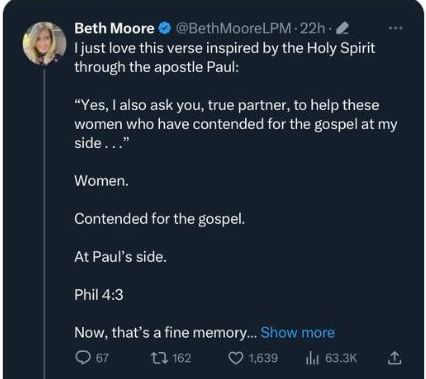
I saw on Twitter last week some women who Beth Moore whipped up and then flicked into off into fantasyland with outspoken but wrong ideas of women’s leadership in the early church. Beth does this so well, wind women up. Here is Beth’s tweet,
Notice the analytics. 63,000 people engaged with her tweet in one way or another. This is also tragic and it is why I write about her like this. She INFLUENCES negatively. A Mr. Robert Fletcher commented,
At best, @BethMooreLPM doesn’t seem to understand the difference between evangelism and teaching/having authority over men in the church. At worst, she does understand it, and she is purposefully drawing a straw man to further deceive her followers. Either way, she is eisegeting.”
The only options are Beth’s ignorance, or her deception. But women get whipped up when Moore disingenuously comments about women along these lines. One replied to Beth Moore,
Sarah went on to present verses about Chloe, Priscilla, Phoebe and ‘the elect lady’ who were allegedly “leading” the early church.
First of all, the Bible says women are not to lead. And don’t @me about Deborah. She was the clear exception to the rule, she wasn’t a king, Priest, or scribe, and she was installed to shame the men. It was about men’s weakness, not women’s strength or ability
The word “lead” is incorrectly used. We’ll start with Chloe. Chloe didn’t lead. We know next to nothing about this women. She actually was not even specifically named! The verse in 1 Corinthians 1:11 names only that some from her household let Paul know of strife at Corinth. That’s it. That is the sum total of Chloe. Oh and her name means green herb. How someone gets from that to Chloe being “an early church leader” is insane.
Priscilla was mentioned, too. We know she was married to Aquila, and we know she took Apollos aside along with her husband in order to teach Apollos more accurately.
Priscilla was mentioned 6 times, (Acts 18:2, 18, 26; Romans 16:3; 1 Corinthians 16:19; 2 Timothy 4:19). She is always mentioned along with her husband. They are a pair, and separating Priscilla in order to place her on an imaginary leadership pedestal would be to use a scalpel to excise Aquila from scripture. We cannot vault Priscilla to a leadership position any more than we could for Aquila.
Phoebe was also put on the list in this discussion of ‘early women leaders’ as a leader in the church. We do know from scripture she was a benefactor of the early church. Susannah was a benefactor too, but not claimed as a leader. Hmm. Phoebe was mentioned as having brought a letter to Rome, probably in a group of others since traveling alone as a female was dangerous. Phoebe was called a deaconess, meaning servant, and as such, could have been a teacher of all female inquirers of the faith, (because we know from 1 Timothy 2:12 she would not have been teaching the men). Or she could have been active in the helping the poor among the flock, since Paul called her a benefactor.
That’s it. Nothing in there to lead one to believe she was a leader of any type more than Mary and Martha, who opened their home and served those who came, and who were active in Jesus’ ministry as believers and followers.
The simple fact that some women are mentioned is far from proof they led. Dorcas/Tabitha was more than mentioned, an entire story revolves around Dorcas. She was even resurrected from the dead. Yet feminists do not call her a leader. I wonder why. Could it be because the Bible clearly limits her sphere of influence to sewing and widows, traditional female domains?
The stretch and twisting that feminist women give to these few Bible women and try to vault them into positions they clearly did not attain is startling. But when one has an agenda, one will go to lengths to prop it up.
Women’s position in society pre-Incarnation was as chattel, and invisible. They were equated with slaves as far as admissibility in testifying in court, which was a big NOPE. Public worship can take place in a synagogue only if at least ten adult Jewish males were there for a quorum. Women do not qualify as part of this quorum, which is likely why there was a group of women by the river (which included Lydia) that Paul found.
Jesus elevated the status of women by including them in his ministry. Susannah and Lydia and Phoebe were benefactors. Mary and Martha (and Lazarus) opened their home to Jesus. Philip’s daughters evangelized. Priscilla (and Aquila) taught. But their elevation into the mix of daily service does not mean they led in church. Many scriptures are clear that women are not to lead in services but to be silent participants. And to serve enthusiastically in all other places God has ordained and in the many roles we see women serving in the New Testament: financial support, evangelizing, hospitality, serving other women, teaching women, children, and grandchildren, and other background but critical service.
My greatest wish is for usurping women to finally become content with the roles Jesus has outlined for us in all spheres; church, home, and world. If they do not, Jesus will address this on the Day, which will be more uncomfortable and more embarrassing than accepting it here on earth.