The thread of Christianity depends on a unity from one generation to the next of mutual understanding of our important words. Hence the Word of the Week.
Immutability: Is the unchanging nature of someone. To be immutable is to be unchanging. God is unchanging in his character, will, and covenant promises. He does not change His mind, His will, or His nature.
Consider what thou owest to his immutability. Though thou hast changed a thousand times, he has not changed once; though thou hast shifted thy intentions, and thy will, yet he has not once swerved from his eternal purpose, but still has held thee fast. – Charles Spurgeon, The Christian—A Debtor, Sermon #96.
For someone to change, there must have been a point in time where the person was something else, or thought something different, or had alternate plans. Then as time passed, the person changed. Since God is outside of time, He is always the same, from point A to point B.
Also, His attributes are unchanging. He doesn’t add to His character nor subtract from it. He isn’t more loving today than when He was in Genesis 1:1 when our time began. He isn’t more wrathful against sin than when He was 15 years ago or 100 years ago. He isn’t more merciful or less compassionate than when Jesus walked in His incarnation.
What does immutability mean for us, His people?
As we read in Hebrews 6:17-18,
So when God desired to show more convincingly to the heirs of the promise the unchangeable character of his purpose, he guaranteed it with an oath, so that by two unchangeable things, in which it is impossible for God to lie, we who have fled for refuge might have strong encouragement to hold fast to the hope set before us.
It means we should be encouraged that His promises are sure. The joy that is waiting for us in heaven, the reunion with the glorified family as adopted sons and daughters, the glory, the sinlessness, all that, is unchanging because God does not change. He promised this. It will happen.
It means doom for those who will not repent. God will not forsake His holiness and allow rebels into heaven. It means the judgment and subsequent hellish torment awaiting many millions is sure. It will happen.
The gulf between the two eternities is never more stark than when considering His immutability. He has forged those two paths and they will not change. Keep both in mind when pondering His immutability.
The wind blows where it wishes and you hear the sound of it, but do not know where it comes from and where it is going; so is everyone who is born of the Spirit. (John 3:8)
I lived in Maine for almost 30 years. It’s cold. It’s windy. A fun trip we’d take was to the top of Mt. Washington Observatory in the White Mountains of nearby New Hampshire. That is a place known for its wild and erratic weather, and for holding the record for most of the 20th century for highest ever recorded wind speed of 231 mph.
When you live in and near the mountains and there is a lot of wind, you notice that many of the trees are stunted. It’s hard for them to grow in severe conditions. There’s actually a “tree line”, the line where trees stop growing and at higher elevations and it’s just scrub and rocks to the summit.
You also notice that the trees are bent away from the wind. Trees are actually structures, and wind creates a heavy load against them. Constant aerodynamic drag eventually sculpts or molds the tree. The tree’s resistance declines and it conforms to the direction of the wind. Like these trees:
Photographer: Andrew Bone from Weymouth, England. Wikimedia CCWindswept “Bent Tree” on Big Island, HI. Photographer- mccready. Wiki CC
We might look at a windswept tree and notice it standing tall. We might return in 30 years and notice that it has conformed to the prevailing wind and it’s been shaped. However, if we were to return to the mountain top or the field where the tree is every day, we would not notice the slow transformation of it.
It is like that with us. The Holy Spirit slowly transforms His people. He chips away at our resistance. Day by day in increments not seen, we are being transformed into Christ’s likeness. If we knew someone as an unregenerate person, celebrated their salvation, but then went to work in another country for 30 years, and then returned, we would notice a massive change in their character, morals, spirit, and mind. But it’s something one does not notice as much day by day. We cannot see the Spirit but we know where He has been by the people He has conformed.
Now imagine the multiplication of His work among an entire congregation. Like this:
Source: Wikimedia Commons
The Holy Spirit is amazing. He is always at work, conforming, transforming, changing, producing fruit. Yet He is invisible, and only always points to Christ.
Our one God in three Persons…the Trinity…God the Father, God the Son, God the Holy Spirit, worthy to be praised.
May the grace of the Lord Jesus Christ, and the love of God, and the fellowship of the Holy Spirit be with you all. (2 Corinthians 13:14).
Thank you so much for reading! In a few short months I’ll have been writing daily at this blog for ten years. That is a testament to the Holy Spirit and His Word that there is so much information to plumb in one closed canon!
When blogs first came to the fore, I was delighted. I’m a writer, though I’ve never managed to make a living at it. I have always had the urge to write-write-write, but publication avenues for me, the little guy, were tightly held by publishing gatekeepers.
So when the gates opened and publishing on a global platform became available via blogs, I was thrilled. However, the dangers only grew, because now my one and only “client” is Jesus. In addition, I need to write what He would want me to write, but I need to study in order to learn what would please Him.
One danger of long-term blogging is complacency. It would be terrible to take advantage of Jesus’s love and forgiveness and write sloppily about Him.
Another danger is marginalizing Him. Writing about my own desires and interests would be terrible on a blog devoted to exalting His name.
An additional kind of danger to writing for years is casualness with Bible verses. Vigilance is required in the Christian walk and that goes for everything we do, but especially what we do specifically in His name.
Anyway, you get the idea. I want Jesus to be the forefront of all I write and do in life and on the blog.
Below are some topics I plan to write about in upcoming days. Have a blessed weekend and week ahead everyone!
The Great Banquet (Man-made weekend retreat, not the biblical promise)
By Elizabeth Prata
This essay first appeared on The End Time in January 2014.
Now the Spirit expressly says that in later times some will depart from the faith by devoting themselves to deceitful spirits and teachings of demons, through the insincerity of liars whose consciences are seared,”
(1 Timothy 4:1-2).
What does a seared conscience look like? Like this:
Now as the king of Israel was passing by on the wall, a woman cried out to him, saying, “Help, my lord, O king!” And he said, “If the Lord will not help you, how shall I help you? From the threshing floor, or from the winepress?” And the king asked her, “What is your trouble?” She answered, “This woman said to me, ‘Give your son, that we may eat him today, and we will eat my son tomorrow.’ So we boiled my son and ate him. And on the next day I said to her, ‘Give your son, that we may eat him.’ But she has hidden her son.” (2 Kings 6:26-29).
You see the issue. The woman was appealing to the King for justice. For a breach of contract. But what a breach of contract! She was SO SEARED in mind that she never stopped to think of what she was saying. “I want justice because the other woman broke our deal to cannibalize our children?!” The horror is that she related this so matter of factly. The worse horror is that she was so unconscious about her sin that she simply and unemotionally stated the facts of the case without stopping to think of what she was actually saying.
That is a seared conscience.
That is also a judgment. Judgment for their apostasy was prophesied by Moses in Deuteronomy 28:56-57:
The most tender and refined woman among you, who would not venture to set the sole of her foot on the ground because she is so delicate and tender, will begrudge to the husband she embraces, to her son and to her daughter, her afterbirth that comes out from between her feet and her children whom she bears, because lacking everything she will eat them secretly, in the siege and in the distress with which your enemy shall distress you in your towns.
Cling fast to the faith. In my opinion, this is why Paul said to take very thought captive, every thought. (2 Corinthians 10:5). Do not listen to liars with seared consciences, who have already been pre-judged for their lies by having the seared conscience to begin with. The road which they travel and lure followers only gets darker and more evil with every step. As with everything biblical, there exists a progression. Ascent into holiness and then glorification is a process and descent into evil and the final apostasy is also a process. It all begins with one step.
This is where sin brings the unwary to: cannibalism…and worse. How can it get worse you ask? Apostasy is a terrible thing. It brings people so deep into sin they can’t even feel their sin anymore. People who have seared consciences are not only sinners, but are “inventors of evil”! (Romans 1:30) Worse, they not only sin deeply, don’t care, and invent ways to perform more evil, but they give hearty approval to those who practice the evil. (Romans 1:31).
Times of great apostasy are always dangerous for the vulnerable- the physically vulnerable and the spiritually vulnerable. In the Tribulation, the vulnerable will be at most risk once again. (Matthew 24:21-22; Luke 12:51-53). It will be a free-for-all of sins like we saw in the 2 Kings passage. A seared conscience is a terrible thing.
If you still feel conviction over your sin, great! Keep that feeling alive by remaining in a humble and penitent relationship with your Holy God. If you do not feel the same about sin as you used to, you must check yourself to see if you are in the faith. (2 Corinthians 13:5). If you don’t, you know the outcome. You will get eaten up- either by your neighbor because love has gone cold (Matthew 24:12) …or by satan, for the wages of sin is death.
According to the Bible, women are not to be pastors or teach in authority over men. This is a controversial stance in today’s feminist age, where the western culture is told that women can and should do everything that men do and that nothing should be denied them. It’s counter-cultural to think that there are settled spheres of complementary roles, that when working together, form a bond and an order that helps marriages, families, and societies functional at maximum efficiency.
We see the beauty and power of creation in Genesis 1, then the tremendous creative energy of God’s mind making man and then woman. In Genesis 2 He outlined the roles and gave them “a garden to keep”. Man was to work it and woman was to help. Unfortunately this unity of purpose within separate but complementary spheres did not last long. The woman was deceived and transgressed.
For Adam was formed first, then Eve; and Adam was not deceived, but the woman was deceived and became a transgressor. (1 Timothy 2:13-14).
The transgression was that Eve listened to the serpent, and ate the forbidden fruit. In her conversation with him, in the Bible’s very first recorded words of woman, she misrepresented the Word. She added to it.
The Bible is meaningful when it comes to firsts. One of the guidelines people use in biblical interpretation is the Law of First Mention. In its place with other hermeneutical rules, the law of first mention is that,
The law (or principle or rule) of first mention is a guideline that some people use for studying Scripture. The law of first mention says that, to understand a particular word or doctrine, we must find the first place in Scripture that word or doctrine is revealed and study that passage. The reasoning is that the Bible’s first mention of a concept is the simplest and clearest presentation; doctrines are then more fully developed on that foundation. So, to fully understand an important and complex theological concept, Bible “students are advised to start with its “first mention.” (source)
It’s not a hard and fast rule to be overlaid on every verse but it’s a good principle to notice the first time things are mentioned. When outlining gender roles, Paul reiterated the creation order, Man was made first. It’s interesting to note that in Eve’s first conversation she twisted the one command from God.
Women as the weaker vessel (1 Peter 3:7) does not mean woman is less valuable than man, because we are equally loved by God and made in His image. But we are obviously physically weaker. The 1 Timothy verse indicates women have a tendency to be weaker in other areas too, since she was deceived first by the serpent.
Hence the Lord’s command that men occupy the office of pastor. When women usurp men and charge into that role, folly follows.
Here is an example.
The Azusa Street Revival was a historic revival meeting that took place in Los Angeles, California, and is the origin of the Pentecostal movement. It was led by William J. Seymour, an African American preacher. It began with a meeting on April 9, 1906, and continued until roughly 1915. The revival was characterized by spiritual experiences accompanied with testimonies of physical healing miracles, worship services and speaking in tongues. The participants were criticized by the secular media and Christian theologians for behaviors considered to be outrageous and unorthodox, especially at the time. Today, the revival is considered by historians to be the primary catalyst for the spread of Pentecostalism in the 20th century. (Source)
The 20th century focus and fascination with signs and tongues began here. Prior to that time, their existence in the church was practically nil. It began in Topeka Kansas in 1901, and exploded in 1906 at Azusa Street mission in Los Angeles.
There were several women involved with this Holiness movement who were at its forefront. Men were involved too, and pushed the false doctrines and error into American consciousness just as much as the women did. But at the top leadership included several powerful women operating in usurping roles leading as pastors, teachers, and spokesmen in authority. Agnes Ozman, Julia Hutchins, Lucy Farrow, Rachel Sizemore, Jennie Seymour, Aimee Semple McPherson were all leaders and several were pastors who had founded churches or missions and were actively preaching to congregations (such as Julia Hutchins and Lucy Farrow).
Satan can and does counterfeit miracles. He can appear as an angel of light and a minister of righteousness. He was able to show Jesus all the kingdoms in the world. (Matthew 4:8). He deceived the woman Eve. He still deceives. Modern day women of today believe they have been “called” or “gifted” to “step into leadership roles” such as preaching and teaching men. Many of these women then or later reveal they heard a voice or felt a strong inner impulse or saw an angel that prompted them toward their path to ordination. These are counterfeit miracles originating with satan.
Women today are the ones at the forefront of the widespread mystical practices, personal prophecies, and channeling.
1 Timothy 2:11–12 is the main verse speaking to women’s authority over men in the church. Women can and do teach, help, evangelize, explain, and pray in the church (and out). Women’s spiritual authority, however, does not extend to preaching to a congregation or pastoring in authority over the sheep.
Any so-called female pastors that exist are not interpreting the scriptures rightly, so therefore their pastorship is based on a lie. Others might be interpreting the scripture rightly but ignoring what it says. Her pastorate will also fail also, because it is based on rebellion.
There’s both a beauty and a difficulty of operating within biblical boundaries of the roles outlined for us as women. We have a natural tendency to want to help. We nurture. We also have the seed of rebellion in us (Genesis 3:16). But it is our privilege and our joy to obey the Lord, who is omniscient and knows all. He does know what is best. He did say that our tendency will be to want to overstep, but we must resist that desire. (Genesis 3:16, 4:7b).
All gears mesh well when there is oil to lubricate the metal. The oil for men and women meshing in unity is obedience to God and submission to each other.
I love to speak of Jesus’s love, mercy, grace, salvation, and sanctification. However I also think it is important to speak of His justice, wrath, and consignment of the rebellious to hell in torment forever. Jesus spoke both of His kingdom to come and hell constantly. Yet, we don’t. We should. Many of those on earth won’t be joining Him in His kingdom to come unless they repent of their sins and believe on Him. Jesus taught quite a bit on wrath, hell and the consequences of sin. I read this week for background to this essay that the Bible runs 3-to-1 on wrath vs. love as a topic.
It may be worth noting that in Deuteronomy 28 (and following), the blessing section (28:1-14) is a great deal shorter than the cursing section (28:15-68).
Paul taught that thinking about and teaching about the rapture and the joy to come is encouraging. It is, but remembering the wrath we ourselves were under before salvation and is still poised over every unbeliever is a worthwhile thing to ponder, too.
I started a new book this week, John Gerstner’s treatise, Jonathan Edwards’ on Heaven & Hell. It’s quite illuminating. Though hell should not be a popular subject, (after all it’s the weightiest in the universe), it should not be marginalized, either. Here is the blurb on the book-
Dr. Gerstner was an ardent student of the famous Jonathan Edwards. In this short work, previously published by Baker, he examines the teaching of Edwards on the subjects of heaven and hell.
Hell is a real place and unconverted people will be cast there at the Day of Judgment. If it not real, then where did Jesus descend to during his three-day death to proclaim to the spirits bound there? (1 Peter 3:18-20). Though people try to debate this, dampen, it (annihilationism, universal salvation), hell is real.
a. Everlasting punishment. Mt 25:46.
b. Everlasting fire. Mt 25:41.
c. Everlasting burnings. Isa 33:14.
d. A furnace of fire. Mt 13:42,50.
e. A lake of fire. Rev 20:15.
f. Fire and brimstone. Rev 14:10.
g. Unquenchable fire. Mt 3:12.
h. Devouring fire. Isa 33:14.
4. Prepared for the devil, &c. Mt 25:41.
5. Devils are confined in, until the judgment day. 2Pe 2:4; Jude 1:6.
6. Punishment of, is eternal. Isa 33:14; Rev 20:10.
7. The wicked shall be turned into. Ps 9:17.
8. Human power cannot preserve from. Eze 32:27.
9. The body suffers in. Mt 5:29; 10:28.
10. The soul suffers in. Mt 10:28.
11. The wise avoid. Pr 15:24.
12. Endeavour to keep others from. Pr 23:14; Jude 1:23.
13. The society of the wicked leads to. Pr 5:5; 9:18.
14. The beast, false prophets, and the devil shall be cast into. Rev 19:20; 20:10.
15. The powers of, cannot prevail against the Church. Mt 16:18.
16. Illustrated. Isa 30:33.
John Gerstner (RC Sproul’s mentor) was an ardent student of Jonathan Edwards’ works, as noted above. From Gerstner’s essay on Edwards’ Rationale of Hell, we read Gerstner’s thoughts interspersed with Edwards’-
“those that have a sinful fear of God fear God as evil, but a right fear fears him as great and excellent.” (Edwards). Thus there is a right and wrong fear of God. This wrong fear of God, fearing him as an evil and dreadful being, drives men from God.
“A sinful fear makes men afraid to come to God.” (Edwards)
But, on the other hand, there is a proper fear of God, as the good and holy being that he is, and this right fear makes men afraid to go from him.
Eve and Adam had a sinful fear of God and they fled from Him. Those who are in Him would have a healthy fear to flee away from Him, but instead fly toward Him in all circumstances. On so many levels, once we are converted, everything turns upside down (or right side up, depending on yoru perspective!)
So he began saying to the crowds who were going out to be baptized by him, “You brood of vipers, who warned you to flee from the wrath to come? (Luke 3:7).
You snakes! You brood of vipers! How will you escape the sentence of hell? (Matthew 23:33)
I’m sorry not to be uplifting or sentimental today. Sometimes I feel the weight of the lost and their permanent eternity, or I give a mournful shaking of my head when I see important topics being shunted aside, and I feel compelled to write about the more unpopular subjects. Hell might not be popular, but it is very real. I recommend John Gerstner (especially at Ligonier.org) and Jonathan Edwards for credible treatment of the subject.
The Puritans were a fascinating group of people. Hardy pioneers, committed to religious belief, literate and intelligent, yet complex, misunderstood, and historically mocked…who were these people?
One internet definition of a Puritan is
a member of a group of English Protestants of the late 16th and 17th centuries who regarded the Reformation of the Church of England under Elizabeth as incomplete and sought to simplify and regulate forms of worship.
As such, many of the men who were persecuted in England for their beliefs fled to the Netherlands. In Holland, however, the Puritans found worse conditions. It was a licentious place adversely affecting their children. William Bradford wrote,
“But that which was more lamentable, and of all sorrows most heavy to be borne, was that many of their children, by these occasions, and the great licentiousness of youth in that country and the manifold temptations of the place, were drawn away by evil examples into extravagant and dangerous courses…”
So the Puritans gathered up and emigrated to America in what is known as The Great Migration. (1620-1640). Some notable arrivals were:
Sir Richard Saltonstall, three sons, and two daughters
Isaac Johnson and his wife Lady Arabella, daughter of Thomas Clinton, 3rd Earl of Lincoln
Charles Fiennes
Thomas Dudley, his wife, two sons, and four daughters
William Coddington, a Governor of Rhode Island Colony and his wife
William Pynchon and his wife and three daughters
William Vassall, for whom Vassalboro, Maine was named, and his wife
John Revell, merchant, who lent money to the Plymouth Colony, and who was chosen assistant to the Massachusetts Bay Colony
Captain Thomas Wiggin, the first Governor of the Province of New Hampshire
Anne Hutchinson
These men were married. They had wives. These women were mothers. What did the women think? What was their contribution? How did they fare? This series will be about the Puritan women. With a string of children behind them, a new world ahead, dire conditions and hardship- what was their life like?
Anne Hutchinson: Background and introduction
Having grown up in Rhode Island, I could not help but learn about the colony’s founder Roger Williams. He was a Puritan who’d emigrated to the Massachusetts Bay Colony in 1630 but was banished from it just 5 years later. He was convicted of sedition and heresy.
Williams believed the Church of England was thoroughly corrupt and advocated for complete separation (unlike the Puritans who thought it could be reformed). He also was increasingly displeased at what he saw as unfair dealings with the Native Americans regarding land purchases, and incidentally Williams was an abolitionist, too. Massachusetts Governor William Bradford declared Williams’ ideas strange and causing a problem for Williams and the church. Williams was eventually tried. Banished,Rogers established Providence (Rhode Island).
Enter Anne Hutchinson, the first entry in my new series. In an era when women were mainly quiet at home and invisible, Hutchinson was loud and active. An intelligent, complex, wayward mother of 15 children, she, too, was tried and banished from the Massachusetts Bay Colony just two years after Williams was exiled. Exiled in 1638 and left with nowhere to go, she traipsed to Rhode Island where she was welcomed by Roger Williams. That’s the background.
Sometimes we think of our historical brethren as backward or uneducated, but in fact Puritan Massachusetts was populated with highly literate people, and that included the women.
The early settlers of Massachusetts included more than 100 graduates of Oxford and Cambridge. One historian termed Massachusetts “the best-educated community the world has ever known.” Puritan women, though they didn’t receive a college education, were generally literate and often well-read. The only respectable female vocation in Puritan America was managing a household. But that “household” generally included large numbers of children, servants, apprentices, and even single men and women (who were required to live with families). (Source)
We read trial transcripts of one Abigail Kippin fined for wearing lace and excessive clothing or Ann Linsford who was fined for drunkenness. But aside from these incidental and sadly negative glimpses, what was the long-lasting impact and contribution of the Puritan wives? Puritan wives were busy, capable, and hardy. They are still mainly invisible and it has been hard to find other notable Puritan women besides the more well known names of seditious Anne Hutchinson, poet Anne Bradstreet, and Quaker-convert Mary Dyer (eventually hanged for her Quaker beliefs).
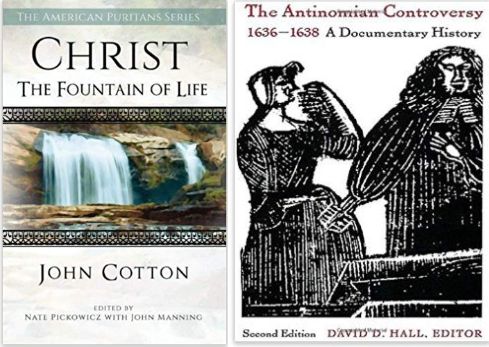
In the Puritan Women series I’ll look at Anne Hutchinson, Anne Bradstreet, and other women to be named later as I come across them in research. Two source books for the Anne Hutchinson essay will be-
Puritan wives were indispensible in building the country we now call America. Their work in the nascent nation was crucial to our growth. Because of the nature of their work – managing the household, supporting the husband – they are largely invisible to history. Trying to find the names and deeds of these women has been difficult, except for the several I mentioned above.
But were/are they invisible? Their patience, their Godliness, their contribution to American society was the children they bore and raised. Laurie Hochstetler, in the September 2013 edition of The New England Quarterly, wrote that the home was the “locus of spiritual and civic development and protection”. (Making Ministerial Marriage: The Social and Religious Legacy of the Dominion of New England).”
Thus, the Puritan home was the incubator for the men & women who came after the Great Migration and went on to populate and found the country. Puritan parents “exercised an authoritative, not an authoritarian, mode of child rearing” that aimed to cultivate godly affections and reason, with corporal punishment used as a last resort.” (Source). And the influence of the godly Puritan wife was the nexus.
Look for the first installment of Puritan Wives soon!
The thread of Christianity depends on a unity from one generation to the next of mutual understanding of our important words. Hence the Word of the Week.
Normally I write about a little-used word but one that we as believers need to know (and use in our vocabulary). I’ve written about aseity, omnipotence, and justification, for example. But this week’s word will be Light.
It seems like it is an easy word, and it is, but as with all things in the Bible, there are layers of meaning.
The word Light is used in the Bible in several different ways. There is created light, as when God said “Let there be light”…and He separated the light from the dark. This is literal. There is miraculous light, as in the glory light of Jesus when He transfigured. And there is figurative/symbolic Light, as in the Word is a light or when we are ‘in the light’ as opposed to those sinners who are ‘in darkness’, or ‘don’t hide your light under a bushel’.
Once you see the different ways the word light is used you can’t unsee it, nor would you want to, lol.
One of the most wonderful, cheering, and useful of all the works of God; called into being on the first of the six days of creation, by his voice: “Let there be light;” and there was light. No object better illustrates whatever is pure, glorious, spiritual, joyful, and beneficent. Hence the beauty and force of the expressions, “God is light,” 1 John 1:5, and “the Father of lights,” James 1:17; Christ is the “Sun of righteousness,” and “the light of the world,” John 1:9 8:12. So also the word of God is “a light,” Psalm 119:105; truth and Christians are lights, John 3:19 12:36; prosperity is “light,” Esther 8:16; and heaven is full of light, Revelation 21:23-25. The opposite of all these is “darkness.”
The word “light” is Divinely rich in its comprehensiveness and meaning. Its material splendor is used throughout the Scriptures as the symbol and synonym of all that is luminous and radiant in the mental, moral and spiritual life of men and angels; while the eternal God, because of His holiness and moral perfection, is pictured as “dwelling in light unapproachable” (1 Timothy 6:16). Every phase of the word, from the original light in the natural world to the spiritual glory of the celestial, is found in Holy Writ.
The ISBE even goes on to further separate the different concepts of Light into Natural Light, Artificial Light, Miraculous Light, Mental, Moral, Spiritual Light; and explores its symbolism, expressive terms, and more. Check it out!
We first read the word light in Genesis 1:3 and the Bible closes with it in Revelation 22:5. Light. It’s such a simple word, but such a complex theme.
While He was in His incarnation, we often think of the Pharisees as the object of Jesus’ most fervent wrath. But the Sadducees and the Scribes also endured invective from our Savior. The scribes were themselves filled with sinful hate toward Jesus. Here are just a few examples:
For I tell you, unless your righteousness exceeds that of the scribes and Pharisees, you will never enter the kingdom of heaven. (Matthew 5:20).
Then Jesus said to the crowds and to his disciples, 2 “The scribes and the Pharisees sit on Moses’ seat, 3 so do and observe whatever they tell you, but not the works they do. For they preach, but do not practice. (Matthew 23:1-3).
Now the Feast of Unleavened Bread drew near, which is called the Passover. 2 And the chief priests and the scribes were seeking how to put him to death, for they feared the people. (Luke 22:1-2).
Jesus’s declaration in the first verse above Matthew 5:20 was a shocking message. The Scribes were supposed to be the incubators of righteousness, the guardians of truth, and the teachers and teachers of teachers of Israel. How did things get so out of whack? Why did Jesus condemn them?? What IS a scribe anyway?
Prior to the time of Ezra the Scribe, the scribes acted as secretaries of the state/king/pharaoh. (Esther 3:12). Baruch was scribe to Prophet Jeremiah. They prepared and issued decrees in the name of the king (2 Samuel 8:17; 20:25; 1 Chronicles 18:16; 24:6; 1 Kings 4:3; 2 Kings 12:9-11; 18:18-37, etc.). In one illustration of the Egyptian scribe, the scene depicts the scribe and his helpers counting severed hands.
The class of Scribe for our purposes today began at the time of Ezra and the return from Exile. Ezra was a priest and a scribe.
At a great gathering of the people, of which an account is given in Nehemiah 8-10, the Law was publicly read by Ezra, and a solemn covenant entered into for national obedience to it. Being thus established as the binding rule of both civil and religious life, it became necessary that the Law should be thoroughly studied and interpreted to the people, who otherwise could not reasonably be expected to comprehend fully its principles and their application. This duty at first fell naturally to the priests, who for a time continued the main teachers and guardians of the Law. But gradually there grew up an independent class of men, other than the priests, who devoted themselves to the study of the Law, and made acquaintance with it their profession. These were the Scribes. Possibly at first their chief duty was to make copies of the Law, but the higher function of interpretation was soon added; and as the supreme importance of the Law came more and more to be recognized, so the profession of a Scribe came to be held in higher estimation than even that of a priest. Source
The scribes taught the Law, and did so since Ezra the Scribe (who was also a priest) through to the time of Jesus and beyond to today.
The scribe’s job was to copy and recopy the scrolls, preserve them, and interpret them. When Jesus did the reading of the Old Testament at synagogue (Luke 4:16-17), He was handed a scroll. This had no doubt been copied by a scribe at some point. A copying scribe was meticulous in copying the letters perfectly, even counting the spaces between each word so it matched exactly to its original. His title was sofer, (sopher) which in Hebrew literally means, “counting,” as in letters.
In the Holman treasury of key Bible words, we read,
In New Testament times, the scribes were a class of scholars who taught, copied, and interpreted the Jewish Law for the people. They appear in the Gospels primarily as opponents of Jesus. They continually accused Him of violating the Law on numerous occasions: in forgiving sins (Matt. 9:1–3; Luke 5:17–26), in breaking their notion of Sabbath observance through work and healing (Luke 6:1–2, 6–11), in not following their accepted ceremonial washings (Mark 7:2–5), and in ignoring their practice of fasting (Luke 5:33–39). Not surprisingly, they especially disapproved of Jesus’ practice of mingling with the unclean and outcasts of Jewish society (Mark 2:16–17; Luke 15:1–2).
Being a scribe came with a high esteem, the people regarded them highly because of their literacy, their education, and their influence in the community. They performed several functions:
Scribes studied and interpreted the Law
Scribes taught the Law, especially to youth
Scribes judged in the community, as well as wrote official documents such as marriage contracts etc.
Scribes copied and preserved the scrolls.
A youth whose family designated him for the life of a scribe would send him to a school at about age 13. If he was accepted, his training would commence then and last until about age 30. Depending on which career track he wound up in, a day in the life of a scribe of any type would no doubt be inside, not as the dyers, tanners, or shepherdslived, out of doors at the mercy of the elements. He was a professional.
If he was a little more fortunate, his career track might take him to litigator or an arbiter or even an executor. (Luke 12:14). He might be appointed to the Sanhedrin or become an esteemed teacher at one of the schools. If he was a copying scribe, he would do his work at his home or an office, have adequate lighting, sit at a table with quill, ink, and parchment, and bend for hours over his papers. His days and weeks would look like this:
Several centuries ago the laws of the Soferim, called STaM, were unified to give consistency in writing Sefri Torahs. It generally takes one year to write a Torah. On an average each Torah will have 245 columns with 42 lines each with a consistent total 304,805 letters. A very rough estimate required for a Sofer’s time would be one sheet per week (average 52 sheets per Sefer Torah), one column per day, six lines per hour, and 3 letters per minute.
Cattermole, George, 1800-1868; The Scribe
A scribe understood the Law, interpreted it, and debated fine points of the law with his clan, or in practical manner aided the community members in living it to the letter via the official documents such as wills or marriage contracts he drew up. It was a good profession and a lucrative one at that. The long years in apprenticeship and training were worth it. It was good work even at the lower rungs as copyist or executor in a small town. Sadly, over time the scribes began to add to the Law by oral tradition and precedent. Their esteem came to be so high that,
As time passed on the “words of the scribes” were honored above the law. It was a greater crime to offend against them than against the law. The first step was taken toward annulling the commandments of God for the sake of their own traditions. (Mark 7:13) …While the scribes repeated the traditions of the elders, Jesus “spake as one having authority,” “not as the scribes.” (Matthew 7:29). Source
So when the people said that Jesus spake as one having authority, not as one of the Scribes, this was a big deal. Equally, it was a big deal that the Scribes opposed Jesus and plotted to kill Him. (Luke 22:2). They had the money and influence to do it, and we know that they succeeded. They were active in obtaining Jesus’s death. (Matthew 26:3; Luke 23:10).
Where is the one who is wise? Where is the scribe? Where is the debater of this age? Has not God made foolish the wisdom of the world? (1 Corinthians 1:20 )
——————————
Some Scribes named in the Bible
Baruch (scribe to Jeremiah)
Ezra (Ezra 7:1-25)
Zadok (Nehemiah 13:13)
Shemaiah (1 Chronicles 24:6)
Jonathan, David’s uncle, was a counselor, being a man of understanding and a scribe (1 Chronicles 27:32)
Shimshai (Ezra 4:8)
——————————————————–
1. Antiquity of. Jdj 5:14.
2. Wore an inkhorn at their girdles. Eze 9:2, 3.
3. Families celebrated for furnishing
a. Kenites. 1 Ch 2:55.
b. Zebulun. Jdj 5:14.
c. Levi. 1 Ch 24:6; 2 Ch 34:13.
4. Generally men of great wisdom. 1 Ch 27:32.
5. Often learned in the law. Ezr 7:6.
6. Were ready writers. Ps 45:1.
7. Acted as
a. Secretaries to kings. 2 Sa 8:17; 20:25; 2 Ki 12:10; Es 3:12.
b. Secretaries to prophets. Jer 36:5, 26.
c. Notaries in courts of justice. Jer 32:11, 12.
d. Religious teachers. Ne 8:2–6.
e. Writers of public documents. 1 Ch 24:6.
f. Keepers of the muster-rolls of the host. 2 Ki 25:19; 2 Ch 26:11; Jer 52:25.
8. Modern
a. Were doctors of the law. Mr 12:28; Mt 22:35.
b. Wore long robes and loved pre-eminence. Mr 12:38, 39.
c. Sat in Moses’ seat. Mt 23:2.
d. Were frequently Pharisees. Ac 23:9.
e. Esteemed wise and learned. 1 Co 1:20.
f. Regarded as interpreters of Scripture. Mt 2:4; 17:10; Mr 12:35.
g. Their manner of teaching contrasting with that of Christ. Mt 7:29; Mr 1:22.
h. Condemned by Christ for hypocrisy. Mt 23:15.
i. Often offended at out Lord’s conduct and teaching. Mt 21:15; Mr 2:6, 7, 16; 3:22.
j. Tempted our Lord. Joh 8:3.
k. Active in procuring our Lord’s death. Mt 26:3; Lu 23:10.
l. Persecuted the Christians. Ac 4:5; 18:21; 6:12.
9. Illustrated of well instructed ministers of the gospel. Mt 13:52.
Torrey, R. A. (2001). The new topical text book: A scriptural text book for the use of ministers, teachers, and all Christian workers. Oak Harbor, WA: Logos Bible Software.
Ladies from our church are attending the weekly webinars with Rachel Jankovic called “Motherhood: A Call To Arms”. It’s a weekly webinar series, 4 consecutive weeks, where Jankovic discusses motherhood, motherhood issues, and biblical perspectives about raising children.
I do not have children and I won’t be having them (I’m 58 and single) but I am enjoying the series because I get to be with the younger ladies, learn what they learn, and encourage them in it. (Titus 2:3-5).
One aspect of Jankovic’s points was interesting to me. Jankovic said we see our babies, our tots, our little kids and that’s all well and good but we are actually birthing kingdom people.
“God giving us children is not for an Instagram moment. He is giving us children for kingdom work.”
There are many scriptures that discuss or announce babies, but these two scriptures also apply to motherhood:
Now Adam knew Eve his wife, and she conceived and bore Cain, saying, “I have gotten a man with the help of the Lord.” (Genesis 4:1)
After this Job opened his mouth and cursed the day of his birth. And Job said: “Let the day perish on which I was born, and the night that said, ‘A man is conceived.’ (Job 3:1-3).
When I visited Italy, we toured the Carrara marble quarry where Michelangelo’s marble had been quarried from. We went on to Florence where Michelangelo’s tremendous marble statue of the David stands at the Accademia Gallery. The particular piece of marble had been difficult to work with for other sculptors. The Encyclopedia Britanica explained that Antonio Rossellino, the initial sculptor, cited the poor quality of the marble and rejected it, walking away from the project 1n 1464. Modern scientific analyses of the marble have confirmed that it is indeed of mediocre quality.
The marble block had proven so difficult to work with, that the huge piece lay abandoned in the courtyard for 37 years. Yet Michelangelo took on the project and seemed to carve the David with ease. Asked about it, he said,
Every block of stone has a statue inside it and it is the task of the sculptor to discover it. I saw the angel in the marble and carved until I set him free.
Isn’t that a great way to view children? Every squalling baby is really an adult. We chip away at the ‘extra’ until the fully grown person is revealed.












 the-end-time.org