Posted in encouragement, theology

How to read the Puritans

On blind spots…JD Greear said,

Our Christian forebears were fallible men and women, but so are we. And we fool ourselves to simply assume that we would have had the courage to act differently when every societal pressure was pushing one direction. They had blind spots which we see clearly now. But we too have blind spots that our children and grandchildren will speak of with shame.

Greear was specifically speaking of slavery, but his concept applies to theology too. There has never been a time when the fundamentals and the tangential items of the faith were completely settled. During Jesus’ day, His ‘new’ theology, which was really the original theology, was misapplied, misunderstood, and rejected. Even Nicodemus, THE Teacher of Israel, whiffed the concepts of suffering servant/sacrificial atonement/new birth. The Pharisees certainly didn’t get it and at one point even John the Baptist, who’d had the Spirit in him since the womb, asked if Jesus was the one or should they wait for another.

During the Apostolic age, there were many points of theology to be settled, and the succeeding councils during the centuries after to hash them out are testament to the fluid nature of man’s understanding of the Kingdom. Early church fathers were certainly fallible men. Origen’s theology (c. 184-c. 253) was hailed either as the “height of faithful theology or the depth of horrendous error.

Augustine (354-430) adhered to many theologies that were solid but he clung to many that were not. Hailed as a brilliant thinker, at the same time, his philosophies “also considerably skewed the Christian vision.”

I could go on, but far be it for anyone to think that the faith delivered once for all to the saints is understood widely by all the saints for all time. In every era men struggle with certain elements of it due to their cultural blind spots of the time in which we live.
jedwards
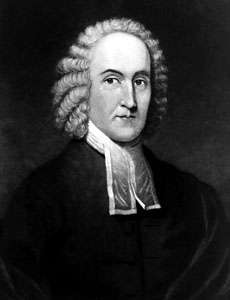
Jonathan Edwards

By the time of the Reformation, the understanding of the faith delivered once for all to the saints had been polluted beyond saving, and the Puritans started afresh, breaking completely with the Roman Catholic Church.

Suffice to say that the theologians in each era were duly conscientious of their thinking, striving to understand all that is required, and to explain it in ways the common man could understand, too. But they had blind spots, being products of their own generation. This is the way of it. We in this era have blind spots too, being products of our own generation. When we read a modern book, we nod and say, yes, yes, not realizing that the constructs of our own culture and time are blinding us to this or to that. Our grandchildren will look at our books of the millennium na shake their heads at us.

This is why it is important to read the products of the ancient and historical thinkers. We see their blind spots clearly, and we are happily exposed to theology that can and does enhance our understanding of the faith.

But oftentimes the ancients and historical fathers are difficult to read as well. Language changes. When reading Spurgeon, (1834 –1892) his words seem quaint. Backing up a hundred years, Jonathan Edwards (1703-1758) is a bit more difficult. By the time we get to the Puritan John Owen, (1616-1683) his works present comprehension difficulties nearly impossible to overcome. Even the great theologian JI Packer called Owen “cumbersome” and Kris Lundgaard took an hour to read just 8 or so pages of Owen, re-reading sentences three and four times and using a dictionary to look up certain words. The common man who finds these hurdles insurmountable miss out on great thinkers and founding fathers of the past.

What to do?

I have a few tips on how to grapple the ancients and the historical men who’ve contributed mightily to the faith but whose works present difficulties.

I’ve found that pairing books helps. For example, this summer I read John Bunyan’s spiritual autobiography Grace Abounding to the Chief of Sinners paired with A Pilgrim Who Made Progress, the Life Story of John Bunyan, by William Deal. I found that Deal’s book offered historical information that helped me understand some of Bunyan’s spiritual choices. That Deal’s book is aimed at the Youth demographic was actually a help.

If you’re interested in Augustine’s Confessions, the biography by Peter Brown is a good pairing. Brown’s treatment of Augustine seems to have become THE standard bio of Augustine since its publication nearly fifty years ago. Augustine of Hippo: A Biography.

Another kind of paring I’ve done is for example, I read Kris Lundgaard’s The Enemy Within paired with John Owen’s Indwelling Sin. Lundgaard’s book is essentially a re-write/Cliff’s Notes to Owen’s towering work. My version of Owen’s book was from the Puritan Paperback series. Where Lundgaard’s is a total re-write using modern examples, the PP series is a slightly edited and slightly modernized version of the original Puritan work. It’s put out by Banner of Truth Trust, an organization, you can, well, trust!
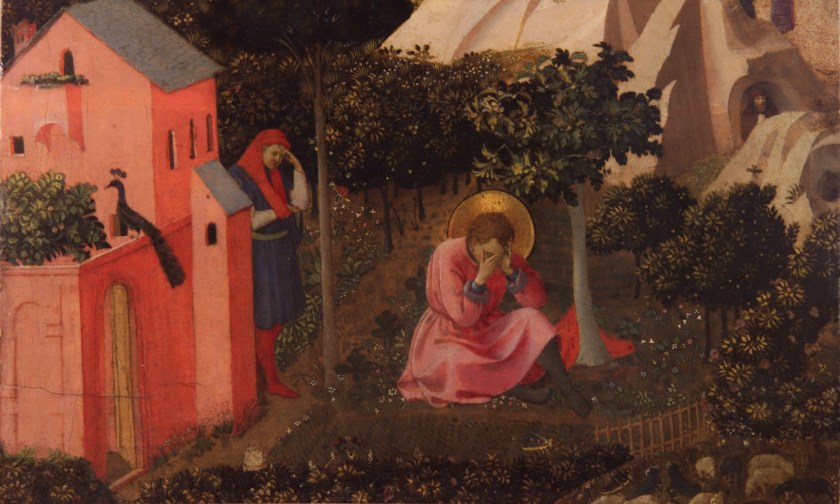
Fra_angelico_-_conversion_de_saint_augustin-e1440725829425
Fra Angelico, The Conversion of St. Augustine

I read Lundgaard on Mondays and the same Owen chapter the next day. I found that Lundgaard’s version helped me prepare my heart and my mind for the depth of the main meal Owen serves up.


Lundgaard also wrote Through the Looking Glass: Reflections on Christ that Change Us as a modernized re-write of Owen’s Glory of Christ, so that could be another pairing.

For Moby Dick, a theological but difficult book, (1851) there are many are study guides online. I used this one as I read the book itself.

For Pilgrim’s Progress, (a 1678 Christian allegory) there are study guides also. I bought The Pilgrim’s Progress Study Guide by Maureen L. Bradley.

Ligonier also has a wonderful teaching series on video by Derek Thomas, as well as a hard copy study guide by the same author. Ligonier says of the teaching series:

The Pilgrim’s Progress, written by John Bunyan over 300 years ago, is one of the most widely-circulated books ever to be published in the English language. In spite of its popularity in the past, many people today are not familiar with this masterpiece. Join Dr. Derek Thomas as he leads a guided tour of this allegorical work, showing that Christians have as much to gain from this book today as they did hundreds of years ago.

The first video is free. The remainder of the series are fee-based.

So, you can pair books with re-writes of books. Or you can pair books with a biography of the author you’re trying to read. You can use a study guide. Go through a teaching series. Buy a Puritan Paperback which is lightly modernized and abridged.

Any way you do it, don’t let the classics languish. There is a multitude of good theology in them we should not lose our connection to. I’ve offered some ways to ease the difficulty so to speak. If you have ideas, please do share them.

Posted in discernment, theology

Music in worship

By Elizabeth Prata

I saw a couple of quotes today one after the other (not linked or published on purpose, just happenstance) that made me think about music in worship once again.

Not to debate contemporary vs. traditional. Though I’m a huge traditionalist, I’m also a realist, and I know there has been good music written after 1900, though, lol.

I enjoyed my own church’s service yesterday, as I always do. We are a nearly three-year church plant. We have a plurality of elders (4), a time of confession during the service, and good music. It’s a mixture of old and new. The team takes care to select songs and hymns that match the theme of the sermon.

Music isn’t all there is to a service, meaning, it’s not primary. But it’s not secondary either. It’s important and has its place. Yesterday I was thinking about how important it is when we hear the word preached and when we sing and hear the song words sung. It is all supposed to edify us.

Ligonier tweeted,

Ligonier Ministries, @Ligonier
3:30 PM – 29 Jul 2018

We should be careful about the words of the music we sing and ensure that those words communicate truth. —@RCSproul

My friend Rachel tweeted,

Rachel, @REL4077
8:21 PM – 29 Jul 2018

I’ve listened to a lot of Christian music from the 70s/80s and a lot of CM from that time focused so much on Christ’s return, who Jesus is, and the need to share the Gospel. What happened since then that we have songs about reckless love and our “messed up” lives?!! Give me Jesus.

I agree. To that end, here is a thoughtful article from the Reformed Church in America. (Note: I liked the article but don’t know much about the website as a whole, but they seem a bit social justic-y to me “make the world a better place”, and they use the word ‘broken’.)

This article lists some thoughtful things about how we approach music in worship.

THE THEOLOGY AND PLACE OF MUSIC IN WORSHIP

Here are just a few quotes from the article, which again, I enjoyed. It outlines some facts about music in worship and then outlines a framework to think about when selecting music.

The church’s ministry of song is for the edification of God’s people

The church’s ministry of song is for the glory of God
It is also important that the emotional power of music in worship be evocative rather than manipulative, honest rather than manufactured, and that the congregation’s singing allow for the full range of emotions in worship.

Does our congregational singng include the many moods and types of prayer, including praise, thanksgiving, confession, lament, intercession, and dedication? A congregation which sings only “upbeat” praise choruses and hymns, for example, will have a diminished and restricted understanding of prayer.

I pray that you enjoy the thoughts here, the article at thelink, and most of all, music in worship.

music verse 1

Posted in christian life, theology

Mail Call: What is your opinion on the Christian’s responsibility regarding voting?

By Elizabeth Prata

mail call
Mail Call on the old TV show M*A*S*H

Q.
I would like your opinion on the Christian’s responsibility regarding voting.

A.
I’m not a good person to ask. I am very conflicted over my own behavior in this issue.

I used to be intensely involved in politics, being a reporter/editor of a weekly newspaper and covering all the politics there was. I had and still hold a firm belief that the US is the best country to live in, and that an aware and involved citizenry is what’s best for America. However, I ingested a little too much of local politics back then covering it for the paper, and now I have a healthy distaste for all politics! The level of greed & corruption disgusts me, and the news media’s current hatred toward all conservatives doesn’t help. It’s a minefield trying to educate myself on the local referenda or the national issues because of all the blatant fake news.

I do vote for President and usually Senator/Representative. But that is about it. I don’t do a lot of research into local ordinances, zoning, or  ballots any more because it all still turns my stomach.

I also believe what John MacArthur preached as the Christian’s responsibility toward government involvement. Here is the opening of his part 3 sermon on the topic, and of course he went on with scripture and biblical examples.

Christians and Politics part 3

My point is not that Christians should remain totally uninvolved in politics or civic activities and causes. They ought to express their political beliefs in the voting booth, and it is appropriate to support legitimate measures designed to correct a glaring social or political wrong. Complete noninvolvement would be contrary to what God’s Word says about doing good in society: “Therefore, as we have opportunity, let us do good to all, especially to those who are of the household of faith” (Gal. 6:10; cf. Titus 3:1-2).

It would also display a lack of gratitude for whatever amount of religious freedom the government allows us to enjoy. Furthermore, such pious apathy toward government and politics would reveal a lack of appreciation for the many appropriate legal remedies believers in democracies have for maintaining or improving the civil order.

A certain amount of healthy and balanced concern with current trends in government and the community is acceptable, as long as we realize that that interest is not vital to our spiritual growth, our righteous testimony, or the advancement of the kingdom of Christ. Above all, the believer’s political involvement should never displace the priority of preaching and teaching the gospel.

I am always trying to find that balance between what Dr MacArthur Mac phrased as “pious apathy” and the Bible’s concept of “responsible involvement.” I don’t think I’ve hit it. And I always hold my nose whichever course I take. So those are my thoughts! What are your thoughts?

Question used with permission from sender.

Posted in discernment, theology

One more thought on direct revelation

Yesterday I wrote an essay describing the preeminence of Jesus and how God in Hebrews 1:1-2 said He has spoken through His Son. What this means, for claimants of direct revelation, is that once God said He has spoken through His perfect, holy, supreme being of His son, God then chose to speak to and through Joe Blow in Peoria and Jane Q. Public in Waco? No. Jesus’ preeminence means God has the perfect vessel through which to speak, He has spoken, and He is no longer speaking through prophets, bushes, donkeys, mountains, or men. I’d made the bold claim that if a person says they have heard directly from God or Jesus, they do not believe Jesus is preeminent.

This post is a PS to that thought regarding direct revelation. It involves the content of these supposed revelations.

One thing you notice about these revelations, visions, dreams and intuitions, is that the content of them is small. They usually involve advice on jobs, careers, or other personal mundanities. If they involve biblical content, the revelations do not usually align with the Bible. Sarah Young, author of Jesus Calling, comes to mind, where the totality of her revelations are strikingly similar to one another and to what a middle aged white woman in America would say or think, not God’s grand redemptive plan. For example,

Softly I announce my Presence. Shimmering hues of radiance tap gently at your consciousness, seeking entrance. Though I have all Power in heaven and on earth, I am infinitely tender with you…

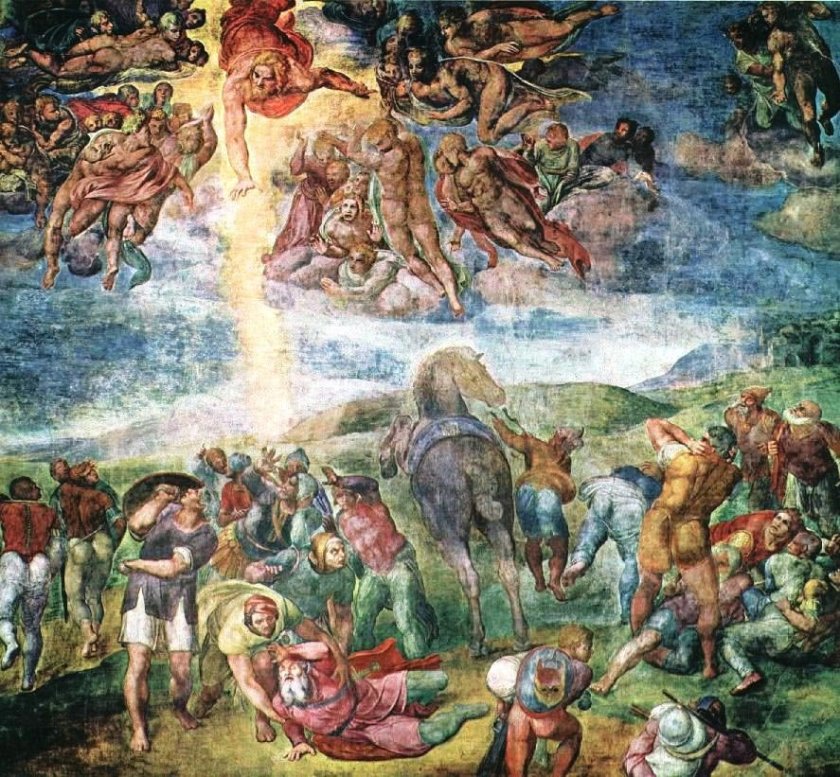
Like He was with Saul/Paul? Thrown to the ground and blinded?

The-Conversion-of-Saul-by-Michelangelo
The Conversion of Saul, by Michaelangelo

My face is shining upon you, beaming out Peace that transcends understanding. You are surrounded by a sea of problems, but you are face to face with Me, your Peace… ~Sarah Young, Jesus Calling

‘Beaming out peace’ to even one of His believers?

zechariah
The angel strikes Zechariah mute

In the past, when God spoke to people or through intermediaries, did He dispense personal advice? Suggest jobs or where to buy a house? Promise career success? Give tips on how to resolve that prickly relationship with the mother-in-law? No, He only spoke of His redemptive plan or addressed immediate circumstances if it affected His redemptive plan, not the minutiae of personal life. See these excerpted thoughts from the Titus Institute. (Other than this one article I am not familiar with the Titus Institute, though it seems to be a good resource on first glance).

How Has God Spoken To His People Throughout the OT and NT?

After the fall, what we see throughout the Scriptures is God communicating with specific individuals at specific times for specific purposes that always involve his redemptive plan. He only addressed personal sin or other personal issues when it involved his redemptive plan.

God spoke to our forefathers (OT believers) through the prophets and has spoken to us (NT believers) in his Son.

God spoke to the people of Israel through intermediaries, the prophets. When he spoke to the prophets, it always had to do with his redemptive plan, not personal issues in their lives unless it involved his redemptive plan.

The pattern in both the OT and NT is God speaking to his people through intermediaries and those intermediaries receiving revelation only regarding matters involving God’s redemptive plan. Those intermediaries were then to speak to God’s people about righteousness. This involved preaching about what is good and right before God and about what is sin and evil before God which we as God’s people are to apply in our lives.

Those intermediaries then wrote that revelation down which became the OT and NT.
Even when God spoke to these intermediaries, we see infrequent communication rather than frequent regular communication.

He spoke to Noah 5 times over 950 yrs, Abraham 8 times over 175 yrs, Isaac 2 times and 1 time to Rebekah over 180 yrs, Jacob 7 times and 1 time to Laban over Jacob’s lifetime. These are just some examples.

We also see that God does not address personal issues, only issues that involve his redemptive plan.

In the New Testament,

Two major things we notice, the revelation from God was infrequent and it was purposeful, always concerning Peter and Paul’s ministry, not personal matters.
Most of the time, Peter and Paul were ministering for the Lord without receiving direct revelation from the Lord.

Even at important times of decision the Lord did not always speak to them. In Acts 1:21-26, Peter used the casting of lots to determine the Lord’s will. In Acts 6:1-7, there is no record of revelation regarding the selection of men for the widow’s ministry. In Acts 15, there is no record of revelation in the first doctrinal crisis of the early church regarding what is necessary to be saved.

We see that man forfeited at the fall, direct communication with God on a personal basis. He then only received direct revelation through intermediaries. God communicated infrequently and only as He deemed necessary to fulfill His redemptive plan.

When we get to heaven we will have direct communication with God again. That is part of the blessing of redemption.

Now Ladies, if you would, please think of how often we hear and see today’s ‘Bible teachers’ claim they heard personally from God. Then please compare with God’s actual activity recorded in the Bible. Think about how infrequently He spoke and about what kinds of things He said.

Beware of ‘teachers’ who claim to have had revelations apart from the Bible. If you think you have had a revelation yourself, please re-think that and refer again to the scripture in Hebrews 1:1-2. God spoke through His Son, who appeared in the flesh on earth to seek and save the lost, to die in our place for our sin, and who rose again to take His place next to the father. He is THE Word. His life and teachings are recorded in the Bible, which would take years and lifetimes to learn, understand.

The Bible is enough. More than enough, it’s a gift beyond measure. When we are glorified we’ll have an eternity of direct communication with our Savior. For now, rest on His written word, and do not seek vain communiques from a disembodied voice.

Posted in discernment, theology

If you think God is speaking directly today, here is what that means…

A follow-up to this essay is here, One more thought on direct revelation

By Elizabeth Prata

Women have for at least two generations now, grown up in the faith with famous or celebrity women Bible teachers claiming to have had personal revelations and interactions with Jesus. They say “God told me” or “God laid it on my heart to tell you” or “I want to share some of the messages I have received” or “I heard Him specifically say…” Their persistent claims of direct revelation outside of the Bible has normalized it when it was never even normal in Bible times! Worse, it has accomplished two things:

–de facto declared the insufficiency of the Bible
–made a generation of women illiterate, because why do the hard work of studying the Bible when it can just plop down from the sky?

God is not speaking today to people outside of His word.

Whenever I or any of my friends say this, we receive tremendous push back. We are charged with proving it. We are told we’re wrong/bad/ignorant of scripture or history. Or, demands are made for scriptures that say so. But when provided, those very scriptures are dismissed. We are given the excuse that we must not “put God in a box” because, after all, He has the ability to do anything He wants, including speak to us in any way or at any time He wants.

It’s true that in the past He spoke in many different ways. He spoke directly to man (Adam, Noah, Moses et al), through rituals, ceremonies, from the sky, from the mountain, a donkey, angels, prophets, and a burning bush.

I want to come at this from a different tack today. I was listening to Steven J. Lawson preach Hebrews 1:1-4. This is the classic text that declares that God has ceased speaking because, though He spoke in many ways in prior ages, He has spoken finally in this age, through His Son. WHat came to my mind as Lawson preached was this:

Jesus is the Supreme Being of the Universe. He is the unrivaled supreme one.

And that is why God is not speaking to you.

The previous ways God spoke to man described above are indicative of His progressive revelation. God was building revelatory knowledge of His redemptive plan thread by thread, weaving a picture in His tapestry of redemption through the ages. The pinnacle, the capstone, the zenith of that picture, is Christ. Jesus is God’s exact imprint. (Hebrews 1:3). He is the ultimate. He is the highest. He is all-authority. He said and did everything the Father wanted, perfectly. God’s words, His concepts, and His principles are supreme overall, and represent His final word through Christ.

People who insist that God or Jesus speaks to them, do you really think that after having set Jesus up as His apex, declaring Himself pleased, that God will then will go lower and speak through you? When He has Jesus He’s spoken through, He will speak through you instead?

Will God choose to speak through sinful flesh, when He has His own exact imprint of glory and perfection through which He has already spoken? What a ghastly thought! May it never be!

If you believe Jesus is speaking through you, or your favorite Bible ‘teacher’ or author, you do not hold Jesus as supreme. It is as simple as that.

No, the superiority of Christ drowns out every other voice!
~Steve Lawson sermon on Hebrews 1:1-4 The Unrivaled Supremacy of Christ

He is the image of the invisible God, the firstborn of all creation. 16 For by him all things were created, in heaven and on earth, visible and invisible, whether thrones or dominions or rulers or authorities—all things were created through him and for him. And he is before all things, and in him all things hold together. And he is the head of the body, the church. He is the beginning, the firstborn from the dead, that in everything he might be preeminent. For in him all the fullness of God was pleased to dwell, and through him to reconcile to himself all things, whether on earth or in heaven, making peace by the blood of his cross. (Colossians 1:15-20).

god is not speaking he is preeminent

A follow-up to this essay is here, One more thought on direct revelation

Posted in discernment, theology

“Lord, Lord” is such a woeful verse

By Elizabeth Prata

On that day many will say to me, ‘Lord, Lord, did we not prophesy in your name, and cast out demons in your name, and do many mighty works in your name?’ Mt 7:22.

How many is many? The word for ‘many’ is:

polýs – many (high in number); multitudinous, plenteous, “much”; “great” in amount (extent). (Strong’s).

This is terrible to think. It seems that the visible church is filled with believers, but the verse is saying that many aren’t believers after all. I worry for others, but also for myself. “Examine yourselves, whether you be in the faith“. 2 Corinthians 13:5.

Do business with Jesus today, this very day, while there is still time. Here are some resources

Is It Real? : 11 Biblical Tests of Genuine Salvation

What are some of the signs of genuine saving faith?

Assurance of Salvation: You Can Be Sure

Toshiba Exif JPEG

Posted in discernment, theology

Taming the Tongue on Social Media

Look at the ships also: though they are so large and are driven by strong winds, they are guided by a very small rudder wherever the will of the pilot directs. (James 3:4).

Our boat circa 1995

I was watching my Twitter follow count the last few days. Surprisingly, I was nearing 1,000 followers. That isn’t a lot, but it’s a lot to me. 1,000 is a new and exciting level.

I have two blogs, mirrored on two platforms, (Blogger and WordPress) so that means 4 blogs. The End Time which is this one, with Christian content, and The Quiet Life, about art, crafting, cooking, etc. I’ve got Twitter. I have an Instagram account with a minimal amount of followers. I have two Facebook pages, one called The End Time and the other is the personal one. I have a GoodReads account. I use email. I text to my GroupMe church and sundry church small groups. I have a Pinterest account. I have a Disqus commenting account.

I’ve learned modern terms like ‘reach’ and ‘impressions.’ I have ‘stats’.

Some years ago John MacArthur said that he has never worried about his reach (influence). He focused on the depth and knew the Spirit would take care of the reach.

I was concerned from the very beginning about the depth of my ministry, and I said if I take care of the depth of my ministry, I can leave the breadth of it to God. You know, if it’s something He can use, then He’ll take it where He wants it to go. So I’ve never done anything to take it anywhere.

I took his words to heart and I’ve never done anything overt to push any of my social media. I’ve had The End Time blog for 9 1/2 years and The Quiet Life for 12. I don’t do SEO, I don’t request friends to go look at it, I don’t concentrate on the statistics. I know that the Spirit will put whatever He wants of what I write in front of whom He wants to. I’ll write a little PS to this thought I’ll add at the bottom, though.

I listened to a good sermon this week, twice. We all have a God-given desire to communicate, said Chris Hamilton in his sermon Taming the Tongue on Social Media. We want to be heard.

He said that until recently the opinion making and influence reach was in the hands of a very few people. I remember that time before the internet distinctly. Prior to the internet the Average Joe or Jane remained obscure all his or her life. The only times someone would be guaranteed to get into the paper was when they were born, married, or died. Sometimes your name went into the paper if you went to jail, or were derelict in paying property taxes. That’s it. Opining on the culture wars of the day, publishing books or poetry, presenting your photography portfolio, announcing things on television, wase left to others, a very few others. Cut to today:

The agenda of public thought and discourse is no longer set by a few people in the news networks [and newspapers]. It’s set by just about anyone, such as wannabe celebrities, rap artists, actors, or minor journalists. There has been a rush of human beings to become a source of data, perspective, leadership, and influence with words…~Chris Hamilton

Now, billions of people every day say things on any social media that they want.

Before we’re saved, the desire to be heard is a sinful desire. Even when we have good intentions, our sin-nature means that the desire to communicate is always self-glorifying at some level. We can’t help it. The utter depravity of man is never more on display than when posted on social media. ~Chris Hamilton

The tongue is a restless evil and a poison.” (James 3:8b).

After salvation, the Bible is clear on right speech and wrong speech, giving over many verses to the subject. A major series of verses are in James 3. Here is Chris Hamilton with 12 ways the Bible says we are to use our tongue-

1.   Confess with your mouth Jesus is Lord. Romans 10:9
2.   Teach God’s word (we all teach in some capacity. Deuteronomy 11:19; Heb 13:7
3.   Speak of God. Psalm 71:8
4.   Preach the Gospel. Matthew 28:20, Romans 10:14, 1 Timothy 4:12
5.   Speak truth. Ephesians 4:25
6.   Building each other up. Ephesians 4:29, 1 Timothy 5:14
7.   Admonish one another (warning using the word of God, not our opinion). Colossians 3:16a
8.   Sing. Colossians 3:16b
9.   Expressing thankfulness. Colossians 3:16c, Ephesians 5:20
10. Pray. 1 Thessalonians 5:17
11. Confess sin. James 5:16
12. To make a defense and give a hope that is within us. 1 Peter 3:15

God gave us a tongue and told us how to use it, but we are unable to comply without the saving grace of God.

The tongue is a rudder. This is the rudder on our boat. The boat weighed 23,000 pounds. A small shaft running through the rudder and connected to the steering wheel was all that made the yacht go where we wanted.

the boat out of the water, exposing the rudder

As for participation on the internet and social media: it calls for WISDOM.

James 3 goes from a discussion of the tongue straight into wisdom. Think about why that might be for a minute…

This is not the wisdom that comes down from above, but is earthly, unspiritual, demonic. 16For where jealousy and selfish ambition exist, there will be disorder and every vile practice. 17But the wisdom from above is first pure, then peaceable, gentle, open to reason, full of mercy and good fruits, impartial and sincere. (James 3:15-17)

Is our conduct on social media:
pure,
peaceable,
gentle,
reasonable
full of mercy ?

Or is our conduct on social media

earthly,
unspiritual,
demonic ?

At minimum we should be thinking about that before we press send.

As Mr Hamilton preached, And then there is the case of silence. Not speaking. Saying nothing. No words. Silence can be an expression of worship, humility, wisdom, chastening, etc. God did not give us a tongue in order to remain silent. Obviously. No command in scripture says to not use words. But consider our contribution to the internet and whether, in some cases, a response might not be necessary. Silence can reign supreme sometimes. It’s OK. (Ecclesiastes 3:7; Ecclesiastes 5:2; Revelation 8:1).

Silence also protects our own ignorance. Let us (me) not put our own ignorance on display. (Proverbs 10:19).

We can and should remain silent in response to the foolishness and sin of others. (1 Peter 2:21-22, referring to Christ’s trial, where He remained silent). And a case is made to remain silent in the face of conflict. (Proverbs 26:17).

Mr Hamilton was tough on Christian participation in social media. His stance was that using social media to promote the name of Jesus is good and fine, but if we do that, we are entering territory that is teaching. And the scripture says not many of you should become teachers. He is right. He said to his immediate audience, “some of you should stand down.” He is right again.

I thought about it for a long time, and as appropriate, applied the scriptures and the warning to myself. Should I stand down? How is my tongue? I meditated.

On the other hand, we do have this marvelous opportunity to, within our sphere, encourage, lift up, share verses, learn of others’ burdens so we can shoulder them, and so on. I do feel called to teach and I employ that online. (My foremost priority are the real people in my real church life though).

These are some of the stats of the most popular ‘Christian’ teachers online today. Their evil influence reaches millions.

PS: As for my own reach & influence, I am not concerned with the reach or the stats but I’m highly concerned with my content- that it’s accurate and edifying.

With all the false out there masquerading as truth, how can I NOT promote Jesus, share credible ministries, offer true interpretations of the Bible’s words, with every means possible? The world will always love its own. But as long as I have a tongue in my head or an online connection, here I speak, I can do no other.

With the Lord’s help and Chris Hamilton’s words and admonishments ringing in my ears, I pray that as I do speak, it’s pure, peaceable, gentle, reasonable, full of mercy. I face a stricter judgment. And that does give one pause.

Posted in theology, word of the week

Sunday Word of the Week: Orthodoxy

By Elizabeth Prata

The thread of Christianity depends on a unity from one generation to the next of mutual understanding of our important words. Hence the Word of the Week.


Orthodoxy: as defined by Theopedia

The word orthodox comes from two Greek words, ortho + doxa, meaning “right opinion” or “correct thinking.”

In Christianity, it generally means adhering to the accepted or traditional historic Christian faith. Some see “orthodoxy” as that which is defined by the early ecumenical creeds which would include the Nicene-Constantinopolitan Creed, popularly known in the West as the Nicene Creed, that was formally accepted by the second Council of Constantinople in 381 A.D.

Orthodoxy as defined by CARM.org:

Orthodoxy is the belief in the standards of accepted and true doctrines taught in the Bible. That which is orthodox agrees with Biblical teaching and the interpretation of the Christian Church. False religions are not orthodox. They are heterodox.

No one person is completely orthodox because that would mean they are completely correct in all their thinking about all that God has delivered for us to know. Only Jesus was totally orthodox in His thinking.

It is also true that as we define ‘church,’ which are really only segments of the one Church, no local church is totally orthodox, though all churches in the one true Church should be as orthodox as possible. The standard is higher for churches than it is for individuals, because the Spirit dwells in the church in fuller measure. However, without right thinking in highest standard, individual churches would cease to be a segment of the divinely given organization it is called to be.

But even as we see a microcosm of churches across Asia Minor in the first century, as viewed by Jesus in Revelation, none were completely orthodox.

Now and in the past, sme churches attempt to create creeds, declaring a standard of ecumenical orthodox thinking across denominations, and this is acceptable as a method of describing orthodoxy. Others drill down the doctrines of God to essentials, to which an orthodox denomination, church, or individual must adhere, and this is acceptable too.

The mystery of orthodoxy, in my opinion, is at most, difficult to define and at worst, impossible. But the soul knows it when it see its, and rejoices, Similarly the discerning soul knows when it doesn’t see it also.

One day, all will be perfectly orthodox as Jesus claims His bride from the world, raises us to His abode, and glorifies our body. We will know as we are known, and we will no longer see through a glass darkly. We will be perfectly orthodox.

Illustrating orthodoxy is difficult but I am going to use the biblical concept of straight vs. crooked this week. Straight, of course, representing orthodox.

The way of peace they do not know, and there is no justice in their paths; they have made their roads crooked; no one who treads on them knows peace. (Isaiah 59:8)

orthodoxy 1


———————————————-

Further reading:

6. Glorification
5. Sanctification
4. Propitiation
3. Immanence
2. Transcendence
1. Justification