Posted in encouragement, rejoice, salvation

Relief in Christ, a soul rejoices

Psalm 107:4-9

Some wandered in desert wastes,
finding no way to a city to dwell in;
hungry and thirsty,
their soul fainted within them.
Then they cried to the LORD in their trouble,
and he delivered them from their distress.
He led them by a straight way
till they reached a city to dwell in.
Let them thank the LORD for his steadfast love,
for his wondrous works to the children of man!
For he satisfies the longing soul,
and the hungry soul he fills with good things.

This was me! Was this scripture written with my name in mind? Certainly it must be so? A poor wanderer, a Pilgrim without a destination, a sinner without repentance, yet longing for something, something. For what did I long? For what drink was I thirsty? Why was I feeling a deep, gnawing distress? Why was the way crooked? From whence did this trouble come?

Praise our glorious Lord for loving me before I knew Him. Praise Him, for though He was offended by my sin, He set the straight Way through Jesus for me, a sinner, to enter. Praise Him for satisfying my soul, completely. Praise Him for His wondrous works to the children of man.

No longer a wanderer, I am atop the rock, and the rock is Christ.

Posted in agriculture, donkey

Bible topic: the Donkey

Studying the natural history of the Bible is a good thing to do. Plants, places, and animals are constantly mentioned in God’s Word. Processes such as wine-making and agricultural endeavors like threshing and irrigating are mentioned too. Knowing what the references mean helps deepen our understanding of such verses when we study them. For example in Psalm 21:1, it is stated

The king’s heart is a stream of water in the hand of the LORD; he turns it wherever he will.

This is a vivid metaphor that anyone can understand. But knowing that in ancient times and even today, Egyptian farmers by the Nile dig complicated channels in the earth and board the source of each one, and by lifting a certain board at any given time they could precisely direct the channel to a row of crops as they will. Now you have an even more clear picture of the metaphor. (More here)

Or this regarding passing under the rod. In Ezekiel 20:37 it says,

And I will cause you to pass under the rod, and I will bring you into the bond of the covenant:

which Jamieson/Fausset/Brown’s Commentary says,

pass under the rod—metaphor from a shepherd who makes his sheep pass under his rod in counting them (Le 27:32; Jer 33:13). Whether you will or not, ye shall be counted as Mine

As the shepherd bunked down nightly, he would count each sheep to ensure they were all collected. As each one passed under his rod entering the sheepfold he would count them. Knowing these things could develop into a deeper study of agricultural practices in order to provide background context for scripture study, or simply knowing a little bit about what the rod or the channels of water helps provide  a better understanding of the verse.

There are many animals in the Bible either used in fact or referred to as symbols (like the ant in Proverbs 6:6). Donkeys are an animal mentioned frequently and used as beasts of burden to carry goods or people.

So Abraham rose early in the morning, saddled his donkey, and took two of his young men with him, and his son Isaac. And he cut the wood for the burnt offering and arose and went to the place of which God had told him. (Genesis 22:3)

Donkeys were part of the Law.

If you meet your enemy’s ox or his donkey going astray, you shall bring it back to him. (Exodus 23:4)

There are some famous donkeys in the Bible. Balaam’s donkey for example, spoke. Or was it God speaking through the beast?

Jesus’ Triumphal entry was on the back of a donkey. John 12:14 records,

And Jesus found a young donkey and sat on it, just as it is written, “Fear not, daughter of Zion; behold, your king is coming, sitting on a donkey’s colt!”

Initially, people who could afford them rode donkeys, such as Judges. (Judges 5:10). After that time, though, horses were imported, and high officials enjoyed riding white horses more than donkeys so they left the donkeys to the poorer folk. When Jesus rode in to Jerusalem on a donkey it was demonstrating his humility and meekness.

Donkeys were a beast of burden used frequently as the preferred animal because they were stoic and patient, and tended to panic less easily than horses. Physically,

Donkeys’ feet have a number of differences, including being more elastic, narrower in shape, and more upright than a horse’s. Donkeys can be prone to developing very long hooves as they do not chip and breakaway as a horse’s would do. The donkey’s digestive system is considerably more efficient than that of a similar sized pony. … Donkeys in general have a very efficient walking pace and to be honest, in most situations it is easier to walk at the donkeys pace rather than try and make them go at ours.  (source)

A boy and his donkey. This is Papallacta, high in the Andes.
The type of saddle has been in use since Inca times. EPrata photo

Rejoice greatly, O daughter of Zion; shout, O daughter of Jerusalem: behold, thy King cometh unto thee: he is just, and having salvation; lowly, and riding upon an ass, and upon a colt the foal of an ass. (Zechariah 9:9)

Bible topics: The Domestic Ass.

Posted in jesus, Mosul, prophecy, woe

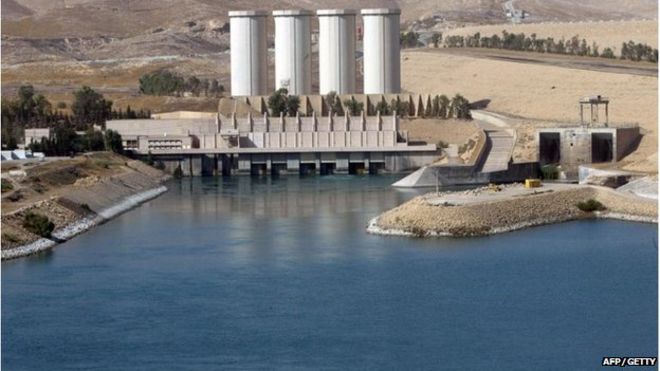
Mosul Dam at risk of catastrophic failure

Introduction & Background

BBC

A news headline caught my eye last week. It is from the UK Telegraph, and consists of a dire warning from US officials regarding the Mosul Dam.

US warns of ‘tsunami wave’ across Iraq if the Mosul Dam collapses

Iraq’s Mosul Dam faces “unprecedented” risk of a “catastrophic failure” that would unleash a wave of water which could flatten cities and kill hundreds of thousands within hours, the US has said. The American government issued an unusually stark warning of the horrors that face Iraq if the dam gives way, describing a “tsunami-like wave” that would crush nearly a third of the country.

Iraq’s power grid could be entirely knocked out and parts of major cities would be underwater for weeks like areas of New Orleans after Hurricane Katrina, the US said. The Iraqi government would be unable to direct an evacuation because Islamic State of Iraq and the Levant (Isil) still controls much of the territory near the dam and so people need to prepare to evacuate on their own, the US said.

The 2014 article from the BBC recounts the reasons why the dam is so unstable-

Instrument of war
However, since its completion in the 1980s, the dam has required regular maintenance involving injections of cement on areas of leakage. The US government has invested more than $30m (£17.9m) on monitoring and repairs, working together with Iraqi teams. The black flags of jihadist group Islamic State flew over the Mosul dam for 10 days before it was recaptured by Kurdish and Iraqi ground forces. In 2007, the then commanding general of US forces in Iraq, David Petraeus, and the then US ambassador to Iraq, Ryan Crocker, warned Iraq’s PM Nouri Maliki that the structure was highly dangerous because it was built on unstable soil foundation. 

“A catastrophic failure of Mosul dam would result in flooding along the Tigris river all the way to Baghdad,” [200 miles away] they said in a letter. “Assuming a worst-case scenario, an instantaneous failure of Mosul dam filled to its maximum operating level could result in a flood wave 20 metres (65.5ft) deep at the city of Mosul,” it said.

So the dam itself is faulty and now that the terror group ISIS has captured so much land in the surrounding area fears are they will use the dam as an instrument of war. The situation has not improved much since ISIS took over surrounding area and even had taken over the dam briefly in 2014, because, as this CNS News article from yesterday states,

The situation worsened when ISIS terrorists overran the dam and held it for several weeks in 2014. Since then, efforts to reinforce the dam’s foundations have not been adequate, partly because ISIS still controls the factory that produces concrete for the dam. (source)

Catastrophic Effects of Dam Busting

This situation brings to mind two items, First is Dam Busters and the Geneva Convention, and second is the Great Tribulation.

Familiar to many people are the battles of WWII. We all know the names of battles such as The battle of the Bulge, Bombing of Berlin, The London Blitz, and D-Day. Less familiar is Operation Chastise.

According to Wikipedia,

Prior to World War II, the British Air Ministry had identified Germany’s heavily industrialised Ruhr Valley, and especially its dams, as important strategic targets: in addition to providing hydro-electric power and pure water for steel-making, they also supplied drinking water and water for the canal transport system. The methods used to attack the dams had been carefully worked out. Calculations indicated that repeated air strikes with large bombs could be effective, but required a degree of accuracy which Bomber Command had been unable to attain in the face of enemy defences.

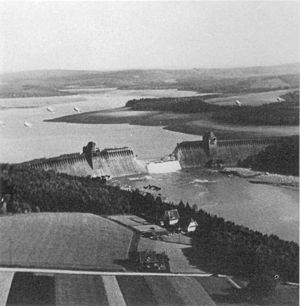
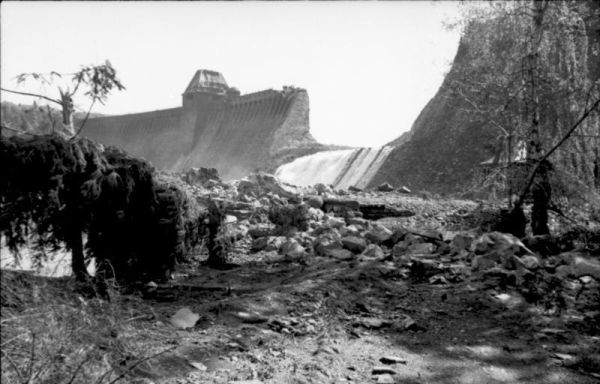
The Möhne dam the day following the attacks.
16–17 May 1943. Wikipedia

The movie “The Dam Busters” is the story of one scientist who developed a special bomb that could skip over water, avoid the torpedo nets, and then sink against the bottom of the dam in order to explode it at a sensitive point. The concept is of an earthquake bomb. Once the bomb was developed, the Operation was a success but there was heavy loss of Allied life due to the pilots having to fly so low to drop the bombs. The Operation was successful for the British both in its short-term and its long-term effects. But at what cost?

Flying Officer Frank “Jerry” Fray wrote of the experience of seeing the Valley after the dam breach-

When I was about 150 miles from the Möhne Dam, I could see the industrial haze over the Ruhr area and what appeared to be a cloud to the east. On flying closer, I saw that what had seemed to be cloud was the sun shining on the floodwaters. I looked down into the deep valley which had seemed so peaceful three days before [on an earlier reconnaissance mission] but now it was a wide torrent. The whole valley of the river was inundated with only patches of high ground and the tops of trees and church steeples showing above the flood. I was overcome by the immensity of it.

This is the same level of damage the opening articles were mentioning if the Mosul Dam in Iraq collapsed.

The destruction was so cataclysmic that it prompted a new resolution to the Geneva Convention. In 1977, Article 56 of the Protocol I amendment to the Geneva Conventions, outlawed attacks on dams “if such attack may cause the release of dangerous forces from the works or installations and consequent severe losses among the civilian population.”

ISIS, Infrastructure, and the Great Tribulation

Recently, people have been making date predictions about the start of the Great Tribulation. Some have said it will begin in March 2016, which is now. FYI, it is not going on now. The Tribulation has not begun. We know this because the church has not been removed from the earth yet, which will happen prior to the beginning of the Tribulation wrath being poured out.

Setting a specific date for the start of this worst event to ever happen on the face of the earth (Matthew 24:21) is forbidden by scripture, (Matthew 24:36, Acts 1:7), but people do it anyway. Sigh. One reason we are not to date set is that continual date setting with failure to fulfill destroys the confidence in weak Christians. That is sad. It also tarnishes the study of prophecy in general, and prophecy is extremely important.

What I find troublesome is the people who make fun of this date setting. Christian mockers mocking the event’s non-event. The Great Tribulation is no laughing matter. Jesus warned that it will be the WORST time on earth, ever. This means worse than the Flood of Genesis when every person on earth save 8 drowned. Every animal died (except on the ark). The Great Tribulation will be worse. It will be blood and anger and horror and demons abounding. It will be destruction and war and hate and brutality. It is not something to be taken lightly and certainly not to be made fun of.

One reason I mention prophecy quite often is because I want people to understand that the way things are will end. We are living on borrowed time, nationally speaking. What we see in our countries will exist no more. Infrastructure will crumble. Bridges, dams, walls, towers, will come down. Governments will l dissolve and reform to form a global tyranny. People will kill for no reason, or just because. The world’s most vulnerable – widows, children, poor, pets/animals – will be at most risk. People will simply not care one bit for their neighbor. People will be killed for a sip of water, or because they wore blue that day or they didn’t walk fast enough. The Great Tribulation literally will be hell on earth.

The dams in WWII that were busted caused so much havoc and death that the World decided not to use them as targets ever again. When the dams were busted in WWII 1,600 civilians were killed.

Here, the breach in the Mohne Dam’s massive wall gives way to a scene
of utter devastation as millions of gallons of water flooded into the valley
Image: Schalber, cc-sa-3.0 DE)

Prophecy authenticates the speaker, so this means ultimately God’s word is authenticated as He speaks and His prophecies come true. (Deuteronomy 13:1-3). Prophecy is supposed to quicken us and enliven us as we are ever-aware that this is not our world. We are not citizens of earth. We are citizens of heaven.

During the time of the Tribulation, do we think for one moment that some terror group won’t hesitate to destroy any dam? Any bridge? ISIS already destroys for the sake of destroying. What do we think will happen when the Restrainer has left the earth and allows man his full range of sinful impulses?

The devastation upon earth during the Tribulation will be uncountable. If the Mosul Dam is teetering on the brink of failure now, just imagine the horror of that and other catastrophic failures during the time of greatest woes ever occurring on the earth. Don’t take the Tribulation lightly and certainly, please, don’t mock even those who set dates about it. It is the second heaviest subject in the Bible, permanent wrath in hell being the worst. The Tribulation will be hell on earth and hell will have to enlarge its mouth for it to accept the many thousands at a time to enter it as will happen during the Tribulation.

Pray for souls to be saved now, during the age of grace. Be a living witness of the cause of Christ, warning of the wrath to come, in all due gravity and urgent pleading. If the Mosul Dam fails it will be like a mosquito bite compared to the devastation daily occurring during the Time of Jacob’s Trouble.

Posted in church, encouragement, sermons

Shepherd’s Conference 2016 begins tomorrow

My friend Craig wrote the following and I agree. I am SO looking forward to the Shepherd’s Conference! It’s live streamed, then archived. It’s especially poignant to see 4,500 pastors gather to be ministered TO. The impact of such numbers of mature, loving, leading shepherds makes one realize that churches across America and other nations are blessed with God-raised men who labor for His name. It’s very encouraging simply to see so many of them. Also please be sure to listen to the 4,000 gathered men sing hymns, it will stir your soul and overwhelm your emotions. Now to Craig’s comment-

“If I was forced to choose only one event each year which I could attend or watch, John MacArthur’s Shepherd’s Conference would win hands down. It is specifically geared to minister to the pastors, elders and leaders of the local church. 

“And as such it is very meaty due to the spiritual maturity of those in attendance. I say this not to discourage those who might not consider themselves to be theological scholars but simply for them to know in advance that many things might be discussed without the benefit of filling in some of the gaps you might usually expect to hear with a less Biblically educated audience. Not a less Christian gathering, just one that might need to hear some of the gaps filled in so as not to be confused or worse feel misinformed.”

“This particular gathering of attendees do not require that level of detail so expect that to be the case as you listen. It might even be a catalyst for many of you to do some research on your own since “spoon feeding” will not be the order of the day as we have become so accustomed to hearing and expecting.”

All times (GMT-08:00) Pacific Time.
Shepherds’ Conference 2016 – March 9 – 13
https://www.shepherdsconference.org/

To give you a foretaste, here are thousands of shepherds whose voices are lifted up in praise of the Lamb. Pray for them! Each one of the heads you see and each of the voices you hear are from men God has enabled to shepherd people like you. For many of them, this is the only R&R these warriors receive all year. Grizzled solders persevering during the long war, new and naive soldiers fresh to the battlefield, overwhelmed by the heated warfare, stagger or sprint to this lone battlefield station where they are refreshed and nurtured for a few short days before leaving to take up arms once again.

Posted in bible, husband, marriage, prophecy, wife

What marriage is really all about

The Bible begins with a marriage and ends with a marriage. The marriage motif is laced throughout scripture in progressively obvious ways. As BibleGateway explains,

“Marriage is used to describe the relationship between God and Israel in the OT and between Jesus Christ and the church in the NT. Contemplating marriage deepens understanding of God’s love for his people; examining God’s covenant love for his people similarly enriches an understanding of marriage.” (BibleGateway)

It begins in Genesis 2, where God unites Eve and Adam as one flesh. He made Eve from Adam, as a helper fit for him.

Therefore a man shall leave his father and his mother and hold fast to his wife, and they shall become one flesh. (Genesis 2:24)

As we progress through the Old Testament, we see God declare He is “married” to Israel. God’s marriage covenant with Israel is seen in Ezekiel 16:8-14, below. The covenant at Sinai was seen as a form of marriage. See also Jeremiah 31:32; Ezekiel 16:59-60.

God as Israel’s husband is also seen in Isaiah 54:5 and also Hosea 2:7; Joel 1:8.

8 “When I passed by you again and saw you, behold, you were at the age for love, and I spread the corner of my garment over you and covered your nakedness; I made my vow to you and entered into a covenant with you, declares the Lord God, and you became mine. 9 Then I bathed you with water and washed off your blood from you and anointed you with oil. 10 I clothed you also with embroidered cloth and shod you with fine leather. I wrapped you in fine linen and covered you with silk.[a] 11 And I adorned you with ornaments and put bracelets on your wrists and a chain on your neck. 12 And I put a ring on your nose and earrings in your ears and a beautiful crown on your head. 13 Thus you were adorned with gold and silver, and your clothing was of fine linen and silk and embroidered cloth. You ate fine flour and honey and oil. You grew exceedingly beautiful and advanced to royalty. 14 And your renown went forth among the nations because of your beauty, for it was perfect through the splendor that I had bestowed on you, declares the Lord God. (Ezekiel 16:8-14)

In the New Testament, we see frequent symbolism of Jesus as the Groom and the Church as His bride.

For I feel a divine jealousy for you, since I betrothed you to one husband, to present you as a pure virgin to Christ. (2 Corinthians 11:2)

The kingdom of heaven may be compared to a king who gave a wedding feast for his son, (Matthew 22:2)

The Marriage supper is likely one of the most eagerly anticipated events…by Jesus! Since before time began when names were written down, Jesus has been promised a wife, one who will adore Him and with whom He will be the groom, lovingly guiding her all the rest of eternity. The day which He knows not, the day when the Father will say, “Son, go get your Bride”, (cf Matthew 22:2) and brings His church triumphant to heaven for glorification (consummation) will be a tremendous, tremendous moment. It hardly bears mental sensibility to even imagine such an event!

We’ve seen the marriage theme in Adam and Eve, in Hosea, Ezekiel, Isaiah, Joel, and Jeremiah. In the New Testament we see the marriage theme in Matthew, 2 Corinthians, and other books, and now in Revelation.

Then came one of the seven angels who had the seven bowls full of the seven last plagues and spoke to me, saying, “Come, I will show you the Bride, the wife of the Lamb.” (Revelation 19:7)

We Christians long for the day when we are the wife, the glorified, perfected church, able to worship properly and perfectly, walking in true harmony with the Groom. As for the Bible, the marriage metaphor is sewn into the very heartbeat of scripture. It begins with a marriage, scripture showing that all marriages are the picture of Jesus and His redeemed and perfected bride, and the Bible ends with a marriage. The kingdom itself is a wedding feast!

Then came one of the seven angels who had the seven bowls full of the seven last plagues and spoke to me, saying, “Come, I will show you the Bride, the wife of the Lamb.” (Revelation 21:9)

John MacArthur explains in his commentary that in Revelation 21:9 the church is referred to as the wife because the marriage has taken place in Rev 19:7. Oh what a day that will be.

The most important thing to remember is this: earthly marriage is a picture of the Church’s marriage to Jesus. He as Head, lovingly guiding, shepherding, teaching, taking responsibility even though He never makes a problem. The Church as bride, loving her Groom, helping, submitting. Submission is a joyful following. As was stated in our sermon Sunday, a woman said regarding submission (which men are to submit also), “If submission to the Father did not ruin Jesus’ dignity I don’t suppose it will ruin mine.”

Marriage does not exist to make you happy. Being happy has nothing to do with it. I’ts to love a married life (if you’re called to it) in mutual submission, sacrificing for each other, and persevering for the long term. It is a picture of Jesus and His bide and personal happiness has nothing to do with it.  Of course, if you’re happy in your marriage, GREAT! But God did not design marriage for your personal happiness.

Since marriage on earth is a picture of Jesus and His spotless bride, then THAT is why satan works so hard to interfere with marriage. That’s why it’s under assault. It’s why feminism arose, so the wife would be rebellious. It’s why homosexuality arose, so men would not marry women and lead solid homes. And in case someone does not believe that marriage is ‘one man, one woman, forever’, think of this. When the Pharisees asked Jesus about marriage, Jesus explained it by going back to the Old testament and stood firm on Genesis 2:24, which says,

Therefore a man shall leave his father and his mother and hold fast to his wife, and they shall become one flesh.

When the Pharisees tested Jesus on marriage, Matthew 19:4-6 says, He answered, “Have you not read that he who created them from the beginning made them male and female, 5and said, ‘Therefore a man shall leave his father and his mother and hold fast to his wife, and the two shall become one flesh’? 6So they are no longer two but one flesh. What therefore God has joined together, let not man separate.”

So Jesus stood on the OT picture of marriage and that has not changed. Satan tries his best but don’t let him interfere with you wives by allowing your flesh to rise up and usurp the husband, or tempt you to a career choice that sacrifices the children.

The Bible begins with a marriage and it ends with one. Marriage is important.

PS: There are some women and men He has set aside (consecrated) for singleness. Apostle Paul calls this a gift. (1 Corinthians 7:6) For example, there will be 144,000 virgin men who will become super-evangelists during the Tribulation. Jeremiah never married, it’s probable that John the Baptist never did either. In modern times, the famous preacher John Stott never married. Neither did missionary Gladys Aylward. If God has chosen you for singleness, it is a gift and He will sustain you throughout your celibate life for the ministry or task He has consecrated you to. Take heart! You’re in good company!

Posted in arminianism, books, challies, easy believism, flowers, macarthur

Prata’s Potpourri: Dominionism, 190 blogs, 300 books, decisonal easy-believism, wandering pastors, more

March in Georgia is a funny month. It begins the warm and stormy tornado/thunderstorm season. Yet it also brings us our best chance for snow days off from school. In the last five years, the most snow we’ve received has been in March. I guess you could call the month turbulent.

On the plus side, the forsythia and the daffodils are blooming, and those are two flowers that mean spring business. The days certainly are warmer and the birds have returned to adorn the trees with color and song.The best part is that IF snow falls, it’s always gone by the next day. The temperatures rebound.

I love flowers. Tremendously. If you look closely at a flower, its delicacy and beauty are a never ending marvel. In my yard there are tiger lilies, rhododendron, roses, forsythia, daffodils, magnolia blossoms, pear blossoms, morning glories, the usual southern wildflowers such as bluebells, crimson bee balm, white clover, asters, snowdrops, and there used to be a huge five-o’clock-flower bush. This photo is from the five o’clock flower bush. Its stripe is perfectly placed, and yet other blossoms on the same bush might have different colored stripes in different locations. The delicate stamens seem to be reaching for the sun, like we do when emerging from the house on a day after a long winter and we turn our faces to the sun for a moment and bask.

I started watching The Story of Maths, a documentary about how mathematics was developed and used throughout history. The title even states that it’s the ‘language of the universe’. The opening lines of the BBC Documentary-

Throughout history, humankind has struggled to understand the fundamental workings of the material world. We’ve endeavored to discover the rules and patterns that determine the qualities of the objects that surround us, and their complex relationship to us and each other. Over thousands of years, societies all over the world, have found that one discipline above all others yields certain knowledge about the underlying realities of the physical world.

We know that the Bible yields certain knowledge, but math is a language of God and He uses its pattern and order to beautiful and astounding effect in our world and the universe. It is an interesting documentary, even to me who seems very likely to have dyscalculia.

The first episode deals with the Egyptians and the Babylonians. Though the Bible is not mentioned, any person having a Biblical worldview will see immediately how unified the universe is and that it’s math that permeates it because God is orderly and so is His creation. Knowing the Egyptian and Babylonian cultures from reading the Bible, it makes for a fascinating documentary to see how, for example, the Egyptians dealt with the twice annual Nile floods and having as a result to re-organize the parcels of land and their attendant taxes. Up next will be the Greeks and then I hope Fibonacci when they cover medieval maths.

Flowers are mathematical. How? Watch the video! (On Netflix and all 4 parts free on Youtube)

——————————

Yesterday I was asked to research what “Dominionism” is, and today on the Berean Research Twitter stream, I saw this. Rather than duplicate their good work, which mine would not be as concise and well-written, I refer you to this essay which explains it so well. Included in the explanation is New Apostolic Reformation information, who the leaders of this movement are, and what they believe. There are also extra links.

Dominionism (NAR)

The New Apostolic Reformation (NAR) is a dominionist movement which asserts that God is restoring the lost offices of church governance, namely the offices of Prophet and Apostle.

——————————

Here are a couple of good photo memes I came across this week.

Have you experienced a sermon where the pastor does that? I have, in several different churches. It seems pandemic that the pastor is a roving storyteller on stage. In one case, the long anecdotes delivered from the wandering preacher were not even his own but were stories plagiarized from another pastor’s life and told as if they were his own.

God said of those kinds of pastors,

Therefore, behold, I am against the prophets, declares the LORD, who steal my words from one another. (Jeremiah 23:30).

God said of worthless shepherds who do not feed the flock,

Woe to the shepherds who destroy and scatter the sheep of My pasture!” says the LORD. Therefore thus says the LORD God of Israel against the shepherds who feed My people: “You have scattered My flock, driven them away, and not attended to them. Behold, I will attend to you for the evil of your doings,” says the LORD. (Jeremiah 23:1-2)

I am currently blessed with a pastor who stands, at a real pulpit, and explains the Bible, accurately and passionately. Too many people do not understand that is what a pastor does. Here is a blog series which explains what a pastor’s duties are. And are not.

The Absence of Shepherds
Why Does God Call them Shepherds?
Don’t Starve the Sheep
Abusive Shepherds
What To Look for in a Shepherd
How Do We Measure a Shepherd’s Success?

———————————–

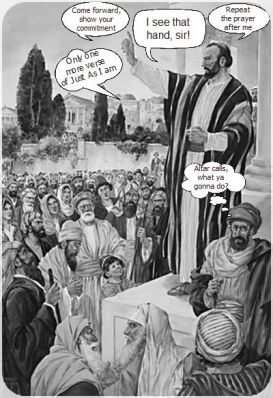
Living in Georgia and being member of Southern Baptist Convention Churches means usually there is an invitation at the end of a sermon, to walk down the aisle and ‘accept Jesus’ and be written down in a log book and declared a Christian. This is done in children’s Sunday School classes and at VBS, too. Frequently the church’s pastor or an imported evangelism-revivalism type preacher would have us close our eyes at the end of the sermon and the seeker would parrot back a prayer the preacher said, and then sometimes even raise one’s hand to declare they have decided for Christ, no need to walk an aisle. Let’s make salvation easy. Hipster gatherings use glowsticks which are held up to indicate the seeker’s new allegiance to Jesus as a follower. The preachers would tell everyone to close their eyes while the music played, and the preacher says, “I see that hand, yes, I see that hand too.” Once a friend of mine who sat in the back said he peeked and there were no hands up.

What is the “invitation” or “altar call”?

An altar call is an appeal for an immediate public response to a sermon just preached. It is popularly called the invitation and as used in this context is an appeal for a public act of commitment and can involve hand raising, going to a counseling area or signing a commitment card. Most often it involves walking down the aisle to the front of a church auditorium. The altar call is tacked on to the end of a sermon and the invitation usually is to “come forward and accept Christ as your Savior.” Various emotional techniques such as telling sad, tear jerking stories and playing mood-creating music in the background are employed to encourage response to the altar call.  …

In Acts 2:36-37 we are told that at Pentecost 3,000 people were saved but no altar call was used. The saving of those 3,000 was the work of the Holy Spirit of God and not of clever emotional appeals to come to the front of the meeting place. Whatever reasons one may give for using the altar call, it is a fact that it cannot be supported from the word of God.

As we have already pointed out, some people believe and teach that if one does not give an invitation in connection with his sermon he is not evangelistic. But we cannot be more evangelistic than the New Testament and the altar call or invitation system is not to be found in the pages of the New Testament. Actually having an altar call is a departure from scriptural requirements and practice.

In the New Testament and in Christian history up until the year 1820 AD sinners were invited to Christ, not to decide at the end of a sermon whether to perform some physical action. You will search Christian history in vain for an altar call or invitation before about 1820. George Whitefield, the greatest evangelist perhaps of all time never used the altar call. Charles Spurgeon under whose preaching more people were saved than perhaps any other pastor over the centuries never gave an invitation.

Well, where did the altar call come from if God’s word doesn’t teach it? The answer is that the altar call is a human invention that is less than 200 years old.

Source: Why We Don’t Use the Altar Call. More at link.

I always resisted that kind of man-made decisionism and mourned those who were likely false converts, even before I knew what the Doctrines of Grace were. It just seemed manipulative to me. I prayed both for those who might have been prematurely declared a Christian and also prayed for the practice to stop. By God’s grace he opened my eyes and grew me to a better understanding of what justification is and God’s sovereignty over it, through illuminating His word. Here is a meme featuring Calvinist-Baptist Charles Spurgeon on man-made choosing God practices (Arminianism) and God’s sovereignty over His choice of the elect.

Yesterday I saw on Facebook a meme-photo titled “Things Peter Never Said” and I liked it but I can’t find it now. I re-created my own and it went something like this:
#Things Peter Never Said
——————————

If your blog roll is getting a little stale, here are 190 blogs for your consideration. Have you ever wondered how Tim Challies, popular blogger and book reviewer, manages to put out fresh content daily with all those wide-spread links? I have. Yesterday he answered the question and opened for public viewing his list of blogs from which he mines content. If you want to read some different perspectives than the blogs you always read, or just want to refresh your blog roll for others, here is a good resource.

190 Blogs I read

——————————

On Facebook, someone had posted 300 Books Everyone Should Read. I’ve been having a hard time lately with reading. I studied on my problem for a while and it boils down to two things, I think. I need new glasses, badly, and that means a trip into the city to see an ophthalmologist. It’s been 8 years since I last had an eye exam. I dislike the city and I dislike going to see doctors, hence the delay with proper eye-wear and my eyes feeling tired and blurry by the end of the day.

Secondly, in my ever present push to “be productive,” I’ve gravitated to reading only theological books, which is fine, but it also has sapped some of the fun out of reading. I haven’t read a good yarn since the Grisham book-before-last and the Will Thomas book-before-last. (Both of Grisham’s and Thomas’s most recent books were disappointing and I didn’t finish).

I decided to look at the list and see what someone considered “must-read literature.” I was not surprised by many of the titles on the list. Some of the titles were new to me, while others had long ago been on my own “must-read” list but had fallen by the wayside. I decided to look some of them up at Amazon.

If a book was a young adult book I wanted to read, like Lois Lowry’s “The Giver” or “Where the Red Fern Grows”, I decided to check them out from my school’s library. If the book was a movie, I decided to watch the movie. One such book was “The Perks of Being a Wallflower”.

It is a book about high school, something that fascinates me because I still haven’t figured out what THAT was all about, 40 years ago. Fast Times at Ridgemont High (1982), Ferris Bueller’s Day Off (1986), Clueless (1995),  and Election (1999) are some of my favorite High School movies. FTARH and Election deal with one or two dark themes but those are handled well and the movie overall has a cinematic lightness to it. Literally, the movies are light. I found Perks online and began watching.

Perks was different. Though I did not know ahead of time what the themes were, apart from a shy boy negotiating the social miasma that is American high school, the movie was cinematically dark and somber in mood. After about fifteen minutes I became concerned with the direction the movie was taking. I decided to read the plot summary for the movie at Wikipedia instead of watch it. Themes dealt with in the movie were:

suicide by gun,
molestation of female minor,
molestation of male minor,
homosexuality,
bullying,
drugs, tobacco, alcohol,
fornication.
abortion

All righty then.

I was glad I didn’t pursue the movie and I sadly mourn the themes our youth are subjected to these days. What a different 20-30 years makes… In addition, that is one of the reasons I gravitated away from fiction. Sigh. I guess the search continues.

I did purchase three books at Amazon. The Book Thief, The Kite Runner, and The Curious Incident of the Dog in the Night-Time. I also have started Pilgrim’s Progress in conjunction with a free class I am taking, and a Jan Karon book, Home To Holly Springs. Spring Break is on the horizon and I will be ready (as long as my eyes are!)

——————————

Our new church plant begins small groups today, praise the Lord. I am so proud of our elders and the way they unroll each new aspect of our new church under submission to the leading of the Spirit and done in a manner of unity and mutual respect. The men are certainly good examples to someone like me. Because of the timing of the place we are renting, our services begin at 3:30pm (WHICH I LOVE!) and our first small groups begin afterwards in various homes today. If you can find the time to pray for our church once in a while, I would appreciate it.

Have a blessed Lord’s Day everyone.

Posted in barnhouse, prophecy, rapture, second coming, tribulation

Expecting God

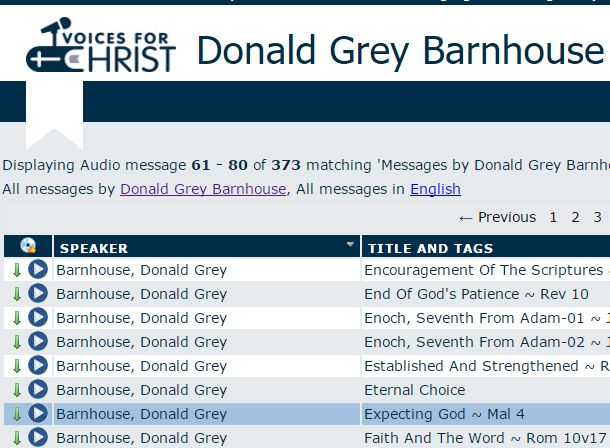
Dr Donald Gray Barnhouse preached a great 22 minute message called “Expecting God”. In it, he ties together prophecy from Matthew and Malachi, regarding the Tribulation and the removal of the Church prior to that Great Day of the Lord. He teaches this so clearly and concisely but so insightfully that I wanted to share.

One thing Dr Barnhouse said was that the coming of Jesus we are eagerly expecting will be in several stages. This is a notion that even recently in one particular comment stream on this blog, people have a hard time understanding. It is an obstacle which often makes them want to deny the literality of the coming 1000-Year Kingdom, AKA the Millennium Kingdom.

Just as Jesus came the first time over 33 years, Barnhouse said, His second coming will be 7 years plus 1000 years. (Tribulation plus Millennium).

I can only link to the sermon, it is not on Youtube to embed. When you go to this link, the screen shot below is what you’ll see. Just click on “Expecting God” and enjoy!

Posted in bible, discernment, weaker vessel, women

Are you a weak woman, or are you a weak woman?

The Bible says some women are weak, and it is meant in a bad way. The Bible also says Christians are to be weak, but it’s meant in a good way. Let’s look at the two ways.

Weak in a bad way

Silly, weak woman!


For among them are those who creep into households and capture weak women, burdened with sins and led astray by various passions (2 Timothy 3:6)

The Greek word for weak here is gunaikarion, a contemptuous term meaning a silly, foolish, little woman.

Jamieson, Fausset, & Brown Commentary says,

laden with sins—(Is 1:4); applying to the “silly women” whose consciences are burdened with sins, and so are a ready prey to the false teachers who promise ease of conscience if they will follow them. A bad conscience leads easily to shipwreck of faith (1 Ti 1:19).

Matthew Henry’s Whole Commentary on the Bible says of these women:

A foolish head and a filthy heart make persons, especially women, an easy prey to seducers.

John MacArthur Commentary says,

 Weak in virtue and knowledge of the truth. and weighed down with spiritual and emotional guilt over their sins, these women were easy prey for the deceitful false teachers.

Weak in a good way

Weak woman is strong. She prays and relies on Jesus.

For the sake of Christ, then, I am content with weaknesses, insults, hardships, persecutions, and calamities. For when I am weak, then I am strong. (2 Corinthians 12:10).

Gill’s Explains it this way:

for when I am weak, then am I strong; when he was attended with all the above mentioned infirmities, when laden with reproaches, surrounded with necessities, followed with persecutions, and brought into the utmost straits and difficulties, and was most sensible of his weakness in himself to bear and go through all these things; then was he upheld by the divine arm, and strengthened by the power of Christ; so that he was not only able to sustain the conflict, but became more than a conqueror, and even to triumph in the midst of these adversities;

The difference is that silly weak women are loaded down with unrepented-of sin, which clouds their mind and they fall prey to untruth. Weak women who rely on the glorious Divine Arm to lift them are wise, strong, and in His power. They know the truth and see Him clearly. They possess virtue and radiate calm wisdom.

So. Are you a weak woman or are you a weak woman?

Posted in beth moore, bible study, discernment, hermenutics

When teachers rely on word studies to create lessons

The Master’s Seminary published an essay titled “Exegetical Fallacies: The Word Study Fallacy” by William Barrick.

I found it interesting because much of women’s ministry teaching comes from this kind of study. The Grandmother of word studies is Beth Moore. Her proteges are following suit and her proteges’ proteges, third generation Bible teachers for women, are following suit also.

I attended a BM Living Proof “study” in North Carolina five years ago. I had begun going to church regularly 4 years prior. So I was a newbie to church and only I was a few years in the faith to begin with. I was totally new to discernment. Most of my early blogging had to do more with prophecy than discernment or encouragement.

I re-read the discernment essays I had written back then regarding Moore’s teaching and I am proud of the Holy Spirit because I think they hold up over time. I believe I was on the money with my concerns to a degree that only the Holy Spirit can take credit because, as I said, I was new and fairly unlearned. I had written a review about my concern with how Moore approaches a teaching she said she constructs for delivery at Living Proof.

She explained how she arrives at the lessons she teaches on her tour. She said that when she prays the Holy Spirit will deliver a word to her. [This is an extrabiblical, Mystical practice] In the case for the teaching in Charlotte, it had been “Hold Fast.” In the case of her next tour in Columbia, it will be “Prepare.” She then creates an acrostic of teaching points that begin with each letter in the main word. Ours was –

His affection is set upon us
Only He is your praise
Loving Him awakens your true heart
Doing His will does us good
Fleeing to Him means fleeing with Him
Any tighter embrace will also replace
Satan wants what we have
The Lord is your life

Looks kind of OK, doesn’t it? I won’t explain each of the eight mantras point by point, but share with you some of what troubled me most. I think word studies are good, and I like when teachers look into the Greek or the Hebrew meaning. This manner of exegetical study, finding all the words that relate to a subject and building a lesson out of it is fraught with danger. You lose the context of each passage you are extracting the word from. If you cross OT to NT that context gets more complicated because you have to research whether the word used in a context was meant only for the Jews in the Old Covenant or can be extrapolated into the New Covenant for the Gentiles. Getting meaning from the Hebrew-to-Greek is also problematic for a layman.

This approach also means that you wind up using a LOT of verses in one study and that tends to feel cobbled together and superficial. You can’t really explain to full depth each verse so you simply refer to them, and there winds up being a lot of different points. It gets unfocused, really fast.

Moore had said that she found every ‘hold fast’ in the Bible, OT or NT, and she put together a lesson from that. A lot of people in the audience were so impressed with her mention of the Greek word for this or the Hebrew word for that. Even at my naïve state years ago, ripping out a word from its context and matching it to other words it may seem like, wasn’t a good approach. Context is everything.

The Master’s Seminary article explains in detail just why students should not absorb lessons from teachers who crafted lessons based on these kinds of word studies, nor should teachers create lessons based on studies of these kinds. Below are two short excerpts from the short version of their article. If you want to go deeper into the whys and wherefores, there is a fuller, lengthier version of the same article, here.

When it comes to studying Scripture, word studies are popular, easily obtained from available resources and an easy way to procure sermon content. However, word studies are also subject to radical extrapolations and erroneous applications. It is not always possible to strike exegetical gold by extracting a word from the text for close examination. Word studies alone will not suffice. Indeed, over-occupation with word studies can be a sign of laziness and ignorance involved in much of what passes for biblical exposition in our times.

Study of the words alone will not present us with a consistent interpretation or theology. This is one of the misleading aspects of theological dictionaries/wordbooks. One learns far more about obedience/disobedience or sacrifice and sin from the full statement of a passage like 1 Sam 15:22–23 than he will from word studies of key terms like “sacrifice,” “obey,” or “sin” in the text.

The most important thing about studying the Bible is actually reading the Bible. Too many people spend too much time warming up first. Getting the right chair, the cup of coffee, the notebook, the pen, the devotional, the book about how to read the Bible … all fussing over the preparations and never getting to the main event.

Be a good Bible student. And watch out for shallow word study teachers. Just because they mention “Greek” or “Hebrew” doesn’t necessarily mean they’ve delved deeply. Many times it means the opposite.

Recommended resources:

Hermeneutics:
her·me·neu·tics- ˌhərməˈn(y)o͞odiks/
noun. the branch of knowledge that deals with interpretation, especially of the Bible or literary texts.

Grace To You/John MacArthur-
Essay: How to Study Your Bible
Essay: Simple Steps to Solid Study
Book: How To Study the Bible

Article by Tim Challies: How To Study the Bible

Book by Richard Mayhue How To Interpret The Bible By Yourself

Challies Review of Mayhue’s Book

Article by Focus on the Family: How to Study the Bible