Posted in culture shock, encouragement, expatriate, the world

The very real effects of culture shock, Introduction

This is an Introduction to a series.

Part 1: Examine the very real effects of expatriate living and culture shock.
Part 2: Examine the very real effects of expatriate living and culture shock on the Christian, this time comparing the effects through a lens of the Christian worldview.
Part 3: What to do about those stresses.

——————————————-

Visible Christianity as it has been known for these past decades is declining in the West. Of course the true church still spotless and gleaming white. But the surface “Christian-y” (not Christianity) culture in America is fast falling away. It has been a disorienting process for some. The ground is made of shifting violently sand, and especially unaware or new Christians, have been put off balance.

Friends quickly anger if you talk negatively about a favored idol-teacher. Facebook comment sections blow up in anger from previously mild-mannered friends. Family members are irritated by all your Jesus talk. Work spaces no longer tolerate your prayer lunch group- if it’s Christian. Muslim employees receive a private prayer room and Halal cafeteria. Portrayals of our faith in media have become simply cartoonish. All this and more gives the Christian coming to terms with the new normal (read: hostile world) a feeling of upset and disorientation.

It’s culture shock. That is because the moment we’re justified, our citizenship transfers from the world to heaven. We become expatriates, dwelling in a place that is not our home any longer.

I’ve mentioned before on this blog and my other blog that during the 1990s I traveled widely. My husband and I loved to pick up and go, and the sub-text was that we would also keep our eyes open for a warm weather, inexpensive place to winter over. Maine is cold. Brrr.

We spent time in Florida, Texas, the desert of the American Southwest, but also the Bahamas, and Ecuador. We traveled to Europe but it seemed too expensive to become an expatriate in those places. The European Union hadn’t been formed yet, and even after it was, the borders were still pretty tight in those early days. Of course as Maine residents, we visited Canada frequently but as a winter getaway for snowbirds, well, it defeats the purpose.

The sprawling city of Quito, Ecuador. EPrata photo

We liked Ecuador a lot. At the time, American money would last a long time there. The government had been pretty stable, and thanks to Ecuadoreans we knew, we were given a tour from north to south. My husband I liked Cuenca, a colonial city of universities and at a lower altitude than Quito. The height of Quito’s location at nearly 10,000 feet made for pretty thin air and a long time to cook anything, so we liked Cuenca which was at about 8200 feet above sea level. Warm, but not hot like at the seacoast or the jungle.

When we were in Quito, we found a cool bookstore called Confederate Books. It is touted as South America’s best selection of English-language books. Indeed, I found a rare Brautigan there. We spoke to the owner, who was from America, for a long time about what it is like to live as an “ex-pat.” An Expatriate is someone who lives outside their native country. It’s a person who is settled in another land. We were considering living in Ecuador for the mild winters down at the equator. Though we were in Ecuador for a month, we knew there was a huge difference between visiting and living in a third world nation.

Culture shock is an experience a person may have when one moves to a cultural environment which is different from one’s own; it is also the personal disorientation a person may feel when experiencing an unfamiliar way of life due to immigration or a visit to a new country, or a move between social environments… Source

After our conversation at Confederate Books, we emerged into the strong equatorial light onto Amazonas St, which is the bustling main shopping street in the high-altitude city of millions, we began walking toward where the restaurants were. My husband had a special kind of belt where he kept the money and copies of our passports for ID etc. Since we were always together, he carried the money and papers for us both. Pickpockets were a huge problem. As we walked, we began talking as we were jostled in the crowd, and then we began arguing. I don’t remember what over. Angry, at one point I turned on my heel and stomped off in the other direction.

The crowd quickly closed in and within a minute I realized I had done something very stupid. I was a woman alone, in a non-English speaking country (and not many Quitenos spoke English) and I had no ID and no money. It was in my husband’s belt, who had now disappeared from sight and was lost in the crowd. I couldn’t even take a cab back to the rental apartment, nor was there anyone home for me to call even if I managed to find a phone, scrape some coins, and know how to dial in a third world country. (This was pre-cell phone days). Suddenly my sunny shopping day was fraught with danger and anxiety. I quickly turned around and hustled to find my husband.

Life as an expatriate requires significant effort to adapt to new social and cultural environments. Source
In my inaugural trip of my decade of traveling, I spent a month alone in Italy. The first week was with an ex-pat American family my mother had known. The last two weeks I was going to meet up with a group and I would participate in an archaeological dig. So in reality I was only totally on my own for a week. I wanted to make my way down from Milan where the plane had landed, to the Italian Riviera to Siena, Florence, then Rosia, the little Tuscan town where the dig was going to happen.

What living in Italy for a week all on my own meant was that reading train schedules, ordering food in a restaurant, finding the grocery store, completing a reservation at a hotel, had to be done by no one else but me, all by myself in a foreign language with no support system. Finding attractions, safely walking the streets, handling money and making sure I received the correct change, etc, was all very taxing. Not knowing what to do with even the smallest of details gives you a fight or flight feeling. One is never sure if one is stumbling into a dangerous situation or not. All the signals are mixed.

Me in Portofino, Italy

Traveling from Portofino to Florence we hurtled through mountains and the train would go through tunnels. At one point I was standing outside my little compartment and a nice looking well dressed Italian gentleman tried to start a conversation. I had no clue if he was hitting on me, casing my pockets, or something else. It was something else. He said through gestures that when we go thru a tunnel it’s a good time for pickpockets to grab what they can from your person or your luggage. He was patiently trying to give me a warning. He recommended sitting back in my compartment with my valuables on me. I went from being scared of him to being scared of pickpockets during the brief but frequent tunnel blackouts.

When you’re alone in a strange land, you have no idea who is a threat or what situation is safe or could lead to disaster. You have no idea that a benign situation could suddenly explode into a dangerous one, or a trying one, or a misunderstanding one. Your normal reactions are all off.

Culture shock is a real thing. Shock being the focus. Here is some information from Expat Exchange on the stress of living abroad in another culture. Here is the ExPat Exchange-

It only takes six weeks and one foreign language for the average expat to figure out that life overseas is not for the faint of heart. …

What is stress?

According to thinkquest.org “stress is a particular pattern of disturbing psychological and physiological reactions that occur when an environment event threatens important motives and taxes one’s ability to cope. In plain English, stress is the “wear and tear” our bodies experience as we adjust to our continually changing environment.”

This 4-part series is one of encouragement. Here is the point, if you have not seen it by now.

Christians are expatriates.

Let me say that again. This world is not our home. We are born on earth, we live on earth, and we are OF the world … until the moment of justification. When we are saved, our citizenship immediately transfers to Heaven, and we become strangers in this land. (Philippians 3:20). Those around us are enemies of us becuase they are at enmity with the God in us. (Romans 8:7). We still live here, but we are strangers. We think of heaven, we long for heaven, we are of heaven. (Colossians 3:2). The citizens of earth consider us their enemy (consciously or unconsciously). We are not of this world, but we are still in this world. (John 17:14–19).

Lately, pressures have been building even for those fortunate enough to have been placed by God in nations where persecution is not overtly occurring. Christians are finding that we are standing on very shifting sand as expatriates. The times are changing rapidly and hostility against us here in the former land of free speech are living through a culture shift that, taxes our ability to cope. As the ExPat Exchange site mentioned, living for a prolonged time in a nation that is not our own and is in fact hostile to us taxes us to the point of stress, where physiological reactions occur.

Culture shock, personal loss, and discouragement are at all time highs, just as discernment is at all time lows. It’s taxing all right.

Of course, over this series, I will reiterate that unlike earthly expatriates, we have the Spirit in us to help us live tranquilly even if everything around us is being dismantled. So our experience isn’t exactly like other expatriates, but it is similar and I’d like for us to recognize the real stresses many of the brethren are enduring.

This was the introduction. So what’s next?

Part 1: Examine the very real effects of expatriate living and culture shock.
Part 2: Examine the very real effects of expatriate living and culture shock on the Christian, this time comparing the effects through a lens of the Christian worldview.
Part 3: What to do about those stresses.

Posted in bible study, commentaries, discernment

Commentary author recommendation: Roy Gingrich

Dr Roy Gingrich, source Faithlife

We study the Bible because we love Jesus and want to know more about Him. The only place where we can reliably learn more about our Savior is in His word, which is THE authoritative word. We ladies like to learn theology, so we read God’s word.

I cut my teeth on the Old Testament, loving it from the beginning even as a babe in Christ. I spent the first years of my salvation reading all the Old Testament Prophets. They’re hard, though, complicated at times and filled with symbolism, idioms, and long history which requires understanding for context. The Holy Spirit is the main help to us, because scripture teaches scripture. He illuminates the word to us as we study and pray. Psalm 119:18 says,

Open my eyes that I may see wonderful things in your law.

Ephesians 1:17-18 says

that the God of our Lord Jesus Christ, the Father of glory, may give you the Spirit of wisdom and of revelation in the knowledge of him, having the eyes of your hearts enlightened, that you may know what is the hope to which he has called you …

However, for information regarding the histories or interpretations of other difficult passages, we also use commentaries. God has raised up men before us who wrote down explanations and comments regarding the books of the Bible. In researching the book of Jeremiah, for example, I found few sermons, and fewer commentaries (which were available to me or reasonably priced enough to access).

Some people look down their noses at using commentaries, saying “I just use scripture.” Really? you don’t also listen to your pastor who stands there week after week explaining the scriptures to you? In his essay 20 Tips on How to Use Bible Commentaries, Professor and Pastor David Murray quotes Spurgeon,

It seems odd, that certain men who talk so much of what the Holy Spirit reveals to themselves, should think so little of what he has revealed to others. My chat this afternoon is not for these great originals, but for you who are content to learn of holy men, taught of God, and mighty in the Scriptures. It has been the fashion of late years to speak against the use of commentaries…A respectable acquaintance with the opinions of the giants of the past, might have saved many an erratic thinker from wild interpretations and outrageous inferences” (C H Spurgeon).

The essay linked above with HOW to use commentaries, because there is a right way and a wrong way. Just as you study alone, you learn from your pastor, and listen to online sermons, definitely read commentaries also. Do use them.

On my Logos 6 software, I learned of a theologian called Roy Gingrich. I had not heard of him before and yet I was intrigued. He has commented on all the Bible and some Bible topics besides. He lived relatively recently and most of his writing was finished in the latter part of his life, in the 1970s to the ’90s and even into the 2000s.

The bio at the Faithlife (Logos) wiki states,

Roy Gingrich was an American pastor and author best known for his comprehensive commentary series. He was born to Arthur and Arista Gingrich on February 3, 1920 in Ozark, Illinois, the youngest of four children. Roy received God’s call to enter the Christian ministry in 1941. After intensive preparation and pastoral stints in Illinois and Indiana, he became pastor of Faith Bible Church in Memphis, Tennessee, where he remained for over 40 years.

In 1963, Gingrich graduated cum laude from Victory University (formally Mid-South Bible College) and soon thereafter joined the teaching staff. Gingrich began writing conservative Bible commentaries in 1964. Roy Gingrich’s Commentaries in Outline Form (100 vols.) includes 60 different commentaries on the books of the Bible, and 40 additional commentaries on major Bible themes.

In 2001, Dr. Gingrich retired from a long and fruitful ministry, but continued to revise his commentaries and lecture at colleges and churches in the US. In 2003, he was inducted into the Crichton College Hall of Fame.

Here is one revoew of one of the commentaries. Of Dr Gingrich’s Commentary on Isaiah, fellow Professor of Theology Paul M. Davidson at Mid-South Bible College wrote in 1977 in the preface to Gingrich’s Commentary on Isaiah,

The book of Isaiah is named for its author, the prophet Isaiah. Isaiah means “Jehovah is salvation” or “Salvation is of Jehovah.” He is rightly called “the Evangelical Prophet of the Old Testament.” By common consent, he ranks among the great literary geniuses of all time and his book is recognized as a part of the world’s great literature. 

According to tradition, Isaiah was martyred, sawn asunder, Hebrews 11:37. Just so, in the hands of destructive modern critics his book has suffered, being cut up into many parts. Consequently, liberal Biblical scholars today deny the unity as well as the Isaiah an authorship of this great work. They affirm that it is the product of various authors, writing at different times, long after Isaiah’s death. Then an unknown redactor combined the various elements into the book that we know today as Isaiah. 

In view of the above errors, it is refreshing to read Mr. Gingrich’s thoroughly orthodox, expanded, analytical outline of Isaiah. His exposition comes from a balanced and responsible conservatism which gives the work an abiding value. Like his other books, this one begins with a full general introduction, treating such topics as authorship, unity, historical background, importance, etc. This is followed by a succinct exegesis and explanation of the text. Both the layman and the busy preacher can use this commentary and quickly come to the heart of a passage and receive much help. For the greatest profit, this outline should be both read and studied with an open Bible. It is designed for both personal and group use.

For many years, Mr. Roy Gingrich has been pastor of Faith Bible Church, Memphis, Tennessee. He is a graduate of Mid-South Bible College, where he is presently a much loved and respected professor. He is truly a humble man of God and a diligent, tireless student of the Word. The reader of these pages has before him the fruit of many hours of prayerful research and the insights of six or seven of the most outstanding and scholarly commentaries on Isaiah.

Heartily and without reservation, I encourage pastors, teachers, and lay persons desiring a thorough grasp of Isaiah to study carefully this analytical outline, this outline being an interesting and effective aid to an understanding of this portion of the Scriptures.

The really interesting thing about Dr Gingrich’s approach to writing commentaries, is that they are all outlines. I love me some Matthew Henry but in accessing his Whole Commentary on the Bible through Logos, sometimes it takes me a long time of reading before I get to the single nugget I want. Mr Gingrich wrote all his commentaries, including the Prophets, as an outline, with a one or two clear, concise sentences for each verse. It’s very helpful. Here is an example of a page from his commentary on Zechariah.

I have not read all of his commentaries, obviously. Just last night I completed downloading the final commentary on the major and minor prophets, to that end, my set is now complete. I’ve enjoyed what I’ve read so far of Dr Gingrich’s work and I especially love he outline form. They are great for small group, too. If you are looking for an alternative to long, complicated commentaries which seem to be orthodox and best of all, affordable, please consider Dr Gingrich’s outlines. They have proved invaluable.

Most of his outlines are available as a download through Logos 6 or Kindle or other method. There are paperback copies available through Amazon also.

Available from RoyGingrich.com

Available at Amazon

————————————

Further Reading

20 Tips on How To Use Bible Commentaries

Posted in be sober, beth moore, discernment, hair

Beth Moore’s hair pride

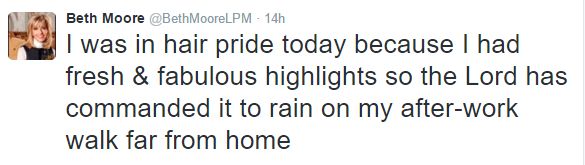
A friend on Facebook put up a screen shot of a Beth Moore tweet, which is truly outlandish.

HT Bud Ahlheim

I had written a comment, “Troubling is the narcissism, but more troubling to me is purporting to KNOW and positively state that she has knowledge of why God does things at any particular moment. She is mistress of the theological humblebrag.”

Someone asked a very reasonable question:

Come on, guys. I know there are plenty of Beth Moore issues, but do you seriously think this wasn’t a joke?

Is it a joke? Should we all just lighten up? I thought about it for a while then wrote back,

If this was the only tweet, essay, book blurb, or audio statement she ever made of this nature, then yes, joke. Sadly, in context of the body of all her work over many decades, such shallow narcissism, self-.involvement, and comfy cozy God-talk is all too usual for Moore. So I conclude it is not a joke, or only a half-hearted joke.

The points here are both good. Don’t take one thing a teacher or leader said once and blow that up especially if it’s obviously meant as a joke. Common sense should prevail. However if a certain unbiblical behavior is constant, for example, anger or sarcasm or boasting, then by all means take the totality of the person’s work or speech and compare it to scripture.

In one other thought, I replied again,

And let’s say in devil’s advocate fashion, that it was a joke, a lighthearted comment meant for fluff. Remember, Moore says she teaches God’s word, speaks for God in her lessons and influences millions of women over several generations. Is this the kind of speech a mature Bible teacher should be constantly and ‘light-heartedly’ tweeting? (Tweets of this nature are constant).

Would a mature teacher with gravitas, say a John MacArthur, ever tweet, “I had tie pride so God made me spill soup on it right before I went to the pulpit so I’d have to take it off.”? No, Titus 2:7b-8 applies.

Some teachers take their relationship with God seriously and other teachers don’t.

There are several things to unpack here. As for the totality of her casual rapport with God, such Twitter comments are all too sadly common from Mrs Moore. She says God calls her honey, baby, babe, kiddo, and other terms of intimate endearment. Setting aside the allegations of direct revelation, can one believe that God calls Moore these things? Did God call John His pal? Did He refer to John the Baptist as kiddo? Did He announce the birth of Christ by shouting from heaven, “Hey, Mary baby!” No. Not that there aren’t tender and intimate moments (Jesus comforting Hagar in the desert, an angel baking bread for a tired Elijah, etc,) but the casualness of such speech diminishes God’s august stature and our own witness.

When Beth Moore goes on a Sabbath play date with God at the zoo and says she and God had a blast, compare that casual kind of language to the Bible by inserting one of the Patriarchs, Prophets, or Apostles’ names. In the Bible lesson where Moore claimed she and God went on a date, contained in her book The Beloved Disciple, she had said God took over her steering wheel and as if on autopilot He steered her into the zoo where she and God watched a baby koala sleep while she sipped a Starbucks fancy drink. Nothing was reported as to what God had sipped. As her date with God to learn how to Sabbath rest concluded, Moore declared she and God had a blast.

Let’s compare that scene to the moment when the real God actually taught Moses about the Sabbath. Sadly for Moses, God did not take over Moses’ legs and put him on autopilot as Moses trudged up Mount Sinai. He did that on his own. When Moses got to the top, did he and God watch a sleeping mountain lion while Moses sipped brewed tea and God wrote the Ten Commandments? Was it a picnic atmosphere when Moses met with God up there? Did Moses then feel restful and walk back down the mountain and face all Israel and declare, “God and I had a blast! We played!” I think not.

As for the casualness of declaring what God is doing and saying at any given moment, we have lost the gravitas due our Savior, thanks in no small part to Moore and her silly statements. Remember John the Baptist’s father, Zechariah. He was a priest and labored in the Temple on rotation, it was his rotation when Gabriel appeared and announced to Zechariah that he would be blessed with the forerunner prophet to Messiah despite he and his wife Elizabeth being advanced in years. (Luke 1:8-23). Zechariah was then struck mute when he asked an impertinent question. God is serious! That Moore’s impertinence has been overlooked for this long is a measure of how much common grace He bestows upon unbelieving sinners like her.

As for the silly self-involvement of Moore’s statement, that God made it rain specifically so that her hair would be flattened, it’s just too over the top to comment on. The pride in which someone would actually say that and believe it is just sad. God didn’t make it rain in order to bring sustenance to farmers so people could eat? (Leviticus 26:4, James 5:18). God didn’t make it rain so He would prove He is still ordering the progression of the seasons in His capacity as Creator and sustainer of all things? (Genesis 8:22). No, He made it rain so Beth Moore’s hair would be squashed down, never mind the thousands of other people nearby who do not have hair pride and who would also suffer the woe of flat hair for the rest of their journey.

My points are several:

1. Do not follow Beth Moore
2. Give Jesus His due and respect Him on social media
3. If you’re not sure if something a teacher has said or a Bible anecdote really applies, insert a Bible character’s name into it and if you can’t picture him or her saying it then there’s your answer. Examples:

Moses said, “God and I had a blast up on Sinai!”
Paul and Silas were singing in jail and God appeared and said “Baby, you have not even begun to believe Me. You haven’t even begun!’”
Mary said, “Elizabeth, guess what! God hollered from heaven and said “Baby, you’re gonna have a baby!”

Comment to the naysayers:

No. I have not contacted Moore. She already has been contacted, multiple times, and she refuses to repent. Also, contacting her is not necessary. See here and here.

No, I am not against lighthearted tweets. This from Moore was appropriately fun and lighthearted:

Goofing around with her daughter after her grandkids were sleeping is a mom-daughter fun thing to do. Fine. Not fine is when you start tweeting you know what God is doing and including His name in your silliness. It’s offensive to me as a Christian and as a woman.

The Second Commandment says not to take the Lord’s name in vain. At Desiring God, that is defined:

How do you define the sin of taking the Lord’s name in vain? 

Well that’s a quote from the Ten Commandments: “Don’t take the name of the Lord your God in vain.” The idea of vanity (and I think the Hebrew carries this connotation) is “don’t empty the name.” 

So it doesn’t just refer to a certain tone of voice or a certain use of the word. It’s dealing with God and speaking of God in a way that empties him of his significance. This includes both throw-away words—like “God!” or “Jesus!”—as well as speaking about him in trifling and flippant ways. Not just swear ways but cheap ways, low and insignificant ways that just treat him like a commodity. And when you hear them you sense that there is no weight to that sentence, no corresponding emotion to that statement. It seems to have just been gutted.

Older women likewise are to be reverent in behavior, not slanderers or slaves to much wine. They are to teach what is good, 4and so train the young women to love their husbands and children, 5to be self-controlled, pure, working at home, kind, and submissive to their own husbands, that the word of God may not be reviled. (Titus 2:3-5).

Self-control. Does the Body of Christ good.
——————————————–
Further Reading:

Breaking up with Beth Moore, by Pam Terrell

The Apotheosis of Beth Moore, by the husband of the woman above, Robert Terrell. Very good essay.

Strange Fire Q&A,

How do I respond to people who refuse to admit that those who supposedly receive divine revelation are dangerous even though they don’t teach outright heresy? 

Can you talk about the dangers of popular teachers who are not heretical but say that God talks to them?  I am thinking specifically of Beth Moore.  What are we to do with people who refuse to see the danger and insist such teachers are OK? 

Believers must always listen carefully when any teacher or preacher speaks about the Bible and theology.  They must share the nobility of the Berean saints whom Luke commended for double checking Paul’s teaching according to Scripture (cf. Acts 17:1–11).  While Beth Moore teaches with accuracy on some points, she also holds positions and teaches doctrines that are both incorrect and dangerous.  

Beth Moore promotes contemplative prayer, a mystical practice not found in Scripture which includes elements of eastern mysticism.  She chooses not to draw firm doctrinal lines on her website while implying the Roman Catholic Church is a Christian denomination alongside the Methodist, Baptist, and other denominations.  Beth also claims that she has received visions from God and sometimes receives revelation from Him in her heart.  From these examples we must conclude that the lack of biblical and theological depth in Beth Moore’s teaching renders her a dubious and dangerous source of Bible teaching.  You may read a critique of Beth Moore’s teaching here.

Posted in a matter of faith, discernment, encouragement, movie review

Movie Review: "A Matter of Faith"; plus, ‘PureFlix’

A friend recommended the movie A Matter of Faith and I watched the movie. Released in 2014, the film is directed by Rich Christiano and stars Harry Anderson, Jordan Trovillion, Jay Pickett, and Clarence Gilyard. Christiano is an American filmmaker, who has directed, produced and written many Christian films, such as The Secrets of Jonathan Sperry and Time Changer. I’ve watched the former two and they are good.

Harry Anderson (Cheers, Night Court) was the standout actor amid some good-ish but slightly amateur actors, which is usually the case with under-budgeted Christian films. However that was not a deterrent since the film’s premise was so well unfolded.

A Matter of Faith

The movie begins with a family delivering a young college girl to her dorm and encouraging her as they leave her to begin her first year of college. She was raised a Christian and claims to be a Christian, but the girl finds her faith challenged by her biology professor (Anderson) who is an atheist and totally committed to evolution.

A Christian friend supports her but other friends she meets in the dorm and around campus draw her away from her Christian stance, and soon she does not know what to believe. She is freewheeling in limbo, a position that becomes more untenable as the dad’s concern over his daughter increases and he travels to the college to meet with the biology professor. The dad is trapped into agreeing to debate the Prof in public over evolution v creation, which embarrasses his daughter to no end and causes a split between them.

A sub-story that emerges is that years ago, the Biology professor had gotten his creationist colleague fired. Bitter and unhelpful, the ex-professor refuses to help the dad when the dad appeals to him for help in researching material for the debate with the atheist evolutionist.

The dad fears he is not up to the task of debating a superlative speaker such as the biology professor and wonders how to mend the rift with his daughter, and the plot builds to the climactic moment when the debate opens.

I thought the writer did a god job of presenting the myriad issues in a subtle but realistic manner. Any young girl or guy attending college away from home for the first time will be tested, and the world is experienced at drawing away the unwary.

One of my favorite lines is when the girl’s Christian friend at college explains to her that the reason the biology professor is so popular is that he gives a grade of C just for showing up. The girl agrees. Yet the boy says that underlying this unusual grading scheme is a satanic ploy to get as many people as possible into his classes, for the express purpose of delivering atheistic philosophy so as to confuse the weak in faith. “The world is not our friend. The professor has an agenda.” Connecting the grading scheme to the Professor’s intent to delude seemed to surprise the girl. “But he’s so nice! And popular!”

Though we who are more mature readily see these things, youth who are out from under a parent’s wing for the first time may not immediately see the connection.

The girl’s spiritual disciplines waned as other, worldly temptations came her way. She delays finding a church, she has drifted away from reading her Bible, she has not made any Christian friends, nor has she sought out any Christian activities or clubs. And this leaves a vacuum for the ideas of the plausible biology professor to enter in.

The film was clean, with no modesty issues or profanity. It showed the issues facing youth when they leave home for the first time, whether it is to a job, college, or military. The dad was shown as grounded in his church, submitted to his pastor, and leading his family as a shepherd. The usual worldly temptations were shown yet without the usual explicitness. Recommended.

The film brought to mind the testimony of Michael Kruger. Below at the link to The Gospel Coalition, Kruger describes his first year at college in a 6-minute video. Kruger gives students, parents and guardians some solid advice. The essay with accompanying video is titled How to Survive World Religions 101 but could just as easily be titled How to Survive Biology 101.

How to Survive World Religions 101

Michael Kruger on Facing the Challenges of a Secular University Environment
August 27, 2015 

Michael Kruger entered his freshman year at the University of North Carolina as a committed Christian. He thought he was ready for the intellectual challenges college would mount against his faith—that is, until he found himself sitting in a New Testament introduction class with Bart Ehrman as his professor. It left him shell-shocked.

Many students can relate. Churches often have a hard time preparing their youth for a secular university environment. They equip them on a moral level, which is good and important, yet fail to prepare them intellectually and doctrinally. So how can churches better brace young people for the day their faith will be challenged, attacked, and deemed intellectually indefensible by professors and peers? 

In this new video, Kruger, president and professor of New Testament and early Christianity at Reformed Theological Seminary in Charlotte, shares some of the lessons he learned in college. He encourages students to check their expectations, prepare for opposition, dig for answers, and more. Above all, he urges them to anchor themselves in the local church.

I know that many of you are looking for good, clean movies for yourselves or for your children or family. They are hard to come by, we all know this. A friend sent me a link to a movie streaming site called PureFlix. It is based on Netflix, the original streaming movie site, and claims to show only pure films, good for the family of faith. However as the friend says also, one would suppose one would need as much discernment on PureFlix as would be needed at any “Christian bookstore” since so much heresy and doctrines from other faiths is mixed in with the gold. Here is the synopsis of PureFlix,

Pure Flix Entertainment is a Christian film production company, headquartered in Scottsdale, Arizona. The company produces, distributes, acquires and markets Christian and family-friendly films

Just an FYI for you guys. I do not subscribe to PureFlix so I can’t review it. However I see on the home page I see that at least, blessedly, one can scroll through the offerings safely without having to shield young eyes as you have to do on Hulu or even Netflix. The movie covers shown are clean.

Posted in millennial kingdom, prophecy, satan

Must satan be released?

“New Jerusalem” EPrata photo

I love prophecy. I always have. It is glorious to read in the Bible, uplifting me even when the Prophets pronounce doom. This is because I worship a God who prophesies, and He prophesies because He is Master of all history. He Prophesies because He can. He is the only One who can. And it’s especially uplifting when the prophecy comes true, namely, in the form of the Messiah who came and died and was resurrected on the third day.


remember the former things of old;
for I am God, and there is no other;
I am God, and there is none like me,
declaring the end from the beginning
and from ancient times things not yet done,
saying, ‘My counsel shall stand,
and I will accomplish all my purpose,
(Isaiah 46:9-10, emphasis mine)

We worship a God who is that powerful. He ordains every event, every heart, every minutiae throughout the entire universe. Yet He tells us – His created creatures – what He is doing and will do.

For the Lord GOD does nothing without revealing his secret to his servants the prophets. (Amos 3:7).

but these are written, that ye may believe that Jesus is the Christ, the Son of God; and that believing ye may have life in his name. (John 20:31).

In the Word of God AKA the Bible, God has set down a progression of past and future history which we can read and study and understand. This is what is called fulfilled prophecy and unfulfilled prophecy. Prophecy remaining to be fulfilled includes (but is not limited to),

  1. The Rapture of the Church
  2. The Great Tribulation
  3. Jesus’ Second Coming to Earth
  4. Vanquishing of the Armies at Armageddon
  5. All Israel Will be Saved
  6. The Millennium Kingdom
  7. Satan Bound in the Pit during the Millennium Kingdom
  8. Satan released
  9. Great White Throne Judgment
  10. Destruction of earth and universe, New Heaven and New Earth
  11. Eternity
  12. ?
EPrata photo

What a powerful God. The word for that concept is omnipotent. Let’s get back to using proper Bible words for things, such as justification, sanctification, glorification, omniscience, omnipresence, omnipotent, transcendence, immanence, etc.

Omnipotence is an attribute of God alone. It is the quality of having all power (Psalm 115:3). He can do all things that do not conflict with His holy nature. God has the power to do anything He wants to do. However, God cannot do that which is contrary to His nature. For example, God cannot lie (Titus 1:2).

Omnipotence is referred to in Job 42:2.

I know that you can do all things and that no plan of yours can be thwarted.

As Jesus returns and protects all the recently converted Jews at Petra at the end of the Tribulation, and swings over to Armageddon and slays the collected armies, then lands on the Mount of Olives which then splits in two, Jesus subsequently sets up the kingdom on earth which will last for a thousand years.

The Millennium Kingdom is a period of time where all the promises to Israel about inhabiting their promised lands without need for fighting to keep it or to fend off attacking armies will be fulfilled. The Messiah will personally rule and reign and the world will be in peace.

The people who are alive at the end of the Tribulation will include both saved and unsaved. In order to determine who will be allowed to enter the Kingdom (saved) Jesus will gather all the nations in front of Him, and He will separate the believers from the unbelievers. This is the Sheep and Goats judgment, as explained here. (Matthew 25:32-33).

Jesus will also have an angel cast satan (and by implication, his demons) into the pit to be sealed in for 1000 years- the entire period of the Millennium Kingdom. (Revelation 20:1-2). Imagine those who are born into the Millennium Kingdom living with Jesus reigning perfectly and peacefully, and no satan or demons around to tempt them or to deceive the nations!

However, just because believers enter the Kingdom, it does not mean that their offspring will necessarily be believers. As people are born and grow up, they live on the planet under Jesus’ rule and outwardly submit, because He rules with a rod of iron. (Revelation 2:27). Inwardly they are rebelling. This is because people are still sinners with a sin-nature. Not all are glorified yet.

But Jesus knows this, and he has a plan.

Then I saw an angel coming down from heaven, holding in his hand the key to the bottomless pit and a great chain. 2And he seized the dragon, that ancient serpent, who is the devil and Satan, and bound him for a thousand years, 3and threw him into the pit, and shut it and sealed it over him, so that he might not deceive the nations any longer, until the thousand years were ended. After that he must be released for a little while. (Revelation 20:1-3, emphasis mine).

The Master’s Seminary published an essay in Spring 2014 addressing the question, why must satan be released?

As with all previous “must statements,” it is not only that Satan will be released, as seen with the future tense in Rev 20:7 (“And when the thousand years are completed, Satan will be released from his prison,”), but also Scripture plainly states that after the thousand years are over, Satan “must be released for a short time.” Chafer considered that, “No small mystery gathers around the fact that Satan is released from the abyss even for ‘a little season.’” He further refers to it as “this strange release.” Based on the normal use of “must” in other Scriptures, many scholars also mark its use in Rev 20:3. Thomas writes in regard to Satan’s release, “It is a divine necessity. . . for the dragon to be released ‘after these things.’” Swete concurs, writing in reference to the future release that “it must come; there is a necessity for it (dei).” Alford refers to the usage as “the dei of prophecy; must according to the necessity of God’s purposes.”

For it is written of satan’s final defeat:

And when the thousand years are ended, Satan will be released from his prison and will come out to deceive the nations that are at the four corners of the earth, Gog and Magog, to gather them for battle; their number is like the sand of the sea. And they marched up over the broad plain of the earth and surrounded the camp of the saints and the beloved city, but fire came down from heaven and consumed them, and the devil who had deceived them was thrown into the lake of fire and sulfur where the beast and the false prophet were, and they will be tormented day and night forever and ever. (Revelation 20:7-10).

The Master’s Seminary article continues:

In addition to the other reasons, Satan must be released to deceive the nations and bring about not only the final rebellion, but also the final deaths of all humans who reject the Messiah. Further, God’s promise “to curse the ones who curse you” actually relates to all enemies of Israel and not only to the Gentile nations. In keeping with God’s Word, God curses Satan and throws him into the lake of fire (Rev 20:10). Then when death has been abolished forever and after the Great White Throne judgment of the eternally damned (Rev 20:11–15), when all evil will have been divinely eradicated, then the new heavens and new earth—and New Jerusalem—will arrive.

And what a day that will be!

EPrata photo

Posted in discernment, journaling, scriptures

Bible Journaling: Biblical or Occultish?

My friend Craig Fulford sent me a few links regarding the trend for Bible journaling. The essays are covering a topic distinct from the fad where women decorate their journals by using crayons or paints to actually obscure the Word with doodles and picture. The essays’ topic is also distinct from coloring in coloring books or in Hindu-style mandalas.

In this first essay, the author warns about the dangers of journaling, which are present and more intense if one is inattentive to them. Sometimes during the journaling process we begin depending on an ephemeral inner life to emerge to give us scriptural meaning or even expectations begin to creep in thinking the process will sanctify us, this is the same activity with the same intentions that occultists use when attempting to contact the other side.

Journaling
Biblical or Occultic?

“Journal-keeping” is becoming popular among Christians as a new genre of books emphasizes the “inner life” and presents various methodologies for “hearing from God.” This is not to say that meditating on the Word of God and seeking closer communication with Him and deeper insights into His will ought not to be an important part of every Christian’s life, and even writing down for future reference insights or guidance that one believes to be derived from this would be very helpful. However, this same technique is used by occultists to make contact with the spirit world, and by psychologists to contact deep levels of the psyche, and thereby, tap into the “ancient wisdom” allegedly contained in the “collective unconscious.”

“Christian” books on journaling, however, seldom warn of the dangers of mistaking one’s imagination for communication with God, and of spending more time upon one’s own inward thoughts than upon God’s Word. Whether through a “proper” use of journaling or journal-keeping, or other forms of meditation, one’s focus must always be upon the Scriptures and must never deviate from that Guide.

Go to the link for more

In this article the question is asked What value is there in Christian journaling?. This essay gives a balanced view of how, if used correctly, Bible journaling can be a help in our process of meditating on scripture.

As with everything, test it, be wise and use discernment. Even “good” Christian activities can become an idol or be used by satan to his advantage, and not to Jesus’ glory.

On the other hand, if one is wise and with Jesus in proper focus, some activities can be used safely and for the good of the person, or the church, or to bring glory to Jesus.

What value is there in Christian journaling?

“Journaling” can mean different things to different people. For some, journaling is written prayer. For others, journaling is keeping a record of prayer requests and answers. Some keep a journal of especially poignant spiritual truths, perhaps insights from a sermon or quotes from spiritual books or a collection of Scripture. Some may write accounts of particularly meaningful encounters with God. For some a journal is a form of diary, a place to record the events of their day and a few thoughts or insights about it; these entries may be as brief as one or two phrases or a long narrative. Some might keep a “gratitude” or “joy” journal that lists one or more things each day—small or large—for which they are thankful. Still others journal in the sense that they write out their thoughts or respond to a particular prompt; it is not so much a prayer or specifically God-directed as it is a written exploration on a topic. Journals can come in a variety of forms—written in a notebook, typed on the computer, in an online forum, shared with friends or private, including art work or pictures or solely visual art without words, etc. The Bible does not mention journaling, so is there value in any of these activities?

Go to the link for more.

I wrote the following in 2013.

Is Christian Journaling Good or Bad?

Journaling has always been popular, for many different reasons, as we see above. Over the last few years, journaling for Christian reasons has made a comeback. Christians are told to keep track of thoughts in a journal. This activity is now variously called spiritual discipline, spiritual formation, or Christian journaling. 

Is journaling good? Is journaling bad? Must I do journaling to “partner” with God in order to advance my sanctification? Does journaling aid the Holy Spirit? Let’s take a look at the pluses and minuses of Christian journaling.

I hope these ideas contained in the essays offered here clarify or aid you in you walk in some way.

Further Reading:

The End Time Meditating on God’s Word

The End Time Bible Art Journaling: No, No, No

Housewife Theologian Aimee Byrd: New Trends in Bible Journaling

Posted in bible, reading, sanctification

Meditating on God’s Word

Let my meditation be pleasing to Him; As for me, I shall be glad in the LORD. (Psalm 104:34)

Thomas Brooks offers an excellent description of Biblical meditation…

Remember that it is not hasty reading—but serious meditation on holy and heavenly truths, which makes them prove sweet and profitable to the soul. It is not the mere touching of the flower by the bee which gathers honey (cp Ps 19:10-note; Ps 119:103-note)—but her abiding for a time on the flower which draws out the sweet. It is not he who reads most, but he who meditates most—who will prove to be the choicest, sweetest, wisest and strongest Christian.”

I’ve read oftentimes that meditating on God’s word is similar to chewing on cud. Not having an agricultural background, I researched exactly how cows digest their nutrients when they graze grass.

What is cud, and why do cattle chew it?

Have you ever noticed that when you see a cow it always seems to be chewing something? The reason is because cows must chew their food twice in order to digest it properly. Cows spend nearly eight hours out of every day chewing their cud. This plus normal chewing of food can total upwards of 40,000 jaw movements per day. 

Cattle are ruminant animals, this mean their stomach contains four compartments:
1. Rumen
2. Reticulum
3. Omasum
4. Abomasum 

Cows have one stomach with four different compartments. 

When a cow first takes a bite, it chews just enough to moisten the food. Once swallowed, the food goes into the first section, the rumen, where it mixes with other acidic digestive liquids and is softened. The softened food is called cud, small balls of food. 

Next, the rumen muscles send the cud back up to the cow’s mouth, where it is re-chewed and swallowed again, this time going to the Omasum section of stomach in order to squeeze out all of the moisture. 

Finally, the food enters the last part, Abomasum of the stomach where it mixes with digestive juices and makes its way to the intestine to be completely digested.

To “chew” on the Bible, we must first read it. I’m always surprised at the number of professing Christians who simply don’t directly read the Good Book. Secondly, when I meditate on God’s word, this is what I tend to do. It may not work like this for you but I find it’s easier to ask questions.

Why is this word here? What does it mean in the original language? What kind of writing is this, Law, Narrative, Poetry, Prophecy? What is the symbolism Agricultural? Cultural? Symbolical? Eschatological? An Idiom?

For example, we read many times in the Bible that they will be “going in and coming out”. (Psalm 121:8, Ezekiel 37:28). Barnes Notes (as well as other commenters) tell us that this is a common Hebrew expression meaning

The Lord shall preserve thou going out and thy coming in – Preserve thee in going out and coming in; in going from thy dwelling, and returning to it; in going from home and coming back; that is, everywhere, and at all times.

Who is the audience here? What do the parallel verses say? What does it make me think of? How does this inform me of God’s attributes?

Like that.

You may write some thoughts in a journal. You may want to discuss the verse or passage or chapter in your small group, or one-on-one with a friend or elder. However you meditate, as the saying goes, just do it.

Some people find that they are distracted during the day and forget the morning’s devotion or the day’s quiet time quickly. Here is where the very present help in the Holy Spirit aids us. He brings these things to mind, He keeps our mind focused on God. He reveals the attributes of Jesus. If you pray and ask for wisdom from reading and learning the verses, He will give it. One of His ministries is to draw us closer to the Lord. We do this through His word. (Ephesians 2:18, 1 John 3:24)

The Spirit sanctifies us through His word. When we meditate upon it, we aid the sanctification process. Ask the Spirit to apply the word you’re meditating upon to your heart and mind’s sanctification to the good of your soul. (John 17:17, Ephesians 5:26, Psalm 119:9-12, James 1:21)

He Guides into all truth. When we meditate upon the Word, the Spirit uses that clay of the Word as a Potter uses the lump of clay to form it into a new creation.

When I meditate upon the Word I find it helpful to mention it during the day, even at work. I might say, “I’m reading Genesis 40 and this morning I read about Potiphar’s wife. Where it says in Genesis 39:12 that Joseph fled the wife and left his coat behind…Man, Joseph and his coats, two times his coats were used against him.” This does several things. It gets the Word into public for any hearers nearby. It helps me process what I’ve read by talking about it out loud. And it helps wash the person you’re talking to when you use the verse, and last, they might have an insight to share back. I like sanctifying conversations.

However you meditate, I encourage you to do it. The process enlarges our heart, solidifies biblical world views in us, sanctifies us, and keeps our focus on Jesus.

“Cud” you do it? 😉

Posted in aimee byrd, church, Michelle Lesley, scripture, women's ministry

Is your Women’s Ministry at church fully integrated, or is it still a kids’ table?

Ladies, be aware of when the church diminishes your value to Christ by scheduling fun activities-lite for you instead of Bible studies with meat. At a certain point, kids graduate from the Thanksgiving kids’ table to the adult table. You should, too.

Source Bon Appetit

Not that scheduling a ladies night around a fun activity isn’t worthwhile. Sometimes it’s relaxing to get together at a home or in the Fellowship Hall with other like-minded friends and just hang out. It’s even more fun to hang out by doing something or creating something than just to sit around and chat. But if your church believes exclusively that these kinds of Ladies Ministry outings and events are a substitute for learning theology, then gently but insistently remind them that your value in Christ is not about decorating cookies and scrapbooking, it is growing in grace in likeness of Christ and knowledge of Him. The only way to do that is by the Word as the Spirit applies it- as you learn it.

Here is Michelle Lesley having stated it so well. This is a re-blog of an excellent piece she wrote, titled,

Mary and Martha and Jesus and Women’s Ministry
By Michelle Lesley

You remember the story. Jesus comes to Mary and Martha’s house. Martha’s Pinteresting up the place while Mary sits at Jesus’ feet to listen to Him teach. Martha gripes to Jesus that Mary should help her and Jesus says no because it’s better for her to listen to Him than fold napkins into the shape of swans or whatever. Moral of the story- Martha needs to relax and not let other things distract her from Jesus.

That’s a good, true, and important takeaway from this passage, and one that we would all do well to heed. 

But did you ever stop to think that Mary and Martha aren’t the main characters in this story? Jesus is. Jesus is the main character in every Bible story, so our primary focus should always be on Him: what He said and did and was like. 

What was Jesus teaching that day at Mary and Martha’s house? The passage doesn’t tell us the topic He was speaking about, but we are privy to a very important lesson He imparted through the scenario with Mary and Martha. A lesson about the way God loves and values women.

Remember how women were generally regarded at that time? They didn’t have much more value than livestock, furniture, or a man’s other possessions. They were considered intellectually inferior, they weren’t formally educated, and their legal and social standing were often tenuous at best. They could not go beyond the Court of the Women at the temple for worship. There was even a traditional prayer Jewish men recited in which they thanked God for not making them a woman, a Gentile, or a slave. Women were low man on the totem pole, so to speak.

And that’s where we find Martha. She wasn’t doing anything wrong that day. In fact, in her culture, she was doing everything right. If anything, Mary would have been the one viewed as being in the wrong because the teaching was for the men, and it was the women’s job to bustle around taking care of all the hospitality duties. Martha knew this. Mary knew this. Jesus knew this. Everyone else present knew this. Martha must have wondered why someone hadn’t yet shooed Mary out of the living room and into the kitchen. So her statement to Jesus in verse 40, “Lord, do you not care that my sister has left me to serve alone? Tell her then to help me,” was probably not just, “I need another pair of hands,” but also a bit of, “Mary is forgetting her place. This isn’t what proper women do.”

Oh yes it is.

Whatever else He might have been lecturing about that day, that was one of the lessons Jesus taught Mary, Martha, the rest of their guests, and Christendom at large.

Women aren’t second class citizens in the Kingdom of God. We are precious and valuable to Him. He has important, worthwhile work for us to do – His way – in the body of Christ. And He wants us trained in His word in order to carry out that work.
How did Jesus teach that lesson?

First, He allowed Mary to stay and receive His teaching (39). (We see this echoed in God’s instruction to the church in 1 Timothy 2:11: “LET a woman learn…”) It hadn’t slipped Jesus’ mind that she was sitting there. He could have told her to leave, but He had no intention of doing so. Jesus wanted Mary there. He wanted to teach her and to have her learn God’s word from Him.

Next, when someone tried to take Mary away from hearing and being trained in God’s word, Jesus – God Himself – answered with a resounding NO. This “will not be taken away from her,” Jesus said. Mary, and Martha too (41), could arrange centerpieces or turn a cookie into a work of art any time or never. But this, the teaching of God’s word, was urgent. Vital. Jesus didn’t want either of them to miss it by focusing on the trivial things they thought they should be pursuing. 

And He doesn’t want us to miss it either, ladies.

Jesus pulled women out of the craft room and into the study. Is the women’s ministry at your church trying to pull them back? 

Is the women’s events page on your church’s web site filled exclusively with painting parties, fashion shows, ladies’ teas, and scrapbook sessions?

Does your women’s ministry do canned “Bible” studies authored by women who offer nothing but personal stories, experiences, and false doctrine? 

Are the Marys in your church who want to sit at the feet of Jesus and hear His word rightly handled and taught being scolded by the Marthas for not staying in their place and embracing the banality the women’s ministry is doling out? 

Is this it? Is this all women are good for in the church- fluff and false doctrine?

Jesus didn’t think so.

Let’s have our women’s ministries train women in the full scope of biblical womanhood. Let’s be serious students of God’s word by picking it up and studying it like mature women. Let’s get equipped to teach and disciple other women who are babes in Christ. Let’s share the gospel with the lost. Let’s learn how to train our own children in the Scriptures and be the ones to raise the bar for what the kids at our church are being taught. Let’s roll up our sleeves and get our hands dirty ministering to those who are ill, in prison, lonely, poor, elderly, considering abortion, experiencing crisis; who have wayward children, problems in their marriages, a parent with Alzheimer’s, or have lost a loved one.

Women are worth more and capable of more than the bill of goods they’re being sold by “Christian” retailers suggests. More than cutesy crafts and fairytales masquerading as biblical teaching. Let’s put the “ministry” – ministry of the Word and ministry to others – back in “women’s ministry.”

Keep this good definition of Women’s Ministry in mind, it’s from Grace Community Church

Women’s Ministries at Grace Church exists to encourage women to worship our Savior and Lord Jesus Christ through the study and application of Scripture and the deepening of relationships with other women for fellowship and accountability.

The fellowship has the express purpose of application of scripture and accountability under it. Note that in order to do that, first comes worshiping Jesus through study.

——————————-

Further Reading

Aimee Byrd, series:

The Danger in Women’s Ministries
Why We Are So Insulted
How the Church Ministers to Every Member

Posted in encouragement, love, transfiguration

"…With all your strength,…all your soul…"

And behold, a lawyer stood up to put him to the test, saying, “Teacher, what shall I do to inherit eternal life?” He said to him, “What is written in the Law? How do you read it?” And he answered, “You shall love the Lord your God with all your heart and with all your soul and with all your strength and with all your mind, and your neighbor as yourself.” And he said to him, “You have answered correctly; do this, and you will live.” (Luke 10:25-28)

Do not think that I have come to abolish the Law or the Prophets; I have not come to abolish them but to fulfill them. (Matthew 5:17)

When Jesus had received the sour wine, he said, “It is finished,” and he bowed his head and gave up his spirit. (John 19:30)

Jesus lived a perfect life and He fulfilled the Law. We know this. But what this means, what it really means … is that Jesus loved the Father with all His heart, all His mind, all His strength, and all His heart, every second of every day. All His life.

No human on earth has been able to fulfill the Law to that degree … except Jesus. No one else except Jesus has ever been able to be an ambassador for God. No one else has ever been His covenant Keeper, except Jesus. What a unique and incredible Person He is.

In the beauty of the lilies Christ was born across the sea,
With a glory in his bosom that transfigures you and me:
As he died to make men holy, let us die to make men free,
While God is marching on.
~Battle Hymn of the Republic