Posted in damascus, earthquakes, explosion, nuke

Did Israel use a nuke at Damascus (likely not). And other news

Here are a few things I thought were interesting. First, the USGS list of earthquakes over the last 7 days. I know the disclaimer at the top of their page says they are going to stop updating the page at some point, but I keep using it until they do, because it is easier to read, has larger print, and has the major quakes in red so you can spot them easier. The new page has none of that. I noticed a cluster of smaller quakes in unusual places, occurring close in time. I list them here

2.9 WESTERN TEXAS
2.6 WESTERN MONTANA
2.8 WESTERN MONTANA
2.7 OREGON
2.6 WESTERN TEXAS
3.6 SOUTHERN IDAHO
4.2 SOUTHERN IDAHO
2.8 YELLOWSTONE NATIONAL PARK, WYOMING

The Australian reports ‘Lost continent’ found off Africa
“SCIENTISTS believe they’ve discovered the remains of a lost continent on the floor of the Indian Ocean off Africa. The research team from Norway, South Africa, Germany and the UK identified the ancient “microcontinent” after analysing beach sands from the island of Mauritius. They believe Mauritius was split from the larger island of Madagascar, 900 kilometres to the west, by volcanic eruptions between 61 and 84 million years ago. The beach sands were deposited by subsequent eruptions within the last nine million years. But the analysis found a smattering of zircon grains up to 2 billion years old, suggesting the recent volcanoes had spewed out fragments of an ancient continental crust.”

OK, this has the geological world pretty excited. They love anything that they believe supports an old earth construct. The earth is not billions of years old, despite what scientists and Jack Kelley say.

It seems likely that at some point however, the continents were joined, and during the flood the massive geological upheaval separated them. (source). That event was tremendously stressful to the earth. Remember the 9.0 quake at Japan two years ago. A short amount of shaking during that earthquake moved the earth’s axis and shortened the day! What did the Flood do to the lands? Peter says that the earth at that time was deluged with water and perished. (2 Peter 3:6). And as Gill’s Exposition says, ‘whatever alteration there might be in its form and position.’ Not that the earth passed away, but everything on it and in it died. One can only wonder at God’s power. Therefore though the earth is not billions of years old, it is interesting to wonder about a lost continent or two!

A few days ago, Israel carried out two strikes in Damascus. Foreign Policy magazine reports,
“Top news: The Syrian government charged Sunday that an overnight airstrike that targeted what is believed to be a military research center in Damascus was carried out by Israel, a development that marks the most significant international military action in the ongoing Syrian conflict and raises the specter that the conflict will spread beyond Syrian borders.”

The enemies of Israel are claiming that the massive explosion at Damascus the other night was in fact a nuclear blast. In viewing the video posted of the explosion from different angels, they say that the cloud that arise from the massive fireball looked like a mushroom cloud. The explosion happened at night and Israel is mum on the entire operation, so due to the fog of war it will likely be impossible to nail down whether a nuclear missile, a nuclear-type missile, or simply a powerful rocket destroyed the facility atop the Damascus mountain.

However that doesn’t matter a bit. Whether or not Israel used a low-level nuke (and I think that they did not) the enemies of Israel will simply claim that they did and run with it. This will provide them grounds to call for a retaliation, and also obscure the fact that there is evidence that the rebels used sarin gas (a deadly poison).

John McTernan wonders if WWIII has broken out, and though sometimes he gets a bit over-excited, I admit I wondered the same thing myself when I saw that blast. You can view the Youtube eyewitness video of the massive explosion, here, and/or search Youtube for other angles to view. When I saw how large that explosion was, like McTernan, I wondered, “Is this it?”

I was reading Zechariah last night, tears coming to my eyes at the sweep and scope of the LORD’S work upon the earth. We often settle into reading the same chapters which point to last days prophecy- Matthew 24, Revelation, Psalm 83, Ezekiel 38 & 39, and Isaiah 17 and 19. But the bible holds so much more, of course. Obadiah is interesting, if difficult. Zechariah enhances Revelation, being an almost parallel. Ezekiel 40-48 gloriously describe the Millennium kingdom. The last third of Isaiah points to Israel’s restoration. And so on. Don’t be afraid to branch out in reading Old Testament passages from the major and minor prophets. The Lord is great to behold, no matter what passage you read and no matter how much or how little one understands it at the time. Continual reading opens the passageways of understanding. And don’t forget Peter, Paul, Jude and other NT writers had stuff to say about the last days, too. So don’t get stuck in a rut, read, read, read- widely and often!

Posted in death, sin, spirit

One sin feels lonely

Sin always brings destruction and death. Even if you are a Christian, especially if you are a Christian, you are not immune to sin’s temptations nor its effects. Satan will tempt you and tempt you. Jesus paid the price for the penalty of our sin on the cross. After His resurrection, He sent the Holy Spirit to dwell in us to help us resist sin. But we still battle it.

The bible tells us to kill sin. Romans 8:13 says, “For if you live according to the flesh you will die, but if by the Spirit you put to death the deeds of the body, you will live.” In other words,

“If ye do not kill sin, it will kill you.”

As believers, we cannot lose our place in heaven due to sin, because Jesus took them unto Himself, but we lose our rewards. 1 Corinthians 3:15 says, “If anyone’s work is burned up, he will suffer loss, though he himself will be saved, but only as through fire.”

Due to the nature of sin, I like to say ‘one sin feels lonely.’ In his book “Surviving in an Angry World”, Charles Stanley writes about anger’s link to other emotions. He takes the one sin of anger, and shows how it has a way with linking to other emotions, which become actions. He wrote for example, anger + hatred = rage. Yet the bible says be angry and do not sin, not letting the sun go down on your anger. (Ephesians 4:26-27). The reason is that this gives the devil a foothold. Another example is anger + resentment = retribution. Yet the bible says ‘vengeance is Mine sayeth the LORD. ‘(Romans 12:9).

Sin is a snare that captures evildoers (Proverbs 29:6). It can happen before you know it. Jesus said that anger in your heart is like murdering in fact, both are sins. What He was saying is that sins begin in the heart, then land on the mouth and once a person gives voice to it, it becomes action. In Good News Club we always used to say that we hope the Lord will be pleased with everything we “think, say, and do.” Because that is the progression of sweet aromatic actions that please the Lord, and that is the same trajectory of sinful actions that displease the Lord.

Let’s say a man is daydreaming salacious thoughts about a female co-worker. His wife sees his pleased, daydreamy look and says, “What are you thinking about?” The man of course can’t say “Another woman” so he says “My golf score last week.” So he adds lying to lust and two sins are born. Then let’s say he does not stop those thoughts and they turn to action. He says to his wife that he is running to the store for milk, and he takes the long way so he can drive by her house. His wife says “What took you so long?” and he says that he stopped to chat with a friend he ran into. Now he has added collusion + deception to his cadre of the sins of lust and lying. They are piling up fast. The final stage is when he flirts with the woman, taking his thoughts and words to action. We have a messy pile of ugly sins now, and one sin doesn’t feel lonely any more.

In the Garden, in Genesis 3, we see that disobedience was born and then right after, blame, shame, and arguing. It did not take long to open the door to a nasty pile of sins in Adam and Eve.

By the time you see a pattern of sin emerge in  a person, you can bet that there are other sins alongside it. Like this iceberg.

Though the sins one sees in a person outside themselves may seem small, the heart is holding a huge pile of sins under the surface.

The Lord gave us the Holy Spirit to help us kill sin. Would you rather deal with a mountain, or a molehill? Molehill of course. Nobody likes to climb Everest when you can simply step over an anthill. Or trap a little fox as opposed to shooting big bad wolf. (Song of Solomon 2:15). No pile of sins are too big for our gracious Lord to handle. He already forgave them at the cross. But please do not let them grow in you. The bigger the mountain of sins in you, the more people are hurt when your sin is finally revealed. Sin has effects on you and on those around you, too.

If you repent, the Spirit will help you in the Lord’s power to resist the sinful inclinations of man. Pray to Him for help in repenting and resisting sin, as soon as it comes to mind.

And have no fellowship with the unfruitful works of darkness, but rather reprove them. 
(Ephesians 5:11)

And always remember, it was an iceberg that sank the Titanic.

Posted in discipline, pastor, plagiarism, sermon

Preaching hollow words: when pastors plagiarize

Today, the deacons revealed to our congregation that our pastor was asked to resign for plagiarism.

I’m heartbroken.

But I am also joyful.

This is a story of the faithfulness of Jesus and His concern over His church, the ministry of the Holy Spirit in how He operates in giving gifts and working among the people. It is a praise to the Lord for the way He set up the church and the checks & balances that are in His word.

People, the process works.

So what happened? For many years, he had been downloading sermons from the internet, memorizing them, and passing them off as his own work. I’m not talking about plagiarizing an outline. I’m not talking some research lifted from one sermon and used in his own sermon. I am talking mirror image, page for page, word for word ripoff. For these last few years, his entire preaching ministry was an act.

IS PLAGIARISM A SIN? OR JUST A HELPFUL AID TO BUSY PASTORS?

Plagiarism is an act where a person takes credit for another person’s work. It doesn’t have to be illegally obtained, like stolen words or infringed copyright. It can be, but depressingly often these days, sermons are purchased from websites where the pastor or person who owns the website sells them, like Charles Stanley, for example. Rick Warren also offers sermons. There are sites like sermoncentral.com, pastors.com, sermonspice.com, and desperatepreacher.com where you buy them. The practice has become so widespread that 7 years ago, the Wall Street Journal wrote about sermon plagiarism, saying,

That Sermon You Heard on Sunday May Be From the Web”
“The widespread buying of packaged wisdom has touched off a debate about ethics, especially after incidents in which pastors have resigned over plagiarism allegations. Some members of the clergy say sermon sales diminish religious oratory and undermine both scholarship and the trust between ministers and their flocks.”

“Every minister owes his congregation a fresh act of interpretation,” says Thomas G. Long, a preaching professor at the Candler School of Theology at Emory University in Atlanta. “To play easy with the truth, to be deceptive about where the ideas come from, is a lie.”

Since 2006, plagiarism in the pulpit has exploded into something that is commonly done. It’s become so ingrained in Christendom, particularly in western countries, that there are even discussions now as to whether plagiarism even IS a sin. We read of excuses like Rick Warren’s, who said, “other pastors’ sermons fed my soul – and eased my preparation! we’re all on the same team. Let’s help each other out…”

Unequivocally, plagiarism, in any sphere or any form, academic, professional, or pastoral, is a sin. Period. Therefore, behold, I am against the prophets, declares the LORD, who steal my words from one another. Jer. 23:30

The fact that these websites flourish is an indicator of deep rottenness at the heart of our faith. To use sermons from Warren or Stanley or desperatepreacher.com is a sin of omission because your flock believes you have done the work of creating a unique message from the Spirit designed specifically to meet a local congregation’s spiritual needs, when it is actually someone else’s work, and you do not correct them. Whether the originating pastor gives you permission to use his work is beside the point, though it does add stealing to cheating when a pastor takes a sermon without paying for it or without the original pastor’s permission.

Some pastors make the issue an even deeper sin by not just letting their flock believe he created the sermon, but purposely says that he created it. The first is a sin of omission, the latter is a sin of commission. He might say, “This week as I was preparing …” or, “As I was researching for this message…”.

It does get even worse. In the ugliest sin of all in the plagiarizing sphere, some pastors use the same anecdote as the original pastor did, but change all the pronouns to “I” and spoke it as if he has lived the anecdote himself.

As DA Carson says of this all too common practice, “re-telling personal experiences as if they were yours when they were not makes the offense all the uglier. Make no mistake, plagiarism in the pulpit is an offense, both to Jesus and to the sheep who are supposed to be feeding on His word.”

How terrible to be following an under-shepherd who leads the Lord’s sheep to green pastures, only for the sheep to discover that the grass he is feeding them is astroturf.

CON MEN

A confidence trick is an attempt to defraud a person or group after first gaining their confidence. The people who perform these scams are confidence men, or con men.

Though it pains me to say it, a pastor who is dwelling in a permanent pattern of plagiarism is a con man. They are in a position of trust with Jesus as the called under-shepherd, and in a position of trust with the members of their flock as an approved workman to feed them. The act of plagiarizing sermons is a trick, a sleight of hand that can only be called fraud. The bible calls men like these impostors and deceivers (2 Timothy 3:13). Trust is destroyed in an instant.

As John MacArthur said in his sermon “Should fallen pastors be restored?“, “Trust forfeited is not so easily regained. Once purity is sacrificed, the ability to lead by example is lost forever. As my friend Chuck Swindoll once commented when referring to this issue–it takes only one pin to burst a balloon.”

Often, a pastor who plagiarizes initially may have had a good intention, but as the Christian Index reported in 2006, one misstep can lead to disaster–

One misstep can be disastrous. Consider the case earlier this year of a mid-Georgia pastor who was struggling under stress of personal problems and had trouble focusing on weekly sermon preparation. Over a six-week period he preached several sermons verbatim without giving attribution. When confronted he confessed and shared his problems and asked forgiveness from the church. It was not an act of laziness but pure survival, he maintained, trying to hold his ministry together in the face of seemingly insurmountable difficulties. While the church apparently extended the forgiveness, the pastor did feel his ministry had been severely damaged and resigned from the church.

MacArthur concluded his sermon, he said, “What should you do in the current crisis? Pray for your church’s leaders. Keep them accountable. Encourage them. Let them know you are following their godly example. Understand that they are not perfect, but continue nonetheless to call them to the highest level of godliness and purity. The church must have leaders who are genuinely above reproach.”

WHAT DOES THE BIBLE SAY?

What is the biblical stance on plagiarizing?

The wonderful bible does cover this, directly and indirectly. In Jeremiah 23:30 we directly read of how the LORD feels about stolen words:

Therefore, behold, I am against the prophets, declares the LORD, 
who steal my words from one another.

Barnes Notes says of the verse, which is embedded in a longer treatise about how false prophets operate,
“Jeremiah gives in succession the main characteristics of the teaching of the false prophets. The first is that they steal God’s words from one another. Having no message from God, they try to imitate the true prophets.”

Clark’s Exposition says, “Three cases are mentioned here which excited God’s disapprobation:, first, The prophets who stole the word from their neighbor; who associated with the true prophets, got some intelligence from them, and then went and published it as a revelation which themselves had received, Jeremiah 23:30.”
 
Though a modern day pastor is not a prophet of old who exhorted the Word of the LORD from direct revelation, he still is a type of prophet, because he is exhorting the word of the Lord delivered via the bible and understood via the Spirit.

The LORD is against this practice of stealing words from one another. AGAINST! Anything the Lord is against, I am against also. It is that simple.

In addition to the Jeremiah verse which speaks directly to stealing the Lord’s words, we read a simple commandment in Exodus 20:15, Thou Shalt not steal. Taking someone else’s words and using them as your own is stealing. A pastor doing this is also blasphemy. (Blasphemy: To blaspheme is to speak with contempt about God or to be defiantly irreverent.)

Further, the bible speaks to deceit. Purposely intimating or explicitly stating a sermon is your own when it is not, and pretending another person’s life story is yours when it is not, is deceit. The bible speaks much to deceit and lies.

  • A false witness will not go unpunished, and he who breathes out lies will perish. (Proverbs 19:9)
  • You shall not steal, neither deal falsely, neither lie one to another. (Leviticus 19:11)
  • Let no corrupt communication proceed out of your mouth, but that which is good to the use of edifying, that it may minister grace to the hearers. (Ephesians 4:29)
  • Lie not one to another, seeing that you have put off the old man with his deeds; (Colossians 3:9)

And so on.

None of us who believe in the Lord want to sin. We know we are going to. The key is to repent immediately so that we can get back into right relationship with Him. However, the consequences are even higher for pastors/elders, (and deacons) because the bible endows them with special responsibility, and outlines explicit qualifications for their office. I refer to Titus 1:5-9 for pastors.

As John MacArthur summarized, “Its requirements are faultless character, spiritual maturity, a willingness to serve humbly and a skill in teaching.” 1 Timothy 3:1-7 also lists qualifications for overseer/elder/pastor (terms used interchangeably) and again the first one is to be “above reproach”. All other characteristics listed that go to qualifying a pastor for service to lead a flock stem from that overarching quality: faultless, above reproach.”

Obviously any pastor who plagiarizes is no longer faultless nor above reproach. MacArthur continues,

“Pastors must take great care to remain above reproach for several reasons. First, they are the special targets of Satan, and he will assault them with more severe temptation than others. Those on the front lines of the spiritual battle will bear the brunt of satanic opposition.”

“Second, their fall has a greater potential for harm. Satan knows that when a shepherd falls, the effect on the sheep is devastating.”

“Third, leaders’ greater knowledge of the truth, and accountability to live it, brings greater chastening when they sin.”

“Fourth, elders’ sins are more hypocritical than others’ because they preach against the very sins they commit.”

What happens when a sin like that goes undetected, or unaddressed if detected? First, it gives the pulpit over to satan. Sin is his playground. If he has the pulpit he has a voice in the church. He will use that prime position to secretly introduce destructive doctrines. (2 Peter 2:1). What could be better than a sinning pastor to accomplish that?

Barnes explains how this secret introduction of false doctrines is accomplished-

“They would not at first make an open avowal of their doctrines, but would, in fact, while their teachings seemed to be in accordance with truth, covertly maintain opinions which would sap the very foundations of religion. The Greek word here used, and which is rendered “who privily shall bring in,” (παρεισάγω pareisagō,) means properly “to lead in by the side of others; to lead in along with others.” Nothing could better express the usual way in which error is introduced. It is “by the side,” or “along with,” other doctrines which are true; that is, while the mind is turned mainly to other subjects, and is off its guard, gently and silently to lay down some principle, which, being admitted, would lead to the error, or from which the error would follow as a natural consequence.”

Left unaddressed, things will only get worse over time. The thief comes to steal, kill, destroy. (John 10:10a). Therefore any gross, disqualifying sin discovered in a pastor or leader must be addressed!

WHAT SHOULD BE DONE?

What should be done if plagiarism, or another ethical or a moral sin surfaces in your pastor?

The wonderful Lord put processes and standards and gifts in place. This is why it is so important to have been abiding by them all along, so when satan comes, and he will, (2 Peter 2:1, Matthew 7:15), your church will have a vigor that’s inherent in your church already. To resist the devil, you need the Lord’s strength, and that strength includes adherence to His statutes. In other words, obedience is your foundation.

Some of these standards include having men only as elders and pastors. Having deacons who fit the biblical qualifications of the office. Church discipline process is given importance and exercised when necessary. Overall, issues of church governance appear in Acts and pastoral instructions are given in the epistles to Timothy and Titus. Follow those!

If your church has strayed from the biblical polity as given, then start now in strengthening it. A bridge with foam buttresses will not stand. No matter how strong the bridge is, it needs that solid infrastructure to withstand the rushing flood of waters satan sends against it.

How about the people of the congregation? Does the church practice discipline? Bible.org states, “The discipline of the church is first patterned after the fact that the Lord Himself disciplines His children (Heb. 12:6) and, as a father delegates part of the discipline of the children to the mother, so the Lord has delegated the discipline of the church family to the church itself (1 Cor. 5:12-13; 2 Cor. 2:6).”

Church discipline nurtures all involved, whether to restoration or to discipline. (Hebrews 12:11).

In other words, does your church structure fit the outlines we’re given in the bible? Having vigor in those areas is like an athlete who strengthens his muscles to prepare for the race. You cannot expect to run a marathon if you have not been preparing for it!

Next, does your church honor the gifts of the spirit? All of the gifts? The Spirit sends people to your church with certain gifts that will meld and coalesce in a way that He knows you need now and will need in the future. Often, the gift of discerning of spirits is misunderstood, ignored, or maligned. Sometimes justifiably so. There are nuts out there who believe there is a demon behind every tree and that you got that hangnail because you have a spirit of hairballs. Use your gift and honor the gifts of others. It is for the common good, after all! (1 Corinthians 12:4-7).
Plagiarism has been a problem in the world for centuries. It is defined as “to steal and pass off (the ideas or words of another) as one’s own.” A truly humble person with real integrity will avoid plagiarism, and that was true of Paul. He never displayed a willingness to take credit for others’ labors. ~John MacArthur.
WHAT HAPPENS IF PLAGIARISM IS ADDRESSED BADLY?

I’ve spoken of what happens if a church addresses plagiarism correctly, and if a church fails to address it. The third possibility is it is ignored or addressed badly, it leaves the church vulnerable.

It leaves the church powerless and without the Spirit.

Samuel Chadwick (1860-1932) was a Wesleyan Methodist minister. ordained in 1890. Rev Chadwick said in a sermon called The Tragedy of a Powerless Church

“The Holy Spirit is the active, administrative Agent of the glorified Son. He is the Paraclete, the Deputy, the acting Representative of the Ascended Christ. His mission is to glorify Christ by perpetuating His character, establishing His Kingdom and accomplishing His redeeming purpose in the world. The Church is the Body of Christ, and the Spirit is the Spirit of Christ. He fills the Body, directs its movements, controls its members, inspires its wisdom, supplies its strength. He guides into the truth, sanctifies its agents, and empowers for witnessing.”

“It is possible to excel in mechanics and fail in dynamics. There is a superabundance of machinery. What is wanting is power. To run an organization needs no God. Man can supply the energy and enterprise for things human. The real work of a church depends upon the power of the Spirit.”

If you are in a church where an ethical or moral failing has been uncovered in a pastor or elder, take heart. The loving Savior cares more for His church than all of us combined! He loves us and wants his trophies of grace to be strong and beautiful for His name. He is intimately involved in His church! We are His Bride. There’s comfort in clinging to  that. Also, He sent His word via the inspiration of the Holy Spirit and His designated Apostles and writers. His word contained warnings and prophecies, including warnings that false pastors or leaders will come. How wonderful that He told us ahead of time so we can be prepared. Prophecy is a true word, so if it comes to pass we can praise the Lord who knows the end from the beginning. (2 Peter 1:19; Isaiah 46:10).

If you have elected Godly deacons, then how to address this issue will become known to them, no matter the specifics of your particular denomination’s constitution or bylaws. Jesus is involved, and He sends His Spirit to endow these men with wisdom of what to do. Pray for them and trust them.

Jesus sends His Spirit to operate in and activate Christ’s power! His gifts meld together in a beautiful way to ignite glory for the Father. To avoid a powerless church, then acknowledge who is the Head of it. (Revelation 3:20). We worship the risen Christ, not a man, no matter how loved or popular or how long his tenure has been in your church. Be a praying church, a submitting church, a gifted church, an obedient church. How wonderful and beautiful is the Holy Spirit who points to Jesus always, and who multiplies HIS church-

“Then had the churches rest throughout all Judaea and Galilee and Samaria, and were edified; and walking in the fear of the Lord, and in the comfort of the Holy Ghost, were multiplied.” (Acts 9:31).

————————
Of Related Interest,

Discernment lesson: The Sin of Inaction

Where is the righteous indignation? The holy anger?

Posted in foxe's book of martyrs

Sunday Martyr Moment

Foxe’s Book of Martyrs. According to this summary from Christian Book Summaries,

Writing in the mid-1500s, John Foxe was living in the midst of intense religious persecution at the hands of the dominant Roman Catholic Church. In graphic detail, he offers accounts of Christians being martyred for their belief in Jesus Christ, describing how God gave them extraordinary courage and stamina to endure unthinkable torture.

From the same link, the book’s purpose was fourfold:

  • Showcase the courage of true believers who have willingly taken a stand for Jesus Christ throughout the ages, even if it meant death,
  • Demonstrate the grace of God in the lives of those martyred for their faith,
  • Expose the ruthlessness of religious and political leaders as they sought to suppress those with differing beliefs,
  • Celebrate the courage of those who risked their lives to translate the Bible into the common language of the people.
James (the Less)

This James was the brother of Jesus and the writer of the epistle. He seems to have been the leader of the church at Jerusalem (see Acts 12:17; 15:13-29; 1:18-24). the exact time and manner of his death is not certain, although it’s believed to be about AD 66. According to Flavius Josephus, the Jewish historian, the High Priest Ananus ordered James killed by stoning. But Hegesippus, an early Christian writer,  quoted by third-century Christian historian Eusebius, says James was cast down from the Temple Tower. This version of his death further states that James was not killed by the fall, and so his head was smashed by a fuller’s club, which may have been used to beat clothing, or a hammer used by blacksmiths.

Posted in damascus, middle east, prophecy

"Looks like it just got real in Damascus"

The title for this blog entry came from Mark Hemingway, Senior writer at The Weekly Standard, who tweeted this out about an hour ago. Watch about 20 seconds in

BBC Reports,
“Syrian state TV says Israeli rockets have hit a military research centre on the outskirts of the capital Damascus. Huge explosions have been heard in the Mount Qassioun area of the city. Earlier, Israeli officials speaking on condition of anonymity said that on Friday Israeli aircraft had attacked a shipment of missiles in Syria. The missiles were believed to be destined for Lebanon’s Hezbollah. Heavy explosions shook Damascus overnight. Amateur video footage posted online showed a huge ball of fire rising into the night sky above the city.”

A Damascus resident speaks to Al Jazeera via Skype about a rocket attack in the Syrian capital, that she described as a “big and huge explosion” that caused “everything” to shake.

Damascus is destined to be destroyed completely (Isaiah 17:1). Syria is a proxy state for Iran. Iran will not take kindly to interruptions of their supply line of rockets to terrorists in Damascus and Beirut.

Remember, Psalm 83 is commonly interpreted as a ‘parked’ prayer in advance of a war where its participants have never entered into a coalition in all of past history. That is why bible scholars believe it is a future war. The Psalm describes Israel’s near neighbors Syria, Lebanon, Hezbollah and Hamas, Jordan, and Gaza attacking Israel but Israel will be victorious. Many believe it is that victory, with assumed land expansion and a relaxed guard Ezekiel describes, which prompts Israel’s further neighbors to ally in the God Magog battle of Ezekiel 38-39 (Russia, Baltic States, Turkey, Armenia, Egypt, northern tier of Africa…). In that war, Israel was about to lose but God personally shows Himself holy and saves His nation.

Whatever the specific timing of the above-mentioned upcoming wars, the situation in Damascus is devolving rapidly. Keep praying.

Posted in conemplative prayer, jen hatmaker, seven sacred pauses, spiritual formation

Book Review & Discernment- "7: An Experimental Mutiny Against Excess" by Jen Hatmaker, part 2

In Part 1 of this two-part book review of Jen Hatmaker’s “7: An Experimental Mutiny Against Excess”, I wrote that the book’s focus on social Gospel and try-harder, works mentality was really just Catholic Mysticism wrapped up in a new age monasticism. That the sweep of these kinds of books began a few years ago with David Platt’s “Radical: Taking Back Your Faith from the American Dream,” continued with Year of Living Biblically by AJ Jacobs and A Year of Biblical Womanhood by Rachel Held Evans. Radical began a craze of anti-consumerism as a spiritual means to ‘get closer to God’ rather than a focus on the discipline of Godly living and biblical shepherding of our means – whatever means we’ve been given – via biblical standards.

Hatmaker’s book states that she and her family “made seven simple choices to fight back against the modern-day diseases of greed, materialism, and overindulgence.” All of this is completely off-kilter, of course, because we are supposed to be doing that anyway, while living completely for Jesus as His witness in sharing the Good News about the real problem modern-day folks have: sin. The worst part of the book I’d mentioned in Part 1 was that the by-product of the Hatmaker’s legalistic and artificial methods of addressing their self-identified problem was that it meant they discovered “a greatly increased God.” If you really think about that statement, it means that they are teaching that because they recycled, God increased.

However, a more ominous clue as to the incorrect emphasis Hatmaker’s book is that she and her family participated in the “seven sacred pauses.”

The “seven sacred pauses” are code for the Divine Hours. Divine Hours, AKA Liturgical Hours, AKA breviary, are praying at set times, like the monks used to do. It is Catholic mysticism at its most ancient and its worst.

The Liturgy of the Hours or Divine Office or canonical hours, often referred to as the Breviary, is the official set of daily prayers prescribed by the Catholic Church to be recited by clergy, religious institutes, and laity. It consists primarily of psalms supplemented by hymns and readings. Together with the Mass, it constitutes the official public prayer life of the Church. The Liturgy of the Hours, along with the Eucharist, has formed part of the Church’s public worship from the earliest times.” (Source wikipedia)

The Catholic’s prayers at set times is very similar to the Muslim’s 5X daily prayers. In Islam the prayers prayed at set times per day is called the Salah. As this Muslim website explains, “The prayer times are before daybreak, at noon, mid- afternoon, after sundown and at night. We wake up thinking of Allah and we interrupt our daily busyness to worship and remember him.”

Below, a comparison of the Seven Sacred Pauses Hatmaker performed in her book and the false Catholic regime’s unbiblical Divine Hours. Click to enlarge.

Just as the Catholic rituals of contemplative prayer and labyrinth walking are unbiblical, so is ritualistic, set prayer. Matthew 6:5-8 specifically advises against prayer becoming ritualistic. Matthew 6:9-15 teaches us how to pray according to the way Jesus would have us do. It should be noted that when Jesus taught the disciples (and by extension, us) to pray, He did not say when to pray, He only said “When you pray…” Bible.org, in teaching about the Lord’s Prayer, says,

“It is not and was never intended to be a ritual prayer to be formally and liturgically recited. It was a model designed by our Lord to show the nature of prayer and what prayer should consist of by way of content. There is nothing wrong, of course, with reading or reciting it together as we would any passage of Scripture for a certain focus or emphasis or as a reminder of truth. I am convinced, however, it was never meant to be simply recited as a prayer to God in place of personal prayer poured out to God from the heart.”

Personal prayer is never meant to be replaced by a man-made schedule with man-made meanings. It easily becomes ritualistic and that is something the Lord spoke specifically against in condemning the Pharisee’s prayer and lauding the tax-collector’s. (Luke 18:13). However, we all like to feel that we are more deeply connected to God, so prayer labyrinths are re-emerging as a popular activity in emergent churches. So are Spiritual formation disciplines. However labyrinths and other ritualistic prayer practices are not biblical. Got Questions says,

“While prayer labyrinths have been used in Catholic cathedrals for centuries, the past decade has seen resurgence in their popularity, especially within the Emergent Church and among New Age groups and neo-pagans.”

So where did all this come from? Back along, conservative Christians discovered Dallas Willard, who was fascinated with the Catholic mystics. His rediscovery sparked an interest in the “spiritual formation disciplines,” a series of ritualistic actions designed to form us into higher spiritual beings if performed correctly. In Matthew 11:29-30, Jesus mentions his yoke being easy, a yoke Willard interprets as the practice of spiritual disciplines like solitude, silence, and simple living. You can easily see the rearing-up of Catholic mystical practices based on those monastic notions, in conservative circles in the solitude (ritualistic contemplative prayer) and the current push from people like Hatmaker for “simple living” (monasticism).

Critical Issues Commentary says Dallas Willard re-interpreted the Christian life. Willard wrote, “Although we call the disciplines “spiritual”—and although they must never be undertaken apart from a constant, inward interaction with God and his gracious Kingdom—they never fail to require specific acts and dispositions of our body as we engage in them. We are finite and limited to our bodies. So the disciplines cannot be carried out except as our body and its parts are surrendered in precise ways and definite actions to God…” Wirse, CIC says that Willard sees Jesus’ “yoke” as an offer to take up a life-style that will make us better people. This is tantamount to substituting works for grace, and making Jesus an ethical teacher whose example can be followed rather than the unique Son of God who alone always does the things that please the Father.” (source)

Neo-pagans are finding that some of those “specific actions” Willard promoted require dispensing with ‘stuff’ and stripping down to simple living, eschewing wealth as others define it, and living more at one with the world. Yet just as Jesus rebuked ritualistic prayers of the Pharisees, Paul rebuked man made ascetic disciplines designed to abuse the body (Colossians 2:20-23).

You can read more in the Critical Issues Commentary on the spiritual disciplines, here.

So why do women eat this stuff up? I don’t know. I imagine the language used by such authors appeals to women, language like this-

“You can learn to enter into the spirit of the hour wherever you are. No matter what you are doing, you can pause to touch the grace of the hour.”

Really? What does the grace of the hour feel like? How do I enter the spirit of the hour? Will it feel warm? Cold? Is there a door? Hours have a spirit? Who says?

Women like to feel they are warm, enveloped in love, watched over, and thus the romanticization of Jesus began. Jumping on to that notion, books like One Thousand Gifts, The Secret, and this book by Jen Hatmaker pierce the ancient desire of women for a gentle but strong white knight to speak to them in women-language, whispers that only they can covet and take in like perfume. Having an appearance of godliness only makes the book more enticing. Yet underlying the sensitivity of the language of these best selling books, the money side of things is the cold hard reality.

As female buying power increased, false prophets took note. Remember, the motivation for false prophets is money. (Titus 1:10-11 2Peter 2:1-32, Peter 2:14-151, Timothy 6:3-5)

This copy writing tutorial web page says that “Women’s buying power has increased tremendously in recent years. Mothers alone account for $1.3 trillion of sales per year. Romance fiction made $1.37 billion in sales in 2008 and, in fact, had the largest share of the book market (13.5 percent).” That figure is even higher now.

The same copy writing web page advises that if you want your books to sell there are ten key words to use: love, heart, secret, King, Queen, Princess, Prince (or some other honorable title), Temptation and Forbidden, Cloud, Moon, Stars (and other celestial bodies), heaven, paradise, kiss, Magic, Enchanted, Bewitched (and other references to the supernatural), and virgin.

We especially see this trend of romantic words in contemporary lyrics. It is a problem that women are succumbing to these ploys. 2 Timothy 3:6 says that a favorite ploy of satan is to capture weak willed women burdened with sins who then in turn influence the men.

MacArthur explains the 2 Timothy 3:6 women verse,

The false cults and isms of today are no different than this, they go after weak defenseless women. That’s their target audience. Why do you think they go door to door all day long and not at night? Who do you think they’re after? Weak women who are vulnerable because they’re out from some protection and who are captivated by these people because they promise them deliverance from the burden of sin and guilt and they promise them a system of truth. Those are the kinds of victims they pick on. They come from all kinds of angles. They come at them on the radio during the day. They come at them on the television. They come at them through the printed page. They come at them door to door. The word “weak women” is one word, it’s used in contempt here, feeble women, easy prey, literally means little women. But it’s the idea that they’re just defenseless. Just as Satan’s strategy was to deceive Eve, so heretical false teachers have frequently chosen to spread their falsehoods by the same method.” [emphasis mine]

And then in verse 7 it says they probably are the kind of women who have a curiosity about religion. They’re attracted to easy solutions that don’t really call for a radical change and don’t deal with the real issue, the issue of sin before a holy God and salvation in Jesus Christ.” 

So you find an attraction by women to a book that advocates turning off the TV and recycling as means for closeness to God rather than repenting and taking up one’s cross daily. The former is easier, the latter is harder.

I’m not saying that every woman who loved Hatmaker’s book, or The Secret, or Jesus Calling, One Thousand Gifts, or Seven Sacred Pauses are weak-willed. But rather, these books are the ploy of satan that match the verse in 2 Timothy where he will come after the women. And this is one way- slyly romance them. Thanks to Beth Moore and her spiritual daughters, we have a plethora of books and devotionals that use the exact methods we were warned about to get at the women, just as satan did in the Garden with Eve.

“For the time is coming when people will not endure sound teaching, but having itching ears they will accumulate for themselves teachers to suit their own passions, and will turn away from listening to the truth and wander off into myths.” (2 Tim 4:2-4)

“7: An Experimental Mutiny Against Excess” is not recommended.

As a final PS, I put the call out to men: in general, today’s female Christian book market is a mine field of falsity and sly enticement. Most of it is bad. Only a little is good. Just in this one blog entry I noted the dangers of the following best selling books–

–One Thousand Gifts ( #14 in Amazon.com Christian Living Books)
–Jesus Calling ( #4 Amazon.com Christian Living Books)
–The Secret ( #16 Amazon.com Books > Religion & Spirituality )
–7: An Experimental Mutiny Against Excess (released 4 months ago,  #24 in Books > Christian Books & Bibles > Theology) THEOLOGY???!!!
–A Year of biblical Womanhood (#18 in Religious Studies > Theology)
–Beth Moore (The sales of her book about Esther alone were credited as part of what made a “strong” quarter for Lifeway Christian Stores during the height of the Great Recession- source)

These women make a lot of money for their publishers and women are buying their stuff in droves. Men, I’d recommend monitoring your wife or daughter or girlfriend’s book consumption vigilantly.

Part 1 of Book Review, 7: An Experimental Mutiny Against Excess

Posted in discernment, jen hatmaker, monastic, simplicity, social gospel

Book Review & Discernment- "7: An Experimental Mutiny Against Excess" by Jen Hatmaker, part 1

Part 2 here

The Shack got women talking. The Secret titillated them. A Thousand Gifts made them swoon. Now, 7:An Experimental Mutiny Against Excess by Jen Hatmaker is causing another stir among the female brethren. Here is the Amazon.com book blurb-

American life can be excessive, to say the least. That’s what Jen Hatmaker had to admit after taking in hurricane victims who commented on the extravagance of her family’s upper middle class home. She once considered herself unmotivated by the lure of prosperity, but upon being called “rich” by an undeniably poor child, evidence to the contrary mounted, and a social experiment turned spiritual was born.”

“7 is the true story of how Jen (along with her husband and her children to varying degrees) took seven months, identified seven areas of excess, and made seven simple choices to fight back against the modern-day diseases of greed, materialism, and overindulgence.”

“Food. Clothes. Spending. Media. Possessions. Waste. Stress. They would spend thirty days on each topic, boiling it down to the number seven. Only eat seven foods, wear seven articles of clothing, and spend money in seven places. Eliminate use of seven media types, give away seven things each day for one month, adopt seven green habits, and observe “seven sacred pauses.” So, what’s the payoff from living a deeply reduced life? It’s the discovery of a greatly increased God—a call toward Christ-like simplicity and generosity that transcends social experiment to become a radically better existence.”

Where do I begin.

OK, as always begin with the language that is being presented and carefully scrutinize it, and then compare it to the bible.

First, the impetus of the book worrisome. A kid called them ‘rich’ so they changed their life? Were they ashamed to be called rich by a poor child? Guilty of the blessings God had sent them? If they were prosperous in contrast to a poor kid, then it was an opportunity to do more with their means. It is not a sin to be rich, even by comparison to others. Abraham was wealthy. So was Job. David. Solomon. Nicodemus. Joseph of Arithamea. Joanna the wife of Chuza, the manager of Herod’s household, and Susanna; helped Jesus out of their own means. (Luke 8:3). It is the love of money that rots. Was this family loving money too much? Or just ashamed of what they had? There is a difference.

If they were attempting to shepherd their means in more Godly fashion, then that is fine. But it seemed that they were ashamed of their status in life. The bible has much to say about money, Godly living, shepherding resources, and excess, yet they did not consult with the word. They are off to a bad start.

What was their source for proceeding? They created a man-made outline to guide their behavior rather than consult the bible. By what standards did they decide on seven? On food, clothing, spending? What about giving?

Stress? Stress is part of life. Ask Paul. Peter. Stephen. Any martyr. Any Christian. We are at war with the powers and principalities of this world, and that is stressful. Do they think they deserve a stress-free life? What was the source of their stress? If they had made unGodly decisions about work, to the expense of their children, that is one matter. If they simply want the ‘good life’ that is another. Achieving it by man-made means and monastic ‘simplicity’ is not the way.

We have had a wave of these try harder “faith” type books these last couple of years. We suffered through Year of Living Biblically by AJ Jacobs and A Year of Biblical Womanhood Rachel Held Evans. In my opinion, this current wave of ‘do something, try harder, strip away the consumerism so we can get close to God’ kind of books began with David Platt’s “Radical: Taking Back Your Faith from the American Dream.” That was a book that made it seem like those who were not doing big and bold things for God and coming home after work to sit on their American couch were second rate.

This past January, I wrote,

“You might remember I talked about the time when David Platt’s book Radical: Taking Back Your Faith from the American Dream came out. Christians all over the place got on the bandwagon and decided that their plain-jane faith was unremarkable and they needed an adrenaline shot of daring and a radical change to prove to God that they’re really a Christian who means it. Let’s contrast the fancy lights and high volume indoctrination of charismatic faith preached at Passion 2013 with this-” and I linked to John MacArthur’s essay called “An Unremarkable Faith“.

MacArthur’s essay extolled the virtues of a plain old Godly life lived by biblical standards (which is actually harder to do than sell everything and run off to Burma.). And I mentioned Radical again this past March, referencing Southern View Chapel’s treatment of Platt’s book in fall of 2011. They write,

“A similar voice is David Platt’s and his book Radical: [Taking Back Your Faith from the American Dream]. Platt offers better balance than Chan but still propagates a two-tiered gospel composed of the true gospel of redemption and the social gospel. While Platt is careful to elevate the true gospel, the social gospel of feeding the hungry and giving to the poor is the primary focus of the book and accounts for its popularity.[26] He writes, “As we meet needs on earth, we are proclaiming a gospel that transforms lives for eternity.”[27] The author does not advocate the social agenda as opposed to true evangelism, as mentioned above, but he does say that caring for the poor is evidence of salvation. As a matter of fact “rich people who neglect the poor are not the people of God.”[28] However, when we turn to the New Testament, we find that, while Christians are to be loving and generous to all people, they are never told to attempt to remedy the consequences of the sin of unbelieving humanity through social action.”

7:An Experimental Mutiny Against Excess is a natural outgrowth of books like Platt’s Radical. We can see influences of Platt in the blurb when we read that following the author’s example will lead to “a radically better existence.”

Are we to seek a radically better existence for ourselves on this earth? It is not our home. It is our battleground. Are we to seek a radically better existence for others on this earth through experiments like social gospel? No. Better their book be titled “An Experimental Mutiny Against Sin because that is what Christians are called to do, witness for Christ against sin and Him alone as the way to overcome it.

I sidetracked about the Jacobs, Evans, and Platt books because I wanted you to see how these things are connected in waves. Platt’s book was seminal and damaging. We see that now.

Back to An Experimental Mutiny Against Excess. The blurb says the family discovered that once they dispensed with their stuff, they found “a greatly increased God”? So, God ‘increases’ if we recycle? People, God doesn’t change depending on what WE do.

The phrase in the blurb says it all: “a social experiment turned spiritual was born”. They didn’t consult the bible and adopt biblical standards in repentance and to seek God, they performed legalistic and rigid actions and a byproduct of that was that their own experience seemed to bring them closer to God. It’s backwards. That is how one knows they are false.

Now, let’s see what the bible has to say about riches.

Let’s substitute Abraham’s name for their name and see if this social experiment makes as much sense. From the blurb:

American life can be excessive, to say the least. That’s what Jen Hatmaker had to admit after taking in hurricane victims who commented on the extravagance of her family’s upper middle class home. She once considered herself unmotivated by the lure of prosperity, but upon being called “rich” by an undeniably poor child, evidence to the contrary mounted, and a social experiment turned spiritual was born.

From the bible-

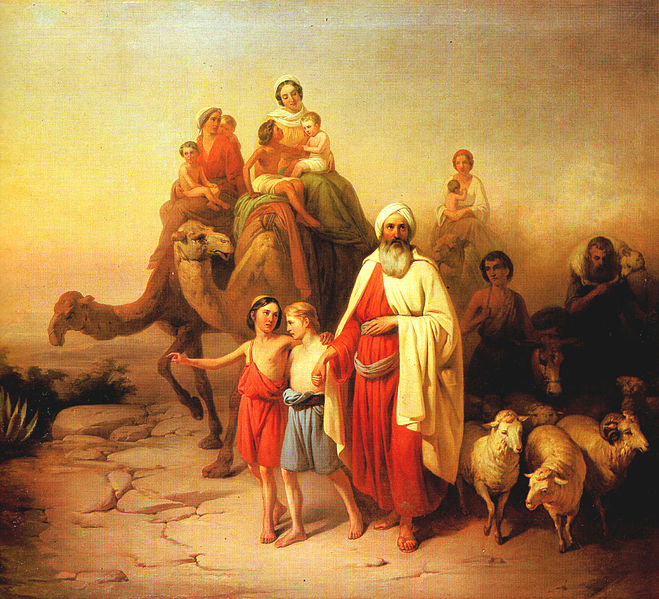
Now Abram was very rich in livestock, in silver, and in gold. And he journeyed on from the

A painting of Abraham’s departure by József Molnár

Negeb as far as Bethel to the place where his tent had been at the beginning, between Bethel and Ai, to the place where he had made an altar at the first. And there Abram called upon the name of the Lord. (Gen 13:2-4).

Blending the two-

“And Abram was called “rich” by a poor slave from Pharaoh’s house and Abram felt guilty for his excesses. And lo, Abram chose the number seven and gave 7 cows to the child, and 7 pieces of silver to the beggar by the gate and 7 pieces of gold to the cripple by the road. And a grand social experiment was born, and behold, Abram felt closer to God and God was increased because of Abram’s works.”

BAH HA HA HA — stupid, eh?

Now, it is not stupid to shepherd your means wisely. It is not stupid to care for the poor. It is not stupid to have compassion on those less fortunate. All those things are good. We are reminded of the Parable of the Talents (Matthew 25:14-30). Some people are richer than others and that is the way God set it up (Matthew 25:15). It is what we do with what we have that He is looking for. (Matthew 24:28). How we go about witnessing for Jesus regarding those important topics is what matters. How we share our means is what is at stake. Is what we are doing for the right reasons and done in the right way? Because there are right and wrong reasons and a right and a wrong way, as the parable shows.

In the next part of this book review, I’ll explore what the reference in the book’s “seven sacred pauses” means. The meat of the problem with the book “7: An experimental Mutiny Against Excess” is contained in that phrase, and I’ll explicitly tell you why this ‘discipline’ is very, very bad. Is what we are doing for the cause of Christ Godly and deep, grounded in His word? Or is what we are doing for the cause of Christ superficial and wrong headed, off track and thus of the kingdom of darkness? This book is in the latter group and in the next part I’ll clearly show you how they went about it in the wrong way, and thus why the book is to be avoided.

Part 2 here

Posted in identity, jesus, watch me daddy

"Watch me, Daddy!" Our identity in Christ

Remember when we were kids, and we could run fast as a cheetah, jump as high as a kangaroo, turn cartwheels as fast as a bowling ball? We felt it, we knew it.

photo credit: Runs With Scissors via photopin cc

As kids we loved moving for the sheer joy of it. However, it made the movement all the sweeter when we shouted to Mom or Dad, “Watch me!” It seemed desperately important for our parents or grandparents to see us. We needed that confirmation of our identity. Doing our trick or running real fast somehow wasn’t as good if mom or dad didn’t see it. Kids yearn for that acknowledgement when we acquire a new skill. Children love praise. It makes our new skill all the nicer when we can see that dad approves.

On the playground I’m asked all the time to “Watch me run!’ “Watch me flip!” Watch me do a cartwheel!” I remember the intensity of wanting my mom’s eyes upon us. It meant everything. It had to happen! They had to watch! So when I’m asked on the playground at school to watch, I always say yes. I always wait until they return and say “did you see?” because they always ask. “Did you see?” I say “yes, great job!” And they run away happy.

What is it within a child that makes it such a desperate need to be seen? It’s as if our entire identity is cemented as long as we receive that parental confirmation. It’s as if even our entire existence is validated as long as father sees us and applauds. Kids desperately seek attention from their father, don’t they?

As adult Christian believers, we don’t have to say, “Father watch me!” By faith, we know our identity is in Christ. Our very existence, we owe to Him. And by faith we know He watches us, as much as is eternally possible and all the time. We don’t have to ask.

The LORD himself watches over you! The LORD stands beside you as your protective shade. (Psalm 121:5)

He does not take his eyes off the righteous; He enthrones them with kings and exalts them forever. (Job 36:7)

For the eyes of the LORD run to and fro throughout the whole earth, to give strong support to those whose heart is blameless toward him. (2 Chronicles 16:9).

Does he not see my ways and count my every step? (Job 31:4).

Brethren, friend, loved ones, His eyes are on you! He watches us with delight!

the LORD delights in those who fear him, who put their hope in his unfailing love.
(Psalm 147:11)

While we are trophies of grace, He doesn’t look at us just to look at us, nor does He look at us because we’re so great. He does love us. But don’t you look at your own trophy case? Admire your work? Hang your platinum albums on the wall? Pin the pennant up over your bed? He watches us because He will magnify HIS OWN name by us, His trophies of grace. (Ezekiel 36:23).

We do not need to shout to our Father, “Watch me!” anymore. We toil on earth, not letting the left hand know what the right hand is doing. We give, edify, pray in our secret closet. We don’t need to ask the Lord to watch us acquire a new skill, because we know by faith He watches. What we do as His ambassadors is to say “Watch our Father! Look what He can do!”

When He calls us home and we stand before Him at the Bema rewards, and He says “Well done, Son, well done, daughter! Well done good and faithful servant!” Our identity will be finally realized, fulfilled, and made eternal. We become one in flesh with the Father, and then have an eternity to enjoy Him as He enjoys us, the Bride finally home with the Groom. And we can look Him full in the face and we can say about HIM- look at our Father! watch HIM!

photo credit: ClaraDon via photopin cc

Posted in anger, holy, righteous anger, wrath

Where is the righteous indignation? The holy anger?

Most sane people, until recently at least, would agree that child abuse is heinous. It is something that arouses in people an anger and feelings of severe indignation, in some cases, even violence. The very notion of an innocent and vulnerable child being abused by a horrid man or woman is beyond comprehension. The notion of baby abuse is even worse. Most people, including myself, refuse to even think about that because of the dread feelings abuse against children or babies breeds in the heart.

Though most sane people who become righteously angry at the notion of a child being abused will not enter into violence. Most will hanker for justice. They will vigorously pursue a due punishment for that abuser through all appropriate channels – to the utmost.

They will pursue justice through the court system. Of the abusing priests, they pursue justice through the Vatican. Some dedicate their lives to protecting abused children. Others dedicate their profession through a lifetime to obtaining justice for these kids.

All believers are children of God. To God, we are His kids. We feel grown-up, mature, and in earthly terms, we may be. But we are children.

  • Galatians 3:26 For ye are all the children of God by faith in Christ Jesus.
  • John 1:12 Yet to all who did receive him, to those who believed in his name, he gave the right to become children of God–
  • Romans 8:14 For those who are led by the Spirit of God are the children of God.

Even if we have been a believer for 50 years, we are still a kid to the LORD. We are his sheep, dumb, helpless, and shivering at the wolves who prey on us.

“The weak you have not strengthened, the sick you have not healed, the injured you have not

bound up, the strayed you have not brought back, the lost you have not sought, and with force and harshness you have ruled them. 5So they were scattered, because there was no shepherd, and they became food for all the wild beasts. My sheep were scattered; they wandered over all the mountains and on every high hill. My sheep were scattered over all the face of the earth, with none to search or seek for them.”

“Therefore, you shepherds, hear the word of the Lord: As I live, declares the Lord God, surely because my sheep have become a prey, and my sheep have become food for all the wild beasts, since there was no shepherd, and because my shepherds have not searched for my sheep, but the shepherds have fed themselves, and have not fed my sheep, therefore, you shepherds, hear the word of the Lord: Thus says the Lord God, Behold, I am against the shepherds, and I will require my sheep at their hand and put a stop to their feeding the sheep. No longer shall the shepherds feed themselves. I will rescue my sheep from their mouths, that they may not be food for them. (Ezekiel 34:4-10)

We can see from the above verses that the sheep can be prey for the wolves in many different ways. When a worthless shepherd throws them to the wolves and feeds himself instead, it is a very bad thing- for the anger of the LORD burns in His chest.

What He is describing is spiritual abuse. This occurs against the children of God by those in positions of trust. We are enduring a flood of worthless shepherds these days, as well as worthless prophets, false teachers, and unregenerated “believers”.

“A steady stream of false teaching has been cumulative so that it is wider and deeper now than it has ever been in human history. False teaching about God, about Christ, about the Bible, about spiritual reality is pandemic. (source)

Pastors who plagiarize are abusing the sheep because they are giving voice to satan and turning the pulpit over to the kingdom of darkness. Teachers who introduce destructive heresies ruin the people who listen to it. (2 Timothy 2:14). False prophets who speak a dream they’ve made up dilute the word.

So my question is, when a pastor or leader or teacher abuses the flock, why don’t we become as righteously angry as we do with secular child abusers? Why, so often, is there more focus on the victimizer than the victims? His feelings? His reputation? His restoration? Why do we not get more righteously angry about spiritual child abuse? Their feelings? Their restoration? Their needs in the face of recovery?

Look at how harshly Paul dealt with those whom the Spirit commanded to be turned over to judgment.

“This command I commit unto thee son, Timothy, according to the prophecies which pointed to thee that thou by them mightest war a noble warfare; holding faith and a good conscience which some having put away have made shipwreck concerning the faith; of whom are Hymenaeus and Alexander whom I have delivered unto Satan that they may learn not to blaspheme.” (2 Timothy 2:14-19).

There is a place for righteous anger in a holy setting. We’re commanded to limit it, but it is OK to feel it.

“Be angry, and yet do not sin; do not let the sun go down on your anger.” (Ephesians 4:26). Here is what

Dr. John MacArthur says about righteous anger:

“You have a right to be angry about some things.

Psalm 97:10 says: “Ye that love the Lord hate evil.” And Psalm 69:9 David says: “Zeal for Thine house is eating me up. The reproaches that are falling on Thee are falling on me.” He’s saying, God, I can’t tolerate what people do to Your name. It infuriates me.

Now I admit I get angry sometimes. I hope to God I never get angry about what happens to John MacArthur, I hope I always get angry about what happens to God’s holy name. And I hope I never stop getting angry about that. We should have a basic, built in, – that is a programmed anger over sin, a programmed anger over evil, that puts us in a beatitude mentality so that whenever I see sin be it in you or be it in me, I mourn in my spirit. That kind of anger is the sinew of the soul.

F. W. Robertson, a great saint, tells in one of his letters that one time he met a certain man who he knew was trying to lure a young girl into prostitution. And he was so angry he bit his lip until it split open and bled.

The anger that is selfish, passionate, undisciplined, uncontrolled is sinful, useless, hurtful. It must be banished from the Christian life. But the disciplined anger that seeks the rightful place of a righteous God is pure and selfless and dynamic.

This sermon goes on to offer practical ways to allow holy anger to rise to the surface but not to let it consume you.

“anger that is unselfish and is based on love for God and concern for others not only is permissible but commanded. Genuine love cannot help being angered at that which injures the object of that love.

“But even righteous anger can easily turn to bitterness, resentment, and self–righteousness. Consequently, Paul goes on to say, do not let the sun go down on your anger, and do not give the devil an opportunity. Even the best motivated anger can sour, and we are therefore to put it aside at the end of the day. Taken to bed, it is likely to give the devil an opportunity to use it for his purposes. If anger is prolonged, one may begin to seek vengeance and thereby violate the principle taught in Romans 12:17–21…”

In Psalm 4, David shows us what to do with our righteous anger and it’s consistent with what Paul said, “Be angry, and do not sin!” (From Bible.org)-

Twice in this very short psalm (Psalm 4) David refers to his bed. In verse 4, David speaks of being still, of not taking action himself. Apparently David has done all that he could, in the rebuke of his enemies as recorded in verses 2 and 3. Now, he remains still on his bed, not mulling over the sins of his enemies, or plotting their demise, but rather meditating on the virtues of his God.

Get angry if the sheep are abused. Spiritual abuse is terrible and ruins lives and souls. Be angry! But do not sin. You have a right to be angry about some things. You have a command to be angry about some things! However we should not let that righteous anger linger because it would turn to sour bitterness. If we are angry about what angers God and not angry over ourselves, it is a righteous anger. Keep your eyes on God, even when you are praying for justice for the abused sheep.

Posted in gonorrhea, jesus, robert a. j. gagnon, sexual sin

Sexual sins are worse. Here’s why

The UK Daily Mail has this story:

Doctors warn that antibiotic-resistant strain of gonorrhea could be ‘worse than AIDS’ 
Doctors are warning that an antibiotic-resistant strain of gonorrhea, now considered a superbug, has the potential to be as deadly as the AIDS virus. Gonorrhea is the second most commonly reported sexually transmitted infection in North America. This particular strain of gonorrhea, known as HO41, was discovered in Japan two years ago in a 31-year-old female sex worker who had been screened in 2009. The bacteria has since been found in Hawaii, California and Norway. HO41 has so far proved resistant to current antibiotic treatment and so it has been placed in the superbug category. ‘This might be a lot worse than AIDS in the short run because the bacteria is more aggressive and will affect more people quickly,’ Alan Christianson, a doctor of naturopathic medicine told CNBC. Nearly 30 million people have died from AIDS related causes worldwide, but Christianson believes the effect of the gonorrhea bacteria is more direct.

Wow. That kind of came out of nowhere…

What kind of problem does gonorrhea usually present? The Center for Disease Control reports on their gonorrhea fact sheet,

CDC estimates that, annually, 820,000 people in the United States get new gonorrhea infections and less than half of these infections are detected and reported to CDC.

Gonorrhea is a sexually transmitted disease, given or received by any sexually active person, heterosexual or homosexual.

Sexually transmitted diseases at their basic root are a judgment from God in the way that all disease is a function of the decay the people who dwell on the earth experience as a general consequence of it. Disease is a fact of the wrath of God He is allowing to be present in this age. Judgment aside, sexual diseases ARE a consequence of wanton sexual activity outside the biblical confines of marriage. There is a reason God set it up so that one man and one woman enjoy conjugal relations for a lifetime. Abandoning that opens a person up to sin, emotional decay, and physical disease. Remaining in a committed marriage with only one partner, or celibate if single, immeasurably decreases your chances of contracting such a disease.

In addition, Romans 1:18-32 describes God’s wrath against sexual sin and worse perversion.

So how does one avoid God’s displeasure in sexual sin, particularly when the culture is so immoral? Even insurance advertisements use adultery and lasciviousness to sell product! Well, the bible says, “Flee from sexual immorality. Every other sin a person commits is outside the body, but the sexually immoral person sins against his own body. (1 Corinthians 6:18).”

Barnes Notes explains,

Flee fornication – A solemn command of God – as explicit as any that thundered from Mount Sinai. None can disregard it with impunity – none can violate it without being exposed to the awful vengeance of the Almighty. There is force and emphasis in the word “flee” φεύγατε pheugate. Man should escape from it; he should not stay to reason about it; to debate the matter; or even to contend with his propensities, and to try the strength of his virtue. There are some sins which a man can resist; some about which he can reason without danger of pollution. But this is a sin where a man is safe only when he flies.

Remember Joseph. He is our example here.

But one day, when he went into the house to do his work and none of the men of the house was there in the house, she caught him by his garment, saying, “Lie with me.” But he left his garment in her hand and fled and got out of the house. (Genesis 39:11-12)

The prophecies in the bible about the last days and the Tribulation indicate that disease will run rampant over the entire earth and kill a great many people. Death and Hades are given authority to kill a fourth of  of the earth’s people by sword, famine, beasts, and disease. (Revelation 6:8). Jesus warned that in the last days there will be pestilences (Luke 21:11).

It is no accident, in my opinion, that the CDC and other agencies are worried about and reporting on an increase in drug resistance. Superbugs didn’t exist as commonly as they do today when I was a child. There have been outbreaks, but none like the ones predicted in the Tribulation.

This website lists the five deadliest pandemics in history. Smallpox, a mystery disease, Spanish Flu and good old bubonic plague have been with us since recorded history.

  • In The Peloponnesian War Pestilence, a disease killed 30,000 Athenians and was never identified. About half of Athens perished.
  • The Anotonine Plague, thought to be smallpox, ran its course in 15 years and killed 5,000 a day and a total of 5 million people.
  • The Plague of Justinian occurred in 541-542 AD, this disease now known to be bubonic plague killed 10,000 people in Constantinople every day. With no room nor time to bury them, bodies were left stacked in the open. it is estimated that almost a quarter of the Mediterranean region was killed during this course of the disease.
  • In the 1300s, the Black Death (bubonic plague) took a heavy toll on Europe. The fatality was recorded at over 25 million people or one-fourth of the entire population.
  • The Spanish Flu of 1918-1919 affected every continent. It is perhaps the most lethal pandemic in the history of humankind: between 20 and 100 million people were killed, more the number killed in WWI itself.

And now this disease poised to be “worse than AIDS”. The World Health Organization reports that 1.5-1.9 people died of AIDS related illnesses in 2011. Since the beginning of the HIV/AIDS epidemic, 60 million people have contracted HIV and 25 million have died of AIDS-related causes.

And this new gonorrhea bug may be worse? And rising at a time when the Lord said that pestilence will be rampant? And when the Restrainer ceases His restraining ministry after the rapture and sexual sin will explode? Good gravy, please believe on the Lord Jesus and escape all these things by being part of the Bride and rise at the rapture!

His faithfulness is such that He takes ALL sinners, no matter who confesses and repents. He is loving, just, merciful and kind. However, though He is those things, after the rapture He will unleash His wrath and anger, and render unto the unbelieving and sinning world the due consequences of their actions. The above list of ‘five worst pandemics’ will seem like a summer cold by the time the bodies are stacked up at the end of the Tribulation. You do not want to be here for that.

In case you missed it above, sexual sin, any sexual sin, (pre-marital sex, AKA fornication, homosexual sex, adultery, pornography, and all other perversions) is worse than other sins because…here it is in 1 Corinthians 6:18 again.

And a word of caution to us all before the blessed event of the rapture takes place: FLEE from sexual sin, and that includes thoughts as well as actions. “Let marriage be held in honor among all, and let the marriage bed be undefiled, for God will judge the sexually immoral and adulterous.” (Hebrews 13:4)

Jesus is GREAT and faithful to help us. You do not have to be a slave to sexual sin.  “He saved us, not because of works done by us in righteousness, but according to his own mercy, by the washing of regeneration and renewal of the Holy Spirit.” (Titus 3:5)

Amen!!

—————————-

Further Reading

Is Homosexual Practice really No Worse than Any Other Sin?
“Christ’s universal coverage of sin through his death on the cross does not mean that all sins are equal in all respects but only that all sins are equal in one respect: They are all covered.”