I share my admiration for John 1:1-5 from the KJV, I love the majestic language and profound meaning of the verses. I highlight the significance of Christ as the source of life and light, underscoring the importance of Jesus and His Gospel as the ultimate Good News and our reliance on Him for salvation.
I’ve written before about how, when I was not saved yet but the Spirit was strongly drawing me, that there was a pastor of a Bible believing Baptist church in my town. I used to work at the Post Office putting up the post office box mail. The wall didn’t go all the way to the ceiling and of course the boxes were open at my end and with a door at the customer’s end.
So, I could hear all conversations in the lobby. When the pastor came in he would always mention blessing, or Jesus, or the Savior, or something that was like acid on my soul. I used to shove the mail into the boxes while grinding my teeth, thinking, “Why does he always talk of Jesus? How foolish! Doesn’t he know that no one’s listening!”
Of course, I was listening. The Lord used throwaway words, not even aimed at me, to grab me at the scruff of the neck and force me to look at my sin like a bad puppy.
I’ve also mentioned before how John Bunyan heard conversations from three or four ladies at their doorstep, and how Bunyan marveled at how they seemed to ‘know’ the savior, who to Bunyan at that point, was a remote God. Their grace-filled words words carried to his heart and eventually were used to bring him to Christ.
Famously, Augustine heard a child’s song in the next-door walled garden, of a child singing a song Augustine had never heard before (or since) including the words “Tolle lege!” which means ‘pick up and read’. He felt a compulsion to do so, and he did pick up the Bible and read. He was convicted by what he read in Romans. We know the rest from there.
Wholesome words are never wasted even if they seem throwaway. God’s word never returns void. It always makes its intentions sure and profitable, and this includes words in conversation. (It’s why we mustn’t gossip or slander, because those words have an equally negative impact as much as wholesome words have their positive effect).
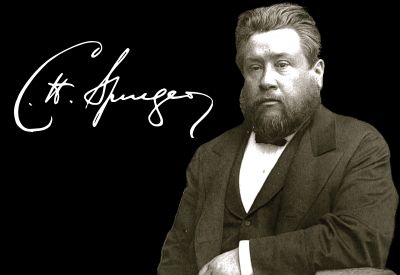
Charles Spurgeon never knew the following anecdote until the end of his life, though the incident occurred at the beginning of his pastorate. The following are his own words from “The Autobiography of Charles Haddon Spurgeon“.
THE FAST-DAY SERVICE AT THE CRYSTAL PALACE.
During the time of our sojourn at the Surrey Gardens, it was my privilege to conduct one service which deserves special mention, for it was the occasion on which I addressed the largest congregation to which I ever preached in any building. This was on Wednesday, October 7, 1857, when 23,654 persons assembled in the Crystal Palace to join in the observance of the day appointed by proclamation “for a solemn fast, humiliation, and prayer before Almighty God: in order to obtain pardon of our sins, and for imploring His blessing and assistance on our arms for the restoration of tranquillity in India”.
About a month previously, in my sermon at the Music Hall on “India’s Ills and England’s Sorrows”, I had referred at length to the Mutiny, and its terrible consequences to our fellow-countrymen and women in the East. The Fast-day had not been proclaimed, but when it was announced, I was glad to accept the offer of the Crystal Palace directors to hold a service in the centre transept of the building, and to make a collection on behalf of the national fund for the sufferers through the Mutiny.
The Lord set His seal upon the effort even before the great crowd gathered, though I did not know of that instance of blessing until long afterwards. It was arranged that I should use the Surrey Gardens pulpit, so, a day or two before preaching at the Palace, I went to decide where it should be fixed; and; in order to test the acoustic properties of the building, cried in a loud voice, “Behold the Lamb of God, which taketh away the sin of the world.” In one of the galleries, a workman, who knew nothing of what was being done, heard the words, and they came like message from Heaven to his soul. He was smitten with conviction on account of sin, put down his tools, went home, and there, after a season of spiritual struggling, found peace and life by beholding the Lamb of God. Years after, he told this story to one who visited him on his death-bed.
It was a service I was not likely ever to forget, and one result upon my physical frame was certainly very remarkable. I was not conscious, at the close of the service, of any extraordinary exhaustion, yet I must have been very weary, for after I went to sleep that Wednesday night, I did not wake again until the Friday morning. All through the Thursday, my dear wife came at intervals to look at me, and every time she found me sleeping peacefully, so she just let me slumber on until–“Tired nature’s sweet restorer, balmy sleep,”
I was greatly surprised, on waking, to find that it was Friday morning; but it was the only time in my life that I had such an experience. Eternity alone will reveal the full results of the Fast-day service at the Crystal Palace.
We never know the effect of words spoken from His word either to the direct listeners in the pew or behind the radio or TV, nor do we know the effect of His word on those we have no idea are listening nearby, or even unseen within in hearing distance, like that workman. Spurgeon didn’t even know the workman was there, the Bible believing pastor didn’t know I was behind the wall, nor did the child in the garden know there was a spiritually agonized sinner named Augustine behind the garden wall.
God is great and His purposes ALWAYS accomplish exactly what He intends. He is worthy of so much praise.
O taste and see that Yahweh is good; How blessed is the man who takes refuge in Him! (Psalm 34:8)
As a Christian, we don’t have simply a mental assent that God is good. It’s not just a cognitive comprehension.
For example, we can know a certain dish is good, maybe Shepherd’s Pie. We can see the list of ingredients in the recipe and know that its culmination will be tasty. We can see photos of the completed dish and see it is good.
But when we taste it, THEN the item comes inside is to be digested and its goodness applied to every organ. We are then absorbing it into our whole body, its goodness is sent along the bloodstream, and its good properties applied to every part of our body.
When we taste something we are experiencing it in its entirety. See two old time Commenters on the Psalm 34 ‘taste and see’:
Barnes’ Notes on the Bible, The word “taste” here – טעם ṭâ‛am – means properly to try the flavor of anything, Job 12:11; to eat a little so as to ascertain what a thing is, 1 Samuel 14:24, 1 Samuel 14:29, 1 Samuel 14:43; Jonah 3:7; and then to perceive by the mind, to try, to experience, Proverbs 31:18.
Gill’s Exposition, in conversion a new taste is given, so as to have a saving experimental knowledge of the grace and goodness of God in Christ, an application of it to them; and in such manner as to live upon it, and be nourished by it; and though this is not a superficial taste of things, like that of hypocrites, nor a single one only, being frequently repeated; yet it is but a taste in comparison of the enjoyment of it in the heavenly state; and every taste now influences and engages trust in the Lord
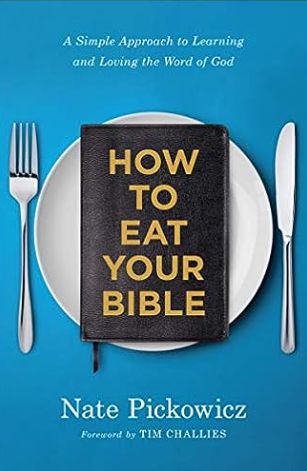
Here is a resource along those lines: a book by pastor Nate Pickowicz, “How to Eat Your Bible: A Simple Approach to Learning and Loving the Word of God”.
Blurb: Loving God means loving His Word. If you’re feeling distant from God, could it be because you’re ignoring His Word? But maybe you don’t know where to start. Maybe the long books and strange names feel overwhelming. Maybe you just don’t like reading. Whatever the case, How to Eat Your Bible will help you cultivate an appetite for life-long study of God’s Word. Find practical guidance for overcoming the hurdles that have kept you from making Bible study a regular part of your life. You’ll also become encouraged to pursue God’s Word by learning how other Christians throughout time maintained this crucial practice. Pastor Nate Pickowicz also includes a unique Seven Year Bible Plan so that you can apply what you’ve learned and continue drawing near to God as you consume His Word.
Consume the banquet of His word. I need to do that myself. School starting a few weeks ago has hit me hard and I’m often tired both in the morning and in the evening. I have been spotty with tasting that that Lord is good. His word when consumed, goes into the brain and then the Holy Spirit applies the Living and Active word to my living body. He illuminates it to my mind and it circulates in my whole being, finally resting in my beating heart, now a permanent part of me. Why do I leave off absorbing the word of God? It is a fine meal.
In the beginning was the Word, and the Word was with God, and the Word was God. The same was in the beginning with God. All things were made by him; and without him was not any thing made that was made. In him was life; and the life was the light of men. And the light shineth in darkness; and the darkness comprehended it not.
John 1:5 in the KJV moves me to tears any time I spend more than a few seconds pondering it. I don’t know why, all I can say is it must be the Spirit responding and pointing me to our glorious Savior.
“…and the darkness comprehended it not…” especially. I know that other translations say “overcome it not” which is also powerful, but the one that moves me is the KJV in this verse.
Matthew Henry on John 1:1-5,
‘Without him was not any thing made that was made’
“All things were made by him, and not as an instrument. Without him was not any thing made that was made, from the highest angel to the meanest worm. This shows how well qualified he was for the work of our redemption and salvation. The light of reason, as well as the life of sense, is derived from him, & depends upon him.”
What a great Savior! Upon whom would we depend? Who else is there? Peter said “Lord, to whom shall we go? You have the words of eternal life”.
The words of eternal life, refreshing, life-giving, Christ is all and He is the Word and the Word is all. Jesus Christ and His Gospel is the Good News.
I bow down toward your holy temple and give thanks to your name for your steadfast love and your faithfulness, for you have exalted above all things your name and your word. (Psalm 138:2)
It’s currently fashionable to dismiss the holy Word of God, AKA the Bible. It supposedly proves one’s relevance to say that one desires a closer relationship with Jesus as opposed to studying holy writ. When the heretical novel called The Shack was published in 2008 it swept the Christian world, remaining at a number one bestselling spot for several years. In it, the author never pointed to God’s word as sufficient and infallible. It rather undermined those concepts by insisting on personal revelation and denigrated the Bible as ‘that old dusty King James” thing. The author scoffed at the idea that God has spoken authoritatively and sufficiently through the Bible. He points away from Scripture he points towards subjective promptings and leadings. (source).
The subtle mocking and scoffing of the Word of God, so delicately put in a thinly disguised new age treatise in 2008, is by now in 2016 a full-blown attack by a leading and influential Southern Baptist Minister. The salvos have just kept coming, prompting pastor, author, and podcaster Justin Peters and Pastor Jim Osman to take note. Peters said on his podcast Friday on World View Weekend, that
A friend of mine sent me a video interview of Andy Stanley by Russell Moore. Moore asked Stanley what he would do if he were the “Evangelical Pope.” Stanley had some rather surprising remedies for what ails the Christian church. I’m joined in studio (my office) by my friend and pastor Jim Osman and we play the clip and discuss.
In the clip, Stanley said that he would ask pastors of all kinds (senior, youth, seminarians, etc) to “get the spotlight off the Bible and back on the resurrection. Let’s get people’s attention back on Jesus as soon as possible. To leverage the authority we have in the resurrection, as opposed to scripture.”
Matthew Henry said, of the Psalm 138:2 verse, that the LORD’S name and His Word is above all things-
For thou hast magnified thy word (thy promise, which is truth) above all thy name. God has made himself known to us in many ways in creation and providence, but most clearly by his word. The judgments of his mouth are magnified even above those of his hand, and greater things are done by them. The wonders of grace exceed the wonders of nature; and what is discovered of God by revelation is much greater than what is discovered by reason.
As a practical matter for us today in living our Christian lives, do not compromise on your life and always remember the Lord God Himself magnified His word and His Name above all else. Here is John MacArthur on the fact that our God is an uncompromising God who expects of His disciples, An Uncompromising Life
It might be well to remind ourselves at the very beginning that God is the uncompromising God. God never compromises an absolute. God never compromises a principle. God never sets aside a truth for expediency purposes. God always lives according to His word. In fact, He said, “I have exalted My word above all My name.” In other words, He says, “I Myself, as to My nature, make Myself submissive to My word.”




 the-end-time.org