Posted in theology

How busy was the Temple?

By Elizabeth Prata

The Prophetess Anna (or Old Woman Reading) by Rembrandt van Rijn.

Reading through Chronicles in the Bible is eye-opening. In the sections where it is described about the complexity of Temple architecture and the complexity of worship, it’s astounding. But then again, it is all God’s due! He is worthy of the most beautiful Temple and the most precise worship. He wants and should receive exactly the kind of worship He desires.

John MacArthur: Luke gave another significant detail about Anna, who is usually mentioned at Christmas time:

and then as a widow to the age of eighty-four. She did not leave the temple grounds, serving night and day with fasts and prayers“. (Luke 2:37).

“That’s an emphatic statement, which suggests that Luke meant it in a literal sense. Evidently, Anna lived right there on the temple grounds. There were some apartments in the outer courts (Nehemiah 13:7–9). These were modest chambers, probably used as temporary dwelling places for priests who lived on the temple grounds while doing their two weeks’ annual service.”

“Perhaps because of her long faithfulness, her obvious spiritual gifts, her steadfast devotion to the Lord, and her constant commitment to her ministry of prayer and fasting, temple officials had given her a small chamber. She was now too old to be employed as a caretaker, but perhaps she had once served in that capacity, and her living quarters had been given to her for life. In any case, it was ultimately the Lord who had graciously provided her a place in His house and sovereignly orchestrated whatever arrangement she might have had with the temple custodians. Source -sermon, Anna, the Aged Evangelist“. –end MacArthur quote


Interesting to think of sleeping cells in the Temple, but it makes sense.

In Alfred Edersheim’s 1898 book, The Temple—Its Ministry and Services, he explains about the apartments inside the Temple. Really, just sleeping chambers. Some were above the Court of the Gentiles, while bigger apartments were for the High Priest to spent the week before the Day of Atonement in study and meditation. Other apartments were for the Levite musicians. (1 Chronicles 9:33)

When we think of the Temple at the time of Jesus in 30AD, we know it was grand and large. Perhaps we think of a European cathedral, or a large church sanctuary in the US, where all is still and quiet. A hushed reverence hangs over the pews, dust motes swirling in the occasional sunbeam angling in through stained class, with people quietly praying or worshiping. Marble halls echo in stillness of shuffled footsteps as priests move about.

Below is a listing of all the Temple Ministries and Duties. Wow, that’s a lot. Source MacArthur Study Bible, Day June 30. Think of all the personnel it took to maintain it, thrive it, and protect it.

The Jerusalem Temple was not like that at all. It was hugely busy, loud, and active. Edersheim again:

In this court tradition places eating and sleeping apartments for the Levites, and a synagogue. But, despite pharisaic punctiliousness, the noise, especially on the eve of the Passover, must have been most disturbing. For there the oxen, sheep, and doves selected as fit for sacrifices were sold as in a market; and here were those tables of the money-changers which the Lord overthrew when He drove from His Father’s house them that bought and sold (Matt 21:12; John 2:14).

If Anna literally did not depart from the Temple, but that she actually lived on premises, she was probably given a sleeping chamber and was taken care of, since she was a widow, especially since her devotion to the LORD was known and noted.

I think of Paul’s admonition for single women, to be selflessly devoted to loving God with all our strength, heart, mind, and soul. The verse in 1 Corinthians about unmarried people being single-mindedly devoted to the Lord was not written yet at Anna’s lifetime, but she certainly fulfilled the spirit of that verse.

Imagine Anna’s life. Living in such a busy and loud place, apostasy all around, yet undeterred, Anna was constantly in devotion to God, vigilantly awaiting Israel’s Consolation. What a blessing the Lord gave her, to see the babe who would be King.

Amid the hustle of Temple business, the men and women coming and going, Priests at their tasks, lowing of the cattle, rattle of the money changers, Anna herself praying, in the crowd she spotted a couple with a baby. It must have been the Spirit that alerted her that this, of all the people entering the majestic Temple, this was the Babe she had been waiting for. What did she do?

And coming up at that very hour she began to give thanks to God and to speak of him to all who were waiting for the redemption of Jerusalem. (Luke 2:38).

We Christians on this side of the cross are no longer waiting for the redemption of our souls. We have been blessed to receive it by the Holy Spirit if we have repented of our sins. We now wait for the return of our Messiah. We long to see Him in person. Perhaps today will be the day He returns. If not, then another day. Meanwhile we can take up Anna’s example and give thanks to God, and speak of Him to all.

Posted in encouragement, Uncategorized

Thirty Days of Jesus Redux: Day 10, the Boy Jesus at the Temple

By Elizabeth Prata

thirty days of Jesus day 10

With Him are wisdom and might; To Him belong counsel and understanding (Job 12:13).

Further Reading:

The Day Jesus Went AWOL

Twelve-year-old Jesus goes to the Temple

The Son of God at twelve years old
~~~~~~~~~~~~~~~~~~~~~~~~~~~~~~~~~~~~~~

Thirty Days of Jesus Series-

Introduction/Background
Day 1: The Virgin shall conceive
Day 2: A shoot from Jesse
Day 3: God sent His Son in the fullness of time
Day 4:  Marry her, she will bear a Son

Day 5: The Babe has arrived!
Day 6: The Glory of Jesus
Day 7: Magi seek the Child
Day 8: The Magi offer gifts & worship
Day 9: The Child Grew

Posted in encouragement, Uncategorized

Thirty Days of Jesus: Day 10, the Boy Jesus at the Temple

thirty days of Jesus day 10

With Him are wisdom and might; To Him belong counsel and understanding (Job 12:13).

Further Reading:

The Day Jesus Went AWOL

Twelve-year-old Jesus goes to the Temple

The Son of God at twelve years old
~~~~~~~~~~~~~~~~~~~~~~~~~~~~~~~~~~~~~~

Thirty Days of Jesus Series-

Introduction/Background
Day 1: The Virgin shall conceive
Day 2: A shoot from Jesse
Day 3: God sent His Son in the fullness of time
Day 4:  Marry her, she will bear a Son

Day 5: The Babe has arrived!
Day 6: The Glory of Jesus
Day 7: Magi seek the Child
Day 8: The Magi offer gifts & worship
Day 9: The Child Grew


Posted in Uncategorized

Jachin and Boaz, two named Temple columns

I like columns. Did you know there were two particular columns that were part of Solomon’s temple, and that they had names? Since the terms describing these pillars have gone into history, and no explanation is given in the Bible as to why they are so named, these pillars remain mysterious. The Bible records their existence and look and that’s it.

Of course whenever there is a mystery there are a plethora of mystical and conspiracy theories regarding it. The Bible mysteries are no different. If you go off researching about the two pillars/columns, be wary of many of the search results.

Jachin and Boaz were the names of the pillars which were set up in front of the Sanctuary in Solomon’s Temple in Jerusalem (I Kings 7:15–22, 41–42; II Kings 25:13, 17; Jeremiah 52:17, 20ff.; II Chronicles 3:15–17; 4:12–13). According to Josephus in Antiquities of the Jews, Boaz (“In him/it [is] strength”) was on the left when entering Solomon’s Temple, while Jachin (“He/it will establish”) was on the right. The were made by Hiram. It seems that though opinion is divided, most scholars seem to believe these were freestanding pillars and performed no structural function in the temple.

He set up the pillars in front of the temple, one on the south, the other on the north; that on the south he called Jachin, and that on the north Boaz. (2 Chronicles 3:17).

The pillars had a size nearly six feet thick and 27 feet tall. The eight-foot high brass capitals on top of the columns bore decorations of brass lilies. The original measurement as taken from The Torah was in cubits, which records that the pillars 18 cubits high and 12 cubits around, and hollow, four fingers thick. (Jeremiah 52:21–22). Nets of checkerwork covered the bowl of each capital, decorated with rows of 200 pomegranates, wreathed with seven chains for each capital, and topped with lilies (1 Kings 7:13–22, 41–42). (Wikipedia).

I do not know a lot about the Temple but I’m looking forward to learning. Ligonier Connect has an online class I’m going to take over Christmas break called Understanding the Tabernacle. The Temple is the place where God decided to make His presence known and inhabit for a time, so I believe learning about it will be profitable and interesting. He was specific in its aesthetic and dimension, and so by virtue of His interest in the temple, my interest is also ignited.

Aesthetically, I’ve always loved pillars and columns, I suppose the tendency in us is to admire things that reach for heaven. We see that this tendency can be corrupted, as the pagans built Ashereh poles, and monuments, pillars, and altar cairns on the high places. The problem with Ashereh poles is mentioned constantly in the Old Testament. Warnings and admonitions about them appear in Exodus, Deuteronomy, Judges, both Books of Kings, the 2nd Chronicles, and the prophetic books of Isaiah, Jeremiah, and Micah. One can build a beautiful monument to a god, and worship there, but it has to be a monument to the One True God and worship there has to be true. (Leviticus 10:3). Of course, one does not have to build a soaring monument to God, one can worship Him in any humble building. But we sometimes still have the urge to offer worship to Him in a building that matches His majesty. Columns add to that majesty.

I’ve traveled to Europe and have seen the great cathedrals and churches. It’s a shame most of them are Catholic and therefore perform the same function as Ashereh poles. Any worship in those places only comes to dust and ashes. But I understand the desire to build something beautiful and soaring for the Lord. David felt it and inquired of the LORD in 1 Chronicles 17. David asked through the prophet Nathan, may he built a dwelling place for the LORD? The LORD praised David’s urge, but reminded David he had not rebuked previous kings and leaders for not building a temple. He said that a temple will be built, but David may not do it. Solomon will. In 1 Chronicles 22:8 we learn God’s reason- David had shed much blood because he was a man of war. David’s urge is something  many of us feel, we want the best for our Lord because He IS the best. The temple in heaven must be absolutely glorious and indescribable.

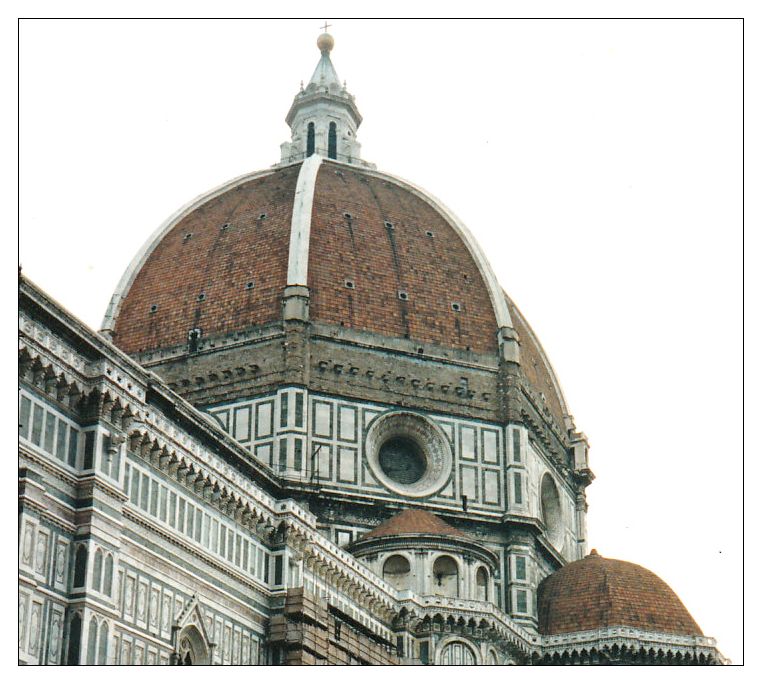
Florence Cathedral with the famous dome. Prata photo

There is a good book called Brunelleschi’s Dome, by Ross King, covering the incredible story of the largest masonry dome ever built. It adorns the top of the Santa Maria del Fiore (Saint Mary of the Flower) cathedral in Florence, Italy. The cathedral’s construction began in 1296 without knowledge of how the dome would be built to the architectural design they were following. The people were sure that by the time they got to the top, they will have figured out how to do it, lol. The cathedral was finished in 1436 with the dome engineered by Filippo Brunelleschi, in an ingenious way.

I remember reading Ken Follett’s monumental book Pillars of the Earth, a sweeping historical narrative covering the people designing and building a cathedral in 12th century England. It’s historically accurate and a ripping good yarn. I read it long before I was saved so I do not remember whether it can be safely recommended as a clean book to Christians. I do remember the author balanced both the sweep of epic cathedral building with finely drawn realistic characters.

Columns are soaring and beautiful. They adorn many a church in America, from humble to cathedral. The Temple will be interesting to study, as will the two named columns, Boaz and Jachim. There is so much to study, isn’t there? God surely has an incredible mind. We’re blessed He has shared some of it with us in His word.

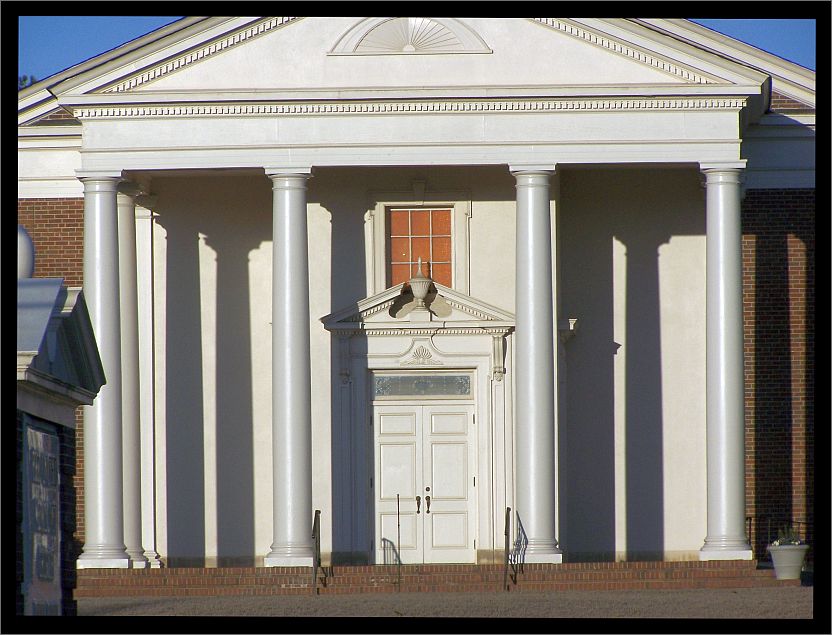
Columns of a Georgia Baptist Church. Prata photo


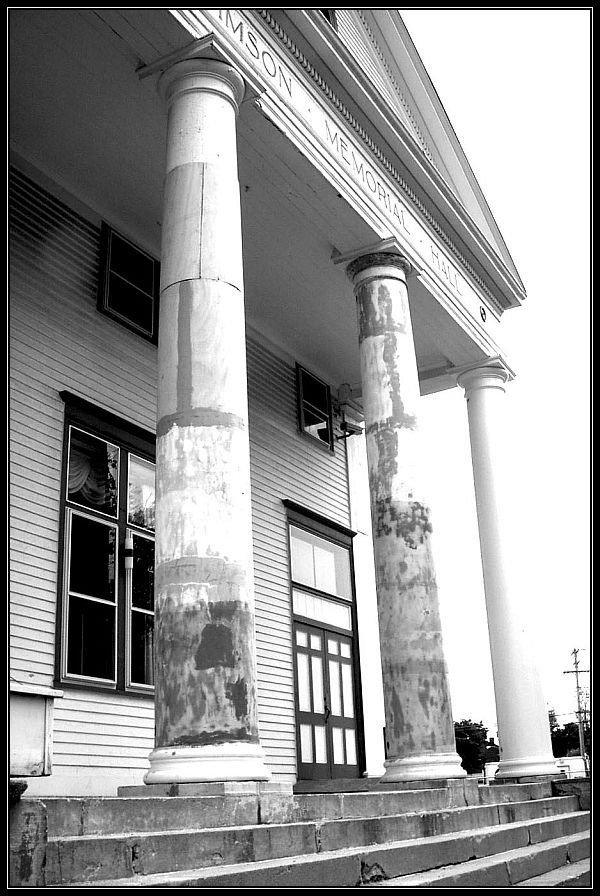
Columns under repair, New England secular building
Prata photo
A larger Georgia church with its columns. Prata photo