Posted in prophecy, theology

“But I’m a good person!”

By Elizabeth Prata

When they live in dreadful wickedness, they are but filling up the measure which God hath limited for them.~Jonathan Edwards


ust when we start to think we might be such bad people, here is a splash of cold water for us all to ponder. Commenting on Hosea 7:1, Israel’s sin, Matthew Henry wrote

The actual wickedness of men’s lives bears a very small proportion to what is in their hearts. But when lust is inwardly cherished, it will break forth into outward sin. Those who tempt others to drunkenness never can be their real friends, and often design their ruin. Thus men execute the Divine vengeance on each other. Those are not only heated with sin, but hardened in sin, who continue to live without prayer, even when in trouble and distress. (“Matthew Henry’s Concise Commentary on the Bible“)

We’re not as bad as we could be, but it’s in there and under certain conditions, our greater seed of iniquity comes out. Pogroms, genocide, the Holocaust, are all examples where the evil men did rose in greater proportion to what is in there. And that is not end of the evil that lurks within still. During the Tribulation, men will fully enact what is in their heart. The full measure of sin will be complete. (Dan 8:23, Matthew 23:32). Jesus said it will be the worst time the planet has ever known. (Matthew 24:21-22).

In 1735 Jonathan Edwards preached on 1 Thessalonians 2:16, in his sermon titled When the Wicked Shall Have Filled Up the Measure of Their Sin, Wrath Will Come Upon Them to the Uttermost

by hindering us from speaking to the Gentiles that they might be saved—so as always to fill up the measure of their sins. But wrath has come upon them at last! (1 Thessalonians 2:16)

This is true of every individual person, but will be in greater application during the Tribulation. Edwards’ sermon again,

There is a certain measure that God hath set to the sin of every wicked man. God says concerning the sin of man, as he says to the raging waves of the sea, Hitherto shalt thou come, and no further. The measure of some is much greater than of others. Some reprobates commit but a little sin in comparison with others, and so are to endure proportionably a smaller punishment. There are many vessels of wrath; but some are smaller and others greater vessels. Some will contain comparatively but little wrath, others a greater measure of it. Sometimes, when we see men go to dreadful lengths, and become very heinously wicked, we are ready to wonder that God lets them alone. He sees them go on in such audacious wickedness, and keeps silence, nor does anything to interrupt them, but they go smoothly on, and meet with no hurt. But sometimes the reason why God lets them alone is because they have not filled up the measure of their sins.

Edwards urges us to get into the ark, Christ.

We find in Scripture, that where glorious times are prophesied to God’s people, there are at the same time awful judgments foretold to his enemies. What God is now about to do, we know not. But this we may know, that there will be no safety to any but those who are in the ark. — Therefore it behooves all to haste and flee for their lives, to get into a safe condition, to get into Christ. Then they need not fear, though the earth be removed, and the mountains carried into the midst of the sea; though the waters thereof roar and be troubled; though the mountains shake with the swelling thereof: for God will be their refuge and strength; they need not be afraid of evil tidings; their hearts may be fixed, trusting in the Lord.

Through rapture or death, what a blessing it will be to arrive home to heaven where Jesus dwells, and there is no sin or death or evil any longer. Then, we can be with and gaze upon the only truly Good Person there ever was or shall be: Emmanuel.

~~~~~~~~~~~~~~~~~~~~~~~~~~

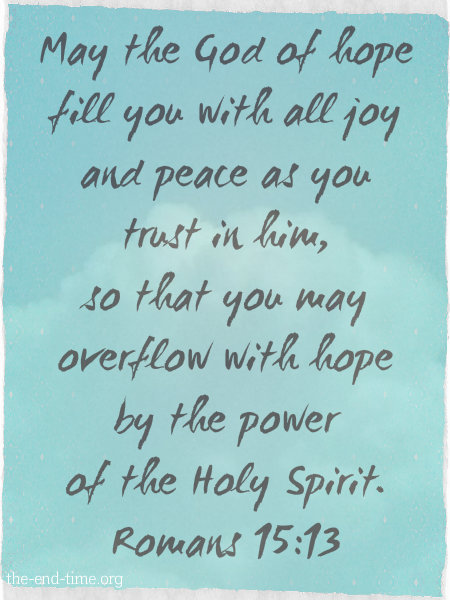
filled with hope verse

Posted in theology

I Surrender All (Or Do I?)

By Elizabeth Prata

I do hope your faith is growing and your trust in Jesus is too. He is so magnificent. Daily I’m awed by His sweetness, perfection, and power. I wrote on this blog a while ago about how the Spirit sometimes leads me through listening to hymns, and one example blessed me. I like the traditional hymns because they either directly quote scripture, or closely paraphrase Bible verses. This morning I awoke humming “I Surrender All.”

So that got me thinking on the word surrender. I was wondering, what IS surrender, exactly. How does one surrender? What does one surrender? I know we “surrender” because it’s a war between the flesh and the Holy Spirit who draws us. Even after conversion with the Spirit in us, we still struggle against the flesh. Our carnal nature still seeks to gain territory within us, making us less effective for Christ.

Self-surrender is defined in Galatians 2:20: Paul saying, “I have been crucified with Christ; it is no longer I who live, but Christ lives in me; and the life which I now live in the flesh I live by faith in the Son of God, who loved me and gave Himself for me.

Curious, I looked up the word surrender in the biblical encyclopedia. It’s defined as “the struggle between the natural human impulses of self-seeking, self-defence and the like, on the one hand, and the struggle toward self-denial, self-surrender, on the other. The Scriptures represent self-surrender as among the noblest of human virtues.” The following is an excerpt on surrender. Go to this link to read the short paragraph.

Some examples given in the Old Testament are Adam and Eve, In the Old Testament self-surrender is taught in the early account of the first pair. Each was to be given to the other (Genesis 2:24; Genesis 3:16) and both were to be surrendered to God in perfect obedience (Genesis 3:1-15).”

Also the faithful ones like Abraham are characterized by self-surrender. Abraham abandons friends and native country to go to a land unknown to him, because God called him to do so (Genesis 12:1). He would give up all his cherished hopes in his only son Isaac, at the voice of God (Genesis 22:1-18). Moses, at the call of Yahweh, surrenders self, and undertakes the deliverance of his fellow-Hebrews (Exodus 3:1-4:13). The prophets are good examples of self-surrender.

The International Bible Encyclopedia defines self-surrender as,

In the New Testament self-surrender is still more clearly set forth. Christ above all men was the prime example of self-surrender to the Father’s will. Christ’s teachings and example as presented in the Gospels, give to it special emphasis. It is a prime requisite for becoming His disciple (Matthew 10:38; Matthew 16:24 Luke 9:23, 24, 59; Luke 14:27, 33). When certain of the disciples were called they left all and followed (Matthew 4:20; Matthew 9:9, Mark 2:14, Luke 5:27 f). His followers must so completely surrender self, as that father, mother, kindred, and one’s own life must be, as it were, hated for His sake (Luke 14:26).

Do we surrender? As saved sheep of the Shepherd, we have been called to surrender our ego, our desires, our souls to Him, and we continue striving to do so. But how much territory does Satan gain back? He cannot take all of it because we are sealed for Christ and we’re His for certain. But satan can tempt us. I read recently that all one needs to do to conform to a secular world view, is nothing. We must work against the current and continue to swim upstream, every day. Part of that struggle involves surrendering ourselves to the cross every day. (Luke 9:23).

Meanwhile, I sing “I Surrender All” and consider it a privilege to ask the Spirit to guide me into ever deeper submission to His will. It is a good Will, working for the good of all those who love Him.

apple

Posted in theology

Indwelling sin and beaver dams

By Elizabeth Prata

John Owen’s treatise on indwelling sin is a devastating look at our internal selves, both regenerate and unregenerate. It’s devastating because he draws out the reality of our sin, something, to be honest, most of us would rather just glance at then away, than study for any length of time.

It’s worth it though.

Owen uses the picture of ‘streams’ in several ways when describing sin or grace. Either way, when he uses the word-picture, it’s potent. In his last three chapters, which I believe to be his best, Owen remarks about the situation for the Christian why he at first was fervent but then as time goes on loses his oomph so to speak. Here are a few excerpts.

Decays in degrees of grace caused by indwelling sin

Upon the first conversion and calling of sinners unto God and Christ, they have usually many fresh springs breaking forth in their souls and refreshing showers coming upon them, which bear them up to a high rate of faith, love, holiness, fruitfulness, and obedience; as upon a land-flood, when many lesser streams run into a river, it swells over its bounds, and rolls on with a more than ordinary fulness. Now, if these springs be not kept open, if they prevail not for the continuance of these showers, they must needs decay and go backwards.

What would cause the springs to decay and go backwards?

Some great sin lying long in the heart and conscience unrepented of, or not repented of as it ought,

Neglect your great sin at your peril.

If it be neglected, it certainly hardens the heart, weakens spiritual strength, enfeebles the soul, discouraging it unto all communion with God, and is a notable principle of a general decay. … His present distemper was not so much from his sin as his folly, — not so much from the wounds he had received as from his neglect to make a timely application for their cure.

Back to the streams-

But now, if the utmost diligence and carefulness be not used to improve and grow in this wisdom, to keep up this frame, indwelling sin, working by the vanity of the minds of men, will insensibly bring them to content themselves with slight and rare thoughts of these things, without a diligent, sedulous endeavour to give them their due improvement upon the soul.

As men decay herein, so will they assuredly decay and decline in the power of holiness and close walking with God. The springs being stopped or tainted, the streams will not run so swiftly, at least not so sweetly, as formerly.

Some, by this means, under an uninterrupted profession, insensibly wither almost into nothing. They talk of religion and spiritual things as much as ever they did in their lives, and perform duties with as much constancy as ever they did; but yet they have poor, lean, starving souls, as to any real and effectual communion with God. By the power and subtlety of indwelling sin they have grown formal, and learned to deal about spiritual things in an overly manner; whereby they have lost all their life, vigour, savour, and efficacy towards them. Be always serious in spiritual things if ever you intend to be bettered by them.

As I was reading this wonderful book, I thought of the Christian’s failure t repent and keep his streams flowing afresh, of a beaver building a dam.

The power of the Holy Spirit allows us to resist sin, but we fail to make as much use of Him and His power as we might. Add onto that, our choice to sin, we pile it on and pile it on,m as logs onto a fire. Or as a beaver onto a dam. Soon the streams of grace are hindered, diverted, tainted, and we wither and dry.

Watch this beaver for a couple of minutes and see the lengths we go to indulge our sin and the decays it causes the streams of grace.


Posted in discernment, theology

Sin ensnares another high profile pastor

I’m very sorry to have to report this. Art Azurdia, elder at Trinity Church of Portland (OR) and frequent speaker at high-profile conferences such as The Shepherds’ Conference, has fallen.

He admitted to a sexually inappropriate relationship with a woman outside their church, and in fact admitted to a previous inappropriate sexual relationship also. The elders of Trinity Church, as biblically commanded, removed Art from leadership. Short statement below.

A Statement regarding Art Azurdia from the elders of Trinity Church of Portland
July 2, 2018 by Thomas Terry
Category: Trinity Church Announcement
On Sunday, June 24, the elders of Trinity Church of Portland received an accusation that Art Azurdia has been in a sexually immoral relationship with a woman from outside of Trinity Church. The elders of Trinity Church, after an initial investigation, confronted Art with the accusation. Art admitted to the immorality. He also admitted to a previous sexually immoral relationship. Based on these facts and the biblical qualifications required of an elder (1 Timothy 3, Titus 1), the elders have removed Art Azurdia as Senior Minister of Word and Worship at Trinity Church, as an elder, and from all pastoral ministry at Trinity Church. We grieve the shame this brings to the Gospel and the sorrow it brings to God’s people.

Sometimes when I get up in the morning and turn on Facebook and Twitter, I sigh because I know that it’s like putting your face into a buzz saw. Seeing posts like the one from Trinity hurts. I hurt for Art and for the woman and for their church and for all of us. The last sentence mentioning the shame to the Gospel and the grief it brings to God’s people is apt.

But as tempting as it is to turn turtle and ignore all that is going on, it’s important not to. Sin lurks. Sin crouches, waiting to have you, and me. We have to be vigilant, and unfortunate incidents like this remind us that it can and DOES happen every day to anyone.

We can’t ignore these things because it’s a call to action. Pray for YOUR pastor and elders and teachers. Often I am so fervent in praying for the right doctrine to enter my elders’ minds and come out in their teaching that I forget to pray for them morally too.

Paul warned Timothy,

Watch your life and doctrine closely. Persevere in them, because if you do, you will save both yourself and your hearers. (1 Timothy 4:16).

This sentence from the Jamieson-Fausset-Brown Bible Commentary restating Calvin sums it up:

The two requisites of a good pastor: His teaching will be of no avail unless his own life accord with it; and his own purity of life is not enough unless he be diligent in teaching [Calvin]

We need Jesus every hour. All of us.


Posted in encouragement, Uncategorized

The Prayer Machinery of Heaven #7: The Debt

If I had cherished sin in my heart, the Lord would not have listened. (Psalm 66:18).

If we confess our sins, he is faithful and just to forgive us our sins and to cleanse us from all unrighteousness. (1 John 1:9).

Prayer straddles our lives both on earth when we pray and in heaven when Jesus hears. All week I’m focusing on prayer. It’s important. I need to do better in my life, and I can’t imagine a Christian who doesn’t think they can do better at prayer either.

Charles Spurgeon said,

Prayer meetings are the throbbing machinery of the church.

Last weekend, I was thinking of one of Spurgeon’s sermons, called God’s Providence. (#3114). Spurgeon likened the cherubim’s acts near the throne and the wheels within wheels as described by Ezekiel as machinery of Providence. He described, hypothetically of course, the wheels going up and down and left and right in tandem as the machinery of Providence carrying out God’s will and decrees. It’s an interesting thought, and Spurgeon is vivid about his descriptions.

This series of ‘prayer machinery of heaven’ is inspired by those two thoughts.

Please enjoy this scripture photo I made of the machinery of prayer. Under that will be some further resources on prayer suggestions.

prayer machinery 7

There are two ‘If’s’ there. If we confess, He is faithful to forgive. If we hold onto our sins and cherish them, He does not listen. Prayer is the vehicle of communion with the Lord, and dealing with sin is the oil that expedites the prayer or it falls to the ground with a thud.

In “The Lord’s Prayer” from Matthew 6:9-13, Jesus said “pray in this way” which includes instructions to pray for forgiveness of sin,

And forgive us our debts, as we also have forgiven our debtors. (Matthew 6:12)

Gill’s Commentary mentions the use of the word debts for sins

And forgive us our debts,…. Nothing is more frequent in the Jewish writings than to call sins “debts”; and the phrase, of forgiving, is used both of God and men.

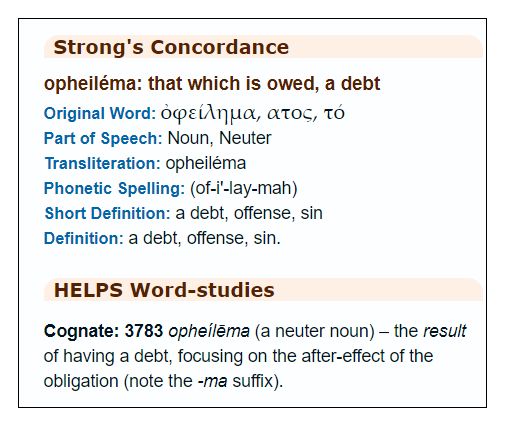
And sins are debts, aren’t they. Strong’s Concordance explains the Greek word used here

And to Him we owe it all! Jesus paid it all, all to Him I owe!!!

He paid the debt, and He set us free. We are mindful of the two ‘Ifs’ however, do not cherish sin, and confess it daily. What a privilege to pray. What a gift that He hears us.


Prayer Machinery of Heaven series:

Prayer Machinery #1: Introduction and Praying for Missionaries

Prayer Machinery #2: Praying for pray for our Elders (pastors, deacons, teachers, etc).

Prayer Machinery #3: Praying for each other

Prayer Machinery #4: How to Pray

Prayer Machinery #5: A focus on Jesus in heaven who hears our prayers, and what a comfort that is

Prayer Machinery #6: Persevering in Prayer

Prayer Machinery #7: The Two ‘If’s’ and the Importance of confessing Sin

Posted in bible reading plan, Uncategorized

Bible Reading Plan thoughts: Abraham’s lie of omission

And Abraham said of Sarah his wife, “She is my sister.” And Abimelech king of Gerar sent and took Sarah. 3 But God came to Abimelech in a dream by night and said to him, “Behold, you are a dead man because of the woman whom you have taken, for she is a man’s wife.” 4 Now Abimelech had not approached her. So he said, “Lord, will you kill an innocent people? 5 Did he not himself say to me, ‘She is my sister’? And she herself said, ‘He is my brother.’ In the integrity of my heart and the innocence of my hands I have done this.” 6 Then God said to him in the dream, “Yes, I know that you have done this in the integrity of your heart, and it was I who kept you from sinning against me. Therefore I did not let you touch her. 7 Now then, return the man’s wife, for he is a prophet, so that he will pray for you, and you shall live. But if you do not return her, know that you shall surely die, you and all who are yours.” So Abimelech rose early in the morning and called all his servants and told them all these things. And the men were very much afraid. (Genesis 20:2-8)

Porn: I’m not hurting anybody. It’s my decision. I’m the only one affected.
Adultery: Nobody knows, it’s fine. No one else is hurt by it.
Drunkenness: So what if I drink alone in my house, nobody else is being hurt, are they?

And so on. Sin is sin. Sin affects not only the perpetrator of sin but those around him or her.

Abraham told a half-truth. Sarah was his half-sister. But he left off a critical piece of information, one that Abimelech was seeking in good faith: is Sarah married? Abraham was silent on that score. He committed a sin of omission.

James 4:17 declares, “Anyone, then, who knows the good he ought to do and doesn’t do it, sins.

Abraham also committed a sin against God by not trusting Him with the circumstance.

Poor Abimelech. There were certain things he had to do as a result of Abraham’s lie, such as returning Sarah, making arrangements to get Abraham back, telling the servants and so on. Abraham caused an upset against another person, a major one that almost cost Abimelech his life.

Think of Achan in Joshua 7. He stole some things in the military victory, though the Israelites were warned not to. Although the account shows that Achan individually was guilty of coveting and taking these war spoils, Joshua 7 opens with a declaration that the whole community of “the children of Israel [had] committed a trespass” (Joshua 7:1). Achan’s sin wasn’t individual, for 36 men lost their lives in the battle of Ai, which was lost because of Achan’s sin. (Joshua 7:11). All of Achan’s family were stoned as a result. (Joshua 7:24).

Whether sins of omission or commission, sin is never individual. It harms the person sinning, it harms the family, church, or even the nation. Most of all, personal sin is against God. Like ripples in a pond, sin extends it tentacles outward.

Finally, as David declared in Psalm 51:4,

Against you, you only, have I sinned and done what is evil in your sight, so that you may be justified in your words and blameless in your judgment.

ripples
EPrata photo
Posted in prophecy, Uncategorized

God’s grief over sin

While reading Psalm 14 in yesterday’s Bible Reading Plan, I was reminded of another set of verses. First, here is Psalm 14-

The fool says in his heart, “There is no God.”
They are corrupt, they do abominable deeds;
there is none who does good.

2The LORD looks down from heaven on the children of man,
to see if there are any who understand,
who seek after God.

3They have all turned aside; together they have become corrupt;
there is none who does good,
not even one.

4Have they no knowledge, all the evildoers
who eat up my people as they eat bread
and do not call upon the LORD?
(Psalm 14: 1-4).

We’re familiar with Paul’s reference to Psalm 14:3, in Romans 3:10. We are also familiar with the famous verse in Psalm 14, ‘the fool says in his heart, “There is no God.” ‘

But the tone of the Psalmist crying out to God because of peoples’ ungodliness, reminded me of the tragic verses in Genesis 6:5-6,

The LORD saw that the wickedness of man was great in the earth, and that every intention of the thoughts of his heart was only evil continually. 6And the LORD regretted that he had made man on the earth, and it grieved him to his heart.

It’s good to be reminded that as much as we grieve over sin, like the Psalmist, God grieves so much more. When your little one throws a tantrum, or steals his brother’s toy, or hits a kid at school, you’re angry and grieved because we know that behavior is not the best for your child. I wonder what God sees when He looks down upon His children on the earth. According to the Genesis verse, He grieves. We also know He is angry. (Romans 1:18).

Oh, how sweet it will be when all are reconciled in holiness to our Holy God, no more blot or stain to arouse His grief and anger. What a day that will be.


Posted in bible reading plan, Uncategorized

Bible Reading Plan thoughts: Sins in the heart

In our Bible Reading Plan today we read Matthew 5-7.

But I say unto you, That whosoever looketh on a woman to lust after her hath committed adultery with her already in his heart. (Matthew 5:28)

Here’s a bit of history for you. President Jimmy Carter was the 39th President of the United States. He was elected in November 1976 when I was almost 16. He served one term until I was 20 years old.

He was an active Christian, the first one I’d had any ‘contact’ with. In my personal life growing up, religion didn’t play a role at all. I knew no Christians. Because Carter was a public figure, President, his beliefs were public and often passed before my eyes in TV interviews and newscasts as he was interviewed about them.

During Carter’s campaign he was interviewed by a freelance writer for an article to be published in Playboy Magazine. Carter offered unprompted,

“I’ve looked on a lot of women with lust. I’ve committed adultery in my heart many times.”

Time Magazine’s opinion of the incident was put this way:

The decision to do an interview with Playboy magazine was possibly not the best call of President Carter’s tenure. Yet, it was all going pretty well until he started talking about the Bible and adultery. Now, Carter’s not actually admitting anything shocking. Most men would probably say, “Yep, been there.” But presidents rarely (and for good reason) venture into the land of “too much information”: Ideally, they should exist on a higher plane than the rest of us. It was an uncomfortable moment for America.

I agree with the secular view of offering too much unprompted information. We all want to dwell in a fiction of our leaders being above reproach. But since Carter said it, and I heard it, I was left with the problem of trying to figure out what it meant. Having no knowledge of the Bible, I was strenuously trying to reconcile my own knowledge of sin, which I called immorality. I didn’t understand that sin came from a completely depraved heart. Being unsaved, I thought sin was a private matter, nobody’s business. Adultery I well understood, having two parents who both indulged in it. It seemed wrong to me but I was too young to have any firm basis for saying so. However I believed that thoughts about adultery were one’s own and thus a private matter.

I learned after salvation that God reads the heart and knows the intentions of man. Sin actually springs from the heart and mind. All sins, even the unacted-upon sins, even thoughts only, are just as damaging. But back then, it was perplexing to me that a man should feel ashamed of his ‘normal’ thoughts. As long as he didn’t act on it, I thought he should be termed “a good man.” I thought Carter was silly for saying anything about it.

The Matthew verse today shows me that I was the silly one. Carter might have made a political faux pas, but he was biblically correct. It’s wrong to commit adultery in your thoughts. What a radical thought. It was to me then, and the reactions of the listeners of the sermon on the mount and others later thought so too. (Matthew 7:28-29; John 6:60). Guard your thought life.

sat heart

Posted in discernment, Uncategorized

The power of crafty words

Now the serpent was more crafty than any other beast of the field that the LORD God had made. He said to the woman, “Did God actually say, ‘You shall not eat of any tree in the garden’?” (Genesis 3:1)

We are introduced to satan early and his introduction contained an extremely negative assertion about his character. He’s crafty.

Satan is an angel. He is an unholy angel, as opposed to Gabriel or Michael who are holy angels. If you look at the angels’ activity you see just how powerful and intelligent they are. They administer judgment. (e.g. Revelation 8:6-13). They give the Law. (Acts 7:53, Hebrews 2:2, Galatians 3:19). They give the Gospel to the whole earth at once. (Revelation 14:6). They stand on the sun. (Revelation 19:7). They hold back the wind. (Revelation 7:1).

They’re powerful.

We’ll come back to that in a moment.

I’m enjoying the buzz around a couple of movies just out. Darkest Hour is the story of Winston Churchill’s early days as England’s Prime Minister. He was leading the United Kingdom through tough times as WWII rages on the continent and is about to hit home for Britain. Much of the focus of the movie is on Churchill’s oratory. It’s a movie largely without action and is tightly confined to the bunker tunnels and small rooms below the city. Churchill made several famous speeches which roused the populace, enabled changed minds and hearts to make decisions, and cemented the nation in unity to face the evil force that was soon to come upon them. It’s a movie about speeches.

Another movie just out is called The Post. It depicts the editor Ben Bradlee and owner/publisher Katherine Graham of the Washington Post during the critical years of the decisions about whether to release the Pentagon Papers, and leading up to their coverage of the Watergate Break-in, which eventually led to the downfall and resignation of American President Richard Nixon. It’s a movie about words.

Words, whether written or spoken have power. Where would we be without Thomas Paine’s Common Sense, Lincoln’s Gettysburg address, Kennedy’s ‘to the moon and back’, Reagan’s ‘tear down this wall’? We remember Chief Joseph’s surrender speech, ‘I will fight no more forever.’ Lou Gehrig’s farewell to baseball ‘luckiest man alive’ speech. President Reagan reassuring a shocked nation after the space shuttle Challenger exploded and the astronauts having ‘slipped the surly bonds of earth’ to ‘touch the face of God.’

Look at the impact of President Franklin Roosevelt’s Fireside Chats:

Fireside chats is the term used to describe a series of 28 evening radio addresses given by U.S. President Franklin D. Roosevelt between 1933 and 1944. Roosevelt spoke with familiarity to millions of Americans about the promulgation of the Emergency Banking Act in response to the banking crisis, the recession, New Deal initiatives, and the course of World War II. On radio, he was able to quell rumors and explain his policies. His tone and demeanor communicated self-assurance during times of despair and uncertainty. Roosevelt was a great communicator on radio, and the fireside chats kept him in high public regard throughout his presidency. Their introduction was later described as a “revolutionary experiment with a nascent media platform”.

I’m brought back to the early chapters of Genesis. The serpent. What was his mode of attack? Did he hold Eve hostage and force her to eat the fruit? Did he call for his legions of followers to surround them and attack? No. He did it with words. Satan attacks with words.

We should not pay attention to satan.

Of course we don’t pay attention to satan, you say. Of course not, silly! But we do. We come across a false teacher and we listen. We rationalize that we have the power to ‘eat the meat and spit out the bones’. We wail, ‘But he/she helped me so much!’ Of course false teachers are skilled at oratory. They can make fine speeches. They use words well. They’re crafty!

False doctrine is sin because false doctrine doesn’t originate from God. (John 7:16, Titus 1:2). God hates false doctrine. (Revelation 2:15). Several of the letters in the New Testament were written to address errors of false doctrine (Galatians 1:6–9; Colossians 2:20–23; Titus 1:10–11). Take false doctrine seriously. Why? Its words will affect you.

Why do we know that speeches, movies, newspapers, and advertising affect us, but mistakenly think that listening to false doctrine won’t?

The Bible says that those who listen to false teachers are heaping these teachers up so they can ‘suit their own passions.’ (2 Timothy 4:3). Don’t indulge your passions by falling into satan’s crafty trap of words.

Black

~~~~~~~~~~~~~~~~~~~~~~~~~~~~~

Further reading

Challies: The Five Tests of False Doctrine

Michelle Lesley: Is She a False Teacher? 7 Steps to Figuring it Out on your Own

Got Questions: How can I recognize a false teacher / false prophet?

Art of Manliness: Resurrecting the Lost Art of Oratory