Posted in theology

When satan spoke in the Bible…

By Elizabeth Prata

Do you know how many times the Bible records when satan actually spoke to someone, and his words were recorded?

Three times.

He is a dominating figure and an overarching theme in the Bible, but for all that, this fallen angel only spoke three times that the Bible records.

Let’s take a look.

We all think immediately of the dramatic moment in Genesis 3:1-4, satan in the guise of the serpent speaks to Eve.

In Job 1:7, 9–11; Job 2:2, 4–5 satan speaks to God.

In Matthew 4:3, 6, 9 satan tempts Jesus while He is in the wilderness.

We know about satan from Isaiah 14 that Isaiah records satan’s inner desires, and from Ezekiel we see why Lucifer fell. We also know that Jesus said that satan spoke to Him regarding a request to sift Peter. But satan’s actual words bear looking at.

#1 Garden of Eden
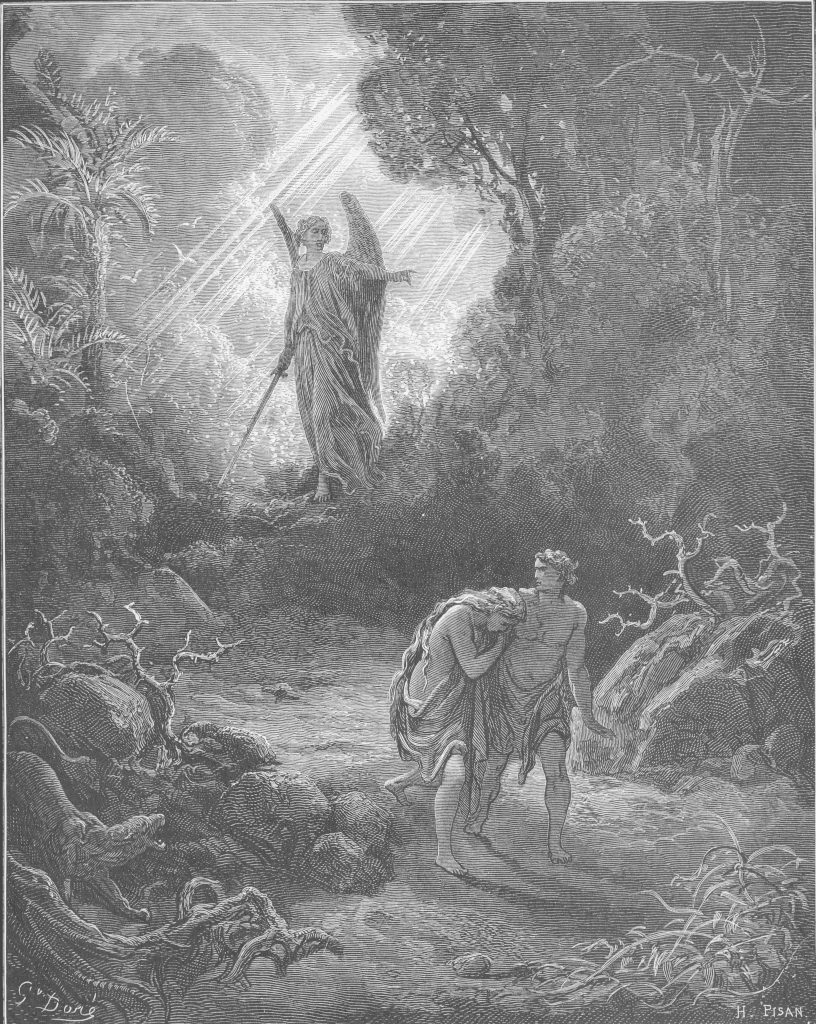
“Adam and Eve Are Driven out of Eden” (also known as The Expulsion from the Garden) by illustrator Gustave Doré, published in 1866

In the garden of Eden, satan questioned what God had said by slyly twisting it. ‘Did God really say you may not eat from any tree in the garden? This was a distortion. Yes, God commanded them about the fruit of the trees. No, God did not say whey could not eat from any, but could eat from all, except one. This forced Eve into a defensive position, and in defending God, she overstated the command.

Then satan simply contradicted God. God had said they will die if they eat of the Tree of Good and Evil. Satan said “No you won’t.”

So, bear in mind that those 2 methods worked for satan- distortion and contradiction.

#2 Job’s Righteousness
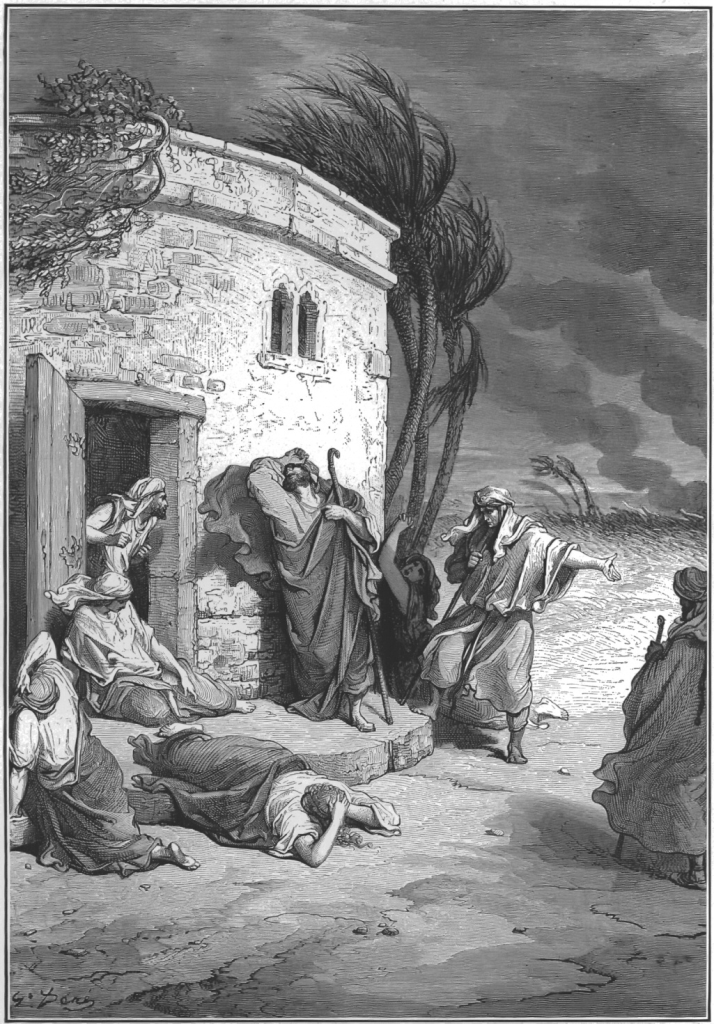
Job Hears of His Misfortunes (or Job Hearing of his Ruin) Gustave Doré for Doré’s English Bible (1866)

In the book of Job, satan found a righteous person and targeted him. Before God, Satan proposed that Job’s righteousness was conditional and temporary. That if circumstances changed, Job’s righteousness would vanish. He was saying essentially that God was bribing Job into righteousness. His charge against Job was also a charge against God.

Remember David’s lament, “against you and you only have I sinned.” Even though David committed adultery and murder, his ultimate sin was against God. Same with satan in accusing Job. Satan was also accusing God.

So, bear in mind that satan sows doubt by challenging a person’s affections and motives, and reduces God to heavenly Butler delivering the goods to a worshiper.

#3 Wilderness Temptation
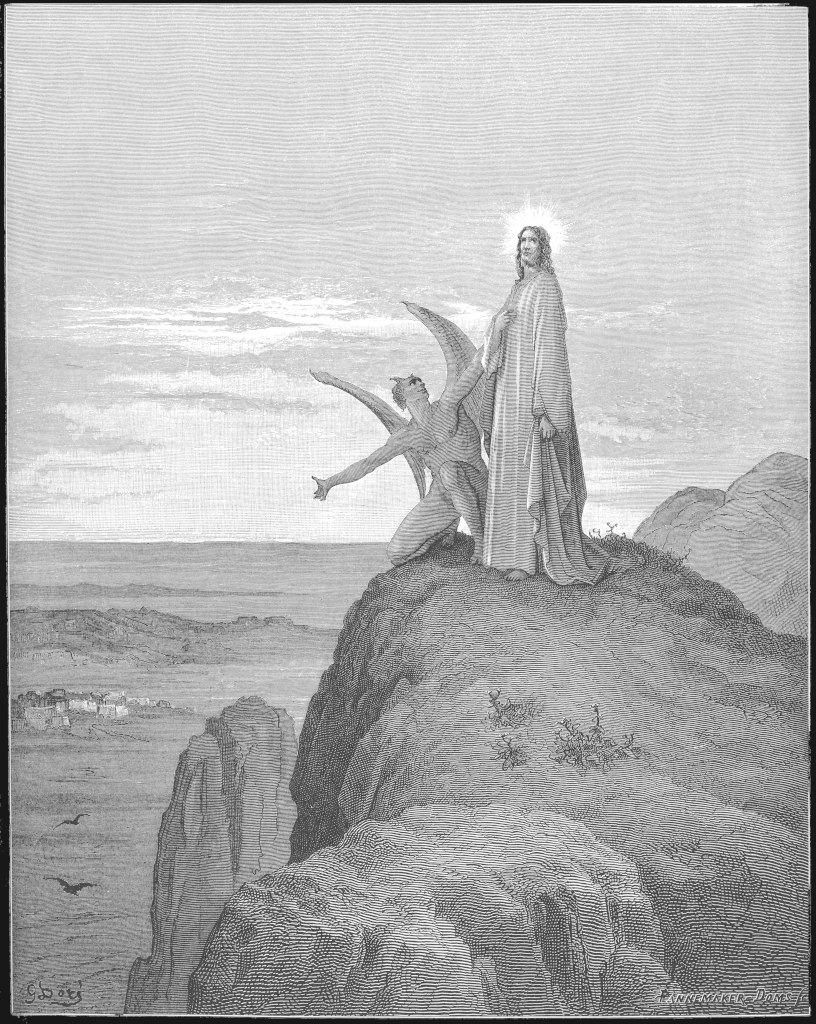
Gustave Doré 1832 – 1883, The Temptation by the Devil, engraving — 1865

In the Wilderness Temptation, satan directly dealt with Jesus Himself. In Genesis he approached the humans directly. In the Job situation he accused a believer before God. Here, He went head to head against the Second Person of the Trinity!

Satan pinpointed a potential weakness. In the first temptation, Jesus was hungry, so satan focused on that, saying that Jesus could turn the stones into bread of He wanted.

In the third temptation (I’ll cover the second temptation in a moment), satan appealed to ego- perhaps seeing Jesus as ‘second fiddle’ under God’s authority…? Seeing that satan himself chafed under God’s authority perhaps he thought he could entice Jesus with that approach.

In the temptation, satan said that he would give Jesus all the authority and splendor in the universe…if he’d just bow and worship satan.

In the Wilderness Temptation, satan also used scripture to tempt Jesus in no doubt was a physical weakness- Jesus hadn’t eaten for many days! It is the only time that satan quoted scripture, and of course he distorted it. He referred to Psalm 91, saying in Matthew 4:5-6,

Then the devil took Him along into the holy city and had Him stand on the pinnacle of the temple, and he said to Him, “If You are the Son of God, throw Yourself down; for it is written:

‘He will give His angels orders concerning You’;

and

‘On their hands they will lift You up,
So that You do not strike Your foot against a stone.'”

He was misusing Psalm 91:11-12,

For He will give His angels orders concerning you,
To protect you in all your ways.
On their hands they will lift you up,
So that you do not strike your foot against a stone
.

Saran did not present the entire verse. He omitted “to guard you in all your ways”. This changes the context to suggest a literal interpretation of physical protection, instead of the true meaning, which is obedient living under God. God’s intent is to protect those who humbly obey, but satan’s omission changed the verse into a self-exaltation. In other words subtly changing the focus to one’s self while inspiring a reckless confidence.

He did the same to Eve, subtly changing the focus of God’s words (which were not written down at that time).

Of course, Jesus saw through that immediately and challenged satan with rightly quoting Deuteronomy 6:16, “You shall not put the LORD your God to the test, as you tested Him at Massah”.

Subtlety works

We are told in Genesis 3:1 that satan is subtle. We have seen his subtleties in his tactics of contradiction, distortion, appealing to physical weaknesses, spiritual weaknesses, ego, and twisting scripture by omissions or ripping out of context.

Think of the demon-possessed slave girl in Acts. She followed Paul and us and cried out repeatedly, saying, “These men are bond-servants of the Most High God, who are proclaiming to you a way of salvation.” (Acts 16:17). If the translation you read includes the definite article “a way” then that is obviously a subtle change from Jesus being the ONLY way to salvation. (Acts 4:12).

The main problem is that the demon possessed slave girl was widely known to have a spirit of divination. She made much money for her masters. For Paul to allow her to continue proclaiming God’s salvation with serpent tongue would give the wrong impression- that the Apostles were cooperating with or otherwise tolerating satanic influences. Nothing could be further from the truth.

So, we need to be aware of satanic influences in the teachers we follow, and do not tolerate them. They subtly twist God’s word, as we have seen satan himself do. Satan is nothing if not pragmatic, he does what works.

I am afraid, however, that just as Eve was deceived by the serpent’s cunning, your minds may be led astray from your simple and pure devotion to Christ. (2 Corinthians 11:3).

We should seek wisdom from His word, and seek it from credible pastors, starting with our own. Be aware of satan’s schemes. They worked against humans all those centuries ago with Eve and they still work today. Here are a few of them we have seen in just the 3 times satan spoke in the Bible:

Distorting the word
Appealing to ego
Exploiting a spiritual or physical weakness
Denying God’s authority
Contradicting His authority
Sowing doubt
DECEPTION!

Further Resources

A good question concisely answered with insight and wisdom in 7 minutes-

The Strategies of Satan from Bible Study Tools

Posted in theology

Satan’s eloquence and the danger of his allure

By Elizabeth Prata

Halloween just ended. At school, I am the greeter, and of course the day before Halloween the children are allowed to arrive in their ‘book character’ costume. We see the usual policemen, firemen, princesses, and this year there were a lot of Spidermen. Even though I can usually figure out their costume, I always ask each child what they are dressed as, so they can tell me, and then I say ‘How fun!’ or ‘How cute!’ or “I like it!’

One little guy I really could not figure out. I asked. His answer? “The Devil.” I have no idea why a child would want to dress as the devil, but there you have it.

Admittedly, Lucifer AKA Satan AKA the Devil has fascinated many over the eons. He is a powerful figure. He is the most evil being in the universe. He is the cause of woe. He brought about war in heaven. Many demons AKA fallen angels have been written about, but few authors have tackled writing about the actual satan as a main character in a book. Probably a good thing.

CS Lewis’ The Screwtape Letters feature a demon instructing his nephew in the ways of evil to be used against a targeted Christian man. Mark Twain’s The Mysterious Stranger specifically introduces his main character named satan as a nephew of satan. Faust is about a high-ranking demon named Mephistopheles.

I hadn’t known about a Russian book called The Master and Margarita by Mikhail Bulgakov, written in the early part of the 20th century. It features an incognito embodied satan posting as a professor. But books featuring satan as main character are few.

Satan has, though, has been written about in 2 famous books: by Dante Alighieri in a three-part epic titled The Divine Comedy. This is the book that features 9 circles of hell, deepening depending on how bad the sinner was, and the bottom has Lucifer trapped in a frozen lake- with Judas the betrayer.

Now we come to the most famous treatment of satan in literature of all: Paradise Lost by John Milton.

As all authors are, Milton was a product of his time. And those who read Paradise Lost at its publication were also a product of their time. The English Civil war had raged and the King had been executed. The Republic was established, and Milton was a staunch republican who was given a diplomat position in the newly established government.

Many people interpreted the themes in his epic poem (and epic here is the literary & classical sense of the word) as outgrowths of his political positions. Others were offended by Milton’s treatment of satan because his character was given a will, desires, thoughts, strategies- in other words, Milton treated satan like the being he is, not as a one-dimensional evil persona. Still others objected to how God was presented, which was a tyrannical, judgmental God. But since the focus of the book was on evil opposition to God in rebellion causing Man’s fall, God is severe on those themes- as seen in the Bible. Especially Jeremiah.

Milton turned the Epic standards for its heroes on its head by making Satan the central character, albeit as an anti-hero. He is presented as majestic (which tracks with 2 Peter 2:10–11, Jude 1:8–9). He is presented as having a will (Isaiah 14). He is presented as proud, vain, eloquent, cunning, and deeply tragic- as Paradise Lost progresses satan becomes physically weaker and his intellect decays (as sin will do to a person!).

I read the book this summer and I am glad I did.

The Bible’s presentation of satan as an evil being out to thwart God is mirrored so poetically in Paradise Lost. We know satan is cunning and subtle. We are not unaware of his schemes. His pride was his downfall. That Milton gave satan flowing, eloquent words is not a surprise, it is one of the features of satan that he can convince almost anyone of anything. (Ezekiel 28:15-16). After all, his feat of convincing a third of the angelic host to side with him and foment a war against God is well known.

I do look forward to the day when my own sin, thanks to satan tempting Eve & Adam, is permanently subdued. I can’t wait for ultimate justice to be served and the fallen angel Lucifer to be cast into the lake of fire. I’m thankful there are not many books that feature satan as a main character. Though I can’t say the same for TV and movies, sadly. Those abound, foolishly.

Though I do not dwell on satan as a character and don’t read books any longer with demons as characters, (except CS Lewis’ Screwtape). It’s no wonder that so few authors have taken on making satan himself a main character.

If you are going to read one book about satan vs. God, choose Paradise Lost. Dante’s Inferno is a Catholic view of sin and justice, which is unsuitable since their version of both is made-up.

And please, do not allow your children to dress as the devil!

Posted in theology

Invented word: Pandemonium

By Elizabeth Prata

If you’ve ever been to a full-to-the brim animal shelter during puppy and kitten season, you know it can be a chaotic situation. After a winning football game with fans streaming onto the field, the first day of Pre-Kindergarten class, the courtroom when an unexpected verdict is announced…it’s pandemonium.

Merriam Webster defines the word pandemonium as: “a noun that refers to a wild uproar, tumultuous noise, or utter chaos and disorder. It typically describes a situation where people are confused, excited, angry, or frightened, resulting in loud, unmanageable bedlam.”

‘Unmanageable bedlam.’ I like that description.

Prior to 1667, the word pandemonium did not exist. John Milton invented it. He is the author of Paradise Lost, and his use of the word first occurs in Book 1 of the Epic Poem, line 756.

As with any Epic, the author begins the poem in the middle of the action, or in media res. Paradise Lost opens in the chronological middle of the plot, where Satan and his evil cohorts have been found to be sinners and tumbled from heaven into the deeps of hell. After recovering from the shock, Satan and his evil angels build a castle fortress in hell, and it is called “Pandemonium.”

Etymology Online describes the origin of the word:

“1667, Pandæmonium, in “Paradise Lost” the name of the palace built in the middle of Hell, “the high capital of Satan and all his peers,” and the abode of all the demons; coined by John Milton (1608-1674) from Greek-
–pan- “all”
-Late Latin daemonium “evil spirit,”

So…’pandemonium’ means ‘all demons’.

The meaning of the word by 1779 came to be understood as “place of uproar and disorder”. source.

In Rome, you might know of the building the Pantheon, you see the word ‘pan’ again. Pan means ‘all’ and theon meant gods. The word ‘panorama’ is pan meaning all and orama meaning ‘view’.

As I’ve mentioned before, words change. Our commonly understood vocabulary does not remain static, but changes over time. Old definitions drift away. New words come in. In fact, Shakespeare invented about 1700 words by changing nouns to adjectives and vice versa, combining words, and totally inventing new ones.

Words like accuse, courtship, blushing, dishearten, elbow…all from The Bard.

Pandemonium is such a good word to depict the author of Chaos’ evilly erected fortress out of the Lake of Fire. His Infernal Council as Milton terms it, when the unholy ones roused themselves after being cast out of heaven, the highest evil one situated atop his dastardly throne, debating war plans and strategizing from the fellow ‘gods’ such as Molech and Baal… contrasts with the peace of heaven’s throne, orderliness of God’s foreknowledge and perfectly unfolding plan for the universe, heaven, and humanity…

We know there are only two gates. There is pandemonium with the flesh of all pagans kicking against the goads… or peace with God and a stilled and forgiven soul for those who have repented to Jesus.

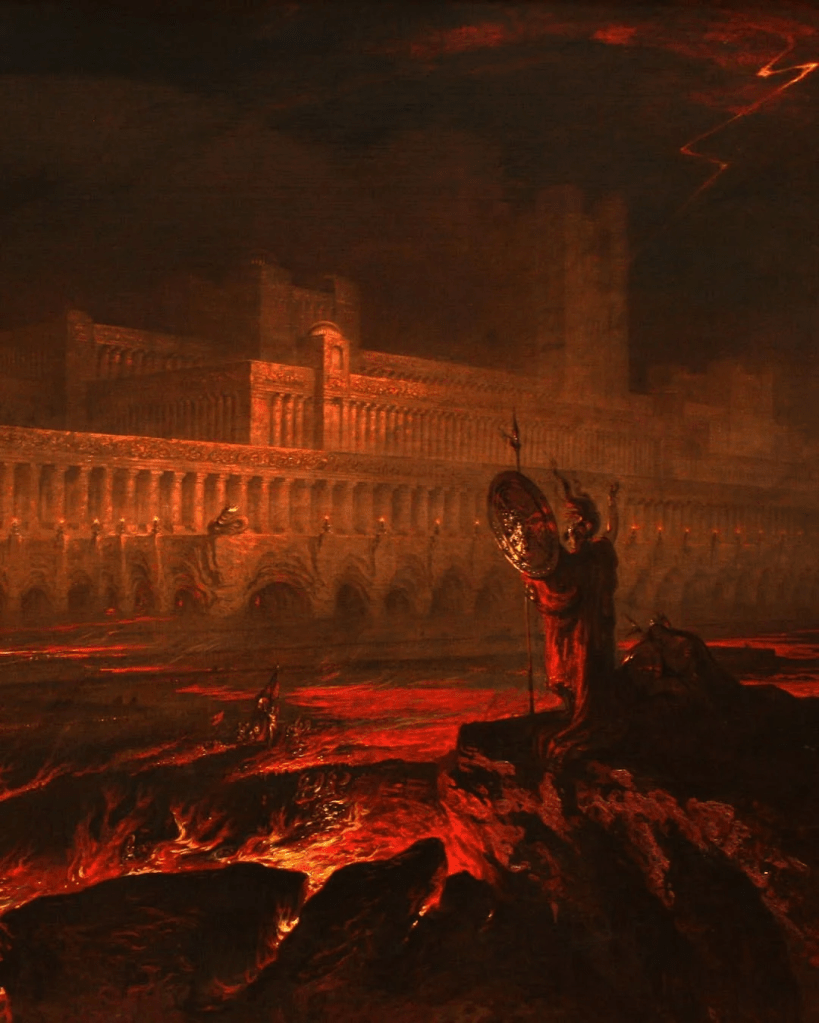
John Martin 1841, his interpretation of Pandemonium-

Above- “In Paradise Lost (Book I), Milton describes Pandemonium as a grand, opulent palace built by fallen angels under Satan’s command, rising from Hell’s fiery landscape with “stately height” and adorned like a temple. Martin captures this by portraying towering, temple-like structures with Babylonian and classical architectural influences, wreathed in flames and smoke. The painting’s monumental scale and intricate details show Milton’s vision of a city that rivals heavenly splendor, symbolizing the fallen angels’ pride and ambition.” Description source.

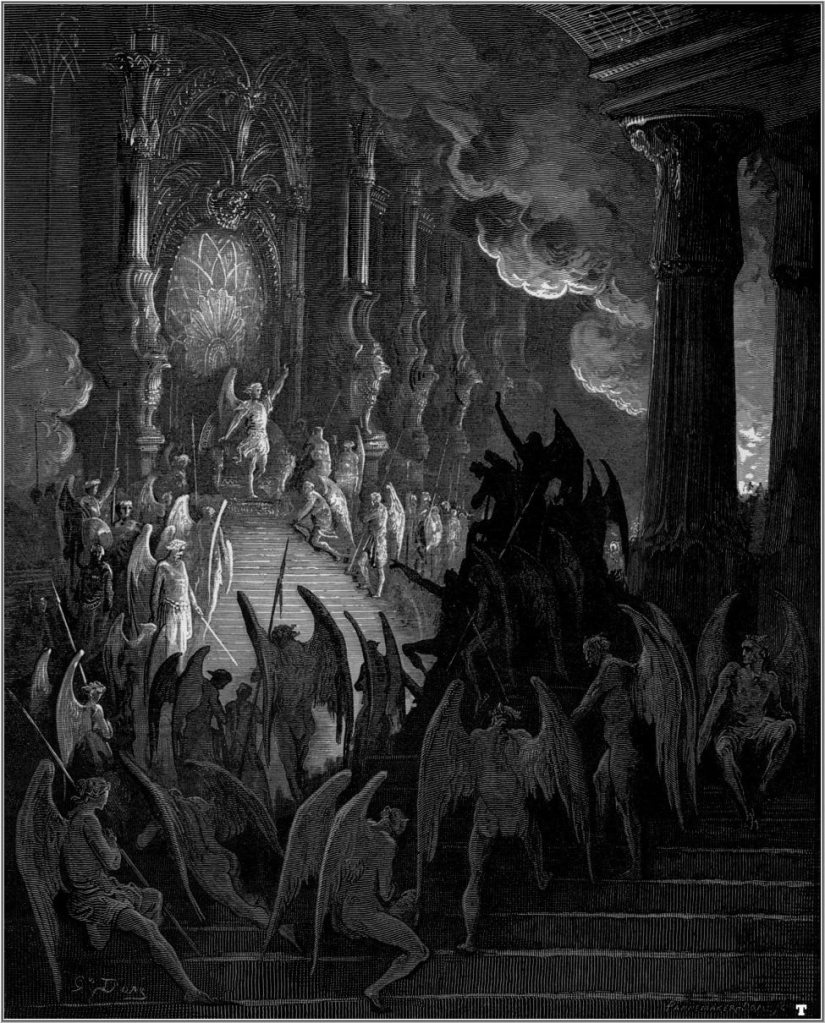
Below, Gustave Dore’s interpretation of Pandemonium and the engraving that is included in my edition:

Posted in prophecy, theology

What will become of the devil? Satan’s end

By Elizabeth Prata

SYNOPSIS

The content outlines the history and future of Satan, originally an angel named Lucifer who rebelled against God. It describes his declarations, fall, and ongoing efforts to oppose God. Key events include the Great Tribulation, his temporary power over the earth, and eventual defeat, culminating in eternal torment in the Lake of Fire.

Continue reading “What will become of the devil? Satan’s end” →
Posted in theology

Understanding Satan: The Fall of Lucifer

By Elizabeth Prata

Part 1: I will vs. I AM

EPrata photo

SYNOPSIS

The content explores the origins and fall of Satan, originally known as Lucifer, a beautiful cherub created by God. Due to pride and slander against God, he became evil and was cast down. Despite his fall, Satan continues to have limited access to heaven, operating under God’s authority until a final judgment. Part 2 of 3. Part 1 below

Continue reading “Understanding Satan: The Fall of Lucifer” →
Posted in theology

Satan’s ‘I Will’ Statements vs. Jesus’ ‘I Am’ Declarations

By Elizabeth Prata

SYNOPSIS

The post contrasts Satan’s five “I will” declarations of ambition against Jesus’ seven “I am” statements of identity. While Satan aims to elevate himself above God, Jesus reveals His nature and role as the bread of life, light of the world, and good shepherd, emphasizing divine truth versus deceitful aspirations.

Continue reading “Satan’s ‘I Will’ Statements vs. Jesus’ ‘I Am’ Declarations” →
Posted in discernment, parable, tares, weeds

The Wheat and Tares: A Biblical Analogy Explained

By Elizabeth Prata

The Parable of the Weeds
He put another parable before them, saying, “The kingdom of heaven may be compared to a man who sowed good seed in his field, but while his men were sleeping, his enemy came and sowed weeds among the wheat and went away. So when the plants came up and bore grain, then the weeds appeared also. And the servants of the master of the house came and said to him, ‘Master, did you not sow good seed in your field? How then does it have weeds?’ He said to them, ‘An enemy has done this.’ So the servants said to him, ‘Then do you want us to go and gather them?’ But he said, ‘No, lest in gathering the weeds you root up the wheat along with them. Let both grow together until the harvest, and at harvest time I will tell the reapers, Gather the weeds first and bind them in bundles to be burned, but gather the wheat into my barn.’” (Matthew 13:24-30)

Donald Grey Barnhouse, in his sermon “What is God Doing Today?” explained,

Now, the Lord Jesus Christ taught clearly that we are in this age to sow the seed – that is, to spread the Gospel. But we are to expect that only part of the seed will fall on good ground, that is, believing hearts. And that the rest will not produce good fruit. The fault is not with the seed, but with the hearts. Christ taught that satan would plant counterfeit believers in the midst of true believers so that it would be difficult to tell the real from the false. The true and the false, the real and the counterfeit grow together until the harvest which is the end of the age in which we live. These truths He taught in the Parable of the Sower and the Wheat and Tares. And he gave the explicit interpretation Himself, not leaving it to man’s imagination. The good and the bad are to grow together. Neither will destroy the other. God will take care of the separation.

Matthew Henry:

So prone is fallen man to sin, that if the enemy sow the tares, he may go his way, they will spring up, and do hurt; whereas, when good seed is sown, it must be tended, watered, and fenced.

EPrata photo

What is a weed? It is useful to study the properties of the object of the agricultural metaphor which the Lord in His wisdom used to explain the parable to us. As we read these properties of weeds, let’s keep in mind how these properties mirror the properties of the unbeliever. At the Penn State Extension website, we read Introduction to Weeds,

–a plant growing where it is not wanted
–a plant whose virtues have not yet been discovered. (R.W.Emerson). [Ed note: i.e. a virtueless plant]
–plants that are competitive, persistent, pernicious, and interfere negatively with human activity (Ross, et. al.)
–No matter what definition is used, weeds are plants whose undesirable qualities outweigh their good points.

These qualities of weeds certainly mirror the unbeliever’s qualities. Unbelievers in the world interfere with our activity, in pernicious, persistent, and competitive ways. This is because they are sown by satan. To continue looking at weeds:

Certain characteristics are associated with and allow the survival of weeds. Weeds posses one or more of the following:

a) abundant seed production;
b) rapid population establishment;
c) seed dormancy;
d) long-term survival of buried seed;
e) adaptation for spread;
f) presence of vegetative reproductive structures; and
g) ability to occupy sites disturbed by human activities.

I was particularly struck by the notion that weeds engage in “rapid population establishment”. Satan does not rest. One weed soon leads to others.

Weeds are troublesome in many ways. Primarily, they reduce crop yield by competing for water, light, soil nutrients, and space.

The parable is fairly simple, as parables go. The field is not the church. The Lord said the field is the world. (Mt 13:38). If we interpret the field as the church, then we would have a conflict with Matthew 18:15-17, which says to put unrepentant sinners out of the church, i.e. uproot them. So the field is the world, and the unbelievers are sown by satan.

In this tolerant, all-inclusive age, some people chafe when we say that there are two kinds of people in the world, those who are children of the Kingdom and those who are children of satan. We hate to think that there is no middle ground, or love to think that there must be ‘some good’ in people, they’re kinda, almost, mostly good. But no. If a person is not under the control and sovereignty of the Lord Jesus, they are under the control and sovereignty of satan. Wheat or tares. There are no hybrids.

The parable is telling us that we believers are sown into the world by Jesus. Let’s stop there. How wonderful! To be specifically planted by Jesus in the time and in the place He desires us to be grown is a very comforting thought. Matthew Henry wrote the comment to the verse by saying, “when good seed is sown, it must be tended, watered, and fenced,” and how wonderful it is to know we are being grown, nurtured and tended by Christ Himself.

The last part of the parable reminds us that Christ will do the separating at the end of the age. Again, this does not mean pastors aren’t to pursue biblical correction or even excommunication for unrepentant church members. It means that the world’s harvest will be accomplished by Jesus, since He has the power and discernment to see men’s hearts.(John 2:24).

The tares’ fate is to be thrown into the fire, and a woeful moment that will be for them, but for believers it will be an honor to watch Jesus right everything and avenge His name. (Revelation 6:10, 19:2).

Angels if you notice are God’s ministers of judgment. They often carry out the judgments God pronounces. They did at Sodom, also, it was an angel of the Lord that struck Herod down, and throughout Revelation angels execute the dread judgments, to name a few examples. And at the end of the age, they are the harvesters.

The five worst words in the Bible in my opinion. “…and the earth was reaped”. It demonstrates the power and might of the Lord to easily punish men. It also shows the meager and measly efforts of man to thwart Him. It is not possible. It is a terrifying verse because at some point all things will not go on as they have been. There is an end day. It will end for the tares/weeds. But it will continue in glory for the wheat!


Posted in bible, jesus, judgment, satan

Back to Basics: Who is Satan?

By Elizabeth Prata

Satan is real.

He was God’s covering cherub, it is believed the highest of the high angels, and the most beautiful. (Ezekiel 28:14-17). Since he is an angel he is therefore a created being, thus, under God’s sovereignty. The eternal clash between good and evil is not one of equal opposites, but one of rebellion of a created being against an uncreated, holy powerful God. (Isaiah 14:13-14)

We hear satan’s actual voice three times in the Bible. Once in Genesis 3:1-5 when he (as the serpent) is talking with Eve in the Garden of Eden. There, he insinuated to Eve that God is not good enough to her by not letting her have all the fruit of the Garden. The second time we hear him speak, it’s in heaven to God about Job. (Job 1:7-11). There, he told God that God was being too good to Job. The third time is when satan tempts Jesus. (Luke 4:1-12). In that scene, he used several the schemes in his arsenal (temptation of the body, temptation of power, temptation of testing God) and when he failed, he went away until another opportune time. (Luke 4:13).

These scenes tell us that satan has many schemes in his bag of tricks, he is not hesitant to use them against people, or Jesus or even GOD, and that he never quits.

Satan is mentioned in the Gospels twenty-nine times. And twenty-five of those times, Jesus is the one talking about Satan. Satan is mentioned in seven Old Testament books and every New Testament book.

He has different names to which he is referred. That Old Serpent, Adversary, Devil, Satan, (which is a title)

Satan is a real person. He is not allegory, a metaphor or a figment. If you believe he is an allegory or figment or just an evil force, then you destroy the integrity and truthfulness of every NT book, each Gospel, a quarter of the Old Testament, and the character of Jesus. It is not possible to disbelieve satan is real but also believe the rest of the Bible is truthful, historical, prophetic, and the word of God.

He is real and thus has a will, goals, plans. He is seen spoken of in Isaiah 14:13-14,
But you said in your heart,
‘I will ascend to heaven;
I will raise my throne above the stars of God,
And I will sit on the mount of assembly
In the recesses of the north.
I will ascend above the heights of the clouds;
I will make myself like the Most High.’

So his goal is to supplant God….usurp God…BE God!

Satan is not in hell. He is not the ruler of hell. So where is he? He is roaming up and down upon the earth. (Job 1:7, Job 2:2; 1 Peter 5:8). Satan is the prince of the air. (Ephesians 2:2). Satan is in heaven accusing the brethren. (Revelation 12:10; Job 1:6). God has granted limited and temporary sovereignty to satan, for he is the god of this world. (2 Corinthians 4:4). From this we see that satan has been granted much latitude by God on earth, the air and in heaven.

Satan is busy! He is accusing the brethren, roaming the earth, fighting the holy angels, sowing tares among the wheat, ensnaring the unwary, polluting the doctrine. He is wreaking devastation and destruction. (John 10:10). And much more!

What is satan’s destiny? When satan rebelled in the primordial past, God prepared hell for satan and his angels. (Matthew 25:41). There will be no offer to repent and no opportunity to come to salvation. The devil and his angels’ futures are fixed. (John 16:11). Meanwhile, God uses their evil for our good and His glory.

During the time since the fall of Adam and Eve in the Garden, satan has been allowed latitude in each of the three spheres of earth, air and heaven. However, midway through the Tribulation, he will be thrown out of heaven and access will no longer be granted to him or his angels. Perhaps satan thought he would be able to go on like this forever. God’s patience is longsuffering, but it does have an end, and satan gets tossed. He and his angels will be furious and will wreak their fury on the population of the earth. Woe to the people! (Revelation 12:7-17).

At the conclusion of the Tribulation, satan will be thrown into the abyss and locked up for 1000 years. When 1000 years is over, he will be let out for a little while to foment one last, short, rebellion that God puts down with a word. (Revelation 20:3; 8). Finally vanquished, he will be thrown into the lake of fire, the place prepared for him in the prehistorical past. His angels will be thrown there too, (Revelation 20:10) along with every person who followed him. (Revelation 20:15).

If you are a believer and are struggling or strong or persevering or weak: He who is in us is greater than he who is in the world. We need not fear satan, but we do need to appreciate his capabilities and thus rely on the Holy Spirit more than ever. And to the lost: make no mistake, satan is real.

Oh, woe to those who disbelieve Jesus’s words about future judgment for sin and His word to John in Revelation about the Book of Life. If your name is not written in it, you will be thrown into the Lake of Fire to be tormented forever.

Look at the cross! God’s love of humanity- expressed through Jesus-  triumphed over evil and sin and death! (Colossians 2:13-15). Holiness wins too. (John 9:39). All one needs to do is look at the lake of fire- the place prepared for the devil and his angels, and all those who follow satan. (Matthew 12:30-32). Unless you believe in Jesus, you are actually following satan by default. When you die, you will follow satan right into the Lake of Fire.

A caution: Satan is real, powerful, and we are continually warned in the Bible not to dally with him or his flavors of sin and perversion. It’s dangerous to ignore these sober warnings from the One who knows all! However it’s just as dangerous to excessively focus on the devil. Some people look for him around every rock, attribute every major and minor thing to satan, and see him as an equal with God battling it out for the universe.

Our own sin nature advances satan’s goals for him much more than we’ll ever know. We are usually too puny to even be bothered with by him. Focus on obeying Jesus and slaying our own sin, while being mindful we do have an actual living adversary. Balance is best.

Now for some encouragement to the brethren:

“Little children, you are from God and have overcome them, for he who is in you is greater than he who is in the world.” (1 John 4:4)

“Now is the judgment of this world; now will the ruler of this world be cast out.” (John 12:31).

“For God, who commanded the light to shine out of darkness, hath shined in our hearts, to give the light of the knowledge of the glory of God in the face of Jesus Christ.” (2 Corinthians 4:6).

Thanks be to God for Jesus!

Those are a few facts about satan. As always, read the word for yourselves to see if these things are true.

Further Reading

The Wiles of Satan, William Spurstowe (Puritan Paperback)

GotQuestions essay, Who is Satan?

Ligonier devotional, The Devil

The Devil’s Wiles, 37 minute sermon by Sinclair Ferguson

Posted in theology

Satan’s relentlessness

By Elizabeth Prata

I’d mentioned the famous quote from John Calvin as I concluded a recent series on idols and idolatry, that our hearts are idol factories. Our own flesh betrays us constantly. But add to that failure, satan’s pressure of constant temptation. (Idolatry series below)

Is “Trad wife/life” an idol?
What IS idolatry?
How to make an idol: Example, Nehushtan
Idolatry: Did you know of these two false gods?
Idolatry finale, roundup & resources

One must always be vigilant. I’d read a startling thought in Spurstowe’s book The Wiles of Satan. One of satan’s strategies is to tempt us. We know that. But an even wilier strategy is to “cease to tempt, or to feign flight.” Have you ever thought of that? It’s to provoke our pride. We SEEM to have won the battle. We think, ‘Oh great, I’ve got this temptation licked! I got the victory of that sin!’ But no. Just as we release our guard, satan comes back!

We see this satanic relentlessness in the Bible.

Example #1: The Demon Possessed slave girl. Acts 16:16-18a,

It happened that as we were going to the place of prayer, a slave woman who had a spirit of divination met us, who was bringing great profit to her masters by fortune-telling. She followed Paul and us and cried out repeatedly, saying, “These men are bond-servants of the Most High God, who are proclaiming to you a way of salvation.” Now she continued doing this for many days.

Note that she did this “for many days”. Paul was greatly annoyed, the verse says. In the original Greek, the word greatly annoyed meant “exhausting, depleting grief which results in “piercing fatigue.” “

Satan relentlessly troubles us till we become so exhausted we either give in to the temptation or we destroy our witness with anger or some other un-Christian behavior. Oh, if we all had the same power Paul had to simply banish the demon away! But we don’t.

Example #2: Satan came to Jesus three times in the wilderness. Luke 4:1-13. Note that satan tempted Jesus in the first place! Satan’s arrogance is such that he thought he could tempt the Sinless One to sin! If satan opposed Jesus in this way, then for certain he and his minions will oppose you and me.

Of course satan couldn’t budge our Messiah, but note how he departed. Not in defeat, but in promise of continuing the battle:

13And so when the devil had finished every temptation, he left Him until an opportune time.

Satan is always prowling. (1 Peter 5:8). He roams to and fro upon the earth, Job 1:8 says. Satan has a God-given access to everything on the earth, and that includes people (wherever God said satan could go or as far as he could go). He tried to get at Job continually, but could not until God allowed satan to get increasing access to him. Job was probably the most perfect man on earth ever (not sinless, but morally upright). And that is why satan wanted him. God put a hedge of protection around Job…until He didn’t. No one on this here earth can expect continual protection from satan.

Our soul is safe if we are truly converted, but our heart can be tempted. When we fall into sin, especially a public sin, then satan, his minions, and the world rejoices, saying “There goes another hypocrite!”

1 Timothy 3:7 speaks of the importance of remaining above reproach for leaders. The reason being a leader’s reputation must glorify God. And he must have a good reputation with those outside the church, so that he will not fall into disgrace and the snare of the devil.

The same is true for us women even though we are not leaders. We must maintain a good reputation. 1 Timothy 5:10, says we should be having a reputation for good works. This is because our reputation is not our own, but of Jesus in us.

Jesus protected Himself through prayer and fasting. One of satan’s tactics is to SEEM to let up on you but he is just biding his time to come at you again. Our own flesh even more so. Don’t let up! I do let up occasionally, to my own shame. But just because we are not being tempted at present, it is likely that the devil’s minion is simply releasing us to our own pride. He always waits for a more opportune time. Do not get snared!