In the wake of the murderous assassination of Charlie Kirk, we ponder Ralph Venning’s “The Sinfulness of Sin,” which emphasizes the pervasive nature of sin, where society tolerates some sins while abhorring others. Venning contrasts God’s holiness with humanity’s sinful nature, urging believers to expect persecution and to rejoice in Christ, the light amidst darkness, who offers salvation and righteousness to repentant sinners.
1685, John Bunyan (1628 – 1688), the English writer and preacher who wrote ‘Pilgrim’s Progress’. Original Artwork: Drawn by Kenneth Maclean from a rare print by Francis Hall, after the painting by T Sadler. (Photo by Hulton Archive/Getty Images)
SYNOPSIS I review John Bunyan’s “The Greatness of the Soul,” a challenging yet rewarding Puritan work. I mention the emotional and intellectual demands of reading unedited texts from the 17th century, advocating for their spiritual richness. I encourage readers to incorporate such literature into their routine for personal growth.
When I was researching for my series on Puritan Wives entry on Margaret Winthrop, I read this in a footnote and followed it up to the source. “In 1640, Margaret Winthrop was deeded 3,000 acres of land at the mouth of the Concord River, which was later sold for establishing Wamesit, an Indian Praying Town.” Source
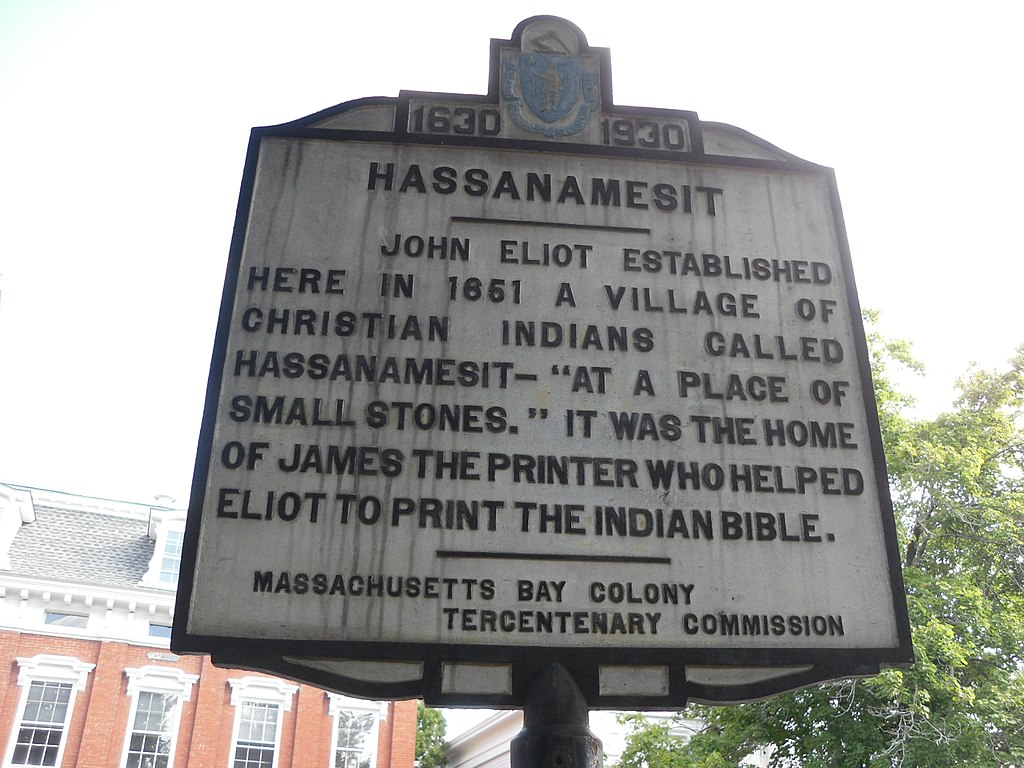
Wait, wut?! An Indian Praying Town? I need to know more about this please. It all starts with Puritan John Eliot.
“Eliot left England, the land of his birth, in 1631 as a young Puritan pastor. He worked in Boston for a year, then established a church five miles away in Roxbury, where he remained for 58 years, until his death. From the beginning he established an excellent relationship with the Narragansett Indians in the area and gradually also with other peoples speaking related languages.” Source
It seems that shortly after settling in Massachusetts, the Puritans recognized the need to evangelize the Native Americans. The language barrier was a difficulty, though. John Eliot was particularly burdened for these souls, and attempted a sermon in 1646 which was a failure, mainly due to the butchered language. Nevertheless, Eliot continued to meet with the leader (sachem) of the Massachusetts tribe, Cutshamekin, and soon he converted.
But the language barrier bothered Eliot, and he decided to do something about it. The Pequot Cockenoe, who had been captured in the 1637 Pequot War between the colonists and the Indians, served Eliot as translator and teacher. In return, Eliot taught Cockenoe how to write. The first things Eliot transliterated was the Lord’s Prayer and the Ten Commandments, plus some other prayers. By the late 1640s, Eliot was preaching to the Indians in their language. The earliest converts were from Eliot having conducted sermons and visited Native American homes, these were the earliest ways of propagating the gospel. But it was slow and cumbersome, and there was only one of Eliot.
Eliot wrote to England for help. In 1649, the government in England chartered the “Corporation for the Promoting and Propagating the Gospel of Jesus Christ in New England”. The Act endowed the parties with an official Corporation, complete with President and Treasurer. It was allowed to collect and send money to the Puritans in New England for the purpose of missions to the indigenous peoples on this side of the Atlantic. They raised 12,000 English pounds! That is equivalent to 2million dollars in today’s currency (according to one history calculator).
As converts increased, Eliot then set about finding acreage for these newly converted Indians to live, called “praying Indians”. He wanted to separate them from their tribal obligations and mode of dress, and reduce temptations. He also wanted to have the Native Americans and Colonists mix more.
This is where the acreage mentioned at the top of this essay comes in. The Winthrop acreage established an “Indian Praying Town”. It was and to this day is called Natick, Massachusetts. Eliot taught them how to establish a Christian community.
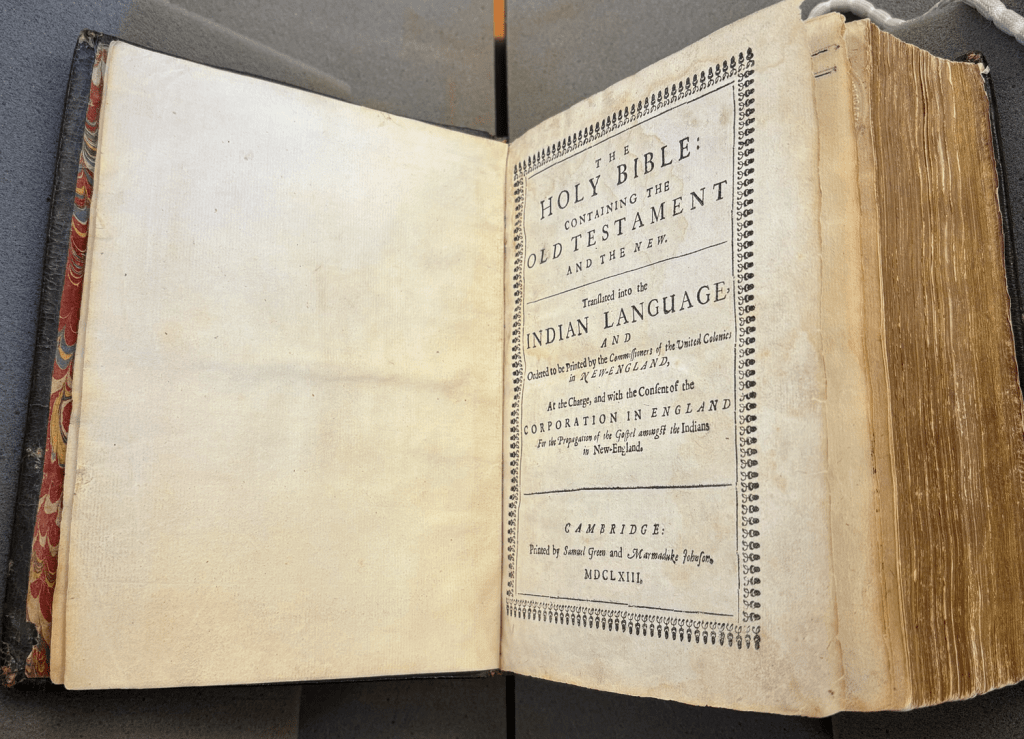
Eliot then ramped up his commitment to translate the Bible into their language, Algonquin. No easy task, there was no Algonquian alphabet! Eliot had to devise one, and thus became a lexicographer and grammarian in their language. He spent the next 14 years doing this but eventually in 1663, published “Mamusse Wunneetupanatamwe Up-Biblum God”.
The Eliot Indian Bible, published in 1663 as the first Bible printed in North America, was published with the support of the Society
Three years later, The Indian Grammar Begun was published also.
Now that it was translated, the Bible needed to be printed. Eliot wrote to the Corporation-
“I shall not trouble you with anything at present save this one business of moment, the printing of the Bible in the Indian language, which business sundry of the elders did petition unto the Commissioners, moving them to further it, as a principal means of promoting religion among them. … [Please send a printer] to New-England at the press in Harvard College, and work under the College printer, in impressing the Bible in the Indian language and with him send a convenient stock of paper“. (Source- The early Massachusetts press, 1638-1711, by George Emery Littlefield)
And the Corporation did just that, sending professional printer Marmaduke Johnson, 100 reams of paper, and 80 pounds of new type for the printer.
“Eliot was the only missionary to devise a new alphabet from an unwritten language for the purpose of teaching and preaching the scriptures“, we read in The American Puritans by Benge and Pickowicz. Eliot helped found the first missionary society in the New World, printed the first Bible in the New World, and was known as ‘Apostle to the Indians.’
Meanwhile, the “Indian Praying Towns” were multiplying. Eliot’s son John Jr. was now helping, then his son-in-law came to serve as well. There were 14 Indian Praying Towns in Massachusetts and 3 in Connecticut at the height. Eliot also established schools for the Christian Indians, established churches, and encouraged commerce between the Natives and the Puritan colonists. All was going well until…
Metacomet (English name: King Philip, 1638 – 1676) was chief of the Wampanoag people. The King Philip War – the most devastating war (1675 – 1676) between the colonists and the Native Americans in New England – is named according to him. Wood engraving, published in 1884. Source
King Philips War ended things abruptly. King Philip was actually a Native American called Metacom who started a war in 1675 until 1676 between a group of Indians and the English Colonists & their Native allies. Metacom’s father was Massasoit, you may remember, the Native American who helped the earliest Pilgrims who landed at Plymouth. Massasoit helped them avoid starvation. After Massasoit passed away, Metacom was not as friendly, claiming violations of the English in the treaties, and encouraged raiding parties. Eventually as tensions increased, war broke out.
Praying Indians offered to aid the Colonists in this war but were rejected. Many were either confined to their towns or relocated to Deer Isle. When the war was concluded relations among any and all Native Americans’ including the Praying Indians, was permanently damaged. It was said that it was a violation to even speak well of an Indian.
In 1675, when Philip’s war broke out, the English inhabitants generally were jealous of the praying Indians, and would have destroyed them, had not General Gookin and Mr Eliot stepped forth in their defence.Source, “History of the town of Natick, Mass. : from the days of the apostolic Eliot, MDCL, to the present time” by William Bigelow, 1830.
Things never got back to the height of the well-thought-of Praying Town. Ten of the original fourteen MA towns were disbanded. A few stragglers filtered back to Natick, the original Praying Indian Town, but it was closely supervised by the colonists.
John Eliot poured out his life for the Native Americans in his sphere. He was earnest for these souls and in return was beloved by the people he helped convert. Tokkohwompait was one of these men. At the end of Eliot’s life, he wrote to John Eliot,
“God hath made you to us and our nation a spiritual father, we are inexpressibly engaged to you for your faithful indefatigable labors, and love, to us and for us, you have always manifested the same to us as well in our adversity or prosperity, for about forty years making known to us the glad tidings of salvation of Jesus Christ.”
What a testimony for the name of Jesus Christ. What a well-done life poured out on behalf of pagan souls. Many do not know of John Eliot’s missionary endeavors, but I encourage you to search further and read up on this inspiring man.
You know how some people jokingly say he or she ‘broke the internet’? Well, Anne Hutchinson broke the colony.
History hasn’t been that balanced to Puritan wife Anne Hutchinson. She is either portrayed as an religiously oppressed early feminist denied her identity, or a screeching harridan who deserved what she got. She has been called a heroine, an American Jezebel, an instrument of satan, poison, and a great imposter (the negative ones were all from Massachusetts Governor John Winthrop).
Of course the truth is somewhere in the middle.
This is the fourth entry in my Puritan Wife series. I’d written:
Sometimes we think of our historical brethren as backward or uneducated, but in fact Puritan Massachusetts was populated with highly literate people, and that included the women, unusual for the time. The 1600s was an era when women were mainly quiet at home, revered, but out of the public eye. We only know of Anne Bradstreet because her brother-in-law copied her poems and published them in London without her knowing. We only know of Margaret Winthrop because her letters between her and her husband were preserved. And we know of Anne Hutchinson because of the trial transcripts! The two years she stirred up controversy reverberate to this day, I am not kidding.
In her religious outworkings and domestic life, Hutchinson was loud and active. An intelligent, complex, wayward mother of 15 children, she was tried and banished from the Massachusetts Bay Colony. Exiled at age 47 in 1638 and left with nowhere to go, she traipsed to Rhode Island where she was welcomed by that colony’s founder, the also-exiled Roger Williams.
That was the end of the end of the Antinomian controversy but not the end of Anne Hutchinson.
Anne was born Anne Marbury in 1591 in Alford, England. Her father was an Anglican cleric. Being literate himself and a teacher, he educated Anne to the fullest.
The family moved to London and lived there a while, but when Anne married childhood friend William Hutchinson she moved back to Alford. There, they enjoyed John Cotton’s sermons. Cotton was an outstanding theologian and a dynamic preacher, a combination not often found. Cotton was extremely well thought of.
Cotton was an Anglican preacher who had served for 20 years by the time the Hutchinsons met up with him. He peached much on grace in justification as well as the usual works being the fruit of it. Anne liked the grace part.
He believed the Church needed reforms, such as divesting itself of ritual and ceremony, but did not want to separate from it. He wanted to change it from within, or, “purify” it. Hence the moniker Puritans. As time went on, though, his consistent attitude against the framework of the Anglican church and his continual speaking against it eventually exceeded the leniency his overseers gave him, and pressure forced him out. He sailed for Massachusetts in 1633.
Devastated, Anne prompted her husband to follow Cotton. In 1634, the Hutchinsons packed up their 14 children and decided to follow Cotton to the new Colony that had been established just 13 years prior.
The Hutchinsons and William’s brother-in-law, John Wheelwright, were quickly accepted into the life of the colony. Anne was a midwife, and she met and discipled many women on her normal rounds. Being articulate and a deep thinker, many women sought her commentary on the Bible. Anne soon began holding weekly meetings for women at her home, repeating and commenting on Cotton’s sermons.
So far, so good. A woman ministering to her fellow sisters in body and soul is what the Bible tells us ladies to do. (Titus 2:3-4). Mothering in midwifery and ministering spiritually to sisters in the colony is a good thing.
However, it wasn’t long before Hutchinson expanded the discussions of the week’s sermon into her own exposition on them. Notoriety and interest caused men to attend her meetings, which were ever-expanding. Anne’s commentary was insightful, but a woman leading men in preaching and teaching, even in the privacy of a home, is a dangerous endeavor spiritually. (1 Timothy 2:12). The tendency to usurp is great, and that is what Anne did when she taught and preached to men. Some say that up to 60 people flooded her home to listen to Anne’s opinions and expositions. And it was definitely Anne they came for, not her husband John. (the sin of passive Adam, Genesis 3:6).
Does sin ever only get worse? Yes. Eventually, Anne did not restrict her home meetings’ topics solely to dissecting/discussing her pastor’s sermons, she strayed into dissecting other ministers’ sermons, too, usually negatively. Believing only she and her small circle of supporters were the only ones in the right, she criticized heavily, violating Titus 2:3 not to be slanders and Colossians 4:6 to let your conversation be gracious.
Remember, these were emigrants defying death in England for their views, defying death aboard the ships that brought them, surviving the first winters of privation and starvation. The one thing they needed was trust in their leaders’ stances and that is the very thing Anne destroyed.
More men began showing up, women too. Her ‘talks’ gravitated to mainly criticism of everyone else besides her favorite, John Cotton. She began to call names, and impugn character.
A soothing tongue is a tree of life, But perversion in it crushes the spirit. (Proverbs 15:4)
She hinted that some were antichrists and not saved. She said that these other pastors were preaching a covenant of works, while the only true pastor, Cotton, was preaching rightly, the covenant of grace. Anne over-focused on grace and was against Law. She was an antinomian.
Definition Antinomian: Anti means against, nomos is law. It’s “relating to the view that Christians are released by grace from the obligation of observing the moral law.” Oxford Dictionary
In looking at the two sides of the theological debate, it seems to me that both sides were right and both sides were wrong. Anne thought that the Holy Spirit indwelled, which is true, but, she taught that a person could live as they pleased under grace because assurance of salvation was known to the individual, therefore no external moral proof was necessary to evidence justification. Anne took this as far as it could go- where Cotton had been careful to link the Spirit with the Word, Anne decided that the mystical union with the Spirit was so close, one did not need the word, and could rely on “immediate revelations” from Him.
John Winthrop’s reply to a person receiving personal revelation from God was that it is “the most desperate enthusiasm in the world.”
Several of the named pastors naturally took a dim view of her preaching, and there was a meeting held to discuss what to do. John Winthrop, the Governor and spiritual leader of the Puritans at that time, was equally, if not more angered. Anne refused to listen.
And the sin deepened. Soon Hutchinson began to encourage women to rise up and walk out of sermons that preached doctrines with which she did not agree. Walking out is a disdainful, rebellious act. Elders deserved double honor. (1 Timothy 5:17). But many women did it. Men too.
The meetings continued, only growing in number. Anne’s dissections of others’ sermons, were not God-glorifying nor encouraging to pastors. Nor did they focus on educating the attendees and enlighten them as to Jesus as Savior. Nor did they prompt the people to good works and moral restraint. They were simply to point out the pastor’s errors and to cement her own position which she believed to be righteous. Think of the worst discernment ministries running today, who lack love, and who never lift up but only tear down, and that was the situation between 1636-1638 with Anne.
Anne was spurred on by people who should know better. A male admirer put it this way-
“I’ll bring you to a woman who preaches better gospel than any of your black-coats who have been at the ninnyversity, a woman of another kind of spirit who has had many revelations of things to come….I had rather such a one who speaks from the mere notion of the Spirit without any study at all than any of your learned scholars.” (Source)
See how personal revelations take a person AWAY from the word of God as it did this admirer?
Left, the statue of Hutchinson on the Massachusetts State House at 24 Beacon Street, Boston, MA. Still so controversial 375 years after death, and almost 100 years after the statue was commissioned, the original recipient, the Public Library, refused it and the Legislature ignored it for 2 years. It was finally installed in 2005. Story here: A heretic’s overdue honor
And Anne’s sin just deepened and deepened. It wasn’t long before Hutchinson began spouting personal revelations and prophecies. The apex of this was at her trial for sedition and heresy. Anne’s behavior had spawned a schism, had encouraged women to rebel, and caused a region-wide argument on the finer points of works v. grace. It also exiled her brother-in-law, John Wheelwright. It damaged Cotton’s reputation for years to come. The colony itself was suffering over this to the point of collapse. Winthrop’s “city on a hill” was only after a few years mired in petty bickering and politically unstable, caused by Anne. She had to be stopped.
Hutchinson was put on trial, after various attempts to get her to stop, recant, and repent. Hutchinson held firm. In her trial, she bested every single man in a theological debate, including Winthrop, who never forgave her, as we’ll see later.
It might have gone her way, except at the last, she overstepped, and claimed that God Himself had told her these things, and worse, that He told her He put a curse on them all. The initial charge of sedition was not met with a preponderance of evidence, due to her skill in theological combat. However when Hutchinson insisted God spoke to her personally, she was charged with blasphemy and exiled. In the spring, she moved to nearby Rhode Island and founded Portsmouth. Her husband and many of her children were already there.
Anne Hutchinson is noted as “a woman of conscience who yielded to no authority”, as quoted in this book about fellow Puritan preacher William Wentworth. Today’s feminists laud Hutchinson’s stance, but Christians know that is not the way. Of course we yield to authority.
Hutchinson rebelled against the scriptures, namely 1 Timothy 2:12 by teaching men. She and was unconcerned and unrepentant about it. She also failed to submit to her leaders, as Hebrews 13:17 says to do. Open and constant criticism of your leaders by disparaging them and encouraging walk-outs, is sin. (Also 1 Thessalonians 5:12, 1 Corinthians 16:16). Anne seems to have been unconcerned about the rift she was causing, and the word submit didn’t seem to be in her vocabulary. When she knew she was causing a problem, she did not repent, but persisted. This violated Romans 12:16, as she did not live in harmony with one another and failed to be humble. See also 1 Peter 3:8.
Above, John Cotton by John Smibert
How many Proverbs did Anne Hutchinson violate? She was not the meek, kind, quiet woman Proverbs calls us to be. She did not tend to her house (Proverbs 14:1). She was contentious, quarrelsome, and loud. She was overly proud of her own theological positions AND her ability to not only express them but to defend them.
The woman of folly is boisterous, She is naive and knows nothing. (Proverbs 9:13).
Men are supposed to lead the household. John Winthrop wrote of Anne’s husband William,
a man of very mild temper and weak parts, and wholly guided by his wife,
Anne’s positive influence could have been great. She was mother of 15 children, many of them boys. Her insights and strong theological knowledge could have raised up a new generation of founding fathers for our nation. If Anne had remained in her mid-wifery and women’s Bible study sphere, and tended to her home, who knows what might have come of it.
As it was, there were a few positives from the negatives of the Anne Hutchinson Antinomian controversy. Winthrop sought a colonial confederation to unite the colonies. The men banded together and established Harvard College, initially a seminary to train up the generation of men, as this quote indicates,
To provide a bulwark against remnants of Hutchinson’s free-grace theology, just two weeks after she was banished the General Court of Massachusetts finally released funds in November 1637 to establish the “College at Newtowne” (renamed Harvard in 1639)
Third, it spurred Roger Williams to deepen his conviction that there should be a “wall of separation” between church and state. Hutchinson was tried as a seditionist and a heretic, and eventually convicted of blasphemy. Williams thought that-
the magistrate should not punish religious infractions—that the civil authority should not be the same as the ecclesiastical authority. The second idea—that people should have freedom of opinion on religious matters—he called “soul-liberty.” It is one of the foundations for the religion clauses of the First Amendment to the United States Constitution. Williams’ use of the phrase “wall of separation” in describing his preferred relationship between religion and other matters is credited as the first use of that phrase, and Thomas Jefferson’s source in later writing of the wall of separation between church and state in a letter to the Danbury Baptist Association in 1802.
In addition, the controversy illuminated the fact that there was no perfect uniformity of doctrine among the men, which caught the leading Puritans off-guard. Winthrop thought that “The society must not only function as a unit, but in order to do so, must remain narrowly exclusive in content.” (Emery Battis, Saints and Sectaries). Whether this is ever possible, only God knows…
Debating whether to bring Anne to trial and during the trial, it became clear that there was no uniformity of content.
Banishment from Mass. Bay Colony. Wikimedia. It took 6 days to walk to RI
Hutchinson was not the only bad actor in this debacle. John Winthrop behaved badly too. (Among others). Anne was in her mid-forties when the trial occurred. She was either pregnant during the trial or shortly after. She emigrated to Rhode Island the spring after the trial ended and shortly afterward, gave birth. The issue from the birth was not a baby but what is believed to have been a hydatidiform mole, or molar pregnancy. It was a mass of tumors, not a baby. Knowing what would happen if it became publicly known, the Hutchinsons had it quickly and secretly buried. However, Winthrop heard about it, sought the grave, got it exhumed, and used the tragedy as ‘proof’ that his stance was right. He wrote of it widely: ‘see how the wisdom of God fitted this judgment to her sin every way, for look—as she had vented misshapen opinions, so she must bring forth deformed monsters.” Not cool.
This to me, is a total lack of charity and speaks ill of his own character.
Yet, William Coddington quoted a friend reminiscing about the controversy: “We were in a heate, and chafed, and were all of us to blame. In our strife, we had forgotten we were brethren.“
Later, when it appeared that Massachusetts was set to annex Rhode Island (it never happened), fearing reprisals, Anne and her children (her husband had passed away by then) moved out of Winthrop’s reach and into New York, the Netherlands’ territory. A year later, Anne and all but one of her children were killed in an Indian massacre. Many New England pastors wrote gloating reports of her death. Winthrop called her upon her death “An American Jezebel.”
Anne Hutchinson was an amazing colonialist who had much to offer the colony and her church. Unfortunately, she went outside the bounds of the ordained spheres for a woman and she caused upset, schism, and was a negative role model that reverberates 387 years later!! There’s no doubt though, she was formidable and earned a place in American history. As a wife, though, the more negative Proverbs speak of her and women like her than do the positive ones.
Unlike the positive example of Anne Bradstreet and Margaret Winthrop, whose excellence as wives and contributors to their family and community are noted to this day, Anne Hutchinson is the anti-wife whose contentious spirit and pride caused much harm to all those around her.
Be peaceable, And the Lord’s servant must not be quarrelsome but kind to everyone, able to teach, patiently enduring evil, (2 Timothy 2:24)
———————————————–
A few resources I used for background, sources for you too-
The Puritans are certainly worth reading. If you follow this blog for even a short time, you know I’m going to bring those guys up, lol. They were part of my pre-salvation, arousing a curiosity in me as to the worth of God, that they would leave all they knew to come to the New World so as to worship. That alone told me the worth of Jesus, something in my sinful, unconverted state I didn’t understand but was curious about.
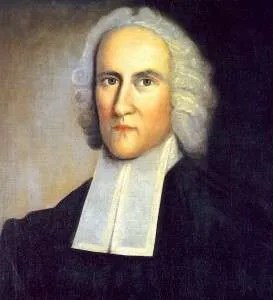
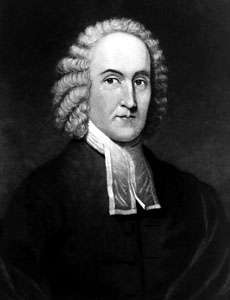
Jonathan Edwards is considered the ‘last Puritan’. He is also almost universally acknowledged as America’s greatest theologian. Joel Beeke, a Puritan authority, said Edwards “was a powerful force behind the First Great Awakening, as well as a champion of Christian zeal and spirituality.”
Edwards lived from 1703-1758. During his shortish life, he wrote profusely, constantly, and expertly. His writings on theology were well-founded and concise, always pointing to the greatness of God.
The Stanford Encyclopedia of Philosophy says “His work as a whole is an expression of two themes — the absolute sovereignty of God and the beauty of God’s holiness.”
Encyclopedia Britannica says, “Jonathan Edwards, (born October 5, 1703, East Windsor, Connecticut [U.S.]—died March 22, 1758, Princeton, New Jersey), greatest theologian and philosopher of British American Puritanism, stimulator of the religious revival known as the “Great Awakening,” and one of the forerunners of the age of Protestant missionary expansion in the 19th century.“
That is an incredible legacy.
He ascended his first pulpit as a sole pastor in Northampton, the most important church in Massachusetts outside of Boston. In his first published sermon, preached in 1731 to the Boston clergy and significantly entitled God Glorified in the Work of Redemption, by the Greatness of Man’s Dependence upon Him, in the Whole of It. Edwards preached 1 Corinthians 1.29, 30, 31, saying at the outset, “All the Good that they have is in and through Christ; He is made unto us Wisdom, Righteousness, Sanctification, and Redemption.”
Edwards is well known for his many books, such as The End for Which God Created the World, The Life of David Brainerd, which inspired thousands of missionaries throughout the 1800s, and Religious Affections, which is “probably the most profound analysis of spiritual experience ever written – and by the most brilliant philosopher/theologian to ever come from North America (and possibly the English language)” says one reviewer.
He also penned the ’70 Resolutions’, “As a young man – a teenager, really – Jonathan Edwards set down on paper a series of thoughts and practices to help cultivate his growth in grace. (See 2 Peter 3.18) Edwards then re-read this list at least once a week to keep his mind focused and renewed. The result was that he became a man of humble godliness, who was to become a significant spark used to ignite one of the greatest revivals known to history.” (Source)
Edwards had a wide range of interests. He was was pastor, writer, theologian, missionary supporter, college President, but also a natural history expert. He was very interested in natural history and took long walks or horse rides with pen and notebook in hand to take notes on his observations. As a precocious 11-year-old, he’d observed and written an essay detailing the ballooning behavior of some spiders. He later published this as a scientific essay titled “The Flying Spider”.
When people think of Jonathan Edwards they most likely think of his most famous sermon, Sinners in the Hands of an Angry God. In that sermon, widely acknowledged for sparking the Great Awakening, a massive revival where many souls were won to God, Edwards used hard truths and vivid imagery to make clear the dangerous state of the unconverted. He used a spider allusion, given his knowledge of and interest in the crawling arachnid. Here are just a few excerpts-
Your wickedness makes you as it were heavy as lead, and to tend downwards with great weight and pressure towards hell; and if God should let you go, you would immediately sink and swiftly descend and plunge into the bottomless gulf, and your healthy constitution, and your own care and prudence, and best contrivance, and all your righteousness, would have no more influence to uphold you and keep you out of hell, than a spider’s web would have to stop a falling rock.
The God that holds you over the pit of hell, much as one holds a spider, or some loathsome insect over the fire, abhors you, and is dreadfully provoked: his wrath towards you burns like fire; he looks upon you as worthy of nothing else, but to be cast into the fire; he is of purer eyes than to bear to have you in his sight; you are ten thousand times more abominable in his eyes, than the most hateful venomous serpent is in ours.
Wrath and God’s offense at sin and sinners is much discarded in the face of love and roses and our worth and lovableness, as many teach today (especially female ‘Bible teachers’). But we must understand the sinfulness of sin, God’s hate toward sin, and our precarious state as an unbeliever. Edwards made that vividly plain to the listeners that day in 1741.
In fact, they were so struck, they kept crying out in spiritual agony, pitching themselves toward the altar asking piteously “What shall we do to be saved?” Eventually the cries and mayhem were such that Edwards had to stop preaching, and pastors went down the aisles to pray with people and talk of salvation.
Though Edwards is famous for his focus on hell in that particular sermon, his voluminous works contained much more focus on heaven. For example, he is known for his book Heaven, a World of Love.
If you are unfamiliar with Jonathan Edwards, he is a good one to look up. His works are edifying and challenging, not to mention noteworthy. His contribution to the faith stands as monumental, 300 years after his passing into glory.
Jonathan Edwards: Teaching series Stephen Nichols (6 videos) I enjoyed this course on Edwards. The first message is free. The rest are behind a paywall. I recommend it though, it’s an easy way to learn about the man, and so interesting.
the women should keep silent in the churches. For they are not permitted to speak, but should be in submission, as the Law also says. (1 Corinthians 14:34).
Paul was exhorting about orderly worship here. Worship had gotten out of hand. Worship must be orderly, quiet, and respectful, that was the watchword. And Paul gave that word in this passage.
Is there a time for a woman to holler and throw stools at the pastor? Apparently there was for Jenny Geddes. She’s gone down in Reformation History as someone who stood up for Jesus. Here’s how.
Jenny Geddes (c. 1600 – c. 1660) was a Scottish market-trader in Edinburgh, who is alleged to have thrown her stool at the head of the minister in St Giles’ Cathedral in objection to the first public use of the Anglican Book of Common Prayer in Scotland. The act is reputed to have sparked the riot which led to the Wars of the Three Kingdoms, which included the English Civil War.
Well, that’s some stool. It all happened on July 23, 1637 in Edinburgh.
Always independent, the Puritan Scots had become suspicious of the increasing encroachment of liturgy and rigid traditions a la the Roman Catholic Church. They had observed King Charles Is’ coronation rites and were displeased with his use of Anglican rituals. Next came forced use of the Book of Common Prayer, a high Episcopalian book, with its readings in the Apocrypha. King Charles issued a warrant in 1635 declaring his spiritual power over the Church of Scotland, insisting that the Church would be issued with a new book of liturgy which would be read at services. And on July 23, 1637 in St. Giles Cathedral, the Common Book of prayer was opened and John Hanna, Dean of Edinburgh, began to read.
Jenny Geddes sat fuming on her “fald stool” or a “creepie-stool” meaning a folding stool. Finally she had heard enough and stood up and cried; “Deil colic the wame o’ ye, fause thief; daur ye say Mass in my lug?” meaning “Devil cause you severe pain and flatulent distension of your abdomen, false thief: dare you say the Mass in my ear?” And at that she hurled her stool straight at the Dean’s head. This sparked a full scale riot in the church. one congregation member who had been heard uttering a response to the liturgy was thumped with Bibles. The Dean took cover and the Provost summoned his men to put down the disturbance. The rioters were soon ejected from St Giles and the Bishop of Edinburgh appealed for calm. However this was not going to end quietly…
The national spiritual unrest was real, but overlaid upon the spiritual unrest was political unrest too. Hence the riots that sparked the Wars of the Three Kingdoms, and then the English Civil War. You can read about that part of the history elsewhere.
Jenny Geddes’ anger at the encroachment of evil into the pure worship service reminded me of another, more recent ‘Jenny Geddes.’
On November 10, 2013, Memorial Church of the Reformation in the city of Speyer, Germany hosted Karl Jenkins’ performance piece, titled “A Mass for Peace- “The Armed Man” where as part of the performance, the Islamic call to prayer is performed by an Imam.
German woman Heidi Mund had heard of this performance, grabbed her flag on which is emblazoned “Jesus Christ is Lord” headed to the church, and bought her ticket. But first, Ms Mund said, she prayed. To make matters even more emotional, the church the performance was to be held at was the Memorial Church of the Protestation in Speyer Germany, constructed specifically in 1900 where,
Its construction was supposed to be a reminder of the protest action that the imperial evangelical states brought to bear in 1529 at the Reichstag in Speyer. The Luther memorial in the vestibule and the adjacent statues of local Protestant rulers serve as reminders of this event.
Having no particular plan, she quietly listened to the music and readings, but when the Imam began praying to Allah in Arabic and saying, “Allahu Akbar!” she felt what she called a holy anger rising up in her. Much like Jenny Geddes, who was righteously aggrieved with the blasphemy in her midst, Mund stood up at this “interfaith event” and fearlessly began shouting that Lord Jesus alone is God and proclaimed His supremacy over all the earth.
If we are confronted with something of like kind, what would be our reaction? There is a time to sit silently and submissively, but is there ever a time for disruption and holy anger? Jenny Geddes threw a stool, narrowly missing the preacher’s head. Physical violence is never appropriate. How would we react to the incursion of evil into a holy place, a place set aside for the proclamation of the pure word? Just food for thought.
Both Geddes and Mund knew of what was to happen during the service. Neither were surprised. Mund prayed ahead, one can surmise that perhaps Geddes had also prayed ahead. In one way or another, we are all confronted with false doctrine creeping in. Start praying ahead for strength in the Lord to react in ways that honor and glorify Him.
———————————— Further Reading
Trivia: Scottish Poet Robert Burns named his mare Jenny Geddes
You know how some people jokingly say he or she ‘broke the internet’? Well, Anne Hutchinson broke the colony.
History hasn’t been that kind to Puritan wife Anne Hutchinson. She is either portrayed as an oppressed early feminist denied her identity, or a screeching harridan who deserved what she got. She has been called a heroine, an American Jezebel, an instrument of satan, poison, and a great imposter (the negative ones were all from John Winthrop).
Of course the truth is somewhere in the middle.
The introductory entry in this series on Puritan Wives is here. If you’d like to read some background to the Puritan emigration and founding of Massachusetts Bay Colony, you can read that link.
Sometimes we think of our historical brethren as backward or uneducated, but in fact Puritan Massachusetts was populated with highly literate people, and that included the women, unusual for the time. The 1600s was an era when women were mainly quiet at home, revered, but out of the public eye. However, Hutchinson was loud and active. An intelligent, complex, wayward mother of 15 children, she was tried and banished from the Massachusetts Bay Colony. Exiled at age 47 in 1638 and left with nowhere to go, she traipsed to Rhode Island where she was welcomed by that colony’s founder, also-exiled Roger Williams.
That was the end of the end of the Antinomian controversy but not the end of Anne Hutchinson.
Anne was born Anne Marbury in 1591 in Alford, England. Her father was an Anglican cleric. Being literate himself and a teacher, he educated Anne to the fullest.
The family moved to London and lived there a while, but when Anne married childhood friend William Hutchinson she moved back to Alford. There, they enjoyed John Cotton’s sermons. Cotton was an outstanding theologian and a dynamic preacher, a combination not often found. Cotton was extremely well thought of.
Cotton was an Anglican preacher who had served for 20 years by the time the Hutchinsons met up with him. He believed the Church needed reforms, such as divesting itself of ritual and ceremony, but did not want to separate from it. He wanted to change it from within. As time went on, though, his consistent attitude against the framework of the Anglican church and his continual speaking against it eventually exceeded the leniency his overseers gave him, and pressure forced him out. He sailed for Massachusetts in 1633.
Devastated, Anne prompted her husband to follow Cotton. In 1634, the Hutchinsons packed up their 14 children and decided to follow Cotton to the new Colony that had been established just 13 years prior.
The Hutchinsons and William’s brother-in-law, John Wheelwright, were quickly accepted into the life of the colony. Anne was a midwife, and she met and discipled many women on her normal rounds. Being articulate and a deep thinker, many women sought her commentary on the Bible. Anne soon began holding weekly meetings at her home, commenting on Cotton’s sermons.
So far, so good. A woman ministering to her fellow sisters in body and soul is what the Bible tells us ladies to do. (Titus 2:3-4). Mothering in midwifery and ministering spiritually to sisters in the colony is a good thing.
However, it wasn’t long before notoriety and interest caused men to attend her meetings, which were ever-expanding. Anne’s commentary was insightful, but a woman leading men in preaching and teaching, even in the privacy of a home, is a dangerous endeavor spiritually. The tendency to usurp is great, and that is what Anne did when she taught and preached to men.
Does sin ever only get worse? Yes. Eventually, Anne did not restrict her home meetings’ topics solely to dissecting/discussing her pastor’s sermons, she strayed into dissecting other ministers’ sermons, too, usually negatively. She criticized heavily.
More men began showing up, women too. Her ‘talks’ gravitated to mainly criticism of everyone else besides her favorite, John Cotton. She began to call names, and impugn character. She hinted that some were antichrists. She said that these other pastors were preaching a covenant of works, while the only true pastor, Cotton, was preaching rightly, the covenant of grace.
In looking at the two sides of the theological debate, it seems to me that both sides were right and both sides were wrong. However, the nuances of this soon-to-be schism are not the purview of this essay, and besides, many other people smarter than me have written on it.
My goal is to look at Anne Hutchinson’s life, and the effects of a rebellious woman’s actions and how they harm the body.
Several of the named pastors naturally took a dim view of her preaching, and there was a meeting held to discuss what to do. John Winthrop, the spiritual leader of the Puritans at that time, was equally, if not more angered.
And the sin deepened. Soon Hutchinson began to encourage women to rise up and walk out of sermons that preached doctrines with which she did not agree. Walking out is a disdainful, rebellious act. But many women did it.
The meetings continued, only growing in number. Anne’s dissections of others’ sermons, were not God-glorifying nor encouraging to pastors. Nor did they focus on educating the attendees and enlighten them as to Jesus as Savior. Nor did they prompt the people to good works. They were simply to point out the pastor’s errors and to cement her own position which she believed to be righteous. Think of the worst discernment ministries running today, who lack love, and who never lift up but only tear down, and that was the situation between 1636-1638 with Anne.
Anne was spurred on by people who should know better.
A male admirer put it this way-
“I’ll bring you to a woman who preaches better gospel than any of your black-coats who have been at the ninnyversity, a woman of another kind of spirit who has had many revelations of things to come….I had rather such a one who speaks from the mere notion of the Spirit without any study at all than any of your learned scholars.” (Source)
One of Anne’s doctrines was that a person did not need any clergy, but could be guided by their own inner light. Anne was correct that the Spirit dwelling in us illuminates the scriptures to our mind, but incorrect that we need no clergy at all to explain the scriptures to us.
Note that “Inner light” is a Quaker term. Quakerism was rising at the time, in fact, another woman, Mary Dyer, supported Hutchinson but was later hanged as a rebel. The Quakers did not believe in baptism, formal prayer and the Lord’s Supper, nor did they believe in an ordained ministry. Each member was a minister in his or her own right, women were essentially treated as men in matters of spirituality, and they relied on an “Inner Light of Christ” as their source of spiritual inspiration, according to Dyer’s Wiki entry.
The equality of men and women in Quakerism, the lack of ordained ministry (to whom church members submit) and the inner light were all things Hutchinson would have been attracted to. It was this the admirer above was hinting at. Quakerism was anathema to Puritans and they enacted many laws against it.
Right, the statue of Hutchinson on the Massachusetts State House at 24 Beacon Street, Boston, MA. Still so controversial 375 years after death, and almost 100 years after the statue was commissioned, the original recipient, the Public Library, refused it and the Legislature ignored it for 2 years. It was finally installed in 2005. Story here: A heretic’s overdue honor
And Anne’s sin just deepened and deepened. It wasn’t long before Hutchinson began spouting personal revelations and prophecies. The apex of this was at her trial for sedition and heresy. Anne’s behavior had spawned a schism, had encouraged women to rebel, and caused a region-wide argument on the finer points of works v. grace. It also exiled her brother-in-law, John Wheelwright. It damaged Cotton’s reputation for years to come. The colony itself was suffering over this to the point of collapse. Winthrop’s “city on a hill” was only after a few years mired in petty bickering and politically unstable, caused no less by a woman. She had to be stopped.
Hutchinson was put on trial, after various attempts to get her to stop, recant, and repent. Hutchinson held firm. In her trial, she bested every single man in a theological debate, including Winthrop, who never forgave her as we’ll see later.
It might have gone her way, except at the last, she overstepped, and claimed that God Himself had told her these things. The initial charge of sedition was not met with a preponderance of evidence, due to her skill in theological combat. However when Hutchinson insisted God spoke to her personally, she was charged with blasphemy and exiled. In the spring, she moved to nearby Rhode Island and founded Portsmouth. Her husband and many of her children were already there.
Anne Hutchinson is noted as “a woman of conscience who yielded to no authority”, as quoted in this book about fellow Puritan preacher William Wentworth. Today’s feminists laud Hutchinson’s stance, but Christians know that is not the way. Of course we yield to authority.
Her friend and pastor John Cotton noted the missteps and sins Hutchinson committed,
Three things I told her made her spiritual estate unclear to me.
1. That her Faith was not begotten nor (by her relation) scarce at any time strengthened, by publicke Ministry, but by private Meditations, or Revelations, onely….
2. That she clearly discerned her Justification (as she professed:) but little or nothing at all, her Sanctification: though (she said) she believed such a thing there was by plain Scripture….
3. That she was more sharply censorious of other men’s spiritual estates and hearts, then the servants of God are wont to be, who are more taken up with judging of themselves before the Lord, then of others. Source: The New England Antinomian Controversy, Monergism
The first two are part of the theological controversy, but it’s the third I’d like to draw your attention to. Hutchinson rebelled against the scriptures, namely 1 Timothy 2:12 by teaching men. She and was unconcerned and unrepentant about it. She also failed to submit to her leaders, as Hebrews 13:17 says to do. Open and constant criticism of your leaders by disparaging them and encouraging walk-outs, is sin. (Also 1 Thessalonians 5:12, 1 Corinthians 16:16). Anne seems to have been unconcerned about the rift she was causing, and the word submit didn’t seem to be in her vocabulary. When she knew she was causing a problem, she did not repent, but persisted. This violated Romans 12:16, as she did not live in harmony with one another and failed to be humble. See also 1 Peter 3:8.
Left, John Cotton by John Smibert
Hutchinson was seen even by her lone supporter as overly judgmental and critical, as John Cotton enumerated in his list, #3.
How many Proverbs did Anne Hutchinson violate? She was not the meek, kind, quiet woman Proverbs calls us to be. She did not tend to her house (Proverbs 14:1). She was contentious, quarrelsome, and loud.
The woman of folly is boisterous, She is naive and knows nothing. (Proverbs 9:13).
When we step outside God’s ordained spheres for us, chaos ensues. I’m not speaking solely of women stepping into leadership or usurping men. Children are called to live in obedience to their parents. Men are supposed to lead the household. John Winthrop wrote of Anne’s husband William,
a man of very mild temper and weak parts, and wholly guided by his wife,
There are spheres for all of us, and when we set them aside for our own glory or our own purposes, even for a deeply held conviction or our conscience, chaos comes.
Anne’s positive influence could have been great. She was mother of 15 children, many of them boys. Her insights and strong theological knowledge could have raised up a new generation of founding fathers for our nation. If Anne had remained in her mid-wifery and women’s Bible study sphere, and tended to her home, who knows what might have come of it.
As it was, there were a few positives from the negatives of the Anne Hutchinson controversy. Winthrop sought a colonial confederation to unite the colonies. The men banded together and established Harvard College, initially a seminary to train up the generation of men, as this quote indicates,
To provide a bulwark against remnants of Hutchinson’s free-grace theology, just two weeks after she was banished the General Court of Massachusetts finally released funds in November 1637 to establish the “College at Newtowne” (renamed Harvard in 1639)
Third, it spurred Roger Williams to deepen his conviction that there should be a “wall of separation” between church and state. Hutchinson was tried as a seditionist and a heretic, and eventually convicted of blasphemy. Williams thought that-
the magistrate should not punish religious infractions—meant that the civil authority should not be the same as the ecclesiastical authority. The second idea—that people should have freedom of opinion on religious matters—he called “soul-liberty.” It is one of the foundations for the religion clauses of the First Amendment to the United States Constitution. Williams’ use of the phrase “wall of separation” in describing his preferred relationship between religion and other matters is credited as the first use of that phrase, and Thomas Jefferson’s source in later writing of the wall of separation between church and state in a letter to the Danbury Baptist Association in 1802.
It was effectively the end of the city on the hill Winthrop had wanted to establish. His theocracy was no more.
Banishment from Mass. Bay Colony. Wikimedia. It took 6 days to walk to RI
Hutchinson was not the only bad actor in this debacle. John Winthrop behaved badly too. (Among others). Anne was in her mid-forties when the trial occurred. She was either pregnant during the trial or shortly after. She emigrated to Rhode Island the spring after the trial ended and shortly afterward, gave birth. The issue from the birth was not a baby but what is believed to have been a hydatidiform mole, or molar pregnancy. It was a mass of tumors, not a baby. Knowing the outcome of it being publicly known, the Hutchinsons had it quickly and secretly buried. However, Winthrop heard about it, sought the grave, got it exhumed, and used the tragedy as ‘proof’ that his stance was right. He wrote of it widely: ‘see how the wisdom of God fitted this judgment to her sin every way, for look—as she had vented misshapen opinions, so she must bring forth deformed monsters.”
This to me, is a total lack of charity and speaks ill of his own character. Later, when it appeared that Massachusetts was set to annex Rhode Island (it never happened), fearing reprisals, Anne and her children (her husband had passed away by then) moved out of Winthrop’s reach and into New York, the Netherlands’ territory. A year later, Anne and all but one of her children were killed in an Indian massacre. Many New England pastors wrote gloating reports of her death. Winthrop called her upon her death “An American Jezebel.” I pray that today’s pastors are more charitable and loving toward their own sectarian.
If you’re a woman beset by conscience due to doctrinal difference with your pastor, what should you do? Well, not usurp the men, criticize openly, and encourage walkouts. Certainly don’t put words into God’s mouth that your stance is directly from Him.
First, decide if your difference is a salvific one or a secondary or tertiary issue. Next, pray, for your pastor, but for yourself too. Pray for wisdom and enlightenment. Perhaps you are wrong!
Then, be patient. You’re not the only one to have spotted an issue that threatens the church. Perhaps other men are working on it behind the scenes. Not everything depends on you. Be patient.
If it continues or worsens, then make an appointment to see the pastor, with your husband if possible. Ask questions to learn, don’t go in with guns blazing thinking you know it all. Ask, be an eager hearer.
Return home and be more patient. Let the information you’ve gained sink in, consult your husband, and read the Bible. Pray some more. Resist the temptation to gossip about it to mount up soldiers for your side.
As time goes on you might be relieved to find the Lord has resolved this issue, or you might find it worsening and have to make decisions. If you decide to leave your church, leave well.
Anne Hutchinson was an amazing colonialist who had much to offer the colony and her church. Unfortunately, she went outside the bounds of the ordained spheres for a woman and she caused upset, schism, and was a negative role model. There’s no doubt though, she was formidable and earned a place in American history. As a wife, though, the more negative Proverbs speak of her and women like her than do the positive ones.
Be peaceable, And the Lord’s servant must not be quarrelsome but kind to everyone, able to teach, patiently enduring evil, (2 Timothy 2:24)
———————————————–
A few resources I used for background, sources for you too
Our Christian forebears were fallible men and women, but so are we. And we fool ourselves to simply assume that we would have had the courage to act differently when every societal pressure was pushing one direction. They had blind spots which we see clearly now. But we too have blind spots that our children and grandchildren will speak of with shame.
Greear was specifically speaking of slavery, but his concept applies to theology too. There has never been a time when the fundamentals and the tangential items of the faith were completely settled. During Jesus’ day, His ‘new’ theology, which was really the original theology, was misapplied, misunderstood, and rejected. Even Nicodemus, THE Teacher of Israel, whiffed the concepts of suffering servant/sacrificial atonement/new birth. The Pharisees certainly didn’t get it and at one point even John the Baptist, who’d had the Spirit in him since the womb, asked if Jesus was the one or should they wait for another.
During the Apostolic age, there were many points of theology to be settled, and the succeeding councils during the centuries after to hash them out are testament to the fluid nature of man’s understanding of the Kingdom. Early church fathers were certainly fallible men. Origen’s theology (c. 184-c. 253) was hailed either as the “height of faithful theology or the depth of horrendous error.”
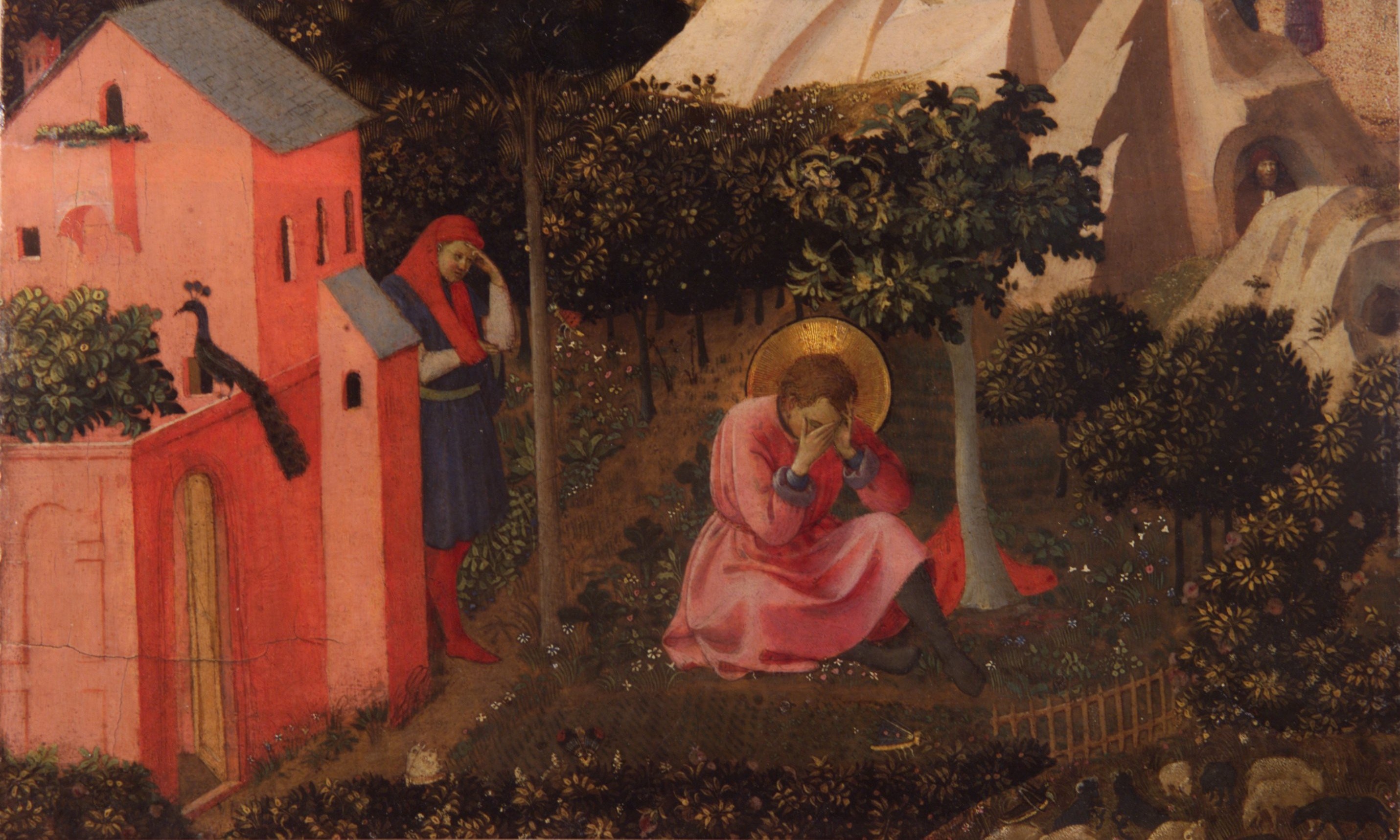
Augustine (354-430) adhered to many theologies that were solid but he clung to many that were not. Hailed as a brilliant thinker, at the same time, his philosophies “also considerably skewed the Christian vision.”
I could go on, but far be it for anyone to think that the faith delivered once for all to the saints is understood widely by all the saints for all time. In every era men struggle with certain elements of it due to their cultural blind spots of the time in which we live.
Jonathan Edwards
By the time of the Reformation, the understanding of the faith delivered once for all to the saints had been polluted beyond saving, and the Puritans started afresh, breaking completely with the Roman Catholic Church.
Suffice to say that the theologians in each era were duly conscientious of their thinking, striving to understand all that is required, and to explain it in ways the common man could understand, too. But they had blind spots, being products of their own generation. This is the way of it. We in this era have blind spots too, being products of our own generation. When we read a modern book, we nod and say, yes, yes, not realizing that the constructs of our own culture and time are blinding us to this or to that. Our grandchildren will look at our books of the millennium na shake their heads at us.
This is why it is important to read the products of the ancient and historical thinkers. We see their blind spots clearly, and we are happily exposed to theology that can and does enhance our understanding of the faith.
But oftentimes the ancients and historical fathers are difficult to read as well. Language changes. When reading Spurgeon, (1834 –1892) his words seem quaint. Backing up a hundred years, Jonathan Edwards (1703-1758) is a bit more difficult. By the time we get to the Puritan John Owen, (1616-1683) his works present comprehension difficulties nearly impossible to overcome. Even the great theologian JI Packer called Owen “cumbersome” and Kris Lundgaard took an hour to read just 8 or so pages of Owen, re-reading sentences three and four times and using a dictionary to look up certain words. The common man who finds these hurdles insurmountable miss out on great thinkers and founding fathers of the past.
What to do?
I have a few tips on how to grapple the ancients and the historical men who’ve contributed mightily to the faith but whose works present difficulties.
I’ve found that pairing books helps. For example, this summer I read John Bunyan’s spiritual autobiography Grace Abounding to the Chief of Sinners paired with A Pilgrim Who Made Progress, the Life Story of John Bunyan, by William Deal. I found that Deal’s book offered historical information that helped me understand some of Bunyan’s spiritual choices. That Deal’s book is aimed at the Youth demographic was actually a help.
If you’re interested in Augustine’s Confessions, the biography by Peter Brown is a good pairing. Brown’s treatment of Augustine seems to have become THE standard bio of Augustine since its publication nearly fifty years ago. Augustine of Hippo: A Biography.
Another kind of paring I’ve done is for example, I read Kris Lundgaard’s The Enemy Within paired with John Owen’s Indwelling Sin. Lundgaard’s book is essentially a re-write/Cliff’s Notes to Owen’s towering work. My version of Owen’s book was from the Puritan Paperback series. Where Lundgaard’s is a total re-write using modern examples, the PP series is a slightly edited and slightly modernized version of the original Puritan work. It’s put out by Banner of Truth Trust, an organization, you can, well, trust!
Fra Angelico, The Conversion of St. Augustine
I read Lundgaard on Mondays and the same Owen chapter the next day. I found that Lundgaard’s version helped me prepare my heart and my mind for the depth of the main meal Owen serves up.
Lundgaard also wrote Through the Looking Glass: Reflections on Christ that Change Us as a modernized re-write of Owen’s Glory of Christ, so that could be another pairing.
For Moby Dick, a theological but difficult book, (1851) there are many are study guides online. I used this one as I read the book itself.
For Pilgrim’s Progress, (a 1678 Christian allegory) there are study guides also. I bought The Pilgrim’s Progress Study Guide by Maureen L. Bradley.
The Pilgrim’s Progress, written by John Bunyan over 300 years ago, is one of the most widely-circulated books ever to be published in the English language. In spite of its popularity in the past, many people today are not familiar with this masterpiece. Join Dr. Derek Thomas as he leads a guided tour of this allegorical work, showing that Christians have as much to gain from this book today as they did hundreds of years ago.
The first video is free. The remainder of the series are fee-based.
So, you can pair books with re-writes of books. Or you can pair books with a biography of the author you’re trying to read. You can use a study guide. Go through a teaching series. Buy a Puritan Paperback which is lightly modernized and abridged.
Any way you do it, don’t let the classics languish. There is a multitude of good theology in them we should not lose our connection to. I’ve offered some ways to ease the difficulty so to speak. If you have ideas, please do share them.
the women should keep silent in the churches. For they are not permitted to speak, but should be in submission, as the Law also says. (1 Corinthians 14:34).
Paul was exhorting about orderly worship here. The women, who as Hebrews were not invited to participate in worship with the men or to be educated, were over-exuberant in their new found freedom as Christians. As a result, worship had gotten out of hand. Worship must be orderly, quiet, and respectful, that was the watchword. And Paul gave that word in this passage.
Is there a time for a woman to holler and throw stools at the pastor? Apparently there was for Jenny Geddes. She’s gone down in Reformation History as someone who stood up for Jesus. Here’s how.
Jenny Geddes (c. 1600 – c. 1660) was a Scottish market-trader in Edinburgh, who is alleged to have thrown her stool at the head of the minister in St Giles’ Cathedral in objection to the first public use of the Anglican Book of Common Prayer in Scotland. The act is reputed to have sparked the riot which led to the Wars of the Three Kingdoms, which included the English Civil War.
Well, that’s some stool. It all happened on July 23, 1637 in Edinburgh.
Always independent, the Puritan Scots had become suspicious of the increasing encroachment of liturgy and rigid traditions a la the Roman Catholic Church. They had observed King Charles Is’ coronation rites and were displeased with his use of Anglican rituals. Next came forced use of the Book of Common Prayer, a high Episcopalian book, with its readings in the Apocrypha. King Charles issued a warrant in 1635 declaring his spiritual power over the Church of Scotland, insisting that the Church would be issued with a new book of liturgy which would be read at services. And on July 23, 1637 in St. Giles Cathedral, the Common Book of prayer was opened and John Hanna, Dean of Edinburgh, began to read.
Jenny Geddes sat fuming on her “fald stool” or a “creepie-stool” meaning a folding stool. Finally she had heard enough and stood up and cried; “Deil colic the wame o’ ye, fause thief; daur ye say Mass in my lug?” meaning “Devil cause you severe pain and flatulent distension of your abdomen, false thief: dare you say the Mass in my ear?” And at that she hurled her stool straight at the Dean’s head. This sparked a full scale riot in the church. one congregation member who had been heard uttering a response to the liturgy was thumped with bibles. The Dean took cover and the Provost summoned his men to put down the disturbance. The rioters were soon ejected from St Giles and the Bishop of Edinburgh appealed for calm. However this was not going to end quietly…
The national spiritual unrest was real, but overlaid upon the spiritual unrest was political unrest too. Hence the riots that sparked the Wars of the Three Kingdoms, and then the English Civil War. You can read about that part of the history elsewhere.
Jenny Geddes’ anger at the encroachment of evil into the pure worship service reminded me of another, more recent ‘Jenny Geddes.’
On November 10, 2013, Memorial Church of the Reformation in the city of Speyer, Germany hosted Karl Jenkins’ performance piece, titled “A Mass for Peace- “The Armed Man” where as part of the performance, the Islamic call to prayer is performed by an Imam.
German woman Heidi Mund had heard of this performance, grabbed her flag on which is emblazoned “Jesus Christ is Lord” headed to the church, and bought her ticket. But first, Ms Mund said, she prayed. To make matters even more emotional, the church the performance was to be held at was the Memorial Church of the Protestation in Speyer Germany, constructed specifically in 1900 where,
Its construction was supposed to be a reminder of the protest action that the imperial evangelical states brought to bear in 1529 at the Reichstag in Speyer. The Luther memorial in the vestibule and the adjacent statues of local Protestant rulers serve as reminders of this event.
Having no particular plan, she quietly listened to the music and readings, but when the Imam began praying to Allah in Arabic and saying, “Allahu Akbar!” she felt what she called a holy anger rising up in her. Much like Jenny Geddes, who was righteously aggrieved with the blasphemy in her midst, Mund stood up at this “interfaith event” and fearlessly began shouting that Lord Jesus alone is God and proclaimed His supremacy over all the earth.
If we are confronted with something of like kind, what would be our reaction? There is a time to sit silently and submissively, but is there ever a time for disruption and holy anger? Jenny Geddes threw a stool, narrowly missing the preacher’s head. Physical violence is never appropriate. How would we react to the incursion of evil into a holy place, a place set aside for the proclamation of the pure word? Just food for thought.
Both Geddes and Mund knew of what was to happen during the service. Neither were surprised. Mund prayed ahead, one can surmise that perhaps Geddes had also prayed ahead. In one way or another, we are all confronted with false doctrine creeping in. Start praying ahead for strength in the Lord to react in ways that honor and glorify Him.
————————————
Further Reading
Trivia: Scottish Poet Robert Burns named his mare Jenny Geddes
It was in the month of July — a month since become so memorable in the history of human freedom — on the twenty-third day of the month, that Jenny emerged from domestic obscurity to historic celebrity and renown.
On that day there was a strange ferment throughout Scotland and a wild excitement in the city of Edinburgh. King Charles had resolved to make Presbyterianism give place to Prelacy throughout the realm. A book of canons had been prepared subversive of the whole system of Presbyterian government, and had been enjoined upon the realm by proclamation upon the king’s simple prerogative.
Following this book came a liturgy as a law of public worship, and a royal edict had commanded its introduction into all the churches of the realm on this memorable Sabbath day. Notice to this effect bad been given the Sabbath before, and hence this intense excitement. For the Scottish people knew that if this measure were carried into effect by the authorities, Presbyterianism was virtually in its grave.
As the hour of Sabbath service approached, the streets of Edinburgh were thronged with crowds of people — every bosom throbbing, every eye flaming with excitement. But whither were they directing their steps? Conspicuous from many a point in the city of Edinburgh is a lofty tower, terminating in an open, carved stonework, with arches springing from the four corners and meeting together at the top in the form of a crown.
Already more than three centuries were looking down from that tower-top. It rose from the centre of a vast and venerable pile, including the High Church at the eastern end, There Knox so often preached, and within which pile “forty altars” were at one time supported.
It was thither mainly the crowds were pressing, and among them Jenny Geddes. Not being overburdened with modesty, she elbowed her way through the crowd to a convenient place, her stool, in near proximity to the pulpit, and seated herself on her throne. The edifice was filled to repletion with titled nobility and the nobler untitled nobility of the Scottish Presbyterian masses. There were present archbishops, bishops, the lords of the session, the magistrates of the city, members of the council, “chief captains and principal men,” and Jenny Geddes and her stool.
The excitement was becoming every moment more intense. The minutes dragged themselves along with tormenting tardiness and the suspense was becoming almost breathless. When the feeling was wrought up to its highest tension the Dean of Edinburgh made his appearance, clad in immaculate surplice, book in hand — the fatal book of the liturgy — the device of English Prelacy for the reform of Scotch Presbytery. The book was opened and the service begun.
The cup was now full, though as yet no one pretended to know, no one dreamed, what form of expression the pent-up indignation of the outraged people would assume. The question was soon decided. No sooner had the first words of the book, through the lips of the clean, reached the ear of Jenny, the stern prophetess on her tripod, than a sudden inspiration seized her. In an instant she was on her feet, and her shrill, impassioned voice rang through the arches of the cathedral:
“Villain! dost thou say mass in my lug?’ and in another instant her three-legged stool was seen on its way, travelling through the air straight toward the head of the surpliced prayer-reader. The astounded dean, not anticipating such an argument, dodged it, but the consequences he could not dodge.
He had laid his book, as he thought, upon a cushion — the cushion proved a hornet’s nest. In an instant the assembly was in the wildest uproar. Hands were clapped; hisses and loud vociferations filled the house, and missiles, such as the hand could reach, filled the air. A sudden rush was made toward the pulpit by the people in one direction, and from the pulpit by the dean in the other. On the retreat of the dean, the Bishop of Edinburgh took his place in the pulpit, and solemnly commanded the winds and waves to be still, but no calm followed. He was as rudely handled as his brother in oppression, and nothing but a vigorous onset of the magistrates saved his lawn and mitre from the rough hands of Jenny Geddes’ soldiery.











 the-end-time.org