Posted in prophecy, theology

What are the Seven Thunders of Revelation?

By Elizabeth Prata

*The answer to the question I posed in the title is, “I don’t know. No one knows.”

100_2097moon at sunset pixlr red sky
EPrata photo

The Seven Thunders seem to be a part of the series of judgments in the Book of Revelation. I say “seem to be” because the words were not allowed to be written down, so we cannot be sure that they specifically are judgments. However, coming in sequence after the Seal and Trumpet judgments, and before the Bowl judgments, it seems that the mysterious Thunders may be judgments too.

Given that thunder is the voice of God in judgment, it seems to further the notion that these mysteriously sealed instructions may be judgments.

John MacArthur wrote of the Seven Thunders in his book Because the Time is Near:

The seven peals of thunder did not merely make a loud noise, but communicated information that John was about to write. In obedience to God’s commands, John had already written much of what he saw in his visions. Later in Revelation, John would once again be commanded to write what he saw in his visions. (14:13; 19:9; 21:5).
But before John could record the message of the seven peals of thunder, he heard a voice from heaven saying, “Seal up the things which the seven peals of thunder have spoken and do not write them.”Whether the voice was that of the Father, or Jesus Christ, or an angel is not revealed. The command, however, clearly originated with God. The reason John was forbidden to record the message is not revealed. It may be that the judgments were simply too terrifying to be recorded. Any speculation as to the content of their message is pointless. If God wanted it to be known, He would not have forbidden John to write it. They are the only words in the book of Revelation that are sealed.

Let’s focus in on the “too terrifying” part of the reasoning here. In all the apocalyptic movies I’ve ever seen specifically related to the Tribulation, they are all uniformly sanitized. In other words, the horrific reality of the Tribulation as depicted in the Bible’s Book of Revelation has been visually watered down to be as non-reflective of the reality of a cellophane wrapped hamburger meat at Publix is compared to the blood, filth and messiness of a low-rent butchery. And even that is not reflective of the reality of what is coming.

The non-Christian apocalyptic movies movies I’ve seen, Threads, The War Game, and It’s A Disaster, were harrowing and soul-slaying. Their real depiction of nuclear or nerve gas apocalypse stayed with me for a long time. The War Game was commissioned by the BBC to specifically illustrate the horrors of nuclear war and the BBC Board found the movie too realistic to be released. For thirty years it languished in a closet. Yet even that film doesn’t go the distance of what the reality of the Tribulation will be like in terms of nuclear horror and death. People just do not understand what it really means when Jesus promised it to be a time of distress exceeding even the time of the Flood. (Matthew 24:21). And remember, that was a time when everybody on earth horribly died. (Except 8 people).

So here is Oliver B. Greene in his Verse-By-Verse Study of Revelation, on the Seven Thunders’ terror:

Thunder is the voice of the Lord in judgment (I Samuel 7:10, Psalm 18:13). The seven thunders “uttered their voices.” (John assumes that the readers already have Some knowledge of these seven thunders.) In Revelation 4:2, 3 John saw a throne encircled by a rainbow, and here in chapter ten we see the same rainbow. In Revelation 4 John saw upon the throne One who was to look upon as a jasper and a sardine stone, and “out of the throne proceeded lightnings and thunderings and voices.” In chapter 10, we have the same thunder, sounding out a message of God’s fury and judgment.

The seven thunders are the judgment thunders from the throne of God. When the Lion of the Tribe of Judah roars, as on the eve of bounding forth upon His prey, the seven thunders utter their roaring voices as in full sympathy and agreement with what is about to proceed in righteous vengeance and holy fury from the throne of eternal majesty. Personality is attributed to these “seven thunders.” Everything is in sympathy with the Lamb of God. These mighty thunders utter messages that are intelligible . . . they speak words. John heard what they said – and when the time comes in reality, the seven thunders will speak literal words that earth’s dwellers will fully understand. It will be a message in tones of thunder. We use a public address system to amplify voices when we want to be heard – but God needs no amplification. He can speak like mighty thunder – and He WILL when the time comes!

At the beginning of these marvelous visions, John was commanded to write in a book what he saw and heard – past, present and future. But when the thunders spoke, John was given another command. He was about to write – but a voice from Heaven said: “Seal up those things which the seven thunders uttered, and write them not!” The seven thunders must have given a terrible message. Already set before us are blood, tears, famine, heartache and heartbreak; killing, misery, hail, fire, burning mountains, demon monstrosities, men begging to die and unable to do so. Surely what John was forbidden to write must have been beyond human imagination and understanding! There is no need to speculate on what the thunders said. Your guess is as good as mine; but you may rest assured that the message had to do with God’s last gigantic, unheard of, indescribable judgment, when God “lowers the boom” in utter destruction.

Will YOU be on earth when the seven thunders speak? You are the only one who can answer that question. If you are born again you will NOT be here – but if you are not born again, you may be here. Read John 1:11-12, 3:16-18, 3:36, 5:24; Romans 10:9-10, 10:13, 10:17; Ephesians 2:8-9; I John 1:9. Read these verses, hear what they say; receive them – and you will not be here when the seven thunders utter their message of destruction. You will be with Jesus.

Imagine a message that exceeds the terror and blood of all that had already previously been spoken. Or if that was not the case, imagine a message that was so tremendously powerful it needed to be sealed from our tender brains until the moment they would be spoken during the Tribulation.

Prophecy is supposed to motivate us to witness, and yet the reality of the judgments of souls in rebellion to God is omitted from the message of the Good News when liberals or ashamed people share it. How terrible that it’s omitted so often these days, when the days are coming that many will be living it!

May this essay motivate you to read Revelation, to pray for wisdom and understanding of the coming days, to receive the promised blessing for having read it, and for its words to be a catalyst in your heart for the lost who are under that very “boom” Greene mentioned, soon to be lowered…


Posted in bible reading plan, Uncategorized

Bible Reading Plan thoughts: The Terrible Duty of Truth

Our Bible Reading Plan for today brings us to some difficult Psalms, Psalms 9-11.

I love these Psalms where David exhorts to God for justice, for the wicked to perish, for nations that rebel to be put down.

In today’s loving and tolerant climate, such imprecations are seen as unworthy of the Christian.

But they’re not.

The wicked (as we all were, to be sure) who reject the kingship of Messiah and refuse to repent, do polluted things against our most Holy God. These things are evil, they are wrong, they are a grief and a cause for mourning in the Christian that our God should have mud splattered on His holy name. We concentrate so long on the wicked person, praying for salvation, urging repentance, we forget the reason we do these things is to proclaim the name of Jesus among men and urge men everywhere to repent of the evil they do against Him.

I’m with John MacArthur when he said in his book Found: God’s Will:

“If the truth offends, then let it offend. People have been living their whole lives in offense to God; let them be offended for a while.” John Macarthur

In today’s Psalm, David said

The wicked shall be turned into hell, and all the nations that forget God. (Psalm 9:17)

O, terrible thought! It gives me no delight to proclaim the fact of hell and the individual’s sure condemnation of those who reject Jesus. It gives no consolation to know that nations will fall into the lake of fire to remain trapped in punishing fire for all eternity. Yet Spurgeon said it so well,

Many of God’s ministers have been accused of taking pleasure in preaching upon this terrible subject of “the wrath to come.” Indeed we would be strange beings if so doleful a subject could afford us any comfort. I should count myself to be infinitely less than a man, if it did not cause me more pain in speaking about the impending sentence of condemnation, than it can possibly cause my hearers in the listening to it.

God’s ministers, I can assure you, if they feel it to be often their solemn duty, feel it always to be a heavy burden to speak about the terrors of the law. To preach Christ is our delight; to uplift his Cross is the joy of our heart; our Master is our witness, we love to blow the silver trumpet, and we have blown it with all our might. But knowing the terror of the Lord, these solemn things lie upon our conscience, and while it is hard to preach about them, it would be harder still to bear the doom which must rest upon the silent minister…

Reminding the world of the wrath to come is part of the terrible duty of truth. We stand firm in it.

duty 2
Photo EPrata

Posted in prophecy

When a sweet smell is foul

Hear, O earth; behold, I am bringing disaster upon this people, the fruit of their devices, because they have not paid attention to my words; and as for my law, they have rejected it. What use to me is frankincense that comes from Sheba, or sweet cane from a distant land? Your burnt offerings are not acceptable, nor your sacrifices pleasing to me. (Jeremiah 6:19-20).

The LORD had instituted incense offerings which can be seen in Exodus 30:7-8; Exodus 30:34; 2 Chronicles 13:11. According to Easton’s Illustrated Bible Dictionary, from 1897, we read of incense that the sacrifices were

a fragrant composition prepared by the “art of the apothecary.” It consisted of four ingredients “beaten small” (Exodus 30:34-36). That which was not thus prepared was called “strange incense” (30:9). It was offered along with every meat-offering; and besides was daily offered on the golden altar in the holy place, and on the great day of atonement was burnt by the high priest in the holy of holies (Exodus 30:7 Exodus 30:8). It was the symbol of prayer (Psalms 141:1 Psalms 141:2; Revelation 5:8; Revelation 8:3 Revelation 8:4). Source Easton’s Illustrated Bible Dictionary, 1897. Public Domain, copy freely.

A Renaissance era pomander container. Source

In today’s verse from Jeremiah we read that the LORD had become angry with a sweet smelling offering that was devoid of obedience and love for His law. An empty sweet smelling fragrance would do nothing to satisfy Him or render the giver justified in any way. It’s ineffective. Instead, such an empty sacrifice incurs wrath.

The notion of ineffective perfumes reminded me of the 14th century bubonic plague remedy. People were told to carry pomanders, which were perfume balls containing herbs, flowers, and spices, either around their neck or in their hand, and to sniff it constantly so as to ward off the disease.

Pomanders are traditionally mixtures of fragrant substances which are often held within a container – although the term can also be applied to the container itself. The odours given off by the mixtures were once believed to offer protection against disease and they are particularly associated with times of plague, from the 1300s onwards. Their use is linked to centuries-old miasma theories which suggested that disease was transmitted through foul-smelling air. Keeping a sweet-smelling pomander close by was believed to offer protection.

Miasma theory posited that disease was carried by a cloud of poisonous vapor in the air, which was created by decay and could be identified by a bad smell. Following the logic that bad smelling air carried disease, it makes perfect sense that you could “cure” the air by making it smell good. Hence the perfume. And the long nose to stuff good smelling material into.

It seems silly to think that a perfume ball containing a few herbs and sweet-smelling spices would protect one from bubonic plague! But just as silly were the Jews who thought that they could disobey Him all day long and at the end offer the Lord God a sweet smelling offering and everything would be all right. Such empty fragrances do nothing to ward off the disease of sin. Nor would they protect one from wrath and judgment.

So what would satisfy His wrath and stay His judgment?

Thus says the LORD:
Stand by the roads, and look,
and ask for the ancient paths,
where the good way is; and walk in it,
and find rest for your souls
(Jeremiah 6:16)

The good way is traveling the road of His word. It pleases the LORD and it gives rest to the rebellious soul. We also would do well to inquire as to where the good paths are, and walk on them. The sweetest scent of all is obedience.

————————————

Note: Tomorrow- the link between incense and prayer

Posted in prophecy, Uncategorized

Throwback Thursday: He will open the door and He will close the door

This essay was first published on The End Time in December 2011.

Do you take the Lord’s power and grace for granted? Have you diminished His Holiness in your mind? Many people in this day and age have. How do I know? They think the Lord will somehow relent, and allow everyone into heaven after all. Or that His mercy is so great and so wide that they will be forgiven, even if they do not know Jesus. Jesus will not relent. His decision is final, and His decrees are sure. If you do not know Jesus on the day you die, you will be cast into hell. If you do not know Jesus on His day of wrath, if you die you will be cast into hell.

Even saying such a thing in this day and age seems like a revolutionary act. People chide us Christians who flatly declare the truth from the Word, that He will not relent. “Our God is a loving God,” they exclaim. “He would never do that!” Well, Remember rebellious Korah who was swallowed by the earth? Remember Uzzah who touched the ark? Remember Ananias and Sapphira, who blasphemed the Spirit by lying to the Apostle? Jesus will not relent, because He is the door.

I am the door: by me if any man enter in, he shall be saved, and shall go in and out, and find pasture.” (John 10:9).

He is the only One who opens the door.

I know your deeds. See, I have placed before you an open door that no one can shut. I know that you have little strength, yet you have kept my word and have not denied my name.” (Revelation 3:8).

He is the One who shuts the door.

And they that went in, went in male and female of all flesh, as God had commanded him: and the LORD shut him in. (Genesis 7:16).

When the ark was filled He shut the door and the rest of the world was judged. And so it will be again, for the unaware.

But while they were on their way to buy the oil, the bridegroom arrived. The virgins who were ready went in with him to the wedding banquet. And the door was shut. “Later the others also came. ‘Sir! Sir!’ they said. ‘Open the door for us!’ “But he replied, ‘I tell you the truth, I don’t know you.’ (Matthew 25:10-12)

He is the King of the Kingdom and it is He who says who enters and who doesn’t. He is the Door. Right now the door is open to all who would repent. It will be shut at the rapture. Not that anyone cannot be saved after the rapture, but with the door shut, you are in the cold, hard world and exposed to believing the lie.

and with all the deceit of unrighteousness in those who perish, because they received not the love of the truth, that they might be saved. And for this cause God shall send them strong delusion, that they should believe a lie,” (2 Thessalonians 2:10-11)

Enter now while the door is open. Repent and believe the truth: that Jesus is resurrected Lord and He is the only way to enter the Kingdom. He speaks the truth, and when He says that judgment is coming, believe it. The time will come when the door will be shut. As it says in Isaiah 26:20- “Come, my people, enter you into your chambers, and shut your doors about you: hide yourself as it were for a little moment, until the indignation is past.”

While the door was open, they did not listen and believe in Noah’s day:

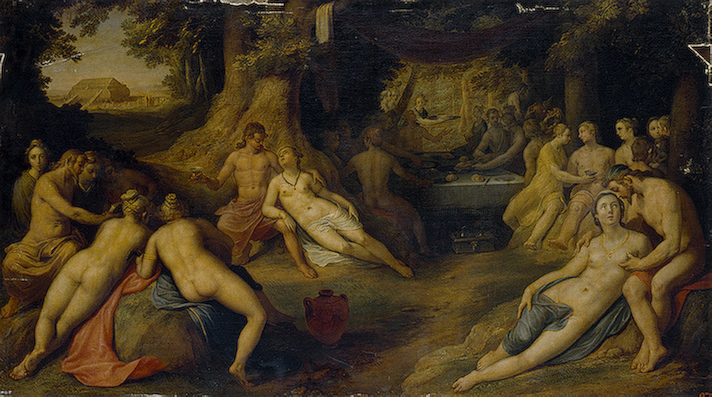
Sinners before the Flood, 1594 Cornelis Cornelisz. van Haarlem
After the Flood, Circa 1588 Cornelis Cornelisz. van Haarlem

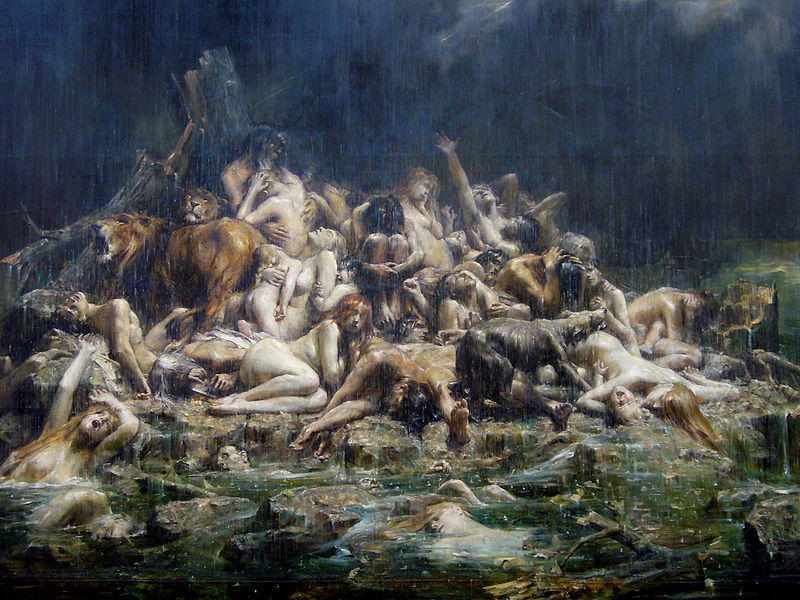
This is what Judgment looks like:

The deluge, Léon Comerre  (1850–1916) 

This is what grace looks like:

Noah’s flood KAULBACH, Wilhelm von (1805-1874)

How so? you ask. How is this grace? The serpents are writhing, the people are dying! Well, don’t focus on the serpents and the people. It is one way we diminish His holiness and His mercy. Focus on Him and His protected righteous and the fact that His promises of salvation are sure. The angels ministering, the ark itself was a lengthy warning to the same people who are now crying for the door to be opened. “Come, my people, enter you into your chambers, and shut your doors about you: hide yourself as it were for a little moment, until the indignation is past.” He made a way for the righteous to be saved!

Please answer His call, and repent!

Once the owner of the house gets up and closes the door, you will stand outside knocking and pleading, ‘Sir, open the door for us.’ “But he will answer, ‘I don’t know you or where you come from.'” (Luke 13:25)

Don’t grumble against each other, brothers, or you will be judged. The Judge is standing at the door!” (James 5:9)

Posted in discernment, Uncategorized

The global church is bloated with counterfeit Christians

On that day many will say to me, ‘Lord, Lord, did we not prophesy in your name, and cast out demons in your name, and do many mighty works in your name?’ And then will I declare to them, ‘I never knew you; depart from me, you workers of lawlessness.’ (Matthew 7:22-23).

A few days ago I’d mentioned I had heard a song from 1964 by the Sego Brothers and Naomi called Sorry, I Never Knew You. In the song, a man was dreaming that he was standing before Jesus on Judgment Day and to his shock, he was placed on Jesus’ left. He heard Jesus say to him, “I never knew you.” It was the first Gospel song to sell 1 million copies.

Link to song

The verses in Matthew, to me, are some of the most haunting and devastating prophecies in the Bible. Prophecy is surer than a promise, it will happen. On that day many people who claim to be Christian but are not will try to prove it to Jesus by recounting their deeds in His name, but sadly, they were self-deceived and will be sent to the Lake of Fire for eternal torment instead.

The problem of professing Christians who do not actually possess Him is significant. The global church is bloated with counterfeit Christians, some of whom know they are false and gleefully upset whole families and sneakily pollute their church. (Titus 1:11, Jude 1:4). Others have only a dim clue they are false but never repent or even try to seek him, perhaps lazily believing their deeds will be enough to get them to heaven instead of repentance and faith. Others have no idea at all they are on the broad path to destruction.

External Christianity, professing Christianity possesses millions of people who feel like Christians, who have been induced into thinking they are Christians, who live with the hope of entering heaven and escaping hell, but will find at the end that they were wrong. There are millions of people who claim to believe in Jesus, who use His name who call Him “Lord,” who say they believe in Him, expecting heaven, only to receive hell. John MacArthur

Occasionally someone asks me about their faith as a Christian. They’re doubting. They ask questions or share concerns about the genuineness of their faith. Sadly, I hear others responding to doubters superficially, saying that the doubter should dismiss these doubts out of hand, because ‘it’s just satan messing with you.’

While that certainly could be the case, sometimes the person really isn’t saved. They’ve become genuinely worried when they perceive a major difference between their ‘walk’ with Jesus and others’ walk with Him. These queries should be taken seriously, very seriously. Not everyone who professes faith possesses the Spirit.

RC Sproul often speaks of the difference between a mere profession of faith, and the possession of it. The key is assurance. In this article titled “Faith and Fruit”, Sproul says,

One thing that is sometimes neglected in the discussion of spiritual growth is the fact that the assurance of our salvation contributes mightily to our maturity. If we have a proper understanding of assurance, it becomes an impetus for holy living. When we know that we belong to Jesus, our love for Him motivates us to obey His commands and thus we increasingly display the reality of salvation.

In the final analysis, any assurance we have of salvation is grounded in the person and work of Christ. By His life, death, resurrection, and intercession, He has demonstrated His full ability to save His people. We are justified because of His righteousness, and so the confidence we have in our salvation is not ultimately a confidence that we have in ourselves but a confidence that we have in the Savior.

Despite this fact, an important existential question remains. If true faith is the instrument by which the righteousness of Christ is imputed to us, how do we know that we have true faith? How do we know that we are not only professing faith but also possessing it?

There are several evidences of true faith. One of the most important is whether or not we have love for Christ at all in our hearts.

Dr Sproul continues with other pieces of evidence. It’s a good article, and short.

In the weeks after I was first saved, I was convinced that I could grow just as much by watching TV preachers and not have to go sit in a congregation. I’d never attended church in my 42 years of life (except for a wedding, baptism, or event as a visitor) and I definitely didn’t want to start. So I stayed at home for almost a year and watched Joel Osteen.

In 2004 he was at the height of his popularity. He was in the throes of buying the Compaq Center which would host the tens of thousands of people that flocked to his church. I liked Osteen for three reasons.

1. He made me feel good.
2. I was fascinated with his rhetorical ability. As a rhetorician and an academic I was interested in how he held an audience week after week, and how he continually crafted his 28-minute ‘story arc’ so perfectly
3. All those tens of thousands of people could not be wrong.

Someone gave me a Bible, thankfully, and once I began comparing what Osteen said with what the Bible said, it was game over. The Spirit exposed Osteen to me as a liar.

But back to the numbers. Many people think that because a church is large or that so many people attended the Crusade and “came forward” or so many youths were saved at camp etc. that these numbers are evidence of genuine conversion. Not so! Quite often, it’s the opposite. (Luke 6:26). I remember a few years ago when John MacArthur hosted the Strange Fire conference. This was a conference designed to scripturally expose practices that are misleading hundreds of millions of people.

Tim Challies live-blogged the conference. He shared the numbers. One objection to the conference was that it was making a big deal of only a small part of the movement, the so-called lunatic fringe. Not so, Challies said.

[Naysayers claim] This issue is only true of the extreme lunatic fringe side of the movement. MacArthur believes that this statement is patently untrue. There is error in this movement all the way through it. 90% of the movement believe in the prosperity gospel. 24 to 25 million of these people deny the Trinity. 100 million in the movement are Roman Catholic. This is not characteristic of the fringe. This is the movement and it grows at a rapid rate.

I want to turn back to Matthew 7:22-23, the verse where Jesus said ‘many will say to me, Lord, Lord…’. I looked up the word “many” in the Greek. In this verse, by Strong’s Greek Dictionary, it is the word polloi, main word polys.

polýs – many (high in number); multitudinous, plenteous, “much”; “great” in amount (extent).
4183 /polýs (“much in number”) emphasizes the quantity involved. 4183 (polýs) “signifies ‘many, numerous’; . . . with the article it is said of a multitude as being numerous” (Vine, Unger, White, NT, 113,114) – i.e. great in amount.

Do you see the issue??? ‘Many’ is an exceedingly great number! A great quantity. It’s not just the jungle tribesman who will be rejected, not just the militant atheist. It is possibly the woman sitting next to you in the pew! Maybe the youth who served on all the committees! Hopefully not the long-term deacon!

I’m not saying that we should go around looking askance at every person in the church, suspicious of their faith or standing before Jesus. I am saying that first, the issue is so much bigger than people think. Hundreds of millions of professing Christians on this earth at this very moment think they are going to heaven but they are not. How much do you have to hate them to let them keep thinking that? It’s one great, biblical reason that the Strange Fire conference was loving.

And second, if a person comes to you unsure of their faith, don’t dismiss their concerns. Really come alongside them and delve. Sit down, listen, and love them. If they wonder and they trusted you enough to come to you, then it’s a serious conversation that needs to be had.

Third, if you have known a sister or brother a long time and there does not seem to be any fruit whatsoever, and instead you see a long-term pattern of rebellion of one kind or another (they promote strife, they gossip and slander, they refuse to submit to their husband, etc) then if you have a good relationship with that person, and there seems to be a good moment to sit down over coffee, gently bring up the issue. The book of 1 John is helpful here.

Remember the word polys. ”Much in number, emphasizing the quantity involved. We love Jesus and have no issue with His right to reject whom He will reject and judge those whom He will judge. It will be a glorious moment of vindication where we can praise Him in His final victory over His enemies. However, while we are still here on earth, we love and care for our neighbors. What a devastating moment if the Lord says “I never knew you.” But what a glory to His Spirit if you have helped a person examine their faith, discipled a wobbler, prayed for a person of whose faith you were unsure, and on the Day they come out the other side and are placed on Jesus’ right! Oh what a day that will be.

——————————–

Further Reading

Do Not Hinder Them, book by Justin Peters

This article might help. There are all kinds of different Counterfeit Sanctifications.

Also, Dr MacArthur’s pamphlet, “Is it Real? 11 Tests of Genuine Salvation.”

Posted in prophecy, Uncategorized

Predestination means people are elected as vessels of wrath, too. Part 2

The verse to consider today is from Romans 9:21-24

Has the potter no right over the clay, to make out of the same lump one vessel for honorable use and another for dishonorable use? 22 What if God, desiring to show his wrath and to make known his power, has endured with much patience vessels of wrath prepared for destruction, 23 in order to make known the riches of his glory for vessels of mercy, which he has prepared beforehand for glory— 24 even us whom he has called, not from the Jews only but also from the Gentiles?

There are vessels of mercy, and there are vessels of wrath. Considering anything regarding God is weighty and should fill the saved and the non-saved with awe and humility. But to really consider His work of judgment should bring to mind the famous comment attributed to martyr John Bradford,”There but for the grace of God go I”.

Here is Scottish pastor Robert Murray M’Cheyne preaching on the Romans verse. In my opinion, it’s brilliant. I’ll post M’Cheyne’s point 3 tomorrow, Lord willing. Part 1 is hereM’Cheyne’s full sermon is here.

~~~~~~~~~~~~~~~~~~~~~
The Vessels of Wrath Fitted to Destruction

I come now to the second reason why any are left to perish–it is, that God may show his power. “What if God, willing to make his power known?” We are frequently told in the Bible of the power of God. He said to Abraham, “I am the Almighty God.” We are told in the ninety-third Psalm, that “the Lord on high is mightier than the noise of many waters; yea, than the mighty waves of the sea.” We are frequently told of his almighty power; and not only so, but we have brilliant examples of it.

The first upon record is creation. “God said, Let there be light: and there was light.” “He spake and it was done – he commanded and all things stood fast.”

Another example of the same thing is, the constant providence of God. “In him we live, and move, and have our being.” He rides on the swift wings of the wind.

Another example of the power of God is, his restraining and bridling of the wicked. “Be ye not as the horse, or as the mule, which have no understanding, whose mouth must be held in with the bit and bridle.” – Psalms 32:9. This is the way in which God holds the wicked.

Another way in which God makes his power known is, in the conversion of souls. “Not by might, nor by power, but by my Spirit, saith the Lord.” This is said to be “the wisdom of God and the power of God.” I believe the converting of a soul is something greater than the making of the world.

Brethren, there is one exhibition of divine power that yet remains – it is, the destruction of the wicked. “What if God, willing to shew his wrath, and to make his power known, endured with much longsuffering the vessels of wrath fitted to destruction?” I believe, dear friends, that the reason why God has raised up Pharaohs is to show his power in them. He said to Pharaoh, “For this cause have I raised thee up, that I might show my power in thee.” No, I say, in regard of those of you in this congregation who will die unsaved, that God has raised you up, to show his power in you. Thus, it is said in Isaiah 62, “I will tread them in mine anger, and trample them in my fury; and their blood shall be sprinkled upon my garments, and I will stain all my raiment.” And then in Revelation 18, “She shall be utterly burned with fire; for strong is the Lord God who judgeth her.” And we are told by our Lord in Matthew 10:28, to fear God, “who is able to destroy both soul and body in hell.” You will notice in this passage that he says, “God is able to destroy”; and therefore, brethren, it is plain that there must be some great power exercised in his destroying the wicked; and I think it is to consist in this – God will destroy their well-being, but not their being. Here, then, is another exhibition of the power of God.

When lately in the north of Scotland, I stood on the sea-shore, and saw the rocks standing out of the sea. It was very remarkable to stand and see the mighty waves dashing upon the rocks. There were two things remarkable in it: first, the greatness of the rocks on which the waves dashed: second, the rocks remaining unmoved – no force of the waves could move them. Brethren, this scene is an emblem of what will be witnessed another day, when God shall pour out his wrath on the wicked. Ah, brethren! will it not be fearful to see God put out his power upon the wicked – to see him upholding them with one hand, and pouring out his wrath upon them with the other? Surely, brethren, the power of God’s wrath is very great. If any of you have seen a great furnace, you will have seen the power that the fire has; but fire is God’s creature. What must his power be who is the Creator?
——————————–

Further Reading

Predestination means people are elected as vessels of wrath, too. Part 1
Predestination means people are elected as vessels of wrath, too, part 3

Jesus’ Predestined Life

Is Predestination biblical?

Posted in prophecy

Predestination means people are elected as vessels of wrath, too. Part 1

A few days ago I’d posted an essay about predestination. This is the doctrine where the Bible teaches that God is completely sovereign over everything that happens, including individual salvations. He elects people to salvation, independently and apart from foreknowledge of any decision they make. It’s all His grace, and not our decision.

People dislike that doctrine and fight against it. One of the reasons people resist the plain truth of the doctrine is that people want to think that somewhere in their heart or mind, they chose God. However, we are dead in sins and trespasses and have no ability to choose God, or ‘make a decision’ about our salvation. It is granted to us. (Galatians 3:22). We have no part in it, except the resulting gratitude and service in His name.

The verse to consider today is from Romans 9:21-24

Has the potter no right over the clay, to make out of the same lump one vessel for honorable use and another for dishonorable use? 22 What if God, desiring to show his wrath and to make known his power, has endured with much patience vessels of wrath prepared for destruction, 23 in order to make known the riches of his glory for vessels of mercy, which he has prepared beforehand for glory— 24 even us whom he has called, not from the Jews only but also from the Gentiles?

There are vessels of mercy, and there are vessels of wrath. Considering anything regarding God is weighty and should fill the saved and the non-saved with awe and humility. But to really consider His work of judgment should bring to mind the famous comment attributed to martyr John Bradford, “There but for the grace of God go I”.

Here is M’Cheyne preaching on the Romans verse. In my opinion, it’s brilliant. I post ed M’Cheyne’s point 2 here. I’ll post point 3 tomorrow and the next day, Lord willing. The full sermon is here.

~~~~~~~~~~~~~~~~~~~~~

The Vessels of Wrath Fitted to Destruction

The following sermon preached on the afternoon of March 12, 1843, was the author’s last in St. Peter’s. “It was observed, both then and on other occasions,” says Andrew Bonar, “that he spoke with peculiar strength upon the sovereignty of God.” The following evening McCheyne’s illness commenced and on Saturday, March 25, he went to the Saviour whose glory he lived to proclaim.
“What if God, willing to shew his wrath, and to make his power known, endured with much longsuffering the vessels of wrath fitted to destruction: and that he might make known the riches of his glory on the vessels of mercy, which he had afore prepared unto glory?” – Romans 9:22,23

In a former discourse, brethren, I attempted to show you that the reason why God will punish the wicked eternally is, because he loveth righteousness. It is said in the eleventh Psalm, “Upon the wicked He shall rain snares, fire, and brimstone, and an horrible tempest: this shall be the portion of their cup, for the righteous Lord loveth righteousness.” I then tried to show you, that God has created hell, and will maintain it for ever, not because He loves human pain – I believe it is not so, nor is it because He is subject to passion, as men speak of passion – but because the righteous Lord loveth righteousness.

And I showed you, as you will remember, what a certainty hell is to the wicked. If it had its origin in the love of human pain, then you might have hoped that it would have an end; or, if it proceeded from passionateness, then it might cool; but ah! when it proceeds from Jehovah’s love of righteousness, I see, brethren, in that a reason why “the worm dieth not, and the fire is not quenched.”

There is a second question which no doubt has occurred to you: why are there any left unpardoned at all? Why was Adam left to fall? Could God not have held him up? Or, if it was necessary that Adam should fall, in order that Christ might die, why are not all saved? Surely there is efficacy in the blood of Christ to pardon all – why, then, are not all saved? There are many answers to that question which we will know in a higher state of being; but here is one; “What if God, willing to show His wrath and to make His power known, endured with much longsuffering the vessels of wrath fitted to destruction: and that He might make known the riches of His glory on the vessels of mercy, which He had afore prepared unto glory?” You will notice, brethren, that in these words the apostle Paul tries to give an answer to that question. He does not answer it directly, he employs a “what if”.

Let us enter into this subject a little more deeply. There are three reasons set down here why men are allowed to perish.

I. The first is, that God was willing to show His wrath. These words are terrible. We are told frequently in the Bible of the wrath of God. It is not like human wrath: it is calm, settled – it consists principally in a regard to what is right. This is the wrath of God. We are told a great deal about it in the Bible. It is revealed against all sin. “For the wrath of God is revealed from heaven against all ungodliness and unrighteousness of men, who hold the truth in unrighteousness.” – Romans 1:18 Observe the word “all” – it is against all sin. Then Colossians 3:6, “For which things’ sake the wrath of God cometh on the children of disobedience.” We are told also, brethren, that this anger is constant. “God is angry with the wicked every day.” – Psalms 7:11. The bow of God’s justice is, as it were, already bent against the wicked, the arrow of God’s is already on the string against the wicked. And then we are told that His wrath is intolerable. In the Psalm which we were singing (Psalms 90:11), it is said, “Who knows the power of thy wrath?” And we are told in Revelation, “The great day of His wrath is come, and who shall be able to stand?”

But we learn more by example than even by these declarations. We have many examples of God’s wrath and its consequences. The first example we have is, his casting the angels out of heaven. We are told by Jude, “That the angels which kept not their first estate, He hath reserved in everlasting chains, under darkness, unto the judgment of the great day.” And we are told by Peter, “That God spared not the angels that sinned, but cast them down to hell, and delivered them into chains of darkness, to be reserved unto judgment.” Now, brethren, in several respects this was one of the greatest examples of divine wrath we have, for it seems to have happened in one day. One day these angels were in heaven – the next in hell. One day they were angels of light – the next fiends of darkness. And then this made it fearful, when the Lord left them no room for repentance. One thing the universe might have learned from this was, that God will certainly punish sin.

Another example of God’s punishing sin was not in heaven, but one earth, when He sent the deluge upon it. “God saw that the wickedness of man was great in the earth, and that every imagination of the thoughts of his heart was only evil continually. And it repented the Lord that He had made man on the earth, and it grieved Him at His heart. And the Lord said, I will destroy man, whom I have created, from the face of the earth.” And so it came to pass: “The flood came, and carried them all away;” and it has left traces on our world still, to show that God will not fail to punish sin.

Another example of divine vengeance was, when God destroyed Sodom. “Now, the men of Sodom were wicked, and sinners before the Lord exceedingly.” The cry of its wickedness went up to heaven, and God sent down two angels, to see if it was according to the cry that came up; and they found it even so; and, when they had taken out just Lot, God rained fire and brimstone upon the devoted city; and he has left traces of it there to this hour.

There was yet another exhibition of divine wrath on earth – it was the death of God’s dear Son. If ever there was a time when God could have said that he would forego his wrath it was surely this. It was this for two reasons. First, because the object of that wrath was dear to God. There never was on in the universe so dear to God as his Son. And another reason was, Christ had no sin of his own. Just as his robe was seamless, so was his soul sinless. Nay, brethren, that one act of his – laying down his life, was so glorious, as an exhibition of God’s justice, that the universe never saw its “marrow”. “Yet it pleased God to bruise him.” These words do not give the least shadow of his suffering from God on account of our sin. Brethren, if any thing in the world can show that God will punish sin, it was the death of his dear and sinless Son.

There is one exhibition of his wrath yet to come. Verse 22 – “What if God, willing to shew his wrath, and to make his power known, endured with much longsuffering the vessels of wrath fitted to destruction?” God is yet to destroy the souls that he has made–not the angels that fell, for he has done that already, when he cast them into hell, but the souls on which he has waited. There is to be a new exhibition of wrath that the world never saw the like of before. He is going to show what he will do to the despisers of his Son – to those who despise his gospel. it will be a new thing when “God will be revealed from heaven in flaming fire, taking vengeance on them that know him not, and that have not obeyed the gospel.” God waits to show his wrath. Ah, brethren! it will be fearful to feel it – it is fearful even to think of it. so I believe it will be with the wicked: they will be beacons, to show how God will punish sin.

~~~~~~~~~~~~~~~~~~~~~
Posted in prophecy, Uncategorized

Prophecy: They sang the song of Moses in Exodus AND Revelation

When the Israelites were miraculously delivered from their bondage to the Egyptians, they sang a song of praise. This is known as the Song of Moses. It’s an ode to the one True God, who is all-powerful. The Israelites, led by Moses and Aaron, knew that God was God. They knew who He is.

He is a man of war, who smites enemies. He is a God of wrath,  and power, and salvation. He does wonders that make His people tremble. He is King of Kings, who dismays the kings of the earth. He is mighty. He is to be exalted.

Please read this wonderful song.

The Song of Moses, Exodus 15:1-18

“I will sing to the Lord, for he has triumphed gloriously;
the horse and his rider he has thrown into the sea.
2 The Lord is my strength and my song,
and he has become my salvation;
this is my God, and I will praise him,
my father’s God, and I will exalt him.
3 The Lord is a man of war;
the Lord is his name.
4 “Pharaoh’s chariots and his host he cast into the sea,
and his chosen officers were sunk in the Red Sea.
5 The floods covered them;
they went down into the depths like a stone.
6 Your right hand, O Lord, glorious in power,
your right hand, O Lord, shatters the enemy.
7 In the greatness of your majesty you overthrow your adversaries;
you send out your fury; it consumes them like stubble.
8 At the blast of your nostrils the waters piled up;
the floods stood up in a heap;
the deeps congealed in the heart of the sea.
9 The enemy said, ‘I will pursue, I will overtake,
I will divide the spoil, my desire shall have its fill of them.
I will draw my sword; my hand shall destroy them.’
10 You blew with your wind; the sea covered them;
they sank like lead in the mighty waters.
11 “Who is like you, O Lord, among the gods?
Who is like you, majestic in holiness,
awesome in glorious deeds, doing wonders?
12 You stretched out your right hand;
the earth swallowed them.
13 “You have led in your steadfast love the people whom you have redeemed;
you have guided them by your strength to your holy abode.
14 The peoples have heard; they tremble;
pangs have seized the inhabitants of Philistia.
15 Now are the chiefs of Edom dismayed;
trembling seizes the leaders of Moab;
all the inhabitants of Canaan have melted away.
16 Terror and dread fall upon them;
because of the greatness of your arm, they are still as a stone,
till your people, O Lord, pass by,
till the people pass by whom you have purchased.
17 You will bring them in and plant them on your own mountain,
the place, O Lord, which you have made for your abode,
the sanctuary, O Lord, which your hands have established.
18 The Lord will reign forever and ever.”

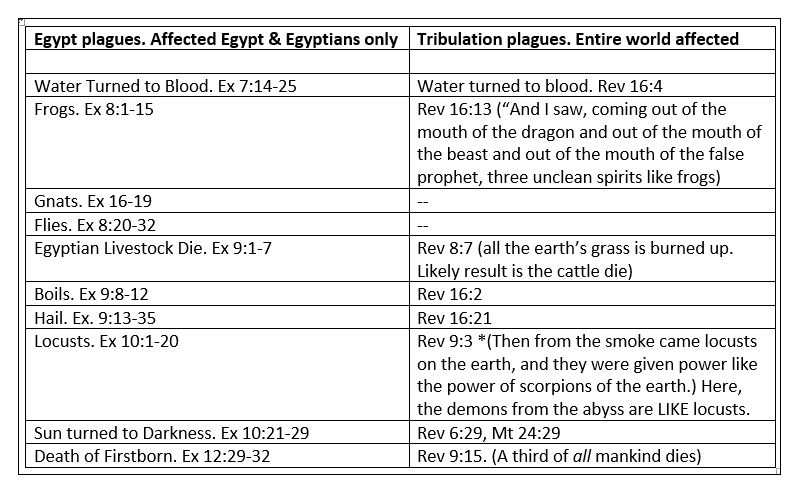
You might recall the ten plagues of Egypt that God placed on Pharaoh and his people. They were step-for-step dethronings of the Egyptian gods. God demonstrated He is the One True God with power over all the false gods the Egyptians worshiped. The plagues were also punishment for rebelling against God.

God has promised that after the rapture, when all the earth’s people who rebel against Him, from kings on down to slaves, they will be punished in wrath for their rejection of Him. (Revelation 6:15-16). At that time He will dethrone not only all false gods, but the false god of all time- satan. God will send to people of the earth plagues that are in like kind to the plagues God sent to Egypt. In Exodus, the plagues occurred just to the Egyptians. Even when the sun was darkened, the Israelites had light inside their own homes. (Exodus 10:23). Even when the Egyptian cattle died, the Israelite cattle lived. (Exodus 9:6). God is that precise.

During this post-rapture time of wrath, called The Tribulation (Or The Time of Jacob’s Trouble, Jeremiah 30:7), all the earth will be affected by these plagues. Everyone. During that time many will come to Christ and be saved, but most of the newly saved believers will be martyred. We read in Revelation, that just as the Hebrews sang the song of Moses in praise to God after their deliverance, the martyred will also sing the Song of Moses. We read this in Revelation 15:2-4

And I saw what appeared to be a sea of glass mingled with fire—and also those who had conquered the beast and its image and the number of its name, standing beside the sea of glass with harps of God in their hands. 3 And they sing the song of Moses, the servant of God, and the song of the Lamb, saying,

“Great and amazing are your deeds,
    O Lord God the Almighty!
Just and true are your ways,
    O King of the nations!
4 Who will not fear, O Lord,
    and glorify your name?
For you alone are holy.
    All nations will come
    and worship you,
for your righteous acts have been revealed.”

Here is a side by side comparison of the plagues of Egypt with the plagues of the tribulation, in both cases, God’s people were delivered from bondage. Click to enlarge.

Barnes’ Notes explains the parallels between the two circumstances of the singing of the song of Moses, at the commentary of Revelation 15:3,

Barnes’ Notes on the Bible
And they sing the song of Moses the servant of God – A song of thanksgiving and praise, such as Moses taught the Hebrew people to sing after their deliverance from Egyptian bondage. See Exodus 15. The meaning here is, not that they would sing that identical song, but that, as Moses taught the people to celebrate their deliverance with an appropriate hymn of praise, the redeemed would celebrate their delivery and redemption in a similar manner. There is an obvious propriety here in referring to the “song of Moses,” because the circumstances are very similar; the occasion of the redemption from that formidable anti-Christian power here referred to, had a strong resemblance to the rescue from Egyptian bondage.

As does Jamieson-Fausset-Brown Bible Commentary

song of Moses … and … the Lamb—The New Testament song of the Lamb (that is, the song which the Lamb shall lead, as being “the Captain of our salvation,” just as Moses was leader of the Israelites, the song in which those who conquer through Him [Ro 8:37] shall join, Re 12:11) is the antitype to the triumphant Old Testament song of Moses and the Israelites at the Red Sea (Ex 15:1-21). The Churches of the Old and New Testament are essentially one in their conflicts and triumphs. The two appear joined in this phrase, as they are in the twenty-four elders.

Our pastor preached on the Exodus plagues and the majesty of God this past Sunday. Our pastor has a Spirit-given talent for bringing the listener up to heights to glimpse up close the power and glory of God, which is itself if breathtaking and humbling. One becomes crushed after glimpsing Him through the exposition of scripture in sch a powerful way. After the sermon, I realized that as difficult as it is for me, who is saved, to see God as He really is (through scripture) that the lost people I know will meet Him in their own flesh. How like grass the flesh is! How they will be brought low, to wither as a match against a universal conflagration! When we ‘see’ God, we understand our own position in relation to Him, first as sinner worthy of all punishment, and then gratefully, as adopted sons and daughters of righteousness.

I recommend the sermon, if you have 40 minutes. It’s worth listening to. As for God’s work between the Old Testament and the New, from Egypt to the Tribulation-

But Jesus answered them, “My Father is working until now, and I am working.” (John 5:17)

Exodus and the Glory of God
What is the book of Exodus really about? We covered the heart of the book (with a brief summary of the whole) this week. Exodus is about God’s Glory in Salvation through Judgment.

May God and God alone be praised!!

Posted in prophecy, Uncategorized

Is it raining frogs yet? Thoughts on US Presidential election

Bob Schieffer is a political reporter. Out of the total 58 elections the United States has enacted since the beginning of our elections process, Schieffer has covered 14 of them. His perspective is valuable by virtue of his lengthy experience as knowledgeable observer throughout 56 years. Yesterday he said the following:

I have seen a few [elections], but I’ve run out of ways to say I’ve never seen one like this. It’s as if the nation is enduring some kind of curse,” Schieffer said on the CBS Evening News Monday.”

Even the non-saved person such as Mr Schieffer knows and understands God’s hand upon the earth and on this nation. We have turned our back on God in all the ways possible and as a result, we are under judgment. God’s hand upon us is not one of soft care but hard abandonment. Romans 1:18-32 has the progression- we have had a sexual revolution, we then had a homosexual revolution, and now we have such reprobate minds we can’t even declare for certainty what our own biological gender is. The nation IS under a curse. Obviously the curse is so palpable that even the blinded mind can detect it.

Schieffer went on to say, “What should we expect next – that it will rain frogs? I wouldn’t bet against it.”

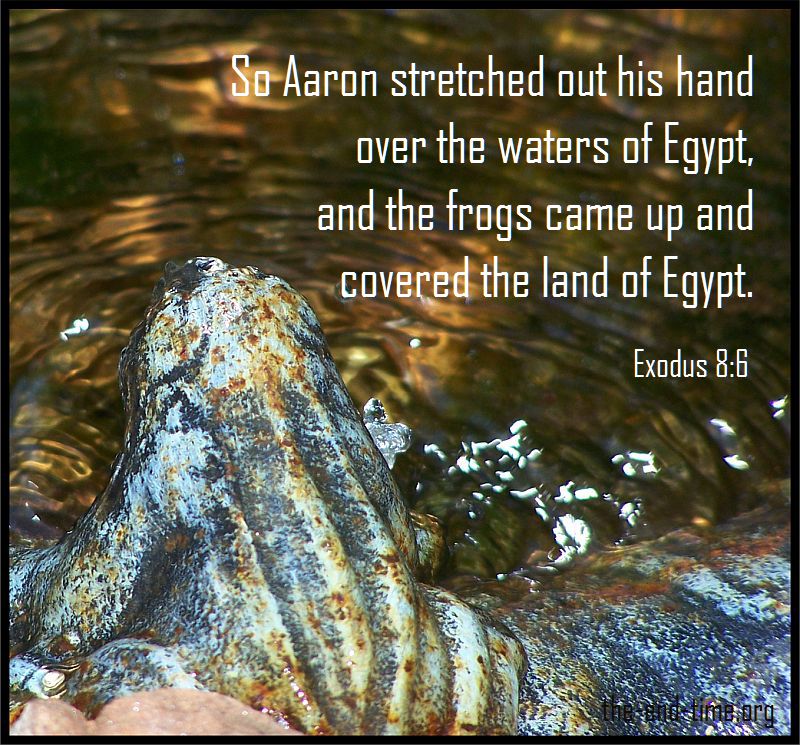
His reference of course is to the biblical plagues God sent upon the Egyptian Pharaoh who would not let the Israelite people go. The plague of frogs was the second plague, as we read in Exodus 7:25–8:15. I surmise that Schieffer’s reference here is to the unnatural conditions one finds in the United States, as compared to previous elections and conditions upon which candidates had promised to fix. How interesting that when one comes up against an unnatural condition, one’s mind turns to the Bible and its plagues or other events in which to compare.

Finally, Schieffer said,

“We tend to call every election the most important of our lifetime, but this one might well be. Those of you who are voting for the first time, take it from me – this election is not business as usual,” Schieffer said. “This one is different – and not in a good way.”

It does feel different. Time will show just how different. It says a lot on how far down the judgment path this nation has traveled since 2008 when many, many folks detected an evil supernatural quality to Obama, so much so that lots of folks thought he was the antichrist. And now they are feeling this election with its crop of candidates is worse? That’s saying something.

When God abandons a nation, He gives us the leaders we deserve. In His judgment against Judah and Jerusalem, He gave them mere boys to lead. (Isaiah 3:4). Later in Isaiah 3 we see that sometimes as a judgment He gives them women to rule over them. (Isaiah 3:12.)

In Isaiah 19:11-12 we see that the nation’s wise men had become foolish, their wisdom vaporizing like dew on a warm day. They could not deal with the crises at hand and had become helpless to fix them. This is because they were ignorant that God’s judgment was the cause.

If any of this sounds familiar, it should. These cycles of blessing and judgment have gone on since the Garden and they will until Jesus concludes His redemptive plan. Humans have always been either one of two things, sinful or righteous in God. If they are sinful they do not know God and worship the creation. Their foolish hearts are darkened and their minds cannot think correctly. If the people of a nation are righteous in Christ, they (we) submit to the temporal happenings with grace and good humor.

Despite the hoopla over the US Presidential Election, God’s redemptive schedule is still on track. Nothing is hindering it, nothing is throwing it off balance or behind schedule. Even if frogs rain down on post-election morning, I will still praise my Savior for His grace and works. This nation is enduring a curse. However, His children are never cursed. Our standing in Him is made righteous through Christ, and our citizenship is in New Jerusalem. Presidents come and go, but our Ruler is eternally on His throne.

Kiss the Son, lest he be angry, and you perish in the way, for his wrath is quickly kindled. Blessed are all who take refuge in him. (Psalm 2:12).