It all started with this pocket notebook I found at a thrift store:
When I’m out and about, and the Holy Spirit connects something I’m doing or seeing to a previous biblical thought, I need to capture it. My mind’s thoughts are increasingly ephemeral, fleeting, mist-like. So I need a notebook around me to write down the connections I’m formulating. The little but pretty notebook got me thinking about pocket notebooks, thoughts, and on-the-go connections my mind might be knitting.
I am working my way through a course called Heaven and Hell led by Dr. Kevin Zuber. The first half of the course focuses on hell and those false philosophies that try to explain hell away. The second half focuses on heaven. I’m almost there.
I’ve learned a lot, but mainly I’ve decided that we do not talk about hell enough.
When you mention ‘Jonathan Edwards,’ people immediately think of his famous sermon, “Sinners in the Hands of an Angry God” a sermon that sparked an awakening in the pagans who heard it, an awakening which spread throughout New England and beyond, thanks to George Whitfield who pushed it on. Edwards is also known for his sermon titled “A Faithful Narrative of the Surprising Work of God in the Conversion of Many Hundred Souls in Northampton (1737),” a treatment on justification by faith. This sermon was reprinted and read widely across America and in Britain.
But Edwards was more than just the hellfire preacher. He was genuinely concerned for the sluggish, apathetic, sleepy pagans and the nominal Christians who professed but likely didn’t possess the Spirit. One of his goals was to awaken them to both heaven’s bliss and hell’s agonies. He actually preached on heaven more than hell, but his preaching on hell was startling and made deep impressions.
The following is from his 16 part series (16 parts!!) called “Heaven, a World of Love”. It is from part 16, the last part. Edwards contrasted the bliss of heaven he had already preached on in previous parts, with the holiness of God’s wrath in hell.
I know hell isn’t the most comfortable subject, but it is a big part of the Christian life. When we say ‘I’m saved!’ we should ask, FROM WHAT? From the just penalty of eternity in hell, paying for the sins we performed in this life against a holy God. Every person born on this planet is destined for hell by default because of our sin nature. (Babies and the cognitively unable are another subject). Please, please, gird up your loins, take a deep breath, and read on. We must confront the uncomfortable subject of hell. We must!
When you share the Gospel, DON’T leave out hell.
Here’s Jonathan Edwards:
What has been said on this subject may well awaken and alarm the impenitent. — And,
First, by putting them in mind of their misery, in that they have no portion or right in this world of love. You have heard what has been said of heaven, what kind of glory and blessedness is there, and how happy the saints and angels are in that world of perfect love. But consider that none of this belongs to you. When you hear of such things, you hear of that in which you have no interest. No such person as you, a wicked hater of God and Christ, and one that is under the power of a spirit of enmity against all that is good, shall ever enter there. Such as you are, never belong to the faithful Israel of God, and shall never enter their heavenly rest.
It may be said to you, as Peter said to Simon (Acts 8:21), “Thou hast neither part nor lot in this matter, for thy heart is not right in the sight of God;” and as Nehemiah said to Sanballat and his associates (Neh. 2:20), “You have no portion, nor right, nor memorial, in Jerusalem.” If such a soul as yours should be admitted into heaven, that world of love, how nauseous would it be to those blest spirits whose souls are as a flame of love! and how would it discompose that loving and blessed society, and put everything in confusion! It would make heaven no longer heaven, if such souls should be admitted there. It would change it from a world of love to a world of hatred, and pride, and envy, and malice, and revenge, as this world is! But this shall never be; and the only alternative is, that such as you shall be shut out with “dogs, and sorcerers, and whoremongers, and murderers, and idolaters, and whosoever loveth and maketh a lie,” (Rev. 22:15); that is, with all that is vile, and unclean, and unholy. And this subject may well awaken and alarm the impenitent,
Secondly, by showing themthat they are in danger of hell, which is a world of hatred. There are three worlds. One is this, which is an intermediate world — a world in which good and evil are so mixed together as to be a sure sign that this world is not to continue forever. Another is heaven, a world of love, without any hatred. And the other is hell, a world of hatred, where there is no love, which is the world to which all of you who are in a Christless state properly belong. This last is the world where God manifests his displeasure and wrath, as in heaven he manifests his love. Everything in hell is hateful. There is not one solitary object there that is not odious and detestable, horrid and hateful. There is no person or thing to be seen there, that is amiable or lovely; nothing that is pure, or holy, or pleasant, but everything abominable and odious. There are no beings there but devils, and damned spirits that are like devils. Hell is, as it were, a vast den of poisonous hissing serpents; the old serpent, who is the devil and Satan, and with him all his hateful brood.
In that dark world there are none but those whom God hates with a perfect and everlasting hatred. He exercises no love, and extends no mercy to any one object there, but pours out upon them horrors without mixture. All things in the wide universe that are hateful shall be gathered together in hell, as in a vast receptacle provided on purpose, that the universe which God has made may be cleansed of its filthiness, by casting it all into this great sink of wickedness and woe. It is a world prepared on purpose for the expression of God’s wrath. He has made hell for this; and he has no other use for it but there to testify forever his hatred of sin and sinners, where there is no token of love or mercy. There is nothing there but what shows forth the Divine indignation and wrath. Every object shows forth wrath. It is a world all overflowed with a deluge of wrath, as it were, with a deluge of liquid fire, so as to be called a lake of fire and brimstone, and the second death.
The entire sermon contained in a short booklet you can download free or read online, is here.
A six-part series on the Life of Jonathan Edwards is here at Ligonier. I took this class, it’s good. First message is free, successive lessons are behind a paywall. Or, you can get Nichols’ book Jonathan Edwards: A Guided Tour of His Life and Thought in paperback (used) for $1.99 at Amazon.
Institute for Christian Life: Heaven & Hell by Dr. Zuber is here.
As I arise this morning, January 1, 2024, I reflect on the Lord’s faithfulness to me, and to all His children, His church, and to His word. For eons it has been so. He is the LORD and He does what He says. His promises are pure, holy, and eternal. 2023 was no different. I am grateful for his past faithfulness and promises of future faithfulness.
For we are a sanctuary of the living God; just as God said, “I will dwell in them and walk among them; And I will be their God, and they shall be My people. 17 Therefore, come out from their midst and be separate,” says the Lord. “And do not touch what is unclean, And I will welcome you. 18 And I will be a father to you, And you shall be sons and daughters to Me,” says the Lord Almighty.
Therefore, having these promises, beloved, let us cleanse ourselves from all defilement of flesh and spirit, perfecting holiness in the fear of God.
I was blessed in 2023 with being able to continue in the wonderful job He gave me which was working with children. I continued in my church, another blessing He has given me. I continued in my warm, clean, beautiful home, what a blessing. I had health, means, peace, punctuated by occasional happy surprises.
Aging issues are real. I noticed in 2023 that my mental faculties are dimmer, a bit blurry around the edges. I am not as alert after work as long into the evening as I used to be. I also cannot count on energy being present. Sometimes I have it after work, sometimes I don’t. Sometimes I have it on the weekends, sometimes I don’t. Because of this, after school I tended to slide into less productivity for the Lord. Not reading my Bible as long, not researching as deeply, and sadly also, not reading as many books either secular or theological.
I have never been that successful with “New Year’s Resolutions”. Self-help usually fails. But when it’s a resolve to pursue holiness, to walk more closely with the Lord, to work toward glorifying Him through my earthly decisions, well now, that’s a whole ‘nother kettle of fish, isn’t it! I deeply desire to serve Jesus and please Him.
The Author of Hebrews 12:14, wrote, Pursue peace with all people, and the holiness without which no one will see the Lord.
Be a slave to God Romans 6:22, because ‘the fruit you reap leads to holiness,’
This time of year people usually turn to Jonathan Edwards’ famous Resolutions, as well they should. Beginning in 1722 at age 19, Jonathan Edwards wrote 70 resolutions designed to help him live a holy life.
Edwards was intent on pursuing God’s glory, spiritual good for himself, and the good of fellow man. He was only 19, but several of the resolutions spoke of the end of his life and his eventual death. For me, this one from Edwards kind of sums up the whole resolutions thing: #17,
Resolved, that I will live so as I shall wish I had done when I come to die.
Here at Ligonier in an article titled The Resolution Solution, Gene Edward Veith shows the difference between Edwards’ resolutions and the ones made by Benjamin Franklin who’d taken a cue from Edwards shortly after Edwards issued his. Franklin called his experiment of pursuing 13 virtues in 1726 “A bold and arduous project of arriving at moral perfection”. Gulp. We know where this is going to end, don’t we? Edwards looked to God. Franklin looked to self.
Edwards’ resolves “were focused on God’s glory, Scripture, heaven and hell, and Jesus Christ; Franklin’s were secular, pragmatic, and this-worldly, focused on becoming a good citizen and a successful businessman.”
How did it turn out for Franklin? Did he achieve ‘moral perfection’?
Benjamin Franklin 1706 – 1790)
“Franklin kept a chart upon which he made check marks indicating his progress. When he found that he had problems keeping them all at once, he tried concentrating on one virtue at a time. When he found that he was still not making all that much progress, he eventually gave up the whole plan.“
Sound familiar? Yet Apostle Paul struggled, like we all do. He wrote,
For the good that I want, I do not do, but I practice the very evil that I do not want. 20 But if I am doing the very thing I do not want, I am no longer the one working it out, but sin which dwells in me.
21 I find then the principle that in me evil is present—in me who wants to do good. 22 For I joyfully concur with the law of God in the inner man, 23 but I see a different law in my members, waging war against the law of my mind and making me a captive to the law of sin which is in my members. 24 Wretched man that I am! Who will deliver me from the body of this death? 25 Thanks be to God through Jesus Christ our Lord! So then, on the one hand I myself with my mind am serving the law of God, but on the other, with my flesh the law of sin. (Romans 7:19-25).
Ruth in the Bible had made a resolution. Let’s look at her resolve:
But Ruth said, “Do not plead with me to leave you or to turn back from following you; for where you go, I will go, and where you sleep, I will sleep. Your people shall be my people, and your God, my God. (Ruth 1:16).
Pieter Lastman ca. 1583 – 1633. Ruth Declares her Loyalty to Naomi
Jonathan Edwards was impressed with Ruth’s resolve, writing in his essay “Ruth’s Resolution“,
I would particularly observe that wherein the Virtuousness of this her Resolution consists, viz. That it was for the Sake of the God of Israel, and that she might be one of his People that she was thus resolved to cleave to Naomi. … It was for God’s sake that she did thus, and therefore her so doing is afterwards spoken of as a virtuous behavior in her, Ruth 2:11,12, …She left her father and mother, and the land of her nativity, to come and trust under the shadow of God’s wings,
Our resolutions can be as specific and lengthy as Edwards’ or a simple as Ruth’s. But whatever you resolve, they should not be rested upon self, as Ben Franklin’s was. We should resolve things. We are told to walk, run, pursue God’s standards in obedience. We must ‘work out our salvation with fear and trembling.’ (Philippians 2:12). These are all active verbs. For us to be active we must decide, resolve, commit.
So whatever kind of resolve you have made looking into the New Year, if they are centered on God’s will, His glory, and His kingdom, He will be sure to bless you and sustain you. We don’t resolve to seek moral perfection, we know that cannot happen anyway until the glorification comes. But we pursue Jesus and work to become more like Him every day, day over day. We realize we can’t do it ourselves, even Paul couldn’t. If we look to Jesus always, and rely on the Spirit through prayer, growing in knowledge of His word, and surmounting sin, our victories whether large or small will increase.
Make your resolutions, then put one foot in front of the other, steeple your hands in prayer, keep the eyes focused upward, and walk on into 2024. That’s what I plan to do. Resolved.
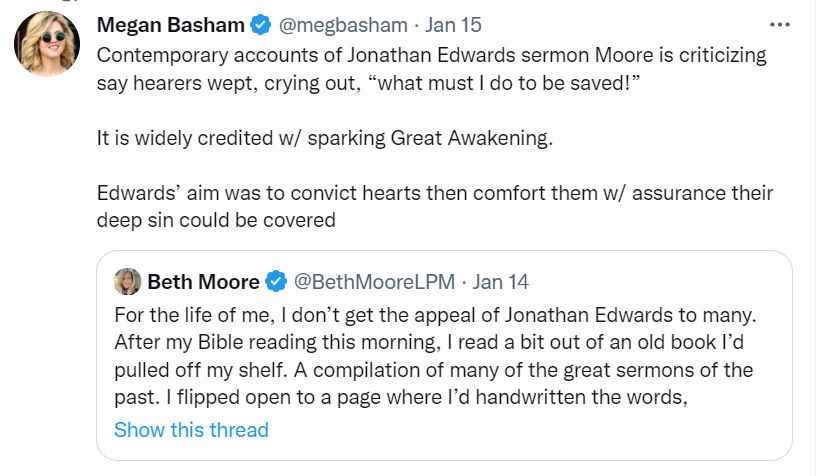
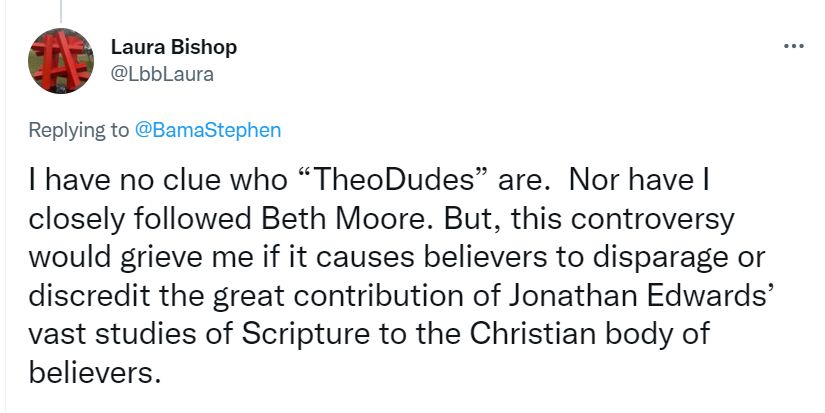
The other day Beth Moore tweeted something stupid in a Twitter thread. She dismissed Jonathan Edwards and his impact, saying for the life of her she can’t figure out the attraction. She disliked his forceful approach to preaching the wrath and conviction of sin, preferring to focus on her usual emotional feelings and such. I introduced Edwards in a previous essay, encouraging people to go look up his works, which are great even 300 years later.
Here is an article remarking on the resulting controversy if you’re interested. I’m much more interested in the replies. I screen shot a few. I love how some people can tweet a pithy reply within the character limits, concisely stating a truth, presenting a witticism, or even doing apologetics in short form.
@MichelleDLesley: “Posting a tweet that caused bunches of people to Google and read “Sinners in the Hands of an Angry God” is probably the greatest gospel impact Beth Moore has ever had.”
LOL
I love Twitter. If you follow the right folks, Godly and intelligent, you will be edified. I learn a lot from folks on that particular social media. I follow good links, see grace, know who to pray for and am prayed for, observe wisdom, charity, and grace. It’s also fun. Not that I can’t experience those things in real life, I do. But Twitter gives me another window to the global church and I’m grateful for it. We are not alone, not a remnant, and the church is thriving!
The Puritans are certainly worth reading. If you follow this blog for even a short time, you know I’m going to bring those guys up, lol. They were part of my pre-salvation, arousing a curiosity in me as to the worth of God, that they would leave all they knew to come to the New World so as to worship. That alone told me the worth of Jesus, something in my sinful, unconverted state I didn’t understand but was curious about.
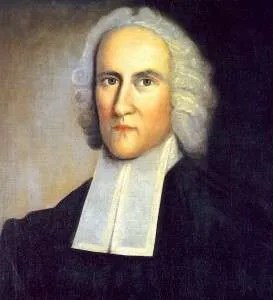
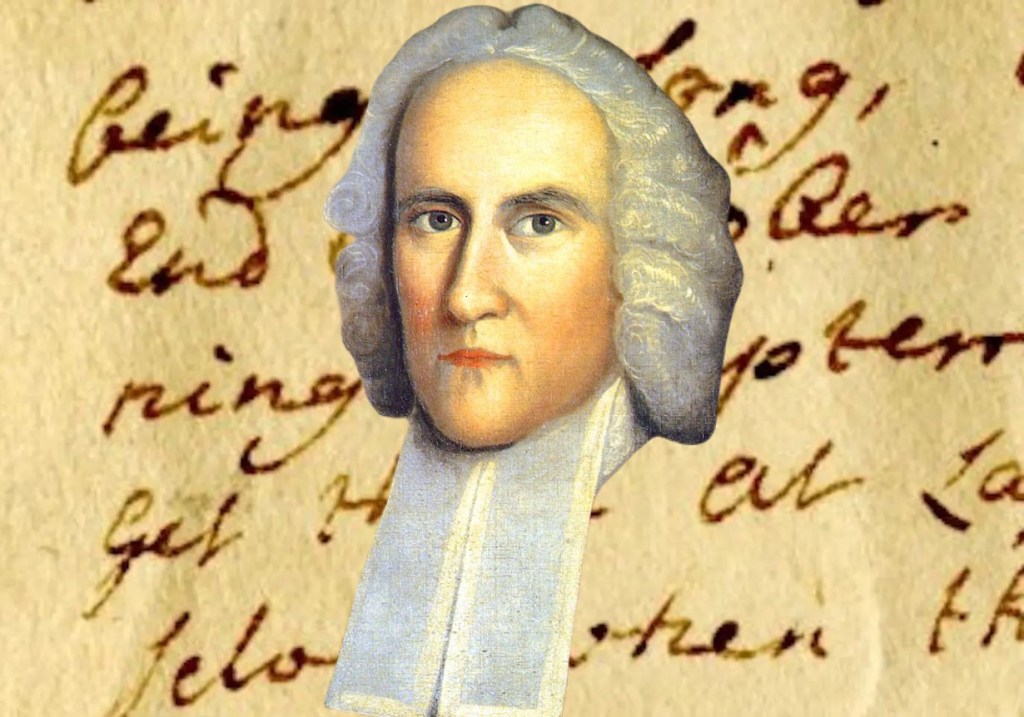
Jonathan Edwards is considered the ‘last Puritan’. He is also almost universally acknowledged as America’s greatest theologian. Joel Beeke, a Puritan authority, said Edwards “was a powerful force behind the First Great Awakening, as well as a champion of Christian zeal and spirituality.”
Edwards lived from 1703-1758. During his shortish life, he wrote profusely, constantly, and expertly. His writings on theology were well-founded and concise, always pointing to the greatness of God.
The Stanford Encyclopedia of Philosophy says “His work as a whole is an expression of two themes — the absolute sovereignty of God and the beauty of God’s holiness.”
Encyclopedia Britannica says, “Jonathan Edwards, (born October 5, 1703, East Windsor, Connecticut [U.S.]—died March 22, 1758, Princeton, New Jersey), greatest theologian and philosopher of British American Puritanism, stimulator of the religious revival known as the “Great Awakening,” and one of the forerunners of the age of Protestant missionary expansion in the 19th century.“
That is an incredible legacy.
He ascended his first pulpit as a sole pastor in Northampton, the most important church in Massachusetts outside of Boston. In his first published sermon, preached in 1731 to the Boston clergy and significantly entitled God Glorified in the Work of Redemption, by the Greatness of Man’s Dependence upon Him, in the Whole of It. Edwards preached 1 Corinthians 1.29, 30, 31, saying at the outset, “All the Good that they have is in and through Christ; He is made unto us Wisdom, Righteousness, Sanctification, and Redemption.”
Edwards is well known for his many books, such as The End for Which God Created the World, The Life of David Brainerd, which inspired thousands of missionaries throughout the 1800s, and Religious Affections, which is “probably the most profound analysis of spiritual experience ever written – and by the most brilliant philosopher/theologian to ever come from North America (and possibly the English language)” says one reviewer.
He also penned the ’70 Resolutions’, “As a young man – a teenager, really – Jonathan Edwards set down on paper a series of thoughts and practices to help cultivate his growth in grace. (See 2 Peter 3.18) Edwards then re-read this list at least once a week to keep his mind focused and renewed. The result was that he became a man of humble godliness, who was to become a significant spark used to ignite one of the greatest revivals known to history.” (Source)
Edwards had a wide range of interests. He was was pastor, writer, theologian, missionary supporter, college President, but also a natural history expert. He was very interested in natural history and took long walks or horse rides with pen and notebook in hand to take notes on his observations. As a precocious 11-year-old, he’d observed and written an essay detailing the ballooning behavior of some spiders. He later published this as a scientific essay titled “The Flying Spider”.
When people think of Jonathan Edwards they most likely think of his most famous sermon, Sinners in the Hands of an Angry God. In that sermon, widely acknowledged for sparking the Great Awakening, a massive revival where many souls were won to God, Edwards used hard truths and vivid imagery to make clear the dangerous state of the unconverted. He used a spider allusion, given his knowledge of and interest in the crawling arachnid. Here are just a few excerpts-
Your wickedness makes you as it were heavy as lead, and to tend downwards with great weight and pressure towards hell; and if God should let you go, you would immediately sink and swiftly descend and plunge into the bottomless gulf, and your healthy constitution, and your own care and prudence, and best contrivance, and all your righteousness, would have no more influence to uphold you and keep you out of hell, than a spider’s web would have to stop a falling rock.
The God that holds you over the pit of hell, much as one holds a spider, or some loathsome insect over the fire, abhors you, and is dreadfully provoked: his wrath towards you burns like fire; he looks upon you as worthy of nothing else, but to be cast into the fire; he is of purer eyes than to bear to have you in his sight; you are ten thousand times more abominable in his eyes, than the most hateful venomous serpent is in ours.
Wrath and God’s offense at sin and sinners is much discarded in the face of love and roses and our worth and lovableness, as many teach today (especially female ‘Bible teachers’). But we must understand the sinfulness of sin, God’s hate toward sin, and our precarious state as an unbeliever. Edwards made that vividly plain to the listeners that day in 1741.
In fact, they were so struck, they kept crying out in spiritual agony, pitching themselves toward the altar asking piteously “What shall we do to be saved?” Eventually the cries and mayhem were such that Edwards had to stop preaching, and pastors went down the aisles to pray with people and talk of salvation.
Though Edwards is famous for his focus on hell in that particular sermon, his voluminous works contained much more focus on heaven. For example, he is known for his book Heaven, a World of Love.
If you are unfamiliar with Jonathan Edwards, he is a good one to look up. His works are edifying and challenging, not to mention noteworthy. His contribution to the faith stands as monumental, 300 years after his passing into glory.
Jonathan Edwards: Teaching series Stephen Nichols (6 videos) I enjoyed this course on Edwards. The first message is free. The rest are behind a paywall. I recommend it though, it’s an easy way to learn about the man, and so interesting.
Jonathan Edwards. Puritanical. Bundling. Church. American Colonial era. Youth. Furniture. It all ties in.
The Puritans founded New England after they departed the European Continent in the early to mid 1600s. Though they are often painted as severe, fun-denying, holier-than-thou type folks, the Puritans were actually leisure-loving folk who took personal holiness seriously. Or, they were people who took holiness seriously, but also knew how to have fun. However, a common practice in Early New England distressed Northampton, Massachusetts preacher Jonathan Edwards to no end: it was called bundling.
As any youth pastor knows, youths’ level of frivolity and hijinks can rise to unmanageable levels in a heartbeat. And it was no different in the mid 1700s when Edwards preached in Northampton. In fact, there were many laws enacted in Massachusetts during that time regarding “nightwalking,” youthful frivolity and hijinks in town which resulted in curfews for youth and fines against parents who allowed their teens to roam at night causing ‘disorder’ and ‘damages’. If the youth’s parents could not give a satisfactory explanation as to the reason for the disorder ‘in the night season’, they’d be fined $17.
Bundling was another custom among the youth, but this time, with parents’ approval. Edwards delicately termed it “company-keeping,” a weird practice that put a courting couple into the same bed together at bedtime, clothed or mostly clothed, sometimes with a board slotted between them, in which they talked and visited with each other through the night. I know. Weird. What were they thinking!? But keep reading, in context, it (might) make sense. At least, it did to the Colonials.
It especially grieved Edwards that these various frivolities often occurred after the Holy Day’s sermon, on Sunday evenings. He blamed the parents, strongly, for being too lenient. In his 1729 lecture “Sin and Wickedness Bring Calamity and Misery on a People,” Edwards said,
“And parents are very much to blame in its being thus. There are those practices that parents commonly allow of that lead to uncleanness, that is so evident to the common light of mankind … I believe there is not a country in the Christian world, however debauched and vicious, where parents indulge their children in such liberties in company-keeping as they do in this country…. Such things as are commonly winked at by parents here, trusting in their children that they won’t give way to temptation, would in almost any other country ruin a person’s reputation and be looked upon as sufficient evidences of a prostitute.” Source- The Jonathan Edwards Encyclopedia, Harry S. Stout Editor.
Whoa. Rough. But true. Not one to give up, Edwards capitalized in his 1741 funeral sermon on the community’s shock of a youth’s sudden death, “Youth Is Like a Flower Cut Down”. He urged the listening youth to take holiness seriously, for the number of one’s days may be short. He said,
not only the gross acts of lasciviousness, but such liberties as naturally tend to stir up lust: that shameful lascivious custom of handling women’s breasts, and the different sexes lying in beds together— the custom of frolicking, as it is called; [and] of the so general custom of being absent from family prayer and being out very late in the night, and those of different sexes sitting up great part of the night together…
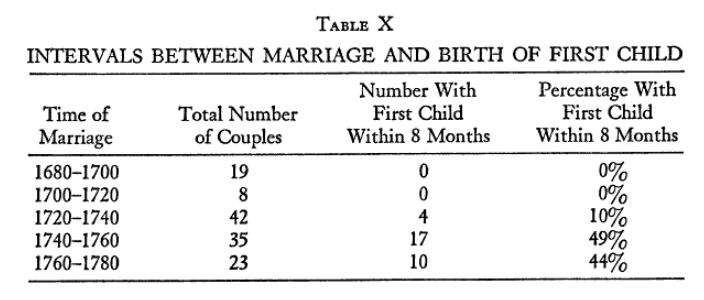
He said almost the same when he reformatted that sermon and delivered it on the occasion of the death of his own daughter, Jerusha, in 1748. Edwards had reason to consistently rail against the widespread custom of bundling. Unwed pregnancies even in strict Northampton where Edwards preached rose to 10%, and the rate of pre-marital pregnancies was much higher elsewhere. “The percentage of couples with a first child born within eight and a half months of marriage jumps from 10 percent from 1720 to 1740 to 49 percent from 1740 to 1760,” writes John Demos in “Families in Colonial Bristol, Rhode Island: An Exercise in Historical Demography” of the folks in Bristol, RI, source below. Any Chaperone to a youth lock-in knows the risks.
John Demos’s research shows a dramatic increase of pre-wedding pregnancies in Bristol, RI, in the heyday of the bundling practice:
Source: The William and Mary Quarterly, Vol. 25, No. 1 (Jan., 1968), pp. 40-57 (18 pages)
Premarital sex was becoming commonplace, thanks to bundling. Even when the parents placed a sack and tied it about the gal’s waist, and left the couple to bundle, sometimes pregnancy still resulted. Imagine that.
Worse, when it resulted in pregnancy, no one thought much about it as long as the couple got married. No stigma was attached. Jonathan Edwards was concerned not only with the bundling practice that resulted in fornication and pregnancy, but the lax attitude regarding these sins. He saw it as a decline in holiness within the family- and said so.
His efforts worked. The sudden death of the youth Billy Sheldon shocked the town’s youth and they gathered with Edwards for prayer meetings and Bible study. He pastorally talked with them and they began to take holiness- and Jesus- seriously. This was the germ of the Great Awakening taking root, which as we know, flew fervently into many hearts in the 1730s and 40s. Praise the Lord for that!
However as the decade of 1740s waned, so had Edwards’ influence.
By 1750, the people of Northampton had grown tired of Edwards’ consistent emphasis on morals and personal holiness. They remembered his stance against bundling, the bad books incident arose, and finally, his refusal to follow the Halfway Covenant (baptizing unconverted children of unconverted parents), caused the the congregation to vote Edwards out in 1750. His stance against bundling is often specifically cited as one of the main reasons for his ouster, as we see from this source-
Fourth, Edwards faced dismissal from his church because of certain moral stands he took while in Northampton. One occurred over bundling, a traditional courtship ritual designed to test the compatibility (and virtue) of a young man and woman by allowing the couple to spend a night together in bed, clothed, usually with only a board between them. While the awakening essentially began as a movement among the youth of Northampton, Edwards’s demise also rested in their affairs. Source: from The Jonathan Edwards Encyclopedia, Harry S. Stout Editor.
The New England folks were certainly attached to the bundling custom. But where does the sofa come in? Part 2 tomorrow!
During preparation for battle, prophet Elisha’s servant was weak kneed and worried. There seemed to be a lot of them and not a lot of us.
When the servant of the man of God rose early in the morning and went out, behold, an army with horses and chariots was all around the city. And the servant said, “Alas, my master! What shall we do?” 16He said, “Do not be afraid, for those who are with us are more than those who are with them.” 17Then Elisha prayed and said, “O LORD, please open his eyes that he may see.” So the LORD opened the eyes of the young man, and he saw, and behold, the mountain was full of horses and chariots of fire all around Elisha. (2 Kings 6:15-17).
Isaiah, Ezekiel, and Daniel saw the throne of God in heaven through visions. Paul (we assume) was lifted up to heaven and saw things he could not express. John, Peter, James saw heaven come down in the form of a transfigured Jesus in His glory. These men had glimpses of things beautiful and glorious. Paul (we assume) seemed especially affected, the way we spoke of the experience in 2 Corinthians 12:7. He said what he saw was of surpassing greatness. The word surpassing here in Greek is hyperbole, you might recognize the term. Here it is in a strong emphatic meaning beyond measure, excessively beyond, surpassing excellence.
This all makes me want to see heaven even more! But what about the opposite? What if we could pray to the Lord as Elisha did, and say, “Lord, open their eyes and show them their future, in punishment and torment in the Lake of Fire, where the worm does not die.” If people could see hell, would they repent? Would they believe God means what He says?
Just imagine for a moment that the eyes of all unconverted men were opened to see the situation in which they stand. Oh! What doleful cries of agony and terror would rise from every dwelling, when they saw that the Almightiness of Jehovah is all ready to be let loose upon them, body and soul, forever. ~M’Cheyne, “The Believer’s Joy”
Would they be aghast, not at seeing God who encircles His throne with holiness and glory so strong it wold kill you to merely glimpse it, but the orange-lit fires of hell, a blazing furnace of sulphur, where the screams and cries of the damned echo eternally.
Jonathan Edwards evoked the picture of hell in his famous sermon Sinners in the Hands of an Angry God. His preaching about our sin and its just and due punishment, sent people flinging themselves into the aisles at the thought of such wrath for sin. Edwards wanted, not to scare them, but to awaken them to the fact that there does exist a just punishment for sin, and that the day of reckoning may come sooner rather than later for any person in the church that day.
The veil had been momentarily lifted through Edwards’ word pictures and viewing that scene in their mind’s eye was one of grief and pain for the hearers. Stephen Williams, who had attended the sermon that day, said that “The [sic] shreiks and crys were piercing and amazing.”
Until salvation comes, unrepentant sinners stand on a precipice so gaping, the fires so hot, hell so yawning, and that the punishment is eternal, that it is hard to grasp the weight and fact of it. Truly, the unregenerate mind does not even try to grasp it.
Fortunately, though God allowed Elisha’s servant to glimpse his majesty and might, we don’t need God to allow glimpses of hell in order to visualize the fact of coming punishment, nor do we need vivid word pictures like Edwards’, as helpful as sermons like his were and are. Any person at any time can read about it in His book, the Holy Bible. Jesus explained about it, the Spirit inspired other verses and passages about the reality of hell. It’s the opposite of bountiful joy, eternal torment. Jesus spoke more about hell than any other issue.
Jesus talks about hell more than he talks about heaven, and describes it more vividly. There’s no denying that Jesus knew, believed, and warned against the absolute reality of hell. Source
It begins and ends there. Learn about a holy God who judges and saves. See the written, inspired descriptions of joys abounding in heaven and torments unspeakable in hell. Comprehend the law and grace available to your inquiring eyes.
In that moment, God gave Elisha’s servant a mercy in allowing him a glimpse of God’s protective might. But in reading the Bible, we can not merely glimpse, but absorb and enjoy learning about Jesus, His love and His wrath- both.
Edwards’ word pictures alone were enough to startle a congregation and elicit moans and cries on the spot. Imagine the real reality of the lake of burning sulphur, of not being lovingly placed there, but thrown, like a used tissue. Of being in it forever. read His word on to gain knowledge of our sin, His punishment for it, and the glorious Gospel of Jesus Christ, the gracious remedy.
By Elizabeth Prata Heaven and Hell: Jonathan Edwards on the Afterlife by John H. Gerstner
Dr. Gerstner was an enthusiastic student of the famous Jonathan Edwards. He spent a good deal of his professional life studying Edwards and his theology. In this book, he examines the teaching of Edwards on the subjects of heaven and hell.
A short work, at times felt more like Cliff’s Notes, but it is such a weighty subject, particularly the way Edwards deals with it, that I don’t know if my heart and soul could stand the pain of reading about hell any more deeply that was already presented.
I didn’t agree with all Edwards had to say on the subject (i.e. earth being the location of hell after the conflagration, or that devils torment us in hell) but alternately, Edwards did raise interesting points. Like this one: are men punished for sins IN the state of punishment as well as in the state of trial?
One comes to appreciate Edwards’ attention to the doctrine. His pleas, constant and earnest as they were, to avoid hell ran consistently with the Bible’s frequency on the subject (3-to-1 in favor of threats and warnings vs comforts and lovelies). Here is one excerpt from an unpublished sermon where Edwards remarks on his own frequency of hell’s mention-
And indeed when I went about preparing this discourse it was with considerable discouragement. I thought it was now some time since I had offered any discourse of this nature. But so many had been offered with so little apparent effect that I thought with myself I know not what to say further.
But however because I must warn you from God whether you will hear or whether you will forbear I have warned you again. It has now been told once more, whether you will yield to the power of God’s Word, to the force of the awful warnings and threatenings which the Word of God sets before you [or not]. If you will not hear now you may possibly solemnly lay these things to heart when you come to die. And if you continue in your stupidity to the last, being given up of God to a dreadful degree of hardness that is beyond the alarm of approaching death, which is the case with some, yet as soon as ever you are dead you will be fully sensible of all.
Edwards’ motivation for the frequency of hell’s mention stems from a vivid understanding of God’s character, his wrath and His grace. His sermons are clear on the wondrous character of God and his unchangeableness in dealing with sin. Edwards fervently wanted his hearers to spend eternity in grace, not wrath. Some were converted, some were not. Some even stayed on the fence, Edwards says that “they were neither awakened, nor at ease.”
Gerstner uses copious amounts of quotes from Edwards’ sermons and writings, and many footnotes for further study.
Edwards once remarked that the only way for men to have ease on earth is to delete the doctrine of hell, and so it is the same to this day. Recommended.
I love to speak of Jesus’s love, mercy, grace, salvation, and sanctification. However I also think it is important to speak of His justice, wrath, and consignment of the rebellious to hell in torment forever. Jesus spoke both of His kingdom to come and hell constantly. Yet, we don’t. We should. Many of those on earth won’t be joining Him in His kingdom to come unless they repent of their sins and believe on Him. Jesus taught quite a bit on wrath, hell and the consequences of sin. I read this week for background to this essay that the Bible runs 3-to-1 on wrath vs. love as a topic.
It may be worth noting that in Deuteronomy 28 (and following), the blessing section (28:1-14) is a great deal shorter than the cursing section (28:15-68).
Paul taught that thinking about and teaching about the rapture and the joy to come is encouraging. It is, but remembering the wrath we ourselves were under before salvation and is still poised over every unbeliever is a worthwhile thing to ponder, too.
I started a new book this week, John Gerstner’s treatise, Jonathan Edwards’ on Heaven & Hell. It’s quite illuminating. Though hell should not be a popular subject, (after all it’s the weightiest in the universe), it should not be marginalized, either. Here is the blurb on the book-
Dr. Gerstner was an ardent student of the famous Jonathan Edwards. In this short work, previously published by Baker, he examines the teaching of Edwards on the subjects of heaven and hell.
Hell is a real place and unconverted people will be cast there at the Day of Judgment. If it not real, then where did Jesus descend to during his three-day death to proclaim to the spirits bound there? (1 Peter 3:18-20). Though people try to debate this, dampen, it (annihilationism, universal salvation), hell is real.
a. Everlasting punishment. Mt 25:46.
b. Everlasting fire. Mt 25:41.
c. Everlasting burnings. Isa 33:14.
d. A furnace of fire. Mt 13:42,50.
e. A lake of fire. Rev 20:15.
f. Fire and brimstone. Rev 14:10.
g. Unquenchable fire. Mt 3:12.
h. Devouring fire. Isa 33:14.
4. Prepared for the devil, &c. Mt 25:41.
5. Devils are confined in, until the judgment day. 2Pe 2:4; Jude 1:6.
6. Punishment of, is eternal. Isa 33:14; Rev 20:10.
7. The wicked shall be turned into. Ps 9:17.
8. Human power cannot preserve from. Eze 32:27.
9. The body suffers in. Mt 5:29; 10:28.
10. The soul suffers in. Mt 10:28.
11. The wise avoid. Pr 15:24.
12. Endeavour to keep others from. Pr 23:14; Jude 1:23.
13. The society of the wicked leads to. Pr 5:5; 9:18.
14. The beast, false prophets, and the devil shall be cast into. Rev 19:20; 20:10.
15. The powers of, cannot prevail against the Church. Mt 16:18.
16. Illustrated. Isa 30:33.
John Gerstner (RC Sproul’s mentor) was an ardent student of Jonathan Edwards’ works, as noted above. From Gerstner’s essay on Edwards’ Rationale of Hell, we read Gerstner’s thoughts interspersed with Edwards’-
“those that have a sinful fear of God fear God as evil, but a right fear fears him as great and excellent.” (Edwards). Thus there is a right and wrong fear of God. This wrong fear of God, fearing him as an evil and dreadful being, drives men from God.
“A sinful fear makes men afraid to come to God.” (Edwards)
But, on the other hand, there is a proper fear of God, as the good and holy being that he is, and this right fear makes men afraid to go from him.
Eve and Adam had a sinful fear of God and they fled from Him. Those who are in Him would have a healthy fear to flee away from Him, but instead fly toward Him in all circumstances. On so many levels, once we are converted, everything turns upside down (or right side up, depending on yoru perspective!)
So he began saying to the crowds who were going out to be baptized by him, “You brood of vipers, who warned you to flee from the wrath to come? (Luke 3:7).
You snakes! You brood of vipers! How will you escape the sentence of hell? (Matthew 23:33)
I’m sorry not to be uplifting or sentimental today. Sometimes I feel the weight of the lost and their permanent eternity, or I give a mournful shaking of my head when I see important topics being shunted aside, and I feel compelled to write about the more unpopular subjects. Hell might not be popular, but it is very real. I recommend John Gerstner (especially at Ligonier.org) and Jonathan Edwards for credible treatment of the subject.
We all want revival. We all want the Spirit of God to enter each one of us and make us obviously set apart into a royal priesthood, doing good and devoting ourselves to prayer, hearing of the word, and breaking bread in loving fellowship. We long for our church and life to mirror the earliest days of the first century church of Acts.
However when churches schedule a special Revival speaker, or goes to a Revival conference, and we emerge smiling for a few days but then the waves of euphoria fade, we call that revival. It’s what we’ve become used to as our experience of “revival.”
Yesterday our pastor read from a biography of Jonathan Edwards, the 18th century theologian and pastor who is ‘credited’ with sparking the Great Awakening in America with his sermon “Sinners in the Hands of an Angry God.”
The extended quote Pastor Mark read was about what life was like in their village while the Awakening (revival) was going on.
Here is Jonathan Edwards from his book, A Faithful Narrative of the Surprising Work of God on what happens in a heart that is falsely revived, IF they are even lucky enough to hear a preacher who preaches sin in the first place, an increasingly rare event nowadays:
Very often, under first awakenings, when they are brought to reflect on the sin of their past lives, and have something of a terrifying sense of God’s anger, they set themselves to walk more strictly, and confess their sins, and perform many religious duties, with a secret hope of appeasing God’s anger, and making up for the sins they have committed. And oftentimes, at first setting out, their affections are so moved, that they are full of tears, in their confessions and prayers; which they are ready to make very much of, as though they were some atonement, and had power to move correspondent affections in God too.
Hence they are for a while big with expectation of what God will do for them; and conceive they grow better apace, and shall soon be thoroughly converted. But these affections are but short-lived; they quickly find that they fail, and then they think themselves to be grown worse again. They do not find such a prospect of being soon converted, as they thought: instead of being nearer, they seem to be further off; their hearts they think are grown harder, and by this means their fears of perishing greatly increase. But though they are disappointed, they renew their attempts again and again; and still as their attempts are multiplied, so are their disappointments.
When the Spirit of God moves, it is obvious what is happening. The community changes immediately. Read what Edwards wrote about life in a truly revived community:
These awakenings when they have first seized on persons, have had two effects; one was, that they have brought them immediately to quit their sinful practices; and the looser sort have been brought to forsake and dread their former vices and extravagances. When once the Spirit of God began to be so wonderfully poured out in a general way through the town, people had soon done with their old quarrels, backbitings, and intermeddling with other men’s matters. The tavern was soon left empty, and persons kept very much at home; none went abroad unless on necessary business, or on some religious account, and every day seemed in many respects like a Sabbath-day.
The other effect was, that it put them on earnest application to the means of salvation, reading, prayer, meditation, the ordinances of God’s house, and private conference; their cry was, What shall we do to be saved? The place of resort was now altered, it was no longer the tavern, but the minister’s house that was thronged far more than ever the tavern had been wont to be.
That is just beautiful. But why wouldn’t it be? The Holy Spirit of God is beautiful. They are simply reflecting Him in a way we are not used to seeing en masse.
The key to revival is awareness of one’s sin and God’s wrath against it. People who have become aware of their sin will naturally do the things Edwards described. Far from being a dolorous position, people who know their sin are joyful, because now they know and understand grace. See more Edwards’ Faithful Narrative-
The unparalleled joy that many of them speak of, is what they find when they are lowest in the dust, emptied most of themselves, and as it were annihilating themselves before God; when they are nothing, and God is all; seeing their own unworthiness, depending not at all on themselves, but alone on Christ, and ascribing all glory to God. Then their souls are most in the enjoyment of satisfying rest; excepting that, at such times, they apprehend themselves to be not sufficiently self-abased; for then above all times do they long to be lower.
Some speak much of the exquisite sweetness, and rest of soul, that is to be found in the exercise of resignation to God, and humble submission to His will. Many express earnest longings of soul to praise God; but at the same time complain that they cannot praise Him as they would, and they want to have others help them in praising Him. They want to have every one praise God, and are ready to call upon every thing to praise Him. They express a longing desire to live to God’s glory, and to do something to His honor; but at the same time complain of their insufficiency and barrenness; that they are poor and impotent creatures, can do nothing of themselves, and are utterly insufficient to glorify their Creator and Redeemer.
A revived community will reflect God’s heart, which is contained in His Son, who is the Word. (John 1:1-5). People’s passion will be to seek God more, through His word. (Hebrews 1:1-2). Edwards sees a love for His word come alive in the people who have been truly revived:
While God was so remarkably present amongst us by His Spirit, there was no book so delightful as the Bible; especially the Book of Psalms, the Prophecy of Isaiah, and the New Testament. Some, by reason of their love to God’s word, at times have been wonderfully delighted and affected at the sight of a Bible; and then, also, there was no time so prized as the Lord’s day, and no place in this world so desired as God’s house. Our converts then remarkably appeared united in dear affection to one another, and many have expressed much of that spirit of love which they felt toward all mankind; and particularly to those who had been least friendly to them. Never, I believe, was so much done in confessing injuries, and making up differences, as the last year. Persons, after their own conversion, have commonly expressed an exceeding great desire for the conversion of others. Some have thought that they should be willing to die for the conversion of any soul, though of one of the meanest of their fellow-creatures, or of their worst enemies; and many have, indeed, been in great distress with desires and longings for it. This work of God had also a good effect to unite the people’s affections much to their minister.
The dominant thread in Edwards’ recounting of the aftermath of the Revival, is self-hate. It’s true. People all around had come to recognize their own depravity, and thus in contrast, God’s beauty. This was what the Awakening helped them see, understand, utter, live. The revival was thrust forward on waves of self-hate.
Martin Luther, as you know, launched the Protestant Reformation. He was a Roman Catholic priest who came to understand the truth of salvation by grace through faith alone in Christ alone, apart from works, and ceremonies, and all the rest; and so he determined that he would confront the Roman Catholic system, the great monolithic system of error and deception, and he selected 95 different statements, 95 different protests – that’s why we’re called “Protestants” – 95 different assertions that ran contrary to Catholicism. He wrote them down and he nailed them on the door of the Castle Church in Wittenberg.
The fourth of his protests, the fourth of his 95 assertions was that a penitent heart, a heart that comes to God and receives salvation is characterized by – here’s his term, “self hate.” Self hate. Quoting from Luther’s fourth statement. “And so penance remains while self hate remains.” He said that self hate was the true interior penitence. “This,” said Luther, “is essential to the gospel.”
This is why revivals of today fail. The audience does not hear a message of self-hate, they hear messages of self-love. Self-love will never, ever revive a heart or convict one of sin.
Special speakers are hired to come to our churches for a week, or people clamber aboard buses to be shuttled to arenas where special speakers await…who give the message that we are worth something to God, we are good, we are just waiting to be whatever we can be. Our dreams can ambitions can be fulfilled. We can have all our rights, privileges, respect, honor, and affirmation, plus Jesus. In today’s revivals, Jesus is the add-on, nestled alongside to a person who is usually pretty good but just needs an extra boost. In Edwards’ Awakening, first the person understands his abasement, comes to see his depravity through Jesus’ eyes, and loathes it. Then and only then, can he see Jesus as He is, glorified, holy, and beautiful.
Tomorrow, we’ll look at a revival in the Bible that is tremendous in its power and effect.






















 the-end-time.org