Posted in encouragement, Uncategorized

Just a closer walk with Thee

I like the Appalachian fiddle instrumental version of the old song Just a Closer Walk With Thee. Here are the lyrics, written by an anonymous or unknown author

I am weak, but Thou art strong;
Jesus, keep me from all wrong;
I’ll be satisfied as long
As I walk, let me walk close to Thee.

Refrain:
Just a closer walk with Thee,
Grant it, Jesus, is my plea,
Daily walking close to Thee,
Let it be, dear Lord, let it be.

Through this world of toil and snares,
If I falter, Lord, who cares?
Who with me my burden shares?
None but Thee, dear Lord, none but Thee.

When my feeble life is o’er,
Time for me will be no more;
Guide me gently, safely o’er
To Thy kingdom shore, to Thy shore.

The only mention of anything sovereign is the word ‘kingdom’ in the last line.

I’ve been watching the biography of Queen Elizabeth II, called The Crown. It’s an excellent biography, by the way, well written, well acted, with sumptuous production values. It is Netflix’s most expensive series to date. They spent a lot of money replicating the surroundings of the kings and queens depicted, and nearly exactly replicated the events they lived through.

One thing that this first season’s series has firmly shown, is that while the crown is a successive institution, the people inhabiting it alternate. Yet the people inhabiting it are still distinct from the commoners. The Queen, her mother, her sister, her father, any of the sovereigns, are isolated. They live behind fences and high walls. When they appear in public they are again shielded. If they are walking, there is always a large distance between the rows of people and the Queen (or the King as it may be). They might walk past the people, but they do not walk with the people.

Jesus is our King. He is King of KINGS and Lord of LORDS! He is the highest of the high. Has any King ever invited the commoners to walk with Him? No! Did King Ahasuerus (Esther’s husband) invite people to walk with Him? No! He decreed that anyone entering his throne room without him having called them there would be put to death! Did King Herod go out and stroll around with Lydia and Timothy and James? No!

Jesus invites us to be His friend, He is our Father, our Brother, our Intercessor, our Priest, our Redeemer, and our Savior. Yet…walking with the King is unheard of!

We sing that song in a lively fashion when we hear it on the radio, because it’s familiar to us and it’s sweet. But think about the words, really think about them. We ask Jesus to walk closer to us And He will!

None of this is news to any of you. But it does us good to think about Him once in a while as the amazing Person He is, King, who does not isolate Himself behind fences and walls. In what other kingdom at any time or anywhere, does the King invite His people to walk with Him? The King who does not dismiss the commoners, but invites them to participate with Him in his sovereignty is to be praised in wonder and awe.

Walking the long road with the King!
Posted in encouragement, Uncategorized

Wynter awakeneth all my care

One of the oldest surviving poems in written form is the Middle English poem Wynter awakeneth all my care. It is thought the poem was written in about 1340, before even Chaucer wrote.

Click to enlarge

As A Clerk of Oxford wrote on their blog,

A translation is inadequate, though; a lot of the power of the poem is in the rhymes, and the untranslatable negatives, especially ‘Nou hit is, and nou hit nys, / Also hit ner nere, ywys’. There are some clever touches, such as the phrase waxeth bare: ‘waxen’ can just mean ‘to become’, but it usually means specifically to ‘grow’ (like the moon, which waxes and wanes; do we use the word in any other context now?). But when leaves fall, waxing bare, it’s the exact opposite of growth; it’s death and depletion.

From the Library of the University of Rochester, we read,

Al that gren me graveth grene. “All that seed men bury unripe.” … “to put something under the ground, cover with earth; bury; plant.” There is no MED gloss for gren, a much-discussed crux, sometimes emended to grein, “grain, seed” (suggestive of John 12:24–25: “Amen, amen I say to you, unless the grain of wheat falling to the ground die, itself remaineth alone. But if it die, it bringeth forth much fruit”).

Regarding the world’s joy…Spring is certainly a joyous time. Shoots and leaves burst forth. Time-lapse photography on the nature channels show flowers veritably bounding from the soil. Flora’s vivid early spring colors bring smiles to all who see.

Summer simmers into a dreamy and languid time. One’s cares still crowd the thoughts, but they are less potent, their robustness competing with sunny joys and relaxing pursuits.

Fall’s surge of color and riotous leaf swarms in wild wind both delight and vex. Stooping to pick up a brightly colored leaf, craning to see the Vee-shape of birds scuttling south, glancing at rushing clouds and crystal skies, breathing the crisp air…

Sadly, these momentary flares of color and movement are soon doused in the harsh embrownment of the darkling season. Winter. No better description of the ground and sky at late fall exists, in my opinion, than Thomas Hardy’s opening scene of The Return of the Native

A Saturday afternoon in November was approaching the time of twilight, and the vast tract of unenclosed wild known as Egdon Heath embrowned itself moment by moment. Overhead the hollow stretch of whitish cloud shutting out the sky was as a tent which had the whole heath for its floor.

The heaven being spread with this pallid screen and the earth with the darkest vegetation, their meeting-line at the horizon was clearly marked. In such contrast the heath wore the appearance of an instalment of night which had taken up its place before its astronomical hour was come: darkness had to a great extent arrived hereon, while day stood distinct in the sky.

Winter’s dark death, dearth of color and lack of life…

Nou hit is, and nou hit nys, Also hit ner nere, ywys; (Now it is and not it isn’t, as if it never had been, indeed!). And yet, what a time, the bleak midwinter, to praise the Lord for all life! He has stripped away the distracting color and movement and delights of flora, and shown us His manifest care. In the bleak midwinter, one that awakeneth all my sorrow, He sustains all life, precious but hidden in His hand. “All passes but God’s will”.

How kind of Him to allow this fallow time so as to see new life resurrecting in spring, just as He came to life from the dead. The frigid season is one that entombs itself but then again bursts with life and joy and color soon enough. “It all goes to nought”, for only a season. The grace of this cyclical and everlasting flourishing is bounteous and beauteous. God is in control!

For in Him all things were created, things in heaven and on earth, visible and invisible, whether thrones or dominions or rulers or authorities. All things were created through Him and for Him. He is before all things, and in Him all things hold together. (Colossians 1:16-17).

The supremacy of Christ, spring, summer, fall, and winter, everlasting supremacy and everlasting life. In him was life, and the life was the light of men. (John 1:4)

Jesus, help that this be known,
And shield us from hell,
For I know not whither I’ll go,
Nor how long here dwell.

No matter. The dormant seed entombed in ice, fleeting on scudding wind, or falling unnoticed on harsh road, I am that unripe seed, not knowing how long here I dwell. But secure am I that as wynter comes, even a death, I will spring forth in joy and color and movement from the very grave that seeks to grip me fast, but never can. The springtime of the eternity in Jesus awaits.

Posted in prophecy, Uncategorized

Ex-Wham! singer George Michael dead

At age 53, on Christmas day afternoon, it appears that George Michael has died “peacefully at his home”. Fox News, BBC, UK Mirror, Business Insider confirm. Here is TMZ

George Michael passed away at his home in England at the age of 53 … his rep confirms.

A rep for the pop star says, “It is with great sadness that we can confirm our beloved son, brother and friend George passed away peacefully at home over the Christmas period.”

Details surrounding Michael’s death have not been released. Police say there’s nothing suspicious about the death, according to the BBC. George was a music legend — and sold more than 100 MILLION albums during his career. Michael launched his career with WHAM! in the ’80s — churning out hits like “Wake Me Up Before You Go-Go” and “Careless Whisper.

The immediate thought whenever a celebrity or local person dies, is always, ‘I wonder if they are surprised at their eternity’. Either way, whether the person died in their sin or they died in Jesus, the fact of their eternity becomes real one second after breath expires, and is a billion times worse, or a billion times better, than he could ever conceive while on earth.

I have a connection to George Michael. I’m 56 years old, three years older than he was, and grew up on his songs. I wasn’t saved until I was in my forties, so I enjoyed pop songs with all the range of lyrics from sweet to profane, for half my adult life. I liked Wham! and I liked George Michael’s songs.

But even more than that, music is so forceful especially when you’re a teen and young adult. The lyrics feel almost alive, embedding themselves into one’s brain and heart to settle intimately with the very sinews and tendons of the body, becoming part of us in ways that other leisure activities do not. You hear a certain song, it immediately takes you back, you’re swallowed in a memory with all its smells, feelings, and sensations as if it occurred a moment ago. At Psychology Today the question is asked,

Why Do the Songs from Your Past Evoke Such Vivid Memories?

We all know the power of an old song to trigger vivid memories that seem to transport us back in time and space. What songs bring back emotional memories from your past? The songs we love become woven into a neural tapestry entwined with the people, seasons, and locations throughout our lifespan. What is the neuroscience behind the ability of music to evoke such strong memories of the people and places from our past?

The discovery may help to explain why music can elicit strong responses from people with Alzheimer’s disease, said the study’s author, Petr Janata, associate professor of psychology at UC Davis’ Center for Mind and Brain. The hub that music activated is located in the medial prefrontal cortex region—right behind the forehead—and one of the last areas of the brain to atrophy over the course of Alzheimer’s disease.

The article goes on to describe findings from three different studies about the therapeutic potential the research can yield.

One of George Michael’s biggest hits was the song Careless Whisper. It is about a man expressing regret over the pain that his now-discovered adultery caused. It was a good song, but it was too real for me. It was on the radio when my ex-husband was engaged in adultery and leaving our marriage. This life-altering event occurred over thirty years ago, and the pain of one flesh being ripped back into two has simmered to long healed scar tissue, only occasionally flaring up…such as if I hear Careless Whisper again in an elevator…radio…or in the wake of George Michael’s death. The Careless Whisper is a whisper with teeth, ready to bite.

Let marriage be held in honor among all, and let the marriage bed be undefiled, for God will judge the sexually immoral and adulterous. (Hebrews 13:4)

It’s strange how life takes you and your loved ones on different paths. Neither my husband nor I were saved while we were married, but eventually I became saved by grace afterward. To my knowledge, he never was. He died unexpectedly 6 months ago as a young man of 58, and I wonder, did his eternity surprise him? Is he regretting his own careless whisper? There but for the grace of God go I…at any point prior to being saved if I had died my own eternity would have surprised me as I’d be punished for all my own many careless and careful sins.

Adultery is horrible, and it inflicts a particularly painful pain that which takes many decades to soften. The grace of God lifted mine and gave me the strength to overcome anger and bitterness and to forgive. The careless whisper of adultery brings pain and spiritual death. The careful whisper of Jesus on the cross is the guiding whisper of my life, ‘It is finished.’Even as His own breath expired, He brought life to His elect who are now forgiven in sins. The sin of adultery forgiven as all other sins are forgiven. What a difference in life and death Jesus makes.

Men, women, husbands, wives, I can tell you that adultery is terrible, whether it’s the person committing it or the person being committed against. I’ve experienced it, I’ve helped wives through it. It is a dastardly sin. Don’t do it.

Flee from sexual immorality. Every other sin a person commits is outside the body, but the sexually immoral person sins against his own body. (1 Corinthians 6:18).

I can never hear that song by George Michael, his Careless Whisper, and not be immediately transported to my old sunny dining room, me with a Walkman sitting at the table doing the bills, and hearing the first notes of the mellow and sultry saxophone, turned up full blast on my ears, my heart breaking, my hands shaking.

My ex-husband died recently, and this brings its own sad weight to the grace-filled heart. The man who wrote and sang the song is now dead, too. One wonders, (hopes), they are enjoying bliss and not torment. My own sins are forgiven and I know the eternity that awaits me. We three, our own unholy trinity inside a song, inside the lyrics, blowing wind borne notes now at long last released, lifting into different destinies.

For the wages of sin is death, but the free gift of God is eternal life in Christ Jesus our Lord. (Romans 6:23)

Posted in prophecy, Uncategorized

Repost – From swaddling cloths to grave cloths to…

First posted December 25, 2015.

~~~~~~~~~~~~~~~~~~~~~~~~~~~~~~~~~

From swaddling cloths to grave cloths…to…

Therefore the Lord himself will give you a sign: The virgin will be with child and will give birth to a son, and will call him Immanuel. (Isaiah 7:14)

The Anunciation, Henry Ossawa Tanner, 1898

And she gave birth to her firstborn son and wrapped him in swaddling cloths and laid him in a manger, because there was no place for them in the inn. (Luke 2:7)

Then Simon Peter came, following him, and went into the tomb. He saw the linen cloths lying there, and the face cloth, which had been on Jesus’ head, not lying with the linen cloths but folded up in a place by itself. (John 20:6-7)


and in the midst of the lampstands one like a son of man, clothed with a long robe and with a golden sash around his chest. 14The hairs of his head were white, like white wool, like snow. His eyes were like a flame of fire, 15his feet were like burnished bronze, refined in a furnace, and his voice was like the roar of many waters. 16In his right hand he held seven stars, from his mouth came a sharp two-edged sword, and his face was like the sun shining in full strength. (Revelation 1:13-16)

And this is the testimony: God has given us eternal life, and this life is in his Son. (1 John 5:11)

Merry Christmas!

Posted in Uncategorized

The Saddest Christmas Carol Ever

I’ve been focusing on Jesus these past weeks. I’ve written a series on the names He has been given from the Isaiah 9:6 verse, and also a two part series on Christmas traditions. We looked at the Nativity in art. I wrote about the Peanuts Christmas moment when Linus speaks the Luke verse during the Christmas play rehearsal, after Charlie Brown had asked in frustration what is the true meaning of Christmas. I’ve been making scripture photos with snow and mangers and peaceful flocks by night.

We all have been. Most bloggers enjoy this time of year to promote the truth and beauty of the Christmas story. However, there is a part of the Christmas story that is dark, evil, and often overlooked. But it is part of the truth just as much as the pondering Mary and the babe in the feeding trough. It is the Massacre of the Innocents.

Peter Paul Rubens

Then Herod, when he saw that he had been tricked by the wise men, became furious, and he sent and killed all the male children in Bethlehem and in all that region who were two years old or under, according to the time that he had ascertained from the wise men. Then was fulfilled what was spoken by the prophet Jeremiah:

“A voice was heard in Ramah,
weeping and loud lamentation,
Rachel weeping for her children;
she refused to be comforted, because they are no more.”
(Matthew 2:16-18).

The Magi from the East had come to Jerusalem, inquiring of Herod as to the location of the child born, King of the Jews. King Herod was extremely troubled at this news and assembled all his own wise men to search the scriptures and confirm to him the facts of the matter. (Matthew 2:3-4).

Herod set up a wily plot to trap the babe and the Wise Men, but the Magi were warned in a dream not to return near Herod so they left the area by another way. When Herod realized this, he became enraged. Some translations say furious. Even those two strong words do not cover the depth of his violent frenzy. Herod was enraged to the point he was not even thinking straight. He was totally consumed with violent, uncontrollable anger.

Herod set a command to kill all the boys under the age of two in and around Bethlehem. Jesus was probably a few months old by this time, perhaps one year old. Can you imagine the evil depravity in a man so thoroughly deep that he would kill innocent babies just to protect his position? Can you imagine being a Roman soldier, waking up one day and being told by your legion commander to go kill babies? And you do?! Can you imagine a mother in her home, cooking the flatbread for the day and a soldier bursts in and spears your baby in front of you? For no reason?

The cries of the mothers must have been piercing and loud, rising to heaven as an unendurable shroud of grief.

When Jesus entered the world, there was joy! There was also sorrow. His incarnation was the beginning of sorrows.

Jesus is THE dividing line between good and bad, holiness and evil, humility and pride, grace and disfavor. He has always sparked joy, worship, gratitude in those who love Him. He has always sparked hatred, evil, and disgust in those who hate Him. He came to bring life (John 14:6, John 14:19). Jesus divides. Because He is life, the opposite is death. This is the first point.

Herod’s evil was no surprise to Jesus. He knew what was in man. (John 2:25). We are all sinners. Though we may not all be murderous tyrants like Herod, the capability is in us due to our sin nature. Here is the second point. Jesus lived the perfectly holy life to become the sacrifice for sin, absorbing for His elect the wrath which would punish those sins. Though Herod was not forgiven, many other murderers have been. Tyrants, evil kings, killers, prideful holders of lofty positions…forgiven. Jesus came to forgive sins like Herod’s. This is the second point.

The scene above by Peter Paul Rubens is hard to look at. He captured the fear and horror and frenzy of the most evil of situations, killing babies. Jesus knew what was in a man. Yet He came, incarnated as a Man(God) and lived among our evil for over 30 years. He prayed for sinners, He loved sinners, even Judas. He saves sinners. This kind of sin does not surprise Jesus. His mercy abounds.

We sing Christmas Carols such as O Come All Ye Faithful, or We Three Kings. We sing Joy to the World, Away in a Manger. Those are joyous and uplifting. But did you know there was a Carol commemorating the Massacre of the Innocents? It is the Coventry Carol.

Below is the US Army Band Chorus singing it in the traditional form, which dates back at least to 1534, the earliest date it was written down. Here is the song, and the lyrics in modern spelling. I like their version because it is sung properly, like the dirge it is.

Lully, lullay, thou little tiny child,
Bye bye, lully, lullay.
Lully, lullay, thou little tiny child,
Bye bye, lully, lullay.

O sisters too, how may we do
For to preserve this day
This poor youngling for whom we sing,
“Bye bye, lully, lullay”?

Herod the king, in his raging,
Chargèd he hath this day
His men of might in his own sight
All young children to slay.

That woe is me, poor child, for thee
And ever mourn and may
For thy parting neither say nor sing,
“Bye bye, lully, lullay.”

The mystery and wonder of Christmas… in all its aspects, both joy and grief. Thank You Jesus for Your life, death, and resurrection.

Posted in prophecy, Uncategorized

Examining Christmas Traditions #2: Wise Men at the manger?

There are traditions regarding the Christmas story within the faith. We have Christmas carols with lyrics that say that angels sing, we set up nativity scenes with Wise Men, we erect Christmas trees, and more.

Do these traditions have any bearing from scripture? If not should we care? If not, should we abandon them? Accept them? Are we disrespecting Christ by perpetuating them? Or not?

Friday I wrote about the hymns we sing at Christmas time where lyrics portray angels singing. I looked at whether scripture shows angels singing or not. Scripture shows angels saying, proclaiming, and shouting, but not singing. Today let’s look at nativity scenes with Wise Men crowded around the babe in a manger. Is that scriptural?

Yes, and no.

Wise men did come from the east upon learning of the birth of the Messiah. They did not arrive at the night of his birth though. They arrived up to two years later. The verse says,

Now after Jesus was born in Bethlehem of Judea in the days of Herod the king, behold, wise men from the east came to Jerusalem, 2 saying, “Where is he who has been born king of the Jews? For we saw his star when it rose and have come to worship him.” (Matthew 2:2).

The ‘after this’ is after His birth, where Matthew 1 ends. How do we know it wasn’t the day after, and that it was up to two years after? Because of this-

After listening to the king, they went on their way. And behold, the star that they had seen when it rose went before them until it came to rest over the place where the child was. (Matthew 2:9).

The verse says where the child was, not ‘where the baby was’. In the Greek the word used for child means,

(“a little child in training”) implies a younger child (perhaps seven years old or younger). Strong’s.

The Magi went to Bethlehem and fell down and worshiped Jesus at his house. He was not in a barn, or stable, or any sort of animal enclosure, and He was not laying in a manger.

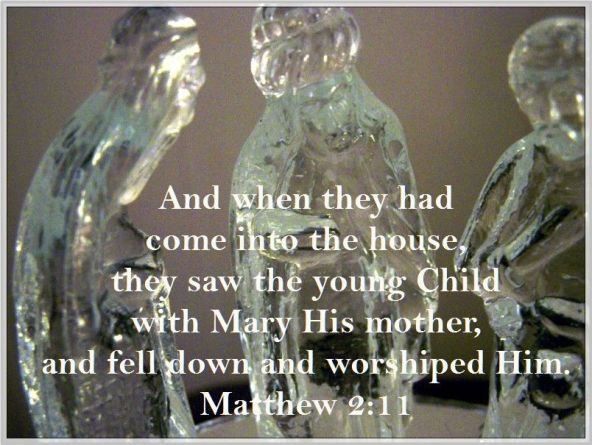
And going into the house, they saw the child with Mary his mother, and they fell down and worshiped him. (Matthew 2:11)

Herod died in 4BC so the men must have visited between the birth and up to when Jesus was around two years old. Later, Herod made a declaration to kill all the children under two years of age.

Then Herod, when he saw that he had been tricked by the wise men, became furious, and he sent and killed all the male children in Bethlehem and in all that region who were two years old or under, according to the time that he had ascertained from the wise men. (Matthew 2:16).

It is clear that in actual time, the Magi from the East did not arrive in time to worship Jesus in his birth location, which was temporary. So is it unscriptural to set up a nativity scene with the Wise Men? I don’t believe so.

The Wise Men did in fact arrive to worship. It happened. It would be unscriptural for example, if a nativity scene had figures such as Moose or beavers, not indigenous to the location. Or if the scene had added figures such as Herod or Jezebel, who were evil and certainly not depicted anywhere in proximity (and of course Jezebel was long dead).

I believe that collapsing time is an acceptable literary license. The Apostles did so when they wrote inspired scripture. They said things like, ‘Then Jesus went…” where the actual time might have been months later from the evetnt written of in the previous sentence. “Jesus was born, then the Wise Men came…”

What I like about the birth chronology is that everyone involved with it, from announcement to just before the Family had to flee to Egypt, is that everyone worshiped. Elizabeth and Mary, Joseph, the Shepherds, Anna and Simeon, the angels, and the Wise Men. Worship is the proper response to meeting Jesus, both intellectually and emotionally. Our Savior is born, and hallelujah that He came into the world. Though not exactly perfectly historic, the crowd around the manger of animals, shepherds, parents, and wise men do depict an accurate response to the birth of the Savior. However, I understand if some people decide to remove or not install figures of the Wise Men in their nativity, or decline to have Wise Men circulating at a live nativity scene, due to historical inaccuracy.

Jesus lived the perfect life under God’s standards for holiness that we could not. Enduring agonizing separation from His Holy Father, He cried out and absorbed all God’s wrath for our sin.  Accused unjustly, He was nailed to the cross and executed, thus becoming the sacrificial lamb. Pleased with His Son, God resurrected Jesus on the third day and Jesus ascended into heaven. Now, His blood atones for our sin and forgiveness awaits those elected to ask for it. Praise God He made a way for us to be reconciled to Him! Mercy abounds.

Further Reading: Answers In Genesis Three Wise Men?

Grace To You 2 min podcast- Where Are the Wise Men?

christmas-wise-men-verse

Posted in prophecy, Uncategorized

Our precious Jesus, His cross, and the ‘accusation’

Jesus died on the cross. When He was nailed to the tree, the soldiers an ‘accusation’ placed above His head.

And over his head they put the charge against him, which read, “This is Jesus, the King of the Jews.” (Matthew 27:37.)

The other three Gospels also note that an ‘accusation’ was placed over His head, each Gospel stating that Jesus is King of the Jews. Mark 15:26, Luke 23:38, John 19:19.

Jesus was ‘tried’ in two different courts. He had a religious Jewish trial and a secular Roman trial. Since each kind of trial had three phases, Jesus was involved in 6 different legal proceedings. In none of them was a sinful accusation leveled at Him. The sign above His head did not say thief. Nor did it charge Him with being a blasphemer. Nor a rebel. Nor a usurper.

The only ‘accusation’ above the head of Jesus as He expired on the cross was THE TRUTH. No blot was above His precious head. Only the truth that Jesus was, and is, and is to come as King of the Jews.

Now note the Christmas story. Wise Men from the East arrived at Jerusalem. They sought the babe whose star had led them to the city. The men went to Herod and asked about this Messiah. They asked,

Now after Jesus was born in Bethlehem of Judea in the days of Herod the king, behold, wise men from the east came to Jerusalem, saying, “Where is he who has been born king of the Jews? For we saw his star when it rose and have come to worship him.” (Matthew 2:1-2).

Tremendous truth-

WHEN JESUS WAS BORN, HE WAS ANNOUNCED AS KING OF THE JEWS.

WHEN JESUS DIED HE WAS PROCLAIMED AS KING OF THE JEWS.

Eventually, His kingship will be over the entire earth and all its people. Hallelujah!

On his robe and on his thigh he has a name written, King of kings and Lord of lords. (Revelation 19:16)

Posted in discernment, Uncategorized

Examining Christmas traditions #1: Do angels sing?

It’s the Christmas season and the lights are up inside homes and all over the neighborhood. Children are having photos with Santa and moms and dads are hurriedly finishing their shopping lists. Kids at school are doing Christmas crafts with paint and Popsicle sticks and teachers are counting the days until Christmas vacation. Churches have cookie swaps and families enjoy the annual classics, “It’s A Charlie Brown Christmas”, “Frosty The Snowman”, and “It’s A Wonderful Life”. In the south where it is warmer and more rural, many places host a live Nativity, where animals roam in an enclosure and a manger is set up with shepherds, Joseph, Mary, and a baby (or a doll) for the enjoyment and interest of the locals. These are some of our annual traditions here in America.

There are traditions regarding the Christmas story within the faith, also. We have Christmas carols with lyrics that say that angels sing, set up nativity scenes with Wise Men, erect Christmas trees, and more.

Do these traditions have any bearing from scripture? If not should we care? If not, should we abandon them? Accept them? Are we disrespecting Christ by perpetuating them? Or not?

In this essay from Answers In Genesis, “Hark! The Herald Angels Said?“, the author wrote,

The idea of angels singing on the night of Christ’s birth has become so common that many are surprised to learn that the Bible does not unequivocally state this. This example provides a good opportunity to discuss traditions. In and of themselves, traditions are not wrong, but they must be based on and consistent with Scripture. If they contradict Scripture, then they must be rejected. …

One of the points of this series on misconceptions is to lead us all to look closely at what the Bible teaches. Far too often traditions have been the basis of our thinking, and we end up believing things that are not found in Scripture. We have heard and sung about angels singing on that night so often that many do not bother to look closely at the text.

Looking at the specific issue of whether angels sing, we do know there are a great many Christmas carols saying they do. However, scripture never indicates once that the angels sing. They shout, proclaim, and praise, but not sing. However, given the various contexts in which they are rejoicing, such as on the night Jesus was born, it is possible they they sang, also.

Answers In Genesis explains things from their view:

As we wrap up this Christmas article (pun intended), you are probably wondering if the angels did sing to the shepherds. In light of the fact that there is a strong connection between praising and singing in the Bible, and since angels, in all likelihood, are capable of singing, there exists biblical support for the tradition of singing angels found in the Christmas hymns.

GotQuestions thinks they do. Robin Schumacher thinks they do. John MacArthur thinks they do. J. Vernon McGee doesn’t think so. Phillip Holmes at Desiring God doesn’t think so either.

Since scripture doesn’t say one way or the other if angels sing, we are not being unscriptural by singing carols that say they do. It’s a tradition that isn’t harmful to a person’s faith if they want to believe angels sing. The point of the season is to focus on Jesus, His incarnation, and respond with song, praise, and worship.

AiG finishes this way:

In any case, when we think about God’s amazing gift of a Savior to mankind on that night, we should glorify and praise God, whether in spoken word or in song, just as the shepherds did on that incredible night after they had seen the newborn King.

Posted in prophecy, Uncategorized

Jesus is the Prince of Peace

Part 7 – Jesus is the Prince of PeaceFor to us a child is born, to us a son is given; and the government shall be upon his shoulder, and his name shall be called Wonderful Counselor, Mighty God, Everlasting Father, Prince of Peace. (Isaiah 9:6).

Part 1 – For unto us a child is born
Part 2 – A Son is given
Part 3 – And the government shall be upon his shoulder
Part 4 – ‘and his name shall be called Wonderful Counselor’
Part 5 – Mighty God
Part 6 – The Everlasting Father: the Father of eternity
Part 7 – Prince of Peace

This is a multi-part series looking at this wonderful verse of scripture from Isaiah and commentary from Barnes’ Notes. I’d said that for me, the text is rich and full of truth; complex with spiritual meaning, yet can be read and understood by children; is a great a promise, one even spoken as had already happened, yet would not occur for hundreds of years hence; a faithful promise, and a comforting thought. Barnes Notes on the last part of the verse, ‘Prince of Peace’

The Prince of Peace – This is a Hebrew mode of expression denoting that he would be a peaceful prince. The tendency of his administration would be to restore and perpetuate peace. This expression is used to distinguish him from the mass of kings and princes who have delighted in conquest and blood. In contradistinction from all these, the Messiah would seek to promote universal concord, and the tendency of his reign would be to put an end to wars, and to restore harmony and order to the nations; see the tendency of his reign still further described in Isaiah 11:6-9; the note at Isaiah 2:4; see also Micah 5:4; Hosea 2:18. It is not necessary to insist on the coincidence of this description with the uniform character and instructions of the Lord Jesus. In this respect, he disappointed all the hopes of the Jewish nation, who, in spite of the plain prophecies respecting his peaceful character, expected a magnificent prince, and a conqueror.

Gill’s Exposition:

The Prince of peace; Christ is a Prince, often so called, Ezekiel 34:24 he is so by birth, being the King’s Son, the Son of God, and by office, power, and authority; he is so a Prince as that he is a King; he is exalted to be a Prince and a Saviour; and he is a Prince superior to kings, being the Prince of the kings of the earth, Acts 5:31 and he is called the “Prince of peace”, because he is the author of peace; just as he is said to be the “Prince of life”, Acts 3:15 for the same reason:

he is the author of peace between Jew and Gentile, by abrogating the ceremonial law, the enmity between them, and by sending the Gospel to both, and making it the power of God to salvation to some of each of them, and by bringing them into the same Gospel church state, and making them partakers of the same privileges and blessings, internal and external, Ephesians 2:14 and he is the author of peace between God and sinners; he has made it by the blood of the cross, having the chastisement of their peace laid upon him, in consequence of a covenant of peace he made with his Father, who was in him reconciling the world to himself, and he is so called likewise, because he is the giver of peace; of all outward peace and prosperity to his churches, as rest from their enemies, concord among themselves, and additions to them of such as shall be saved; of internal peace through the discoveries of his love, and the application of his righteousness, blood, and sacrifice in a way of believing in him, and in a course of obedience to him; and likewise of eternal peace and rest in the world to come.

Moreover, all that concern him as a King or Prince show him to be the Prince of peace: his kingdom lies, among other things, in peace and joy in the Holy Ghost; the sceptre of his kingdom is the golden sceptre of grace and mercy; his royal proclamation is the Gospel of peace; the fruit of his Spirit is peace; and his subjects are peaceable ones, both in church and state.

Posted in prophecy, Uncategorized

‘and his name shall be called Wonderful Counselor’

For to us a child is born, to us a son is given; and the government shall be upon his shoulder, and his name shall be called Wonderful Counselor, Mighty God, Everlasting Father, Prince of Peace. (Isaiah 9:6).

Part 1 – For unto us a child is born
Part 2 – A Son is given
Part 3 – And the government shall be upon his shoulder
Part 4 – ‘and his name shall be called Wonderful Counselor’
Part 5 – Mighty God
Part 6 – The Everlasting Father: the Father of eternity
Part 7 – Prince of Peace


This is a multi-part series looking at this wonderful verse of scripture from Isaiah and commentary from Barnes’ Notes. I’d said that for me, the text is rich and full of truth; complex with spiritual meaning, yet can be read and understood by children; is a great a promise, one even spoken as had already happened, yet would not occur for hundreds of years hence; a faithful promise, and a comforting thought. We’d looked at the first part of the verse, ‘For unto us a child is born’, and part 2, ‘a son is given,’ and part 3, ‘and the government shall be on His shoulder’.

his name shall be called Wonderful Counselor…

Barnes Notes:

Wonderful – pele’. This word is derived from the verb pâlâ’, to separate, to distinguish, or to make great. It is applied usually to anything that is great or wonderful, as a miracle; Exodus 15:2; Lamentations 1:9; Daniel 12:6. It is applied here to denote the unusual and remarkable assemblage of qualities that distinguished the Messiah. Those are specified more particularly in the other part of the verse; such an assemblage of qualities as to make proper the names Mighty God, etc. ‘The proper idea of the word,’ says Hengstenberg, ‘is miraculous. It imports that the personage here referred to, in his being and in his works, will be exalted above the ordinary course of nature, and that his whole manifestation will be a miracle.’ Yet it seems to me, that the proper idea of the word is not that of miraculous. It is rather that which is separated from the ordinary course of events, and which is suited to excite amazement, wonder, and admiration, whether it be miraculous or not.

This will be apparent if the following places are examined, where the word occurs in various forms. It is rendered marvelous, Psalm 118:23; Psalm 139:14; Psalm 98:1; Job 5:9; wonderful, 2 Samuel 1:26; Psalm 139:14; Proverbs 30:18; Job 42:3; Psalm 72:18; Psalm 86:10; hidden, Deuteronomy 30:2; things too high, Psalm 131:1; miracles, Judges 6:13; Exodus 15:2; Psalm 77:14; Psalm 88:10; Psalm 89:5; the word is translated wonders, in the sense of miracles, in several places; and hard, Deuteronomy 17:8; Jeremiah 32:17. From these passages, it is clear that it may denote that which is miraculous, but that this idea is not necessarily connected with it. Anything which is suited to excite wonder and amazement, from any cause, will correspond with the sense of the Hebrew word. It is a word which expresses with surprising accuracy everything in relation to the Redeemer. For the Messiah was wonderful in all things. It was wonderful love by which God gave him, and by which he came; the manner of his birth was wonderful; his humility, his self-denial, his sorrows were wonderful; his mighty works were wonderful; his dying agonies were wonderful; and his resurrection, his ascension, were all suited to excite admiration and wonder.

Counsellor – This word has been sometimes joined with ‘wonderful,’ as if designed to qualify it thus – “wonderful counselor;” but it expresses a distinct attribute, or quality. The name “counselor” here, denotes one of honorable rank; one who is suited to stand near princes and kings as their adviser. It is expressive of great wisdom, and of qualifications to guide and direct the human race.

iStock illustration purchased by author

Our Wonderful Counselor, personification of all-wisdom, guidance, and counsel, stands ready to hear you and me in prayer. Bring your troubles to Him, bring your worries to wisdom personified. Praise His glorious name, one of which is Wonderful.