Posted in encouragement, Uncategorized

The Approachableness of Jesus (reprise)

There are so many attributes of Jesus Christ than we can praise and ponder. One of them is His kingliness.

He is King of Kings and Lord of Lords. (Revelation 19:16). God has given Jesus all authority in heaven and in earth (Matthew 28:18), therefore He is above all authorities anywhere that can possibly be imagined. He is High and exalted on His throne and He is KING.

On earth few of us have actually been in the presence of a King or Queen. There are relatively few royals on earth, compared to number of the population of the plebeians like us.

If one is favored enough to visit a royal, there is strict protocol. ABC News reminds us, regarding a visit with Queen Elizabeth II-

There is a long list of protocols that guides one’s behavior in the presence of Her Majesty and even though the president and the first lady are not required to abide by all of them, there are certain formalities they do have to follow.

There is the “no-touch” rule…
Wait until the Queen extends her hand to shake it
No gripping her hand or tightly pumping it
No hugs, no kiss on the cheek, no touching the shoulder

Refer to the Queen as “Your Majesty” initially then “ma’am” subsequently
Bow upon being introduced
Do not turn your back to the Queen
Wear conservative clothing with not much flesh showing

And so much more.

I remember the HBO mini-series John Adams. It was an excellent series, showing the life of our second President from a fiery attorney in his youth through to old age, in other words, most of his political life.

There came the moment when the Americans had won the Revolutionary war. Adams had been given the privilege and responsibility as diplomat to begin relations with The United Kingdom as national co-equals. He was to meet with the King. The moment was fraught with tension for two reasons. He had all of the future of America resting on his shoulders in how he approached the Monarch these next few moments. Would the United Kingdom be an enemy or an ally?

The second reason was protocol. Here was a scrappy lawyer born in 1735 in British America, (Quincy MA), and was American through and through, about to meet the most powerful man in the world, King George III. Americans had not been known to stand on formality and protocol, and Adams had been strongly tutored for this meeting. Bow three times, once upon entering, once when halfway to the ‘Royal Presence’ and a third time as you enter the ‘Royal Presence’. Avert your eyes until standing before the ‘Royal Presence’. Wear suitable clothing, “something more British.” Unsuitable clothing has been the undoing of many an Ambassador, we learn.

See how it went, at the link. It’s an extremely memorable cinematic moment and an incredible piece of acting, as well as a visible punctuation for my point. I can’t embed, HBO has disabled it.

There have always been strict protocols when meeting royalty. In Esther 4:11 we read,

All the king’s servants and the people of the king’s provinces know that if any man or woman goes to the king inside the inner court without being called, there is but one law—to be put to death, except the one to whom the king holds out the golden scepter so that he may live. But as for me, I have not been called to come in to the king these thirty days.

This scene is described in Esther 5:1. The King is holding his scepter.

On the third day Esther put on her royal robes and stood in the inner court of the king’s palace, in front of the king’s quarters, while the king was sitting on his royal throne inside the throne room opposite the entrance to the palace.

Wikipedia

Thrones were always higher, set upon a dais in order to visibly indicate the lower position of the person approaching the Royal Presence. This is a photo of Napoleon’s throne. Pharaoh is described as sitting on a throne in Exodus 11:5; Exodus 12:29.

Solomon wrote,

Do not claim honor in the presence of the king, And do not stand in the place of great men; 7For it is better that it be said to you, “Come up here,” Than for you to be placed lower in the presence of the prince, Whom your eyes have seen.

And yet, another aspect of the uniqueness of Jesus continues. He sits upon His throne, the highest of the high and lifted up (Isaiah 6:1) and yet we may approach!

Let us then with confidence draw near to the throne of grace, that we may receive mercy and find grace to help in time of need. (Hebrews 4:16)

In him and through faith in him we may approach God with freedom and confidence. (Ephesians 3:12).

Must we dress in a certain way? Must we wait to be introduced or summoned? Must we bow in sequential order as we reach certain spots in the throne room? Must we avert our eyes until He speaks? No! No! No! No!

Our Lord Jesus is said to be the Mediator between God and man. Now, observe, that the office of mediator implies at once that he should be approachable. ~Spurgeon
He is Lord of Lords and King of Kings and yet He has told us we may approach Him with petitions large and small! He is tremendous. Every time we pray we approach Him. He is a God who sees (El Roi Genesis 16:14) and a God who hears!

In 1920 Frank Boreham wrote a book titled “A bunch of everlasting; or, Texts that made history“. His book contains biographies of famous Christians who came to the saving grace of salvation as the light of one particular verse broke upon their hearts. John Bunyan met Jesus through this verse in John 6:37,

All that the Father giveth me shall come to me; and him that cometh to me I will in no wise cast out.

From Boreham’s text we read,

In his pitiful distress, there broke upon the soul of John Bunyan a vision of the infinite approach-ability of Jesus. John Bunyan’s text-verse was a revelation to him of this approach-ability.

‘This scripture did most sweetly visit my soul; and him that Cometh to me, I will in no wise cast out.” Oh ! the comfort that I had from his word, in no wise! As who should say, “By no means, for nothing whatever he hath done. ‘Him that cometh I will in no wise cast out!’ Like the gate that swings open on hearing the magic ‘sesame’; Like the walls that fell at Jericho when the blast of the trumpets arose; the wall round Bunyan’s mountain fell with a crash before that great and golden word. ‘Him that cometh to Me I will in no wise cast out!’ The barriers had vanished! The way was open!

Christ is approachable. Praise Him! Approach today, with no worries of what you must say or how you must look. He will in no wise cast you out. How sweet is this knowledge.

————————–

Further Reading

Spurgeon sermon- The Approachableness of Jesus

Frank Boreham, A Bunch of Everlastings, online text

Wikipedia entry about John Bunyan

Etiquette: How to Address a King or Queen
Posted in prophecy, Uncategorized

Preaching in Jesus’ name

Therefore thus says the Lord concerning the men of Anathoth, who seek your life, and say, “Do not prophesy in the name of the Lord, or you will die by our hand” (Jeremiah 11:21).

and when they had called in the apostles, they beat them and charged them not to speak in the name of Jesus, and let them go. (Acts 5:40).

The name of Jesus Christ is extremely powerful. I’m not talking that it’s powerful like a magic charm, or a mantra, or a mystical incantation. His name is powerful because Jesus is the most powerful person in the Universe, because He sustains the world with His will, because He became the unique, one and only sacrifice for sin, died, and rose again defeating death.  He is the I AM. He is the Authority. It’s that simple.

And Jesus came and said to them, “All authority in heaven and on earth has been given to me.” (Matthew 28:18)

You can preach in any other name and the heart of the listener might or might not be emotionally or mentally affected. He might become emotional at a good speech delivery. She might feel temporarily joyful or sad but that burns off because an emotional reaction it doesn’t reach the soul. Only the word of God can affect the soul, and the only name in which we preach the true word is Jesus.

When the words affect the soul, the reaction has staying power, whether it’s to cause the person to retreat further into sin, or to convert under grace.

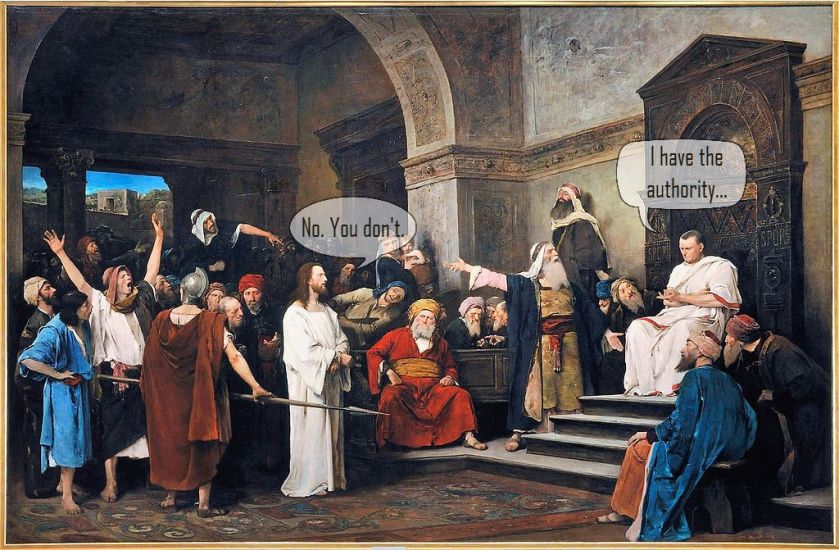
In the New Testament we know that the party opposing Jesus (Scribes, Pharisees, Sadducees) hated the name of Jesus. They hated His teachings, His disciples, His power, His authority, His resurrection. They thought they had authority, but they did not.

Pilate thought he had power and authority. He did not know that his authority was not his own, but was from above.

So Pilate said to Him, “Do You refuse to speak to me? Do You not know that I have authority to release You and authority to crucify You?” Jesus answered him, “You would have no authority over me at all unless it had been given you from above.” (John 19:10-11)

Jesus’ name has power. Not because it’s a magic mantra. But because all authority in heaven and on earth has been given to Jesus. He is the ultimate authority over men. And men’s souls sense this. We rebel against authority. We fight authority but authority always wins, sang John Cougar Mellencamp in his “The Authority Song”. We been doin’ it since we were young mean and we come out grinnin’.

We think it’s funny to rebel against parents, teachers, employers, police, the law, the government. But who we’re really rebelling against is God and God alone. He is the authority and He gives His authority to parents, teachers, employers, police, the law, the government. However, He retains sole claim to all authority and dispenses it to whom He desires. That is why when we rebel it is against Him and Him alone. (Psalm 51:4).

The authority of the name of Jesus calls for men’s submission to that name, but in our sinful state we protect our rebellion instead of submit to authority. We are rebels, sinning at every turn and hating those who tell us to stop.

Fortunately, Jesus’ name does have power. Without His power, we would never be saved. Jesus lived a perfect and holy life under the Law. He fulfilled every bit of it, and was crucified unjustly. He took on all man’s sins and endured God’s wrath for that sin. He died and was buried.

Three days later He rose again victorious over death!

“O death, where is your victory? O death, where is your sting?” The sting of death is sin, and the power of sin is the law. But thanks be to God, who gives us the victory through our Lord Jesus Christ. (1 Corinthians 15:55-57)

Vainly attempting to grasp our rebellion against authority, or foolishly trying to keep whatever scraps of authority we think we have, will always end in one moment, one act: bowing before Jesus and confessing Him as Lord. It’s better to submit to His authority now and be adopted as son and friend, than to have confess to Him as a rebel.

Munkacsy_-_Christ_in_front_of_Pilate
With apologies to artist Mihály Munkácsy, “Christ before Pilate, 1881

Posted in encouragement, Uncategorized

Heaven is a busy place

busy
The busyness of Rome’s Piazza del Popolo can’t compare
to the busyness of heaven. EPrata photo

Heaven is busy. I know you know this. But sometimes we let the invisible become abstract, and once abstract, distant. People tell me that they feel that since our faith relies on invisibility, despite their certainty, praying to heaven sometimes feels like whistling in the wind.

I understand the feeling, and I’d like to help along those lines.

Let’s get specific.

When we have a civic issue, we do things. We write letters to the editor. We complain on Facebook. We join protests. We march. We petition. We attend Town Council meetings and speak in the microphone.

“My road isn’t paved and it’s wrecking my car!”
“There’s too many potholes on my road, do something!”
“You can’t fire the Town Manager/increase the budget/Add onto the school!”
“We need a stoplight at John Smith Road!”
“Make John Q. Public Street a 4-way stop!”
“Re-stripe the lines on Main Street!”

We are pretty busy when it comes to civic duties. We make ourselves heard for our civic needs in all the venues that are available to us.

What do we do when we have a spiritual issue? We do things. We write letters to the pastor. We complain on Facebook. We join grumbling protests. We prayer march. We petition. We attend Elder Council meetings and speak up.

What don’t we do? Pray. For whatever reason, we don’t make available to us the first thing we should be doing. Instead, we relegate it to a last resort.

Far from being an inert, harp-playing, cloud lounging, Deistic place, heaven is active and always in motion. It is in operation all the time. Heaven is busy, Heaven is involved.

Heaven has angels coming and going, presenting themselves to God. The High Court is always in session. Jesus is praying. Incense is rising. The angels are hollering holy, holy, holy. Warfare is breaking out. Martyrs are arriving. Jesus is mediating. Requests and Petitions are coming in. Praise and worship is continuing.

So pray! Pray for all your concerns. Pray to praise Jesus. Pray for your sanctification. Pray for your friends’ salvation. Pray for nations abroad, and your kids at home. Pray about everything, especially your concerns.

When you pray, you become intimately involved in the activity of heaven. Your prayer is heard by Jesus and is then absorbed into the great stream of work and operations of the celestial realms. If Jesus heard Hagar’s lone cry in the vast desert, if He saw Elijah’s exhaustion in his escape from Jezebel, if He knows the heart of Nicodemus by night, if He understands all our sorrows, fears, and feelings, He hears your prayer. You don’t have to worry. You don’t need a liver shiver or a sign or confirmation. He hears it.

Scripture references

Job 1:6; Revelation 4:1-11; Hebrews 6:20; Hebrews 7:25, Romans 8:24; Revelation 8:4, Revelation 4:8, Isaiah 6:2-3; Daniel 10:13, Revelation 12:7
Genesis 28:12; Revelation 6:9; 1 Timothy 2:5, Job 9:33; Philippians 4:6, 1 Timothy 2:1; Revelation 19:6-7, Revelation 11:16.

Posted in encouragement, Uncategorized

Christ, The Sure and Steady Anchor

Storm of the Century, March 1993. I was living on my sailboat, and I was in it. The arrow shows where.
Storm_of_the_century_satellite

I was saved at age 42, and before that I traveled a lot. I lived on a sailboat for two years, traveling about 10,000 nautical miles (with another 2000 miles on a speedboat delivery). As they say, “A lot of blue water under my keel.”

We left on our first voyage in October 1992. In March of 1993, we were anchored at Georgetown Bahamas, where we experienced the Storm of the Century.

anchor
The anchor as seen at night, through clear Bahamian waters, 20 feet down! It was convenient to be able to see that it was set well. Note the ripples the chain made in the sand as the boat at anchor sways gently to and fro.

In this from the Broward/Palm Beach New Times, we read the article Lost at Sea:

They called it the “storm of the century.” … that unnamed freak March tempest killed as many people in Florida as Hurricane Andrew and left $500 million in damage, even dropping snow in the Panhandle, by the time it finally moved out of Florida. It took with it a 40-foot sailing ketch called Charley’s Crab. No scrap, no bit of flotsam, no article of clothing was ever found from that boat, and after two desperate SOS calls, the four people who were sailing it just off the coast of Palm Beach were never seen or heard from again.

The storm continued to wreak havoc as a record-breaking blizzard as it moved up the east coast of the United States and into Nova Scotia. NOAA Weather:

The Superstorm of 1993 (also called the Storm of the Century) was one of the most intense mid-latitude cyclones ever observed over the Eastern United States. The storm will be remembered for its tremendous snowfall totals from Alabama through Maine, high winds all along the East coast, extreme coastal flooding along the Florida west coast, incredibly low barometric pressures across the Southeast and Mid-Atlantic, and for the unseasonably cold air that followed behind the storm. In terms of human impact the Superstorm of 1993 was more significant than most landfalling hurricanes or tornado outbreaks and ranks among the deadliest and most costly weather events of the 20th century. (source)

Wikipedia specifically mentions the derecho winds:

The squall line produced a serial derecho as it moved into Florida and Cuba [and The Bahamas, Ed. Note] shortly after midnight on March 13. Straight-line winds gusted above 100 mph at many locations in Florida as the squall line moved through. The supercells in the derecho produced eleven tornadoes.

Today’s point, is the anchor.

anchor 2
In gentler times, pulling the anchor up at dawn, another day of sailing
the Intracoastal Waterway.

1993 was before the internet and cell phones. GPS was very new and few sailors had it. Yet the sailing network still worked. We had been dithering about anchoring outside the harbor a little ways off behind a small island, really a sand bar hump, that had a lone palm tree. If we had followed through with that decision we might have died. As we came back in to the harbor from our day sailing, we heard the weather buzz. The chatter about the coming storm was pitched and nearly manic.

The severe weather talk prompted us to set two anchors instead of one.

As we further learned of the severity of the storm, I suggested that we set a third anchor. We possessed a third anchor but it wasn’t attached to the rope (rode) yet. We normally used the CQR as the main anchor and the Danforth as the backup two each night. The third, a Bruce, was the spare for emergencies. I considered this an emergency.

My husband resisted, but I pushed. Eventually he got busy and attached the anchor to the rope and set the third. We’d set the two anchors as if the wind would come from the normal direction, north-northwest. The harbor was very large, it could hold up to 400 boats in peak season. It was peak season. There were many, many boats anchored around us.

Storms in that location usually come in from the north-northwest. However as the unusual derecho swept over the peninsula of Florida, the Gulf Stream, and then western Bahamian Islands, it became obvious this was a storm that didn’t adhere to anything “normal.” It came not from the north, the usual winter storm pattern, but from the west.

As boaters anchored ahead of us were hit with the wind we heard them yelling into their VHS radios, reporting data from their anemometers. The wind only increased as it swept over the harbor.

“It’s 50 miles an hour!”

It’s 75 miles an hour!

“It blew out the anemometer at 98 miles an hour!”

My husband looked at me wide eyes. Without a word, he turned on the engine.

I heard it before I saw it. A terrible train sound increasing in its unearthly roar even as it blackened the horizon and roiled toward us at unbelievable speed. It seemed like a monster, a clawing, gobbling thing intent on devouring the yachts in its path like matchsticks. The last thing I heard before it hit was the incredulity in one yachtsman’s voice:

“IT’S COMING FROM THE WEST. THE WEST!!!”

610__360x_tayana37-sailplanIt hit. Our sailboat had a full cast iron keel from bow to stern, weighing 7,000 pounds. Our boat overall weighed 23,000 pounds. The derecho hit us on the side and slammed us over like a baby in a tub dunking a rubber ducky. Our side rail hit the water and as we righted, two of the anchors popped loose. My husband had gunned the engine to full speed, but we made no headway to relieve the wind’s pressure on the third anchor. All our prayers were on that last anchor. One thin rope ending in one metal anchor is all we had between us and destruction.
Boats all around us were dragging. Some were dragged by the insane wind onto the beach. Others were dragged into each other, masts tangling and rigging twining together. My husband and I stood the storm shoulder to shoulder, engine at full throttle, leaning into the wind staring into the black. Just standing. There was nothing else we could do in the face of such power.

The derecho passed over and left behind a week of winds. Thankfully, we were unscathed but many boats sustained damage, even anchored in the harbor. We heard that the sailboat Charley’s Crab (Florida restaurant owner) on its way across the Gulf Stream was lost, a tugboat and a freighter were lost at sea, too. Overall 48 people on the sea were reported missing. The Coast Guard rescued 160 people at sea. 270 people died on land.

anchor
That one little anchor, that one thin line, is all that saves you in a storm. It’s all that keeps you in one place at night when you pull down the sails and anchor in place. You go to sleep knowing that the anchor has to hold. Otherwise as you sleep, your boat could be dashed upon the rocks or swept to sea.

Christ has meaning for me as The Sure and Steady Anchor. I will hold fast to the anchor.

Posted in prophecy, Uncategorized

Revelation 101

So often I hear that people are scared to, or worried about, reading the Book of Revelation. It’s this monolith at the end of the Bible that people stay away from because it’s too hard, too mysterious, too difficult to understand. Yet the book itself says otherwise.

Believers cannot afford to ignore the immense truth this book contains. In fact, we’re commanded not to; Revelation 22:10 says, “Do not seal up the words of the prophecy of this book, for the time is near.” ~John MacArthur

It’s actually one of the easiest books to understand.

By the way, the book is called “Revelation” singular. It’s not “Revelations.”

Daniel is dense. Pound for pound, Zechariah has twice as much prophecy than Revelation. Some of the minor prophets are hard to understand because of the time frames and the history. Romans is heavily philosophical. If I was to pick a book that is hard to understand, I’d choose any of those over and above Revelation. Revelation is actually one of the easiest book in the Bible to understand.

How can I say this?

Two reasons.

1. It is the ONLY book in the Bible in which the reader is promised a blessing if he or she reads it. The. Only. Book. That’s something worth paying attention to. The promise is stated at the beginning and at the end of the book.

Blessed is the one who reads aloud the words of this prophecy, and blessed are those who hear, and who keep what is written in it, for the time is near. (Revelation 1:3).

How can we keep what is written in it, if we do not read it?

And behold, I am coming soon. Blessed is the one who keeps the words of the prophecy of this book.” (Revelation 22:7).

Clipboard04Did Jesus promise a blessing, and in a cosmic ‘gotcha’, then make it intellectually or spiritually too difficult to understand? Or is it because it’s one book that proclaims Jesus in His full glory, promises a great ending for His people, and wants us to look ahead for the encouragement?

2. It has its own built-in study guide. Despite the chaos it reveals, it is actually a very orderly book. I’m not kidding.

The first three chapters are greetings and letters to churches, which we would do well to study. To each church, Jesus identifies himself in a different way, revealing a certain aspect of Himself that matches the warning or commendation He gives to the church. It also shows how intimately He is involved with His church as its Head and its Priest.

In Chapter 4 the scene shifts to heaven. In Chapter 5 we’re still in heaven, but now heaven is readying for the “things to come”, meaning, the global judgment.

Chapter 6-18 are those judgments. Again, it’s orderly. A series of three (perhaps four, if the Seven Thunders are judgments) each containing 7 judgments are unleashed, one after the other. The time frame is fairly chronological. It’s also rapid. The events take place mostly within three and a half years (7 total) so reading this main portion of Revelation can be compared to reading the Gospel of Mark. Mark reports quickly, covers a great time frame in short order, and uses muscular language and a rapid pace. It’s the same with this portion of Revelation.

The judgments, in addition to being judgments, are also working to UNcreate the world. Compare Genesis 1-2 with Revelation 6. Genesis shows the creation, Revelation is the UNcreation. As the LORD deals with sin, He is also preparing the world for its upcoming regeneration (“The New Earth.”). Mainly the story proceeds chronologically with an occasional glimpse back to heaven or a parenthetical comment.

Chapter 19-22 is the wrap-up- the new heavens and new earth, New Jerusalem, the Marriage Supper, the final strings to tie up, the last encouragement.

Voila!Clipboard05

As for the symbolism, scripture interprets scripture. The symbols are not a lot harder to interpret than other analogies and symbols in the Bible. Jesus being the vine (we know He is not ACTUALLY a vine). Or when the angels pour out the bowls of wrath, we are reminded of Jesus drinking the cup of wrath. The dragon with seven heads and ten horns and seven crowns on its heads is a similar kind of symbol to the ram with long horns of Daniel 8, which is interpreted for Daniel right in the same chapter.


I’m not saying everything about Revelation is easy. It still takes study. What I’m saying is that is is not harder than any other book of the Bible and in some ways it is easier. Please do not be intimidated by it.

On sale now at Grace To You through June 25 is a booklet for $1.50 called A Jet Tour Through Revelation. It is adapted from a sermon MacArthur gave a while ago. Even when the sale is done the booklet only costs $2.00. Of course, you can listen to the sermon for free at any time. The booklet-

-helps take the mystery out of a portion of Scripture many people consider too difficult to understand. Yet, the book of Revelation promises blessing to those who read its words and heed them. This Jet Tour booklet will help you make sense of the symbols, imagery, and significance of this amazing prewritten history. It will increase your appetite for heaven—or give you a needed dose of concern about your eternal future and point you to Christ, who alone can save you from the wrath He will one day bring.

One of my favorite books on Revelation is another of MacArthur’s -“Because the Time is Near”. This book is also on sale now for $8.25. I found it not only to be clear, non-academic and useful in laymen’s terms, so encouraging. Yes, the Book of Revelation is encouraging. Seeing all that wrath poured out is hard on the heart, but it is also encouraging knowing Jesus took that same wrath for His people. This in turn inspires a profound relief and love for His work on the cross. It’s one thing to know about the cup of wrath He endured, it is another to understand it. Revelation helps you understand sin and wrath, and by contrast, grace. In this way, reading Revelation helps you love Jesus even more.

Far from being a dense, mysterious, non-understandable book, I have always found it to be encouraging, amazing, and inspiring. It shows Jesus as He is now, in full glory, power, and beauty. It is one of my favorite books of the Bible, Genesis being the other!

Please don’t be intimidated by Revelation, just start reading it. You will be blessed. That is a promise from Jesus.

Posted in encouragement, Uncategorized

Do the sheep really know what the Shepherd does for them?

A list on this Father’s Day. If you’re saved, Jesus is the best Father.

sheep

The image of God as a shepherd points to his continual direction, guidance and care for his people.

Shepherd as a title for God-
Ps 80:1 See also Ge 49:24; Ecc 12:11

God’s people are his flock-
Israel is God’s flock Ps 95:7 See also Ps 79:13; 100:3; Jer 50:7; Eze 34:31

The church is God’s flock 1Pe 5:2 See also Lk 12:32; Ac 20:28-29

The tasks undertaken by God the shepherd-
The shepherd leads and guides Ps 23:2-3 See also Isa 40:11

The shepherd provides Ps 23:1 See also Ge 48:15; Ps 23:5-6; Hos 4:16; Mic 7:14

The shepherd protects Ps 28:9 See also Ge 49:23-24

The shepherd saves those who are lost or scattered Jer 31:10 See also Ps 119:176; Isa 53:6; Eze 34:11-16; Mt 18:12-14 pp Lk 15:3-7

The shepherd judges Eze 34:17-22 See also Jer 23:1; Zec 10:2-3; 11:16; Mt 25:32-46

God gives shepherds to be leaders over his people-
He gives David’s line Eze 34:23 See also 2Sa 5:2 pp 1Ch 11:2; Ps 78:70-72; Eze 34:23-24; 37:24; Mic 5:4; Mt 2:6

He gives individual leaders Isa 44:28; 63:11

He gives faithful leaders Jer 3:15 See also Jer 23:4; 1Pe 5:2-4

Manser, M. H. (2009). Dictionary of Bible Themes: The Accessible and Comprehensive Tool for Topical Studies. London: Martin Manser.

Posted in encouragement, Uncategorized

There’s one thing we’re all good at

Sinning. Every human on the planet, no matter his or her age, is good at sinning. Hands down. Me included.

Look at this example from scripture.

Woe to you, blind guides, who say, ‘If anyone swears by the temple, it is nothing, but if anyone swears by the gold of the temple, he is bound by his oath.’ You blind fools! For which is greater, the gold or the temple that has made the gold sacred? And you say, ‘If anyone swears by the altar, it is nothing, but if anyone swears by the gift that is on the altar, he is bound by his oath.’ You blind men! For which is greater, the gift or the altar that makes the gift sacred? So whoever swears by the altar swears by it and by everything on it. And whoever swears by the temple swears by it and by him who dwells in it. And whoever swears by heaven swears by the throne of God and by him who sits upon it. (Matthew 23:16-21).

What this section of scripture is about is Jesus pronouncing woes upon the Pharisees. The Pharisees were one of the two ruling classes in Israel, the Sadducees being the other. The Pharisees had twisted the faith into something unrecognizable, laying incredible burdens down on the people, (like over 600 laws!) failing to minister to sinners, making sons of hell twice as worse as they were, and being total hypocrites. When Jesus pronounced His many woes upon them, this particular set of woes involved swearing by the LORD and lying.

The Pharisees has cunningly devised a way to appear to swear by the Lord but be able to get out of it later. They THOUGHT that if they swore an oath by the temple and not by the gold of the temple, they could break their oath later with no repercussions. Or swear by the altar and not the gift on the altar, or by heaven and not by the throne in heaven. “It depends on what the meaning of is is.”

Photo Pixabay.com. cc.

Look how finely they were splitting hairs! They were dead wrong, as we read Jesus’ excoriation of their sly practices. All the hairs matter.

But you see how we as humans excel at sinning and rationalizing our sin. We’re really, really good at it. “It wasn’t that bad.” “It wasn’t a real promise.” “No one keeps promises anymore.” “I’m not gossiping, I’m relating a prayer request.” “It wasn’t as bad as that other guy’s sin over there.” “No one saw.”

All rationalizations are simply self-justifications. And there is only One who justifies, Jesus. Our pitiful attempts to justify ourselves when we sin are just evil blasphemies and vain delusions. When we transgress God’s laws, we injure ourselves and dig ourselves deeper into the pit we will eventually fall into.

As I go through the day I ask Jesus to show me where I am sinning but rationalizing it away. Where I am too ignorant or blind to see my own sin. I ask Him to help me sin less against Him tomorrow than I did today, by the Spirit’s conviction and strength. I am not only the Chief of Sinners, I am Queen of Rationalizations! Open the eyes of my heart, Lord. I pray mine and your walk grows purer with each day and each step. Paul was so wise to pray this for his people:

I pray that the eyes of your heart may be enlightened in order that you may know the hope to which he has called you, the riches of his glorious inheritance in his holy people, (Ephesians 1:18).

Lord open the eyes of my heart so I may see and repent of the sins that lurk there.
All the ways of a man are pure in his own eyes, but the LORD weighs the spirit. (Proverbs 16:2).

I need Your eyes, Lord.

Posted in encouragement, Uncategorized

Praise the Lamb, who is building His church

Crazy world! But the sane world is coming, and Jesus will rule and reign. So we study end time prophecy in order to obey the command of Him who said to be watchful, sober, and vigilant; to encourage each other with these words, and to turn our eyes from this world in preparation for the next. And let’s offer His world to as many as we can! Let’s encourage fellow saints who are fainting, embroiled in besetting sin, or who are only lukewarm. We all need encouragement, and it’s the one thing these days that is FREE.

Therefore encourage one another and build one another up, just as you are doing. (1 Thessalonians 5:11).

But you, beloved, by building yourselves up in your most holy faith and praying in the Holy Spirit, (Jude 1:20).

Have you been thinking all along that we were making a defense to you? We speak before God in Christ, and all of this, beloved, is to build you up. (2 Corinthians 12:19).

And soon enough, one of these days we will all really be physically going up, built up in Christ’s majestic plan, and we will see it in its conclusion. He is building His church upon Himself, the Rock.(Matthew 16:18).

John Piper:

“I will build my church.” The church is not a building. It’s a people, with or without a building. But the Bible pictures this people sometimes as tree that grows and sometimes as a building that is built. The point is that this people has a builder, and the builder is the Christ, the Son of the living God. Jesus builds the church.

Photo EPrata

Praise the Lamb!

Posted in Uncategorized, visual exegesis

Visual Exegesis: Jesus Upholding the Universe

Full of Eyes is a support-based ministry of exegetical art that creates still and moving images intended to point people to the beauty of God in the crucified and risen Son. All art and animations are done by Chris Powers. Powers’ goal is to help people see and savor the faith-strengthening, hope-instilling, love-kindling beauty of God in Christ. And he does this by creating free exegetical art in the form of pictures, animations, and discussion guides. His work is at http://patreon.com/, Youtube, and his website fullofeyes.com

Upholding the Universe, by Chris Powers

Hebrews 1:3, “He is the radiance of the glory of God and the exact imprint of His nature, and He upholds the universe by the word of His power.”
I’ve been teaching a small Wednesday night study at our local church and for the last few months we’ve been walking through the ecumenical councils. Last night we were discussing the council of Chalcedon–which substantially solidified orthodox Christology for the Church. One passage of the creed of Chalcedon reads:

“…one and the same Christ, Son, Lord, Only-begotten, to be acknowledge in two natures, incofusedly, unchangeably, indivisible, inseparably…”
There are many implications that could be drawn from just these few words, but at least one of them is that when the eternal Son took humanity to Himself, He did so “unchangeably” and “inseparably.” In other words, since the incarnation, God the Son has never and will never cease to be fully man.

Again, beautiful implications abound, but the one I wanted to focus on in this image is that–even in His death–the “natures” of God and Man are not divided. Consider it, even while a “corpse” (Mark 15:45-46), Jesus was all that God is….meaning that all that God is (the “fullness of diety” Col. 1:19, 2:9) was once expressed in and true of the lifeless man, Jesus.

God the Son did not cease to uphold the universe with the word of His power according to His deity even as He Himself lay, according to His humanity, in the dust of death.

And an even more glorious reality flowing from these things is that, even while His body was veiled in the tomb, Jesus was still the “radiance of the glory of God and the exact imprint of His nature.” Becuase He is ever and always fully God, it is always true to point at the man Christ Jesus and say, “Here is the radiance of God’s beauty and exact image of His identity”….and that did not cease to be true–indeed, it became definitively true–when Jesus gave Himself even unto death on the cross for our sins.

There is no God like YHWH.