Isaiah contains some of the loftiest, majestic, and beautiful poetry in the Bible. It also contains some of the most startling truths, which are made all the more startling by their being wrapped in such vividly lyrical, beautiful language. I was struck the other morning by this verse in Isaiah 50:11,
Behold, all you who kindle a fire, Who encircle yourselves with flaming arrows, Walk in the light of your fire And among the flaming arrows you have set ablaze. This you will have from My hand: You will lie down in torment.
The reader is involved with the imagery, the poetry of the words and then BLAM! the blunt ending.
Wow. Isn’t the Bible amazing! Truth, unspoiled because it is from the mind of God. Pure and perfect, set down for us puny humans to gain insight as to who this Great God is.
“Behold, all ye that kindle a fire – This verse refers to the wicked. In the previous verse, the Messiah had called upon all the pious to put their trust in God, and it is there implied that they would do so. But it would not be so with the wicked. In times of darkness and calamity, instead of trusting in God they would confide in their own resources, and endeavor to kindle a light for themselves in which they might walk. But the result would be, that they would find no comfort, and would ultimately under his hand lie down in sorrow. The figure is continued from the previous verse.”
“The pious who are in darkness wait patiently for the light which Yahweh shall kindle for them But not so with the wicked. They attempt to kindle a light for themselves, and to walk in that. The phrase, ‘that kindle a fire,’ refers to all the plans which people form with reference to their own salvation; all which they rely upon to guide them through the darkness of this world. It may include, therefore, all the schemes of human philosophy, of false religion, of paganism, of infidelity, deism, and self-righteousness; all dependence on our good works, our charities ties, and our prayers.”
“All these are false lights which people enkindle, in order to guide themselves when they resolve to cast off God, to renounce his revelation, and to resist his spirit. It may have had a primary reference to the Jews, who so often rejected the divine guidance, and who relied so much on themselves; but it also includes all the plans which people devise to conduct themselves to heaven. The confidence of the pious Isaiah 50:10 is in the light of God; that of the wicked is in the light of people.” –end Barnes’ Notes
I turned to the commentary to confirm what I had interpreted. It was the same. It is a grief that there are so many people walking about trying to save themselves. Praying and worshiping a fictitious god. As Barnes said, ‘The phrase, ‘that kindle a fire,’ refers to all the plans which people form with reference to their own salvation’. How many false religions are there? Too many to count over the millennia. How subtly the devil creates an ‘almost right religion’ (Catholicism, 7th Day Adventists, Mormons…) who claim Jesus. But almost right is wrong. Self-salvation doesn’t exist.
How many people are already in torment because of their refusal to give up their sins… O, heartbreak!
BUT GOD! He did not leave us in our pitiful, hopeless state!
But God, being rich in mercy, because of His great love with which He loved us, even when we were dead in our wrongdoings, made us alive together with Christ (by grace you have been saved), and raised us up with Him, and seated us with Him in the heavenly places in Christ Jesus, so that in the ages to come He might show the boundless riches of His grace in kindness toward us in Christ Jesus. For by grace you have been saved through faith; and this is not of yourselves, it is the gift of God; (Ephesians 2:4-8).
For us sinners, mercy is the greatest thing He is rich in! The gospel is law and it is grace. It is hell and it is heaven. It is wrath and it is love. Martyn Lloyd-Jones preached through Ephesians. His sermon outline for Ephesians 1:1 is as follows,
Sermon Breakdown
The epistle to the Ephesians reveals the glory, mystery and riches of God’s redemption through Christ.
The epistle provides a panoramic view of salvation from the heavenly realm.
The epistle exalts God, His glory, greatness, majesty and sovereignty.
God is eternal, self-sufficient and dwells in His own glory.
God’s sovereignty is displayed through His will and control over all things.
God’s ways are a mystery which we cannot fully comprehend with our finite minds.
The epistle reveals the riches and abundance of God’s grace.
The epistle holds us face to face with God and what He has done.
The epistle’s theme is God the Father who is over all.
The epistle also focuses on the Lord Jesus Christ through whom God’s purposes are accomplished.
There is no gospel or salvation apart from Jesus Christ.
We have redemption and forgiveness through Christ’s blood.
God’s purpose is to gather all things in Christ, both in heaven and on earth.
God’s plan of redemption was necessary due to the fall of man and the work of Satan.
God began working out His plan of redemption through calling the nation of Israel.
God’s purpose is now seen through the church where Jews and Gentiles are united in Christ.
The church provides an example of God’s purpose to unite all things in Christ.
The epistle calls us to live out the Christian life in light of God’s purpose.
It’s great to ponder these things in love for our Savior.
In Him, you also, after listening to the message of truth, the gospel of your salvation—having also believed, you were sealed in Him with the Holy Spirit of the promise, who is a first installment of our inheritance, in regard to the redemption of God’s own possession, to the praise of His glory. (Ephesians 1:13-14).
John MacArthur note from MacArthur Daily Bible for September 29:
“sealed…with the Holy Spirit. God’s own Spirit comes to indwell the believer and secures and preserves his eternal salvation. The sealing of which Paul speaks refers to an official mark of identification placed on a letter, contract, or other document. That document was thereby officially under the authority of the person whose stamp was on the seal. Four primary truths are signified by the seal:
The Holy Spirit is given by God as His pledge of the believer’s future inheritance in glory (2Co 1:21).” —end MacArthur comment
Someone once asked his friend, “WHat’s your favorite book of the Bible?” And the friend answered, “The one I’m reading now.”
LOL. It’s that way with me too. I started Ephesians this morning and I am reminded all over again what a beautiful book that is. I pondered the seal for a while. What a gift Jesus gave us in the Spirit, and then knowledge of the Spirit’s work in us as sealed forever through another great gift, His word.
What a joy to know our salvation is secure. What relief to know this word is authentic. Ownership is a hot button word these days, but the fact is, we are either owned by satan or owned by God. The Potter created us and the Potter owns the clay. Authority- how wonderful to know through and through that Jesus will never abuse His authority. How great to understand to whom we must submit. Governors change. Presidents change. Bosses change. Jesus never changes. He is THE authority!
So often we pray for the ‘big things’ and that is right and good. We pray for salvations, for healings, for big provision. We pray in thanks for these if they are granted. But also pray praises for the ‘little things’ which really are big. Like praising Him for the Bible. For preserving it and getting it translated in our language. For the seal of the Spirit and knowing we are secure. Can we find authenticity and security in this world? No. Nothing is secure! Authenticity is in short supply. I don’t know about you but I’ve been lied to, even by those closest to me. Jesus’ word is ALL truth! Guaranteed.
My favorite book is the one I’m reading now- Ephesians!
I’ve been watching the discussion around the new book for sale apparently written by fallen Reformed Teacher Steven J. Lawson. I said ‘apparently’ because due to its seeming AI content, many wondered if it was written by Lawson or if it was a totally generated piece put out by a counterfeit. Phil Johnson and Justin Peters did confirm it’s by Lawson. It apparently contains a lot of AI however.
Why is there a discussion on whether to read his book? Well, in September 2024, Lawson, formerly professor of preaching and dean of D.Min. studies at The Master’s Seminary (TMS), highly sought after conference speaker, and guest preacher at many well-known churches, was discovered to have been engaging in a 5-year-long sexual affair with a younger woman. Lawson is married. Worse, when the affair was discovered, Lawson delayed speaking about it and apparently was forced to come clean. Most people understood he would not have done so if the other party and her family had not outed the affair first.
Lawson separated from his wife and to this day are living in separate states. It took 6 months for Lawson to publish an apology or repentance open letter on Twitter, now X.
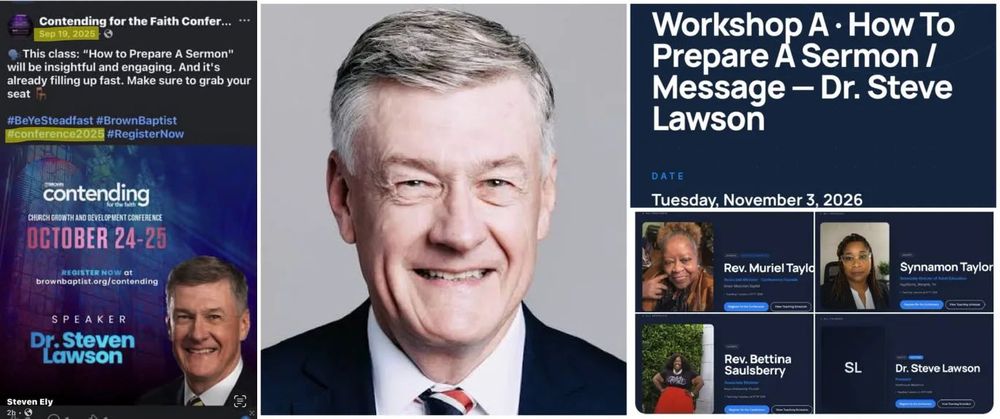
Strangely, a mere year after his fall, in September 2025, a post appeared promoting Lawson as speaker at Brown Baptist Church’s ‘Contending Conference’. Then it disappeared. Justin Peters has the screen shots, reproduced below.
The same thing happened less than a year after that, in July 2026, Lawson was promoted again as a speaker by Brown Baptist for their Contending Conference. The posting included details on which day Lawson was scheduled to speak, a bio, and the title and synopsis of his upcoming session. There was an outcry. The post disappeared. Lawson’s entry was deleted from the conference promotion. Lawson did not appear at the conference.
Now in September 2026, a posting appeared announcing a new book. It is called “Mercy in the Wilderness: Why I fell and What I Learned” by Steve Lawson. It is self-published. Initially the publisher was listed as ‘But God Press’. However, the publisher link went to a Japanese page. Soon the publisher on the Amazon listing was changed to “Steven Lawson”.
Is it any of our business?
This event has caused no little discussion. Many of the questions and points being raised are good ones. I have been thinking about them and sorting through my conclusions about how to react to a re-emergence of a fallen pastor.
Of late and disappointingly, several pastors have fallen who I previously enjoyed. Art Azurdia, RW Glenn, Ligonier’s Samuel Renihan, and Steve Lawson are ones in my section of the faith who have shown themselves to be adulterers. It’s crushing.
Seeing this happen over and over raises many emotions that bystanders impacted by their fall need to sort through. I posted one lady’s feeling on that below. Hopefully the sorting through is done graciously and according to standards set by the Bible.
And rather than naysayers chirping “It’s none of your business,” I recall a years ago investing hard earned money in Todd Friel’s Drive By Discernment series. There were 72 lectures and most of them with Friel paired with RW Glenn. After Glenn’s fall, the series was revamped with solely Friel and Steve Lawson. Oops. And again it was revamped.
Mainly, such events concern us because the name of Christ is reproached. Psalm 23:3 says
He restores my soul; He guides me in the paths of righteousness For the sake of His name.
Righteousness and His NAME’s sake go hand in hand. In Ezekiel 36:22, God rebukes the house of Israel because they have profaned His name-
“Therefore say to the house of Israel, ‘This is what the Lord GOD says: “It is not for your sake, house of Israel, that I am about to act, but for My holy name, which you have profaned among the nations where you went.
Even if you don’t care about the Lawson issue, his affair, or his book, do care about the name of Christ and how you conduct yourself from day to day so you will not be rebuked for profaning it.
Why do leaders fall?
This is the first question such a situation raises. We invest in our local pastors, teachers, and leaders near and far with our reputation, money, time, and goodwill. When they sin, it’s as if they betrayed us as well. But as David said, “Against You and You alone I have sinned”. All sin is ultimately against our Holy God.
But the damage left behind is enormous. For example, not only was I personally affected by the RW Glenn situation as I remarked above, but I attended and promoted the G3 Conference. I went to two of them and publicly promoted the whole scenario with that organization. It turned out to be a rat’s nest of secret sin.
Even more personally, years ago I was in a church where I discovered the pastor was plagiarizing every sermon he spoke, word for word. He even adopted and preached the family anecdotes and illustrations as if he had lived them. Worse, he was taking sermons from Charles Stanley, Rick Warren, and Joel Osteen! I was so heartbroken and physically ill it took me 5 days to recover. I gathered the evidence, brought it to one trusted leader (that’s another damage, who can I trust with this? Will the elders do right by the evidence? They didn’t at first with Glenn). Eventually after proper biblical standards were met, the plagiarizing pastor was ‘encouraged to resign’.
So whether it’s our own local pastor or a leader in whom we’ve invested in some way, we care about their fall, their soul, and their life after- for the sake of Jesus NAME. We’re all one Body. (Not to say we get involved with another church’s business in discipline, but only that we care and we must sort through our own feelings and stances in the aftermath).
“Trust, but verify” to quote President Reagan. In the Christian world, this is where discernment comes in. Trust in grace, but verify by the Word.
The “WHY?!” of it is a hard one to answer. It’s also easy. Why do pastors fall? We are human and we sin. Humans are sinners, and I am a sinner too. Why some pastors fall and others don’t is the everlasting question I leave to Jesus.
What happens after the fall?
We all sin and we all need to repent and receive grace. We are fortunate to believe in the One True God who is love, who dispenses grace to those who humbly come to Him. If a layperson sins, repent. You and I will be forgiven. For leaders though, there are more dire consequences.
Do not become teachers in large numbers, my brothers, since you know that we who are teachers will incur a stricter judgment. (James 3:1).
While we all must behave well, remembering we were bought with a price, (1 Corinthians 6:20), pastors and teachers have a heavy burden on them particularly. They speak and teach in Jesus’ name. They are front line. Nothing must be done doctrinally or behaviorally to besmirch His name or ruin His reputation among the flock.
But as for you, proclaim the things which are fitting for sound doctrine. (Titus 2:1)
But you, O man of God, flee from these things and pursue righteousness, godliness, faith, love, perseverance, and gentleness. (1 Timothy 6:11).
Since God is God and is the most supremely intelligent Being in the universe, and since He is our creator, He knows us. He knows we will sin and He knows leaders will fall. His word contains many directions for what do to after.
1.First, Matthew 18 gives advice on how to handle a sinning congregant. If the person does not repent, there is a process that ultimately leads to excommunication. If they do repent, we forgive him. However, there is an additional layer of protection and procedure to follow when an accusation is made against a pastor/elder. Erik Raymond at For the Church explains in this essay on the basis of Matthew 18:15-18 and 1 Timothy 5:21-
2.Second, the issue of restoration. It’s this issue that’s sparked the most discussion in recent years. Some say that we forgive the person and eventually after a period of reflection and humble living, they can resume their pastoral or teaching position. That they can be restored to their office. David who committed adultery is often cited in support of this stance.
Differences with David:
-David’s kingship was civil position, not a religious one. -David instantly confessed. He confessed without qualification or prevarication. There was no delay. -David wrote Psalm 51. Notably, he did not package it as a stand-alone essay and sell it. -He endured dire consequences afterward but did not blame God, nor did he shift the topic to himself and exclude God. He kept the focus on God’s righteousness and his own sin.
Others say they can never be restored to office but can be restored to God’s good graces. Forgiveness is the restoration. The support for this viewpoint is 1 Timothy 3:2; Titus 1:6-7.
EPrata photo
I’d like to add Proverbs 6:32-33 NASB to the mix, which says-
One who commits adultery with a woman is lacking sense; He who would destroy himself commits it. He will find wounds and disgrace, And his shame will not be removed.
This means when a pastor/elder commits adultery, he can be forgiven, but he is permanently under reproach because his shame for this sexual sin remains forever. It is never removed. Pastors who have fallen due to this sin can never be a pastor, elder, deacon, or teacher again. They are not above reproach anymore, as 1 Timothy 3:2 and Titus 1:6–7 says they must be.
Personally my stance is that the fallen pastor or teacher can never be restored to that office or position. He squandered it. The shame of his reproach remains. YES, definitely forgive him if he is repentant. YES definitely ‘forget’ his sin and treat him as the beloved brother he is. But no, he cannot re-attain that official position of leader.
People say. ‘But, but, DAVID! He was forgiven and remained king!’ King was a civil position, not a religious one. Also, be aware that David was disqualified from building the temple, something he dearly wished to do. He also lost his children, and endured many other dire consequences due to his sin.
Moses disobeyed God and also was disqualified from entering the Promised Land. Eli and his sons were actually killed for their sins and squandered their opportunity to honor Jesus while occupying their priestly positions.
Trust lost by a leader or pastor is trust gone for good. Disobedience has consequences. Personal relationships can recover, beautifully and according to the grace of the Gospel but not the office.
I am often puzzled by people who reject this reality. Never mind the Bible verses that state so, but there is illogic of re-installing someone who has disqualified themself from the job. In the secular world, would a company hire an embezzler to be their treasurer? A pedophile to run a daycare? A gigolo to manage a singles ladies night? A drug addicted doctor? There are ethical standards for secular jobs and consequences for falling under those standards. A spokesman for God has an even higher calling and a more weighty position. Thus the consequences are deeper and more lasting.
Some say that Lawson’s book should be read, because even if he has selfish or greedy motives, if Christ is proclaimed it’s worthwhile. They cite Philippians 1:15-18, where Paul rejoiced that even though a group may have had selfish motives, Christ was proclaimed. Jamieson-Fausset-Brown Bible Commentary says of the Philippians verse,
“‘The proclamation of Christ,’ however done, roused attention, and so was sure to be of service. Paul could thus rejoice at the good result of their bad intentions (Ps 76:10; Isa 10:5, 7).
Yet others cite Acts 16:16-18, where a demon possessed slave girl was following Paul & Co. saying, “These men are bond-servants of the Most High God, who are proclaiming to you a way of salvation” and Paul was mightily grieved by her proclamation, even when he hadn’t been grieved by the selfish crowd with ill-intent in the Philippians verse. Barnes’ Notes explains why-
(2) Because it might be said that he was in alliance with her, and that his pretensions were just like hers; (3) Because what she did was for the sake of gain, and was a base imposition; (4) Because her state was one of bondage and delusion, and it was proper to free her from this demoniacal possession.
So in that vein, if Lawson is not saved and is in bondage, buying his book is an affirmation on which he would rest, which won’t lead him away from the dark and into the Light. And while we’re on the topic, let’s talk about filthy lucre and the sake of gain by peddling the name of Jesus.
Others who say they will not read Lawson’s book mention Simon Magus, who tried to BUY the Holy Spirit, as Barnes had said, “a base proposition”. In today’s language, GROSS. This sentiment on X hit the target for many who read it- Nonna on X wrote, @Nonna6Hearts
I’m a legit nobody over here, but I feel a sharp sting of betrayal by Steve Lawson for 1. Selling me many books and studies for years during his affair. 2. Wanting me now pay to read of his repentance. I wish he would have shown his face, his heart and done an interview for free.
Lawson has already gained lots of money from his hypocritical books and teaching positions, speaking honoraria while having his affair. Justin Peters shows a clip in his Youtube conversation where Lawson is explaining to a young seminarian how not to become an adulterer, WHILE Lawson was engaged in his 5-year adulterous affair! Hypocrisy to the highest order.
Challies has some good words here on the very topic of whether to read a book by a fallen leader-
“First, I don’t think all of us will respond to this question in the same way, and I don’t think we need to. It is not a matter of clear right and wrong as much as a matter of wisdom and conscience.”
Much of how we deal with sinners in the faith depends on if they are saved or not saved. Some say we shouldn’t even broach the topic at all, ever. ‘We don’t know their heart’ they say. That is true, usually. In some cases the Bible tells us that their behavior reveals their heart. 2 Peter 2:2-3 says this regarding false teachers,
Many will follow their indecent behavior, and because of them the way of the truth will be maligned; 3 and in their greed they will exploit you with false words; their judgment from long ago is not idle, and their destruction is not asleep. “Heart motives are reflected in actions.” DB Harrison
Or they say ‘Leave the judgment to Jesus, don’t judge’. However there are many verses which instruct us to do exactly that- judge. Meaning- discern, assess, evaluate. How will we know the false teachers by their fruit if we do not examine their fruit? How will we know who to mark and avoid if we never assess who to mark?
A significant indicator is Lawson’s behavior of being able to resist the Holy Spirit’s conviction in him, if he indeed has the Spirit. And resisting the Spirit’s pointing to righteousness and to Jesus. Remaining un-reconciled to his wife and living in different states is another indicator the situation is not moving toward a resolution in a godly way.
That’s why we wait a while before deciding whether the fallen leader ‘s walk is worthy or false. Fruit takes time to grow, both before AND after a fall. After the fall the fig tree is withered. Will figs grow back? Or will the tree remain fruitless?
Challies has some ideas as to why some fallen leaders push for restoration to their platformed position. The religion career is all they know.
“Have you ever wondered why pastors who have been disqualified from ministry so rarely concede to the reality of their disqualification and just move on? Have you ever wondered why they so often disappear for a year or so and then turn up at another church or in a different denomination? I have wondered often and have formed a theory about the matter.”
Justin Peters: “This book should have never been written – don’t buy it. …Peters said, “If you have a true godly sorrow over sin (2 Cor. 7:9-11), the last thing you would ever want to do is make money off it.”
Peters explains his reasoning in the review linked above.
My Conclusion (yours may differ)
My decision is I am not going to read anything by Steve Lawson. In fact, the one book of his that I owned I threw out. It’s my own conscience, my own need to read wholesome material unpolluted by obvious sin’s taint. For the sake of my discernment and my walk with Jesus I strive to absorb sermons, speeches, books, essays, and podcasts that are MORE wholesome rather than LESS wholesome.
If you stayed with me this whole, long essay, thank you. What are your thoughts?
I love a nice rain, don’t you? We haven’t had rain here for a long time. We are in a drought of varying levels up and down the state. Ours is ‘Extreme drought”. I miss a nice, gentle rainy day, with rumbles of thunder far off and some lightning.
The air smells (people tell me) so fresh and vibrant after a rainy thunderstorm. I never thought about why. Then this week Ken Ham of Answers in Genesis wrote the following. There is a scientific reason. The air actually DOES smell different after a storm!
Trees glow during thunderstorms. A recent study of tree leaves has revealed what scientists have long suspected but have never been able to observe: The tips of tree leaves shimmer as a thunderstorm passes overhead. This “glow” is called the corona and is caused by a weak electrical discharge. It’s invisible to the naked eye, but technology has allowed researchers to observe and document the phenomena. And this glow is actually really important. As the corona is discharged, it releases hydroxyl radicals, which clean the air, removing pollutants. It’s such a powerful cleaning force that it’s known as “nature’s detergent.”
This whole process is just another example of how our Creator God has lovingly provided for the needs of His creation. God’s creation is truly amazing, and every discovery of the things He’s made brings glory to Him. “Let the heavens be glad, and let the earth rejoice; Let the sea roar, as well as its fullness; Let the field exult, and all that is in it. Then all the trees of the forest will sing for joy Before Yahweh, for He is coming, For He is coming to judge the earth. He will judge the world in righteousness And the peoples in His faithfulness” (Psalm 96:11–13).
Scientists chasing thunderstorms in a retrofitted minivan finally captured something never seen before in nature: faint electrical glows shimmering from treetops during a storm. These “corona discharges,” long suspected but never observed outside a lab, appeared as tiny UV flashes at the tips of leaves. The discovery could reshape how we understand forests, since these bursts may help clean the air by breaking down pollutants.
Then God said, “Let the waters below the heavens be gathered into one place, and let the dry land appear”; and it was so. And God called the dry land “earth,” and the gathering of the waters He called “seas”; and God saw that it was good. Then God said, “Let the earth sprout vegetation, plants yielding seed, and fruit trees on the earth bearing fruit according to their kind with seed in them”; and it was so. The earth produced vegetation, plants yielding seed according to their kind, and trees bearing fruit with seed in them, according to their kind; and God saw that it was good. And there was evening and there was morning, a third day. (Genesis 1:9-13)
God did all that in one day! He is an amazing, powerful creative, holy God! He made this for US, so we could live on a beautiful planet. So many places are still so stunningly beautiful even with the Fall of man polluting and corrupting it. Imagine what heaven will be like! God’s dwelling place with no sin to stain it. Imagine what He has in store for us in eternity to do for Him! It will not be boring, that is for sure. It will be beautiful, good, and true.
Dr. Dan Schricker, who earned a Ph.D in music composing, is a highly intelligent and educated man. He was also a cult victim and one who has made a lifetime study of cults. He is often an invited speaker on the topic such as when he spoke as a presenter at the 2023 International Cultic Studies Association Conference.
Lori Alexander is a blogger who puts out teachings on her version of the Bible’s female submission issues. Lori’s output is vast and constant, but only on one topic: behavior of women and wives based on only 3 verses of the Bible, Titus 2:3-5. Her teachings are not consistent with the Bible and is in fact warped and legalistic. Lori is a false teacher.
Two years Dr Schricker studied Lori Alexander’s output. Based on widely recognized criteria regarding cults that social scientists use to recognize and warn about high-control groups, AKA cults, Dr. Schricker concluded that Lori meets the criteria of being a cult leader a cult of women who have sadly fallen into Lori’s high-control mind thought.
In Dr. Schricker’s article from two years ago, after laying out quotes and examples from Lori herself, with linkable footnotes, he concluded,
Make no mistake, the thin veil of Scripture and religious terminology that cloaks Lori’s teaching seeks to hide the fact that her message is fundamentally anti-gospel, anti-Christian, and anti-women. The legalism, the misuse of Scripture, and the spiritually bankrupt view of marriage and women are all disqualifying factors in terms of her teaching ability. My recommendation is to reject her message on all fronts and, when necessary, call it out if you have the platform to do so. I am grateful for the people who have already done that.
Lori Alexander, her profile pic
After Dr Schricker’s careful presentation, rife with explicit examples and compared to scripture how did Lori react? She wrote a few months ago,
Then Lori went on to reject the evidence in exactly ALL the ways cult leaders always do.
Now comes another post exploring these themes. Elise Heerde is an educated and trained Religious Trauma Coach & Cult Recovery Expert. Her article about Lori Alexander is here. She also refers to Dr Schricker’s article. Ms Heerde wrote,
This piece responds to Lori Alexander’s post “Am I a Cult Leader?” published at thetransformedwife.com on June 26, 2026. All quotes are taken directly from that post. The analysis applies publicly documented research frameworks to publicly available content and teaching.
Ms Heerde’s verdict, according to the data, is that yes, Lori Alexander is a classic cult leader leading a cult of women who are emotionally manipulated, highly controlled, and drenched in false teachings.
She makes an excellent point that when we think of cults, we think of a charismatic leader who sequesters himself and his followers away from public society, normally in a compound, in order to perform weird behavioral and sexual things, which usually ends violently. (I.E Branch Davidians, The Peoples Temple-Jonestown, Heaven’s Gate, The Manson Family…). Yet that is not the only version of cults. Looking at Robert Lifton’s 8 criteria for cults, Heerde wrote,
“None of those criteria require a compound, a charismatic leader, or explicit punishments for leaving.They describe psychological mechanisms that can operate in a living room, a blog comment section, or a Facebook group with hundreds of thousands of followers.“ Source Heerde.
Heerde went through Lori Alexander’s rebuttals and rejections of Dr Schricker’s evidence and showed how they are just deflections against the truth.
These types of warnings are important because firstly, of course you do not want anyone falling into a “cult”. Saying the world cult usually implies an isolated and manipulated group led by a controlling figure as mentioned above. Yet any idea or religion taken to an extreme can become a cult.
Ms Heerde wrote, “Coercive control doesn’t require the controller to be physically present, to have direct access to the person being controlled, or to impose consequences through their own direct action. What it requires is a framework that the person has internalised so thoroughly that they control themselves on behalf of the system.”
In Jesus day, cults existed. The Cult of Artemis in Ephesus was a potent one with many followers who were not isolated on some compound. In and around Jerusalem there were 4 groups of ‘believers’ who claimed the One True God. Whether these were cults or sects is still a debate, but the Pharisees, Essenes, Zealots, and Sadducees were competing high-control groups oppressing and/or isolating the believers in various ways. (John 9:22; John 12:42)
The framework Lori Alexander pushes is constant, errant, and dangerous. Ms Heerde goes through some of the more troublesome aspects of it in her article. I recommend it not just to learn why Lori Alexander fills the marks of a cult leader, but for information in general. It is easy for a false teacher to become popular then begin to warp the faith and grow his or her platform of followers, who then become like minded as the leader.
Heerde also focuses on deeply troubling aspect of Lori Alexander’s framework. It includes Lori having been formed through the dangerous teachings of Bill Gothard and Michael & Debi Pearl. Both these groups are recognized as cultish, abusive, and dangerous. Ms Heerde wrote,
The company someone keeps is relevant information. When someone cites as their primary formative influences two figures associated with documented institutional abuse, sexual misconduct allegations, and child welfare concerns, and defends both of them against scrutiny using the same logic she uses to defend herself, that pattern is worth noting.
I worry greatly for Lori, her husband Ken, and their followers who are deceived into thinking Lori’s version of Christianity is viable. It’s dangerous not only to her followers, who are internalizing a warped version of the Gospel and life’s walk with Jesus, but because Lori uses Jesus as her basis for promoting her false teachings. He hates that. (Revelation 2:20-23).
Lori’s output is constant and vast, across multiple platforms. It is Jesus-adjacent, so that a person could be easily confused into thinking what Lori teaches is actual truth. It isn’t. Please avoid Lori Alexander The Transformed Wife. Dr Schricker ended his article with a pointed plea, which I echo-
“In short, do not join the cult of Lori Alexander. And if you have joined already- for heaven’s sake, get out.”
Making the rounds on social media this week is a 4 minute rendition of the hymn Nearer My God to Thee. It is a live clip from André Rieu’s tour in Maastricht a couple of years ago. It is now on his album The Sound of Heaven. The Album has a mixture classical masterpieces, romantic melodies, and evergreens, beautifully performed by André Rieu and his Johann Strauss Orchestra.
In this clip, the jumbotron occasionally pans from the players, conductor, or singers, to the audience members who are caught wiping a tear or two from their eyes. The music is so moving.
A famous line from the 1697 play The Mourning Bride by English playwright William Congreve is: “Music hath charms to soothe a savage breast, to soften rocks, or bend a knotted oak.” I was surprised when I looked this up just now because I thought the attribution was to Shakespeare. But no. The concept in the quote is that music enchants. It soothes. It can calm anger, or appease the hardest heart.
Can you imagine the music in heaven? The New Song that will be sung by blameless tongues of the 144,000 who had been purchased from the earth. (Revelation 14:3).
And in Revelation 15:3 the tribulation martyrs sing the song of Moses and the song of the Lamb, holding the harps of God.
And in Revelation 5:8-9a the four living creatures and the 24 elders with the harps sang a new song.
We will sing in heaven and there will likely be instruments there too. Hezekiah said “We will sing with stringed instruments all the days of our lives in the temple of the Lord.” (Isaiah 38:20)
The wider issue is that we need beauty. We respond to it deep in our souls. We need it in music, art, architecture, nature, all ways and and at all times. We thirst for beauty. This world is beautiful, but there is much ugliness too, much cruelty, much pain. Let us drink in the Lord’s magnificence through beauty when we find it.
Indeed, the Psalmist in Psalm 27:4 said his ONE pursuit is to behold God’s beauty-
One thing I have asked from the Lord, that I shall seek: That I may dwell in the house of the Lord all the days of my life, To behold the beauty of the Lord And to meditate in His temple.
What an incredible honor we believers have, to soon look upon the enthralling face of the Savior, his perfections, glory, infinite holiness. His beauty is unmatched by anything seen, created, or imagines. It was David’s ONE hope, and should be ours.
Jesus is the ultimate beauty, and all earthly beauty comes from Him. This is why we respond to it.
If hymns praising Him then move us toward that pursuit of His beauty, then all the better.
Further Resources
Sheehan Quirke is otherwise known as The Cultural Tutor. He has a variety of resources such as a book, podcast, newsletter, and social media speaking on topics of art, architecture, history, poetry, and literature. He is interesting. His website is here.
RC Sproul’s teaching series at Ligonier on Recovering the Beauty of the Arts is here. I took the course. It’s good. Download & stream the 9 lessons for $14.50
Synopsis: Leah is remembered, but Bilhah and Zilpah often fade into the background. Given as slaves, used as surrogates, they still bore sons who shaped Israel. Their stories expose suffering but a God who did not forget them.
Here are some practical ideas on HOW to love as Jesus would have us love. Love these days is in short supply in the world. Our love will shine brightly if we love as Christians- loving our brethren, our families, the pagans, and even our enemies.
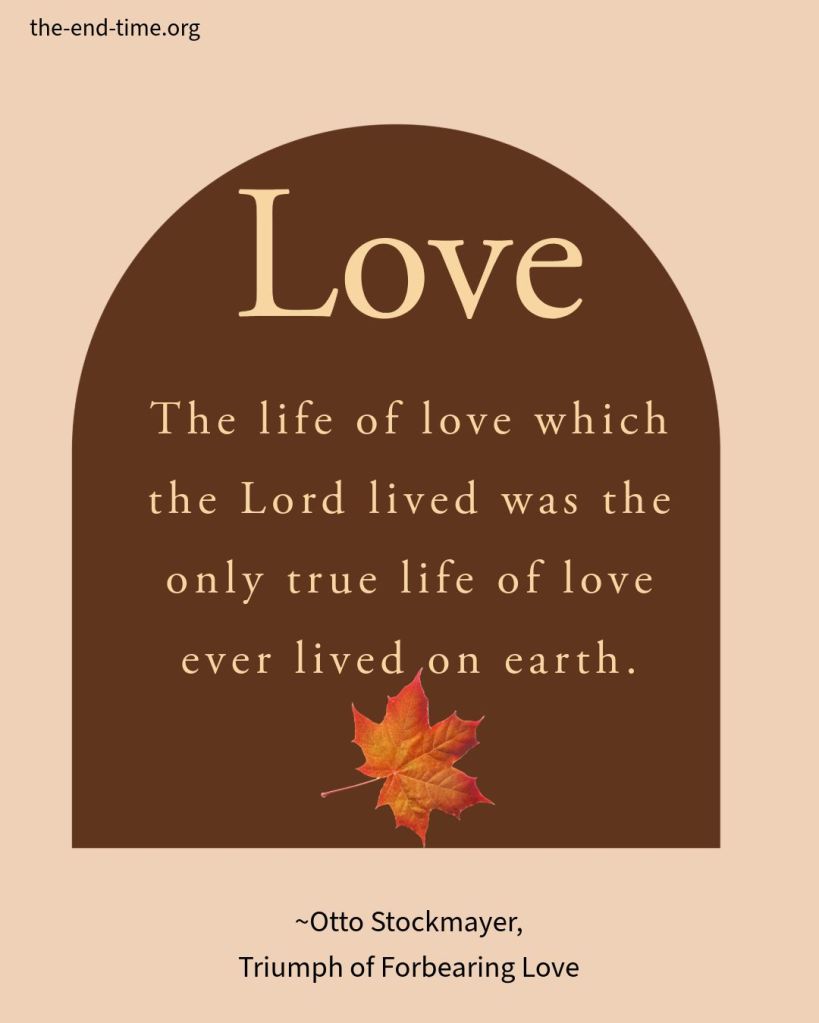
Extended quote from Free Grace Broadcaster #159, Love, from Chapel Library: essay The Triumph of Forbearing Love by Otto Stockmayer,
“Let us stop and consider the form of the expression. Of course, so far as we are children of God, Christ is in us. We cannot be born of God without having Christ in us. Christ must indeed be formed in us (Gal 4:19), but at the very moment we are born again from above He is in us.
Might it not be a very practical test, and a Biblical and Scriptural way of proving that Christ is in us, to get into the holy habit of always seeing Christ in our brother? Even if he were born again but yesterday, or only an hour ago, it is well for us at the very beginning of his Christian life to see in him, through faith, Christ abiding in his heart by the Spirit of God; a being of whom God—Father, Son, and Holy Spirit—has taken possession.
Let us learn to look at our brother as seeing in him the unseen Christ, and we shall help him in a mighty way to take heed that Christ may shine in his life. By this means he will become conscious of the holy ground on which he stands and moves and walks, by having become a Christian. We who have for years walked with Christ must help the babe, the child, to awake to his high calling as quickly as possible.
By recognizing Christ in him, we shall help him to become conscious of the wonderful secret of his new life; and we must prove ourselves to be men in Christ by not stopping short at what we see with our eyes and hear with our ears of the manifestations of the flesh which we may find in the young Christian. We must be able, through Divine love shed abroad in our hearts and free grace in our lives, to look beyond what is seen; we must love our brother through faith in God, that He may bring out the new creation in him in a beautiful way… more beautiful, it may be, than in our own lives.”
The Benny Hinn-style of prosperity gospel is well known and easily seen among those Christians with even a snippet of discernment. The Hinn-style prosperity gospel, labeled ‘hard prosperity gospel’ in the article below, promises instant health or wealth, or immediate financial gains. These prosperity gospelers frequently use terms like ‘breakthrough’, urge positive confessions, (AKA ‘name it and claim it’), and press their audiences for donations they call ‘seed faith’ giving. Joel Osteen is one of these. So is Kenneth Copeland.
But there is another type of prosperity gospel that is much harder to detect. As always, that old serpent is subtle. It is in fact the first quality we learn about him, from Genesis 3:1. The first mention in the Bible of the serpent tells us of his subtlety. The word means cunning in a bad way, crafty, or shrewd. So it stands to reason satan adjusts his methods of deception. The “softer prosperity gospel” is one of those.
At 9Marks’ article quoted below, we learn of this more subtle prosperity gospel which in the quote below, says assumes its audience knows the Gospel already:
This is not a new concern. Others have described facets of this prosperity gospel under names like moralistic therapeutic deism, Christless Christianity, and the commodification of Christianity. In truth, all three descriptors overlap to describe a prosperity gospel that is easily missed, because it is seems reasonable to Christians who love God and the American Dream.
That said, the ‘soft prosperity gospel’ can be just as ruinous as the hard prosperity gospel. Any deviation from Christ’s standards for life and doctrine is ruinous. Why? Because any deviation comes from either our flesh, the world, or from satan, and stands opposed to Christ’s Good News. Just because it’s soft does not mean it’s less hard on the soul.
9Marks: “While evangelicals have traditionally decried the prosperity gospel in its “hard” form, there is a softer form of this teaching that is all too common among us. Often undetected by Bible-believing Christians, it assumes the gospel and leads its adherents to focus on things like financial planning, diet and exercise, and strategies for self-improvement. In contrast to the hard prosperity gospel, which offers miraculous and immediate health and wealth, this softer, subtler variety challenges believers to break through to the blessed life by means of the latest pastor-prescribed technique.”
I liked the use of the term “assumes the Gospel”. Too often as a Christian ministry whose goal of presenting information to its audience assumes its audience as Christians already know the Gospel. However, genuine Christians need to be reminded of it all the time. And we can never assume that anyone reading or listening to our output is actually a Christian and/or already knows the Gospel. The Gospel as Good News should be shared incessantly to one and all.
The 9Marks article mentioned diet & exercise as a location for one of the ways softer prosperity gospel enters in. Among the Christian circles I frequent, which focus on women, there is a huge emphasis on diet and exercise. It’s also called ‘wellness’. I’ve written previously about the trad wife & crunchy Christian woman. In these realms it seems a softer prosperity gospel abounds. Angela Mitchell of Raising Apologists has done a yeoman’s work on this topic as well. See some of her links below.
Wellness Christianity is not the only potential soft prosperity pitfall, of course. The pitfalls exist in spheres of financial planning, self-improvement, and other American style problems we think we have.
We do want to be healthy, plan wisely with our finances, and improve ourselves. That is not the issue. The problem comes when promoters of a soft prosperity shift the focus from Jesus’ blessedness to the blessings.
The 9Marks article continues with presenting 5 trademarks of soft prosperity.
Soft prosperity elevates “blessings” over the blessed God.
Soft prosperity detaches verses from the redemptive framework of the Bible.
Soft prosperity diminishes the curse that Christ bore and the blessing of the Holy Spirit.
Soft prosperity relies on pastor-prescribed therapeutic techniques.
Soft prosperity largely addresses first world, middle class problems.
It is easy to get drawn in to these, so please take a look at the article and see if you have or haven’t been fooled by these subtleties. If you have, of course Jesus will accept your repentance and the Spirit will respond to your request to be strengthened in discernment. If you have not been taken in, pray in praise to Jesus that He has delivered you from this error. Remember we do nothing on our own. We always abide in Him.
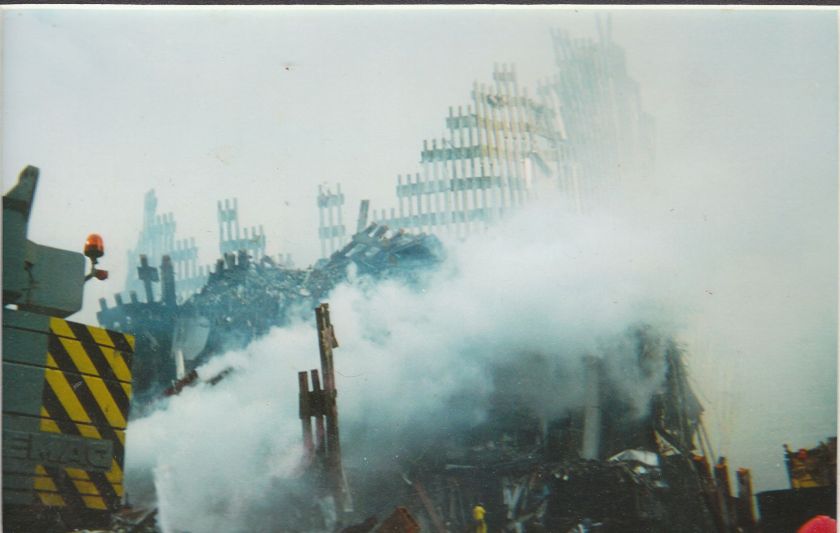
Photo of the fallen towers in New York City, taken by an American Legionnaire a few days after the terror act, and given to me
In March of 2001 I started a newspaper. It was a weekly community paper where I’d determined to cover our local government. I was fiercely committed to our First Amendment rights, especially a free press and the right to assemble.
The local community had a newspaper already but it had drifted from its origins when founded 30 years prior, and was now actually oppressing the citizenry. They were effectively a government arm. I had a goal of using my paper to teach the locals what their rights and responsibilities were as participating citizens of a great country and how to grow our town into a thriving society, based on those aforementioned freedoms.
On the morning of September 11, 2001, it was a Tuesday. I’d arrived at my newspaper office early since Tuesday was a big paper day, we go to print early Wednesday morning. We weren’t digital then, I’d have to drive the laid-out boards to a nearby city, so the timing was important. Tuesday then, was the day we put the paper all together.
I was renting my news office from my friend who lived a big, rambling farmhouse. I was in the front room, she and her family lived in the back rooms. She called me from her living room. I thought it was unusual that she phoned, being just a few feet away from me in the same building. But her usually quiet voice evaporated all other thoughts. She said with fierceness, “COME HERE NOW”.
The first plane had just hit the twin tower in NY. Shoulder to shoulder we stared at the burning hole in the North Tower, trying to comprehend what had made such a big hole. We watched with eyes wide, breathing shallowly, standing with arms numbly at our sides…
As we watched, the second plane hit at 9:03. Our heads swiveled toward each other, eyes locked. We knew. We knew without saying a word that this was an attack. We were being attacked from an enemy combatant.
We also knew that nothing would ever be the same. It only took seconds for us to realize this.
A knot was in my stomach and comprehending thoughts refused to form in my head. But we did know that when a war starts you do a few things right away. We got our purses and first we walked across the street to the hardware store and we bought the biggest flag they had. We went back to the office and put it up.
AMERICA!
Then we drove down the street to the bank to get money. Cash was going to be important if the electricity went out or we were ordered to evacuate. We didn’t know what was coming next and we wanted to be prepared. It could have been a nuke coming next, for all we knew. We worried about nukes. There was a huge Navy telecommunications station in Cutler, Maine that the Russians had their missiles aimed at for a long time. Maine certainly was a target. We felt exposed, unsafe, with an enemy that could be lurking anywhere.
At the bank, they had the TV on in the break room with the door open and the volume up so customers could hear what was going on. A third plane had crashed into the Pentagon. We saw the fire and military men running around to evacuate that military building. The Muslim terrorists had struck the building that represented the strongest military in the world! This was a different kind of war.
While we were at the bank we saw a fourth plane had just gone down in PA. The smoking crater was being shown. We knew that plane was part of whatever was happening. It seemed like it was coming from all directions. The feeling was disorienting, not just for us but for everyone. Everyone around us seemed like zombies…with unsure gait, eyes wide, half-sentences drifting off as the mind groped.
We did not know if we would have to evacuate so after the bank, we gassed up our cars. Better be prepared. Then, with the flag up at the office, cash in hand, and cars parked and ready, we went into the office and got to work.
FREEDOM!
We resolved that our freedom was under attack. Running a newspaper which reported the news and offered a platform for the people to speak their thoughts on any political or civic matter freely, we decided our most patriotic thing we could do to support the Constitution that day was to get the paper out. The terrorists were not going to stop the presses. They were not going to stop freedom from ringing out. And that is what we did.
Those Muslim terrorists were evil. But we are all evil before we repent. I wasn’t saved on 9/11. I was about to be soon, but not yet. Jesus is the hope we have to become good. Not on our own merits. We do not become good through our own efforts. No, “Why do you call me good?” Jesus answered. “No one is good–except God alone.” It is not a popular thing to say, that we are not good, but we are not.
In Islam the only sure way they have to get to heaven is to kill in Allah’s name. The terrorists thought they were gifting Allah with their lives but 1 second after they died they learned Allah is a figment. There is no Allah. They met the one True God – Jesus- who will pour out His wrath upon them in hell for all eternity. (Revelation 14:10). As He will to all sinners.
In Islam you pour out your life so that others die. I thank Jesus that He poured out His life so that we may live…and become righteous. “It is because of him [God] that you are in Christ Jesus, who has become for us wisdom from God—that is, our righteousness, holiness and redemption.” (1 Corinthians 1:30).
Even at that, our fleshly lives on earth are a struggle, a struggle against sin and growth in righteousness. I long for the day when flesh shall be glorified and sin shall be banished.
Part 2 tomorrow, upon the 25th anniversary of 9/11.
Here are John MacArthur’s sermons during that terrible week that aimed to help people understand-
Jesus will return in glory with His glorified saints. He will institute new nations and new cities populated by sinless resurrected chosen ones. There will be no more war because our hearts will be made right with Him. There will be no more terror because we will want nothing, having been given it all by our Savior. If you bow low to the Savior and repent, He will lift you up high. Please do it soon.