Posted in good friday, theology

The World’s Most 3 Important Days: Good Friday to Resurrection Sunday

By Elizabeth Prata

Can you imagine the pit of despair the Disciples felt on Good Friday? To them it was a hellish and confusing Friday. They were confused, they scattered, Peter even denied Jesus.

Jesus’ separation from the Father while on the cross (Matthew 27:46) is the loneliest and most poignant moment any person ever felt in the history of the universe, bar none.

But the disciples’ sudden and unexpected separation on Friday from their spiritual Father they’d been following so hopefully for three years came upon them cruelly and brutally, throwing them all into states of panic, despair, and spiritual depression. Even though Jesus had told them ahead of time, and even though they had studied the scriptures, they didn’t understand. To them, it wasn’t Good Friday. It was just bad Friday and the seeming end of the long trail of hopes and highs they’d been experiencing for three years with Jesus in discipleship to Him. They did not know as we do, Friday’s here, but Sunday’s coming!

We worship Jesus every day. We worship and praise Jesus collectively in services on Sunday. We exalt Him each year on Resurrection Sunday. We know Him as Resurrected King triumphant over sin and death!

His ultimate moment will be His return, when every knee shall bow and every tongue will confess (Romans 14:11, Philippians 2:10, Isaiah 45:23).

The LORD will be king over the whole earth. On that day there will be one LORD, and his name the only name.” (Zechariah 14:9)

Everyone will know that Jesus is MESSIAH! They will finally know the Resurrected Jesus is the only name. He is all names. He is the beginning and the end!

And it started with the cross on Friday, when it was finished.

Posted in cross, theology

Exploring the Cross: A Symbol of Christ’s Glory

By Elizabeth Prata

I designed this picture to stare at and better ponder its truths. The mental picture of it as I was reading was so vivid before my eyes I had to draw it out.

Initially I drew just the wavy line and the cross. The cross is lifted up, the sole item on the bloody landscape. To view it, all eyes must look UP. The cross of Christ is the only thing has any meaning in the world. When I was an unsaved person I rejected this notion immediately. As a saved person, by the grace of God, I am humbled to kneel and stare at this wonderful, terrible cross.

The line represents not only the hill, for the Son of Man must be lifted up, and it was a hill He died on and a hill he will return to. (Zechariah 14:4).

The line is also the dividing line of all human history. The above and below, the hell and the heaven, the line that divides before Christ’s birth and after Christ’s incarnation and is both the starting point and the ending point of all that is and all that will be.

On the day of His death the sun was darkened. This is only right, for Jesus is the Light of the world.

It was now about the sixth hour, and darkness came over the entire land until [u]the ninth hour, 45because the sun stopped shining; and the veil of the temple was torn in two. (Luke 23:44-45).

“Christ’s victory is the spectacle that holds the attention of the universe.” ~Tony Reinke, Competing Spectacles

Christ’s glory is the spectacle of all spectacles, and its power is most clearly seen in how it equips and motivates and animates our faithful obedience in all other areas of life.

Christ was not merely made a spectacle on the cross, the cross became a shorthand reference for everything glorious about Christ- His work as creator and sustainer of all things, his incarnation, his life, his words, his obedience, his miracles, his shunning, his beatings, his crucifixion, his wrath bearing, his resurrection from the grave, his heavenly ascension, his kingly coronation, and his eternal priesthood- all of his glory subsumed into his heavenly spectacle. ~Tony Reinke, Competing Spectacles

To be able to love Jesus and not hate Him any longer is the joy of my life.

We love because he first loved us. (1 John 4:19)

Posted in theology

Understanding Demonic Influence in the Gospel of Mark

By Elizabeth Prata

EPrata photo

We are going through the book of Mark in our church. Our teaching pastor recently preached on Mark 5:1-20. It’s the incident of the Gadarene Demoniac. The man in the Bible had a Legion of demons in him. A Roman legion had up to 6000 soldiers. The man didn’t necessarily have 6000 demons in him, in fact it’s more likely he had around 2000, but still.

Demons are fallen angels. These are the angels who rebelled against God and followed satan. They are totally depraved, sinful, and out to do as much damage as they can on the earth to all people, but especially to God’s people.

The demons are present on earth always, but seem to have been more highly active in three great waves. They were particularly active around the time of Moses, during the Elijah-Elisha period, and when Jesus walked the earth. In the future, they will be highly active during the prophesied Tribulation period. Demons are also called ‘unclean spirits’.

In the New Testament, we read of the demons and their activity more times than one may remember. It is a big topic, especially in the Gospel of Mark. A demon became agitated when Jesus taught in the synagogue, and the man the demon was inhabiting shouted, “saying, “What business do you have with us, Jesus of Nazareth? Have You come to destroy us? I know who You are: the Holy One of God!“( Mark 1:24).

The Gadarene legion of demons in the man called out “Jesus, Son of the Most High God.” (Mark 5:7). This title was used by both Jews and Gentiles to distinguish the one true God from the false gods. The titles the demons used to speak to Jesus, Most High God and Holy One of God are acknowledgements from the fallen, unholy angels that they know exactly who Jesus is. Even if the crowds didn’t or even the disciples.

The demons used the highest name for Jesus, they know who He is and how holy He is.

After that incident, Now when evening came, after the sun had set, they began bringing to Him all who were ill and those who were demon-possessed. 33And the whole city had gathered at the door. 34And He healed many who were ill with various diseases, and cast out many demons; and He would not permit the demons to speak, because they knew who He was. (Mark 1:32-34).

‘all those who were demon-possessed’… ‘cast out many demons’. Hmm, sounds like a plague of demons were abounding. In Mark 3:14-15 there is an important verse, don’t gloss over it when you’re reading:

And He appointed twelve, so that they would be with Him and that He could send them out to preach, 15and to have authority to cast out the demons.

EPrata collage

Jesus appointed them to preach AND to show they had authority over the demons.

That is a key thought. They had authority. So did Paul. (Acts 16:16-18, Acts 19:11-12). This was to authenticate their message. Remember the demon-possessed slave girl? She had a spirit of divination, and she annoyed Paul for many days. He busted that spirit out of her. He “said to the spirit, “I command you in the name of Jesus Christ to come out of her!” And it came out at that very moment.” (Acts 16:16-18).

Do you remember that Jesus appointed 72 to go forth and preach and heal etc? They came back jubilant. Now the seventy-two returned with joy, saying, “Lord, even the demons are subject to us in Your name!” (Luke 10:17).

The apostles, including Paul, and the 72, had been given authority by Jesus – “The Holy One of God” – to exorcise demons. And they did. Demons were busting out all over the place by those who were given that authority.

Charlatans abound in every era and in every religion. There were false prophets, false healers, and false exorcists. These exorcists roved from town to town, plying their trade. Casting out demons is mentioned in Matthew 12:27; and Mark 9:38.

Copycat exorcists, hoping to profit from the excitement created by Paul’s ministry, sprung up around Ephesus. The book of Acts records that some groups successfully invoked the names of Jesus and Paul in their exorcisms, possibly receiving financial rewards (though this is not mentioned in Acts). Source Lexham Bible Dictionary.

But also some of the Jewish exorcists, who went from place to place, attempted to use the name of the Lord Jesus over those who had the evil spirits, saying, “I order you in the name of Jesus whom Paul preaches!” Acts 19:13).

Demon deliverance was a thing. Even some who were not believers seem to have been successful at times in getting a demon out. Luke 7:21-23 shows some people pleading with Jesus to allow them into heaven, because they did miracles and works and cast out demons.

Pharaoh’s magicians were able to counterfeit some miracles- up to a point. And in Matthew 24:24 we are warned- For false christs and false prophets will arise and will provide great signs and wonders, so as to mislead, if possible, even the elect. Satan and his fallen demons are active and powerful.

EPrata collage

Then the scene narrows in to one particular instance- Now we come to a funny scene.

It seems that there was a Chief Priest named Sceva who had 7 sons. Acutely aware that Paul was earning much notice with the people, these 7 brothers tried to copycat, at least where demons were concerned. These Jewish demon busters tried to get a demon out of a man. The demon inside didn’t budge but then asked the Jewish itinerant exorcists,

But the evil spirit responded and said to them, “I recognize Jesus, and I know of Paul, but who are you?” (Acts 19:15).

Then the demon possessed man leaped on the 7 brothers and beat them up until they left the house howling, bloody, and naked.

The Sons of Sceva tried to cast the demon out but instead the demon cast the Sons of Sceva out!

You might be thinking, ‘one against seven? The odds are in favor of the brothers, aren’t they?’ No. Demons are mighty. They are angels after all, fallen and unholy, but still powerful. An angel is going to stand on the sun (Revelation 19:17). Four angels are going to stand on the 4 corners of the earth and hold back the 4 winds. (Revelation 7:1). The Gadarene demoniac was so strong he broke chains and no one could contain him.

A Christian cannot be demon-possessed. We are sealed with the Holy Spirit. We are given armor of God to protect us, (Ephesians 6:11–17) and we are supposed to resist the devil and he will flee from us. (James 4:7).

So, how are unbelievers successful in casting out demons if they do not have the authority from Jesus nor even belief in Him? Catholics are famous in secular literature for their supposed expertise in exorcisms.

Demons are real. Satan is real. However, Satan is a master trickster and the father of lies (John 8:442 Corinthians 11:14). A demon’s ability to lure gullible human beings into its traps often exceeds our ability to detect the traps (2 Corinthians 2:111 Peter 5:8). If it would serve its purpose to hide within a human body, a demon might do that. Or, if it would serve its purpose to pretend to come out on command, it might do that, too. Satan could very well participate with an unsaved exorcist in order to inflate the exorcist’s pride and boost confidence in his power over evil. Source GotQuestions

I find the topic of demons fascinating. I believe there are demons around today and inhabit unsaved people. We are not so scientifically advanced as to disbelieve the reality of satan and his minions operating on the earth, second heaven, and third heaven. But though it is a legitimate topic of study in Systematic Theology, (see links below), I think that focusing too much on demons will take our eyes off Jesus. Keeping our eyes on him through His word and prayer is the best practice. We will meet the holy angels one day, and we will see the judgment of the unholy angels. What a day that will be.

EPrata photo

Further Resources

Spiritism” sermon by Martyn Lloyd-Jones. Synopsis- ” Dr. Martyn Lloyd-Jones looks across Scripture to help the listener understand the general activity, as well as the particular operations of evil and malevolent spiritual forces in the world. This sermon on demonology helpfully classifies the outworking of occult activity in its ancient and modern forms.”

The Doctrine of Satan and Demons: Wayne Grudem (outline)
The  following  is an outline from Wayne Grudem for chapter 20 of his book, Systematic Theology, dealing with Satan and Demons. There are three teachings on this chapter located elsewhere on this website.

Angels and Demons– Ligonier Ministry (23 minute video). “If we claim to believe what the Bible teaches, then we must take the existence of angels and demons seriously. In this message, R.C. Sproul turns to the teaching of Scripture on the role of these spirits and the reality of Satan.”

Posted in encouragement, rock of ages

Creation Grace: Fragility

By Elizabeth Prata

Heaven and earth will pass away, but my words will not pass away. (Luke 21:33).

We think of the earth as something solid, firm, lasting forever. Some believe it has been here for billions of years and will remain for billions more. In truth, the earth is passing away as we speak, and it is no more firm than the bubbles children at a festival were trying to burst.

The fragility of life is seen in the gossamer web spoken of in Jonathan Edwards’ Sinners in the Hands of an Angry God sermon:

Your wickedness makes you as it were heavy as lead, and to tend downwards with great weight and pressure towards hell; and if God should let you go, you would immediately sink and swiftly descend and plunge into the bottomless gulf, and your healthy constitution, and your own care and prudence, and best contrivance, and all your righteousness, would have no more influence to uphold you and keep you out of hell, than a spider’s web would have to stop a falling rock.”

The fragility of our lives, of our deeds, of the very earth is no more solid than the walls of Jericho which fell without warning, (Joshua 6:20)  and the Tower of Siloam, which fell without warning. (Luke 13:4). So it will be for the Great Wall of China, which seems so strong and sturdy,

CC photo, use w/attribution, Fabien Dany – www.fabiendany.com

Even now, it is crumbling-

CC photo, by Bill Price III

The earth is fragile, cracked and quaking even as we speak-

USGS

The earth staggers like a drunken man; it sways like a hut; its transgression lies heavy upon it, and it falls, and will not rise again. (Isaiah 24:20)

Our lives, our deeds, the very earth is fragile. The breath we draw is fleeting. No more substantial than the silk of a gossamer web, no more sturdy than a butterfly wing, no more lasting than a bubble ascending to some height, only to vanish in its evanescence and be no more.

Jesus lasts forever. He is the eternal, the substantial, the durably secure shelter in which we cling.

The Rock, his work is perfect, for all his ways are justice. A God of faithfulness and without iniquity, just and upright is he.” (Deuteronomy 32:4)

Hide thy fragile self in Him, the Rock of Ages!

Posted in theology

Reader Q&A: Can Wolves in Christianity Truly Be Saved? (Part 2)

By Elizabeth Prata

Yesterday I wrote about a Q&A I’d had from a reader and promised to post the other questions and answers today. Here is yesterday’s part 1- Decoding False Teachers: Types of Wolves in Christianity- Reader Questions & Answers part 1

I love when I receive questions. It encourages me because the queries show me that there are women out there who care about discernment, about Jesus, and about the purity of their walk with Him. That’s all discernment is: a process of training one’s self to have an ever more pure walk with Jesus. To learn who and what to go toward and who and what to stay away from in order to attain a more clear view of Him.

Here are the other two questions and my answers. I certainly do not have a monopoly on answers or final knowledge of the Bible. How would you have replied? What is your stance on some of these things?

Can a wolf be saved? Is there a hope for them in terms of genuine repentance, and saving faith?

I’ve often wondered this. Quite a bit, actually. Not knowing the answer and only surmising as to some notions as you’ll see below, I still do pray for the false teachers the Lord burdens my heart with.

Now, God CAN save anyone. He saved Saul the persecutor and turned him into the most productive evangelist and missionary in the history of the world. Jesus pronounced woes and invectives upon the Pharisees, Sadducees, and Scribes (so did John the Baptist). But Sadducee Joseph of Arimathea and Pharisee Nicodemus were more than likely genuine believers by the end.

However … my personal feeling of the actual false teachers, the ones embedded in Christianity and profess to love Jesus, is no, they will not be saved. Here are my reasons:

First- Jude 1:4 seems to indicate that at least some of these false teachers were deliberately raised up for God’s reasons, and were always marked for condemnation. After all, “There must be heresies among you so that those who are approved might be made manifest” (1 Corinthians 11:19). 2 Peter 2:1 seems to indicate the same. 1 Timothy 4:1-2 says these hypocrites have a seared conscience.

At some point, Jesus turns the rebels over to their sin. (Romans 1:21). Of course, we do not know the point if and when it occurs in various individuals.

Secondly, as to the seared conscience and also remembering Pharaoh’s heart was hardened, these false teachers, if they actually had the Holy Spirit in them, they would not persist in their evil teaching ways. The Holy Spirit always points us toward truth. It might take weeks, months, or in some rare cases a year or so, but someone cannot and does not persist for 40 years as a false teacher and then suddenly repent.

Romans 1:25 says they know God, but they exchanged the truth of God for falsehood, and worshiped and served the creature rather than the Creator, who is blessed forever. Amen.

I’ve never seen a long-term, false professing Christian teacher repenting, and I’ve never heard of it. It is more likely that they are seared in conscience, hardened in heart, and being used by God as a judgment. Here is Paul Washer on false teachers. clip is 5 min, here is the beginning of it-

Washer transcript: “False teachers are God’s judgment on people who don’t want God, but in the name of religion plan on getting everything their carnal heart desires. That’s why a Joel Osteen is raised up. Those people who sit under him are not victims of him. He is the judgment of God upon them because they want exactly what he wants and it’s not God.”

God allows false teachers so that it may be manifest those who are true. There must be heresies among you so that those who are approved might be made manifest. (1 Corinthians 11:19).

Can a person truly be a wolf if they believe in and teach sound doctrine?

Let’s look at the word “believe”. The demons believed in Jesus. In fact in Mark it was demons who assigned to Jesus the highest praise name of all- the Holy One of God. Judas believed sound doctrine. The issue is, they did not submit to it. They are rebels. So we need to be careful using the term ‘believe in Jesus’.

Let’s look at the word “doctrine”: All false teachers mix truth with the false. They all twist doctrine in some way, some more skillfully and hidden and others more easily detected (Example, Beth Moore- skillfully twisting her doctrine to make it seem sound, Todd Bentley- false doctrine easily detected). So it depends on what is meant by ‘sound doctrine’. Also, new converts might believe Louie Giglio is sound or a Beth Moore but as they grow they realize their doctrine is not sound. So while soundness is soundness, our perception of it is a continuum.

No doubt, false teachers may be difficult to recognize in the moment. If we don’t have access to their personal lives, or their doctrinal compromises haven’t yet been manifest publicly in their behavior, we may find it difficult to know whether they are true. But time will tell. They will be known by their fruit — not the fruit of ministry quantity and numbers, but quality and endurance — and ultimately the quality of their own lives. ~Dave Mathis, The Surprising Truth about False Teachers

Rick Warren appeared to teach sound doctrine. So did David Platt. For a while. Billy Graham appeared to teach soundly for a long time but secretly held heretical beliefs. Ravi Zacharias appeared to teach sound doctrine, in fact was noted for it, but was living a grossly immoral secret life. Look at lifestyle as part of any assessment of a teacher of the Bible.

Apollos was a diligent student of scripture and knowledgeable, and he taught, but he did not have the full story of the new covenant, only John’s Baptism. Did his lack mean he was false? No, because his teachableness and humility when approached by Priscilla and Aquila were also indicators of his status as true teacher. He did not reject the fuller knowledge, in fact, he hastily absorbed it and went on in humility to become a noted true teacher of the Gospel.

Beth Moore knows the full story of the Bible but chooses NOT to teach it even when urged, reminded, alerted, and corrected. Romans 1:25 applies to her.

All in all, false teachers are bad. They should not be tolerated, even a little bit.

And in the Scripture they are never tolerated. They’re never tolerated as sort of partially right and needing to be helped along to the fullness of the truth, they are totally denounced, condemned to eternal damnation. ~John MacArthur, Portrait of False Teachers part 1

Conclusion

The best thing to do is to train in discernment and to:
–stay in the word frequently if not daily
–appeal to the Holy Spirit daily for help in interpreting it rightly
–pray for growth in discernment

The Lord will give these good gifts to His children, because they are aligned with HIS will.


Further Resources

Portrait of False Teachers part 1, MacArthur sermon

Lessons I’ve learned from False Teachers, Tim Challies, essay

How to Identify False Teachers if you Don’t Know the Truth, For the Gospel, Costi Hinn essay

False teachers, Just Thinking Podcast

Decoding False Teachers: Types of Wolves in Christianity- Reader Questions & Answers part 1 The End Time

Posted in theology

Decoding False Teachers: Types of Wolves in Christianity- Reader Questions & Answers

By Elizabeth Prata

I love when I receive questions. It encourages me because the queries show me that there are women out there who care about discernment, about Jesus, and about the purity of their walk with Him. That’s all discernment is: a process of training one’s self to have an ever more pure walk with Jesus. To learn who and what to go toward and who and what to stay away from in order to attain a more clear view of Him.

The other day I received some questions and after mulling for a day or so, I answered. I certainly do not have a monopoly in answers or final knowledge of the Bible. How would you have replied? What is your stance on some of these things?

There were 4 questions. I’ll answer 2 today and 2 tomorrow.

Are wolves pastor-teachers only or can they be lay people within the congregation?

We read of wolves in Matthew 7:15, Acts 20:29-30, and Luke 10:3 where that term is used.

The word wolf is used in reference to and sometimes synonymously with the terms false prophets, false teachers, deceitful workers, deceitful spirits… The Bible seems to emphasize that such people frequently appear in leadership roles – likely because that is where they can do the most damage – but they do not appear exclusively in that role. Galatians 2:4 indicates that false brothers were brought in further, the reason they came in- to spy and to enslave-

Yet it was a concern because of the false brothers secretly brought in, who had sneaked in to spy on our freedom which we have in Christ Jesus, in order to enslave us. (Galatians 2:4).

Paul recounted that one of his many dangers was from from false brothers, 2 Corinthians 11:26.

Paul said in Acts 20:29-30Even from your own number, men will rise up and distort the truth to draw away disciples after them.”

Jude 1:4 notes, For certain men have crept in among you unnoticed—ungodly ones

As to the term used “false brothers” – quoted from the Greek Lexicon, “The term “pseudadelphos” refers to someone who pretends to be a brother in faith but is not genuine. It is used to describe individuals who infiltrate Christian communities with ulterior motives, often causing division or spreading false teachings. The term highlights the danger of deceit within the church and the need for discernment among believers.”

So while the wolves who appear as pastors present false doctrine to lead astray, the false brothers cause division and lead astray. Wolves have various roles and can and do appear anywhere.

Every New Testament book except Philemon warns of false teachers who appear in some form or another.

Matthew 13 describes the parable of the weeds (tares). “and the weeds are the sons of the evil one”; Satan sows deceitful workers. ALL hypocrites and unbelievers in the church are the work of Satan, whether they are called a wolf or any of the other names noted above. Thus, a wolf can describe any person, not just a teacher, seeking to undermine Jesus’ teaching, and we know from 2 Peter 2:3 their main motivation is greed or personal gain.


Do wolves come in varying degrees of “badness”? Are there are certain wolves that are worse than others?

In Matthew 7:15, the Greek term “harpax” is used in the verse when speaking of ravenous in ‘ravenous wolves’.

Quoting the Lexicon, “It’s used in the New Testament to describe individuals who are greedy, grasping, or who take by force. It conveys the idea of someone who is not only eager to possess more than they have but is willing to do so through unjust or violent means. This word is often used to characterize those who exploit others for personal gain.”

In Acts 20:29 Paul used the term “savage wolves”. In the Greek Lexicon savage “is used to describe something that is heavy or burdensome, both in a literal and metaphorical sense. It can refer to physical weight or to something that is difficult to bear, such as a severe trial or a grievous situation. In the New Testament, it often conveys the idea of something oppressive or hard to endure.”

Wolves are bad, we know this. But then the Apostles specifically warned that the wolves who come in are especially bad. Through and through. There is no such thing as a gentle wolf, a kind wolf, or a baby wolf cub so cute we don’t need a warning about handling them. Even in Song of Solomon 2:15 we read that even little foxes can ruin vineyards. (Commentary here).

cub fox, AI. Cute, eh? They’ll ruin your vineyard!

Some false teachers expose all their badness earlier while other false teachers hide it longer, but while outside they are whitewashed, inside they are all tombs. Professing false brothers, hypocrites, wolves, false teachers- which are all synonyms- are an abomination to Jesus. They are all bad all the time, no matter how ‘good’ they appear. They produce evil and garbage.

If you were presented with three casseroles at a potluck; one perfectly cooked, one with a little fecal matter in it, or one totally full of fecal matter, which would you eat? ALL wolves are bad and are bad for you. Their character is all the same, no matter what version they appear in (teacher, helper, student, disciple, etc). They are arrogant, immoral, promote immorality, and are propelled by greed. We read this characterization in both 2 Peter and Jude.

Remember, they MASQUERADE as sincere, helpful, kind people. (2 Corinthians 11:13-15). The undiscerning sometimes can’t see through that, OR they have helped in the heaping up of these wolves and don’t wish to see how bad the false teachers really are. (2 Timothy 4:3).

For some people it is hard for them to reconcile the vivid descriptions of false teachers in the Bible to the smiling, toothy visage of a Joel Osteen, or the excited energy of a seemingly friendly Beth Moore, or the longevity of a Charismatic Benny Hinn, but indeed, inside they are ravenous wolves. Remember the term “masquerade”.

Cultural and Historical Background: In the Greco-Roman world, the concept of changing one’s form or appearance was not uncommon, often associated with theatrical performances or philosophical ideas about the nature of reality and perception. The New Testament usage of ‘disguise’ reflects a deeper spiritual reality, emphasizing the contrast between genuine transformation in Christ and superficial or deceptive changes.

masks.

We are always at risk. We are sheep. False teacher wolves have been hunting believing sheep for millennia. They know how to trick, deceive, disguise, and play the cunning helper. It’s why we need the strength, wisdom, and word of God to protect us. Discernment is important.

Posted in theology

Prata Potpourri: Staying ‘Resolute’, Easter planning, Forming Friendships in Christ, the Nicest Show on TV, Busy-ness; More

By Elizabeth Prata

The Answers for Women conference at Ken Ham’s Ark Encounter concluded. I’ve seen the photos and videos of the fellowship among the leaders, and I was much encouraged. I see the crowd of hungry women who traveled far to attend in order to receive great teaching, and I’m encouraged.

I see the crowd and I wonder if Lori Alexander The Transformed Wife, who is against women ‘learning theology’ and against women ‘teaching theology’ and against women being out in the world, would see this many women being taught by other women and would say “They are all wrong and I am right” and “Ken Ham is wrong and I am right”. I muse on the deception of sin and the spiritual harm of pride.

Stay teachable, ladies.

Lori Alexander could have written this book…

Most false teachers like Lori quote scripture, but so did the devil – and to Jesus’ face no less. Sin is so deceptive. Lori could have written this book… Meanwhile I encourage you to go to Answers in Genesis TV when the video sessions are posted and view them. The topic was staying Resolute for Christ, and many sessions taught about discernment and false movements that destroy.


Virgil Walker wrote an essay titled Don’t Mistake Activity for Obedience: Why the Kingdom Isn’t Built on Busyness.

I remember years ago, a woman who was busy at church. She was busy-busy. She was on many committees, volunteered for everything, was there every time the doors opened (this was back when we had 2 Sunday services and Wednesday night prayer meeting). She was working full time and a married mom of two, but was so busy her second job seemed like it was church. She got tired, complaining, and burned out. She later separated from her husband, divorced for no biblical reason, resisted counseling, avoided church discipline, and was eventually excommunicated. Not that busy-ness necessarily leads to apostasy, but sometimes busy-ness covers for a lack of spiritual core that true repentance gives a person when they are saved. Read Virgil’s piece…


I listened to the first session of Susan Heck’s conference at Crossway Bible Church in Kansas. The topic was Forming Faithful Friendships in Christ. Her first session focused on what it means for US to be friends with Jesus, a great first session. Mrs. Heck laid a solid foundation. The sessions, all 4 plus a Q&A, are at the church’s website. It is listed on the Sermons page, which over time the Friendship sessions will get squashed down, so you may have to scroll a bit if you are reading this months from now.

Forming Faithful Friendships in Christ by Susan Heck.


Tim Challies wrote about “The most pleasant show on television”. If you’re wondering, it’s All Creatures Great and Small, the modern reboot. Usually when I see ‘modern reboot’ it means crassness, wokeness, sexual immorality, and other pollutions. Not this time. I saw the original show in the 1970s when it first came out and I think this reboot is even better. I agree with Challies, it’s just plain nice.

Challies concludes his essay saying, “I hope the show’s success helps the studios understand that if they keep out the raunch, hold back the politics, and simply tell good stories in a compelling way, they’ll have an audience eager to watch.”

Owen Strachan said the same thing a few months ago with his essay, The Enchanted Realism of “All Creatures Great and Small” : An Essay on Television’s Best Show.

A few short weeks ago I recommended the CBS show Elsbeth. But this week, I became very disappointed. I love the show and Carrie Preston’s skill at bringing the character to life. The episode ‘Tiny Town’ was so good! However, the latest episode featured lesbian kissing, a throuple, homosexual kissing. AND emphasis on ‘no judgment’. One person in a polyamory ‘marriage’ had been suspected of killing another in the threesome. The police captain said he could not get his head around the notion of a threesome in marriage. “I get all I need from my one love, Claudia. Maybe people would actually be happy if they focused on one person.” That was the comment he felt he needed to apologize for, since it was “insensitive” according to the show’s script.

Sad. I do JUDGE. Tekel: You, Elsbeth, have been weighed on the scales and found wanting.

Christian friends, there may be little on TV we care to consume, but there ARE a few here and there that allow for safe viewing and a pleasurable media experience. I hope All Creatures stays the course.


Mrs. Sharon Lareau at Chapter 3 Ministries has a good essay about Worry Less About Which Bible Reading Plan to Use and More About Which Bible, and she explains the Bible translations. Occasionally I see people on Twitter/X discussing their choice of translation, or a chat about their decision to change translations. I started with the NKJV because that was the Bible a friend gave me. Then I used the ESV for years, until I changed to the NASB. I use NASB and Legacy Standard Bible (LSB) interchangeably. My pastor preaches from the ESV.

The translation does matter and we should make an informed decision about which translation we read and study from. Sharon makes a recommendation and then explains the basis for her choice.

Post-Its and Bible study go together like Mac & cheese. EPrata photo

Marci Ferrell / Thankful Homemaker has some good resources ahead of Easter. She writes,

Easter is almost here, and as Christian women, we want to make sure our celebration is focused on Jesus.⁣ In today’s video, I’m sharing simple, heartfelt, and practical ways to plan a Christ-centered Easter at home—without feeling overwhelmed.⁣

Whether you have little ones, teens, or an all-adult household, I pray this episode encourages you to reflect on the beauty of the resurrection and gives you tools to point your family to Christ in meaningful ways.⁣

💌 Download My Free Christ-Focused Easter Planning Guide⁣
Includes meal prep timelines, Holy Week Scripture readings, discussion questions, and simple celebration ideas.⁣

📺 Watch Marci’s Easter video on YouTube


⁣It’s the weekend here as I write this. Green leaves are budding, birds are singing, and I have the next week off for Spring Break from school. Time to go outside and enjoy God’s green creation.

Posted in discernment, theology

The Importance of Spiritual Discernment for Believers

By Elizabeth Prata

Discernment is important.

Let me rephrase that.

Discernment is important.

Discernment is:

Discernment is the skill of understanding and applying God’s Word with the purpose of separating truth from error and right from wrong. ~Tim Challies

Charles Spurgeon drills down even further:

Discernment is not knowing the difference between right and wrong. It is knowing the difference between right and almost right.

Though ALL believers must train in discernment (Hebrews 5:14), some believers are given a heightened ability to discern by virtue of possessing a gift from the Spirit.

and to another the effecting of miracles, and to another prophecy, and to another the distinguishing of spirits, to another various kinds of tongues, and to another the interpretation of tongues. (1 Corinthians 12:10, underline mine).

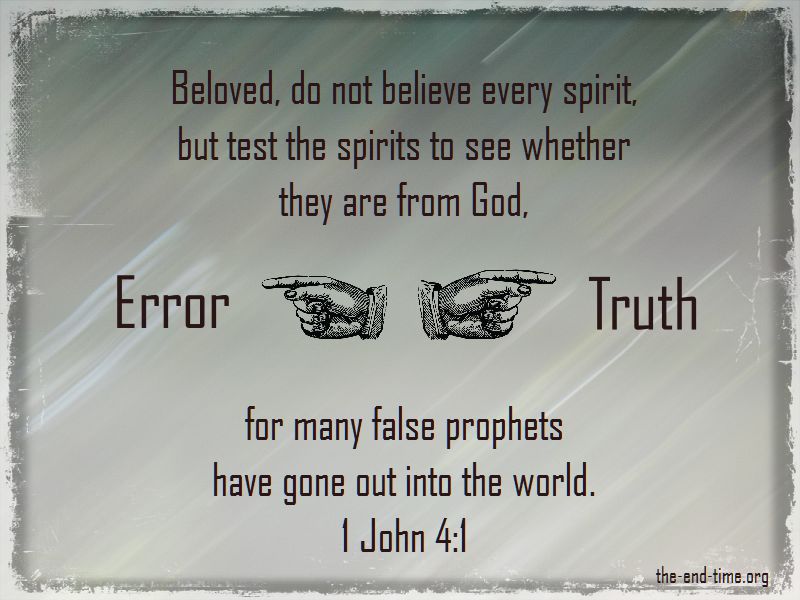
For spirit-gifted discerning believers AND all others, we must practice discernment in our walk. (1 John 4:1, Philippians 1:9-10, Romans 12:2). That means both identifying it AND acting on it. It’s non-negotiable.

Sheep, or Wolf? A Call to Discern
by Dr. Colin Eakin
Discernment: The Neglected Imperative

Where does God command believers to exercise spiritual discernment? Perhaps a better question is, where doesn’t He? The answer is Philemon. Of all the books in the New Testament, this letter of twenty-five verses is the only one in which there is no instruction for the believer to be on guard against falsehood. All remaining twenty-six books of the New Testament (and many of the Old Testament) exhort the believer, to a greater or lesser degree, to discern truth from falsehood and to act upon it.

Satan downplays the importance of discernment. How? He twists scriptures such as the ones under discussion today, two of the most abused scriptures in the Bible, plus one more-

Judge not, that ye be not judged. (Matthew 7:1)

And this one:

If your brother sins against you, go and tell him his fault, between you and him alone. (Matthew 18:15).

And this admonition based on nothing in the Bible but bandied about as if it was:

Be nice. Jesus ate with sinners, you know.

Sadly, when I write an essay discerning a false teacher, or speaking against a false doctrine, inevitably I receive a slew of comments from women who insist I perform one or the other of the verses above. This makes me sad, because I know from such comments these women are not operating at peak Christian condition. Their insistence that I employ one or both of these verses usually reveals two things about them:

— they hold to an errant understanding of the verses above
— they hypocritically have failed to follow their own advice and ‘come to me privately’, and to ‘judge not’.

Wise people treasure knowledge, but the babbling of a fool invites disaster. (Proverbs 10:14).

Here is my rebuttal to the commenters lobbing the most abused discernment verses:

Judge not, that ye be not judged. (Matthew 7:1).

‘Do not judge’ cannot mean ‘do not discern.’ There are calls to discern in every book of the New Testament except Philemon, and many of the Old. (1 John 4:1, Philippians 1:9-10, Hebrews 5:14, Romans 12:2, 1 Corinthians 2:14, 1 Kings 3:9, & etc.)

So, ‘Judge not’ can’t mean do not judge, because in John 7:24 we’re told to judge. Wisdom would suggest that rather than there being an inconsistency in the Bible, there is an inconsistency in our understanding.

So if Matthew 7:1 doesn’t mean not to discern and it doesn’t mean judge not, what does it actually mean? Well, first, read the verse in context. Here is Matthew 7:1-5,

Do not judge so that you will not be judged. For in the way you judge, you will be judged; and by your standard of measure, it will be measured to you. Why do you look at the speck that is in your brother’s eye, but do not notice the log that is in your own eye? Or how can you say to your brother, ‘Let me take the speck out of your eye,’ and behold, the log is in your own eye? You hypocrite, first take the log out of your own eye, and then you will see clearly to take the speck out of your brother’s eye.

It means when we do have to judge something, as in test, discern, check, etc, do not do so hypocritically, harshly, or wrongly.

Resource here: GotQuestions- What does the Bible mean that we are not to judge others?

2. Have you gone to her privately?

In this one, commenters are referring to a section in Matthew 18, where the Bible outlines procedures for church discipline. Here is the passage:

If your brother sins, go and show him his fault in private; if he listens to you, you have won your brother. But if he does not listen to you, take one or two more with you, so that by the mouth of two or three witnesses every fact may be confirmed. If he refuses to listen to them, tell it to the church; and if he refuses to listen even to the church, let him be to you as a Gentile and a tax collector. (Matthew 18:15-17 NASB)

This verse is about church discipline, when one member of a local body has sinned against another person in the local body. It is a local, internal procedure. It is not referring to our response to book reviews or other public statements false teachers have made in public.

Phil Johnson explained here, in a 2006 blog essay:

It would be a serious mistake to imagine that a private meeting is always a mandatory prerequisite before any Christian can legitimately express public criticism of another believer’s published work or public behavior. On the contrary, sometimes—especially when we’re dealing with a public and scandalous transgression—open rebuke may be warranted as a first response (cf. Galatians 2:11-14). Matthew 18:15-17 outlines instructions for dealing with private sins and personal offenses. These are not guidelines for dealing with false teaching or public behavior that might cloud the truth of the gospel or besmirch the reputation of the whole church.

Here is a link to a pdf “Editorial on Abusing Matthew 18” by Don Carson

Here is Tim Challies with an easy button version of Don Carson’s essay on Matthew 18 abuse.

3. Jesus ate with Sinners

Strangely, in a third most abused verse in the discernment world, many of them say ‘Be nice. Don’t condemn. Jesus ate with sinners.’ What they are referring to is Mark 2:16.

And the scribes of the Pharisees, when they saw that he was eating with sinners and tax collectors, said to his disciples, “Why does he eat with tax collectors and sinners?”

If you think about it, you realize how massively ridiculous their statement that one should not cry out against false teachers or false doctrine is.

The only sinless person who ever lived was Jesus. Of COURSE He ate with sinners. He ate with sinners every time He ate. Jesus eating with sinners verse was about the Pharisees complaining that Jesus was eating with tax collectors and prostitutes whom the Pharisees believed were “sinners”, outcasts unworthy to be in polite society, while at the same time believing that they themselves were NOT sinners and thus worthy to grace Jesus with their presence.

Jesus ate with sinners, having compassion on them, because they were lost sheep. However, He never expected them to remain in their sin. He told the adulteress to ‘go and sin no more,’ for example. He also was very harsh with many other sinners. He whipped up a fury against the merchant greed-mongers in the temple. He called the Pharisees blind guides, fools, wicked, and greedy.

Of course we (forgiven) sinners will eat with (unforgiven) sinners because we are to be in the world. But if we see a friend involved in a false doctrine, do we eat their food but leave them with a poison in their soul? No.

Jesus, Friend of Sinners: But How?
By Kevin DeYoung

As precious as this truth is—that Jesus is a friend of sinners—it, like every other precious truth in the Bible, needs to be safeguarded against doctrinal and ethical error. It is all too easy, and amazingly common, for Christians (or non-Christians) to take the general truth that Jesus was a friend of sinners and twist it all out of biblical recognition.

Jesus was a friend of sinners not because he winked at sin, ignored sin, or enjoyed light-hearted revelry with those engaged in immorality. Jesus was a friend of sinners in that he came to save sinners and was very pleased to welcome sinners who were open to the gospel, sorry for their sins, and on their way to putting their faith in Him.

More:

Why is it significant that Jesus ate with sinners?

It’s the biggest problem.

People ask me this all the time, “What is the greatest need in the church today? What is the most compelling need? What do you see as the biggest problem in Christianity? The biggest problem in the church?

It’s simple for me to answer that. The biggest problem in the church today is the absence of discernment. It’s a lack of discernment. It’s the biggest problem with Christian people, they make bad choices. They accept the wrong thing. They accept the wrong theology. The are prone to the wrong teaching. They’re unwise in who they follow, what they listen to and what they read. ~John MacArthur, Principles for Discernment 2002.

You can enhance your discernment through constant training, (Hebrews 5:14), prayers for wisdom, (James 1:5) and staying in the word (Psalm 119:11). Then perhaps at some point you can help advise a sister and encourage her in her discernment walk. 🙂

 

Posted in theology

Will We Recognize Each Other in Heaven?

By Elizabeth Prata

I was speaking with a lady recently who seemed to think that the only person we will know in heaven will be Jesus. I thought about that for a while, then I did the usual thing: I consulted the scriptures. I came to the conclusion that no, we WILL know everyone in heaven. There will be no introductions, no name tags, no mnemonic devices to remember who is who. WE WILL KNOW.

Why do I think this? Well, let’s look at scripture and the biblical scenes which led me to this conclusion.

For now we see in a mirror dimly, but then face to face; now I know in part, but then I will know fully, just as I also have been fully known. (1 Corinthians 13:12).

The verse less speaks to recognizing people than it does to our being freed from darkness and obscurity of knowledge; of God, of His ways, and wants. Matthew Henry says,

Now we can only discern things at a great distance, as through a telescope, and that involved in clouds and obscurity; but hereafter the things to be known will be near and obvious, open to our eyes; and our knowledge will be free from all obscurity and error. God is to be seen face to face; and we are to know him as we are known by himWe shall know how we are known, enter into all the mysteries of divine love and grace. Matthew Henry’s commentary on the whole Bible.

But … if we are freed from darkness and obscurity of the fuller knowledge of God and enter into the mysteries of the universe, and if we will see God ‘face to face’, then it stands to reason we will also know each other.

But more specifically, at the Mount of Transfiguration, Peter immediately recognized Moses and Elijah, even though both men had passed away long before Peter ever lived.

And behold, Moses and Elijah appeared to them, talking with Him. Peter responded and said to Jesus, “Lord, it is good that we are here. If You want, I will make three tabernacles here: one for You, one for Moses, and one for Elijah.” (Matthew 17:3-4).

Though some interpret the scene of the Rich Man and Lazarus as a parable, others take it as actual. Either way, the scene involved the unnamed Rich Man and the beggar at his gate named Lazarus. They died. The Rich Man went to Hades, Lazarus went to Abraham’s bosom AKA Paradise. The Rich Man looked across the great gulf that is fixed, where none may cross from one side to the other, and he recognized Abraham.

John MacArthur says of recognizing people in heaven,

In the Old Testament, when a person died, the biblical writers said he was “gathered to his people” (cf. Gen. 25:8; 35:29; 49:29; Num. 20:24; Judg. 2:10). In 2 Samuel 12, when David’s infant child died, David confidently said, “I shall go to him, but he shall not return to me” (v. 23). David evidently expected to see the child again–not just a nameless, faceless soul without an identity, but that very child.

It will be a glorious day when we finally see our Savior in person. It will be wonderful to be reunited with loved ones we knew on earth. It will also be fabulous to sit with Moses, Paul, Rahab, Abigail, Dorcas…and all the other believers who are in heaven waiting for the Day of full completion.

Posted in theology

Little Known Bible Characters #7: Salome

By Elizabeth Prata

Previous entries in the series:

Little Known Bible Characters #6: King Chedorlaomer
Little Known Bible Characters #5: Harbonah the Eunuch
Little Known Bible Characters #4: Eutychus
Little Known Bible Characters #3: Trophimus
Little Known Bible Characters #2: ‘The List of Offenders’
Little Known Bible Characters #1: Iddo

There are two Salomes in the Bible. Both are New Testament women, but have vastly different characters.

Salome #1 is not named in Matthew 14:6-11; Mark 6:22-28, but only says she was the “daughter of Herodius.” Josephus tells us her lineage and her name: Salome. Salome #1 danced for Herod and Herod was pleased. He promised her anything she asked for. She wanted the head of John the Baptist on a platter, and she got it.

The Salome #2 that I focus today on appears later in the New Testament. She IS named, and appears several times. —Matthew 20:20-24; 27:56; Mark 10:35-40; 15:40, 41; 16:1, 2. Mark tells us her name, and Matthew goes further and names her as the mother of Zebedee’s children. Zebedee was the prosperous fisherman who was mending his nets when Jesus came along and called his sons to discipleship. Who were these two sons? Mark 3:17 reveals their identity: James the son of Zebedee and John the brother of James (to them He gave the name Boanerges, which means, ‘Sons of Thunder’).

So, the family is Zebedee, Salome, James, and John

Given that when Jesus called the sons away from their father and the father’s work, and Zebedee did not argue or restrain them, it seems likely that he had more than likely trained his boys (now men) in the admonition of the Lord. Salome, the mother, also seems to have been spiritually prepared to accept Jesus as Messiah. She began following Jesus as well. And in the end, she along with the other women, were present through His earthly ministry, the crucifixion, and after His death when even her two sons had fled.

Salome as any mother wanted the best for her sons. Having followed Jesus through His ministry, having identified Jesus as the Messiah, she boldly but reverently asked Jesus for something…

Christ Meeting Sons and Mother of Zebedee by Paolo Veronese, 1565

Then the mother of the sons of Zebedee came to Jesus with her sons, bowing down and making a request of Him. And He said to her, “What do you desire?” She said to Him, “Say that in Your kingdom these two sons of mine shall sit, one at Your right, and one at Your left.” But Jesus replied, “You do not know what you are asking. Are you able to drink the cup that I am about to drink?” They said to Him, “We are able.” (Matthew 20:20-23).

Mark 10:35-40 has the same scene but Salome is omitted and it’s James and John asking. Warren Wiersbe says,

Before we criticize what they did, let’s notice some commendable features in this event. For one thing, they did believe in prayer, and they dared to believe the promise Jesus had given about sitting on thrones (Matt. 19:28). The word “regeneration” in that verse means “new birth,” and refers to the new world over which Jesus and His followers will reign when He returns to earth. It must have taken faith on their part to believe He would establish these thrones, because He had just told them that He was going to die.

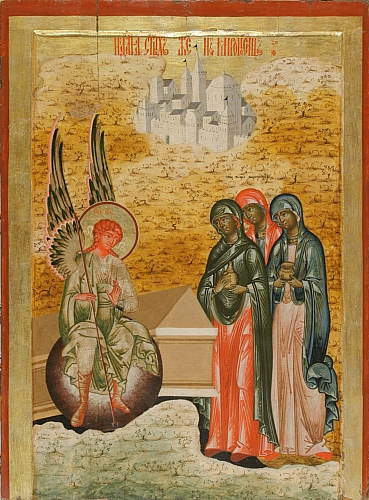
Eastern Orthodox icon of the two Marys and Salome at the Tomb of Jesus (Kizhi, 18th century).

But there were several things wrong with the request, as well. Wiersbe again,

Little did Salome realize that the path to the throne is a difficult one. James was the first of the disciples to be martyred, and John had to endure hard days on the Isle of Patmos. These three believers wanted their will, not God’s will, and they wanted it their way. Wiersbe, W. W. (1996). The Bible exposition commentary (Vol. 1, p. 75). Victor Books.

Remember, these Bible people are human, just like us.

Most assume Salome was part of the crowd of women present, “who were mourning and grieving for Him” when Jesus turned to them and said “Daughters of Jerusalem, do not cry for me…” in Luke 23:28.

Crucifixion, from the Buhl Altarpiece, 1490s. Salome is one of the two leftmost women with a halo.
© Ralph Hammann – Wikimedia Commons CC BY-SA 4.0

Salome was present at the crucifixion but a little far off as Mark records. But they were there.

Now there were also some women watching from a distance, among whom were Mary Magdalene, Mary the mother of James the Less and Joses, and Salome. (Mark 15:40).

Lockyer says, “Salome, along with the other women “stood afar off,” probably because of the malicious crowd, the rough soldiers, and the horrors of the cross, all of which was sufficient to make them timid. They were full of love and sympathy, even though they stood afar off. With tear-filled eyes with which they had shown their devotion on the way to the cross (Luke 23:28), they still beheld Him as He hung there in death.”

Salome was faithful not only to the end, but afterwards:

The Resurrection – When the Sabbath was over, Mary Magdalene, Mary the mother of James, and Salome bought spices so that they might come and anoint Him. (Mark 16:1).

Salome was faithful with her husband in raising their children and providing a model for worship and patience waiting for Messiah to come. Probably never did she believe it would happen to her in her lifetime. When it did, she was all-in. She must have been spiritually satisfied that her sons were following. She followed, she learned, and she loved Jesus. Her sorrow at His crucifixion was real and deep. Her dedication was evident when she bought the spices to anoint His body in the little time between His death and sunset when Sabbath began. It was evident again when she arrived at pre-dawn 3 days later to anoint His body.

Salome’s godly motherhood and worshipful model in following Christ is an example to us. James was the first apostolic martyr and John the last to pass into heaven. Even if Salome was not alive to endure that grief, as Lockyer said, “The mother sought earthly crowns for her sons, but through losing their lives for Christ’s sake, they gained greater honor in heaven. … Happy and grateful are those Christian parents who live to see their offspring wholly dedicated to the service of the Lord.

Little Known Bible Characters #8: Tryphena and Tryphosa
Little Known Bible Characters #6: King Chedorlaomer
Little Known Bible Characters #5: Harbonah the Eunuch
Little Known Bible Characters #4: Eutychus
Little Known Bible Characters #3: Trophimus
Little Known Bible Characters #2: ‘The List of Offenders’
Little Known Bible Characters #1: Iddo