I emphasize the importance of remaining anchored in the Word to prevent spiritual drifting, as referenced in Hebrews 2:1. Drawing parallels from sailing, I highlight the need for vigilance and multiple reference points to ensure one’s faith remains strong, and I warn of the deceptive nature of gradual drift away from God.
“Man without Christ is a shipwreck upon the rocks, rocked by every wave of temptation, with no anchor, with no hope. Death looms before him as a door to judgment, for the wages of sin is death,” says Dustin Benge in his Hearts Aflame episode of Puritan devotionals.
In the episode above, we meet Scottish late Puritan Thomas Boston. In Boston’s well-regarded classic, Human Nature in its Fourfold State, Benge explains that “Thomas Boston vividly portrays the fallen condition of humanity—alienated from God, enslaved to sin, and without hope apart from Christ. The depth of human ruin is sobering, yet it magnifies the glory of divine grace.”
Do you recognize the depth of your natural misery without Christ’s redemption?
The episode talked about man without Christ,
“Man without Christ is like a ship wrecked upon the rocks, tossed by every wave of temptation, with no anchor, no hope.”
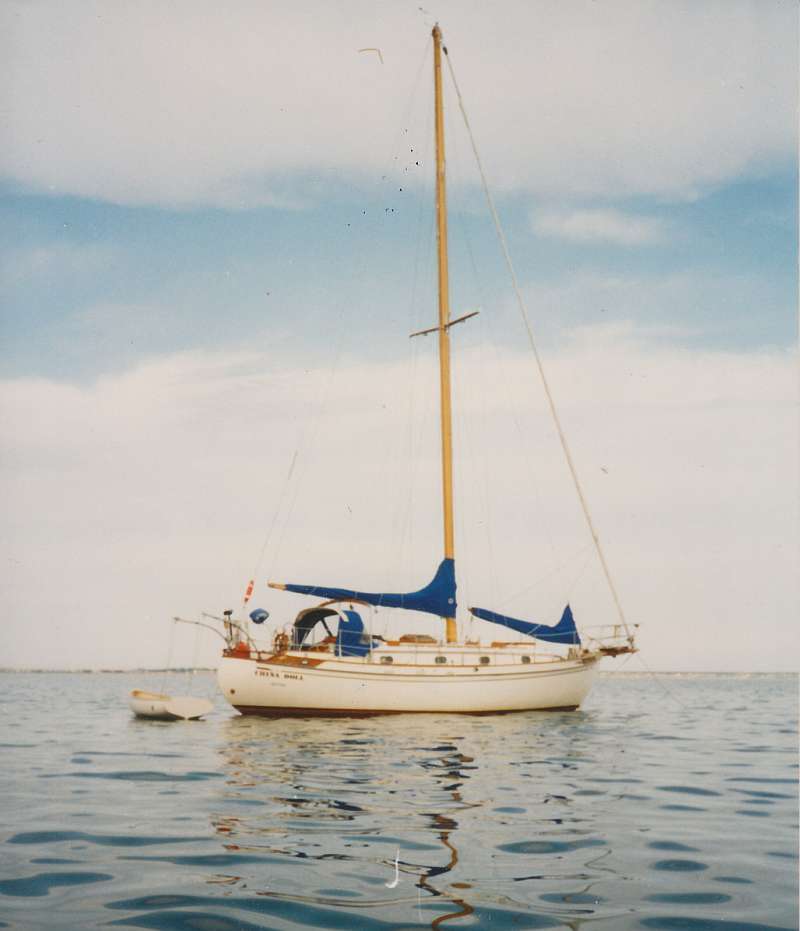
This maritime metaphor is real to me. I have sailed about 15,000 nautical miles living in a sailboat upon the waters from Maine to Florida and across to the Bahamas and back, twice. I’ve sailed from Tampa Florida to the Dry Tortugas, and zoomed from Naples, Florida to Rhode Island in a 21 foot powerboat. I’ve crossed the Gulf Stream in calm, at night, and in a storm. Gone through the washing machine that is Hell’s Gate in New York City. I’ve been in the Storm of the Century 1993. I’ve been in Hurricane Bob. I know lighthouses, rocks, shoals, and shipwrecks (Charley’s Crab was lost in the storm of ’93, and another friend lost his boat in a different storm in the Caribbean). We came close to shipwreck ourselves, twice.
Shipwreck is a very bad thing.
Worse would be making a shipwreck of the faith.
Russian painter Ivan Aivazovsky (1817-1900) made a career out of painting maritime scenes, including shipwrecks. Like this one:
Without Christ, we can do nothing. Oh, I know the skeptic will say, ‘Doody-head, of course we do things! We live and breathe and work and have kids and play baseball and drive cars and all the things!” Correct. But the pagan without Christ can do nothing that pleases Him. Without Christ we cannot bear fruit for the kingdom, worship Him rightly, live for holiness, reflect His image, or do anything at all.
Paul advised Timothy to ‘fight the good fight’, keeping faith and a good conscience, which some have rejected and suffered shipwreck in regard to their faith. (1 Timothy 1:19).
Jude wrote that the ungodly pretenders are unreasoning animals and warned that they “are the ones who are hidden reefs in your love feasts…“(Jude 1:12a). Do you know what hidden reefs do? Wreck your ship.
“The Ninth Wave” by Ivan Aivazovsky
Hebrews 2:1 says For this reason we must pay much closer attention to what we have heard, so that we do not drift away from it. Do you know what happens when you don’t pay attention? Your mooring becomes loose and you drift away from the dock or the mothership, and untethered, you soon lose sight of land. Shipwreck.
“The Wrath of the Seas” Ivan Aivazosky
‘Drifting’ is the thing to be afraid of. Just as some boat, not made fast to the bank, certainly glides down stream so quietly and with so little friction that her passengers do not know that they are moving until they come up on deck, and see new fields around them, so the ‘things which we have heard,’ and to which we ought to be moored or anchored, we shall drift, drift, drift away from, and, in nine cases out of ten, shall not feel that we are moving, till we are roused by hearing the noise of the whirlpools and the falls close ahead of us; and look round and see a strange country. McLaren’s Expositions.
Now, if you are truly saved, you can never lose your salvation. Judas had the rejection inside of him all the while, he just pretended to be a disciple of Christ. He followed with his feet, but his heart could do nothing.
Matthew Henry says of 1 Timothy 1:19’s shipwreck,
As for those who had made shipwreck of the faith, he specifies two, Hymeneus and Alexander, who had made a profession of the Christian religion, but had quitted that profession; and Paul had delivered them to Satan. Matthew Henry’s commentary on the whole Bible: complete and unabridged in one volume (p. 2352).
Warren Wiersbe said, “Paul changed the illustration from army to navy (1 Tim. 1:19). He warned Timothy that the only way to succeed was to hold fast to “faith and a good conscience.” It is not enough to proclaim the faith with our lips; we must practice the faith in our daily lives“. Wiersbe, W. W. (1996). The Bible exposition commentary (Vol. 2, p. 213). Victor Books.
A good conscience is key to the verse. Shipwreck comes when one ignores the conscience, suppresses what is good, and eventually sears it so that he or she drifts, winds up on the rocks, and wrecks their faith.
As is said in the Hearts Aflame article, The depth of human ruin is sobering, yet it magnifies the glory of divine grace.” The wondrous mystery is that Jesus relieves us of our sin burden, erases it from the record books when we repent. Those who recognize the depth of our natural misery are deeply grateful for having this burden and misery removed. The Lord’s divine grace shines so brightly that the Christian never looks away but only grows in love and attachment to Him, and as a result, we are “keeping a pure conscience.”
We sang Christ the Sure and Steady Anchor at church yesterday. I love the marine references in the Bible, and as I sang I thought about anchors.
I lived by the water growing up and most of my adult life, mainly the ocean. Some years were spent on a lake. I loved it.
The ocean has moods, a personality, mystery, and power. Who doesn’t love a day at the beach? Even better, who doesn’t love a day ON the water? When we got a chance, we got on a boat. After a while, we had a boat. LOL, back in the day, a bunch of teenagers zooming around the bay on a 20 foot Boston Whaler wasn’t unusual.
We grew up knowing how to use our knees to ride the waves, could look at the rocks to spot the state of the tide, knew how to anchor, dock or throttle up to reach plane. We kept a weather eye on the clouds, watched the whitecaps, and had a grand time.
Despite having such familiarity with the water, and were so comfortable on it, we knew its dangers. On Narragansett Bay there was a navigational hazard called “boiler awash”.
It is a shallow patch of water near Hope Island near Prudence Island. A Navy tug sank there and its boiler, being tall, presented a hazard to the keels of boats passing over it. To make the shallow water issue worse, its boilers came to just under the surface of the water at low tide. It was a hazard all right. We always gave it a wide berth.
As an adult, I lived on a sailing yacht for two years and we sailed from Maine to Florida, crossed the Gulf Stream, and went on to the central Bahamas. We returned with the weather following the same route. Our route took us on almost every coastal river, sound, bay, and canal along the entire eastern seaboard as well as the Atlantic ocean waters off it.
Because we lived on the boat and were no longer teenagers messing around near shore, we well knew the hazards. Our VHF radio was full of calls from mariners in distress, the squawk of the marine weather station, and calls from the Coast Guard to alert to hazards (container awash, drifting and disabled boat, etc). Sailing in New England meant having intimate knowledge of reefs, shoals and rocks, and sailing in Florida meant having intimate knowledge of drunken fools, wannabe mariners and rich guy weekend warriors. In between, we learned to respect the fishermen, shrimpers, oystermen, and all the others trying to make a living.
We quickly acclimated to the water living and became respectful of the hazards. When you are underway, you are always on guard, even if it’s familiar water. Always, every second. Because any second, anything could happen, and since your boat was both your home and your transportation as well as your life, well, if it required being vigilant, that is what you did.
That is why, when the anchor was set and the engine turned off, you breathed a special sigh of relief. Oh, anything could still happen, but the ratcheting down of the vigilance was considerable. As long as the anchor held, you were all set. We just had to trust that it would hold.
I remember feeling a wonderful sense of relief when the day’s run was ended and we anchored. The engine turned off and all we could hear were the sounds of the birds and the waves. We were still, secure, and finished for the day.
When we’d traveled a thousand nautical miles were under our keel over the dark and murky waters, wondering ‘what’s down there?’ when we got to The Bahamas, the waters were clear to the bottom! We could SEE the anchor! We could determine if it was set or not, It was such a comfort after all those miles of trusting but not seeing the anchor, now to SEE it with our eyes. Our faith had become sight.
Our anchor 20 feet below, we could see it even at night! EPrata photo
In Bible days there were only three ways to travel. You got there by walking, riding an animal, or boat. Paul traveled a lot and because of that, he was on a boat a lot. He used many marine references in his letters, examples that the people of the era would know well and understand immediately. Here are a few examples Paul and the other Apostles used:
But let him ask in faith, with no doubting, for the one who doubts is like a wave of the sea that is driven and tossed by the wind. (James 1:6)
…tossed to and fro by the waves and carried about by every wind of doctrine (Ephesians 4:14)
These are hidden reefs at your love feasts, as they feast with you without fear, shepherds feeding themselves; waterless clouds, swept along by winds (Jude 1:12)
holding faith and a good conscience. By rejecting this, some have made shipwreck of their faith, (1 Timothy 1:19)
Therefore we must pay much closer attention to what we have heard, lest we drift away from it. (Hebrews 2:1)
The interesting thing about that last one is that the drifting away in the Greek literally means from God’s anchor.
Strong’s explains, to “drift away from,”pararrhyéō, only occurs in Hebrews 2:1 where it refers to going spiritually adrift – “sinning by slipping away (from God’s anchor)”. It means to “lapse” into spiritual defeat, describing how we slowly move away from our moorings in Christ.”
Friends, stay moored to Christ. He is our anchor. One day, ourfaith will become sight and we will see Him as He is.
Though our journey is tense, and long, imagine the sweet relief we will feel when we get there! When all storms are over, and there are no more hidden reefs. The empty clouds deceive us no more, and our friends and family’s spiritual shipwrecks (so hard to watch!) are but a distant memory gentle Christ wipes from our mind. The sweetness and rest awaiting us beside the glassy sea is unimaginably wondrous. Rest in that assurance 🙂
Here is “Christ the Sure and Steady Anchor” performed by Matt Papa, Matt Boswell, Keith & Kristyn Getty-
Therefore we must pay much closer attention to what we have heard, lest we drift away from it. (Hebrews 2:1).
The question was raised at Bible Family Group last night, how does a Christian prevent developing a hardened heart? One wise older man said by staying in the Word.
The word is the only antidote for developing poor habits, shrinking our biblical worldview, and drifting away. I agree.
The word drift away used in the Hebrews verse in Greek means-
properly, to float (flow) alongside, drifting past a destination because pushed along by current. /pararrhyéō (“drift away from”) only occurs in Heb 2:1 where it refers to going spiritually adrift – “sinning by slipping away” (from God’s anchor). 3901 /pararrhyéō (“gradually drift away”) means to “lapse” into spiritual defeat, describing how we slowly move away from our moorings in Christ.
Paul often used nautical allusions and marine metaphors. Last night at Family Group I’d shared the experience from when I was living on the sailboat that relates to the verse. We usually sailed during the day, unless we were on an overnight passage out in the ocean. But if we traveled down the Intracoastal Waterway, we’d find a snug spot to anchor in at night and went to bed after the sun sank.
The anchor becomes all-important. The anchor holds you in place, prevents you from drifting and damaging other boats anchored or moored nearby, and keeps you afloat rather than crashing into the rocks or going aground.
We spent a lot of time tending the anchor. When we initially set it, we’d take time to ensure it was set correctly. Is the rode taut and not tangled? Are the flukes digging into the ground? Is there enough depth under us for when we swing with the tide or current?
Then we’d watch it a while. We took reference points ashore to compare with our position. One reference point isn’t really enough. Drift is deceptive and incremental. You could be drifting away and still seem like you’re lined up with the same reference point. So we’d take two references. Three references are better so you can triangulate.
During the night, we’d sleep lightly, listening carefully for any change in the pattern of the waves slapping the bow, or any other untoward noises that meant there was likely a problem.
We spent a lot of time tending the anchor.
Do I spend an equal amount of time tending the anchor of my spiritual life, the Word? Do I treat it carefully, thoughtfully? Do I employ reference points to ensure I’m not drifting? Reference points in our spiritual lives that help us against drifting away from the truth are: visiting our prayer closet, studying His word, corporate worship, small groups, discipling and being discipled, and so on. Are we in position, standing firm in the center line of that narrow way, not going to the right or the left? Are we vigilant, listening for any variation in pattern of our sanctification in life?
We spent much time tending the anchor because our lives depended on it. We should take an even greater amount of time tending the anchor of our spiritual life because our spiritual life depends on it. When Paul says we must pay closer attention, the word in Greek means exceedingly, abundantly, vehemently.
When man sails upon the waters, he is not in his element. It is a foreign environment. It’s an environment that’s hostile, with many things in it either actively or benignly trying to kill him. Just so, Christian man on earth is not in his element. There are many things in this environment actively or benignly trying to kill him. We should pay the closest attention so we do not drift away. Remember all the nature documentaries…what always happens to the gazelle that lags behind and is alone?
Stay anchored to the Word, in position, with lots of reference points and a growing biblical worldview 🙂



 the-end-time.org