The church is one body, formed by the Spirit, who places each believer intentionally. Like a pointillist painting, individual lives lived further afield may seem indistinct, yet from God’s perspective every placement contributes to a unified, beautiful masterpiece completed in heaven according to His sovereign design.
“John Fullerton MacArthur Jr. — pastor, teacher, author, and a strong defender and proclaimer of biblical truth — has entered the presence of his Lord and Savior at 6:17pm PT on July 14th, 2025”.
John Fullerton MacArthur, June 19, 1939 – July 14, 2025
John F. MacArthur was remarkable preacher, a pastor, shepherd, lion of a Godly man, now laid to rest. He was 86.
Dr. John MacArthur had led Grace Community Church since February 1969 as the lead pastor-teacher. He became President of The Master’s University in 1985 and founded The Master’s Seminary in 1986. He was the longest-serving president of the college transitioning to the Chancellor role in 2019.
His media ministry, Grace to You, is a nonprofit organization responsible for distributing John’s books, audio resources and the “Grace to You” radio program to a global audience. More than 3,000 of John’s sermons are available for free on GTY’s website.
He had been married to his wife, Patricia, for almost 62 years, has four married children, 15 grandchildren and 9 great-grandchildren.
August 30, 2024, Facebook post: “Celebrating 61 years of marriage with my precious Patricia. My college sweetheart for life.”
“None on earth can estimate his worth. He was the Evangelical Prophet of his age; our modern Isaiah. Like Isaiah, he early saw “the Lord sitting upon a throne, high and lifted up; ” he had his lips purged with the live coal; and when he heard the call, ” Whom shall I send, and who will go for Us?” he gladly answered, “Here I am, send me.” Beholding the Lord in His temple, he laid himself upon the altar, and like Isaiah, he was “very bold” to declare the Word of God.”From the Pulpit to the Palm-branch, a book about Charles Spurgeon’s passing
MacArthur often said he had two goals: to preach faithfully, and raise up men to preach faithfully.
“His light rose in obscurity, and broke forth as the morning. He deliberately set his heart against seeking great things for himself, yet fair and clear he shone undimmed before the world for [sixty] years; shining more and more until the perfect day.” From the Pulpit to the Palm-branch
The similarities between Spurgeon and MacArthur, their stances, their controversies, their ministries, and their ministry output, are remarkable. JMac, as he was affectionately called, was very like like Spurgeon in his time, with ceaseless preaching. His was known for his stalwart promotion of the Gospel even though it fell out of season. Leading his seminary and raising up men of faith in good standing to launch then land in places the Lord wanted, was his Gospel faithfulness. Praying, letter-writing, counseling, leading, defending, faithful loving husband to Patricia for over 60 years, shepherding, expositing, even rebuking… JMac was seemingly tireless in his duties in service to Christ for 60-plus years.
He once said a pastor never retires. His men should take him off the stage when he starts not to make sense. There was no retirement when serving God. He said the following in 1984,
I get weary. There is a tolerance level that all of us have, and I don’t know about you, but I seem to be on the edge of it most of the time. And some people would say to me, “Well, why do you keep taking more projects on? Why don’t you just back away?” Well, I don’t know what you mean by that. There’s nothing I can’t not do because of what God has put in my heart. And in the midst of the doing and looking ahead, you say, “Well, aren’t you looking forward to retirement?” I’ll never retire. From what, the gospel? You may dump me long before I’m ready to go but – I mean, this is a life commitment. As long as I have my senses. And the discipline for this time seems a small thing when you think about the hope of eternity, doesn’t it?John MacArthur, Source.
His ministry’s impact was global. Like Spurgeon, his sermons flung out from the point of origin, Sun Valley, CA, to the ends of the world. To the Faroes at the Arctic Circle, deserts of Africa, behind the Iron Curtain, closed China…
In MacArthur’s time he also endured times of favor within his camp and times of disfavor. He became a lightning rod during several controversies due to his stalwart stand on biblical issues. He did not bend to culture. The Lordship Salvation controversy of the late 1970s through the 1980s (opposing ‘carnal Christianity’), the Strange Fire controversy of the early 2000s (opposing charismaticism), and the Beth Moore “Go Home” controversy of the 2020s (opposing feminism & female preaching) involved much ink spilled as debates raged over these important topics within evangelicalism.
His stances, though biblical, were not always appreciated. Once, during a heavily attended Sunday Service, an intruder wearing a backpack strolled down the aisle of the church while MacArthur was preaching, ascended the pulpit steps, and walked over on the stage to confront JMac on his cessationist stance. More here on that incident.
MacArthur authored more than 150 individual books and monographs, he had also contributed to more than 30 multi-author works. His commentary series covers all of the New Testament and he has published several commentaries on books of the Old Testament as well.
MacArthur said of his desire to be a pastor: “I never wanted to be an itinerant minister, because I always wanted to exposit the Scripture. I mean I had poured – I took a Greek minor in college because I wanted to work in the New Testament. I didn’t want ten suits and ten sermons. I didn’t want to be on the road. I didn’t want to be the out-of-town guy. I wanted to follow what my dad did and my granddad did. I wanted to be in a church, and I wanted to exposit the Word of God.“
MacArthur preached on. He is known for having preached through every verse of the New Testament. It was a 43 year endeavor. He completed it on June 5, 2011. He had been preaching at his church since February of 1969. This accomplishment is considered rare in modern church history.
Preaching to male students at The Master’s University Chapel
His long tenure as pastor of Grace Community Church was without any moral failure, without one theological blot, for all these decades, a true testament to God’s faithfulness in raising up lions of the faith.
“Now he has left the pulpit for ever, and he stands amongst the great multitude who are before the throne and before the Lamb, “clothed with white robes, and palms in their hands.” He is not in strange company there, for the song of those who wave the palm-branch was ever his theme as he stood in the pulpit: “Salvation to our God who sitteth upon the throne, and unto the Lamb.” From the Pulpit to the Palm-Branch has been for him a very natural transition. He preached Christ here; he praises Him yonder.” source “From the Pulpit to the Palm-branch“, a memorial to Charles Spurgeon
We mourn the passing of this stalwart soldier today, and we express joy that his labors are complete and he is enjoying his well-earned rest with his beloved Lord.
I am sure that many will write of Johnny Mac, as he was also affectionately called, in better or more poignant terms. But Susannah Spurgeon’s reflections of her husband’s likely entry into heaven impacted me and I re-state it becuase no doubt, NO doubt in my mind, JMac was greeted in this manner as well:
“His ‘abundant entrance’, the ‘Well done, good and faithful servant!’ of the Master, the great throng of white-robed spirits, who welcomed him as the one who first led them to the Saviour, the admiring, wondering angels, the radiant glory, the surprise of that midnight journey which ended at the throne of God; all this, and much more of blessed reality for him, has lifted our bowed heads, and enabled us to bless the Lord, even though he has taken from us so incomparable a friend and pastor. All that was choice, and generous, and Christlike, seemed gathered together in his character, and lived out in his life. He was pre-eminently ‘the servant of all’; yet he served with such humility and wisdom, that, with him, to serve was to reign.
Preaching from his pulpit at Grace Community Church. It’s on a hydraulic lift. more here
Dr. John F. MacArthur truly was the Spurgeon of our time:
“Then I will give you shepherds after My own heart, who will shepherd you on knowledge and understanding.” (Jeremiah 3:15).
The article discusses the misinterpretations of 1 Timothy 2:11-12 regarding women’s roles in the church. It critiques arguments allowing women to teach or preach under male authority, emphasizing adherence to biblical authority and order. The essay cites theologians like John Piper and John MacArthur, reinforcing traditional views on gender roles in ministry.
Turning Point USA’s Young Women’s Leadership Summit aims to empower women through civic engagement and political activism. However, the article critiques this initiative, questioning its alignment with biblical roles for women which are supposed to be primarily focused on home and motherhood. It highlights inconsistencies among speakers promoting activism while diverging from scriptural teachings on femininity and family responsibilities.
I state in this essay that women preaching is a significant rebellion against God’s standards. I emphasize that such behavior undermines the church and God’s commands, regardless of societal trends.
G3 Conference 2020, theme was Worship. EPrata photo
SYNOPSIS:
I talk about Christian conferences, particularly in light of the recent issue of the G3 Conference. While I appreciate the value of some events, I express concern over commercialization and issues undermining spiritual integrity. The tension between organizing a large venue conference and pure ministry remains a critical issue.
I am conferenced out. I had the wonderful privilege of attending the National G3 conference a few times and I enjoyed it. But as I age, I am finding that being in a cavernous building filled with thousands of people overwhelms me more quickly than it used to. My energy drains away faster than two shakes of a lamb’s tail.
As an older women a few years away from retirement, it seems lately that all I want to do is come home from work and sit down. Sunday go to church. Repeat. LOL. However I am also grateful for the opportunity through the wonderful invention of the internet, to be able to consume material from present day solid ministries and past ones that have been uploaded, such as at Monergism, Grace Gems, and the like.
Being careful but savvy about what to consume on social media allows a woman to develop her discernment. As long as we are in the word, studying, reading, singing, and in church worshiping, we can extend our learning by testing it with material we find online. This includes buying books and listening to music, whether through Spotify, Pandora, Youtube, or Apple.
In that vein, below are a few links offering a wealth of information about women for women.
Always wise, always measured, and with a right-heart attitude, Amy broaches the subject that many women unfortunately stumble on, hearing God’s voice: Ladies, No One Is Whispering to You by Amy Spreeman at Berean Research
Grace Sutton muses on the different states of being as an adult- singleness and marriage. Desiring one over the other isn’t necessarily making an idol nor would it be sinful. God set apart some for singleness and many for marriage. Here’s Grace working through the issue: Let Me Be Single essay at For the Church
Aussie Daniel Schricker writes and speaks about cults because he grew up in one. Here, he identifies the markers and makings of a cult, and applies the scholarly information to a well-known woman on seemingly every social media there is, The Transformed Wife, Lori Alexander. The Cult of Lori Alexander, essay by Daniel Schricker, Ph.D
With all the brouhaha of gender studies in the recent past, documentary satirist Matt Walsh published a film asking ‘gender experts’ the simple question… What is a Woman? full documentary by Matt Walsh
In 2013, Sunny Shell of Abandoned to Christ ministry wrote the following essay. It was scriptural and humble. She said that consuming Piper’s material “requires more discernment than I currently possess.” She said she loved him and considered him a brother, but she couldn’t follow him any longer, not while there were so many other good ministries out there. Sunny received a LOT of push back, even though there was not an accusatory bone in the whole essay. She took it down and it stayed down for a number of years. A few years ago she put it back up.
As for me, I do not follow Piper either. His continuationism and his multi-step justification stances gave me pause some years ago as to following him or consuming his material. Never mind his lack of discernment in inviting or sharing platforms with Mark Driscoll, Beth Moore, Rick Warren etc. an issue that Sunny pointed out in 2013. Recently, Piper spoke at Pastors’ Workshop and his recorded remarks are causing consternation among the more solid theologians. Here, Ekkie points out the conundrum in a short tweet. Below, find Sunny’s humble but accurate article. Though at this time I consider Piper a brother, I do warn that he has had many confusing stances in the past and of late. Too many bones… Why I no longer follow John Piper or Desiring God ministry
I’m on Twitter a lot (now called X). I get the headlines and weather in just a few lines. I commune with Christian friends, both virtual and in real life that I know personally. I see nice photos of different areas of the country. It’s a good social media for me.
I’ve also seen a lot of headlines lately about public education teachers arrested for lewd or sexual acts with their minor students. Enough to make me investigate whether there has been a noticeable uptick in reported incidents over the past few months. It seems to me there has been, which could suggest increased media coverage—or simply more incidents coming to light. From CA to CT to Delaware to NYC, and sadly, many in Texas, have been in the news just this past month.
Even worse, there has been momentous and tragic news of this sort in Christian circles, too. The news that Steve Lawson had been engaged for five years in an adulterous affair with a young woman in her twenties and thirty+ years his junior came to light a few months ago and was a severe shock to many.
But even this week, Robert Preston Morris, formerly pastor at mega-Gateway Church in Texas, was indicted on charges he had engaged in sexual misconduct with a 12-year-old girl in the 1980s. In March 2025, he was indicted on five counts of lewd or indecent acts with a child. A warrant has been issued for Morris’ arrest. What happened was, Morris was a pastor invited to a friend’s home and over repeated visits, molested their host’s 12 year old child. This is an unconscionable evil and betrayal of the worst kind.
This same week, International House of Prayer Kansas City (IHOP KC) founder pastor Mike Bickle is found in a released report which alleges 17 cases of abuse. The report states “The allegations range from spiritual abuse to rape.” Two of the women at the time of the alleged molestation/rape were minors. Another unconscionable evil.
Can you think of anything worse than USING the name of Jesus as a cover and His church hunting ground in order to prey on children?
We know that Jesus was tender about children and toward children. He considers children, and widows, a most vulnerable demographic. Always at risk, children have been misused in every culture and period in history. In ancient Rome a father could kill his child without penalty. They were seen as property. In Hawaii, China, and Japan, many female and disabled children were killed to maintain a strong race without overpopulation. Girl children were not as preferred as male children. Child sacrifice was rampant. (Molech, among other cultures). Child labor was routine.
Sexual predators have always been around. But even lately it seems to be growing worse in every level of society. We read about abductions of children who are trafficked and put up for sale to sexual predator and porn rings.
God puts a high value in children. Almost the first command God gave to the man and the woman was to be fruitful and multiply. “The Bible emphasizes the significance of children from the opening chapters of Genesis, where God makes the earth and every living thing on it to be fruitful—including the man and woman (Gen 1:27–28). Humanity can only fulfill God’s mandate of fruitfulness by bearing and raising children…” The Lexham Bible Dictionary.
EPrata photo
Children were to honor their parents, and were expected to work with the family, especially in that agrarian culture. In return, children, especially boys, were educated in the scriptures, liturgies, and expected to attend the festivals. They were full participants in daily life of the family and the community.
In the New Testament, “Thompson notes that 50 percent of children in the ancient Roman world died before age 10, and Graeco-Roman society valued girls less than boys. Infants born with disabilities or unwanted female infants were commonly left exposed to the elements. As Christianity grew more influential in the Roman Empire, the Jewish and Christian value for human life increasingly pervaded Roman society. Christian emperors of Rome outlawed infant exposure in AD 374“. The Lexham Bible Dictionary.
Jesus valued children.
We are perhaps most familiar with the verse from Matthew 19:13-15, “Then some children were brought to Him so that He might lay His hands on them and pray; and the disciples rebuked them. But Jesus said, “Let the children alone, and do not hinder them from coming to Me; for the kingdom of heaven belongs to such as these.” After laying His hands on them, He departed from there.”
Take heed that ye despise not one of these little ones; for I say unto you, That in heaven their angels do always behold the face of my Father which is in heaven. (Matthew 18:10).
The Gospels record that Jesus healed several children and even brought at least one child back from the dead. For example:
• He raised Jairus’ daughter from death (Matt 9:18–26; Mark 5:22–43; Luke 8:41–56). • He healed the Gentile Syrophoenician woman’s daughter of a demon (Matt 15:21–28; Mark 7:24–30). • He healed the demon-possessed son of a common man (Matt 17:14–19; Mark 9:14–28; Luke 9:37–42). • He healed a royal official’s son (John 4:46–54).
By healing such a variety of children—both boys and girls, Jews and Gentiles, poor and wealthy—Jesus showed that He valued all children, for their own sake as well as for their families and communities. The Gospels further portray Jesus ascribing value to children by welcoming them and inviting them to come near to Him even over the objections of His disciples (Matt 19:13–15; Mark 10:13–16; Luke 18:15–17). Jesus also identifies qualities in children that He wants His disciples to emulate. For example, He uses the humility of a child as a leadership model for His disciples (Matt 18:1–5; Mark 9:35–37; Luke 9:46–48). In Mark 10, Jesus states, “Anyone who will not receive the kingdom of God like a little child will never enter it.” The Lexham Bible Dictionary.
As sin increases, we know that the warnings from Paul to Timothy are true: “But realize this, that in the last days difficult times will come. 2For people will be lovers of self, lovers of money, boastful, arrogant, slanderers, disobedient to parents, ungrateful, unholy, 3unloving, irreconcilable, malicious gossips, without self-control, brutal, haters of good, 4treacherous, reckless, conceited, lovers of pleasure rather than lovers of God…” The last days have been since Jesus ascended, but with sin, it always gets worse. As time goes on, our sin-soaked world will eventually reach the state where it’s Genesis 6:5 again, “Then the LORD saw that the wickedness of mankind was great on the earth, and that every intent of the thoughts of their hearts was only evil continually.”
Child abuse, molestation, neglect etc. are heinous crimes against little ones who are defenseless and rely upon their adults to nurture and protect them. I will be glad for the day when there is no more sin, no more predation, and no more evil against our precious little ones.
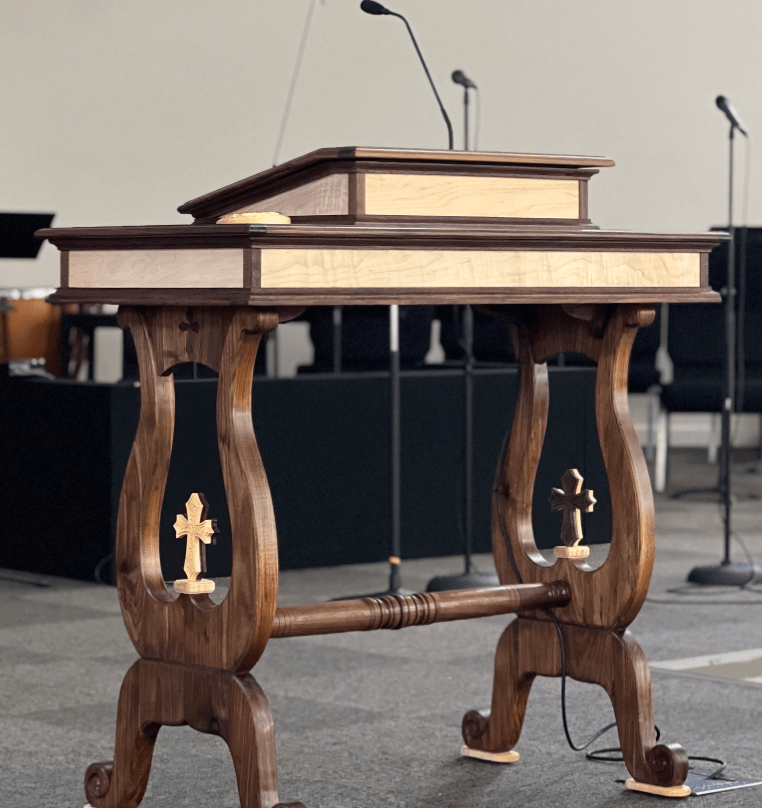
Pulpits. If you attend church, you’ve got one. It may be a music stand, a desk, a simple or an ornate traditional pulpit. But the preacher needs to stand somewhere to face his audience, and preach the truth visibly and audibly. A pulpit, in Western church architecture is “an elevated and enclosed platform from which the sermon is delivered during a service.”
Here is Spurgeon opining on how horrible many pulpits are, lol. At the time apparently, the Pulpit was enclosed in some way, either by rails or a box, and between being confined and having gas lamps near the head, Spurgeon said, “is very apt to make a preacher feel half intoxicated, or to sicken him. We ought to be spared this infliction.” More here, Pulpits–
Remarkable are the forms which pulpits have assumed according to the freaks of human fancy and folly. Twenty years ago they had probably reached their very worst. What could have been their design and intent it would be hard to conjecture. A deep wooden pulpit of the old sort might well remind a minister of his mortality, for it is nothing but a coffin set on end: but on what rational ground do we bury our pastors alive? Many of these erections resemble barrels, others are of the fashion of egg cups and wine glasses; a third class were evidently modeled after corn bins upon four legs; and yet a fourth variety can only be likened to swallows’ nests stuck upon the walls. Some of them are so high as to turn the heads of the occupants when they dare to peer into the awful depths below them, and they give those who look up to the elevated preacher for any length of time a crick in the neck. I have felt like a man at the mast-head while perched aloft in these “towers of the flock.” These abominations are in themselves evils, and create evils.
Even 200 years ago they were looking for that sweet spot of design for a pulpit. Seems like at some point, Spurgeon found it.
Here is HB Charles on the making of the only 3rd replica of Spurgeon’s pulpit desk from which HB will now preach. He was overcome with joy at how this structure supports and aids the preacher in his preaching: The Charles Spurgeon Pulpit at Shiloh
Pastor David Tarkington was asked by a woodworking congregant what kind of pulpit he would like if he could design one, and he promptly said, ‘Like Spurgeon’s- go see HB Charles’ to see what it looks like.‘ Then he wrote,
What is the significance of having a replica pulpit of Spurgeon’s? I know that throughout our community and around the world, God’s men are preaching God’s Word faithfully while standing behind home-made stands, music stands, milk cartons stacked up, ornate pulpits, tall tables, and some with no stand at all. Yet, in our church, with the facility God has blessed us to have, this stage set-up and pulpit says more than most know. The desk where the copy of God’s Word is opened each Lord’s Day for the preaching of the word is more than just a piece of furniture. It is a heavy responsibility for the pastor to preach the Word, rightly divide it, and feed the flock well, trusting the Holy Spirit to empower the spoken words from the written Word so that God may be glorified.
Rebecca Van Doodewaard wrote an 8-part series on Ecclesiastical Architecture. I enjoyed that series very much. Here is an excerpt from that series, the entry focusing on pulpits:
So, “because the Word is indispensable, the pulpit, as the architectural manifestation of the Word, must make its indispensability architecturally clear” (Bruggink and Droppers, 80). The sacraments are necessary. Congregational singing is important. Prayer is needed.
Proclaimed gospel, however, has historically held and should hold primary importance in Protestant worship. Everything else in worship and the sanctuary should revolved around it and point to it. Presbyterians, low Anglicans, Baptists, and Methodists (among other Protestant groups), despite their differences, all originally put the preached Word front and center, theologically and architecturally.
This most basic element of biblical Christianity found consistent architectural expression across the board. You will see in old churches that have not renovated their sanctuaries, that even in times of strong denominational affiliation, large, beautiful, central pulpits were ubiquitous.
The pulpit was large, not only so that it was visible from all parts of the sanctuary, but also so there was space to hold the preacher’s notes, a hymn book and a copy of the Scriptures which the congregation could see. The other reason that pulpits were large was to make the minister look smaller, hiding most of the man behind this architectural manifestation of the Word. Source Rebecca Van Doodewaard, Ecclesiastical Architecture.
Pastors often express interest in the pulpit at Grace Community Church. It is famous as one of the first pulpits ever mounted on a hydraulic lift, so that it can be adjusted for height, (side note: Spurgeon complained that as a short person “They are generally so deep that a short person like myself can scarcely see over the top of them, and when I ask for something to stand upon they bring me a hassock…” which is unstable.) and it can even descend all the way beneath the platform, all at the touch of a button.
(This was made necessary by the placement of the baptistery, which is at the congregation’s eye level, in the platform behind the pulpit. The pulpit was built to descend so that it could be permanently located at the very front of the platform, yet be easily moved—almost imperceptibly—so that the baptistery can be seen.)
I’ve often said this is my favorite pulpit to preach from, for several reasons. Of course, it’s a historic pulpit with an unrivaled reputation as a place where biblical preaching always meets an eager congregation.
But I like the pulpit for pragmatic reasons, too. It offers more real estate for notes than any pulpit I have ever preached from anywhere. Its top is almost flat, not slanted like a music stand. (Slanted pulpits always allow my notes to slide beneath the reach of my bifocals. I’d prefer a totally flat pulpit-top.) Our pulpit is high enough that the line of sight between my notes and eye-contact with the congregation is very short.
As a piece of furniture, our pulpit is not particularly remarkable. There’s nothing ornate or extraordinary about its craftsmanship. But what it lacks in aesthetics it more than makes up for in serviceability.
CR Wiley says, “I was recently asked, “What makes a good pulpit?” Here’s one I designed and had built for me at my last church. Here are a few convictions and practical considerations that went into the design of this one.
1.A pulpit has a liturgical function—it isn’t a lectern, it is the throne of the Word in Reformed churches. Consequently, it should make the pulpit Bible visible from every part of the sanctuary. It’s not supposed to enhance the status of a preacher, instead it should say something about the authority of God’s judgements. To reinforce this I had what appear to have armrests on either side of the pulpit Bible—and it just so happened that these provided places for a preacher to place his hands.
2.It should be substantial, even heavy, made of the highest quality materials a congregation can afford. This pulpit is made of quarter sawn red oak from the Berkshires in Massachusetts and it weighs roughly 400 pounds.
3.On the practical side of things, it should have places to put notes and books that might be used during preaching. As you might be able to tell, this pulpit provides plenty of space on either side of the pulpit Bible for those things. Source
Chris Martin used to write at his blog Millennial/Evangelical, which is now defunct. FYI, Hardcover or paperback books never go defunct, but online essays come and go like milkweed seeds in the wind. OK, old lady rant over, lol.
EPrata photo
In 2015 he wrote a piece called 3 Bad Reasons to Leave Your Church which is in archive mode now. The link works. Mr Martin is currently content director for Moody Radio and keeps a substack instead of a blog now.
I had not read a great quantity of articles at his site, but I did enjoy this piece. At the bottom of it, he has a link to a companion piece called 3 Good Reasons to Leave Your Church. Here is his archived essay ‘3 Bad Reasons’ opening paragraph:
“Stop treating your local church like your high school girlfriend, and start treating it like the bride of Christ.”
“You don’t leave the church when it doesn’t share the same musical interests, when it hurts your feelings, or when a newer, more popular one catches your eye.“
“The people of God, the Church around the world, is the bride of Christ, and the bride of Christ deserves the faithfulness of a bride, not the summer crush you bailed on when you were a jerk in college.“
And in like manner Mr Martin did indeed write about 3 ‘good’ reasons to leave your church. In the former (the bad reasons) they were trivial and self-serving. But sometimes there arises an issue in one’s church which violate one’s conscience, harms the sheep, or otherwise provide a basis for a holy reason to leave. Here are his opening paragraphs about ‘good’ reasons to leave:
On Wednesday I shared “3 Bad Reasons to Leave Your Church.” That sort of piece is common, almost a rite of passage for Christian bloggers these days. As I was brainstorming some blog posts the other day, I realized that I’ve read a bunch of posts on why not to leave your church, but I’ve read very few on reasons why you should leave your church. Allow me a bit of disclaimer as well: even among these “good” reasons to leave your church—it is my hope, as one who deeply cares about the local church, that even these problems wouldn’t cause you to leave. My hope is that somehow you could work through the problems listed below, stay at your church, and see them through to health and new life. However, not everyone is in a position to enact major change in their churches, so leaving may be the best option, unfortunately. Here are three good reasons to leave your church…
I recently left my church. I left in good standing and with recommendations from my elders to the church I’m currently a member of now. It was a plant to which I’d been a member since before the first service when we were praying and organizing. One of the elders who planted it had been my Sunday School teacher for 5 years prior to that. It was very hard to leave. I miss him so much to this day.
EPrata photo. Leaving your church is hard. It SHOULD be hard, anyway.
I left for 3 reasons. I’d had an issue since 2 years into the plant, then another issue cropped up 5 years later, then a final issue which cemented my decision to depart. I’d prayed for the elders and been a submitted member the entire time I was wrestling with my issues, but eventually, the Spirit in me made it clear in the way He makes it clear, that it was acceptable to depart. My first and longest-lasting issue was my church’s eschatology.
This week on Twitter/X I saw a poll and a discussion about eschatology which brought to mind this issue of whether to leave a church over its eschatology. The question was, “If your church required a specific end-times view to become a member, would you agree with that policy, though you held that same view of the end-times?“
I haven’t thought through the part about a membership requirement, but it brought to mind the issue of a church member believing differently on Last Things than their church teaches.
I noticed two things about the replies. Everyone called Eschatology (Doctrine of Last Things) a ‘secondary doctrine’. In purely theological terms a secondary doctrine is one that isn’t salvific, that is, requires a person to believe in if they are to be considered saved. The Deity of Christ is an Essential Doctrine. In addition, most of the Essential Doctrines contain a biblically stated penalty for NOT believing. CARM.org calls them Essential Doctrines and outlines them here.
Then there are Secondary Doctrines, AKA Non-Essential Doctrines that don’t touch on one’s salvation. Believing in the timing of Jesus’ return or the specific sequence of end-time events, isn’t a doctrine that illustrates that a person is unsaved. It’s not that the doctrine isn’t important when we call it ‘Secondary’ or ‘Non-essential’, but that it isn’t a biblical mandate to believe.
EPrata photo
CARM asked this question about secondary doctrines: Women pastors is not an essential doctrine, so why worry about it?Shouldn’t we just let those with whom we disagree go ahead and believe what they do about women pastors and not worry about it? The answer is that we should be concerned – very concerned. The reason is that in order to justify having women pastors and elders, several Scriptures need to be reinterpreted.”
If you’re interested, CARM has a Doctrine Grid here. Last Things is classified on CARM’s page as a secondary non-essential, “Any of them can be denied or affirmed, and regeneration is not questioned.”
But that does not mean these secondary non-essentials are insignificant. They are significant. All doctrines in the Bible are tied together with a thread, all of them touch on all the others. In order to believe certain stances, the interpreter needs to change his interpretive method and/or blatantly discount other clearly stated verses. So though a Last Things doctrine isn’t salvific, it comprises a third of the Bible and are a hinge point for many other interpretations and doctrines. It informs the preacher’s hermeneutic, that is, the WAY they interpret all the scriptures. And the way your pastor interprets the scriptures touches every person under his authority.
The second thing I noticed about the Twitter discussion of Last Things and membership was that though most people said ‘nah, do not require a specific eschatological stance for membership, don’t divide over non-essentials…EXCEPT…’ and then the person would state his exception. ‘Except if they believe preterism…except if they want to become a leader…except if they become divisive over it…’
I agree that Eschatology isn’t salvific, but it’s more important than one would think. The Prophets taught on it. It’s taught in the Gospels, referenced in Corinthians, Thessalonians, 2 Peter, and of course Revelation, among other mentions.
Eschatology informs us as to what to think and how to act when certain things come to pass. Eschatology makes certain demands and commands of us, as in Matthew 24, 2 Peter 3, and 1 Thessalonians.
Also, believing alternately from your elders and your church friends creates difficulties and temptations for the member. Several of the Twitter comments referenced this. When one signs on the dotted line to become a member of a church, often there is a clause with asks the prospective member to submit to the church’s teaching.
EPrata photo
In my case, as some of my friends studied and came to eschatological conclusions different from the teaching of our church, they came to me to ask about it. I always referred them to the elders if they had questions. We had open and approachable elders, a blessing. If they insisted to know my stance, I told them in general, but again strongly referred to the elders. If a member goes around teaching something different behind the Elders’ backs, it is divisive and causes confusion and a stumbling block.
This caused me a temptation to teach differently. My conscience was caught between needing to be a submitted member, which the Bible tells us to be, and my conscience in referring people to a teaching I honestly believe is error. A hard go.
Another issue is that the member who believes alternately from his or her church’s teaching on Last Things is muzzled. I wanted to joyfully shout the doctrines and exult in the Lord’s plan. I could not. Eschatology is a third of the Bible that I could not speak to, proclaim, or even encourage. After a while, this hurt my conscience so much.
Why did I join such a church, you ask? It was a plant by a then-young minister who had not completely cemented his personal reconciliation about the Doctrines of Last Things. Two years into it, he had, coming down on an opposite side of what I believed from my own 10 year study of the Old Testament first then the New Testament. What did I do? I was disappointed, but I focused on all the positive things my church did well, and there was a lot to be joyful about.
Until some other issues piled up. Until my conscience issue about the three issues I was having made it impossible and it as clear that I needed to go, not just for myself but for my church family. Let them be joyful in their interpretation, and I’ll go somewhere else and be joyful in mine.
Our church family is family. I know that blood ties feel strong, but they are only fleshly ties. Emotional, yes. Long lasting, yes. But the church family is eternal. It’s a family that is united not by our blood but by the infinitely holy blood of Jesus. Our union is with Him, through Him, and with Him. Leaving one’s church should not be a trivial matter, nor should it be casual.
Here are a few ‘church search’ sites that help you find a church according to the search directory.
TMS church search lists churches led by or planted by The Master’s Seminary Graduates. If you know the doctrinal stances of TMS then you fairly well know the doctrinal stances of these churches. Plug in your zip code or city info and a radius and it brings up a map and a listing. There are links for each search result that bring you to their website with contacts so you can check further:
There are good reasons for leaving a church and there are good reasons for staying. Pray it through, don’t be hasty, honor the Head of the Church and the under-shepherds (your pastors), and may the Lord bless your decision.




 the-end-time.org