I have always been a museum-goer. My parents did a good job of introducing me to cultural things and museums were one of those cultural things. A museum is where I first heard the word “curate” or “curator”.
According to AI, “A curator’s role involves overseeing and managing collections, including historical items, artwork, and other artifacts, ensuring their preservation, proper presentation, and accessibility for exhibits and displays within institutions like museums, libraries, and historical sites.“
The curator selects the art pieces and decides which goes where in order to make a cohesive experience for the viewer in the museum, or gallery, wherever the pieces are that have been curated.
And that setting is where the word “curate” remained for most of my adult life.
Until the internet. Until the internet really got going with social media exploding everywhere.
Now I hear the word curate all the time. According to AI again, in terms of social media,
“In the context of social media, “curate” means selecting and sharing valuable, relevant content created by others to engage your audience and build your brand’s reputation as a credible source of information.”
Everyone is a curator. People curate their Facebook wall. They curate their Twitter stream. They curate their Instagram photos. They curate their TikToks. Everybody is a curator.
I got to thinking… do we curate our souls?
The world’s most precious commodity is the soul. Everybody has one. Someone somewhere might not have a social media to curate, but everyone has a soul.
“The sinful body is the sepulchre in which it is entombed, until Christ giveth it life.” ~The Greatness of the Soul, John Bunyan.
The New Testament is FULL of wise advice, admonitions, and exhortations on how to curate this precious item, this invisible, ephemeral, but real and actual thing. A soul dwells inside all who are unborn and who are born. It emerges wrapped in flesh and lurks in the heart to do only evil against God.
Upon Adam’s sampling the fruit, Boston wrote, “Death also seized his soul; he lost his original righteousness, and the favor of God; witness the pangs of conscience which made him hide himself from God. And he became liable to eternal death…“
But God’s mercy is such that He did not leave us in that hopeless state. He sent His own Son to live the perfectly holy life that we could not ever live. He was killed for this, dying on the cross, and buried. But He rose again on the third day and ascended into heaven, to sit at the right hand of the Father. His feet are upon the footstool of all enemies, including death.
“Turn your eyes, O prisoners of hope, towards the Lord Jesus Christ; and embrace him, as he offers himself in the gospel. “There is no salvation in any other,” Acts 4:12.” Thomas Boston, “Human Nature in its Fourfold State“.
If you have been redeemed, dear reader, how do you curate your soul? The very soul wrested from death’s grip at bloody expense? Have you committed your interests to the Glorious Savior?
Boston again, “Be frequently reflecting upon your conduct, and considering what course of life you wish to be found in, when death arrests you; and act accordingly. When you do the duties of your station in life, or are employed in acts of worship, think with yourselves, that, it may be, this is the last opportunity; and therefore do it as if you were never to do more of that kind. When you lie down at night, compose your spirits, as if you were not to awake until the heavens be no more. And when you awake in the morning, consider that new day as your last; and live accordingly.”
When we receive the word of God, we have a responsibility to it. Before we are saved, our responsibility is to repent and believe the Gospel, for the Kingdom of God is at hand (Mark 1:15).
After we are saved, we still have a responsibility regarding our response to the word. Here is my pastor:
“What you receive from it will be directly related to how you receive it. Look at the verse in Mark 4:24. With the measure you use, it will be measured to you and still more will be added to you. Now that’s a very simple principle. What you get out of or from God’s word will depend on how well you pay attention to it. In other words, there’s a reward for diligent understanding of God’s word, diligent effort. If you apply yourself to carefully understanding and heeding God’s word, you’re going to be richly rewarded for your efforts.”
The pastor continues with other verses along the same principles, earnestly devoting yourself to the Word as you receive it will yield wisdom, discernment, joy, and more. Pastor again:
“In Proverbs 19, verse 27; Cease to hear instruction, my son, and you will stray from the words of knowledge. But if you take heed of what you’ve been taught, then the truth will become a guard over you. Paul wrote in 1 Timothy 4:16, keep a close watch on yourself and on the teaching. Persist in this, for by doing so, you will save both yourself and your hearers. And so don’t be careless in how you receive God’s Word. Pay attention to what you hear. And like newborn infants, long for the pure spiritual milk that by it you may grow up into salvation. Have you been careful in how you hear? In our scripture reading today in Hebrews 5, the author criticizes the audience. He says, you have become dull of hearing, Hebrews 5, verse 11; “For though by this time you ought to be teachers, you need someone to teach you again the basic principles of the oracles of God. You need milk, not solid food. For everyone who lives on milk is unskilled in the word of righteousness since he is a child. But solid food is for the mature, for those who have their powers of discernment trained by constant practice to distinguish good from evil.” In other words, this is a classic description of someone who has not taken heed of the truth. They have not received it, thought carefully about it, and applied it to their lives.”
On the next day’s devotional, I heard Dustin Benge’s reading of the Puritan John Owen from his classic “Communion with God.” The principle of hearing well was brought up again. These ‘spiritual coincidences’ delight me.
The father’s love “was fixed on us before the foundation of the world. Before we were, or had done the least good, then were his thoughts upon us, — then was his delight in us; — then did the Son rejoice in the thoughts of fulfilling his Father’s delight in him, Prov. 8:30, says Owen. Why did the father love us? There was “nothing in us for which we should be beloved” and “though we change every day, yet his love changeth not. Could any kind of provocation turn it away, it had long since ceased. Its unchangeableness is that which carries out the Father unto that infiniteness of patience and forbearance…”
Seeking the special closeness with God through our prayers and receiving of His word is a special privilege of the saints. “Men are generally esteemed according to the company they keep. It is an honour to stand in the presence of princes, though but as servants. What honour, then, have all the saints, to stand with boldness in the presence of the Father, and there to enjoy his bosom love!” says Owen. “What a safe and sweet retreat is here for the saints, in all the scorns, reproaches, scandals, misrepresentations, which they undergo in the world.”
“His love is not ours in the sweetness of it until it be so received. Continually, then, act thoughts of faith on God, as love to thee, — as embracing thee with the eternal free love before described. When the Lord is, by his word, presented as such unto thee, let thy mind know it, and assent that it is so; and thy will embrace it, in its being so; and all thy affections be filled with it. Set thy whole heart to it; let it be bound with the cords of this love.” ~John Owen
Receive His word faithfully, earnestly, knowing His love is immense and directed toward His children. Receive it, do diligence with it, and return this love in worship and in all our strength, mind, and heart.
Fly to the fountain, once filled with blood, now gushing love to all who are in Him. Receive His word with joy, implant it in your heart, do not delay, for within is a bountiful mercy. Owen concludes,
“Indeed, the great sin of believers is, that they make not use of Christ’s bounty as they ought to do; that we do not every day take of him mercy in abundance. The oil never ceaseth till the vessels cease; supplies from Christ fail not, but only when our faith fails in receiving them.”
There is a social media story going around that alleges a man died in a hospital and spent 11 hours in heaven. It’s an older story, 6 or 7 years old, but getting traction now. The man said he got a full tour, complete with glowing-eyed monsters, demons climbing out of the pit to claw his back, fires, green grass so beautiful and symmetrical, feathered angels hugging him, and Jesus face to face.
“Jim was never a religious man. When it came to matters of God and faith, he was ambivalent. But as he lay in the hospital bed, clinically dead for more than 11 hours, his consciousness was transported to the wonders of Heaven and the horrors of hell. When he returned to this world, he brought back the missing peace his soul had been longing for.“
He told his story on Youtube, saying he was never particularly religious, if anything, he was agnostic. He said, “I hoped that someone was in charge of the chaos but I never sought it out.”
Stop and think, if the people who Jesus has chosen from the foundation of the world to be one of His, and this man was a Jesus-rejecting sinner, why would Jesus give him, and not others the opportunity to preview what he would be missing if he continued in his unsaved state?
The man has traveled around North and South America, having spoken to about 20,000 people so far.
“James, my son, this is not yet your time. Go back and tell your brothers and sisters of the wonders we have shown you. While he now attends church, Woodford doesn’t affiliate with any denomination, eschewing labels. ‘Labels do not matter to God. He knows your heart better than you do,’ he states. For Woodford, it boils down to living a life of kindness and service. “That’s how simple the love of God is. It requires nothing more of you other than a dedication to doing good for others.” source.
Didn’t the Rich Man in Hades beg Abraham to send his servant Lazarus to his brothers to warn them of their impending doom? And didn’t Abraham say,
‘They have Moses and the Prophets; let them hear them.’ 30But he said, ‘No, father Abraham, but if someone goes to them from the dead, they will repent!’ 31But he said to him, ‘If they do not listen to Moses and the Prophets, they will not be persuaded even if someone rises from the dead.‘” (Luke 16:19-31).
some heaven tourism books, still popular
Was Abraham wrong? This man’s friends will listen to him since he rose from the dead? You see how the contradictions mount up.
It is not your time? Doesn’t the precision of God dictate perfection in birth and death? Was his entrance to heaven a mistake?
The man said that the experience apprised him of how wasteful his life had been, accumulating wealth, being unkind, unhelpful. These are normal things a convert says when truly converted, we recognize that. But the method of his alleged conversion is distinctly false. Jesus is not giving guided tours of heaven, personal messages or warnings, and then sending the person back to their body. In normal life, a near-death experience often changes people, but the change is not sourced from the blood of the Lamb to His elect. It’s a moral decision from inside the person.
And just as it is destined for people to die once, and after this comes judgment, (Hebrews 9:27)
Tim Challies said of one particular book during the height of the heaven tourism era 12 years ago, “I am not going to review To Heaven and Back. It’s pure junk, fiction in the guise of biography, paganism in the guise of Christianity.”
In fact, there came to be such an outcry against the spate of these books being pumped out, that in 2014, “LifeWay Christian Resources has stopped selling all “experiential testimonies about heaven” following consideration of a 2014 Southern Baptist Convention resolution on “the sufficiency of Scripture regarding the afterlife.”
Paul reluctantly, very reluctantly described some of his experience in heaven, not for titillating or self-serving purposes, his trip to third heaven. He refused even to name himself as the ‘traveler’, and he said specifically there were some things man was not even permitted to say.
And yet all these people allegedly return from ‘heaven’ and gush about their experience. And make money off them…
Did Mary and Martha’s brother Lazarus write a parchment and travel around telling his story of being dead for 4 days and his experience of the afterlife? No.
One minute after you slip behind the parted curtain, you will either be enjoying a personal welcome from Christ or catching your first glimpse of gloom as you have never known it. Either way, your future will be irrevocably fixed and eternally unchangeable. Erwin Lutzer, One Minute After You Die
Our eternity should be taken seriously. It is a weighty matter, and not one for merchandising, flippantly joking about, or bearing tales about. Lutzer again,
And so while relatives and friends plan your funeral- deciding on a casket, a burial plot, and who the pallbearers shall be— you will be more alive than you have ever been. You will either see God on His throne surrounded by angels and redeemed humanity, or you will feel an indescribable weight of guilt and abandonment. There is no destination midway between these two extremes; just gladness or gloom.
The scriptures are sufficient to tell us how to prepare for the moments after our bodies cease, and our souls go to its place, awaiting judgment and a fitted body for heaven. Failing to prepare, which means failing to repent and believe in the resurrected and ascended Jesus, a person will be fitted with a body for hell.
A way to determine that these stories are false, aside from the time that one author came out and said he had been lying all along, is that the people who claim to have gone to heaven claim to have spoken with grandma or seen family or been hugged by friends, and had been shown green grass and beauty…fail to mention the ONE THING that will capture our attention: Jesus on his throne.
Here is Todd Friel with a one minute comment on that: Auto-start at 5:07- ends at 6:29
Anytime somebody tells you they’ve been to heaven, do not believe it. This is mysticism. This is trying to get in touch with the divine, with deity through subjective experience and disengaging the mind
Just as visions are not happening today, just as God isn’t directly speaking/whispering to anybody today, trips to heaven are not happening. They either come from a lying tongue or a deceived mind.
I was asked about the Lifeway Bible Study “When You Pray.” The study involves a collection of authors, who wrote a chapter each. They are- Kelly Minter, Jackie Hill Perry, Jen Wilkin, Jennifer Rothschild, Jada Edwards, and Kristi McLelland. It is a 7-session lesson designed for small groups, self alone, or a retreat accompanied by the separately purchased ‘Group Experience Kit’. Each session was written by the different author listed above. It includes a video component for each session. The study uses 6 different Bible translations, including the NLT.
It is not best practice to use multiple translations in one study.
Using many translations in one study: AI says, “A Bible teacher should generally not use six different translations in one study as it can be overwhelming and confusing for students, potentially detracting from the focus on understanding the text rather than comparing translation nuances; it’s usually better to stick with one primary translation and only reference a few others when necessary to clarify meaning or highlight translation variations in specific passages.”
I thanked the questioner for the query and for the encouragement and for reading my material here on the blog. Discernment is always good.
I am sorry to say that uniformly, almost anything from Lifeway is going to be bad. They unashamedly platform false teachers. A while back Lifeway published a spate of “heaven tourism” books where people who said they’d died were given a tour of heaven, some of them claiming to have met Jesus. Lifeway continued to publish these books for years until a big outcry finally pushed them off Lifeway’s shelves. Their years-long persistence in publishing these books, some of which contradicted each other and all contradicting the Bible, despite appeals, petitions, and rebukes, displayed a wanton lack of concern for the spiritual state of their customers, a lack of discernment, and a prioritizing of greed over truth.
Jen Wilkin left, Jackie Perry right
As for this specific study titled “When You Pray”, I’ve written several times about the authors Jackie Hill Perry, and Jen Wilkin. Both are egregious Bible twisters. Perry came out with an announcement that she receives direct revelation from Jesus and was instructed to tell people the different pieces of news ‘He’ tells her. Like this: “Ok ok. I’ll say this. God primarily deals with me in dreams. I’ve been enlightened, warned, and led to intercede for others through them.” She has since removed this Twitter announcement. You can read a transcript of it at the link above.
Jen Wilkin is obsessed with two things, preaching and women. This equals women preaching, she twists almost every sermon, Q&A, panel, or interview into a women need to be leaders WITH men (in roles the Bible denies us, of course). In one famous sermon she likened period blood (excerpt) from women to the blood on the cross, saying women have a better understanding of the gospel because of this. I am not kidding.
As for Minter & Rothschild, Michelle Lesley has written about them, discerning that these women preach to men and they support and promote false teachers. She does not recommend either of these women.
Alternatives to Lifeway’s When you Pray ‘study’ might be:
At Ligonier, there is a 6-week lesson series with video etc, called Prayer, where RC Sproul “uses the acronym ACTS and the Lord’s Prayer to teach us how to pray” 24 min each. It costs $9.00/month. https://connect.ligonier.org/library/prayer-27945/about/
Praying the Bible by Donald S. Whitney is a small book and 5-min youtube videos by the author go thru how to pray daily without falling into the rut of saying the same old thing. https://youtu.be/A-HziKu5Ot0?si=yU70QoTBvrklUrbw
Grace Community Church led by MacArthur has a huge small group ministry section for men and women, many of the lessons are taped or video’d and have accompanying pdf or notes.
I’d say any of those alternatives are better than Lifeway. 🙂
Lifeway is not a trustworthy source for any Christian material, sadly.
Pulpits. If you attend church, you’ve got one. It may be a music stand, a desk, a simple or an ornate traditional pulpit. But the preacher needs to stand somewhere to face his audience, and preach the truth visibly and audibly. A pulpit, in Western church architecture is “an elevated and enclosed platform from which the sermon is delivered during a service.”
Here is Spurgeon opining on how horrible many pulpits are, lol. At the time apparently, the Pulpit was enclosed in some way, either by rails or a box, and between being confined and having gas lamps near the head, Spurgeon said, “is very apt to make a preacher feel half intoxicated, or to sicken him. We ought to be spared this infliction.” More here, Pulpits–
Remarkable are the forms which pulpits have assumed according to the freaks of human fancy and folly. Twenty years ago they had probably reached their very worst. What could have been their design and intent it would be hard to conjecture. A deep wooden pulpit of the old sort might well remind a minister of his mortality, for it is nothing but a coffin set on end: but on what rational ground do we bury our pastors alive? Many of these erections resemble barrels, others are of the fashion of egg cups and wine glasses; a third class were evidently modeled after corn bins upon four legs; and yet a fourth variety can only be likened to swallows’ nests stuck upon the walls. Some of them are so high as to turn the heads of the occupants when they dare to peer into the awful depths below them, and they give those who look up to the elevated preacher for any length of time a crick in the neck. I have felt like a man at the mast-head while perched aloft in these “towers of the flock.” These abominations are in themselves evils, and create evils.
Even 200 years ago they were looking for that sweet spot of design for a pulpit. Seems like at some point, Spurgeon found it.
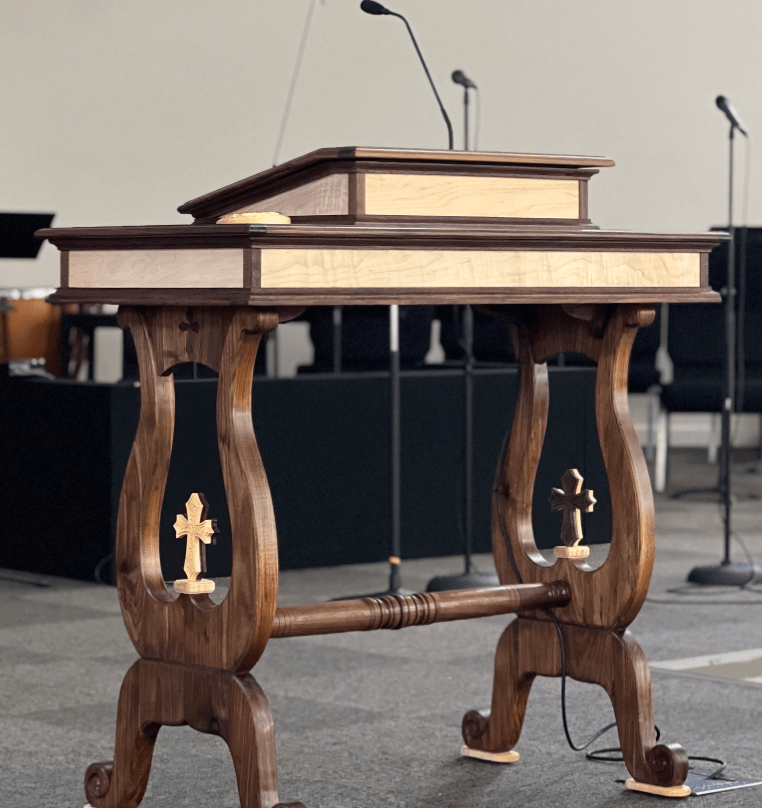
Here is HB Charles on the making of the only 3rd replica of Spurgeon’s pulpit desk from which HB will now preach. He was overcome with joy at how this structure supports and aids the preacher in his preaching: The Charles Spurgeon Pulpit at Shiloh
Pastor David Tarkington was asked by a woodworking congregant what kind of pulpit he would like if he could design one, and he promptly said, ‘Like Spurgeon’s- go see HB Charles’ to see what it looks like.‘ Then he wrote,
What is the significance of having a replica pulpit of Spurgeon’s? I know that throughout our community and around the world, God’s men are preaching God’s Word faithfully while standing behind home-made stands, music stands, milk cartons stacked up, ornate pulpits, tall tables, and some with no stand at all. Yet, in our church, with the facility God has blessed us to have, this stage set-up and pulpit says more than most know. The desk where the copy of God’s Word is opened each Lord’s Day for the preaching of the word is more than just a piece of furniture. It is a heavy responsibility for the pastor to preach the Word, rightly divide it, and feed the flock well, trusting the Holy Spirit to empower the spoken words from the written Word so that God may be glorified.
Rebecca Van Doodewaard wrote an 8-part series on Ecclesiastical Architecture. I enjoyed that series very much. Here is an excerpt from that series, the entry focusing on pulpits:
So, “because the Word is indispensable, the pulpit, as the architectural manifestation of the Word, must make its indispensability architecturally clear” (Bruggink and Droppers, 80). The sacraments are necessary. Congregational singing is important. Prayer is needed.
Proclaimed gospel, however, has historically held and should hold primary importance in Protestant worship. Everything else in worship and the sanctuary should revolved around it and point to it. Presbyterians, low Anglicans, Baptists, and Methodists (among other Protestant groups), despite their differences, all originally put the preached Word front and center, theologically and architecturally.
This most basic element of biblical Christianity found consistent architectural expression across the board. You will see in old churches that have not renovated their sanctuaries, that even in times of strong denominational affiliation, large, beautiful, central pulpits were ubiquitous.
The pulpit was large, not only so that it was visible from all parts of the sanctuary, but also so there was space to hold the preacher’s notes, a hymn book and a copy of the Scriptures which the congregation could see. The other reason that pulpits were large was to make the minister look smaller, hiding most of the man behind this architectural manifestation of the Word. Source Rebecca Van Doodewaard, Ecclesiastical Architecture.
Pastors often express interest in the pulpit at Grace Community Church. It is famous as one of the first pulpits ever mounted on a hydraulic lift, so that it can be adjusted for height, (side note: Spurgeon complained that as a short person “They are generally so deep that a short person like myself can scarcely see over the top of them, and when I ask for something to stand upon they bring me a hassock…” which is unstable.) and it can even descend all the way beneath the platform, all at the touch of a button.
(This was made necessary by the placement of the baptistery, which is at the congregation’s eye level, in the platform behind the pulpit. The pulpit was built to descend so that it could be permanently located at the very front of the platform, yet be easily moved—almost imperceptibly—so that the baptistery can be seen.)
I’ve often said this is my favorite pulpit to preach from, for several reasons. Of course, it’s a historic pulpit with an unrivaled reputation as a place where biblical preaching always meets an eager congregation.
But I like the pulpit for pragmatic reasons, too. It offers more real estate for notes than any pulpit I have ever preached from anywhere. Its top is almost flat, not slanted like a music stand. (Slanted pulpits always allow my notes to slide beneath the reach of my bifocals. I’d prefer a totally flat pulpit-top.) Our pulpit is high enough that the line of sight between my notes and eye-contact with the congregation is very short.
As a piece of furniture, our pulpit is not particularly remarkable. There’s nothing ornate or extraordinary about its craftsmanship. But what it lacks in aesthetics it more than makes up for in serviceability.
CR Wiley says, “I was recently asked, “What makes a good pulpit?” Here’s one I designed and had built for me at my last church. Here are a few convictions and practical considerations that went into the design of this one.
1.A pulpit has a liturgical function—it isn’t a lectern, it is the throne of the Word in Reformed churches. Consequently, it should make the pulpit Bible visible from every part of the sanctuary. It’s not supposed to enhance the status of a preacher, instead it should say something about the authority of God’s judgements. To reinforce this I had what appear to have armrests on either side of the pulpit Bible—and it just so happened that these provided places for a preacher to place his hands.
2.It should be substantial, even heavy, made of the highest quality materials a congregation can afford. This pulpit is made of quarter sawn red oak from the Berkshires in Massachusetts and it weighs roughly 400 pounds.
3.On the practical side of things, it should have places to put notes and books that might be used during preaching. As you might be able to tell, this pulpit provides plenty of space on either side of the pulpit Bible for those things. Source
A reader asked me about Elisabeth Elliot. This is the answer I gave.
Elliot was one of the five wives whose husbands were killed by the unreached Ecuadorean Auca Indians back in 1956. She decided to remain in the mission field and minister to the same natives who had speared her husband. Later, returning to the US, she remarried and began speaking on a circuit. Her second husband, Addison Leitch, died agonizingly of cancer 4 years later. Elliot wrote books and hosted a radio program for 13 years called Gateway to Joy. She married for a third time in 1977 to Lars Gren and remained so until her death caused by dementia in 2015. She had one daughter, Valerie. Elisabeth was seen as a graceful, valiant, strong woman, but she was also disillusioned at times, complex, and had bouts of depression.
The question I was asked about Elliot was, was her theology off? It seems a bit off to the reader. I answered, yes her theology IS off. Elisabeth seems to be something of a sacred cow in evangelical circles, and has escaped scrutiny or critique. She gets a pass.
Some years ago I read an interview a Catholic lady was involved in with Elisabeth Elliot. A remarkable exchange occurred which the interviewer put in her resulting article. Elisabeth’s evangelical brother Thomas converted to Catholicism. He became an apologist for Roman Catholicism and wrote many books on the religion.
She said of her brother, the Catholic, that she wished she was brave or she’d be a Catholic too. From Catholic Exchange, an interview:
“Do you know my brother, Thomas Howard? He entered the Catholic Church some years ago. I only wish I had his courage. … “Cowardice, I suppose. My listeners and readers simply would not understand.” Source: Courage to be Catholic
No, we would not.
Though these things happen, it wasn’t solely wanting her child to go to American schools that made Elisabeth leave the mission field, it was constant interpersonal conflict with fellow widow Rachel Saint that was the final straw. They could not stand each other. Though Elisabeth apparently tried to heal the fracture, it never did heal. It’s really not here or there, but the press gives Elliott a winsome graciousness or a settled placidity which was not always true.
She also preached to men. Christianity Today wrote, “Elliot, like many prominent conservative women, also manifested certain contradictions amid her complementarian advocacy. Though she insisted that only qualified men could serve as pastors, she taught church audiences that typically included adult men. Along with her second husband, she joined the Episcopal Church, one of the denominations most adamant about ordaining female pastors.“
In her early life and especially when courting Jim, she had weird ideas about personal will and divining the will of God, using almost mystical means such as circumstances and experience. Her Keswick Holiness upbringing instilled this in her. This led her to excessive self-introspection and sometimes paralysis in decision making.
Elliot biographer wrote in her essay Why Elisabeth Elliot Changed Her Beliefs about Finding God’s Will, “She saw God’s care as dependent on her perfect obedience, and obedience as including not only her actions and her will but every aspect of her life right down to her natural inclinations. Human free will involved only the choice to obey or disobey God’s direction, and God’s will was so minutely specific that even an earnest seeker could miss the narrow path of obedience.”
Elisabeth Elliot teaching men
The fear of missing God’s direction caused Elliot much grief. While it is admirable to want to lay down the whole body, mind, strength, and heart down for the Lord, it is a kind of personal sovereignty that thinks our own decisions can and do thwart God’s will.
Did not Mordecai say to Esther, “Then Mordecai told them to reply to Esther, “Do not imagine that you in the king’s palace can escape any more than all the other Jews. For if you keep silent at this time, liberation and rescue will arise for the Jews from another place, and you and your father’s house will perish. And who knows whether you have not attained royalty for such a time as this?” (Esther 4:13-14), making it clear that Esther could decide what she wanted to decide, but that God’s plan would proceed regardless of Esther’s decision.
Elisabeth developed a rubric for divining what God wanted her to do,
(1) the circumstances, (2) the witness of the Word, (3) peace of mind
It’s an unstable thing to depend on emotions to confirm a personal decision. Whether it’s fear or peace, emotions should not figure in. No doubt Paul did not ‘feel peace about it’ when he got up from the road from being beaten almost dead to confront the mobs again, or when he floated on a shipwreck plank for days. In Acts 9:16, Jesus tells Paul, “For I will show him how much he must suffer for the sake of my name.” Knowing the certainty of suffering was ahead, I am sure Paul didn’t feel a spiritual placidity all the time. Our emotions should not be a guide for obedience.
On the plus side, Elisabeth was staunchly against feminism, and spoke frequently about headship submission, roles in marriage, and resisting cultural norms. On the downside, she often said these things at predator Bill Gothard’s events. And she began this professional relationship with Gothard in the mid 1990s, AFTER accusations began to come out against Gothard, which were later confirmed by his Board.
She certainly endured horrific tragedies, martyrdom of her first husband, agonizing long death of 2nd from cancer, and a semi-abusive relationship with the 3rd, and a 10-year battle with dementia, which caused her death at age 88. Her work on the mission field is beyond admirable, and her writing no doubt has helped many, as well as her popular radio program.
However, her legacy is definitely complicated, wrapped in grace under suffering, obedience to the Lord even under the most difficult trials, and an advocate for gender roles- which are all good things. However her search for HOW to obey God, her yearning for Catholicism, and her evident hypocrisy in preaching to men, are sad complicating factors in her life’s story.
Over the last five or eight years, I’ve seen a dramatic rise in what people term a “victimhood culture.” This is a culture which declares all power is evil, privilege is ill-gotten and leads to oppression, and victimhood is virtuous. Victims are allowed to opine on anything without facing critique, because, after all, it was their experience, or in the current parlance, “their truth.”
It’s the idea that that suffering and persecution (and any slight, wound, or grief is ‘persecution’ to victims) are a source of status. The deeper the ‘persecution’ the higher the status.
The notion that suffering or persecution can become a source of status is testimony to two things: 1) how satan twists anything, even the good things of the Bible, and 2) how me-centered Christianity can become if allowed to fester unfettered.
How does satan subtly twist the Bible away from Jesus toward ourselves? In this identity politics sphere anyway, the Bible says that the foolish shame the wise, the the weak are made strong, the king becomes a slave so that the slaves may become kings, the first shall be last and the last shall be first. Satan took this and ran with it to create victimhood mentality.
Victim identity is not new. Prior to Swiss philosopher Jean-Jacques Rousseau’s ideas infiltrating his 1700s culture, participants in civil society counted their status based on what they had contributed positively to it. After Rousseau, who invented the category of ‘the disadvantaged’, it became based on a lack or a negative. Source.
But its infiltration wholesale into the faith is fairly new. Slowly, incrementally (because satan is subtle) me-centeredness crept into the faith in the form of sermons, books (self-help), and famously platformed ‘wounded women’ prancing about their stages opining about how they were ‘hurt’. Thus, one’s faith is based on how the person overcame the hurt in their own power, instead of focusing on and glorifying Christ by their teaching. Their experience becomes the focus.
I give one example among many, perhaps the best known example to this day- Beth Moore. On her instagram recently, she wrote,
Here is how Beth Moore was ‘hurt by her denomination’: She was given a Sunday School class to teach by her denomination (Southern Baptist Convention pastor John Bisagno, Moore’s pastor). When it outgrew the room, she was given an auditorium. Then she was given opportunity to ‘speak’ (AKA preach) to her congregation on Sunday evenings. Moore’s pastor John Bisagno is widely seen as having launched her ministry career and ’empowering women’ in ministry in modern times. When Moore’s first manuscript was rejected by Lifeway, an arm of her denomination, her friend Lee Sizemore advocated for her and got the manuscript published. Moore went on to have a lucrative relationship with Lifeway for decades, with a Lifeway worker noting “no one’s products brings in more money for Lifeway than Beth Moore’s”.
Her denomination via Lifeway paid for half of Moore’s private jet travel for decades as she rose in prominence and became known as the most famous conservative evangelical woman in the world at the time. Supported by her denomination she was puffed by Christianity Today and even the secular magazine The Atlantic in long articles. Moore made millions, and at one time enjoyed owning 4 homes scattered across Texas from Galveston to Tomball to Menard.
But … the ‘denomination hurt her’. She called all this support ‘misogynistic’ even though she was specifically launched as an ’empowered woman in ministry’ BY her denomination, and supported for decades BY her denomination, petted and jetted BY her denomination. Now wrung dry, Moore’s noisy and divisive exit was the thanks they got.
That’s the victimhood culture- as long as it serves the person and their goals, they will play the victim. Playing the victim keeps the focus on the individual and away from Jesus.
Oh, I know they will say the word ‘Jesus’ a lot. They may even attribute their overcoming their hurt to Jesus. But the focus is squarely on themselves, their hurtful experience, and their power to overcome.
While reality constrains us to acknowledge genuine suffering and oppression exist and obligates compassion, it also requires us to acknowledge that the doctrine of perpetual victimhood—an ideology that frames individuals as powerless, blameless, and entirely at the mercy of external forces—stands in opposition to reality and starkly contradicts the teachings of Scripture. Source The Doctrine of Victimization and the Destruction of Personal Agency
At root of the victim mentality is pride. It says ‘I was hurt. I deserve better treatment than that.’ The word deserve is key here. In fact, what we deserve is hell. What did John the Baptist deserve? He was beheaded. Did he deserve that for speaking the truth? No. Is he deemed a victim in the Bible? Jesus said he was the greatest man. Did Paul deserve to be imprisoned? No. Did Paul claim to be a victim? He went through a lot. He counted it all as joy in service to the King.
If you have a victim mentality, you will see your entire life through a perspective that things constantly happen ‘to’ you. Victimisation is thus a combination of seeing most things in life as negative, beyond your control, and as something you should be given sympathy for experiencing as you ‘deserve’ better.Source: The Victim Mentality: What it is and Why You Use It
A true Christian will see whatever happens to them as being FOR them. Why? Because Jesus is sovereign and is the cause of all things.
Today a person’s moral authority is directly proportional to how many different ways he or she can claim to have been victimized.
I could easily trade on being a victim. I grew up in a neglectful and abusive home. I am a child of divorce. I was a latchkey kid. I was stalked by an actual rapist in college and helped the police catch him. I was betrayed and abandoned by an adulterous husband. I was a congregant in a spiritually abusive church. I was a congregant in a church whose worthless pastor blatantly plagiarized every sermon he gave, even ripping off the original pastor’s life anecdotes as if he had lived them. Do you know what all of that adds up to? LIFE. It’s life. That’s all.
Pagans and Christians alike have things happen to them. Just because Christians have wounds and hurts doesn’t make us special. Playing a Christian victim is a devolving sphere of self-pity and a heaping up other victims to affirm your self-pity.
Herbert Schlossberg has said of victim mentality that it, “exalts categories of weakness, sickness, helplessness, and anguish into virtues while it debases the strong and prosperous. In the country of ontological victimhood, strength is an affront.” (see source below).
This is exactly why strong Christian men are seen as oppressors and Christian women crying over ‘misogyny’ in the faith are seen as the strong and ‘brave’ ones.
It is OK to feel sorrowful once in a while. Do I ever feel sorrowful for a lost childhood? Sure. But I focus on the positives. I have been saved by the blood of the Lamb, though I do not deserve it. I have His strength, provision, and support every day. I can boldly approach the highest throne with my petitions. I have an eternity to see the face of God and dwell in glory. What a joy that the Lord shepherded me even before my moment of justification to turn me into the person I am today, including the life trials before and after salvation! What minuscule things my wounds and hurts are when compared to the weight of glory!
I am sorry if you were hurt by family, stranger, church, denomination, anyone. I am sorry if you are feeling sorrowful. But we are not victims. We are to love, forgive, bring our cares to Jesus and lay them at His feet. Some of the people who ‘hurt’ me are not saved. They were just living their unsaved lives in sin, and their sin affected me. Some have passed into their eternity unsaved as far as I know. Others are near death’s door as an unsaved person. How can I feel sorry for myself when their eternity hangs in the balance? May it not be that I sit in the safe seat of justification and point to myself when others around me are destined for eternal wrath and torment!
Both Paul and Moses were so torn by the fact of their countrymen being unsaved they pleaded for them, even to suffer in their stead. (Romans 9:3, exodus 32:32). This kind of self-abegnation is unheard of today.
It would be logical for pagans to wonder, ‘what kind of Jesus do Christians serve who constantly moan about being a victim? What a sad, ineffectual religion!’
The cross of Jesus defeats all self-pity, victimhood, pride, anger, bitterness. Yes, we may need to work hard at claiming this defeat depending on the depth of the crime. But we certainly do not need to inflate our wounds in order to garner attention and pity. Jesus is too precious for that.
So many people, especially women, are hopscotching the globe founding important ministries, establishing orphanages, ’empowering’ native women, or teaching to packed arenas, that it makes the rest of us humdrum ladies feel, ahem, left behind. Should we be doing the big things? Can we do the bigger things? Are we doing enough?
All I do every single day, is go to work. I come home and I study my Bible &pray, I write, and if I have enough energy after that, I read a bit. Then I go to sleep and do it all over again. On the weekends all I do is grocery shopping, laundry, cooking the week’s lunches ahead, and study a lot more and write a lot more. I go to church on Sunday late afternoon. Bed time. Repeat.
I’m not skipping off to host conferences or giving interviews on panels or unashamedly on tour or in Rwanda on a storytelling trip. I wash dishes in obscurity in GA and my job is to help kindergarteners tie their shoes and learn their ABC’s. It’s not glamorous. It doesn’t seem like it’s very much at all of a contribution to the kingdom. I mean, Beth Moore is a 60+ year old grandma busy with her panels, and cohorts, and Bible studies, and traveling tours. She keeps a packed schedule. Younger women also seem to be doing the big things, the glamorous things, like Jennie Allen and Raechel Myers and Kari Jobe. As for me, I’m just plodding.
Well, let’s hear it for the plodders.
First, if you are a mother, you are in a highly esteemed Biblical position. You are doing such wonderful work for the kingdom in being a foundation block in society, in raising pure young women and strong young men for the next generation. I thank Mrs George G. Paton and Mrs Eliza Spurgeon and Mrs Irene MacArthur and all the other Missus’ who raised men and women who in turn, impact the kingdom.
Secondly if you think of the life of Paul most often we think of the highlights. His speeches before thousands, his dramatic miracles, his appearances before kings and leaders.
However, Paul also walked. Thousands upon thousands of miles, he plodded. He trudged. He hiked. From one town to another, in all weathers. In addition, Paul sewed tents. (Acts 18:3). He did the mundane. He wrote letter upon letter to friends. He fundraised. The in-between miracle times in his three missionary journeys were rife with the mundane and the insignificant, except nothing about a Christian’s life is insignificant. Not Paul’s and not mine and not yours. The Lord cares for all our concerns. He clothes us and feeds us and He even knows the number of hairs on our heads. To Him, it’s all significant.
As for the women of the New Testament, Dorcas was beloved not because she was on storytelling tours of Rwanda empowering women for ‘style and justice’, but because she sewed. She made clothes for the poor and she “was always doing good”. (Acts 9:36). She lovingly helped, humbly and quietly, within her own sphere.
Mary, mother of God? Do we hear of her going on her book tour, telling about the angel that came to her one day, and the miracle of the three wise men or hyping up audiences with her harrowing tale of narrowly escaping the massacre of the innocents? No. Whether she was in Egypt or in Israel, Mary simply raised her Son. She brought Him up in the faith and managed her household and she raised Jesus’ siblings too. A few times a year she made the pilgimage to the Temple and the rest of the time, she did what women then and onward have done, she lived in her home and she was faithful to the Lord through His word.
Here are two articles about the plodding kind of faith that endures. That kind of faith is cement. It’s bedrock.
It’s sexy among young people—my generation—to talk about ditching institutional religion and starting a revolution of real Christ-followers living in real community without the confines of church. Besides being unbiblical, such notions of churchless Christianity are unrealistic. It’s immaturity actually, like the newly engaged couple who think romance preserves the marriage, when the couple celebrating their golden anniversary know it’s the institution of marriage that preserves the romance. Without the God-given habit of corporate worship and the God-given mandate of corporate accountability, we will not prove faithful over the long haul.
This one is one of my favorites. It’s by John MacArthur, titled An Unremarkable Faith
Meet Larry, a thirty-six year old Science teacher. Larry married Cathy 12 years ago. They love each other and enjoy raising their two sons. Larry’s life wouldn’t hold out much interest to the average citizen. His Facebook account doesn’t draw many friends and nobody ever leaves a comment on his blog. In fact, most people would summarize Larry’s life with one word—boring. But not Larry. Teaching osmosis to junior high students, playing Uno with his kids, and working in the yard with Cathy is paradise to him. But the real love of his life is Jesus. Larry’s a Christian. He’s been walking with the Lord for more than 20 years.
Not that founding orphanages isn’t worthwhile or something women or men can’t or shouldn’t do. Not that going on a missionary trip to Africa isn’t something Jesus wants us to do. But the big doers are fewer than we think, despite the hype. Most of the church is populated with plodders. As Kevin DeYoung concluded his article,
Put away the Che Guevara t-shirts, stop the revolution, and join the rest of the plodders. Fifty years from now you’ll be glad you did.
For those of us who love God and seek to obey at all pints (but knowing we fail, so we repent and try again), the persistent and entrenched disobedience of some self-proclaimed Christian women is a puzzle to us.
But then again, we read our Bibles and see 1 John 2:4 which says, The one who says, “I have come to know Him,” and does not keep His commandments, is a liar, and the truth is not in him;
And we say, those who constantly disobey, (especially by preaching in church, which is a gross abomination to Jesus), who are unteachable, who reject correction, who preach a different gospel, who deny the sufficiency of the Bible by their direct revelatory stories and puffed up visions, who abandon their career of motherhood & children at home to pursue a career, whose fruit is only thorns and is bad…must not be saved.
And then we receive pushback on every point above. So it’s still a puzzle when the Bible is so clear on certain points which are easy to understand and interpret. In the collage above are some of the more prominent women who stand behind a pulpit in a church they claim is Jesus’, and preach.
Because if they had the Holy Spirit in them, He would not allow them to continue on a consistent path of rebellion. He would correct them either by opening their eyes to the proper verses, or by some drastic measure to awaken them to their transgressions. Do you think the Holy Spirit is in a woman who, for decades, disobeys? Can a Christian have a seared conscience over their persistent and public sin? Dishonoring Jesus along the way and creating stumbling blocks for the weaker sisters?
No. He killed Ananias and Sapphira to demonstrate how serious He is about sin in the church. He sent 7 letters to the churches in Revelation to show how serious He is about His church.
Above we have- Beth Moore at St Timothy’s, Aimee Byrd at Covenant Church, Rev Nancy Frausto at Seminary of the Southwest, Sadie Robertson Huff at Auburn Community Church (only age 22!), Christine Caine at Life Church, Priscilla Shirer at Concord Church.
“women should keep silent in the churches”. 1 Corinthians 14:33-34.
Ladies, be discerning. Above all, be humble. It takes humility to say ‘I followed this or that woman for a while and invested in her, with my heart, money, time, or energy, but my investment in her was misguided. Let me learn to discern better, let me be pure in my approach to obeying Jesus, let me abandon that which makes me stumble on my walk and turn to “…whatever is true, whatever is honorable, whatever is right, whatever is pure, whatever is lovely, whatever is commendable, if there is any excellence and if anything worthy of praise, think about these things.” (Philippians 4:8).
If you see a woman standing at a pulpit on a Sunday morning at church service and open her Bible and preach to the congregation, she is in rebellion. Though satan is subtle, and hides his schemes secretively many times, this one is an easy spot. If the woman preaches consistently (not just a one-time mistake), she is in rebellion and you can learn nothing from her.
If you followed her for a while, just talk to Jesus about it. Repent and ask Him to give you better discernment. He will!
There is an easy way to tell if a teacher you like, follow, admire, or ‘learn from’ is false. I’m going to reveal this heretofore (not so) hidden way to detect false teachers. I could go on like the liberal theologians who say ‘this is a new method for interpreting’ or ‘I have a freshly discovered method…’ but I won’t. It’s been there all along. Here it is. Are you ready for this shocking message?
The one who says, “I have come to know Him,” and does not keep His commandments, is a liar, and the truth is not in him;” (1 John 2:4).
People who say “Jesus, Jesus” but sin against him constantly by living a life contrary to His commands, or teach falsely, do not have the truth in them. In other words, they are not saved.
They are revealed to be hypocritical. As John wrote in the verse above, a person cannot have an authentic relationship with Jesus and obstinately and consistently oppose His commandments with their actions.
The inward transformation of a person results in outward transformation (compare Matt 15:11). The work of Christ in a person necessitates them acting on His behalf, out of love (1 John 3:17). Source Faithlife Study Bible
Jesus made it very easy for us. Yet so many people say “but, but, but” and make layers upon layers of excuses.
“But she talks about Jesus all the time!” Of course they do. They talk about knowing Jesus right up to the moment they face Jesus and claim to His face that they know him. But they don’t. And he says so.(Matthew 7:22-23).
“But she does so many nice things!” I know. So did the Pharisees. Outwardly they did all the right things, seemingly. But Jesus said, “Woe to you, scribes and Pharisees, hypocrites! For you are like whitewashed tombs which on the outside appear beautiful, but inside they are full of dead men’s bones and all uncleanness.” (Matthew 23:27). Inside they were dead. They did not have the truth in them.
dead inside
“But she only to men preaches a little“. Sorry, but “whoever keeps the whole Law, yet stumbles in one point, has become guilty of all.” (James 2:10). Even a small sin, or a single transgression against God’s law, means they are guilty and due his or her just penalty.
“But lifestyle doesn’t count, and her doctrine is fine!” Sorry, but Titus 2:3-5 is only one of several standards for Christian women to adhere to a certain lifestyle. “Older women likewise are to be reverent in their behavior, not malicious gossips nor enslaved to much wine, teaching what is good, so that they may encourage the young women to love their husbands, to love their children, 5to be sensible, pure, workers at home, kind, being subject to their own husbands, so that the word of God will not be dishonored.” It is dishonoring to God to live otherwise. Men too. Lifestyle counts. So does character. Are they divisive? Slanderous? Combative? Unteachable? Then they are false.
“But you don’t know their heart!” Yes we do. In true Christians, “The Holy Spirit implanted in us a heart that can understand and love spiritual truth” says Tom Pennington in his sermon Recognizing False teachers. A false teacher is not saved and thus does not have the Holy Spirit indwelling his heart. You can detect what is in their heart because the Bible tells us these people are greedy, liars, deceivers, hypocrites, and more.
Jesus said, “By their fruit you shall know them”. Not ‘maybe, but you WILL know them. We cannot see their heart but what comes out of their mouth is what defiles them, and then we can see the evidence. Making a determination based on evidence (their fruit) is not ‘seeing their heart’. It’s making an intelligent and accurate assessment of their output.
Figs. Their fruit is rotten. EPrata photo
For example, didn’t the Pharisees make a show of praying, fasting, and worshiping? But we can see the evidence of their self-serving attitude in their lengthened tassels, announcements of fasting, pretentious prayers at the street corners, choosing the chief seats. Look beyond their show. See the fruit.
Barnes Notes says of the 1 John 2:4 verse, “Is a liar – Makes a false profession; professes to have that which he really has not. Such a profession is a falsehood, because there can be no true religion where one does not obey the law of God.“
Gill’s Exposition says, and the truth is not in him; there is no true knowledge of God and Christ in him; nor is the truth of the Gospel in his heart, however it may be in his head; nor is the truth of grace in him, for each of these lead persons to obedience.
Did you catch that reference to the heart? The truth of the gospel is not in his heart. “What is in the heart will emerge, and corrupt theology will result in a corrupt life. False teaching and perverted living are inseparable, and eventually will become manifest.” (Grace to You, “What are the Marks of a False Teacher?“)
We over-complicate things. Just go back to the Bible. A false teacher will claim to know Jesus but constantly, unrepentantly, and long term, be disobedient to His commandments.










 the-end-time.org