Posted in discernment, Uncategorized

Jude’s dreamers and Beth Moore’s necromancy

Consider this statement from Jude 1:8. Jude is talking about ungodly people, false teachers who are already marked out for condemnation, grace-perverters.

Yet in like manner these people also, relying on their dreams, defile the flesh, reject authority, and blaspheme the glorious ones.

Look at the part of the verse which casts a negative light on their reliance on dreams, where I’d underlined. What kind of dreams are meant here? MacArthur Commentary,

The wicked behavior of such men derives from their dreaming a term that Jude uses to identify these apostates as phony visionaries. The New Testament normally uses the noun onar to refer to dreams (Matthew 1:20, 2:12, 13, 19, 22, 27:19), but here Jude chose a form of the verb enupniazo, which is used only one other place int he New Testament, Acts 2:17. In that passage, Peter (preaching on the Day of Pentecost) declared, “‘And in the last days it shall be, God declares, that I will pour out my Spirit on all flesh, and your sons and your daughters shall prophesy, and your young men shall see visions, and your old men shall dream dreams.

Joel’s prophecy (Joel 2:28-32) and its affirmation in Peter’s sermon show that the dreams in question may refer to revelatory dreams (rather than normal dreams). During the Tribulation, prophecies, revelations and visions that have now ceased will return, along with divine revelation. God will speak to people through dreams, just as he did earlier in biblical history )e.g., Joseph in Egypt, Daniel in Babylon, and others).

False teachers often claim dreams as authoritative divine source for their “new truths” which are really just lies and distortions. Such claims allow apostates to substitute their own counterfeit authority for God’s true scriptural authority

At this point in writing the essay I decided to Google some quotes where a famous false teacher had mentioned dreams and end it there. I started with Beth Moore because she’s been around longest and had a higher likelihood of a quote somewhere regarding being a ‘dreamer’ as Jude puts it. I was absolutely shocked as this result came up on Youtube. It is a clip from the LifeToday program on television with James Robison from 6 years ago. At least, Moore mentions that she was 53 years old in the clip and she is 59 years old as of this writing. The 10-minute clip shows Moore describing a dream that she had had, and then its meaning and interpretation. But it’s worse than just a revelatory dream. Much worse.

In the clip, Moore fervently affirms that she just loves Jesus so much and the dream ‘he’ gave her just makes her love ‘him’ all the more. Moore’s friend is Mary Beth Chapman, wife of Grammy and Dove Award winning recording artist, Steven Curtis Chapman. About a year and a half prior to Moore’s dream, her friend Mary Beth had tragically lost her adopted Chinese daughter Maria to a car accident. Mary Beth had been in deep grief.

Moore opened by explaining that in all her 53 years she did not dream that vividly and she never had a dream from God. Though she’d repeatedly prayed and asked for Him to send her a dream,  she explained that God ‘said’ to her that “some people are just safer with the Word on the page.” (1:31 in the clip. By the way, this is an admission that Moore seeks extrabiblical revelation, and that she knows exactly that dreams are extrabiblical revelation).

Her dream involved seeing Mary Beth at a sound stage about to speak to an audience, with her dead daughter holding her hand, in a body and dressed in a white shirt with chunky bangs. At the time, Mary Beth Chapman hadn’t written her book and was not touring sound stages speaking to audiences. Not yet.

The glaring problem with Moore’s description of the dead child is that the redeemed of heaven do not have bodies yet.

Moore explained that every night she prays He would send her a dream or a manifestation, she seeks it earnestly. Luke 11:29 and Luke 11:16 state that an evil generation seeks a sign. So her first mistake was to test the Lord by continually asking for a dream or a manifestation. (her words).

Her second mistake was not recognizing instantly that the dream she’d had was not from the Lord. Why? God abhors communing with the dead. It is a practice that He strenuously forbade the Israelites to engage in (Deuteronomy 18:10-12), calling it an abomination. The New Testament is also firm against sorcery, divination, and necromancy. (Galatians 5:19-21, Revelation 21:8).

Necromancy is defined as the conjuring of the spirits of the dead for purposes of magically revealing the future or influencing the course of events. In the Bible, necromancy is also called “divination,” “sorcery” and “spiritism” and is forbidden many times in Scripture (Leviticus 19:26; Deuteronomy 18:10; Galatians 5:19-20; Acts 19:19) as an abomination to God. It is something that the Lord speaks very strongly against and is to be avoided as much as any evil. (source

There is no reason to believe that a deceased person has any ability to leave heaven or hell in order to visit his living family members. Any such claim is a demonic deception (2 Corinthians 11:14-15). God declared such practices to be abhorrent to Him, and those who did practice such things in Israel were to be put to death (Leviticus 20:27; Deuteronomy 18:10-12). Satan would like nothing more than for people to dabble in the occult world of spiritism and necromancy. (source)

Moore’s third mistake was interpreting the dream herself. Genesis 40:8 plainly says that interpretations belong to God. Moore went on in the clip to interpret the dream herself. She said that the dream meant that Mary Beth was being called by God to speak in front of audiences. She further interpreted that God sent the dream to Moore and not to Chapman because it was too soon after the accident for Chapman as a mother to be able to handle seeing her daughter.

 Chapman said in an interview that she had desired a dream, too. She and her husband desired to see their dead daughter.

After the accident, we avoided the house for several days. We were begging God to show us himself in this, because this was clearly the darkest place he had taken us, and we were drowning. We were like, God, please, let us see. Let us see Maria. Let us have a dream. Let us see something so we know that you’re here. (Mary Beth Chapman)

The scriptures say,

For the living know they will die; but the dead do not know anything, nor have they any longer a reward, for their memory is forgotten. 6Indeed their love, their hate and their zeal have already perished, and they will no longer have a share in all that is done under the sun. (Ecc 9:5-6)

The dead no longer have a share in what is done under the sun. As for the desire to see a dead person,

Scripture never indulges that desire. In the Old Testament era, every attempt to communicate with the dead was deemed a sin on par with sacrificing infants to false gods (Deuteronomy 18:10–12). The Hebrew Scriptures say comparatively little about the disposition of souls after death, and the people of God were strictly forbidden to inquire further on their own. Necromancy was a major feature of Egyptian religion. It also dominated every religion known among the Canaanites. But under Moses’ law it was a sin punishable by death (Leviticus 20:27). Dead Men Tell No Tales

Moore’s dream is the exact definition of necromancy. In OT times, doing what Moore did, summoning a dream or a manifestation of a dead person and basing personal interpretations of future events on that dream was punishable by death.

Jude disparaged ‘dreamers’ and their reliance on their ‘dreams’ because dreaming is a dangerous activity. Sin never sits still. It deepens. It begins with one little sin not repented of, and another and another. It continues with straying from church, the Bible, prayer. It deepens with increased satanic activity surrounding you, traversing the abominable territory into personal revelations. Once a false teacher is comfortable with constant alleged personal revelations, then come the dreams, and then the necromancy, and finally, death, either sooner or later.

In Saul’s case, in the one and only case of communing with the dead, the Lord allowed a summoning of Samuel the Prophet through the Witch of Endor to demonstrate to Saul how far gone he was into the deep things of satan.You also notice that the witch already had a “familiar spirit.” (KJV). Samuel’s appearance was only to confirm Saul’s imminent doom.

This essay has a two-fold purpose. One, to show you again, how deeply Moore is apostate, and to warn you to avoid her. Secondly it is to remind you (and me) that sin never sits still, it is always on the move, prowling. (1 Peter 5:8). As sin moves, it deepens. It gets worse over time if unrepented of, never better.

There are only two ways to go in our walk on earth. One will be on the narrow road or on the broad road. One leads to destruction and eternal death, one leads to eternal life. Walk, or as Paul sometimes said, run, indicates movement. Sin never stays still. You either move toward the “deep things of God” (1 Corinthians 2:10) or you move toward the deep things of satan (Revelation 2:24). When one begins to seek voices and personal direct revelation from God and accept them, one is already far down the path of the deeper things of satan. When one dreams and believes the dreams are from God, it’s a dangerous thing. You then begin relying on the dreams and not “the Word on the page” (as Moore admitted above). Jude says of those who rely on dreams “defile the flesh, reject authority, and blaspheme the glorious ones.” When dreams turn to summoning the dead, and interpreting their activity into future earthly events, you’re already an abomination to God because you are a necromancer. Necromancers do not go to heaven.

Don’t dabble in dreams, nor should we ask for them. Don’t accept personal revelations, but repent of them. That Beth Moore did not recognize her necromancy dream as an abomination but attributed what was in fact the deep things of satan to God, just shows her blindness and abominable status before our holy Lord. Jude was serious, saying

Beloved, although I was very eager to write to you about our common salvation, I found it necessary to write appealing to you to contend for the faith that was once for all delivered to the saints. For certain people have crept in unnoticed who long ago were designated for this condemnation, ungodly people, who pervert the grace of our God into sensuality and deny our only Master and Lord, Jesus Christ. (Jude 1:3-4)

———————————————

End Note:

I’m posting these screen shots of the video with closed captioning in case the video is deleted (which Moore’s criticized videos often are.) I also saved the transcript of the video and I’ll post that if the video is deleted later.

Here, Moore admits she constantly asks God to show her a manifestation or give her a dream.
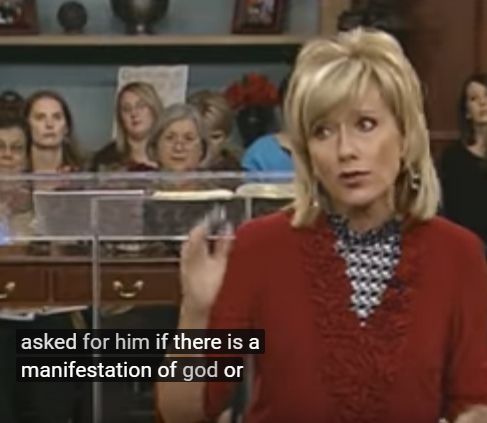
Here, Moore claims to see Mary Beth Chapman’s dead child Maria in body and describes her face, hair and clothes.


Posted in encouragement, Uncategorized

The discovery of 2000 year old Leviticus fragment

What were the original languages the Bible was written in? How did we get the Bible? Is the Bible corrupted by men when they were translated?

Good questions!

The Bible was written in two main languages, Hebrew in the Old Testament, and Greek for the New Testament. Two other languages appear briefly. One of them is Aramaic. A few chapters in Ezra and Daniel were originally in Aramaic and one verse in Jeremiah, also.

There are a few words in another, fourth language that appears extremely briefly for a few words in Job, and that’s Ugaritic. The Ugaritic does’t impact the original Bible’s reading and interpreting so much as it does in helping to understand the Hebrew overall.

Two thousand tablets written in Ugaritic were discovered in 1929. The Kingdom of Ugarit was located in Syria, and was a thriving kingdom of the late Bronze Age (1570 – 1200 BC.) It co-existed with the Hebrew tribes and,

The Ugaritic texts offer innumerable literary and religious parallels to biblical literature. The parallels are so rich and in some cases so specific that it is evident that the Ugaritic texts do not merely provide parallels, but belong to a shared or overlapping cultural matrix with the Hebrew Bible. (Source)

The Ugaritic language was almost letter for letter identical to Hebrew, and where the Hebrew word was unknown or difficult to interpret in context, the Ugaritic texts helped as a kind of Rosetta Stone in interpreting the Hebrew biblical word properly.

Continue reading “The discovery of 2000 year old Leviticus fragment”

Posted in Uncategorized

The Necessary Angst

The natural man knows there is a God. We know this because he suppresses this truth in unrighteousness. (Romans 1:18). There is no such thing as an innocent pagan. Deep down they know there is a God, and if they know there is a God they know they do wrong (sin) and someone has to call them to account for it. (Romans 1:19-22).

I remember before coming to the Lord at age 43, I’d pursued all sorts of lines of questioning. The basic unanswered question that drove me was this:it seemed ridiculous to assume that man’s life ended at death. For man to have ‘evolved’ over millions of years only to life a short life of 40 or 50 or 70 years and then die for good seemed a waste. And if man’s life did not end at death but continued in some sort of afterlife, how was it decided who got in? It seemed equally ridiculous that everyone got in. That would simply replicate life on earth, and so, what would make it heaven? I mean, would Hitler get in? It was logical to think there was some sort of standard. But what? And there my queries ended, because I could not understand the Jesus-blood-resurrection part of it. That seemed ILlogical, so I abandoned the issue. But the issue remained in my heart and mind, like a burr under a horse’s saddle. I had angst about it. Continue reading “The Necessary Angst”

Posted in potpourri, Uncategorized

Prata Potpourri: Relief, Contentment, Evil Suspicions, Slogans, Hillbillies, more

At our school cafeteria the kids (or adults, lol) can purchase ice cream. Cones, Fudgsicles, Pop-Ups, and more, for 75 cents. One of the little kids excitedly told me that “Mom is going to let me get an ice cream every day on Friday!” I said, “Every day on Friday?” “YUP!” He said, his eyes agleam with thoughts of sugar high and forehead freeze.

It got me thinking about time. The child’s sense of time of course is hugely distorted. One hour seems like a day, one day seems like a year, one year seems like a lifetime. As we grow, that refines. We develop a sense of time which is more accurate. But accurate to what? Time is a tool man uses, invented by God, only finalized into the thing we know today during the industrial revolution when they needed the trains to run on time and not crash into each other. The General Time Convention was set up in 1853. Before that, people used sundials, mostly.

In a school your day is segmented almost every hour by bells or schedules, and the clock. It’s rigid. I’ve written before about the Tyranny of the Clock and our release from it, and yet thinking about living in no time, in eternity, is incomprehensible. What will that be like? I don’t know. It might just be like every day on Friday. Continue reading “Prata Potpourri: Relief, Contentment, Evil Suspicions, Slogans, Hillbillies, more”

Posted in Uncategorized

Consider the Sparrow


I haven’t done a natural history essay for a while. Paying attention to the plants, animals, and agricultural processes of the Bible is worthwhile because knowing more about them enhances our understanding of the context in which the particular verse is delivered to us. I’ve written of other natural history topics previously, and the links are below, if you’re interested.

In Matthew 10:29-31 we read that the sparrow is considered the least of birds. The Cornell Ornithology lab describes a sparrow this way,

You can find House Sparrows most places where there are houses (or other buildings), and few places where there aren’t. Along with two other introduced species, the European Starling and the Rock Pigeon, these are some of our most common birds. Their constant presence outside our doors makes them easy to overlook.

Even more specifically, the Bible Encyclopedia describes the sparrows of Israel thus,

The Hebrew tsippor seems to have been a generic name under which were placed all small birds that frequented houses and gardens. The word occurs about 40 times in the Bible, and is indiscriminately translated “bird” “fowl” or “sparrow.” … Sparrows are small brown and gray birds of friendly habit that swarm over the northern part of Israel, and West of the Sea of Galilee, where the hills, plains and fertile fields are scattered over with villages. They build in the vineyards, orchards and bushes of the walled gardens surrounding houses, on the ground or in nooks and crannies of vine-covered walls. They live on seeds, small green buds and tiny insects and worms. Some members of the family sing musically; all are great chatterers when about the business of life. (source)

I watch, and am become like a sparrow That is alone upon the housetop. (Psalm 102:7)

A sparrow is such a friendly bird that if it were on the housetop it would be surrounded by half a dozen of its kind; … In an overwhelmed hour the Psalmist poured out his heart before the Almighty. The reason he said he was like a “sparrow that is alone upon the housetop” was because it is the most unusual thing in the world for a sparrow to sit mourning alone, and therefore it attracted attention and made a forceful comparison. It only happens when the bird’s mate has been killed or its nest and young destroyed, and this most cheerful of birds sitting solitary and dejected made a deep impression on the Psalmist who, when his hour of trouble came, said he was like the mourning sparrow–alone on the housetop. (source)

From Manners & Customs of the Bible by Freeman and Chadwick, we read,

Greek strouthion, (stroo-thee’-on); diminutive of strouthos, (a sparrow); a little sparrow. Sparrows are mentioned among the offerings made by poor. Two sparrows were sold for a farthing, and five for two farthings (Luke 12:6). The Hebrew word thus rendered is tsippor, which properly denotes the whole family of small birds that feed on grain (Leviticus 14:4; Psalms 84:3; 102:7). 

From Henry Hart’s The Animals Mentioned in the Bible (1888) we read the following-

The word tsippor has been already dealt with in most of the passages where it occurs, in which it is translated ‘bird’ or ‘fowl.’ In two passages in the Psalms, however, it is rendered ‘sparrow,’ and the term appears perhaps to refer to a particular species. Elsewhere it is generic. In Ps. 84:3 we read, ‘The sparrow hath found an house, and the swallow a nest for herself, where she may lay her young, even Thine altars, O Lord of Hosts, my King, and my God.’ Here the metaphor is one of rejoicing; and the Psalmist pours forth his heart in glad and beautiful verse, full of the hope that he too may be permitted to dwell in the house of his God.

Canon Tristram considers that the latter ‘sparrow’ may be the ‘blue thrush’ (Monticola cyanus), which is a common and conspicuous bird in Palestine and Southern Europe, solitary in its habits, and fond of sitting on a roof or any conspicuous eminence while uttering a plaintive cry.  It breeds in the ruins about the temple at Jerusalem. Other species of sparrow are found in the Jordan Valley, as the marsh sparrow (P. Hispaniolensis) and the Moabitish sparrow of Tristram (P. Moabiticus).

Hart, H. C. (1888). The Animals Mentioned in the Bible (p. 203). London: The Religious Tract Society.

It was common in the Middle East to catch sparrows (and most small birds) and skin them and roast them to sell for a tidbit. Thus we have the mention of them where the Lord says He notices each and every fall of the sparrow and thus we should be comforted because we are much more valuable than these small, commonly sold tidbit birds.

Are not two sparrows sold for a penny? And not one of them will fall to the ground apart from your Father. But even the hairs of your head are all numbered. Fear not, therefore; you are of more value than many sparrows.

What a gracious and loving God!

—————————————–

Further Reading

Onions

Pomegranates

Making wine

Wheat v. darnel

Linen

Further Reading

Onions

Pomegranates

Making wine

Wheat v. darnel

Linen

Posted in prophecy, Uncategorized

Psychological impact of the Tribulation: people will literally be scared to death

OVERVIEW OF END TIME PROPHECY

In my essay yesterday about Why We Should Value Prophecy, I laid out some reasons why prophecy is just an important kind of biblical literature as other types of biblical literature, such as Law, History, Poetry, Wisdom, or Gospel. I also laid out some thoughts as to the purpose of prophecy.

By now (in 2016) most of the past prophecies have been fulfilled. There is one prophecy that has not been completely fulfilled however, and that is the bundle of prophecies relating to the time of the end of the end. We are in the end time. We have been in the end time since Jesus ascended, and will be until He returns in glory and judges all things, completes his 1000 year reign on earth, and then dissolves the Universe in a fervent heat and makes all things new. The prophecies remaining to be fulfilled describe all things through the end of Revelation 22, which include the Rapture, the Tribulation, the Millennial Kingdom, Satan Released for the Last Battle, and the New Heavens and New Earth.

I’d said a moment ago that the prophecies relating to the end time have not been completely fulfilled. Many of the prophecies are in a state of being fulfilled, while others are definitely not happening yet. Prophecies relating to the end time describe the symptoms of this long stretch of time between the two comings of Jesus. So while the prophecy of Paul in 2 Timothy 3 are describing general conditions during this wide swathe of time, the specific prophecies of certain events have not occurred. That’s the interesting thing about prophecy. One prophecy can have a dual fulfillment, a far fulfillment, a discrete, one-time fulfillment, or a continual fulfillment.

Since it has been a long while since the last fulfilled prophecy, Jesus’ incarnation, death, and resurrection, people may become lulled into a sense of security and mock the end time prophecies and judgments. Even this is prophesied! Peter wrote in 2 Peter 3:3-4,

First of all, you must understand that in the last days scoffers will come, scoffing and following their own evil desires. “Where is the promise of His coming?” they will ask. “Ever since our fathers fell asleep, everything continues as it has from the beginning of creation.”

PSYCHOLOGICAL IMPACT OF THE END TIMES

The nature of sin and the end time are inextricably intertwined. The reason for the prophecies of the end of time are because of sin. Ever since Adam sinned in the Garden and man lost his position of pure fellowship with God, as humans and as a world, we have been in a continual state of devolvement and uncreation. Since the moment Eve bit the fruit and gave some to her husband, who was with her, (Genesis 3:6) all events have been working toward the end of God’s plan. It began with one sin and it will end with all sin.

Sin is the reason for the end time. Because the end time events are about judgment for sin.

We downplay sin. We have respectable sins. We sin and do not repent. As a church we do not regard the spiritual battles with enough fervor. Where is the David tearing his clothes and crying out to God? Where is the city like Nineveh crying out for mercy in sackcloth and ashes from the king down to the lowliest slave? Where are the pray-ers and fast-ers interceding in the battle? Where is the concern for holiness in the church? Not that there aren’t any, but the general trajectory of sin is that it tries with unceasing vigilance to corrupt our hearts and our churches. We already know what unresolved sin does to the human mind of the unsaved person- he is a total slave to it. Their minds are corrupt.

So that is the time of the end. More and more people will be totally corrupted by total sin, and not care.

This will make for an insane society. (Romans 1:28-32, Genesis 6:5, Matthew 24:37). We already see the effects of so much sin on human civilization. It can’t be refuted that civilization of these days has hurtled down the road of libertinism, depravity, murder, and more. Marriage, the first God-given institution, is being dismissed and redefined. Gender itself, a biological absolute from God, is also being corrupted by the doctors’ scalpel and the personal wills of depraved individuals. Life is not valued, ethical restrains are by the wayside, and the age-old cherished values of courage, personal duty, and honor are now old fashioned words, mocked by post-modernists.

And yet today’s depravity and sin-loving condition (Romans 1:32) is nothing, nothing to what is to come.

For out of the heart come evil thoughts, murder, adultery, sexual immorality, theft, false testimony, and slander. (Matthew 15:19).

If all those things are in the heart and come out as we see now, what till the Tribulation be like when there is no restraint at all on mans’ proclivity to seek satan and his evil?! (2 Thessalonians 2:7).

I have tried and failed in past essays to bring to bear the totally depraved and horrific time the Tribulation will be. Because we often cannot or do not understand the nature of sin, we downplay the Tribulation’s evil, ghastly and grotesque condition. However it will be a time when men will simply go mad from what they see.

I’d read somewhere, I’m sorry I forget where, the verse from  Deuteronomy 28:34, a section called The Curses of Disobedience, a number of judgments to come upon the People. The the verse states,

so that you are driven mad by the sights that your eyes see.

Men’s behavior will be so depraved that just looking at what is happening will cause a person to go insane. We don’t even know the half of what sin can do. We haven’t even scratched the surface yet. While the Deuteronomy verse describes an event that has already occurred and passed into history, it mirrors the conditions of the Tribulation. Calvin says of the Deuteronomy verse that,

He adds that there shall be no end to their affliction, until the magnitude of their calamities shall stupefy them.

Matthew Henry says of the verse,

To complete their misery, it is threatened that they should be put quite out of the possession of their minds by all these troubles 

Walvoord says of the verse,

The afflictions mentioned here result from defeat in battle. The military exemptions mentioned in 20:5–7 would be reversed without God’s protection (28:30). Livestock and children would be lost forever (vv. 31–32). Foreign armies would reap the benefit of the farmers’ hard work (v. 33). These devastating losses would produce insanity (v. 34) and painful boils (v. 35; cf. v. 27).

If men’s minds were not able to apprehend the effects of defeat in battle, what of their mental state when actual hell is loosed on earth? When sin reigns? Jesus foretold the following as regards the Tribulation:

  • Men fainting from fear and the expectation of the things which are coming upon the world; (Luke 21:26)
  • And upon the earth distress of nations, with perplexity; (Luke 21:25, KJV)
  • Then the kings of the earth and the great ones and the generals and the rich and the powerful, and everyone, slaved and free, hid themselves in the caves and among the rocks of the mountains, calling to the mountains and rocks, “Fall on us and hide us from the face of him who is seated on the throne, and from the wrath of the Lamb, for the great day of their wrath has come, and who can stand?” (Revelation 6:15-17)

The Tribulation period will be a time of extermination. God will exterminate sinners from the world as cockroaches in disgust and fury. Here is one pastor’s description:

Verse 26, “Men fainting from fear and the expectation of the things which are coming upon the world.”

So we are in the end of the time of the Tribulation when the universe as we know it is being dramatically altered. And first is chaos before there is reconstruction. There’s only one way to deal with all of the things that happen which we went through last time, dismay among nations. The word in the Greek is sunoche and it’s only used one other time in the New Testament, it’s a rare word. It means anguish. It describes a kind of human emotion which is overwhelming and overpowering. It even could be translated severe anxiety. There is…there is a sense of terror and a sense of anxiousness that knows no bounds and no relief. It is compounded by perplexity. The word aporia only here in the New Testament. It’s as if the Holy Spirit uses words that define a time the likes of which has never existed and picks words that are very, very rare for such a rare time. Aporia, perplexity, it simply means confusion in its most severe form. 

Shock is so great that we are told that men are fainting from fear. And fainting is a rather benign way to translate another rare word used no where else in the New Testament, aposuche (?). What that word means is to breathe out or to expire. That’s another word for to die. People will be scared to death. People will be scared to death. People all over the world will die of terror because of what is happening and because what is happening they know will lead to further horrors. (Source)

Even with that, there is no way to describe it. No one would really want to, anyway. We often dwell on the depths of God’s love, knowing that we can’t truly comprehend such eternal, perfect, infinite love. Just so, we cannot really understand sin. It also is boundless, eternal, and utterly incomprehensible to its depths. We think we understand sin. We don’t. The Tribulation pagans and the saved will, because they will see it almost fully. Even then, they will not see what the nature of sin can do to its ends, because Jesus said that if He would not cut short the time, no flesh would be saved at all! (Matthew 24:22-23). Sin destroys utterly.

Prophecy isn’t a sphere of study for the prurient intellectual dabbler. It is a serious sphere given to us by the grace of God so we may answer the question Peter asked. He explained the coming end of time judgments and fulfillment of prophetic promises, and asked his flock the following:

Since all these things are thus to be dissolved, what sort of people ought you to be in lives of holiness and godliness, waiting for and hastening the coming of the day of God, because of which the heavens will be set on fire and dissolved, and the heavenly bodies will melt as they burn! (2 Peter 3:11-12)

Peter made the connection between prophecy and holy living. Prophecy isn’t a distant realm of study for future generations to study. It’s present and it informs us in this day and ever day toward our holy pursuits. Knowing what is coming because we have the blessed advantage of peeking into to the future from God’s word, what sort of people are we to be?

My call is to urge us now, me included, to live in purity. Pursue holiness. Repent often, and in sincerity. Witness of Jesus and His truths. We do not want our best friend left behind. We do not want our worst enemy left behind. We praise Jesus for His soon return in glory and wrath, to render justice for sin. We know that is necessary. But we don’t have to ignore the prophecies, we don’t have to diminish the prophecies, we don’t have to be casual about the prophecies.

Keep this in mind: the truth of the last of the last days will be such that men’s brains will figuratively explode with incomprehensibility because of what they see.

Even so, come Lord Jesus. (Revelation 22:20).

Posted in prophecy, Uncategorized

Why we should value prophecy

With all the prophesying ‘prophets’ these days, and ‘words from the Lord’, and alleged divine revelations, it is easy to dismiss real biblical prophecies. Don’t be tempted to lump in the false revelations with the real ones. We should highly value the prophecy of the Bible. (And only the prophecy of the Bible).

The Bible is not one “book,” it is a “library” of sixty-six books that were written over a period of more than a 1,500 years by many different authors. These authors were “inspired” in their thinking and writing by the Holy Spirit. Thus the Bible is the inspired Word of God without error. It also has the human “touch” from its authors. Paul is different than David, who is different than James or Moses. So their “style and personality comes out to us. … The Bible is Literature, as is any book filled with language. It has: Law, History, Wisdom, Poetry, Gospel, Epistles, Prophecy, and Apocalyptic. Literature. (Source) Continue reading “Why we should value prophecy”

Posted in discernment, Uncategorized

“Fire fall down” – a good thing, or a very, very bad thing?

Have you ever sung that song about fire fall down? You know, the one from Hillsong United? You might want to re-think that.

In the excerpt below from the Strange Fire Panel Q&A session, Todd Friel, John MacArthur, and Justin Peters discuss the theological implications of pleading with God to send fire down on us.

~~~~~~~~~~~~~~~~~~~~~~~~~

Clip #20: (Singing) Fire fall down, fire fall down on us, we pray… As we seek you, Fire fall down, Fire fall down on us, we pray…

TODD: About 16 thousand kids are in the auditorium right now.

Clip #20: (Singing) Fire fall down, fire fall down on us, we…

TODD: All right. Now that song, by the way, goes on for 17 minutes. The word “fire” calling down fire from heaven is a persistent theme that we hear. Theologically do we want fire to come from heaven? In the context, and Justin can point this out, too, a lot of the conversation is about feeling, a burning, being set on fire, thereby calling the fire down from heaven. Theologically how do we respond to this prayer to call down fire from heaven.

JUSTIN: I can only assume that they’re referencing Acts 2, taking an image that is tied to a larger context. The fire there is defined as, even we were talking about this morning, clear and discernible ways that essentially, ultimately it was representative of the Spirit’s coming and the Spirit’s expression was in the gift of tongues for a specific purpose, to confirm the Apostles, to confirm what He was doing, as R.C. said yesterday, and now bringing out a people for himself, confirming the Jews were, in fact, going to be a part of the church. So it has a context. But instead it’s removed from that context and made to mean something just strictly experiential.

JOHN: Yeah, and again that’s a non-repeatable event, Pentecost, as we heard from R.C. Pentecost and then the subsequent exact same reality occurs I those different people groups to somehow turn Pentecost into this kind of mockery, as if you could literally call down fire from heaven is not only unbiblical, it’s just folly. But it’s more than that, it’s manipulation. It’s all about mind control. Rodney Howard Brown is a mind manipulator.

From a human viewpoint, even more frightening is this is demonic from a supernatural viewpoint. Fire came down from heaven, of course, in Leviticus 10 and consumed the worshipers…consumed the ones who offered the sacrifice. That’s the whole point of this conference. John talked about fire baptism, John the Baptist, and that was judgment. I really don’t…these people are so a-biblical, they’re so acquainted with words, Bible words without Bible sentences, Bible words without Bible context, Bible words without Bible doctrine. They throw the words around and they become means by which they manipulate people’s minds. Fire is obviously an incendiary word. It has all kinds of implications of heat and power and energy and…I mean, that’s a perfect word for them to use to manipulate people. The next time fire comes from heaven, it’s going to engulf the world in judgment. God will not drown the world in water again, but He will end the world in fire. The elements will end with a fervent heat. It’s going to be an atomic implosion, the uncreation when the elements melt with fervent heat, that is fire from heaven.

And I don’t think anybody in his right mind would be calling down fire from heaven, because that’s…that’s…going forward, that is a judgment metaphor after Pentecost. You will be baptized by the Holy Spirit and with fire. That’s another baptism, and that’s a judgment.

~~~~~~~~~~~~~~~~~~~~~~~~~

Moral of the story? Lyrics matter.

Posted in encouragement, Uncategorized

Do you feel like you’re just plodding in the faith?

So many people, especially women, are hopscotching the globe founding important ministries, establishing orphanages, ’empowering’ native women, or teaching to packed arenas, that it makes the rest of us humdrum ladies feel, ahem, left behind. Should we be doing the big things? Can we do the bigger things? Are we doing enough?

All I do every single day, is go to work. I come home and I study my Bible &pray, I write, and if I have enough energy after that, I read a bit. Then I go to sleep and do it all over again. On the weekends all I do is grocery shopping, laundry, cooking the week’s lunches ahead, and study a lot more and write a lot more. I go to church on Sunday late afternoon. Bed time. Repeat.

I’m not skipping off to host conferences or giving interviews or unashamedly on tour or in Rwanda on a storytelling trip. I wash dishes in obscurity in Comer GA and my job is to help kindergarteners tie their shoes and learn their ABC’s. It’s not glamorous. It doesn’t seem like it’s very much at all of a contribution to the kingdom. I mean, Beth Moore is a nearly 60 year old grandma busy helping her daughter through her unbiblical divorce and interacting with her grandchildren yet keeps a a packed schedule. Younger women also seem to be doing the big things, the glamorous things, like Jennie Allen and Raechel Myers and Kari Jobe. As for me, I’m just plodding.

Well, let’s hear it for the plodders.

First, if you are a mother, you are in a highly esteemed Biblical position. You are doing such wonderful work for the kingdom in being a foundation block in society, in raising pure young women and strong young men for the next generation. I thank Mrs Paton and Mrs Spurgeon and Mrs MacArthur and Mrs Johnson and all the other Missus’ who raised men and women who in turn, impact the kingdom.

Secondly if you think of the life of Paul most often we think of the highlights. His speeches before thousands, his dramatic miracles, his appearances before kings and leaders.

However, Paul also walked. Thousands upon thousands of miles, he plodded. He trudged. He hiked. From one town to another, in all weathers. In addition, Paul sewed tents. (Acts 18:3). He did the mundane. He wrote letter upon letter to friends. He fundraised. The in-between miracle times in his three missionary journeys were rife with the mundane and the insignificant, except nothing about a Christian’s life is insignificant. Not Paul’s and not mine and not yours. The Lord cares for all our concerns. He clothes us and feeds us and He even knows the number of hairs on our heads. To Him, it’s all significant.

As for the women of the New Testament, Dorcas was beloved not because she was on storytelling tours of Rwanda empowering women for great things, but because she sewed. She made clothes for the poor and she “was always doing good”. (Acts 9:36). She lovingly helped, humbly and quietly, within her own sphere.

Mary, mother of God? Do we hear of her going on her book tour, telling about the angel that came to her one day, and the miracle of the three wise men or hyping up audiences with her harrowing tale of narrowly escaping the massacre of the innocents? No. Whether she was in Egypt or in Israel, Mary simply raised her Son. She brought Him up in the faith and managed her household and she raised Jesus’ siblings too. A few times a year she made the pilgimage to the Temple and the rest of the time, she did what women then and onward have done, she lived in her home and she was faithful to the Lord through His word.

Here are two articles about the plodding kind of faith that endures. That kind of faith is cement. It’s bedrock.

The first is by Kevin DeYoung, titled, Stop the Revolution. Join the Plodders.

It’s sexy among young people—my generation—to talk about ditching institutional religion and starting a revolution of real Christ-followers living in real community without the confines of church. Besides being unbiblical, such notions of churchless Christianity are unrealistic. It’s immaturity actually, like the newly engaged couple who think romance preserves the marriage, when the couple celebrating their golden anniversary know it’s the institution of marriage that preserves the romance. Without the God-given habit of corporate worship and the God-given mandate of corporate accountability, we will not prove faithful over the long haul.

This one is one of my favorites. It’s by John MacArthur, titled An Unremarkable Faith

Meet Larry, a thirty-six year old Science teacher. Larry married Cathy 12 years ago. They love each other and enjoy raising their two sons. Larry’s life wouldn’t hold out much interest to the average citizen. His Facebook account doesn’t draw many friends and nobody ever leaves a comment on his blog. In fact, most people would summarize Larry’s life with one word—boring. But not Larry. Teaching osmosis to junior high students, playing Uno with his kids, and working in the yard with Cathy is paradise to him. But the real love of his life is Jesus. Larry’s a Christian. He’s been walking with the Lord for more than 20 years.

Not that founding orphanages isn’t worthwhile or something women or men can’t or shouldn’t do. Not that going on a missionary trip to Africa isn’t something Jesus wants us to do. But the big doers are fewer than we think, despite the hype. Most of the church is populated with plodders. As Kevin DeYoung concluded his article,

Put away the Che Guevara t-shirts, stop the revolution, and join the rest of the plodders. Fifty years from now you’ll be glad you did.