Posted in encouragement, Uncategorized

How MUCH does Jesus love us?

Now before the Feast of the Passover, when Jesus knew that his hour had come to depart out of this world to the Father, having loved his own who were in the world, he loved them to the end. (John 13:1)

‘To the end’ does not mean to the end of Jesus’ life. To the end does not have a finite, temporal quality here. ‘To the end’ in Greek means to the end of where love ends, an infinite quality. Strong’s says,

It is well-illustrated with the old pirate’s telescope, unfolding (extending out) one stage at a time to function at full-strength (capacity effectiveness).

So to the end doesn’t mean to the end of Jesus life, it means to full extension or furthest capacity. This, of course, is an infinite love, the end of which is only contained in Jesus the finite God-man, who is infinite.

As you go throughout your day, realize that this love was not offered to or lavished on just the disciples, but it’s also lavished on you and me. It’s given to all who believe. Such love is beyond comprehension, yet we experience it daily.

No matter what you are going through or experiencing, Jesus loves us ‘to the end’, to the fullest capacity that it is possible to love. What comfort.

Posted in prophecy, Uncategorized

Do we have the ability to interpret our own circumstances? Should we?

The title’s question is an important one. According to New Age-ish teachers like Henry Blackaby in his Experiencing God study,

God speaks through circumstances to reveal himself, his purposes and his ways.

What Blackaby means in using the word circumstances, is Providence. J. Vernon McGee said providence is “the means by which God directs all things — both animate and inanimate, seen and unseen, good and evil — toward a worthy purpose, which means His will must finally prevail. Or as the psalmist said, “his kingdom ruleth over all” (Psalm 103:19).” I. E. Circumstances.

Blackaby teaches people how to interpret those circumstances through which he claims God is speaking. So let’s look at an example of how well or badly this kind of personal interpretation might go.

But Jonah rose to flee to Tarshish from the presence of the LORD. He went down to Joppa and found a ship going to Tarshish. So he paid the fare and went down into it, to go with them to Tarshish, away from the presence of the LORD. (Jonah 1:3)

Let’s put that circumstance-interpreting to the test. In his sermon on Jonah 1:1-3 titled Sin’s Stupidity!, Ian Hamilton said,

When Jonah arrived at Tarshish, he might have said, ‘Oh! Wow! This is providential! There’s a ship going to Tarshish, just what I’m looking for!’ We are never the best judges in discerning the significance of God’s providence. God’s providence will never overrule His commandments. If you’re ever in a quandary, obey the commandment and leave it to God to sort out the providence. You and I, at our best, are no infallible interpreters of providence. Obey the commandment, and leave God to work out the providence. The Lord Jesus Christ ultimately did that. When all the providences around His life seemed to shout out that He had been ultimately, irrevocably and finally abandoned and forsaken, He still prayed, ‘My God, My God.’ He was obedient unto death, even death on a cross.

Look! A ship loaded and ready to go to the exact place I want to go!  It must be God’s Providence! (Prata photo)

In today’s parlance of interpreting circumstances as Blackaby advised, we might say something exactly like the hypothetical statements Hamilton said Jonah might have said. Leave the interpretations alone and stay with the more sure word. (2 Peter 1:19).

Greg Gilbert of 9Marks reviewed Henry Blackaby’s Experiencing God study. He related a similar example of a person interpreting circumstances and backward proofing it through scripture to confirm.

George Whitefield, the great preacher in the Great Awakening and Edwards’s friend, admitted that even he had fallen into this kind of error. Prior to the birth of his only son, Whitefield announced that the boy would be a great preacher and that he would be great in the sight of the Lord. Four months after his birth, though, the child died. Whitefield recognized his mistake and wrote: “I misapplied several texts of Scripture. Upon these grounds, I made no scruple of declaring ‘that I should have a son, and his name was to be John,'” (in Iain Murray’s Jonathan Edwards, p.241-2). Whitefield had taken the angel’s declaration to Zechariah as his own, and had thus fallen into error. Let that be a caution to us as Christians to always read the Bible in its context.  

No, we don’t use the scriptures to confirm what we have first intuited as a circumstance for action. Mr Gilbert continues with a solid reminder about omens, providences and circumstances.

God’s normal way of operating in His people’s lives is to shape them by His Word, to transform their minds by His Holy Spirit, and to sanctify their reason so that they can consider and weigh alternatives and make wise decisions.

Key words, “wise decisions.” Jonah had made a decision, nothing more, which happened to be in direct rebellion to God’s clear word. No amount of personal circumstance-interpreting will ever trump what God hath said. Relying on omens and circumstances shifts the onus of the decision from the person making it to some kind of externals, such as to Providence or to God. His commands and His wisdom is in His word. Let obedience begin and end there.

For the foolishness of God is wiser than human wisdom, and the weakness of God is stronger than human strength. (1 Corinthians 1:25).

Posted in creation, Uncategorized

What is ‘earthquake music’?

I came across a lecture to be given last week at University of Southern California Library in a series called Visions and Voices. It grabbed my attention because of my curiosity about the music of the spheres, a concept I’ll explain down below. Here is the blurb for the lecture. To my knowledge, it was not recorded or transcribed so I don’t know the specifics of what was said, though I did email the Lecture people to ask after it.

The earth hums along to its own soundtrack. If only we could listen to it. 

When the ground beneath us shifts, as it is prone to do in Los Angeles, it unleashes enormous quantities of energy as seismic waves. Packing a destructive punch, these waves race through the earth like sound waves through air. In fact, seismic waves bear many remarkable similarities to sound waves. But though we feel them as earthquakes, we can’t hear them; their frequencies are simply too low for the human ear to detect. What if we transposed earthquake waves to an audible frequency? This fascinating event will bring these normally inaudible sounds to life through a panel discussion, scientific demonstrations of how seismic waves affect our built environment, experimental sonification of seismic data, and creative musical interpretations. 

Participants include seismologist Lucy Jones, known to many Angelenos as the longtime public face of earthquake science for the U.S. Geological Survey; composer and USGS geophysicist Andrew Michael (Earthquake Quartet #1); USC Dornsife College earthquake geologist James Dolan; USGS physicist Stephanie Ross; and sound artist DJ /rupture. The discussion will be moderated by Josh Kun of the USC Annenberg School for Communication and Journalism.

I like Dr Lucy Jones. I’ve listened to her explanations regarding earthquakes. I’ve read some of her articles, too. I noticed that the Lecture was to include geophysicist Andrew Michael who is part of something called Earthquake Quartet #1, so I looked that up. His info is located at the United States Geological Survey (USGS). It states in part,

Earthquake Quartet #1 is an outgrowth of a lecture that I have been giving since 1997. This lecture, “The Music of Earthquakes,” mixes performance and lecture, music and science, acoustic instruments and computer generated sounds. A musician controls the source of the sound and the path it travels through their instrument in order to make sound waves that we hear as music. An earthquake is the source of waves that travel along a path through the earth until reaching us as shaking. It is almost as if the earth is a musician and people, including seismologists, are the audience who must try to understand what the music means.

The excerpt above has a sample of the music. How interesting!!

That led me to explore more and I learned about sonification, which was also mentioned in the excerpt of the Visions & Voices Lecture at USC. This is a link to an absolutely fascinating 7-minute interview on how, with today’s technology, scientists are turning data into sound (sonification). Take a listen to data that plots median income in Manhattan turned into a song. Meanwhile, here is an excerpt of the article and interview below:

How do you turn a pie chart into sound? That was the problem faced by NASA scientists who found challenges with conveying data to astronauts who were unable to process it because of movement and sight issues in space. But where visuals failed, sound showed its practicality. 

Ears were found to detect patterns in places where even visuals failed, according to Bruce Walker, director of Georgia Tech’s Sonification Lab, who worked on that initial project when the field was just getting started in the early ’90s. Data sonification is now a full fledged academic field, with a growing number of daily uses. Brian Foo, an application developer for the New York Public Library Labs, is pushing it to new boundaries…

The clip does provide audible sounds for data that are usually visually presented on a pie chart. It’s fascinating. What does data sound like? Listen and you will hear a sample. Meanwhile here is one definition of what sonifcation is

Data sonification means representing data as non-speech sound.  The basic principles are similar to visualization, but where visualizations use elements such as lines, shapes, and colours, sonification relies on sound properties such as volume, pitch, and rhythm.

source

The original premise above was the lecture with earthquake and geophysical specialists who say that seismic waves are similar to musical waves (sound waves) and thus the earth possesses a music all its own. This reminded me of the Music of the Spheres, Musica Universalis, an ancient philosophical notion. I wrote about it in a multi-part essay here. The following is an excerpt.

This is My Father’s World is a hymn written sometime in the 1800s by Maltbie Babcock, a preacher in upstate New York. It was published after his death in 1901, and set to music by Frank L. Sheppard. It references Psalm 104; Psalm 24; Acts 4:24; Acts 4.

If you ever heard the hymn “This Is My Father’s World” there is a lyric in the first stanza that mentions the “music of the spheres”. Hymnary.org explains the hymn’s lyric in context-

 The text is a confession of faith and trust, a testimony that all creation around us is the handiwork of our Father, who made the creation (st. 1), charged us to take good care of it (st. 2), and continues to exercise his kingship over it … The phrase “music of the spheres” in stanza 1 refers to the ancient belief that the planets made music or harmony as they revolved in the universe. 

Pythagoras, Plato, Kepler, Bohr, and Pastor Babcock all brushed up against the same order and harmony in creation in math, astronomy, and music, and each of these people throughout the centuries reacted to the divine knowledge of this creation differently, just as Romans 1 said they would. Some saw harmony and order in creation and worshiped it, while others saw harmony and order in creation and worshiped the Creator.

Musica Universalis is the Latin term for the Pythagorean philosophy called Music of the Spheres. Pythagoras initially developed the thought that the planets made music. This notion is not as far off as it sounds- Pythagoras was really on to string theory.

Does the earth make music? Does the universe make its own music? How can we “sonify” the inherent order and harmony of the created universe? Can we tune in to it? As RC Sproul said in his online class Recovering the Beauty of the Arts,

His word of order triumphed over the chaotic abyss present in Genesis 1:2. Any example of creation points to His majestic artistry.

The orderliness of God in His majesty, set to music, or, extracting the inherent music within His harmonious order. Either way, both are interesting notions.

Now wait a minute, did I read that above correctly? The NY Public Library has labs? Now I’m off to explore THAT rabbit trail! Happy earth listening!

Posted in discernment, Uncategorized

The red rage of the Pharisees yesterday and today

One moment in the life of a blogger who writes discernment essays:

Stumble into the kitchen, bumblingly make the coffee. Yawning, plop down in the chair and fire up the laptop. As the blue light turns to screen saver, I launch open the browser. As the coffee finishes perking and I finish yawning, I pour a cup and look forward to the day. My prayer is to reach women with the truth, to use scripture rightly to turn them away from the false so they can see the glory of Jesus.

Oh, look there is a comment on my blog. Let’s see what it says. It’s from a woman named Karen Setters.

“You and your blog are some of the most inaccurate and heretical false accusations against some of God’s most anointed and accurate teachers in the Body of Christ. How any informed Christian listens to you after the nonsense you spew against God’s people is beyond me! May the Lord Jesus Christ turn your heart, mouth, and blog to understanding the truth of His Word and His people, because obviously you don’t. Satan is using you and when you stand before the Lord at the final day, you are going to be shocked and maybe lost if you don’t humble your Phariseeical heart and listen to what the true Spirit of God says to you.”

In addition to naming me as a heretical, inaccurate, nonsensical, Pharisaical, satanic person, in Karen’s second comment she also called me an antichrist and a coward.

Okey dokey then, lol, I surmise that the truth of scripture did not reach her heart! It’s a powerful reminder however, that those women held in the clutches of a false teacher or who cling to false doctrine clench untruth tightly. The more anger and nasty language that emerges from their mouth demonstrates the further distance away from Jesus they actually are.

Remember, fellow blogger ladies and fellow witnesses, when you point out a false doctrine or a false teacher, anger is often the reaction. It always has been and always will be. Look at the Pharisees’ reaction to Jesus words and deeds and to His designated witnesses like Paul and Stephen. They reacted with gnashing teeth, fury, stone-throwing, blinding rage. They became murderous. (Luke 6:11, Matthew 12:14, John 8:59, Acts 7:54…)

This is because they loved their sin and they loved the darkness. What happens when you poke a rabid bear? A reaction like Karen Setters’ is what happens. Seething, frothing anger and nastiness. In the Luke 6:11 verse it says the Pharisees and Scribes became actually mad with rage. It’s an unthinking, non-rational, senseless, red rage. Matthew Henry says of the Luke 6:11 verse,

Pride, obstinacy, malice, and disappointed self-confidence were “all” combined, therefore, in producing madness. Nor were they alone. Men are often enraged because others do good in a way which “they” do not approve of. 

This kind of rage is also an example of how powerfully sin wants to remain. Sin is the second most powerful force on earth. Jesus’s power in regeneration is the most powerful, but for those left untouched by His hand on their heart, sin reigns and the rage shows just how powerfully it is lord of a person.

The most violent reaction to the truth is murder. Martyrs abound in ever generation and in every country today. As Mark Dever and Burk Parsons and Jesse Johnson and Pastor Gabe of WWUTT.com remind us,

The truth is divisive. Jesus said it would be and we see of course that it is. Jesus said in Luke 12:51,

Do you think that I have come to give peace on earth? No, I tell you, but rather division.

It’s His truth that divides. The truth is the dividing line. In between the gulf of truth on one side and lies on the other, is often anger. The only reaction we can have when met with such anger, even to martyrdom as those in the “closed countries” are met with, is compassion and love. (Mark 10:21).
Posted in discernment, Uncategorized

Did Jesus come to judge the world or save the world? Context, context, context

A favorite tactic for those who take verses out of context, is to read only part of the verse. Or, as in today’s case, to take a complete verse as the statement or their defense, but forego the next verse, which is obviously attached to the former. Here is the example.

As for anyone who hears My words and does not keep them, I do not judge him. For I have not come to judge the world, but to save the world. (John 12:47)

It’s popular for many people to rely on that verse as their defense in saying not to point our error or to name false teachers. “Stop judging!” people say. “The Bible says not to judge, even Jesus didn’t come to judge!”

However, the verse 47 continues the thought into verse 48.

There is a judge for the one who rejects Me and does not receive My words: The word that I have spoken will judge him on the last day.

So people WILL be judged. Gill’s Exposition of the Entire Bible says of John 12:47-48,

and receiveth not my words; the doctrines of the Gospel, but disbelieves them, and denies them to be true, looking upon them as the doctrines of a mere man, and an impostor:

hath one that judgeth him; let not such an one think that he shall escape righteous judgment; though Christ does not judge him now, there is one that judges him, yea, even now; and declares, that he that believeth not shall be damned, and that he is condemned already

the word that I have spoken unto you the same shall judge him in the last day; according to the different dispensations wicked men are under in this world, will be the rule of their judgment hereafter: such who are only under the law of nature, will be judged according to that, that will accuse them, convict them, and condemn them: such who have been under the law of Moses, or the written law, will be arraigned, proved, and pronounced guilty, and punished by, and according to that law; and such who have been under the Gospel dispensation, and have been favoured with the revelation of the Gospel, but have condemned and denied it, that will judge them at the last day. The judge will act by its present declaration, and according to that proceed, as it stands in Mark 16:16. It will rise up in judgment against such persons, and be an aggravation of their condemnation.

Part of what we mean when we say don’t take verses out of context is first, read the whole verse, not just part of it. Second, read the verses around the verse you want to quote. As a matter of fact, it’s good to read the entire passage, page, or even chapter. You will get a better idea of the flow and the points raised and settled. If realtors’ mantra expression is: “There are three things that matter in property: location, location, location,” then the Bible student’s mantra should be “There are three things that matter in Bible study- context, context, context.”

context


Posted in discernment, Uncategorized

What makes a false religion, false?

Left, a Muslim woman in a hijab. Right, Catholic nun in her habit.

If it’s not one false religion, it’s another. False religion has been with us since the Garden. It’s nothing new. When Jesus returns, He mused whether He will even find faith upon the earth. (Luke 18:8)

The question of the day is, what makes a religion false?

Humans have an innate sense of worship. We don’t worship who God wants us to worship. We don’t worship in the way He wants us to worship. We don’t worship for the right reasons.

Examples of these are of course, Adam and Eve, who were tempted into worshiping themselves (“you will be like God”.) Cain did not worship in the right way. (Genesis 4:3-5). But there is a right way to worship and a wrong way to worship. Neither did Nadab and Abihu. (Leviticus 10:1). Many in the days of the Incarnation did not worship Jesus for the right reasons. They preferred the glory of men to the glory of God. (John 12:43).

I’ve spoken with non-saved people who think that God was being too harsh for preferring Abel’s blood offering and by rejecting Cain’s offering of the fruit of the ground. As if God is someone who should be happy with whatever worship we throw at Him. As in our own earthly lives, there are standards. Even unsaved people know that. Parents have standards for children’s behavior, bosses have standards for evaluating their employees, factories have standards of production to ensure a quality product. When it comes to God though, people think that no standards is the more “loving” way.

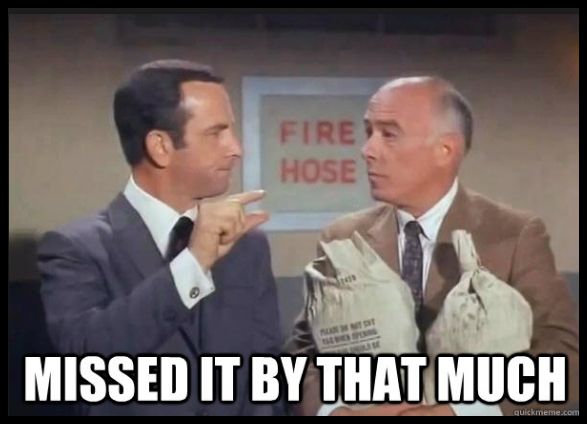
Not so. There was a spy spoof TV program in the 1960s called Get Smart. Max the bumbling, incompetent spy used to say “Missed it by that much.”
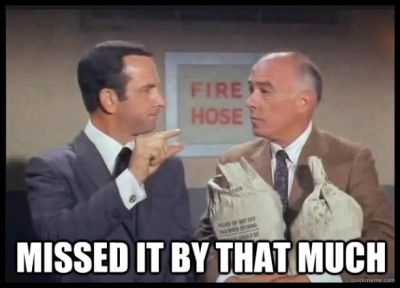
Obviously, this phrase was used when someone, usually Max,
was just a little bit off in his aim, guess, or goal.
Missed it by that much!

And because the path is narrow, it is easy to miss the mark.

However when it comes to faith and worship, missing it even by that much means the wrong eternity. Jesus said the path is narrow. (Matthew 7:13). Though we can never fall off the path once we are on, those who are not saved concoct all manner of methods to save themselves.

For example, in Japan, we learn that it was thought if you crawled through a volcanic “womb cave” you would be reborn.

For centuries, religious devotees, or ascetics, looked towards Mount Fuji as a place of worship, trekking up the mountainside to reap its spiritual powers. The mysterious lava caves were thought of as “human wombs,” and those who journeyed through the dark passageways could experience rebirth. … The cave known as Tainai, which translates to “womb,” is said to be the birthplace of Sengen, the deity of Mount Fuji.  It was common for the religious followers of the Mount Fuji cult to associate terrestrial features of the mountain with parts of the human anatomy. 

I won’t go further into detail, though the articles does. Suffice to say that anyone passing through the womb caves of Mt Fuji and performing the rites there did not save themselves, nor did they cause their own rebirth.

In Catholicism, there are made-up salvation methods such as the Treasury of Merit and Indulgences. From his online class “Justification By Faith Alone,” RC Sproul explains,

The treasury of merit exists so that people can get into heaven. Very few people die and go directly to heaven, according to the Roman Catholic view. The majority of people who die go to purgatory to have their impurities purged. Purgatory is not hell; it is not a place of punishment. People in purgatory do not have sufficient merit to get them directly into heaven. The few who go directly to heaven have sufficient merit as well as supererogatory merit. Works that go beyond the call of duty produce supererogatory merit. Supererogatory merit is more than is required to get into heaven, allowing for the excess to be deposited into the Treasury of Merit. When indulgences are purchased, withdrawals are made from the treasury of merit for those in purgatory.

Purgatory and Indulgences are weird. All that is just as weird as the volcanic womb tunnels.

There are many other weird methods to save one’s self in many other false religions that we could go into but they are all complicated, weird, wrong, and bad.

The truth is so much simpler.

For by grace you have been saved through faith. And this is not your own doing; it is the gift of God, not a result of works, so that no one may boast. (Ephesians 2:8-9).

So what makes a religion untrue, or what makes Christianity true? There are some doctrines that the Bible declares as essential for true faith.

The Bible itself reveals those doctrines that are essential to the Christian faith.  They are 

1) the Deity of Christ, 2) Salvation by Grace, 3) Resurrection of Christ, 4) the gospel, and 5) monotheism. These are the doctrines the Bible says are necessary.  Though there are many other important doctrines, these five are the ones that are declared by Scripture to be essential. A non-regenerate person (i.e., Mormon or Jehovah’s Witness, atheist, Muslim), will deny one or more of these essential doctrines. Please note that there are other derivative doctrines of scripture that become necessary also and the Trinity being one.

Also note that bedsides denying essential doctrines, a non-regenerate person may use the same terms as a Christian, saying things like “I have faith.” Or, “I believe.” They have adopted Christian terms but have through use or intent, redefined them to something they are not. Mormons for example, believe that Jesus is a god, so a superficial look at the essential doctrine that the deity of Christ is essential in that case would seem to satisfy. However, they believe Jesus is a created god, not THE Eternal, self-existent Father. So they deny the Deity of Christ even though they call Him a god. Therefore Mormonism is a false religion.

Catholics even use the term ‘justification by faith’ as born again believers in the true faith do, which is essentially what the Ephesians verse states. However, Catholics disbelieve the source of the necessary righteousness that justifies us is solely from God, but stems from an inner righteousness humans already possess or generate thought works.

Imputation has always been the one thing that has caused the many attempts to resolve the theological conflict of the Reformation to fail. Rome has always rejected the idea that we are justified on the basis of an imputed righteousness. The Roman view would be that the meritorious cause for God to declare a person righteous is because that person is righteous. The Reformed view would be that the meritorious cause for God to declare a person righteous is because Christ is righteous. (RC Sproul, online course “Justified by faith alone”. 

The essential doctrines are expounded upon at the link above. Here it is again. Those are the doctrines the Word of God declare are necessary for faith. If there is any religion which alter those or are absent any of them, it is a false religion.

How can a Christian determine which doctrines are essential and which are not? Here are two bullet points from a short essay by John MacArthur

I. All Fundamental Articles of Faith Must Be Drawn from the Scriptures
II. The Fundamentals Are Clear in Scripture

Any religion which deviates from the essential doctrines, alters them, or puts forth doctrines that are not from scripture or are unclear, is not a true faith. ALL religions which rely on anything other than the word of God and which draws its essentials from the word are false.

Another way to determine if a religion is false is to see how it handles the Bible. False religions may or may not use the Bible as their basis. Jehovah’s Witnesses use the Bible but they’ve re-written it. Mormons use the Bible but have added to it with their Doctrine and Covenants and Pearl of Great Price philosophies. Islam and Hinduism don’t use the Bible at all.

Christianity is revealed to us through the Bible. It’s one book, divided into 66 books, written over 1,500 years but is a unified, cohesive tome with a sole author. I’d encourage you to check out the link at CARM above which outlines the essential doctrines with the verses and explanations.

You might not have thought about it this way, but ALL OTHER religions have a sole author, too. Satan. He wrote the precepts of Mormonism, Catholicism, Hinduism, Jainism, Atheism, Buddhism, Islam, Wicca, and the rest. If a religion is not of God, it is of the devil. (Matthew 12:30). There are two paths, the broad and the narrow. There is either one or the other. (1 Corinthians 10:21, Matthew 6:24). Any religion that isn’t Christianity is opposed to Jesus and therefore it is of the devil. Even religions like Catholicism, which miss it by that much.

Posted in encouragement, Uncategorized

The glory of men versus the glory of God

Nevertheless, many even of the authorities believed in him, but for fear of the Pharisees they did not confess it, so that they would not be put out of the synagogue; for they loved the glory that comes from man more than the glory that comes from God. (John 12:42-43)

Isn’t that such a sad statement. The verse in context is speaking of Jesus and the wonderful things He had been doing. He had performed signs and wonders in the presence of the Jewish rulers, yet many did not believe. Others believed, yet did not confess it because they coveted man’s glory more than God’s.

It’s interesting about the word glory here. Strong’s Concordance says of the word glory/doksa, Continue reading “The glory of men versus the glory of God”

Posted in 2012 prophecy, Uncategorized

Christians losing their minds over the Presidential campaign & election, part 2

Yesterday in part 1 I wrote of how this world is temporary. Pagans put their hopes in a human savior, usually in the form of a President or Prime minister, or some sort of high leader. Others pursue “social justice”, or the “prosperity gospel’, or the “Gnostic mystics.” All those are different gospels. Christians know that our supreme leader is Jesus and our hopes should be on Him. He raises up leaders and ordains their time and even ordains the length of time each nation exists.

Yet, as Christians are painted into a corner regarding our current Presidential choices, hysteria is starting to rise. It seems that many have lost their minds regarding the election. I reminded us that voting is an activity. It’s not a solution. Continue reading “Christians losing their minds over the Presidential campaign & election, part 2”

Posted in discernment, Uncategorized

Christians losing their minds over the Presidential campaign & election. Part 1

Part 2 here

First, Christine Caine’s social justice foundation mission statement:

Christine and her husband Nick founded A21, an anti-human trafficking organization dedicated to abolishing injustice in the 21st century.

Next, Martyn Lloyd-Jones, on the futility of seeking social justice in this world:

Jesus’ message is not intended to reform the world or improve it or to banish war or to make it better. The exact opposite. Our Lord never said that. He never said He’d banish war. He never said He’d make the world better. Never. Indeed, He said this: Continue reading “Christians losing their minds over the Presidential campaign & election. Part 1”

Posted in discernment, Uncategorized

Peter didn’t know what he was saying

1. He said to them, “But who do you say that I am?” Simon Peter replied, “You are the Christ, the Son of the living God.” And Jesus answered him, “Blessed are you, Simon Bar-Jonah! For flesh and blood has not revealed this to you, but my Father who is in heaven. (Matthew 16:15-17).

2. From that time Jesus began to show his disciples that he must go to Jerusalem and suffer many things from the elders and chief priests and scribes, and be killed, and on the third day be raised. And Peter took him aside and began to rebuke him, saying, “Far be it from you, Lord! This shall never happen to you.” But he turned and said to Peter, “Get behind me, Satan! (Matthew 16:21-23a)

3. And as the men were parting from him, Peter said to Jesus, “Master, it is good that we are here. Let us make three tents, one for you and one for Moses and one for Elijah”—not knowing what he said. (Luke 9:33)

1. In the first case, as Jesus and the Disciples came into the district of Caesarea Philippi, Jesus asked the men a question. “Who do people say that the Son of Man is?”

They replied, “Some say John the Baptist, others say Elijah, and others Jeremiah or one of the prophets.”

Jesus pressed them, asking a second time, “But who do you say that I am?”

This time Peter answered and it was the correct answer. “You are the Christ, the Son of the living God.” Continue reading “Peter didn’t know what he was saying”