The first human blood shed in the Bible was a shepherd’s blood, shed by one who rejected God in jealousy and anger.
Now Abel was a keeper of sheep, and Cain a worker of the ground. (Genesis 4:2b) And the Lord said, “What have you done? The voice of your brother’s blood is crying to me from the ground. (Genesis 4:10)
The Death of Abel, by Gustave Dore
The last blood needed for sin’s atonement was the blood of Jesus, The Great Shepherd.
and not through the blood of goats and calves, but through His own blood, He entered the holy place once for all, having obtained eternal redemption. For if the blood of goats and bulls and the ashes of a heifer sprinkling those who have been defiled sanctify for the cleansing of the flesh, how much more will the blood of Christ, who through the eternal Spirit offered Himself without blemish to God, cleanse your conscience from dead works to serve the living God? (Hebrews 9:12-14)
But now in Christ Jesus, you who once were far off have been brought near by the blood of Christ. (Ephesians 2:13)
Chris Powers, fullofeyes.com
Here is a song called The Last Blood. Listen to it entirely. It builds to a devastating climax.
Grace is a concept. But it’s not just a concept. Grace is a gift, but it’s not just a gift. Grace is a force. Think about how powerful grace is. Think about its power as it exists in Jesus, as it is delivered to the saints, its common state as it covers the world, and its special state as it enlivens the saints to do our work.
Here is an excerpt about grace from a sermon from John MacArthur called, Strength Perfected in Weakness, looking at this verse: 2 Corinthians 12:7-10.
or because of these surpassingly great revelations. Therefore, in order to keep me from becoming conceited, I was given a thorn in my flesh, a messenger of Satan, to torment me. 8 Three times I pleaded with the Lord to take it away from me. 9 But he said to me, “My grace is sufficient for you, for my power is made perfect in weakness.” Therefore I will boast all the more gladly about my weaknesses, so that Christ’s power may rest on me. 10 That is why, for Christ’s sake, I delight in weaknesses, in insults, in hardships, in persecutions, in difficulties. For when I am weak, then I am strong.
In speaking of the linchpin part of the passage, ‘my grace is sufficient for you’, MacArthur said,
But grace is not just an inert sort of concept; it is a force, it is a power. It is a power that transforms us. It is a power that awakens us from sleep. It is a power that gives us life in the midst of death. It is a power that is dynamic enough to transform us from the kingdom of darkness to the kingdom of God’s dear Son. It is the power that saves us. It is the power that keeps us, the power that enables us, the power that sanctifies us, and the power that one day will glorify us. You have to look at grace as a force, a divine force that God pours out into the lives of His people at all points to grant them all that they need to be all that He desires.
Grace is a gift. Grace is a state. and… Grace is a POWER.
Because the times are so hard and the world is so dark, I’ve been posting some short essays on worship. Just worship. It’s a way to remind me, and anyone, that “Man’s chief end is to glorify God, and to enjoy Him for ever” says the Westminster Shorter Catechism. Let’s just find ways every day to enjoy God!
I like natural history. It’s God’s creation. I like thinking about how He has created everything from nothing with just a word. I see the intricacy of His creatures and flora and fauna and I’m just amazed.
I walked across my apartment parking lot yesterday when I got home from school. The frigid weather had turned to 68 degrees and it was warm and humid. Halfway across I heard what sounded like a frog. Frogs! I thought it’s way too early for frogs! There is a pond next door butt the sound was coming from high up in the trees on the onterside of the road in the woods.
I went inside and searched for “bird that sounds like a frog” and came up with Hooded Merganser.
But reading natural history books is a two-edged sword. Most are written from a secular point of view, and at some point the constant lies within such books begins to grate, and I abandon them.
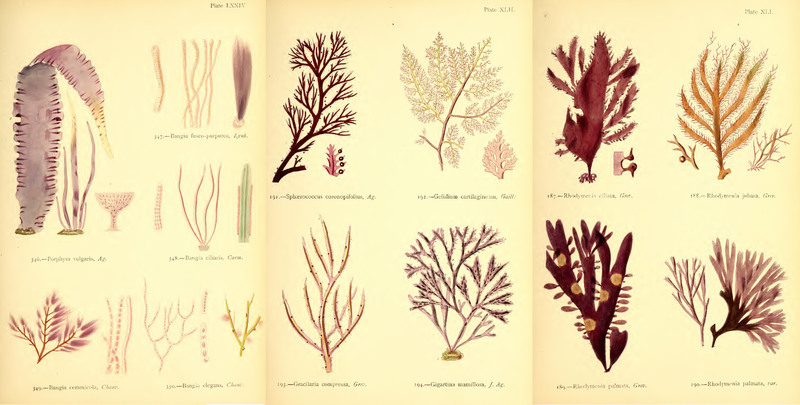
One of the natural history books mentioned in the Atlas Obscura article was a seaweed journal by Margaret Gatty. Atlas Obscura wrote of her,
One of the best known and most dedicated of these so-called seaweeders was Margaret Gatty, a children’s book author who took up the hobby while convalescing in Hastings, on Britain’s southeast coast, in 1848. Gatty’s crowning work of algology, British Sea-Weeds, is an exhaustive compilation of local seaweeds, fully described and illustrated in 86 colored plates.
I did not know there was a whole field of study called ‘algology’. These are selected plates of her seaweed drawings,
Selected plates from Margaret Gatty’s “British Sea-Weeds.” BIODIVERSITY HERITAGE LIBRARY/PUBLIC DOMAIN
I love those colored plates from natural history books from the 1800s. I owned two rare books,
A popular history of the mollusca : comprising a familiar account of their classification, instincts and habits and of the growth and distinguishing characters of their shells, by Mary Roberts, 1851; and
Popular British conchology. A familiar history of the molluscs inhabiting the British Isles, By George Brettingham Sowerby, 1854.
I love the hand colored plates of the plants or animals they carefully drew. I also have several books by Harvard University paleontologist Stephen Jay Gould (secular guy, sigh). There’s French poet-philosopher Paul Valery in his engaging meditation on the aesthetics of the seashell, as Amazon describes his work. Anne Morrow Lindbergh’s musings on shells in her famous Gift from the Sea. And so many other books. I guess now that I’m thinking of listing them, my library contains quite a few natural history books. Rachel Carson, Farley Mowat, John Hay, Abbot & Dance…
In 1664 John Evelyn, diarist, country gentleman, and commissioner at the court of Charles II, produced his monumental book on trees: Sylva, or a Discourse of Forest Trees. It was a seventeenth-century best seller. Evelyn was a true son of the Renaissance. His book is learned and witty and practical and passionate all by turns. No later book on trees has ever had such an impact on the British public.
Hmmm, maybe that’s why the Monty Python comedy troupe mentioned THE LARCH so often…
I love trees. Maybe I’ll get that book.
As much as I love reading about the creation from scientists of various kinds, there’s nothing like reading the Bible, God’s actual account of His world. As poetic as Lindbergh was, as witty as John Evelyn was, as precise as Sowerby or Roberts was, the thrill of reading about the creation from God Himself never fails to thrill me. As familiar as these verses are, they still ignite a reverent awe at His power:
In the beginning, God created the heavens and the earth. 2The earth was without form and void, and darkness was over the face of the deep. And the Spirit of God was hovering over the face of the waters.
3And God said, “Let there be light,” and there was light. 4And God saw that the light was good. And God separated the light from the darkness. 5God called the light Day, and the darkness he called Night. And there was evening and there was morning, the first day.
6And God said, “Let there be an expanse in the midst of the waters, and let it separate the waters from the waters.” 7And God made the expanse and separated the waters that were under the expanse from the waters that were above the expanse. And it was so. 8And God called the expanse Heaven. And there was evening and there was morning, the second day. (Genesis 1:1-8)
Nature displays God’s glory. The best place to read about that is His word, what He, Himself, has declared.
Let the heavens rejoice, let the earth be glad; let the sea resound, and all that is in it. Let the fields be jubilant, and everything in them; let all the trees of the forest sing for joy. (Psalm 96:11-12)
We are glad because as Job 12:10 says,
In his hand is the life of every creature and the breath of all mankind.
Is there any better place to be, if you’re saved? In His hand? Is there any worse place to be, if you’re not saved?
It is a fearful thing to fall into the hands of the living God. (Hebrews 10:31)
Read of His creation. The essays, poems, philosophies of the secular writers and scientists is fine, also good are Natural History books on the Bible such as The Scripture Alphabet of Animals by Mrs. Harriet N. Cook, 1842; The Plants of the Bible by John Hutton Balfour, 1885. But the originator of it all is the one to be worshiped and the best place to do that is read of Him in His word-
Do you not know? Have you not heard? The Everlasting God, the Lord, the Creator of the ends of the earth Does not become weary or tired. His understanding is inscrutable. (Isaiah 40:28)
When anyone hears the word of the kingdom and does not understand it, the evil one comes and snatches away what has been sown in his heart. This is what was sown along the path. (Matthew 13:19).
In the beginning parts of the parable, Jesus had given the vivid picture of the sower scattering seeds along the ground. The seeds fell on different types of ground, hard, rocky, thorny, and good. Later, the disciples asked Jesus to explain the meaning of the parable. He did, and His explanation of the different types of ground and the destinies of each seed is above.
The “path” mentioned is the path that the farmers and other people would walk in between fields. It was so heavily trod that they became hard packed, almost like cement. In Leviticus 23:22 it’s mentioned as a rule that the farmers were not to harvest to the very edges of the field, so that those who are traveling or poor could glean from the stalks that were alongside the path. You might remember Ruth gleaning Boaz’s field. (Ruth 2:2-3). As Jesus and His disciples walked along the fields, they plucked some grain to eat as they passed. (Matthew 12:1). These paths were very hard and well-traveled.
In Barnes’ Notes it’s explained about the paths. As expected, the vivid picture of the hardened path, the seed, and the birds scooping away the exposed seeds is visually understandable.
He is represented by the fowls that came and picked up the seed by the way-side. The gospel is preached to people hardened in sin. It makes no impression. It lies like seed on the “hard path;” it is easily taken away, and never suffered to take root.
But I’d like to focus on the part of the parable verse that mentions that the evil one comes along and snatches the seed away. I ask myself, how does the evil one do this? In what manner? Thanks to the visual nature of the parable we can readily understand that he does, but how?
Someone asked me recently how does the devil do his work, how does spiritual warfare operate. It’s a good question and it is something that though the parable’s images are understood, it what is meant by ‘digging deeper.’ Ask yourself questions as you read. Listen to others ask questions. Pray and ponder a while. Do a parallel verse search. Look up the important words in the verse in Greek or Hebrew. Consult commentaries.
In the Greek, the word for hearing is in the continuous present tense, setting an immediacy to the situation. As stated here in Vincent’s Word studies in the New Testament, “the action is exhibiting action in progress, and the simultaneousness of Satan’s work with that of the gospel instructor. ‘While any one is hearing, the evil one is coming and snatching away, just as the birds do not wait for the sower to be out of the way, but are at work while he is sowing.'”
I am reminded of fishing boats and shrimp boats pulling up a catch, and the cloud of seagulls and other scavenging birds are plucking the fish from the nets even as they are pulled to the boat’s deck. The ground is so hard the seed of the Word never makes any impression in it, and the birds come snatch it almost immediately.
Here is Gill’s Commentary on the subject of how the devil snatches away the seed. This is aimed at the unsaved, but the point has lessons for the saved, which I’ll explore below.
Besides, the word only fell “upon”, not “into” his heart, as into the good ground, as the metaphor in the parable shows; and it made no impression, nor was it inwardly received, but as soon as ever dropped, was “catched” away by the enemy; not by frightening him out of it, by persecution, as the stony ground hearer; nor by filling the mind with worldly cares, as the thorny ground hearer; but by various suggestions and temptations, darting in thoughts, presenting objects, and so diverted his mind from the word, and fixed his attention elsewhere; which is done at once, at an unawares, secretly, and without any notice of the person himself; so that the word is entirely lost to him, and he does not so much as remember the least thing he has been hearing:
The saved can never have the Gospel seed snatched away from Jesus’ hand. This is because it takes root immediately. John 10:28 explicitly says so. But even though satan cannot destroy the salvation of the saved by snatching the gospel seed from the ground into which it is sown, he can diminish our effectiveness. We, too, can be tempted as the unsaved Gospel-hearers can be tempted. The word will never be “entirely lost” to us, as Gill said it will be of the hard ground unsaved, but we can be tempted by–
–various suggestions and temptations, –darting in thoughts, –presenting objects, –and so diverted his mind from the word, and fixed his attention elsewhere –which is done at once, at an unawares, secretly, and without any notice of the person himself;
Here is John MacArthur on his version of how the devil snatches the seed away from the unsaved, but has application for us in satan’s ever-present attempt to divert us from our effectiveness:
In other words, when someone does not respond to the gospel initially, when they’re hardhearted and stiff necked, Satan just snatches it away. He just blinds them to its true value. How does he do that? Well, there are a lot of ways. One way he does that is send false teachers along to say all of that stuff was lies. Don’t believe that stuff. Another way he snatches the seed is by the fear of man. People don’t respond to it because they’re afraid they might lose their reputation or they might be kicked out of their little group or somebody might think they’re a religious fanatic.
Sometimes Satan uses pride. People are just know-it-alls. They just don’t want to admit that they need some help, that they need some information, that there’s some things they don’t know. Sometimes Satan snatches it away through doubt. Sometimes he snatches it away through prejudice, sometimes through stubbornness. Sometimes through the love of sin the person doesn’t want to give up. Sometimes through procrastination. But one way or another or a combination of ways, when it hits that hard stuff, Satan snatches it away and the person so easily forgets that it ever came.
When we believers procrastinate in repenting, delay reading the word, become only intermittent church-goers, become stubborn, prideful, doubtful, follow false teachers, or fear man, satan is snatching away our effectiveness of His word and our growth. He cannot snatch away the gospel, because that has already entwined with our soul and the Holy Spirit proptects it, but we can reduce our effectiveness for the Lord.
Snatching the seed of the word away from a non-believer and reducing a believer’s effectiveness is spiritual warfare. Spiritual warfare isn’t done by being against people. No, our battle is against the evil one who is prince of the power of the air. Also, it is a battle of the mind. Spiritual transformation happens in the mind, and what we think becomes what we say and then what we do. Don’t let satan steal your effectiveness. If we’re saved then that means the word was sown on good soil. Keep aerating the soil of our heart by turning over His word constantly in our minds. Unearth sin and reject it, confessing and repenting. Let the roots of His truths grow deep into our heart and then we will stand like trees beside the waters, and cannot be moved. (Jeremiah 17:8, Psalm 1:3).
Maranatha!
Satan snatches away the seed that falls on the hard ground almost immediately as it it sown.
Yesterday I posted about how Jesus Intercedes for Us. My goal was to encourage and assure ladies that the Triune God hears our prayers, supplications, appeals, and repentances.
Doesn’t it just crush you to pray to Jesus…and know He hears us? It’s incredible, and a privilege we always remember in gratitude.
As Isaiah cried in his wonder and grief, “I am a man of unclean lips!” (Isaiah 6:5). In my case, a woman of unclean lips. Why should I be able to use these lips to pray to Jesus when I am the chief of sinners, wretched woman that I am? What is man that God should be mindful of us? (Psalm 8:4). Why should He hear us?
But He does.
Though ‘El Shama’ is not an official name of God, it refers to the fact that God hears…He listens. God told Hagar to name her soon to be born son Ishmael. Ishmael is is a combination of el and shama, “God hears” or “God listens”. The name would be a reminder to Hagar and all who knew them that He heard Hagar’s cry in the wilderness. (Genesis 16:11). He listens.
Psalm 17:6 says
I have called on you, for you will hear me, O God: incline your ear to me, and hear my speech.
Gill’s Expositions says of the Psalmist’s plea in verse 6,
“for thou wilt hear me, O God; God is a God hearing prayer; he is used to hear his people, and they have frequent experience of it, and they may be assured that whatsoever they ask according to his will, and in the name of Christ, he will hear; and such an assurance is a reason engaging the saints to a constant calling upon God, Psalm 116:2; and such confidence of being always heard Christ had, John 11:41;”
1 John 5:14 says,
And this is the confidence that we have toward him, that if we ask anything according to his will he hears us.
Did Peter forever relive his anguish each morning of his remaining life, when he heard the rooster crow the day awake and remembered his own perfidy? Owww, Peter, I understand your grief, the pain of betraying Jesus in word or in deed from our own sinful actions. Yet…Jesus prayed for Peter. Luke 22:32. He did not pray for Judas. Both men betrayed Jesus, but Jesus prayed for Peter.
If you’re a Christian, Jesus prays for you, too. It’s staggering to consider that the God of the Universe prays for us. He hears us, and He prays for us. We have a superlative God, One who is true and kind and loving and compassionate. Sister, no matter what you are going through, Jesus hears your prayer and He takes your cares to the Father in prayer. Be encouraged.
The NY Times published an article titled The modern charm of practical magic. I found it interesting for many different reasons. I was not saved by grace of the Lord Jesus until I was 42 years old. I spent all of my adulthood prior to the salvation moment, searching for the magic key to the magic in life, the unexplainable, explained. I dabbled in lots of different kinds of magic. Ouija boards, Kirlian aura photography, dreamcatchers, sage burning, Reiki, astral projection, summoning spirits & spirit guides, clairvoyance…
We all want to know what’s on the other side. We do enjoy peeking behind the veil, knowing the unknowable. Because, the unsaved person knows there is a higher power. (Romans 1:19-20). They just deny Who it is. ‘Oh it can’t be God. It must be runes…solstice…labyrinths…”
The NYT article says that they notice more than ever, people seeking answers through magic,
You may have noticed it at work. Perhaps your co-worker has ornamented her cubicle with rose quartz crystals? Has a friend uploaded an I Ching app onto his phone? Or maybe your boyfriend blamed his failure to respond to your text messages on Mercury being in retrograde?
Why magic, and why now? The lack of religious faith so prevalent in our age is an anomaly in history. Magic, which usually does not demand faith in a particular deity, or the sometimes exclusionary imperatives of organized religion, allows people to access a sense of the miraculous on the level of the quotidian.
The article concedes the yearning for a higher power but subtly warns against it actually being God,
There is relief to be found in simply accepting a higher order, in letting go, but what of appeals to reason? Is it not important to disbelieve things that aren’t real? Might faith in the healing powers of a vibratory sound bath lead the next day to outlandish conspiracy theories?
I liked this NY Times article, for many reasons but mainly for its use of my favorite word, quotidian. Where else are you going to read an essay where the author uses such a fancy word which means mundane?
The Christian is bombarded with practical magic all the time. Did you know that? The fads are part of the devilish worming into your home of these magical activities. Labyrinths, Breath prayer, mantras, prayer beads, Mandala coloring books, the false gospel of telling you your words have power, drawing prayer circles, horoscopes, seeking the Presence (which is actually summoning spirits)…and more, are just different kinds of old magic that satan is using to take your eyes off Jesus.
Beware of the charm of practical magic, brethren. The warning is not just for unbelievers, but for believers. Satan insinuates practical magic into our lives under the guise of it being Christian, but it never is. We have the answers. We have the mind of Christ. (1 Corinthians 2:16). Our answers are in the all-sufficient Bible. We do not need additional practices that promise to deliver information, (but never does), or promises to give added insight (but won’t) or gives a special closeness to Jesus (but never does).
Here are some resources about the dangers of Christian magic:
I love church. I love the music, hymns & songs connecting me to my ancestors in the faith, all the way back. I love the sermons, God’s word expositionally preached is thrilling and fascinating every moment the preacher speaks truth to his flock. I love the people, singing praises to the Lord and singing His attributes to each other. Communion is an especially sweet time with the Lord. Just the thought that I can pray to Him asking for forgiveness of sins, and He will forgive them, is humbling. Dipping the bread into the wine is an act that Jesus performed as His last supper, when He instituted the ritual. My arm picking up the bread and dipping it feels like a long line holding me to time past, and in between, and the now with a oneness with all the other believers who have done the same thing. Continue reading “Art and beauty have a place in church”→
People don’t refer to cardinal directions of north, south, east, west very much any more. If someone asks for directions and you tell them to go north three blocks, they look at you like you just lapsed into Hindi.
In the days before we were too reliant on GPS, people traveled by using the sun, moon, and stars. They spoke of cardinal directions.
In the Bible there is a lot of talk about the east and the west. (Of course, north and south is also spoken of but I’m concentrating on east-west today).
East is a major direction in the Bible and not just for the directions, but for the symbolism. Let’s look at a few examples.
The Garden of Eden was planted toward the east. (Genesis 2:8).
The scriptures specify the LORD placed cherubim at the eastern entrance of the Garden, to protect it and the tree of life.
After God drove out the man, He placed a cherubim with flaming sword to protect this eastern entrance. (Genesis 3:24).
When God’s glory comes/came to the Temple, it comes/came from the east:
Then he led me to the gate, the gate facing east. And behold, the glory of the God of Israel was coming from the east. And the sound of his coming was like the sound of many waters, and the earth shone with his glory. (Ezekiel 43:1-2).
The wise men followed the star which had risen in the east.
Saying, Where is he that is born King of the Jews? for we have seen his star in the east, and are come to worship him. (Matthew 2:2 KJV)
The Lord will return from the east. (Matthew 24:27): For as the lightning comes from the east and shines as far as the west, so will be the coming of the Son of Man.
The sun rises in the east and its rays shine from that direction. John 1:5 says God is Light, in Him there is no darkness at all. The west is where the sun sets, bringing darkness. The east is where the Light is.
When the sun rises, the light comes from the east. When the Son returns, His Light comes from the east.
There is much more that can be studied on even so mundane a topic as cardinal directions. The wonder of the Bible is that you can take practically any topic, any word, and explore. And do you know what you will come up with?
Jesus.
That’s why the Bible is so great. All scripture points to Jesus.
Search the scriptures; for in them ye think ye have eternal life: and they are they which testify of me. (John 5:39 KJV)
If you listen to old time radio pastors from the 1930s through 1950s and later, each one at some point, has said that this generation of church-going Christians or this era of Christianity is going downhill. Charles Spurgeon famously published an anonymous article actually written by his friend Robert Shindler (with input from Spurgeon himself) addressing a visible downgrade in an 1887 issue of his magazine, Sword and Trowel. That article, and its follow up, famously brought the “Down-grade controversy” to the public’s attention.
A hundred and fifty years before Spurgeon, Jonathan Edwards wrote about the devil’s triumph in squelching a religious revival in New England and a lack of religious affections that had become evident in the people.
We can trace the genealogy of apostasy back to Genesis 6, or to Genesis 3. So is it anything new to say that this generation of church-going Christians are weak or falling away, that visible Christianity itself is downgrading itself in a compounding manner, faster and faster as we go? No.
Now the Spirit expressly says that in later times some will depart from the faith by devoting themselves to deceitful spirits and teachings of demons, (1 Timothy 4:1)



 Satan snatches away the seed that falls on the hard ground almost immediately as it it sown.



 the-end-time.org