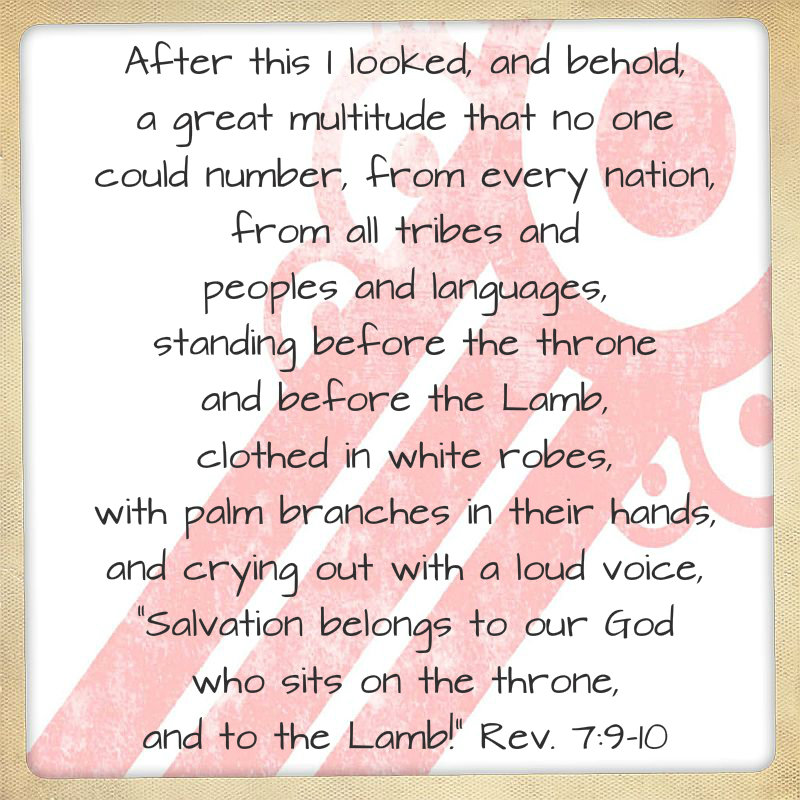
Pentecost yielded 3000 souls. Hallelujah! However, the harvest of souls will be even greater during the Tribulation. (Rev 7:9-10, 13). Hallelujah again!
Was it The Great Awakening? That revival, in three waves, yielded thousands over three waves, (First (c. 1730–1755; Second c. 1790–1840); Third c. 1855–1900), but Jonathan Edwards worried that some of those in the frenzy were simply carried away by emotionalism and societal pressure rather than their own brokenness over sin, marking them as false converts. In response to the very real probability that mixed in with the genuinely converted were many false professors, he wrote The Distinguishing Marks of a Work of the Spirit of God.
Revivals have always been plagued by errors in judgment from leaders and participants alike, Edwards warned, and have suffered from the delusions of Satan. Great care and discernment are always the order of the day. ~God’s Spirit or Human Hysteria? My Time Among the Charismatics, by Jeff Robinson.So it’s hard to count that revival’s numbers and thus its effects.
So what was the greatest revival ever? For sure?
It was Nineveh that yielded 600,000 souls for the glory of God. It was and still is the largest harvest God has effected to date. In addition, we know that was a genuine repentance and coming to faith, because first, the Bible said so, and second, the LORD stayed His hand in destroying the city. (Jonah 3:5, 10).
How do we know it was around 600,000 souls when the only number mentioned in regards to Nineveh is 120,000? Jonah 4:11 says,
And should not I pity Nineveh, that great city, in which there are more than 120,000 persons who do not know their right hand from their left, and also much cattle?
‘Not knowing the right hand from the left’ is a Hebrew idiom meaning ‘children’. Children don’t know their right hand from their left. Extrapolating the number of children and assigning them to two parents, historians and theologians estimate the city was populated by about 600,000. Its size also (three days’ walk) indicates a populous, bustling city of this magnitude.
By comparing these revivals at Pentecost, Nineveh, and the Tribulation we can praise God for His continuing and marvelous ongoing work in salvation. We will have lots of company in heaven! As Jonah said, “Salvation belongs to the Lord.” (Jonah 2:9). He will glorify His name by His mighty power to deliver men from the darkness of bondage to sin, speaking life into their dead bones,and resurrecting them to eternal life. Praise the Lord!
This essay first appeared in September 2010 on The End Time
Angels. They exist. They were created by God and they serve God. There are multitudes and multitudes of them. (Hebrews 12:22).
The bible shows us that angels appear on earth as men, sometimes looking like ordinary men (Joshua 5:13-14; Mark 16:5), and at other times looking like something other-worldly, so much so that the people gazing upon them were gripped with fear, as was Zacharias in Luke 1:12. He was speechless before the angel who visited him. So were the keepers of Jesus’ tomb, ‘who became as dead men when they saw the angel of the Lord’ (Matthew 28:4).
When they appear to people on the earth sometimes they take on human form like in Genesis 18:1-19. Jesus and two angels appeared as men and actually ate a meal with Abraham. Later two of the angels went on to Sodom and slept overnight at Lot’s house. So we know they can incarnate, appear as men, and spend a period of time on earth.
We know that some angels fell, meaning, they sided with Satan in the angelic rebellion and were cast from their places in heaven. Satan’s fall is described in Isaiah:
“How you have fallen from heaven, O morning star, son of the dawn! You have been cast down to the earth, you who once laid low the nations!” (Isaiah 14:12)
A third of the angels fell with satan:
“Then another sign appeared in heaven: an enormous red dragon with seven heads and ten horns and seven crowns on his heads. His tail swept a third of the stars out of the sky and flung them to the earth.” (Revelation 12:3-4).
Though satan lost his high position, he is god of this world (2 Corinthians 4:4), therefore, being cast out doesn’t interfere with from his intent to deceive us. He still pretends to be on God’s side, as seen here. “And no wonder, for Satan himself masquerades as an angel of light.” (2 Corinthians 11:14). Note the word ‘masquerades’ and ‘light’. Masquerade means “An involved scheme; a charade; as in wearing a mask or disguise’. Of course he would pretend he is one of the good guys to an unsuspecting unbeliever, or even to a Christian. His underlings pretend to be on the good side, too. His servants are the fellow angels that followed satan in the war against God and also pretend to be one of the good angels. But they only want to deceive.
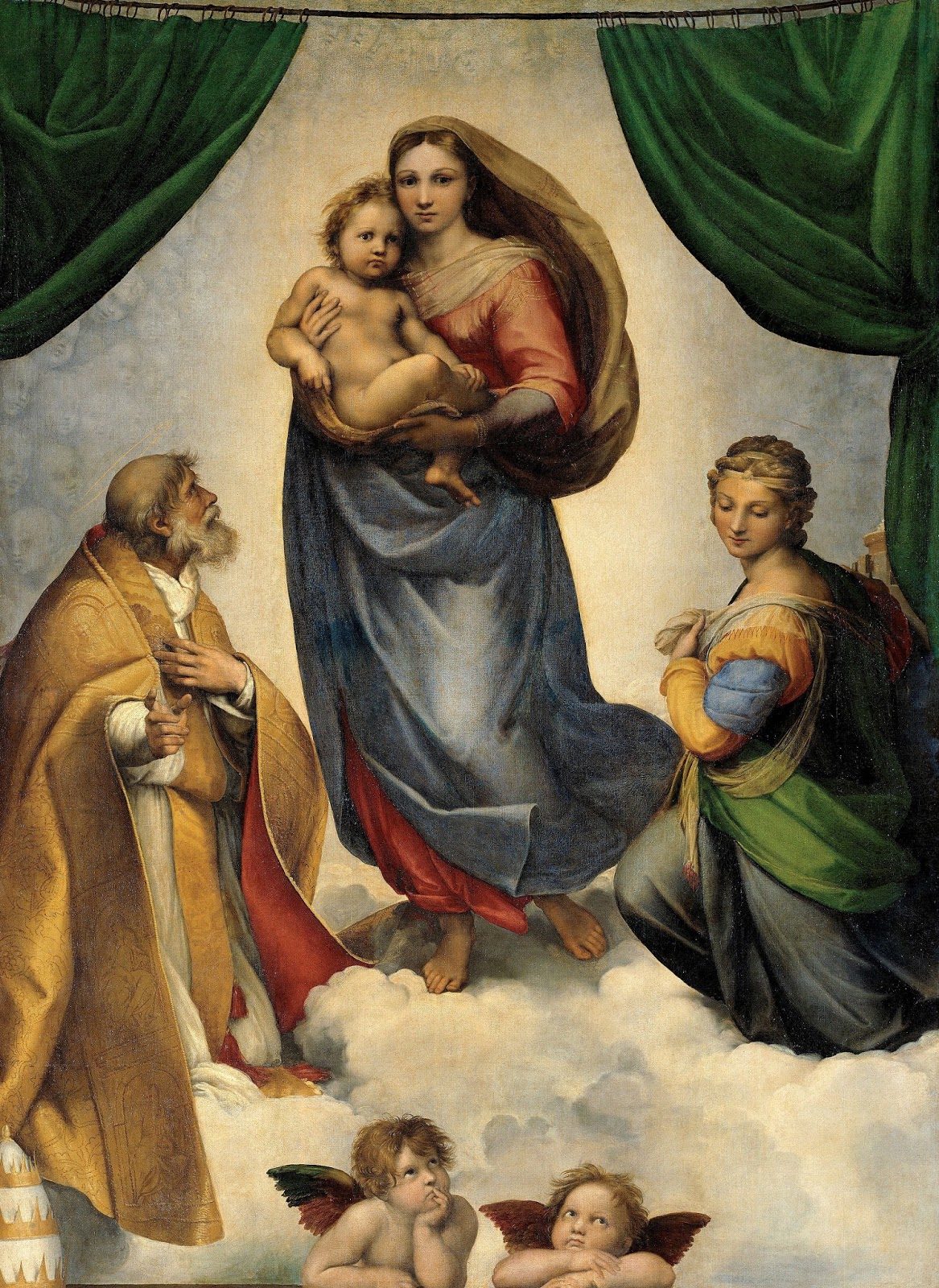
You know these guys. They’re putti, or cherubs as the Renaissance artists love to portray angels.
The two innocent-looking cherubs seem harmless. They’re from an excerpt of the larger piece called Sistine Madonna by Raphael. Angels are not cherubic babies. But satan and his demonic horde would like you to think so.
“It is not surprising, then, if his servants masquerade as servants of righteousness.” (2 Corinthians 11:15).
Hebrews 13:2 says we sometimes entertain angels unawares.
So the point is, if you were beset by an angel of light, how would you know he is one of the good guys, or one of the bad guys? There is a 1 in 3 chance he is one of the bad ones. How would you know? Would you be so gripped with fear that you just accept what the angel says? Would you be so filled with pride that one of these beings was sent to you that you would accept what he said without question? Would you be so entranced by their light that you unquestioningly accept they are from God?
The only way to know is to know the Word of God. John and Peter both warned of false teachers, and Jesus said they may come to us in sheep’s clothing (Matthew 7:15; 1 John. 4:1; 2 Peter 2:1). John said our duty is to “test the spirits,” and Paul said: “Test everything. Hold on to the good.” (1 Thessalonians 5:21).
Not all angels come in peace. Some are your enemy. Be watchful and test all things!
Our pastor began a new series Sunday on Jonah. He is taking it slow and luxuriating in our verse-by-verse exposition, which means I am too.
I want to say how delighted that he opened the sermon by explaining that the Book of Jonah, with all its supernatural wonders, and especially the great fish swallowing the prophet, was history and really happened as the Bible says. As the wrongly attributed George Orwell quote goes, “In a time of deceit, telling the truth is a revolutionary act.”
Don’t take for granted both the real and spiritual slings and arrows that are flung against your pastor for being brave in preaching the unvarnished truth to a skeptical world. Be sure to pray for him for his spiritual, physical, and emotional health and well being.
I love the prophets and I love the book of Jonah. So on the Monday after our pastor delivered the sermon I listened to four sermons on Jonah, and on Tuesday I listened to one more. There are multiple layers in Jonah, lots of deep, rich aspects one could go in the journey through this wonderful book. I know our pastor will bring out many truths as we sit under his preaching throughout the summer.
But being practical and being logical, and having been a mariner in my younger days, there was one question that bugged me. I could not find an answer to it in any sermon, commentary, or study Bible note. Until it hit me. It hit me like a thought-comet the Holy Spirit flung at my mind.
Here is the scene:
The LORD hurled a great wind on the sea and there was a great storm on the sea so that the ship was about to break up. 5Then the sailors became afraid and every man cried to his god, and they threw the cargo which was in the ship into the sea to lighten it for them. But Jonah had gone below into the hold of the ship, lain down and fallen sound asleep. (Jonah 1:4-5).
The storm was rough. The word ‘hurled’ in describing the Lord’s hurling of a storm is the same word that was used to describe King Saul’s hurling of the spear to David. This was not an ordinary storm, and the sailors knew it. Mariners don’t exaggerate. If anything, they understate the height of the waves or the intensity of the storm. Later, with a cup of grog in hand, they might say, “Aye, the boat bounced a bit.” Or “The waves were stirring all right.” Sailors are tough.
So it’s notable that the sailors were afraid. The word in Hebrew is terrified, also reverent. They knew it was some god that was doing this and they were religiously afraid. They prayed to whichever god they followed to appease him or her.
Before throwing over the cargo, the sailors would have been shortening sail. Billowing sails in a storm blow out and become tatters. So they’d reef the main and take in the jib. When that doesn’t work they take in the main sail completely and go under bare poles. They would throw the attached anchor overboard to help stabilize the boat. They would shift ballast in the hold. They would cut the dinghy away if they had one. Then they would throw over the cargo. Last, they pray, because foxholes are filled with praying people. Activity on a boat during a storm is at a pitched and chaotic level.
Does anyone know where the love of God goes when the waves turn the minutes to hours? Gordon Lightfoot, The Wreck of the Edmund Fitzgerald
It is also loud. In winds that high, the waves roar, and even the spray is loud. The spray and foam mix with the air and it’s hard to breathe, you’re breathing water half the time. The high winds whistle and beat against the mast and buffet the sailors. The waves slam and beat against the boat, which in turn creaks and makes all manner of tortured sounds. Mariners have to scream to be heard when they give directions, and when the wind becomes too loud, they just use hand gestures. Sometimes that doesn’t even work because darkness and spray obscure all sight. Anything on deck or below deck not in place or lashed down moves, skids, flings around like crazed maniacal ping pong balls.
Though the above activities are not mentioned, that is what they would have been doing. When the usual marine protocols failed, the sailors resorted to a last resort: throwing the cargo overboard. This lightens the boat and makes it bob in the water higher, so the tall waves have less chance to over-swamp the boat and capsize it or break it apart. Sailing with cargo is a money-making enterprise, and you do not want to anger the ship’s owner by having thrown over what amounts to his money. So when we read that the sailors threw over the cargo, this is very last resort.
If you’re down below, sailors have to tie themselves in or raise the bunk boards, so they aren’t flung across the cabin like a rag doll.
Against this backdrop, Jonah was asleep. Depending on the translation, scripture says not only that Jonah was sleeping, but he was fast asleep, sound asleep, in a heavy sleep, a deep sleep. How, how could Jonah sleep through all this?
It bugged me. It was not normally possible to sleep that way during a storm as severe as described. I pondered this over and over again. It seemed an important juxtaposition, the sleeping prophet as the boat is almost sinking.
Then it hit me. Jonah wanted to die.
The book of Jonah is clear about this fact. It’s stated several times that Jonah wanted to die. He would rather die than obey God in evangelizing the Ninevites. At the least, when Jonah ran away disobeying God it was a usually a death warrant. Jonah would have been aware of the cost for disobedience in the Holy of Holies, and also Uzzah’s penalty for disobeying when he touched the ark.
Jonah wanted to die as seen in Jonah 1:12 when he could have repented on deck and asked God’s forgiveness, but he chose instead to be thrown into the sea, to be tossed around like a peanut then drown alone.
In Jonah 4:3 he explicitly said he wanted to die, rather than live. He said it again in Jonah 4:8. So four times we see Jonah acting in ways that showed or stated he was serious about dying.
Elijah wanted to die because people were so bad. Jonah wanted to die because God was so good.
People who are intent on death often suddenly display an eerie calm. As the sailors were above fighting the storm, what they were really fighting for was their lives. Not Jonah. He was not fighting for life, he was resigned to death. He fell asleep. Deeply.
However potentially even more worrying is a sudden calmness, and many individuals who are contemplating suicide have a sense of resignation that can result in them acting very calm and even peaceful in the days leading up to their attempt. If they have gone from appearing excessively sad and exhibiting mood swings, to suddenly acting calm and peaceful then this can be a very dangerous sign and it’s important to look out for other signs that the calmness may not be all it seems.
Jonah was serious about dying. He wasn’t exaggerating. It wasn’t hyperbole. It wasn’t an idiom. He really preferred death to obedience, death to being an instrument of God’s compassion and love toward the pagan and evil Ninevites.
Elijah the prophet wanted to die, too. After the showdown against the Prophets of Baal and Queen Jezebel, we read,
But he himself went a day’s journey into the wilderness and came and sat down under a broom tree. And he asked that he might die, saying, “It is enough; now, O LORD, take away my life, for I am no better than my fathers.” 5And he lay down and slept under a broom tree. (1 Kings 19:4-5a).
Elijah’s sleep was a regular sleep, a completely different Hebrew word than Jonah’s deep sleep. Another difference is that Elijah wanted to die because people were so bad. Jonah wanted to die because God was so good. (Jonah 4:2-3).
I wonder if Jonah spent three days in the belly of the fish rather than one day, or one minute, because he hoped to die again. Maybe as the fish swallowed him, he was thinking, “OK, this is convenient, no one lives in a fish, now I can die!” But when it didn’t happen and didn’t happen, and on a third day it didn’t happen, then Jonah prayed his prayer. I wonder if it was his stubbornness kept him inside a foul, airless, acidic, sewage, rotting belly of a fish for all those days, only praying when he realized the Lord was going to keep him alive no matter what. Sigh. So realizing the Lord was going to supernaturally keep him alive anyway, he prayed his famous prayer in Chapter 2 and was released. Because in chapter 4 he said two more times he still wanted to die.
Who or what is your life ring? Who do you call for your S.O.S.?
So that’s the story of the death-seeking Jonah. It tells us a lot about him on that boat, that he wanted to die rather than see thousands come to Christ. That he could sleep amid a hurricane. God dealt graciously and kindly toward Jonah.
Which is good, because He deals with us graciously too. When we complain, run from Him, exhibit racist tendencies, or are just knowingly but stubbornly resist His will, He is patient. The Book of Jonah ends with a question that once again displays God’s love:
“Should I not have compassion on Nineveh, the great city in which there are more than 120000 persons who do not know the difference between their right and left hand, as well as many animals?”
Should we not have compassion on the lost, as God seeks their salvation and is slow to anger, that all would repent? We were rebellious, once, too. The LORD is gracious and compassionate, slow to anger and rich in love. (Psalm 145:8).
“It was a God-thing!” “The sign couldn’t have been more clear!” “It surely wasn’t a coincidence, it must have been from God!”
Have you ever heard anyone say any of these things? Or said them yourself?
Even after salvation we are sinful creatures. It would be so much easier to interpret circumstances rather than interpret the Word. We see what is happening in our lives and immediately interpret that these circumstances are in fact signs from God, omens, and ‘Godly coincidences’ that are directly and presently speaking to us. We go ahead and make decisions based on them.
But should we? Let’s look at two examples of interpreting circumstances, from the Word of God. Thanks goes to my wonderful and brilliant pastor for preaching this yesterday. Here, I summarize part:
We all know the story of Jonah. He was a Prophet of God, who prophesied to Israel. (2 Kings 14:21-25). He prophesied good things to Israel. It was during the reign of Jeroboam II King of Israel, when God was bestowing unmerited grace upon the people even though the King did evil in God’s eyes. The nation’s boundaries were being set and prosperity was growing. Therefore, likely Jonah was popular as a Prophet.
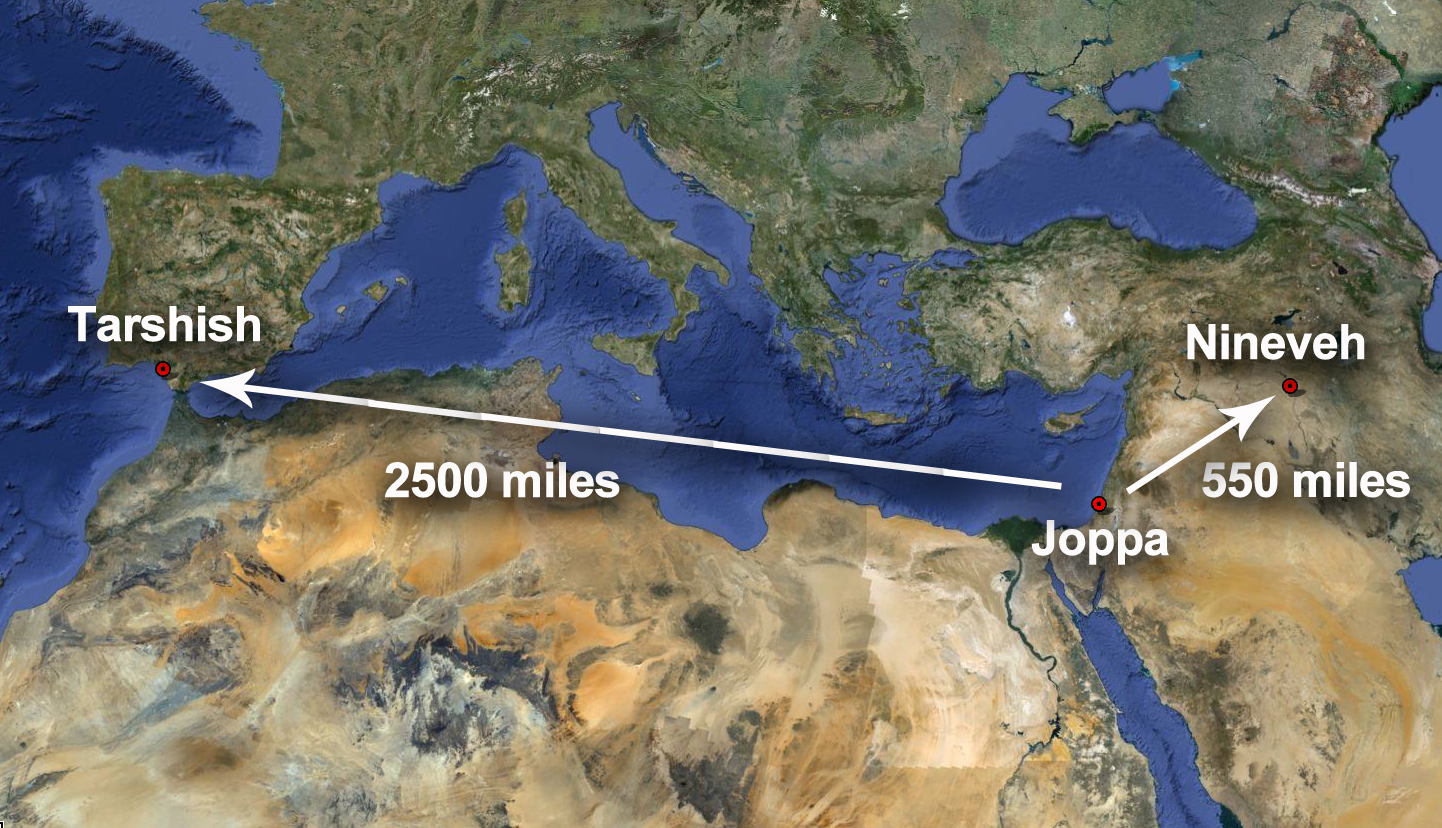
Then one day the word of the LORD came to Jonah. Jonah was told to travel to the city of Nineveh in order to prophesy to them. Nineveh was evil, they were an enemy, and Jonah was aghast. He refused. Effectively resigning his mantle, Jonah ran to Joppa instead, a seaside city where Jonah intended to grab a ship to Tarshish. This was the opposite direction of where God had told Jonah to go.
When Jonah got to Joppa (now Jaffa), he saw that there was a ship at harbor. Jonah paid the fare and flung himself into the bowels of the vessel, tired beyond bearing, and went to sleep. Though this next scene is a little beyond the time frame of my focus today, I can’t resist the glorious language from Herman Melville’s Moby-Dick:
All dressed and dusty as he is, Jonah throws himself into his berth, and finds the little state-room ceiling almost resting on his forehead. The air is close, and Jonah gasps. then, in that contracted hole, sunk, too, beneath the ship’s water-line, Jonah feels the heralding presentiment of that stifling hour, when the whale shall hold him in the smallest of his bowel’s wards.
Did Jonah feel vindicated when he saw a ship at sail, ready to voyage with the next tide? Did Jonah say, “See? It is providential! This must be what God wanted, since a ship appears before me at the ready!”
Interpreting circumstances is a dangerous thing.
Let’s look at David. He was fleeing from King Saul, who was seeking David’s life. David and his men huddled in a cave in the wilderness of Engedi, hiding from the fire-breathing king. Saul suddenly appeared in that exact cave. There are hundreds of caves at Engedi. Hundreds. Yet Saul entered the exact cave in which David hid.
Pixabay, free to use. Hundreds of caves dot the En-gedi desert.
David’s men interpreted circumstances, saying, ‘Look, here is the king! It must be the hand of God delivering the king to your sword!’
After stealthily snipping a bit of Saul’s robe David felt convicted. He said to his men,
“Behold, this day your eyes have seen that the LORD had given you today into my hand in the cave, and some said to kill you, but my eye had pity on you; and I said, ‘I will not stretch out my hand against my lord, for he is the LORD’S anointed.’” (1 Samuel 24:10-11).
The word of the LORD had not come to David. David knew that the LORD’s anointed were protected by God, raised up by Him to perform His will and plan. David knew that the LORD Himself had placed Saul into kingship and it was the LORD’s business to remove Him if He so wanted. It was not up to David. (1 Samuel 26:10)
“If we detach ourselves from the Word, we will never interpret circumstances correctly.” ~Mark McAndrew, Jonah 1:1-3, June 4, 2017
What Pastor Mark meant here is not that we interpret signs and omens, but that when things happen and we want to know what to do or how to think about it, we refer back to the Word. David knew God’s word and David knew His character. David acted according to this knowledge, not according to subjective impressions of the circumstances.
Romans 8:14 says “For all who are led by the Spirit of God are sons of God.” So we know that the Spirit leads because He promised to lead us. But the Spirit doesn’t speak to us except through His word. And when you start thinking that God is giving you special revelation outside of His word, you have diminished the singular authority of scripture.
We don’t know whether our interpretation of the circumstance is “a heavy conscience, a strong personal desire, or emotion-driven enthusiasm” as Jeremiah Johnson wrote at the link above. If David had decided to kill King Saul because Saul had showed up in the cave at that moment and had slain Saul, it would have been grievous sin for David. If Jonah had deduced that because the ship was ready to sail in the direction he wanted to go, it must be providential, it would have been a sin for Jonah. There are always ships ready to sail to Tarshish! Jonah would be simply rationalizing his own personal desire and back-hoeing the Spirit into his sin, which is blasphemy. Johnson wrote,
We ought to look for the Holy Spirit’s leadership, but we must be cautious about assigning to Him responsibility for our words and actions. Our feelings are not necessarily a trustworthy source of information, nor are they an accurate indication that God has a special message to deliver to us or through us.
God’s people need to be circumspect when it comes to His leadership, particularly through subjective impressions and inclinations. Moreover, we need to be wary of those who hijack the prophetic seat and presume to speak for God. Source
Some throw out a fleece for guidance, some look for open doors or windows. Satan can create circumstances too. Remember Job. Satan brought about the many different circumstances that plagued Job. Stay away from interpreting signs and circumstances and just interpret life through God’s word.
Book Review: Experiencing God, by Henry Blackaby : 9Marks
[Remember, Blackaby was the one who ‘legitimized’ interpreting God’s will through circumstances, introducing the concept to conservative evangelicals]
the women should keep silent in the churches. For they are not permitted to speak, but should be in submission, as the Law also says. (1 Corinthians 14:34).
Paul was exhorting about orderly worship here. The women, who as Hebrews were not invited to participate in worship with the men or to be educated, were over-exuberant in their new found freedom as Christians. As a result, worship had gotten out of hand. Worship must be orderly, quiet, and respectful, that was the watchword. And Paul gave that word in this passage.
Is there a time for a woman to holler and throw stools at the pastor? Apparently there was for Jenny Geddes. She’s gone down in Reformation History as someone who stood up for Jesus. Here’s how.
Jenny Geddes (c. 1600 – c. 1660) was a Scottish market-trader in Edinburgh, who is alleged to have thrown her stool at the head of the minister in St Giles’ Cathedral in objection to the first public use of the Anglican Book of Common Prayer in Scotland. The act is reputed to have sparked the riot which led to the Wars of the Three Kingdoms, which included the English Civil War.
Well, that’s some stool. It all happened on July 23, 1637 in Edinburgh.
Always independent, the Puritan Scots had become suspicious of the increasing encroachment of liturgy and rigid traditions a la the Roman Catholic Church. They had observed King Charles Is’ coronation rites and were displeased with his use of Anglican rituals. Next came forced use of the Book of Common Prayer, a high Episcopalian book, with its readings in the Apocrypha. King Charles issued a warrant in 1635 declaring his spiritual power over the Church of Scotland, insisting that the Church would be issued with a new book of liturgy which would be read at services. And on July 23, 1637 in St. Giles Cathedral, the Common Book of prayer was opened and John Hanna, Dean of Edinburgh, began to read.
Jenny Geddes sat fuming on her “fald stool” or a “creepie-stool” meaning a folding stool. Finally she had heard enough and stood up and cried; “Deil colic the wame o’ ye, fause thief; daur ye say Mass in my lug?” meaning “Devil cause you severe pain and flatulent distension of your abdomen, false thief: dare you say the Mass in my ear?” And at that she hurled her stool straight at the Dean’s head. This sparked a full scale riot in the church. one congregation member who had been heard uttering a response to the liturgy was thumped with bibles. The Dean took cover and the Provost summoned his men to put down the disturbance. The rioters were soon ejected from St Giles and the Bishop of Edinburgh appealed for calm. However this was not going to end quietly…
The national spiritual unrest was real, but overlaid upon the spiritual unrest was political unrest too. Hence the riots that sparked the Wars of the Three Kingdoms, and then the English Civil War. You can read about that part of the history elsewhere.
Jenny Geddes’ anger at the encroachment of evil into the pure worship service reminded me of another, more recent ‘Jenny Geddes.’
On November 10, 2013, Memorial Church of the Reformation in the city of Speyer, Germany hosted Karl Jenkins’ performance piece, titled “A Mass for Peace- “The Armed Man” where as part of the performance, the Islamic call to prayer is performed by an Imam.
German woman Heidi Mund had heard of this performance, grabbed her flag on which is emblazoned “Jesus Christ is Lord” headed to the church, and bought her ticket. But first, Ms Mund said, she prayed. To make matters even more emotional, the church the performance was to be held at was the Memorial Church of the Protestation in Speyer Germany, constructed specifically in 1900 where,
Its construction was supposed to be a reminder of the protest action that the imperial evangelical states brought to bear in 1529 at the Reichstag in Speyer. The Luther memorial in the vestibule and the adjacent statues of local Protestant rulers serve as reminders of this event.
Having no particular plan, she quietly listened to the music and readings, but when the Imam began praying to Allah in Arabic and saying, “Allahu Akbar!” she felt what she called a holy anger rising up in her. Much like Jenny Geddes, who was righteously aggrieved with the blasphemy in her midst, Mund stood up at this “interfaith event” and fearlessly began shouting that Lord Jesus alone is God and proclaimed His supremacy over all the earth.
If we are confronted with something of like kind, what would be our reaction? There is a time to sit silently and submissively, but is there ever a time for disruption and holy anger? Jenny Geddes threw a stool, narrowly missing the preacher’s head. Physical violence is never appropriate. How would we react to the incursion of evil into a holy place, a place set aside for the proclamation of the pure word? Just food for thought.
Both Geddes and Mund knew of what was to happen during the service. Neither were surprised. Mund prayed ahead, one can surmise that perhaps Geddes had also prayed ahead. In one way or another, we are all confronted with false doctrine creeping in. Start praying ahead for strength in the Lord to react in ways that honor and glorify Him.
————————————
Further Reading
Trivia: Scottish Poet Robert Burns named his mare Jenny Geddes
It was in the month of July — a month since become so memorable in the history of human freedom — on the twenty-third day of the month, that Jenny emerged from domestic obscurity to historic celebrity and renown.
On that day there was a strange ferment throughout Scotland and a wild excitement in the city of Edinburgh. King Charles had resolved to make Presbyterianism give place to Prelacy throughout the realm. A book of canons had been prepared subversive of the whole system of Presbyterian government, and had been enjoined upon the realm by proclamation upon the king’s simple prerogative.
Following this book came a liturgy as a law of public worship, and a royal edict had commanded its introduction into all the churches of the realm on this memorable Sabbath day. Notice to this effect bad been given the Sabbath before, and hence this intense excitement. For the Scottish people knew that if this measure were carried into effect by the authorities, Presbyterianism was virtually in its grave.
As the hour of Sabbath service approached, the streets of Edinburgh were thronged with crowds of people — every bosom throbbing, every eye flaming with excitement. But whither were they directing their steps? Conspicuous from many a point in the city of Edinburgh is a lofty tower, terminating in an open, carved stonework, with arches springing from the four corners and meeting together at the top in the form of a crown.
Already more than three centuries were looking down from that tower-top. It rose from the centre of a vast and venerable pile, including the High Church at the eastern end, There Knox so often preached, and within which pile “forty altars” were at one time supported.
It was thither mainly the crowds were pressing, and among them Jenny Geddes. Not being overburdened with modesty, she elbowed her way through the crowd to a convenient place, her stool, in near proximity to the pulpit, and seated herself on her throne. The edifice was filled to repletion with titled nobility and the nobler untitled nobility of the Scottish Presbyterian masses. There were present archbishops, bishops, the lords of the session, the magistrates of the city, members of the council, “chief captains and principal men,” and Jenny Geddes and her stool.
The excitement was becoming every moment more intense. The minutes dragged themselves along with tormenting tardiness and the suspense was becoming almost breathless. When the feeling was wrought up to its highest tension the Dean of Edinburgh made his appearance, clad in immaculate surplice, book in hand — the fatal book of the liturgy — the device of English Prelacy for the reform of Scotch Presbytery. The book was opened and the service begun.
The cup was now full, though as yet no one pretended to know, no one dreamed, what form of expression the pent-up indignation of the outraged people would assume. The question was soon decided. No sooner had the first words of the book, through the lips of the clean, reached the ear of Jenny, the stern prophetess on her tripod, than a sudden inspiration seized her. In an instant she was on her feet, and her shrill, impassioned voice rang through the arches of the cathedral:
“Villain! dost thou say mass in my lug?’ and in another instant her three-legged stool was seen on its way, travelling through the air straight toward the head of the surpliced prayer-reader. The astounded dean, not anticipating such an argument, dodged it, but the consequences he could not dodge.
He had laid his book, as he thought, upon a cushion — the cushion proved a hornet’s nest. In an instant the assembly was in the wildest uproar. Hands were clapped; hisses and loud vociferations filled the house, and missiles, such as the hand could reach, filled the air. A sudden rush was made toward the pulpit by the people in one direction, and from the pulpit by the dean in the other. On the retreat of the dean, the Bishop of Edinburgh took his place in the pulpit, and solemnly commanded the winds and waves to be still, but no calm followed. He was as rudely handled as his brother in oppression, and nothing but a vigorous onset of the magistrates saved his lawn and mitre from the rough hands of Jenny Geddes’ soldiery.
In Daniel chapter 10, we learn that Daniel has been praying for 21 days. He had inquired of the LORD, and Daniel was awaiting the reply. On day 24, the reply came, personally in the form of an angel. Daniel lifted his eyes and this is what he saw:
I lifted up my eyes and looked, and behold, a man clothed in linen, with a belt of fine gold from Uphaz around his waist. His body was like beryl, his face like the appearance of lightning, his eyes like flaming torches, his arms and legs like the gleam of burnished bronze, and the sound of his words like the sound of a multitude. (Daniel 10:5-6).
What a mighty being! Angels are strong and powerful servants of God!
Beryl is a gemstone like amethyst. It can be yellow or green or aquamarine in color. It sparkles, as any gem does. We all know what lightning looks like, as we know fire’s qualities, and burnished bronze and the sound of a multitude. The Hebrew word for multitude is roar or tumult. So, when the angel spoke, it was loud.
Such a being is powerful and frightening. No doubt that is why the angels all greet those whom they visit with the phrase “Fear not!”
So why is it that puny humans think they can march around the block and utter a few phrases and believe that the unholy angels will be scared enough to scuttle away? Is it the Christian’s duty to engage with spirits they have somehow deduced lurk about a certain location? Is it biblical to think that we can directly confront such powerful beings and use our own words to turn them away from their evil deeds? Is it realistic to think that a believer can utter a prayer that will “bind” such a powerful creature?
The holy angel visiting Daniel was delayed three weeks by an unholy angel, and only escaped when Michael arrived to help him. And we think that though such a powerful angel was delayed so many weeks, we can utter a prayer, similar to snapping our fingers or twitching our nose, and the unholy angel will fly away from us? Think about it.
We are not ignorant of satan’s schemes. (2 Corinthians 2:11). We should not be ignorant of his power, either. He is not God’s equal. But he and his cohorts are much more powerful than the little winged cherubs we like to think are the angels. Satan hates us because he hates God. He is at war with God, that old adversary, the usurper. (Isaiah 14:13-14). We must let God wage the war. We wage the war in His strength by standing and resisting, not by chasing and exorcising.
Our job is to grow in grace and strength, not chase around demons.
As an educator, I’m home for the summer. I have no family or major responsibilities, a minuscule social life, and I don’t need a lot of self care or personal maintenance. I take the way the Lord has structured my life to mean I should spend the extra time I have on Him, as Paul indicated singles should do. (1 Corinthians 7:17, 34). And as I want to.
Lately I’ve been feeling like I could do more. To be sure, I attend church regularly and my weekly Bible Study Group, and any the fellowship meetings the elders set up. Online, I write a daily blog and a weekly blog, and I maintain two Facebook pages as well as do other social media activity. But could I do more? I feel I need to.
When I ran my newspaper I was committed to presenting different kinds of writing. I felt the paper should be browsable. It ran the gamut of different styles of language, and the articles ran the gamut in length. Some were short, some long, some were photos with a long caption, and I was really fond of bullet points and other graphics. I want to do the same things with the various social media opportunities out there. This generation has the most widespread availability of communication methods ever. I’ve got a Pinterest page, Instagram, Flickr, and Unsplash which are photo-driven with various opportunities for text. I’ve got a Twitter stream, two Facebook pages and two blogs (four, really, The Quiet Life (personal) and The End Time (theological) are spread on two platforms, Blogger and WordPress.) Blogs and Facebook offer more opportunity for print and of course some photos.
The influx of free photo editing software allows for more graphical displays of theological concepts, such as making scripture photos and the like. So the modes of communication are wide and varied and I like to use them all to reach different audiences with the message of Jesus and the Good News.
I could not settle on exactly what I wanted to do though, this something more. I used to send out a hefty weekly newsletter by email to a few hundred people, some years back. Should I revive that? It didn’t feel right. Then I got connected with a woman on Facebook. She is the mom of a neighbor who lives at some distance. The daughter said I’d like her mom and her mom would like me. She put us together on FB and she is right. Her mom is a wise and graceful lady. The lady puts out a column of grace-filled nuggets of wisdom, spiritually based but refreshing in their sweetness. I found them encouraging and enlivening to my soul. I think people are thirsting for something good and light and sweet in these days of heavy sin and falsity and blasphemy. The columns are also short. I have a problem with writing short. It’s hard and I need practice at that. They are also life-applicable and I need to develop that as well. I decided that the column was the answer.
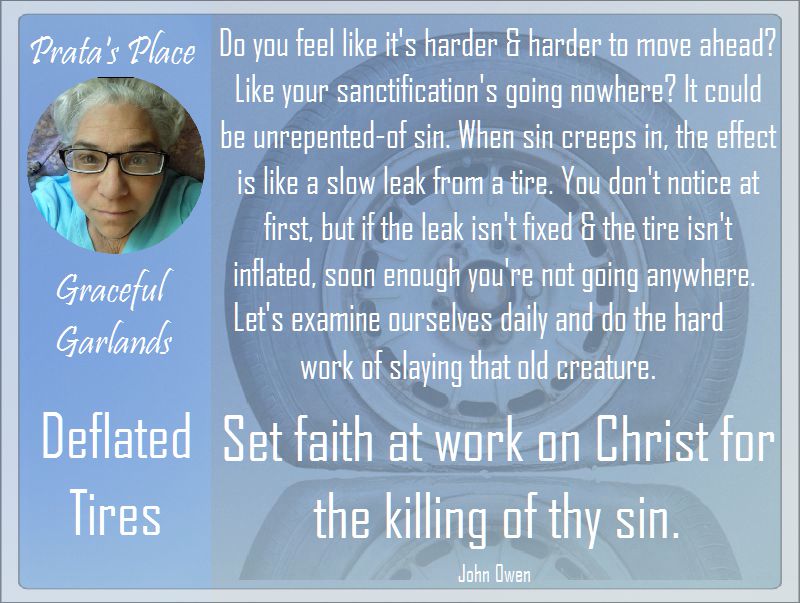
I asked her permission to copy her style of column. Our audiences do not overlap as she lives at some distance. We do not share Facebook friends, either (except her daughter). She was gracious and said yes, there was always room to share the Good News. How kind of her! So a new column is born. It will be called Prata’s Place, Graceful Garlands. The name is from Proverbs 4:8-9, the ‘she’ here is wisdom,
Prize her highly, and she will exalt you;
she will honor you if you embrace her.
She will place on your head a graceful garland;
she will bestow on you a beautiful crown.
They are written as a photo, or a graphic, so I can share them on Instagram, Pinterest, and other places. The text is meant to bring Jesus to mind in a sweet way. The column might be your cup of tea or not, but I intend to add it to my cadre of items I write that’s focused on Jesus, His good and quiet life (1 Thessalonians 4:11) and His soon return.
The blogs at WordPress and Blogger are the same. I mirrored them in case WordPress or Blogger decided to pull my blog, I’d have a backup. Also, some people like WP better or Blogger better for their mobiles so I decided just to create a mirror of each.
Personal:
Facebook- this is a personal page. It’s open to the public though. I post the typical things- about my cute cats, what I had for dinner, and how long my latest nap was. Cliche!
Facebook The End Time– this page is theological in nature. I post my own thoughts, links to good and solid sites, quotes, devotionals and the like.
We read one of many verses about the importance of slaying the sin that still dwells within us.
But I keep under my body, and bring it into subjection: lest that by any means, when I have preached to others, I myself should be a castaway. (1 Corinthians 9:27 KJV).
See also also Colossians 3:5.
To that end, I strive to slay the sin in me. I pray constantly to the Lord for the Spirit’s help in sinning less against Jesus today than I did yesterday.
Sometimes, when I feel strong (boastful?) I think my war cry against sin looks and sounds like this:
But I am such a puny human! Most days I am sure that my ferocious war cry really just looks and sounds like this:
Praise the Lord for His strength, His constant love, and His faithfulness in keeping us in His hand!









 the-end-time.org