Biblical speech must be gracious and gentle when contending for the faith; yet disagreement persists due to sin, ignorance, or conflicting worldviews, not merely poor communication.
It is not possible to deny the virgin birth yet accept Christ as a holy, sinless deity. In 2022 at Christmas no less, Andy Stanley made his statement that there is no need to be concerned with how Jesus got into the world. Here is Pastor Gabe Hughes in a WWUTT 90 second explanation rebutting Stanley’s notion, saying it is actually critical and foundational to the faith. We must believe it.
However, Stanley is not the first pastor claiming to be conservative who denies the virgin birth as necessary to the faith. Billy Graham also denied the necessity of belief in the virgin birth. Yet there was no hullabaloo over Graham’s denial but only excuses made for his ‘misstatements.’
The Annunciation, by Henry Ossawa Tanner, 1898.
In my thorough study of Graham, which encompassed listening to sermons from 1949 through to the 1980s, reading several of his books, reading books about him, listening to interviews, and reading two dissertations looking at the evolution of his theology over Graham’s 50 active years, the conclusion is clear to me. In 1993 Graham said to Time Magazine (as codified in Ken Garfield’s book Billy Graham, a Life in Pictures, of the virgin birth specifically,
“Graham has said that the virgin birth of Christ is NOT an essential part of the Christian faith. In an interview with a United Church of Canada publication in 1966 (“Billy Graham Answers 26 Provocative Questions,” United Church Observer, July 1, 1966), Graham gave the following reply to a question about the virgin birth of Christ: “
Q. Do you think a literal belief in the Virgin birth — not just as a symbol of the incarnation or of Christ’s divinity — as an historic event is necessary for personal salvation? A. While I most certainly believe that Jesus Christ was born of a virgin, I do not find anywhere in the New Testament that this particular belief is necessary for personal salvation.
Graham denied the necessity of the virgin birth not just once but several times in different decades. Graham’s response was a classic example of his penchant for doubletalk. Is there any other kind of salvation, besides the personal? Is there global salvation? Impersonal salvation?
And if we use his contradictory statement as the basis, “I don’t find anywhere in the New Testament” …we can also say “I don’t find anywhere in the New Testament any specific reference to the Trinity” so therefore “belief in the Trinity is not necessary to personal salvation”.
If Christ be not the virgin-born Son of God, He could not be our Savior. To reject the doctrine of the Virgin Birth is to reject the only Sinless Savior that God has provided for sinners.
Graham’s public denial of Jesus as the exclusive way to God, as seen in his adoption of the wider mercy approach, was articulated clearly and affirmed with follow-up questioning, at Robert Schuller’s Crystal Cathedral interview in 1997, displays Graham’s saddest denial of all.
Though there are discussions about which fundamental of the faith is necessary for belief, there are at least five fundamentals of the faith below which are essential for Christianity and must be believed-
1. The Deity of our Lord Jesus Christ (John 1:1; John 20:28; Hebrews 1:8-9). 2. The Virgin Birth (Isaiah 7:14; Matthew 1:23; Luke 1:27). 3. The Blood Atonement (Acts 20:28; Romans 3:25, 5:9; Ephesians 1:7; Hebrews 9:12-14). 4. The Bodily Resurrection (Luke 24:36-46; 1 Corinthians 15:1-4, 15:14-15). 5. The inerrancy of the scriptures themselves (Psalms 12:6-7; Romans 15:4; 2 Timothy 3:16-17; 2 Peter 1:20).
GotQuestions: Why is the Virgin Birth so Important? Jesus was not born in sin; that is, He had no sin nature (Hebrews 7:26). It would seem that the sin nature is passed down from generation to generation through the father (Romans 5:12, 17, 19). The Virgin Birth circumvented the transmission of the sin nature and allowed the eternal God to become a perfect man.
Ligonier: Must Christians believe in the Virgin Birth? Christians must face the fact that a denial of the virgin birth is a denial of Jesus as the Christ. Grace To You: Why the Virgin Birth is Essential The virgin birth is an underlying assumption in everything the Bible says about Jesus. To throw out the virgin birth is to reject Christ’s deity, the accuracy and authority of Scripture, and a host of other related doctrines central to the Christian faith. No issue is more important than the virgin birth to our understanding of who Jesus is.
Praise God for His unique, stunning, and most compassionate Gospel, with all its details, including that “Therefore the Lord Himself will give you a sign: Behold, a virgin will be with child and bear a son, and she will call His name Immanuel.” (Isaiah 7:14).
Isaiah 7:10-16 “The Life of Christ: The Virgin Birth” S. Lewis Johnson
I liked how Pastor S. Lewis Johnson emphasized the virgin conception rather than the virgin birth. He preached, as you will read below in part, that the birth was typical, human, bloody, and messy. It was the conception that was immaculate. The art by American painter Gari Melchers depicts a scene more reflective of a birth than most nativity scenes usually do. Here, we see a deeply concentrating Joseph gazing at his newborn son, perhaps pondering the spiritual implications of this new life that promised to bring new life. Mary, exhausted, drooping, leans against her husband sleepily, recently used washbowl and cloth by her side. Is the glow from the Babe’s head, or the lantern that has been set by Him? The scene depicts exhaustion, wonder, light, and hope.
Gari Melchers “The Nativity” 1891.
Here is Pastor S. Lewis Johnson on The Virgin Birth, from his series on the Life of Christ-
Now out of this marriage there was to come the man who was really God, the God-man, our Lord Jesus. But I think you can see the kind of arrangements that would be made between Jacob and Eli concerning the young carpenter and the pious maiden whose name was Mary. Now, of course, the moment that this marriage was arranged by the parents, it was legal. That is, they were married. So Matthew says,
“Now the birth of Jesus Christ was on this wise: When as his mother Mary was espoused to Joseph, (That is, when the arrangements had been made) before they came together, she was found with child of the Holy Ghost. Then Joseph her husband…”
Now apparently from the account, this is not stated directly, but apparently from the account, Joseph had learned of the pregnancy of Mary, whether he had been told this by Mary herself, whether he had discovered it and she had kept quiet about it the text does not say. I am inclined to think because of the statement that is made in just a moment, that Joseph was very much in love with Mary and that as a result of his love for her, the fact that she was pregnant caused a great deal of consternation to him. And I think, if I judge these characters correctly, that Mary had told him of the experience.
But Joseph, like so many of us, when confronted with such a miracle and after all, there never had been anything like this before; the closest thing to it was the supernatural birth of Isaac in the Old Testament, but that was by natural means, and yet supernatural, I’m quite sure I can understand something of the wrestling that took place in the heart of Joseph. I can imagine that after he was told this that he spent many a sleepless night. He wondered perhaps, “Should I really marry this young girl?” That is, “Should our marriage be consummated and should be begin to live together?” If it’s not true, perhaps I should put her away according to the Old Testament law. If it is true, I hesitate to take her to be my wife for the simple reason that if this is of God and the Messiah is to be born of her, it seems almost unholy to begin to live with her.
Now Joseph apparently was about to reach a decision, which meant that he was going to put her away. I gather that is the force of the text when he says, “And not willing to make her a public example was minded to put her away privily.” That is, he wasn’t going to do it publicly, but he was just going to take the minimum of two witnesses and carry out the divorce according to the Old Testament. So Joseph apparently had made up his mind.
Now I would say that this is true because in the 20th verse, the tense of the word “while he thought on these things” is a tense that suggests that the action had been reached. That is, that the conclusion had been reached. And so having made up his mind and about ready to carry out something that was contrary to the will of God, the angel spoke to Joseph and said to him in a dream, “Joseph, thou son of David, fear not to take unto thee Mary thy wife: for that which is conceived in her is of the Holy Ghost.”
Now this, of course, is something that we can never really fathom. We can only adore. Who could ever understand what it means to be born of the Holy Ghost? G. Campbell Morgan used to say, “This is the holy mystery, the touch of God upon the simple life that made it forever sublime.” She was found with child of the Holy Ghost. That which is conceived in her is of the Holy Ghost. So in a restless night amid fitful sleep, Joseph had a visitor and the visitor told him in supernatural terms and direct language that this in Mary was of the Holy Ghost. Now what he meant by this was that the Spirit was the source of the vitalizing energy which gave to the embryo in her womb.
Now I want to say something about the doctrine of the virgin birth at this point that I hope will help to clarify your mind some of the theology of it. Who would ever expect a simple New Testament professor and preacher of the word to transform the doctrine of the virgin birth so that everybody now understands it in a new light? So I’m not having any kind of sense of transforming all of theological thought concerning the virgin birth.
But I do want to say this that the New Testament does not teach the doctrine of a virgin birth, the New Testament teaches the doctrine of a virgin conception, a virgin conception. In other words, our Lord Jesus was conceived by the Holy Ghost, but he was born naturally, born naturally.
Now I want you to notice that I’m not denying the so called doctrine of the virgin birth. That would make nonsense of everything that I’ve said up to this point. I just want you to think clearly that it was the operation of the Holy Spirit in the conception that is referred to here, not in the birth. Jesus was born as an ordinary person was born.
Praise the Lord Jesus was conceived directly of the Holy Spirit, absent the sin-nature that taints all of us. What mysteries the LORD had prepared in His mind since eternity began! What tremendous love He has for His people! Mary, what favor you had and what strength you showed in submitting to the will of God so graciously-
“My soul magnifies the Lord, and my spirit rejoices in God my Savior, for he has looked on the humble estate of his servant.” (Luke 1:46-48).
This reflective essay explores the biblical truth that “God is light,” examining its spiritual meaning and divine implications. Drawing from Scripture, Greek definitions, and commentaries, it reveals how God’s light signifies purity, holiness, and life itself—illuminating believers, exposing darkness, and promising eternal brilliance in His presence.
In 1998, I drove to Maine’s Farnsworth Art Museum to see Wondrous Strange: The Wyeth Tradition, an eerie exhibition exploring dreamlike and unsettling imagery. Reflecting later, I contrast the human imagination of the Wyeths with the true “wondrous strange” mystery of the Gospel—God’s unimaginable incarnation and redemption.
Grace is a concept. But it’s not just a concept. Grace is a gift, but it’s not just a gift. Grace is a force. Think about how powerful grace is. Think about its power as it exists in Jesus, as it is delivered to the saints, its common state as it covers the world, and its special state as it enlivens the saints to do our work.
Here is an excerpt about grace from a sermon from John MacArthur called, Strength Perfected in Weakness, looking at this verse: 2 Corinthians 12:7-10.
or because of these surpassingly great revelations. Therefore, in order to keep me from becoming conceited, I was given a thorn in my flesh, a messenger of Satan, to torment me. 8 Three times I pleaded with the Lord to take it away from me. 9 But he said to me, “My grace is sufficient for you, for my power is made perfect in weakness.” Therefore I will boast all the more gladly about my weaknesses, so that Christ’s power may rest on me. 10 That is why, for Christ’s sake, I delight in weaknesses, in insults, in hardships, in persecutions, in difficulties. For when I am weak, then I am strong.
In speaking of the linchpin part of the passage, ‘my grace is sufficient for you’, MacArthur said,
But grace is not just an inert sort of concept; it is a force, it is a power. It is a power that transforms us. It is a power that awakens us from sleep. It is a power that gives us life in the midst of death. It is a power that is dynamic enough to transform us from the kingdom of darkness to the kingdom of God’s dear Son. It is the power that saves us. It is the power that keeps us, the power that enables us, the power that sanctifies us, and the power that one day will glorify us. You have to look at grace as a force, a divine force that God pours out into the lives of His people at all points to grant them all that they need to be all that He desires.
Grace is a gift. Grace is a state. and… Grace is a POWER.
So many people, especially women, are hopscotching the globe founding important ministries, establishing orphanages, ’empowering’ native women, or teaching to packed arenas, that it makes the rest of us humdrum ladies feel, ahem, left behind. Should we be doing the big things? Can we do the bigger things? Are we doing enough?
All I do every single day, is go to work. I come home and I study my Bible &pray, I write, and if I have enough energy after that, I read a bit. Then I go to sleep and do it all over again. On the weekends all I do is grocery shopping, laundry, cooking the week’s lunches ahead, and study a lot more and write a lot more. I go to church on Sunday late afternoon. Bed time. Repeat.
I’m not skipping off to host conferences or giving interviews on panels or unashamedly on tour or in Rwanda on a storytelling trip. I wash dishes in obscurity in GA and my job is to help kindergarteners tie their shoes and learn their ABC’s. It’s not glamorous. It doesn’t seem like it’s very much at all of a contribution to the kingdom. I mean, Beth Moore is a 60+ year old grandma busy with her panels, and cohorts, and Bible studies, and traveling tours. She keeps a packed schedule. Younger women also seem to be doing the big things, the glamorous things, like Jennie Allen and Raechel Myers and Kari Jobe. As for me, I’m just plodding.
Well, let’s hear it for the plodders.
First, if you are a mother, you are in a highly esteemed Biblical position. You are doing such wonderful work for the kingdom in being a foundation block in society, in raising pure young women and strong young men for the next generation. I thank Mrs George G. Paton and Mrs Eliza Spurgeon and Mrs Irene MacArthur and all the other Missus’ who raised men and women who in turn, impact the kingdom.
Secondly if you think of the life of Paul most often we think of the highlights. His speeches before thousands, his dramatic miracles, his appearances before kings and leaders.
However, Paul also walked. Thousands upon thousands of miles, he plodded. He trudged. He hiked. From one town to another, in all weathers. In addition, Paul sewed tents. (Acts 18:3). He did the mundane. He wrote letter upon letter to friends. He fundraised. The in-between miracle times in his three missionary journeys were rife with the mundane and the insignificant, except nothing about a Christian’s life is insignificant. Not Paul’s and not mine and not yours. The Lord cares for all our concerns. He clothes us and feeds us and He even knows the number of hairs on our heads. To Him, it’s all significant.
As for the women of the New Testament, Dorcas was beloved not because she was on storytelling tours of Rwanda empowering women for ‘style and justice’, but because she sewed. She made clothes for the poor and she “was always doing good”. (Acts 9:36). She lovingly helped, humbly and quietly, within her own sphere.
Mary, mother of God? Do we hear of her going on her book tour, telling about the angel that came to her one day, and the miracle of the three wise men or hyping up audiences with her harrowing tale of narrowly escaping the massacre of the innocents? No. Whether she was in Egypt or in Israel, Mary simply raised her Son. She brought Him up in the faith and managed her household and she raised Jesus’ siblings too. A few times a year she made the pilgimage to the Temple and the rest of the time, she did what women then and onward have done, she lived in her home and she was faithful to the Lord through His word.
Here are two articles about the plodding kind of faith that endures. That kind of faith is cement. It’s bedrock.
It’s sexy among young people—my generation—to talk about ditching institutional religion and starting a revolution of real Christ-followers living in real community without the confines of church. Besides being unbiblical, such notions of churchless Christianity are unrealistic. It’s immaturity actually, like the newly engaged couple who think romance preserves the marriage, when the couple celebrating their golden anniversary know it’s the institution of marriage that preserves the romance. Without the God-given habit of corporate worship and the God-given mandate of corporate accountability, we will not prove faithful over the long haul.
This one is one of my favorites. It’s by John MacArthur, titled An Unremarkable Faith
Meet Larry, a thirty-six year old Science teacher. Larry married Cathy 12 years ago. They love each other and enjoy raising their two sons. Larry’s life wouldn’t hold out much interest to the average citizen. His Facebook account doesn’t draw many friends and nobody ever leaves a comment on his blog. In fact, most people would summarize Larry’s life with one word—boring. But not Larry. Teaching osmosis to junior high students, playing Uno with his kids, and working in the yard with Cathy is paradise to him. But the real love of his life is Jesus. Larry’s a Christian. He’s been walking with the Lord for more than 20 years.
Not that founding orphanages isn’t worthwhile or something women or men can’t or shouldn’t do. Not that going on a missionary trip to Africa isn’t something Jesus wants us to do. But the big doers are fewer than we think, despite the hype. Most of the church is populated with plodders. As Kevin DeYoung concluded his article,
Put away the Che Guevara t-shirts, stop the revolution, and join the rest of the plodders. Fifty years from now you’ll be glad you did.
In the beginning, God created the heavens and the earth
When God created the earth, He could have made it colorless. He could have used only His brush strokes of black, or gray, or brown. The world could look like this:
EPrata photo
Did you ever wonder why God graced us with a common grace of color? He has made the world beautiful in its time, says Ecclesiastes 3:11. This beauty includes the spectrum of colors which we enjoy in all its prettiness. I particularly enjoy colorful flowers.
EPrata photo
EPrata photo
EPrata photo
The Bible has in it of course, references to colors. It doesn’t, however, really explain if colors of the tabernacle meant anything, if they individually had a symbolism. Other colors do have a symbolism. Here is Baker’s Evangelical Dictionary’s entry on color:
Although the Bible contains relatively few references to individual colors, their symbolic associations are theologically significant. Colors usually symbolize redemptive and eschatological themes. The Bible is, however, silent on whether the colors used in the tabernacle, temple, and priestly garments held symbolic meaning.
Black signifies gloom, mourning, evil, judgment, and death (Lam 4:8; Micah 3:6; Zechariah 6:2 Zechariah 6:6; Revelation 6:5 Revelation 6:12). Its image is often one of dense, impenetrable darkness (Job 3:5; Isa 50:3). The terms “darkness” and “night” parallel this usage (Job 3:3-7; Joel 2:2; Zeph 1:15). Hell is the place of “blackest darkness” reserved for the godless (2 Peter 2:17; Jude 13).
The pale horse of Revelation 6:8 resembles the color of the terror-stricken and corpses (cf. Jer 30:6; Dan 10:8). The horse’s color matches the work of its rider. Its rider is called Death, who, with Hades, goes forth to kill a fourth of humankind.
An expensive dye, purple represents wealth and royalty (Judges 8:26; Est 8:15; Daniel 5:7, Daniel 5:16, Daniel 5:29; Luke 16:19); for this reason, idols were attired in purple (Jer 10:9). The purple dress of the harlot symbolized Roman imperial rank (Rev 17:4; Revelation 18:12, Revelation 18:16). Before his crucifixion, Jesus was robed in purple in mockery of him as “king of the Jews” (Mark 15:17, Mark 15:20; John 19:2, John 19:5; cf. Matt 27:28,; “scarlet robe”). Garments of purple suitably clothe a wife of noble character (Prov 31:22).
Red symbolizes blood. Israel’s sin as brilliant scarlet and deep-red crimson is analogous to the bloodstained hands of murderers (Isaiah 1:15 Isaiah 1:18). The images of red, blood-soaked garments of God as an avenging warrior (Isa 63:1-6) and the fiery red horse bringing slaughter through warfare (Zech 6:2; Rev 6:4) describe divine retribution against evildoers (see also Joel 2:31; Rev 6:12). The red color of the dragon (Rev 12:3) and beast (17:3) symbolizes the shedding of innocent blood (11:7; 16:6). The red heifer (Nu 19:1-10) and scarlet wool (Heb 9:19) symbolize the Old Testament means of purification through blood; the New Testament powerfully expresses the fullness of Christ’s atoning work through a contradictory color image: believers’ robes are washed pure white through the blood of the Lamb (Revelation 7:9 Revelation 7:13-14 ; 19:13-14).
White signifies purity and holiness. It depicts complete forgiveness of sin. David and Israel’s bloodguilt would be fully removed, leaving them whiter than snow/wool (Psalm 51:7; Isa 1:18). It represents the absolute moral purity of God (Da 7:9), Christ (Rev 1:14; Mark 9:3; pars.), angels (Mark 16:5 ; pars. Acts 1:10), and believers (Rev 2:17; 3:4-5; 4:4), and thus of the divine judgment of God (20:11) and Christ (14:14). It indicates the certainty of God’s conquest and victory over evil (Zechariah 6:3 Zechariah 6:6; Rev 6:2; 19:11).
H. Douglas Buckwalter, Bibliography. G. W. Thatcher, Hasting’s Dictionary of the Bible, 1:456-58; P. L. Garber, ISBE, 1:729-32; A. Brenner, Colour Terms in the Old Testament; “Color, ” BEB, 1:494-96.
Color is a common grace. Every person on the planet whether young or old, saved and acknowledging the creator or unsaved and worshiping the creation, enjoys the colors of this earth. Everyone can admire a sunset, colorful avian plumage, floral hues that delight the senses.
Common Grace refers to the grace of God that is common to all humankind. It is “common” because its benefits are experienced by the whole human race without distinction between one person and another, believers or unbelievers. It is “grace” because it is undeserved and sovereignly bestowed by God.
The Lord God created a world that is beautiful. Its beauty is enhanced by the colors He created for us (and Him!) to enjoy in our common grace. The painted desert, the lush tropics, the animals, insects, and fish in all their rich tones and hues are a joy. He didn’t have to but He did.
Grace is a concept. But it’s not just a concept. Grace is a gift, but it’s not just a gift. Grace is a force. Think about how powerful grace is. Think about its power as it exists in Jesus, as it is delivered to the saints, its common state as it covers the world, and its special state as it enlivens the saints to do our work.
Here is an excerpt about grace from a sermon from John MacArthur called, Strength Perfected in Weakness, looking at this verse: 2 Corinthians 12:7-10.
or because of these surpassingly great revelations. Therefore, in order to keep me from becoming conceited, I was given a thorn in my flesh, a messenger of Satan, to torment me. 8 Three times I pleaded with the Lord to take it away from me. 9 But he said to me, “My grace is sufficient for you, for my power is made perfect in weakness.” Therefore I will boast all the more gladly about my weaknesses, so that Christ’s power may rest on me. 10 That is why, for Christ’s sake, I delight in weaknesses, in insults, in hardships, in persecutions, in difficulties. For when I am weak, then I am strong.
In speaking of the linchpin part of the passage, ‘my grace is sufficient for you’, MacArthur said,
But grace is not just an inert sort of concept; it is a force, it is a power. It is a power that transforms us. It is a power that awakens us from sleep. It is a power that gives us life in the midst of death. It is a power that is dynamic enough to transform us from the kingdom of darkness to the kingdom of God’s dear Son. It is the power that saves us. It is the power that keeps us, the power that enables us, the power that sanctifies us, and the power that one day will glorify us. You have to look at grace as a force, a divine force that God pours out into the lives of His people at all points to grant them all that they need to be all that He desires.
Grace is a gift. Grace is a state. and… Grace is a POWER.
But what fruit were you getting at that time from the things of which you are now ashamed? For the end of those things is death. (Romans 6:21)
Paul is asking this rhetorical question in the majestic section of “The Wages of Sin.” What has sin profited you? What fruit, then, has sin produced?
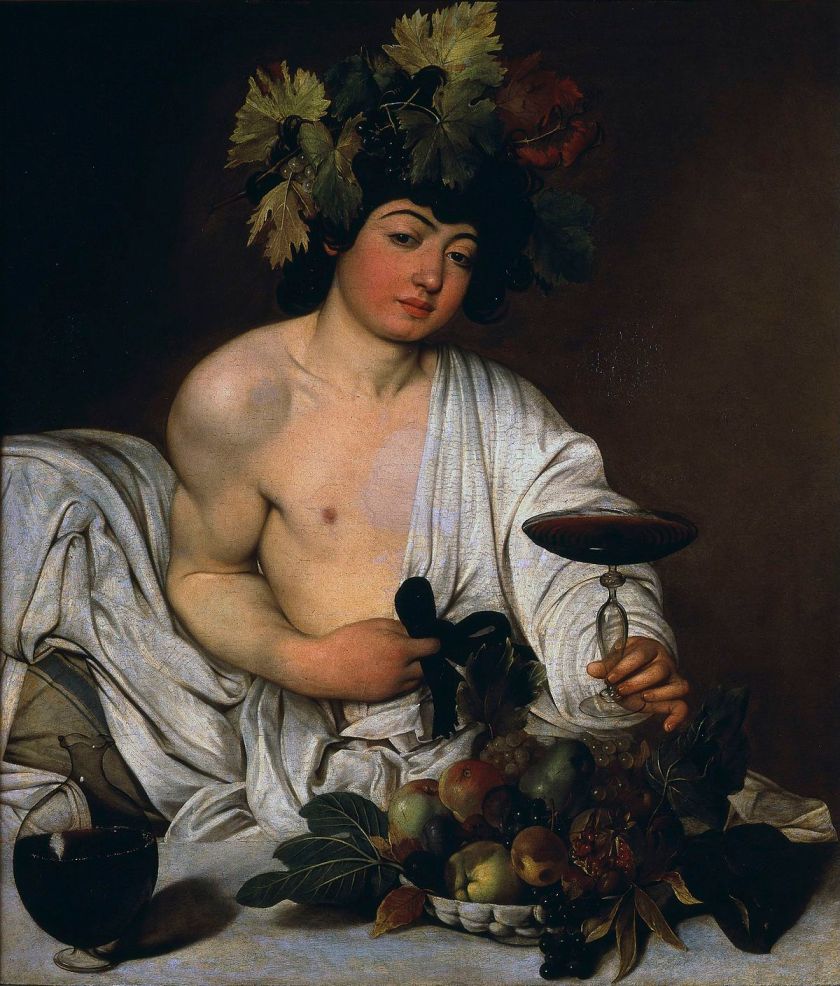
I’m a lover of art. I saw Caravaggio’s Bacchus in the Uffizi some years ago. Caravaggio’s Bacchus is a decadent painting, becoming more so as one gazes at it. Bacchus was the Roman god of the grape harvest, winemaking and wine, of ritual ecstasy, fertility and so on. Dionysus was the parallel Greek god. Here he is:
How is it decadent, one asks? We see the heavy-lidded youth, the Bacchus, reposing against his dirty sheets, with his own covering having slipped off, exposing his fleshy upper torso. He fingers the opening suggestively. His face appears ruddy, from outdoor farm work in the vineyards, or perhaps more to the point, the florid blush of too much wine. On close inspection, the bowl of fruit shows its over-ripeness. The pears are bruised and browning. The figs are burst and oozing. The peaches are in obvious decay.
Decay, rot, decomposition is the theme of the entire portrait. And anyway, it’s a false god.
But the fruit of the Spirit is love, joy, peace, patience, kindness, goodness, faithfulness, gentleness, and self-control. (Galatians 5:22-23)
Does sin bring the fruit of love? Does sin bring the fruit of peace? Does sin bring the fruit of patience? Does sin bring the fruit of kindness? Does sin bring the fruit of goodness? Does sin bring the fruit of faithfulness? Does sin bring the fruit of gentleness? Does sin bring the fruit of self-control?
Can you think of any sin which brings any of the good fruit of the Spirit? Does jealousy bring love? Does bitterness bring self-control? Does gossip bring kindness? Does adultery bring peace?
Or does sin’s fruit bring decay, rot, and decomposition? The fruit of love only grows brighter as it ripens. The fruit of sin brings festering putrefaction, flies, and disease. Eventually, death.
For the wages of sin is death, but the free gift of God is eternal life in Christ Jesus our Lord. (Romans 6:23).
Flee from that sin, sister. Resist it, slay it. God has given us His Spirit to aid us in this, and the free gift of eternal life is ours so we can enjoy His Holy self forever.




 the-end-time.org