Posted in Uncategorized

Consider the Sparrow


I haven’t done a natural history essay for a while. Paying attention to the plants, animals, and agricultural processes of the Bible is worthwhile because knowing more about them enhances our understanding of the context in which the particular verse is delivered to us. I’ve written of other natural history topics previously, and the links are below, if you’re interested.

In Matthew 10:29-31 we read that the sparrow is considered the least of birds. The Cornell Ornithology lab describes a sparrow this way,

You can find House Sparrows most places where there are houses (or other buildings), and few places where there aren’t. Along with two other introduced species, the European Starling and the Rock Pigeon, these are some of our most common birds. Their constant presence outside our doors makes them easy to overlook.

Even more specifically, the Bible Encyclopedia describes the sparrows of Israel thus,

The Hebrew tsippor seems to have been a generic name under which were placed all small birds that frequented houses and gardens. The word occurs about 40 times in the Bible, and is indiscriminately translated “bird” “fowl” or “sparrow.” … Sparrows are small brown and gray birds of friendly habit that swarm over the northern part of Israel, and West of the Sea of Galilee, where the hills, plains and fertile fields are scattered over with villages. They build in the vineyards, orchards and bushes of the walled gardens surrounding houses, on the ground or in nooks and crannies of vine-covered walls. They live on seeds, small green buds and tiny insects and worms. Some members of the family sing musically; all are great chatterers when about the business of life. (source)

I watch, and am become like a sparrow That is alone upon the housetop. (Psalm 102:7)

A sparrow is such a friendly bird that if it were on the housetop it would be surrounded by half a dozen of its kind; … In an overwhelmed hour the Psalmist poured out his heart before the Almighty. The reason he said he was like a “sparrow that is alone upon the housetop” was because it is the most unusual thing in the world for a sparrow to sit mourning alone, and therefore it attracted attention and made a forceful comparison. It only happens when the bird’s mate has been killed or its nest and young destroyed, and this most cheerful of birds sitting solitary and dejected made a deep impression on the Psalmist who, when his hour of trouble came, said he was like the mourning sparrow–alone on the housetop. (source)

From Manners & Customs of the Bible by Freeman and Chadwick, we read,

Greek strouthion, (stroo-thee’-on); diminutive of strouthos, (a sparrow); a little sparrow. Sparrows are mentioned among the offerings made by poor. Two sparrows were sold for a farthing, and five for two farthings (Luke 12:6). The Hebrew word thus rendered is tsippor, which properly denotes the whole family of small birds that feed on grain (Leviticus 14:4; Psalms 84:3; 102:7). 

From Henry Hart’s The Animals Mentioned in the Bible (1888) we read the following-

The word tsippor has been already dealt with in most of the passages where it occurs, in which it is translated ‘bird’ or ‘fowl.’ In two passages in the Psalms, however, it is rendered ‘sparrow,’ and the term appears perhaps to refer to a particular species. Elsewhere it is generic. In Ps. 84:3 we read, ‘The sparrow hath found an house, and the swallow a nest for herself, where she may lay her young, even Thine altars, O Lord of Hosts, my King, and my God.’ Here the metaphor is one of rejoicing; and the Psalmist pours forth his heart in glad and beautiful verse, full of the hope that he too may be permitted to dwell in the house of his God.

Canon Tristram considers that the latter ‘sparrow’ may be the ‘blue thrush’ (Monticola cyanus), which is a common and conspicuous bird in Palestine and Southern Europe, solitary in its habits, and fond of sitting on a roof or any conspicuous eminence while uttering a plaintive cry.  It breeds in the ruins about the temple at Jerusalem. Other species of sparrow are found in the Jordan Valley, as the marsh sparrow (P. Hispaniolensis) and the Moabitish sparrow of Tristram (P. Moabiticus).

Hart, H. C. (1888). The Animals Mentioned in the Bible (p. 203). London: The Religious Tract Society.

It was common in the Middle East to catch sparrows (and most small birds) and skin them and roast them to sell for a tidbit. Thus we have the mention of them where the Lord says He notices each and every fall of the sparrow and thus we should be comforted because we are much more valuable than these small, commonly sold tidbit birds.

Are not two sparrows sold for a penny? And not one of them will fall to the ground apart from your Father. But even the hairs of your head are all numbered. Fear not, therefore; you are of more value than many sparrows.

What a gracious and loving God!

—————————————–

Further Reading

Onions

Pomegranates

Making wine

Wheat v. darnel

Linen

Further Reading

Onions

Pomegranates

Making wine

Wheat v. darnel

Linen

Posted in prophecy, Uncategorized

Psychological impact of the Tribulation: people will literally be scared to death

OVERVIEW OF END TIME PROPHECY

In my essay yesterday about Why We Should Value Prophecy, I laid out some reasons why prophecy is just an important kind of biblical literature as other types of biblical literature, such as Law, History, Poetry, Wisdom, or Gospel. I also laid out some thoughts as to the purpose of prophecy.

By now (in 2016) most of the past prophecies have been fulfilled. There is one prophecy that has not been completely fulfilled however, and that is the bundle of prophecies relating to the time of the end of the end. We are in the end time. We have been in the end time since Jesus ascended, and will be until He returns in glory and judges all things, completes his 1000 year reign on earth, and then dissolves the Universe in a fervent heat and makes all things new. The prophecies remaining to be fulfilled describe all things through the end of Revelation 22, which include the Rapture, the Tribulation, the Millennial Kingdom, Satan Released for the Last Battle, and the New Heavens and New Earth.

I’d said a moment ago that the prophecies relating to the end time have not been completely fulfilled. Many of the prophecies are in a state of being fulfilled, while others are definitely not happening yet. Prophecies relating to the end time describe the symptoms of this long stretch of time between the two comings of Jesus. So while the prophecy of Paul in 2 Timothy 3 are describing general conditions during this wide swathe of time, the specific prophecies of certain events have not occurred. That’s the interesting thing about prophecy. One prophecy can have a dual fulfillment, a far fulfillment, a discrete, one-time fulfillment, or a continual fulfillment.

Since it has been a long while since the last fulfilled prophecy, Jesus’ incarnation, death, and resurrection, people may become lulled into a sense of security and mock the end time prophecies and judgments. Even this is prophesied! Peter wrote in 2 Peter 3:3-4,

First of all, you must understand that in the last days scoffers will come, scoffing and following their own evil desires. “Where is the promise of His coming?” they will ask. “Ever since our fathers fell asleep, everything continues as it has from the beginning of creation.”

PSYCHOLOGICAL IMPACT OF THE END TIMES

The nature of sin and the end time are inextricably intertwined. The reason for the prophecies of the end of time are because of sin. Ever since Adam sinned in the Garden and man lost his position of pure fellowship with God, as humans and as a world, we have been in a continual state of devolvement and uncreation. Since the moment Eve bit the fruit and gave some to her husband, who was with her, (Genesis 3:6) all events have been working toward the end of God’s plan. It began with one sin and it will end with all sin.

Sin is the reason for the end time. Because the end time events are about judgment for sin.

We downplay sin. We have respectable sins. We sin and do not repent. As a church we do not regard the spiritual battles with enough fervor. Where is the David tearing his clothes and crying out to God? Where is the city like Nineveh crying out for mercy in sackcloth and ashes from the king down to the lowliest slave? Where are the pray-ers and fast-ers interceding in the battle? Where is the concern for holiness in the church? Not that there aren’t any, but the general trajectory of sin is that it tries with unceasing vigilance to corrupt our hearts and our churches. We already know what unresolved sin does to the human mind of the unsaved person- he is a total slave to it. Their minds are corrupt.

So that is the time of the end. More and more people will be totally corrupted by total sin, and not care.

This will make for an insane society. (Romans 1:28-32, Genesis 6:5, Matthew 24:37). We already see the effects of so much sin on human civilization. It can’t be refuted that civilization of these days has hurtled down the road of libertinism, depravity, murder, and more. Marriage, the first God-given institution, is being dismissed and redefined. Gender itself, a biological absolute from God, is also being corrupted by the doctors’ scalpel and the personal wills of depraved individuals. Life is not valued, ethical restrains are by the wayside, and the age-old cherished values of courage, personal duty, and honor are now old fashioned words, mocked by post-modernists.

And yet today’s depravity and sin-loving condition (Romans 1:32) is nothing, nothing to what is to come.

For out of the heart come evil thoughts, murder, adultery, sexual immorality, theft, false testimony, and slander. (Matthew 15:19).

If all those things are in the heart and come out as we see now, what till the Tribulation be like when there is no restraint at all on mans’ proclivity to seek satan and his evil?! (2 Thessalonians 2:7).

I have tried and failed in past essays to bring to bear the totally depraved and horrific time the Tribulation will be. Because we often cannot or do not understand the nature of sin, we downplay the Tribulation’s evil, ghastly and grotesque condition. However it will be a time when men will simply go mad from what they see.

I’d read somewhere, I’m sorry I forget where, the verse from  Deuteronomy 28:34, a section called The Curses of Disobedience, a number of judgments to come upon the People. The the verse states,

so that you are driven mad by the sights that your eyes see.

Men’s behavior will be so depraved that just looking at what is happening will cause a person to go insane. We don’t even know the half of what sin can do. We haven’t even scratched the surface yet. While the Deuteronomy verse describes an event that has already occurred and passed into history, it mirrors the conditions of the Tribulation. Calvin says of the Deuteronomy verse that,

He adds that there shall be no end to their affliction, until the magnitude of their calamities shall stupefy them.

Matthew Henry says of the verse,

To complete their misery, it is threatened that they should be put quite out of the possession of their minds by all these troubles 

Walvoord says of the verse,

The afflictions mentioned here result from defeat in battle. The military exemptions mentioned in 20:5–7 would be reversed without God’s protection (28:30). Livestock and children would be lost forever (vv. 31–32). Foreign armies would reap the benefit of the farmers’ hard work (v. 33). These devastating losses would produce insanity (v. 34) and painful boils (v. 35; cf. v. 27).

If men’s minds were not able to apprehend the effects of defeat in battle, what of their mental state when actual hell is loosed on earth? When sin reigns? Jesus foretold the following as regards the Tribulation:

  • Men fainting from fear and the expectation of the things which are coming upon the world; (Luke 21:26)
  • And upon the earth distress of nations, with perplexity; (Luke 21:25, KJV)
  • Then the kings of the earth and the great ones and the generals and the rich and the powerful, and everyone, slaved and free, hid themselves in the caves and among the rocks of the mountains, calling to the mountains and rocks, “Fall on us and hide us from the face of him who is seated on the throne, and from the wrath of the Lamb, for the great day of their wrath has come, and who can stand?” (Revelation 6:15-17)

The Tribulation period will be a time of extermination. God will exterminate sinners from the world as cockroaches in disgust and fury. Here is one pastor’s description:

Verse 26, “Men fainting from fear and the expectation of the things which are coming upon the world.”

So we are in the end of the time of the Tribulation when the universe as we know it is being dramatically altered. And first is chaos before there is reconstruction. There’s only one way to deal with all of the things that happen which we went through last time, dismay among nations. The word in the Greek is sunoche and it’s only used one other time in the New Testament, it’s a rare word. It means anguish. It describes a kind of human emotion which is overwhelming and overpowering. It even could be translated severe anxiety. There is…there is a sense of terror and a sense of anxiousness that knows no bounds and no relief. It is compounded by perplexity. The word aporia only here in the New Testament. It’s as if the Holy Spirit uses words that define a time the likes of which has never existed and picks words that are very, very rare for such a rare time. Aporia, perplexity, it simply means confusion in its most severe form. 

Shock is so great that we are told that men are fainting from fear. And fainting is a rather benign way to translate another rare word used no where else in the New Testament, aposuche (?). What that word means is to breathe out or to expire. That’s another word for to die. People will be scared to death. People will be scared to death. People all over the world will die of terror because of what is happening and because what is happening they know will lead to further horrors. (Source)

Even with that, there is no way to describe it. No one would really want to, anyway. We often dwell on the depths of God’s love, knowing that we can’t truly comprehend such eternal, perfect, infinite love. Just so, we cannot really understand sin. It also is boundless, eternal, and utterly incomprehensible to its depths. We think we understand sin. We don’t. The Tribulation pagans and the saved will, because they will see it almost fully. Even then, they will not see what the nature of sin can do to its ends, because Jesus said that if He would not cut short the time, no flesh would be saved at all! (Matthew 24:22-23). Sin destroys utterly.

Prophecy isn’t a sphere of study for the prurient intellectual dabbler. It is a serious sphere given to us by the grace of God so we may answer the question Peter asked. He explained the coming end of time judgments and fulfillment of prophetic promises, and asked his flock the following:

Since all these things are thus to be dissolved, what sort of people ought you to be in lives of holiness and godliness, waiting for and hastening the coming of the day of God, because of which the heavens will be set on fire and dissolved, and the heavenly bodies will melt as they burn! (2 Peter 3:11-12)

Peter made the connection between prophecy and holy living. Prophecy isn’t a distant realm of study for future generations to study. It’s present and it informs us in this day and ever day toward our holy pursuits. Knowing what is coming because we have the blessed advantage of peeking into to the future from God’s word, what sort of people are we to be?

My call is to urge us now, me included, to live in purity. Pursue holiness. Repent often, and in sincerity. Witness of Jesus and His truths. We do not want our best friend left behind. We do not want our worst enemy left behind. We praise Jesus for His soon return in glory and wrath, to render justice for sin. We know that is necessary. But we don’t have to ignore the prophecies, we don’t have to diminish the prophecies, we don’t have to be casual about the prophecies.

Keep this in mind: the truth of the last of the last days will be such that men’s brains will figuratively explode with incomprehensibility because of what they see.

Even so, come Lord Jesus. (Revelation 22:20).

Posted in prophecy, Uncategorized

Why we should value prophecy

With all the prophesying ‘prophets’ these days, and ‘words from the Lord’, and alleged divine revelations, it is easy to dismiss real biblical prophecies. Don’t be tempted to lump in the false revelations with the real ones. We should highly value the prophecy of the Bible. (And only the prophecy of the Bible).

The Bible is not one “book,” it is a “library” of sixty-six books that were written over a period of more than a 1,500 years by many different authors. These authors were “inspired” in their thinking and writing by the Holy Spirit. Thus the Bible is the inspired Word of God without error. It also has the human “touch” from its authors. Paul is different than David, who is different than James or Moses. So their “style and personality comes out to us. … The Bible is Literature, as is any book filled with language. It has: Law, History, Wisdom, Poetry, Gospel, Epistles, Prophecy, and Apocalyptic. Literature. (Source) Continue reading “Why we should value prophecy”

Posted in encouragement, Uncategorized

Do you feel like you’re just plodding in the faith?

So many people, especially women, are hopscotching the globe founding important ministries, establishing orphanages, ’empowering’ native women, or teaching to packed arenas, that it makes the rest of us humdrum ladies feel, ahem, left behind. Should we be doing the big things? Can we do the bigger things? Are we doing enough?

All I do every single day, is go to work. I come home and I study my Bible &pray, I write, and if I have enough energy after that, I read a bit. Then I go to sleep and do it all over again. On the weekends all I do is grocery shopping, laundry, cooking the week’s lunches ahead, and study a lot more and write a lot more. I go to church on Sunday late afternoon. Bed time. Repeat.

I’m not skipping off to host conferences or giving interviews or unashamedly on tour or in Rwanda on a storytelling trip. I wash dishes in obscurity in Comer GA and my job is to help kindergarteners tie their shoes and learn their ABC’s. It’s not glamorous. It doesn’t seem like it’s very much at all of a contribution to the kingdom. I mean, Beth Moore is a nearly 60 year old grandma busy helping her daughter through her unbiblical divorce and interacting with her grandchildren yet keeps a a packed schedule. Younger women also seem to be doing the big things, the glamorous things, like Jennie Allen and Raechel Myers and Kari Jobe. As for me, I’m just plodding.

Well, let’s hear it for the plodders.

First, if you are a mother, you are in a highly esteemed Biblical position. You are doing such wonderful work for the kingdom in being a foundation block in society, in raising pure young women and strong young men for the next generation. I thank Mrs Paton and Mrs Spurgeon and Mrs MacArthur and Mrs Johnson and all the other Missus’ who raised men and women who in turn, impact the kingdom.

Secondly if you think of the life of Paul most often we think of the highlights. His speeches before thousands, his dramatic miracles, his appearances before kings and leaders.

However, Paul also walked. Thousands upon thousands of miles, he plodded. He trudged. He hiked. From one town to another, in all weathers. In addition, Paul sewed tents. (Acts 18:3). He did the mundane. He wrote letter upon letter to friends. He fundraised. The in-between miracle times in his three missionary journeys were rife with the mundane and the insignificant, except nothing about a Christian’s life is insignificant. Not Paul’s and not mine and not yours. The Lord cares for all our concerns. He clothes us and feeds us and He even knows the number of hairs on our heads. To Him, it’s all significant.

As for the women of the New Testament, Dorcas was beloved not because she was on storytelling tours of Rwanda empowering women for great things, but because she sewed. She made clothes for the poor and she “was always doing good”. (Acts 9:36). She lovingly helped, humbly and quietly, within her own sphere.

Mary, mother of God? Do we hear of her going on her book tour, telling about the angel that came to her one day, and the miracle of the three wise men or hyping up audiences with her harrowing tale of narrowly escaping the massacre of the innocents? No. Whether she was in Egypt or in Israel, Mary simply raised her Son. She brought Him up in the faith and managed her household and she raised Jesus’ siblings too. A few times a year she made the pilgimage to the Temple and the rest of the time, she did what women then and onward have done, she lived in her home and she was faithful to the Lord through His word.

Here are two articles about the plodding kind of faith that endures. That kind of faith is cement. It’s bedrock.

The first is by Kevin DeYoung, titled, Stop the Revolution. Join the Plodders.

It’s sexy among young people—my generation—to talk about ditching institutional religion and starting a revolution of real Christ-followers living in real community without the confines of church. Besides being unbiblical, such notions of churchless Christianity are unrealistic. It’s immaturity actually, like the newly engaged couple who think romance preserves the marriage, when the couple celebrating their golden anniversary know it’s the institution of marriage that preserves the romance. Without the God-given habit of corporate worship and the God-given mandate of corporate accountability, we will not prove faithful over the long haul.

This one is one of my favorites. It’s by John MacArthur, titled An Unremarkable Faith

Meet Larry, a thirty-six year old Science teacher. Larry married Cathy 12 years ago. They love each other and enjoy raising their two sons. Larry’s life wouldn’t hold out much interest to the average citizen. His Facebook account doesn’t draw many friends and nobody ever leaves a comment on his blog. In fact, most people would summarize Larry’s life with one word—boring. But not Larry. Teaching osmosis to junior high students, playing Uno with his kids, and working in the yard with Cathy is paradise to him. But the real love of his life is Jesus. Larry’s a Christian. He’s been walking with the Lord for more than 20 years.

Not that founding orphanages isn’t worthwhile or something women or men can’t or shouldn’t do. Not that going on a missionary trip to Africa isn’t something Jesus wants us to do. But the big doers are fewer than we think, despite the hype. Most of the church is populated with plodders. As Kevin DeYoung concluded his article,

Put away the Che Guevara t-shirts, stop the revolution, and join the rest of the plodders. Fifty years from now you’ll be glad you did.

Posted in discernment, Uncategorized

Why the therapeutic gospel is another gospel

In the purchasable resource called Drive By Discernment, the apocryphal or heretical gospels are mentioned. Some of these you may have seen some of these false gospels on secular Library bookshelves, books such as –

Gospel of Thomas
Gospel of Peter
Gospel of Nicodemus
Early Life of Christ
Gospel of Judas

There are other kinds of false gospels. In a blog essay of the past, I’d written about the therapeutic gospel, a point made by Trevin Wax. He’d said that the true Gospel is Christ centered. The Therapeutic Gospel ultimately fails to satisfy because it switches out the great reward of knowing God for the lesser reward of receiving something from God.

In the previous, longer essay, Pastor Wax compares the subtle shift in a counterfeit Gospel from being Christ-centered to man-centered, by comparing the parable of the sheep as they are presented in Luke and in the false Gospel of Thomas. Here is the Gospel of Luke:

What man of you, having a hundred sheep, if he has lost one of them, does not leave the ninety-nine in the open country, and go after the one that is lost, until he finds it? And when he has found it, he lays it on his shoulders, rejoicing. And when he comes home, he calls together his friends and his neighbors, saying to them, ‘Rejoice with me, for I have found my sheep that was lost.’ Just so, I tell you, there will be more joy in heaven over one sinner who repents than over ninety-nine righteous persons who need no repentance. Gospel of (Luke 15:4-7)

The other is from the non-canonical, false Gospel of Thomas.

Jesus said, “The kingdom is like a shepherd who had a hundred sheep. One of them, the largest, went astray. He left the ninety-nine sheep and looked for that one until he found it. When he had gone to such trouble, he said to the sheep, ‘I care for you more than the ninety-nine.‘ (FALSE, NON-CANONICAL “Gospel of Thomas”)

What has happened here, said Mr Wax, is that in the counterfeit Gnostic gospel the writer has shifted the emphasis. The point of the parable in the counterfeit gospel is about the worth of the sheep, instead of the work of the Shepherd. Any teaching that does this, is another gospel.

Paul wrote in Galatians 1:8 some very strong words about ‘another gospel’. He said

But even if we or an angel from heaven should preach to you a gospel contrary to the one we preached to you, let him be accursed.

Matthew Henry wrote of this verse,

Some would set up the works of the law in the place of Christ’s righteousness, and thus they corrupted Christianity. The apostle solemnly denounces, as accursed, every one who attempts to lay so false a foundation. All other gospels than that of the grace of Christ, whether more flattering to self-righteous pride, or more favourable to worldly lusts, are devices of Satan. And while we declare that to reject the moral law as a rule of life, tends to dishonour Christ, and destroy true religion, we must also declare, that all dependence for justification on good works, whether real or supposed, is as fatal to those who persist in it. While we are zealous for good works, let us be careful not to put them in the place of Christ’s righteousness, and not to advance any thing which may betray others into so dreadful a delusion.

As Henry wrote, any ‘gospel flattering to self-righteous pride’ (or any other emotion, like self-esteem), or ‘more favorable to worldly lusts’, (like prosperity gospel) are devices of satan. Anyone who persists in them is dooming himself.

The therapeutic gospel appeals to your self-esteem, and it presented in a way that aims to make you “feel better” about yourself. Many women ‘Bible’ teachers promote a therapeutic gospel. They focus the lessons on the worth of the sheep rather than the work of the Shepherd.

The truth is, none of us suffers from low self-esteem. We already love ourselves with all our heart, all our mind, all our strength, and all our soul. Jesus said to get the attention off ourselves and love the Lord your God as we love ourselves. (Luke 10:27). If we loved God with as much steam as we already love ourselves, we’d really be cooking.

However the device of satan is to prevent that shift in attention. The therapeutic Gospel is one of those devices. If you listen to any teacher who focuses on the worth of the sheep rather than the work of the Shepherd, you are listening to another gospel. Rather than focusing on ourselves, In Matthew 16:24 re read that we are to deny ourselves

Then Jesus told his disciples, “If anyone would come after me, let him deny himself and take up his cross and follow me.

I’ll close with an echo of Paul’s words. If anyone teaches another gospel, let him be accursed. We are much too friendly with those who bring fatal gospels. Gill’s Exposition says of the Galatians 1:8 verse,

let him be accursed, or “anathema”; see 1 Corinthians 16:22 which may respect his excommunication out of the church, and his sentence of condemnation by Christ at the last day; and the sense be this, let him be ejected from the ministry of the word, degraded from his office, and cast out of the church; let him be no more a minister, nor a member of it; and let him be abhorred of men, and accursed of Christ; let him hear the awful sentence, “go ye accursed”, &c.

Finally, Barnes said of the Galatians 1:8 verse,

…that we are not to patronise or countenance such preachers. No matter what their zeal or their apparent sincerity, or their apparent sanctity, or their apparent success, or their real boldness in rebuking vice, we are to withdraw from them.

What makes us feel better, ultimately, is resting in Christ and looking at Him full in the face. Reflecting on His attributes is an endless delight.

Seek the LORD and his strength; seek his presence continually! (Psalm 105:4)

Posted in encouragement, Uncategorized

Brown University, depraved minds, & biological impossibilities

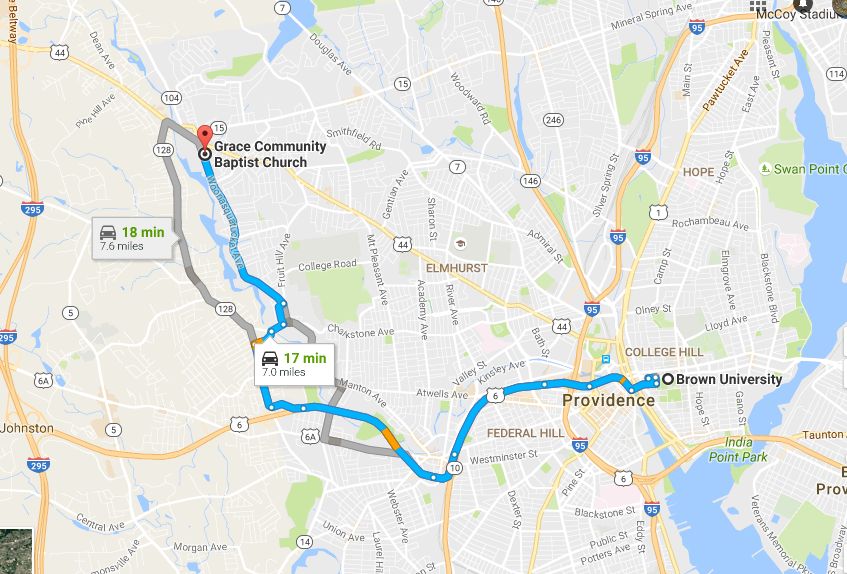
I’m from Rhode Island. I was born in Providence, I lived there a while, and it’s where my grandparents lived their entire lives. I’m very familiar with Providence.

Brown University is an Ivy League school located on what is locally known as the “East Side”.The Boston Globe describes this area as,

communities unto themselves, such as Providence’s East Side. The area is college-centric, with Brown University and the Rhode Island School of Design figuring prominently in life here. But even if you largely avoid the two college campuses, visitors still find the East Side rich in history, unique architecture, culture, and culinary flavor.

With Ivy League and Art college ‘culture’ usually comes liberalism. And so we see this headline below,

It’s enough to make me simultaneously sigh, say ‘gross’, and laugh at the absurdity of a man trying to use a tampon because he think’s he’s a woman who gets a period. SMH at biological impossibilities. Headlines like this also sadden me at the state of affairs in the world.

However I also smile in joy because Jesus never leaves us without a witness. Therefore, meanwhile…on the other side of the city, at the same time…

…at Grace Community Baptist Church, we have this-

I’m so grateful for the Lord who is the Head of His church. He is always working, raising up teachers like Dr Lawson, who teach men to preach well, who raise up solid congregations, who in turn identify more men for seminary or local leadership, who nurture youth as they grow, the next generation…

Yes these men will have their work cut out for them. Providence is a liberal city. But then again, Rome, Ephesus, and Corinth were liberal cities at the beginning. They were pagan through and through, without one believer…until the Apostles showed up. Until the women raised their boys in the Lord. Until the churches nurtured believers.

And so it goes. The Lord always leaves a witness. Elijah said to the LORD,

He replied, “I have been very zealous for the LORD God Almighty. The Israelites have rejected your covenant, torn down your altars, and put your prophets to death with the sword. I am the only one left, and now they are trying to kill me too.” (1 Kings 19:14 NIV).

The LORD answered

Yet I reserve seven thousand in Israel–all whose knees have not bowed down to Baal and whose mouths have not kissed him.” (1 Kings 19:18 NIV)

By the way, you see the first photo of Brown University’s official crest & the University’s Motto? It’s “In Deo Speramus”, which means, “In God We Hope”.
Posted in discernment, Uncategorized

Strange Fire Q&A: ?

Can you believe it has been three years since the Strange Fire Conference? Its impact continues, with men and women still using the wonderful resources at the website to confirm truth to their hearts. Many have been led out of the Charismatic chaos as a result.

For those of us who are in solid churches but sadly see it beginning to creep in, here is a Strange Fire Q&A which addresses the practicalities of being a bulwark against Charismatic practices.  How do we combat this? But first, a short backgrounder: Continue reading “Strange Fire Q&A: ?”

Posted in encouragement, Uncategorized

Etiquette of meeting the monarch

There is an HBO series called John Adams which I believe to be one of the best historical treatments of one of our Founding Fathers, John Adams. That’s the title, and there is a scene I believe to be fraught with just as much tension as any thriller, and just as much import as any broadcast news flash. The moment was Adams’ torment at how to behave at his upcoming meeting with King George, whom the newly formed United States had vanquished in the Revolutionary War. Now Adams, no longer a royal subject, as a diplomat was was preparing to meet the King.

Wrapped into the wrinkle of defining their new relationship, was also the knowledge that Adams, originally a farmer from Quincy Massachusetts, was about to meet royalty, He lacked the proper etiquette. How does one show deep respect to someone in high authority? Meeting royalty was a minefield of rules and prescribed behaviors, of which Adams knew nothing. Quick lessons ensued. Continue reading “Etiquette of meeting the monarch”

Posted in encouragement, Uncategorized

TV, Movies, the Conscience, and Entertainment

I just wanted to watch a nice movie. It had been a long and stressful week. I’d worked all of Saturday writing and by Saturday night I wanted simply to turn my brain off and watch something enjoyable without having to think to much.

I searched for a nice movie like Up. Despicable Me. Babe, Lassie 1997. Eddie the Eagle. Something nice. Children’s movies from this summer didn’t interest me. I am over Nemo, so Finding Dory wasn’t in the cards. She can stay lost as far as I’m concerned. I don’t like Rudyard Kipling so Jungle Book was out. Already saw Secret Life of Pets.

I looked up “faith based movies” and was depressed at the list. There were so many false doctrinal movies on it, and I’d seen the one or two that were good. After having resisted it all this time I tried Mom’s Night Out. Nope, terrible. I was soooo right to resist it. I tried Risen. Nope, terrible. Platitudes and mushy love talk but no Jesus as risen God and no Gospel. Also, it was agonizingly slow.

Sinking Sand seems to have emerged for a nanosecond and disappeared from every radar known to man. I spent a good half hour looking for it online or on any streaming video service. Nope.

Sigh. Continue reading “TV, Movies, the Conscience, and Entertainment”

Posted in encouragement, Uncategorized

God’s Providence is like a Pointillist painting

This essay was first published at The End Time in February, 2014

——————————————

We know that the church is a body, a united body of believers.

For just as the body is one and has many members, and all the members of the body, though many, are one body, so it is with Christ. (1 Corinthians 12:12)

The Holy Spirit ordains where each believer is to be and what gifts he is to have. He ordains where we are in the body so as to contribute to the good of the whole.

All these are empowered by one and the same Spirit, who apportions to each one individually as he wills (1 Corinthians 12:11)

It could be said that the Lord is painting a picture.

If you’re familiar with the Impressionist movement of art that emerged in the late 1800s in Paris, then you’re familiar with the works of Monet, Manet, Sisley, Renoir, & etc. These artists used short brush strokes to convey movement and impression, rather than precision. There was a sub-culture of the Impressionists called the Pointillists. Here is Georges Seurat’s famous pointillist painting, “Sunday Afternoon on the Island of La Grande Jatte“.

As the website IncredibleArt.org states,

Strictly speaking, Pointillism refers to the technique of using dots of pure color in such a way that, seen at the appropriate distance, they achieve maximum luminosity.” (source). Georges-Pierre Seurat made this technique famous. His painting,

Sunday Afternoon on the Island of La Grande Jatte (1884-1888) is one of the most famous paintings in the world. … At left you see a closeup of Seurat’s painting. It is a closeup of the the man laying down on the lower left. Even thought he appears to be wearing white pants, as you can see, the part of the pants in the shadow just above the grass has no white in it. It’s only when you look at it from a distance that the colors blend in. Seurat spent two years on this painting. He carefully planned it out with several sketches first.

It could be said, that the earth is the canvas and the people are the points of paint God daubs precisely here and there, working toward an end.

I’ve seen pointillist paintings at museums. You look very closely and all you can see are daubs of color. Dots. If you back away to a distance, you can see the scene clearly. It’s amazing how the colors blend to make a seamless and beautiful picture.

We can think of ourselves as dots. We can’t see the whole picture, we don’t have the right perspective. God does. He puts a pink next to a blue and though all we can see is the blue next to us, we have to trust that the Great Artist is making something beautiful. Even if you don’t like the color pink, you know and trust that the Artist’s purposeful placement of it next to you will make the picture as a whole perfect when it is complete.

Just like heaven.