 |
| Sure, I walk around every day in Renaissance hair and a wedding dress clutching a crumpled leaf. FYI, read to the end regarding this very verse. |
Over these last ten and twenty years we have become used to women’s ministers and Bible teachers preaching the consistent message of female empowerment of one sort or another. They put out messages like, “You are beautiful”, “You are wonderful.” “Jesus created you with a cosmically important job that only you can do”. These Bible teachers seek to encourage women, which is good, but they do so by appealing to our self-esteem and growth on the basis of strengths and qualities we possess. What their message boils down to is that we become God-approved by becoming more of ourselves. The cumulative message from all these teachers leads to a place no Christian wants to be. The end result is not growth, but apostasy; not encouragement, but despair.
Here is an example of the mixed messages we see, these are from Christine Caine, founder of Propel, a female empowerment ministry. Caine is an activist, not an evangelist, though she claims the opposite.
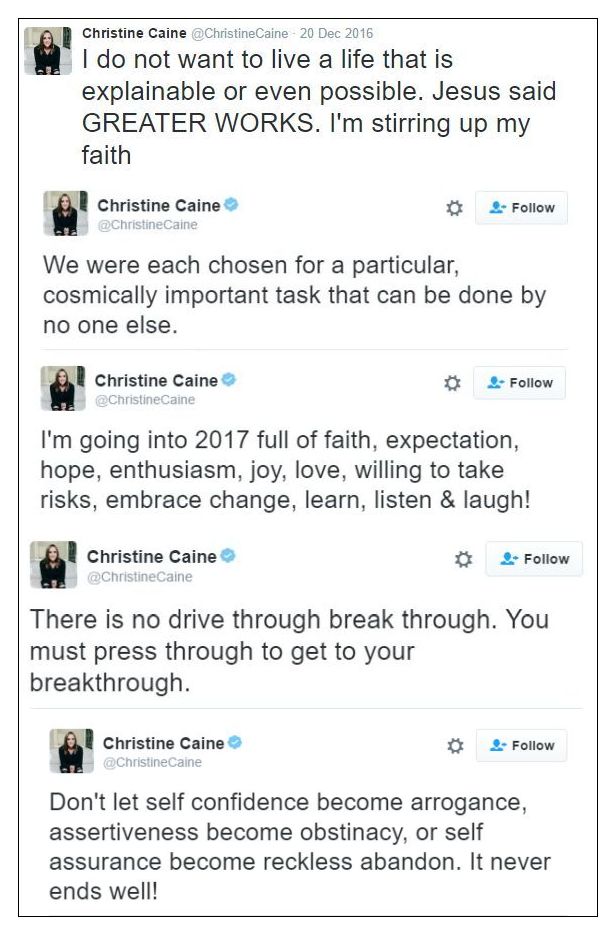
Live an unexplainable life, because you were chosen uniquely for a cosmic task ONLY you can accomplish (not God?) so press through and take risks. But don’t be arrogant, self-assertive or self-confident about it! #Mixed messages, Mrs Caine.
That’s the trouble with appealing to women’s emotions and qualities. While these teachers want to make affirmations to women that we are sensitive snowflakes melting in love with Jesus who is in turn melting in love with us, we also possess power, accomplish important tasks, and live a risky unexplainable life to accomplish it all. That is why the encouragement turns to despair- it doesn’t add up. The cognitive dissonance grates.
While previous generations of Bible teachers like early Kay Arthur and Elisabeth Elliot taught that our power is in God through submission to Him within the limits of the roles He has outlined for us, these past few generations of Bible teachers teach that our power is in us as women and it demonstrates sanctifying growth when we act on it, which God affirms by giving us more power.
Blogger Phylicia Delta wrote this week on the topic. It’s a good essay that makes the point, from which I’ll post some excerpts below-
Dear Women’s Ministry, Stop Telling Me I’m Beautiful
If I judged Christianity by its women’s conferences, I’d be led to believe that the Bible is no more than a series of compliments from God to man. Instead, the real story is far less complimentary and far more humiliating. Jesus didn’t come to earth because we were beautiful, special, or great. He came because we were too grossly sinful to bridge the gap between ourselves and God.
That’s not a message we want to hear from the stage of Extraordinary Women, is it? But it’s the one we need, because women who think they’re pretty awesome don’t need a Savior. [emphasis hers]
The truth is that I’m not beautiful, special, or all that unique. I’m born into sin, bent to rebellion. My insecurities and fears are too deep, pulsing through Adam’s blood in my veins. They can’t be rooted out with shallow “encouragements”.
The solution is simple. Stop preaching the easy message, and start preaching the right one. Stop exalting us as women and start exalting Christ.
A few days later, I noticed this satirical post from the Babylon Bee, which makes the point about the end result of all these esteem-laced female “encouraging messages”.
Woman Unsure Why She Needs Jesus After Preacher Spends 30 Minutes Telling Her How Amazing She Is
TWIN OAKS, AZ—According to reports coming out of Hope Community Church, first-time visitor Brittany Wilson remains unsure about why she needed “this Jesus guy” in her life after the pastor spent the entire Sunday sermon reiterating how awesome, amazing, unique, and special she is.
“The message was super-encouraging. It was all about how I need to let the goodness within me shine and ‘just do me,’ without worrying about all the haters,” Wilson said after the service.
“But then the pastor said I needed Jesus, out of the blue. Like, what? It made no sense. I’m not sure what He has to offer that I don’t, based on how wonderful the pastor said I am.”
Do you see the devastating cumulative effect of the mixed messages? The point of these particular kind of women’s studies and Bible teachers is to appeal to the pride of life. Satan did it in the Garden with Eve. Resist, ladies! The main way to resist being deceived is to stay in the Word. Read and study the Bible. Another way is also feed on good and solid books and studies, like this one-

Women’s Ministry in the Local Church
I have not read this book but it is on my ‘to-read’ list.
There is a way to do women’s ministry biblically. This book addresses that. Here is the publisher’s synopsis:
Susan Hunt and Ligon Duncan walk through the Scriptures to help readers better understand what it means to have an effective, biblical women’s ministry in the church. The benefits of women’s ministries are great: training and discipling, evangelizing, and reaching out to the poor and needy. This book, written by seasoned ministry leaders, provides many proven tools to help start a women’s ministry in your church.
Here is a verified purchaser’s review of the book:
This book was very helpful in understanding the biblical view of women’s roles in the church. It encourages the empowerment of women in a positive way. This is an excellent guide for developing a meaningful ministry to women of all ages within the church body. Women want to know how God can use them to make a difference for His kingdom and this book addresses that concern very well.
As for the difficulty with many female Bible teachers in this day and age, and the Instagram, Pinterest, & other Social Media picture verses they put out… the Isaiah 43:4 verse above is a partial verse! Usually when a partial verse is written, it’s proper to indicate so, either by stating it or by putting a or b after the verse to show if it’s the beginning part of the verse one has excerpted or the latter part of the verse you’ve excerpted. In this case, the verse should read Isaiah 43:4a since the author saw fit to only paste the first half of it.
The FULL verse reads:
Since you were precious in my sight, you have been honorable, and I have loved you: therefore will I give men for you, and people for your life.
The word “since” here is key. It connects the former verse to the latter verses. It is a concluding thought. As a reader one must have the previous verses in mind when arriving at the conclusion, which in this case begins “Since”. Excising the since off the verse destroys both the meaning and the context.
So first, ladies, when you re-post a social media verse like this, check the actual Bible to see it is at the address stated and if it is the entire verse.
Secondly, CONTEXT is key. In the verse, God has been talking to the Prophet Isaiah to tell the NATION ISRAEL His message, not special snowflake ladies in the 21st century. Moreover, He is not telling them that He is so in love with them, as the way the verse is presented over the photo. He is saying that he is setting apart the NATION and will keep it intact, even to the point of KILLING men (nations) to do so. Puts a different spin on the whole thing, doesn’t it? Barnes’ Notes explains the verse:
Since thou wast precious in my sight – This verse contains another reason why God would defend and deliver them. That reason was, that he had loved them as his people; and he was willing, therefore, that other people should be overcome in order that they might be saved.
Thou hast been honorable – This does not refer so much to their personal character, as it does to the fact that they had been honored by him with being the depository of the precious truths of his religion. It means that he had made them honorable by the favors bestowed on them; not that they were honorable in reference to their own personal character and worth. [emphasis mine]
Therefore will I give men for thee – As in the case of Egypt, Ethiopia, and Seba Isaiah 43:3. He would cause other nations to be destroyed, if it were necessary, in order to effect their deliverance, and to restore them to their own land.
Puts an entirely different spin on things, doesn’t it?
I hope you have enjoyed reading this two-fold lesson. Firstly, we looked at women’s ministries and how their skewed emphasis perverts the mind of women into thinking their inherent worth is the reason God is so concerned with them. I quoted from two articles, one was a well-written article from Phylicia Delta and the other was a satire piece from the Babylon Bee.
Secondly I used as an example one of the women’s ministry photos I found on Pinterest to demonstrate how verses are twisted to falsely emphasize how God is allegedly concerned with women as special women He is in love with. Double check all memes before posting, please.
Now that you are aware of these discernment issues, what can we do about them? You can buy the above mentioned book by Duncan and Hunt about Women’s ministries. You can pause before clicking the meme to check that it’s actually a verse, the whole verse in context, and the correct address. You can check out the MOOC (Massive Online Open Course) offered for free at Southwest Baptist Theological Seminary called Biblical Theology of Womanhood I and II. It’s free. I have not taken it so I can’t say one way or another if it’s good. I have signed up. I’ll let you know. There are many free courses, usually MOOCs, that can be taken either through colleges or seminaries or places like Ligonier or other parachurch ministries. As always, use your prayerful discernment when submitting to teaching.
Ladies, don’t be taken in by pop psychology self-esteem teaching. We love who Jesus made us to be, but we love him more for who He is.
 the-end-time.org