Posted in discernment, Uncategorized

What does it mean to teach by allegorizing the scriptures?

Twisted scriptures

In 2 Peter 3:16, Peter wrote,

as he does in all his letters when he speaks in them of these matters. There are some things in them that are hard to understand, which the ignorant and unstable twist to their own destruction, as they do the other Scriptures.

First, please note that he said that those who twist the scriptures do so to their own destruction. So often when I write about false teachers, false doctrine, and actually name the false teachers of doctrine, the ignorant and unstable become upset with it. They fire angry emails and comments asking what have I done lately for the Lord. They charge me with failing to pray for these misguided souls. They claim the false teachers are just making a temporary mistake and all will come out right in the end if we but have patience and love.

Not so.

Scripture twisters to be destroyed

They twist the scriptures to their own destruction. Here is MacArthur commentary on that part of the verse:

By distorting the scriptures, the false teachers were simultaneously securing their own destruction, (cf. 2:2, 3-12, 3:7; Jude 10, 13; Rev 22:18-19) as well as the spiritual demise of their followers. That’s why Peter warns his beloved readers beforehand,  so that they might be on their guard against the error of such unprincipled men (Phil 3:2; 1 Tim 4:1-7, 6:20-21; 2 Tim 2:15-19; Titus 1:16, 3:10).

Distorting the scriptures is a serious business. The many warnings not to do so should be taken seriously, not the least reason is that there are so many ways to distort the scriptures. This essay discusses two of them, spiritualization and allegorization, which are very similar.

Allegorization: A Twisted Practice

Here is John MacArthur defining spiritualization/allegorization:

What do you mean spiritualize or allegorize? Well, you use Scripture like some kind of story and make it mean whatever you want.

Here is Rev. Matt Slick defining allegorization:

To allegorize means to use a symbol as representing a more complex idea.

An example of this erroneous method of interpreting the Bible is recounted by John MacArthur, when he did just that in his very first sermon:

John MacArthur on “Don’t Spiritualize

Third, don’t spiritualize the straightforward meaning of a Bible verse. The first sermon I ever preached was a horrible sermon. My text was “An angel of the Lord descended from heaven and came and rolled away the stone” (Matthew 28:2). My sermon was “Rolling Away Stones in Your Life.” I talked about the stone of doubt, the stone of fear, and the stone of anger. That is not what that verse is talking about; it’s talking about a real stone. I made it into a terrific allegory at the expense of its plain meaning.

On another occasion I heard a sermon on “they cast four anchors…and wished for the day” (Acts 27:29 KJV); the anchor of hope, the anchor of faith, and so on. Those Acts 27 anchors were not anchors of anything but metal. … Don’t spiritualize the Bible; study it to gain the right meaning.

It’s not just men who allegorize. This wrong method of interpretation appeals to many false women teachers, too. It seems like a good method for the women who are emotionally driven and spiritually lazy. Like Beth Moore.

Exegetical Errors – If Mrs. Moore is exercising the position of a Bible teacher, then she should be able to properly exegete Scripture. Unfortunately, she is guilty of frequent allegorization where she misapplies Scripture. To allegorize means to use a symbol as representing a more complex idea. The problem is that with allegorizing, Scripture can be made to say almost anything. Let’s take a look at a few of the many examples of Beth Moore’s improper biblical interpretive practices.

Quote: Speaking of the demoniac of Matt. 8:28-34, she says, “before we proceed to the next point, consider a fact revealed in verse 27. The demonic didn’t live in a house. He resided in the tombs. I wonder how many people today are living “in the tombs”? I know a woman who is still so oppressed by despair that decades after the loss of a loved one, she still lives “in the tombs.” (Jesus, the One and Only, by Beth Moore, B & H Publishing Group, Nashville, Tenn., 2002, p. 143-144).

Response: The biblical text is about Jesus’ authority over the demonic realm, not about people living “in the tombs.” The two demoniac’s that were living in these dark places were exceedingly violent (v. 28). They said to Jesus, “What do we have to do with you, Son of God?  Have you come here to torment us before the time?” Jesus then commanded the demons in these two men to leave, and they went and entered into swine (vv. 31-32). The point of the text has nothing to do with people who are held in bondage by emotional traumas. Beth’s allegorizing the text to make it fit her need is a wrong use of the text.

As both John MacArthur and Matt Slick stated, the danger of spiritualizing and allegorizing is that the person who is spiritualizing can just pick out of the air any symbol they want to make mean something and use it to interpret the Bible that way. Once you unhitch from the text you can then insert any symbol for any meaning or interpretation you like. “In the tombs” are not actual tombs, but symbolizes woman in despair. The “anchors” are not anchors but stand for faith, hope, etc. The “stone” was not a stone but symbolized fear. If I decided to allegorize those same texts I could decide that tombs means marginalized people in social injustice, anchors means lack of sanctification progress, and stone means hindrance to prosperity. Voila.

The only acceptable allegorizations

The Bible does have some allegories within it that can be explained as they are. There’s –

  • Nathan’s parable of the rich man who killed a poor man’s beloved pet lamb, 2 Samuel 12:1-4
  • Jesus’ parables have a wide range of degrees of allegorical symbols, many of them explained in the text just after the recording of the parable itself.
  • In Galatians 4:21-31 Paul uses the story of the children of Sarah (Isaac) and Hagar (Ishmael) and the images of Jerusalem above and Mount Sinai as a double allegory, which Paul then goes on to explicitly explain. “Now this may be interpreted allegorically: these women are two covenants…(v. 24)

No need to make up our own symbols when the few times allegories are used in the Bible they are already explained for us. Nor does the presence of allegories in the Bible give us license to continue our own allegorizations. Scripture interprets scripture.

Good interpretive practices

This article from 9Marks discusses the 9 marks of a prosperity gospel church by comparing good church practices with prosperity church practices. One could just as easily substitute any false practice by comparing to these 9 good marks. Topping the list is that a good church will practice expositional preaching on a regular basis.

Expositional preaching is

…at its simplest is preaching that is focused on explaining the meaning of Scripture in its historical and grammatical context. Expositional preaching involves explaining what the Bible says to a contemporary audience that is likely unfamiliar with the cultural and historical settings that the passage was written in.

The word exposition simply means “a setting forth or explanation.” So expositional preaching is the explanation of Scripture that is based upon diligent study and careful exegesis of a passage. It is the primary call of the pastor or preacher as we see in 2 Timothy 4:2: “Preach the word! Be ready in season and out of season. Convince, rebuke, exhort, with all longsuffering and teaching.”

No need for application

Where many preachers get into trouble is that they believe their sermon needs some sort of ‘application’ at the end. It could be that they have interpreted rightly, have explained the text in a solid expositional sermon, but when they get to the end they feel that it needs explicit teaching on how to apply the text to their congregants’ lives.

Here is an answer to the oft-asked question “Why Doesn’t John MacArthur Add much Application to His Sermons?” He is asked this because he is one of America’s best known-preachers for teaching exposionally, having taught verse-by-verse through the entire New Testament over the course of 42 years. Yet there is very little application in any of his sermons. Here’s why:

Now let me tell you what happens when you preach effectively. You do explanation. In other words, you explain the meaning of Scripture, okay? The explanation carries with it implication. In other words, there are implications built into this truth that impact us. You add to that exhortation. And I’ve said things tonight to exhort you to follow what is implied by the text. Now when you deal with the text and the armor of God, like tonight, all I can do is explain it. That’s all it does. There aren’t any applications in that text. It doesn’t say, “And here’s how to do this if you’re 32 years old, and you live in North Hollywood.” “Here’s how to do this the next time you go to a Mall.” “Here’s how to do this when you go in your car and you’re driving in a traffic jam.” It doesn’t tell you that. And if I made my message mostly a whole lot of those little illustrations, I would be missing 90 percent of you who don’t live in that experience.

It’s not for me to do that. Application belongs to the Spirit of God. All I’m interested in is explanation and its implications. And the power comes in the implication and the Spirit of God takes the implications of what I’ve said tonight, all these things I’ve said, I don’t need to say all kinds of little scenarios to you and paint all kinds of little individual circumstances. All I need you to know is this is what the Word of God says and the implications are powerfully brought to bear with authority on your life and I exhort you to respond to those implications, it is the Spirit’s work to drive those implications into direct and personal application.

Ladies, I Warn About Beth Moore Again

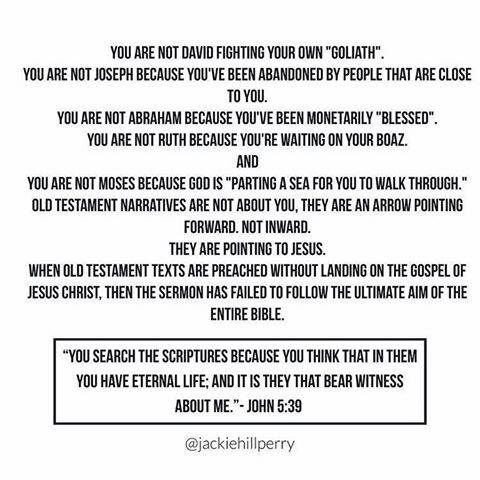
I’d like to refer you again to the picture at the top. I’ve listened to a lot of Beth Moore as well having listened to as other ladies who claim to be good Bible teachers. Beth Moore is not a good Bible teacher. If you have gone through her “Bible studies” please think about how many of the examples Moore has used like the ones in the picture at the top. The example from Matt Slick is only one of the several of Moore’s faulty interpretations he reported. Chris Rosebrough has also explained why Moore’s allegorizations are faulty. So has Justin Peters. Mike Abendroth. And so on.

I consider Moore “patient zero” in the infection into conservative, evangelical circles of her faulty way of teaching through made-up allegory. She has done it that way for so long that generations coming up are now also teaching it that way.

I warn you to avoid any teacher who consistently uses allegorization as their main way of interpreting scripture. Remember, they twist to their own – and their followers’ destruction.
Posted in discernment, Uncategorized

How does the Holy Spirit lead us?

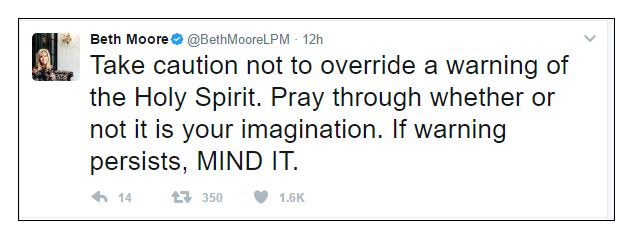
On Facebook last night I’d posted a mini-discernment lesson regarding a tweet Beth Moore had written advocating a process for distilling whether a prompt from the Holy Spirit is legitimate or if it’s your own imagination. I wrote the following in response to her tweet:

moore tweet

Beth Moore is an alleged ‘Bible teacher’. She has 753,000 followers on Twitter alone. The following comment is something she taught a few hours ago on Twitter. Nothing in the Bible says what she taught and teaches. What solid and credible Bible teachers do is teach their pupils to go externally and seek the source of all truth, the Word of God. Moore teachers women to go internally and rely on mystical warnings, feelings, and prompts. What Moore is actually teaching is the insufficiency of scripture and the sufficiency of ourselves in obeying personal feelings.

If Moore was a true Bible teacher she should have written that we seek wisdom from the Bible and follow its commands. We do not rely on the timing of mystical feelings in order to make decisions. We don’t even have to wonder if it is our imagination if we read it in the Word of God. Here is what she should have written-

“Take caution not to override a command of the Lord in His word. Pray persistently in seeking the strength from the Lord you need to obey what is written. Mind the Lord and His statutes.”

I thought that it would be obvious that Moore is teaching something extra-biblical. Obvious.

I was wrong.

I received several comments, one of which asserted that I’d misunderstood the tweet. While it’s always possible I misinterpret an author’s intent within the confines of a 140 character tweet, in this case I’ve studied Moore’s work widely enough to know that I had not done that in this case. I also thought the tweet was plain enough in its assertion.

Another commenter tried to to convince me that there was room for direct revelation. She knows there’s room, she said, because though 99% of the time scripture is enough, sometimes God speaks “very clearly” to her and she knows it’s Him because what He says comes true according to her wishes and wants at the time.

If scripture isn’t sufficient 100% of the time, it is not sufficient at all. God is not speaking clearly or audibly to anyone in any form, not in…

whispers
prompts
leadings
warnings
impressions on our heart
‘told me’
spoke audibly

…because the Bible says that God has spoken though His Son, who IS the Word. (Hebrews 1:2)

Peter said personal experience is never a proper validation of God’s authority, because the word is more sure. (2 Peter 1:19). I notice in these kind of discussions that people assert that it must be God is telling them stuff because what they wanted is coming true. However I notice it never seems to be the case that ‘the Lord told us very clearly one of us will die from cancer’, or ‘the Lord told us very clearly that we will never have children,’ or ‘the Lord told us very clearly that I should stop sinning via pornography.’ No, the direct leading of the Spirit people claim they receive are never that kind, the type that brings bad news against their wish list or commands the person to slay their besetting sin.

Worse, women who claim “He told me very clearly that…” means the woman is claiming prophet status – which elevates her to a position she does not have. Moreover, it discourages other women who have not had the privilege of “hearing directly from God”. They begin to doubt their situations when they aren’t given such personal, clear commands.

One commenter did ask a good question, which formed the basis for this post. She asked, “Where does the Holy Spirit come into it?” Her question is a good one, but a sad one. An entire generation of women have been taught by the Beth Moores etc. that we should expect to be directly (or audibly) led by God, that they do not know what to be led by the Spirit actually means. So here is a post on what it means to be led by the Spirit.

We know the Spirit does lead us. One verse in particular comes to mind, Romans 8:14, where it says so.

For those who are led by the Spirit of God are the children of God.

Now, the Holy Spirit does guide us and convict us and teach us and help us but not in a way we know at the time. You might look afterwards and say, gee, that sure was from the Lord. But at the time, we cannot, must not, rely on feelings, prompts, whispers, inclinations, or imaginations, and attribute them to God. That is dangerous because the flesh is at war with the Spirit. One can never really know if it’s the flesh or not. We are commanded not to obey the flesh, but to slay it. (Mt 16:24). Just because Beth Moore teaches that if the feeling hangs around long enough it must be God is ridiculous on the face of it. The flesh is persistent. Very persistent.

It’s also mysticism and divination to follow promptings and claim they were from God. How can we interpret? We can’t, we’re sinful. So while the Spirit leads, His main ministry is to point to Jesus, who is the Word. John 16:14. That’s why a good teacher also points to the Word, which is more sure.

Here is John MacArthur on the Romans verse 8:14, with a very simple explanation of the Spirit’s leading:

How does He lead us? Two ways. Externally, by the Scripture – externally, by the Scripture, Psalm 119:18: “Open my eyes that I may behold wonderful things from Your law.” Show me the truth of Scripture. Externally by Scripture, internally by sanctification. Those two ways. Externally, Scripture; internally, sanctification.

Therefore, there’s no need for a teacher such as Moore to teach an extra-biblical process for figuring out if the prompting is imagination or not.

Sinclair Ferguson at Ligonier Ministries has a good take on leading by the Spirit, which concurs with MacArthur’s in terms of the main leading of the Spirit being illumination of the scriptures. Remember, the point of the Spirit’s ministry is to point to Christ – who is the Word. (John 16:14, 1 John 4:2).

Spirit of Light, by Sinclair Ferguson
Why, then, are Christians today—in contrast to their fathers—so thirsty to experience immediate revelation from God, when His desire for us is the ongoing work of the Spirit opening up our understanding through the mediated revelation of the New Testament? There seem to be three reasons:

1. It is more exciting to have direct revelation rather than Bible revelation. It seems more “spiritual,” more “divine.”

2. For many people, it feels much more authoritative to be able to say, “God has revealed this to me” than to say, “The Bible tells me so.”

3. Direct revelation relieves us of the need for painstaking Bible study and careful consideration of Christian doctrine in order to know the will of God. In comparison to immediate revelation, Bible study seems—to be frank—boring.

Lest we be brow-beaten and develop a kind of siege mentality as Reformed Christians, here are some things we should bear in mind about the work of illumination:

This is the divine method that produces authentic Christian growth, because it involves the renewal (not the abeyance) of the mind (Rom. 12:2) and it is progressive (it takes time and demands the obedience of our wills). Sometimes God does things quickly. But His ordinary way is to work slowly and surely to make us progressively more like our Lord Jesus.

The result of the Spirit working with the Word of God to illumine and transform our thinking is the development of a godly instinct that operates in sometimes surprising ways. The revelation of Scripture becomes, in a well-taught, Spirit-illumined believer, so much a part of his or her mindset that the will of God frequently seems to become instinctively and even immediately clear—just as whether a piece of music is well or badly played is immediately obvious to a well-disciplined musician. It is this kind of spiritual exercise that creates discernment (see Heb. 5:11–14).

In other words, the Spirit leads us by slowly conforming us to Christ-likeness through the application and illumination of the word in us. Our affections change. As MacArthur above said, by the word externally and by inner sanctification as the word works through us.

Now, is there such thing as impressions or promptings? Ferguson below then Phil Johnson below that, explain…yes…and no.

Ferguson from the Ligonier article above:

Well-meaning Christians sometimes mistake the Spirit’s work of illumination for revelation, which, unhappily, can lead to serious theological confusion and potentially unhappy practical consequences. But the doctrine of illumination also helps us explain some of the more mysterious elements in our experience without having to resort to the claim that we have the gift of revelation and prophecy.

Here the late John Murray spoke with great wisdom: “As we are the subjects of this illumination and are responsive to it, and as the Holy Spirit is operative in us to the doing of God’s will, we shall have feelings, impressions, convictions, urges, inhibitions, impulses, burdens, resolutions. Illumination and direction by the Spirit through the Word of God will focus themselves in our consciousness in these ways. (Collected Writings, I, p. 188).

Again, it’s through the Word.

Phil Johnson, Shepherds Conference 2002, “Super Seminar: Private Revelations”

Now, does the Spirit of God ever move our hearts and impress us with specific duties or callings? Certainly. But, even in doing that, He works through the Word of God. Experiences like this, impressions and all, are not in any sense prophetic or authoritative except as they echo what the Word already says. They are not revelation. Those sensations, those impressions, those feelings you get are not revelation, but they are the effect of illumination. When the Holy Spirit applies the Word to our hearts, and opens our spiritual eyes to His truth. And, we need to guard carefully against allowing our experiences and our own subjective thoughts and imaginations to eclipse the authority and the certainty of the more sure Word of God. This is a very practical application of the principle of Sola Scriptura.

Think about this…to what ever degree you seek private messages from God outside His Word, you have abandoned the principle of Sola Scriptura.

It is simpler and more direct to say something like “My husband and I decided to adopt 3 children” rather than “The Spirit led us to the adoption agency.” It’s more honest to say, “We decided to purchase the organ for the church because we adhere to the biblical principle of cheerfully giving” than to say “We felt led by the Spirit to drive down Main Street where we saw the organ store and God clearly told us to buy it.”

The Spirit leads us into sanctification, where we gradually and inexorably conform to Jesus’ likeness, not by having Him specifically give us explicit directions for certain actions at any given time. But what a joy to know He does lead us!

Posted in discernment, Uncategorized

What is ‘Bridal Mysticism’? And why is it so prevalent?

In 2005, Beth Moore was interviewed by Today’s Christian Woman magazine. They asked Moore:

Q. What led you to Jesus?

A. Beth Moore’s [2005] answer:

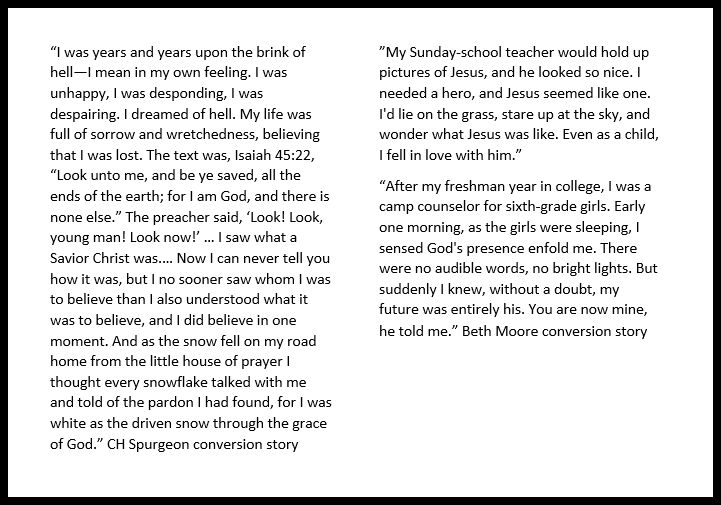
My Sunday-school teacher would hold up pictures of Jesus, and he looked so nice. I needed a hero, and Jesus seemed like one. I’d lie on the grass, stare up at the sky, and wonder what Jesus was like. Even as a child, I fell in love with him. After my freshman year in college, I was a camp counselor for sixth-grade girls. Early one morning, as the girls were sleeping, I sensed God’s presence enfold me. There were no audible words, no bright lights. But suddenly I knew, without a doubt, my future was entirely his. You are now mine, he told me. (source)

If that sounds familiar, it’s because it is very much like many other false teachers’ conversion stories.

It’s a testimony devoid of essential Gospel elements such as sin or repentance, but rife with romantic eroticism. Sarah Young describes her experience this way:

Suddenly I felt as if a warm mist enveloped me. I became aware of a lovely Presence, and my involuntary response was to whisper, ‘Sweet Jesus.’ This utterance was totally uncharacteristic of me, and I was shocked to hear myself speaking so tenderly to Jesus. As I pondered this brief communication, I realized it was the response of a converted heart; at that moment I knew I belonged to Him. (source)

Bob Dewaay explains the problems with such erotic romanticism.

The Bible speaks of the church as the Bride of Christ but does not describe the universal call of the gospel in sensual terms of a lover pursuing His love interest (who may have no interest in return). God is commanding sinners to repent. The gospel calls for repentance and faith, not romantic feelings looking for satisfaction. Voskamp’s romanticism is enhanced by her skill at describing things in a most sensual manner. The sensual terminology is designed to create a mood, a feeling, a sense of romantic mystery that longs for discovery and fulfillment. Those like me who relish clear description of theological concepts meant to be understood and discerned, will be horribly frustrated by the book. Her book is not meant to be a theological text filled with ideas to be judged true or false, but is instead a literary piece filled with feelings to be relished.

Conversion and life in Christ is not the fulfillment from a young girl’s romantic heart, yearning for a boyfriend. It’s the majestic gift of grace from a powerful but merciful God who draws people to Himself and forgives of sin, making them a new creation. Moore’s yearning for a heroic boyfriend is not the same as Godly reconciliation and peace from the spiritual battle in which all are engaged. Sadly, Moore has built a career on the false premise, and many millions have followed her down that path.

Such romanticism is not new nor did it originate with Protestants. Some Catholic mystics were adept at seeking and enjoying such unions. These women were popular in the Middle Ages. Here is an explanation of this kind of conversion story related to a famous Catholic mystic, Teresa of Avila:

Teresa described the soul’s intense desire for God in the language of erotic passion. In this, she belongs to a long tradition of mystical experience that is known as bridal mysticism. … 

The symbolism of bridal mysticism is found already in early gnostic forms of Christianity, where the central sacrament is called the Bridal Chamber. There the feminine soul of the gnostic unites with the masculine spirit and is in this way spiritualized, that is, liberated from the limitations of mundane existence.

The Catholic Encyclopedia explains mystical marriage:

In a more restricted sense, the term mystical marriage is employed by St. Teresa and St. John of the Cross to designate that mystical union with God which is the most exalted condition attainable by the soul in this life. … This state consists of three elements:
1. The first is an almost continual sense of the presence of God, even in the midst of external occupations.
2. The second element is a transformation of the higher faculties in respect to their mode of operation: hence the name “transforming union”;
3. The third element consists in an habitual vision of the Blessed Trinity or of some Divine attribute.

You notice in the writings of these women, especially Voskamp and Young, they mention “Presence”. That’s mystical bridal union state #1.  For example, Voskamp wrote,

The practice of giving thanks . . . eucharisteo . . . this is the way we practice the presence of God, stay present to His presence, and it is always a practice of the eyes.

This notion of continual presence and feeling it tangibly comes from a book written by Brother Lawrence, called Practicing the Presence, who was, you guessed it, a 17th century Catholic mystic.

These “mysti-chicks” such as Voskamp, Moore, Kim Walker Smith and Young, also mention that they have experienced bridal mysticism’s heightened senses and a clarity of thought, and third, they say they continually hear God or see angels or have habitual visions. Just as the Catholic encyclopedia says occurs in their descriptions of what they claim is the state of bridal mysticism.

Compare those flimsy, feelings & emotion saturated female ecstasy conversion stories with a real conversion story. This one is drenched in the scriptures.

Beth Moore’s conversion answer to the Christian reporter was terribly sad in its absence of anything remotely Gospel. A mysti-chick seeking a handsome hero to enfold her and keep her forever is a conversion story more attuned to bridal mysticism than the gritty realty of a repentant sinner saved by grace through faith.

And that’s bridal mysticism. As for the second part of my original question, why is it so prevalent? It is because apostasy is always present. As long as Christianity exists in this age, there will be those who claim to possess a transformed heart but do not possess one.

Now the Spirit expressly says that in later times some will depart from the faith by devoting themselves to deceitful spirits and teachings of demons, (1 Timothy 4:1)

Some of these people making the claim will be teachers, pastors, leaders. If you believe that false converts should be easy to spot, you’re wrong. Judas lived intimately with the disciples and Jesus for three and a half years and none of the disciples even suggested Judas as the false one when Jesus said there is one among them. Philip baptized Simon the Sorcerer, who later was cursed because he thought he could obtain the Spirit by money. Demas walked with Paul, the greatest evangelist on earth, but he showed his true colors when he left Paul because he loved the world more.

If the Disciples, Philip, and Paul could not initially spot a false convert under their nose, neither can we. However, false converts always do or say something eventually to reveal who they really are.

So, mysti-chicks did not originate with post-modern Christianity, nor did they originate in the Middle Ages’ Catholic bridal mysticism. They’ve been around as long as metaphorical Jezebel, whom Jesus threatened to strike dead. (Revelation 2:20-23). Be wary of teachers who have a conversion story absent of the necessary elements, who have added elements, or who have relied on some sort of temporal experience as the basis for their conversion. They must have a clear view of who Jesus is, (Savior) and who they are, (sinner) from the start. Not a mature perspective, because converts are babes in Christ, but a correct one. A house built on sand will not last.

For the ladies who wonder if it is OK to read or study under these false female teachers’ earlier works, ‘when they still seemed solid,’ just remember their conversion was based on sand. They were never solid.

Build Your House on the Rock
Everyone then who hears these words of mine and does them will be like a wise man who built his house on the rock. And the rain fell, and the floods came, and the winds blew and beat on that house, but it did not fall, because it had been founded on the rock. And everyone who hears these words of mine and does not do them will be like a foolish man who built his house on the sand. And the rain fell, and the floods came, and the winds blew and beat against that house, and it fell, and great was the fall of it.” (Matthew 7:24-27).

See below the conversion story of a 16 year old Charles Spurgeon, compared to the 18 year old Beth Moore conversion story. House of sand indeed.

Posted in discernment, Uncategorized

Two divorce cases: Summer White and Melissa Moore

Many Christians have a sin or an issue which they have a particular affinity against or former involvement with. Children of alcoholics tend to have an interest in the Christian discussion of teetotaling. People who had been deceived by charismatic doctrine tend to be focused on deception/purity in the church. And so on.

Mine is divorce.

Continue reading “Two divorce cases: Summer White and Melissa Moore”
Posted in discernment, Uncategorized

Jude’s dreamers and Beth Moore’s necromancy

Consider this statement from Jude 1:8. Jude is talking about ungodly people, false teachers who are already marked out for condemnation, grace-perverters.

Yet in like manner these people also, relying on their dreams, defile the flesh, reject authority, and blaspheme the glorious ones.

Look at the part of the verse which casts a negative light on their reliance on dreams, where I’d underlined. What kind of dreams are meant here? MacArthur Commentary,

The wicked behavior of such men derives from their dreaming a term that Jude uses to identify these apostates as phony visionaries. The New Testament normally uses the noun onar to refer to dreams (Matthew 1:20, 2:12, 13, 19, 22, 27:19), but here Jude chose a form of the verb enupniazo, which is used only one other place int he New Testament, Acts 2:17. In that passage, Peter (preaching on the Day of Pentecost) declared, “‘And in the last days it shall be, God declares, that I will pour out my Spirit on all flesh, and your sons and your daughters shall prophesy, and your young men shall see visions, and your old men shall dream dreams.

Joel’s prophecy (Joel 2:28-32) and its affirmation in Peter’s sermon show that the dreams in question may refer to revelatory dreams (rather than normal dreams). During the Tribulation, prophecies, revelations and visions that have now ceased will return, along with divine revelation. God will speak to people through dreams, just as he did earlier in biblical history )e.g., Joseph in Egypt, Daniel in Babylon, and others).

False teachers often claim dreams as authoritative divine source for their “new truths” which are really just lies and distortions. Such claims allow apostates to substitute their own counterfeit authority for God’s true scriptural authority

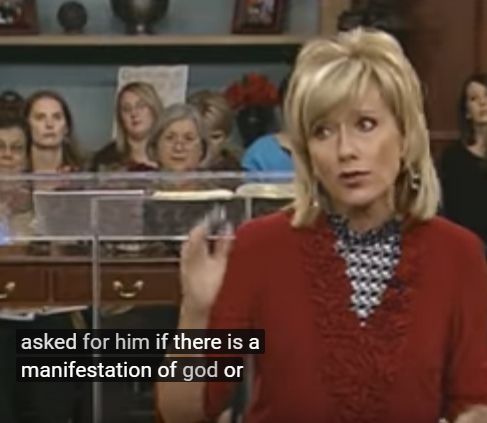
At this point in writing the essay I decided to Google some quotes where a famous false teacher had mentioned dreams and end it there. I started with Beth Moore because she’s been around longest and had a higher likelihood of a quote somewhere regarding being a ‘dreamer’ as Jude puts it. I was absolutely shocked as this result came up on Youtube. It is a clip from the LifeToday program on television with James Robison from 6 years ago. At least, Moore mentions that she was 53 years old in the clip and she is 59 years old as of this writing. The 10-minute clip shows Moore describing a dream that she had had, and then its meaning and interpretation. But it’s worse than just a revelatory dream. Much worse.

In the clip, Moore fervently affirms that she just loves Jesus so much and the dream ‘he’ gave her just makes her love ‘him’ all the more. Moore’s friend is Mary Beth Chapman, wife of Grammy and Dove Award winning recording artist, Steven Curtis Chapman. About a year and a half prior to Moore’s dream, her friend Mary Beth had tragically lost her adopted Chinese daughter Maria to a car accident. Mary Beth had been in deep grief.

Moore opened by explaining that in all her 53 years she did not dream that vividly and she never had a dream from God. Though she’d repeatedly prayed and asked for Him to send her a dream,  she explained that God ‘said’ to her that “some people are just safer with the Word on the page.” (1:31 in the clip. By the way, this is an admission that Moore seeks extrabiblical revelation, and that she knows exactly that dreams are extrabiblical revelation).

Her dream involved seeing Mary Beth at a sound stage about to speak to an audience, with her dead daughter holding her hand, in a body and dressed in a white shirt with chunky bangs. At the time, Mary Beth Chapman hadn’t written her book and was not touring sound stages speaking to audiences. Not yet.

The glaring problem with Moore’s description of the dead child is that the redeemed of heaven do not have bodies yet.

Moore explained that every night she prays He would send her a dream or a manifestation, she seeks it earnestly. Luke 11:29 and Luke 11:16 state that an evil generation seeks a sign. So her first mistake was to test the Lord by continually asking for a dream or a manifestation. (her words).

Her second mistake was not recognizing instantly that the dream she’d had was not from the Lord. Why? God abhors communing with the dead. It is a practice that He strenuously forbade the Israelites to engage in (Deuteronomy 18:10-12), calling it an abomination. The New Testament is also firm against sorcery, divination, and necromancy. (Galatians 5:19-21, Revelation 21:8).

Necromancy is defined as the conjuring of the spirits of the dead for purposes of magically revealing the future or influencing the course of events. In the Bible, necromancy is also called “divination,” “sorcery” and “spiritism” and is forbidden many times in Scripture (Leviticus 19:26; Deuteronomy 18:10; Galatians 5:19-20; Acts 19:19) as an abomination to God. It is something that the Lord speaks very strongly against and is to be avoided as much as any evil. (source

There is no reason to believe that a deceased person has any ability to leave heaven or hell in order to visit his living family members. Any such claim is a demonic deception (2 Corinthians 11:14-15). God declared such practices to be abhorrent to Him, and those who did practice such things in Israel were to be put to death (Leviticus 20:27; Deuteronomy 18:10-12). Satan would like nothing more than for people to dabble in the occult world of spiritism and necromancy. (source)

Moore’s third mistake was interpreting the dream herself. Genesis 40:8 plainly says that interpretations belong to God. Moore went on in the clip to interpret the dream herself. She said that the dream meant that Mary Beth was being called by God to speak in front of audiences. She further interpreted that God sent the dream to Moore and not to Chapman because it was too soon after the accident for Chapman as a mother to be able to handle seeing her daughter.

 Chapman said in an interview that she had desired a dream, too. She and her husband desired to see their dead daughter.

After the accident, we avoided the house for several days. We were begging God to show us himself in this, because this was clearly the darkest place he had taken us, and we were drowning. We were like, God, please, let us see. Let us see Maria. Let us have a dream. Let us see something so we know that you’re here. (Mary Beth Chapman)

The scriptures say,

For the living know they will die; but the dead do not know anything, nor have they any longer a reward, for their memory is forgotten. 6Indeed their love, their hate and their zeal have already perished, and they will no longer have a share in all that is done under the sun. (Ecc 9:5-6)

The dead no longer have a share in what is done under the sun. As for the desire to see a dead person,

Scripture never indulges that desire. In the Old Testament era, every attempt to communicate with the dead was deemed a sin on par with sacrificing infants to false gods (Deuteronomy 18:10–12). The Hebrew Scriptures say comparatively little about the disposition of souls after death, and the people of God were strictly forbidden to inquire further on their own. Necromancy was a major feature of Egyptian religion. It also dominated every religion known among the Canaanites. But under Moses’ law it was a sin punishable by death (Leviticus 20:27). Dead Men Tell No Tales

Moore’s dream is the exact definition of necromancy. In OT times, doing what Moore did, summoning a dream or a manifestation of a dead person and basing personal interpretations of future events on that dream was punishable by death.

Jude disparaged ‘dreamers’ and their reliance on their ‘dreams’ because dreaming is a dangerous activity. Sin never sits still. It deepens. It begins with one little sin not repented of, and another and another. It continues with straying from church, the Bible, prayer. It deepens with increased satanic activity surrounding you, traversing the abominable territory into personal revelations. Once a false teacher is comfortable with constant alleged personal revelations, then come the dreams, and then the necromancy, and finally, death, either sooner or later.

In Saul’s case, in the one and only case of communing with the dead, the Lord allowed a summoning of Samuel the Prophet through the Witch of Endor to demonstrate to Saul how far gone he was into the deep things of satan.You also notice that the witch already had a “familiar spirit.” (KJV). Samuel’s appearance was only to confirm Saul’s imminent doom.

This essay has a two-fold purpose. One, to show you again, how deeply Moore is apostate, and to warn you to avoid her. Secondly it is to remind you (and me) that sin never sits still, it is always on the move, prowling. (1 Peter 5:8). As sin moves, it deepens. It gets worse over time if unrepented of, never better.

There are only two ways to go in our walk on earth. One will be on the narrow road or on the broad road. One leads to destruction and eternal death, one leads to eternal life. Walk, or as Paul sometimes said, run, indicates movement. Sin never stays still. You either move toward the “deep things of God” (1 Corinthians 2:10) or you move toward the deep things of satan (Revelation 2:24). When one begins to seek voices and personal direct revelation from God and accept them, one is already far down the path of the deeper things of satan. When one dreams and believes the dreams are from God, it’s a dangerous thing. You then begin relying on the dreams and not “the Word on the page” (as Moore admitted above). Jude says of those who rely on dreams “defile the flesh, reject authority, and blaspheme the glorious ones.” When dreams turn to summoning the dead, and interpreting their activity into future earthly events, you’re already an abomination to God because you are a necromancer. Necromancers do not go to heaven.

Don’t dabble in dreams, nor should we ask for them. Don’t accept personal revelations, but repent of them. That Beth Moore did not recognize her necromancy dream as an abomination but attributed what was in fact the deep things of satan to God, just shows her blindness and abominable status before our holy Lord. Jude was serious, saying

Beloved, although I was very eager to write to you about our common salvation, I found it necessary to write appealing to you to contend for the faith that was once for all delivered to the saints. For certain people have crept in unnoticed who long ago were designated for this condemnation, ungodly people, who pervert the grace of our God into sensuality and deny our only Master and Lord, Jesus Christ. (Jude 1:3-4)

———————————————

End Note:

I’m posting these screen shots of the video with closed captioning in case the video is deleted (which Moore’s criticized videos often are.) I also saved the transcript of the video and I’ll post that if the video is deleted later.

Here, Moore admits she constantly asks God to show her a manifestation or give her a dream.

Here, Moore claims to see Mary Beth Chapman’s dead child Maria in body and describes her face, hair and clothes.

Posted in discernment, Uncategorized

Beth Moore’s “Bus Stop vision” was not from God, here’s why

A new video clip of Beth Moore speaking to a group of people, filmed by Trinity Broadcasting, is making the rounds. It is a 5-minute clip excised from her 30-minute broadcast on that TBN schedule. it shows Moore relating a story of a vision she received when she had been in prayer. Since it seems the clip cannot be embedded, I am going to synopsize the anecdote for you and then explain why this vision she has allegedly received from “God” is untrue and a demonic deception.

Beth Moore : Jesus Knows Your Need

She said that as she prayed “as plain as day” God put a picture “in her mind” of a Houston Bus Stop. It was a particular stop that was about 30 minutes from her home. It was definitely not a stop that was close to her home, as she saw it clearly “in her heart”. She explained that she “jotted down what she felt like God was saying. He didn’t speak to me out loud, I felt it “in my spirit.”

What she said she “jotted down” as her “note” was,

“Take money with you, I will show you who to give it to.” ~God

Moore can aver all she wants that she isn’t hearing “God” audibly, but she wrote down exactly what “God” said, didn’t she. The statement from the entity she says is God is in the first person, isn’t it. If it’s first person command from God, it is authoritative, and it is scripture. God can’t be any less authoritative with Moore than He was with Habakkuk when He said to write it down, can He? So Moore “jotted down” a “note” in response to the God of the Universe commanding her in first person. Such a casual response, isn’t it.

Back to the vision.

She then went to the ATM to get money for this jaunt, and she said

“I believe I know in my heart how much it was supposed to be. Then I go to the mall and run my errands. It’s my husband’s birthday in a few days.”

Let’s stop here. We are one minute and five seconds into the description of the vision. There are many contradictions already.

Ever since Moore has been criticized for her alleged visions, she has changed her story to now say that she does not hear God audibly. In just the first 45 seconds she said she received her summons from God-

In her mind.
In her heart.
In her spirit.
In a picture.
Intuition. (regarding the $$)

It’s never this unclear when God spoke to the Prophets or Apostles, especially within the same vision. We read that “The Lord said…” He speaks clearly to the prophet, the prophet records the words, or he performs the task. It’s not rocket science. Enough with the inaudible, intuitive, mind-spirit-heart pictures already.

Now to my main point. What we also notice in the Bible is that when the Lord says “Arise and go” or “Follow me” they arise and go. Immediately. At once.

When Jesus said “Come, follow Me“, to the fishermen disciples … “And at once they left their nets and followed Him“. (Mt 4:20). At once.

When Jesus said ‘follow me’ to Matthew, didn’t he jump up from his tax booth and follow Jesus right then? (Mark 2:14).

And as he passed by, he saw Levi the son of Alphaeus sitting at the tax booth, and he said to him, “Follow me.And he rose and followed him.

And, didn’t Jesus say to the man who had errands to do first, “Let the dead bury the dead” and to the other man who wanted to say goodbye to his family, “Anyone who puts the hand to the plow and looks back isn’t worthy“… (Matthew 8:22; Luke 9:62). When the God of the universe says go do something, you do it at once, or you’re not worthy to follow Him.

Yet, let me understand this. According to Beth Moore, “God” said to Beth Moore, ‘GO TO THE BUS STOP!’ but Beth Moore went shopping first!? You notice she squeezed God into her schedule and went to the mall first since it was on her way. She actually said that. Since this particular mall was out near the Bus Stop she had been divinely commanded to appear at, she would do her errands there before obeying God.

I can just see her notes she said she “jotted down.”

1. Keith’s b-day.
2. Bus stop for God.
3. Get gas.
4. Pick up milk.

If she was truly hearing from God she would have obeyed immediately. Hearing from God elicits a response in the soul that is convicting, immediate, because the command comes from the ultimate authoritative source. The response of the Prophets and Apostles and Disciples who actually heard from God responded immediately. We see that in just the few examples I shared from the Bible, and there are many other examples. Moreover, He said anyone who does errands first is not worthy to follow Him. What He was saying there is that He is the priority at any given moment.

Moore squeezing God into her schedule to make it more convenient for her day is not Christian obedience. She is actually teaching her listeners to diminish God’s authority by demonstrating her casual and disdainful response to His command. She is showing her audience how to satisfy the flesh before you obey God. And she is teaching them to deny the sufficiency of scripture by claiming to have heard from “God,” and further diminish scripture, because had written down in first person what he “said.” Or actually had “jotted down” the “note”.

As my friend said on Facebook as per our conversation about this ‘vision’, giving the Apostle John in Revelation 1:10 the same kind of response Moore gave,

I was in the Spirit on Patmos when the Lord came to me. I said, “Hold on a minute, I’m making some fish for my wife’s birthday dinner.

Sadly, aside from the thousands to tens of thousands or millions who tuned in to her show on TBN and saw it originally, a quarter of a million people have additionally viewed this clip that was posted later. We are truly living in a time of deep biblical illiteracy. You can combat that by reading your Bible and praying for the wisdom from the Spirit to illuminate it to your mind.

Do your best to present yourself to God as one approved, a worker who has no need to be ashamed, rightly handling the word of truth. (2 Timothy 2:15)

The clip is also on GodTube here.

——————————-
Further Reading

Essay: What does it mean that the Bible is inspired?

Essay: Is God a Bad Communicator?

Sermon: Spiritual Shipwreck of the Word Faith movement

Video clip WWUTT: Visions and Voices from God (Beth Moore, 1:30 min)

How can we know if what they are hearing or seeing is truly from the Lord? There is a very simple test you can apply. Does their personal revelation agree with the Bible? If the answer is no, they are either making stuff up or the voice they are hearing isn’t from God. If the answer is yes, then you don’t need their word or vision, it’s in the Bible.

Audio clip: When We Understand the Text (WWUTT).

Taking a couple questions from listeners, one is a criticism and another looking for clarification on the WWUTT video featuring Beth Moore. (20 minutes).

Posted in Uncategorized

Discernment Lesson: Comparing a Beth Moore & Martyn Lloyd Jones teaching on on the same verse

I recently did a discernment lesson on the most popular story Beth Moore tells, The Hairbrush Story. Chris Rosebrough has dismantled it sentence by sentence, and I pointed readers to that link, and then offered some of my own insights.

Because writing a discernment lesson about a false teacher takes so much time, which means I have to spend a lot of time wallowing in her muck, it necessitates a spiritual wash afterwards. I got curious about Moore’s teaching on Ephesians 3:19, which The Hairbrush Story was allegedly about. She focused on the part of the verse which promises the full measure of God (NIV), or the fullness of God (ESV).

and to know the love of Christ that surpasses knowledge, that you may be filled with all the fullness of God. (Ephesians 3:19)

I love Martyn Lloyd Jones’ sermons, especially on Ephesians, which I am going through anyway. I decided to listen to his treatment of the verse, the same verse, the one and only verse, and see what I could learn. After hearing Moore, I really did want to know more about the full measure of Christ it is a majestic topic. The phrase kept rolling around in my head. So I headed over to the Martyn Lloyd Jones (MLJ) Trust Sermons and listened so my mind could be cleansed from the mud and I could learn about Jesus from a credible preacher. I found the MLJ sermon All the Fullness of God

As I was pondering these things, a tweet came up from my twitter friend Landon Chapman at Entreating Favor website and Fire Away! podcast. Here it is:

This is very, very wise. I take his advice to heart.

I have never immediately compared a false teacher’s lesson on a verse to a credible teacher’s treatment of it. Of course I always compare the false teacher’s lesson to the Bible. Also, it’s not often I can find a false teacher having focused solely on one verse for the point of her lesson and then find a preacher who also preached on that exact sole verse. Comparing would be easy. Not uncomplicated or fast, but easy as in apples to apples. The Moore teaching was still fresh in my mind, as I listened to Jones’. I listened to MLJ’s sermon three times in fact.

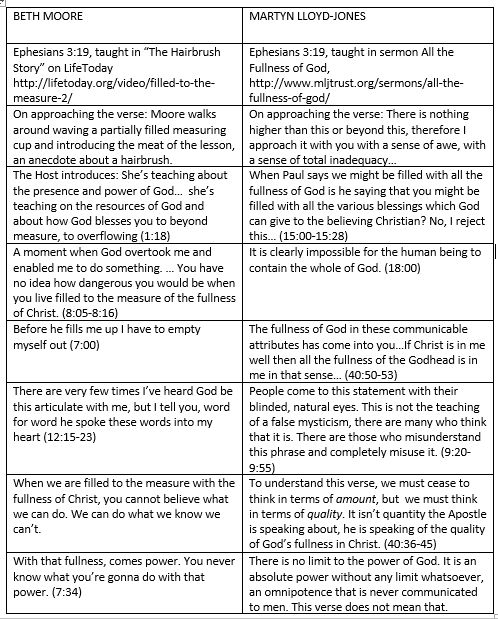
I found that Beth Moore and Martyn Lloyd Jones, having taught the same single verse, came to exactly opposite conclusions. Totally at odds with each other. One says yes, the other no. One says black, the other says white. One says up, the other down. By the picture below, you can easily see which Bible teacher’s teaching I found biblical.

Lloyd Jones’ well known nickname; A nickname I dub Moore

Moore taught that the full measure of Christ in us believers is something we do not currently possess.
Jones taught that the fullness of Christ is something we currently do possess.

Moore taught that we could possess it IF we do certain things.
Jones taught that the fullness is something every believer already has as a gift.

Moore taught that the reason we want the full measure of Christ is so we can get blessing and power.
Jones categorically rejects this.

Moore taught that the fullness was a feeling.
Jones taught that the fullness was a doctrine.

Moore taught that we want the full measure of Christ so we can get something, power, love, blessing.
Jones taught that having the fullness of Christ is something we aspire to because Christ is the prize.

They even have a different summation point-

Beth Moore teaching the point of lesson: “I’ve got to know somebody totally loves me.”
Lloyd Jones says the point of the verse is: “It is the highest doctrine of all.”

I won’t go on, you can see it on this chart I made. I included the links from which I delved into each lesson, and the minute at which I heard each teaching so if you care to check it out yourself, you can. Below the chart are the two illustrations each teacher gave. Moore’s was with the measuring cup and Jones’s was about a bottle. They come to opposite conclusions. Moore believes the fullness has a quantity to it and Jones says the full measure is about the quality of it.

Note: MLJ preached the Ephesians series between 1957 and 1980. Moore’s hairbrush story was re-published on LifeToday in 2012 and that is where I reviewed it, though she had delivered it at least as early as 2011 and maybe a year or two earlier than that. The comments in the chart are direct quotes.

The illustration: Moore’s measuring cup and liquid.

With this visual prop, Moore was teaching that we do not possess the full measure. However if we do certain things in our own power and then ask for the fullness, Christ will give it AND “the power that comes with it”. In Moore’s interpretation, we are all 16 oz measuring cups and some of us have 2 ounces of the fullness and others of us have 4 ounces and others get to be filled up completely. A total filling is not something that will happen on this side of eternity anyway.

Lloyd-Jones teaches the opposite. He focuses on ton the vessel but on the quality of the filling. He said we already possess the fullness of Christ in us when we’re saved. He said the power of God (omnipotence) is an attribute of God that is NON-communicable. MLJ also said the fullness is not a quantity, but a quality. Why?

because the amount varies. It varies in the same man from time to time. It varies from one of us to the other, and yet we all can have the fullness.

Here is an illustration to show how you can possess the fullness and yet have more of it. Take a bottle and put it into the sea. You can fill it. Then you can say that bottle is full of the sea. Then you can take a great tank and do the same thing. They both have a fullness but they haven’t the same amount. And the sea is always the sea. The little bottle full of sea has just the same characteristics of the sea in fullness as the tank has.

The drastic difference between the two teachings comes from their view of Jesus and of self. Jones’ eyes are on Christ, Moore’s is on herself. With her, the fullness is something we get, power comes with it, we do things with this power, we get blessing, we receive affirmation of love, and we can have more of it. We, we, we. Her eyes are on self.

Jones shows us where our eyes should be. Not on the bottle, not on the amount that is IN the bottle, not on the tank, not on anything we might think we get, but on the SEA. It is what is IN us that matters. It’s all about Christ in us, His righteousness, His fullness. It has nothing to do with our works, our deeds, our emptying, our effectiveness, our requests, or anything whatsoever to do with us. He bestows His fullness of Himself to us on salvation. It is all about Christ.

For this reason I bow my knees before the Father, from whom every family in heaven and on earth is named, that according to the riches of his glory he may grant you to be strengthened with power through his Spirit in your inner being, so that Christ may dwell in your hearts through faith—that you, being rooted and grounded in love, may have strength to comprehend with all the saints what is the breadth and length and height and depth, and to know the love of Christ that surpasses knowledge, that you may be filled with all the fullness of God.

Now to him who is able to do far more abundantly than all that we ask or think, according to the power at work within us, to him be glory in the church and in Christ Jesus throughout all generations, forever and ever. Amen. (Ephesians 3:14-21)

[By Elizabeth Prata]
Posted in Uncategorized

One of God’s judgments on people are false teachers

Repost from March 2012 with some edits added.

For the time will come when they will not endure sound doctrine; but wanting to have their ears tickled, they will accumulate for themselves teachers in accordance to their own desires.” (2 Timothy 4:3)

“False teachers are God’s judgment on people who don’t want God, but in the name of religion plan on getting everything their carnal heart desires. That’s why a Joel Osteen is raised up. Those people who sit under him are not victims of him but he is the judgment of God upon them. And they want exactly what he wants, and it’s not God.” ~ Paul Washer

We often think that the verse means that people who sit under a Joel Osteen or a Beth Moore are hapless victims, fallen prey to the insidious destruction of the prowling false teacher. No. The verse clearly shows us that people are the agitators, they are their own catalysts for false teachers being raised up. The people “accumulate for themselves” teachers who match their passions.

Notice that the onus of the act is on the people, NOT the teachers (not that I am saying the teachers escape culpability). But the people who have passions search out and look for false teachers that match those passions, and “accumulate for themselves” these teachers. And the teachers are only too happy to comply, because there is money in it, the usual reason false teachers want to be false teachers. (2 Peter 2:3). Paul Washer said someone like an Osteen is not making victims of the people he IS the JUDGMENT upon the people! In other words, they asked for him, they got him!

So people who want affirmation of their emotions in mystical visions, seek out a Beth Moore. People who seek prosperity and are greedy at heart seek out a Joel Osteen. People who are focused on the body and healing seek out a Benny Hinn. And so on. Prideful people who want to think they are earning their own salvation seek out the Pope. They accumulate for themselves the false teacher…

Here is Washer, explaining the verse:

[By Elizabeth Prata]

Posted in Uncategorized

Discernment Lesson: Deconstructing Beth Moore’s most popular story

My first introduction to Beth Moore was in 2011 at a Southern Baptist Church in Georgia I was a member of at the time. The women regularly read her books, talked about her, and watched her show on LifeToday, where it was broadcast then. Now it is broadcast on TBN, tucked in a scheduling line-up among many well known heretics and false teachers.

I was invited to go along on a Ladies Retreat weekend. We would launch our study from having watched a Beth Moore DVD segment. The Ladies Ministry leader (pastor’s wife) would then facilitate a discussion. The centerpiece on day 1 of the video teaching was Beth Moore telling a story about being in an airport and sitting next to a old man in a wheelchair with extremely matted hair. It’s known as the Hairbrush Story.

Continue reading “Discernment Lesson: Deconstructing Beth Moore’s most popular story”

Posted in Uncategorized

Beware of desiring a vision/dream/word from the Lord

dream women
Women who claim to have heard God’s voice. Clockwise, Kim Smith, Beth Moore, Joanna Gaines, Ann Voskamp.

I hear so many of the false teachers saying these days they had a dream where they were loved on by Jesus and it was so emotionally sweet. Or they say they had a vision where Jesus called her honey and babe and He took her to the zoo so she could have a nice play date. Or they have a word from the Lord where He softly whispered sweet nothings. Or they are communing with Him in a garden and He audibly calls her name and gives her specific career instructions and encouragement and personal promises of success if she would just obey what is already written in the Word. Or they describe their vision of how he showed them how they complete Jesus.
Others hear about these visitations, and become jealous or discouraged that they are not also receiving such personal ministrations from their heavenly boyfriend Almighty Ancient of Days.

Have you noticed that whenever these women speak of having a personal visit/dream/word it is always sweet and wooing, but never GOD-like? Two weeks ago my pastor was teaching on the passage in Genesis 20, the section on Abraham and Abimelech.
Continue reading “Beware of desiring a vision/dream/word from the Lord”