Posted in abendroth, green, johnson, listening, lloyd-jones, macarthur, preachers, sermon

How to listen to a sermon: part 1 "The mechanics of listening"

Part 2 here: “Expository Listening”

As I’m sure you do, I like to listen to sermons. I listen at my laptop, while I am doing dishes or cooking, and in church. The former means I have no visuals to accompany the listening, and the latter does.

The catch is finding a good preacher who treats the scripture with respect, doesn’t promote a false doctrine, and is clear in his preaching. That is hard to do these days! Once you find some pastors like that, phew, it is easy to settle into a routine that contains your favorite few. Mine are John MacArthur, Mike Abendroth, (and also here)  Phil Johnson, and Don Green.

However, I have an Old Testament prophet’s heart and I LOVE to listen to good exposition on the OT texts. The problem is, pastors who preach those texts are few and far between. Pastor Johnson has a great series on the Psalms, and Dr. MacArthur has a very few on OT texts (his series on Genesis 1 is fantastic) and Pastor Green as a tiny amount, but that’s it.

Martyn Lloyd Jones was a well-known British preacher. He lived from 1899 to 1981. He preached for a long time. Recently, his recorded sermons were combined into a trust and released to the public via the internet. There are 133 sermons on the OT. There are 55 on the great biblical doctrines. There are 1,600 sermons overall. What a treasure trove! I got so excited!

This week, I listened to two of his sermons from Jeremiah and I had a hard time sticking with it. I like Jeremiah a lot, and  was truly interested in the exposition of the text. So why was my mind balking? Lloyd-Jones is an old-fashioned fire and brimstone preacher, which I love. So why was I having a hard time? You know me, I have to analyze everything.

Lloyd-Jones’s voice is upper crust, ‘veddy British’. He rolls his rrrr’s dramatically. He has a high nasal

voice, not helped by older recording equipment from the 40s, 50s, 60s that makes him sound more tinny than likely he was in real life. The vocabulary he uses is slightly different that I’m used to, and it included British words as well as simply a different phraseology than I’ve heard before. All these surface elements of the skill of listening negatively impacted my listening experience.

I thought about it for a while and I came to the conclusion that our ears settle into a comfortable rut. Just as we enjoy living in a routine, so do our ears. People’s voices are like blankets. We become used to how our pastors sound, we know their verbal tics, and go along with their vocal rhythms. Listening is an ability. It needs to be kept in good working order, the wheels of the mind greased and stretched. I was having a hard time not because of the content of Lloyd-Jones’s sermons, which are tremendous, nor because of any spiritual conviction I was experiencing, but simply because my listening ability was being stretched.

I’m sure you’ve experienced this when a guest preacher comes to your church. It takes a while for your mind to settle down and get used to hearing a new tone of voice, an new rhythm, a new way of speaking. All this stretches your listening vocabulary and listening skills. And listening is a skill.

I used to watch foreign films a lot. I don’t like dubbing so I always went for the subtitles, which never bothered me. Foreign films of course show foreign things, contain foreign ideas, use a different approach to story telling, and even the cinematography is different because of different type cameras used in the making of the film. It has been about ten years since I’ve seen a foreign film and I watched one recently. I had a hard time settling down at first because I’d lost the skill of watching them. Same goes for black and white movies, which I’ve recently gotten back into, and the same goes for silent films. I was surprised that the 2011 American/French film “The Artist” won so many Academy Awards (five) because it was a silent film. A silent film hasn’t been made nor an old one released in a long time, and many of us have lost that skill of how to watch one.

It is the same with listening. The mechanics of listening to a sermon are just as important. Keep honing your skills in listening to a wide range of good preachers. Here is a little tutorial on how to keep the mechanics of your listening skills in good shape. In another blog entry, I’ll discuss the spiritual mechanics of biblical listening.

Literacy is reading and writing, listening and speaking. It is via literacy that we create meaning in our lives. The US Air Force has a University called The Air University, or AU. In this good series on Listening Effectively, we read,

“Listening is a complex process—an integral part of the total communication process, albeit a part often ignored. This neglect results largely from two factors.”

“First, speaking and writing (the sending parts of the communication process) are highly visible, and are more easily assessed than listening and reading (the receiving parts). And reading behavior is assessed much more frequently than listening behavior; that is, we are more often tested on what we read than on what we hear. And when we are tested on material presented in a lecture, generally the lecture has been supplemented by readings.”

“Second, many of us aren’t willing to improve our listening skills. Much of this unwillingness results from our incomplete understanding of the process—and understanding the process could help show us how to improve. To understand the listening process, we must first define it.”

The essay goes on to explain that, “The process moves through the first three steps—receiving, attending,

Group of people listening to a sermon.
Coranderrk, c.1860-c.1865
source

understanding—in sequence.” Receiving is what it means, someone transmits a body of information auditorially and your ears receive it. There are many things that can impact receiving. If you’re in a car and driving, of course that impacts you because you get distracted. The speaker is still sending, you’re not receiving. Even if you are in a pew and seated comfortably, receiving can be impacted by the preacher’s speech, any impediments, his rhythm, tone, or distracting verbal tics.

My old pastor used to punctuate every half phrase with “Amen?” as in, “Paul was about to set out in his second missionary journey, amen? And then he got in the boat, amen?” etc. Like that. Drove me nuts. I’m exaggerating a bit on how frequently he said it, but it was frequent enough that it became a distraction to me rather than a pattern of speech unique to him. Sometimes I’d just count the amens rather than listen to what he was saying. That is what I mean by verbal tics. MacArthur repeats a sentence he really wants us to get. He doesn’t do it often within a sermon, but only at the introduction of a new main idea, so it doesn’t distract me. In the former case, it was distracting, in the latter, a comforting vocal blanket to my ears.

In the Air University lecture it stated that “attending” is the second part of the process of listening. Attending is hard when you’re distracted. This impacts receiving. Like I said above, I had a hard time paying attention to the content when the distraction of the amens got in the way.

The AU lecture notes that in the second part of the listening process attending, there is such a thing as–

“Selectivity of attention. We direct attention to certain things to prevent an information overload.”

And alternately, we become distracted by things when they are competing for our attention. This is why listening is active. If there arise any barriers to listening, we must mentally work to overcome them.

“Selectivity of attention explains why you “perk up” or pay attention when something familiar to you, such as your hometown or your favorite hobby, is mentioned. In fact, you may have been listening intently to a conversation when someone in a different conversation mentions your name. Immediately, the focus of your attention shifts to the conversation in which your name was mentioned.” (source)

So in listening to a sermon, you may have a favorite topic. If any preacher mentions anything about eschatology, I am all ears. If the sermon is on marriage (I’m single) I tend to want to tune out.

Strength of attention. Attention is not only selective; it possesses energy, or strength.

Attention requires effort and desire. It is possible to get lazy in listening, that is why I’m writing about listening as a skill that needs honing and practice. We make ourselves literate when we connect the new to the known. If you are listening to a preacher for the first time, you have nothing to connect the new to the known with. In other words, I understand without having to think about it that when MacArthur repeats a sentence it means he is emphasizing a point and getting ready to launch into another verbal paragraph. This barely registers with me now but it is what I am talking about when I say that listening is an active skill. When you tune in to a new preacher you won’t know his patterns and it takes a few listens to acquire them. Stick with it.

Words are verbal symbols. Yet there can exist barriers to understanding even when we all speak the same language.

Barrier #1: The same words mean different things to different people.

I laugh when I remember this example. When I was married, my husband and I used to talk of course. All

my degrees are in literacy and my profession is teaching. I live by words. My husband was a mathematician, his profession was databases and computer software. One time we were having a talk. We were both speaking English. We were at home and undistracted. But we were not connecting verbally. Finally, I asked him, “When you speak what does it look like in your mind?” He said, “Numbers. I think in equations. How do you think?” I answered, “I think in anecdotes.”

In the AU lecture, the professor said, “I may tell my colleague that the temperature in the office is quite comfortable. My “quite comfortable,” however, is her “uncomfortable”: 75 degrees is comfortable for me; 70 degrees is comfortable for her. The same word can mean different things to different people.”

If you listen to a new preacher it takes a while to become familiar with what he means when he says such and such.

“Barrier #2: Different words sometimes mean the same thing”

It took me a while after moving from the north to the south in the US that buggy meant cart, soda meant pop, and tea meant cold and sweet. I remember asking one of my kindergarteners to get the wastebasket and he literally didn’t know what I meant. I said “the trash can” and then he brought it right over.

A new preacher you’re listening to might indeed be speaking English but may be using different words in that present a barrier to understanding. With ongoing listening you absorb his meanings into your mental listening vocabulary.

Barrier #3: Misinterpretation of the voice. The quality, intelligibility, and variety of the voice affect the listener’s understanding. Quality refers to the overall impression the voice makes on others.

There is a preacher I listen to who has a tone that tends to become petulant, even though he is not petulant in the least. I have to work hard while listening not to be distracted by it. I love Pastor Mike Abendroth’s voice on his radio program No Compromise Radio. His voice is so soothing, he speaks slowly and clearly, there are no sound effects or distractions. In fact, when I want to be soothed, I’ll listen to him. His voice is like an oasis in the loudness of life. He makes it easy to receive, attend, and understand.

Well, that was a little lesson on the mechanics of listening. In the next essay I’ll offer some information on how to partner with the preacher via maximized listening so that the Word of God accomplishes its intended purpose. It will be geared to the theology of listening: expanding your capacity for expository listening. Meanwhile I’ll urge you all to keep the mechanics of your listening skills honed by occasionally practicing an deliberate expansion of who you listen to, and how.

Posted in domitian, Sunday martyr moment

Sunday Martyr moment: Persecution under Domitian

Foxe’s Book of Martyrs. According to this summary from Christian Book Summaries,

Writing in the mid-1500s, John Foxe was living in the midst of intense religious persecution at the hands of the dominant Roman Catholic Church. In graphic detail, he offers accounts of Christians being martyred for their belief in Jesus Christ, describing how God gave them extraordinary courage and stamina to endure unthinkable torture.

From the same link, the book’s purpose was fourfold:

  • Showcase the courage of true believers who have willingly taken a stand for Jesus Christ throughout the ages, even if it meant death,
  • Demonstrate the grace of God in the lives of those martyred for their faith,
  • Expose the ruthlessness of religious and political leaders as they sought to suppress those with differing beliefs,
  • Celebrate the courage of those who risked their lives to translate the Bible into the common language of the people.
The Second Persecution, under Domitian, A. D. 81.

The emperor Domitian, who was naturally inclined to cruelty, first slew his brother, and then raised the second persecution against the Christians. In his rage he put to death some of the Roman senators, some through malice; and others to confiscate their estates. He then commanded all the lineage of David to be put to death.

Among the numerous martyrs that suffered during this persecution was Simeon, bishop of Jerusalem, who was crucified; and St. John, who was boiled in oil, and afterward banished to Patmos. Flavia, the daughter of a Roman senator, was likewise banished to Pontus; and a law was made, “That no Christian, once brought before the tribunal, should be exempted from punishment without renouncing his religion.”

A variety of fabricated tales were, during this reign, composed in order to injure the christians. Such was the infatuation of the pagans, that, if famine, pestilence, or earthquakes afflicted any of the Roman provinces, it was laid upon the Christians. These persecutions among the christians increased the number of informers and many, for the sake of gain, swore away the lives of the innocent.

Another hardship was, that, when any Christians were brought before the magistrates, a test oath was proposed, when, if they refused to take it, death was pronounced against them; and if they confessed themselves Christians, the sentence was the same.

The following were the most remarkable among the numerous martyrs who suffered during this persecution.

Dionysius, the Areopagite, was an Athenian by birth, and educated in all the useful and ornamental literature of Greece. He then travelled to Egypt to study astronomy, and made very particular observations on the great and supernatural eclipse, which happened at the time of our Saviour’s crucifixion.

The sanctity of his conversation, and the purity of his manners, recommended him so strongly to the Christians in general, that he was appointed bishop of Athens.

Nicodemus, a benevolent Christian of some distinction, suffered at Rome during the rage of Domitian’s persecution.

Protasius and Gervasius were martyred at Milan.

Timothy was the celebrated disciple of St. Paul, and bishop of Ephesus, where he zealously governed the church till A. D. 97. At this period, as the pagans were about to celebrate a feast called Catagogion, Timothy, meeting the procession, severely reproved them for their ridiculous idolatry, which so exasperated the people, that they fell upon him with their clubs, and beat him in so dreadful a manner, that he expired of the bruises two days after.

Text from Project Gutenberg

Posted in gog magog, iran, israel, military strategy, psalm 83 war

Was Israel’s Latest ‘Air’ Attack on Syria from a Submarine? This would be a game changer

Was Israel’s Latest ‘Air’ Attack on Syria from a Submarine?
“An attack two weeks ago that destroyed an advanced Russian missile shipment delivered to Syria’s Assad regime should also serve as a warning to Iran – and to those complacent Western diplomats who have (dangerously in my view) reconciled themselves to the idea of allowing Iran to go nuclear and then trying to contain it. For it seems that the July 5 attack on an arms depot near the Syrian naval base of Latakia, which has been attributed to Israel, came not from the air (as CNN and the New York Times reported last weekend) but from under the water.”

“Many Western officials who have apparently concluded that Israel could only destroy Iran’s nuclear program from the air – and that Israel does not have the capability to carry out such long-range air strikes in a decisive way – should take note. In recent years, Israel has greatly advanced its sea-based capabilities, and the geographical range of operations that Israel can mount from the sea, I am reliably told, now spans the entire globe. Israeli submarines are no longer confining themselves to the Mediterranean.”

———————–

Hmmm. If that is true, then look at this.

Iran’s nuclear program has several locations as seen on the map below. I added Qom to the map below. Since the map below was formulated in 2009, it has been discovered that an underground secret facility exists in Qom. Bushehr is a main facility. Look where it is. Easily reachable by sea, if Israel can get a sub around the Strait of Hormuz. Bushehr is ON the sea.

Source

 You see how Bushehr is right ON the water. Click to enlarge.

Bushehr to Qom is 700 miles, reachable by sub missile. Every Submarine-launched ballistic missile (SLBM) has intercontinental range. The Russian Navy patrols the Black sea by sub and surface ships but I suppose if Israel wanted to they may be able to get a sub in the Black Sea and attack Iran from the North. The Black Sea is the body of water yo see on the above map north of Tehran.

Either way, it was a big AHA! moment when the news reported that the Syrian attack on the Russian missile cache was performed by sea. Stay tuned…

Posted in eschatology, israel, jews, replacement theology, temple

Messianic return from Jewish point of view

A Haaretz (Israel daily newspaper) article today. It is interesting to read of Messianic prophecy from the point of view of a person who does not believe the New Testament, but should have a better grasp of eschatology than is evidenced in this article. It is rife with errors but also contains some truth.

Why do many Christians believe Jesus will appear after Jews rebuild the temple?
“These are the same Zionist evangelicals who oppose any peace agreement in which Israel will cede parts of the homeland, and who customarily make donations to various right-wing associations in Israel. For them, Israeli sovereignty over the Holy Land is fraught with redemptive meaning. Only the continuing and eternal covenant between the Jewish people and its God in heaven can lend a messianic significance to its deeds on earth.”

“It was such a frame of mind that prompted the well-known evangelical preacher Jerry Falwell to assert, back in 1988, that “the most important date we should remember [since the Ascension] is May 14, 1948.” The reason is because, in his view, the creation of the State of Israel “is the greatest single sign indicating the imminent return of Jesus Christ.”

“But there’s a snag. Two months ago we celebrated the 65th anniversary of Israel’s creation, and for some reason Jesus has not yet appeared.”

Oh, but He will. They should know better than anyone about the Lord’s plans mean nothing in man’s scale of time. He sent the Jews into a 70 year exile. They wandered 40 years in the desert. A Jubilee Year comes around once every 50. They spent 400 years waiting for a prophet to speak (Malachi to John the Baptist). The Egyptian captivity was 400 years. And they scoff at 65?

Yes, they scoff.

The article calls the 15-million seller book The Late great Planet Earth by Hal Lindsey (an eschatological view of the run up to the Tribulation and the last 7 years of punishment upon the Jews) as a “mythical best seller.” The article repeats the old chestnut that John Darby started the notion of the rapture, even though Paul taught it and the earliest church fathers believed it.

The article goes on,

“The relationship between Christian evangelicals and Temple activists is warmer today than ever. It is a strange alliance, in which each side is using the other to further its own redemptive goals, knowing full well that the other has a completely alternative, indeed opposite, picture of the way redemption will look.”

Why can’t they see the clear and plain truth in the bible? That the rapture will sweep the church from the earth and that those who remain will be left to deal with God’s anger on His unbelieving people, the Jews? Because they can’t. Paul explained it all in Romans 11. Opening that wonderful chapter, Paul said,

“I ask, then, has God rejected his people? By no means! For I myself am an Israelite, a descendant of Abraham, a member of the tribe of Benjamin. God has not rejected his people whom he foreknew.” (Romans 11:1-2)

That should silence the replacement theologians who said that the Jews are done and the church is all that God cares about now. Paul goes on to explain the program and plan of God in the Age of Grace that we are in now:

“What then? Israel failed to obtain what it was seeking. The elect obtained it, but the rest were hardened, as it is written,
“God gave them a spirit of stupor,
eyes that would not see
and ears that would not hear,
down to this very day.”” (Romans 11:7-8).

The Jews rejected Jesus when He appeared. Originally the Jews were supposed to be the Light to the world and instruct the Gentiles about God. But they clung to the law, turned insular, and then used the law for their own gain, coasting on the covenant promise and failing to share the Light with the pagans.

Jesus charged them: “You that make your boast of the law, through breaking the law dishonor you God? For the name of God is blasphemed among the Gentiles through you.” (Romans 2:23-24).

“But when the Jews saw the multitudes, they were filled with envy, and spoke against those things which were spoken by Paul, contradicting and blaspheming. Then Paul and Barnabas waxed bold, and said, It was necessary that the word of God should first have been spoken to you: but seeing you put it from you, and judge yourselves unworthy of everlasting life, see, we turn to the Gentiles. For so has the Lord commanded us, saying, I have set you to be a light of the Gentiles, that you should be for salvation to the ends of the earth.” (Acts 13:45-47)

Paul explains that the Gentiles are grafted in so as to make Israel jealous.

“So I ask, did they stumble in order that they might fall? By no means! Rather through their trespass salvation has come to the Gentiles, so as to make Israel jealous.” (Romans 11:11).

Paul says it again, explaining the ‘mystery of Israel’s salvation’.

“Lest you be wise in your own sight, I want you to understand this mystery, brothers:d a partial hardening has come upon Israel, until the fullness of the Gentiles has come in” Romans 11:25).

They have been partially hardened. The most difficult mission group to reach is the Jew, because they have been made hard of heart and blind so that they cannot see. That is why we wind up with articles that state the redemption plan between the Jew and the Christian are opposite. They aren’t , but the hardened Jew see it that way.

All Israel will be saved. Jesus preserves a remnant throughout the Tribulation. He uses the Jew once again as His light to bring salvation, supernaturally sealing 144,000 Jews to witness for Him, 12,000 from each tribe. (Revelation 7:6-8).

He will punish His people, that is what the Tribulation is all about. It is called the Time of Jacob’s Trouble. Yet in the end, all Israel will be saved! (Isaiah 53)

“I will no longer hide my face from them, for I will pour out my Spirit on the people of Israel, declares the Sovereign LORD.” (Ezekiel 39:29)

“And I will pour out on the house of David and the inhabitants of Jerusalem a spirit of grace and pleas for mercy, so that, when they look on me, on him whom they have pierced, they shall mourn for him, as one mourns for an only child, and weep bitterly over him, as one weeps over a firstborn” (Zechariah 12:10)

The LORD is grace and mercy. He loves His people. Punishes for idolatry, yes. He does this because He is holy. Even though punishment tough, He will not break His promise to His covenant people the Israelites. He will be as overjoyed as anyone on earth or in heaven when His people cry out to Him as Messiah.

“And the Lord will be king over all the earth. On that day the Lord will be one and his name one.” (Zechariah 14:9)

Posted in produce healthy food

Bountiful Baskets offers affordable produce in expensive times

My friend brought me a Bountiful Basket two weeks ago. In our town a local co-op opened up that is a site for the nationwide co-op known as Bountiful Baskets. The baskets are loaded with fruit and vegetables, and they are overflowing with bounty indeed. The produce is spectacular also, very fresh and tasty. The fruit TASTES like something. Here is what I got this week.

Great basket today. Cantaloupe, 2 heads Kale, large and fresh head Romaine lettuce, blueberries, 6 bananas, 2 lb grapes, huge head cauliflower, head of cabbage, 6 kiwis, 8 plums 3 mangoes. Wow. Just wow. The head of cauliflower is very large, so is the head of romaine.

In every case it costs less to receive all this for $15.00 (plus $1.50 to process so $16.50 in all) than to try and duplicate it at the store. In less time, too. And the quality is much higher than the store. The food is good. You’re talking to an ex-crunchy granola, New England VW camper van hippie. I’ve had many decades of dealing with co-ops and always, I’ve been disappointed every time. I would not have joined this one unless my friend had bought and delivered a basket into my hands, lol.

I plan to grill the cabbage, bake the kale into chips, and roast the cauliflower. Mango smoothie, cantaloupe smoothie, blueberry muffins, and corn flakes with bananas (and banana pancakes). Romaine salads with seasonally ripe garden tomatoes. Yum. Tomorrow a friend is giving me green tomatoes. I’ll bread and bake them at the same time I do the kale chips and cauliflower. We need each other now. Sharing what we have is the way to go, more than ever. (Acts 4:32)

How much did it all cost? $15 and ten minutes of time. WOOT!

I mentioned yesterday that the Depression-era mindset kicks in when paychecks decrease and food gets scarce. Of course, it is nothing like it is in Third World nations now and absolutely nothing like it will be in the Tribulation, but at present, even in wealthier America, people even with jobs find it hard to provide healthy food to their families. Money is depreciated and it buys less. Food costs are increasing. The goal of Bountiful Baskets is to get healthy produce into the hands of families. I think the size of the produce offered at stores is decreasing too. Heads of cauliflower are smaller, plums and kiwis are miniscule now. I don’t think it’s my imagination, particularly since dry goods packaging is undergoing severe shrinkage, also. That IS a fact. That blog entry demonstrated visually the smaller cracker box issue.

I’d noted here in 2011,
“I was sad to see that the downward spiral of groceries in general is accelerating. Since last week milk went up 50 cents along with many other items, though not all of them went up in price as drastically as milk. In addition to prices going up, sizes are going down. The bagels that I look at each week, longing for but sadly decline to buy at a prohibitive cost of $3.59, suddenly were 1/3 smaller this week. Size of items are getting smaller and package sizes are getting smaller. 13 oz powdered creamer is now 11 ounces. And so on.”

The co-op is something I believe we will see more of in coming weeks and months. A volunteer-run, no middleman, neighborly sharing and cooperative kind of thing. Creative ways to make our food and money stretch. I go with a friend and we trade stuff. Last time I got a baby watermelon in my basket and I don’t eat watermelons so I gave her mine. This week she gave me a dozen eggs from her chickens when we got to the basket pick-up place. Sadly, the economic times means we often have to cut back. We have to do what we can to stay healthy and to make sure we are getting the kind of food that will keep our families healthy. But in pooling our money we can do the food co-op and still receive good quality produce without having to cut back where it counts. The saving also means I can use the money I’d use for produce to make an offering, or use he savings in other ways. The Baskets are affordable enough that I can buy two and give one to a family in need, also. If you have GMO concerns, it only costs $10 extra to order a 100% certified organic Bountiful Basket.

I rent so I can’t put in a garden. Other people don’t have the strength to garden. In some cases, town or city ordinances make it illegal to own chickens- like in Chattanooga this week. In other places, it is not allowed to garden on your land, like in condos with Homeowner’s Associations. In Oak park MI, a front yard container gardener who owned her own detached home was threatened with 93 days in jail. Same for keeping goats or cows, or meat processing. (I know people who do pig roasts). Some don’t even have even the money to start a garden (it costs to buy manure, mulch, seeds and never mind the tractor or machine to bust sod). Have you noticed that it is expensive to be poor?

Gas is cost-prohibitive so often that means getting to the ‘good’ store farther away is off limits. I noticed two years ago that though I used to buy OJ a lot, I hadn’t been. I said out loud to myself, “When did orange juice become a luxury item?”

Anyway go to the website Bountiful Baskets to see if a site is near you. If not, there are directions on how to start one. It is a good way to be neighborly and help each other in Depression-times.

———————–

Further reading
Bountiful Baskets, what was in the first basket I got?

Economic Downturn, depression; tomato, tomato

Posted in chickens

Chickens in my yard

A cute surprise in my yard this morning

I had a few visitors this morning. I’ve had turkey vultures, doves, eagles, hawks, and geese. But never chickens. They contentedly pecked around under the apple tree until they heard my door open. Then they lined up and trotted off at the hay field border.

Wait, was that a worm? Gotta check it out…
“Are you coming? Hurry up!” She’s got a camera, she can ID us!”

OK, OK, wait for me…
Posted in israel, kerry, peace talks, prophecy, tribulation

After four years, the Israel-Palestinian peace talks resume. How does this fit in prophecy?

Here is some news just out-

Kerry: Direct Israeli-Palestinian peace talks to resume next week in Washington
“U.S. Secretary of State John Kerry announced Friday in a press conference in Amman that direct Israeli-Palestinian talks are due to begin next week in Washington. The announcement comes after Kerry had traveled to the region six times within four months and spent countless hours in talks with Prime Minister Benjamin Netanyahu and Palestinian President Mahmoud Abbas. “We have reached an agreement that establishes a basis for resuming direct final status negotiations between the Palestinians and the Israelis,” he told reporters in Jordan. “The agreement is still in the process of being formalized.”

According to Wikipedia, there are numerous issues to resolve before a lasting peace can be reached, including the following:

  • Borders and division of the land;
  • Strong emotions relating to the conflict on both sides;
  • Palestinian concerns over Israeli settlements in the West Bank;
  • Status of Jerusalem;
  • Israeli security concerns over terrorism, safe borders, incitements, violence;
  • Right of return of Palestinian refugees living in the Palestinian diaspora.

Prophetically we know several things. Overall, we know that there will be no lasting peace until Messiah comes. (Isaiah 2:3-5).

  • The world will be against Israel in the final days. (Zechariah 12:2-3)
  • The LORD will allow the nations to invade and (mostly) defeat Israel (Zechariah 14:2, Rev 11:2)
  • They have divided His land, angering the LORD (Joel 3:2)
  • He will save a remnant, all Israel will be saved (Romans 11:25-26)
  • While they are saying peace and safety sudden destruction will come upon them (1 Thessalonians 5:3)

Here is the biggie:

A covenant will be confirmed. A pact. A treaty.

“And he shall make a strong covenant with many for one week, and for half of the week he shall put an end to sacrifice and offering. And on the wing of abominations shall come one who makes desolate, until the decreed end is poured out on the desolator.” (Daniel 9:27)

Othe translations say-

“And he shall confirm the covenant with many for one week” (KJV)
“He will make a firm covenant with many for one week” (Holman Standard)
“He will confirm a covenant with many for one ‘seven.'” (NIV)

This indicates that some kind of treaty or pact is already in existence and will be confirmed among the many, rather than a new one being created or formulated at the time.

This covenant satisfies Israel. We know this because firstly, they participate in its confirming, and secondly, they are allowed to begin sacrificing at the temple again. All seems well for three and a half years, until the antichrist reveals himself by stepping into the temple. He declares himself God and commands all worship must focus on him. Until then, we do not know who the antichrist is, although he does participate in the original confirming of the covenant three and a half years earlier. (2 Thessalonians 3:6).

It is this moment which Jesus spoke of in Matthew 24:15-17, “So when you see standing in the holy place ‘the abomination that causes desolation,’ spoken of through the prophet Daniel–let the reader understand-Then let them which be in Judaea flee into the mountains: Let him which is on the housetop not come down to take any thing out of his house: …”

Any time many nations are involved in forming a treaty or pact with Israel, it is time to heighten attention to the prophetic words of His prophets. It is time to pray for Israel even more fervently. It is time to pray for the pagans and Gentiles who live in that region with vigor. It is time to pray for the Christians witnessing to Messiah in the Land that they would be the Light so many will be saved and thus escape the horrors to soon come. It is time to strengthen our own faith and straighten our own walk, so that we may be ready for the trumpet call to stand unashamed before Him in glory.

Seeing the scaffolding having been erected for the Tribulation we know that soon the rapture call will occur, because the Bride will be called home before the judgments begin. So look to the Middle East with the political doings, and look up. Is our Redemption drawing nigh? I believe so, every day brings us closer. With the resumption of peace talks, the inching forward just took a giant leap.
____________________

Further reading:

All about the Tribulation: explained

The Times of Israel reviews “Damascus Countdown” & hopes it doesn’t come true.

Posted in baltic dry index, economic depression, economy, israel, russia

Economic downturn, depression, tomato, tomato. Developing a Depression mindset

I haven’t done an essay on the economy in a while. I’ve been watching…observing….mulling. What is happening to us in America (and all over the world) is really interesting.

For those of us who know the world is not our home, we are told many times in scripture not to cling to it. (Galatians 6:14, 1 Timothy 6:7) and not to conform to it (Romans 12:2). After all, satan rules it, (2 Corinthians 4:4) the world is enemy territory, (Ephesians 6:10-18) and our vaporous life will soon leave it. (James 4:14).

However, we still have to live here until the rapture or death. So we are of the world but we are not in it. (John 17:14–19). No we are not holograms, lol, but we are islands of holiness dwelling in the midst of a pool of sin.

I know my treasure is in heaven but I still make great efforts to be a good steward of what the Lord has given me in terms of goods and money. (2 Thessalonians 3:10, Philippians 2:4). And as long as I am being faithful to manage the goods and money then I will have more time and money and blessings to enable me to be a good steward also of the gifts of grace He gave. (1 Peter 4:10).

I’ve always been frugal, it is in my nature. Excessive spending is not in me. Buying things that are not practical is not in me. Even if someone gave me $30 to spend on anything I wanted, I’d use it to pay a bill or groceries. About the only spending I engage in that doesn’t directly go to keeping me alive, clothed and in a home with 4 walls are books. I have little money but what I have I like to use for other people.

Because of reading the bible, I know that as time goes on the economy will get worse and worse. Oh, sure, any economy has cycles of ups and downs, but over the long haul the general trend is down. How do I know this? The world is dying. It is cursed. All relationships, projects, economies, and governments are drenched with this curse. None are righteous. (Romans 5:12-21, 1 John 2:17; Matthew 24:35).

This downward trend accelerated dramatically after the presidential election of 2008, a process that began right before the November election in Sept-Oct. In effect, the global economy crashed on or about October 1, 2008, and has never recovered. Though economists continue to call what is happening a ‘recession’ or even insultingly, a ‘recovery,’ I call it what it is, a Depression.

I always thought that with my natural tendency to frugality and a long life of having done without that I’d transition to any economic depression rather easily. I was wrong.

There is a huge difference between frugality as a choice and developing a Depression mindset due to necessity.

What happens to a person who dwells in a long-term state of want, need, constriction, frustration, and fear? To the unsaved, it causes a severely de-stabilizing effect. They want and need something but know not what it is (what they are looking for is peace with God through reconciliation with His Son). That is why they had previously sought to fill that hole where peace goes with the things of this world. When the things of this world are no longer available to them because of drought-like economic conditions, they panic because even the false, temporary pseudo-peace they gained from the things of this world are now unattainable. There are two responses to that panic: turning to God and find that peace, or turning to self and go deeper into the dark hole of unfulfillment. They wonder, is this life just a long, heartbreaking quest for the unattainable? An economic depression brings that hidden question closer to the surface.

The psyche changes during prolonged periods of want and scarcity. This means that societal structure changes too, because the family structure changes. From “Digital History: The Depression” we read:

The Depression had a powerful impact on families. It forced couples to delay marriage and drove the birthrate below the replacement level for the first time in American history. The divorce rate fell, for the simple fact that many couples could not afford to maintain separate households or to pay legal fees. Still, rates of desertion soared. By 1940, there were 1.5 million married women living apart from their husbands. More than 200,000 vagrant children wandered the country as a result of the break-up of their families.

The Depression inflicted a heavy psychological toll on jobless men. With no wages to punctuate their ability, many men lost power as primary decision makers. Large numbers of men lost self-respect, became immobilized and stopped looking for work, while others turned to alcohol or became self-destructive or abusive to their families.

In contrast to men, many women saw their status rise during the Depression. To supplement the family income, married women entered the work force in large numbers. Although most women worked in menial occupations, the fact that they were employed and bringing home paychecks elevated their position within the family and gave them a say in family decisions.

That aforementioned ‘say in the family decisions’ plays into satan’s hands. Men and women were cursed in Genesis 3:16 at the Fall. “Your desire shall be for your husband, and he shall rule over you.” Women’s tendency from that time on will was to usurp the headship of the husband (Ephesians 5:23) and the tendency of the husband has been either be to capitulate, or to become a dictator.

Last week, the NY Times reported that a similar gender gap in jobs during this ‘downturn’ is occurring and I noticed a similarity to the changes in family structure in the First Great Depression. One year after it began in 2008, women held 49.99 percent of all jobs. Even today, women are getting jobs at a much faster rate than men, though jobs overall are still scarce. Economists insist that the “start of the recovery” was June 2009. This statistic notes: “Women gained back nearly 90 percent of the jobs they lost in the recession and men gained back 64 percent, from the start of the recovery to June 2013.” So over the last four years women have gained back an economic power and men have remained stagnant.

As we saw in the first Great Depression, when men don’t have a job for a long time it changes the mental mindset, it changes the family dynamic, and this changes the societal structure. (Because the family, based on marriage, is the basic unit of society).

That is the second major cultural shift when a society enters long period of want. Marital roles are upended. The first was the stress on a person who wonders where the next meal is coming from and begins to panic.

For the Christian who truly relies on Jesus for all things to be added to them, hopefully you are not panicking. He said in Matthew 6:33, “But seek first the kingdom of God and his righteousness, and all these things will be added to you.” The ‘these things’ are mentioned in previous verses: food, water/beverages, and clothes. In other words, the necessities of life. The passage says ‘do not worry.’

I admit that is easier said than done. I rely on the Lord a great deal and worry only minimally. This is because He has never failed to provide for me. But also I do not have children. I know that if I did, my worries over providing for them would make relying peacefully on the provision of Jesus a challenge.

However the mindset of properly stewarding my resources does take effort, if not stress. I plan, think, budget, and look ahead constantly to ensure that what I have goes a long way. I put pout of my mind the things I don’t have and can’t afford. I constantly review my week to see that I am attaining a good balance between stewardship of the things the Lord has provided for myself and making sure that I am cheerfully ministering in love, whether I tithe, give, spend time, or work for someone else.

Mary Owlsey recalled life during the First Great Depression:

“I knew one family there in Oklahoma City, a man and woman and seven children lived in a hole in the ground. You’d be surprised how nice it was, how nice they kept it. They had chairs and tables and beds back in that hole. And they had the dirt all braced upon there, just like a cave”

Las Vegas hole dwellers, Source

Pauline Kael a well-known film critic, was a college student at the University of California at Berkeley during the Depression.

“When I attended Berkeley in 1936, so many of the kids had actually lost their fathers. They had wandered off in disgrace because they couldn’t support their families. Other fathers had killed themselves so the family could have the insurance. Families had totally broken down. Each father took it as his personal failure. These middle class men apparently had no social sense of what was going on, so they killed themselves.It was still the Depression. There were kids who didn’t have a place to sleep, huddling under bridges on the campus, I had a scholarship, but there were times when I didn’t have food.” (Source)”

David Blankenhorn wrote in his book, Fatherless America,

“The United States is becoming an increasingly fatherless society. A generation ago, an American child could reasonably expect to grow up with his or her father. Today, an American child can reasonably expect not to. Fatherlessness is now approaching a rough parity with fatherhood as a defining feature of American childhood.”

The Washington Times reported in their article from a few months ago, “Fathers Disappear from households across America,” that 1 in 3 kids in America live in a household without a father.

source

Psychology Today published an article in 2010 called “The Psychic Toll of the Great Recession“.
“There is little doubt that financial struggles and uncertainty take a significant toll on people. They must confront the daily stress that comes from being unable to make ends meet with few prospects for the immediate future. This stress isn’t just psychological, but can also exact real physical costs in terms of poor sleep and diet, increased illness and injury, and, even worse, alcohol and drug abuse as a means of coping with the stress.”

“With each day of unemployment, people’s belief in themselves atrophies, causing them to question how capable they are of surmounting this immense hurdle. Their faith in the ability of the economy to recover is also shaken. And, of course, their trust in our government is lost as well. The result is a crisis of confidence.”

And there you have it. The LORD shakes them so that the only place they have to go is looking up. And as for us believers, we must, I repeat, must display the confidence we possess in the Lord. Faith in Jesus means knowing He will take care of His own, in every way. As people increasingly develop a Depression mindset, and it wears on them and they begin to panic, how much of a balm can we be to them in our placid trust of a wondrous Jesus who provides for His children?e The purpose, I am convinced, for this current, and last, time of sever restriction and privation before the rapture is to strip people away from their comforts. They are of the world, but let us give them a glimpse of the better world, the world of Jesus and His kingdom.

After the rapture the constrictions and privation in place now will blossom into pure hell. People will work all day just to procure a loaf of bread.

Bread line during First Great Depression, NYC

They will be so desperate for faith in something, anyone, that they will believe the lie of the antichrist when the LORD sends the delusion. Oh, please develop your Depression mindset now, and fast. It is one of trust in the Lord for His provision, reliance on the Holy Spirit to enable us to properly shepherd the provisions He does send, and an attitude of peace and calm in the midst of economic turmoil. How that will stand out to the lost person will be like a floodlight into the eyes of an alligator hiding in the muddy waters.

Lo, the lilies of the field!
Reginald Heber, hymn

Lo, the lilies of the field!
How their leaves instruction yield!
Hark to nature’s lesson given
By the blessed birds of heaven!
Every bush and tufted tree
Warbles trust and piety:—
Mortals, banish doubt and sorrow,
God provideth for the morrow.

One there lives, whose guardian eye
Guides our earthly destiny;
One there lives, who, Lord of all,
Keeps His children lest they fall:
Pass we, then, in love and praise,
Trusting Him through all our days,
Free from doubt and faithless sorrow,—
God provideth for the morrow.

———————–

Further reading:

Bountiful Baskets, affordable produce of great quality

Detroit files for bankruptcy protection

Russian economy becomes biggest in Europe

The One Bubble you may not have heard Pop (Baltic Dry Index)

Europe raises pressure on Israel (boycott)

Posted in theology

Art

I express myself in words, the written word, not spoken so much.

Some talented Christians express themselves in art. Some honor God with their photography. Some, with their poetic imagery.

I go through bouts of wanting and needing to  make an image, an art piece, but I am not talented and usually fail. But I still try sometimes.

This one is called “Above and Below”. The bottom half is a photograph of my apartment reversed into a negative.

“For now we see through a glass, darkly; but then face to face: now I know in part; but then shall I know even as also I am known.” (1 Corinthians 13:12).

The lace in the middle represents the veil, through which Jesus has broken but as long as we are individually in fleshly bodies, we cannot go beyond until rapture or death (unless by prayer :).

“And behold, the curtain of the temple was torn in two, from top to bottom. And the earth shook, and the rocks were split.” (Matthew 27:52)

The upper portion is the heavenly realm.

“I know a man in Christ who fourteen years ago was caught up to the third heaven—whether in the body or out of the body I do not know, God knows” (2 Corinthians 12:2)

Just a page out of my art journal. It was Barbara who inspired me to go back and take a look at my art journal. You should check out her art. It is very good.

Posted in bible, charismatic, dreams

What the bible says about dreamers

Elizaeth Prata, Dreams, 2003

Everyone is dreaming a dream now. Everyone is having a vision now. It’s practically the ticket of entry into a church and almost required for faith…among the Charismatics and false teachers, that is.

Until about about 100 years ago when the charismatic and experience-driven Azusa Street Revival broke out, these kind of ecstatic experiences never were part of a normal Christian working faith. Since 33 AD or certainly since 94 AD, the normal Christian did the ‘boring things’ of prayer, service, congregational worship, study, ministry, work, and family building. But why do all that when you can have an experience, hear God personally, and have His ‘truth’ plopped right down on your head and become famous over it?

The truth is, for 1900 years, dreams were not a part of the normal Christian expectation, and the following verses denounce, diminish and dismiss the experience of having a dream as important at all.

“Likewise also these filthy dreamers defile the flesh, despise dominion, and speak evil of dignities.” (Jude 1:8)

MacArthur explains this verse:

“So what we have here then at best is that false teachers, now follow this, false teachers inevitably have to have a source for their deception. And they have to have a source that’s believable. They have to have a source that has some authority, or that is convincing. So they can’t just say, “I think…” They can’t just say, “I feel…” They can’t just say, “We’ve got a committee in our group and we came up with this deal.” The really effective false teachers and apostates will inevitably tell you God communicates to them in secret ways, in their dreams, in their visions. These are revelatory experiences. Apostate false teachers from Joseph Smith to Benny Hinn and everybody in between claim that God speaks to them in their dreams, in their visions. And this, of course, transcends the necessity to be submissive to the Word of God which is not in their hearts anyway. And it gives them the illusion of authority and God gets blamed for all their aberrations. They reject the Word of God.“

MacArthur calls those the ‘terrorists of the church‘.

“[ Paul’s Visions and His Thorn ] I must go on boasting. Though there is nothing to be gained by it, I will go on to visions and revelations of the Lord.” (2 Corinthians 12:1)

Paul is telling the Corinthians of his troubles, and had just listed his persecutions. It was an incredible list, so incredible that it had all happened to one person, Paul said that God Himself is witness to it. And though it does no good, Paul said, he must go on telling them of his visions though it was not profitable, because it could tempt him to pride. However, the Corinthians’ fascination with the false teachers’ false visions and revelations left him little choice to tell what a real apostle who had real dreams and real revelations is all about. The point here is, there is nothing to be gained by telling of visions and dreams.

“Let no one disqualify you, insisting on asceticism and worship of angels, going on in detail about

Gustav Klimt: Music, 1895

visions, puffed up without reason by his sensuous mind,” (Colossians 2:18).

This tells us that visions puff up and that going on about them would disqualify you! All that going on about dreams and visions do is spiritually intimidate the brethren! Don’t fall for it!

“And we have something more sure, the prophetic word, to which you will do well to pay attention as to a lamp shining in a dark place, until the day dawns and the morning star rises in your hearts,” (2 Peter 1:19)

What Peter is saying here is that despite having seen the transfigured Jesus Himself prior to even the resurrection (!) Peter says there is something more sure than a powerful experience like that: the WORD.

MacArthur explains:
“Literally the Greek order is this, “And we have more sure the prophetic word.” More sure than what? More sure than experience, even the valid, genuine experience of the Apostles. Peter’s reply to anyone who wants to question his experience is that there is a more reliable source, that is the Word of God. … God Himself has repeatedly emphasized that the Word is a sufficient source of truth, the Word is in inerrant, the Word is in infallible, truth never to be questioned, and never to be helped along or validated, as it were, by experience.”

Just because an experience may be credibly supernatural does not mean it came from God.

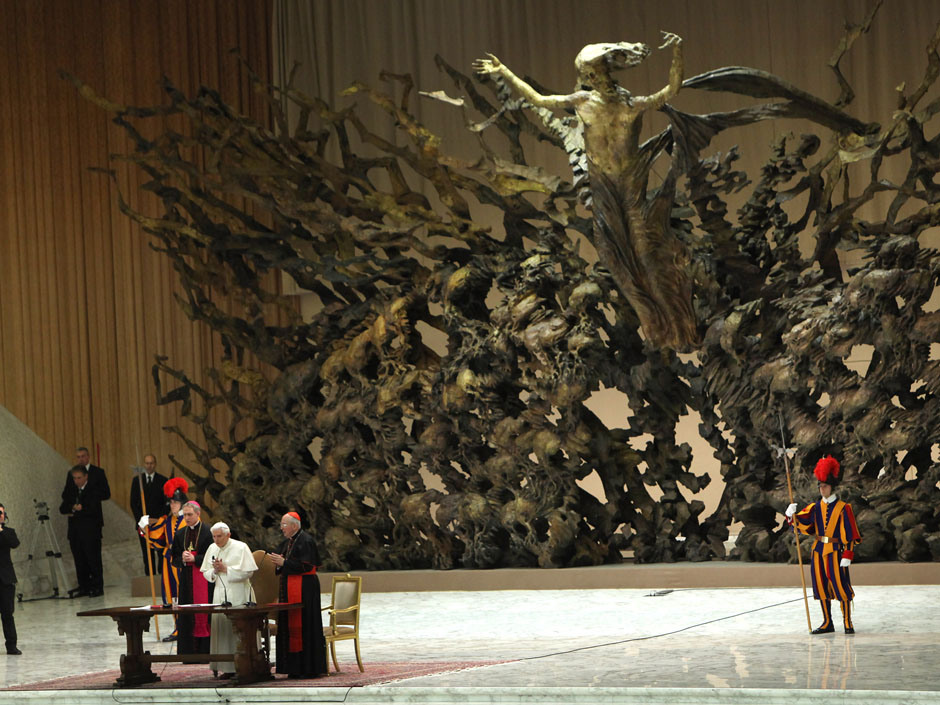
Fazzini sculpture “Resurrection” @ Vatican

“For false christs and false prophets will arise and perform great signs and wonders, so as to lead astray, if possible, even the elect.” (Matthew 24:24).

Please do not listen to dreamers and people’s retelling of visions. Please do not seek after dreams and visions. Do not undergo a trance in order to induce a dream or a vision. If you think you have had a supernatural dream, keep it to yourself, consult the bible to see if it is consistent with the more sure word. If it is, praise the Lord and go on about your business.  If it is not, pray to be protected from satanic invasions such as that and then examine yourself to see if you are in the faith. (2 Corinthians 13:5).