Posted in encouragement, jesus, perspective

Adopting a heavenly perspective

Back in the 1990s my immediate and my extended family used to rent a house on an Island once a year. We’d converge from three or four different states on this rental and enjoy a week together at the beach. Of course this was an event that was eagerly and fervently anticipated. We’d email and telephone back and forth about our plans once we got there. I would look at the photos of the rental house at least once a week. I’d google for maps of the place and look at all the roads leading to and from and around the house. How far was it from town? What restaurants were nearby? Where was the bike rental place? There was no detail spared in looking up and anticipating our visit.

Set your minds on things that are above, not on things that are on earth.” (Colossians 3:2).

I was talking with a friend the other day about a concert she was planning to attend. I got excited for her, because it was a big concert. We both laughed as I asked if she looked at a schematic of the auditorium to see where she and her companions would be sitting. Looking at photos of the venue, looking up biographies of the men in the band. It was exciting to think of the big event, and no detail was spared in all the discussion about what the concert may be like.

Do you ever have excited conversations with friends or family about a big upcoming event you’re really looking forward to? You know you have!

Why don’t we do that with heaven? We talk more about upcoming concerts and cabins than we do heaven! But heaven is a fact. It is real, and it is there. We are definitely going. Even the concert could be canceled or the rental cabin could burn down, but the fact of our going to heaven if we are saved by His grace is real and unalterable. As a matter of fact we are already citizens of heaven!

You would not believe how many people look at me strangely because I talk excitedly about the place Jesus is preparing for us. Or remark on the trees lining the River of Life, or the color of the emerald rainbow surrounding God’s throne, or meeting up with Noah or David or Hannah and walking with them, or any number of things that the bible describes as the future promise. Being in heaven with Jesus is THE MOST EXCITING THING in the entire universe, it awaits every Christian, and yet few talk about it! We talk about the big concert or the summer cabin with more excitement than we discuss the glories of the place Jesus is preparing for us.

It is important to have an eternal perspective. It is the secret to contentment, because it puts earthly trials in their place. It ignites hope. It soothes the heart. Adopt an eternal perspective because it is exhorted in the bible for us to do so.

Our light and momentary troubles are achieving for us an eternal glory that far outweighs them all. So we fix our eyes not on what is seen, but on what is unseen. For what is seen is temporary, but what is unseen is eternal” (2 Corinthians 4:17–18)

We do this in several ways. Have an active prayer life. Talking to Jesus sets the mind on the things above, because that is where He is.

Also, read the bible, and focus on the passages where it describes the things to come in concrete terms. Like the passages in Ezekiel after chapter 39 when the Millennial Kingdom is set up (the kingdom will be on earth and limited to a time of 1000 years but we ourselves will be glorified by then and living in an eternal body). Read Revelation 21 and 22. Read the passages in Corinthians and Thessalonians describing the glorified body.

The truth of the word will permeate your heart and mind and this sets you up for thinking of the things above. (A side note: AVOID all books describing heaven tourism, books like “Heaven Is For Real” and such nonsense. Stick with the words God gave us in describing His holy habitation, they are true and trustworthy).

Then, think on these things. “Finally, brothers, whatever is true, whatever is honorable, whatever is just, whatever is pure, whatever is lovely, whatever is commendable, if there is any excellence, if there is anything worthy of praise, think about these things.” (Philippians 4:8). And what is more pure, lovely, commendable, and excellent than His heaven and our home?

Finally, talk about these things. When I speak of making a date with a friend in heaven and going to see David or Noah or Hannah, they look at me funny. But these names are not just bible characters, but real people dwelling in heaven in real worship right now. When the time of glorification comes, they will have real bodies, as we will, and we will worship and sing and walk and talk and eat and live together! It is a fact. Talking about heaven and the bible’s men and women as real people whom we will see makes it all the more real for those with whom we are having the conversation. (And for those listening to us!) 

If we’re not embarrassed to spout on and on about the cruise we’re going to take in a few months, then what is so embarrassing about talking about what our place in heaven might look like, or the fruits of the trees of life lining the river, or the pillars of the temple shaking as the cherubim sing HOLY HOLY HOLY? Those things are more real than the cruise, which hasn’t happened and might not, while God is in heaven on His throne right now! (Revelation 4:1-5)

If we would remember that all the trees of earth are marked for the woodsman’s ax, we should not be so ready to build our nests in them.” Charles Haddon Spurgeon

Pray, read, think, and talk about heaven. You’ll find your happier, more content, more able to endure hardship, and your re-oriented perspective will excite the brethren and please Jesus. What’s to lose? It’s a win-win all around.

Posted in adorn, doctrines, encouragement

We are adornments

According to Merriam Webster Dictionary, the word adorn is defined as

to make (someone or something) more attractive by adding something beautiful

With that in mind let’s look at this verse from Titus:

Bondservants are to be submissive to their own masters in everything; they are to be well-pleasing, not argumentative, not pilfering, but showing all good faith, so that in everything they may adorn the doctrine of God our Savior.” (Titus 2:9-10)

I like the emphasis here. Jesus’ doctrine is pure and beautiful on its own, but we adorn it when we live by its standards. Pastor Bayless Conley expounded on this verse in a devotional titled “Double Standard.”

——————–Begin Conley———————–

Double Standard

I would like for you to read again the Scripture we read yesterday, Titus 2:9-10,

Exhort bondservants to be obedient to their own masters, to be well pleasing in all things, not answering back, not pilfering, but showing all good fidelity, that they may adorn the doctrine of God our Savior in all things.

We make the gospel unattractive when we live contrary to our beliefs. The gospel becomes unsavory and unattractive to those outside the church when our lives do not match up to what we say we believe.

Take the verses we read here. Paul says, in effect, that we make the gospel unsavory when we pilfer (which means stealing items of small value) or talk back to our boss.

You do not adorn the gospel when you show lack of respect for your boss, rip the company off, use the phones and computers at your job for personal business, take extra long lunch breaks, steal paper, take staplers, steal pens, or whatever you can get your hands on.

You should not dress the gospel in rags and then pass out tracts to all your coworkers or invite your boss to church.

This truth does not just apply to work. Do not live contrary to your beliefs anywhere. Do not live a double standard at home. If you do, it will turn your kids away from wanting to serve Christ. If you are into sports and you curse a lot, cheat, or have a bad temper, you dress the gospel in rags.

In 2 Corinthians 3:2 Paul states that, You are our epistle written in our hearts, known and read by all men.

The truth is, we are the only Bible some people will ever read. They are looking at our lives.

——————–End Conley——————

Here is one other verse with the word adorn in it:

And I saw the holy city, new Jerusalem, coming down out of heaven from God, prepared as a bride adorned for her husband. (Revelation 21:2)

Gill’s Exposition explains,

when all the elect of God are gathered in, the number of the saints is perfected; when the good work of grace is finished in them all, and they are all arrayed in the righteousness of Christ: and to be “adorned”, when not only they are clothed with the robe of righteousness, and garments of salvation, and are beautified with the graces of the Spirit, but also with the bright robes of immortality and glory.

So keep His doctrines, for we are an adornment to our Groom’s truths. In heaven right now, He is adorning His city for us, His bride.

Posted in amazing grace, discernment, hymns, savior, sinner, words, wretch

Do you mind when they change the lyrics to ‘Amazing Grace’ and leave out "wretch"?

Words matter. I was a newspaperwoman for 7 years and let me assure you, the words we choose to put in print color our perceptions of the world, of people, and of concepts. The same goes for poems, stories, and textbooks. I can’t imagine any writer who doesn’t take care with choosing exactly the right word to use at particular points of his or her piece. (Except maybe Proust).

Consider this sentence,

“The large group of activists marched through town”
“The large group of protesters walked through town”

A different take, depending on which word was chosen, isn’t it?

On March 11, 2003 an actual NY Times headline read:
Iraq forces suspension of U.S. surveillance flights

And on the same day the headline reporting the same incident in USA Today read:
U.N. Withdraws U-2 Planes

This is known as bias. As the essay from ‘News Bias Explored: Word Choice‘ defines, “Words are very precise building blocks that form the basis for all communicated ideas…Bias, in many forms, is not necessarily explicit in the words that have been used but can be recognized when seen in the fuller context that the words represent. Journalists do this by manipulating single words in such a way that whole sentences’ meanings are subtly changed…and sometimes not so subtly.

I wasn’t saved by grace until I was 43 years old. That meant I had many years as a youth and a fully grown adult to reject Jesus and all He stands for. I remember several times being in places where the hymn “Amazing Grace” by John Newton was sung. Whether it was a concert or a church wedding, the hymn is usually familiar to even the most oblivious of a non church-going person, like me, because it is played even at so many places other than church where the lost tend to congregate.

Wikipedia says of the song:

Author Gilbert Chase describes “Amazing Grace” as “without a doubt the most famous of all the folk hymns.” Jonathan Aitken, a Newton biographer, estimates that it is performed about 10 million times annually. “Amazing Grace” stands as an emblematic Negro spiritual and exemplar of Appalachian shape note hymnody. In the nineteenth century the hymn was sung by Native Americans enduring the ordeal of the Trail of Tears, by abolitionists, by soldiers in the U.S. Civil War, and by homesteaders settling the Prairies. Today it has attained international popularity…” (Left, John Newton, author of Amazing Grace”)

What an opportunity the lost person has to learn of the grace of the Great Savior! That they are lost, which they do not know! That grace awaits, which they do not understand. They they are a wretch but can be saved, that they need but do not want. In places where bibles are banned and sermons are stopped, songs can be sung with loaded words which carry the grace of Jesus and the first, dawn-like whiffs of hope and deliverance.

Wretched man that I am! Who will deliver me from this body of death? (Romans 7:24)When I was lost, I liked the hymn. I thought it was pretty, and had a good message and stirred me somehow. Except one part I hated. When it got to the lyric that said, “saved a WRETCH like me.” When it got to that part, I closed my mouth and refused to sing the line. ‘I’m not a wretch’ I’d think to myself. ‘I’m a good person! How ridiculous to have such low self-esteem!’

Of course, that was the point Newton was trying to make. He was a very great sinner, but so are we all. No matter who is singing this song, save one exception in the universe (Jesus), that wretch lyric can and does apply.

Now that we are in such an apostate world, no one likes to believe they are a wretch. But unless we understand how very great of a wretch we are, we will not understand how very great a Savior we have. I heard “Amazing Grace” this week by a new artist. The lyric had been changed. This is what she sang-

“Amazing Grace, how sweet the sound, that saved a SOUL like me.”

For you say, I am rich, I have prospered, and I need nothing, not realizing that you are wretched, pitiable, poor, blind, and naked. (Revelation 3:17)
We all have a soul. Even the most atheistic of people believe we have a soul and it goes somewhere after we die, if even to be annihilated or changed into a centipede. What’s so amazing about grace that saves a soul? Nothing. It is the wretch that is saved that is so amazing.

but God shows his love for us in that while we were still sinners, Christ died for us“. (Romans 5:8)

Jesus didn’t die for souls, He died for sinners, wretched sinners. If you are confronted with a lyric or a verse where it has been changed, please know that it makes a difference. Remember that what you read or hear are words, and words communicate ideas. The most important idea in the universe is that we are all sinners in need of a Savior, and that Savior IS Jesus Christ and no other. We are all wretches, and Jesus as the Sinless One lifted us up and gave us new life in Him. As the article above I’d quoted and linked to states, the lost world likes to change ideas and they do “this by manipulating single words in such a way that whole sentences’ meanings are subtly changed.” Wretch and soul are not the same. Words matter.

~~~~~~~~~~~~~~~~~~~~~~~~~~~~
Further Reading:

Here is a short documentary about the song and how it came to be written.

Amazing Grace: The Story Behind the Song

Wretched Radio with Todd Friel

Posted in encouragement, grace, jesus, majesty, throne

The throne of Majesty, the throne of Grace

I was listening to a S. Lewis Johnson sermon on Hebrews 4 the other day. He was expounding on the following verse-

Let us then with confidence draw near to the throne of grace, that we may receive mercy and find grace to help in time of need. (Hebrews 4:16)

The Queen of England in 2004 delivering a speech.
Cleveland Plain Dealer photo

Thrones are usually seen as majestic. Thrones are large and high-backed, stately, usually covered in finery, adorned with jewels, and lifted up. Of course the Lord’s is no different, it is THE most majestic throne of all! This verse from later in Hebrews attests to its majesty and the one who occupies it.

Now the point in what we are saying is this: we have such a high priest, one who is seated at the right hand of the throne of the Majesty in heaven, 2a minister in the holy places, in the true tent that the Lord set up, not man. (Hebrews 8:1-2)

In the Hebrews 8 verse we see the throne of majesty and the Lord performing His holy duties. It is such a comforting picture, to think of Jesus administering His holy duties! However such a throne would not be so approachable.

The protocols surrounding meeting the Queen of England, Elizabeth II, are formal and strict. Only the politest of questions are suggested, such as “Is Your Majesty enjoying the performance?” She is to be referred to as Your Majesty, and Ma’am thereafter.One does not turn one’s back to the Queen, and curtsies are expected. One does not touch the Queen, and if she extends her hand, one must not grip it or pump it. These are indicators of respect and obeisance to the Sovereign.

The photo below is of Pope Benedict on his throne, richly adorned and atop marble steps. It is not an approachable throne.

Pope Benedict

Though man tries to emulate a sovereign throne of majesty, they all pale in comparison to the one described in Hebrews. Such majesty the Lord’s throne must emanate! I can see Him in my imagination through the biblical description as Priest performing His duty. Isaiah was given a sight of this:

In the year that King Uzziah died I saw the Lord sitting upon a throne, high and lifted up; and the train of his robe filled the temple. 2Above him stood the seraphim. Each had six wings: with two he covered his face, and with two he covered his feet, and with two he flew. 3And one called to another and said:

“Holy, holy, holy is the Lord of hosts;
the whole earth is full of his glory!”

4And the foundations of the thresholds shook at the voice of him who called, and the house was filled with smoke. 5And I said: “Woe is me! For I am lost; for I am a man of unclean lips, and I dwell in the midst of a people of unclean lips; for my eyes have seen the King, the Lord of hosts!” (Isaiah 6:1-5)

Now THAT is a throne of majesty!!! One would hardly dare to approach in confidence and boldness as the Hebrews 4 verse says!

So the Lord in His mercy and wisdom inspired the writer of Hebrews to encourage us, when we need to receive mercy and find grace to help in time of need, to approach the throne of grace.

In the times where we have a need, we are encouraged to approach with confidence not the majestic throne, though it is, but to draw near to the throne of GRACE.

How merciful is our God, who demonstrates again and again his wisdom and His mercies! When we need Him, His throne is one of grace, approachable and ready for us to receive His gift. It was S. Lewis Johnson who pointed to that distinction between the Hebrews 8 throne of majesty and Hebrews 4’s throne of grace.

I hope you ponder the majesty of our Holy God and also delight in His throne of grace, which stands ready to be approached by us, His little children, to weep for help and to be the beneficiary of His grace in our time of need. He is a tremendous God! Praise Him today, with your mouth, in your songs, and by your heart with love to Him the Worthy One.

~~~~~~~~~~~~~~~~~~~~~

Further Reading

S. Lewis Johnson bio

    Posted in earthquakes, oklahoma, prophecy, rapture

    Oklahoma: "We have already crushed last year’s record for number of earthquakes"

    I’ve written about earthquakes a lot lately. This is why. It is an excerpt of an article that reports the quake swarm occurring in OK as it has been since 2009. The rest of the article proposes that hydraulic fracturing of rocks in oil extraction could be the cause, but this has been debunked elsewhere. I’m amazed at all the things the Lord is in control of and how He handles the events that will eventually bring us to His point when all history constricts down to one moment: the Rapture.

    Please read the news article below and see what you think.

    ~~~~~~~~~~~~~~~~~~~~~~

    Series of small earthquakes rock Oklahoma in record seismic activity
    Earthquakes rattled residents in Oklahoma on Saturday, the latest in a series that have put the state on track for record quake activity this year, which some seismologists say may be tied to oil and gas exploration.  One earthquake recorded at 3.8 magnitude by the U.S. Geological Survey rocked houses in several communities around central Oklahoma at 7:42 a.m. local time. Another about two hours earlier in the same part of the state, north of Oklahoma City, was recorded at 2.9 magnitude, USGS said.

    Those two were preceded by two more, at 2.6 magnitude, and 2.5 magnitude, that also rolled the landscape in central Oklahoma early Saturday morning. A 3.0 magnitude tremor struck late Friday night in that area as well, following a 3.4 magnitude hit Friday afternoon.

    Austin Holland, a seismologist with the Oklahoma Geological Survey who tracks earthquake activity for the USGS, said the earthquake activity in the state is soaring.

    “We have had almost as many magnitude 3 and greater already in 2014 than we did for all of 2013,” Holland said.

    Last year’s number of “felt” earthquakes – those strong enough to rattle items on a shelf – hit a record 222 in the state. This year, less than four months into the year, the state has recorded 253 such tremors, according to state seismic data.

    “We have already crushed last year’s record for number of earthquakes,” Holland said.

    Posted in discernment, joel osteen, scripture twisting

    A short note on Joel Osteen

    To research some background on a recent blog essay, I listened to a short interview by a reporter from the Wall Street Journal blog and Joel Osteen of Lakewood Church in Houston. He was being interviewed on the occasion of the release of his latest book (October 2013) “Break Out!” In the interview, the reporter asked Osteen what he thought of the (then) new Pope, Francis. Osteen lauded the new pope. He loved the Pope’s “inclusive” message and how he got out “among the people.”

    The reporter picked up on Osteen’s mention of inclusiveness and asked him how to reconcile what the bible says about, say, gay people, and welcoming same sex couples to church. ‘How do you walk that line?’ the reporter asked.

    Osteen said, “Jesus said ‘you will know them by their love for one another’ so you have to say, you know, I may not agree with you, but I’m going to accept you and I’m going to love you. We believe what the bible teaches but we also we believe the bible says to accept and love everyone.

    The scripture Osteen was twisting here is “you will know them by their fruits”. (Matthew 7:16). Jesus most assuredly did NOT say you will know them by their love. And, in an ironic turn of events, just who is it that we will know? Jesus is actually talking about false prophets.

    Beware of false prophets, who come to you in sheep’s clothing but inwardly are ravenous wolves. You will recognize them by their fruits. (Matthew 7:15-16a)

    Does the bible teach us to accept everyone? It sounds nice, but no. “Accepting” same sex couples in church is accepting that they are deliberately flaunting their sin in direct opposition to God’s holy standards. It is the same with any unrepentant person. If a drunk were to come drunk to church every single week, with a vodka bottle, saying “I’m PROUD of my drunkenness!” would you accept that as God-honoring church behavior? This is why we have a process for church discipline, to bring that person to repentance. If they do not repent, we excommunicate them. We do NOT accept flagrant sin. It dishonors the name of Christ, and it also allows sin to spread like a cancer. God wants His bride to remain pure and undefiled. (Ephesians 5:25-27). We never “accept” sin. Never. Christ’s blood is too precious.

    More to the point, accepting people’s sin is paving the way to hell for them. The Lord will richly repay Joel Osteen for his evil deeds.

    Asked about why he is successful, he said,
    “I try to make my message not heavy on doctrine necessarily”

    Well, of course. “For the time will come when they will not endure sound doctrine; but wanting to have their ears tickled, they will accumulate for themselves teachers in accordance to their own desires,” (1 Timothy 4:3)

    I hope you will not even post one quote from Mr Osteen on your Facebook page, or buy one book of his, or listen to even one more second of his “sermons.” He is a scripture twisting, hell paving, evil minister of darkness. He is untaught and unstable.

    The untaught and unstable twist them to their own destruction, as they also do with the rest of the Scriptures. (2 Peter 3:16)

    Posted in big god, discernment, osteen, pray big, prayer

    Sayings and mottos that sound pious but aren’t. #4: "Pray big because we have a big God"

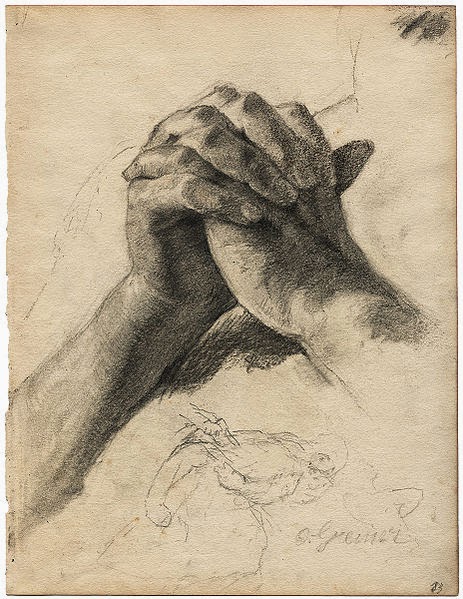
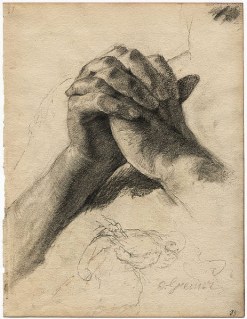
    Otto Greiner, Praying Hands, circa 1900. CC

    Some sayings sound legitimate on their surface. They sound pious. They sound biblical. Like this one: “Cleanliness is next to Godliness”. Only problem is, that one isn’t in the bible. At all.

    It is sometimes hard to tell what truly is Christian and what merely sounds Christian. Charles Spurgeon wisely said, “Discernment is not a matter of simply telling the difference between right and wrong; rather it is telling the difference between right and almost right.” So what sayings are right, and what sayings are almost right (AKA ‘wrong’)? Let’s look at the following sayings which have become such cliches.
    Some of these mottoes are:

    1. “Let go and let God
    2. “I don’t use commentaries because they’re men’s wisdom. I only use God’s Word when I study.”
    3. “We can’t know for certain what the bible means, I’m not that smart
    4. “Pray big because we have a big God.”
    5. “He’s so heavenly minded he’s no earthly good

    Does praying big mean as Cassandra Martin says on her blog,

    We tend to pray small prayers, shy prayers, safe prayers. God wants us to pray big prayers, risky prayers, prayers that stretch our faith, expand our vision, and place us firmly in His hands. He wants us to take His word seriously and “with confidence draw near to the throne of grace, that we may receive mercy and find grace to help in time of need.” (Hebrews 4:16) Praying Big begins with remembering that we serve a very BIG God. He is bigger than our fears, our struggles, our falls, our joys, our plans, and our expectations. Praying Big encourages us to invest ourselves in prayer in a big way. Faith-full people are always big pray-ers. When we pour ourselves into prayer, God pours Himself into us. Praying Big invites us to see our lives, our challenges, our opportunities, and our world through heaven’s eyes. Prayer changes our vision, our responses, and our attitudes because in prayer God changes us.

    Gee. That sounds good. Or does it mean as Anna Diehl said on her blog, The Pursuit of God,

    Here’s a popular little jingle in Christendom: “Pray BIG, because we have a BIG God.” But what does this mean exactly? If we need a car, does God want us to pray for a brand new SUV instead of some small beat up clunker? If we need a new place to live, does He want us dreaming of mansions instead of just hoping for a room somewhere? If finances are tight, are we supposed to name and claim millions instead of just what we need? Is God offended by our lack of faith when we don’t dream big and pray expectantly? Well, it depends.
    God wants us to be bold in our prayers, but only when our priorities are aligned with His.
    ~Anna Diehl

    Think about the kinds of things you’ve asked God for recently. What were your prayer requests over the last year? Lump them all together into your mind and then divide them into two categories: things that have to do with your earthly comfort, and things that have to do with your spiritual growth. Which category do you pray about more often?

    Gee. That sounds good too.

    Or does it mean as so many ‘name it claim it’ casually teach, like Joel Osteen, that we need to be more ambitious in what we’re asking God for and more confident in what we’re looking for in our lives and to do this we need to pray ‘God-sized prayers’?

    No. That definitely sounds bad.

    This confusion is why we need to examine what we say and be mindful of our cliches.

    The root verse for this ubiquitous phrase we’ve come to hear so frequently is usually supported by an interpretation of Hebrews 4:16,

    Let us then with confidence draw near to the throne of grace, that we may receive mercy and find grace to help in time of need.”

    Gill’s Exposition explains the boldness and confidence indicated in the Hebrews verse:

    …a drawing nigh to God in that ordinance with spiritual sacrifices to offer unto him: and this may be done “boldly”; or “with freedom of speech”; speaking out plainly all that is in the heart, using an holy courage and intrepidity of mind, free from servile fear, and a bashful spirit; all which requires an heart sprinkled from an evil conscience, faith, in the person, blood, and righteousness of Christ, a view of God, as a God of peace, grace, and mercy, and a holy confidence of being heard by him; and such a spirit and behaviour at the throne of grace are very consistent with reverence of the divine Majesty,
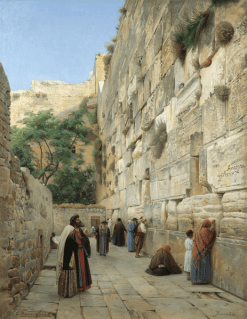
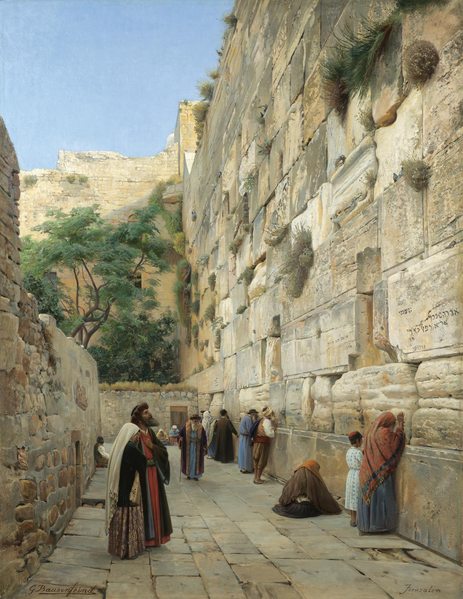
    The Wailing Wall, Jerusalem,
    by Gustav Bauernfeind (1848-1904). CC

    Let’s contrast confidence to approach the throne after the cross as opposed to the Temple days before the cross. In the days before the veil was torn it meant that you had to go through an incredibly time-consuming and intricate set of rituals to enter the holy of holies where the presence of God was. The High Priest must atone for his sins in order to be considered pure enough even to enter. If you made a misstep, you would be struck dead.

    Think of Uzzah, who put his hand on the Ark of the Covenant, and was stuck dead instantly, because his hand is sin while the dirt of the ground is just dirt, not sin.

    The Holy of Holies was separated from the rest of the tabernacle/temple by the veil, a huge, heavy drape made of fine linen and blue, purple and scarlet yarn and embroidered with gold cherubim. God said that He would appear in the Holy of Holies (Leviticus 16:2); hence, the need for the veil. There exists a barrier between man and God. The holiness of God could not be accessed by anyone but the high priest, and then only once a year. God’s “eyes are too pure to look on evil” (Habakkuk 1:13), and He can tolerate no sin. The veil and the elaborate rituals undertaken by the priest were a reminder that man could not carelessly or irreverently enter God’s awesome presence. Before the high priest entered the Holy of Holies on the Day of Atonement, he had to wash himself, put on special clothing, bring burning incense to let the smoke cover his eyes from a direct view of God, and bring sacrificial blood with him to make atonement for sins (Exodus 28; Hebrews 9:7) Read more: http://www.gotquestions.org/Holy-of-Holies.html#ixzz2y1390c2Z

    In those days, coming boldly before the throne with confidence was not possible. However, once the veil was torn, signifying that THE atonement had been completed, we can all approach now. We don’t have to wait for a certain day, we don’t need a representative to go for us, we can all approach and He is listening. We know He is listening because He is our intercessor. (Romans 8:34)

    So understanding the reason for our confidence (or boldness as some versions say) it brings the focus back on Jesus. Now to look at the size of prayers we’re told to make.

    We have somehow equated boldness in behavior to largeness of prayer. We’ve swapped confidence in approach for magnitude in request. If there are “big” prayers by definition they are saying that there are “small” prayers too, and worse, assigning a size to prayers tacitly insinuates that the small prayers are no good.

    Philippians 4:6 teaches, “Do not be anxious about anything, but in everything by prayer and supplication with thanksgiving let your requests be made known to God.”
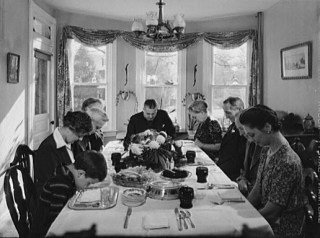
    Thanksgiving Prayer, 1942.Photo by Marjory Collins.
    Farm Security Administration (Library of Congress)

    It doesn’t say “by prayer let your BIG requests known to God” but instead it says do not be anxious about anything and make requests [of any size] known to God.

    My God is big enough to care about everything, not just the big things. Are we to dispense with “small” prayers because He could get busy and overwhelmed? What a ghastly thought! He is perfect in patience. Because we don’t want to take up His time? Time in heaven does not exist, and He is the author of time on earth!

    In the link above, Joel Osteen explains to the Wall Street journal reporter about big prayers. He says that “we get into a rut” with our prayers. Wrinkling his nose and speaking dismissively, Osteen said that ‘sure, we pray for our food, and our children, but we think hey, God’s got bigger things to deal with than my goals and my dreams…’ and so we don’t pray big prayers.” In Osteen’s latest book Break Out, he explains why we should pray big–this is from the book blurb

    We were not created to just get by with average, unrewarding or unfulfilling lives. God created us to leave our marks on our generations. Every person has seeds of greatness planted within by the Creator. When life weighs upon us, pushing us down, limiting our thinking, labeling us in negative ways, we have what it takes to overcome and rise above into the fullness of our destinies

    One of the five strategies for living a more rewarding life and leaving our mark according to Osteen is to “pray bold prayers”. The opposite to that of course, implicitly stated, is that praying ‘small’ prayers will result in a less fulfilling and rewarding life.

    Yet to have a life fulfilled with all my personal dreams coming true is not the reason we pray. We pray because it is commanded (Luke 18:1). We pray to glorify God (John 14:13). We pray in a spirit of humility and unselfishness, pleading with Jesus to advance His cause and Glorify Himself. We pray to bear each other’s burdens and to be in His will and for reasons large and small we make petitions to demonstrate our acknowledgement of our dependence on Him. Jesus should be the orientation of the prayer and His will ultimately should be the goal.

    So,..is praying for our food a small prayer? The Lord told us to pray in this way. In Matthew 6:11 He said to pray for our daily bread. Acts 2:42 says that they were continually praying, meeting, and breaking bread together as acts of worship. Showbread (AKA Bread of Presence) was a holy item in the temple, and the manna was in the ark. Food’s important.

    Praying for our children? Is this a small prayer? Children are a heritage from the Lord, according to Psalm 127:3. Should David not have prayed for his sick son? (2 Samuel 12:16). Should Hannah not have prayed to be given a son? (1 Samuel 1:13). Should Job have not continually interceded for his children? (Job 1:1-5). Yet Job was called blameless and upright.

    As far as the so-called “rut” goes…what about the persistent widow? She was lauded for persisting in her plea for justice. What about the admonition to always pray, and to pray ceaselessly? (1 Thessalonians 5:17)

    Ephesians 6:18 says “And pray in the Spirit on all occasions with all kinds of prayers and requests” ‘All kinds”, the verse doesn’t say not to bother God with small petitions. It also does not say that the bigger you pray the bigger your faith is.

    As we saw at the beginning of this essay from the three ways the phrase is used (Cassandra Martin, Anna Diehl, Joel Osteen) the ‘pray big because God is big’ mantra can mean different things by different people. The point of this exercise in examining these cliches and phrases is to be mindful of what we say, and to know what it is we’re saying so we can defend or explain it. (Jude 1:3, 1 Peter 3:15). Is what we’re saying God-honoring? Is it biblical?

    Overall, though the cliche can be explained as a good thing, I try not to say this phrase at all because of the confusion it causes. Most often, people take it simply to mean that the bigger the prayer, the bigger our faith in God is. I pray for Him to heal my eczema. Do I lack the same quantity of faith as a barren woman praying for a child? And what about the biggest prayer of all, the most incredible act of the universe, prayer for salvation for someone? I think it’s dangerous to start sizing up prayers., it’s especially foolish to base a size of a prayer on the size of our God, because we can’t know how big He really is. And with all His size, He is a God of mercy, and His eyes roam over the earth, and sees when a sparrow falls. He knows the number of hairs on our head. Those are small things.

    Just meditating on the fact that we can pray to an interceding Jesus is an amazing thing to ponder and be grateful for. God isn’t impressed by the size of our prayers,  Just as Jesus wasn’t impressed by the length of the prayers of the Pharisee but by the condition of our hearts. With that in mind I encourage you to read Anna Diehl’s piece above and see the example prayers. They give one pause for thought.

    ~~~~~~~~~~~~~~~~~

    Further Reading

    What are different kinds of prayer?

    What are most common things people say are in the bible that aren’t in the bible?
    Posted in chile, earthquake, prophecy, tribulation

    Earthquakes in the Tribulation

    I’m fascinated by earthquakes. By the spike in hits on the blog after a quake, many other people are too. There’s something primal about the seemingly solid ground under our feet turning out not to be solid, and to be literally shaken.

    My only experience with a quake was the recent 4.1 magnitude in Georgia/South Carolina we had on February 15. I felt that one as it was happening.

    The only other experience I’d had was the World Series Loma Prieta Quake in 1989. I was on the phone talking with a guy friend and we were “watching” the baseball game together. It was before ubiquitous use of personal recording devices or police or traffic cams, but since the game was televised live, the initial jolt was recorded live. It knocked out the cameras but before it did, we can hear announcer Tim McCarver say “We’re having an earthq”, we hear screams, and then dead air and a scrambled signal before everything went dark. That quake was a 6.9 and 63 people died.

    I went on an archaeological dig in 1990 to Italy and one of the team members was a woman who lived in Loma Prieta, and she had photos she carried with her that she showed me of her destroyed house.

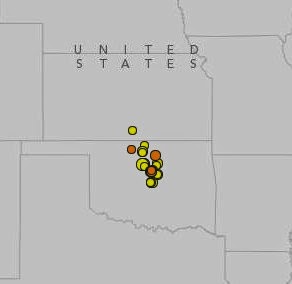
    Oklahoma continues to experience a non-stop quake swarm. There have been 44 this week and 123 this month. This photo is a screen shot of the ‘7-DAY, recent quakes’ page at UN Geological Survey.

    Yes, the quakes in OK are unusual. There isn’t an earthquake fault in the areas the quakes are occurring. The minor fault at southwest OK hasn’t moved in 1300 years. So they attribute the quakes to fracking (fracturing of rock by a pressurized liquid) to extract oil. The problem with that that theory is that fracking occurs at an even higher frequency in Texas and there is not an attendant increase in frequency or magnitude of quakes at that location. This scientist from the Oklahoma Geological Survey explains, (article from 2010)

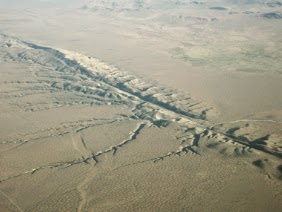
    The only known surface expression of an active fault occurs in southwestern Oklahoma. The last slip on this fault is estimated to be about 1300 years ago and may have been equivalent to a magnitude 6.5 or 7.0 earthquake. This fault is known as the Meers Fault and is visible from the air as can be seen in the following picture.”

    He says they don’t know why there has been a dramatic increase in quakes and they don’t have an answer. It is interesting that Jesus said as a sign of His coming there would be earthquakes in diverse places. That an ongoing, several year swarm is occurring in a place where no fault exists negatively impacts man’s plate tectonics theories and in my opinion directly shows God’s sovereignty.

    Not every earthquake (or tornado or hurricane or tsunami) is a judgment from God, though sometimes they are. We read below in the Job verse the LORD shakes the wicked from the earth. Sometimes as Romans 8:19-21 states, the LORD made the creation subject to decay and frustration and it groans, so that man will ponder the effects of sin. Sometimes God, for His won good purposes, allows satan to control the weather. Satan was allowed to torment Job by a mighty wind and by fire falling down from heaven consuming Job’s servants and sheep. (Job 1:16-19).

    As of this writing, there have been 104 earthquakes in Chile this week since the 8.2 major quake. Several of the aftershocks in Chile have been major quakes in themselves. One was a 7.6 magnitude and another was a 6.5. The news says that 900,000 people were evacuated from the coast after the quake triggered a tsunami, and in many cities, electricity went out, triggering panic. As of this date five people died in the quake and aftermath. This news article from CNN says of the Chile quake,

    Chile quake: This was big but a bigger one awaits, scientist says
    An 8.2-magnitude earthquake struck off the coast of northern Chile Tuesday night, triggering small landslides, setting off a tsunami and killing at least five people. But geologists say an even larger quake in the region is lurking. “This magnitude 8.2 is not the large earthquake that we were expecting in this area,” said Mark Simons, a geophysicist at Caltech in Pasadena, California. “We’re expecting a potentially even larger earthquake.” It could be tomorrow. Or it could be 50 years. “We do not know when it’s going to occur,” he said. Here’s why…

    …and the article continues in explaining how fault lines work and why they believe a bigger quake awaits Chile.

    “Have you commanded the morning since your days began, and caused the dawn to know its place, that it might take hold of the skirts of the earth, and the wicked be shaken out of it?”        Job 38:12-13Bible believers know that larger quakes await anyway, irrespective of the human penchant to formulate theories as to why these happen.

    There will be one in the Tribulation described in Revelation 6, the 6th Seal Judgment of Revelation 6:12

    When he opened the sixth seal, I looked, and behold, there was a great earthquake, and the sun became black as sackcloth, the full moon became like blood.”

    This is the earthquake to cause men to hide in the caves and under rocks and shout in fear that the Great Day of Wrath has come.

    After that there will be general quakes as stated in Revelation 8:5. In Revelation 11:13 another great quake occurs, and a tenth of the city of Jerusalem falls, killing 7,000. The survivors are terrified and give glory to God in heaven.

    Finally at the end of the Tribulation the 7th Bowl Judgment concludes the Wrath. An earthquake hits the city of Jerusalem, where many people will die and the city will be split into three parts. It will be the greatest quake ever to occur on the earth. It is the 6th Bowl judgment and it concludes God’s wrath. The loud voice crying out from the throne says “It is done!” (Revelation 16:18-20).

    And there were flashes of lightning, rumblings, peals of thunder, and a great earthquake such as there had never been since man was on the earth, so great was that earthquake. (Revelation 16:18)

    Never more than through an earthquake does God reminds us that the earth is His, and everything in it. (Psalm 24:1)

    Dragon’s Back (Elkhorn Scarp) in the Carrizo Plain. Source

    At that time his voice shook the earth, but now he has promised, “Yet once more I will shake not only the earth but also the heavens.” 27 This phrase, “Yet once more,” indicates the removal of things that are shaken—that is, things that have been made—in order that the things that cannot be shaken may remain. 28 Therefore let us be grateful for receiving a kingdom that cannot be shaken, and thus let us offer to God acceptable worship, with reverence and awe, 29 for our God is a consuming fire.” (Hebrews 12:26-29)

    Doesn’t this section of the San Andreas Fault in California look for all the world like an earth scar? Won’t it be wonderful when He removes the curse, and the earth no longer groans! We are so grateful, Lord, for Your kingdom which cannot be shaken! You are truly the Rock, immovable!

    O come, let us sing unto the LORD: let us make a joyful noise to the rock of our salvation. (Psalms 95:1)

    ~~~~~~~~~~~~~~~~~~~~~~~~
    Further Reading

    Let Us Reason Ministry: The Blood Moons are Coming

    John MacArthur preached on the Tribulation several times. Here are two sermons, decades apart:

    1970: The Terrors of the Tribulation

    2011: The Future Tribulation

    Scriptures: What does the bible say about earthquakes?

    Institute for Creation Research: Great Earthquakes of the Bible

    Posted in God, hail, power, tribulation

    Tremendous storm in Denton TX

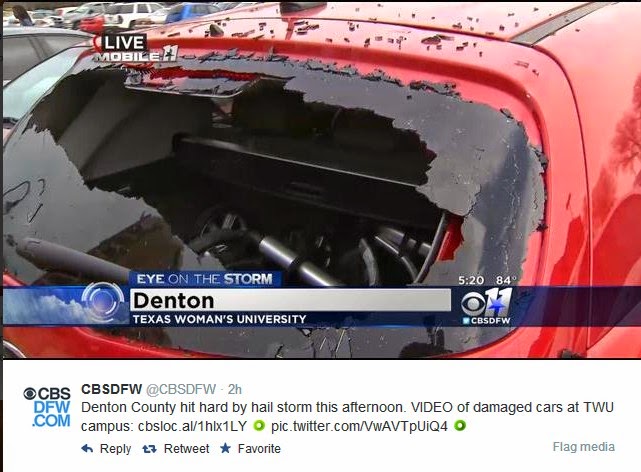
    A major hail & rain storm occurred in Denton TX this evening, and a tornado also. Here are some photos of the softball sized hail. Some of these photos are just unreal.

    Texas Storm Chasers ‏@TxStormChasers

    TWC Breaking ‏@TWCBreaking 3h. #Hail up to 3.5 inches in diameter fell in Denton TX around 3:45p

    It is always amazing to think of the power of God. Seeing photos like this reminds me. And they also remind me that this is but a minute portion of His power. He has been patiently holding it back. But the full cup of His unleashed power in wrath will be fully unleashed during the tribulation, when 100 pound hailstones fall from the sky to crush men.

    And great hailstones, about one hundred poundsd each, fell from heaven on people; and they cursed God for the plague of the hail, because the plague was so severe. (Rev 16:21)

    He is surely a long-suffering God!

    Yours, O Lord, is the greatness and the power and the glory and the victory and the majesty, for all that is in the heavens and in the earth is yours. Yours is the kingdom, O Lord, and you are exalted as head above all.” (1 Chronicles 29:11)

    Posted in clarity, humble, perspicuity, scripture, The Hermeneutics of Humility

    Sayings and mottos that sound pious but aren’t. #3 "I’m too humble to think that I could ever know what the Bible really means"

    Part 1: “Let Go and Let God
    Part 2: “I don’t use commentaries because they’re men’s wisdom. I only use God’s Word when I study.”
    Part 4: #4: Pray Big Because We Have a Big God
    Part 5: He’s so heavenly minded he’s no earthly good

    Some sayings sound legitimate on their surface. They sound pious. They sound biblical. Like this one: “Cleanliness is next to Godliness”. Only problem is, that one isn’t in the bible. At all.

    It is sometimes hard to tell what truly is Christian and what merely sounds Christian. Charles Spurgeon wisely said, “Discernment is not a matter of simply telling the difference between right and wrong; rather it is telling the difference between right and almost right.” So what sayings are right, and what sayings are almost right (AKA ‘wrong’)? Let’s look at the following sayings which have become such cliches.
    Some of these mottoes are:

    1. “Let go and let God”
    2. “I don’t use commentaries because they’re men’s wisdom. I only use God’s Word when I study.”
    3. “We can’t know for certain what the bible means, I’m not that smart”
    4. “Pray big because we have a big God.”
    5. “He’s so heavenly minded he’s no earthly good”
    #3, The Hermeneutics of Humility.

    Mike Ratliffe said, “Hermeneutic of Humility” is a way of looking at our faith and interpreting the very Word of God through a filter that sees certainty as a product of pride and uncertainty as a virtue. … These people contend that to be certain divides people while uncertainty creates an environment of unity.

    However the mantra that doctrine divides is a misconception. True doctrine does divide, and that is a good thing, because that is what it is supposed to do. But first let’s define hermeneutics.

    CARM defines Hermeneutics as “The science of interpretation. Theologically, and biblically, speaking it is the means by which a person examines the Bible to determine what it means.”

    The hermeneutics of humility says that anyone saying for sure what the bible means is being proud and displaying arrogance. Ultimately, it is a subtle denial of the truth.

    There’s a new hermeneutics, a new science of interpretation called the Hermeneutics of Humility, and this is serious to the people who espoused this and their Hermeneutics of Humility say, “I’m too humble to think that I could ever know what the Bible really means and so I can only offer my opinion and I certainly can’t say that this is in fact the truth.” (source)

    Now, while it is good to be humble (that’s why this saying is a subtle trick), let’s look at the difference between personal humility and interpretive humility. In personal humility, Romans 12:3 says,

    For by the grace given to me I say to everyone among you not to think of himself more highly than he ought to think, but to think with sober judgment, each according to the measure of faith that God has assigned.”

    In other words do not exalt yourself, but think soberly and judge rightly.

    Do your best to present yourself to God as one approved, a worker who has no need to be ashamed, rightly handling the word of truth.” (2 Timothy 2:15).

    Do we suppose that sober judgment and rightly handling the truth means that we can never know what it means? As Paul would say, “What a ghastly thought!” Denying that the bible can be clear is denying the work of the Holy Spirit, who makes it clear. (John 14:25-26).

    Yet the issue is a delicate one. Professor of religion and philosophy Winfried Corduan said, [link is to a .pdf]

    …the Bible is the inspired Word of God. And Jesus has promised the Holy Spirit to lead us into truth (John 14:26; 16:13). The Christian interpreter ought never to proceed without relying in both mind and spirit on God’s gracious gift of illumination. Nonetheless, the presence of the Holy Spirit in the life of the believer (undeniable though it is) does not provide a short cut through the hermeneutical process. The obvious counter-example to any such presumption is found in the fact that Christians who are equally committed to the discovery of truth disagree with each other. But the Holy Spirit does not teach different truths to such believers. Apparently it is possible to (at least claim to) rely on the Holy Spirit alone and not arrive at truth. Consequently it is best to say something along the line that the Holy Spirit’s work of disclosure is not entirely divorced from the human task of interpretation.”

    It is why we strike a balance between personal humility and interpretive humility in the learning process, and boldness and confidence in proclaiming what we have learned.
    The doctrine of the clarity (or perspicuity) of Scripture (that the central message of the Bible is clear and understandable, and that the Bible itself can be properly interpreted in a normal, literal sense) has been a cornerstone of evangelical belief ever since the Reformation. ~John MacArthur
    The reason why these sayings resonate is because they sound almost right. There is a grain of truth to the fact that we need to demonstrate humility when we approach the scriptures. It is an interpretive humility we need to possess.

    In Kevin J. Vanhoozen’s book,”Is there a meaning in this text?” he writes,

    God is a speaking God. The Father is the one who, in the words of the creeds, est locutus per prophetas. [spoken through the prophets]. Most of what God does, creating, commanding, warning, communicating, promising, forgiving, informing, comforting, etc., is accomplished by speech acts. Moreover, God’s speech agency is the epitome of clarity and efficacy.”

    Pride rears its head in people exhibiting a lack of interpretive humility when we believe we have got the meaning right before we have made the appropriate effort to recover it, as Vanhoozen explains. In other words rightly divide and make a sober judgment and with the aid of the Holy Spirit we will know what God is saying to us as far as our assigned faith will take it. Clearly and definitively. Because what good is unknowable truth?

    Illumination: Wiki Commons

    Ultimately as Vanhoozen says, “Humility must be balanced by conviction. The uncommitted interpretation is not worth hearing.

    What a person adhering to a hermeneutic of humility is really saying is that:

    –I am too lazy to put in the effort to really understand God’s written word,
    –If we can’t know for sure what the bible means, then I don’t have to follow its commands,
    –Look at me, I’m so humble I won’t even try to figure out what God is saying,
    –God spoke but not clearly enough to understand it. He is a God of confusion.

    Ask the Spirit to aid you in remaining personally humble, and seek His aid in being interpretively humble. Then, when the Spirit illuminates a truth to you, proclaim it boldly and certainly! The bible never says that bold faith is arrogance.

    –In whom we have boldness and access with confidence through our faith in him. (Ephesians 3:12)

    –Proclaiming the kingdom of God and teaching about the Lord Jesus Christ with all boldness and without hindrance. (Acts 28:31)

    Scripture itself at tests its own perspicuity, but not to the point that it can not be misunderstood or is in every point equally simple and clear. The doctrine does not rule out the need for interpretation, explanation, and exposition of the Bible by qualified leaders. The doctrine does mean that Scripture is clear enough for the simplest person, deep enough for highly qualified readers, clear in its essential matters, obscure in some places to people because of their sinfulness, understandable through ordinary means… Professor Larry Pettigrew, The Master’s Seminary

    Sir Gawaine the Son of Lot, King of Orkney,
    by Howard Pyle (1903)

    ~~~~~~~~~~~~~~~~~

    Further reading

    Definition: The Clarity of Scripture

    Ordinary Essay: The Clarity of Scripture

    Seminary level paper: The Perspicuity Of Scripture (.pdf)