Posted in encouragement, exhort, prophecy, salvation, steven lawson

Some good stuff!

Some good things! A smorgasbord for you

The Long View on Pastoral Ministry
John MacArthur March 10, 2015

Why We’ll Never Bake Your Fake ‘Wedding’ Cake
Matt Barber March 9, 2015

Are wives really to submit in everything?
Sharon Lareau March 8, 2015

Salvation: How to be absolutely sure
Steven J. Lawson March 4, 2015

The Power of Thy Word
Tony Kiar March 8, 2015

What is closeness?
Dalrock, March 8, 2015

The Eye Scanning Password Authenticator, A Biometric Device That Safeguards a Person’s Digital Data
E.D.W. Lynch March 10, 2015

20 Finalists of the Smithsonian Photo Contest Show Earth’s Awesome Beauty
Alice Yoo March 9, 2015

Photo Anthony Smith
Posted in bible, busy, martin luther, proverbs 31

If you feel inadequate reading Pinterest, then DO NOT read this

I am reading the book “50 People Every Christian Should Know: Learning from Spiritual Giants of the Faith“, Warren Wiersbe. The blurb says,

Christians in the twenty-first century need encouragement and inspiration to lead lives that honor God. When faith is weak or the pressures of the world seem overwhelming, remembering the great men and women of the past can inspire us to renewed strength and purpose. Our spiritual struggles are not new, and the stories of those who have gone before us can help lead the way to our own victories.

I like the format, short biographies of the greats. Something browsable, short, edifying that I can fit into my busy day. And then I read the first bio…and I nearly fainted and have not recovered yet.

Anyway, before I get to that, I read Challies’ link to the following article The Gospel According to Pinterest and it reminded me of the bio in 50 Christians. It starts this way:

It seems I’m always one step away from being completely overwhelmed by social media. I’ve purged my Twitter and Instagram feeds and I’ve radically altered my Facebook settings. These changes have made social media more enjoyable for me. I can better process what I see. I don’t feel as if I’m dodging a barrage of words and images being hurled at me at lightning speed.

Pinterest is another story.

When I first created my account, I thought Pinterest was a wonderful idea. All those recipes, craft projects, and tips conveniently saved for later perusal. But “later” hardly ever came, until last week. 500+ pins, all testifying to my insatiable need to be better.

A better cook.
A better decorator.
A better homemaker.
A better reader.
A better student of the Bible.

Projects I will never tackle, recipes I will never cook, and homemade cleaning solutions I will never try – they all mocked me horrendously. Staring at all the amazing things other women are doing, I felt ashamed.

Sista, you haven’t felt inadequate until you read Katherine Von Bora’s bio. Not hardly. After you read her bio, you WISH you had Pinterest to mock you again. Talk about the short route to getting a hyperhousewifery complex. Proverbs 31 lady was a total slacker compared to Von Bora.

Her interesting story begins much before her nuptials to the famed reformer Martin Luther in 1525, but suffice to say, she came into her own as the quintessential diligent wife after her marriage.

Living in a monastery? Why let all that room go to waste?! To boost their income, she made use of the rooms in the former monastery, running a guest house and offering room and board to up to as many as 30 paying students and visitors. She was 16years younger than Martin,

Of course, Martin Luther was busy reforming all of known Christendom. They were the original power couple.

Pinterest? If you will pardon me, I have 19 children to raise, an orchard to plant, some pigs to slaughter, household finances to balance, butter to churn, guests to attend, my husband’s peers to entertain, vegetables to pick, fish to catch (and gut and clean and cook), theologians to confer with, and beds to change. I’m swamped.

Posted in prophecy

The hope that prophecy brings

It is noteworthy that in no other religious writings in the world do we find any specific predictive prophecies like we find in the Scripture. You will find no predictive prophecies whatsoever in the writings of Buddha, Confucius, Mohammed, Lao-Tse, or Hinduism. Yet in the Scripture there are well over two thousand prophecies, most of which have already been fulfilled.

Though the Bible has been attacked at every other place, the one place where God rests His inspiration is that the things He foretells come infallibly to pass.

The Bible prophecies are altogether unexpected! I know of no one ever prophesying that any other human being would rise from the dead and ascend into heaven. That is exceedingly improbable. The chance of it happening by coincidence is incalculable. No, the Bible is not merely a book written by men; it is a book written by God through men, and the heart of its prophetic message is Jesus Christ.

Kennedy, D. J., T. Cabal(2007). Christ: The Fulfillment of Prophecy.

Posted in jephthah, oath, promises of god, vow

Making rash vows

Yesterday I wrote about Jephthah’s daughter. Her father had been pressed into military duty to oppose the invading Ammonites. It was a time of high apostasy for Israel and the cycle in Judges of repentance-drifitng-apostasy-repentance was well underway. Jephthah accepted the call of duty, but bargained with God.

And Jephthah made a vow to the Lord and said,“If you will give the Ammonites into my hand, then whatever comes out from the doors of my house to meet me when I return in peace from the Ammonites shall be the Lord’s, and I will offer it up for a burnt offering.” (Judges 11:30-31).

I’d said in the essay yesterday, that his daughter was the one who came out of the house first. The LORD was punishing Jephthah for his rash vow, his distrust of the LORD and his presumption to bargain. Further, his daughter had a better handle on how to worship the Holy God of Israel than her father did. Jephthah offered herself up, allowing her father to retain his honor and fulfill his promise to God.

The bible verses in that passage make it clear that Jephthah had no other children.

She was his only child; besides her he had neither son nor daughter
. (Judges 11:34b)

With his daughter’s death, his only solace would be gone, as well as his genealogical line dying on the vine.

Do we bargain with God? Do we suppose that God needed an offering of a virgin in order to succeed against the Ammonites? That the slave or daughter that exited the house first would be THE necessary ingredient to ‘help’ God solve the Ammonite problem?

Or do we distrust God in His sovereignty, making bargains as if we are full partners with Him? “God if you get me out of this, I’ll…” Or, “If You do this, then I’ll…” Foxhole theology is no theology at all.

VOW:
Promises made to God, usually in the context of worship or religious practice. There was no requirement on any Israelite to make vows, but once made, they were binding and had to be kept. Manser, Dictionary of Bible Themes

Jesus said to pray this way:

Our Father in heaven,
hallowed be your name.
Your kingdom come,
your will be done,
on earth as it is in heaven.
(Matthew 6:9-10)

Or as Mary did,

And Mary said, “Behold, I am the servant of the Lord; let it be to me according to your word.” And the angel departed from her. (Luke 1:38)

Or this:

And Mary said,
“My soul magnifies the Lord,
47 and my spirit rejoices in God my Savior,
48for he has looked on the humble estate of his servant.
For behold, from now on all generations will call me blessed;
49for he who is mighty has done great things for me,
and holy is his name.
50And his mercy is for those who fear him
from generation to generation.
51He has shown strength with his arm;
he has scattered the proud in the thoughts of their hearts;
52he has brought down the mighty from their thrones
and exalted those of humble estate;
53he has filled the hungry with good things,
and the rich he has sent away empty.
54He has helped his servant Israel,
in remembrance of his mercy,
55as he spoke to our fathers,
to Abraham and to his offspring forever.”
(Luke 1:46-55)

We exalt Him, knowing His plans are to the good of those who love Him. He has all strength, all omniscience, all power to purpose His plans to fruition. He does not need us nor does He want us to make ‘If…then” statements which limit and qualify our love and devotion to Him.

Lyndon Johnson swearing the oath of office
aboard Air Force One after Pres. Kennedy’s assassination

Let’s look at the reverse of Jephthah’s vow. He’d said that IF the LORD gave the Ammonites into Israel’s hand, THEN Jephthah would deliver the first person exiting his home. What if God had not delivered the Ammonites into Israel’s hand? Would Jephthah’s faith had been shaken? Would he have thought God was smaller than He is? Or that He hadn’t been listening? Or that Jephthah didn’t pray hard enough or with enough faith (as Joel Osteen would say)

God is sovereign! HE decides when the breath of life goes out of a man!

Then the Lord answered Job out of the whirlwind and said:
2“Who is this that darkens counsel by words without knowledge?
3Dress for action like a man;
I will question you, and you make it known to me.
4“Where were you when I laid the foundation of the earth?
Tell me, if you have understanding. (Job 38:1-4)

John Calvin said of vows involving life and death,

For example, when the assassins, of whom mention is made in the Acts, vowed “that they would neither eat nor drink till they had killed Paul” (Acts 23:12), though it had not been an impious conspiracy, it would still have been intolerably presumptuous, as subjecting the life and death of a man to their own power. Thus Jephthah suffered for his folly, when with precipitate fervour he made a rash vow (Judges 11:30). … In such perverse conduct they must not expect God to be their helper; let them rather remember the words, “Ye shall not tempt the Lord your God” (Deut.6:16).

Israel, Hannah, and Jacob famously also made vows, also including “If…then” promises. The difference with Jephthah’s vow is that

In contrast to Jacob, the Israelites, and Hannah, who gave back to the Lord something that they had gained from their vows, with Jephthah there is no direct relation between the two sections of the vow. (Source)

We make a lot of oaths throughout life. Boy Scout oath, Marine oath, police oath, work oaths and promises, Civil Servant oaths. But believers, be careful about vows, oaths, covenants, and promises you make to the Lord. Especially be careful about bargaining with Him. I know it’s tempting when in severe distress to say something like, “Lord, if you let my child live…” but Jephthah learned the hard way about the consequences of rash vows. We never know if we will be able to keep the oaths we swear. James said in chapter 5:

But above all, my brothers, do not swear, either by heaven or by earth or by any other oath, but let your “yes” be yes and your “no” be no, so that you may not fall under condemnation. (James 5:12)

Matthew Henry said of the James verse,

The sin of swearing is condemned; but how many make light of common profane swearing! Such swearing expressly throws contempt upon God’s name and authority. This sin brings neither gain, nor pleasure, nor reputation, but is showing enmity to God without occasion and without advantage it shows a man to be an enemy to God, however he pretends to call himself by his name, or sometimes joins in acts of worship. But the Lord will not hold him guiltless that taketh his name in vain. In a day of affliction nothing is more seasonable than prayer.

Amen! Prayer, and resting in the promises God has made to US is the eternally gratifying way to peace under His sun.

Posted in abraham, isaac, jephthah, jephthah's daughter, jesus

Two dirty words of the new Millennium

I suppose the Millennium isn’t new anymore, now being in its second decade. However in this day and age we see the words obey and submit as increasingly maligned.

We usually see the kerfuffles on social media and played out in small, sometimes heated, discussions among people in real life of the words obey and submit when applied to wives. Here are a few of the verses which command wives to do both.

Likewise, wives, be subject to your own husbands, so that even if some do not obey the word, they may be won without a word by the conduct of their wives, 2 when they see your respectful and pure conduct. (1 Peter 3:1-2).

Wives, submit yourselves to your own husbands as you do to the Lord. (Ephesians 5:22)

Wives, submit yourselves to your husbands, as is fitting in the Lord. (Colossians 3:18)

Today I will focus on children. Not just husbands or wives, but children are supposed to obey and submit, too. The Fifth Commandment speaks to this, and it is the first commandment with a promise, interestingly.

Honor your father and your mother, that your days may be long in the land that the LORD your God is giving you. (Exodus 20:12)

Lest one balk that these are just “Old Testament” commands and argue that they’re passe, old fashioned, or outdated, look at what Jesus said several times in the New Testament:

For God said, ‘Honor your father and mother’ and ‘Anyone who curses their father or mother is to be put to death.’ (Matthew 15:4)

honor your father and mother,’ and ‘love your neighbor as yourself. (Matthew 19:19)

AND see what Paul by the Spirit:

“Honor your father and mother”–which is the first commandment with a promise— (Ephesians 6:2)

Children, obey your parents in everything, for this pleases the Lord. (Colossians 3:20)

In that last verse, Paul was speaking about the family structure, with husband/father as head, submitting to Jesus, mothers/wives are to submit to husbands, and children are to submit to and obey parents. As long as the persons within the family structure follow these commands, everything will flow smoothly, spiritual blessing will come, and the Lord’s promises will be delivered. This is because the Godly family is the foundation block of society and one of the ways to illustrate God’s standards and His strength to a dark world.

Biblical Filial Obedience: Jephthah’s daughter and Abraham’s son

Genesis 22:1-19 records the story of Isaac’s obedience to his father, Abraham. (It records the incident for many other reasons, too, but we’ll look at Isaac in this scenario). God told Abraham to journey to the top of Mt. Moriah and to sacrifice Isaac, his only son, whom Abraham loved, at the altar there. Isaac was no babe. He was no mere tot, nor a child. Though the bible does nor record exactly how old Isaac was, he was anywhere from between the age of 13 to 37. He was his own man, or nearly so. Isaac was obedient to his father all his days- not just when he “had to” as a kid.

Sacrifice of Isaac, by Caravaggio

First, Isaac journeyed with his father. When Abraham announced the lengthy journey, Isaac didn’t argue, roll his eyes, stamp his foot, or demand that he be allowed to go to the prom instead. He went.

In addition, he willingly was a beast of burden for his father. When Abraham laid the bundle of wood on Isaac’s back for the offering, Isaac carried it. He didn’t whine, he didn’t groan, and he didn’t complain.

Third, and of course this is the most meaningful one, is that Isaac allowed his father to tie him and lay him on the altar. Isaac isn’t recorded as balking even when Abraham raised the knife to “slaughter” his son.

Of course I do not mean that children are to be passive tools of abuse. I don’t accept that they are to be dealt with violently. The scene in Genesis was an extraordinary scene, mirroring the one and only scene of the Father of Lights glorifying His Son whom He loved as He allowed Him to be slaughtered by sinful men for our sins as the sacrifice. Abraham and Isaac had a unique and vivid relationship with the LORD. However, the point is that Isaac trusted His father Abraham. When Isaac asked where the sacrifice was, and Abraham said the LORD would provide it, Isaac knew His LORD and he knew his father knew his LORD. At the root of obedience is trust in God.

As for the gals, we have Jephthah’s daughter. Judges 11 has the story. Jephthah was a mighty warrior. When it looked like the Ammonites were going to attack, the men besought Jephthah to be their general and lead them into victory in the LORD’S name. He accepted the call of duty, and the Spirit of the LORD was upon Jephthah. (Judges 11:29). But just because the Spirit was upon him does not mean that Jephthah was making all the right decisions, as his tragic vow in the very next verse demonstrates.

The Return of Jephtha, by Giovanni Antonio Pellegrini

Jephthah made a vow to the LORD and said, “If You will indeed give the sons of Ammon into my hand, 31then it shall be that whatever comes out of the doors of my house to meet me when I return in peace from the sons of Ammon, it shall be the LORD’S, and I will offer it up as a burnt offering.” (Judges 11:30-31)

The LORD did give the Ammonites into the Israelites’ hand, and satisfied, Jephthah went home. He loved his daughter, his only daughter, as the bible records. He had no sons. Despite being an old and mighty warrior he was tender toward her. That is why he was horrified to see that the first person exiting his house upon his return was…his daughter. The LORD was punishing Jephthah for bargaining with Him, not having enough trust in Him to deliver the victory, and for making a vow to sacrifice a person – which is forbidden.

Jephthah accepted her father’s vow and only asked for two months to go into the mountains to bewail her misfortune in never being able to bear children, the high point of life for a Hebrew maiden. It also means that her father’s line would be ended, thus nullifying the possibility that their genealogy would be included in the Messianic line.

The Daughter did indeed return at the appointed time and indeed the burnt offering was carried out. (Judges 11:39).

The daughter’s obedience actually indicated a deeper worship and knowledge of the LORD than her father’s.

Her answer was most heroic. There were no resentful or rebellious tones in it. She shed no tears, nor shook with despair after her father with a crushed heart spoke of his vow. There was the quiet acceptance of the tragic fact that she was to be the burnt offering her father had promised. Only known by the simple title of “Jephthah’s daughter,” this most commendable maiden may not have had the gifts and talents of some other women of the Bible, but she will ever remain as the incarnation of willing sacrifice. “My father, if thou hast made this promise to the Lord, do to me according to the promise.” If there is a quality for which a woman is supreme, it is sacrifice, and in this virtue the obedient daughter of Jephthah gave what was nobler than gifts—she offered herself. (Source Bible Gateway)

The two examples here, Isaac and Jephthah’s daughter, show that they were either prepared to or actually did submit themselves unto death for the glory and honor of the name of the LORD. There is no greater filial obedience humanly possible, except for Jesus’ sacrifice in willingly following His Father’s plan to die for our sins.

In today’s times, we are not called by our parents to sacrifice ourselves unto death, but we are called to be living sacrifices by our spiritual Father, Jesus Christ. These two examples of filial obedience are worth mulling. We see the pale shadow of obedience of today’s youth and adults, and we know that in the future that obedience will be non-existent. (2 Timothy 3:2, 1 Timothy 1:9).

Jephthah accepted her fate, asking only for time to mourn and prepare. Today’s daughters pitch a fit when dads ask them not to text at the table. Isaac humbly carried the firewood up the mountain for his dad, asking only where the sacrifice was. Today’s sons roll their eyes and diss their dad when asked to take out the trash.

We are all called to Godly obedience. Ephesians 6:1 says

Children, obey your parents in the Lord, for this is right.

Bible Exposition Commentary by Warren Wiersbe says,

When a person becomes a Christian, he is not released from normal obligations of life. If anything, his faith in Christ ought to make him a better child in the home. To the Colossians Paul enforced his admonition with “for this is well pleasing unto the Lord” (Col. 3:20). Here is harmony in the home: the wife submits to the husband “as unto Christ”; the husband loves his wife “even as Christ also loved the church”; and the children obey “in the Lord.”

Children, youth, young adults, older children of aged parents, submit and obey. They are not dirty words but are blessed words which in brings blessing when lived out. When you’re asked to do something against which you rebel, whether it be anything from taking out the trash, to being denied access to the family car at the moment you want it, all the way to refraining from porn or protecting your virginity, think of the honor Jephthah’s daughter brought to the Lord’s name and how Isaac’s submission is still talked of today. Love, honor, and obey your father. After all, Jesus did.

And being found in human form, he humbled himself by becoming obedient to the point of death, even death on a cross. (Philippians 2:8)

Posted in chris powers, patreon, testimony, youth

A testimony from Chris Powers

Since last August, I’ve written four other times about Christian artist and animator Chris Powers. The most recent mention was a few days ago. I think he is doing wonderful kingdom work.

In the mention a few days ago, I said that I enjoyed the animation he created for the song Dead Come Alive, and that it was one of my favorites. I also mentioned that the target audience for his creations are the youth, and asked you to please consider sharing his work with the youth in your circle. Powers’ work is so much better than the watered down, meaningless, seeker-sensitive hogwash we are subjected to on a daily basis.

Well praise the Lord, he posted a testimony. Here it is:

I [Chris Powers] wanted to share a testimony with you. A brother in Christ named Rogelio translated a few of the Full of Eyes resources into Tagalog and used them to help explain the gospel to a group of youth at a Bible study he leads. He used “Dead Come Alive” as well as the translated gospel tract and said that afterwards about 16 young people prayed to make Christ their Lord and Savior. Praise God for that! Hearing that is an answer to prayer and an example of what this ministry exists to do – point people to the Lord Jesus Christ.

Also, Rogelio said that there is a famine of youth-oriented materials in his area, please pray for him and especially for these 16 souls – that they would truly know the Lord.

Testimonies like the one Rogelio shared are such a blessing from the Lord and an evidence of his great grace to take the fish and loaves of our feeble offerings and multiply them to feed many.

Tagalog is an Austronesian language with about 57 million speakers in the Philippines, particularly in Manila, central and southern parts of Luzon, and also on the islands of Lubang, Marinduque, and the northern and eastern parts of Mindoro.

Chris Powers–

Chris Powers AKA Action Jones, and his ministry Full of Eyes

The End Time: Chris Powers’ next animation: Idolatry!

The End Time: Visual Theology: Chris Powers & Full of Eyes

Girls, stop cutting, Jesus loves you

Website: Full of Eyes

Support Christ through Patreon

Posted in alistair begg, rc sproul, shepherds conference

Day 1 and 2 of Sheperds’ Conference: an ugly DNS attack and beautiful worship

A friend of mine sent me his synopsis of day on of the Inerrancy Summit: Shepherds’ Conference held annually at The Master’s Seminary/Grace Community Church, John MacArthur’s church. With permission it is posted below. Day two (March 4th) went off without any apparent hitches. Please use the same links to view yesterday’s events or read the time-stamped blog notes.

Nearly 5000 men from every state in the US and 70 other countries (about 700 men) are attending. This represents many seeds in the Kingdom for His glory. Please pray for these pastors in their labors and as they bring the refreshed hearts and increasingly transformed minds back to their battle stations and continue fighting for souls.

The reason the Conference live stream went down is not because it was overwhelmed with viewers (wouldn’t THAT be a praise!) but because it was hacked into a DNS (denial of service) attack. Satan surely hates the saving message of Jesus to get out there, doesn’t he?

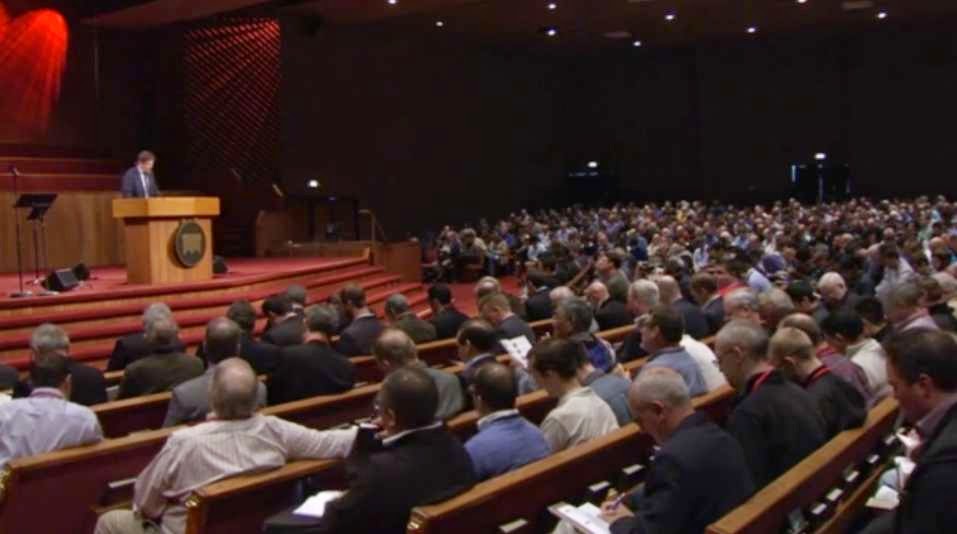
This photo is from Day 2, Alistair Begg is preaching. The photo represents only a fraction of the men who are attending. Many more are in this audience, and many others are in different rooms with video feed, due to the size of the crowd. Who knows what denial of service attacks satan perpetrated on each pastor as he made his way from all corners of the US and abroad, but they made it and now our senior pastors of the faith are ministering to these precious men. I praise the Lord for the body of Christ and for the shepherds He has raised up.

SUMMARY RECAP: Day one (March 3rd) saw the live stream hacked and the it was down most of the day. It’s is back up now but thousands of people were denied the opportunity to view two of the best presentations, by Dr. MacArthur and Dr. Sproul, I have ever seen.

Here are links to both video presentations:

Dr MacArthur

Dr. Sproul

There is also a site that has time stamped summaries of all presentations which is most useful. It includes most of the referenced verses of Scripture with links as well.

Summit Notes

If you are interested in reading the “Chicago Statement on Biblical Inerrancy” it is here.

Posted in marshmallow test, rewards

The Marshmallow Test: an illustration of temptation and the hope in future rewards

Do you wrestle with temptation? Is delayed gratification a struggle? Of course you do. I do. We all do. Here is a video that may be worth 3 minutes of your time.

Pray then like this: “Our Father in heaven, hallowed be your name. Your kingdom come, your will be done, on earth as it is in heaven. Give us this day our daily bread, and forgive us our debts, as we also have forgiven our debtors. And lead us not into temptation, but deliver us from evil. (Matthew 6:9-13)

Posted in bible, encouragement, judgment, prophecy, tribulation

End time encouragement from a long-past prophet: Habakkuk

My friend, Pastor Phil Andrukaitis of the First Baptist Church of South Portland Maine, preached on Habakkuk 3 recently. I am on the email list for the sermon notes, and I was struck by how encouraging the notes were. Because:

  • it is always good to be energized by the profound truths of God’s word
  • it is always wonderful to remember that prophecy points to the sovereignty of God
  • it is comforting to see there are faithful pastors laboring in all parts of this country and the world, serving and ministering to our Lord

I asked Pastor Phil to reprint the notes. They include a thoughtful and discerning introduction. Please be encouraged with either or both, the introduction or the sermon notes themselves. I added the photos and artwork. They are not original to the sermon.

Please continue to pray for pastors all over the world who preach the Gospel faithfully and discerningly. There are 4,500 pastors meeting in Sun Valley CA right now at the annual Grace Community Church/Masters College Shepherds’ Conference. There are thousands of other pastors right now working out sermon notes, praying in tears for their sheep, visiting the sick, building a new church, or doing any of the myriad and seemingly impossible things God calls His under-shepherds to do.

Pastor Phil Andrukaitis

It is only by the Holy Spirit that these men are able to lift themselves up each day under the workload, to have the word of God illuminated to them, to have kindness and comfort to offer the grieving or sin-stricken, to have strength to have the difficult conservations and uncomfortable confrontations.

And when I came to you, brethren, I did not come with superiority of speech or of wisdom, proclaiming to you the testimony of God. For I determined to know nothing among you except Jesus Christ, and Him crucified. (1 Corinthians 2:1-2)

Good pastors are a gift from God.

And I will give you pastors according to mine heart, which shall feed you with knowledge and understanding. (Jeremiah 3:15)

The introduction and sermon are long. Print it out, mull it over, return to it when you have time. These are God’s words, delivered through a pastor’s heart, and offered in love and truth to comfort you.

SERMON INTRODUCTION

Phil Andrukaitis
Good afternoon my family and friends,

As a pastor, I have a divine responsibility to shepherd my flock [and to encourage other Christians] by strengthening their faith with the Bible and by preparing them for future trials and tribulations, which lie ahead for all of us. Knowing my own weaknesses and failings, I still press on to model my faith with my life, as this is part of the process of making disciples.

Question: My family and friends, are we ready to experience the difficult times that are coming to our country? As I read the Book of Habakkuk, this prophet of God was told what was in store for his nation. This news was so disturbing for Habakkuk, it caused him to tremble. I believe God is allowing discerning Christians, along with many American citizens, to see ominous signs for our nation. And some folks are trembling.

The concept of the Rapture is embraced as an escape plan among many Christians. While I believe Scripture promises the church to escape the “Great Tribulation,” the church may very well experience smaller tribulations [e.g., the collapse of our economic system, martial law, restricted freedoms, fear in the streets, etc.] before the actual rapture of the church.

My brothers and sisters, I urge you in the name of the Lord not to dismiss current events or to become discouraged by them. Rather, we are to embrace God and His Word, as did Habakkuk. Therefore, let each Christian embrace his God-given assignment and enable the church to fulfill the Great Commission, making disciples of Jesus Christ.

I pray that Habakkuk’s message will strengthen your faith and prepare you to stand firm on the Rock of our salvation, Jesus Christ.

Your servant in Christ,
Pastor Phil

SERMON TRANSCRIPT

This morning, I begin this sermon not with a story to illustrate the passage; rather, with the text itself. It is one of the most magnificent pieces of Hebrew poetry [comparable to Psalm 23]; the closing verses in the Book of Habakkuk (3:17-19 – NASB):

Though the fig tree should not blossom and there be no fruit on the vines; though the yield of the olive should fail and the fields produce no food; though the flock should be cut off from the fold and there be no cattle in the stalls; yet, I will exult in the LORD, I will rejoice in the God of my salvation. The Lord GOD is my strength, and He has made my feet like hinds’ feet, and makes me walk on my high places.

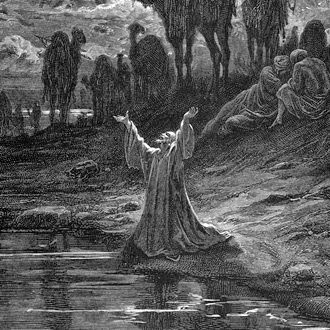
Gustav Dore: Habakkuk crying out in prayer

Did you hear Habakkuk’s words with your soul? But wait: Unless we understand these words in the context of the chapter, in the context of the book, and in the context of its setting, Habakkuk’s words of praise would be wrongly interpreted and misapplied to our lives. Therefore, let us begin with the fact that Habakkuk is a devout servant of God who…

  • grieved over his nation’s wickedness,
  • wrestled with theological perplexities,
  • and shook with fear when God told him what was coming to the nation.

God was bringing judgment to His people. Yet, Habakkuk declared his faith and expressed praise to the Lord GOD, in spite of the news he learned (Habakkuk 3). How is that possible?

So as not to get ahead of myself, permit me to ask you two questions: First, what was the most gut-wrenching, painful experience you have ever had? Second, how long did it last and what were the consequences? Perhaps some of you have experienced one or more of the following:

• The death of a parent, spouse, child, or friend
• An act of violence committed against you [rape, beaten, robbed, etc.]
• News that your health is failing – you have only three months to live
• The rejection of your spouse [divorce]; the betrayal of a friend; the discipline of a church
• The consequences of a sinful decision that brought overwhelming guilt and shame

Okay, now that you are in the moment for just a moment, what were your thoughts towards God when you were in that time of trouble? Were you praying? Were you crying? Were you afraid? Were you angry? Did you doubt God’s love? Were you filled with despair? How did you get through this painful experience?

Transitional Sentences

Having jolted your memory, you are now ready to connect with the prophet’s words and emotions; but just for a little bit. I do not want to offend anyone by minimizing your gut-wrenching painful experience, but when God told Habakkuk what was coming to the nation, within the prophet’s lifetime, Habakkuk wrote,

I heard and my inward parts trembled, at the sound, my lips quivered. Decay enters my bones, and in my place I tremble. Because I must wait quietly for the day of distress, for the people to arise who will invade us (Habakkuk 3:16 – NASB).

Yet, immediately following these words,

• Habakkuk did not stare at the horrific news he just received.
• Habakkuk did not become paralyzed in his walk with God.
• Habakkuk did not run away from God; rather,
• Habakkuk grounded himself in what he knew to be true about God and praised the Lord.

Historical Setting

Okay, before we proceed further, you might be asking, who is Habakkuk? There is nothing known about the prophet’s personal life. While students of Scripture have speculated that Habakkuk was of a priestly family, the Scripture is silent on this issue.

Habakkuk’s name means, “to embrace.” Based on the prophet’s words, it appears that Habakkuk embraced God [God’s glory, will, purity, heart, people, and suffering]. While all the other prophets spoke for God to the people, Habakkuk speaks openly to God about people.

Habakkuk wrote this book approximately 2 years before the first of three deportations to Babylon [B.C. 605, 597, 586]; 20 years before king Nebuchadnezzar eventually destroyed Jerusalem with a great slaughter. Habakkuk was a contemporary of Jeremiah. Moreover, there is a sense in the text that Habakkuk is also living in Jerusalem.

• We know that Jeremiah lived through the two-year siege of Jerusalem. Jeremiah describes God’s wrath against Jerusalem (Lamentations 2), whereby the Babylonian military forces first starved the people into submission and then broke through Jerusalem’s wall, slaughtering, plundering, and destroying the people and the city.

• However, as for Habakkuk, we do not know if he perished in the two-year siege or died by the sword when the Babylonian forces ransacked the city. However, when the prophet heard the news from God, what was to come, it is no wonder the prophet shook with fear.

I heard and my inward parts trembled, at the sound, my lips quivered. Decay enters my bones, and in my place I tremble. Because I must wait quietly for the day of distress, for the people to arise who will invade us (Habakkuk 3:16 – NASB).

In order to understand more fully Habakkuk’s prayer of praise in Chapter 3, let us review quickly a summary of the Chapters 1 and 2.

Summary Points in Chapter 1

Habakkuk’s 1st Complaint (1:2-4)

• God, why do You seem so indifferent to my prayers?
• God, why did You allow Israel to go so far with their sins?
• God, why do You not bring justice to the land?

Evidently, the time for divine judgment was now. From the Book of 2nd Chronicles, the godly reforms King Josiah instituted were reversed by his wicked sons, especially by king Jehoiakim. Consequently, Israel was rife with the following sins:

The people were idolatrous, especially as they sacrificed children upon the altars of demons, for financial and agricultural prosperity.

  • Corruption in the highest political and religious offices were the norm [Observation: perhaps that is why the nobility were first to be carried off in the first of three deportations to Babylon].
  • Jerusalem’s officials abused their authority and power, bringing injustice to the widows and the poor.
  • Bloodshed and crime were rampant throughout the land.
  • The Word of God was rejected; so were the prophets, as they were persecuted.
  • Consequently, the people of the land refused to repent of their sins.

God’s Reply to Habakkuk’s 1st Complaint (1:5-11)

God said, I am bringing the Chaldeans [Babylonians] to judge My people [Israel].

Habakkuk’s 2nd Complaint (1:12-2:1)

• But God, the sinfulness of the Chaldeans is worse than the sinfulness of the Jews!
• God, how can You endorse evil people to do Your divine work?
• God, You are too holy to look upon sin.
• God, the cruelty of the Chaldeans is known worldwide! They will destroy us!

To feel the horror that filled Habakkuk’s soul, imagine ISIS forces overwhelming this nation, as they are overwhelming the nations of Iraq and Syria.

Summary Points in Chapter 2

God’s Reply to Habakkuk’s 2nd Complaint (2:2-20)

• God declares: The just shall live by faith [present the gospel]
• God declares: I will judge the Chaldeans for their sins [5 woes]

–greed and aggression (5-8)
–exploitation and extortion (9-11)
–violence (12-14)
–immorality (15-17)
–idolatry (18-20)

Summary Points in Chapter 3

Even though Habakkuk did not understand everything about God and the course of action He was taking against Israel, the prophet offers a powerful prayer of praise.

First, Habakkuk makes a request of God (2).

–Revive Your work.
–Make Your work known.
–Be merciful when You express Your wrath.

Observations about Habakkuk’s request

1. Habakkuk knows what is coming and expressed his fear, along with his faith in God.

2. Understanding that God is holy, Habakkuk knew that God must judge sin. Habakkuk does not ask for personal deliverance, ease of suffering, defeat over the Chaldeans, or for Israel’s deliverance.

3. Rather, Habakkuk asked for God’s will to be done. Hmmm, this is reminiscent of the Lord’s Prayer. Consider the following questions: Are we more concerned about…

…our personal welfare or God’s will in our lives?
…which political party will win next year’s election or purity of the church?
…becoming more like Christ or securing material possessions?
…our comforts in this life or the kingdom of God?

Do you seek the shadow of the Jesus’ cross looming over this passage? Habakkuk asks, “in wrath remember mercy.” Habakkuk knew that God could no longer tolerate Israel’s sin. God’s righteous character demands that He judge sin.

God is still the same God today. He does not change. He cannot look upon our sin without judging us. That is why God sacrificed His Son on the cross for our sins. When Jesus hung on the cross, He alone bore the wrath of God so that you and me could escape God’s wrath. Indeed, God did remember His mercy while pouring out His wrath on His Son. We do not deserve to be saved. God held back the judgment we deserve [mercy] and gave to every sinner who has believes, eternal life [grace].

Listen, my friends, there is no sin in your life beyond the cross. Even though no one else knows about your sin, God knows. Come to Him in faith, believing that the blood of Jesus cleanses you from all your unrighteousness.

And to my brothers and sisters in Christ, God continues to bestow mercy and grace on our lives. Forsake the sin that so easily cripples your walk with God by calling out to Him to revive your heart for Him.

Second, Habakkuk remembers the deeds of God (3:3-15).

God displayed His majesty to the world.
God displayed His power over the nations [the Exodus and the plagues].
God displayed His presence among His people [Mount Sinai].
God displayed His glory, causing the nations to fear Him [Joshua 10].

What was God’s purpose in all of His deeds? The answer is clear: To demonstrate to His salvation for a people He loved.

Applications from Habakkuk’s remembrance

1. Read Scripture and understand how God has demonstrated His faithfulness in the past. A good place to begin would be at the cross. Think through how God took steps to bring Jesus into this sin-cursed world. In your mind, imagine yourself among the fickle crowds that called for the death of Jesus. See with your mind’s eye how Jesus carried His cross for you; the soldiers who nailed Him to the cross. Listen to His last words from the cross. These actions on our part have a way of strengthening our faith and making more intimate our personal relationship with Jesus.

2. Think back how God has delivered you in the distant and recent past. Be sure to tell others about His faithfulness.

3. Parents and grandparents, how are we demonstrating our faith and what values are we setting before our children? It is true that many young people are leaving the church. Might the problem lie in our homes and the manner in which we live out our faith?

Third, Habakkuk confesses his fear because he knows what lies ahead of him (16).

Habakkuk knew what was coming. If the Spirit of God told us of our future, I do not think we would be able to handle it, as God permits a measure of intense suffering for many of us. Read Peter’s first letter as suffering is a major theme he addresses (1st Peter 2:20-25; 3:13-17; 4:12-19).

Is it any wonder then, that we often times design our lives to avoid future suffering? God’s Word says, “Many are the plans in the heart of man, but the answer comes from the Lord.” God desires that we learn to walk by faith and not by sight or to solely lean on our own understanding (Proverbs 3:5-6). Therefore, as Habakkuk’s heart melted in fear, his faith did not paralyze his walk with God.

Applications from Habakkuk’s confession

I do not read tea-leaves. I do not listen to Glenn Beck. I am not a pessimist. However, you do not have to be a rocket scientist to see that difficult days lie ahead for this nation.

God has not spoken to me, as He did to the prophet Habakkuk; however, His Word speaks to all of us. And our country, like ancient Israel, is rife with the same sins. God is going to judge America for her many sins. The question is, when will this judgment fall?

As your pastor, I have a divine responsibility to strengthen your faith with the Word of God and by modeling my life before you; making disciples of Christ.

My brothers and sisters, are our souls ready to experience what is coming to our country? God told Habakkuk what was coming and the news caused him to tremble. God is allowing us to see the signs in our country and across the world and I sense that people are beginning to tremble.

I believe many of us think that the Rapture is the church’s escape plan. Yes, I believe Scripture promises the church to escape the Great Tribulation; however, there will be many smaller tribulations, [like the collapse of our economic system, martial law, restricted freedoms, fear in the streets, etc.] that impact the church.

My brothers and sisters, I urge you in the name of the Lord not to dismiss current events or to become discouraged. Rather, we are to embrace God, as did Habakkuk, seek to fulfill our mission as a church, bringing Jesus into the lives of others.

With that being said, let us look at the final portion of Habakkuk’s prayer of praise.

Fourth, Habakkuk praises God because… (17-20)

–God’s sovereignty never changes (17).
–God’s salvation is sure (18).
–God’s strength will help us walk with Him (19)

Though the fig tree should not blossom and there be no fruit on the vines;
though the yield of the olive should fail and the fields produce no food;
though the flock should be cut off from the fold and there be no cattle in the stalls;
yet, I will exult in the LORD, I will rejoice in the God of my salvation.
The Lord GOD is my strength, and He has made my feet like hinds’ feet,
and makes me walk on my high places.

Applications from Habakkuk’s praise

When the Chaldeans ransack the nations, they wiped out the permanent crops [figs, grapes, olives], the basic food and the flocks. In other words, God oversaw the destruction of Israel’s economy. What did that mean for the people of Israel? There was no food in the land. The absence of social services, like those of today, guaranteed that the young, the old, and the sick would most likely die of starvation.

What do we say today, when any of us lose our job and become unemployed; when the insurance runs out; when social security check is denied? Even worse, what might be our reaction should Wall Street collapse, wiping out all of our savings?

A word to the wise and prudent: Our country is on the verge of economic collapse. Even now, America is financially bankrupt, not to mention morally and spiritually bankrupt. Even though many people may lose everything, God remains in control. After all, He is responsible for removing those things in our lives.

Conclusion

This is Communion Sunday. Someone has said that God tries our faith so that we may try God. When God gives His people unwanted burdens, God also provides His undeserved blessings. Therefore, thankfulness comes from what is in our hearts, not what is in our hands.

Even though I have lost everything [consider Job], I will rejoice in the Lord for He has guided my steps into this experience. May each of us cultivate a heart like that of Habakkuk, of Job, and of Jesus. Amen.

—————————————————————-

First Baptist Church 879 Sawyer Street ~ South Portland, Maine 04106
Office: (207) 799-4565 Fax: (207) 799-5922
Website: http://www.spfbc.com Email: southportland.fbc@gmail.com
Posted in earthquake, end time, God, last days, sovereign

Unusual quakes in CT, TX, Smoky Mountains

We haven’t had a good old earthquake update for a while. I think that nothing expresses His sovereignty over the earth as much as when He shakes it.

who shakes the earth out of its place, and its pillars tremble; (Job 9:6).

People will flee to caves in the rocks and to holes in the ground from the fearful presence of the LORD and the splendor of his majesty, when he rises to shake the earth
. (Isaiah 2:19)

There was a small quake in the Smoky Mountains. What is notable is that it is only the third earthquake in that region, ever.

Earthquake strikes the Smoky Mountains

Early in the morning on Wednesday, February 26, 2015, a minor earthquake shook up the Smoky Mountains. For a little over a week, the Smoky Mountains have been covered in snow and ice, but that didn’t stop the earthquake that rumbled in the mountains sometime between 4-4:15 a.m. on Wednesday morning. The earthquake registered at a 2.1 magnitude about 7 miles south of Gatlinburg, closer to Clingmans Dome. According to local news station WATE, this is only the third earthquake that has been recorded within national park boundaries. The first was in 1979 and the second in 2011. Thankfully, no earthquake in the Smoky Mountains has been powerful enough to cause any damage.

Another location has been experiencing quakes: Connecticut

Connecticut’s quakes unusual

Geologists are trying to make sense of about a dozen small to moderate earthquakes that have peppered eastern Connecticut in and around Plainfield, a sleepy town that hasn’t seen much excitement since its textile industry moved out in the 1920s. The largest of these was a magnitude 3.3 quake that was felt at 6:36 a.m. on Jan. 12. “We’re getting a swarm of earthquakes, which is a little unusual for Connecticut,” said Susan Long, professor of geology at Yale University who specializes in earthquakes.

2.2 Magnitude Quake Is the 12th in a Week

The ground shook again in Eastern Connecticut on Thursday morning as the area experienced its 12th earthquake in a week. On Friday local and state officials will be holding meetings to inform residents and discuss how prepared the state is should a damaging earthquake strike here.

Plainfield gets another quake

PLAINFIELD- Earthquakes, no matter how minor, can rattle one’s nerves, not to mention pictures and plates. Still, the people of Plainfield appear to be settling into their new existence. The Quiet Corner has morphed into the Quake Corner. Tuesday morning, at approximately 9:30, the Plainfield Police Department fielded roughly a dozen phone calls, most from Green Hollow Road, reporting yet another earthquake. This one was a 2.1 magnitude. “And, that’s nothing like the hundreds (of calls) that we were dealing with earlier when this was all occurring,” said Plainfield Police Capt. Mario Arriaga. … Dr. Long says seismologists worldwide remain interested in the state’s recent rumbles.

Jeepers! New Look at ‘Creeping’ San Andreas Fault

A small part of the San Andreas Fault that was thought to quietly slide without shaking its neighbors may actually be capable of strong earthquakes, including magnitude-6 shakers, a new study finds. The San Andreas Fault is divided into three legs. The middle leg has long been treated as a benign barrier between the more seismically active northern and southern segments. That’s because the central section “creeps” — rocks on either side of the fault slip past each other without snagging. On the other two legs, rocks lock together, building up strain that is unleashed as powerful earthquakes. … Scientists had thought that San Andreas Fault earthquakes primarily struck in the locked zones, so it was a surprise finding locked patches big enough to trigger sizable earthquakes in the creeping zones, said lead study author Romain Jolivet, a geophysicist at the University of Cambridge in the United Kingdom, who conducted the research as a postdoctoral scholar at Caltech in Pasadena, California. … Scientists have recently raised the possibility that an earthquake could rupture the entire length of the San Andreas. The biggest recorded earthquakes on the fault either started or stopped in the transition zones.

Earthquakes in Texas…Again

In the relative calm of an early morning where North Texas was bracing for a rare snow storm, the Dallas suburb of Irving got a wake-up call, literally, on Friday, February 27, when a small 3.1 magnitude earthquake struck at 6:18 AM, according to the US Geological Survey (USGS). This was the first temblor felt in a month. The City of Irving has been the site of “roughly two dozen quakes to hit since the beginning of 2015, and more than 40 earthquakes have hit since April of last year,” CBS DFW reported. They stated that the USGS located the epicenter as just east of the former site of the Texas Stadium off of State Highway 193. … Although the team has not yet been able to provide an answer as to what has been causing all the seismic activity, it does indicate “there is a narrow two-mile fault extending from Irving into Dallas, running 3 to 5 miles deep,” also according to CBS DFW. … Dallas residents are not used to having earthquakes and their nerves have been frayed by the constant seismic activity of late.

You have made the land to quake; you have torn it open; repair its breaches, for it totters. (Psalm 60:2)